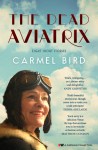
Lynette Washington, Plane Tree Drive (#BookReview)

Lynette Washington, Plane Tree DriveLynette Washington’s debut collection of short stories, Plane Tree Drive, reminded me a little of Rebekah Clarkson’s Barking dogs (my review). Both are collections of stories revolving around a location, and in both the location is in the Adelaide region. There are differences though. Clarkson’s book is a little grittier with an overall theme of community undergoing social change, while Washington’s book is the portrait of a suburban street. There is change, of course, but the change is more broadly human – breakups, ageing and retirement, generation gaps, friendship and dementia, illness and death – although contemporary issues are also touched on.

Like Clarkson’s book too, Washington’s has some continuing storylines – such as Jennifer who is unhappily married to Dan while pining for her first love, Alexander – that are interspersed with the stories of other people. I liked this. Not only do these ongoing storylines provide a lovely sense of cohesion for the whole, but they also reflect a typical neighbourhood street. By this I mean that in any of our neighbourhoods there are people we know well, those we know a little, and others whom we only know passingly. And so, in Plane Tree Drive, there’s Jennifer who appears regularly; there are others like Maurice, Alice, Amily and Faraj who appear more than once, sometimes as a reference in another person’s story; and there are those who only appear in their own story.

To make all this work, Washington pays careful attention to structure. The overall order is chronological, driven primarily by Jennifer’s story, but the collection starts and ends with the other main continuing story, that of musician Maurice. His final section cleverly but light-handedly brings several of the characters together, but I won’t tell you how! The book is divided into sections – I think that’s the best way to describe it – which are named for the characters they cover, but some sections comprise small chapters. For example, a section titled Faraj, Coralie and Ruby, which focuses on Afghani asylum-seeker Faraj, has two short chapters, “Housing Needs Assessment” and “The Bay”. And this brings me to form …

Many of the stories are short, in fact very short, and most are told first person, but there’s some interesting variety, some experimenting with form, too. There’s a dialogue between Maurice and his wife Jacqui (“He said/She said”), some diary entries by the teenaged Poppy (“Dear diary”), several government employee reports on Faraj’s application for housing (“Housing Needs Assessment”), some social media commentary (in the cheeky “Scarlett’s shed”), and even a flow-chart from IT expert Sarah (“Oma’s fruit cake”). This playing with form – which brings with it changes in tone – break up what could, in other hands, become a tedious and melancholic parade of first person voices.

Oh dear, I’ve spent a lot of time describing the book and how it works but not much on whether I enjoyed it – so I’ll do that now. Of course I enjoyed it! How could any reader who is interested in the lives of people not enjoy a book which pokes into the nooks and crannies of all our lives? There are stories with a political bent, albeit told from personal not political perspectives. These include the aforementioned Faraj and his search for a home, a couple (Stella and Graham) who travel overseas to access euthanasia legally, and a woman (Coralie) watching the demolition of a loved theatre. I like that Washington doesn’t proselytise, but simply shows how people are affected by and react to these situations. There are lighter stories, such as Marg who talks to animals, particularly her neighbour’s badly behaved cat (“That cat”).

And there are, dare I use that cliché, “poignant” stories, such as, to give an example, Martha and Charles (“Gaps between boxes” and “So much sand and so much water”). They are a retired couple who have been together since childhood but who, at this point in their lives, suddenly find themselves at odds. She wants to adventure – to “seek out the gaps between the boxes” they’ve been ticking all their lives – but he just wants peace. He thinks “the boxes made a darn good life”. This story is gently and warmly told. No fireworks, just hope and acceptance on both sides.

There’s exploration in the writing – in form in particular – as I’ve already said, but the stories are accessible. This is the sort of short story collection that should have wide appeal. The use of recurring characters makes it appealing to those who prefer novels, while the playing with the short story form and structure provides interest for the short story lover.

Washington, who has appeared here before as editor of Breaking beauty (my review), precedes her book with an epigraph from F. Scott Fitzgerald’s The great Gatsby. The quote concludes with “I was within and without, simultaneously enchanted and repelled by the inexhaustible variety of life.” I wouldn’t say I was repelled, albeit some characters are more appealing than others, but Plane Tree Drive does contain a wide variety of life which makes it an engaging and yes, enchanting even, read. Like many books from smaller publishers, it deserves a wider audience than it will probably get.

AWW Badge 2018Lynette Washington
Plane Tree Drive
Rundle Mall, MidnightSun Publishing, 2017
245pp.
ISBN: 9781925227345

(Review copy courtesy MidnightSun Publishing)

Amy Witting, Afterplay (#Review)

Amy Witting’s first novel wasn’t published until 1977, when she was 59 years old, which is why she appeared in my late bloomers post a few years ago. She went on to publish five more novels after that – two of which I read and enjoyed long before blogging – and she was an accomplished short story writer and poet.

An interesting piece of Witting trivia is that in the 1960s she taught at the same high school in Sydney as Thea Astley, who was a few years younger. Astley encouraged her to submit a short story to the New Yorker, which duly published it. Wikipedia tells us that Australian poet Kenneth Slessor once said “tell that women I’ll publish any word she writes”. And critic Peter Craven argues that her form of realism wasn’t really accepted by the reading public until Helen Garner appeared on the scene.

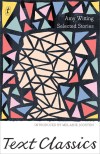
Amy Witting, Selected stories

“Afterplay” is not in this collection!

All this is to say that although Witting has never had the level of recognition enjoyed by writers like Astley, Jolley and Garner, she was well-regarded in literary circles, and is being brought to our notice again through Text Classics. This year they added three of her books – The visit (her first), A change in the lighting (which my reading group did back in the 1990s), and Selected stories – to their list. Discussing the publication of her stories, they said they could not include them all as they wanted to keep the book to a manageable size. However, as a little tempter, they decided to publish one of her stories, “Afterplay”, online, describing it as “a bite-sized taste of Witting’s short-form genius”. This has given me a wonderful opportunity to include her on my blog – and with a story you can read too. Win-win, as they say!

“Afterplay” provides an excellent introduction to Witting’s writing for a number of reasons. It’s a good example of the realism which Peter Craven sees as her métier; it exemplifies her spare, direct style; and its subject matter reflects her main writing interest, relationship-focused stories in domestic settings. It is also, at less than 1,500 words, a short short-story, and, according to Text, demonstrates “Witting’s masterly economy”.

“Afterplay” focuses on “two young women”, Judith and Geraldine, and their response to Geraldine’s break-up with Ken ten days previously. The problem is that her way of breaking up was to walk out leaving a note on the kitchen table, and he, not expecting this to happen, wants to talk to her. Judith thinks Geraldine should, but Geraldine is resisting all his attempts to contact her, telling Judith that she “can’t stand confrontation. Never could.”

The thing about this story, which is told third person, is the way Witting subtly shifts perspective between the two women, and only gives us Ken’s perspective through Judith reporting a phone conversation as it takes place. There is also a little back story about Geraldine’s previous relationship which seems to have ended with, or just before, the man’s death (by suicide is the implication). The effect of all this is to keep the reader a little uncertain, a little off-balance. We are not given the full picture from any of the perspectives, so our antennae keep pointing in different directions as we try to work out where our sympathies should lie. In the end, I think, my sympathy went mostly to the poor friend caught in the middle!

There’s some cheeky humour here – including little innuendoes about sex as a sport. Ken was “proficient at all sports, never missed a goal”, and of course the title “afterplay” brings to mind “foreplay” (which was not, apparently, Ken’s forte, albeit he’s “a sweet-tempered man”.) However, there is one awkward part where Geraldine tells Judith some things about the break-up that she surely already knows. You could argue, perhaps, that at times like these people do tell and retell their experiences, but it did feel a little clumsy.

Regardless, “Afterplay” is a beautifully crafted little (in size, not in value) story. But, don’t take my word for it. At only 1500 words and available on-line, how about you read it too – and let me know what you think.

aww2017 badgeAmy Witting
“Afterplay”
First published (I think): Quadrant 39 (5), May 1995
Available online at Text Publishing.

Stephanie Buckle, Habits of silence (#BookReview)

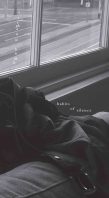
Stephanie Buckle, Habits of silenceI have been champing at the bit to read local author Stephanie Buckle’s debut short story collection, Habits of silence, ever since I attended its launch in August by John Clanchy at the Canberra Writers Festival. The readings that both Clanchy and Buckle herself gave from the book grabbed my attention and convinced me that this would be a book I’d like. However, it had to wait its turn in my review copy pile. Finally its number came up – and I devoured it. I will never understand why some readers don’t like short stories. At least, I understand their reasons in my head, but I don’t in my readerly heart! (If that makes sense.)

John Clanchy, in launching this beautifully designed book, spoke about its title which is not, as commonly occurs, the title of one of the stories inside. When this happens, it’s logical to consider what the title means, and for Clanchy it reflects the book’s interest in communication, and particularly in the part played by silence. Silence, he said, can be positive or negative, and both of these are explored in Buckle’s stories. This is not to say that all the stories are specifically about, or even feature silence in a major way. But even in those that don’t, there’s usually some missed communication or miscommunication that might just as well be silence.

And now I come to that part that’s always a challenge with reviewing short story collections, which is whether to quickly survey all the stories or focus on a couple or try to do a bit of both. I usually opt for the last of these, and will probably do so again here. One day I’ll come up with an exciting new way to discuss short story collections, but I haven’t found it yet!

So, the survey part. There are fourteen stories, some of which have been published before, with a couple having won awards. There are both first-person and third-person stories – providing lovely variety – and the protagonists range in age, situation, and gender. It feels like a collection that could only be written by someone with a good few decades of life experience under her belt (but perhaps that’s denying what imagination can do). I’m certainly not saying that Buckle has experienced all she writes about, but the stories do feel imbued with a deep sense of knowingness.

One of the stories that is specifically about silence is titled, well, “the silence”. It’s about two brothers, Jim and his older brother George Clayton (love this cheeky last name), who live in a country town and have run the family furniture business for years, without speaking to each other. Each works alternate days and George communicates with Jim by letter, because, it seems

Silence is safe. Silence commits to nothing. Far easier to be silent than to speak.

Except, this silence is burning Jim up – that, and his brother’s complete inflexibility about changing anything in their increasingly anachronistic shop to bring it up to date. I liked this story, the beautiful realisation of the characters, and its tentative but by no means certain resolution.

Another story in which silence is central is “fifty years”. This is one of the stories read from at the launch, and it tantalised me. It concerns a woman who has been rendered mute by a stroke. She’s in hospital, attended by her husband of fifty years and her daughter, from whose point of view the story is told. Here’s part of the excerpt read at the launch. It comes after the husband has been prattling on with platitudes:

And that’s when I see it, the first time. It’s the expression you make when you think no one’s looking. The one you make to yourself, with your back turned. It’s the one that makes all the others look like masks, as if all the cups of tea, and all the ironed shirts, are just pretending. She turns from me and regards him quite steadily, but as if she sees him down the wrong end of a telescope, or as if he’s a fly buzzing still against the window, that she briefly thinks she might stir herself to deal with, but can’t be bothered. Are you still here? it says.

If that doesn’t make you want to read this book, then I’d say you’re a lost cause! Buckle’s insights into human relationships make you sit up and pay attention – and her honed spare writing is well-suited to her theme.

The second story in the collection, “sex and money”, is also about a lonely wife who feels unappreciated. Like the husband in “fifty years”, Frank appears to know little about the wife he lives with, and is more likely to help a neighbour than do something she’s asked. And yet, in his head, he loves – at least he desires – his wife. Rose meanwhile finds her own way of obtaining pleasure. It’s all to do with money, but not what you might be thinking. Buckle’s playing with ideas of lust, desire and money here is cheeky – and telling.

But not all marriages, not all relationships in the book, are poor. The woman in “the man on the path” has been grieving her beloved husband’s death for four years. She has come to the Lakes, a favourite holiday place of theirs, for a break, but feels out of place amongst all the happy holidaying couples. Then, out walking, she meets a man on the path, but a “failure of courage”, an inability to communicate appropriately, sees an opportunity to make a connection pass. She perseveres with her walking, however, and, well, you never know, there could be a second chance …

There’s nothing like mental illness to focus us on essential truths about humanity. Lillian, in the opening story “lillian and meredith”, is developing dementia – her “words scatter in all directions” – but, like many of the book’s characters, she’s lonely so when new patient Meredith appears she sees her opportunity. Meredith is welcoming, but when money goes missing, it all falls apart and poor Lillian is handled with less than kindness by the staff. This is just one of several stories which feature mental illness, with three of them – “us and them”, “frederick”, and “no change” – set in the same place, Cedar Grove Psychiatric Facility. There is no cross-over in characters, but there’s something nicely grounding in returning to a familiar place, even if when we get there we are confronted by questions about duty of care and our frequent failure, for whatever reasons, systemic or personal, to provide it.

Buckle’s stories, then, explore all sorts of relationships – between couples, siblings, parents and children, friends, teachers and students, and even staff and patients – showing that none are immune from communication challenges, from silences that hide true feelings to words which do the same, from convictions that relationships are true to realisations that they aren’t, from attempts to connect to refusals to do so. Although some stories impacted me more than others, I was engaged by them all, reminding me once again why I love short stories. It’s their little nuggety insights into human nature – and Buckle’s Habits of silence provides just that.

aww2017 badgeStephanie Buckle
Habits of silence
Braidwood: Finlay Lloyd, 2017
202pp.
ISBN: 9780994516534

(Review copy courtesy Finlay Lloyd)


Stephen Orr, Datsunland (#BookReview)

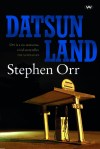
Stephen Orr, DatsunlandTwo things I loved about Stephen Orr’s novel The hands (my review) were its evocation of men, boys and their relationships, and its rural setting. And this is also why I liked Datsunland, his recent short story collection comprising thirteen short stories and a novellaIt’s a no-holds-barred exploration of the lives of boys and men. It is not a pretty book, but it feels real, even where it pushes extremes.

Lisa (ANZLitLovers) interviewed Orr in one of her early Meet an Australian Author Series of posts. Answering her question about who inspired him to write, he said

I became convinced the human psyche was the only thing really worth worrying about, so I’ve been working at it ever since.

This is true of these stories in which men confront their dreams and hopes, their strivings to achieve these, and their frequent failures. Take, for example, the first story, “Dr Singh’s despair”, which is about an Indian doctor from the Punjab who obtains a visa to work in rural Australia. We are desperate for doctors in rural/outback areas and he seeks a better life for his family. Unfortunately, his welcome – to Coober Pedy, which would be a challenge for anyone – is less than ideal. Indeed, we could call it non-existent. Not surprisingly, Dr Singh does not last and returns home, “disappointed … [but] at least happy”. This is the first story in the collection … worth considering, that ordering of the stories!

The stories in this collection are loosely linked. Most are set in rural or suburban South Australia; all focus on men (though women do appear); and many reference, sometimes so briefly you could miss it, a particular school, the Christian Brothers’ Lindisfarne College. The characters never cross into each other’s stories, however. It’s more that the school represents a certain conservative or inward-looking value or attitude – which makes this a good time to introduce the second story, though I promise to not describe every story in the collection! Titled “The shot-put”, it is set on a farm in 1919, just after World War 1, and concerns a couple whose son, a school shot-put champion, is being publicly listed on a Cowards’ List and has therefore been removed from his school’s – the aforementioned college – Honour Board. It’s another story of hopes (and in this case promise) unfulfilled – and more, of lack of compassion.

Lack of compassion is, in fact, one of the underlying themes of the collection. Had Dr Singh in the first story, for example, been shown some compassion, he may have stayed. In the fourth story, “A descriptive list of the birds native to Shearwater, Australia” a new wife begins to realise that what she’d hoped might be compassion in her husband was something entirely different, and in the fifth story there’s something creepy in Brother Vellacott’s caring for Miss Mary. It all, though, comes to a head halfway through the collection, in “Akdal Ghost”, the seventh story. It’s about a preacher, Pastor Fletcher, who should be compassionate, right? He hires a commercial video producer to make a video showing people what will happen if they don’t “find God”. It features the Akdal Ghost, which I had to look up in Wikipedia, and is absolutely shocking, though, as in several of the stories, Orr does not play it fully out. Much more effective to leave it to the reader’s imagination!

Religon is another motif that runs through the collection, and is behind some of the most violent stories. Besides “Akdal Ghost”, there’s “Confirmation” in which a massacre in 1976 Ireland is set against the hopefulness of a son’s confirmation, and “The Syphilis Museum” about a man preparing for the end of the world. One gets the impression that Orr is not a fan of religion.

And, so the stories continue. Some are more poignant, such as “The Barmera Drive-in” about a 45-year-old man who buys an old, long defunct, drive-in, thinking (hoping) he can reclaim his childhood and in so doing make the (or his) world a better place, and “The Shack” about an aging father who needs to decide what to do about his “retarded” son.

Most of the stories focus on adults, but a few feature children, including the 9-year-old boy lost in the hull of ship under construction (“The One-eyed Merchant”) and the 6-year-old boy trapped with a neglectful mother and an abusive step-father (“The Adult World Opera”). The final, titular story, “Datsunland’, which appeared in last year’s Griffith Review IV novella edition, also features a child, though in this case a teenager.

At 100 pages, “Datsunland” concludes the collection beautifully, continuing the melancholic tone but containing just that little bit of hope to leave us not completely discouraged as we turn the last page. It concerns teen-aged Charlie Price, his widowed father Damien, who sells second-hand cars at Datsunland, and his Lindisfarne College guitar teacher, William Dutton. The story opens with William Dutton, a struggling musician who finds teaching, particularly at that “poor cousin of elite schools” Lindisfarne, stultifying. He hates the narrow focus on assessment and performance, on trivialities, such as the proper wearing of socks, on rules that squash motivation and creativity.

Meanwhile, Damien knows his son is bright, has potential, but becomes increasingly concerned about the relationship developing between Charlie and William. The story leads us on, keeping us, along with Damien, unsettled, exploring the awful challenge faced by teachers in today’s fearful environment. What are the boundaries between teacher and student, and where are they crossed? How can a teacher nurture, safely?

Now, more often than not, reviewers describe short story collections as uneven, which is probably not totally unreasonable, because how can every story have equal punch for every reader. So, I’m not going to go there. I don’t think it particularly helps and, anyhow, I’ve seen reviews of collections where different reviewers identify very different stories as the best or the weakest. It’s so subjective, particularly given short stories can range from quiet slices of life to plot-driven-tales-with-twists. If you are a plot-twist lover, can you equally love the quieter story? I’ll simply conclude by saying that in Datsunland, we, like William Dutton, find ourselves “caught in the middle of multiple truths” – and what uncomfortable truths they mostly are. It’s a provocative read, but a good one.

Lisa (ANZLitLovers) reviewed the novella and the collection. The collection has also been reviewed by French blogger Emma (bookaroundthecorner) and Carmel Bird (The Newtown Review of Books) whose insightful analysis of the language and style is well worth reading.

Stephen Orr
Datsunland
Mile End: Wakefield Press, 2017
295pp.
ISBN: 9781743054758

(Review copy courtesy Wakefield Press)

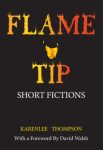
Karenlee Thompson, Flame tip: Short fictions (#BookReview)

Karenlee Thompson, Flame tipShort story anthologies usually have some sort of organising principle – a theme, perhaps, such as Australian love stories, or a prize, such as the Margaret River Short Story Competition – but single author collections tend to be looser. Not so Karenlee Thompson’s Flame tip which she describes as containing “creative writing pieces that weave in and around the Tasmanian bushfires of 1967”. These fires, she writes, “left 62 people dead, 900 injured and over 7,000 homeless in a single day”.

With subject matter like this, you might think Flame tip would be distressing to read – and there is that. But Thompson manages to vary the tone enough, by injecting the occasional bit of humour and satire for example, to lighten the melancholy of the heavier stories. This humour, in fact, starts with David Walsh’s idiosyncratic (we would expect no less) introduction. He tells us he remembers the day – 7 February – because it was his first day of school, and his Mum forgot to pick him up. She “forgot” because she was fighting a fire on their back fence, but Walsh wonders whether this was a “viable excuse” or whether she chose to “triage the back fence over her weird and difficult son”. Whatever the reason, Walsh’s family lost neither home nor persons – unlike some of the characters in Thompson’s book.

So now, the book. Karenlee says in her introduction that it’s a collection to be “dipped into at random” and that her aim is “to present the truth ‘under the mask of fiction’ (to borrow from Gao Xingjian), revealing nuances of character and place, as well as repercussions that are often difficult to expose through nonfiction”. This is exactly what she achieves. Some of the stories are told from the point of view of people who experienced the day – who lost loved ones or property – and some are told by later generations. Sometimes the impact of the fires is direct and obvious, such as the wife who lost the love of her life (“Like a wall”), while elsewhere it is far less direct, such as the fickle lover in “Love, what is thy name?” whose grandparents lost their home in the fires.

Many of the stories of loss – the loss of a husband, parent or friend – are the sorts of stories you’d expect. I don’t mean by that, however, that they’re clichéd or uninteresting, but just that in such a collection you’d expect such stories of loss. Thompson ensures her stories are interesting by personalising the loss, and by creating “real” characters rather than the heroes and saints you tend to get in the media. An example is the betrayed wife in “A bird in the oven” who was 12 years old when she lost her mother in the fire and who took “a long time growing up”. Another is “The keeper of the satchel”, a man more damaged by his mother’s lack of love than by her death.

There are positive stories too, such as the young girl in “Jack Frost” who finds love. And there are surprising stories. One is “Medusa One Snake”, about how a family of birds manipulates fire to locate prey (the fleeing animals, “a mobile smorgasbord”). Another is “Degustation” about a woman on a date with the perfectly-named Augustus from a family which “had bought up all the available charred and rubble-ridden farms in the district, after the fire had rendered the singed locals almost comatose with shock”. There’s always someone ready to make a buck out of other people’s pain!

The issue of form … short fictions

The book is subtitled “short fictions”, and Thompson describes it as a collection of “creative writing pieces”. In other words, the term “short stories” isn’t used. There are “traditional” short stories here, but the collection also includes other “pieces”. There’s the shape poem “Flame”, an epistolary story (“Love, what is thy name”), and the piece titled “Lost” which riffs on lost-and-found ads. In it Margaret Groombell writes:

Lost

A life

Including: four-bedroom weatherboard home with indoor amenities, a much loved border collie answering to the name of Richie, a sense of security, linen and cutlery, a priceless hand-painted jardinière, stamp collection gathered and assembled over three generations, pink shower cap studded with daisies, deck of hand-painted burlesque playing cards, a position of some standing in the community, 2 striped deck chairs …

And so on. The random ordering of “items” here – “a sense of security” next to “linen and cutlery” – beautifully conveys the dislocation, the disorder, that such loss generates.

Another piece, “Annabelle, just looking”, plays with the idea of personal ads, but it’s an extended ad in which 72-year-old Annabelle explains her needs and why she’s where she is. She describes herself. She’s “never considered Botox or any of that other rubbish”, she says:

My forehead, therefore, is less like a flat screen TV and more like a topographical map. Life has surprised me, frightened me, delighted me – it’s all there in plain sight, writ large for the world to see.

Her demands aren’t many, but she hates “open fires”.

My final example is the short two-pager, “Cross stitch”, about Nettie who’s lost everything, but is surrounded by the macrame and aprons

made with altruistic fervour, no doubt, by women and girls who wanted to give her something to help her settle into a tiny house that had nothing from her life before.

I love the way Thompson, in piece after piece, breaks down popular notions about fires and their aftermath, and shows us the more likely reality.

So far, I’ve focused on the bushfire theme, but one of the lovely things about this collection is how Thompson interweaves other ideas into it. In “Like a wall” and “Jack Frost” she tackles racism and community prejudices. And in “Degustation” she satirises fine dining – degustation menus in particular – as well as the arrogance and sense of entitlement of the wealthy. It’s a delightful, funny story. Indeed, Thompson’s writing overall has a light touch, with a keen eye for the absurd.

Flame tip is a serious collection about a serious subject, and it could so easily have become heavy. However, by varying form, voice and tone, Thompson has produced a book that not only sustains our interest but that, despite its subject matter, is enjoyable to read. And that’s no mean feat.

Lisa (ANZLitLovers) also enjoyed the book

aww2017 badgeKarenlee Thompson
Flame tip: Short fictions
Melbourne: Hybrid Publishers, 2017
166pp.
ISBN: 978 1 925272 73 4

(Review copy courtesy Hybrid Publishers)

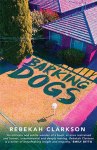
Rebekah Clarkson, Barking dogs (#BookReview)

Rebekah Clarkson, Barking dogsThe best way to describe Rebekah Clarkson’s debut book, Barking dogs, is that it’s a portrait of a community undergoing social change. This community is Mount Barker on the outskirts of Adelaide. Once a farming community, it is now, says Wikipedia, “one of the fastest growing areas in the state”, the province of developers, the aspirational and the upwardly mobile, rich pickings in other words for an observant novelist. But, did you notice that I said “debut book” not “novel”? This is because, superficially, this book presents as a collection of short stories. However …

What’s in a name? It reminded me of the recent discussion about Junot Díaz’s debut book, Drown, on the ABC’s First Tuesday Bookclub. Drown is also a collection of short stories, but panel members argued that it could be defined as a novel because “the stories are too interlinked for us not to see it as a narrative whole”. Drown, though, does have the same narrator throughout, which Clarkson’s book doesn’t. Her book is probably closer to Tim Winton’s The turning. Like Barking dogs, its stories are set in the same place, and it has some recurring characters, though, from memory, I’d say recurring characters are a stronger feature of Clarkson’s book.

The question is, of course, does any of this matter? Not really, except that calling it a novel might attract more readers – you know, those who say they don’t like short stories. And, it is always relevant to consider form, even if, in the end, the actual label is irrelevant.

The form, style and structure of Barking dogs, do, in fact, give us much to consider. There are, for example, 13 stories. Are we meant to consider the “negative” implications of the number 13 in terms of this community’s future? Why does Clarkson start the collection with a troubling story (“Here we lie”) set at a later time in the book’s chronology, and end with a story set at the earliest time (“If it wasn’t this”)? The fact that this last story, although set in the seemingly idyllic rural days, ends rather bleakly on the image of a tree “alone, stark and bare” suggests that Clarkson recognises the complexity in all communities. Again, I was reminded of Pulitzer prize-winning author Paul Beatty on the First Tuesday panel talking about how he sometimes plays around with the order of the stories in Drown, and how this changes its impact.

Regardless of the overall intention, though, the stories make great reading. Whether they are told 1st, 2nd or 3rd person, and whether the narrator is male or female, young, middling or older, or struggling financially or more well-off, Clarkson is able to get inside her characters’ heads. She captures, and explores, the feelings, values and thoughts, the confusions, uncertainties, and pretensions, of her town’s inhabitants. We can “see” it all: the struggle to pay mortgages, to maintain meaningful marriages, to raise their children (or to conceive them in the first place), to get on with their neighbours, to achieve the lives to which they aspire.

A number of motifs run through the book, including the murdered girl Sophie Barlow (whose family appears in the second story, “Something special, something rare”, but whose story is never fully told), the Wheeler family which forms the main connecting thread in the collection, and of course the barking dogs of the title. These, together with the setting, contribute to the coherence of the whole.

Some stories stood out more than others. This may say more about my particular interests, rather than the quality of the stories, but it may also be that the stories that are more connected by characters are more engaging because of the story development they entail. It’s a book that would bear multiple readings, because even skimming it for this review revealed further links and connections that I missed on my first pass.

The overall theme, that of a community going through change, is beautifully encapsulated in the story “Hold me close”, in which the recently widowed Edna, a long-term resident of the town’s now rural outskirts, struggles to understand the aspirations and lifestyle of her daughter, Andrea, who has moved back to the area. Andrea lives in a “ex-display home village” and, Edna thinks, is more interested in appearance than substance. This tension between striving for success and being, hmm, more real is played out in various ways in the other stories.

The Wheelers

But, perhaps the best way to illuminate the book is to look briefly at how the Wheeler family is woven through the book. The Wheelers are 49-year-old Malcolm, a successful management professional, his confident teacher wife, Theresa, their 11-year-old son Martin who’s been diagnosed with Asperger’s, and Jasper, their barking dog. They epitomise the new families in the area – their aspirations, their values, and their problems – and at least one of them appears, or is referred to, in seven of the stories. The first references are in passing. In “Something special, something rare”, Martin has been physically bullied by Liam Barlow, but we don’t meet him specifically, and in the following story “World peace” he is again referred to, this time by one of his classmates. We gather he’s a little different, and doesn’t fit in well with the normal schoolyard cut-and-thrust.

The next four stories (4th, 7th, 9th and 11th) in which they appear are told from their perspectives, the first two from Malcolm’s, then one from Martin’s, and finally Theresa’s. I don’t want to give too much away, but we get the picture of a fairly kind, laissez-faire husband married to a more go-ahead, shall we say, proactive, wife. In the fourth story, “Raising boys”, we also meet their barking dog who is bothering his neighbour, and in the seventh, which is, structurally, the central story, Malcolm receives some terrible news which provides the book’s emotional heart. The penultimate story, “Jasper”, is shocking. It exposes the cracks in “society today”, such as unrealistic aspirations, lack of neighbourly communication, fractured marital relationships.

Interestingly, while the stories are not presented chronologically, the Wheelers’ “story” is, giving the book a clear narrative arc. The overall order, perhaps, provides its thematic one, one that warns against rose-coloured glasses about the past.

Unfortunately, I am using an uncorrected proof copy from which quotes are forbidden (though I have “quoted” one or two phrases which I hope is okay!). However, I do want to briefly mention the writing, which maintains an effective satirical tone while also conveying a level of tenderness for the characters. There’s some lovely irony too. We know for example, that poor Graham Barlow’s vision for his business, Winners, is unlikely to be realised (“Something special, something rare”), and that Gladeview Park, where many of our characters live, does not provide the “Serene and fun-filled living” environment promised on the estate’s sign (“Jasper”).

Barking dogs offers a thoughtful, intelligent look at contemporary suburban life. It explores what a pristine, homogenous white middle-class enclave might look like. Unfortunately, it looks more like a bunch of isolated individuals than a healthy community, partly because the pressures that drive them seem to prevent real engagement with each other. It doesn’t need to be this way.aww2017 badge
Rebekah Clarkson
Barking dogs (Uncorrected bound proof)
South Melbourne: Affirm Press, 2017
240pp.
ISBN: 9781925475494

(Review copy courtesy Affirm Press)

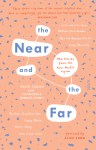
David Carlin and Francesca Rendle-Short (eds), The near and the far: New stories from the Asia-Pacific region (Review)

David Carlin and Francesca Rendle-Short, The near and the far

Anthologies, almost by definition, have a unifying theme, something that explains their existence. There are the “best of” type, as in best of a year or of a genre, for example. There are those drawn from a prize, such as The trouble with flying, and other stories (my review) from the Margaret River Short Story competition. And of course there are subject-oriented ones like Rebellious daughters (my review) or Australian love stories (my review). David Carlin and Francesca Rendle-Short’s anthology, The near and the far, is another type. Its origin is a project called WrICE (Writers Immersion and Cultural Exchange) which, the editors tell us, is “a program of reciprocal residences and cultural events focused on writers and writing from Australia and the Asia-Pacific”. The residencies and events occurred in such places as Singapore, Malaysia, Vietnam and Australia. The aim was to enable Asia-Pacific writers to immerse themselves in the face-to-face exchange of ideas and collaborative experiences, in order to build cultural understanding and find, as one participant says, “sustainable ways of speaking amongst ourselves and relating to one another as cultural practitioners”.

The result is that the stories – and even the forms of the pieces – are varied. The book has been thoughtfully presented. There’s a foreword by Alice Pung and an introduction by the editors at the beginning, and some notes on WrICE and a list of contributors with mini-bios at the back. The stories themselves are organised into three groups – The Near, The Far, and The Near and The Far – though I’d probably have to think hard about why certain stories have been allocated their particular group. There are 21 stories, 15 of which, if I’ve counted correctly, are by women. There’s a lovely extra touch, which is that at the end of each story is an author’s reflection – on the writing process, the goals and/or the experience of WrICE. They were often illuminating.

Before we get to the stories – and of course I’m only going to be able to focus on a few – I’d like to share some comments from the foreword and introduction. In her foreword, Pung calls the book a travel anthology, and I suppose it is, in a sense, though I may not have described it that way if I hadn’t read her foreword! She says

The near and the far is one of those rare travel anthologies, combining fiction with poetry and longform essays, each piece revealing a real insider’s experience of inhabiting a different world without exoticising the foreign. Each story has a centre – whether philosophical, moral, or political – and yet none of them are didactic.

The editors talk of how our different colonial experiences had “left long shadows across our imaginations”. They refer particularly to “settler” Australians who live in what was seen as an “outpost” – further than the “Far East” – and yet who still tend to look to Europe and America for our main cultural input. “The far feels near”, they write, “and the near feels far away”. That makes a lot of sense – to me.

You think you know (Omar Musa)

Now the stories. They come from, as you’d expect, a diverse group of writers, from Australia and Vietnam, from the Philippines and America, and from many places in between. Some I knew – like Melissa Lucashenko, Omar Musa, Cate Kennedy, and of course Francesca Rendle-Short – but most were new to me. Many of the pieces explore in some way the idea of what we know and don’t know. They may be about ignoring what we know because it’s too painful, or because we fear the rejection of others. They may be about the disconnect between what we assume and what we find. Or they may simply be about facing something new or unexpected.

I loved that indigenous Australian writer Melissa Lucashenko’s story, “Dreamers”, was chosen to start the anthology. Set in rural Australia in 1969, two years after the famous referendum, it’s a beautifully structured and told story about the relationship that develops between indigenous woman and her non-indigenous employers. It’s a story about love, loyalty and tolerance, but manages to quietly reference, without being polemical, social change issues such as environmental protest and the stolen generations.

Not surprisingly, the theme of accepting – welcoming, hopefully – diversity runs through the book. In “My two mothers”, Singaporean Suchen Christine Lim shares a story about a young adopted girl’s shame at having two mothers, her unwillingness to appreciate their love and tender care, and her eventual recognition of what they had given her.

If you have ever read or heard Australian-Malaysian performance poet Omar Musa, you won’t be surprised to hear that diversity underpins his contribution, “You think you know”. In this first-person story he explores “the deeply troubling issues” regarding sexual identity in Malaysia through his narrator’s (presumably himself) friendship with a young Malaysian man met on a bus. It’s a quiet, reflective, wrenching story – quite different from the higher octane wordplay of his performance poetry.

A story using a completely different tone and pace is Chinese-Indonesian, now American writer Xu Xi’s “BG: The significant years”. In a time when scientists and historians argue about dating nomenclature – BCE/CE anyone? – Xu Xi has come up with her own, BG or Before Google! Google (created 19 August 2004, if you want to know) provides for her a significant life marker. In short chronological sections, starting with “BG 43 (circa 1961 to ’62)”, she chronicles her life – in a lightly satirical tone – from applying to go to university in America, to becoming a US citizen, and getting a job and then losing it in the 1986 stock market crash. Her commentary on life in the US is enlightening. Joining the unemployment queue meant, she writes, that “for once I wasn’t a minority, because the minority was the majority in that government office”! Telling eh?

There are many more stories I’d like to share: Laurel Fantauzzo’s second-person-told story, Some Hints About Travelling to the Country Your Family Departed, about going back to the place (in her case the Philippines) a parent came from; Francesca Rendle-Short’s “1:25,000” on the geologies of time, on memories, regrets and saying “no”; and Maxine Beneba Clark’s short, painful, 9/11-inspired “Aviation” in which accepting “other” is put to the test.

And then there’s David Carlin’s gender-bending, mind-bending “Unmade in Bangkok”. Inspired by Thailand’s ladyboys, he explores ideas about identity and gender. The story is told in ten sections, mostly in third person but slipping between male and female personas. In section four, “she” considers:

Women make themselves up, men do not. This is curious when she thinks about it. To be a woman, in this culture, is to be a creature dipped in fiction, whereas to be a man is to be altogether real or at least natural, unconstructed.

So she dresses up and considers: “What is she becoming? Ever more fictional? A character in drag?” I enjoyed how Carlin explored gender identity, using broader ideas about “fiction”. “Some fictions trap us”, he writes, “but other fictions free us”. For ladyboys the implications are serious. It’s a complex story which covers a lot of ground. I need to read it again.

I titled this section “you think you know” because in all the stories, the writers are seeking to know, not so life can be assured, or complete, but in the spirit of understanding, of growing. Alvin Pang, in the note to his story “The Illoi of Kantimeral”, discusses the invented language he used:

Their precise meanings may or may not be immediately discernible from context, but neither is the experience of engagement, negotiation, resistance, and mystery within the Asia-Pacific itself as straightforward as we might wish the world to be. There is humility and pleasure in earnest encounter, and in listening out for the inherent humanity of what we do not fully recognise.

Perfect! This is a book which confronts us with many ways of seeing and experiencing. Different stories will appeal to different readers, depending on experiences, but I hope I’ve given you a taste. Books like this deserve a bigger audience than they often get.

aww2017-badge

David Carlin and Francesca Rendle-Short (eds),
The near and the far: New stories from the Asia-Pacific region
Melbourne: Scribe, 2016
288pp.
ISBN: 9781925321562

(Review copy courtesy Scribe)

Kate Chopin, Fedora (Review)

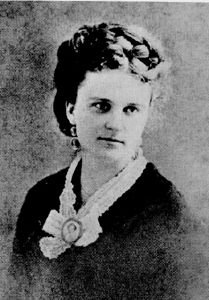
Kate Chopin

Kate Chopin (Public domain, via Wikipedia)

Time methinks for another Library of America (LOA) Story of the Week, particularly since one of their recent offerings was one of my favourite American authors, Kate Chopin. “Fedora” is the sixth story by Chopin I’ve discussed here, and is probably the shortest, more of a “sketch”. In fact its original title was apparently ““The Falling in Love of Fedora. A Sketch”

If you’ve read any of my previous posts, or her novel The awakening which I read a couple of times before blogging, you’ll know that Chopin was not afraid to tackle confronting subjects, like suicide, adultery, and miscegenation. LOA’s notes briefly discuss the controversy surrounding The awakening. Words such as  “morbid,” “sex fiction,” “poison,” were applied to it, and the clearly more conservative, younger, Willa Cather, whom I’ve also reviewed here, said that “I shall not attempt to say why Miss Chopin has devoted so exquisite and sensitive, well-governed a style to so trite and sordid a theme.”

Well, of course, many of us do know why she explored the themes she did in puritanical late-nineteenth century America, and we admire her for doing so. LOA explains that while her stories were usually sought after, some were a little too hot to handle. “Fedora” was one such, being “turned down by the national magazines that often competed for her work”, only appearing “in an upstart literary journal in her hometown of St. Louis”.

So, what is it that was so shocking about “Fedora”? Well, there’s the rub, because it’s one of those short stories that leaves you wondering. Fedora is 30 years old – and is described pretty much as the quintessential spinster:

The young people—her brothers’ and sisters’ guests, who were constantly coming and going that summer—occupied her to a great extent, but failed to interest her. She concerned herself with their comforts—in the absence of her mother—looked after their health and well-being; contrived for their amusements, in which she never joined. And, as Fedora was tall and slim, and carried her head loftily, and wore eye-glasses and a severe expression, some of them—the silliest—felt as if she were a hundred years old. Young Malthers thought she was about forty.

The story concerns her going to the station – driving the horse and cart – to pick up young Malthers’ sister who is returning from college. Young Malthers is, we are told, 23 – and Fedora has become fascinated by him, suddenly realising he is a man – “in voice, in attitude, in bearing, in every sense — a man”. Now, early in the story, we’d been told that:

Fedora had too early in life formed an ideal and treasured it. By this ideal she had measured such male beings as had hitherto challenged her attention, and needless to say she had found them wanting.

But, suddenly she is aware of him, she watches him:

She sought him out; she selected him when occasion permitted. She wanted him by her, though his nearness troubled her. There was uneasiness, restlessness, expectation when he was not there within sight or sound. There was redoubled uneasiness when he was by—there was inward revolt, astonishment, rapture, self-contumely; a swift, fierce encounter betwixt thought and feeling.

Fedora could hardly explain to her own satisfaction why she wanted to go herself to the station for young Malthers’ sister. She felt a desire to see the girl, to be near her; as unaccountable, when she tried to analyze it, as the impulse which drove her, and to which she often yielded, to touch his hat, hanging with others upon the hall pegs, when she passed it by.

It seems, then, that she is in love with him, as the original title encourages us to think – or that she, at least, feels a desire or passion for him. So, when she picks up Miss Malthers, why does she do what she does? That is the question – and it’s one I’m not going to answer, because that would be a spoiler and because the story is so short that you can read it, and ponder it, yourself. And anyhow, I’m still thinking about it myself, given the way Chopin teases us. Suffice it to say that, however you read it, Chopin was challenging her readers to think about desire – its origins, its expression, and its impact on the person who desires.

This is a beautiful and intriguing little “sketch”, though to call it that doesn’t fully do it justice.

Note: My other Kate Chopin reviews are A pair of silk stockings, After the winterA respectable womanDésirée’s baby and Morning walk. My, they are building up aren’t they?

Kate Chopin
“Fedora”
First published: Criterion, February 20, 1897
(Under the pseudonym, La Tour)
Available: Online at the Library of America

Claire Battershill, Circus (Review)

Claire Battershill, Circus

Metaphors and allusions can be dangerous. The inside-front-flap-blurb for Claire Battershill’s debut collection of short stories, Circus, concludes that the book “is a beautiful reminder that sometimes everyday life can be the greatest show on earth”. A reviewer on the back cover describes it as “the kind of book you’ll want to run away with”. As I finished it, however, my first thought was that “life is a circus”, meaning it can be disconcerting and unpredictable. Luckily for Battershill, all these work, and are encompassed by her epigraph from ee cummings’ play Him which says “Damn everything but the circus … damn everything that won’t […] throw its heart into tension, surprise, fear and delight of the circus, the round world, the full existence.”

A selection of stories from this book co-won the 2013 Canadian Authors Association Emerging Writer Award, and, before that in 2008, the title story won the CBC Literary Award for Short Fiction. It has some cred in other words, but you might be wondering how I came to it. It was, in fact, a Mothers Day gift from Daughter Gums (DG) back in 2014. She and I had seen the book on a Canadian authors stand in a Toronto bookshop a couple of months earlier that year, and she noticed that it was one that I had eyed particularly covetously. (It helped that it is a beautifully designed book and is lovely to hold!) I was thrilled when I opened my gift, and apologise to DG for taking so long to complete it.

There are nine stories in the book, with the titular story “Circus” occupying the middle. Two are told first person, the rest third. I do like short story authors to mix their voices up a bit and to not be afraid of third person, as sometimes new writers can seem to be. Battershill uses the voices well. The guide in the Hendricks Memorial Miniature Museum (“Each small thing”) talks to the reader as though we are in her tour group. First person was needed here to effectively convey the guide’s self-absorption. It’s perhaps not so critical in “Two-man luge: A love story”, but the first person voice does enable us to feel the narrator’s uncertainty and longing for connection.

What I love about this collection is the variety of her characters and the often bizarre situations they find themselves. We have Henry Bottlesworth (“A gentle luxury”) who “has given himself  thirty-one days to find love on the internet” after ten years of enduring the matchmaking efforts of friends and family. This is not so unusual a situation, and the ending is probably the most predictable, and yet Battershill injects such warmth into what could be a frustrating character. The next story (“Sensation”) switches gear completely to a story about a single father and the tent he buys for his daughter’s 16th birthday. They pitch it in the living room:

Annie loves it … She loves how the energy saver-light bulb glows like a dying star through the waterproof nylon, how scents from the rest of the house filter in, from time to time, through the mesh windows … She is open to the elements, but there’s no danger of rain or mosquitoes, no need for thermal underwear or finicky gas lanterns. This is camping at its finest.

Haha, love it. From here, the tent becomes a conduit first to a closer relationship between father and daughter, and then with the neighbourhood, and then … well, I don’t want to spoil it, but it is a gorgeous story that manages to be warm while also having a little dig about art, fads and fame.

And so the stories continue. Here are some more. There’s the couple who buy a house in the country (“Brothers”) only to find that they’ve also acquired two elderly brothers, shepherds, one blind, the other deaf. Or the widowed grandfather who listens to the Northern Lights and wants to share this love with his grandson (“The collective name for Ninjas”). Or the wife who goes to New York with her husband for their first no-children holiday, only to return alone (“Quite everyday looking”).

The stories are warm, and humane, sometimes humorous, but all about relationships (with partners, parents, children, others) and the decisions made and not made. They are written with a lovely eye for those details that can lift them out of the ordinary:

Henry has, with time and experience, learned a thing or two about the culinary ins and outs of first dates. Sushi, for instance, invites a rice explosion. Ordering a saucy noodle dish or a dressing-laden salad is asking for a spill, and Chinese broccoli is impossible to eat all in one bite without losing one’s dignity. (“A gentle luxury”)

Karen has the face of someone who has swan-dived into love and never hit bottom. (“Brothers”)

The New York version of her was slim, with bare, smooth legs rather than thick, sturdy calves in support socks. And surely as soon as the plane touched down at JFK, she would instantly know how to apply liquid eyeliner precisely and her hair would emerge in elegant finger waves when she lifted her head from the neck pillow. (“Quite everyday looking”)

So, “greatest show on earth”? Not if you think this means fireworks and high drama. But if it means for you the idea that seemingly ordinary lives can be surprisingly varied and rich, then, yes, Circus fills the bill – and fills it with confidence and aplomb.

Endings are hard. Everyone knows it – the end of life, the end of a holiday, and of course the end of a novel. EM Forster knew it – and wrote about it in Aspects of the novel. Endings are particularly important in short stories, I’d argue, and Claire Battershill’s endings are good ones. There are no twists or neat resolutions here. Just a sense that characters have reached some point in life, major or minor, and are now moving on – in a direction that is usually clear to the reader but not completely spelled out. I like that.

POSTSCRIPT: It seems that Circus is out of print, but you can read one of the short stories, “Two-man luge: A love story”, online.

Claire Battershill
Circus
Toronto: McClelland & Stewart, 2014
207pp.
ISBN: 9780771012785

Eudora Welty, A curtain of green (Review)

This week I received the Library of America’s annual email in which they list their “Top 10 Story of the Week selections of 2016″. I’ve only read eleven of their selections this year, but two – Kate Chopin’s “A pair of silk stockings” (my review) and Willa Cather’s “Enchanted bluff” (my review) – are in their Top Ten. More interesting to me though is that it contains another writer I like, Eudora Welty. I read her book One writer’s beginnings and what is probably her most famous short story, “Why I live at the P.O.”, before I started blogging, so I decided to read this Top Ten story, “A curtain of green”.

weltycurtainofgreenWelty was a short story writer and novelist who wrote mostly about the South. She won the Pulitzer Prize in 1973 with her novel The optimist’s daughter and, according to Wikipedia, was the first living writer to be published by the Library of America (LOA)! “A curtain of green” was one of her early stories. It provided the title for (and was included in of course) her first published collection of short stories (1941), which also includes “Why I live at the P.O.”

However, before I get to the story, I want to share a little from One writer’s beginnings. This book originated in a series of lectures, the inaugural ones apparently, she gave in 1983 at Harvard University, the William E Massey Sr. Lectures in the History of American Civilisation. The cover of my 1984 edition claims that it was on the New York Times Bestseller List for 46 weeks! Pretty impressive for a series of essays I think. She was born in 1909 in Jackson Mississippi, the eldest of three. From the opening pages of the book she tells us how her growing up contributed to her writing.

For example, in the first paragraph she mentions growing up “to the striking of clocks”. She’s not sure whether it’s because of her father’s Ohio family “having been Swiss back in the 1700s” but her family were all “time-minded” all of their lives:

This was good at least for a fiction writer, being able to learn so penetratingly and first of all, about chronology. It was one of a good many things I learned, almost without knowing it; it would be there when I needed it.

Surely there’s a little bit of the tongue-in-cheek in her reference to the Swiss origins? Anyhow, two pages in, and she’s talking about her parents’ respective reactions to the weather, her father’s caution regarding storms for example and her mother’s rejection of that “as a character failing”:

So I developed a strong meteorological sensibility. In years ahead, when I wrote stories, atmosphere took its influential role from the start. Commotion in the weather and inner feelings aroused by such a hovering disturbance emerged in dramatic form.

And so the book continues in this delightful manner, sharing her childhood with affection, perception and a wonderful sly wit … but now to “A curtain of green” in which meteorological conditions do, in fact, feature!

“A curtain of green” is about grief, but it starts

Every day one summer in Larkin’s Hill, it rained a little. The rain was a regular thing, and would come about two o’clock in the afternoon.

One day, almost as late as five o’clock, the sun was still shining …

It tells the story of Mrs Larkin whose husband had died the previous summer in a terrible accident – a tree, “a fragrant chinaberry”, had come crashing down on his car as he was arriving home. She had seen it happening, had believed her love would keep him safe. And so now, while the other women of the town sit inside “fanning and sighing, waiting for the rain”, Mrs Larkin is out in her garden, where she is now all the time, because “since the accident in which her husband had been killed, she had never once been seen anywhere else”. It’s a fertile garden, needs “cutting, separating, thinning and tying back” to keep the plants from “overreaching their boundaries and multiplying out of all reason”. But, Mrs Larkin is deranged with grief. She does none of this, just works incessantly, obsessively, planting

thickly and hastily, without stopping to think, without any regard for the ideas that her neighbours might elect in their club as to what constituted an appropriate vista, or an effect of restfulness, or even harmony of colour. Just to what end Mrs Larkin worked so strenuously in her garden, her neighbours could not see …

She doesn’t offer flowers when they’re sick or die, for example. I love how the language in this story just piles on, driving us forward this way and that, just like Mrs Larkin’s grief does to her. The garden, to the neighbours who had initially tried to support her, “had the appearance of a sort of jungle, in which the slight, heedless form of the owner daily lost itself”. It’s oppressive to us, but Mrs Larkin has isolated herself behind her “curtain of green”. The only person she tolerates in this garden, and then only occasionally, is Jamey, “the coloured boy who worked in the neighbourhood”.

At this point in the story, which is told third person, the perspective shifts from omniscient to subjective, to Mrs Larkin’s point-of-view, that is. We are now in the garden with her as her memory returns her to the day of the accident. Suddenly all is still, “everything had stopped again, stillness had mesmerised the plants …” Jamey infuriates her, with his “look of docility”, of being “lost in some impossible dream of his own”. She watches him – her hunger for his innocence suddenly overtaken by a fury at his youthfulness, at his being able to be lost in this, to her, “impossible dream”. She’s overwhelmed by the unaccountability of accident, of life and death, by the meaningless of it all, and wants to smash his innocent absorption – but then comes the rain. There are two more pages in the story after this, but I’ll finish here.

This story was written in 1938 – quickly written and easily published, according to LOA. LOA also tells us that in 1931, Welty and her mother had been present when her father died of leukaemia, and they quote Welty’s biographer Suzanne Marrs as saying that her mother “discovered solace in gardening”. She spent hours in her garden, most days, often with Eudora by her side. Welty, says Marrs, wrote in an unpublished essay that “its [the garden’s] peace and fragrance are soothing to frayed nerves when we are weary from contact or perhaps conflict with the everyday world.” This memory clearly informed her story of the grieving Mrs Larkin.

“A curtain of green” is a great read, for its exploration of how grief can derail you, making you, temporarily at least, a little mad; for its evocative writing which captures that sense of derailment, taking you right into that garden with Mrs Larkin; and for its resolution which offers hope without being simplistic about it. After such a year as this has been, it seems just the right story to end on. Happy New Year everyone!

Eudora Welty
“A curtain of green”
First published in: Southern Review (Autumn 1938).
Available: Online at the Library of America