Thea Astley, Hunting the wild pineapple (Review)

Thea Astley‘s “Hunting the wild pineapple” is both a short story and the title of a collection of connected short stories (that includes, of course, the title story). Today I am going to write on the short story as it’s one of the 16 included in the current Meanjin Tournament of Books – and it has made it through to the second round.

“Hunting the wild pineapple” is the third story of eight, which are all narrated by a man called Leverson. It is set in far North Queensland in a place called Mango, which she writes about again in her 1987 novel, It’s raining in Mango. In this story, Leverson, accompanied by the American Mrs Crystal Bellamy who is “impossibly researching the human geography of the north for a nonsense thesis”, is visiting a pineapple farmer called Pasmore. Pasmore, while waiting for a lobster to thaw for dinner, takes his guests on a somewhat alcohol-fuelled car-ride, first to hunt for wild pineapples and then to visit his two migrant farm workers, “the two”.

It is pretty vintage Astley, at least mid-career Astley as I know her, with its lush, evocative, “imagistic” (as she once described it) language and its focus on inequitable human relationships in which one group, usually white men, wield power over another – women, migrants, and (though not in this particular story) indigenous people.

The story is set in the 1970s, and is characterised by satire and irony. Leverson describes Pasmore as

a well-intentioned buddy who wanted to prove we’re not all grubbing away at soil up here, that we’re smooth, polished, and have swung quite nicely, ta ever so, into the sophisticated seventies.

So smooth that outside the house we are left gawking at a whopping heart-shaped swimming-pool filled with blue tears that blinked as a woman (his wife?) plunged from sight.

See what I mean about the language? It’s packed with images and ideas that rub somewhat uncomfortably against each other. In Astley, discomforting language is de rigueur; it, more than plot or characterisation, is the tool she uses to unsettle us, to shock us out of our comfort zone and force us to confront the unkindness, the viciousness, if not the downright violence that she sees lurking beneath the surface of human interactions. (I admit now that I don’t always get it on a rational level, but it rarely fails to move me.) In this story, the relationships she spears with her pineapples are those between husband and wife (Mr Pasmore and Tubs), employer and worker (Mr Pasmore and migrant workers, Tom and Georgy), and even between colleagues (Tom and Georgy).

And yet, it’s Astley’s language that has got her most into trouble, because it is heavily imagistic (not at all spare, until perhaps her very last works which were a little sparer, comparatively speaking) and some readers and critics don’t like it. Here, for example, is Leverson on Pasmore presenting his hunted down, “huge humped” pineapple to Mrs Bellamy:

… he tattooed her arms with spikes; the head spears stabbed her skin. He lit, post-coitally I think nastily, a cigarette.

Not very subtle, eh, but effective in its hints of sex, power and violence. Similarly, here is Pasmore knocking on the door of “the two”, he

drummed a neat riff on the wall beside the open front door, the over-familiar, paternalistic-presumptuous tat-a-tat, tat-tat, and emitted hearty cries of boss-lure …

Writer and critic Kerryn Goldsworthy, like me, likes Astley. She says*:

I love Thea Astley’s writing and always have. I love its densely woven grammar, its ingrained humour, its uncompromising politics, its demented metaphors, and its undimmed outrage at human folly, stupidity and greed. I love the way that even at its most savage and despairing, it has always had a suggestion of redemptive energy working away somewhere in the plot, no matter how subterranean, outmaneuvered or comprehensively beaten down….

This story is a good example of the Astley that Goldsworthy and I like. There’s a savage bite to it, but there’s also the slightest hint of the opposite. I wonder how far it will get in Meanjin’s tournament.

Thea Astley
“Hunting the wild pineapple”
in Hunting the wild pineapple and other related stories
Ringwood: Penguin Books, 1979, pp. 63-76
175pp.
ISBN: 9780140058437

* from “Undimmed Outrage”, Australian Book Review, Sept 1999, Issue no 214.

Barbara Baynton, The chosen vessel (Review)

I’m blaming author and blogger Karen Lee Thompson again for this post, because she wrote a wonderful comment on my post on Barbara Baynton‘s short story “Squeaker’s mate”, and I’m going to quote it pretty much in full (I hope that’s ok from a copyright point of view – tell me if it isn’t Karen Lee):

Barbara Baynton wrote some wonderful stories and, had literary politics been a little more inclusive in the days of the Bulletin, I’m sure she would have received wider recognition. Many of Baynton’s short stories, like ‘Squeakers Mate’, turn ‘The Australian Legend’ on its head and, perhaps because of this, the male literary elite (A.G. Stephens, A.A. Phillips for example) chose to modify or explain her work in various ways.

An interesting example of this editorial intrusion is the politics surrounding Baynton’s ‘The Chosen Vessel’ (Baynton’s preferred title was ‘What the Curlews Cried’) which I have read, in its various forms, a number of times. Stephens published it as ‘The Tramp’. It is believed he wanted the title to shift the focus away from the central woman and it allowed for clarity between a ‘tramp’ (an isolated individual) and a ‘swagman’ (a virtuous kind of everyman of the bush). Stephens also cut a significant part of the story before publication.

For anyone who enjoys ‘Squeakers Mate’, I’d suggest a reading of ‘What the Curlews Cried’ (aka ‘The Chosen Vessel’ or ‘The Tramp’), preferably in its unabridged form.

“The chosen vessel” and “Squeaker’s mate” are Baynton’s best known and most anthologised short stories. However, I hadn’t read “The chosen vessel” before and so decided, on Karen Lee’s recommendation, to read the version in Bush studies. According to my brief research, and Karen Lee can correct me if I’m wrong, The Bush studies version is the final complete version Baynton presented for publication. However, it is not the same as the original version which was submitted as “What the curlews cried” and then significantly edited by the Bulletin.

Anyhow, if I thought “Squeaker’s mate” was tough, then this one is tougher. The female protagonist is left alone with her baby, rather like Lawson’s wife in “The drover’s wife”, but this woman faces a double whammy. Left by a cruel husband, she is terrorised by a “swagman” (not a “tramp” despite its first published title). She’s a town girl unfamiliar with bush life, but that’s not what scares her. I won’t detail the plot more because it’s a short story (around 8 pages) and you can find it in the online link below. The shorter Bulletin version, I understand, did not change what happened to the woman, but excised a whole section and thereby effectively changed the meaning of the story to suggest an isolated instance rather than something more systemic.

In the introduction to my Sydney University Press edition, Susan Sheridan confirms my statement in my “Squeaker’s mate” post that Baynton’s main concern was not the harshness or terrors of the bush and the land, which contemporary critics tried to argue, but male brutality to woman and, more significantly, “the impossible position that male culture constructs for ‘woman’ in the abstract”. She writes that woman is glorified as the Madonna, God’s “chosen vessel”,  but “at the same time the capacity for motherhood is regarded as confining her to the animal level of existence”. In “The chosen vessel” religious imagery – the mother and her baby are both mistaken for a ewe and a lamb and as a vision of the Madonna and child – is used to devastating ironic effect.

I’m not surprised that those late nineteenth century men found her writing confronting and that the Bulletin only ever published one of her short stories, but, for me, Baynton’s writing presents an alternative view of life in the bush that I’m glad we have available today.

Barbara Baynton
“The chosen vessel”
in Bush studies
Sydney University Press, 2009
ISBN: 9781820898953

Available online: in Bush studies at Project Gutenberg

Barbara Baynton, Squeaker’s mate (Review)

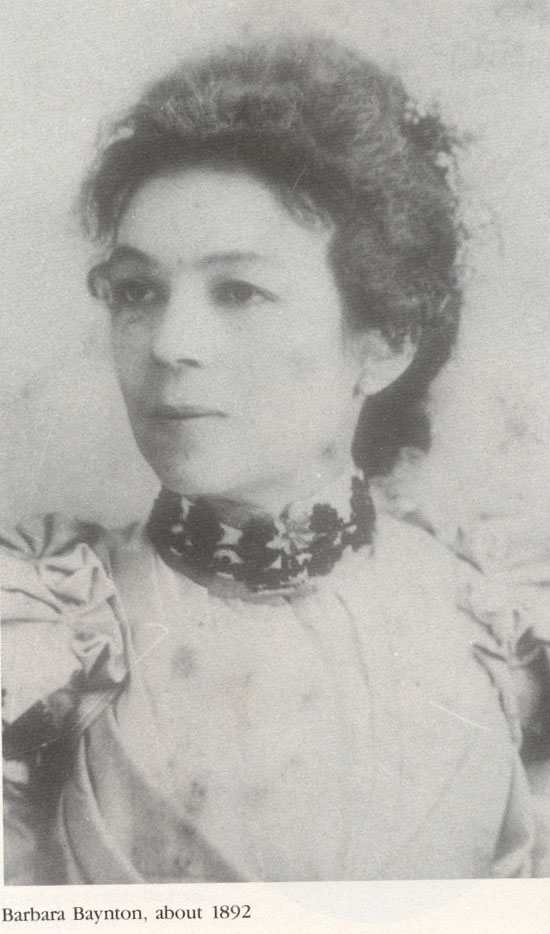
Barbara Baynton 1892

Baynton 1892 (Presumed Public Domain, via Wikipedia)

My last post was about this year’s Meanjin Tournament of Books which is pitting short stories against each other. One of the short stories is Barbara Baynton‘s “Squeaker’s mate”, which I’ve read before but a long time ago. I decided, though, to read it again, since I have easy access to a copy, on my shelves and online.

Author and blogger Karen Lee Thompson commented on my tournament post that she’d like to see a bout comparing “Squeaker’s mate” (1902) with Henry Lawson’s “The drover’s wife” (1892), and it would be delicious. I was tempted to do it here but I won’t. However, I did think of commencing this post with “Only a woman …” because, despite their broad similarities in subject matter and setting – the harsh life faced by pioneer women in the outback – there is a big difference in tone. Both stories chronicle the bravery and perseverance of bush women,  but Lawson’s story has an heroic, even somewhat romantic, tone. Not so with Baynton.

Squeaker’s mate, “the best long-haired mate that ever stepped in petticoats”, is a hardworking, taciturn woman whose mate, Squeaker, is a good-for-nothing. Here’s paragraph three:

From the bag she took the axe,  and ring-barked a preparatory circle, while he looked for a shady spot for the billy and the tucker-bags.

It’s not that there’s anything wrong with Squeaker, other than laziness, but “she knew the man, and her tolerance was of the mysteries”. However, things change dramatically early in the story when a tree falls on her, putting her out of action. Squeaker’s initial reaction is chilling – “he was impatient, because for once he had actually to use his strength” – and, a little later

he supposed he would have to yard them [the sheep] tonight, if she didn’t liven up. He looked down at unenlivened her.

It’s only in the last few paragraphs of the story that we learn “her” name. Significantly, it’s Mary.

The rest of the story chronicles his self-centred callous treatment of her, sometimes leaving her for days with no sustenance. All she has is her loyal dog which, for we readers, relieves, albeit slightly, our despair at her situation. There is no heroism in here, very little kindness even – but there is, on the part of Squeaker’s mate, resilience and, without giving away the story, a triumph of sorts.

Baynton is critical of men’s attitude to women – and this is a major theme of the story, though it’s not that simple either. Early on, a few men do show kindness to Mary – let’s dignify her with her name now – but their women put a stop to that. Mary had not been one for “yarnin'”, making her “unlikely” to be popular with them. Baynton writes:

It is in the ordering of things that by degrees most husbands accept their wives’ views of other women.

And so Mary is left alone.

The writing is compelling. It is told third person, but the perspective swaps between hers, his, and, later on, that of the woman he brings into their home. In some circumstances this narrative approach could provide an even-handed view of the characters, but here it only serves to reinforce our early opinion of them. In other words, Squeaker does not improve on acquaintance. Baynton plays effectively with the “word” mate, contrasting the roles, responsibilities and rights of mates as partners, alongside those of the Australian “mateship” tradition, with Squeaker’s un-mate-like, in all senses of the word, behaviour.

Imagery is used sparingly, but it’s pointed when it’s there. It is a tree that brings Mary down, and then late in the story Squeaker decides to clear some land:

So that now, added to the other bush voices, was the call from some untimely falling giant. There is no sound so human as that from the riven souls of these tree people, or the trembling sighs of their upright neighbours whose hands in time will meet over the fallen victim’s body.

A little melodramatic in that 19th century way maybe, but Baynton’s suggestion that there’s more solidarity among trees than the humans below is well made. In fact, while life is harsh, it’s not an unforgiving environment that is the main problem for Baynton’s characters.

It’s a grim but effective story that focuses mostly on gendered callousness in a world where survival would be best ensured by cooperation. In confronting gender issues, Baynton is part of a tradition of Australian women’s writing of the late nineteenth to early twentieth century that has, to a large degree, been forgotten a century or so later. It’s time to revive these early writers – and hopefully recent initiatives by Sydney University Press, Text Publishing and others, will do the job.

Barbara Baynton
“Squeaker’s mate”
in Bush studies
Sydney University Press, 2009
ISBN: 9781820898953

Available online: in Bush studies at Project Gutenberg

Zane Lovitt, The midnight promise (Review)

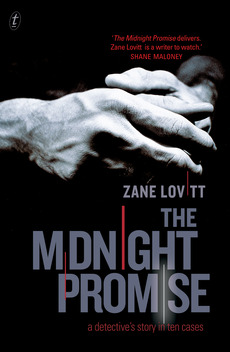
Zane Lovitt, Midnight Promise

Book cover (Courtesy: Text Publishing)

Zane Lovitt’s debut book, The midnight promise, is one of those books for which I can’t decide how to start my review. I could go with the point, previously made in this blog, that I’m not a reader of crime and so cannot speak with authority on the subject. Or, I could write about the fact that one of the chapters in the book, “Leaving Fountainhead”, won the SD Harvey Short Story Award in Australia’s top crime awards, the Ned Kelly awards*. I could start with how Melbourne-based Lovitt joins the growing number of lawyers who write fiction. Or, I could start with the topic that interests me most, its form.

Because, if you haven’t noticed, I didn’t use the word “novel” once in my opening paragraph. There’s a good reason for this: The midnight promise is, if I can draw from the main media through which I consume crime, more like a detective series than a movie. I could have described it as a book of short stories, but that would be misleading. The ten chapters or stories all feature the one detective or “Private Inquiry Agent”, John Dorn, and they are told chronologically. Moreover, even though the book comprises ten separate cases, rather than one main case as would be expected in a novel, there is an overarching, albeit not immediately obvious, plot, defined by “the midnight promise”.

This form may, in fact, be one of the reasons I liked it. Each story is complete in itself while also forming part of a greater whole if you keep reading. The form is also, however, responsible for my only real criticism, which is that, almost without exception, the stories are structurally the same. They follow a present-flashback-present-flashback (and so on) structure. In a “true” book of short stories, I like things to be mixed up a bit; I like to see variety in style, in voice, structure, tone, language. That’s not the case here – but neither, I suppose, would it be the case in a television detective series, so perhaps my criticism isn’t valid. Still, a couple of times, I felt myself saying “here we go again …”.

John Dorn is not, I think, a particularly original character, for the genre. Like many crime protagonists, he’s somewhat of an outsider, a loner with a broken engagement behind him. He’s also a man of some principle which is why his is pretty much a hand-to-mouth existence. In the early stories his fee ranges from $400 a day to $250 a day to nothing depending on whether he wants (or believes in) the job or not. The higher the charge the less he wants it! For this reason we like Dorn, and want things to work out for him, but somehow, more often than not, he manages to shoot himself in the foot.

Being a private eye, his cases are varied, from marital spying to finding missing people to protection (of the innocent or the guilty). But the theme is consistent. It’s “the shitty things people do to each other” or, as he puts it more colourfully when describing roadkill in the final story:

We drive over two foxes, parallel, like one of them couldn’t bear to live without the other. Though what’s more likely is one fox was eating a dead fox and got hit by a car because he didn’t see it coming because he was distracted because the other fox was so delicious.

Not a grammatically beautiful sentence but appropriate and effective in the context. In fact, I liked Lovitt’s writing. The voice is first person, and the writing is generally direct and spare with the occasional well-placed image which works partly due to its rarity. Like this, for example:

I’ve heard rumours about his shady GST schemes, but everything I know about tax offences wouldn’t rouse a chihuahua from its beauty sleep.

The dialogue is realistic. There is humour – mostly in Dorn’s sardonic view of the world – which varies the tone. There is irony, as in the name of the character, Comedy, who is anything but funny, and in the story “Grandma’s House” whose title belies the horrors within.

And this brings me back to the form, to the fact that while each story is complete there is a trajectory in the book, heralded by the occasional bit of foreshadowing. We know something is going to happen that will change Dorn’s life, and probably for the worse. The crisis occurs in the seventh story, “The Crybaby Technique” – and it’s ironic because he was, in this particular case, only a bit player. Things change gear from here, leading to the final crisis in the tenth story which is significantly titled “Troy”. It’s a gripping read with a beautifully controlled out-of-control last page. You’ll have to read it to see what I mean.

So, would I recommend this book? Yes, to non-crime readers, like me, who look for character and good writing, and to crime readers who, I’m presuming, like intriguing cases with a detective who keeps you guessing. If I were a crime reader, I’d be saying I hope this isn’t the last we see of John Dorn, or of Zane Lovitt. In fact, I’ll say it anyhow …

Zane Lovitt
The midnight promise
Melbourne: Text Publishing, 2012
283pp.
ISBN: 978192192230

(Review copy supplied by Text Publishing)

*In 2010. It also appeared in Scribe’s New Australian Stories 2, that same year.

Paddy O’Reilly, The salesman (Review)

I’ve been wanting to read Paddy O’Reilly for the longest time but somehow haven’t managed to get to her so, as is my wont, I decided to read a short story of hers in the Griffith Review. She made her name, I think, with her short stories, but has also written novels/novellas and a screenplay, and is a regular contributor to Australia’s best literary magazines.

I know you wouldn’t expect this of me, but I’ve just told a lie – just a white one, your honour – because I have read a couple of articles by Paddy O’Reilly, and I did read her opening story in Scribe’s New Australian Stories 2, published in 2010. The story was titled “How to write a short story”. It’s a very short piece, just over a page, but it was my first, albeit very short, introduction to O’Reilly. The piece is presented as a recipe, with a list of steps, such as:

Test whether the story is done by inserting a reader. If the reader comes out clean, the story is done. If the reader comes out sticky, place the story back into the situation for another 500 words.

This story suggested to me that O’Reilly is not afraid to let women’s experience underpin her writing. But, this doesn’t mean that she wants her writing to be labelled “women’s fiction”. As she asks in her recent post for the Australian Women Writers Challenge 2012, what is women’s fiction? Writing for women? About women? By women? I’m inclined to agree with her that it’s not a useful distinction. What after all is “men’s fiction”? Categorising works as “women’s fiction” has the potential to (and in fact does already) marginalise, trivialise even, women writers and readers. So, like Paddy O’Reilly, I tend not to think in terms of “women’s fiction”. I do, however, and I’d argue this is quite different, like to focus on “women writers”.  Hence, here I am, reading (more) Paddy O’Reilly …

“The salesman” is set in a working class suburb of Melbourne where there’s 80% unemployment. It features a salesman (obviously), a young woman named Marly, and her boyfriend and his mate. The story opens with the young woman alone at home. It’s hot and life is clearly not much fun. Her boyfriend Shaun and his mate, Azza, spend their days working on cars, their heads “under the bonnet like stupid long-necked emus”. And, the fridge is “moaning”. Such language in the first paragraph makes it pretty clear that Marly is not a happy woman. In fact, we learn a little later on that she has lost part of a leg, creating an effective metaphor for a life that is missing something critical. Pran, the salesman, appears in the fourth paragraph. He’s a Hindu from Delhi but Marly, and later Shaun and Azza, persist in calling him a Paki.

Pran insists he’s not selling anything, but after Shaun and Azza return, we finally learn that what he is “selling” is a free offer! Shaun and Azza, as (stereotypically) men often do in these situations, lead Pran on while Marly is conflicted. Shaun is an “attentive” boyfriend. “She would not do better than this”, not better, she thinks, than a man “who had not once in eleven months raised a hand to her”. But, she’s attracted to Pran, to his “rich burnt-toffee” coloured skin and his “runny dark brown” eyes. It’s not just the physical though.  She senses through him, through her questions about his beliefs, that there could be more to life than hanging around waiting for the men to bring home beer and pizza. She does not want his visit to end in violence as, we are told, has happened before.

I’ll say no more about the plot. This is a story about the underside of modern Australia. It’s about poverty and deprivation and how these result in an arid, goal-less life in which there is little empathy for other. It’s about racism, about how, if you are the wrong colour, years of study can lead you to peddling “free offers” to people who can’t afford them. The ending is clever. While we are told the general outcome, we have to guess what really went down. What we do know, though, is that no-one ended up a winner. This is just the sort of story I like – it’s accessible, it has a clear vision with a tight focus, and it raises more questions than it answers. You can read it online at the link below.

Paddy O’Reilly
“The salesman”
Published in the Griffith Review, Edition 29, August 2010
Availability: Online at the Griffith Review

Andrew Blackman, Nights on Fair Isle (Review)

You probably know by now that I occasionally like to review short stories that are available online, most often those published by the Library of America.  So when author and blogger, Andrew Blackman, recently posted that one of his stories had been published online, I thought I’d check it out.

“Nights on Fair Isle” is, he says, the first time he has had a short story available free on the internet, but he expresses uncertainty about the value of reading online and asks his readers’ opinions. Good question and one I’d like to answer … somewhat anyhow, and then bat it on to you. I don’t as a rule read fiction online. I read novels on an e-Reader but I don’t think that’s the same as online, or is it? And I read short stories and essays that are made available online. But, here’s the rub. I don’t read them online. I print them out and read the hard copy instead. This might just be the product of my babyboomer-dom… I could in many cases, I suppose, download stories and essays onto my e-Reader, but mostly I think what’s the point. It’s just as fast to print it out.

Anyhow, the story. It’s a little story … And I mean that literally in terms of its length not as a comment on its quality. In just three pages (in my printout version), Blackman tells a tightly controlled story of loneliness and how one woman goes about soothing her soul to enable her to keep on going day after day in a big city, London to be exact. We don’t know where Aurelia is from, but we do know that she wasn’t an English-speaker when she arrived in London. Not long after her arrival, she stumbles on the shipping  forecast on the radio and hears a “gentle male voice intoning” words like “Low, Fastnet, nine seven three, falling slowly”. Each night she tunes in to the same words, and thinks it’s a nightly prayer that she’s hearing. Eventually of course she’s put right, but she goes on tuning into the forecast for its soothing sound …

And for the way it reminds her of her mother’s “sweet lullabies … that chased away the shadows and fears”. Blackman neatly segues from the shipping forecast to the sea and Aurelia’s favourite sea-based fairy story, and effectively uses the paradoxes inherent in sea/water imagery to convey both fear and calm. I won’t relate more of the story though … after all it’s short enough for you to read yourselves via the link below. I’ll just say that I liked the way Blackman gently explores the power – and limit – of dreams and reverie to keep you going. It’s a realistic rather than grim or depressing story.

Meanwhile, do you read online? And if so, do you think it changes the way you read, or what you read?

Andrew Blackman
“Nights on Fair Isle”
SolquShorts, 2012
Availability: Online

Melissa Lucashenko, The silent majority (Review)

I have reviewed many individual short stories by Americans (through the Library of America), but not by Australians. Time to rectify that a little, and why not with a short story by Melissa Lucashenko, an Australian writer of European and indigenous Australian heritage. She is an award-winning novelist and an essayist, but I hadn’t read her – until now.

You might be wondering why I chose her and this story? But it’s obvious really. I was pottering around the web and came across this:

It is a truth universally acknowledged, Jo decided, that a bored teenager with a permanent marker is a pain in the bloody neck.

How could I go past it? I had to read it to see what it – and Lucashenko whom I was keen to read – was all about. It’s a short, short story, well suited, I suppose, to publication in a magazine like the Griffith Review. Jo is a single mum of indigenous heritage and during the course of the story is mowing the grounds of the cemetery in the small northeastern NSW town of Mullumbimby. Her teenage daughter Ellen is supposed to be babysitting her young nephew Timbo while Jo does her mowing but, like a teenager, gets bored and “tags” Timbo with slogans such as “Better Conditions or I ring DOCS*” and “Pay me a living wage”. The daughter is needling her mother, but there is of course double meaning for the reader in these slogans, messages about the conditions many indigenous Australians face.

The story mainly comprises Jo’s thoughts as she gets on with her mowing. She reflects on those who lie in the ground beneath her – the Protestants and Catholics, in their separate sections. They are the literal “silent majority” of the title, and she wonders about their stories, now lost with the erasure by time of their details on the gravestones. Jo wonders about

These stories that had once been so important to the town, that had needed carving in granite: where were they now.

Stories, though, are important to Jo – and, in my experience, are an important treasured part of indigenous Australian culture. Jo is a little worn by her “previous life and its discontents” in which an Eeyore-like man Gerry kept dragging her into “his tight white world”. In fact, she appears not to have much time for people, with her “favourite humans living in the pages of books” and her preferred living creatures being horses. She quotes Walt Whitman – I found that interesting – on horses:

They do not sweat and whine about their condition.
They do not lie awake in the dark and weep for their sins.
… not one is demented with the mania of owning things.

Hmmm … this certainly conveys to me a sense of cynicism about humans, of all colours. But the real point of the story comes in the third last paragraph, with her pondering on what the land was like before, when it was

not yet doomed by the axes and greed of men who – months and years from anything they thought of as home – had tried to slash and burn their way to freedom here.

So what we have here is a meditation, in a way, on stories and their importance, on animals and land, and on walking a line between white and indigenous culture. It’s not all melancholic, as what I’ve said here might suggest. There are some touches of humour. Overall, I was intrigued by her writing and I liked the story, though it felt a little undeveloped. I understand that Lucashenko’s next novel is set in the Mullumbimby area. I wonder whether this story is part of it – or, at least, whether Jo appears in it. I hope so.

Melissa Lucashenko
“The silent majority”
Published in the Griffith Review, Edition 26, November 2009
Available: Online at the Griffith Review

*The Department of Community Services which is feared by struggling parents for fear their children will be taken away.

Robert Frost, The question of a feather (Review)

Well I never! Never knew, that is, that Robert Frost wrote prose as well as poetry. I suppose I didn’t know that he didn’t do it, either, but now I know that he did! And how do I know? Through the Library of America of course! This week’s story is “The question of a feather” by Robert Frost.

LOA’s notes, as usual, provide some interesting background. It appears that in 1899 Frost was chronically ill with, the doctor thought, tuberculosis which had caused his father’s death. The doctor’s advice? Go work outdoors, young man! And so Frost, “a born-and-bred city boy”, and his wife, decided to take up poultry farming, first on a rented farm and then on a farm bought for them by Frost’s grandfather. Robert and Elinor farmed for around nine years at the beginning of the 20th century.

Still wanting to write, Frost wrote poems which were, apparently, regularly rejected for publication so, LOA says, “he eventually lit upon the idea of writing pieces for the regional poultry-farming papers”. “The question of a feather” was one of these pieces. Frost scholar, Mark Richardson, amusingly wrote of these pieces:

In regards to Frost’s writing for poultry journals, it must be acknowledged first that they are certainly the best poultry-stories written by a modern American poet.

I bet they are!

Now, I have to be honest here and say that I really only know a couple of Frost’s famous poems – “the road not taken” and so on – so this is not going to be an analysis of how this sketch illuminates or represents his work. Rather I’m just going to introduce it a little, and hope you decide to read it yourselves using the link below. It’s a short piece. (LOA’s notes say that there are hints of this story in his poem “A Blue Ribbon at Amesbury”).

It is subtitled “How an editor got out of the frying pan and into the fire” and concerns the editor of the poultry journal, Hendom, who receives a letter from a reader stating that their poultry farm

is the result of following your instructions to the letter … You have been our only teacher, and we want you to be the judge whether it has been to our advantage.

Now, our editor is not thrilled about this. He tells his readers not to follow him exactly, but to “use judgment in keeping hens”. However, he’s been stuck in his office all day “and he was tired of it” so decides to visit the two sisters “though he did not feel he was to blame”. He fancies the result will be “bad” or “amusing”. He assumes he will be confronted by “a failure to make money in hens”. There’s a mock-heroic sense to all this, which I liked:

He considered himself as having one of the good times incident to his calling. He liked nothing better than visiting a farm, and visiting this one had a spice of real adventure.

Of course, what he finds is not what he – the superior male editor – assumes. And he is confronted with an ethical question regarding poultry showing:

“… you are just in time, Mr Fulton, to help us with that feather on the leg of, I think, our best pullet.”
“Pull it?”
“Yes, pullet.”
“Help you pull it, I mean.”
“Tell us whether it is right to pull it,” she answered, flushed and serious.

There is quite a bit of sly humour in the piece … and a lovely description of character. You know exactly what sort of man the editor is – pompous and patronising towards women, particularly spinsters, and yet his unwillingness to be definite about anything gives away a degree of wishy-washiness, a lack of confidence perhaps. And you know the sisters too, their conscientiousness, openness, and willingness to confront the difficult questions. It’s an odd little piece, really, but shows to me a Frost interested in the details of everyday life, in how people do or don’t communicate, and in describing character. It also provides a little picture of New England at the time.

Robert Frost
“The question of a feather”
First published: Farm-Poultry, July 15, 1903.
(Library of America’s text is from Mark Richardson, The Collected Prose of Robert Frost: A New Critical Edition, Rutgers University doctoral dissertation, 1993. Reprinted by permission)
Available: Online at the Library of America

Jeanine Leane, Purple threads (Review for Indigenous Literature Week)

What I especially like about Jeanine Leane’s book, Purple threads, is how well she draws the universal out of the particular. That she does this is not unusual in itself. After all, this is what our favourite books tend to do. The interesting thing about Purple threads, though, is that the particular is an Indigenous one. Even as I write this post my mind is flicking back-and-forth between thinking about the Indigenous Australian themes in the book and the more universal ones about family and relationships. More on that anon. First, I want to say a little about the book’s form, because ….

I’m not sure whether to call Purple threads a novel or a book of connected short stories, except I don’t think it matters much. What is significant is that the stories revolve around a mostly female-only Indigenous Australian family living on a small piece of land in the Gundagai area of New South Wales in the 1950s to 1960s. The main characters run through the whole book, and the stories are told pretty much chronologically. There could even be a plot line or two, but they are not strong and are not what drive us to read on. This form had an eerie familiarity as I was reading and I realised it was because it reminded me of another David Unaipon Award winning book I have reviewed here, Marie Munkara’s Every secret thing. Is this a coincidence – after all, there are similar books by non-Indigenous writers – or should I go out on a limb and wonder whether this form reflects an Indigenous Australian way of story-telling? In addition to this similarity in form, these two books share a particular style of humour. Munkara’s is probably more belly-laugh, and is definitely more gut-wrenching, but both have a self-deprecating element, a willingness and ability to laugh at themselves, to see the absurd. It’s a form of humour we also see in Alexis Wright‘s Carpentaria. Okay, enough of that, back to the book itself.

The stories are told first person by Sunny (Sunshine) who lives with her sister Star, and her grandmother, Nan, and aunts, Boo (Beulah) and Bubby (Lily). Her mother, father, grandfather, more aunts and uncles, and others in the community, also appear in the book, but these five named characters are the focus. They are well differentiated. Nan is the down-to-earth matriarch of the group who doesn’t know how to read but “sure as hell know[s] how ta think”. Boo is independent and feisty, the one who takes action when action is needed. She loves the ancient Romans, particularly Empress Livia “who knew how to work behind the scenes”. Bubby, on the other hand, is the gentle, romantic one, who loves Emily Bronte and Wuthering Heights. The stories chronicle the first two decades of Sunny’s life in this female-dominated household. There are anecdotes about walks with Aunty Boo, about spoilt Petal (Sunny and Star’s mother), and about interactions with neighbours, teachers and others in the community. Most of the stories are light, albeit with a good degree of bite, but some are dark, such as the story of the young white neighbour, Milli, who is regularly beaten by her husband. This story, in fact, forms a minor plot line in part of the book.

The universal themes are about the way families comprise different and sometimes conflicting personalities and yet manage to love and support each other to ensure their joint survival. The particularity, though, has to do with being Indigenous, with being lesser, in a rural community. Leane handles this cleverly, using, for example, the Christian symbol of “the black sheep” throughout the book to tease out the ironies and complexities packed into this idea when it is played out in a sheep-farming community. The symbol is explicitly introduced to us in “God’s flock” where Sunny talks about going to church and being taught the story of “the black sheep”:

‘ … But Jesus, if we pray to him [the priest says], will find all the lost sheep and return them to the fold, even the black sheep that no one  else wants or loves.’

At least this bit made sense to us. Apart from Jesus, we didn’t know any other sheep farmer who loved black sheep. Most hated them, in fact. That’s why every year my Aunties always ended up with a few black lambs to raise ….

Leane shows how Nan and the Aunties navigate life in a world where “black was not the ideal colour” and in which “women livin’ by themselves are always easy targets”. They navigate it with dignity, often by pretending to go along with white society’s ways while staying true to their own values, which involve respecting and caring for other people and creatures and for their little bit of land.

Purple threads, apparently drawn from Leane’s life, provides an engaging but uncompromising insight into a life most Australians know little about. I hope I’m not being too pompous when I say that we need more books like this, and they need to be read by more people, if we non-Indigenous Australians are to have a chance of truly comprehending the experience of being Indigenous in our nation.

Read for ANZLitLovers Indigenous Literature Week, for which Lisa has also reviewed it.

Jeanine Leane
Purple threads
St Lucia: University of Queensland Press, 2011
157pp
ISBN: 9780702238956

(Review copy supplied by University of Queensland Press via ANZLitLovers blog giveaway. Thanks Lisa. Thanks UQP)

* I have assumed copyright permission for this cover on the basis that the book was provided by UQP

Kate Chopin, After the winter (Review)

Kate Chopin

Kate Chopin (Public domain, via Wikipedia)

I am, as many of you know, a Kate Chopin fan and I therefore tend to keep an eye out for her in the Library of America‘s (LOA) Story of the Week program. “After the winter”, one of her earlier works, was an LOA story in April and so here I am for the fourth time writing about Kate Chopin.

According to LOA’s notes, “After the winter” was written in late 1891, expressly for Easter, and was bought by Youth’s Companion. However, they never published it. LOA writes:

Chopin’s story includes a mention on the very first page to [?] the calamity that had turned the main character into a misanthrope; while he was away fighting in the Civil War, his wife had grown “wanton with roaming” and had left him. It was Chopin’s first reference in her fiction to an unfaithful spouse, and it’s possible, one biographer [Emily Toth] suggests, that youth in the 1890s needed to be protected from even a passing reference to adultery – especially one that describes “women whose pulses are stirred by strange voices and eyes that woo”.

Chopin sold it again a few years later and it was finally published in 1896.

Despite the apparently risqué reference to “wanton” women, “After the winter” is a lighter story than most of her work that I’ve read. It is also a more straightforward read, but this doesn’t mean it’s not a good read. Chopin has a wonderful ability to engage readers with strong characters and effective imagery.

The story is set at Easter, which of course symbolises rebirth. As we read the story, we wonder whether this symbolism is going to play out literally or ironically, and Chopin manages to maintain our interest and suspense about this right to the end. The plot is fairly simple. Monsieur Michel had returned from the Civil War some 25 years prior to the time of the story to find his wife gone and his child dead

But that was no reason, some people thought, why he should have cursed men who found their blessings where they had left them

or, indeed, why he should have “cursed God”. However, he did and still does, so that by the time of the story he is living pretty much as a hermit, engaging with people as little as possible. Consequently, exaggerated stories had built up about things he’d done and was capable of doing. Enter a young girl, Trézanine, who has no flowers to contribute to the Easter church service. She ventures to the area around Monsieur Michel’s hut and picks all the flowers there, setting off a reaction in Michel that leads us to the story’s conclusion (which I’ll not divulge here).

What this story shows is Chopin’s writing skill and ability to develop a plot, maintain reader engagement, and use effective imagery to convey meaning and tone. The title, for example, is also both literal and metaphoric. Easter, of course, comes after winter, but our misanthrope’s life has, for 25 years, been a wintry one. Chopin makes a clever and ironic link between spring-affected Trézanine and winter-bound Michel. She needs to go hunting for flowers because none can grow in the “bleak, black yard” of her father’s blacksmith shop, while his “low, forbidding” “kennel” that seems to “scowl” is surrounded by “brilliant flowers”.

The story is told in three short acts. In the first we are introduced to Trézanine and Michel, and learn of Trézanine’s plan to go flowerpicking. In the second, Trézanine picks the flowers and Michel comes into town to confront the townspeople, whom he finds in church for the Easter service. The final act resolves the tension … but I won’t give that away except perhaps to say that it has biblical elements.

Another good story from Chopin that I’d happily recommend.

Note: My other Kate Chopin reviews are A respectable womanDésirée’s baby and Morning walk

Kate Chopin
“After the winter”
First published: New Orleans Times-Democrat, April 5, 1896
Reprinted in the story collection A night in Arcadie (1897)
Available: Online at the Library of America