Angela Meyer (ed), The great unknown (Review)

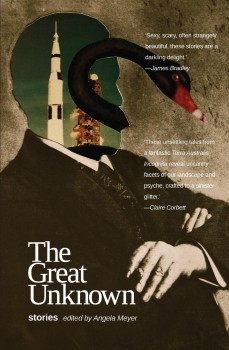
Angela Meyer, The great unknown

Courtesy: Spineless Wonders

The great unknown is a mind-bending collection of short stories which explores, as editor Angela Meyer says, “the unknown, the mysterious, or even just the slightly off.” I was, in fact, expecting more horror, thriller even, which are genres that don’t really interest me, but this collection is not that. There are some truly scary scenes – so if that’s your bag then you’ll appreciate this collection – but many are more subtly mysterious, giving the collection a broader appeal.

There are nineteen stories, most of which are the result of Meyer’s direct invitation to some favourite authors. Six, though, come from the shortlist for the Carmel Bird Short Fiction Award, 2013, of which Meyer was the judge. The invited authors were given the same brief as that for the competition, which was to write a story inspired by the “fifth dimension”, that is, the world found in shows like The Twilight Zone and The X-Files where inexplicable things happen. The result is a collection of stories that vary greatly in setting, voice, subject matter – and even tone. Some are funny, some sad, most are disconcerting and some, of course, are scary.

The collection starts in a suitably creepy way with Krissy Kneen’s “Sleepwalk” in which the protagonist, Brendan, wakes up in the middle of the night to find his partner, Emily – the sleepwalker of the title – missing from their bed. This doesn’t sound particularly unusual, except that upon investigation Brendan discovers Emily intently taking photos – and not with a modern digital camera, but one requiring “real” film. When developing the photos, they see a blurry grey figure. Who is it? What does it mean? To find out you’ll have to read the story – but I can say that it provides a perfect opener to a collection of stories in which the relationship between a couple is a common springboard. After all, where better to explore the inexplicable but in that closest of human relationships, the one in which love and hate, trust and fear, so often collide.

Several of the stories confront contemporary dilemmas. One of my favourites, and winner of the Carmel Bird Award, is Alexander Cothren’s “A Cure”, a truly disturbing Twlight-Zone-like story about a treatment, the appropriately named MindFi, for compassion fatigue. Another TZ-like story I enjoyed is Guy Salvidge’s “A Void”, which is also futuristic and drops us into a world of “Seekers” and experimental drugs. I’m not sure why I enjoyed these TZ-like stories because it was a Twilight Zone episode that set off the most distressing period of my childhood. I’m sure it was that show that turned me off horror for life – quite the opposite reaction to Angela Meyer’s it seems!

Another clever story, and one with an unexpected narrative point of view, is Mark O’Flynn’s “Bluey and Myrtle” about a caged bird and his old mistress. Both have lost their loves and are lonely, but it’s the self-aware bird who takes things into his own hands. Growing older is also the theme of Susan Yardley’s “Significance” in which a woman’s sense of invisibility and irrelevance manifests itself physically. As a woman of a certain age, I can relate to that (though fortunately not within my own family). This story reminded me of Anne Tyler’s novel Ladder of years, except that Tyler explores her theme without resorting to the “fifth dimension”.

Before I stop picking out favourite stories, of which there are several more, I’ll just mention PM Newton’s “The Local” which perfectly captures life in a remote country town and the dangers that lie within. There are of course stories that I didn’t like as much. For me, the writing in Chris Flynn’s “Sealer’s Cove” was too self-conscious and the time-travel story didn’t grab. And Ali Alizadeh’s satire on the Oprah Winfrey-Lance Armstrong interview in “Truth and reconciliation” was a good idea and funny to a point but a little too heavy-handed for my tastes. Satire is like that, I suppose.

An important part of editing a collection is ordering the contents. Meyer has done a neat job of placing the stories in an order that seems natural and thereby enhances our reading. For example, two outback stories featuring missing people, PM Newton’s “The Local” and Rhys Tate’s “The Koala Motel”, one set in a pub and the other a motel, are placed together. And Paddy O’Reilly’s “Reality TV” is followed by the TV-set show, Alizadeh’s “Truth and reconciliation”. It, in turn, is followed by Guy Salvidge’s “A Void” in which drugs feature. Three stories in a row – by Marion Halligan, Susan Yardley and AS Patrìc – feature missing or disappearing women. Put this way, it sounds a little mechanistic but in fact it provides a subtle underlying coherence to what is a highly varied collection.

Meyer concludes the collection with Ryan O’Neill’s “Sticks and Stones” in which a reader, who smugly comments that “characters in ghost stories behaved as if they’d never read ghost stories”, becomes haunted, hounded even, by words. They move, follow and curse him … words, indeed, are dangerous. Be afraid, be very afraid – but don’t let that put you off reading this book! It’s well worth the odd heart palpitation.

awwchallenge2014Angela Meyer (ed)
The great unknown
Strawberry Hills: Spineless Wonders, 2013
177pp.
ISBN: 9780987447937

(Review copy supplied by Spineless Wonders, via Angela Meyer)

Barbara Baynton, Billy Skywonkie (Review)

awwchallenge2014Well, I must say that “Billy Skywonkie”, my fifth* story from Barbara Baynton’s Bush studies, fair near defeated me, so I was rather relieved to read in Susan Sheridan’s introduction that “in this story and others, Baynton’s use of dialect to represent the speech of these uneducated bush folk can also act as a barrier to understanding”. I did understand it, but only just in places. I reckon it would be a good one to hear in audio version.

The story concerns a woman from the city coming to work as “a housekeeper” on a station in drought-ridden outback Australia. It starts on the train, in which she travels with a bunch of drovers accompanying their cattle. En route several cattle die in the heat and squash of their carriage, and the drovers make no attempt to speak nicely to the woman sharing their journey. This sets the scene for the coarse speech, lack of any sort of chivalry, and racist attitudes that feature in the rest of the story after she is picked up by rouseabout Billy Skywonkie in the buggy.

On the first page, Baynton describes the country our female passenger is coming to:

The tireless greedy sun had swiftly followed the grey dawn, and in the light that even now seemed old and worn, the desolation of the barren, shelterless plains that the night had hidden, appalled her.

As she alights at the Gooriabba siding her dismay – and hesitation – as the train disappears in the distance is palpable. There is a buggy waiting but, although she is the only person to alight, the driver seems not to recognise that she is his passenger! We’ve been given no description of our passenger – we have no idea how old she is, what her background is, or why she’s coming outback –  but clearly she’s not the “piece” Billy was expecting. “There’ll be a ‘ell of a row somew’ere” he rather ominously pronounces.

Most of the rest of the story concerns the 12-mile trip – perhaps a bit more given Billy’s shortcut to the “shanty” – to the station. Nothing that happens on the trip goes anywhere near reassuring our passenger or, in fact, the reader, that things are going to get better. Billy evinces no kindness to his charge – leaving her sitting in the hot buggy while he has a drink and a flirt with Mag in the shanty – though he is kind to the drunk kangaroo-shooter collapsed in the sun outside the shanty. That’s telling.

This is racist country. Chows or Chinks in particular are not liked. “Blanky bush Chinkies! I call ’em. No one can tell them apart”. Billy would rather “tackle a gin as a chow any day”, and we soon learn why. His missus, Lizer, is “dusky”, and has him under her thumb, though not enough to prevent his little side-trips to Mag!

There’s rough humour here. The characters tease Billy Skywonkie (whose name apparently means “weather-prophet”) with the question, which they find hilarious, “W’en’s it goin’ ter rain?”. There’s no lightness in the story’s humour though. It’s mostly bitter, unkind stuff, as though the land doesn’t encourage any sort of empathy or genuine relationship. Baynton’s people in this story are not the heroic or tragicomic bushmen of Henry Lawson, Banjo Paterson and Adam Lindsay Gordon. They are, well, base – and the story’s unrelenting language leaves us in no doubt regarding how we are to read it.

When Billy finally arrives at the station with his charge, things do not turn out well, but why is something I’ll leave you to found out (by reading the story in the link below). My problem, though, is that not telling you why severely hampers my discussion of this story. It’s interesting that “Billy Skywonkie” is not as well known as “The chosen vessel” or “Squeaker’s mate” because its exploration of racism, in particular, must surely be pioneering. I certainly found it powerful when I realised what had been going on under my nose! It may be that the challenges involved in reading it, and the ambiguities it contains, put readers off, but it deserves wider readership and attention.

And now, I have one story to go to complete my reading of Bush stories. What an interesting and eye-opening collection it is for one used to romanticising the bush!

Barbara Baynton
“Billy Skywonkie”
in Bush studies
Sydney University Press, 2009
ISBN: 9781820898953

Available online: in Bush studies at Project Gutenberg.

*For my previous reviews of stories in this book, click the appropriate title: A dreamerScrammy ‘and, Squeaker’s mate, The chosen vessel.

Catherine McNamara, Pelt and other stories (Review)

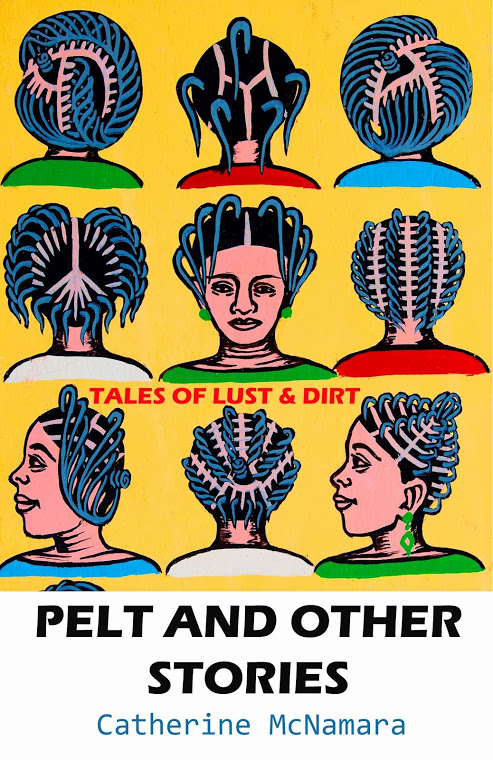
Catherine McNamara, PeltIt seems fitting that my first review of the year be for a book of short stories by one of this blog’s regular commenters, Catherine McNamara. I have reviewed McNamara before, her first published novel, The divorced lady’s companion to living in Italy. McNamara  describes that book as commercial fiction. It is, to describe it differently, chicklit for the mature woman – and is a fun read. However, Pelt and other stories is a different thing altogether. It represents, McNamara has said, where her real writing love is – literary short stories.

You will hear from Catherine herself soon in the form of an author interview on the blog, but by way of introduction now, she is an Aussie expat who left Australia as a student a couple of decades ago. She now lives in Italy but has lived in other parts of Europe and for several years Africa. All this is reflected in her stories which have Australian, European and African settings. As with many short story collections, several of the stories have been published elsewhere, on-line and in print. Her story “Coptic Bride” was published in Giramondo‘s now-defunct, but admired, literary magazine Heat.

The first thing to say about McNamara’s writing is that it is not spare. Her exuberant use of imagery reminds me at times of  the early writings of Thea Astley and another expat, Janette Turner Hospital, both writers who have reveled in colourful, figurative language, albeit to different purposes. Occasionally the imagery can feel a little overdone, but I love their freshness, love the risks McNamara takes. The next thing to say is that her subject matter tends to revolve around sex. The book is, after all, subtitled “tales of lust and dirt”. In McNamara’s work, sexual passion represents the best and worst of what life has to offer. And, given that there’s more drama in the worst or the problematic, it is this – in the form of violence, incest, jealousy and infidelity – that we mostly find in Pelt and other stories. Thirdly, McNamara mixes up her narrative voice. She uses first and third person, and she writes in a variety of voices, including, for example, a white gay male and a black female. This keeps you on your toes. You never know who the next characters will be, and where they’ll be from. I like that.

While Pelt and other stories is a collection, several stories are connected, which makes the order of the stories particularly interesting. I suspect ordering stories in a collection, which I discussed briefly in my review of Knitting and other stories, is one of the trials of preparing a short story collection (or anthology). Do you match or contrast tone or themes? Do you put related stories together? The truth is that it probably matters less to the reader than the writer/editor thinks, as readers will often pick and choose. However, with single-author collections, my practice is to read, from the beginning, in the order presented. And this is where the fun started with Pelt and other stories. There are, for example, sly connections in which a character – Nathalie for example – is an important subject in one story (“Nathalie”), but then appears as a passing reference elsewhere. Other stories have stronger connections. I was particularly intrigued by McNamara’s presentation of three of these – “Opaque”, “Where the wounded go” and “Volta”. They don’t appear consecutively, and when they do appear it is not chronological. I’m not sure what McNamara’s intention was in this, but for me it replicates the way we get to know people. We meet them at a point in time, getting to know their current lives, while gradually learning their back story. In a collection that ranges widely in character and location, the connections can be grounding.

What I particularly like about the stories is their honesty. McNamara doesn’t flinch from letting her characters express their (our) meanest, least generous thoughts. Love, McNamara shows, can make us selfish, desperate, and sometimes cruel. In the first story, “Pelt”, the animality of lust is palpable as a pregnant black mistress stands her ground, fighting for her rather weak, German lover against his barren wife. Many of her stories are about compromised relationships and the accommodations made, by one or both parties, to keep them going. “The Coptic Bride” is one of these, as is “Opaque” in which a woman’s love for her man is tested against her sense of morality, of what is right:

But if she called, it would perforate all that she held close to her. It would cost her her life.

Do you think she made that call?

awwchallenge2014These are unsettling stories about characters struggling to survive in a precarious world. Europe’s colonisation of Africa shadows the book. Many of the relationships are mixed, and in most stories there is power imbalance, and hints of exploitation. It’s there in “Pelt”. In “Janet and the Angry Trees” a sex-worker is taken to her Italian lover’s family home to look after his parents, and seems to accept the pittance of attention she gets from her still-married lover. It’s in the little piece “Innocent” about a taxi driver, his white employer and his pregnant teenage girlfriend, and in “Infection” in which a brother receives a western education while his sister “received no education, cursory love, much admonishment”. There’s a suggestion in some stories of stereotyping – you know, the lusty, sensual black woman and the unfaithful white man looking for “a bit” on the side – but the relationships are more complex than that. Overall, I’d say that the stories are more about humanity than about politics, while recognising that politics has contributed to the uncertainty of the world the characters inhabit.

A recurring motif in the book is the photographer. McNamara seems to view photographers with suspicion. At least they tend not to be the most admirable characters in the stories in which they appear. They represent the disconnect between appearance and reality, and perhaps also the idea of exploitation. In “Gorgeous Eyes”, the narrator views photographs by the visiting famous photographer, Nina Cooke, seeing the truth behind the idealised images of “Dinka men – erotic in beaded body corsets”. He reflects that those in the know see something else, “a crucible of sadness”, in these images and concludes:

If Nina Cooke’s gift ever needed an honest name it would be the invasive branding of humble detail. It appears she is at the vanguard of a vulgar world trait.

These stories are not comfortable reading. Some make more sense to me than others. But McNamara’s voice is strong, her writing lively and her characters real. Pelt and other stories will linger with me for some time.

Catherine McNamara
Pelt and other stories: Tales of lust and dirt
Beaworthy: Indigo Dreams Publishing, 2013
204pp.
ISBN: 9781909357099

(Review copy courtesy the author)

Richard Rossiter (ed), Knitting and other stories (Review)

Richard Rossiter, Knitting

Courtesy: Margaret River Press

Short stories, I’ve decided, are the ideal reading matter for breakfast, so for the last couple of weeks I’ve been engrossed in Knitting and other stories, which contains a selection of stories from this year’s Margaret River Short Story Competition. The competition is new, having been offered for the first time last year. According to the Margaret River Press’s website, there were 260 entries. This book contains 24 of them, including of course the winner and runner-up, and four highly commendeds.

The collection takes its title from the winning story, Knitting, by Barry Divola. Divola is one of the only two names I recognise in the book, the other being Jacqueline Wright whose first novel, Red dirt talking, was published last year. Knitting is a rather apposite title because most of the stories are about characters whose lives are unravelling – or have unravelled – in some way. And not all manage, by the end of their stories, to knit themselves together again, which is realistic even if it makes us readers feel a little unravelled ourselves!

As I was reading the stories a few things became apparent. Most of them are by women (20 of the 24 in fact). Does this represent the gender ratio of stories entered? Not that it matters, but it’s interesting, partly because it also means that, with a few gender-crossing exceptions, most of the stories focus on women. I noticed some recurring themes, about which I’ll write more below. And, I became aware, through connections between theme, character and/or setting, that the order of the stories had been crafted. Rossiter’s introduction, which I read after finishing the book, clarified that he had indeed grouped stories together. I think it enhanced the reading. There is always a jolt when you move from story to story, particularly if you read them without a break. Grouping them not only lessens the jolt but somehow encourages the brain to think beyond the immediate story. Karen Lee Thompson who has also reviewed this book feels quite differently about “contrived” ordering.

Another thing I noticed was that the majority of the stories seemed to be told in first person. Fifteen of them in fact. One is told in second person, making eight in third person. Does this matter? Probably not. First person can provide a level of intimacy that you don’t quite get with the other voices and I enjoy that. But, when you read one after another, no matter how well written they are, all the I, I, I can feel a bit tedious, a bit self-involved. This is not a comment on the individual stories so much as on the impact of the whole. Fortunately there are some lovely third person stories in this collection to break up the I-ness! And Amanda Clarke, in “The girl on the train”, uses the second person effectively to convey the dissociation experienced by a woman grieving over her daughter’s death. Describing her grief as “a vicious sort of cling wrap”, she is both trapped in and standing apart from herself. The “you” voice captures this beautifully.

Now to that old problem of how best to review a collection. For this one, I think the best approach is through its themes, and I’ll start with the one that stood out for me – grief, grief for people who have died, or for broken relationships or lost opportunities. Kristen Levitzke’s “Solomon’s Baby” about a baby’s death is particularly wrenching, but there are stories about grandchildren and grandparents (Vahri’s “I shine, not burn” and Louise D’Arcy’s “Down on the farm”) and people grieving for lost time and opportunities (Jacqueline Winn’s “The bitter end”), to name just a few.  Other recurring themes are memory, growing up, ageing and, either explicitly or implicitly, time. Jacqueline Winn’s “The bitter end” starts:

Let’s not fool ourselves, time is not something to be negotiated. Time passes through us or we pass through time. No second thoughts, no second chances.

Family and family relationships are common subjects. In many stories, a parent is missing – either through death, or separation – creating a gap that can have lasting ramifications. One of my favourite stories in the collection is JS Scholz’s “Focus” about a young boy who’s on the run with his mother from his abusive father. Seen as a “hopeless” student who can’t “focus”, he uses his initiative to carry out a subversive action which shows his true character. In another favourite story, Kathy’s George’s cleverly named “A bend in the road”, the temporary absence of the father creates a tension between a mother and son. The daughter, though, sees the real issue:

“The family is a board game, a game with a missing piece … and nobody can play the game without the missing piece. Not properly anyhow.”

In some stories, it’s the chance meeting of strangers which throws light on the protagonists’ situations. Amanda Clarke’s second-person-story is one of these. In Kerry Lown Whalen’s “Notes in a scale” and Bindy Pritchard’s “The bees of Paris” the strangers are also neighbours.

While most stories are about character and family relationships, not all are. One such is John Dale’s “Expressway” which satirises the need to believe. It’s the story of a smudge on the wall of the Cahill Expressway which Francesca Lombardo believes is an image of the Virgin Mary. This sets in train a series of events including the removal of the section of the wall to Darling Harbour “which had better facilities and all day parking”. The government, talk shows, scientists, and social media are all targeted in this fun but pointed story about, at best, our desire for miracles and, at worst, our gullibility.

There is some lovely writing here, but I’ll just share two short examples. Dorothy Simmons describes the bush in her story, “Off the map”, about a young girl who is an orienteering champion:

All the little movements: lizard flicker, goanna slither, leaf rustle, sleek silvery trees posing beside slouching shaggy grey ones; cicada hum, magpie trill, whip bird …

The other is Paulette Gittins’ description in “Playing with Ramirez” of a gang of children coming down a Melbourne suburban street:

Down the street towards me a vaulting, whooping gang in stripes, red and black, blue and white, shrilling, colliding, hilarious; black-haired, scrawny, curly and nimble, they poured past.

As with any collection, some stories touched me more than others, but all have something to offer, something to say, about living and surviving in a world that for many, as Divola writes in the title story, “is too sharp [with] edges everywhere”. A most enjoyable read.

For other reviews of this collection which highlight some different stories, check out Karen Lee Thompson (in her review mentioned above) and Anne Skivington.

Richard Rossiter (Ed)
Knitting and other stories: Margaret River Short Story Competition 2013
Witchcliffe: Margaret River Press, 2013
319pp.
ISBN: 9780987218087

(Review copy supplied by Margaret River Press)

Murray Bail, Portrait of electricity (Review)

A couple of weeks ago I quoted Murray Bail on compser-house-museums from his latest novel, The voyage. But this isn’t the first time Bail has expressed his attitudes towards turning the home of a famous person into a museum. It was the topic of a short story, “Portrait of electricity” which, as far as I can tell was first published in 1975. And this story, I gather, was probably the inspiration for his novel Homesickness (1980) (though I haven’t yet read that).

I was tickled by the quote because in our recent overseas trip we’d visited the house where Beethoven was born and where Liszt spent the last twenty years of his life, not to mention the residences of writers Goethe and Schiller. We enjoyed visiting these places, because each was well presented providing us with insight into the lives of their erstwhile residents. We probably would have got that from a straight museum, of course, but a museum (usually) needs a building and if it is to be a dedicated museum, why not in a building connected to the subject? The question is, what do you put in that building and how do you present it? The temptation with using a building in which the person lived is to imbue it with an additional layer of “meaning” which can result in what Bail satirises – and that is excessive (defining this is a judgement call of course) reverence, the turning of the space into a shrine.

This is where “Portrait of electricity” comes in. That the story is satirical is pretty obvious from the opening sentences:

There were three guides. One did all the talking, the others nodded in agreement.

Three guides – with only one talking? What were the rest there for? To increase the sense of import?

The visitors/tourists are given special shoes (as we were given in Weimar’s Anna Amalia Bibliotek) but

inside, it was a museum like any other. The rooms strangely impersonal, exhibits arranged in cabinets against the wall, special objects located towards the centre.

It’s hard to imagine how Bail could fashion an 18-page story out of this premise but he does, and it engages. Sometimes you squirm, but other times, fortunately, you are able to adopt Bail’s satirical stance and see how ridiculous such museums can be when taken to extremes – and, being the good satirist Bail is, he takes the fascination for all things belonging to the revered person to rather grotesque extremes. But it would spoil the story to give away here just how far he goes.

The story also satirises the people who visit such museums, including little digs at different nationalities, at gender behaviour, and different tourist types (the sceptical, the smart alec, the unimpressed, the tired, and so on). People take photographs of the chair with its flattened contour “caused by his body weight”, “women put on the expression they use when choosing wallpaper”, and all follow the guides feeling as though they are drawing “closer to him, acquiring greater knowledge”. Meanwhile, the guide conjures up the man’s life in the house, reminding them that “his body travelled through what you see before you”. No object is too small to have meaning. When one visitor asks “Is that worth preserving?” (“that” being a fingernail), there is only one possible answer, “It’s part of him”.

Bail knows his museological stuff, because he also satirising sacred principles such as that of maintaining objects in “original state”. The question behind the satire is whether there should be limits to the collection and presentation of a person’s effects. This is a serious question, one faced by archivists and museum curators every day. Bail’s story is an effective reminder that common-sense should play a role in this decision-making.

I will leave it here. The items the guide draws their attention to become more and more peculiar if not downright absurd, the reliability of the guide’s analysis of the man and the import of the evidence becomes increasingly shaky, while the visitors feel (or hope perhaps) they are drawing towards “important, intimate knowledge”. Can we ever really know a person – famous or otherwise – through a bunch of objects they owned or used? This story is a great read, whether you work in museums or visit them. It may not change your mind about visiting such museums if, like me, you enjoy them, but it will make you think about them next time you do. And in our celebrity-focused, materialist culture that would be a healthy thing.

Murray Bail
“Portrait of electricity”
Published in:
Marion Halligan and Roseanne Fitzgibbon (eds), The gift of story: Three decades of UQP short stories (1998)
and in
Murray Bail, Contemporary portraits and other stories (1975) (and various other Bail collections)

Dorothy Johnston, Eight pieces on prostitution (Review)

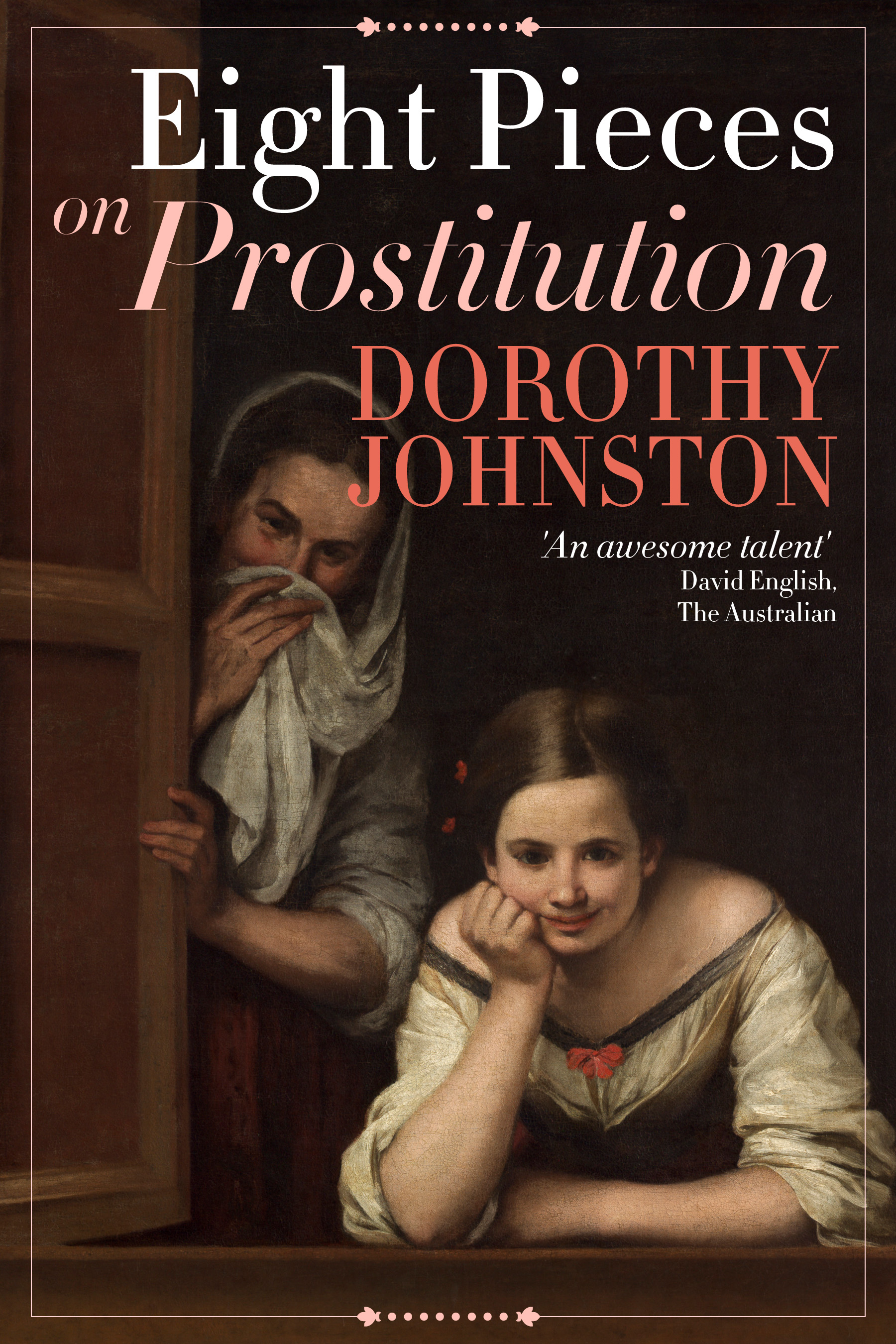
Dorothy Johnston, Eight pieces on prostitution book cover

Lifted, with approval I hope, from Johnston’s website

A few months ago I wrote a Monday Musings on the Australian Society of Authors’ digital publishing initiative, Authors Unlimited e_Book portal. At the time I decided to try it out and bought Dorothy Johnston‘s collection of short stories, Eight pieces on prostitution.

The collection comprises 7 short stories and a long story or novella. One of the stories, ‘Mrs B’, I read earlier this year in Meanjin‘s Canberra edition. Some of the other stories have been published before too: ‘The Man Who Liked To Come With The News’ (The State of the Art, 1983), ‘Commuting’ (Island, issue 52, Spring 1992, and elsewhere), and ‘The Studio’ (Southerly, Winter 1996).

The first thing I should say about this collection is that it is not salacious reading. That is, it’s not erotica. Johnston’s interest is the lives, the experience, of prostitutes as people. Who are they? Why are they doing what they are doing? How do they negotiate their relationships, professional and personal? How do they live the life they’ve chosen and are they happy?

Johnston’s prostitutes are neither glamorous nor tarty, and most work for themselves or in small establishments. They are not the prostitutes of popular imagination. That is, they tend not to work in fancy parlours under control of a madam nor in that sleazy underworld borderland managed by pimps. They are, instead, either ordinary employees or small businesswomen. Some are career prostitutes, others are university students or single mothers who need to support themselves, while still others, like Eve in ‘The Studio’, are a little more mysterious:

She lives in a small flat. She chose the national capital because she imagined it to be a city where she could fade into the background, where she could hide.
Johnston’s characters are often wistful or even a little sad, but they are never pathetic. They are intelligent, and Johnston respects not judges them. They are not powerless, either, though sometimes the power they have is limited to their domain and can be tenuous. They can be a little lost, or perhaps just at a cross-roads in their lives. Maria in ‘The Cod-piece and the Diary Entry’ is uncertain about the world and her place in it. She thinks, when she moves and loses a client:
Looking back, she could not shake the feeling that she’s been on the point of understanding something important while in Harry’s company, that understanding had been no more than a breath away.
Sandy in ‘Names’ admires university student Gail’s strength and resilience:

She never let herself fall into a chair like I did when she came back from a client, slumping my stomach and letting the smile drop off my face.

There is a continuity between these characters and the three women in her novel The house at number 10 which I reviewed earlier this year. Like Elizabeth Jolley, Johnston is not afraid to re-use or develop characters across her oeuvre. I rather like that.

The pieces are set in places known to Johnston – Canberra and Melbourne. We get a clear sense of those cities, but even more we are let into the rooms the prostitutes inhabit – the ones they work in, the ones they relax in between clients. We learn about the things that are part of their daily routine. Sophie, for example, in ‘Commuting’, finds that when she steps outside work
petrol fumes are a relief after hours of perfumed towels and bubble bath.
The final piece is the novella ‘Where the Ladders Start’. The title comes from Yeats’ poem, ‘The Circus Animals’ Desertion’:
I must lie down where all the ladders start
In the foul rag-and-bone shop of the heart.

It concerns a three-woman brothel established by Sue, who’d been dreaming for years of a “better system”. It’s “a co-operative … Tough that word, but they’d risen to its challenges”. Now though, the dream is being severely tested as they cope with the death of a client, on the first page, from erotic asphyxiation, “the choking game”.  The story explores the “one for all, all for one” ideal. Are there limits to trust, and how far should you take loyalty, particularly when it starts to be to your own detriment? Johnston sets the story at the beginning of the new millennium adding an ironic overlay to the situation confronting the women. What sort of millennium are they setting up for themselves by their response to the death?

As in all her stories, Johnston’s view of human nature here is warm but realistic, clear-eyed. She pits the “never let a chance go by” attitude against the desire to protect, care and trust, and then tests that against the need for self-preservation.

Johnston’s language is a delight to read. She’s precise but expressive, using imagery with a light touch:

The freedom to ask each other questions danced and shimmied in the air.

She can be quietly ironic:

Laura went on sitting in the kitchen like a Buddha, or more accurately a simpleton, a girl who’d left her mind someplace and forgotten to go back for it.

Is Laura simple or not is the question we ponder through most of the story.

In dealing with a mysterious death, “Where the Ladders Start” introduces us to that other string on Johnston’s writing bow, the crime novel. It’s a clever story, well-plotted, nicely maintaining a tension between mystery and clarity. Like most of the stories, there’s no simple resolution. Life, Johnston shows, is a messy business.

You’ve probably gathered by now that I thoroughly enjoyed this collection. While there is a commonality between the women, giving the collection a lovely coherence, there is also difference. Each character is unique, each story engaging. If there’s an overall theme, it is one of survival, or perhaps more accurately, resilience. Her women get on with life. They make decisions, some good, some bad, some we are not sure about, but, and here’s the important thing, they don’t stand still. Do read it. At $9.95, I reckon this is a steal.

Dorothy Johnston
Eight pieces on prostitution
Australian Society of Authors, 2013
202pp.
Availability: Online download for $9.95 from the ASA site

Romy Ash, The basin (Review)

Romy Ash has made quite a splash with her debut novel, Floundering. It was shortlisted for the Stella Prize and the Miles Franklin Literary Award, among others. I  haven’t read it yet, but I have read a couple of her short stories that have appeared in the Griffth Review, one of which is “The basin”.

Lake Argyle

A tiny section of Lake Argyle

For those who don’t know, the Griffith Review is published quarterly, with each issue focusing on a particular theme. The issue “The basin” appears in is titled “What is Australia” which is rather apposite given my Monday Musings post this week on Writing the Australian landscape. Ash doesn’t identify the “place” in which the story is set, beyond telling us that there’s a dam which is described in a pamphlet as “the biggest inland body of water in Australia”. Well, that gives it away. It is clearly inspired by Lake Argyle in the Kimberley region of northern Australia. The lake – an artificial one created by damming the Ord River – is huge. I’ve never seen a lake (in Australia anyhow) quite like it.

Ash’s story is about Jess who has come to the region with her husband, Max, and their daughter, Frankie. Jess is not happy, something that is physically represented by her increasing weight: “every bit of her wobbled”, “Sitting there Jess felt fatter”, “her thighs rubbed together”, and so on. “You were skinny, before”, an old farmer tells her.

Max, however, is happy. “We’ve never done so well”, he tells her. But all is not well in this man-made Eden (there are sly references to “apples”) and not all men are happy. It’s not normal for this “dry country” to have so much water. A farmer tells them:

The most beautiful country you’ve ever seen, gone. Them gums, they’re drowned under there. Ever heard a gum drown?  They creak. All the animals. It’s not like fire – them animals can’t sense it coming – they was drowned, sure enough. The surface of the water was just insects. Snakes curled and died. They washed up at the sides. It didn’t look like it does now. It was putrid.

Putrid perhaps, but natural is the implication. I have written about the drowning of this landscape before in my post on Mary Durack’s poem “Lament for a drowned country”. The Duracks’ own homestead was drowned to create Lake Argyle.

Australian Women Writers ChallengeAsh uses feminising imagery to tell her story – with many references to the colour “pink” (galahs, inside of mouths, sunrise, hams) and to the “basin” of the title. Water, often a literary device associated with life, is a complex image in Ash’s story. People are told not to swim in the dam because it’s the town water. Jess and Frankie do, but then Jess will only drink bottled water, refusing to drink the town water. Understandably! A different sort of water features in the story’s resolution.

Although Ash doesn’t explore it, she reminds us of indigenous people’s association with the land when she says that “after the flooding the town had been renamed Burrngburrng-nga, an Indigenous name. Every time she heard someone say it they pronounced it differently and quietly, unsure.” Google tells me that it means “The water boiled” in the Wagiman language (from Katherine in the Northern Territory).

This is a story about the costs – personal and environmental – of mankind’s belief in its ability to control nature. It’s about values, and whether making money is enough to sustain happiness. It’s about the unhappiness that can result when people are dislocated from their roots – either because they move or because their place has been changed beyond recognition. Place – it has such a complex relationship with our physical, emotional and/or spiritual well-being, doesn’t it?

It’s not a particularly dramatic story, but it is a quietly effective one that I can see fitting nicely into a volume intended to encourage us to think about “What is Australia”.

Romy Ash
“The basin”
Published in the Griffith Review, Edition 36, Winter 2012
Available: Online at the Griffith Review

Willa Cather, Peter (Review)

Surely a whole year can’t have passed since I last wrote about a Library of America short story? But yes, it has. My last one was Robert Frost’s “The question of a feather” in July last year. Many times I’ve chosen one to read, and many times I’ve let other things get in the way – but finally I sat down to read a short piece by Willa Cather, one of my favourite American writers. The story is “Peter” and was apparently her very first published piece. It was published when she was 19 as the result of her university professor sending it off to a magazine.

LOA’s notes, as usual, provide some interesting background, including the information I’ve just provided above. They say that she went on to publish it two more times in 1892 and 1900, each with some revisions, and then incorporated its essence into her novel My Antonia which I’ve reviewed here. No wonder it felt familiar!

English: Willa Cather's childhood home in Red ...

Willa Cather’s childhood home in Red Cloud, Nebraska. (Photo courtesy: Museumsparrow via Wikipedia)

It is, essentially, a character sketch. Its focus is Peter, an old man – now 60 – who emigrated to Nebraska from Bohemia with his wife, oldest son Antone, and other children five years before the story starts. In Bohemia, Peter had been a second violinist “in the great theatre in Prague”.  Without belittling the important role of second violinists, I think in terms of Cather’s story, “second” is meant to convey something about Peter:

He could never read the notes well, so he did not play first; but his touch, he had a touch indeed …

Why he could never read the notes well, we are not told, but we can guess because his neighbours in Nebraska see him as “a lazy, absent-minded fellow”. In fact, it is his son who runs the place:

… people said he was a likely youth, and would do well. That he was mean and untrustworthy every one knew, but that made little difference. His corn was better tended than any in the country, and his wheat always yielded more than other men’s.

There is no love lost between these two rather unappealing men. The story starts with Peter telling his son that “thou shalt not sell it [the violin] until I’m gone”. From his son’s point of view, Peter can no longer play due to trembling and the money would be useful. For homesick Peter though it’s his link to happier times. He doesn’t like “the country, nor the people, least of all he liked plowing”. Cather’s characterisation is effective. We are forced to choose between the hard but hardworking Antone who is trying to support the whole family in a harsh land, and the rather pathetic Peter who, even in his past, was “a foolish fellow, who cared for nothing but music and pretty faces”. Antone and Peter are set up as foils for each other, opposites, and Cather wants us, I think, to see and understand but not judge.

This is a classic migrant story, in which the old find it harder to adapt than the young, for whom the immigration was usually made in the first place! It’s also a father-son/generational clash story. Neither understands each other, and neither seems inclined, it seems, to make many concessions. Given all this, the ending is both shocking and not surprising.

It’s an impressive debut for a 19-year-old writer. However, according to LOA’s notes, Cather regretted allowing her professor to publish it before her style matured. Her biographer Phyllis Johnson wrote that the older Cather “warned aspiring young writers against too early publication”. I wonder why? What damage does she think it did to her? As a reader, I love having access to early works like this – or, to say, Jane Austen’s juvenilia. They illustrate, as LOA suggests, the writer’s “the literary journey”.

What do you think? Do you like to read early/youthful works of favourite writers, or would you rather only read their mature works?

Willa Cather
“Peter”
First published: The Mahogany Tree, May 1892.
(Published several times after this, in various revised versions)
Available: Online at the Library of America

Barbara Baynton, A dreamer (Review)

Finally, having reviewed three stories in Barbara Baynton’s collection Bush studies, I start at the beginning with the story “A dreamer”.

This story is a little different to the three* I’ve reviewed to date, primarily because men do not play a significant role in the action or denouement of the plot. The plot is a simple one: a young pregnant woman arrives at a remote railway station, at night, expecting to be met by someone with a buggy. When that proves not to be the case, she decides to walk “the three bush miles” despite the windy, rainy night because it was “the home of her girlhood, and she knew every inch of the way”. Except …

… as it turns out, on a dark rainy night, she doesn’t. Baynton recounts the drama of the young woman’s walk – a wrong choice at a fork, near drowning on a creek crossing – and in the process idealises the mother-child relationship against hostile nature:

Her mother had planted these willows, and she herself had watched them grow. How could they be so hostile to her?

How indeed? This story is another example of Baynton’s gothic, of her non-romantic view of the Australian bush which is, for her, alienating and forbidding, particularly for women. If the language of the opening paragraph is unsettling – “night-hidden trees”, “closed doors”, “blear-eyed lantern” – it only gets worse as nature seems to conspire against the woman. The wind fights her “malignantly” and the water is “athletic furious”, but the woman sees “atonement in these difficulties and dangers”. Atonement for what is not made quite clear but it might simply be that the young woman has been away for some time: “Long ago she should have come to her old mother”. Visions of her mother and memories of her childhood keep her going: “soft, strong arms carried her on”. To avoid spoilers, I’ll leave the plot here. You can read the story at the link below.

In my last post on Baynton, I wrote briefly on reading short story collections in the order they are presented, rather than in the ad hoc way I’ve done with this collection. Mostly, I do read collections from beginning to end. Had I done so with this collection, I would have had, with this story, an effective introduction to Baynton’s style and themes without being confronted with her full fury. In other words, “A dreamer” is the perfect first story in a collection which ends with “The chosen vessel”*.

Barbara Baynton
“A dreamer”
in Bush studies
Sydney University Press, 2009
ISBN: 9781820898953

Available online: in Bush studies at Project Gutenberg.

This review will count towards my Australian Women Writers Challenge 2013.

*For my first three reviews of stories in this book, click the appropriate title: Scrammy ‘and, Squeaker’s mate, The chosen vessel.

Barbara Baynton, Scrammy ‘and (Review)

Barbara Baynton.

Presumed Public Domain: via Wikipedia

Back in November, Trevor at Mookse and the Gripes, decided that rather than write a single review of Alice Munro’s latest collection of short stories, Dear life, he would, over a period of time, read and review the individual stories.  Now, there’s something to be said for reviewing a collection of short stories as a collection because authors do put a lot of effort into the order of those stories. Reading them over a long period of time or, worse, out-of-order, could disrespect the author’s art. However, reviewing each story individually, enables us to give each one real recognition, and that has its value too methinks. Anyhow, this is what I’ve decided to do with Barbara Baynton‘s collection, Bush studies. I have, so far, reviewed the second story, “Squeaker’s mate”, and the sixth and last story, “The chosen vessel”. Today I’m going to review the third story, “Scrammy ‘and”, partly because Debbie of ExUrbanis likes it. Next, maybe, I’ll start at the beginning! I hope Baynton isn’t turning in her grave.

In her post on Australian classics for the Australian Women Writers Challenge 2012, Australian novelist Jennifer Mills wrote of discovering Barbara Baynton, saying that reading her was “an absolute pleasure”. She wrote:

Her work is distinguished by her rural character studies and a poignancy which verges on despair, and her stories are prototypes for the proliferation of outback gothic in our literature now. Baynton is part Henry Lawson, part Eudora Welty, and a master of the tension and texture of the short story form.

I couldn’t say it better myself! Mills’ comment that Baynton’s a master of “tension and texture” in the short story form is particularly true for “Scammy ‘and” because this story commences, quite deceptively as it turns out, with a fair dose of humour. It concerns an old shepherd and his dog Waderloo (Waterloo). The story starts with a flashback to a few weeks previously when the old man’s neighbours had headed into the nearest town to await the birth of their first baby (which, the old man thinks, “will be a gal too, sure to be! Women are orlways ‘avin’ gals. It’ll be a gal sure enough”.) The story then jumps forward to when the old man, having notched up the passing weeks, expects the young couple, who clearly provide some sense of security, to be back.

The humour in the first part of the story derives from Baynton’s description of the relationship between the man and his mate Waderloo as they go about their business. Here for example is the man talking to the dog about fixing a hat:

‘It’s all wrong, see!’ The dog said he did. ”Twon’t do!’ he shouted with the emphasis of deafness. The dog admitted it would not …

… and so on. The man and his dog resemble a Darby and Joan pair, dependent on each other, loyal to each other, but also having their little tiffs. However, underlying what seems like a light-hearted character study are intimations of something darker. First there’s the misogyny which features regularly in Baynton’s work. The old man is critical of the young woman despite her apparent attempts to help him, including fixing the hat. “‘The’re no good'” he says of women. This misogyny becomes more pointed in the parallel story of the man’s irritation with the ewe whose “blanky blind udder” means she can’t feed her “blanky bastard” of a lamb, and that he must feed it. Later on though the ewe is shown to be perfectly capable of teaching her lamb to drink.

But, there are intimations of other menace too.  Things are awry at the farm – including a tomahawk and an axe gone missing. Scrammy is mentioned in the second paragraph. The old man says:

”twarn’t Scrammy.’ But the gloom of fear settled on his wizened face as he shuffled stiffly towards the sheepyard.

As the story progresses, our disquiet increases, though for a while we are not quite sure where the problem is – is it an external threat or is it internal? The old man suspects “ther blacks”, “not poor ole Scrammy, ‘cos Scrammy wouldn’t ‘urt no-one”.  Baynton builds the tension slowly, but gradually, inexorably, it becomes clear – and halfway through the story the perspective shifts from the old man to the vagrant one-handed Scrammy, who’s seen the old man counting out his money. The menace grows. It’s melodramatic and almost a comedy of errors as Scrammy misreads clues … but I’ll leave the plot here.

Again, there’s none of Lawson’s pioneer romanticism here. Rather, this is a powerful story about refusing to see the truth –  or perhaps being scared of the truth. It’s not only the old man’s aloneness that makes him vulnerable but his prejudices. In the end, we see that wisdom is, in fact, more likely to be found in the ewe and the mother.

Barbara Baynton
“Scrammy ‘and”
in Bush studies
Sydney University Press, 2009
ISBN: 9781820898953

Available online: in Bush studies at Project Gutenberg

This review will count towards my Australian Women Writers Challenge 2013.