Ted Chiang, Story of your life (or, Arrival) (Review)

Image for Story of your life

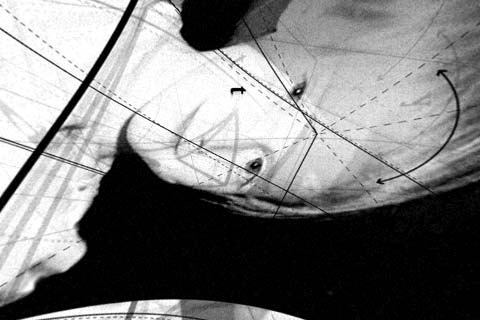
Illustration for “Story of your Life”, by Hidenori Watanave for Hayakawa’s S-F Magazine. [Permission from the artist: CC BY 2.0, via Wikimedia Commons]

Whenever I see a film, I go to Arti’s Ripple Effects blog to see whether she’s reviewed it. Sometimes she has, sometimes she hasn’t. As with books, I don’t read reviews before I see films, so I can never remember whether I’ve seen a review post pass through my inbox. Consequently, when we saw the intriguing, mind-bending sci-fi film Arrival, recently, I had to see whether she’d reviewed it, and she had. She had also provided a link to the long short story from which the film was adapted. The story, Ted Chiang’s “Story of your life”, won the Nebula Award in 2000. Having enjoyed the film, but having questions about its meaning, of course I had to read it. What a fascinating story it is …

But here’s the thing … I usually prefer to read a book or story before I see its adaptation. I don’t hold fast to this rule, particularly if it’s something I probably wouldn’t have read anyhow, like, say, Girl on a train, but if I have an interest in it, reading-before-seeing is my preference. This didn’t happen – obviously – with Arrival, mainly because I hadn’t realised it was an adaptation. So, when I set off reading “Story of your life”, I had the movie freshly in my head. Not ideal and a little distracting at first, but in fact, as I kept reading, I realised that the movie was a “true” adaptation, and I relaxed into the story.

The set up is simple enough. A bunch of aliens – dubbed “heptapods” by the humans because of their octopus-like tentacles – have landed in various spots around the world, including nine locations in the US. They do not appear to be aggressive, but why are they here. The world’s governments naturally wish to discover their purpose, and so they send physicists and linguists to try to find out.

Now, here’s the challenge, as Arti also says in her post: how do we talk about this story without giving some critical things away, because this is one of those stories where much of the meaning is in the telling, even if you don’t know it at the beginning. Arti handles this challenge by talking more about the adaptation, which was indeed well done. I, however, will take a different tack and talk more generally about why I liked the story.

I said at the beginning that I’m not really into sci-fi. I’m not keen on quest films or invasion battle scenarios, but there are sci-fi stories I’ve enjoyed, and they tend to be ones which focus closely on human concerns and issues rather than on fantasy or adventure. I’m talking John Wyndham whom I enjoyed in my teens, and Kurt Vonnegut’s Cat cradle which I read in my twenties. “Story of your life” fits loosely into this sort of sci-fi (in my mind anyhow).

The story is narrated by linguist Dr. Louise Banks, but in two threads. One is the chronological (sequential) story of her work with the heptapods, told in a traditional first person voice, while the other, which jumps around in time, comprises her memories of her daughter who we learn early on dies in her 20s. It’s also told first person, but addresses “you” as if telling this daughter about her life. There are, as you’d expect, connections between the threads, so that the transitions reflect or expand on ideas developed in the other thread.

It’s an intelligent story that demands intelligence of its readers. Chiang uses words and concepts from physics and linguistics and expects us to keep up. The discussions of Fermat’s Principle, for example, and of causal and teleological ways of understanding the world, not to mention of various linguistic forms, demand concentration of the reader, concentration that I might not, in another situation, have been bothered with – but the writing is so clear, and the story so intriguing, that I stuck with it. Here, for example, is Louise’s description of heptapod writing (which was beautifully depicted in the film):

When a Heptapod B sentence grew fairly sizable, its visual impact was remarkable. If I wasn’t trying to decipher it, the writing looked like fanciful praying mantids drawn in a cursive style, all clinging to each other to form an Escheresque lattice, each slightly different in its stance. And the biggest sentences had an effect similar to that of psychedelic posters: sometimes eye-watering, sometimes hypnotic.

One of the things I particularly enjoyed was the exploration of the idea that the language we use correlates closely with how we think. (Not a new idea I know but the implications are interesting here.) So, as Louise starts to learn the aliens’ language, dubbed Heptapod B, she finds herself starting to think differently. Instead of thinking in the traditional human “sequential” (cause-and-effect or linear) mode of awareness, she starts to appreciate the heptapods’ “simultaneous” mode of awareness in which they “experienced all events at once, and perceived a purpose underlying them”.

I found myself in a meditative state, contemplating the way in which premises and conclusions were interchangeable. There was no direction inherent in the way propositions were connected, no “train of thought” moving along a particular route; all the components in an act of reasoning were equally powerful, all having identical precedence.

It’s the idea that you have to know the effects before you can know the causes, that all the components of an action or event, in other words, are simultaneously there. I did say mind-bending didn’t I?

Anyhow, I expect the non-linear/non-chronological second thread of her narrative is meant, in part anyhow, to reflect or illustrate this more holistic or teleological way of thinking.

Ultimately, “Story of your life” is a philosophical story that gets to the nub of how we understand time, of what we know, of what we can (or would change) if we could. And that’s about as close as I’m going to get to giving it away. I do recommend you read the story and see the film.

Christina Stead, Ocean of story, Pt 1: The early years – Australia (Review)

Christina Stead, Ocean of storyContribution no. 2 for Lisa’s Christina Stead Week from Ocean of story: the uncollected stories of Christina Stead.

My first post was on the titular story, “Ocean of story”, which is also used as the collection’s Introduction. After this Introduction, the stories have been organised into 7 sections by editor RG Geering. These sections are presented chronologically, Geering says, reflecting Stead’s timeline, not when they were written. The first is, therefore, logically titled “The Early Years – Australia”. It contains three stories – “The old school”, “The milk run” and “A little demon” – all of which have children as their central subject, which is, perhaps, interesting given Stead had none of her own.

Now, if you ever went to primary (or elementary) school, and that’s all of you I presume, you will enjoy “The old school”. If you were a girl, you’ll probably enjoy it even more. “The old school” was, Geering says, one of the few things Stead worked on in the last years of her life. It was published in Southerly in 1984. It’s like a little slice of life, and like the other two stories, starts with a fairly detailed setting of the scene before she gets to her main subject matter.

So, “The old school” starts with a description of the school, followed by a description of what happens at the school, or, more precisely of what the rumours say happens. But, we are told, in spite of this, “cause and effect” are clearer at school than at home, and “mostly concerned the boys”. Boys who are bad – who truant for example – will go to “the reformatory”. And if you go to the reformatory, your next stop will be prison. And who knows all this? Why “the informants” of course. And who are these “informants”, these “small sages”? Well, Stead writes, they are the “natural moralists, two or three to a class and as far as I knew, all little girls”. From here we are regaled with stories about these informants’ moral pronouncements by this “I”, this “I” who appears in two of the stories and who is an observer, rather than a participant, from within. In “The old school” then, the “I” is a student at the school.

The rest of the story explores the “moral questions” debated by these “informants”, whom Stead describes in more detail:

The informants, our moralists, had clean dresses, pink, blue or sprigged, patent leather shoes and white socks, and curls natural or rag. They did clean school work too, even when we got pen and ink. Goodness alone knows how, with their pink cheeks and shiny curls and neatly dressed brink little mothers, they got all this news about jails, reformatories, judges and sentences, lashings, canings, bread and water.

They are, of course, often little tyrants, deciding which child will be approved and which won’t. The rest of the story chronicles some of their pronouncements and their impacts on their peers. Whenever anything happened in the school “they knotted together, a town moot: they discussed, debated and delivered an opinion.” What the teachers said was to them only “hearsay”. Our “I” character doesn’t have an opinion. She “thought then that cruelty and injustice were natural and inevitable during all of a poor creature’s life”. (The use of “then” would be worth exploring.)

The main story concerns poor little Maidie Dickon who is, literally, “poor” and thus ostracised by our “natural moralists”. She didn’t have the right shoes, didn’t bring the right notes from her mother, and didn’t have her own pen and paper and so would be given some from the school supply. “It isn’t fair” cry the well-provided “informants” who also prove, mystifyingly to our “I”, to be excellent “newsgatherers”. They somehow know about Maidie’s roadworker father, who is (illegally, in those days) striking, and washerwoman mother.

You are getting the drift I’m sure of the story and will be realising that Stead’s focus is on the “natural” justice delivered by these “sages” or “moralists” to those less able to defend for themselves, while the “I”, Stead’s young self, tries to make sense of it all, of how the world works. The ending is gorgeously sharp. The story could take up a whole post – I loved its vivid picture and its passion – but I’ll move on.

“The milk run” was published in The New Yorker in 1972 (and later appeared in a Penguin anthology, The Penguin book of the road, published in 2008). It is set in the same area of southern Sydney as “The old school”, but it tells the story of a family and a little boy whose job it is to get the family’s milk from the grandfather’s dairy a mile away. Stead takes some time setting the physical scene, and describing the family and the boy, Matthew, who worships his father.

It is a beautifully detailed story of a particular place and time. Stead captures ordinary family life and tensions with such precision – a comment here, a brief conversation there, convey all we need to know about the various relationships. It conveys a child’s eye view of the world, the child’s incomprehension of adult behaviour. Things happen. Sometimes they make sense to Matthew, sometimes they don’t. Sometimes the father he worships supports him, sometimes he doesn’t. But, after a lucky find, Matthew gathers to himself a warming thought, something that offers him comfort when all else is uncertain.

And finally, “A little demon”, which was published, Geering says, in “an almost identical version” in the Harvard Advocate in 1973. It’s a satire, which again starts with setting a wider scene by describing a large and successful but rather insular family, the Masons. On the surface, they seem to be perfect, but asides and hints suggest that the surface is just that. There’s something a little claustrophobic and inward-looking about them with their “same notions” and suspicion of travel.

Into this family is born Stevie, the titular “little demon”. We hear a lot about him – the horror of his behaviour and what a trial he is to his mother, though, strangely, not to his teacher who finds him “very good” – but we don’t meet him until the last couple of pages. We are told what an “adorable” person his mother is, and how much she loves her two dogs, Duff and Rags. And here come some hints about who this adorable Mariana really is because, you see, she loved Duff and didn’t want her to ever have puppies. Why would you, after all, “spoil” that beautiful dog by letting her have puppies? Hmm, does this tell us something about Mariana’s attitude to motherhood? Ironically though, she falls in love with Rags, one of Duff’s unwanted puppies, the irony doubled because she doesn’t love her own offspring.

It all starts to go bad for Stevie when the cat that he found upset the dogs. He took the cat’s part, “just for a day or two; and then he saw which way the wind was blowing and lost interest”. And here the rot sets in. Stevie is depicted as having no feelings for animals, and as doing everything he can “to be disagreeable, to annoy, to tease”. How old is this Stevie that everyone – except perhaps his grandmother who defends him – hates? About 5!

It’s a satirical story in which Stead skewers shallowness and self-centredness, not to mention lack of maternal feeling. The language here is more heightened, using exaggeration and exclamation, than the more natural language of the previous two stories. It also has a somewhat stronger plot: we are set up to want to meet this Stevie, and there is a delicious little twist or sting in the tail, which the other two stories don’t have.

I’ve enjoyed reading these stories for Christina Stead Week. I’ll try to read more down the track, but in the meantime they have given me added insight into Stead, into the variety in her writing and into some of her broader themes. Thanks Lisa for the little push to read at least a bit of Ocean of story!
AWW Logo 2016

Christina Stead
“The old school”, “The milk run” and “A little demon”
in Ocean of story: The uncollected stories of Christina Stead
Ringwood: Penguin Books, 1986
552pp.
ISBN: 9780140100211

Christina Stead, Introduction: Ocean of story (Review, possibly)

Christina Stead, Ocean of storyI am so glad Lisa (ANZLitLovers) has given me an excuse, her Christina Stead Week, to finally pick up Ocean of story: The uncollected stories of Christina Stead. I bought this book, in 1991, from a sale table for all of 98 (Australian) cents! What a bargain. I then popped it on my Australian literature TBR shelves, where it has sat, and sat, and sat – until now.

Before I get to it, though, I must confess that this post’s title is a bit of a lie. Christina Stead just called this story “Ocean of story”, but RG Geering, the editor of this “uncollected” collection, made it the Introduction to the book. I decided that I could use this to differentiate in my post title that the post is just about this introductory story. Fair enough?

Now to the overall collection. I am on record as stating that I don’t read introductions to books before I read the book itself. I would in fact prefer these “introductions” to be called “afterwords” and placed at the end. And that’s what Geering has done here except, being perverse, I’d rather that for such a “curated” collection it had been at the beginning! Consequently, I didn’t see it until I’d read the first story and, finding it a little unusual, wondered why there wasn’t some sort of editor’s introduction. So, I went looking. And there, at the end, was his Afterword!

Geering writes that the book

brings together for the first time most of the short prose writings that appeared in various places (journals, magazines and newspapers) outside the thirteen volumes of fiction published during her own life, along with other unpublished pieces found among her personal papers after her death.

And then he says that he has grouped the pieces “according to their settings and contents rather than chronologically”. In this way, they will “follow the contours of [her] somewhat wandering life.” Then, right towards the end of his Afterward, he finally describes the opening piece: it’s

a contribution to ‘The International Symposium on the Short Story’ in Kenyan Review, 1968 … [and] is a highly personal essay, rather than a conventional article.

And that is exactly what it is, a “highly personal essay”, one that, by its end, has given us a “highly personal” understanding of what stories, and particularly short stories, meant to Stead. It starts:

I love Ocean of Story, the name of an Indian treasury of story; that is the way I think of the short story and what is part of it, the sketch, anecdote, jokes cunning, philosophical, and biting, legends and fragments. Where do they come from? Who invents them? Everyone perhaps. Who remembers them so that they pass endlessly across city life? I know some of those marvellous rememberers who pass on their daily earnings in story; and then they are forgotten to become fragments, mysterious indications. Any treasury of story is a residue of the past and a record of the day.

I love the open-endedness of her conception. It’s a free-flowing one that allows stories to take all forms. She goes on to say that “what is unique about the short story is that we all can tell one, live one, even write one down.”

Then she turns autobiographical, starting with her childhood with her father. She was, she says, “born into the ocean of story, or on its shores”, the daughter of a “lively young scientist”. He

told his tales. He meant to talk me asleep. He talked me awake.

Ha, the impact of stories on an imaginative child, which Stead clearly was. He told her stories drawn from his zoological work, and “stories of the outback…and even a few historic events.” But then comes the important thing – the thing that is important to all who read – that is, what stories do for us. She writes that the thousand stories she heard between two and four and a half

formed my views – an interest in men and nature, a feeling that all were equal, the extinct monster, the coral insect, the black man and us; and another curious feeling in me, of terrestrial eternity, a sun that never set.

This feeling came via her father’s nature-related stories which taught her that while death was necessary, there was always “a frail print” left. However, the storytelling – these times that allowed her “to see the unseen” – ended when she was four and a half and her father remarried. The magic was imprinted by then though!

“the million drops of water”

Indeed, she sees stories as “magical”. You only need for someone to say, she says, “Here’s a story; it happened to me” and all will listen. We seek stories – even those “twisted, inferior, cramped, and sterile stories on TV” – because we hope to recognise and “have explained our own existence”. She’s right – on both superficial (what am I doing) and deeper, more psychological (who am I) levels – don’t you think? She continues:

It isn’t necessary that these stories should be artistic or follow formula or be like Chekhov or the last metropolitan fad, or anything. The virtue of the story is its reality and its meaning for any one person: that is its pungency.

She argues that while the “masterpiece” might be appropriate for professionals, “the essential for us is integrity and what is genuine.” She then, interestingly given she wrote this in 1968, harks back to stories of the 1930s:

not all are memorable (some are) but all record the realities of the days when America was suffering and looking for a way out and thinking about its fate; and – look at those same today – they are a vivid and irreplaceable memento. That is what is best about the short story: it is real life for everyone; and everyone can tell one.

In other words, “the story has a magic necessary to our happiness”! We seek “the powerful story rooted in all things which will explain life to us”. I love all this. It is such an argument for the importance and value of the arts.

Stead concludes by telling a story about a group near London that she once joined. All were asked to stand up and tell a story, and

everyone, those stuffy and snug people came to life, became mouths out of which bubbled stories poor and ordinary or before unheard of.

There it was, she says, “the ocean of story”. And this happens everywhere, anytime. So,

The short story can’t wither and, living, can’t be tied to a plan. It is only when the short story is written to a rigid plan, or done as an imitation, that it dies. It dies when it is pinned down, but not elsewhere. It is the million drops of water that are the looking-glasses of all our lives.

I classed this post as “(Review, possibly)” because I haven’t really written a review. Rather, I’ve described/shared Stead’s attitude to stories – and to story-making and storytellers. I love her egalitarianism, even when describing stories that are “poor and ordinary”; I love her flexible idea of what makes a story; I love her chatty, idiosyncratic style; and most of all I love her passion for the importance of stories (particularly short stories) to our lives. I look forward to reading at least some of those in this book.

AWW Logo 2016Christina Stead
“Introduction: Ocean of story”
in Ocean of story: The uncollected stories of Christina Stead
Ringwood: Penguin Books, 1986
552pp.
ISBN: 9780140100211

Willa Cather, The enchanted bluff (#Review)

I’ve reviewed a few Willa Cather stories on this blog now, as well as her gorgeous novel, My Antonia, but as I love her stories, I can’t resist reviewing the latest to have been shared by the Library of America (LOA), albeit that was a couple of months ago now. The story is titled “The enchanted bluff” and was published in 1909, making it the latest of the stories I’ve reviewed to date. Between the previous latest story, “A Wagner matinee” published in 1904, and this one, Cather had moved to New York and started working for, writes LOA, “the notoriously difficult” editor, S.S. McClure, at the eponymously named McClure’s.

LOA explains that her years working there were “both rewarding and gruelling”, but that she “proved a perfect foil to her boss’s temperament and was even ghostwriter of his 1914 autobiography. McClure praised her as “the best magazine executive I know”. However, the downside was that she had little time left for her own writing. A common author-problem eh? The work you do to keep you alive takes you away from the work for which you live!

Enchanted Mesa
Enchanted Mesa, By Ethan (orig. posted to Flickr as Enchanted Mesa) using CC BY-SA 2.0, via Wikimedia Commons

She did though manage to write several short stories, of which “The enchanted bluff” is regarded the best. It appealed to me, not just because it is a Cather story and is imbued with her wonderful description of place and landscape, but because its focus is the legend of the lost tribe of the Enchanted mesa, a high sandstone butte in New Mexico. LOA tells us that “like the boys in her story, Cather had been fascinated by the legend” since childhood but had never been there (at least not by the time she wrote this story). Now, I’ve been to New Mexico and fell in love with its culture and landscape, so reading this story took me back to a most enjoyable time in my life …

“Enchanted bluff” feels a bit different from many of Cather’s stories. It has the nostalgic or melancholic tone common to many, and it has what I’ve described before as “her evocative, careful use of landscape and nature”, but it is more reflection than even a character-driven story. This however didn’t bother me because it does what I most like: it presents a bunch of ordinary people (in this case 6 boys and young men) going about their ordinary lives (in this case a last summer camping trip before they all head back to school.)

Camping trip, do I hear you say? Surely something dramatic happens there? Well, no, not really. The six boys, ranging in age from around 10 to 17, swim, cook their supper, and sit around the campfire talking. There’s an “angry” moon, and the loud “scream” of a whooping-crane, but nothing untoward happens. However, there is a point, to which I’ll come soon.

Cather starts her story by setting a rather idyllic scene. It’s Nebraska, where many of her stories are set, and the “brown and sluggish river”, contains little sand islands created during spring turbulence:

It was on such an island, in the third summer of its yellow green, that we built our watch-fire; not in the thicket of dancing willow wands, but on the level terrace of fine sand which had been added that spring; a little new bit of world, beautifully ridged with ripple marks, and strewn with the tiny skeletons of turtles and fish, all as white and dry as if they had been expertly cured. We had been careful not to mar the freshness of the place, although we often swam out to it on summer evenings and lay on the sand to rest.

You can feel the boys’ love of and joy in the place can’t you?

Anyhow, having set the scene, Cather then describes the boys – brothers Fritz and Otto, sons of the German tailor, and the youngest in the group at 10 and 12; fat Percy Pound who loved to read detective novels; hard-working Tip Smith, the “buffoon” in their games; tall 17-year-old Arthur Adams whose “fine hazel eyes … were almost too reflective and sympathetic for a boy”; and our narrator who would soon be leaving “to teach my first country school in the Norwegian district”. Quite a diverse group, but this is common perhaps in small country towns.

Having set the physical scene, and described her boys, Cather then shares their conversation. We soon realise that this is a story – as many of Cather’s are – being told about the past. Our narrator, in other words, is reminiscing about this last summer camp. And here is where the point starts to become apparent, because after general talk, including discussing the mystery of where the river goes after leaving their area, they start to talk about where they’d like to go. Tip tells them about Enchanted Bluff. They are all fascinated by its “dolorous legend” and discuss, as boys do, various possibilities. All are intrigued and would like to visit it, so agree that whoever “gets to the Bluff first” must tell the rest “exactly what he finds”. The summer ends, the following Christmas the boys catch up and renew their resolution, and then it’s twenty years later, from when the narrator is telling this story. None of them, he tells us, had climbed the Enchanted Bluff. Instead …

It’s a beautifully rendered story about the dreams of youth and the reality of adulthood. There’s a nostalgic glow, a sense of “enchanted youth”, but it’s offset by the reality of what happened to the boys. And this is supported by the language in which warmth and beauty are counterpointed by hints of other forces, not malevolent ones but ones which remind us that few things are as they seem or turn out the way we might dream. A good read.

Willa Cather
“The enchanted bluff”
First published: Harper’s Magazine, April 1909.
Available: Online at the Library of America

Mike Ladd, Invisible mending (Review)

Mike Ladd, Invisible mendingI think … how all our best art is free; as complex as that, as simple as that. (Gaudi and the light)

I rather liked this statement from Mike Ladd’s collection Invisible mending, even though I’m not totally sure what he means! Does he mean freely available, that is, we don’t have to pay to access it? Or does he mean it frees the spirit, takes us away from ourselves? Either way, he has a point, though perhaps “best” might be arguable in the first sense.

But now, that ongoing conundrum: how to review a collection, particularly a rather strange collection comprising poetry, short stories, memoir, essays and photographs, too. The two common choices are to summarise the range of the stories – like, you know, the stories take us from Adelaide to Japan to Chile and tell us about broken relationships, environmental destruction and living with dementia – or to pick a few stories (as I did with Cassie Flanagan Willanski’s Here where we live) and discuss them. Neither approach is completely satisfactory, but what can you do?

Interior, La Sagrada Familia

In the forest, La Sagrada Familia

Overall, I enjoyed the collection, though I did have a couple of quibbles, which I’ll get out of the way now, before I talk about what interested me. One of these quibbles relates to a pet hate, the use of “utilise” rather than “use”. In “Gaudi and the light”, Ladd writes that Gaudi “utilised spirals, honeycombs, the planoid surfaces of magnolia leaves”. There are some who argue that “utilise” adds another layer to “use”, meaning “put to good purpose”, but unfortunately its over-use spoils any special meaning it “might” have for me. Also in “Gaudi and the light” is this sentence:

There had always been an aestheticism within him: his reverence of nature combined with an early drive towards utopian socialism, ongoing vegetarianism and a sometimes dangerous tendency to fast.

He goes on to talk about Gaudi embracing “a Franciscan concept of holy poverty”. Did he mean “aestheticism” or “asceticism”? Actually, my quibbles are all in this story, because my third one is surely a typo: “in the shadows was an agonising crucifixion figure, the body a taught bow”. Taut, methinks? Maybe this story was rushed, which is a bit of a shame because Gaudi’s life is intriguing and Ladd reminded me of the wonderful time we had seeing his work and learning about him when we visited Barcelona three years ago.

There is a lot in this collection to enjoy, including, for me, learning about pantun poetry. I know about Japanese haiku and tanka, but had never heard of “pantun”. Ladd discusses them in his travel essay, “Pantuns in the orchard” which describes his stay in Malaysia with his wife who was working on an art project. There are different types of pantuns he tells us but his favourite is the “tunggal” which comprises four iambic lines with an abab rhyme. Like haiku, pantun is strict about content as well as form: the first two lines “draw their imagery from the outside world” while the last two lines “turn inward toward human relationships and psychology”. Ladd includes a collection of his, in the piece called “A book of hours at Rimbun Dahan”. I’ll share a couple that tickled me:

I start the great four-bladed ceiling fan.
Seconds later, a gecko drops to the floor,
stunned. Yes, the world’s like that,
We all hang on as long as we can.

AND

Under the mosquito net, settling to sleep
you feel safe from the world’s attacks.
Then you hear the needling, invisible whine
of that one mosquito inside the net: the mind.

These don’t have the traditional rhyme pattern, but they work for me.

Superficially, the book looks like a disparate collection, in form and content, but running underneath are some recurring ideas addressing contemporary concerns (such as human rights at home and abroad, and the environment) and family (including the dementia-related death of his father, and the return of a travelling son).  The story “A neighbour’s photo” tells of the loneliness and uncertainty of a 14-year-old Sudanese who has migrated to Australia with his 18-year-old brother. In the poem “Learn to speak our language”, the narrator turns the statement on its head by suggesting the complainer might learn Kauna or Pitjanjatjarra. Sometimes the politics is more stark, as in the short “Gasoline flowers” in which four self-immolators, starting with Mohamed Bouazizi, are likened to flowers.

Nearly halfway through the book is a little series of pieces about health, the narrator’s own experience in hospital and his father’s with dementia. He captures well that eerie world – a hospital – in “The edge of the lake”. He describes the strange camaraderie that can occur in a hospital ward as four men experience their illness. He writes of his experience of surgery:

Though my legs are cut to blazes, I’m enjoying myself. I feel cradled, it all makes glowing sense to me: the hospital system with its rituals and meals and machines, its steel surface and pecking orders.

I know what he means. It’s a weird, weird world – with its own time and laws – and yet it can feel cocooning, with the outside world far away. Sadder though are the pieces about his father, the man with dementia who is “aghast at the rate the world is leaving him” (“My father at the clothesline”).

One of the longest pieces in the book is “Traffik”. It features the unnamed Student and Middleman, as well as a named Japanese man, Morii, and is about the illegal smuggling of orang-utans. I don’t think I’ve read a fiction piece on this topic before. I liked the complexity of Ladd’s story, the careful way he develops it and the fact that our Student smuggler and orang-utan buying Morii are not simplistic stereotypes of the “parts” they play.

Two other pieces I particularly enjoyed were the story about indigenous pensioner “Ken” and the memoir “Gaps” about parents catching up with their son who has returned from a trip to Columbia. I loved the wordplay on gaps – generation gap, the gaps in knowledge you experience when you return from being away for awhile, and gaps in the hearts of people who may never know that their family members drowned on the Siev X.

There was more that I enjoyed too, including the pointed “Skiing in Dubai” and the satirical “Radio News”, but I’ll finish here.

The back cover describes the collection as “based loosely on the ideas of scarring and healing”. As you can probably tell from the pieces I’ve shared, it is certainly about that. However, it is also about the business of being an artist, and so I’ll close with the last lines of the poem “Back again”:

Our magpie (we call it ours)
tries its run of notes, falters, and repeats;
like our writing and art careers.

Well, perhaps there was the odd falter in this collection but that didn’t stop me being impressed by the versatility and passion of Mike Ladd, and enjoying my time with him. Oh, and it has a beautiful cover, too.

Mike Ladd
(with photographs by Cathy Brooks)
Invisible mending
Mile End: Wakefield Press, 2016
127pp.
ISBN: 9781743054079

(Review copy courtesy Wakefield Press)

Cassie Flanagan Willanski, Here where we live (Review)

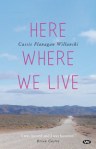
Cassie Flanagan Willanski, Here where we live“Write what you know” is the advice commonly given to new authors – and it’s something Cassie Flanagan Willanski, author of Here where we live, seems to accept. Set in South Australia, where Willanski lives, this debut collection of short stories reflects her two main interests, creative writing and the environment. The book won Wakefield Press’s Unpublished Manuscript Award a couple of years ago, and I can see why.

I wasn’t sure what to expect when I opened the book. Adelaide author and creative writing teacher Brian Castro is quoted on the front cover as saying “I was moved and I was haunted” and on the back “Her stories are as spare and understated as the harsh landscape she describes…” I’d concur. Her stories are not your typical short story. That is, they don’t have tight little plots, nor do they have shock (or even just surprising) endings. They are more like slices-of-life, or like chapters of a novel, in the way they tease out moments in people’s lives that you can imagine continuing into a larger story. And yet, they are complete in themselves and absolutely satisfying.

However, there is more to these stories than “just” slices of life. Willanski writes in her author’s note that they were written as part of her Master of Arts degree, in which she explored “the ways white Australians have written about (and for) Indigenous people in the twentieth and twenty-first centuries”. She introduces the notion of “Indigenous invisibility” which she describes as “ignoring Indigenous Australian people’s current existence, and mourning them as extinct”. She then talks about the issue we’ve discussed here before noting that as white writers became aware of this “Indigenous invisibility” they started to “write about them as characters in their books”. She says she has tried to reflect in her stories the various attitudes she found in her research. I found them authentic and sensitive, but the real judges of whether she’s been successful are indigenous people, aren’t they? There’s a reference to indigenous elder and activist Sue Haseldine in her acknowledgements, which may suggest some acceptance?

There are nine stories in the collection, three told first person, and the rest third person, except for the last and longest story which has two alternating voices, one third, the other second. Her protagonists include a young girl, a young male teacher, a 70-something woman, and a woman grieving for her late female partner. A few stories are connected, but this is not critical to appreciating the collection. Several of the stories, Willanski says in her author’s note, were inspired by real events but in each her imagination has created something new and fictional. Some of these real events are matters of history, such as the Hindmarsh Island Bridge controversy and the Maria shipwreck, while others draw from personal experiences.

Despite the historical inspiration behind some stories, they are all set in contemporary South Australia. The first two are told first person: “This is my daughter’s country” opens the first (“My good thing”) and “The night my husband told me he was going to leave me we were in the middle of a heatwave” starts the second (“Drought core”). Straightaway we are introduced to Willanski’s nicely controlled, pensive tone, and her ongoing themes: family relationships, indigenous issues, the environment and climate change.

The first story is told in the voice of a white woman who has an indigenous husband and a daughter. They are going back to country to clean rockholes. No-one is named – “this is my daughter”, “this is my husband”, “my daughter’s grandmother” – which gives the story a universal, almost mythical sense. There are hints of challenges – subtle references to the Stolen Generations and to environmentally destructive tourism – but it’s a short, warmhearted story about the drive to connect with land and people, and sets up the collection nicely.

I can’t describe every story so I’ll jump to the fourth one, “Stuff white people like”. It is lightly, self-mockingly satirical. It tells the story of a young couple, Oliver and Clay, visiting Ceduna where Oliver is considering a job as a “Nature School Teacher”. They are both earnest, Oliver particularly so, in wanting to understand and relate to indigenous people, so they decide to attend a “healing ceremony” for “‘Maralinga, climate change, feral animals, you name it,’ said the principal vaguely.” It’s an uncomfortable experience, and Oliver doesn’t know how to react to the event which isn’t what he expected. He doesn’t want to be “like the other white people” but how should he be? Clay is able to go with the flow a bit, but not Oliver. Later, on their trip home, she is able to laugh, and take the jokes in the book Stuff white people like, while Oliver is “crippled with self-awareness”. He can’t quite match Clay’s insight. She reads from the book about white people “knowing what’s best” for others:

“Do you think I’m like that?”
“‘Cos you’re excited to get to work with Aboriginal  kids? No!” She stopped for a minute, trying to piece together her thoughts. “Well, I mean–” she said and stopped again.
“What?” said Oliver.
“Well it’s just that Aboriginal people already know about having school outside.”
“I know,” said Oliver. “What’s your point?”
Clay looked at him again, then said, almost irritably, “Well, you’re taking something they’ve been doing for thousands of years and putting the white seal of approval on it.”
“But the missionaries took it away,” said Oliver.
He didn’t say it, but it was implied, and they didn’t know what to do with the implication. Oliver would be giving it back.

I love this on so many grounds – the personal and the political, the desire and the discomfort, the sincerity and uncertainty. These underpin the collection.

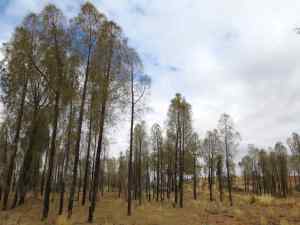
Desert oaks

Desert Oaks, Centralia

There’s only one story in which Willanski speaks “for” or “in the voice of” indigenous people, “Oak trees in the desert”. It’s about the First International Woman Against Radioactive Racism Conference, held in Monument Valley, Utah. This is a fictional conference, but “radioactive racism” is “real” and the aforementioned Sue Haseldine is active in this area.

Willanski opens the story with an indigenous Australian woman introducing herself at the conference. It’s a strong story, with the first-person voices of various First Nation conference attendees interspersed with the third-person story of white Australian woman, 76-year-old Bev, whose late husband had worked at Maralinga and had contracted cancer. There’s also a young white woman activist-organiser providing, again, a light satirical touch. Like many of the stories, it’s very personal but also has a big political message. (I also enjoyed it because I love Australia’s desert oaks, and I’ve driven in the stunning Monument Valley.)

This is getting long so I’ll end with the last story, “Some yellow flowers”, which contrasts a mature love, through the grieving Jean whose partner Nancy has died, with the young love of two teenagers, Loretta and Jackson. This story brings together several of the collection’s themes, including developing and maintaining loving relationships, climate change and caring for the environment, and indigenous-settler relationships. There is a big storm – one of those one-hundred-years storms that are occurring more frequently these days:

The roof shrieks and the sea spray pelts against the front verandah. The separation between land and water, sea and sky, past and present and living and dead becomes more obviously a figment of daytime imagination.

Dreams are had, stories are told, relationships are resolved – not simplistically, but with a sense of continuum.

This is the sort of writing I like: undramatic, understated, reflective stories about ordinary people coping with breakups, death, new relationships, but overlaid with a strong set of values and contemporary concerns, in this case encompassing the intertwined issue of respecting indigenous people and caring for our country. While not always comfortable reading, it’s a hopeful book – and I like that too.

awwchallenge2016Cassie Flanagan Willanski
Here where we live
Mile End: Wakefield Press, 2016
146pp.
ISBN: 9781743054031

(Review copy courtesy Wakefield Press)

Edith Wharton, Writing a war story (Review)

According to Keirsey, Edith Wharton may have b...

Edith Wharton (Presumed Public Domain via Wikipedia)

“Writing a war story” is quite different to the Edith Whartons I’ve read to date, and it was clear from the opening sentence – “Miss Ivy Spang of Cornwall-on-Hudson had published a little volume of verse before the war”. It was the comic tone that did it. All the previous works of hers I’ve read, several novels and novellas, plus a couple of short stories, have been serious, if not downright tragic. However, Wharton was a prolific writer, so I wasn’t completely surprised. In fact, I was rather thrilled to have come across this story via the Library of America (a few months ago now).

I haven’t yet read the highly recommended biography of Wharton by Hermione Lee, but I’ve heard enough about her life to know that she lived in France during the First World War, and that she contributed significantly to the war effort. As LOA’s notes tell us, she stayed in France when the war started while others fled. She raised money, visited the front, established refugee hostels and homes for children. She was admired widely but she, herself, apparently underplayed her role, believing, writes LOA, “that nothing she did could compare with the agonies suffered by the soldiers and their families”. Her story, “Writing a war story” satirises both this role and the idea of writing stories for soldiers, for the war effort.

The plot is simple. Ivy Spang, who had published, to minimal recognition, a book of verse, is asked to contribute a short story to a new magazine, The Man-at-Arms, aimed at convalescent soldiers. Flattered, she accepts, and, due for leave from her volunteer work of “pouring tea once a week” for soldiers in a hospital, she sets off “to a quiet corner of Brittany”, because

devoted though she was to her patients, the tea she poured for them might have suffered from her absorption in her new task.

But, the task proves harder than she’d imagined. She struggles to find “Inspiration”, her mind being full of the one serious but unfortunately pretentious and condescending review, by the editor of Zig-Zag, of her published verse collection. She tells her companion, Madsy, that “people don’t bother with plots nowadays” and that “subject’s nothing”. Eventually, in desperation, she accepts Madsy’s offer to use/collaborate on one of the “stories” Madsy had jotted down from her hospital volunteer work. They agreed that Ivy would take the basic story but add her literary “treatment”. You can probably guess the outcome, but you should read the story to see just how it comes out. There’s a photo and a famous novelist involved too. In addition to the satire on “literature” and war volunteer work, there’s also a gender dig.

One of the things I most enjoyed about the story was its satire of literary pretensions, and how easy it is for an unconfident writer to be derailed by the wrong sort of praise, as Ivy is by Mr Zig-Zag!

In the story’s conclusion, a novelist laughs at her story, before he realises she’s the author. When he realises, and she asks for feedback:

He shook his head. “No; but it’s queer—it’s puzzling. You’ve got hold of a wonderfully good subject; and that’s the main thing, of course—”
Ivy interrupted him eagerly. “The subject is the main thing?”
“Why, naturally; it’s only the people without invention who tell you it isn’t.”
“Oh,” she gasped, trying to readjust her carefully acquired theory of esthetics.

Poor Ivy! I liked the fact that Wharton’s satire is subtle, not over the top. We readers can see what’s coming but Ivy isn’t ridiculed. We feel for her aspirations but we can see that her lack of confidence has laid her open to influence. And there’s irony here because that very influence, that editor of Zig-Zag, had warned her of “not allowing one’s self to be ‘influenced'”, of the importance of “jealously guarding” her “originality”.

There’s more to this story, particularly for people interested in Edith Wharton’s biography. My point is that whatever your interest – literature, war literature, Edith Wharton herself – this story has something to offer, as well as being a good read (with a subject, or two!)

Edith Wharton
“Writing a war story”
The Library of America
Originally published in Woman’s Home Companion, 1919
Available: Online

Larissa Behrendt, Under skin, in blood (Review)

ANZLitLovers ILW 2016In my last review – that for Ali Cobby Eckermann’s Ruby Moonlight – I shared the following lines:

Jack knows the remainder of the conversation
before it was spoke ya see any blacks roaming
best ya kill ’em disease spreading pests
(“Visitor”, from Ruby Moonlight)

Quite coincidentally, this point I was making, that it was not “the blacks” who brought disease, turned out to be the subject of my second choice for Lisa’s 2016 Indigenous Literature Week, Larissa Behrendt’s short story, “Under skin, in blood”. I chose it because I wanted to read at least something by Behrendt.

The story is told in first person by an older woman – called Nana Faye by Merindah, the granddaughter she’d raised – and is divided into three parts. The first and third parts are set in the present while the middle part flashes back to Faye’s past as she tells us why she no longer has her husband and son (Merindah’s father).

In the present, Faye (and Merindah) live in Faye’s grandmother’s country, Gadigal land, around Sydney. But Faye spent her married life, the place where Merindah was born, in Baryulgil on the land of the Bunjalung people. Faye’s flashback is inspired by a discussion she has with university student Merindah who is researching the Northern Territory’s Kahlin Compound, a place to which “half-caste children” (members of the Stolen Generations) were taken between 1911 and 1939. It had – and here you’ll start to understand my introductory paragraph – high rates of leprosy. Merindah is researching claims – claims which have indeed been made and researched – that children there were used as guinea pigs for leprosy drugs. Whether or not these claims are true – they may never be fully resolved due to lack of records – the case causes Faye to comment that the most lethal things white settlers brought to Australia were not guns and alcohol but “microbes” which were “flowing through their veins, floating in their blood, under that skin like bark from a ghost gum tree”. Leprosy, in other words, and malaria, small pox, syphilis, influenza. These killed more indigenous people in the first year of white settlement than bullets.

But these microbial-based diseases are not the main focus of Faye’s memories. It’s the mine in Baryulgil, the mine that opened in 1944 and which everyone thought made them lucky. Having lost their land to the pastoralists, but having decided to stay to be close to their country, the people suddenly found they had jobs – but, what were they mining? Asbestos! Faye tells of the tragic impact asbestos had on her husband Henry and son Jack:

… the mine we felt lucky to have, that gave us the benefits of work and kept the community together was slowly but surely killing us.

The scandal is that there was awareness of deleterious health effects of asbestos in the early 20th century, and certainly by the 1960s its relationship to mesothelioma was recognised. Australia’s best known asbestos mine, Wittenoom, was closed in 1966, ostensibly for economic, not safety reasons. It is telling though that Baryulgil was not closed until 1979. Faye says that the official enquiries that came later found

the mine was barely profitable and only continued to operate to prevent permanent unemployment among the Aboriginal workers in the area. Turned out this employment that was supposed to be doing the community a favour was actually a death sentence.

So, Wittenoom was closed more than a decade earlier because it wasn’t profitable, but different decision-making was used for Baryulgil. Now, normally, I’d approve of decision-making that took into account social values but this one is a bit suss.

This is, I have to say, a fairly didactic story. It could almost have been an essay, except that Behrendt has clearly thought, as she in fact says in her interview with Annette Marfording, that telling it as a story, showing the impacts of policy on human beings, would be the more effective way to go. So, while the story imparts a lot of factual information, Faye shares the devastating impact on her of losing her husband and son. She also tells how indigenous cultural practices work to their disadvantage in a white world. She says:

The hardest thing is to trust these people. These people who have the power of life or death over you, and use that power carelessly. These people we are mute to argue against. And our words never seem a match for what they wrote down, even though we have good memories and they make mistakes.

Now, that is probably the most important message in the story.

awwchallenge2016Larissa Behrendt
“Under skin, in blood”
in Overland (203), Winter 2011
Available online

Kate Chopin, A pair of silk stockings (Review)

Kate Chopin

Kate Chopin (Public domain, via Wikipedia)

Over the years, the Library of America‘s (LOA) Story of the Week has published seven short stories by Kate Chopin, and I’ve posted on four of them. Now comes my fifth. It was actually published in February. I noted it, printed it out, but have only now found time to sit down and read it, and of course, I’m glad I did. It’s another little treasure.

Most of Chopin’s writing – including her most famous novel, The awakening, which I’ve read twice – offers commentary on the lives of women in late nineteenth century America. “A pair of silk stockings”, as you can probably tell from the title, doesn’t depart from this.

I enjoyed, as I usually do, LOA’s introductory notes. They are always succinct, yet hone in on something particularly relevant about the writer and the work. The notes to this story remind us that Chopin met with some resistance to her stories, both because of her themes and what literary historian Richard Gray calls her “subversive streak”. Go Chopin! However, what interested me most in these notes was something I’d forgotten, Chopin’s interest in Guy de Maupassant. I loved Maupassant’s short stories in my youth, and still have my little now-yellowing paperback of his stories. Chopin wrote about why she liked Maupassant, in 1896:

Here was life, not fiction; for where were the plots, the old fashioned mechanism and stage trapping that in a vague, unthinking way I had fancied were essential to the art of story making. Here was a man who had escaped from tradition and authority, who had entered into himself and looked out upon life through his own being and with his own eyes; and who, in a direct and simple way, told us what he saw.

LOA’s notes continue to say that Maupassant’s influence on her was substantial, particularly in his “emphasis on psychological character development” and in the use of “the surprise or disconcerting ending”. That’s certainly the case in “Desirée’s baby” (my review).

But today’s post is about “A pair of silk stockings”, which critics argue is one of her best short stories, one critic contending, in fact, that “it is one of the best pieces in turn-of-the-century American literature by anyone”. It is certainly an excellent read – a quiet slice of life with a little bite. The story concerns “Little Mrs Sommers” who suddenly finds herself with a little windfall of $15. We are not told the source of this money, because that’s not the point. The point is how it makes Mrs Sommers feel and what she does with it.

First, though, who is Mrs Sommers? We don’t know a lot about her, but enough. She has a few children – “the boys and Janie and Meg”. I’m sure Chopin is making a little point in naming the girls but not the boys. Anyhow, she is not well off, and has to scrimp and save to dress her children. She “knew the value of bargains” and could line up at sales and “elbow her way if need be” with the rest of them.  She has not always been poor apparently, having once known “better days”, but she doesn’t think of those now:

She had no time—no second of time to devote to the past. The needs of the present absorbed her every faculty. A vision of the future like some dim, gaunt monster sometimes appalled her, but luckily to-morrow never comes.

So, this money, which has “given her a feeling of importance such as she had not enjoyed for years”, needs careful consideration to ensure she makes “proper and judicious use” of it. She doesn’t “wish … to do anything she might afterward regret”.

That’s the set up. As you can probably imagine, for all her careful planning, things work out very differently. The day she goes shopping she’s “faint and tired” having forgotten to eat lunch with all the “getting the children fed and the place righted, and preparing herself for the shopping bout”. She goes shopping – yes – but what she buys and does with her money is nothing like what she planned. Now I could tell you what she spends it on, without telling you the punch-line, but I won’t. It’s only five pages, and is a good read – not only for what it tells us but for its insight into turn of the century American life.

And this last point is what critic Robert D Arner says we should see in the story. It’s not just a story about a poor, struggling woman, but about the whole society, one that is “caught between traditional ideas of feminine roles and the newly emergent American ‘culture of consumption’.” This is not the gut-wrenching Chopin of The Awakening or “Desirée’s baby” but it’s no less poignant for its recognition of the pressures women face in negotiating their lives in a world over which they have little control – not to mention a world in which the temptations to buy are starting to abound.

Kate Chopin
“A pair of silk stockings”
First published: Vogue, September 16, 1897
Available: Online at the Library of America

Washington Irving, The adventure of the German student (Review)

Washington Irving, c. 1855-60 (Copy daguerreotype by Mathew Brady, reverse of original by John Plumbe. Public domain, via Wikimedia Commons)

Washington Irving (1783-1859) is best known for his short stories “Rip Van Winkle” and “The legend of Sleepy Hollow”, but in fact he was a prolific writer and, according to Wikipedia, is often credited as being America’s first “man of letters”. I was fascinated to read in Wikipedia that, as well as being a writer, he worked as a diplomat in Europe. He helped other writers, promoted the writers’  rights in issues like copyright, and he was admired by the likes of Sir Walter Scott, Lord Byron and Charles Dickens. I guess Americans know all this, but I didn’t.

However, I have had a recent encounter with Irving, before the story in this post that is, because I dipped into his Tales of the Alhambra (1832) when we visited that part of Spain in 2013. I was fascinated by his description of a place that is not totally unfamiliar to an Australian:

its scenery is noble in its severity, and in unison with the attributes of its people; and I think that I better understand the proud, hardy, frugal and abstemious Spaniard, his manly defiance of hardships, and contempt of effeminate indulgences, since I have seen the country he inhabits.

And I loved his desire to travel with an open heart and mind:

but above all we laid in an ample stock of good humor, and a genuine disposition to be pleased, determining to travel in true contrabandista style, taking things as we found them, rough or smooth, and mingling with all classes and conditions in a kind of vagabond companionship.

That’s the spirit, as Son Gums would say.

Anyhow, let’s get to the story, “The adventure of the German student”, that was recently published in the Library of America’s Story of the Week program. It came from his collection, Tales of a traveller, which comprised essays and short stories published in 1824 under his pseudonym, one of several he used, Geoffrey Crayon. This collection was divided into four “books”, and our story was in the first, titled  “Strange stories by a nervous gentleman”.

Most of the stories are set in Germany and Paris, with “The adventure of the German student” being set in Paris during the French Revolution. The opening lines are:

On a stormy night, in the tempestuous times of the French revolution, a young German was returning to his lodgings, at a late hour, across the old part of Paris. The lightning gleamed, and the loud claps of thunder rattled through the lofty, narrow streets …

The story, you may not be surprised to hear, is Gothic in tone. LOA’s notes say this is surprising because his “supernatural tales are known more for gentle whimsy and wry satire rather than the Gothic horror found in this story”. They tell us that this story predates Edgar Allan Poe “by a good twenty years” and that American horror writer H.P. Lovecraft admired it for diverging from his “lighter treatment of eerie themes”.

It’s a simply told story. After that opening, the narrator decides that before continuing he needs to tell us a bit about this German student, Gottfried Wolfgang. He was “a young man of good family” but was, perhaps, a little too sensitive and suggestible for his own good. During his studies he had “wandered into those wild and speculative doctrines which have so often bewildered German students” and he starts to feel that “there was an evil influence hanging over him; an evil genius or spirit seeking to ensnare him and ensure his perdition”. His friends decide he needs “a change of scene” and send him off to Paris.

There, Gottfried starts by enjoying the revolutionary spirit but soon all the blood gets him down. In true Gothic style he lives in “a solitary apartment” in a gloomy street not far from the monastic walls of the Sorbonne”. He visits “the great libraries of Paris, those catacombs of departed authors”, becoming a “literary goul (sic), feeding in the charnel house of decayed literature”.

However, he also has “an ardent temperament” but is too shy to approach women so, being of fanciful bent, he dreams up a woman of “transcendent beauty”. She haunts him in the way such visions do to “the minds of melancholy men”.

Now, remember, this is set during the French Revolution, so as the story progresses a guillotine appears where our student meets his dream-woman. He brings her to his home and is, of course, totally enamoured. Fortunately, these are modern times:

It was the time for wild theory and wild actions. Old prejudices and superstitions were done away; every thing was under the sway of the “Goddess of Reason.” Among other rubbish of the old times, the forms and ceremonies of marriage began to be considered superfluous bonds for honourable minds. Social compacts were the vogue. Wolfgang was too much of a theorist not to be tainted by the liberal doctrines of the day.

Ha-ha! Who needs “sordid forms to bind high souls together” he tells the young woman. So he talks her into immediately pledging herself to him. And here, I’m afraid I’ll leave you, but let’s just say that things don’t quite work out for Gottfried, or his dream-woman. There are several layers in which we can read the story – political, philosophical, psychological, sexual, feminist – but all point, at some level at least, to satire of the times.

In 1860, Irving wrote this about his stories:

I am not, therefore, for those barefaced tales which carry their moral on the surface, staring one in the face; they are enough to deter the squeamish reader. On the contrary, I have often hid my moral from sight, and disguised it as much as possible by sweets and spices, so that while the simple reader is listening with open mouth to a ghost or a love story, he may have a bolus of sound morality popped down his throat, and be never the wiser for the fraud…

An interesting, thoughtful man, this Irving.

Washington Irving
“The adventure of the German student”
First published: In Tales of a traveller (1824)
Available: Online at the Library of America