Oliver Wendell Holmes, The deacon’s masterpiece: Or the wonderful “one-hoss-shay” (Review)

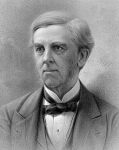
Oliver Wendell Holmes 1879

C1879, By Armstrong & Co. (Boston, Mass.), Public domain, via Wikimedia Commons

Oliver Wendell Holmes is one of those wonderful names that, once you hear it, you can’t really forget it – at least, I can’t. But, the thing is, I often hear wonderful names of people who’ve “done things” without actually knowing what they’ve done. Oliver Wendell Holmes is one of these, and so when he popped up in the Library of America’s Story of the Week series a few months ago I made a note to check it out. The story – actually a narrative poem – has the title heading this post, with the additional subtitle, “A logical story”.

Holmes Sr – his son, Oliver Wendell Holmes Jr, became a Supreme Court judge – was one of those multi-talented men. Wikipedia says that he was a “physician, poet, professor, lecturer, and author” and that “his peers acclaimed him as one of the best writers of the day.” His friends included Ralph Waldo Emerson and Henry Wadsworth Longfellow, which helps me put him into perspective. He was a medical reformer, and was dean of the Harvard Medical School. Indeed, Wikipedia reports that “his essay on puerperal fever has been deemed ‘the most important contribution made in America to the advancement of medicine'”. With this focus on medicine, there was a big gap between his early published writings in early to mid 1830s and his return to writing in the late 1850s, but he returned to it with vigour, so much so that, as Wikipedia says, he is now best known as “a humorist and poet”.

So now let’s get to the post’s topic. He returned to writing around the age of 50, encouraged by a friend to become a founding contributor to a new magazine, The Atlantic Monthly. He wrote a monthly column reviving his earlier creation, Autocrat of the Breakfast-Table. LOA’s notes describe the column:

each piece is written as a table conversation monopolized by the unnamed Autocrat, with interruptions (including poetry, stories, and jokes) from other residents—including the Professor, the Landlady’s Daughter, the Schoolmistress, the Poet, the Old Gentleman, the Divinity-Student, “the young fellow called John,” and others. The new and improved “Autocrat of the Breakfast-Table” appeared in the debut issue of The Atlantic (November 1857) and immediately became the most popular feature in a magazine that boasted works by such celebrities as Emerson, Whittier, and Longfellow.

The eleventh column is the one the LOA published as their story of the week. It describes a “one-horse chaise” (the “one-hoss shay”) that is built to last. The poem became so popular, apparently, that it was published separately in 1892 as an illustrated book.

As the story goes, a deacon builds a one-hoss shay “in such a logical way” to ensure it would not break down. He uses the very best of materials – “the strongest oak/that couldn’t be split or bent or broke” – and makes sure there is no weak spot. The shay lasts for a hundred years:

Colts grew horses, beards turned grey,
Deacon and deaconess dropped away,
Children and grandchildren–where were they?
But there stood the stout old one-hoss-shay
As fresh as on Lisbon earthquake-day!

Built, then, on the day of the Lisbon earthquake, 1 November 1755, it breaks down while being ridden by the current parson on 1 November 1855:

How it went to pieces, all at once,–
All at once, and nothing first,–
Just as bubbles do when they first.

It is a delightful read in terms of tone, voice and rhyme. I particularly love that the rhyming pattern varies, which helps keep it fresh and the reader interested, and prevents it, I think, from reading like doggerel.

Conceptually, though, it’s also interesting: this idea that you could logically work out how to build something that won’t break. You find, as Holmes describes in his introduction to the illustrated edition, “what point any particular mechanism is likely to give way” and make sure that part/point doesn’t. Then you “find the next vulnerable place, and so on”, until you arrive “logically at the perfect result attained by the deacon”.

LOA describes the work as a “semi-farcical ode to Yankee ingenuity and New World rationality”, but also says it’s been seen “as an allegory on the demise of Calvinism”. LOA also says that “the poem’s fame was such that one-hoss shay became a term used in economics and statistics, designating ‘a capital asset that exhibits neither input decay nor output decay during its lifetime’.” However, in terms of economics, I can’t help thinking about his image of what “bubbles do when they burst”.

Describing his old age, and the fact that his friends – like Emerson, Longfellow and Nathaniel Hawthorne – predeceased him, he apparently said “I feel like my own survivor … We were on deck together as we began the voyage of life … Then the craft which held us began going to pieces.” I wonder if in saying this he thought about his “one-hoss shay”!

Oliver Wendell Holmes
“The deacon’s masterpiece: Or the wonderful ‘one-hoss-shay’”
First published: The Atlantic Monthly, September 1858.
Available: Online at the Library of America

Leah A, Ten silly poems by a ten year old (Review)

Leah A, Ten silly poems by a ten year oldPREFACE AND DISCLOSURE: As some of you know Son Gums is a primary school teacher. One of the programs he likes to run with his class is “the Passion Project”. Part of the theory behind this project is that kids don’t always get to do in class the things that really interest them so, over one 10-week term in the school-year, each student chooses a project s/he is passionate about to work on. Some time is allocated in class each week, and the rest is done at home. At the end of term, the students present what they’ve produced or created, which I understand can (and has) included games, computer programs, websites, artworks, live or animated films/videos, novels and cookbooks. This year, one girl wrote, illustrated and then published on Amazon a book of ten poems. I have bought and read the book and been given permission to write about it here.

NOW, THE FUN PART, THE BOOK: I titled my brief Amazon comment/review, “Edward Lear watch out”, because this gorgeous little (in size, not value) book reveals a lively, cheeky mind just like, I imagine, Edward Lear’s was. And like Edward Lear, Leah (hmm, I didn’t notice that homophone until now) is both writer and illustrator. Her ten silly poems are written in a variety of styles, including Lear’s favourite, the limerick.

The first two poems are not limericks, however, but 8-line rhyming couplets about her parents. They reminded me of when our children (one being, of course, Leah’s teacher) were growing up and showing an interest in writing. I decided then that I needed to let go of my ego and be prepared for my less endearing qualities to be revealed to all. Leah’s parents have clearly realised they must do the same, if they are to encourage her talent. Mum gets away with it this time, but Dad doesn’t come out quite so well:

You’re very handsome and oh so cool
Even though you sleep and drool.
(from “Dad”)

Lucky Mum eh?

Several of the poems are about animals and their adventures, usually involving food. “Lightning”, with its nicely controlled a-b-c-b rhyme, tells of the secret behind this horse’s speed (“All his speed and fastness/Was due to eating sauerkraut”)! Isaac the dog, on the other hand, finds that he needs to be a little careful about what he decides to “bite, bite, bite”. Like many of the poems, “Isaac” also uses the a-b-c-b rhyming pattern, but here Leah changes the form a little by ending most of the stanzas with the refrain “bite, bite, bite”. This use of a refrain comprising repeated words enhances the poem’s mood of silliness, but Leah also has the confidence to break the pattern in the middle of the poem, before taking it up again, to provide a needed change of pace. She’s not afraid, in other words, to mix it up a bit.

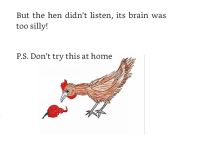
Leah A, Ten Silly Poems, hen imageMost of the poems are narrative, and tell humorous little stories, as you’d expect of the nonsense verse tradition within which Leah is writing. “Carolina Reaper”, for example, tells of a birthday girl who ignores the advice of a Mexican restaurant waiter, to her detriment, while the two delightful “Turbo Turtle” poems play with the commonly held assumption that turtles are slow.

Turbo Turtle, Turbo Turtle
How fast can you go?
Compared to me a cheetah
Is oh so very slow.
(from “Turbo Turtle”)

Occasionally the rhythm falters, but this is offset by the sure sense of story, the cheeky sense of humour, a clever use of language, not to mention the delightful illustrations. And anyhow, what can you expect when you have to write, illustrate and publish a book in ten weeks! Ten silly poems by a ten year old is not only an entertaining read but an impressive achievement. If you have a mind to support young authors, and you have a Kindle (or the Kindle app on your tablet), you might like to buy a copy for yourself at the Amazon link below. At AUD1.31, it’s a steal.

awwchallenge2016A, Leah
(Illus. by Leah A)
Ten silly poems by a ten year old
2016
26pp.
ASIN: B01LY4LZ1J

Available at Amazon (Kindle only) for the amazing price of AUD1.31

Mike Ladd, Invisible mending (Review)

Mike Ladd, Invisible mendingI think … how all our best art is free; as complex as that, as simple as that. (Gaudi and the light)

I rather liked this statement from Mike Ladd’s collection Invisible mending, even though I’m not totally sure what he means! Does he mean freely available, that is, we don’t have to pay to access it? Or does he mean it frees the spirit, takes us away from ourselves? Either way, he has a point, though perhaps “best” might be arguable in the first sense.

But now, that ongoing conundrum: how to review a collection, particularly a rather strange collection comprising poetry, short stories, memoir, essays and photographs, too. The two common choices are to summarise the range of the stories – like, you know, the stories take us from Adelaide to Japan to Chile and tell us about broken relationships, environmental destruction and living with dementia – or to pick a few stories (as I did with Cassie Flanagan Willanski’s Here where we live) and discuss them. Neither approach is completely satisfactory, but what can you do?

Interior, La Sagrada Familia

In the forest, La Sagrada Familia

Overall, I enjoyed the collection, though I did have a couple of quibbles, which I’ll get out of the way now, before I talk about what interested me. One of these quibbles relates to a pet hate, the use of “utilise” rather than “use”. In “Gaudi and the light”, Ladd writes that Gaudi “utilised spirals, honeycombs, the planoid surfaces of magnolia leaves”. There are some who argue that “utilise” adds another layer to “use”, meaning “put to good purpose”, but unfortunately its over-use spoils any special meaning it “might” have for me. Also in “Gaudi and the light” is this sentence:

There had always been an aestheticism within him: his reverence of nature combined with an early drive towards utopian socialism, ongoing vegetarianism and a sometimes dangerous tendency to fast.

He goes on to talk about Gaudi embracing “a Franciscan concept of holy poverty”. Did he mean “aestheticism” or “asceticism”? Actually, my quibbles are all in this story, because my third one is surely a typo: “in the shadows was an agonising crucifixion figure, the body a taught bow”. Taut, methinks? Maybe this story was rushed, which is a bit of a shame because Gaudi’s life is intriguing and Ladd reminded me of the wonderful time we had seeing his work and learning about him when we visited Barcelona three years ago.

There is a lot in this collection to enjoy, including, for me, learning about pantun poetry. I know about Japanese haiku and tanka, but had never heard of “pantun”. Ladd discusses them in his travel essay, “Pantuns in the orchard” which describes his stay in Malaysia with his wife who was working on an art project. There are different types of pantuns he tells us but his favourite is the “tunggal” which comprises four iambic lines with an abab rhyme. Like haiku, pantun is strict about content as well as form: the first two lines “draw their imagery from the outside world” while the last two lines “turn inward toward human relationships and psychology”. Ladd includes a collection of his, in the piece called “A book of hours at Rimbun Dahan”. I’ll share a couple that tickled me:

I start the great four-bladed ceiling fan.
Seconds later, a gecko drops to the floor,
stunned. Yes, the world’s like that,
We all hang on as long as we can.

AND

Under the mosquito net, settling to sleep
you feel safe from the world’s attacks.
Then you hear the needling, invisible whine
of that one mosquito inside the net: the mind.

These don’t have the traditional rhyme pattern, but they work for me.

Superficially, the book looks like a disparate collection, in form and content, but running underneath are some recurring ideas addressing contemporary concerns (such as human rights at home and abroad, and the environment) and family (including the dementia-related death of his father, and the return of a travelling son).  The story “A neighbour’s photo” tells of the loneliness and uncertainty of a 14-year-old Sudanese who has migrated to Australia with his 18-year-old brother. In the poem “Learn to speak our language”, the narrator turns the statement on its head by suggesting the complainer might learn Kauna or Pitjanjatjarra. Sometimes the politics is more stark, as in the short “Gasoline flowers” in which four self-immolators, starting with Mohamed Bouazizi, are likened to flowers.

Nearly halfway through the book is a little series of pieces about health, the narrator’s own experience in hospital and his father’s with dementia. He captures well that eerie world – a hospital – in “The edge of the lake”. He describes the strange camaraderie that can occur in a hospital ward as four men experience their illness. He writes of his experience of surgery:

Though my legs are cut to blazes, I’m enjoying myself. I feel cradled, it all makes glowing sense to me: the hospital system with its rituals and meals and machines, its steel surface and pecking orders.

I know what he means. It’s a weird, weird world – with its own time and laws – and yet it can feel cocooning, with the outside world far away. Sadder though are the pieces about his father, the man with dementia who is “aghast at the rate the world is leaving him” (“My father at the clothesline”).

One of the longest pieces in the book is “Traffik”. It features the unnamed Student and Middleman, as well as a named Japanese man, Morii, and is about the illegal smuggling of orang-utans. I don’t think I’ve read a fiction piece on this topic before. I liked the complexity of Ladd’s story, the careful way he develops it and the fact that our Student smuggler and orang-utan buying Morii are not simplistic stereotypes of the “parts” they play.

Two other pieces I particularly enjoyed were the story about indigenous pensioner “Ken” and the memoir “Gaps” about parents catching up with their son who has returned from a trip to Columbia. I loved the wordplay on gaps – generation gap, the gaps in knowledge you experience when you return from being away for awhile, and gaps in the hearts of people who may never know that their family members drowned on the Siev X.

There was more that I enjoyed too, including the pointed “Skiing in Dubai” and the satirical “Radio News”, but I’ll finish here.

The back cover describes the collection as “based loosely on the ideas of scarring and healing”. As you can probably tell from the pieces I’ve shared, it is certainly about that. However, it is also about the business of being an artist, and so I’ll close with the last lines of the poem “Back again”:

Our magpie (we call it ours)
tries its run of notes, falters, and repeats;
like our writing and art careers.

Well, perhaps there was the odd falter in this collection but that didn’t stop me being impressed by the versatility and passion of Mike Ladd, and enjoying my time with him. Oh, and it has a beautiful cover, too.

Mike Ladd
(with photographs by Cathy Brooks)
Invisible mending
Mile End: Wakefield Press, 2016
127pp.
ISBN: 9781743054079

(Review copy courtesy Wakefield Press)

Paul McDermott, Fragments of the hole (Review)

"Paul McDermott DAAS" by Canley - Own work. Licensed under CC BY-SA 3.0 via Commons.
“Paul McDermott DAAS” by Canley. Licensed under CC BY-SA 3.0 via Wikimedia Commons.

If you’re an Australian, you are sure to know who Paul McDermott is. If you are not Australian, you may not, and this book in fact would not enlighten you, because nowhere on the book is it made clear that “this” Paul McDermott is indeed “that” Paul McDermott. It doesn’t take much reading though to realise that indeed it must be. Have I intrigued you? I hope so.

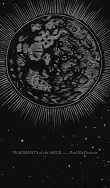
Fragments of the hole is the first of the second set of fl smalls released by small independent publisher Finlay Lloyd. I mentioned them in my recent post on small books, and said then that I’d review them individually as I read them, so here I am.

I’ll start, having already mentioned him, by telling you about the author. Wikipedia describes him as “an Australian comedian, actor, writer, director, singer, artist and television host”. I knew about most of those, but I didn’t realise that his writing included more than writing scripts for his shows, or that he was an artist too. He first came to public notice as a member of the satirical musical comedy group the Doug Anthony All Stars. The Doug Anthony in their name refers to the longtime leader (1971-1984) of the National Party of Australia, which will, perhaps, give you a sense of his political leanings. However, Fragments of the hole is not political satire, so let’s get onto it …

McDermottFragmentsFinlay

The jokes start pretty much on the title page when we are told that the book comprises:

a collection of previously unpublished work from various writer/artists:

Young Master Paul, The Nymbus Art Collective, The Marvellous Mr Me, The Generator, Paul McDermott, Ol’ Miss Daisy & The Caravan King.

Hmm … the way I read it they were all written and illustrated by Paul McDermott but, you know, I could be wrong! Whoever wrote them, though, they are delightful – dark, whimsical, and a little cryptic. The collection comprises one prose story, followed by five in verse form, and most read a little like fairy stories or fables. There’s usually a little point to ponder at the end, even if that point raises another question.

Take, for example, the first poem, “The Bread Girl and the Sparrow”. It is reminiscent of “The Gingerbread Man” which, Wikipedia tells me, is just one of many folktales about “runaway food”. Who’d have thought?  Anyhow, in McDermott’s story, in addition to the issue of trust, there are layers of sacrifice and loyalty between food and predator which adds quite an interesting philosophical twist.

There’s a Roald Dahl-esque edge to the stories. The humour is dark. These are not for (most) children. “Asleep/Awake”, for example, is about the sleeping (real) self meeting the dream self. The exhortation at the end, if you are suggestible, could very well bring on a nasty case of insomnia. You have been warned. I loved too “The man who thought (he was a fog)”, and McDermott’s suggestion that perhaps the initial assumption was not the right one at all. “You look for answers where you may/You find them when you can” he says, but, are you asking the right question?

If any single idea underlies the stories it is something about “self” – what is your “self”, do you protect it, how does it interact with others? Sacrifice – sometimes chosen, sometimes inadvertent – appears in a couple of the stories; the idea of alternative selves appears in others. There is also a sense of life not going to plan. It may not always be –

That evil and sorrow await the naive
At every twist and turn

– but it doesn’t hurt to always have your wits about you.

The poems are told in a fairly simple a-b-c-b rhyming pattern, but the line lengths vary at times to change the pace. McDermott, a comedian who lives by his words, is sure in his language, which is clear and unforced. The pencil drawings are delightful. You can feel the twinkle in his eye – the fun he is having – as you read the stories and look at the pictures. They made me chuckle.

And here I will end because this is a book that is best experienced rather than described or analysed. It’s a cheekily clever but also delightfully charming “little book”. It would, dare I say it, make a perfect stocking stuffer for the discerning reader on your gift list.

Paul McDermott
Fragments of the hole: an illustrated collection (or, Odds and ends, bibs and bobs, and little bits of nothing)
(fl smalls 6)
Braidwood: Finlay Lloyd, 2015
[60pp.]
ISBN: 9780987592958

(Review copy courtesy Finlay Lloyd)

Paul Hetherington and Jen Webb, Watching the world (Review)

Hetherington and Webb, Watching the worldI hope it’s not condescending to suggest, at this time of year, that a book would make a good Christmas present? I know some publishers, and fair enough too, choose around now to release certain types of books deemed to be good gift material. That, however, is not the case with this book, Watching the world, as it was in fact published back in July. It’s just that I’m reviewing it now and, quite coincidentally, I think it would make a good Christmas book. This is not because it’s a light, easy summer read, as it’s not your typical beach book, but because it’s a very attractive book that is priced reasonably and that can be enjoyed in multiple ways. You can meander through it sequentially, stopping to ponder, or dip in and out, exploring what catches your fancy.

Subtitled Impressions of Canberra, Watching the world comprises poems by Paul Hetherington paired with photographs by Jen Webb. It has a rather interesting genesis, as the Introduction explains, in that it’s the “result of an extended collaboration” between the poet and the artist. Their aim was to explore Canberra as a place in which people live and work, rather than, as is usually the case, as a planned city that is also the national capital. I like that idea. Too often Canberra is used as shorthand for the federal government – as in “Canberra said today ….”. But, as we who live here know, there is far more to Canberra than that.

Hetherington and Webb’s method of working was interesting too. They worked, they say, semi-independently:

Jen took photographs, which Paul then used as springboards into poems. Paul’s poems led, in turn, to Jen taking new photographs, or editing existing ones.

They continued this “iterative process” until they found “enough poem-photo pairs” that would satisfy their intention. They suggest that in this method of working a new “reality” appeared, one that was somehow separate both from themselves as individuals and from their partnership, a reality which confronted them with ideas about “the incommensurability of world, image and word”. That makes sense to me – I think! At least, it makes sense to me that we never can completely or exactly capture in one form – say poetry – that which is in another form – in this case life in Canberra. It seems both obvious and sophisticated at the same time to make this point! And so, when you have a poem and a photograph both “commenting” on each other and on life in Canberra, then the meaning (or the “reality”) surely becomes multi-layered? Hmmm … I think I’ll leave the philosophising here, but I hope that I’m making sense and that I’ve understood what Hetherington and Webb are saying.

Now, I’ll get to more concrete stuff (a very poetic word, that), starting with the wider project. In the Introduction, again, we are told that it was initially produced as an installation for the Imagine Canberra exhibition during Canberra’s 2013 centenary celebrations. It then had a couple of other iterations – at a conference, and as a set of scholarly essays – before finding its way into this book form this year. I love that they have managed to achieve such varied mileage out of their work.

And finally, the book itself. The poem-photo pairs are divided into three sections – Where we live, Memory places, and Paddocks and perambulations. They are, as you’d expect from the process described, idiosyncratic, although there is logic too to the groupings. The first poem-pair is titled “Waltz” and captures the physical sense of Canberra. I was amused by the poem’s opening:

Like algebra, these straight-drawn streets,
curves, crescents and rounding circles

Starting with the “straight-drawn streets” must surely be a little provocative gesture to the popular cry from tourists that they get lost in Canberra’s circles! We do, I’m sure, have far more traditionally designed streets than circular ones. It’s just that the circular pattern is a feature of the inner, early Canberra where tourists focus. The accompanying image is a low aerial shot of a warm, cosy looking Canberra suburb in autumn. The poem suggests that there is magic in Canberra, that for all the apparent “algebra” in its straight lines and curves, there is much here that cannot be easily defined or narrowed down to simple formulae.

The poems vary in tone. There is, for example, a subdued reference to indigenous inhabitants in “Ainslie”, whimsical self-deprecation in the simply titled “Canberra”, and wry or defiant humour in “Letter”. At least, it made me laugh: a woman hands her letter to someone, perhaps a husband she is leaving:

‘I know it’s not done
to be so formal
but just this once
I’d like the last word’

The accompanying image shows the back of a blue car driving away in light rain.

Sometimes the meanings of the poems and the connections with the photography are clear and unambiguous, more literal perhaps. Other times they are more tenuous, or abstract, as in “Handkerchief” with its accompanying leaf-litter image, encouraging the reader-viewer to delve further. I enjoy these challenges. It would be interesting to see whether different combinations challenge different readers.

The images are, of course, important, though being primarily a verbal/textual person, my focus tends to be the words. However, there are some gorgeous images here. I’ve mentioned a couple already. I also like the mystical tone of the poem-photo pair titled “Boundaries”, the sense of coming into and out of our different spiritual and physical selves, our individual and our social selves, and so on. A simple image and a two-line poem. Perfect.

Some of the pieces are universal, that is, they could apply to a lot of places in which people live, but many draw on signs and symbols familiar to Canberrans – the circles, the balloons, and Black Mountain Tower, for a start. We are a bush capital, and along with our trees come the birds. I enjoyed the cheekiness of the poem titled “Birds” (and the accompanying image setting movement against stillness) which suggests that for all the planning, life in the city might have other ideas. If you are now intrigued, have a look at the sample provided online by Blemish Books. That will probably speak louder than my 1000 words!

Watching the world is a quietly subversive work that looks at Canberra from an insider’s point of view – with a lot of affection but a willingness to cast an acerbic or questioning eye at times too. And remember, it’s Christmas soon!

Paul Hetherington and Jen Webb
Watching the world: Impressions of Canberra
Canberra: Blemish Books, 2015
79pp.
ISBN: 9780994250827

(Review copy courtesy Blemish Books)

Lesley Lebkowicz, The Petrov poems (Review)

Canberra poet Lesley Lebkowicz has made a couple of brief appearances in my blog: first in my post on The invisible thread anthology, and then when she won this year’s ACT Poetry Award. I was consequently more than happy to accept for review her latest book, The Petrov poems.

English: Evdokia Petrova at Mascot Airport, Sy...

Evdokia being escorted by two Russian diplomatic couriers to a plane at Mascot Airport, Sydney (Presumed Public Domain, from NAA, via Wikipedia)

It’s intriguing that nearly 60 years after the events, we are still interested in the Petrovs. In fact, I have written about them before, in my review of Andrew Croome’s historical novel, Document Z. Most Australians will know who they are, but for those global readers here who don’t, the Petrovs were a Russian couple who worked at the Soviet Embassy in Canberra in the early 1950s. Vladimir (Volodya), Third Secretary, and his wife Evdokia (Dusya) were both Soviet intelligence officers (or, to put it baldly, spies). They defected in 1954. The defection was particularly interesting because Vladimir defected first, and Evdokia two weeks later at the airport in Darwin after some dramatic scenes at Sydney’s Mascot airport.

At first glance, The Petrov poems looks like a collection of poems but in fact it is a verse novel, albeit one comprising many short individually-titled poems. These poems are organised into four “chapters”: Part 1, Volodya defects; Part 2, Dusya defects; Part 3, The Petrovs at Palm Beach; and Part 4, The Petrovs in Melbourne.

I must admit that I wondered, initially, why Lebkowicz had decided to write about the Petrovs, given that they have already been picked over in novels, non-fiction, theatre, and television. But, as soon as I started reading it, I could see why. Lebkowicz gets into the heart of these two characters, bringing them back to ordinary human beings who were caught up in something that was both of and not of their own making. It is a rather pathetic story. There are no heroes here – and yet, as happens with these sorts of things, it captured the world’s attention for a short time.

Now, before I comment specifically on this book, I’d like to quote another Canberra poet Paul Hetherington from an interview with Nigel Featherstone in the online literary journal Verity La:

One of the ways I recognise the poetic is when I find works in which language is condensed, ramifying, polysemous and unparaphraseable. Part of what I wish to do when writing poems is to make works that speak in such ways – but to do so without resorting to any kind of trickery or artificial obscurity.

While I wouldn’t use words like “ramifying” and “polysemous”, and while we can paraphrase the ideas to a degree, this is pretty much what Lebkowicz achieves in The Petrov poems. In just 80 pages or so she manages to not only tell the story of their lives but get to the nub of their hearts and psyches – as much, anyhow, as anyone can do for another person. We learn that Volodya is not succeeding at spying:

He wants to succeed but stumbles. Failure
follows him like iron torn from a roof and
rattled along the wind.
(from “Glass I”)

We learn that he loves Dusya (“Dusya is his place in the world”), but that he loves booze, his dog and prostitutes more. He seems weak, but he’s a man struggling. With Stalin’s death and the arrest of his boss, he fears reprisals when he returns to Moscow. Here he is at the moment of defecting (which he does, after disagreements on the subject, without telling Dusya):

Once again he’s going to be wrenched from the soil.
He remembers his father – struck by lightning, buried up to his neck
by foolish men, and dying in the freezing night.
Then chaos and not enough food. Uprooting a full-grown plant
is no easy thing: so many roots
are wound through the earth. He mutters the Russian words
for sadness and home and ruffles his Alsatian’s fur.
(from “Loss”)

Dusya, on the other hand, is a stronger character, but she has suffered severe losses in her life, including her first love and her daughter:

This is something Dusya does not allow herself to think: how her
life might have been if Romàn had not been arrested. […]
If she had gone on taking happiness for granted. Living with
Romàn had been like walking along a winter street and arriving
in a field of warm poppies. If Romàn had not been broken in a
labour camp. If Irina had not died –
(from Romàn I)

While she understands Volodya’s fear, she fears even more what might happen to her family if she defects. At Darwin airport she doesn’t want to make a decision: “If only/this government man would abduct her”. But of course he can’t.

We then watch them as their relationship falters, first during ASIO’s interrogation, and then the years of living together in Melbourne, officially in disguise but known nonetheless. (“The whole street knows they are Petrovs -/too many photos, too much publicity”).

While I’m not a Petrov expert, I’ve read enough to feel that Lebokowicz’s interpretation is authentic. She explores what happens when the political interferes with the personal; she recognises the pull of culture and the despair that losing one’s home can engender; and she sees that corruption is not confined to communism:

so when ASIO falsifies (No! Not falsifies
amends, adjusts, even corrects) the documents
he brought from the Embassy – of course he assents
(from “Bones”)

Australian Women Writers ChallengeThese are wonderful, readable poems. They are poetic but, to quote Paul Hetherington’s goal, without “trickery” and “artificial obscurity”. The imagery is strong but clear. I particularly liked the way Lebkowicz varies and plays with form. None of it is rhymed, but there are sonnets, couplets, poems with multi-line stanzas but closing on a single dramatic line, and others. There are poems with short lines or terse rhythms, indicating action or stress, and poems with long lines conveying thoughts and reflections. There is also a shape-poem, “Torment”, in which the zigzag shape mirrors Dusya’s distress (“Her life is a staircase that switches directions”).

Like any good historical fiction – if a verse novel can be called that – you don’t need to know the history to understand the story told here. And like any good historical fiction writer, Lebkowicz has produced something that enables us to reconsider an historical event from another perspective and to understand the humanity below the surface of the facts. An excellent and moving read.

Lesley Lebkowicz
The Petrov poems
Sydney: Pitt Street Poetry, 2013
95pp.
ISBN: 9781922080141

(Review copy supplied by Zeitgeist Media Group)

Susan Hawthorne, Limen (Review)

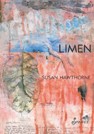
Susan Hawthorne, Limen, book cover

Cover: Courtesy Spinifex Press

Limen is a lovely word, isn’t it? It’s the title of Susan Hawthorne’s recently published verse novel. You probably know what it means, but just in case you’d forgotten like I had, it means threshold or doorway. This Limen though is a verse novel!

If you are uncertain about novels in verse, this would be a great one to try. The story is easy to follow; the language spare and beautiful, but accessible. It has a chronological structure with nine parts (titled Day 1 to Day 9) bookended by a Prologue and an Epilogue. The plot is straightforward. It’s about two women (Woman 1 and Woman 2) who go on a camping trip to the river – a favourite spot – with their young dog (Dog) . They arrive, full of anticipation for a good time, but “thunderclouds gather/on the horizon”. Overnight it rains and by Day 6, the longest section in the novel, they are trapped by the rising river. The story is told through the eyes of these three characters, each having a clearly defined role and personality.

Woman 1 is the driver and, perhaps because of this, is the more anxious one. She can’t sleep at night (“sleep avoids me/my head pops up”, “river rises by stealth/night terror”). Woman 2 is initially less worried, reporting on their activities (“we make lunch/talk in the dampness”) and on how Woman 1 is going, but as the waters rise she too becomes concerned:

she tells me her fears
only now do I understand
her wakefulness
her restless checking of the river at night
(Day 6)

The dog remains calm, caring only for physical comforts (“my ever-filling bowl/gone”), stick-chasing games, and the presence of its owners (“I sleep/curled paws/your body warm next to mine”).

Two men they had met in the local town appear, tow their bogged car out, and leave, telling them “you’ll be right mate” (in the italics Hawthorne effectively uses for dialogue). However, the river defeats them once again so they decide to “stay with the car”. Two young indigenous men, brothers and miners, appear, offer help, then set off to walk to the mine when the river can’t be crossed. The women, worried about the young men’s safety despite “their bush knowledge/carried on down the generations”, wait. Finally, other cars appear and they face the river crossings in convoy…

Limen is a beautiful read. It has its tensions but it’s not a thriller. The strangers they meet are not sinister, but just other people trying to manage the flooding river. The lack of names for any of the characters gives it a mythic tone. Hawthorne describes the joys of camping – the physical beauty, the spiritual peace, the time for talk and reflection – and the disappointments and fears – the pig-hunting that destroys the tranquility, the floods that threaten their safety. The writing is spare. There’s lovely imagery referencing female lives (“the river is a necklace of pools”, “paperbark/ruffled as a frilled ballgown” and “clouds are crocheted close/threatening”) but when the tension is highest the language becomes terse and plain. The story’s momentum is carried by changes in rhythm – from the more lyrical descriptive sections to those pared down to the basics:

start
rev
release

nothing
(Day 6)

The text is supported by simple, stylish, irregularly interspersed, black and white illustrations – a lizard, tire tracks, patterns in the mud.

Now, back to the title. Clearly the women find themselves at a threshold. Do they wait, staying with the car, or do they go? There is no conflict between them, but there are gentle hints of other things amiss – a “black spirit dog … sniffing the Styx”, the pig hunting that destroys the peace, the white policeman who shows no concern about whether the two young indigenous men who set off on foot have made it through (“it’s their/problem if they’re/out there“). These aren’t laboured, but they suggest other thresholds and are there I’m sure for us to notice and consider. For the women

this tiny crack
in our lives
wind and rain strewn
stranded on the limen
[ …]
where we could
be on both sides of time
span beingness
like an unfinished arc
of a bridge
is closing
(Epilogue)

until, perhaps, next time …

Do read this novel, if you can, and see what you think.

Susan Hawthorne
illus. by Jeanné Brown
Limen
North Melbourne: Spinifex Press, 2013
166pp.
ISBN: 9781742198606

(Review copy courtesy Spinifex Press)

Autumn and a favourite poem

Autumn Leaves

Autumn leaves

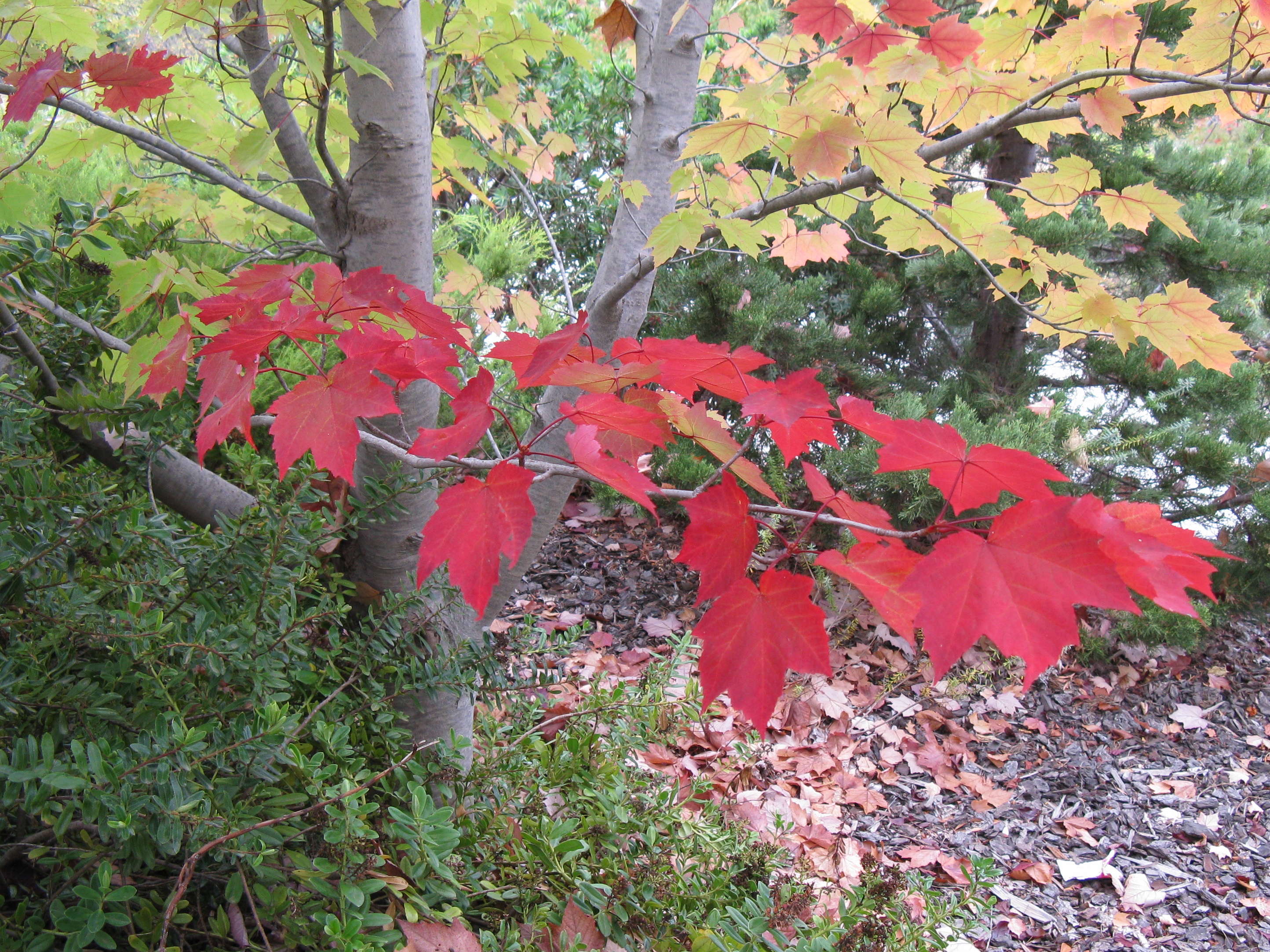
I was lying in front of a sunny window reading my current novel this afternoon when an urge came upon me to write about one of my favourite poems. It’s one of the few I can recite from heart. The poem is “Spring and Fall” by Gerard Manley Hopkins, and it goes like this:

To a young child

Margaret, are you grieving
Over Goldengrove unleaving?
Leaves, like the things of man, you
With your fresh thoughts care for, can you?
Ah! as the heart grows older
It will come to such sights colder
By and by, nor spare a sigh
Though worlds of wanwood leafmeal lie;
And yet you will weep and know why.
Now no matter, child, the name:
Sorrow’s springs are the same.
Nor mouth had, no nor mind, expressed
What héart héard of, ghóst guéssed:
It is the blight man was born for,
It is Margaret you mourn for.

Spring and Fall Quilt, 1985

Spring and Fall Small Quilt, 1985

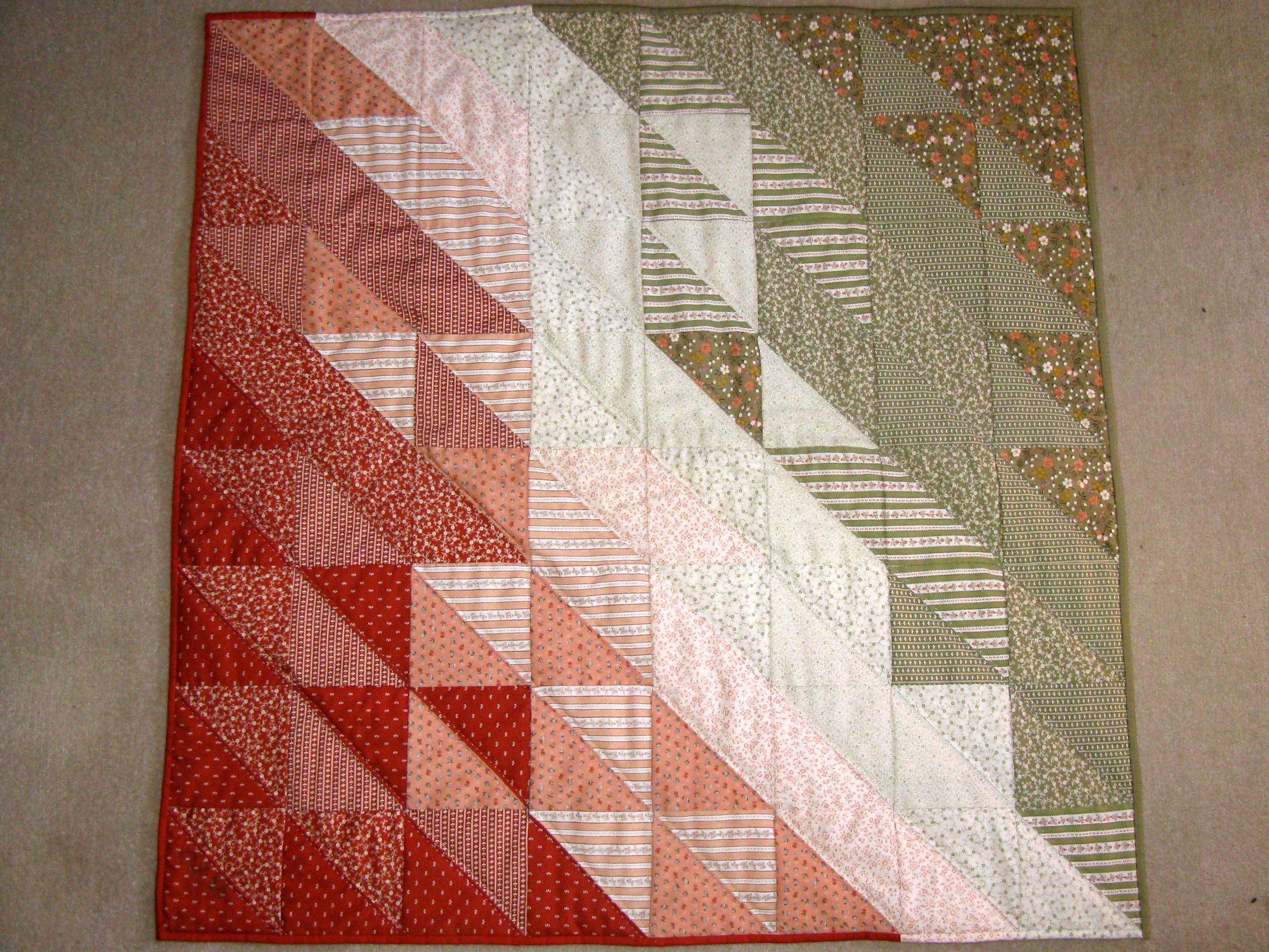
Now, I know you Northern Hemisphere people are enjoying spring and looking forward to the lazy, hazy, crazy days of summer, but down here in the south it is autumn which is, for me and I suspect many of us, a bittersweet time. Sweet because the weather is usually mild and stable, and the light soft and warm, but bitter because there’s a chill in the air, the days are shortening and the frosts are coming. It is for this paradox – and its implications, its recognition of our mortality – that I love Hopkins’ “Spring and Fall”.

What I love about this poem is what I love about Hopkins in general. Firstly there’s his heart that is so openly on show in all his poems, both the religious crisis poems and the ones about life and nature. Then there’s the tone, which is, in this poem, rather melancholic. After all, he is telling the child, Margaret, that what she’s really grieving for, though she’s unaware of it now, is her own mortality. I also love his rhythm (which he called “sprung rhythm“) and how in this poem there’s a jolt towards the end when he makes his main point.  And associated with this, the rhyme, which is appropriately simple here for a poem addressed to a child. But most of all, I love his language, particularly his imagery and the neologisms (like “wanwood leafmeal”). Or, perhaps, not quite most of all … I think most of all I love the way the language so perfectly matches the heart.

The older I get, the more I understand and love this poem!

Do you have poems that come back to you again and again at different points in your life?

Suzanne Edgar, The love procession (Review)

Amongst the madness of last year’s silly season was a little oasis, namely the launch of local poet Suzanne Edgar‘s latest collection, The love procession. It was an oasis not only because the launch was for a book of poetry, but also because it took place in the peace of a garden. Poetry and gardens – a match made in heaven don’t you think?

And in fact, there are gardens in this collection of poems, but before I write about the poems, I’d like to mention the title and cover. As Edgar explained at the launch, the title comes from a painting she loved in the Renaissance Exhibition held at the National Gallery of Australia a year ago. The painting, “Love procession”, is attributed to Marco del Buono and Giovanni di Apollonio, from the 1440s. Apparently it took many months for Edgar and the publishers to negotiate the rights to use the painting, but it was worth it because the end result is a simple, yet rich and stylish cover.

It’s a good title because the collection is about love – romantic and other – and about procession. About the procession of our lives – about love, life and death, about work and the things that keep us going, about friends and family, about nature that travels with us. The subject matter reflects the poet’s stage of life, someone who’s lived more than a few decades, who’s travelled, worked, lost friends and family, managed homes, experienced passion and peace. Well, you know what I mean. I could mention for example a poem about clutter, which conveys the melancholy of time passing:

Wilting hats from our salad days
match skirts too small at the waist.
(from “Silt”)

Or one about the real ravages of age:

A patch of muddy clay could well betray
unwary folk who have a metal hip
and hope to play again another day.
(from “Winter Sports”)

The collection’s first poem is – as you might expect – titled “‘Corteo d’amore’ (Love procession)” and is Edgar’s response to the painting. She imagines the groom waiting at the other end of the procession, reflecting. It’s a cheeky poem that contains both a sense of excitement and uncertainty, setting just the right tone for the rest of the collection:

To bed the girl had always been his goal
but laughing in the square, she’d seemed less grand.

I particularly like the way Edgar varies her tone throughout the collection. There are wry poems, and downright funny ones, and there are the passionate, the sorrowing, and the resigned ones. The style varies too. There are poems that rhyme and poems that don’t. There are three-line poems, a four-page poem, and even a bunch of sonnets. There are story poems and there are ones I’d describe as reflections. The imagery is generally accessible – at least it is to those of us who have lived (are living) similar lives in similar places. She invests the places and objects of our lives with meaning. There’s the woman, for example, who upsizes –

She tries a sea change, a tree change,
an elevated view change
(from “The Leavings”)

– losing, in the process, “her ghosts/ghosts of her children’s cries”. The doggerel-like rhyme and rhythm here are perfect for what Edgar clearly sees as the woman’s silly decision. Other poems speak of chairs that know our lives (“The Life of Chairs”), roll-top desks that trace a family’s history (“A Family Servant”), and of course the gardens that provide “refuge from summer’s sultry hours” (“Two Gardens”).

The poems are unmistakeably Australian with their references to the bush and of course gums, to wattlebirds and magpies, to drought and the pleasures of rain that only dry places know.

My favourite poems, though, are those scattered throughout that chronicle her relationship, at least they feel autobiographical, with her husband/lover/partner/significant other. They are often addressed to “you”. These poems speak of a long and deep love, but one also peppered, as real love is, with differences and squabbles. These poems made me smile, even where they spoke of loss, because they are honest.

Nearly halfway through the collection is a poem that starts:

I wonder where the poems went,
I used to think them heaven-sent.
Life is cluttered with noise and news
(from “Turn Off the Noise”)

Well, the poems are still here and I’d happily recommend Edgar’s collection as the perfect one to dip into whenever you want a respite from “noise and news”. These aren’t difficult poems, but that doesn’t mean they are trivial. Try them, if you can, and you’ll see what I mean.

Suzanne Edgar
The love procession
Port Adelaide: Ginninderra Press, 2012
107pp.
ISBN: 9781740277754

Dame Mary Durack, Lament for the drowned country (Review)

Lake Argyle with Crocodile

Freshwater crocodile heading into Lake Argyle

Near the end of her book True north about Mary and Elizabeth Durack, biographer Brenda Niall writes of Mary Durack‘s poem, “Lament for the Drowned Country”, which she says “has been judged her finest poem”.  Of course, with such a statement, I had to read it. I could have Googled* it, but I decided to check my Penguin Book of Australian women poets and, hallelujah, it was there. (Once again this book didn’t let me down!)

“Lament for the drowned country” is a long poem and is presented in the voice of an Aboriginal woman, Maggie, mourning the drowning (for the Ord River Irrigation Scheme) of her “born country”. It’s a poignant poem – for obvious reasons – as it’s about the loss of country (for the indigenous people) and home (for the Duracks, whose Argyle homestead went under the water). But, there’s something else too – an irony, because the idea of damming the Ord River was first proposed by Mary’s brother Kimberley Durack in the 1940s. Mary supported her brother** at the time … but the reality many years later, after her brother’s death, was sad for her.

The interesting thing about the poem is that Durack chose to write it in the voice of an Aboriginal woman. Niall writes of this that:

At a later time, her creation of a first person voice for Maggie Wallaby might have been questioned. In 1972 it was taken as she intended it, as a work of empathy and imaginative identification.

This made me think of Thomas Keneally‘s The chant of Jimmie Blacksmith which was shortlisted for the Booker Prize in 1972. It was written in the voice of the Aboriginal protagonist, but Keneally has since said that he wouldn’t presume to do that now, and would tell the story from a white point of view. This says something, I think, something positive, I hope, about Australia’s cultural development. In the 1970s and before, indigenous voices were hard to find. This is less so now – and will hopefully only get better bringing us more voices, and a greater variety of story representing the diversity of indigenous experience.

Anyhow, back to the poem. According to Niall, the poem was inspired by Mary seeing Maggie “catching fish and unaccountably throwing them back into the [new] lake”. Mary saw this – realistically or romantically, who’s to say? – as signalling hope. She has Maggie saying:

I sit along river coming down from my born country.
That heart place! I got to talk to that water.
I got to tell that fish: ‘You go back – you go back now –
talk strong my country. You tell him that spirit can’t leave ’em.
You tell him – Wait! Hang on! This is not the finish!
…’

Later in the poem, Maggie talks of the land drying, the sun coming once again to warm it, and the animals and birds returning. Maggie also makes a reference to the Durack homestead:

You go back up there, that old station – Argyle station –
(poor fella my old boss, my old missus. Nothing left that
house, where I sweep’m every day!) You look out that house,
you look out
windmill, tank, garden, kitchen, saddle shed.

The remarkable thing about the poem is how well – or so it seems to me – Mary Durack captures the cadence, the intonation even – of Aboriginal speech and story-telling. I shouldn’t be surprised though, because Durack spent much of her childhood playing with Aboriginal children and spent her adult life, when she could, not only arguing for but working with indigenous people in their fight for equal rights. According to Niall, as Mary Durack left the north for the last time, “the Aboriginal women, knowing they would never see her again, began to beat their heads and wail inconsolably”. We all know the psychology of master-servant/white-black relationships is a complex one, but that doesn’t deny the fact that amongst it all there can genuine feelings and mutual respect.

I’ll be writing more on the Duracks, and particularly on Mary whose love for the land of her birth was, like Maggie Wallaby’s, absolute:

she can’t forget ‘im, my country, she all day heart-crying.

Meanwhile I recommend this poem …

Mary Durack
“Lament for the drowned country”
In Susan Hampton and Kate Llewellyn (ed)
The Penguin Book of Australian Women Poets
Ringwood: Penguin, 1986
pp. 65-68.

* I did Google it too, to provide a link for this post, but I only found excerpts rather than the whole poem. Hence no link here. I guess it’s too recent to be in the public domain.

** Kim Durack was an agricultural scientist. He apparently loved the land and was committed to improving it after the damage caused by years of over-grazing.