Thea Astley, The multiple effects of rain shadow (Review)

There are two main reasons why I like – actually love – to read Thea Astley. One is her language, her wonderful way with words that may, at times, be over-the-top but that is never clichéd. The other is her passion for the underdog, and thus for social justice in a world where it is often conspicuously absent.

Island, Palm and Sun

Island with palm, because Penguin will not answer emails regarding bookcover use (Courtesy: OCAL, via clker.com)

The multiple effects of rainshadow is Astley’s second last novel. Its overall subject matter is, as one character says late in the book, “the unmoored behaviour of humans”, an effective image given the book’s central motif is an island. It has a very loose plot which is based on an actual event that occurred on Palm Island in 1930. Palm Island was, at that time, essentially a dumping ground for Indigenous Australians deemed to be “problems”, but the event in question concerned the white superintendent, mad with grief at the recent death of his wife, running amok and setting fire to buildings (including his own home in which his children were sleeping). He was eventually shot (and killed) by an Indigenous man under the (cowardly) order of the white deputy superintendent. The novel explores, through multiple points of view and over a period of around 30 years, the impact of this event on six white people who were present on the island at the time – but interspersed between these voices is the voice of Manny, the man who shot the super. This is, I think, a pretty risky thing to do but Astley is not one to shy away from risks in her writing.

The voices are, in chapter order:

  • Manny Cooktown, first person, the indigenous “shooter” and main narrator who commences the story and appears between each voice, but does not conclude the novel
  • Mrs Curthoys, first person, landlady on Palm Island at the time of the incident
  • Gerald Morrow, third person, writer/editor who had gone to the Island to work as a foreman, for which he had no skill or experience, and who was in fact escaping the Island in a boat at the time of the incident
  • Captain Brodie, third person, the Superintendant who ran amok and was shot by Manny
  • Mr Vine, third person, a school teacher on the Island at the time of the incident
  • Father Donellan, third person, priest who visits regularly from the mainland and is responsible for the Island’s religious “needs”
  • Leonie née Curthoys, first person, daughter of Mrs Curthoys and so on the Island at the time of the incident
  • Omniscient author who carries the last chapter

Looks complex eh? But in fact it’s pretty straightforward in terms of knowing who is who, as each voice “manages” its own chapter. The chronology is a little trickier as many of the characters (let’s call them that from now on) flip between their present (some are writing from many years after the event) and the past. Did you notice that the first person voices belong to the two groups most recognised by Astley as disadvantaged: women and indigenous Australians? A subtle but clever use of her narrative structure to give them a voice!

The setting is, after all, very much a white patriarchal world, and marriage is seen in that light. Vine, for example, is told to get a wife  for

‘The boring bits. You know. Meals. Washing. Shopping. Kids. All that sort of thing. A man hasn’t time for that sort of thing.’

‘Why not a housekeeper, then?’

‘You are green. Cost too much …’

Not surprisingly Mrs Curthoys and Leonie do not find marriage much to their liking. The main underdogs in this novel though are the indigenous people, many of whom are brought to the Island – and therefore separated from their country – as problems, and are treated with disdain at best and real cruelty at worst by most of the white residents (from 1918 when the settlement begins to 1957 when the book closes). Astley offers, I’m afraid, little hope. She is not a cheery writer: her goal is to shock us into attention – and that she does. However, I can imagine some critics accusing her of putting contemporary views about feminism and indigenous relations in characters’ mouths. I would argue though that contemporary ideas do not spring from a vacuum, and that therefore the occasional more sensitive/egalitarian views expressed in the novel are historically valid.

I said at the beginning of this review that one of the main reasons I like Thea Astley is her language, so here are some examples of her imagery:

…whistlestop hamlets scattered along briefly tarred roads that led to further sprawls moated by loneliness …  [from school-teacher Vine, heading to a country school]

And I am weary of  a Celtic charm that is shaken like spice over any dish within gulping reach. We bore each other rancid. [Leonie on marriage and her philandering husband]

At least I’ll have tried. At least I’ll be learning to decline the gumleaf, conjugate the seasons. [Vine’s “do-gooder” son Matthew]

She also effectively mixes up the rhythm to make points or convey feeling, using short snappy sentences, repetition of phrases (such as Morrow’s “swing dip drag” as he sails across the sea), and punctuation-free streams of consciousness:

There was an unalterable plane geometry to his movements: the clock the tea/toast the clock the bell the classroom the toted piles of exercise books the bell the repeated texts the stale jokes the texts the bell the common-room bitchings the clock the bell … the … the … [schoolteacher Vine]

Astley is often quite self-conscious about the act and role of writing, and this is certainly the case in this novel. I’ll give just one example, the bitter rant of failed writer Gerald Morrow, who is jealous of the success of another, to him, lesser writer:

There must be a million readers out there who crave boredom! Who love the dangling participle! Who wallow in truisms and fatuous theorisings! … Slap in your popular aphorisms, buddy, but don’t make ’em think!

You could never accuse Astley of not making you think, but there has to be some irony here, some little sense of self-deprecation even, in the fact that she put these words in the mouth of a failed writer, as if she knew that for all her passion there’s only so much you can achieve with words. That may be so, but Astley has given it a darned good try!

Thea Astley
The multiple effects of rainshadow
Camberwell: Penguin, 1996
296pp.
ISBN:  9780143180265

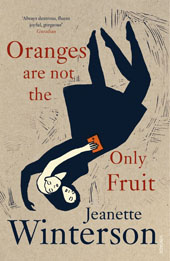
Jeanette Winterson, Oranges are not the only fruit

Winterson, Oranges are not the only fruit, book cover

Book cover: Used by permission of the Random House Group Limited

As I was reading Jeanette Winterson’s novella Oranges are not the only fruit, the question, rightly or wrongly, that was uppermost in my mind was “What is it with the oranges?” Is there something about oranges that I don’t know? Something specific that they symbolise?  I racked (wracked) my brain for something in my literary past that would give me a clue, but I came up with nothing. I guess she wanted to choose a motif to represent her mother’s limiting interactions with her and an orange seemed as good as anything? Certainly oranges are a recurring motif, and her mother regularly insists they are “the only fruit” until the end when a “pineapple” makes its appearance. I’m not sure, however, that this change heralds anything in their relationship other than compounding the paradoxes that seem to underpin this novel.

This is an intriguing book. It is a semi-autobiographical coming-of-age novel which tells the story of the first person protagonist, Jeanette, who was adopted by a religious zealot and is being brought up to be a missionary. However, around the age of 16 she discovers that her (homo)sexual leanings do not meet her mother’s (or her church’s) approval and, well, the plot is slim but perhaps I will leave it here nonetheless…

The novel exhibits some of the hallmarks of postmodernism, of which the most obvious is its metafictional elements, the way it contains stories within stories and plays around with the idea of stories in relation to “truth”. It all begins with Winterson naming the main character after herself and modeling that character’s life on much of her own, resulting in our being, from the start, teased by notions of what is “true” and “real”.

The book is divided into chapters titled appropriately, given Jeanette’s upbringing, by books of the Bible, such as Genesis, Joshua and Ruth. These titles are descriptive but also symbolic and even a little satirical; Jeanette, for example, has walls to confront just like Joshua. And the narrative, while roughly chronological, intermittently leaps from “reality” to “fantasy” as Jeanette tries to escape or make sense of her experience of life. Sometimes these stories – such as the Winnet story near the end – represent a parallel fantasy life for what is happening to her, but other times the reference point is more indirect, and draws on history and myth such as the King Arthur legend (and Sir Perceval’s search for the Holy Grail).

And this brings me to “story” and “history”. Readers of my blog will know that these notions, and the related one of “truth”, fascinate me when they are played out in fiction. I tend to enjoy reading books that deal self-consciously with them, that recognise the challenges and ambiguities inherent in them – and this is one of those books. Jeanette, the character, has some interesting things to say on these topics around the time the “truth” of her life, her sexuality, is becoming clear. She says in the short chapter titled Deuteronomy: The last book of the law:

Of course that is not the whole story , but that is the way with stories; we make them what we will. It’s a way of explaining the universe while leaving the universe unexplained … People like to separate storytelling which is not fact from history which is fact. They do this so they know what to believe and what not to believe. This is very curious …

And she goes on to discuss how history, the past, “can undergo change” because “the lens can be tinted, tilted, smashed”. She recognises that “perhaps the event had an unassailable truth” but we all see it through our own lens. Tellingly, near the end of the book, in the chapter titled Ruth, she runs into Melanie, her first lover (now married with a child):

…she [Melanie] laughed and said we probably saw what had happened differently anyhow … She laughed again and said that they way I saw it would make a good story, her version was just the history, the nothing-at-all facts.

Melanie, it seems, does not have the imagination to re-vision her “story”.

So, did I enjoy this book? Yes, pretty much. I like her attempt to make sense of what was a very particular childhood, and to try to draw from it some larger “truths” about how we might all manage the “stories” of our lives. It is not a straightforward read – and it is first novel with, perhaps, a little of the overdone in it. I’m not sure why, for example, she suddenly decides to include a little rant against Pol Pot. It usefully supports a point she is making about the uses of history, but it is odd in a story that is nowhere else political. Perhaps that’s just being post-modern!

In her introduction to my 1991 Vintage edition, Winterson claims to have written an experimental, anti-linear novel. Well, it is a bit of that I suppose, though not dramatically so. I would have called it reasonably linear – at least in the chronological sense – but perhaps the ideas in it do “spiral” (as she calls it) a bit in the way she toys, through the various narratives, with the idea of “story” and what it means to us. What it means, I think, is not always clear – we like stories but we cannot (perhaps need not) always draw conclusions from them. That is the paradox of our lives. As she says near the end

…not all dark places need light. I have to remember that.

Jeanette Winterson
Oranges are not the only fruit
London: Vintage, 1991 (orig. 1985)
171pp.
ISBN: 9780099935704

David Malouf, Ransom

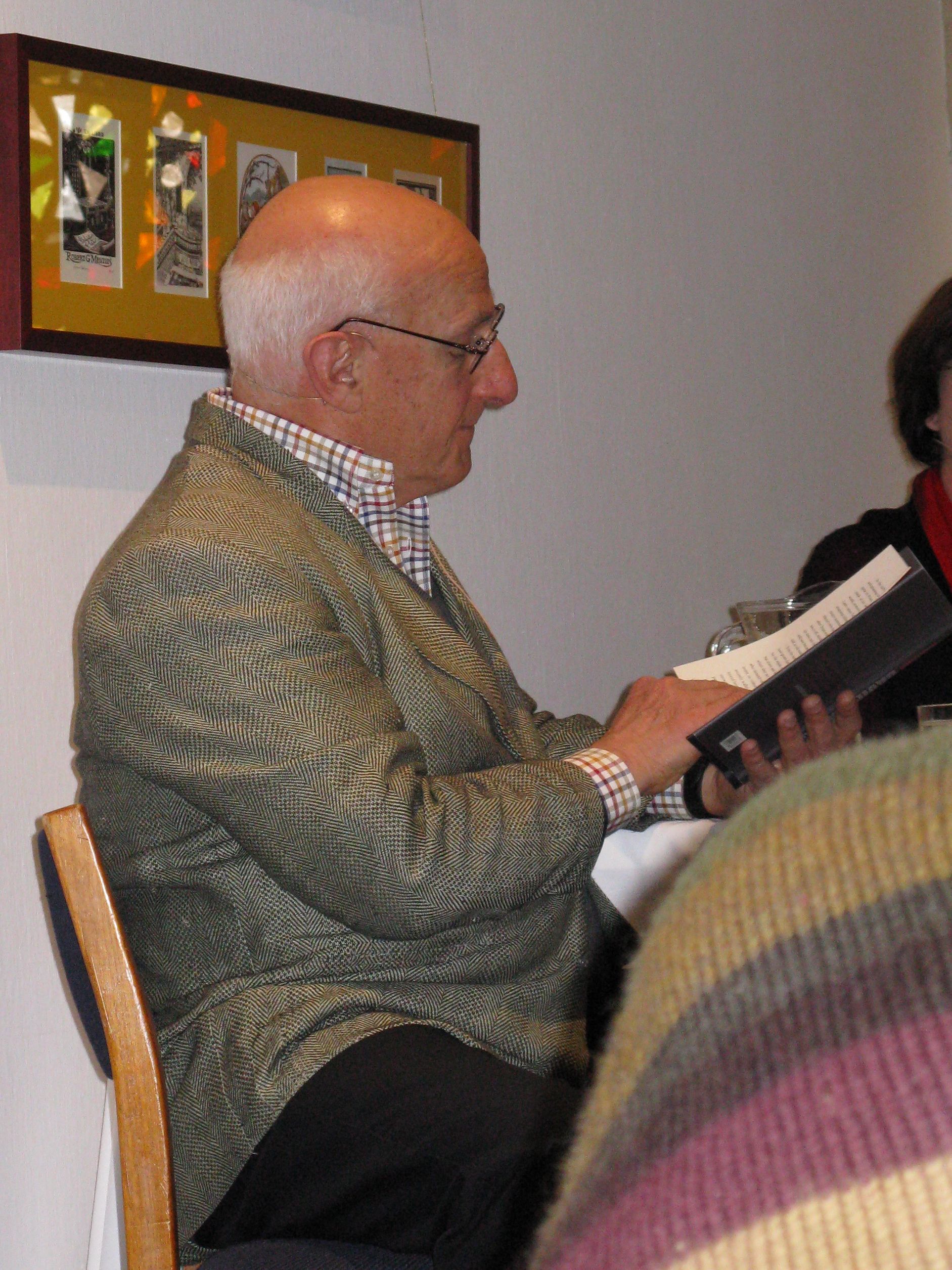
David Malouf reading Ransom

Malouf reading Ransom, National Library of Australia, August 2009

Words are powerful. They too can be the agents of what is new, of what is conceivable and can be thought and let loose on the world. (p. 61)

Is risk-taking only the province of the young? Do desperate times call for desperate measures? Or, more to the point, can the impossible be made possible? These are some of the questions that form the core of David Malouf’s most recent novel, Ransom.

WARNING: Spoiler if you don’t know the Iliad!

Ransom, as I wrote in my post last year, is Malouf’s re-visioning of the section of the Iliad (from Books 16-24) which chronicles Patroclus’ death at the hands of the Trojans, Achilles’ revenge killing of the Trojan prince Hector and his subsequent abuse of Hector’s body, and Priam’s visiting Achilles to ask for his son’s body back. Malouf says that he wanted to suggest a new kind of human, non-heroic consciousness, by re-visioning how Priam does this through deciding “do something extraordinary” (Malouf’s words). As Priam discusses with his wife Hecuba

I believe … that the thing that is needed to cut this knot we are all tied up in is something that has never before been done or thought of. Something impossible. Something new. (p. 58)

and

there might be another way of naming what we call fortune and attribute to the will, or the whim of the gods. Which offers a kind of opening. The opportunity to act for ourselves. To try something that might force events into a different course. (p. 61)

Ah, I thought, here is going to be Malouf’s vision (or recipe even) for our conflict ridden times. He wants to show, through Priam’s desire to do “something impossible. Something new” that  there is another way of managing conflict. But sadly, that is not what he is about. Sure, Priam does do something audacious – he enters Achilles’ compound as an ordinary man on a plain mule-driven cart driven by an even more ordinary man, the humble carter, Somax. But, I was disappointed, because after a lovely interval of humanity the story plays out as it always does with Achilles dying, and Priam being brutally killed by Achilles’ son. What I hoped Malouf was setting me up for wasn’t his goal at all. It was something both bigger and smaller. Smaller because he is not (really) making a political statement for our times, and bigger because he re-visions the story as one of humans rather than of heroes, and as one in which humans can be self-directed rather than at the whim of the gods. There is some irony here though because, as well as being accompanied by the humble Somax, he is for a while escorted by the god Hermes who facilitates their entry into Achilles’ compound. I did wonder about the meaning of this unlikely trio – common man, king, god – but it is in the original and so is not really part of a new message. That said, this is, as I am sure you are starting to realise, quite a complex book despite its small size – and I am only going to touch the surface here.

Some of the loveliest parts of the book are in fact the most human ones, such as the conversation Priam has with Hecuba when he reveals his idea, and Priam’s journey with Somax in which he learns to enjoy ordinary human (as against royal) pleasures. (“It had done him good, all that, body and spirit both”).

In the end after a beautifully rendered meeting with the conflicted Achilles, Priam achieves his goal and brings Hector’s body back for burial. It is a triumph of his vision, but

It is only a provisional triumph, of course; the gods are not to be trusted when they tilt the balance momentarily in your behaviour. And what sort of triumph is it to be bringing home the body of a son? But he has done something for which he will be remembered for as long as such stories are told …

Yes, he is “a man remade” because he has done a “deed that till now was never attempted”. Achilles too has been transformed (at least for a while): he is “visited by a lightness that is both new and a return”. But, and unfortunately there is a but, the story plays out as it always has…

So, what is it all about – besides, that is, the underlying themes relating to fathers and sons, grief, will versus fate, and humanity versus the gods? Perhaps it is simply this, that you can dare to try the impossible, and you can triumph. How big that triumph is, how long it lasts, is perhaps not the right question. The right question is the original one, “Dare I dream, and dare I do it?” It is also about the power of stories. Priam’s action will now be remembered “for as long as such stories are told”, while his killer, Achilles’ son, Neoptolemus, is not so lucky. The murder is a messy one and so “for him … however the story is told and elaborated, the raw shame of it will be with him now till his last breath”.

David Malouf Ransom

UK edition cover (Used by permission of the Random House Group)

In its rather ironic and paradoxical way, then, Ransom is redemptive … and is beautiful for all that. And yet, I do have this little nagging feeling that I’d have liked it to have been a little more. I did in fact want a recipe for our times, a suggestion that we can move our humanity forwards!

David Malouf
Ransom
North Sydney: Knopf, 2009
224pp.
ISBN: 9781741668377

Helen Garner, The children’s Bach

I’ve said a few times now that I rarely reread books, and then go on to write about something I’ve re-read. I must look like a liar, but the fact is that if I’ve liked a book so much that I’ve reread it it’s likely to find its way here. The funny thing is, though, that my reason for rereading The children’s Bach was not so much because I loved it first time around (though I did enjoy it) but because I read a critic who described it as one of the four best short novels – ever! It’s hard to ignore a commendation like that, isn’t it? And so I read it again …

It’s set in Melbourne, and concerns a couple, Athena and Dexter, who lead a self-sufficient life with their two sons, one of whom is severely disabled. This apparently comfortable life is disrupted by the arrival of Elizabeth, from Dexter’s past. With Elizabeth come her sister Vicki, her sometime lover Philip, and his prepubescent daughter Poppy. Through them, Athena and Dexter are drawn into a world whose ideas and values test the foundations of their relationship.*

This sounds like a pretty standard plot, but from it Garner draws something quite special, something tight and marvelously observed, and something, in the way that Garner has, that is brutally honest. This is the thing that I admire about her most – even though I don’t always agree with her: she doesn’t flinch from unpleasant “truths”. And so, in this book, she tackles the challenge of parenting a severely disabled child. While there are people who talk about the joy and meaning a disabled child brings to their lives there are others who feel quite differently. This is the shock at the centre of this book.

Garner introduces a sense of uneasiness right at the beginning with a photo of Tennyson and his family (why Tennyson, I’m not quite sure) which shows them together but not quite together and which is described simply as “the photo of a family”. The photo is old but Dexter keeps sticking it back up again. This beginning is followed by a fairly idealised image of Dexter and Athena as a loving, supportive couple – “she loved him. They loved each other” (p. 4) – and then Garner slowly reveals the cracks. Dexter’s idealisation of Athena is one cause, but the disabled child who holds Athena back, is another. The arrival of Elizabeth and her entourage – with their different and challenging ways of viewing the world – is just the catalyst.

Athena’s harsh attitude regarding Billy, her disabled son, is psychologically real, but is shocking to see in a character who is idealised as the earth-mother. Our readerly assumptions take a knock! Early in the story Athena looks at handprinted cards of places for rent:

… Athena was … scanning the window covered in handprinted cards on which people advertised rooms to let in their rented houses. Athena lived, for as long as it took to read a card, in each sunny cottage, each attractive older-style flat, spacious house, quaint old terrace, large balcony room with fireplace, collective household with thriving veggie garden. Her children dematerialised, her husband died painlessly in a fall from a mountain. What curtains she would sew, what private order she would establish and maintain, what handfuls of flowers she would stick in vegemite jars, how sweetly and deeply she would sleep, and between what fresh sheets.

This could be typical daydreaming but it’s pretty specific in detail (children dematerialised, husband dead): it’s Garner telling us that Athena feels trapped and is ready for change. Then Philip comes along and she is attracted to him; she’s not morally repulsed the way Dexter is by his behaviour: “Dexter lay rigid as a board … but Athena slept, and dreamed that she was in a garden….”.

And so, Garner writes, “The edifice crumbles”. The cracks have been there, in the edifice, but Dexter is (has been) oblivious to them. He’s a kind man but he’s pretty unaware of how other people feel; he expects them all to see life as simply, as happily as he does. But this is not the case – as he finds out …

All this is told in tight, expressive language.  Here is a delicious description of Dexter’s mother:

Like many women of her age whose opinions, when they were freshly thought and expressed, had never received the attention they deserved, Mrs Fox had slid away into a habit of monologue, a stream of mild words which concealed the bulk of thought and knowledge as babbling water hides submerged boulders. (p. 101)

Garner focuses on the gap between appearance and reality, particularly regarding the problems of idealisation (of self and/or of other). Athena is idealised but is shown to have feet of clay; Dexter is also idealised and idealises himself – until his own fall from grace: “he was in its moral universe now, and he could never go back”.

We can read this book in two – not totally exclusive – ways. One is psychological and relates to the realisation of self, particularly for Athena. The other is social and relates to role definitions, again particularly for Athena in terms of the expectations of her as wife and mother. One of the things that Garner tends to do well, in fact, is explore the point where social expectations of how we should feel meet and often clash with our real emotional selves. We see this clearly in The spare room where the character Helen shocks us with her anger at her dying friend.

I have really only touched the surface of this book – there is the music motif to consider, and the conflict of values represented by the intrusion of Elizabeth and her entourage into Dexter and Athena’s world – but I have talked about some of the issues that grabbed my attention and that, I think, will do!

* This is, essentially, the plot summary I wrote a couple of years ago for the Wikipedia article on the book.

Helen Garner
The children’s Bach
Penguin Modern Classics, 2008 (first published 1984)
180pp.
ISBN: 0869140299

Sawako Ariyoshi, The doctor’s wife

The doctor’s wife is the third Ariyoshi novel that I’ve read. The other two – The River Ki and The twilight years – I read well over a decade ago. According to Wikipedia The doctor’s wife is considered her best novel. All, though, are fascinating reads providing an insight into a culture which is so different from my own but in which, at the same time, people experience similar desires, pressures and emotions.

The twilight years is set in 1970s Japan and beautifully captures the cultural changes that were occurring around the time as Japan was (and still probably is) moving from  feudal/traditional parent child relationships to our more modern independent ways, with women caught in the middle. The River Ki chronicles three generations of women from the late 19th to mid 20th century, exploring changing attitudes and expectations of women. You are probably getting a picture here and you’d be right: Ariyoshi’s overriding theme concerns the role of women in Japanese society, both historically and in modern times. (Ariyoshi died in 1984.)

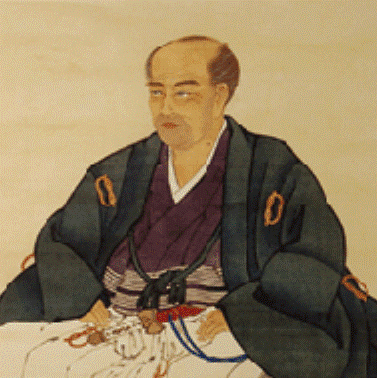
Hanaoka Seishu

Hanaoka Seishu (Public domain, via Wikipedia)

The doctor’s wife is an historical novel, spanning 70 years from around 1760 to 1830 and based on the life of famous Japanese doctor Hanaoka Seishu. A quick plot summary. The doctor’s wife is Kae, a young woman from a wealthy family, who is lured to become Seishu’s bride by his ambitious mother Otsugi, herself a woman married from a wealthy into a poorer family. The novel then chronicles Kae’s life in this extended family household as Seishu develops his medical skill and training until, near the end, he performs the world’s first surgery under anaesthetic (1804, breast cancer)*. While Seishu’s development as a doctor frames the novel, the real plot concerns the relationship between Kae and Otsugi.

The novel is told in third person, mostly the more objective omniscient voice, but occasionally we feel we are specifically in the heads of Kae or Otsugi. According to my edition’s introduction, Ariyoshi had access to Seishu’s personal records, diaries and books. However, being a man of his time and a doctor focused on his research, he did not, I assume, document much of his family life. The story, then, of the women is largely fictional. Mostly through dialogue, with description as needed, Ariyoshi describes how the loving supportive role Otsugi initially presented towards her daughter-in-law changes when her son (who had been married to Kae in absentia some three years before) returns home from his medical studies in Kyoto. Overnight, the relationship, to Kae’s shock and distress, changes into a competitive one – a competition that has serious consequences as they vie to be guinea pigs for his experiments in anaesthesia. Both women are presented as flawed, but as it is Kae who opens the novel and is the more powerless, it is with her that we are most keen to identify and empathise.

Why has Ariyoshi chosen to tell this story of conflict and competition within an historically based story of a great man? Does the historical “truth” add credibility to her exploration of familial power discrepancies? I’m not sure it’s necessary, but perhaps it helps … It is a very human tale – the grand gestures made by the women to support his research are small in the scheme of things though the impact on them, particularly on Kae, is immense. Ariyoshi realistically explores the nuances of their relationship through the normal day-to-day patterns of life (weaving, cooking, house management, childbirth) suggesting that this sort of conflict doesn’t have to be but that it often (traditionally, even) is. In fact, we readers are lulled into seeing it as the norm – the lot of women – until we are shocked out of that frame of mind near the end by Seishu’s unmarried sister who says (in broken speech because she is ill):

I think this sort of tension among females . . . is . . . to the advantage . . . of . . . every male.

She continues to explain her particular perspective on women’s secondary lot, and pronounces that:

as long as there are men and women side by side on this earth, I wouldn’t want to be reborn a woman into such a world.

Clearly, given the story Ariyoshi has told, she rather agrees  – or, at least, agrees for such societies as she depicts here in which women’s lot is not only an inferior one but which work to discourage them from cooperating and supporting each other. The novel may be set in Japan, but the fundamental truths, unfortunately, are not so confined.

What I have described here is the main story, but there’s more here that can be discussed, including the development (or history) of medicine in the east and west, the experimentation on animals and humans, and Japanese social life and customs in the Tokugawa period.

It’s a short but engrossing read. It falters a little I think right at the end when the historical facts are presented so prosaically that they threaten to overwhelm its novelistic achievements, but the last line fuses the two so beautifully that you forgive this.  The doctor’s wife is a fascinating and keenly observed novel that deserves to be read.

*Ironically, in 1811, novelist Fanny Burney underwent a horrific mastectomy without anaesthesia because it was unknown in the west!

Sawako Ariyoshi
The doctor’s wife
(trans. by Wakako Hironaka and Ann Silla Kostant)
Tokyo: Kodansha International, 1966 (orig ed), 1978 (trans)
174pp.
ISBN: 0870114654

Sarah Waters, The little stranger

The little stranger, by Sarah Waters

The little stranger (Book cover courtesy: Virago Press)

I’m not quite sure I know where to start with this one –  the ghost story that isn’t. Or is it? The little stranger is my second Sarah Waters’ novel. I found The night watch riveting, and I did see and enjoy (but not read) her very Dickensian Fingersmith.

Like The night watch, The little stranger was shortlisted for The Man Booker Prize. It’s an easy read, and rather a page-turner, but by the end I have to say that I felt a little unsure about what I’d read. In one of those interesting bits of reading synchronicity, I recently read Helen Simonson’s Major Pettigrew’s last stand. It is very different to this one, and is set a few decades later, but they both deal with the loss of “old families” and the breaking up of their estates. Waters, though, is the far superior writer.

So, what is the plot of The little stranger? Its first person narrator, Dr Faraday, was born to the working class but, through family sacrifice, has pulled himself up into the professional middle class. After a brief flashback to a childhood memory of Hundreds Hall, where his mother had worked as a housemaid, he proceeds to chronicle the relationship he develops with the Hall’s family when he is in his late 30s and practising in the nearby town as a GP. The family comprises the mother, Mrs Ayres, and her adult children, Caroline and Roderick. The book is set soon after World War 2, and the story he tells occurs over the period of about a year, but is told from the vantage point of some three years later.

Waters is best in her vivid description of the house, its inhabitants and its increasing dilapidation. I’m tempted to read the house as a metaphor for the society it represents – for the days of elegance and upstairs-downstairs that are now on the way out.  And, extending this idea, “the little stranger” (or “dark germ”) that seems hell-bent on bringing about the house’s destruction could then be seen as a metaphor for the rapid modernisation that was occurring in post-war England and that was pushing the old families to the brink of economic and, thereby, social ruin. After all, servant Mrs Bazeley reassures the young servant girl Betty that “it” is not interested in them.

To support this way of looking at the novel, here is Dr Faraday early-ish in the novel:

But Hundreds Hall had been made and maintained, I thought, by the very people they were laughing at now. After two hundred years, those people had begun to withdraw their labour, their belief in the house; and the house was collapsing, like a pyramid of cards. Meanwhile, here the family sat, still playing gaily at gentry life, with chipped stucco on their walls, and their Turkish carpets worn to the weave…

And here is Dr Seeley (to whom he later goes for advice):

The Ayreses’ problem … is that they can’t or won’t adapt … Class-wise they’ve had their chips. Nerve-wise, perhaps they’ve run their course.

Quotes like these support a social change interpretation. And yet, perhaps it is more psychological? Dr Seeley suggests that part of one’s psychology, one’s dream-self , can break loose and become some sort of “psychic force”:

The subliminal mind has many dark, unhappy corners, after all. Imagine something loosening itself from one of those corners. Let’s call it a – a germ. And let’s say conditions prove right for that germ to develop – to grow … What would this little stranger grow into? A sort of shadow-self, perhaps a Caliban, a Mr Hyde. A creature motivated by all the nasty impulses and hungers the conscious mind had hoped to keep hidden away: things like envy, and malice and frustration…

Somewhat supporting this interpretation is Caroline’s report of her mother as saying:

the house knows all our weaknesses, and is testing them one by one.

And so what do you think? Psychological/psychic or social? Or perhaps bit of both? That is, the arrogant upper class family out of touch and unable to adapt (social) releasing all its weaknesses (psychic). I’m not sure that Waters makes the case clearly enough – partly I think due to the ambiguity posed by the narrator.

Her characterisation is in fact coherent and convincing, except for the narrator. How are we to read him? Is he genuine – does he really care for the family? Does he genuinely care for the house and its history? Or, is he a social climber who wants his way into the house any way he can. I must say I couldn’t fully work him out. Is he reliable? The tone is quite reminiscent of that in Ishiguro’s wonderful Remains of the day. Like Ishiguro’s butler, Dr Faraday tells the story from some time after the events, and he peppers his account with such words as “recall”, “I think I noticed”, “must have”, words that suggest that all may not be as he sees it. And in some ways it isn’t, but there is no intriguing twist, neither is there a traditional resolution. As I read I wondered whether he was stringing me along, whether he was the cause of the malevolence. He did after all chip away a decorative acorn from the house on his youthful visit:

I was  like a man, I suppose, wanting a lock of hair from the head of a girl he had suddenly and blindingly become enamoured of.

If he was the malevolence, there is no evidence to suggest it is anything other than unconscious. And further, if he was, it certainly makes the whole class divide story more complex – and, more interesting.

Regardless, though, of how the end comes about, of “who” (one? many? none?) is responsible, it is pretty clear that the winners – if there can be such things in the messy game of life – are the old underclass. Hundreds was, in Dr Seeley’s view, “defeated by history, destroyed by its own failure to keep pace with a rapidly changing world”. It is not surprising, I suppose, that by the end the narrator is both “baffled and longing”.  Social change never has been easy!

Sarah Waters
The little stranger
London: Virago, 2009
450pp.
ISBN: 9781844086023

Jorge Amado, Gabriela, clove and cinnamon

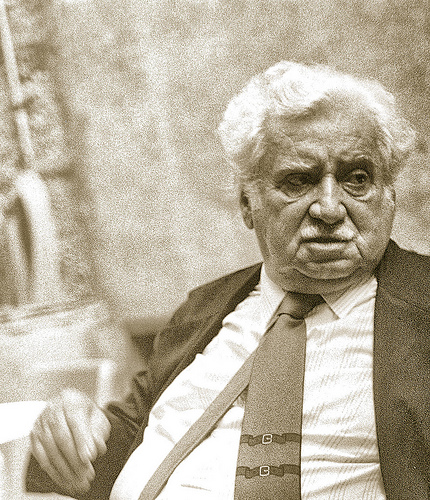
Jorge Amado

Jorge Amado, 1985 (Courtesy: Xan Carballa, via flickr, using CC-BY-NC-2.0)

How could you resist reading a book with a title like this? I don’t manage to read all the books scheduled for the various bookgroups I belong to, but when this one came up I decided it was a must – because it was by a non-Anglo writer and one I hadn’t read before, and because of its gorgeously evocative title. I wasn’t disappointed. This is fun and rather easy to read, but that doesn’t mean it’s simple.

Jorge Amado is a Brazilian writer, and Gabriela, clove and cinnamon (1958) is set in Ilhéus, a coastal city where he spent his childhood. The novel takes place in 1925 – during a time of great social change:

New streets had been opened, automobiles brought in, mansions built, roads constructed, newspapers published, clubs organised – Ilhéus was transformed. But the ways men think and feel evolve more slowly. Thus it has always been in every society. (p. 2)

The basic plot concerns Nacib (the Arab) and his love for Gabriela (the simple, but sensuous, mulatto girl he hires as his cook). But the book’s subject matter is far wider, dealing with politics and society at a time when “old ways” were being challenged by “new ways”. The “old ways” are typified by macho violence, by the notion, really, that “might is right”. Violence is used by the old leaders (mostly the “colonels”) to attain and maintain political power – and to maintain possession of women. It was accepted practice, for example, for a man to kill an adulterous wife and her lover. In fact, the novel starts with such a murder and then a little later we hear of another man being reviled for not doing so, even though his way of handling it had a delicious come-uppance about it. Ilhéus is, we are told, changing but not yet civilised; it still clings to its old and violent customs; it is

so feudal still despite its much publicised and undeniable progress.

While men hold the power, the novel is structured around women. There are four chapters, each commencing with a poem about a woman:

  • The languor of Ofenísia (who would rather die a virgin if she can’t have the Emperor)
  • The loneliness of Gloria (the mistress of a wealthy man, who has everything but what she wants)
  • The secret of Malvina (the young student who will not be controlled by a man)
  • The moonlight of Gabriela (the free spirit who should not be changed)

The first, Ofenísia, does not really appear as an active character in the book (though we are told that her “importance must not be judged by the brevity of her appearance”). The other three though manage to achieve what they want…and in doing so they epitomise the conflict between the “old ways” and the “new”, between maintaining the “status quo” (with its attendant double standard) and accepting change.

The book is peopled with a wonderful array of characters. I found it hard at the start to keep track of all the characters – particularly the many Colonels – but eventually I did, and realised that they fall into two main camps: those tied to the “old ways” and those supporting change. Colonel Ramiro Bastos is the leader of the former, and new arrival Mundinho Falcâo is a proponent of new ways of doing things, such as through negotiation. This conflict is represented literally and symbolically by the sandbar. It prevents the town being used as a port for the new cacao industry and Falcâo promises to dredge it. The scene is set for a big showdown as the various citizens of the town align themselves with one side or another, but the resolution is not as simple and dramatic as we expect. And this is partly what makes this a novel well worth reading. Change is presented as generally good, but it is not “simply” or even always so. Amado conveys this subtly. The characters are complex and through their very realistic interactions and sometimes contradictory behaviours we see that old versus new is not a simple dichotomy. Gabriela, for example, cannot be changed to fit Nacib’s image of a wealthy man’s wife: she is a free spirit who doesn’t quite represent the old or the new. She just is. And symbolically, the sandbar will not stay dredged and will need regular clearing. It is not a simple answer to continued progress for Ilhéus. Nonethess, by the end, some level of civilisation is achieved. At the trial of the husband who’d murdered his adulterous wife and her lover at the beginning of the book, the lawyer Dr Ezequiel Prado is reported as saying:

Ilhéus was no longer a land of bandits, a paradise of assassins; his theme was civilization and progress.

It is interesting to think that this book was published around the same time as Patrick White’s Tree of man (1955) and Voss (1957). Amado and White are both described as modernists, but how different they are. White is psychologically intense, while Amado here is full of humour, colour and movement, reflecting the messiness of society. Modernism, though, is a forgiving church as Lisa (ANZLitLovers) shows in her post on the subject.

There is so much to write about this book. Its humour and satire, the complex characterisation, the clever way the double murder introduced at the beginning is woven as a motif through the book, and the breadth of its subject-matter are just a few of the the topics that could be explored in depth.

I’ll leave those for others though and come back to a favourite aspect for me which is its thorough analysis of the way the desire for progress clashes with the status quo. I’ll end with statements made by two of the town’s old guard. First, the Colonel who sees that change is coming:

That’s right Colonel. Everything you’ve said is right as far as it goes. But it’s right by the conditions and needs of an earlier time. We spend our lives working hard, and we don’t realise that time is going by and that things are changing…

Then, the Colonel who doesn’t see it:

What does Ilhéus want beyond what we’re giving it? What more is there to do? To tell the truth I don’t see these new needs.

It was ever thus eh?

Jorge Amado
Gabriela, clove and cinnamon
(trans. by James L. Taylor and William L. Grossman)
New York: Vintage International, 1958 (1992)
426pp.
ISBN: 9780307276650

Ruth Park, Swords and crowns and rings

Note to self: never again “read” an audiobook over a long period, such as, say, 5 months! This is how I read Ruth Park‘s engrossing 1977 Miles Franklin award-winning novel, Swords and crowns and rings. It was not hard to keep up with the plot as it’s pretty straightforward – and powerful. It is hard, though, over such a time to keep up with and remember all the nuances in her writing and expression and the way they affect character development and thematic strands. For a thoughtful review of the book by someone who read it more sensibly, please see my friend Lisa’s, of ANZLitLovers, here.

I am not an experienced “reader” of audiobooks and I have to say that I found what seemed to me to be the over-dramatisation of the story rather trying in the first few CDs. I gradually got used to it, however, and by the end I was happy with Rubinstein’s reading, but it did take me a while to settle into it.

New-Zealand born Ruth Park is a wonderful chronicler of Australian life. Her novel, The harp in the south, set in working class Sydney in the 1940s is, to my mind at least, an Australian classic – but it is just one of her extensive and well-regarded body of work. Her autobiographies are also well-worth reading, not only for the light they throw on her life and on that of her husband, author D’Arcy Niland, but also on that of the Australian literary establishment of the mid-twentieth century.

Anyhow, back to the novel. Swords and crowns and rings tells the story of two young people born in an Australian country town before World War 1 – pretty Cushie Moy (born to a comfortable family with the stereotypical socially ambitious mother who has married down) and the dwarf, Jackie Hanna (whose background is well and truly working class). Not surprisingly, Cushie’s parents frown on the friendship which develops between the two. This is not an innovative story but, rather, good historical fiction with evocative writing and sensitive character development. Consequently, as you would expect, the two are separated just as they realise their love for each other and the book then chronicles their respective lives – Cushie with various relations in Sydney and Jackie in a number of country locations before he too reaches Sydney. Much of the book takes place during the early 1930s Depression. Park gorgeously evokes the hardships – physical, economic and emotional – experienced by people like Jackie and his step-dad “the Nun” as they struggle to support themselves. All this is underpinned by Park’s thorough knowledge of the social and political history of the time: we learn about labour organisations and the rise of socialism, of that irascible politician “Big Fella” Jack Lang, and of the building of the Sydney Harbour Bridge.

The resolution is predictable – it is, after all, a book of its genre – but it is not over-sentimentalised and is not achieved before the characters, Jackie in particular, have matured to the point that we can trust that he not only deserves what will come but that he will continue to work and mature for the betterment of himself and those he loves. It is truly a powerful book about human nature, as well as about the place and time in which it is set.

Ruth Park
Swords and crowns and rings (Audio CD)
Read by Deidre Rubenstein
Bolinda Audio, 2007
18 hours on 15 compact discs
ISBN: 9781741636628

Helen Simonson, Major Pettigrew’s last stand

If you like warm-hearted novels with a positive ending you may like this. If you like such novels with a touch of social commentary you will probably like this. If you like books like The Guernsey Literary and Potato Peel Pie Society and Miss Garnet’s angel, then this is definitely for you. But if you like a little more meat in your sandwich, a little more fodder for the brain, then you may like to look elsewhere for your next read.

Major Pettigrew’s last stand concerns one widowed Major Pettigrew and the little, very English village in which he lives. He meets Mrs Ali, the English-born-of-Pakistani background owner of the local shop, and the result is a story of racism, classism and materialism as these two find they have much in common but are confronted by bigotry and cultural expectations (from both sides) that set to derail them. I won’t go into details. There are some interesting characters including the Lord of the manor, some businessmen and a self-centred ambitious son, but most are a little too stereotyped for serious analysis. Some valid contemporary issues regarding English village life are raised, particularly regarding the increasing cultural diversity in the population, and the aristocracy and its role in villages, but the plot becomes a little melodramatic and predictable for my preference.

There are however some nice observations in the book:

…as I get older, I find myself insisting on my right to be philosophically sloppy. It’s so hard to maintain that rigour of youth, isn’t it?

I have no patience with all this analysing of writers’ politics … let them analyse the prose.

Good point. I often – as I’m sure many of us do – wonder how much we should take into consideration the politics of the creator. Is it OK to like TS Eliot? Should we listen to Wagner?

Life does often get in the way of one’s reading…

Ain’t that the truth?

Simonson is British born but wrote this in the USA where she now resides. There are quite a few “digs” at America. The Major, with whom we are supposed to sympathise, if not identify, is critical of American “self-absorption” though he discovers that his potential American daughter-in-law has more substance than he thought. The book, does, in fact  explore the way we stereotype each other in ways that can prevent “true” relationship developing. As the Major recognises at one point, he

knew he was a fool. Yet at that moment, he could not find a way to be a different man.

The novel has some genuinely funny scenes and is lightly satirical in that way that the English tend to do well… And so, while it is not my preferred type of reading, it is nicely written and will provide good reading for those who want a bit of grit without the grimness that often accompanies stories of racial conflict and politics. I know a few people to whom I will happily recommend it.

Helen Simonson
Major Pettigrew’s last stand
New York: Random House, 2010
361pp
ISBN: 9781400068937

(Unpublished proof copy, lent)

Alexander McCall Smith, Tea time for the traditionally built

Alexander McCall Smith said at the literary event I attended recently that if he achieves nothing else in his life he is glad he introduced the concept “traditionally built” because it has brought such comfort to many women (particularly, he says with a twinkle in his eye, in America!).

Tea time for the traditionally built is the tenth book in the No. 1 Ladies Detective Agency series – which is not a bad achievement for an idea that started out as a short story! The eleventh in the series, The Double Comfort Safari Club, is now out (in Australia at least) and McCall Smith has no plans yet to finish the series. When you’re on a good thing …

I am not, as I said in my recent post on McCall Smith, normally a reader of series, but I have made an exception for this series and forgive it the things that would normally make me steer clear of books like this, such as simple language and repetition of theme, because, well, because it is gentle and generous. Generosity is, in fact, an important quality for McCall Smith. At the talk I attended he said that he rarely based his characters on real people because that would be “an abuse of authorial role”! Tell Truman Capote that! When he does draw on real people, he said, it is to paint that person in a positive light. One such example is Mma Potokwani, matron of the Orphanage that features in the Detective Agency series, who is clearly a woman he admires.

Anyhow, onto Tea time. It’s a gentle read – with the plot this time focusing on a football team that is suddenly losing every game after having been consistently successful. The owner, Mr Molofololo (great name eh?), suspects a traitor in the ranks and Mma Ramotswe is, of course, called on to investigate. Suffice it to say that she does and the outcome isn’t quite what Mr M suspected.

I’ll say just one more thing about these books and that is that McCall Smith does create “rounded” characters…even the admirable ones have their flaws and this, I think, gives his books a little depth that can engage, even though the language and style do not offer the challenge than I prefer in my reading. Reading one a year is a nice thing to do – and keeps me in touch with a writer who knows the world has problems but who likes to think that people can be good, and that there is hope yet!

Alexander McCall Smith
Tea time for the traditionally built
London: Abacus, 2009
266pp
ISBN: 9780349119977