Abraham Verghese, Cutting for stone

Verghese, Cutting for Stone

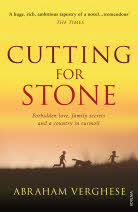
Bookcover (Used by permission of the Random House Group Ltd)

I  saw a man under the spell of his own tale, a snake charmer whose serpent has become his turban.

I’m not sure how I want to use the above quote, which comes late in the book, but I just liked it and so decided to start this post with it. Bear with me!

Discounting Dinaw Mengestu‘s short story, An honest exit, Abraham Verghese‘s Cutting for stone is the first novel I’ve read that’s set in Ethiopia (mostly). And for that, as much as for anything else, I enjoyed it. Also, in one of those eerily frequent experiences of reading synchronicities, this is the second book that I’ve read this year to deal with a long-standing dictator – and, even more eerie, is the fact that dictators in Africa are falling (sort of) around our ears at present. How do these things happen?

Anyhow, Cutting for stone is about as different from Mario Vargas Llosa‘s The feast of the goat as it could be. In the latter, dictator Trujillo is central to the story. He is the story really. In Cutting for stone Haile Selassie, and later Mengistu, provide the background. The characters are touched and, eventually, significantly affected by coups and unrest, but Selassie and his reign are not the subject of the novel.

So what is its plot? It is mostly set in an Ethiopian hospital, aptly, metaphorically, named Missing (a perversion of its original name, Mission). To this mission hospital come an English surgeon (Thomas Stone) via India and a young Indian nun (Sister Mary Joseph Praise), with rather cataclysmic results. Some time later (I’ll leave you to draw your conclusions) identical conjoined male twins named Shiva and Marion are born. The story follows their lives as they grow up, living through political upheavals while their adoptive parents, Hema and Ghosh, treat the sick and poor of the region, until one of them moves to the United States. Perhaps the best way to describe it is to quote Psychologies from the back cover: “a sweeping saga of family life, love, betrayal and redemption”.  Get the picture?

This is a traditional nineteenth-century-style novel, reminiscent, say, of Rohinton Mistry‘s A fine balance (1995). It’s about social conditions and family. The back cover (again) suggests it has flavours of Dickens and Waugh. Perhaps, but a weak flavour I’d say. While it has some of the intensity of those writers, it lacks their bite. I also found the fundamental crisis – which, not surprisingly given the set-up, has to do with a betrayal between the twins over a woman – to be not quite convincing. Maybe it’s me, but the narrator kept telling us of his love for the girl-then-woman in question, Genet, and I went along with it to a point. But it was never made clear how mutual this was. Marion is the narrator – this is a first person tale – and so we see it all through his eyes, but the whole “love” storyline did feel a little bit like a house of cards. Perhaps that’s the point? Perhaps it’s about his obsession regardless of whether it was realistic or not. It is, after all, partly a coming of age novel.

Verghese, like his main characters, is a doctor and so there is a lot of detail about things medical – about vena cavas and how they relate to the liver, about fistulas in circumcised women, about volvulus, and so on. More detail really than I needed, and yet most of it was interesting. What was even more interesting was the difference between the medical system in Africa and in the United States, and then the difference in the United States between the “Mayflower” hospitals and the “Port Ellis” hospitals. There are social messages here about the construction of medicine in the developed and developing worlds, and between the haves and have-nots. But this wasn’t the only message. According to Wikipedia, Verghese is passionate about “bedside medicine” and there is certainly a strong message here of caring for patients as well as treating them. Early in the novel the young Marion sits with a woman, Tsige, as her son dies. Much later, he is the one who can answer Thomas Stone’s question “What treatment in an emergency is administered by ear?”. The answer? “Words of comfort”.

Marion, then, as a child and a young doctor is well attuned to the feelings of others and yet he was unable to forgive all those who “wronged” him – Genet, his brother, and his birth father. I found that somewhat inconsistent with his character, and it affected my ability to fully buy  into the angst on which the plot turned.

Nonetheless, I liked the characters and so I kept reading, the story was interesting and so I kept reading, the writing was fine and so I kept reading. It doesn’t quite hang together, is a little melodramatic at times, but it’s a lively tale about characters I couldn’t help caring about. Early in the novel, we are told that Hema, who raises the twins, had:

come close to defining the nameless ambition that had pushed her this far: to avoid the sheep life at all costs.

The novel is full of characters who “avoid the sheep life”.

I started the review with Marion’s description of his father telling the painful tale of his life. I’ll end with the advice Marion’s adoptive father gives him:

The key to your happiness is to own your own slippers, own who you are, own how you look, own your own family, own the talents you have, and own the ones you don’t. If you keep saying your slippers aren’t yours, then you’ll die searching, you’ll die bitter, always feeling you were promised more…

Obvious stuff really, but that doesn’t mean that it doesn’t need to be said.

Abraham Verghese
Cutting for stone
London: Vintage, 2010
541pp.
ISBN: 9870099443636

Madeleine St John, The women in black

The women in black, Madeleine St John, book cover

The women in black bookcover (Courtesy: Text Publishing)

One thing mystified me as I started reading Madeleine St John‘s The women in black and that is why she would write a book in 1993 about 1950s? It seemed an odd choice. And then, as I read further, it started to become clear. The time period represents one of those cultural watersheds that nations experience. In this particular case, it was a time of social change: not only were things starting to change for women, but the “reffos” or “Continentals” (as the post-war European refugees were disparagingly called) were beginning to impact Australian culture.

St John chronicles these changes lightly, with warmth and gentle humour, but also with determination. It’s not a coincidence, I think, that St John, born in 1941, would have been around the age of the youngest character, Lisa/Lesley Miles, at the time the book is set.

Hmm … having introduced a character now, I’d better talk briefly about the plot. It centres around the women who work in the Ladies’ Cocktail Frocks and the more exclusive Model Gowns sections of a fictional (but thinly veiled DJs) upper crust department store in Sydney called Goode’s, and takes place over the few weeks before and after Christmas. Model Gowns is staffed by one woman, the Continental or reffo, Magda, while Ladies’ Cocktail is staffed by the middle-aged Miss Jacobs, the 29-year-old almost-on-the-shelf Fay Baines, the 31-year-old married-but-so-far-childless Patty Williams. There is also the buyer Miss Cartwright. Overseeing them all is, of course, a man, Mr Ryder. Into this mix is thrown 17-year-old Lesley (who changes her name to Lisa) Miles, who has just finished her Leaving Certificate.

The story is told in short chapters, each one devoted to one or more of these characters. The tone is (almost conspiratorially) conversational, which invites the reader in. St John draws her characters effectively through brief sections of perfectly caught dialogue and succinct but apt descriptions. The style is witty, with light wordplay and irony. Here are some excerpts from Chapter 2:

Mrs Williams was a little, thin, straw-coloured woman with a worn-out face and a stiff-looking permanent wave. Her husband Frank was a bastard, naturally.  [ …]

At the weekends she visited her mother or one of her sisters; Frank drove her there and fetched her, and while she was ‘jaw, jaw, jawing’ he played golf on the public course at Kingsford or drank in the pub. He was a bastard of the standard-issue variety, neither cruel nor violent, merely insensitive and inarticulate.

[…]  as she left the surgery, the physician looking idly at her back view thought, she’d clean up quite well with a new hairdo, some paint on her face and a black nightie; but the husband probably wouldn’t notice, the bastard …

By the end of chapter 2 I was hooked. In three and a bit pages we were told all we needed (and probably more than we wanted) to know about poor little Patty Williams and her bastard of a husband. But Patty’s is just one story. There’s also Fay Baines who’s desperate to be married but meets all the wrong men through her well-meaning night club manager friend, Myra; and Lisa Miles who expects to do well in her end-of-school results but whose father thinks women have no business at university. Into this mix are thrown the outgoing, confident (but “god awful” to the women in black) Magda and her also Continental/reffo husband Stefan.

Magda takes an interest in Lisa and invites her home. She also tries a little matchmaking with Fay. Meanwhile, Patty does try that black nightie, with consequences she would never have foreseen. It could all go horribly wrong but, without spoiling anything too much, I’ll simply say that St John’s book follows, loosely and more lightly, the Jane Austen tradition, that is, it’s a comedy of manners. Unlike Austen though, she’s writing in an historical, rather than contemporary, time-frame, and so has a slightly different goal in mind – and that is documenting the social change I mentioned in my opening paragraph.

Two simple examples of this are “kissing” between friends, and food. Here is Lisa on “kissing”:

And she [Magda] kissed her on the cheek. Lisa smiled shyly at her. I’ve heard she thought, that Continentals kiss each other much more than we do: it means nothing. They do it all the time, even the men. The men even kiss each other.  But how strange I feel.

This little paragraph struck me; I realised that my friends and I kiss each other in greeting but it was not, I think, the norm among my parents’ generation. In one or two generations, in fact, the often-maligned (in the book and in reality at the time) Continentals had effected quite a change. And then there’s the food. By the end of the book, Lisa, Fay, and even Lisa’s father had tasted and enjoyed such exotic foods as salami. And again I reflected on the immense change in diet from my parents’ to my generation.

I won’t tell you more of the story. It’s a gentle one, but there is a drama concerning Patty, and some little tensions surrounding Fay and Lisa, that keep the book moving while it observes a society in change. There are some perfect descriptions of Sydney, such as this of the women coming to do their last minute Christmas shopping:

From the wooded slopes of the salubrious North Shore to the stuccoed charm of the Eastern Suburbs, from the passé gentility of the Western ditto to the terra incognita of the Southern had they travelled by train, bus, tram and even taxi cab to this scene of final frantic activity.

It’s a book almost of vignettes than of fully realised stories, and there’s the odd clumsy or heavy-handed bit, but St John has nonetheless managed to convey a convincing picture of Australian society at the time, while also telling an engaging and generous tale. And, just to show she has a sense of humour, St John, who was a libertarian at university, injects near the end her own little in-joke. Here is Lisa’s father on the possibility of her going to university:

But I’ll tell you one thing: if I decide you can go, and you do go, if I ever hear of you being mixed up with any of those libertarians they have there, you’re out of this house like a shot and I never want to see you again, is that understood? Right then. If you go, no libertarians, not even one.

I wonder what St John’s father – the prickly politician Edward St John – said to her!

Lisa at ANZLitLovers has also reviewed the book.

Madeleine St John
The women in black
Melbourne: Text Publishing, 2010 (orig. 1993)
234pp.
ISBN: 9781921656798

(Review copy courtesy Text Publishing)

Jonathan Franzen, Freedom

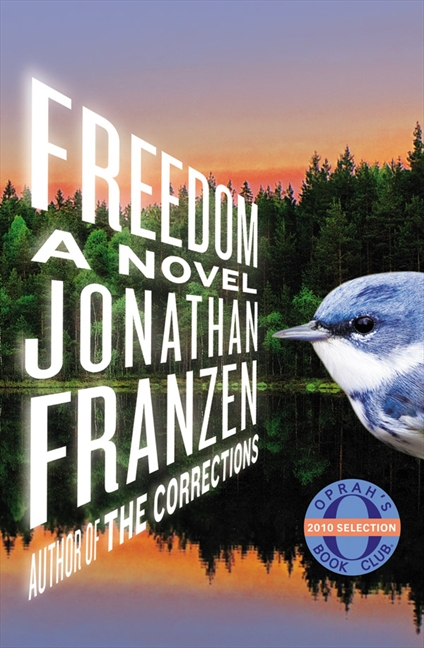
Freedom bookcover, by Jonathan Franzen

Freedom bookcover (Courtesy: HarperCollins Australia)

Hmm … where to start? Half way through this book I was tiring. I wanted to say to Franzen “Enough already” (which, if you’ve read the book, has a certain appositeness). I also started to think of those song lines, so well-known to my generation:

Freedom’s just another word for nothing left to lose.

In fact, I thought of starting this post with that quote, but decided it would be just a little too twee – but somehow it ended up in the first paragraph nonetheless.

In some ways, Jonathan Franzen‘s latest novel, Freedom – which I must be the last blogger to read – is an interesting companion piece to Peter Carey‘s Parrot Olivier in America. They are wildly different in tone, style and historical setting but both explore the foundation upon which America is based, that of freedom of the individual. America tends to parlay this word about a little too, shall I say, freely, a little too unaware at times that freedom is not a simple concept but one that needs to be modified by a few “ifs” and “buts”. It’s these “ifs” and “buts” that confront Franzen’s characters, and that are recognised in those now immortal song lines. In other words, what Franzen’s characters find is that freedom in and of itself is no great shakes. It cannot exist in a vacuum …

But first, the plot. It chronicles the relationship of nice-guy Walter and mixed-up Patty Berglund (and, along the way, their family and friends). The opening paragraph starts around the middle of the chronology, with a rather teasing statement that Walter “had made a mess of his professional life” and then tracks back a few years to the early years of Walter and Patty’s marriage, before tracking back further to their youth and courtship, and then returns to the starting point and on to their future. Through this journey, Walter and Patty, residents of the Twin Cities, grow up, get married, have children, move east, get into a range of “pickles”, and … but that would be telling so I’ll leave the plot there.

It’s a rather complicated structure that owes a lot to postmodernism with its forwards-backwards movement, stories within a story (that is, Patty’s autobiography, told third person, in two distinct parts), a certain intratextuality (such as Patty’s autobiography being read by characters in the novel), the odd font change, and shifting points-of-view. It’s not, however, postmodern in its concerns – and is instead rather earnest, which is part of its problem. I’m not saying that it needs to be postmodern – we don’t need more self-conscious irony and clever playing with the idea of fiction – but it needs something fresh and challenging in characterisation, language and/or tone to carry it right through its 560 pages. Instead, it gets bogged down in too much earnest detail about life in modern America. It’s as though Franzen had a lot of things he wanted to say – about middle-class life, parenting, education, the environment, gentrification, politics, and music – and he was darned sure he was going to say them. We get, therefore, references to 9/11, Cheney and Bush, the war in Iraq, Obama, hints about the GFC, and so on. It’s a bit like Dickens, but without the sustained satire.

That said, there are some funny set pieces, such as the interview Richard (Walter’s friend and rival, and also lately successful rock star) gives to a young fan who wants to use Richard to attract a girl. Richard likens rock music to making chiclets, to being part of not against corporate, capitalist America. And I did love the description of why Walter preferred the aggressive driving of his young assistant, Lalitha, to driving himself:

Walter had come to prefer the anxiety of being her passenger to the judgmental anger that consumed him when he was at the wheel – the seemingly inescapable sense that, of all the drivers on the road, only he was traveling at the right speed, only he … [and on it goes for a page of road-rage inducing complaints].

But, getting back to the main game, what is this “freedom” all about? Most of the characters yearn for and/or experience freedom of one sort or another – they want to live their own lives their way. This can include not working, following one’s own heart regardless of the needs of those around you, having sex with whomever whenever you please, not being responsible for others, not doing the hard yards. And most find that the end result is not a satisfying one.

Walter, whom I presume is Franzen’s main mouthpiece, says:

The reason the system can’t be overthrown in this country … is all about freedom. The reason the free market in Europe is tempered by socialism is that they’re not so hung up on personal liberties … The Europeans are all-round more rational, basically. And the conversations about rights in this country isn’t rational. It’s taking place on the level of emotion, and class resentments, which is why the right is so good at exploiting it ..

This makes sense to me … but, the thing is that there are so many references to freedom that it is hard to locate the main message. This one is political. There are also more personal messages. Here is a description of Walter’s grandfather:

(The personality susceptible to the dream of limitless freedom is a personality also prone to, should the dream ever sour, to misanthropy and rage.)

And of Walter’s father:

He hated the blacks, the Indians, the well-educated, the hoity-toity, and especially, the federal government, and he loved his freedoms (to drink, to smoke, to hole up with his buddies in an ice-fishing hut) the more intensely for their being so modest.

We see parents giving children a “free pass” only to find those children, such as Walter’s brother Mitch, being a “free man” in the sense that he has no home, no secure job, no responsibilities. We see men, like Richard and Joey, thinking the freedom to have sex with anyone anytime will make them happy, but Joey, for example, after an amusing (to the reader!) scene in which he tries to live his fantasy, discovers who he really is:

This wasn’t the person he thought he was, or would have chosen to be if he’d been free to choose, but there was something  comforting about being an actual definite sometime …

And at this point he starts to grow up …

There is a lot to enjoy about this book, despite its bagginess. The characters do engage, flaws and all, and Franzen’s heart is, for me, in the right place. When I got to the end, I smiled and felt that Franzen had achieved something, even if it is simply to show that Freedom is a far more complicated concept than people like to think.

Jonathan Franzen
Freedom
London: Fourth Estate, 2010
562pp.
ISBN: 9780007318520

Mario Vargas Llosa, The feast of the Goat

Mario Vargas Llosa, signing books

Mario Vargas Llosa signing books in 2010 (Courtesty: Daniele Devoti, via Wikipedia, using CC-BY-2.0)

If Nobel Laureate Mario Vargas Llosa‘s The feast of the goat had been a traditional historical novel, chances are it would have started with the assassins concocting their plan and then worked chronologically to its logical conclusion. But, it is not a traditional historical novel, as is reflected in the structure Vargas Llosa has chosen to tell his story.

Before we get to that though, the plot. The central story revolves around the dying (literally) days of the 30-year Trujillo (“the Goat”, “the Benefactor”, “the devil”) regime in the Dominican Republic. This means the main action takes place in 1961. However, overlaying this is the perspective of Urania, the daughter of one of Trujillo’s head honchos. She’d left the country days before the regime ended and cut herself completely off from her father – for thirty-five years, until her sudden return at the novel’s start. The novel is told from these two time perspectives – 1960/61 and 1996 – and from multiple points-of-view*, the main ones being:

  • Urania
  • Trujillo
  • The conspirators/assassins

But this isn’t all there is to this novel’s structure and narrative style. I’m not quite sure how Vargas Llosa gets away with it, but he has written a book that is very accessible (once you get across the intricacies of Latin American names) and yet also rather complex. This complexity is found, primarily, in the structure. The book can, essentially, be divided into two parts. Chapters 1-16 proceed pretty systematically, cycling through, in turn, the stories of Urania, Trujillo (usually with one of his offsiders), and the Conspirators (usually focusing on one of them in particular). By Chapter 16 the two major crises of the book have occurred or been introduced. The last 8 chapters continue to cycle through different points-of-view but not in the same systematic order. In other words, the narrative structure becomes erratic and the rhythm more urgent, as chaos and uncertainty take over.

And yet, there’s more. For example, the novel is told primarily in third person, with the point-of-view changing chapter to chapter. But, every now and then, for just a sentence or two, or maybe a paragraph, the voice lapses into second person. This happens most often with Urania and conveys the sense that there has been some trauma that she hasn’t been able to fully integrate/recover from. We discover the origins of this trauma in Chapter 16, but it is not fully revealed until the last chapter.

… You were still a girl, when being a girl meant being totally innocent about certain things that had to do with desire, instincts, power, and the infinite excesses and bestialities that a combination of those things could mean in a country shaped by Trujillo. She was a bright girl … (Chapter 16)

This little slip into second person in Urania’s story is telling.

Okay, so this is the architecture, the behind-the-scenes technical stuff, but why write it this way? Well, the reasons are intellectual and emotional. Intellectual in that the multiple alternating points-of-view enable us to get a number of “stories” first hand. Through the eyes of the perpetrators and the disaffected, we explore the regime, and how, as happens so often with dictatorships, the early benefits are gradually (but surely) overshadowed by the corruption and violence perpetrated to maintain power, and how this leads to the assassination conspiracy. And emotional in that the constant shifting in perspective, particularly from people we can trust to those we can’t (to the best of our knowledge), and back again, unsettles and discomforts us … just as those who lived through the regime were kept on edge.

It’s impossible, without writing a thesis, to cover all the angles in this book, so I’m just going to look at one more – the characterisation of Trujillo himself. A historical novelist (rather like a biographer) has to choose what to include and what to exclude when describing a person. Vargas Llosa was lucky, really, that Trujillo had some traits that made this choice rather easy, traits that work on both the literal level and the ironic and metaphoric. Fairly early in the novel is this description of Trujillo

…that master manipulator of innocents, fools, and imbeciles, that astute exploiter of men’s vanity, greed and stupidity.

Fairly typical, wouldn’t you say, of a dictator? But, Trujillo was also fastidious about cleanliness and appearance, believing that

Appearance is the mirror of the soul.

If that’s so, then Trujillo’s “soul” is a very superficial thing because his disdain for the rights and feelings of others is palpable. Throughout the novel, Vargas Llosa sets Trujillo’s obsession with personal care (“the man who did not sweat, did not sleep, never had a wrinkle on his uniform, his tuxedo, or his street clothes”) against the coldness of his mind. That his mind is cold is made perfectly clear through his attitude to his offsiders (whom he liked to scare – “it cheered him to imagine the sizzling questions, suppositions, fears, suspicions he put into the head of that asshole who was the Minister of the Armed Forces”) and to women. This regime values machismo above all: it’s brutal to those those less powerful, and has careless disregard for the innocent. Women, of course, bear the brunt:

Again the memory of the girl at Mahogany House crossed his mind. An unpleasant episode. Would it have been better to shoot her on the spot, while she was looking at him with those eyes? Nonsense. He had never fired a gun gratuitously, least of all for things in bed. Only when there was no alternative, when it was absolutely necessary to move this country forward, or to wash away an insult.

Trujillo was nothing if not a master of self-justification.

How it all falls out, what happens after Chapter 16, is both expected and unexpected as those involved do or don’t do what they’d committed to. The end result is a devastating portrayal of how the political becomes the personal! Not a new message, perhaps, but The feast of the Goat is a compelling read that engaged my heart and mind. I recommend it.

Mario Vargas Llosa
(Trans. by Edith Grossman)
The feast of the goat
London: Faber and Faber, 2002
475pp.
ISBN: 9780571207763

* As in most historical fiction, the novel is peopled with historical characters and fictional ones. Most, in fact, are historical but Urania and her father, though based, I understand, on real people, are fictional.

Jane Austen, Sense and sensibility (Vol. 1)

Ch 22 of Sense and Sensibility, (Jane Austen N...

From Chapter 22, illus. by CE Brock (Presumed Public Domain, via Wikipedia)

This year is the 200th anniversary of the publication of Jane Austen’s first (published) novel, Sense and sensibility. To celebrate this, my local Jane Austen group plans to discuss the novel over the next three months, volume by volume. We tried this last year with Mansfield Park and valued the opportunity it presented to delve a little more deeply into the novel – not only the characters and themes, but the writing and structure. Consequently, in this post I’m going to focus on Volume 1 (chapters 1 to 22) which ends with Lucy Steele’s dramatic announcement to Elinor.

But first, some caveats. I’m going to assume that most readers who come to this post will know the story – and if you don’t, the Wikipedia article provides a good summary. Also I am not going to write a formal review but just share some of the ideas that have struck me during this slow reading*.

I have always liked Sense and sensibility, partly because I’m fascinated by the dichotomy Austen sets up between the two sisters: Elinor (sense) and Marianne (sensibility). And yet, it’s not an easy-to-like novel. The heroines aren’t as sparkly nor the heroes as dashing or heroic as in Austen’s next novel, Pride and prejudice. It feels more serious, less witty – though not as serious as Mansfield Park. This could be because its premise – the sudden drop in wealth for Mrs Dashwood and daughters and their dislocation from their family home, due to the death of their husband/father – mirrors what happened to Jane and her mother and sister after Rev. Austen’s death in 1805. It wasn’t until the family settled in Chawton in 1809 that Austen, to the best of our knowledge, returned seriously to her writing. I wonder if this novel is her working through this very real experience of grief and insecurity. (Interestingly, a very similar story is played out at the beginning of Tracey Chevalier’s Remarkable creatures in which she describes the removal of the Philpot sisters from London to Lyme Regis in 1805).

That’s the historical background to the novel – and forms its social milieu. But there is more to the novel than social history. Austen is a far more complex writer than that. Take, for example, the money issue. There is a lot of focus on money and income in volume 1 – on who has what – indicating Austen’s real awareness of the issue, and yet Mrs Dashwood does not focus on husband hunting for her daughters. In fact, she says:

“I do not believe,” said Mrs. Dashwood, with a good humoured smile, “that Mr. Willoughby will be incommoded by the attempts of either of my daughters towards what you call catching him. It is not an employment to which they have been brought up. Men are very safe with us, let them be ever so rich. …”

This is no Mrs Bennet … but she’s not without her faults either.

And, take the dichotomy issue. It’s actually not quite as clear-cut as the title would suggest. Check the way our two heroines are introduced:

Elinor … possessed a strength of understanding, and coolness of judgment, which qualified her, though only nineteen, to be the counsellor of her mother, and enabled her frequently to counteract, to the advantage of them all, that eagerness of mind in Mrs. Dashwood which must generally have led to imprudence. She had an excellent heart; her disposition was affectionate, and her feelings were strong: but she knew how to govern them: it was a knowledge which her mother had yet to learn, and which one of her sisters had resolved never to be taught.

Marianne’s abilities were, in many respects, quite equal to Elinor’s. She was sensible and clever; but eager in everything; her sorrows, her joys, could have no moderation. She was generous, amiable, interesting: she was everything but prudent. The resemblance between her and her mother was strikingly great.

In other words, Elinor has sense (“coolness of judgment”) but is also emotional (“her feelings were strong”); and Marianne is emotional (“eager in everything … no moderation”) but also has sense (“sensible and clever”).

However, as I read the volume 1, the issue that kept raising its head was that of “judgment”. I’m not sure whether it will continue to do so in the next two volumes, and I need to think about how the judgment issue plays out in other novels, but it does seem that Austen is exploring people’s ability to judge – and most seem to be not very good at it. Sir John Middleton, who praises the Steele sisters, is confident in his judgment, as is Marianne of hers on Willoughby – and we know how those turn out. Meanwhile, Edward, says, Elinor, “distrusts his own judgment” – and he is probably right to (in some matters at least!) Elinor, on the other hand, recognises that she has made errors at times and suggests that you need “time to deliberate and judge”. Related to all this is the fact that Marianne tends to judge people by surface factors, whereas Elinor tries to understand what makes people (such as Edward, Col Brandon, Mr Palmer) behave the way they do. I look forward to seeing whether this idea continues to be specifically explored in volumes 2 and 3.

But let’s move on to Austen’s writing; specifically, her plotting. Until recently, Emma was my least favourite Austen. Then I read it again more attentively and was bowled over by how beautifully it is plotted. I started to notice something similar in Sense and sensibility but will just give one particular example – how Austen uses parallels to create links between the storylines and move the plot along. These parallels, though, aren’t all slavish, aren’t exact. Here are some from volume 1:

  • Willoughby asks for/is given a lock of Marianne’s hair; Edward wears a ring made of Lucy’s hair
  • Willoughby and Edward both leave Barton Cottage in different but less than happy circumstances, and the Dashwoods ascribe this, in both cases, to the influence of strong controlling women – Willoughby’s aunt, and Edward’s mother
  • Elinor states that correspondence between Marianne and Willoughby would convince her of their engagement; later, evidence of correspondence between Lucy and Edward convinces her of their engagement.

And here I shall finish, mainly because I’ve gone on long enough. There is so much more to say, but maybe they will still be relevant in volume 2. Meanwhile, I’d love to know what other Austen readers think …

* Our little nod, perhaps, to the Slow-Reading Movement which I must admit does hold some attractions for me.

Barbara Hanrahan, The scent of eucalyptus

Writer-artist Barbara Hanrahan was born half a generation before I was and in the city of Adelaide not a country town in Queensland, but the childhood she depicts in her first novel, The scent of eucalyptus, could almost have been mine. Almost, but not quite, as I was brought up in a standard nuclear family and she by three women – her mother, grandmother, and Aunt Reece (who had Downs Syndrome) – resulting in a somewhat different experience of home-life even if not of wider society.

And there’s another more crucial difference. The half generation time lag accounts for a major change appearing on the horizon – in the education of women. Hanrahan, like my mother who was born nearly half a generation earlier, suffered from the reduced opportunities and low expectations that were women’s lot back then. Both were expected to undertake commercial training at high school – rather than join the academic streams they desired – in order to fulfil “the plan” as Hanrahan calls it:

“( … Our expectations were swallowed by shorthand symbols, hammered by typewriter keys, imprisoned by the columns of a neatly-ruled ledger whose credit column never balances its debit.)

I was part of a school that was a factory, pumping forth each year, from the swollen Commercial class, the girls of fifteen who would go to work as typists and clerks. At eighteen they would be engaged, at twenty, married, at thirty – old. These were the girls I stood with under the lacquered fig trees in the Grade Seven photograph. (They are at their prime at the age of twelve … )

How sad that is. I loved this book from beginning to end. The writing is poetic – not the sort of poetry that is full of allusions and ambiguities in which you have to work hard to locate meaning, but the sort that paints word pictures of both the physical and emotional landscape. An example is her description of a visit to relations in the hills:

“I remember rising while it was still dark to visit them; … watching the sky turn pale and frayed with light; seeing houses jump forward from the darkness; hearing the cold voices of first roosters, the kookaburra’s ruffled peal.”

The writing is rhythmic. There are few wasted words, there is effective use of repetition, there is stream of consciousness, and she uses punctuation precisely to control flow and meaning.

Hanrahan tells her story more or less chronologically, with thematic chapters interspersed at appropriate points and occasional asides foreshadowing her future. The novel spans her life – this is an autobiographical novel – from birth to puberty. It’s not strong on plot, but there is a powerful story here about the development of self. For example, in chapter 2, we see the origins of the artist she was to become: “As a child and ever after, the minute, hidden facets of things intrigued me”.

The first few chapters introduce us to the significant people – the “important” three – in her life. Here she is on her mother:

“My mother was a lark whose tongue was cut; a gull with clipped wings. She learned to expect nothing that she did not strive for … My mother trod a familiar path; hedged by as many briers as Sleeping Beauty’s ever was”.

Such economy of expression that conveys so much. She writes similarly of her grandmother and aunt, and we learn how “the three” love and support each other but also harbour disappointments. These, though, our narrator is barely aware of:

“(I was deceived by familiarity. I didn’t see, couldn’t see, forgot to reason.)”

And so the novel progresses through infancy, kindergarten, and primary school until we reach the point at which I began this post. She paints perfect pictures of school days, of special holidays, of childhood friendships, of fears and hobbies, of a flirtation with religion, and of a sense throughout, but becoming stronger as she grows older, of being “different”:

“And as I grew older I became adept at leaping quicksilver from one of my selves to the other. And as I grew older the split grew deeper, yet I forgot it was there.”

This is a delicious novel – the language is almost mesmeric, capturing a world that has passed and yet is still part of our cultural landscape. I will finish with one final excerpt which delighted me. She, like most Australians, grew up with the image of outback Australia, our “sunburnt country”, firmly entrenched in her mind, but she, also like most Australians, was “a city child” and so she asks:

“But where were the hills of the history book, stitched with the pathways of Burke and Sturt and Leichhardt?- the hills of the sun-burned earth and budgerigar grass, and azure skies and fiery mountains we sang about at school before the flag spangled with all the stars of the Southern Cross I was never sure of seeing? Where were the old dark people I did not link with the lost couples on suitcases at the railway station? Where were the crocodiles and brolgas, the billabongs and snakes? Where were the flowers that wilted in blistered clay, the rusty waves of Spinifex that looped the cliff?

… I looked about me for the sunburned land. In vain.”

This is not the end of the book … but is as fine a place as any to end my review because it, as much as anything, conveys the paradox of her childhood – the knowing one thing but the seeing of/the being something else. This is a book for all Australians to read … and for anyone else who is interested in a thoughtful, lyrical rendition of a childhood.

Barbara Hanrahan
The scent of eucalyptus
St Lucia: University of Queensland Press, 1973
188pp.
ISBN: 0702225169

Katharine Susannah Prichard, The pioneers


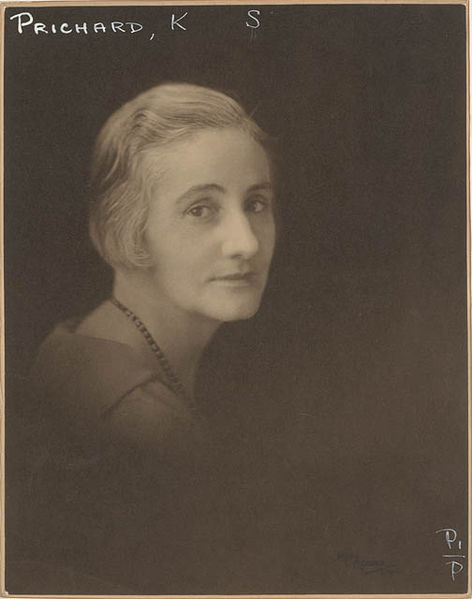
Katharine Susannah Prichard

Prichard, 1927/8, by May Moore (Courtesy: State Library of NSW, via Wikimedia Commons)

Katharine Susannah Prichard (1883-1969) is probably not as well-known in Australia, let alone internationally, as she should be. She was born in Fiji, but grew up in Tasmania and Melbourne, travelled overseas and in other parts of Australia, before settling in Western Australia in 1919. She was a founding member of the Australian Communist Party (1920) and also of the Western Australian branch of the Fellowship of Australian Writers. Politics and literature, then, were the twin passions of her life. Her most famous novel and the only one I’d read until now, Coonardoo (1929), was remarkable in its time for its exploration of the relationship between white men and black women.

I don’t usually commence a review with a biography, but it felt appropriate in this case – partly because she is so little known despite her significance and partly because her politics were an intrinsic part of her literature. In the foreword to my new edition of the book, her granddaughter describes Prichard’s values as:

a huge love of and respect for the bush; the importance of living your life with integrity; of caring and fighting for the underdog; of holding strong principles and remaining true to them; and of embracing life with passion.

These values are evident in The pioneers, her first novel which won the Hodder and Stoughton All Empire Literature Prize for Australasia in 1915. She went on to write over thirty works, including novels, plays, short stories and poetry. But, perhaps that’s enough prelude for now – on with the book.

It’s a simple tale really, plot-wise. It starts with a couple, Donald and Mary Cameron, arriving by wagon in an unsettled area of Gippsland (in eastern Victoria) in the early-mid nineteenth century. They clear the land, build a home and establish a successful farm. Very early in the story, while Donald is away getting supplies, Mary is “visited” by two desperate men, Dan Farrell and Steve. A tricky situation for a woman on her own but she manages to win them over and they leave her, unharmed. The novel tells the story of these people – and the others who move into the district – over the next two decades or so, as they work to make lives for themselves, some honestly and some not so.  There are archetypal characters here – the hard-working, tough, taciturn farmer; the loving, but wise and stoical wife; the loyal but unappreciated-by-his-father son; and more. There are escaped convicts, cattle rustlers, and a thoroughly bad man.

This may all make it sound rather typical and a bit melodramatic. And, in fact, it does have its melodrama. But the book is more than this. Its overriding style, or approach, is social realism, as Prichard explores the hopes and wishes of a new country struggling to come to terms with its origins and forge a more positive future. Her style is not particularly innovative and, while the combination of social realism and melodrama is appropriate for a novel set in the nineteenth century, the melodrama was a little discordant to my modern ears.  Take this, for example:

It was as if that encounter in the valley of shadows had brushed all misunderstandings from the love that was like the sun between them. Deirdre had wrestled with death for possession of him.

A contemporary review suggested that the romance – which drives most of the melodrama – was included primarily to attract readers who may not be interested in the history. This could very well be so.

Despite not being particularly innovative, Prichard’s writing is sure and shows that while this was her first novel she’d been honing her craft for some time. I particularly loved her language. It is gorgeously descriptive. She perfectly captures the paradox of a place that is both beautiful and harsh – and effectively conveys the physical and emotional impact of the landscape:

The bright hours were rent by the momentary screeching and chatter of parroquets, as they flew, spreading the red, green and yellow of their breasts against the blue sky. At sunset and dawn there were merry melodious flutings, long, sweet, mating-calls, carollings and bursts of husky, gnomish laughter. Yet the silence remained, hovering and swallowing insatiably every sound.

The plot, as I’ve suggested, is a little melodramatic and fairly predictable but it’s a well-told tale, nonetheless, of good forces fighting bad, of compromises that are sometimes made, and of bad judgement calls that come back to bite you. The characters, while tending to archetype, are nonetheless real so that you believe them and their various plights. There is, I think, something reminiscent of Dickens here.

The themes reflect very much the values identified by her granddaughter in the foreword. The main characters are imbued with a strong sense of principles that they try to live by. When Mary meets the convicts early in the novel, she says:

But if you will believe the truth it is this: My heart is with you and all like you.

In her twenties, Prichard apparently met the Austrian sociologist, Rudolph Broda, who introduced her to the ideas of socialism and suggested that, as a new country, Australia was leading the world in social legislation. This idea is reflected in the novel. Early on, Mary says to Donald:

It’s a new country and a new people we’re making, they said at home, and I’m realising what they meant now.

Little did she know, then, what this “making” would really involve but defining “a new country” is clearly the goal Prichard set for herself. The novel concludes by suggesting that the new generation will

be a pioneer of paths that will make the world a better, happier place for everyone to live in.

Corny? Or aspirational? Take your pick … but whichever way you see it, this novel makes a significant contribution to the development of the Australian psyche, to our transition from colonial convict-fearing past to an independent self-realised future. I am glad it has been re-released and hope that more people read it.

Katharine Susannah Prichard
The pioneers
Singapore: Monsoon Books, 2010 [first ed. 1915]
272pp.
ISBN: 9789810848804

NOTE: An ebook version of the novel is available at Project Gutenberg.

Garry Disher, Wyatt (Guest post)

Some time ago I found in my mailbox a bundle of books from my lovely contacts at Text Publishing. Unfortunately, there were more books in the bundle than I could read at the time, and a couple were in genres I don’t generally read (though that’s not to say I wouldn’t read them if I had the time). So, like Lisa at ANZLitLovers and as I did for my last LibraryThing Early Reviewers copy of That Paris Year, I decided to use the Guest Post idea. For the LibraryThing guest post, the reviewer was my daughter, Hannah of Wayfaring Chocolate. This time, it’s my son, Evan. The book is Garry Disher‘s latest crime novel Wyatt, which won the 2010 Ned Kelly Award for Best Crime Fiction.

Evan read the novel while he was with us for Christmas. He has since returned to Melbourne (his home and the setting of the novel) and, while busy preparing for his flight to the USA tomorrow, made the time to please his mum by writing his review. I must say, it looks like the sort of crime novel I could enjoy. Thanks Evan …

Evan’s review of Wyatt, by Garry Disher

Gary Disher, Wyatt

Wyatt (Courtesy: Text Publishing)

Less a cops and robbers story than a robbers and robbers story, Wyatt is a new crime novel from the Australian author, Garry Disher. We are introduced to the protagonist and title character, Wyatt, as he is attempting to rob an extortionist. As one would expect in a good crime novel, it doesn’t go according to plan. Disher’s prose is terse and to the point, much like Wyatt himself, and the narrative races along, following a jewel heist and its aftermath. Set in Melbourne, which suddenly becomes dirtier and more sinister under Disher’s pen, Wyatt features many of the trappings of classic noir-ish, hard-boiled novels. This world is populated by seductive femme fatales, tough, if old-fashioned, men, and it will get the better of you if you don’t have your guard up. Wyatt is an aging, professional criminal, who is treated with reverence as a master within his field. He is cold, intelligent and calculating, yet sympathetic.

Surrounded by a host of characters, all dangerous in their own ways, Wyatt is pitted, almost indirectly over the course of the novel, against a French criminal much like him, and much his equal. However, to discuss more of the plot would be to spoil most of the fun. The pace rarely slows down, and the writing is taut and spare. The characters are archetypes, almost larger than life, but not overwritten. Disher has an invigorating, simple style. The violence, when it erupts, is abrupt and surprising and, without a hint of an overdrawn epilogue, the ending simply ends.  Wyatt is apparently the seventh book in a series featuring the title character. Despite having never read any of the others, and having a perhaps irrational bias against series in general, I am now eager to check out the others.

Garry Disher
Wyatt
Melbourne: Text Publishing, 2010
274pp.
ISBN:  9781921656811

(Review copy courtesy Text Publishing)

Alan Bennett, The uncommon reader

Light with bite is how I would describe Alan Bennett‘s delightful novella The uncommon reader. But, before I explain that further, a quick plot summary for those few who haven’t come across it. It explores what happens when Queen Elizabeth II stumbles across a mobile library on the palace grounds and becomes obsessed with books and reading. Bennett cheekily suggests what the impact might be on her family, staff and the politicians around her when reading becomes not only something she wants to do all the time (instead of her work) but also results in her starting to think and question.

One of the delightful things about the novel is that it can be read on several levels from the straight (a sweet story about the current English Queen discovering the thrill of reading late in her life) through the contemplative (a meditation on readers, reading and the value of literature) to the satirical (an expose of life in the palace, and more broadly of politics and those involved in the political process).

Take for example, reading. The Queen (in the book) says that: “Books are not about passing the time. They’re about other lives. Other worlds.” Fair enough, we all agree with that I’d say. But then there’s this, again from our newly enlightened reading Queen: “Books generally just confirm you in what you have, perhaps unwittingly, decided to do already. You go to a book to have your convictions corroborated. A book as it were closes the book.” Hmmm…Bennett’s Queen is one clever (and scary) lady!

Jokes at the expense of palace officials, politics and politicians abound. Nothing really new here but they are proffered with a light touch. The Queen, now talking about writing her own book, says “To enquire into the evidence for something on which you have already decided is the unacknowledged premise of every public enquiry, surely?” on which the Prime Minister thinks to himself “If this was to be the tone of what the Queen was planning to write there was no telling what she was going to say. ‘I think you would do better just to tell your story, ma’am'”.

This is no sentimental tale, but neither is it completely cynical (though some could see it that way). Sly is perhaps the best word to describe its ability to engage us with the humanity of the characters while skewering them and their (our) world at the same time. However, I won’t go on, except to say that the ironies, word play and allusions evident in the title give a clue to what is inside – and yet it can be read and enjoyed whether or not you pick up all, some or none of them. I’m sure I missed my share. But that’s okay, as I would be more than happy to read it again.

Alan Bennett
The uncommon reader
London: Faber and Faber, 2007
124pp
ISBN: 9781846680496

Note: I originally posted this on my reading group’s site but, since one of my online groups will be discussing this in the next quarter, I decided to post it over here too as a record of my current reading and discussions.

Tracy Chevalier, Remarkable creatures

Bookcover

Cover image courtesy HarperCollins Australia

Most readers experience, I think, periods of reading synchronicity when we read books in close succession that are related in some way. I am experiencing such a period now as Tracy Chevalier‘s Remarkable creatures is the third book I’ve read recently to deal in some way with the first decades of the 19th century. The others are David Mitchell’s The thousand autumns of Jacob de Zoet and Peter Carey’s Parrot and Olivier in America.

Tracy Chevalier would not normally be high priority for me, but this book intrigued me because of its period and setting. You see, it is set in Lyme Regis in the early 1800s, and that rings a special bell for me! Yes, it’s to do with Jane Austen. Not only did she visit Lyme Regis, but she set a significant scene in Persuasion there*. So, my appetite was whetted.

But, I must say, I was somewhat disappointed. It’s not that I expected a lot, really, but I did expect a little more than I got. In other words, I didn’t expect exciting or innovative prose, but I did expect writing that wouldn’t bother me. However, it did, and this was mostly due to a lack of subtlety. The best writing shows, not tells, but there was way too much telling in this book, and it falls into two main types:

  • Giving “facts” that we should know. Here is Elizabeth over-explaining Mary’s calling her “Ma’am”, when she’d previously called her “Miss”:

And she was calling me “ma-am” now. Spinster or not, I had outgrown “miss”. Ladies were called “miss” while they still had a chance of marrying.

  • Describing something, such as a character’s emotions, when it should be (and usually is) apparent. Here is a bit of petulance that sounds rather silly in the first person voice of a supposedly mature Elizabeth:

As angry as I sounded, I was also secretly pleased that Colonel Birch had discovered the value of my fish enough to want one for himself.

(For a humorous review of an unsubtle book, do read Kerry, aka Hungry Like the Wolf, on Ken Follett’s The pillars of the earth.)

There are also a couple of rather gratuitous references to Jane Austen and her novels, gratuitous because the main characters don’t read novels and the reference to Austen adds nothing significant in terms of plot or characterisation. It’s as if Chevalier knew Austen went there and decided to draw on Austen’s current popularity by making the connection:

One of Miss Austen’s books had even featured Lyme Regis, but I did not read fiction and could not be persuaded to try it. Life itself was far messier, and did not end so tidily, with the heroine making the right match. We Philpot sisters were the very embodiment of that frayed life. I did not need novels to remind me of what I had missed.

Enough of all that, however. Let me give a quick rundown of the plot. It tells the story of two women who were fossil hunters in Lyme Regis in the first half of the nineteenth century. They were Mary Anning (1799-1847), a poor working class woman whose fossil finds helped change the course of paleontology, and Elizabeth Philpot (1780-1857), a gentlewoman who befriended Anning and who was particularly interested in fossil fish. Using known facts and novelistic licence, Chevalier has written an engaging story that focuses not only on the fossils and their impact on scientific and religious thinking of the time but also on the difficulties faced by women, particularly those unmarried like Philpot or unmarried and uneducated like Anning. Philpot says early in the novel that

… I had to find a passion: I was twenty-five years old, unlikely ever to marry, and in need of a hobby to fill my days. It is tedious being a lady sometimes.

Chevalier shows the financial precariousness of women, their lack of power, and how easily they can be exploited. Women, for example, were unable to belong to the Geological Society of London, and Mary’s collections (in particular) were written up in scientific journals by men, often with no credit given to her contribution. This is the real story of the novel and Chevalier captures well the circumscribed lives of women, and the challenges they faced in living independently. And yet, she undermines this by fabricating a jealous falling out between Elizabeth and Mary over a man. Did Chevalier really need to do this to make the story exciting?

That said, the characterisation is effective overall. She differentiates the two main characters not only by their very different voices, but also by creating a conceit for each of them. For Elizabeth it is her describing what people “lead with”. The forthright Mary, for example, leads with her eyes, while one of the foppish male characters leads, she says, with his hair. Good one, I thought! Mary’s conceit is being the “lightning girl”. The book begins with her being struck, but not killed, by lightning when she was a young girl. Lightning thereafter becomes a motif in her life for surprising or lucky events and for strong feelings.

Chevalier also writes some lovely descriptions – of people and landscapes:

While I accommodated her absence, a dull ache in my heart remained, like a fracture that, though healed, ever flares up during damp weather.

and

Lyme Regis is a town that has submitted to its geography rather than forced the land to submit to it …It is not planned, like Bath or Cheltenham or Brighton, but wriggles this way and that, as if trying to escape the hills and sea, and failing.

This is an enjoyable book for the glimpse it gives into the lives of two interesting and little known women, but the writing, for me, doesn’t quite do the story justice. For a more positive review, you may like to read Lisa’s at ANZLitLovers.

Tracy Chevalier
Remarkable creatures
London, HarperCollins, 2010
352pp.
ISBN: 9780007178384

*It is also the setting, of course, of John FowlesThe French lieutenant’s woman.