Yan Lianke, Dream of Ding village (Review for Shadow Man Asian Literary Prize, 2011)

Yan Lianke's Dream of Ding Village

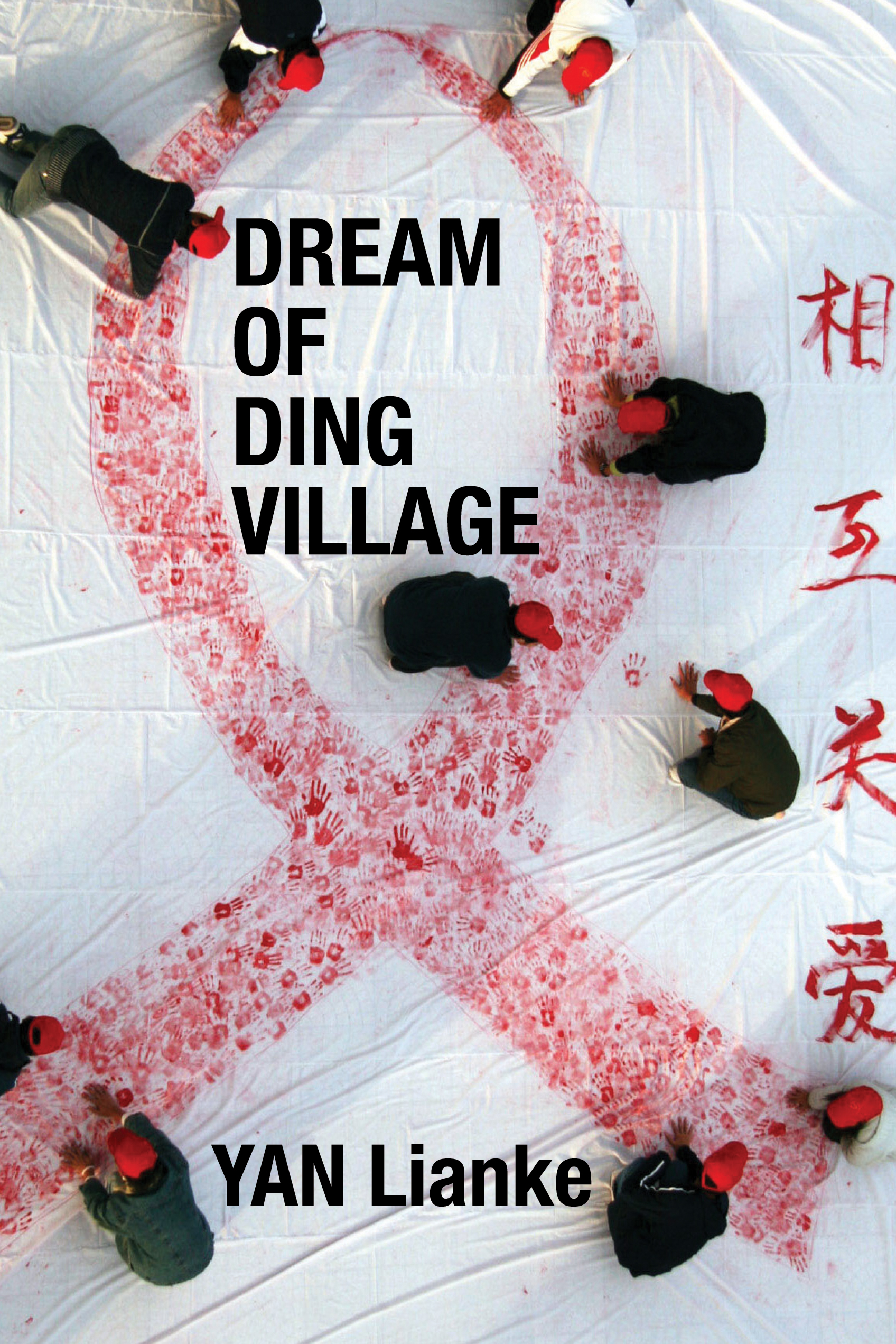
Bookcover courtesy Grove / Atlantic Inc.

As I started reading Yan Lianke‘s Dream of Ding Village, I was reminded of a favourite novel of mine, Albert CamusThe plague. However, as I read on, the similarity started to fade – or, perhaps it’s just that the particularity of Lianke’s conception took over. Both books explore a community living with a highly contagious, deadly disease, and both can be “read” through the lens of a wider political interpretation, but the two stories are told differently. For a start, Camus does not make his political “reading” literal while Lianke closely intertwines the political with the personal in his novel. No wonder this novel was published in Hong Kong and banned in China!

The story was inspired by the fallout that occurred from Henan Province‘s plasma economy, 1991-1995, in which Chinese were encouraged to sell their blood plasma. According to the Wikipedia article, it is estimated that over 40% of the blood donors (sellers) contracted AIDS, due to the low health and safety standards applied to the campaign. It’s a tragic story and Lianke uses it to tell a cautionary tale about a rush to progress that seems to cast humanity to the winds.

So, how does he tell it? The story is narrated by the dead son of “blood kingpin” Ding Hui. Qiang was poisoned in an act of revenge for his father’s role in bringing “the fever” (HIV/AIDS) to Ding Village. In the clear, non-judgemental voice of a child, Qiang proceeds to chronicle events in the village as the disease takes hold, using occasional flashbacks to fill in the gaps. His is not a schmaltzy or sentimental voice. It’s simply the voice of an omnipotent narrator who happens to have also been part of the story, before the novel starts, and whose “existence” initiates its dramatic denouement. It’s an interesting device that nicely balances involvement with distance. We get close, but not too close, to the people and events.

Shadow Man Asian Literary Prize 2011 Badge

Image by Matt Todd of A Novel Approach

The novel is told in 8 Volumes, and progresses chronologically from the appearance of the fever to when its impact on Ding Village is complete. Qiang tells his story primarily through the actions and behaviour of his grandfather, a man who hangs onto his ethics throughout the crisis while trying, mostly against his better judgement, to remain loyal to his two self-centred sons. A difficult task for the hard-working man entrusted with caring for the school and being its teacher when qualified teachers couldn’t be found. While Grandpa does his best to support the villagers in their darkest time, his oldest son Ding Hui engages in scam after scam (such as selling the government’s “free” coffins and organising “marriages” between dead people) to feather his own nest and further climb the greasy pole of bureaucracy.

Along the way, the stories of other villages are told, such as that of the adulterous couple Ding Liang and Lingling who, having uninfected spouses, decide to find affection in each other’s arms. It’s hard to feel they deserved the disapprobation they received (from most, though not all, in the village), but, speaking novelistically, they usefully represent the breakdown in normal codes of behaviour. Early in the novel, there is a respite from the horror when Grandpa invites all infected villagers to live at the school – and for a while a real community develops among the sick and dying. It doesn’t last of course and, as in The plague, bad things start to happen as the villagers respond to their disastrous situation. Graves are robbed, buildings ransacked, and, in a terrible scenario, the village is denuded of all its trees by villagers needing to make coffins. Black humour is never too far from the tone, and this tree-felling scene provides a perfect example.

It’s all powerful stuff and is conveyed through strong writing that uses physical description to underscore the devastation occurring in the village. I particularly liked the paradoxical use of the sun, gold and yellow throughout the novel to convey on one hand, warmth, prosperity and harmony, and on the other drought, desiccation and oppression, with the latter becoming precedent as “the fever” and associated corruption take hold:

Translucent, pale yellow and green leaves shimmered in the sunlight like golden offerings.

BUT LATER

… leaving Grandpa standing in the middle of the road, beneath the blazing sunshine, like a small clay figure of a man that someone had left to dry in the sun. Like an old wooden hitching post bleached by the rotting wood that no one wanted any more.

Other colours also pervade the book such as blood-red suns and green leaves and grass, continuing the disconnect between life and death that characterises Ding Village in the throes of “the fever”.

There’s something about the form though that puzzled me and that’s the use of italics. Sometimes they are used for Grandpa’s dreams – dreams that are often prescient, occasionally surreal – and sometimes they are used for flashbacks. But sometimes I couldn’t quite work out the reason, other than that they were possibly for ideas or events slightly out of kilter with the narrative point at which they occur. I’m not sure that the differentiation, except perhaps to delineate Grandpa’s dreams, serves the novel well.

This is a minor quibble though in a book that explores how greed leads to skewed values (“I spent my whole life doing philanthropy” says the serial scammer Ding Hui) and provides an opening for political corruption. Fast economic progress, Lianke seems to be saying, cannot be simply or easily pasted over cultural traditions that have taken centuries to build … but his vision is not, I think, completely hopeless. “A cool breeze”, he writes near the end, “carried the mingled scents of rotting plants and newly sprouted grass across the plain”. Let’s hope that “newly sprouted grass” gets the upper hand.

For reviews by other members of the Shadow Man Asian Prize jury, please click on my Man Asian page.

Yan Lianke
Dream of Ding Village
(trans. by Cindy Carter)
New York: Grove Press, 2009 (2005, orig. Chinese ed.)
341pp.
ISBN: 9780802145727

Gillian Mears, Foal’s bread (Review)

Gillian Mears' Foal's bread

Foal's bread cover (Courtesy: Allen & Unwin)

Foal’s bread is Gillian Mears’ first novel in around 16 years, though she has published short stories in the interim. This is a shame because she is a beautiful writer, particularly when she writes about the place she knows best, the farms of the New South Wales north coast.

Foal’s bread is about the Nancarrow family. Most of it takes place between 1926 and around 1950, as it follows the fortunes of Noah (Noey/Noh), her husband Roley (Rowley), and the extended family with which they live. Their main business is dairying, but their passion is the sport of horse high jumping. At the beginning of the novel, Roley is an Australian high jump champion and Noey a young 14 year-old girl with promise. They meet, marry (early in the novel, so no spoilers here) and start working hard to achieve their dream of having their own high jumping team. Hope on, Hope ever, is their motto. That’s the broad plot; the story is far more complex.

This is an archetypal story of strong country people coping (or not) with “luckiness and unluckiness” in life. In its depiction of hardship, stoicism and the will to survive in rural families, it reminded me – in tone if not in story – of Geoff Page’s The scarringThe hardship may come from different quarters, but in both there is a sense of forces out of one’s control combining with things of the characters’ own making. That mix – of characters’ judgement or behaviour clashing with luck (usually bad) – tends to make for a good story, in the right hands. It’s a bit Shakespearean in a way, the clash of character with “the elements”.

Australian Women Writers Challenge 2012 Badge

Australian Women Writers Challenge (Design: Book'dout - Shelleyrae)

In Foal’s bread, the “bad luck” has many sources, some human and some natural, such as incest, lightning strikes, giving birth to a disabled child, war and drought. How the characters cope with the trials confronting them is the core of the novel. Unfortunately, more often than not, they don’t cope very well. Why? Mainly due to their very human failings. Noey and Roley, whose marriage commences with great love and big dreams, don’t know how to communicate when calamity hits. Noey’s mother-in-law, Minna, lets her jealousy (“of the happiness she’d never seen before”) get the better of her and prefers to increase the tension between her son and his wife rather than to ameliorate it.

By now you’ll be thinking this sounds like a miserable story, and in some ways it is. But it’s not all darkness. While the novel has an almost elegiac tone, its movement is towards light. It has a three-part structure. There’s a very short Preamble which sets a tone of harshness and brutality with its references to incest, bushfires, floods, and animal cruelty.”Watch out you don’t cry” we are warned. Then there is the bulk of the novel in which the story of Noey and Roley is played out. This is followed by a Coda, set some 50 years later, in which we learn that “the old voices remain … funny, flinty, relentless”. These voices are carried into the future by Lainey, the strong, resourceful daughter of Roley and Noey, “her mother’s daughter through and through”.

A strong story, but what gives this novel its real power is the writing. Mears mixes the rough, ungrammatical country-speak of the era with glorious, rhythmical language describing the magpies, butcherbirds, trees, creeks and hills of One Tree Farm. The “one tree” is a jacaranda, and it features throughout the novel. It could almost be, dare I say it, a character. Early in the novel, when all is full of hope, it quivers “to create the feeling of a big bosomed woman wanting to waltz”. Later, as things start to collapse, it loses its leaves, but at the end “the old tree lives on … like a huge purple cloud hiding the rooflines”.

And then, of course, there are the horses. Reading this book reminded me a little of reading Tim Winton’s Breath. Mears does for horse high-jumping what Winton did for surfing. She made me feel the joy and beauty of the jump, of pushing oneself to achieve just that little bit more in a risky sport, of having a dream that keeps you going, of doing “the impossible”. Mears, like Winton, knows her subject inside out, and you feel it in her writing.

I fear I haven’t done the book justice. I’ve not really described its complex plot. I’ve named only a few of its large cast of colourful characters. It’s an ambitious book with big themes and a big style. Not everyone loves it. Some find the dialogue tricky or some descriptions overdone; some think the ending is disappointing; some think it’s stereotypical in places. I think none of these things. I’d love to know what you – if you’ve read it – think!

Gillian Mears
Foal’s bread
Sydney: Allen & Unwin, 2011
370pp.
ISBN: 9781742376295

(Uncorrected proof copy received from Lisa of ANZLitLovers in a blog giveaway)

Jahnavi Barua, Rebirth (Review for the Shadow Man Asian Literary Prize, 2011)

Shadow Man Asian Literary Prize 2011 Badge

Image by Matt Todd of A Novel Approach

What a shame Jahnavi Barua‘s novel, Rebirth, is, to the best of my knowledge, available “for sale in the Indian Subcontinent only” (backcover). Our Shadow Man Asian team had real problems tracking this one down, but I’m very glad we did manage to obtain some copies, eventually, because this is a beautiful book.

The title, Rebirth, might give you a sense of its subject matter – but, then again, it mightn’t! The novel – novella really – is a first person monologue by a mother to her unborn child. The child is waiting to be born – not reborn – but there is a sense that for the mother, Kaberi, a rebirth might be in the offing as she explores the state of her shaky arranged marriage, and of some tricky or unresolved relationships with family and friends.

While set in India – in Bangalore and Guwahati (in the troubled province of Assam) – this novel does not have the noise and energy that often accompanies stories from the subcontinent. It’s quiet and contemplative. Moreover, while it is imbued with gorgeous descriptions of the plants and landscapes of India, and while it refers to the ongoing political unrest in Assam, it is not specifically Indian in theme. Its story is universal, that of the desire for love between husband and wife, and of the love of a mother for her child. And here is the difficult part, because it is hard to describe this largely plotless novel without making it sound twee or mawkish, but somehow it is not that at all. Barua manages to find a voice for Kaberi that is tender but matter of fact, that is tentative but also confident. The progression is chronological, commencing with her husband leaving her for another woman at the beginning of the novel just as she discovers she is pregnant (after many years of trying). She doesn’t tell him – or her family and friends – for some long time as she considers her life. In the opening paragraphs we are given a picture of her as somewhat passive and inward-looking. Before her husband left, she says she

had been partial to the large soft sofa in front of the television, from where I had a good view of the screen, but from where I also looked inwards, into the heart of the house. I did not see much of the sky or buildings clustered around our own, but all that, anyway, did not cross my mind very often, so focused was I on your father and myself and the home we had fashioned together.

Ah, we think … a person ripe for “rebirth”. And yes she is, but it is slow and undramatic as she gradually, by meeting friends, remembering her old childhood friend who’d died in a bombed bus in Assam, and reflecting on her marriage past and present, comes to a better understanding of who she is. Early in the novel she, a keen reader, says:

I will not buy a book today. I will try and live in my life instead.

As the novel progresses, we find that she is, in fact, stronger and more directed than we (and, more to the point, even she) had realised. She has, for example, written a book and organised for her friend Preetha to illustrate it. This is no simple thing, but her husband, “whose public manners were always nice”, knows nothing of this. Ah, we wonder, what is she saying about his private manners, the way he treats her? We learn, through more stories in the next few pages, that what she hasn’t received from him is tenderness and love. But we also receive a clear sense of strength growing in her:

I demand love. Now, especially now, at least now.

This comes about a quarter of the way through the novel … the rest explores, in the same quiet tone, how things fall out for Kaberi, how she confronts her fears and insecurities. Things do happen – her father dies and she returns home to Guwahati, she eventually tells her husband, family and friends about her pregnancy. You can’t hide that forever after all! In other words, there is a plot of sorts, but the story is mostly an internal one and the ending is appropriately open albeit also with some sense of things resolved.

A little over halfway though the novel Kaberi says:

Birds wheel around slowly in the cloudless sky. Seemingly aimless, but I know better; little happens in nature accidentally.

And, I’d say, little happens accidentally in the writing of this book. It has been carefully and subtly structured to lay the foundations for Kaberi’s growth, and this makes it an absolute pleasure to read.

For other reviews by the Shadow Man Asian team, please click on my Man Asian Literary Prize page.

Jahnavi Barua
Rebirth
New Delhi: Penguin Books, 2010
203pp.
ISBN: 9780143414551

(Review copy supplied by Penguin Books via Lisa of ANZLitLovers)

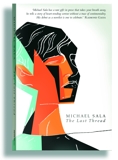
Michael Sala, The last thread (Review)

Michael Sala The last thread bookcover

The last thread (Courtesy: Affirm Press)

It’s clear why Affirm Press chose a comment by Raimond Gaita for the front cover of their latest publication, Michael Sala’s autobiographical novel, The last thread. Gaita, for readers here who don’t know, wrote an award-winning memoir, Romulus, My Father, about growing up as a migrant with mentally unstable parents. Sala’s story is different but both boys suffered emotional deprivations that they chronicle in their books … except, and this is a big one, Sala’s book is classified as “fiction”, and we must therefore read it as such. A bit, in fact, like Francesca Rendle-Short’s Bite your tongue!

So, what is his story? The novel is told from Michaelis’ (later Michael’s) point of view. It is divided in two parts: Bergen Op Zoom and Newcastle. It starts, then, in the Netherlands when Michael is around three or four years old, and his brother, Con (Constantinos) three years older. But it’s not quite this simple, as in the first part which is told third person we follow them from the Netherlands to Australia to the Netherlands and then back to Australia. The family’s unsettled state physically – they also move multiple times in Australia – works metaphorically too because there is little emotional stability in the boys’ lives. At the start of the novel, the mother has left the boys’ father, the Cypriot Phytos, and is living with the physically and emotionally abusive Dutchman, Dirk. (“There’s no problem”, Michael writes of this handyman stepfather, “that he can’t solve with his hands”.) By the end, when the boys have grown up, the mother has been married a couple more times. She is skilled, you would say, at choosing wrong men: “The men in my life take advantage of me”, she says.

What makes this somewhat age-old story compelling is the writing. It is told more or less chronologically but in little vignettes. The two parts are divided into chapters, but the chapters themselves are broken into smaller sections that provide an eye into scenes from Michael’s world. It’s a child’s eye, until near the end, so we readers must try to fill the gaps between what Michael describes and what we know could be the meaning behind what he’s seeing. Why, we must ask ourselves, would a young boy think this:

Michaelis can’t imagine anything more frightening than living forever.

And Michael’s eye, though a child’s one, is very observant. He particularly notices faces, watching them it seems for signs of warmth and connection, but

Each time light blazes from the screen, it washes across Con’s face and reveals it like something carved from stone.

and

She [mother] holds her belly and sighs, and there’s a look in her eyes as if she might burst into tears.

I could be mistaken but it felt to me that as we moved through the second part, Newcastle, which is told first person by the adult Michael, the chronology became more disjointed, mirroring I think Michael’s growing awareness of what lies behind the dislocations in his family, and of its impact on him.

As you’ve probably gathered by now, there are secrets in this family that contribute to the dysfunctional behaviour. These secrets are not mentioned on the backcover, so I won’t mention them either. Sala handles them well. He doesn’t labour them but rather lets them hover in a way that we know they are there but that doesn’t let them occupy centre-stage. We learn to live with them, the way the family has to. In the way of modern novels, there’s no dramatic denouement …

In talking of the writing, I’ve mainly discussed the narrative style but I should also mention the language. It is, in a word, gorgeous. Here are just two descriptions that convey Sala’s ability to capture the essence of things. First, being dumped by a wave:

There is such strength in the sea. He has forgotten it until now. It pulls at his limbs so that his feet touch nothing and only his desperate grip keeps him there. A sensation comes to him of being separate, of seeing it all from a great distance as if he cannot reach out and touch the world. Then the noise dies in his ears, the sky appears again above him.

And next, of his mother’s house:

The rooms and corridors of my mother’s house became like the arteries of a heart attack victim, all clogged up. Even the breeze had to bend in half to get through.

I’ve read quite a bit of autobiographical/biographical fiction, fiction-cum-memoirs, and memoirs in recent months, and some I’ve found a little wanting here and there. This, though, is hard to fault – if, that is, you like reading more for the interior than the exterior, for what’s going on inside rather than for what’s happening in the material world.

In the very last pages of the book, Michael’s mother says that “words and stories can be dangerous” (echoing Francesca Rendle-Short’s “to think, to write, is dangerous”). They can indeed, but sometimes that danger can have positive outcomes. I hope that, for Sala, the dangers of putting his story, his truths, on the page will be restorative. There’s no guarantee though that such bravery will have its just rewards … in life or in fiction.

Michael Sala
The last thread
Mulgrave: Affirm Press, 2012
238pp
ISBN: 9780987132680

(Review copy supplied by Affirm Press)

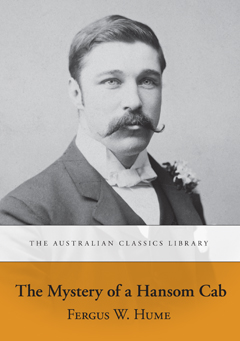
Fergus W. Hume, The mystery of a hansom cab (Review)

Hume Mystery of a Hansom Cab

The mystery of a hansom cab (Courtesy: Sydney University Press)

Sometimes you just have to break your reading “rules” don’t you? Two of mine are that I’m not much into detective fiction (despite having reviewed Peter Temple’s Truth here) and I don’t read self-published books – but then along came Fergus Hume‘s The mystery of a hansom cab. It’s a classic Australian crime novel – and it was “originally” self-published (says she cheekily)!

I’m not, you now know, an aficionado of crime fiction, so my assessment of this book may be the skewed one of a newbie not versed in the intricacies of crime writing. However, I must say that I found this a thoroughly enjoyable and engaging book, and would recommend it to crime and non-crime readers alike, for reasons that will soon become obvious. But first, the plot.

The story commences with a newspaper report of a murder that takes place in a hansom cab, and over the next few chapters we learn the name of the victim (a young man, Oliver Whyte, who was drunk at the time of his death) and that he was killed by a passenger who got into the cab, ostensibly to see him safely home. The detective on the case fairly quickly deduces that the murderer is a rival for the affections of a young society woman … and from here, as it always does, the plot thickens. The accused murderer declares his innocence, that he indeed has an alibi, but he will not divulge the information it would “curse” the life of his fiancée. The trial occurs and is resolved halfway through the novel. The rest explores … but wait, if I tell you this, I’ll give too much away, so I’ll stop here. The resolution, when it comes, is not a complete surprise but neither is it completely predictable. At least, not to non-aficionado me.

Australian Literature Month Platypus logo

Read for Reading Matters' Australian Literature Month

Now, why do I like it? To start with, it’s a well-told story, with nicely delineated characters. Then there’s the setting: it is primarily set in Melbourne, with a little excursion into the country, in the 1880s. This was a boom-time for what was known then as “Marvellous Melbourne” and Hume describes life in this well-to-do post-Gold Rush city with gorgeous clarity. Most of it concerns the middle classes – the professionals and self-made men – but we are also taken into the slums where prostitutes struggle to survive. Hume does not have the social justice goals of, say, William Lane (in The workingman’s paradise) but he doesn’t shy from describing some of the seamier aspects of the city:

Kilsip and the barrister kept for safety in the middle of the alley, so that no one could spring upon them unaware, and they could see sometimes on the one side, a man cowering back into the black shadows, or on the other, a woman with disordered hair and bare bosom, leaning out of a window trying to get a breath of fresh air … Kilsip, turning to the left, led the barrister down another and still narrower lane, the darkness and gloom of which made the lawyer shudder, as he wondered how human beings could live in such murky places.

Hume then describes the woman they had gone to meet, Mother Guttersnipe (how Dickensian is that?):

… a repulsive-looking old crone; and in truth, her ugliness was, in its very grotesqueness well worthy the pencil of a Doré.

This brings me to another aspect I enjoyed. It is chockablock with allusions to Shakespeare and the classics, and references to what the writer of the introduction describes as the “middle-brow, middle-class, international entertainment culture of North America and Europe”, such as the artist Doré, the composer Offenbach, and the writers Poe, Dickens and De Quincy. There’s also a cheeky reference to novelist Mrs Braddon – “Murdered in a cab … a romance in real life, which beats Mrs Braddon hollow” – containing a clue that readers of the time might have picked up.

There’s the 19th century style – third person omniscient, descriptive chapter titles, a touch (but not too much) of melodrama, light satire and humour, the use of little homilies (often to introduce chapters), and a (very) neatly tied up conclusion. This is not ponderous, heavy-handed 19th century writing, but good well-paced story-telling supported by lovely description and observations. Most of the light relief comes through minor characters, like the landlady Mrs Sampson and the young-man-about-town Felix Rolleston. Here is Mrs Sampson:

She was a small, dried-up little woman, with a wrinkled yellow-ish face. She seemed parched up and brittle. Whenever she moved she crackled, and one went in constant dread of seeing a wizen-looking limb break off short like the branch of some dead tree. When she spoke it was in a voice hard and shrill, not unlike the chirp of a cricket.

She is, for all this, a warm-hearted woman, but whenever she appears so do such words as “crackle’, “rustle”, and “chirp”. Beautifully vivid, but nicely controlled.

It is of course also 19th century in its worldview … and so has a patriarchal flavour. Our “plucky” heroine, Madge, buys “a dozen or more articles she did not want” writes the author. And in the resolution the men decide what they will and will not share with the women involved – “it would be useless to reveal” the truth to one female character as “such a relevation could bring her no pecuniary benefit”, and to another because “such a relation could do no good, and would only create a scandal”. The infantilisation of women, eh?

Fate also makes its appearance in the novel, from early on when the accused murderer’s life “hangs on a mere chance” to late in the novel when the author makes his position clear. He writes that men:

… created a new deity called Fate, and laid any misfortune which happened to them to her charge. Her worship is still very popular, especially among lazy and unlucky people, who never bestir themselves … After all, the true religion of fate has been preached by George Eliot when she says that our lives are the outcome of our actions. Set up any idol you please upon which to lay the blame of unhappy lives and baffled ambitions, but the true cause is to found in men themselves.

I’ve said it before, and I’m sure I’ll be saying it again: I could write on and on about this book. It has so much to explore and it would be fun to do so, but at this point I’ll simply recommend it to you and hope that you’ll find time to discover and enjoy it too. It was, in its time, a best-seller …

Fergus W. Hume
The mystery of a hansom cab
(The Australian Classics Library)
Sydney: Sydney University Press, 2010
(Orig. pub. 1886)
293pp.
ISBN: 9781920899561

(Review copy supplied by Sydney University Press)

Kyung-Sook Shin, Please look after mom (Review for the Shadow Man Asian Literary Prize 2011)

Shadow Man Asian Literary Prize 2011 Badge
Image by Matt Todd of A Novel Approach

Am I right in thinking that mothers are more often the subject of novels and memoirs than fathers? Or, is it just that I’m a woman and am subconsciously (or even consciously, if I’m honest) drawn to the topic? Of course, with the Shadow Man Asian Literary Prize reviewing project I didn’t really have a choice. Kyung-Sook Shin’s Please look after mom (or, mother in the British edition) has now been shortlisted for the prize. So, here I am again, reading about a mother!

And I liked it – for a number of reasons. But, before I explain that, a quick overview of the plot. The book commences with the line “It’s been one week since Mom went missing”. We learn pretty quickly that the mother and father had been in Seoul to visit some of their children and had become separated when trying to board the subway together, with the mother being left behind. The rest of the book chronicles the family’s search for the mother and, as they search, their reflections on her life and their relationship with her.

So, what did I find fascinating? Firstly, of course, is the fact that it is set in South Korea. I haven’t been there, and I don’t think I’ve read any Korean literature before, so I was predisposed to be interested before I started it. I wasn’t disappointed. The novel is contemporary but spans a few decades, decades in which many of the current parental generation were still living fairly traditional rural lives while their children were being educated and moving to the city to chase “bigger” dreams. Through flashback reflections of the various characters we learn about this time of transition, and the challenges both generations faced in coping with the change. We learn of the mother’s determination that her children be educated, the lengths she went to to obtain the money to pay for this education, and her disappointment when one daughter trained to be a pharmacist but then married and had three children in pretty quick succession. It’s a story that’s been repeated around the world over the last century or two, and the usual universals are there – the economic challenges and all those big and little conflicts that attend social change – but each situation has its particularity. In this book it’s in how this specific family functions – the mother’s determination springing from her own lack of education, the self-centred father’s unreliability resulting in increased poverty for the family, the sibling relationships characterised by a mix of mutual responsibility, love and exasperation.

The next thing of interest is the form. Readers here know I like books which play around with form and voice, and this is one of those books. The story is told in five parts, using four points of view and three different voices. Got that? To make it easy, I’ll list how it goes:

  • “Nobody knows”, told by the elder daughter (but second eldest child), Chi-hon, in second person
  • “I’m sorry, Hyong-chol”, told by the eldest child, son Hyong-chol, in third person
  • “I’m home”, told by the father/husband, in second person
  • “Another woman”, told by the mother, Park So-nyo, in first person
  • “Epilogue: Rosewood rosary”, told by Chi-hon (again), in second person.

As is common in multiple point-of-view novels, the main narrative, the story of the search, progresses more or less chronologically through these parts, with each part also incorporating some back-and-forth flashbacks in which we learn about that person’s relationship with “mom”. This multiple point-of-view technique provides a lovely immediacy to the different perspectives. The choice of different voices – first, second and third – though, is an intriguing one. Here is how I see it. First person for “mom” makes sense since she is the subject. Second person feels like a half-way house between the intimate first person and the more distant third person. Using it for Chi-hon and her father, to speak about themselves, subtly conveys a tension between their responsibility for “mom” (which would be expected of their roles as elder daughter and husband) and their regret and guilt for their failings. Third person, on the other hand, seems appropriate for Hyong-chol who, as the oldest in the family, carries the major weight of familial responsibility into the future. It’s the most distant voice and gives, I think, a layer of gravitas to his role.

And last is the theme – or, should I say, themes? The lesser, if I can call them that, themes include the country-vs-city one, particularly in relation to values; literacy and education; and our mutual responsibility for others (something, the family discovers, “mom” took seriously for friends and strangers as well as her family throughout her life). The overriding theme, though, is that of guilt and regret, of having taken “mom” for granted. They all assumed she liked cooking and being in the kitchen, day in day out. The children forgot to call her regularly and didn’t always come home for special occasions. Her husband remembers all the times he failed to help her, while she would put herself out repeatedly for him. It’s a pretty common story but the way Kyung-sook Shin tells it – the form, the reflective tone, the characterisation, the setting – makes this universal story about respect, a very personal one. I admit to being a little choked up at the end!

I have one little query though, and that relates to the invocation of Catholicism in the end. “Mom” does, early in the novel, ask about a rosewood rosary, thus providing a link to the Epilogue, but where did this interest in the rosary come from, given the frequent references to the more traditional ancestral rites during the book? Mom doesn’t explain it – “I just want prayer rosary beads from that country”, “the smallest country in the world”, she says. I assume it has something to do with the recent growth of Catholicism in South Korea. It didn’t spoil the book for me, but it provided a somewhat odd note. All I can say is read the book for yourself, and see what you think.

Please click on my Man Asian Literary Prize page link for reviews by other members of the team.

Kyung-Sook Shin
Please look after mom
(trans. by Chi-Young Kim)
New York: Alfred A. Knopf, 2011
237pp.
ISBN: 9780307593917

Jamil Ahmad, The wandering falcon (Shadow Man Asian Literary Prize 2011)

Map of Pakistan

Pakistan, with borders (Courtesy: Omer Wazir via Flickr using CC-BY-SA 2.0))

I’m not sure how to describe Jamil Ahmad’s Man Asian Literary Prize novel, The wandering falcon. Is it a disjointed novel, a picaresque, or a collection of connected short stories? It doesn’t matter greatly – it is what it is – but at least by raising the question I’ve given you a sense of how it feels to read this book.

There’s much to fascinate here, not least of which is that this is a debut novel by an author who was born in 1933. Another late bloomer (though he apparently wrote the stories back in the 1970s). Ahmad worked in the Pakistani Civil Service and spent many years in the region he writes about. The book is set in the decades before the rise of the Taliban and presents – explores – life in the multi-tribal region on the borders of Pakistan, Afghanistan and Iran. Fascinating stuff for a reader whose knowledge of this area is general.

There are nine chapters/stories, each having a unique title like “The sins of the mother”, “A point of honour”, “A kidnapping” and each telling a story from the life of a tribe/clan in the region. What unifies these is the character, Tor Baz, who is the wandering falcon of the title. He is born in the first chapter to a couple on the run for disobeying tribal laws of marriage. This chapter, “The sins of the mother”, sets a rather brutal tone for the novel, a tone that carries through into many of the succeeding stories (or events). This is a region where people live by tribal loyalties (and, of course, rules) and where the imposition of borders cuts across tribal life, particularly for those tribes that are nomadic. In the third story, “The death of camels”, the nomadic Pawindahs want, indeed need, to cross borders as they always have, but are told they need travel documents. Their leader says to the government official:

‘… We are Pawindahs and belong to all countries or to none. [ …] What will happen to our herds? … Our animals have to move if they are to live. To stop would mean death for them. Our way of life harms nobody. Why do you wish for us to change?’

Why indeed?

As you will have guessed from my opening sentence, this is not a strongly plot driven book. Ah, now this is where form becomes an issue. We don’t expect a collection of short stories (connected or otherwise) to have a strong plot and so this, probably, is what it is. But there is a linear chronology running through the book. It’s tracked through our falcon Tor Baz who pops up, for one reason or another, in different tribes, from his birth in the first chapter to the end when he’s a man. We see him in various roles, including informer and guide, but we never really get to know him – and for some reason this doesn’t seem to matter. It simply adds to the feel of the book, which is simultaneously fabular and grounded in reality.

The voice is third person, with the startling exception of one story that is told first person by an outsider, a part Afridi returning to his father’s birthplace. If I have a criticism of the book it’s that occasionally the voice becomes a little didactic, a little inclined to tell us some facts rather than show us, but this isn’t often and it’s not heavy-handed enough to spoil the read.

What makes this book stand out is the writing. It beautifully (if one can use such a word for the world it depicts) evokes the landscape we’ve become familiar with through television news and movies. Here is the novel’s second paragraph, describing a military post:

Lonely, as all such posts are, this one is particularly frightening. No habitation for miles around and no vegetation except for a few wasted and barren date trees leaning crazily against each other, and no water other than a trickle among some salt-encrusted boulders which also dries out occasionally, manifesting a degree of hostility. (“The sins of the mother”)

Hmm … “lonely”, “frightening”, “crazily” and “hostility. With words like this on the first page, you know you are not in for something light and cheery. The interesting thing though is that the book does not read as a diatribe or even as a plea. It’s more a description of people who accept their lives, despite the harshness and difficulty, lives where, for example,

If nature provides them food for only ten days in a year, they believe in their right to demand the rest of their sustenance from their fellow men who live oily, fat, comfortable lives in the plains. To both sides, survival is the ultimate virtue. In neither community is any stigma attached to a hired assassin, a thief, a kidnapper or an informer. (“A kidnapping”)

The book chronicles this life – its unforgiving landscape and sometimes brutal justice – and the changes that are starting to threaten centuries old traditions:

The pressures were inexorable. One set of values, one way of life had to die. In this clash, the state, as always, proved stronger than the individual. The new way of life triumphed over the old. (“The death of camels”)

This is a mesmeric book. We feel the author’s affection for the people, their traditions and the land, and we go with his acceptance of lives whose bases are so different to ours. It’s a book born of the earth but its spirit won’t be pinned down. An eye-opener, in more ways than one – and a worthy contender for the prize.

Note: For other Shadow Man Asian Literary Prize reviews, see Lisa of ANZLitLovers, Mark of Eleutherophobia, and Stu of Winstonsdad.

Jamil Ahmad
The wandering falcon
London: Hamish Hamilton, 2011
181pp
ISBN: 9780241145425

Banana Yoshimoto, The lake (Shadow Man Asian Literary Prize 2011)

Shadow Man Asian Literary Prize 2011 Badge
Image created by Matt Todd of A Novel Approach

When I saw that Banana Yoshimoto‘s novel The lake was shortlisted for the 2011 Man Asian Literary Prize I knew that it would be a high priority for me to read, because I like Japanese literature and I have read and enjoyed Yoshimoto (her novel Kitchen) before.

The first thing that struck me, however, as I started reading the book was a case of reading synchronicity. Roy’s The folded earth, the first book I reviewed for our Shadow Man Asian Literary Prize 2011 project, is about a young woman grieving the death of her husband. In The lake, the protagonist, Chihiro, also a young woman, has just lost her mother. And, in further synchronicity, both women meet men who impact their lives. This is not unusual, of course, but the thing is that in both books there is a sense of mystery surrounding these men. However, this is where the similarity ends: the mystery in The lake has nothing to do with the death of Chihiro’s mother. Rather, it relates to something the man has experienced, something that has clearly damaged him.

So, what is the plot? It is basically a romance. The first line of the novel is:

The first time Nakajima stayed over, I dreamed of my dead mom*.

Chihiro, our first person narrator, then flashes back to tell us about her background, her somewhat unusual life with her bar-owner mother and businessman father who never married due to his family’s objections. Chihiro is around 30, but this is, really, a coming-of-age novel because she doesn’t yet feel grown-up:

I’m still a child. I still need my parents, and yet, I suddenly feel I’m walking alone.

Into this solo life comes a young medical student, a “puzzling young man”, Nakajima, who lives in the apartment opposite hers. They first communicate non-verbally across the dividing space. Gradually Chihiro feels she is falling in love with Nakajima, but she is not sure, partly because he’s odd, uneasy, something he admits to but can’t (yet) explain. However, it is through learning to accept Nakajima, to not push him but simply to care for him, that Chihiro starts to grow up. At first she wants to have fun – “I didn’t want to deal with weighty matters” – but she comes to realise that she needs him, and senses that he is “the one”. All this develops before we know what happened to Nakajima. Plotting the story through Chihiro’s description of their developing relationship puts the focus less on what happened in the past – though we certainly want to know – and more on how two young “kind of weird” people might move together to a good future.

Now, here’s the rub. Do I let on what happened to Nakajima? The blurb inside the jacket hints at what it is, so perhaps it’s ok to. However, I think I won’t. All I’ll say is that the lake – to which Nakajima takes Chirihiro half way through the novel – and the brother and sister (Mino and Chii) living there are important to the resolution. Chii is bedridden and mute but she can foretell the future and she does this through Mino. This adds a supernatural element to the story, which works well enough for me though I’m not sure what it specifically adds to the novel (except perhaps a sense of “otherness” to the atmosphere?)

The more important question to ask is why has this novel been longlisted for the Man Asian Literary Prize? Is it more than a nicely written coming-of-age love story? Well, the mystery and its impact on Nakajima, Mino and Chii is a significant one, but that, from the way the story is told and how the plot is resolved, doesn’t seem to be the main point. It is clearly about grief, trauma and recovery, but I think this might be overlaid with the struggle in Japanese society, particularly for the current young generation, to not follow the norm blindly. Nakajima and Chihiro did not have “normal” upbringings. This means that, whether they like it or not, they symbolise nonconformity – and must, consequently, make active decisions about where to next. Freedom is not, I understand, a high value in Japanese society … but it is an issue that comes up regularly in the book. Chihiro’s parents aren’t, through family expectations, free to marry. The mystery surrounding Nakajima relates to a loss of freedom. In her work as a muralist, Chihiro’s only demand is the freedom to paint what she wants and, when that is threatened by a sponsor wanting her to incorporate an enormous logo into her mural, she intelligently but resolutely conducts a campaign to encourage him to change his mind.

Late in the novel, when talking about his experience, Nakajima says:

When you’re in a state of homogeneity, you’ve lost yourself.

Beyond loss and childhood trauma, then, it is the ongoing things like homogeneity, lack of freedom, the push to be normal that challenge Yoshimoto’s characters. But this is a quiet, lyrical book rather than a feisty one. It recognises that life involves “dull repetition of the same old thing” peppered by those “little leaps of your heart to put a splash of colour in the world”. Have I fully understood this novel? I’m not sure that I have … but I did enjoy reading it and thinking about the issues Yoshimoto seems to be exploring.

Matt of A Novel Approach and Lisa of ANZLitLovers, on our Man Asian team, have also reviewed it and are worth reading for their different takes.

Banana Yoshimoto
The lake
(trans. by Michael Emmerich)
Brooklyn: Melville House, 2011 (orig. Japanese ed. 2005)
188pp
ISBN: 9781933633770

* An American translation. We would say “mum”!

Anuradha Roy, The folded earth (Shadow Man Asian Literary Prize 2011)

Anuradha Chenoy (Jawahar Lal Nehru University,...

At last I’m posting my first review for our Shadow Man Asian Literary Prize longlist reviewing project. The book is The folded earth  by Indian writer Anuradha Roy.  Like many others, my first reaction when I saw this book listed was to wonder whether Anuradha was another name for Arundhati Roy – but it isn’t. She is, however, used to readers confusing her – and now that we have cleared that up, I will get on with my review.

The folded earth is Roy’s second novel. It’s a contemporary story about a young Hindu woman, Maya, who marries a Christian man, Michael, thereby angering both her parents and his. Consequently, when Michael dies, mountaineering, after only 6 years of marriage, she has no family to turn to for support. Grief-striken her solution is to move to Ranikhet, the nearest town in the Himalayan foothills to where he died. The novel chronicles her life in that town – the work she does, the friends she makes. It’s a fairly simple plot, though there are some complications: there’s the mysterious Veer who comes and goes and with whom she develops an uneasy relationship, and there’s the backdrop of conflict as the impending elections bring into focus Christian-Hindu tensions. There are also some references to real people – to the romantically involved Nehru and Edwina Mountbatten, and to the legendary big-cat hunter Jim Corbett.

The main appeal of the book for me was the evocation of village life through its colourful characters. They include Ama, the  stereotypical but nonetheless believable wise village woman; Charu, her lovelorn but resourceful granddaughter; Mr Chauhan, the officious Administrator; Diwan Sihab, the eccentric would-be biographer of Corbett and generous landlord to Maya; Puran, the simple cowherd; Miss Wilson, the austere principal of the Catholic school at which Maya works. And of course, Maya, herself, who is the first person narrator of the novel. These characters come alive and we care about them, even Mr Chauhan who, with his attempts to beautify Ranikhet (“In foreign countries I have heard people have to pick up even their dog’s … waste from roads”), provides light comic relief. He is not totally benign though, as he is also behind one of the book’s cruellest moments when his henchmen torture Puran.

I also enjoyed the writing. Roy’s descriptions of the foothills and seasonal changes bring the landscape alive:

… I stood looking at the mountains, which had risen out of the monsoon sky. Clouds were piled high at their base so that they floated in mid-air, detached from everything earthly. Something in the quality of the light made the peaks appear translucent, as if the molten silver sky were visible through them.

Her descriptions of people and their relationships are often spot-on, such as this of a new relationship:

We were too new and fragile, too skinless to be exposed to daylight just yet.

Roy explores some of the changes confronting the region, particularly in relation to religious difference, education, and the role of women. Should women be educated, and if so how much? (Ama, for example, would like to see Charu educated so that “she won’t let a man get away with treating her badly” but not so much that it will stop her getting a husband.) How do hardworking villagers comprehend the seasonal influx of wealthy travellers? Here is Ama again:

Travelling is all very well […] But it’s for people with money to burn and nothing better to do but eat, drink and idle. Why go walking up and down hills for pleasure? We do that everyday for work.

Social conflict and change are real issues in this neck of the woods!

And yet, despite these positives, the book doesn’t quite hang together, mainly, I think, because it doesn’t know what it is. Is it about coming to terms with grief, an ideas novel about political tensions in contemporary India, a mystery about Michael’s death, a hymn to the Himalayan region (in the face of encroaching urbanisation), or all of the above? I suspect Roy intended all of these but the book is a little too disjointed, a little too unfocused to quite pull it off. The politics seem important but are mostly a sideline to the personal stories. For the political ideas to have impact they needed to collide in some major way with the characters rather than form a backdrop as they do here. There is a mystery about Michael’s death but Roy doesn’t build or sustain the tension well, and when the true story comes out it’s neither surprising nor particularly powerful. There are references to the destruction of the natural world, to humans making “anthills out of the mountains”, to “the distant past of the forests when the shadow of a barasingha’s horns flitted through the denser woods”, but the ideas are not fully integrated into the story.

I’m not sorry to have read it, however. It’s not a ground-breaking book and it doesn’t fully cohere, but there is a lot to enjoy – the writing, the exotic (to me) setting, and the characters, for a start. I don’t imagine this will be my top-ranked book in the longlist but neither would I discourage people from reading it.

From the team: Matt (A Novel Approach) had similar reactions to mine, and Fay (Read, Ramble) also had reservations.

Shadow Man Asian Literary Prize 2011 Badge

Image created by Matt Todd of A Novel Approach

Anuradha Roy
The folded earth
London: MacLehose Press, 2011
257pp.
ISBN: 9780857050441

Andrew O’Hagan, The life and opinions of Maf the dog and of his friend Marilyn Monroe

Andrew O'Hagan 2009

O'Hagan 2009 (Courtesy: Treesbank, CC-BY 3.0, via wikipedia)

Andrew O’Hagan‘s The life and opinions of Maf the dog and of his friend Marilyn Monroe is a fun – though also serious – book, so I’m going to start with something trivial, just because it will provide a laugh to those who know me:

Like all dogs, I take for granted a certain amount of sanctioned laziness, but beaches, tanning, ice-cream? To me the beach is an unfixed term on a roasting spit, a stifling penance …

Yep, Maf and me, we don’t like beaches*! Enough digression, though … on to the book. First off, I liked it – but how to describe a book that roams so widely yet has such minimal plot? The story is told first person by Maf the dog. Maf (short for Mafia Honey) is a Maltese Terrier who was given (in reality as well as in fiction) to Marilyn Monroe by Frank Sinatra. In the first few chapters Maf moves from Scotland, where he is born, to the home of Vanessa Bell and Duncan Grant (of the Bloomsbury set), to the Los Angeles home of Natalie Woods’ parents, to Frank Sinatra to … well, you know who now. In the rest of the book we follow Maf as he lives with Marilyn Monroe, in New York and Los Angeles, in the last couple of years of her life.

The book though is less about Marilyn Monroe (that “strange and unhappy creature”) than it is about America and the author’s exploration of the issues that occupied, or typefied, America in the early 1960s. They were years of hope and excitement, when people believed they could (re)make themselves (“Let me start again” say the migrants coming in through Ellis Island). John F Kennedy was elected in 1960 and the Civil Rights movement was about to take centre stage. But Maf sees the American paradox, sees that the ideals of liberty and happiness are by no means assured.

A repeated motif in the book is that of interior decoration – and its literal meaning can be overlaid with something a little more symbolic:

My hero Trotsky would have made a great interior decorator: after all, decoration is all about personality and history, the precise business of making, discovering, choosing the conditions of life and placing them just so. The best decorators finding it quite natural to inject a splash of the dialectical into their materialism.

It’s a clever motif because it encompasses the perspective (the floor) from which dogs (like Maf) see and describe the world, the (often superficial) fascination with home decoration (which sees, for example, Monroe going to Mexico to buy goods that she never unpacks), and the more existential notion of “decorating” or fashioning oneself.

Another motif running through the book is Trotsky. The above quote comes early in the book, but there are many other references, including this one quite late:

Wasn’t he [Trotsky] the god of small things and massive ideas, a cultivator of man’s better instincts? That, my friends, is the greatest work of the imagination: not action, but the thought of action.

Maf sees Trotsky as an enlightened being, who might, just might have shown us the way, had he been given the chance. But, let’s move on, because this book – chockablock as it is with philosophers, artists, writers, actors, critics and politicians – rarely stands still. We are continually on the move, either physically as Maf moves from place to place, or mentally as Maf explores idea after idea, such as fiction and art versus reality, tragedy versus comedy, humans versus animals, interior decoration, psychoanalysis, politics and fame, master versus servant (even in the great democracy). These are not didactically or artificially explored in a let’s-tick-off-another-obsession way. They are neatly integrated into the story as Marilyn, with Maf in tow, experiences the last years of her life. She dines with Frank Sinatra, discusses books with Carson McCullers, is treated by her therapists, attends Lee Strasberg’s Actors Studio, discusses civil rights with JFK, works with Cukor on Something’s gotta give, and so on. As far as I can tell, all the facts of her life presented here are “real” – as are the major cultural movers and shakers depicted within. It can be daunting to confront so many names in such a short space, but there are some good laughs here if you just go with the flow.

While the facts are interesting, however, what makes the book are Maf’s observations. Somehow, O’Hagan manages to imbue Maf with a persona, a voice, that works. It’s not twee or sentimental. It’s a little tongue-in-cheek, it’s knowing, and it’s clear-eyed but with compassion where compassion’s due. Maf notices for example the paradox contained in:

… the upper classes arguing in favor of radical politics while their servants set down their tea in front of them.

One of the issues that crops up regularly is the line between art/fiction and reality, which is not surprising in a book populated with actors and other artists. Early in the book Maf tells us that dogs**:

have none of that fatal human weakness for making large distinctions between what is real and what is imagined.

I like this. I fear that too often we polarise life/reality and art/imagination, particularly in literary analysis. We might express discomfort, for example, with a dog narrating a story about people! We “trust” realism, and we distrust or are uncomfortable with the opposite, with what we deem to be “not believable”.

A little later, playing with this idea from a different tack, he tells us:

We are what we imagine we are: reality itself is the true fiction.

Marilyn’s inability to sort this out probably contributes to her undoing. The book’s title suggests that we will get to understand Marilyn, but we don’t. She is, at the end, as elusive, “unearthly”, “abstracted”, as ever she was … which is probably the most realistic (ha?) way to go!

Maf says Marilyn taught him that:

A novel must be what only a novel can be – it must dream, it must open the mind.

Can’t say better than that … and this book, I reckon, gives it a good shot.

Andrew O’Hagan
The life and opinions of Maf the dog and of his friend Marilyn Monroe
London: Faber and Faber, 2011
279pp
ISBN: 9780571216000

* A footnote, emulating Maf whose footnotes add to the fun of the book. I do like to visit the coast, to look at the sea. It’s the beaches – the spending hours on them – that I don’t like.

** In a footnote, Maf tells us there’s been a long tradition of animals speaking for humans, listing such writers as Cervantes, Orwell, Woolf, Swift, Checkhov, Gogol and Tolstoy, just in case we decide to question a tale told in his voice!