Dorothy Johnston, The house at number 10 (Review)

Johnston, House at Number 10 bookcover

Courtesy: Wakefield Press

Dorothy Johnston‘s The house at number 10 has one of the cheekiest opening sentences I’ve read for a long time … but I’m not going to tell you what it is. If you are interested you’ll have to find out for yourselves – and tell me if you agree.

I decided to read this novel for a couple of reasons. Firstly, I’d known of Dorothy Johnston since the 1980s but have only read some short stories (specifically, those in the recent Canberra-focused anthologies, The invisible thread and Meanjin’s Canberra Issue.) Secondly, I chose this particular novel because it is set in Canberra and this Centenary year I’m focusing a little, though not exclusively, on books set in Canberra or by Canberra writers.

Dorothy Johnston was a founding member of the Seven Writers, a group of women writers in Canberra who met for many years to share and critique each other’s writing. They have become the stuff of legend, at least to Canberra readers. Johnston has written several novels including four crime novels set in Canberra. She has also been shortlisted for the Miles Franklin award – twice. But The house at number 10 is not one of her crime novels, nor one of the shortlisted novels. It is, though, a good read … and it’s time I got to it!

The novel is set in the early 1990s, on the cusp of the legalisation of the sex industry in Canberra. Its protagonist, late-twenties-something Sophie, has been left by her husband, Andrew, not for another women but for “a floating, open-ended freedom”, for “a raft of girls”. They are sharing the care of their four-year-old, rather self-possessed daughter, Tamsin, and Sophie, now living in the garden flat at the back of the old widow Mrs B’s home, needs to support herself. So she applies for a job in a small, newly established and rather shabby brothel in the suburb of Kingston, at 10 Andover Street. Hence the novel’s title. The novel explores Sophie’s various relationships – with Elise and Kirsten who work in the brothel, with Marshall the brothel owner and Elise’s partner, with her landlady, with her old friend (and architect) Ann, with a couple of her clients, and of course with her estranged husband and her daughter.

There is a little bit of the “oh what tangled webs we weave” about this novel as Sophie strives to keep her two lives separate – but Johnston is not so much interested in mysteries and intrigues here as in how we navigate complicated relationships and cope with betrayal. It’s a surprising set-up but it works, because she keeps the story grounded in the relationships and not in its potential for salaciousness.

And the relationships are what keep you reading, as Johnston slowly draws the various characters into Sophie’s new life. Ann designs a renovation for the brothel, Mrs B takes over fixing up its garden. Characters look out for each other – Kirsten deflects Marshall who is keen to try out this new “girl”, while Sophie looks out for Kirsten through a long illness; Ann and Mrs B accept Sophie’s choice, supporting her while also offering advice. Not all is rosy though. Elise is suspicious and prickly, and Ann has a little fling with Andrew, albeit with Sophie’s not-overly-happy knowledge.

Underpinning all this is a tension stemming from Sophie’s grief and anger at her abandonment. She doesn’t rant, and she holds it together in front of her daughter, but her feelings are made clear when she meets her first client:

She handed him a condom and he rolled it expertly. Now, she thought, now, as grief at her failed marriage made barriers transparent, each one constructed of material so thin she could burst through it at will. Anger welled up, and resentment and self-pity. Blame struck out and swam through the lamplight towards this stranger who wore Andrew’s hair.

It’s a dangerous game she’s playing, particularly when she takes on Jack, who is into bondage, something the brothel has not offered before. For Sophie, though, it provides an opportunity to enact revenge on Andrew, displaced though it is to Jack. She knows he’s not Andrew, but she can imagine so – and this works for a while. However, you can’t of course maintain a secret or divided life forever. Eventually the crunch comes, and Sophie risks losing what matters to her most …

Besides her sensitive characterisation, Johnston also does place well. Canberra is rightly depicted as a place in which ordinary people live and go about their business, but she also captures its particular beauty – the “flat, clean” sun which has a “greedy kind of clarity”, and the light and colours of the changing seasons that are so marked in Canberra. The house at number 10 has a character of its own – shabby, but somehow warm with its worn out armchair and cosy kitchen. Not quite what you’d expect for a brothel – though how would I know – and yet it feels true. And there’s Sophie’s garden flat with its comforting garden:

There was the dark green garden, watered to the gills, and the sense it always gave her of luxury, repleteness, a deep satisfaction with its own existence.

Johnston uses imagery lightly but effectively. Sophie’s divided life is represented by her living on one side of the lake and working on the other. We often drive with her over the lake, making the transition clear. As the novel builds to its climax, the colour “red” and words like “fire” and blood” start to appear, suggesting anger, violence (real or imagined), and revenge. Contrasted with this are references to water, primarily via the lake and a Cupid fountain bought for the brothel’s garden, implying something more female, perhaps calming but also a little mysterious. And then, throughout, there’s gardening and its association with nurture and growth, with vision and imagination.

So what really is it about? Revenge is the motive for the plot, but it is not really the theme. Rather, it’s about facing life bravely and taking risks even if you “draw blood”, about friendship and the things you do for your friends, and about love in all its guises. A quiet book, despite its subject matter, and well worth the read.

AusLitMonth2013Dorothy Johnston
The house at number 10
Kent Town: Wakefield Press, 2005
257pp.
ISBN: 9781862546837

Read for Australian Women Writers’ Challenge and Reading Matters’ Australian Literature Month.

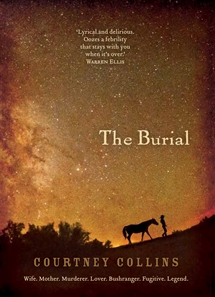
Courtney Collins, The burial (Review)

Book cover (Courtesy: Allen & Unwin)

Book cover (Courtesy: Allen & Unwin)

I became aware of Courtney Collins’ The burial when it was longlisted for the Stella Prize. It has since been shortlisted for the Stella, shortlisted for the new writing award in the NSW Premier’s Literary Awards, and longlisted for the Dobbie Literary Award for new writing. It had previously been shortlisted for the 2009 Australian/Vogel Award for Unpublished Manuscripts. This is one impressive debut. While I’m attracted to several of the books longlisted for the Stella, I particularly wanted to read this one because of its subject matter; it is inspired by the life of Jessie Hickman, an Australian woman bushranger. I hadn’t heard of her before and thought this would be an interesting introduction. I wasn’t wrong. The burial is no ordinary historical fiction.

The bulk of the novel takes place in 1921 when 27-year-old Jessie, having had a gutful of her abusive, horse rustling husband Fitz, takes off, having first … well, let’s just say, done to him what she’d been wanting to do for a long time. In other words, she’s on the run. Now Jessie is no saint. She’s already been in prison for rustling, but she didn’t deserve the treatment she got at the hands of Fitz. The novel chronicles Jessie’s escape, and the story of the two men looking for her, Jack Brown, her lover and co-horse rustler for Fitz, and Sergeant Barlow, who has a story of his own. Escape is, we discover, Jessie’s speciality. It’s not for nothing that the book starts with a story of Houdini, or that Jessie’s horse is named for him.

As I read, I was reminded of two American writers – Toni Morrison and her powerful, gut-wrenching novel Beloved, and Cormac McCarthy and his western novels – for pretty obvious reasons. The burial is narrated by Jessie’s prematurely born daughter whom she kills and buries at the start of the novel, reminiscent of Sethe’s daughter Beloved, despite their different behaviours. And the elemental, evocative language along with the themes – human against human, human against nature, in a forbidding and lawless environment – immediately bring Cormac McCarthy to mind.

What is particularly impressive about this debut is Collins’ handling of the narrative voice and structure. The baby’s voice is generous and wise, not maudlin or pathetic. She cares about this mother of hers, and is a bit like a guardian spirit, albeit one without any power. Somehow, despite what Jessie did to her, she humanises Jessie and encourages us to feel sympathy rather than horror. Collins is light-handed in her use of this trope. As the novel progresses, it feels like a third person story, which it is, really, because it is not about the narrator but is her story of her mother. Every now and then, though, we are reminded of our narrator when she says “my mother”.  As for the structure, the narrative alternates, loosely rather than rigorously, between Jessie’s story and that of Brown and Barlow. It’s basically chronological but there are flashbacks to fill us in on Jessie’s origins as we follow her escape.

Back now to the story. Early in the novel, Jessie is released from jail to be an apprentice horse-breaker and domestic help to Fitz, and pretty soon we are told all we need to know:

Her hope was that her employer was a good man. But he was not.

I love the way Collins’ language flows – from lyrical description to the plain and straight.

Fortunately, Jessie, while fearful of this man who beats her, is also spunky and “found freedom in the ways she defied him”. There is a bit of the picaresque in the novel, as we follow Jessie’s escape and the various people she meets, but it has none of the lightness of that form. A better description is probably gothic. It’s a tough world Jessie finds herself in – one that is particularly cruel to women and children. She spends time, for example, with an old couple. The woman wants her because “All of these years in this miserable place I have prayed for the company of someone other than you and here she is. I am taking her”. The man’s response?  “She’s of no value”!

The brightest spot in the novel occurs when Jessie meets a gang of young rustlers led by the 16-year-old Joe in a spirit of mutual support and cooperation. She joins them and helps them in a well-planned heist in which they manage to steal 100 cattle, sell them at saleyards and return to the hills before the owner notices the loss. It is remote country, after all. However, the theft is discovered and a bounty is put on Jessie’s head – for the cattle they believe she’s stolen and for the rumoured murder of Fitz. And so the final hunt begins involving a bunch of men who are after the bounty, and Brown and Barlow who hope to get to her first.

For a while the gang stays hidden but, eventually, some of the hunters get close:

That’s the sound of desperate men, said Joe. I know this type of man, said Bill. He has no god. And he is all the more dangerous to us because, worse than that, he has no law in him or myth to live by.

Jessie, at her insistence, heads off alone, setting up the climax which is not totally unpredictable – after all, one can’t stay on the run forever – but which contains its surprises.

This is a novel about a hard world in which

A man can rape or kill and expect no consequence except his own consequence. You mean conscience? Consequence is what I said and what I mean to say!

But it is also about love and forgiveness, magic and myth, resilience and resourcefulness … I’ll not forget it quickly.

Courtney Collins
The burial
Sydney: Allen & Unwin, 2012
ISBN: 9781743311875 (Kindle ed.)

Read for Australian Women Writers’ Challenge and Reading Matters’ Australian Literature Month.

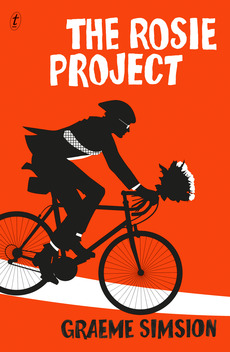
Graeme Simsion, The Rosie project (Review)

Simsion, The Rosie Project

Bookcover (Courtesy: Text Publishing)

While I go to films fairly regularly, I rarely think of adapting books to film when I am reading. However, I was only a few pages into Graeme Simsion’s The Rosie project when it occurred to me that it was perfect film material. The feeling got stronger – and then around a third of the way through the novel I decided to look at the publicity sheet Text Publishing sent with the book. I usually read these sheets after reading the book. Guess what? The Rosie project started as a screenplay and has won a Writers’ Guild Award for Best Romantic Comedy.

This brings me to the other thing that crossed my mind as I read it:  how to categorise it. I’ve now read two books in a row that are a little outside my usual fare. Like the previous one, Anita Heiss’s Paris dreaming, The Rosie project is a romance, but it’s not chicklit and I’m not sure it fits the romance genre as a whole either. You see, the protagonist – as the cover may have told you – is a man, one Professor Don Tillman. As I understand it, romance novels tends to involve a female protagonist and the trials and tribulations she meets en route to true love. Movies have a genre called “romcom” but I’m not sure that term is used for novels. It is, however, the most appropriate description for this novel – because it’s a romance and it’s funny.

Now, I’d better give you a brief outline of the plot. It opens with Don Tillman, a genetics professor, about to give a public lecture on Asperger Syndrome as a favour for his friend Gene (ha!), a psychology professor. In the second paragraph, you start to suspect that Don himself has Asperger’s:

The timing was extremely annoying. The preparation could be time-shared with lunch consumption, but on the designated evening I had scheduled ninety-four minutes to clean my bathroom.

Ninety-FOUR minutes!? The novel continues in this vein with Don admitting to being socially inept, to being routine-driven and focused on efficiency over all else, and so on. He knows all this about himself, but never in the novel is he named as having Asperger Syndrome so I won’t either. However, this description of him provides a good introduction to the novel’s basic premise. Don, nearing 40, wants a wife but, not surprisingly given the way he approaches the world, he hasn’t had much success. He starts the Wife Project and creates a 16-page questionnaire designed to help him eliminate unlikely candidates before he wastes time on getting to know them. In comes 30-year-old Rosie, whom he thinks Gene has sent to him as a candidate. But Rosie, he quickly realises, would fail his questionnaire on the first page. She smokes, works in a bar (and so, he presumes, would fall below the required IQ), is not punctual, dresses unconventionally – you get the picture. Yet, there’s something about Rosie … so, pretty soon, Don offers to help her find who her father is, and thus begins the Father Project, which rather puts on hold the Wife Project.

From here, the novel runs pretty much to a romcom formula. The light tone tells you that it is likely to turn out the way you expect but despite this, the novel engages. This is because, although the plot is formulaic, the characters aren’t. Don is an unlikely hero. He’s aware of his difference and, as the novel progresses, starts to think about whether he can change himself to become more acceptable to people. It’s, dare I say it, poignant – but it’s not saccharine. Don and Rosie are too themselves for that. The novel also has some truly laugh-out-loud scenes. Comedy which involves ridiculing difference can be uncomfortable but again the tone saves it – it’s light and it’s warm. We like Don and our laughter is not so much at his behaviour as at the absurdity of the situations he sometimes finds himself in. I loved, for example, his description of his special treatment by airlines:

As we drank champagne in the lounge, I explained that I had earned special privileges by being particularly vigilant and observant of rules and procedures on previous flights, and by making  a substantial number of helpful suggestions regarding check-in procedures, flight scheduling, pilot training and ways in which security systems might be subverted. I was no longer expected to offer advice, having contributed ‘enough for a lifetime of flying’.

I enjoyed the book. It is a warm, but not stuffily earnest, book about accepting and celebrating difference, about negotiating relationships that accommodate different ways of being. It would make a great film.

Lisa at ANZLitLovers also found it fun.

Graeme Simsion
The Rosie project
Melbourne: Text Publishing, 2013
329pp.
ISBN: 9781922079770

(Review copy supplied by Text Publishing)

Anita Heiss, Paris dreaming (Review)

Anita Heiss Paris Dreaming

Paris Dreaming (used by permission of The Random House Group Ltd)

Late last year I wrote a post about the inaugural Canberra Readers’ Festival. One of the speakers was indigenous Australian author, academic and activist, Anita Heiss. I wrote then that I bought one of her books. It was her fourth (I think) chick lit novel, Paris dreaming. This might surprise regular readers here, as chick lit is not really my sort of thing, however …

There are reasons why I was happy to read this book. First was that my reading group chose it as part of our focus on books featuring Canberra for our city’s centenary year. Yes, I know, it’s called Paris dreaming, but the heroine starts in Canberra and Canberra is mentioned (not always positively I must say) throughout the book. The other reason is the more significant one, though, and that is Heiss’s reason for writing the book. I said in the first paragraph that she is an activist and her chick lit books, surprising though it may sound, are part of her activism. In fact, I think pretty much everything Heiss does has an activist element. In her address at the Canberra Readers’ Festival she described herself, an educated indigenous Australian, as in the top 1% of the bottom 2.5% of Australia. She feels, she said, a responsibility to put her people on the “Australian identity radar”.

Does this book do it, and if so how? Well, one of her points is that 30% or more of indigenous Australians are urban and this book, as its genre suggests, is about young urban indigenous women. Anita Heiss manages I think (though I’m not the target demographic so can’t be sure) to present characters that both young indigenous and non-indigenous women can relate to. Our heroine Libby and her friends are upwardly mobile young professionals. They care about their work; they love fashion, drink and food (this is chick lit remember!); and they wonder how to marry (ha!) their career goals and romance.

Indigenous design vase, on hall table, Governm...

Indigenous art vase, Government House, Canberra

So what’s the plot (besides the obvious chick lit formula which this book certainly follows)? At the start of the novel  30-year-old Libby, manager of the education program at the National Aboriginal Gallery, is on a man-fast. She’s been bitten one too many times and has sworn off men, much to the dismay of her tiddas (her “sisters”). She is, though, keen to develop her career and wants a new challenge – all part of the chick lit formula – and so pitches a proposal to her boss that she mount an exhibition of indigenous Australian art at the Musee du Quai Branly in Paris. Of course, her boss approves and off she goes to Paris where, following the formula, she falls for hunky, sexy Mr Wrong while Mr Right watches on, spurned (and spurned and spurned). But, of course, I don’t need to tell you how it comes out in the end do I? This is not subversive chick lit because that would not serve Heiss’s purpose …

Did I enjoy it? Yes, but not so much as a piece of literature because my reading interests lie elsewhere, but as a work written by a savvy writer with a political purpose. This purpose is not simply to show that young, urban, professional indigenous Australians exist but, as she also said in her address, to create the sort of world she’d like to live in, a world where indigenous Australians are an accepted and respected part of Australian society, not problems and not invisible. She is therefore unashamed about promoting indigenous Australian creators. She names many of them – artists, writers, filmmakers – and discusses some of their work, educating her readers as she goes. Most of the people, works and places she mentions are real but there’s an aspirational element too. The National Aboriginal Gallery does not exist but she presents it as a significant player in the Canberra cultural institution scene. Good for her!

I’ll probably not read another of Heiss’s choc lit (as she, tongue in cheek, calls it) books, but I’m glad to have read this one – and I’ll certainly look out for works by her in other genres (including her memoir Am I black enough for you?). Heiss is a woman to watch.

Anita Heiss
Paris dreaming
Sydney: Bantam, 2011
313pp.
ISBN: 9781741668933

Valeria Luiselli, Faces in the crowd (Review)

Mexican writer Valeria Luiselli’s Faces in the crowd was, as regular readers here might remember, one of my two Bah Humbook virtual gifts from Stu of Winston’s Dad. I ordered it on Christmas Day for my Kindle – after all, it was a Christmas present – and have now read it. Wow, what a read, but how to write about it?

Perhaps I’ll start by quoting something near the end of the novel:

There are people who are capable of recounting their lives as a sequence of events that lead to a destiny. If you give them a pen they write you a horribly boring novel in which each line is there for an ultimate reason: everything links up, there are no loose ends.

This is not such a novel. Things don’t link up, there are loose ends, and it’s both chronological and not. It is in fact a metafictional work. It has the old story-within-a story-within-a-story structure, the self-consciousness about fiction versus reality, all of which could be a bit old hat, except it isn’t. The first person narrator is a somewhat frustrated novelist in Mexico City. She has two children – the boy and the baby – and a husband. To make her novel, an autobiographical one, interesting, she has her husband leave her. (Wish fulfilment? we wonder.) Reading over her shoulder, he says:

Why have you banished me from the novel? What? You wrote that I’d gone to Philadelphia. Why? So something happens.

This fictional husband sometimes takes up the story, telling of his life in Philadelphia and of missing his children. Our narrator reminds us that “it’s only a novel, none of it exists” and says she is writing “A horizontal novel, told vertically”, and then “A vertical novel told horizontally”, and still later “Or a horizontal novel, told vertically. A horizontal vertigo”. Word play, you see! I can imagine the fun the translator had with this – and from what I can tell, she seems to have made a good fist of it because there’s a lot of humour here, humour that is linguistic, verbal, and that requires you to keep your wits about you.

Meanwhile, interspersed with telling the story of her current life in Mexico City and the “fictional” life of her husband in Philadelphia, she tells of her past when she worked in New York City “as a reader and translator in a small publishing house dedicated to rescuing ‘foreign gems'”. There are a few “digs” at Americans in the book and one follows this statement, when she continues, “Noone bought them, though, because in such an insular culture translation is viewed with suspicion!” I can see why Stu, with his love of translated literature, related to this work! This story, the one about her time in NYC, is full of unusual but colourful characters flitting into and out of each other’s lives, houses and beds, all told through little, sometimes interconnecting, vignettes which mostly serve to illustrate the contrariness of existence.

There’s Moby, for example, who “forged and sold rare books that he himself produced on a homemade printing press”. “My husband reads some of this”, our narrator writes, “and asks who Moby is. Nobody I say. Moby is a character.” Is he? Your guess is as good as mine. Suffice it to say that Luiselli plays these games with us from beginning to end, all the while challenging us to consider what is fiction, what is real. Is any of it real, she seems to be asking? She writes, “Writing this is coarse. But reality is even more so.” There are ghosts, blindness, and shadows; people and objects suddenly slip from being substantial to being insubstantial. And gradually our narrator, herself, seems to merge with the obscure Mexican poet, Gilberto Owen, about whom she is writing, while running into (or does she?) other poetic luminaries like Federico Garcia Lorca, William Carlos Williams and Ezra Pound.

There’s a fantastical element to the story, but it’s not the same as Gabriel Garcia Marquez‘s magical realism. It’s more slippery, if that makes any sense at all. While Gabriel Garcia Marquez expects us to comprehend “the magical” as part of it all, Luiselli seems to be saying the opposite, suggesting that perhaps “nothing is”.

This all might sound rather depressing, but it’s not. It is in fact a fun read. And while the novel is, I think, about the challenge of living an artistic life in which the things of the real world threaten to overwhelm the imagination, the final word is positive – albeit ironically so. You’ll have to read it yourself though to find out what that is.

Valeria Luiselli
Faces in the crowd
Translated by Christina MacSweeney
London: Granta Books, 2012
ISBN: 9781847085580 (Kindle ed.)

Frank Moorhouse, Cold light (Review)

As I reached around the two-thirds point in Frank Moorhouse‘s Cold light, the third tome in his Edith trilogy, I wanted to cry out “Enough already”! It’s not that I wasn’t enjoying (most of) it, and it’s not that it’s a bad book, but it does go on – and on. It’s a book, I think, that could do with a severe prune. But perhaps that’s just li’l ol’ novella loving me talking!

For those not familiar with Frank Moorhouse’s Edith Trilogy, a little summation. The first book, Grand days (1993) sees Edith Campbell Berry join the League of Nations as an enthusiastic, idealistic ingénue. She’s “plucky”, as most reviewers point out, which she needs to be because she wants to change the world. It was, as I recollect, a thoroughly engrossing  a thoughtful insight into Europe at that time. The second book, Dark palace (2000), I haven’t read, though it is in the TBR. Embarrassing eh? It won the Miles Franklin Award after Grand days had been controversially rejected for not being, according to the judges’ interpretation of the award conditions, “Australian enough”. Dark palace chronicles the failure of the League and, with it, of the ideal of internationalism. This ideal, or at least her desire to make the world better, is something that Edith still hankers for at the start of Cold light. Unlike the first two novels, which are set in Europe, Cold light is, until the last few chapters, set in Canberra. That of course gave it added interest for me.

The three novels cover the middle half of the twentieth century – from the early 1920s to the early 1970s – with Cold light “doing” 1950 to 1973. Edith must be in her 40s when the novel opens and is well into her 60s by its close. This can be a challenging time of life for a woman and Frank Moorhouse’s exploration of the issues women face – biologically, socially, and intellectually – is sensitively and authentically done. Edith’s challenges are compounded by the fact that she wants to work – in the public sphere – but in 1950s Australia married women, as she was, were not entitled to work for the government. Edith does manage to get around this in various ways, mostly by being employed under honorariums and the like. Not very satisfactory, but better than nothing.

What I most enjoyed about the novel was its coverage of some of the big issues of its time, particularly in relation to Australia: the planning of Canberra which was still in its infancy, the Cold War and the attempts to ban the Communist Party of Australia, and nuclear energy. One way or another, Edith becomes involved in each of these issues and serves as our guide. I particularly liked the discussions about Canberra and what sort of city it should be. Early in the novel it is described as a “toy city”, a “make-believe city”, an “unfinished city”, “a city that is not a city”. Some of those criticisms still hang over it now, though less so I hope. Certainly, Edith begins to warm to it and enthusiastically works for a few years with the Town Planning section. She initially envisions it as a place of “communal memory”, as “the living memory of the nation”. Fifteen years on, as the will-we-won’t-we-will-we-won’t-we artificial lake is finally “opened”, her thinking has moved on. She would like to see Canberra as a “social laboratory”, which would “try out all sorts of ideas for good living”, and as a “place for citizens to ask questions”. Moorhouse’s thorough research into Canberra’s planning shows through here, as it does in the other topics he covers in the book.

I also enjoyed much of his characterisation. The novel has a large cast of characters, so his list of “Who is who in the book” at the end, with the “real” people asterisked, is very useful. But, beware, because if you read Edith’s entry, you’ll find a potential spoiler. The best drawn characters are the fictional ones: Edith, her cross-dressing “lavender husband” Ambrose, and to a less extent her brother and Communist Party official Frederick, and his girl-friend-partner, Janice, for whom Edith has some confused feelings.

Edith is, of course, the focal character. The novel’s voice is third person subjective, that is, it is told through Edith’s eyes, her perspective. And Moorhouse does it well. Edith’s a living, breathing, believable human being – but there’s just too much of her. We spend too long with her questioning and ruminating on just about everything she confronts. She ponders, and wonders, she asks herself multiple questions – and it is all just too much. And yet, and I know I’m being contradictory, she’s an engaging character. But not “plucky”. Surely that’s a bit twee for a professional woman? I’d use the words resourceful and confident. Even when she doesn’t feel confident, she knows how to put on a show. Despite this, by the book’s end, she wonders if she’s “bungled” her life. She wonders, in fact, for many pages, and asks many questions (have I said that before?) in the process. She tries to recast her life as “a journey” rather than as a failure to achieve goals, which seems fair enough to me. She’s most concerned, at this point, with her personal rather than her professional life, and the fact that she’s had three husbands. Alluding to Othello, she concludes:

She had loved not too wisely, nor too well. But she had tried with all her might.

She sure had.

I also enjoyed the themes of the novel. There are many of them, in fact, but the two that interested me most are the failure of idealism and the challenges of aging. As the book draws to a close she wonders:

Perhaps she was wrong to assume that evolution was moving towards some humanistic paradise.

But she still believes that

Safety lay in candour – the open personality in an open society.

And I love her for it.

Finally, I liked the fact that this novel of uncertainties has a very certain end. Moorhouse was clearly determined to end with a bang, not a whimper. Overall though, I would have like some zing, some wit, or alternatively, something to wrench my guts. Instead, it was just a little too laboured for me to feel the “wow” that I’d hoped for. A good read? Yes. An interesting read? Definitely. But a great read? Not quite.

For a thorough and totally positive review, check out Lisa’s at ANZLitLovers.

Frank Moorhouse
Cold light
North Sydney: Vintage Books, 2011
719pp.
ISBN: 9781741661262

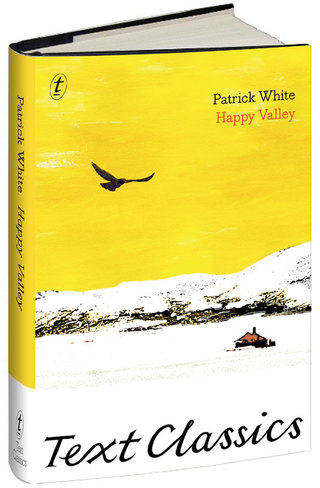
Patrick White, Happy Valley (Review)

Patrick White, Happy Valley

Book cover (Courtesy: Text Publishing)

My love affair with Patrick White, figuratively speaking, began in my last year of high school when I studied Voss. Always partial to Aussie literature, I was, at 17 or 18, bowled over by White’s writing, passion and vision – and by his rather acerbic, though mostly compassionate, view of the way people submerge their “selves” in exterior trappings. I was consequently thrilled when Text decided to publish his first novel as part of its Text Classics series because this book, first published in 1939, was not published again in White’s lifetime. His decision, not his fans, I might add!

Why White refused its republication is a matter of some conjecture. He describes it in his autobiography, Flaws in the glass (1981), as “my first published, best forgotten novel”. Whatever the facts, being published in England and New York in 1939 probably made it easy to “lose”. All I can say is that it’s a great shame, because this is one helluva novel.

But let’s not conjecture, and get on with the book. It’s hard though to know where to start. As a newly released but first Patrick White, it’s going to be (and probably already has, but I’ve kept my eyes averted) the subject of much critical and literary analysis. How, this amateur blogger thinks, can I add to that? By, I suppose, just picking a few things that interested me.

There were several things that interested me in this novel, besides the fact that it is a good read. Perhaps I’d better explain that, the plot, first. It’s set in, yes, a town called Happy Valley, in the Snowy Mountains-Monaro region of New South Wales, just south of where I live and where Patrick White was a jackeroo for a year. If you know Patrick White, you’ll know the town’s name is ironic because White’s people are rarely happy. Life tends to be, for them, disappointing at best, sterile, depressing and/or meaningless at worst. In this book we have a large number of people and families, representing a cross-section of a typical country town: the doctor (Holliday), the teacher (Moriarty), the squatter (Furlow), the storekeepers (Quongs), the banker (Belper), the piano teacher (Alys Browne), the farm worker and “stud” (Clem Hagan), the “simpleton” (Chuffy Chambers). The novel begins and ends with the doctor, but its subject matter is the desire to escape. Many of the town’s residents don’t want to be there, and dream of ways out. Alys dreams of California, Hilda Holliday of Queensland, Sidney Furlow of anywhere-but-here, and so on. For the most part the novel chronicles the relationships between the people, explores the sources of their discontent, and teases them with future possibilities. It seems, until near the end, that nothing particularly dramatic will happen but then a shocking event occurs which precipitates decisions – some big, some small – that will change the lives of those concerned. For the better? Well, that’s a question for us readers to consider, but it’s important to recognise that for White the important decisions/shifts that have to be made are internal. Here is Alys near the end, seeing her escape dream for what it was:

I shall not hurry, she said, I shall shape time with what I have already got.

It’s a good story – and it’s clearly White.  There are a lot of characters, which can be the downfall of first novels, but White handles them well. The connections are clear and he keeps them all moving along so that we readers rarely, if ever, feel lost – once we have them in our heads.

What bowled me over most about the novel though is its style. It’s big – it’s inventive, expressive, rhythmic. As I was reading it, I was reminded of DH Lawrence (and his intense sensuality) and James Joyce (and his “stream of consciousness”). Peter Craven, who wrote the introduction to Text’s edition, agrees, and adds Gertrude Stein (whom I don’t know well enough) and Virginia Woolf (whom I should have picked too!). However, despite these pretty clear influences, the novel doesn’t feel slavish. Although this is (obviously) early in his career, his mature style is already evident. I was impressed by how he moves pretty seamlessly between description, dialogue and interior monologue, by how he shifts point-of-view, even within paragraphs, and by how, almost imperceptibly at times, he changes voice from third to second to first person. It’s spirited, gutsy writing. You feel, sometimes, that’s he’s strutting his stuff, but he rarely loses us and, while he may occasionally push a little too far, it doesn’t feel like showing-off but more like a writer with ideas bubbling out of him.

Earlier in the review, I mentioned writers that I felt influenced White, but now I want to mention one that I think was influenced by him, and that’s Thea Astley. She also had a pretty acerbic view of the world, and could skewer characters for their superficiality while maintaining, unless they really didn’t deserve it, compassion for them. White and Astley also use humour, usually wry or satiric rather than belly-laugh. I loved this description of a person in a bar early in the novel:

But another was an old man, one of those static old men you see in country bars, who seem to have no significance at all, except as recipients of drinks that they pour in through the meshes of a yellowish moustache, just standing and nodding, willing to listen to a story, but never giving much in return. They are generally called Abe or Joe. Though this one was called Barney, as a matter of fact.

That made me laugh; it’s the sort of writing that made me keep reading. But it’s not all quite this benign, because Happy Valley is a town where there “never was co-operation”, where “people existed in spite of each other”, where town “stud” Clem would like to “take a lump of wood, treat her almost like a snake”.

One of the threads running through the novel concerns the limits of language to express true feeling:

Both of them wanting to say something and then it only came in words.

White, I understand, would love to have been an artist, calling himself a “painter manque”, but oh dear, what words we would have missed had he done so.

Lisa of ANZ Litlovers, also a Patrick White fan, loved the book too.

Patrick White
Happy Valley
Melbourne: Text Publishing, 2012 (orig. published 1939)
407pp
ISBN: 9781921922916

(Review copy courtesy Text Publishing)

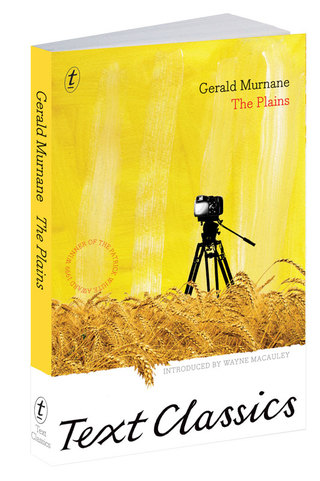
Gerald Murnane, The plains (Review)

Gerald Murnane, The Plains, bookcover

Bookcover (Courtesy: Text Publishing)

Wayne Macauley, he of the Most Underrated Book Award fame, wrote in his introduction to my edition of Gerald Murnane‘s The plains that “you might not know where Murnane is taking you but you can’t help being taken”. That’s a perfect description of my experience of reading this now classic novella. It was like confronting a chimera – the lower case one, not the upper case – or, perhaps, a mirage. The more I read and felt I was getting close, the more it seemed to slip from my grasp, but it was worth the ride.

The plains was first published in 1982, which is, really, a generation ago. Australia had a conservative government. We still suffered from cultural cringe and also still felt that the outback defined us. All this may help explain the novel, but then again, it may not. However, as paradoxes and contradictions are part of the novel’s style, I make no apologies for that statement.

I’m not going to try to describe the plot, because it barely has one. It also has no named characters. However, it does have a loose sort of story, which revolves around the narrator who, at the start of the novel, is a young man who journeys to “the plains” in order to make a film. It doesn’t really spoil the non-existent plot to say he never does make the film. He does, however, acquire a patron – one of the wealthy landowners – who supports him in his endeavour over the next couple of decades. It is probably one of Murnane’s little ironies that our filmmaker spends more time writing. He says near the end:

For these men were confident that the more I strove to depict even one distinctive landscape – one arrangement of light and surfaces to suggest a moment on some plain I was sure of – the more I would lose myself in the manifold ways of words with no known plains behind them.

Hang onto that idea of sureness or certainty.

The book has a mythic feel to it, partly because of the lack of character names and the vagueness regarding place – we are somewhere in “Inner Australia” – and partly because of the philosophical, though by no means dry, tone. In fact, rather than being dry, the novel is rather humorous, if you are open to it. Some of this humour comes from a sense of the absurd that accompanies the novel, some from actual scenes, and some from the often paradoxical mind-bending ideas explored.

So, what is the novel about? Well, there’s the challenge, but I’ll start with the epigraph which comes from Australian explorer Thomas Mitchell‘s Three expeditions into the interior of eastern Australia, “We had at length discovered a country ready for the immediate reception of civilised man …”. Bound up in this epigraph are three notions – “interior”, “country” and “civilised”. These, in their multiple meanings, underpin the novel.

Take “interior”. Our narrator’s film is to be called The Interior. It is about “the interior” of the country, the plains, but it is also about the interior, the self, and how we define ourselves. While there are no named characters, there are people on the plains and there’s a sense of sophisticated thinking going on. Some plainspeople want to define the plains – their country, the interior – while others prefer to see them almost as undefinable, or “boundless”, as extending beyond what they can see or know. The plainspeople are “civilised” in the sense that they have their own artists, writers, philosophers, but it is hard for we readers to grasp just what this “civilisation” does for them. Is it a positive force? Does it make life better? “Civilised”, of course, has multiple meanings and as we read the novel we wonder just what sort of civilisation has ensconced itself on the plains.

These concepts frame the big picture but, as I was reading, I was confronted by idea after idea. My notes are peppered with jottings such as “tyranny of distance” and boundless landscapes; cultural cringe; exploration and yearning; portrait of the artist; time; history and its arbitrariness; illusion versus reality. These, and the myriad other ideas thrown up at us, are all worthy of discussion but if I engaged with them all my post would end up being longer than the novella, so I’ll just look at the issue of history, illusion and reality.

Towards the end of the novel we learn that our narrator’s patron likes to create “scenes”, something like living tableaux in which he assembles “men and women from the throng of guests in poses and attitudes of his own choosing and then taking photographs”. What is fascinating about this is the narrator’s ruminations on the later use of these “tedious tableaux” which have been created by a man who, in fact, admits he does not like “the art of photography”, doesn’t believe that photographs can represent the “visible world”. The landowner contrives the photos, placing people in groupings, asking them to look in certain directions. Our narrator says

There was no gross falsification of the events of the day. But all the collections of prints seemed meant to confuse, if not the few people who asked to ‘look at themselves’ afterwards, then perhaps the people who might come across the photographs years later, in their search for the earliest evidence that certain lives would proceed as they had in fact proceeded.

In other words, while the photos might document things that happened they don’t really represent the reality of the day, who spent time with whom, who was interested in whom and what. They might in fact give rise to a sense of certainty about life on the plains that is tenuous at best.

Much of the novel explores the idea of certainty and the sense that it is, perhaps, founded upon something very unstable. Murnane’s plainspeople tend to be more interested in possibilities rather than certainties. For them possibilities, once made concrete, are no longer of interest. It is in this vein that our narrator’s landowner suggests that darkness – which, when you think about it, represents infinite possibility – is the only reality.

The plains could be seen as the perfect novel for readers, because you can, within reason, pretty much make of it what you will. If this appeals to you, I recommend you read it. If it doesn’t, Murnane may not be the writer for you.

Lisa at ANZLitLovers, a Murnane fan, has reviewed The plains

Gerald Murnane
The plains
Melbourne: Text Publishing, 2012 (orig. published 1982)
174pp.
ISBN: 9781921922275

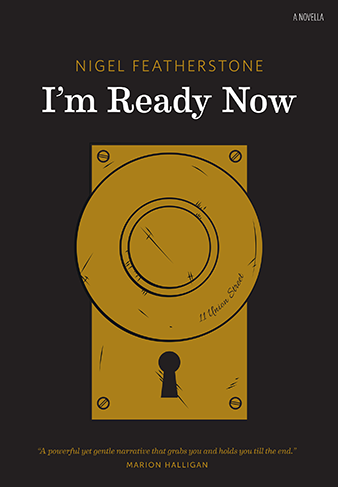
Nigel Featherstone, I’m ready now (Review)

Featherston, I'm ready now, book cover

Book cover (Courtesy: Blemish Press)

Way back in my youth when I started studying literature, I thought I had to get the “right” interpretation. It made reading a little scary, I must say. However, as I gained confidence, I discovered that there are as many responses to a novel as there are readers, something I was reminded of when I attended this week’s launch of Nigel Featherstone’s novella, I’m ready now. And here’s why…

The book was launched by Canberra journalist and biographer, Chris Wallace. She spoke eloquently about the book telling us that it’s about how you can make a change in your life no matter how old you are – whether you’re 30 as Gordon is in the book or 50 as his mother, Lynne, is. She said too that it promotes the idea of living an imaginative life. I thought, yes, she’s right, it does do these things. And then Nigel spoke, and he said that for him the book can be summed up in one word, liberation. And I thought, yes, I can see how it’s that. But I had framed it a little differently from my reading.

Before I give you my different-but-on-a-similar-track take, I’d better tell you something about the plot. It has a small cast of characters, which is pretty much what you’d expect in a novella. They are Gordon, a gay man turning 30 who lives in Glebe and works as a photographer; his old schoolfriend Shanie, who followed Gordon to Sydney; Levi, Gordon’s boyfriend of a year or so; and Gordon’s mother Lynne who, recently widowed, comes up from Hobart to stay with Gordon for a short while. Lynne has put the large family home on the market, and the auction will be held while she’s away. Meanwhile, Gordon is almost at the end of his Year of Living Ridiculously, which is a year of rather self-destructive high living that he designed, and is doggedly keeping to, for his 30th year. He plans to crown this year with something he calls The Ultimate. But then Mum, Lynne, arrives, and puts The Ultimate at risk. What Gordon doesn’t know is that his mother has a grand plan herself, now that she’s free. (Ha! Liberation you see.)

This sounds pretty simple, really, doesn’t it? However, there are complications. Lynne’s husband, Eddie, was not Gordon’s father. Gordon’s father, Patric Finn, walked out on him and his mum when he was around a year old, and neither has completely resolved the abandonment. It’s not that Eddie wasn’t a good husband and father, because he was, but he never fully understood Gordon, and for Lynne he was “a head kind of love, not a heart kind of love”.

What is lovely about Featherstone’s writing – as I also found in his Fall on me – is that he manages to build tension and mystery around his characters’ behaviour without undermining their realness or humanity, and without alienating us readers. We warm to them even while we wonder about the wisdom of their decisions and motivations. Featherstone also uses imagery and allusions lightly. Water, for example, can be a cliched symbol in stories of change and growth, but here it’s appropriate and not laboured. What more logical thing is there to do on a hot night in Sydney than to go for a dip in the sea?

Besides the characterisation, I also like the novella’s voice and structure. It’s told first person in the alternating voices of Lynne and Gordon, and is effectively paced, largely through varying the length of the chapters*. The book opens with a mere half-page chapter in Lynne’s voice, and then moves to mostly longer ones in the main part of the book. They shorten towards the end as the pace builds, keeping us involved and wondering what these two will finally decide to do and what role Shanie and Levi might play in it all.

Now though to how I would describe the novel – and for me it is about coming to terms with the past. Both Gordon and Lynne have not had unhappy lives but both have in some way been damaged by their abandonment. Almost half way through the novel, they both say something significant. Lynne, reflecting with real generosity on Patric’s unheralded departure, says

I think he wanted to be free, a free young man. There have been times – many times – when I’ve found myself actually admiring his audacity to grab life, to run with it, to run as far as he could.

She then tells us that her plan is to leave Australia to live in “a farmhouse on a hill in the beloved country [Ireland] of my mother”. In the next chapter, Gordon’s, we learn in a flashback why he commenced his Year of Living Ridiculously. It’s to discover “what it is that makes me feel most alive”. He wants to “to lean over the cliff, figuratively speaking … to live as vividly as possible” – but his chosen method is clearly not working. The idea, though, reminded me of Fall on me in which the son tells his dad that “safety doesn’t always equal life”. Both these novellas, in a way, explore what Wallace described as “living an imaginative life”.

They are both, too, about something Lynne says towards the end, which is that “life must move forward; anything else is sacrilege”, and yet, paradoxically, her wish for Gordon could be seen to be the opposite: she wants him to go back to find what “hurt him all those years ago”.

And so for me, the book is about “living imaginatively” and about liberation, but it is also about how the past can stall us if we don’t get it in the right perspective. Featherstone opens the book with two epigraphs, one being TS Eliot’s “Home is where one starts from”.  I think that, in a way, says it all.

Nigel Featherstone
I’m ready now
Canberra: Blemish Books, 2012
156pp.
ISBN: 9780980755688

(Review copy supplied by Blemish Books)

* for want of a better word for the numbered parts.

Kate Grenville, The lieutenant (Review)

Kate Grenville, The lieutenant book cover

Bookcover (Courtesy: Text Publishing)

I first came across William Dawes, the inspiration for Kate Grenville’s The lieutenant, in Inga Clendinnen’s award-winning history, Dancing with strangers (2003). But this is not the only book that Grenville’s novel brought to mind, as it also reminded me of Kim Scott’s That deadman dance. (Intriguing that both these books use a dance motif, but it’s an historically valid one).

However, before I talk more about these connections and their relevance, I should briefly describe the plot. The novel is set during the first years of the white settlement of Australia. (The very fact that I write the “white” settlement says something about how far we have come in the last two centuries, though we still have some way to go). Daniel Rooke, the protagonist, is a young astronomer. He has been chosen for the First Fleet on the recommendation of the Astronomer Royal who believes that a significant comet will appear in the southern hemisphere in late 1788-early 1789. With this role in mind, Rooke manages to largely separate himself from the day-to-day hurly burly of the first year or two of settlement by creating an observatory, of sorts, for himself, on a hill (now called Dawes Point) overlooking Sydney Cove. Here, in his isolation, he is visited by a group of indigenous people, mostly women and children, and develops a particular relationship with the young 12-13 year old girl, Tagaran. They learn each other’s language, which Rooke chronicles in his journals. All this generally reflects the story of William Dawes whose journals Grenville (and Clendinnen) read, but, as Grenville writes in her author’s note:

Although I made use of historical sources, I departed from them in various ways. This is a novel; it should not be mistaken for history.

Meanwhile, back in 2003, Clendinnen wrote of Dawes, bemoaning his earlier-than-wished-for departure from the colony:

His departure cost us access to the local language as it was spoken at the time of contact. It possibly also cost us a brilliant ethnography, although his tender conscience  might not have allowed him to open the people to easier communication, and to more disruptive exploitation.

Grenville does a good job of imagining the Dawes described by Clendinnen as an “introspective, scholarly type” in her characterisation of Daniel Rooke. She introduces him as a socially awkward but sensitive and thoughtful young man who joined the military not for love of war but because it provided the best chance for a poor young man to make a life for himself. From this supposition she develops a credible character whose final actions in the book pretty closely mirror what we know of Dawes.

I will leave Rooke here for a moment, though, to talk a little more about the conjunction between the three books I mentioned in my introductory paragraph. The significant point they all make is what Clendinnen calls “acts of kindness” by the indigenous Australians in the early days of settlement (in the east, in the case of Grenville and Clendinnen, and the west in the case of Scott). All three writers describe a willingness to be generous that was not recognised or accepted by the colonial invaders. Now, I know that here I am speaking of history and fiction in the one breath and I know that, as Grenville wrote, novels should not be mistaken for history. However, modern readers can, I think, glean the truths, regardless of form or genre, if the writers provide the appopriate signposts.

Take The lieutenant. In it, Grenville is still smarting I think from the criticism she received from historians regarding her claims about the historical value of The secret river. The book contains many rather sly allusions to facts, reality and truths. I particularly liked Rooke’s contemplation about the value of his journals in which, as well as documenting the language he was learning, he described his interactions with indigenous Australians, telling stories that actually happened but whose meaning, he discovered, could be distorted. He considers omitting all but the dry documenting of language, but then realises:

Making an expurgated version of the notebooks would kill them. Like a stuffed parrot, they would be real, but not true.

With a little sleight of hand, Grenville uses a fictional character and his fictional journal to talk about the use of historical sources and the telling of stories from them. Do you simply present the “facts” or do you tell a story –  either factual as in history or fictional as in novels – from those facts in which you aim to draw out the truths as best you see them. Am I drawing too long a bow? I don’t think I am.

And so, as you can probably tell, I enjoyed the novel. It suffers from a little earnestness in tone but that doesn’t get too much in the way of a good story about how first contact in the first settlement played out. It’s not the only story about first contact but it is a valid one – and it helps us understand how an all too human inability to walk in the shoes of the other resulted in a catastrophe of major proportions that we are still working through today.

Kate Grenville
The lieutenant
Melbourne: Text Publishing, 2008
307pp.
ISBN: 9781921656767

(Review copy supplied by Text Publishing. An unsolicited review copy received in 2010 so I’m afraid I’ve taken my time to get to it.)