Nigel Featherstone, The beach volcano (Review)

Courtesy: Blemish Books

Courtesy: Blemish Books

Back in 2010, Featherstone spent a month, on a writer’s retreat, at Kingsbridge Gatekeeper’s in Cataract Gorge, Launceston. He writes on his blog that he left Launceston with sketches for three novellas. The beach volcano is the last of these, the other two being Fall on me (my review) and I’m ready now (my review). Before I talk about the novella, though, I must compliment Blemish Books on the production of these three books. They are gorgeous – they have appealing, stylish cover designs; they are a perfect size, fall open easily and have lovely, clear print; and together they look like a set. Well done Blemish, I say.

Now, to the book itself. Featherstone has appeared a few times on this blog, via my reviews of the first two novellas, a guest post in 2012, and a five-part interview that I ran over the summer of 2012-2013 when the magazine it was destined for, Wet Ink, folded. Through all of these, one particular idea or theme has been consistent – and it is, as he formally stated in his guest post, that “family is the guts of the contemporary Australian story”. He mentioned several writers, such as Kate Grenville, Craig Silvey and Gillian Mears, for whom this is clearly true, and then turned to his own work:

My main characters are usually men and women (always a good start!) who have children, who want to be parents, who struggle to cope, who feel the pressure of internal and external expectation, who fail and fall into a heap but pat themselves down and have another crack at it.

And so, Fall on me centres on father and teenage son, Lou and Luke, while I’m ready now is about a fifty-something mother and thirty-year old son. In The beach volcano, we’ve moved on again in age. The father here is 80 years old, and the son 44. I’m not sure whether this age progression drove the order in which the books have been published, but it does have a certain neatness. Luke, the teenager in the first book, is pretty wise for his age but he is still a young man sorting out his identity and his separation from his father. Thirty-year-old Gordon, on the other hand, is confronting turning 30 and, not comfortable with what this implies, embarks on a risky “Year of living ridiculously”. This brings us to 44-year-old Canning (aka successful rock musician Mick Dark) who has returned home for the first time since he was 17 to celebrate his father’s 80th birthday. He has come primarily because he wants to discover the “full” truth about a story told to him by his aunt, the estranged sister of his father. I should add here, in case I’ve given the wrong impression, that the first two books don’t focus solely on the son, whereas The beach volcano is very definitely Canning’s story.

The thing about Featherstone’s books – at least these three – is that there’s potential in each for high drama, or, to put it more crudely, for violence and/or death. But, Featherstone is not a writer of crime or thrillers. He’s interested in family and human relationships, and so, while dramatic things happen, the drama never takes over the story. In The beach volcano, terrible things involving abuse of boys by men have happened before the novel starts. They resulted in family secrets to do with a false alibi – and who knows what else, we wonder as we read. This is what Canning has come home to discover.

The story is told, first person, through a traditional linear narrative, with flashbacks to fill us in on relevant background. It starts with Canning’s arrival on Friday, late, for the pre-birthday dinner for the immediate family, and continues to the end of the weekend when all has been revealed, to Canning at least, and he is able to make some decisions about where to from here. Throughout the weekend, Canning has one-on-one conversations with different members of his family, his parents, his two older sisters, a brother-in-law, and a nephew. We to-and-fro between love and hate, welcome and aggression, as this family tries to keep conflict at bay, while threatened by a secret that they refuse to openly confront. Family secrets, gotta love them! But, Canning wants truthful relationships with his family now:

I’d come to Sydney to tell the truth, but it was important to be selective about the truth, and to have good timing in the telling, to be cautious. Because the truth, I thought, was a disturbance. The truth took things apart and put them back together in a different but better shape. But what exactly was a better shape?

This is the question Canning needs to answer, and is why he bides his time. He needs (and wants) the truth to be a positive force, not a destructive or simply life-sustaining one.

Featherstone’s language is clear and evocative, with lovely descriptions of coastal Sydney and realistic dialogue. Canning’s voice feels genuine, if a little inclined at times to over-explain. The “beach volcano” of the title works on both the literal level as an activity that Canning and his father share, and that he then wants to pass onto to his newly-met nephew, and as a metaphor for simmering tensions that threaten to erupt. You’ll have to read the book though if you want to know what erupts and how. It is, in its measured way, quite the page-turner.

In a sense, this is a reworking of the prodigal son story, except that in this version the son returns as a success and is, perhaps, the one who extends the greatest generosity. Like the original, it is about love and acceptance, but has the added theme – one that Featherstone explores in the three novellas – of the need to face the past before you can truly progress into your future.

The beach volcano makes a fitting conclusion to Featherstone’s novella set. I have enjoyed the time I’ve spent with his unique but real families and look forward to seeing what he comes up with next.

Nigel Featherstone
The beach volcano
Canberra: Blemish Books, 2014
140pp
ISBN: 9780980755695

(Review copy courtesy Blemish Books)

Ouyang Yu, Diary of a naked official (Review)

Ouyang Yu, Diary of a Naked Official

Courtesy: Transit Lounge

When I was offered Chinese-born Australian writer Ouyang Yu’s latest novel Diary of a naked official to review, I was warned that it is rather graphic. And so it turned out to be, but, not having read Ouyang Yu before, I did want to give it a go. The accompanying publicity sheet describes it as “Ouyang Yu’s most commercial novel to date – erotic fiction set in contemporary China”. So now you, my blog readers, have also been warned.

Where to start? Perhaps with the title. Not being an expert on Chinese culture, I wouldn’t have fully understood the title if it hadn’t been for the back cover. It explains that “naked official” is a recognised term in China describing men who locate their wives and children overseas, where they also deposit all their money. The men remain in China “naked” and, in this case at least, “totally free” to indulge in whatever they desire – which brings me to the subject matter of this novel …

The main part of the novel comprises diary entries written by our naked official (who may be named Shi Ma and so that’s what I’ll call him) over a period of three months*. In it he details a life driven by satisfying carnal pleasures with no desire (ha) to rein them in. He is so focused on “enjoying” other women – young, beautiful ones – through pretty much any act you could imagine and then some, that he has no time or energy for intimacy with his wife, who does not move to Australia until halfway through the novel. “Sex”, he says early in his diary, is “a keyword of our times, it is like a poisoned liquid that seeps into the minds of everyone, including women”. (Including women, eh! How gender plays out in the novel, in fact, could occupy a whole post).

Framing the diary is the encompassing conceit that the story is presented to us by a writer, who is probably Chinese-Australian and who had found the diary on a USB stick left on a Melbourne train. He decides to present it in its entirety “with a bit of editing here and there, just to make it less offensive to the middle-class sensitivities in this country”. He warns his readers, just as I have, to be prepared for an assault on their “moral values”.

As you have probably gathered by now, this is a clever, complex and rather slippery book. I say slippery because it looks like it’s a critique (or satire) of modern China, of a world where obsession with sex and fast adoption of capitalism collide, and where increasing independence for women sees “concubine” become “working girl” with different expectations. But, when you comprehend that the character “publishing” this diary is based in Australia – and that writer-translator Ouyang Yu spends his life between Australia and China – you see that this is no simple tale. This is not to suggest that the book is autobiographical but rather that, through these layers, Yu plays with our minds, and forces us to recognise that Australia and China have more in common than we may think.

The layers are complicated further by the fact that Shi Ma himself works in a publishing house. His job is to recommend works to his boss, B, for publication. B, though, rarely agrees with him. Our narrator says:

But it is books that speak the honest truth to a hurting degree that are denied the chance of publication because the comfort zone is outstepped and our core values are challenged.

And so, Shi Ma, whose life of self-centred debauchery alienates us, also draws us in with his desire to publish difficult or confronting works. Publishing now, he says, “is dictated by MM, money and market through B, Banker of Books”. At one point, he considers whether a particular erotic book

might be considered for publication if not recommended outright. In today’s China, things are much more confronting, and much more physically permissive than a decade or so back as it is good for the economy … Still, I am not sure because B may object on the basis of market and censorship.

Censorship in China is one issue, but western readers are only too aware that publishing in so-called “free” countries is by no means free of the impact of the market. Shi Ma is pretty devastating in his comment on publishing:

In the scheme of things, an excellent book, by the time it is edited and published, becomes a good book, and a good book, a so-so book. It is amazing how a so-so book can sell, such as the one penned by the guy called Hung Heavens, but I have ceased to be amazed by the mediocrities as the world is made for them, books written by the mediocre for the mediocre, like common food, eaten only to be shat.

In another interesting layer, Shi Ma is given the job of assessing applications for “self-funded poetry”. Ouyang Yu, himself, is a poet and clearly knows only too well how difficult it is to get poetry published.

I have, I know, digressed somewhat, because the examination of publishing is only one aspect of this novel, and I probably haven’t given you much sense of its actual narrative. The novel does have a story, albeit a flimsy one based around sexual exploits. There are recurring characters, including the aforementioned B, a mother and daughter with whom Shi Ma has a complicated relationship, his friend Sam, and various working girls. However, while Shi Ma, himself, does develop to some degree – becoming “absolutely bored with a multitudinous accumulation of bodies” – none of the other characters are “developed” or even “rounded” in the usual way of fiction, because this is not a traditional novel. It is, rather, what I’d call an “ideas novel” that explores not only what is happening in modern China but also, more generally, what a sex-focussed, market-driven world looks like. And it ain’t pretty. Human relationships and original artistic expression are measured by money, and such values as love and morality are degraded in the wake.

Diary of a naked official is a book that shocks and appalls, but that can also surprise and even make us laugh. In it, Ouyang Yu, unlike B, is not afraid to expose “the night in our hearts”. Shi Ma is not a sympathetic character and yet, at times, he makes sense. There are no easy answers, and this book certainly doesn’t provide any. It does, however, ask some very pointed questions.

Ouyang Yu
Diary of a naked official
Melbourne: Transit Lounge, 2014
220pp.
ISBN: 9781921924705

(Review copy supplied by Transit Lounge)

* In an interview I heard with Ouyang Yu, he pointed out that the diary starts on 4 June (the Tiananmen Square date) and ends on 11 September (9-11 in other words). More layers, you see …

Roslyn Russell, Maria returns: Barbados to Mansfield Park (Review)

A week or so ago my local Jane Austen group had a guest speaker at our meeting, Roslyn Russell, the author of Maria returns: Barbados to Mansfield Park. Russell is a local historian who has written this historical novel based on Jane Austen’s novel, Mansfield Park. She is also a lapsed member of our group, so of course we had to ask her to come and talk to us about it. Most of this post draws from my report of her talk, which she titled Maria returns: Barbados to Mansfield Park: Fictionalising the legacy of slavery in Mansfield Park.

Regular readers probably know that I’m not a fan of fan-fiction or sequels of well-known works. In fact, I probably wouldn’t have read any if it hadn’t been for belonging to the Jane Austen Society of Australia. However, having read Deidre Shauna Lynch’s essay, “Sequels” in Jane Austen in context, edited by Janet Todd, I decided that I should relax my “rule”. Lynch convinced me that these books are an important part of our understanding of Austen as a literary and cultural icon. Consequently, I have now read PD James’ crime novel Death comes to Pemberley (my review) and Jo Baker’s Longbourn (my review). Roslyn Russell’s historical novel is my third. In it, she imagines that some ten years after being banished to the country, and upon the death of her companion Aunt Norris, Maria Bertram goes to Barbados and learns about slavery and the abolition movement.

There are, I’m gathering, many different reasons why writers want to write sequels or fan fiction works. For Russell, it was, as she writes in her author’s note, inspired by two passions: her love of Jane Austen and of Barbados. Barbados? How many Australians have been to, let alone developed a passion for, Barbados? Not many, I expect. It was her museum work, in fact, which took Russell to Barbados and there, its history – and particularly the history of its plantations and the practice of slavery – reminded her of Jane Austen’s Mansfield Park in which the leading family, the Bertrams, draw their prime income from their plantation in Antigua.

Jane Austen, Mansfield Park and Slavery

Russell commenced by telling us that although most of the characters in her novel are fictional, some are based on real people. Before discussing this further, however, she read the excerpt from Mansfield Park which contains the only reference to slavery:

“But I do talk to him more than I used. I am sure I do. Did not you hear me ask him about the slave–trade last night?”

“I did—and was in hopes the question would be followed up by others. It would have pleased your uncle to be inquired of farther.”

“And I longed to do it—but there was such a dead silence! And while my cousins were sitting by without speaking a word, or seeming at all interested in the subject, I did not like— I thought it would appear as if I wanted to set myself off at their expense, by shewing a curiosity and pleasure in his information which he must wish his own daughters to feel.” (MP)

She noted that this shows Maria and Julia’s lack of interest in the source of their family’s income. She then referred to cultural theorist Edward Said’s discussion of the novel and his statement that it is not appropriate “to expect Jane Austen to treat slavery with anything like the passion of an abolitionist or a newly liberated slave”. Said, she told us, did not apply 21st century attitudes to his assessment of Austen, but suggested that her work, as that of an author who belonged to a slave-owning society, should be analysed in context and in terms of what she does and doesn’t say rather than simply attacked as being complicit.

Ros then briefly outlined some of Austen’s known or probable connections with plantations:

  • the family’s close relationship with her father’s friend, the plantocrat James Langford Nibbs who was also Austen brother’s godfather. Nibbs apparently took his son out to his plantations in Antigua to settle down his unruly behaviour, which rather mirrors Sir Thomas’ taking Tom out to his plantation.
  • Austen’s aunt-by-marriage, Jane Leigh-Perrot, who was born in Barbados, though went to school in England.
  • Mrs Skeet who is mentioned in Austen’s letters. Skeet is a common name in Barbados, suggesting she had a connection to slavery*.
  • the Holder family of Ashe Park, also friends of the Austens. Holder, too, is a common name in the Caribbean.

The title Mansfield Park, itself, could also reflect Austen’s awareness of the slavery issue, as it may have been inspired by Lord Mansfield who was famous for adjudications which contributed significantly to the eventual abolition of the slave trade. (This is the Lord Mansfield who became guardian of his mulatto niece Dido, fictionalised in the recent film, Belle).

Barbados and Maria Returns

Russell then turned to her own book, first addressing the question of why she had set it in Barbados and not Antigua, where the Bertrams’ plantation was. Firstly, she has been to Barbados several times and knows its history. She couldn’t, she said, write about a place she didn’t know. Secondly, Barbados is also the location of a historical event she uses in her novel.

Mansfield Park was written 20 years before emancipation (i.e. the formal abolition of slavery) in 1834. Maria Returns is set about 15 years after MP, and so during the time when the abolition movement was becoming more vocal. Ros explained that the abolition of the slave trade in 1807 did not seriously affect the Caribbean plantations: they were “breeding” their own slaves and were essentially self-sufficient. However, the abolition of slavery represented a major threat to their livelihoods, and the plantation families were deeply concerned. By the 1820s the abolition movement was becoming active – mostly among Evangelical Anglicans, Methodists and Quakers.

Ros discussed the historical basis of her fiction. For example, at the dinner party in the English village where Maria first meets abolitionist John Simpson, he talks of a trial in Barbados in which slaves were apparently unjustly convicted of and executed for a murder. This trial did occur and is a reason Russell chose Barbados for her setting. The trial was witnessed by James Stephen** who, though he lived a little earlier than our fictional Simpson, is Russell’s model for her character.

Simpson also talks at this dinner about a slave rebellion, led by African-slave Bussa, that occurred in Barbados in 1816. Bussa was killed in the rebellion. Such slave rebellions resulted in plantation owners becoming harsher. Simpson makes it clear which side he is on. This is a wake up call for Maria who:

had not been aware of the strength of feeling in the wider community against the institution of slavery, from which her own family had benefitted so materially. (MR)

After Maria arrives in Bridgetown she meets or hears of other abolitionists, such as the historically real free coloured man, Sam Prescod (who, with Bussa, is now a national hero) and plantation owner Josiah Thompson. Thompson is fictional but, as a former owner who had downsized his estate and treated his slaves-now-servants well, he has historical antecedents. Men who behaved like he did faced hostility from other Barbadians – and so, in the novel, Thompson is a lonely man who is keen to host Maria and her friends at his home. His willingness to import a teacher from England to teach his slaves also has precedents. Maria realises again that she’d never wondered about her father’s plantations, but she begins now to wonder what her father might think about the people she’s meeting.

Ros then spoke about the treatment of slave women by their white owners, particularly in relation to sexual predation. This forms an important part of the story – but I won’t spoil it here. However, she again spoke of historical precedents – not that we really needed any for this one!  We weren’t, though, quite prepared for the example she gave us, one Thomas Thistlewood who kept a diary of his plantation life. Wikipedia confirms what Ros told us: his diary chronicled “3,852 acts of sexual intercourse and/or rape with 138 women, nearly all of whom were black slaves”.

Roslyn Russell, Maria Returns Ros illustrated her talk with some wonderful illustrations, including the painting used on the cover of her book, Agostino Brunias’ The Barbadoes Mulatto Girl. She also mentioned some of the sources she used in her research, like Andrea Stuart’s Sugar in the blood: A family’s story of slavery and empire.

So, the novel

I enjoyed the read. It is pretty much genre historical fiction rather than literary fiction, so not my usual fare. Russell doesn’t try to emulate Austen, and while her writing is clear, her dialogue can be a little too formal and uniform at times. She includes a lot of information about life at the time, information that Austen herself would not have needed to, and indeed did not, supply. But, of course, this is historical fiction, and modern audiences need background that Austen’s contemporaries didn’t.

Russell spins a credible story, both in terms of the plot she creates and how she develops the characters she draws from Mansfield Park. Maria does change significantly, but Russell convinces us that she could. However, this is historical, romantic fiction, not a fierce novel, so Russell’s more culpable characters, in particular Bertram father and son, are let off more lightly than they deserve. This perhaps mirrors the political reality: after emancipation, the Caribbean plantation owners received in total £20 million compensation, while the slaves received nothing.

What did Austen know and feel about slavery? We’re unlikely to ever know, but in Maria returns Russell has given us some insight into the darker side of life that Austen only hints at.

* Names that are common in slave areas are usually so because slaves tended to take on the surnames of their masters.

** Wikipedia tells that Stephen was great-grandfather of Virginia Woolf.

awwchallenge2014

Roslyn Russell
Maria returns: Barbados to Mansfield Park
Flynn: Bobby Graham Publishers, 2014
(Kindle ed.)

Tara June Winch, Swallow the air (Review for Indigenous Literature Week)

Tara June Winch

Tara June Winch (Courtesy: Friend of subject, via Wikipedia, using CC-BY-SA 3.0)

Tara June Winch’s Swallow the air is another book that has been languishing too long on my TBR pile, though not as long as Sara Dowse’s Schemetime. For Swallow the air, it was a case of third time lucky, because this was the third year I planned to read it for ANZLitLovers Indigenous Literature Week. Like the proverbial boomerang, it kept coming back, saying “pick me!” Finally, I did.

Winner of the 2004 David Unaipon Award for unpublished indigenous writers, Swallow the air made quite a splash when it was published in 2006, winning or being shortlisted for many of Australia’s major literary awards. (See Tara June Winch’s Wikipedia entry). I believe Winch is working on another novel, but it hasn’t appeared yet.

Now, though, to the book. The first thing to confront the reader is its form. It looks and even reads a little like a collection of short stories*, but it can be read as a novella. There is a narrative trajectory that takes us from the devastating death of narrator May Gibson’s mother, when May was around 9 years old, to when she’s around 15 years old and has made some sense of her self, her past, her people. May’s mother is Wiradjuri, her father English. At the novel’s opening, she is living in coastal Wollongong, which is not her mother’s country, in a single-parent household with her mother and her brother, Billy, who has a different and indigenous father. Absent fathers are, I should say, disproportionately common in indigenous families.

In fact, one of the impressive things about this debut novel is how subtly, but clearly, Winch weaves through it many of the issues facing indigenous people and communities. Poverty, loss of connection to country, the stolen generations, mining and land rights, alcoholism, drug addiction, racism, rape, child abuse by the church, imprisonment and the tent embassy are among the concerns she touches on during May’s journey. Listing them here makes it sound like a political “ideas” novel but, while Swallow the air is “political” in the way that most indigenous writing can’t help but be, its centre is a searching heart, for May has been cast adrift by the suicide of her mother. Life, which was tenuous anyhow, becomes impossible to hold together as her brother and aunt, both loving, struggle with their own pain.

This is where I become a little uncomfortable as a non-indigenous person making a generalisation about indigenous literature, but I’m going to do it anyhow, because I think I’m on firm ground. I’m talking about story-telling and what I understand to be its intrinsic role in indigenous culture. It imparts – or can do – a different flavour to the writing. Marie Munkara’s David Unaipon Award winning Every secret thing (my review) has some similarities in form to Swallow the air, and covers some similar thematic territory, but is very different in tone. Munkara’s novel also presents as a bunch of stories, with a uniting narrative thread. Swallow the air is more subtle, but nonetheless it’s the idea of stories that underpins the narrative.

What particularly impressed me about Winch’s writing is the way she manages tone and structures her story. She understands the Shakespearean imperative to offer some light after dark. For example, there’s a lovely little chapter/story called “Wantok” about family closeness which occurs after a story about a difficult work experience. In another situation, with just one word at the end of a story (“Mission”) – “Seemed [my emphasis] all so perfect, so right” – she prepares us for the opposite in the next (“Country”).

This flow – with shifts in tone that are sometimes subtle, sometimes dramatic, and with a narrative that is mostly linear but with the occasional flashback – kept me reading and engaged until the end. As did the writing itself. It’s deliciously poetic. Sometimes it is tight and spare, as in:

I do not cry, my eyes are hardened, like honey-comb, like toffee. Brittle, crumbling sugar. He puts his hand out toward me; we shake hands, a pact that I won’t be here digging up his past when he gets back.

And I’m not.

And in this description of life in the city: “Suits and handbags begin to fill the emptiness of the morning”. Other times it is gorgeously lyrical (a review buzz word, I know, but sometimes there’s no other word):

The river sleeps, nascent of limpid green, tree bones of spirit people, arms stretched out and screaming. And at their fingertips claws of blue bonnets, sulphur-crested cockatoos and the erratic dips and weaves of wild galahs, grapefruit pink and ghost grey splash the sky.

But back now to the story. As May makes her journey, we meet many characters – her brother, aunt, women like Joyce who care for her but also know when to push her on, men with whom she hitchhikes, to name a few. None of these characters are developed to any degree, but we learn what we need to know about them by how they relate to May. Most are kind, generous, nurturing. May’s journey, in other words, is not challenged so much by human barriers, but by emotional, social, political and historical ones. It is a generous thing that when she starts to understand her place, it’s an inclusive understanding, one that encompasses all of us who occupy this land:

And it all makes sense to me now. Issy’s drawing in the sand, boundaries between the land and the water, us, we come from the sky and the earth and we go back to the sky and the earth. This land is belonging, all of it for all of us.

However, while May comes to a better understanding of the land and her relationship to it, there is no easy resolution to the ongoing struggle of living in a place in which there is still “a big missing hole” created by the loss of connection to culture. It will take a long time to refill that hole, if indeed it can be done, but books like this will help communicate just what it means, and how it feels, to be so disconnected.

awwchallenge2014Tara June Winch
Swallow the air
St Lucia: UQP, 2006
198pp.
ISBN: 9780702235214

* One chapter/story, “Cloud busting” was published in Best Australian Stories 2005.

Sara Dowse, Schemetime (Review)

Sara Dowse SchemetimeWhat Sara Dowse didn’t know when she recently commented here on her love-hate relationship with Los Angeles was that I was in the closing stages of reading her novel, Schemetime, set there. I’m somewhat embarrassed to say that I’ve had this novel since Christmas 1990 when I was living in the LA area (in adjoining Orange County, in fact). For some reason, I didn’t read the book then, and it has been sitting on my TBR pile ever since, along with several other novels by Aussie writers from the 1980s and early 1990s.

It was interesting to read a book in 2014 that was published in 1990 but set mostly in the late 1960s. This is not a unique situation of course, but most books in my TBR pile are set around the time they were written. Why then was this one set a couple of decades before it was written, making it a “bit” historical, but not really? I think it’s because the late 1960s was an exciting time, politically and socially. It was the time of the anti-Vietnam War movement, a time when high ideals were being vigorously tested against commercial imperatives. Where better to set such a novel than in LA – using the film industry as a framework?

Early in the novel, Dowse establishes this tension through her description of place:

California the golden, Eden re-entered. People pretend they are children. They revel in the heat and the sunshine. But they are fretful. Do they deserve this? The question nags. So there is always, underlying the play, the fear of catastrophe. For a paradise, it has known its fair share. Earthquakes make dogs howl and plateglass shatter and bricks spill from walls, and the fires that sweep through the hills and down the canyons have consumed the grandest of estates. Coyotes live in those hills …

I love this prose – so crisp, so clear, so evocative, and yet so provocative too.

But now to the plot. Schemetime concerns an Australian filmmaker, Frank, who comes to LA wanting to make a career in the film industry, a quality career, though, on his terms. Through him we meet a varied cast of characters: refugee film director Mannheim who wants to make artistic films but needs to make commercials and B-grade movies to survive; Frank’s old flame Susan, a physiotherapist and anti-war campaigner, who leaves her Aussie husband for Nathan; this Nathan, a lawyer conflicted about money and his ideals; the black singer-actress, Paula, with her precarious career; and sundry others. We watch Frank as he enlists these characters to help him, practically, artistically or financially, achieve his goal of making a film about his somewhat mysterious father.

This is not a plot driven novel, however. It is about LA, but more than that, it is about characters searching for, well, meaning. This may sound clichéd, but isn’t it what most of us seek? What makes this novel not clichéd is the style and structure Dowse puts to her task. Often when we describe a novel as reading like a film script, we are suggesting, usually a little dismissively, that the author has written it with a movie deal in mind. But, when I say Dowse’s book reads like a film script, I am implying something very different. I am implying a complex picture comprising multiple little scenes, that sometimes flow and sometimes jolt us along with sudden changes in perspective, much like a camera can, particularly in an experimental movie. In fact, particularly given its time, I’d say this novel is innovative (or experimental) in structure and narrative point-of-view, in the way it moves between first person narration by Frank, and the third-person subjective perspectives of the main characters. It is, though, highly readable because the language is accessible. The syntax is flexible and the imagery expressive, but they are both comprehensible.

If it’s not plot-driven, then, what does drive it? Several things really. The characters’ relationships with each other, for one. An exploration of the meaning of art, for another. And dreams, the dreams and passions that drive us. Much of the novel concerns Frank’s filmmaking venture with Mannheim and Paula. There are lengthy discussions about the 1931 film Tabu, made by Murnau and Flaherty. It was a production mired in conflict between two, if I understand correctly, competing perspectives – Murnau’s focus on aesthetic “truths” and Flaherty’s on those coming from social or political realities. Dowse seems to be suggesting that “art” is (perhaps even should be) a constant struggle between these two imperatives. In Tabu, Mannheim argues, Murnau’s

craft and artifice triumphed. But there is enough of the real to make us believe …

There’s another reason why Dowse seems to have chosen Tabu to discuss, and this is its setting, the Pacific. The Pacific is the link between her two lives – her American birth and her adopted Australian home. Its nature is paradoxical, representing different things to different people: to Mannheim, “nothing in the Pacific is quite as real” as Europe;  to Susan it is both escape and barrier, “the way to freedom and then the highest wall”. One of my favourite scenes occurs when Frank, Paula and Nathan do a beach-crawl along the LA coast looking for the perfect Australian-looking beach! Various stories and images of the Pacific appear throughout the novel, making it, perhaps, her “poem to the Pacific” like Murnau’s Tabu.

Schemetime is a novel of grand conception. Even the title with its hints of schemes, screens and dreams suggests that. I’m not sure I’ve fully grasped all that Dowse intended, and I certainly haven’t touched on all that she raises in this book about “money and love and culture”. I haven’t explored, for example, the rise and fall of Nathan as a hotshot lawyer-investor or the conflicted restlessness of his second wife Susan or the survival skills of first wife Estelle or even the discussions about artists in exile.

“The camera”, Mannheim lectures early in the novel, “is no golem … it sees things you cannot imagine”. And so, we find, does Dowse’s pen. Schemetime is a fine read – and one that is as relevant today as it was when it was written, perhaps even moreso.

awwchallenge2014Sara Dowse
Schemetime
Ringwood: Penguin, 1990
295pp.
ISBN: 9780140080742

Wallace Stegner, Crossing to safety (Review)

StegnerCrossingPenguinNearly two decades ago, I read Wallace Stegner’s Angle of repose. I loved it. Indeed, for many years I had the following quote from it on my work whiteboard: “Civilisations grow by agreements and accommodations and accretions, not by repudiations”. Not just civilisations, I thought, but marriages, teams, organisations. I like the way this man thinks. And so, when someone suggested my reading group do his last novel, Crossing to safety, I jumped at the chance. At last I could read that copy languishing on my TBR.

The tricky thing about discussing Crossing to safety is that it’s about many things – big ones like life, friendship, love, order versus chaos, and the nature of art (in its wider meaning), as well as more specific ones like academia and east-versus-west (in the US). I can only tackle a few of them in this post so will pick those, of course, that speak most to my enthusiasms. First, though, the plot.

Crossing to safety chronicles the 35-year friendship (amicitia) between two couples, which started in Madison, Wisconsin, in 1937. Charity and Sid Lang are a well-to-do couple, with two children, from the east, while Larry (who narrates the story) and Sally Morgan are a far poorer couple from the west. Both women are pregnant when the couples meet, and both men are working, on contract, in the English department of the university. The novel, though, doesn’t start with their meeting. It starts 35 years later, in 1972. Larry and Sally have been summoned, some 8 years after their last visit, to the Langs’ summer compound in Vermont, “the place where during the best times of our lives friendship had its home and happiness its headquarters”. Pretty soon we realise things are somewhat awry. Charity is “at death’s door”, hence the summons. We also learn that Sally is disabled, though since when we don’t know.

The story, then, is being told from 1972. Our narrator, Larry, is aware that:

Recollection, I have found, is usually about half-invention, and right now I realise that there is much about Sid and Charity Lang that I either invented or got secondhand.

This, together with the fact that Larry frequently comments and reflects on life, memory and art, gives the book a complexity without detracting from its being an engaging story about interesting people. Interesting? Did I say interesting?

This is not an adventure story (Larry, early in the novel)

One of the themes of the novel concerns the nature of art. Larry is a writer, so it’s not surprising that he’s interested in the creation and meaning of art. There are several discussions between the characters, as well as comments by the narrator, on the subject.

Around two-thirds through the novel Sid and Charity’s daughter Hallie asks Larry to write a novel about them. Larry demurs, pondering after the discussion:

How do you make a book that anyone will read out of lives as quiet as these? Where are the things that novelists seize upon and readers expect? Where is the high life, the conspicuous waste, the violence, the kinky sex, the death wish?

We are reminded of this a little later in the novel when the four, with their children off their hands, spend a sabbatical year in Italy, lapping up art and culture. Most people, they consider, have read Milton’s Paradise lost, but how many have read Paradise regained? Can art, they wonder, only be about “sin and suffering … the most universal human experiences”? Charity, naturally, dissents, arguing that “of course you could make great art out of happiness and goodness”. She argues that artists (including writers) found it “easier to get attention with demonstrations of treachery, malice, death, violence” but “art ought to set standards and provide models”.

This is pretty much what Stegner has done – not by creating boring paragons but by presenting characters who “made mistakes” but who “never tripped anyone up to gain an advantage”. Instead, they “jogged and panted it out the whole way”. In doing so, he explores what determines a worthy, or even just meaningful, life.

Order is the dream of man (Larry, quoting Henry Adams)

Early in the novel, Larry quotes historian Adams’ statement that “Chaos is the law of nature; order is the dream of man”. This is, I think, one of the major themes of the novel. It’s not for nothing that Charity is established as the supreme organiser. She has absolute faith – one that is never dimmed by evidence to the contrary – that “if you wanted something, you planned for it, worked for it, made it happen”. Time and again, though, Larry shows that

… you can plan all you want to … but within a single afternoon, within hours or minutes, everything you plan and everything you have fought to make yourself can be undone as a slug is undone when salt is poured on him. And right up to the moment when you find yourself dissolving into foam you can still believe yourself fine.

And so, illness happens, jobs are lost, wars start – and the dream of man comes asunder. We could call this fate, and at times Larry does, but I think, really, Stegner is more realist than fatalist. He, through Larry, recognises “the miserable failure of the law of nature to conform to the dream of man” but this is no breast-beating “woe-is-me” novel.

de Amicitia (Cicero, alluded to by Larry)

I don’t want to end on heaviness, so let’s get to the unifying theme, or idea, of the novel – friendship. It’s a friendship built on immense generosity – of spirit and of means. Charity and Sid welcome Sally and Larry into their heart and home. They are generous when Larry has early writing successes “where smaller spirits might let envy corrode liking”. They provide financial support (paid back, later, though not demanded) when polio strikes Sally. In return, Larry points Sid towards a job when Sid’s career flounders. And so on … all that you’d expect in a real friendship, in other words.

This is not to say it’s all smooth sailing. There are tensions, a serpent in Eden to use Larry’s metaphor. They are mainly caused by Charity’s unfulfilled ambitions for Sid and her over-organising nature that results, at times, in “a clash of temperament or will” that she always wins. Stegner writes some powerful scenes that, while not high drama in the big scheme of things, glue us readers to the spot. There is “painful ambiguity” in this friendship but it is underpinned by “uncomplicated love”. If you believe that’s possible, as I do, you will love this book.

How valid is the commission?

This is an unusual review for me because I’ve barely touched on aspects like the style and the structure. Both are interesting and deserve attention, but my patience with myself is running out! Early in the novel, Sid asks Larry about “that banal subject, fascinating to non-writers, of why writers write”. Are they “reporters, prophets, crazies, entertainers, preachers, judges, what” and “who appoints them?” They appoint themselves, they agree, but if so “how valid is the commission?” Good question. All I can say is that I’m glad Stegner appointed himself because he is one thoughtful, engaging writer.

Wallace Stegner
Crossing to safety
New York: Penguin Books, 1988
341pp
ISBN: 9780140133486

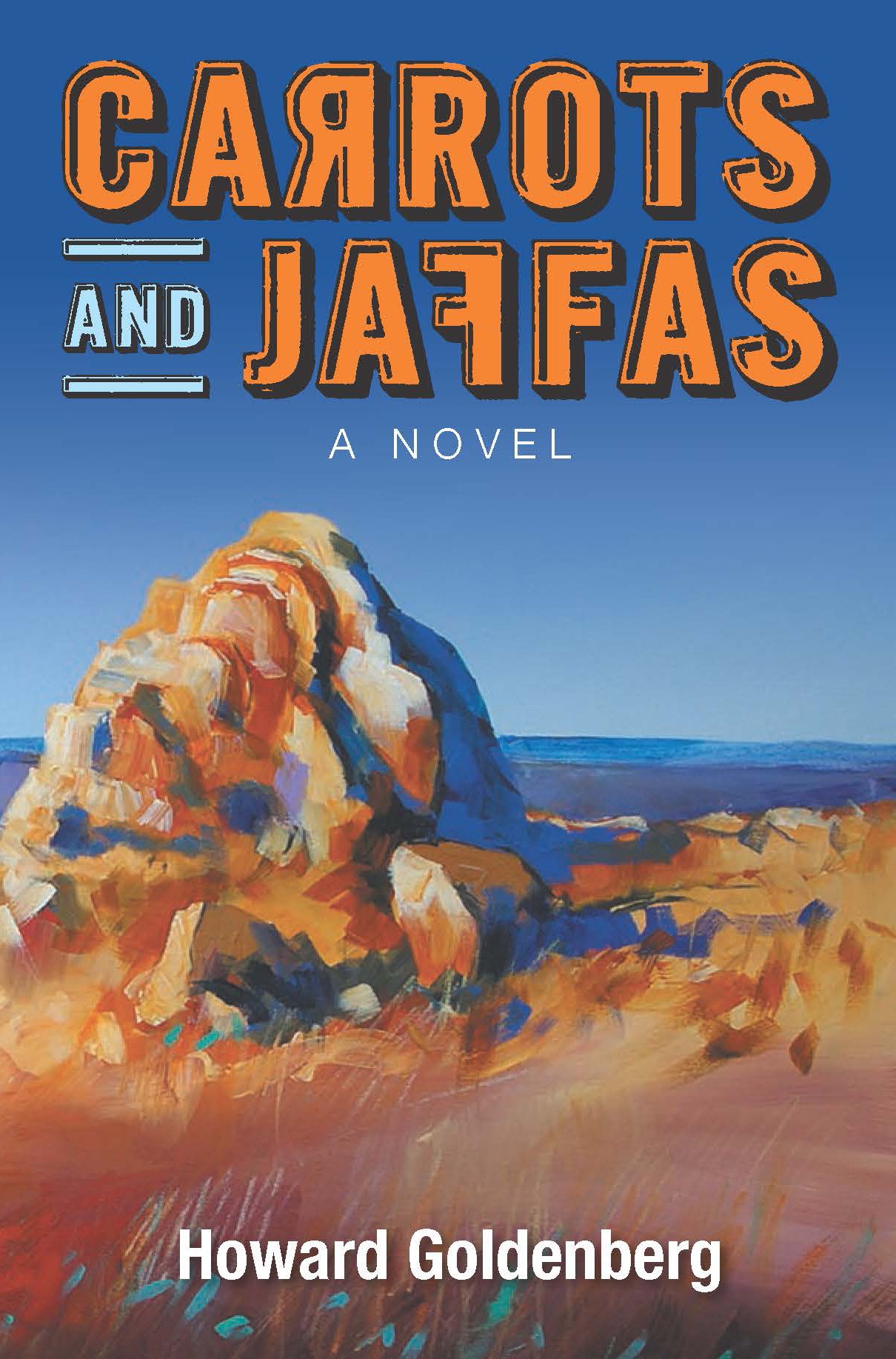
Howard Goldenberg, Carrots and Jaffas (Review)

Howard Goldenberg, Carrots and Jaffas

Courtesy: Hybrid Publishers

Howard Goldenberg, we are told in “About the Author” at the back of his debut novel Carrots and Jaffas, is the sole practitioner of a literary genre – the rhyming medical referral letter! Wouldn’t I love to see some of those! Anyhow, you’ve probably guessed now that Goldenberg is a doctor, and you’d be right. But he’s a doctor with some very specific experience. Earlier this year I wrote about white writers writing on indigenous subjects. It resulted in quite a discussion. While the overall opinion was that there should be no taboos in subject matter for writers, we agreed that such writing is most effective when done from a standpoint of knowledge (and, it goes without saying, sensitivity). Howard Goldenberg, whose novel Carrots and Jaffas I’ve just completed, has such knowledge*, as he has and still does practise for part of his time in outback Aboriginal communities. Beats me how he could also find time to write a novel, but like all passionate writers, he has!

I hadn’t heard of Howard Goldenberg before, but apparently he was featured in one of the sessions at this year’s inaugural Melbourne Jewish Writers festival, about which (the festival, not Goldenberg) Lisa (ANZLitLovers) and Jenny (Seraglio) have posted on their blogs. Goldenberg writes on his blog of his session with Martin Flanagan. He says that Flanagan “led a conversation about the book, about my choice to turn from serious non-fiction to the novel, about stolen children – the ultimate wound, about twinness, about the problems and pitfalls of the whitefella writing about blackfellas.” Oh, wouldn’t I have loved to have been there!

This novel, Carrots and Jaffas, is pretty ambitious. It covers a lot of ground, asking us to make the right connections between different experiences of suffering and loss. It uses parallel stories and a frequently shifting narrative perspective to do this. It has the odd awkward moment – a coincidence pushed a little far, an irony that doesn’t quite ring true, an earnestness that gets in the way – but these are minor in a story that totally got me in from the first page. Goldenberg has written two works of non-fiction – a memoir about his father, My father’s compass, and a book of stories about his experiences as a doctor in outback Aboriginal communities, Raft. These non-fiction works have clearly honed his narrative skills.

The main action of the novel occurs around 2004, with the setting split between suburban Melbourne and the Flinders Ranges in South Australia, in Adnyamathanha country. The plot starts with the abduction of 9 year-old Jaffas, one of identical twins, by an ex-drug addict, ex-con, who plans to deliver him to an old indigenous woman, Greta, who had two sons stolen from her in the 1960s. Clean now, but with a brain damaged by PCP, he (Jimmy aka Wilbur) sees himself as Golem or the Redeemer. He is going to right a wrong. He planned to take the two boys but it goes wrong and he ends up with just Jaffas, leaving behind a distraught Carrots. The story then flashes back to the story of how Carrots and Jaffas came to be, to the meeting and subsequent marriage of their parents, Bernard, an IT specialist who had lost his father when young, and Luisa, an immigrant from Buenes Aires who, we gradually learn, had suffered significant trauma and loss in her youth. Later, we meet Doc who works in the Flinders Ranges, but who has experienced a loss of his own, a sibling through divorce.

From here the story alternates between Carrots at home, and Jaffas in the outback in a neighbouring state. As Carrots starts to fall apart, Jaffas, who was threatened with the death of his twin if he tells, is introduced to indigenous culture. He is not happy, is biding his time for an opportunity to go home, but in the meantime, over a period of a couple of months, he starts to hear different stories about life – indigenous ones from Greta and scientific ones from Doc – and learns another way of living. I will leave the story at this point … except to say that there is drama alongside reflection. It’s quite a page turner, in its quiet way!

There is humour here, despite the serious subject matter. I particularly loved the chapter on the kindergarten fancy dress parade. It brought back such memories. Even in this lighthearted scene, though, there’s seriousness. One child is particularly diminutive, and Goldenberg writes:

No one in his class considered him abnormal. But already behind him, forever past, were the years of parity with his classmates. This would be his last year of unselfconsciousness, the last year before he entered the big school, where bigger kids would be free with unkind comparisons. Luisa gazed at him, concerned; she realised the child did not suffer from dwarfism – not yet.

Oh, the power of labels!

The characters are engaging, each clearly individualised – from Luisa’s bible-learnt English and understandable fearfulness to Greta’s confident, nurturing nature, from Bernard’s practical approach to life to the Doc’s passionate if somewhat eccentric one.

There are many losses explored in this novel – parents “lose” children, and children their parents, siblings lose siblings – and they are mostly needless, human-induced. Goldenberg examines what happens to the soul, the spirit, when it experiences such pain. Not everyone responds in the same way – some start to disintegrate, some go into problem-solving mode, others respond with increased generosity of spirit – but all suffer.

Carrots writes letters that he clearly can’t send to the abducted Jaffas. In one of them he writes “I am not me without you”. They are of course twins, but most people, Goldenberg shows, are irrevocably changed when they experience loss. For all this, the novel is redemptive. I’d love to know how indigenous people respond to the novel but, for me, it’s a novel written with love from the heart. I enjoyed it.

Howard Goldenberg
Carrots and Jaffas
Melbourne: Hybrid Publishers, 2014
242pp.
ISBN: 9781925000122

(Review copy courtesy Hybrid Publishers)

* Read, for example, his powerful, heartfelt blog post on the current Budget recommendations regarding co-payment for medical treatment.

Adam Johnson, The orphan master’s son (Review)

Adam Johnson 2006

Adam Johnson 2006 (Courtesy: Roms69, using CC-BY-SA 3.0, via Wikipedia)

Given my current reading preferences, I probably wouldn’t have read Adam Johnson’s Pulitzer prize-winning novel, The orphan master’s son, if it hadn’t been for my reading group, but I’m rather glad I did. It’s a confronting novel, not only because of its brutal content, but also because it is an outsider’s critique. I always feel more comfortable if criticism comes from within, free of external agendas. However, criticism from within is scarcely possible in a totalitarian regime, so I admire Johnson for taking it on.

Now that’s off my chest, let’s get to the book. Most of you probably already know what it is about. It is set in the Democratic People’s Republic of Korea during the reign of Kim Jong-il (who died in 2011) and explores the lives of citizens living under his repressive, authoritarian rule. The novel is divided into two parts: The Biography of Jun Do, and The Confessions of Commander Ga. The first part is told in third person voice, in a linear chronology. The second part, however, is more complex. As well as continuing the third person narrative, there is a first person strand by a new character, an unnamed interpreter, and an “official” strand told via loudspeakers. While each has a linear chronology, they are told at different rates resulting in the overall chronological sequence being somewhat jagged. This structure reinforces one of the main themes of the novel which has to do with stories, lies and truths, and shifting identities.

The structure is one of my reasons for liking the book. I like it when authors use technical aspects of their work, like the structure, to reinforce their intention. It adds challenge to the reading, making me think about what the author is doing and why. It also, in this case, helped distract my mind from much of the brutality of the content. In the interview with his editor David Ebershoff at the back of my edition, Johnson said that he had “to tone down much of the real darkness of North Korea”. Wow, is all I can say to that.

Anyhow, I’ve written three paragraphs without saying anything about the story or plot. The first thing to say is that Jun Do (a play on John Doe, neatly suggesting hidden or uncertain identities) and Commander Ga are the same person. In the first part, Jun Do, the titular orphan master’s son, takes part in many “adventures” on behalf of the state, including working as a tunnel soldier, kidnapping Japanese, gathering radio information on a fishing boat, and representing North Korea on a delegation to Texas after which, because they fail their assignment, he is sent to Prison 33, a prison mine. In this first part, Jun Do learns the art of survival and, importantly, the importance of stories to that survival. In the second part, Jun Do has survived the prison, killed the hated Commander Ga, and emerged, with the state’s sanction, to take his place, including moving in with Ga’s wife, the beautiful actress, Sun Moon.

It is in this part that Do/Ga’s life comes together and then starts to “unravel”, though not without his complicity and not without doing some damage of his own. The novel is beautifully plotted so that seemingly random or bizarre occurrences – such as Jun Do hearing radio signals from the “girl rower”, his chest being tattooed by a boat captain with an image of Sun Moon, and his being given a DVD of the film Casablanca – all find their place in the latter part of the novel.

“there is nothing between the citizen and the state” (interrogator)

But now I want to get back to stories. In the first part, the fishing boat crew concoct an improbable story involving Jun Do to explain the disappearance of the Second Mate, who has defected, and thereby protect themselves from retribution. In Texas, when Jun Do expresses uncertainty about repeating this story, the delegation leader, Dr Song, tells him:

Where we are from … stories are factual. If a farmer is declared a music virtuoso by the state, everyone had better start calling him maestro. And secretly he’s be wise to start practising the piano. For us the story is more important than the person. If a man and his story are in conflict, it is the man who must change.

This is what Jun Do does throughout the novel. He changes to suit the role he finds himself in. He has to, to survive. In the second part of the novel, we are presented two versions of his story – the third person narrated one which we take as the “truth”, and the propaganda one broadcast over loudspeakers to all the “citizens” of Pyongyang.

Alongside these two narratives is that of our first person narrator, the interrogator, who works in Division 42, the department which extracts information from enemies of the state. A self-styled biographer, he eschews the thuggish techniques of the “rival interrogation team”, the Pubyok, although his apparently benign story collecting methods conclude with a brutal pain (electric shock) machine which aims to create

a rift in the identity— the person who makes it to the far shore will have little resemblance to the professor who now begins the crossing. In a few weeks, he will be a contributing member of a rural farm collective […]. There’s no way around it: to get a new life, you’ve got to trade in your old one.

He is, in a strange way, a voice of conscience, as he starts to question what it’s all about. Indeed, at one point he asks his father “Is it just about survival? Is that all there is?”. This question recurs near the end when Do/Ga, our interrogator’s last case, imagines a life that “would no longer be about survival and endurance”.

In most of my reading, multiple viewpoints are used to convey the idea that there are different ways of seeing things. It’s usually pretty benign, even if some of the individual perspectives are not. But in this novel, there is something sinister going on, so sinister that if you are caught out in the wrong perspective you will very likely find yourself at a prison farm (or worse). You need to make sure, in other words, that your identity matches the one the regime has for you. And this brings me to the scariest thing about the society Johnson depicts – the precariousness, or uncertainty or, even, the randomness of existence. To survive, you must believe what you are told or, as Jun Do learnt early in his life, do what you are told.

“no beginning, an unrelenting middle, and ended over and over” (Do/Ga)

I’ve said nothing, though, about the experience of reading this book. It may sound silly, given what I’ve written above, but this novel takes you on a wild ride. Besides the inevitable brutality, it has tender moments, some very funny ones, and is more than a little absurd. It asks us to accept, and believe in, Jun Do as our guide. It’s a dystopian novel with a touch of romance, adventure and mystery/thriller.

The success of a book like this rests on its authenticity, on whether we believe the truths that lie beneath the fabrication. Unfortunately, I do.

Adam Johnson
The orphan master’s son
London: Black Swan, 2013
575pp.
ISBN: 9780552778251

Kirsten Krauth, just_a_girl (Review)

Kirst Krauth, Just a girl

Courtesy: UWA Publishing

If you’ve already heard about Kirsten Krauth’s debut novel just_a_girl, you’ll know something about its confronting nature – and it is confronting, though perhaps not quite in the way I expected. It was both more and less, if that makes sense.

However, if you’re not Australian, you may not have heard about this novel. Essentially a coming-of-age story, just_a_girl is told in three voices. Two are first person – Layla, a 14 to 15 year-old-girl, and Margot, her mother – and the other is, interestingly, told third person, Tadashi, a lonely Japanese man. The main voice, though, is Layla. She opens and closes the novel, which is set around 2008 in Sydney and the Blue Mountains.

Layla typifies the modern knowing teenage daughter that parents worry they may have. She’s sexually precocious and is acutely aware of her effect on men. She’s what many would call “a tease”. She tells us, though, that she’s a virgin (technically, anyhow, because she’s done pretty much everything else). She wants, she says, to wait until she’s 16:

Fifteen just seems too skanky. You tell your kids you lost your virginity at 15. They’ll just want to do it even younger.

This tells us something more about Layla – her street-wise wisdom. It’s believable because Layla has had to grow up fast. Her parents separated when she was in primary school because her father finally admitted his homosexuality. Her mother, prone to depression, turned to an evangelical church. Layla has learnt to navigate these waters with smart talking, and by using all the weapons at her disposal including personal attributes and modern technology. With studied insouciance, she tells us about her relationships, with her mother, her friend, her father, and various boys and men. She is not innocent, but she is also abused in several ways, by old and young, through the novel.

Meanwhile, her mother Margot struggles with depression, a sense of rejection and failure, and consequent inability to properly relate to her daughter. She has turned to God, but unfortunately the church she has chosen, with its hypocritical leader, is unlikely to be her salvation. You see how easily relationships can go awry during these turbulent years if family members are not strong and confident in themselves. But, Krauth keeps it real. This is not melodramatic. There are no over-the-top mother-daughter scenes, just lack of real communication leading to distance and lack of mutual support where both need it. By the end of the novel both have learnt something and are starting to see each other as people, rather than simply as roles. In other words, it’s not only Layla who needs to grow in this contemporary coming-of-age novel.

Into this mix is added a third voice, Tadashi. He often travels on the same train as Layla, and on one occasion rescues her from a risky situation. Like Margot, he’s lonely, used to relying on a mother who has now gone. In scenes reminiscent of the bitter-sweet movie Lars and the Real Girl he orders and takes possession of a sex (or love) doll which he sees as “a person” who will alleviate his loneliness. In some ways it’s an odd inclusion in the story but, besides his probably not essential role as rescuer, he adds another angle to the exploration of loneliness and relationships, and the use and misuse of sex to address gaps in people’s lives.

In her “Sources and permissions” note, Krauth tells us about her sources for “love dolls” and other ideas or events in the novel. She also explains that some of Layla’s comments have been inspired by teenagers who have appeared on SBS’s Insight program. She has listened well, because from my experience of similar programs I felt very comfortable (if one can call it that!) with Layla’s voice. She’s so fresh, so funny, so knowing, that you can’t help liking her and worrying about her vulnerability, while also being horrified.  Here’s a short example:

Mum says I have to be careful now that I’m in year 9. Because men will start looking at me in a new way. Fuckadoodle, they’ve been looking at me like that for years. Especially when I eat Chupa Chups on the train.

I was going to share the Chupa Chups (“I have a favourite game on the train trip home from school”) episode with you, but I reckon you should read it yourselves. It would be funny if it weren’t so disturbing. It’s a fine piece of writing about a sexualised young girl who “knows” too much. Talk about playing with fire!

Margot’s voice is quite different – the long run-on sentences versus Layla’s short ones convey her anxiety and uncertainty well. Here she is, for example:

When is this soul-searching going to end, I mean, I knew coming off the meds would be hard as I’ve tried it a few times before but it’s like I’ve sunk into a bog, and it’s been a horrendous week because of that film Layla hired, Brokeback Mountain, you know she loves Heath Ledger and was completely devastated when he died last year and everyone thought … [and on she goes for several more lines]

I feared at times that Krauth was trying to pack too much in – single mother, gay father, hypocritical evangelical church, breast cancer scare, viral you-tube, sex doll, workplace sexual harassment, and so on – but no, she made it work. They are treated as things that happen. She doesn’t trivialise, but neither does she labour. Instead, she keeps her focus on the main game, which is how we, and particularly young people and their parents, must navigate the modern digital world with its potential for serious ill, and how in such a world might we still forge meaningful relationships. A thoroughly modern book for a thoroughly modern audience. It will be interesting to see what Krauth does next.

Lisa at ANZLitLovers also liked the book.

awwchallenge2014Kirsten Krauth
just_a_girl
Crawley: UWA Publishing, 2013
265pp.
ISBN: 9781742584959

(Review copy supplied by UWA Publishing)

Jessica Anderson, One of the wattle birds (Review)

I have finally read Jessica Anderson’s final novel, One of the wattle birds, which has been sitting in my beside cabinet since my parents gave it to me in 1998! Never let it be said that I don’t read books given to me – though, on reflection, I’d prefer you didn’t hold me to that! I have many many books in my TBR pile and most of them are not in the bedside cabinet. For a start, they wouldn’t fit. Anderson, though, has stayed there because she really was high priority, as I do like her. What finally prompted me to read this novel was Lisa Hill (ANZLitLovers) who recently reviewed Anderson’s penultimate novel, Taking shelter. She suggested that we swap books, when I’d read mine. When I suggested that it might take me some time, she sneakily said, “I’ll send mine up to you and then you will feel guilty if you don’t do it.” That was mean, don’t you think?

And so, being the responsible person that I am, I read One of the wattle birds and am glad of that little nudge (but don’t tell Lisa!). It is a deceptively simple book. When I started reading it, I wondered whether I was really interested in the first-person story of a 19-year-old female university student and her boyfriend. I thought I knew what it would be about, but how wrong I was. Set in Sydney, it describes three days in the life of the narrator, Cecily Ambruss, the only child of a single-parent family. Cecily’s mother, we discover, had died of breast cancer the previous year while Cecily was overseas with her boyfriend, Wil, and two other couples. Not surprisingly, Cecily is grieving deeply. Her grief is not helped by her inability to understand two things: why did her mother let her go overseas without telling her about the terminal illness and, what’s more, refuse to let her be called back, even for the funeral; and why did her (unmarried) mother stipulate that Cec must marry before she can inherit. Interesting, n’est-ce pas?

Red Wattlebird (Photo: JJ Harrison, using CC-BY-SA 3.0, via Wikipedia)

Red Wattlebird (Photo: JJ Harrison, using CC-BY-SA 3.0, via Wikipedia)

The three days over which the story takes place happen to be part of stu-vac, but while Wil – good, decent, conscientious law-student Wil – is taking his study seriously, arts student Cec is distracted. She cannot get her questions out of her mind. She has given up bothering Wil about them as he’s tired of her talking about her mother. And yet, grief is like that, particularly grief after unexpected deaths. You talk and mull, and mull and talk, over and over and over.

This brings me to the birds. There is, of course, the wattle bird. Cec calls it the DOIK*, for its sound, or “no-comment bird”, because it seems to be drowned out by other birds, reflecting, presumably, Cec’s feeling of inconsequence.  In another reference to birds, Cec says :

I feel like one of those raggedy birds you see trying to feed their remorseless young. And among the gaping beaks, that one gapes widest. And among the chorus of cheeps, that one cheeps loudest.

The beaks and cheeps are the insistent questions that the bird tries to quieten with answers she’s gathered from others, such as her mother’s friends, her uncle and aunt, and even her counsellor. But they don’t satisfy, so she keeps searching – and eventually comes to her father, a man who had professed to have no interest in her and whom, therefore, she had long ago decided she didn’t want to meet.

Alongside this search for answers, Cec does do the occasional study – and what she’s studying is Malory’s story of King Arthur which is, appropriately enough, a quest story. But, it raises other issues for Cec too, such as how much magic versus Arthur’s “own hands” played in his achievements. I suspect this has something to do with Cec learning that not everything has a clear, logical answer.

While all this is interesting, much of the delight in reading the novel comes from the interactions between characters. They are, generally, exquisite. The often prickly Cec has wonderful exchanges, for example, with her Aunt-by-marriage Gail, her Gran, and her father who tries his best to help her see where her mother may have been coming from. These characters aren’t paragons, but neither are they malign. They are, simply, human. My only quibble with Anderson’s characterisation is that Cec and her friends – all around 19 years old I assume – seem at times a little improbable. How many 19-year-olds – particularly university students – talk about mortgages and the like?

Anyhow, by now you must be wondering about Cec’s mother. Without spoiling anything, there’s nothing to suggest they had a difficult relationship – and the answers to Cec’s questions are probably pretty mundane. The point of the novel is, in other words, not so much Cec’s relationship with her mother but her coming to terms with her grief, her identity, and her relationship with Wil.

This novel is not easily categorised. Part quest, part comedy-of-manners, part family drama, it has some laugh out-loud moments as well as reflective ones. It explores many of the themes common to Anderson’s work. One is money and power. Cec’s family has money – “fruit and veg have been good for us” – and money is used both subtly and not so, as a means of control. Another is deceit and concealment. As the novel progresses, Cec starts to tell Will less and less. At first she justifies it because it’s all too complicated to explain – and he does tend to brush her emotional concerns off –  but, by the third day, there are many things she doesn’t tell him. “I foresee no end to the things I won’t tell Wil”, she says. And another, as the surprising last paragraph makes clear, has to do with the act of creation or, perhaps more correctly, with living life creatively.

One of the wattle birds is a tight, cleverly conceived “concoction” that makes, I’d say, a fitting conclusion to Anderson’s literary life. Has anyone else read it?

Jessica Anderson
One of the wattle birds
Ringwood: Penguin Books, 1994
Cover design: Joanna Hunt
192pp.
ISBN: 9780140240320

*A not very tuneful bird. We have a resident Red Wattlebird in the tree outside our bedroom. It squawks us awake every morning.