Fiona McFarlane, The night guest (Review)

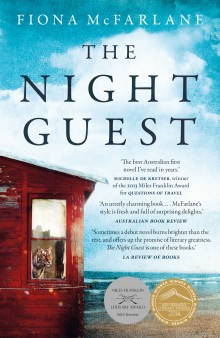
McFarlaneNightGuestPenguinThose of you who followed the literary award season in Australia last year will have seen Fiona McFarlane’s debut novel The night guest pop up several times. The more it popped up, the more I wanted to read it – but also the more I thought it would be good to read with my reading group. So, I bought it, and held onto it until this year, as we did, in fact, schedule it for our end of February meeting.

The first thing to say about this book is that it’s an easy, quick read, a page-turner in fact. But, it is not a simple read. It’s a read that keeps you guessing right to the end, even though you are pretty sure you know what is going on. It’s about Ruth. She’s in her mid-seventies, and recently widowed. She lives in the family’s old holiday house to which she and her husband had retired a few years previously. And, she’s “reached the stage where her sons worried about her”.

Then, along comes Frida, from the government she says, to be Ruth’s carer, because Ruth, as we’d suspected, has dementia, albeit in early stages. She is, she feels, “still self-governing”. Apparently, both of McFarlane’s grandmothers had dementia which helps explain why McFarlane has been able to present Ruth’s state of mind so convincingly. I say “helps explain” because there’s clearly a perceptive and skilled writer at work here too. It’s one thing to experience family members with dementia, but it’s quite another to be able to present it with such authority and authenticity.

How does McFarlane do this? The most important decision a writer has to make I think – and I’ve certainly heard many say this – is the voice. For this book, McFarlane chose third person subjective, that is, it is told third person but almost completely from Ruth’s perspective. A good decision, because we can feel Ruth’s uncertainty as she slides between confidence and uncertainty, between independence and neediness, between reality and a strange world that doesn’t always make sense. Because it’s from her point of view – and not an omniscient author’s – we are kept on our toes, not always sure, as Ruth is not, of where she is on any of those spectrums at any given time. Sometimes it’s patently obvious, but other times it’s not so clear.

Ruth has a few guests during the course of the book – including Frida (of course) and a man called Richard Porter. But there is another one, a tiger! The tiger appears in the opening sentence of the novel:

Ruth woke at four in the morning and her blurry brain said, ‘Tiger’.

She was of course dreaming, except that now she’s awake, she starts to hear noises, “something large … rubbing” against her furniture, and “the panting of a large animal”. These noises are too big to be coming from her cats. The tiger is ongoing “character” in the novel. More on this anon.

The second guest to arrive is the aforementioned Frida. She appears out of the blue one day – “You don’t know me from Adam” she says – to start caring for Frida. The question though is, is she “out of the blue” or is it that Ruth didn’t remember that someone was coming. Questions like this recur throughout the novel, keeping us in a sort of readerly vertigo. One minute we believe we know, and the next we are uncertain again. By the half-way point, though, I suspect most readers are pretty confident of what’s really going on, but even then there are uncertainties about how it will actually play out. All this makes the book an engrossing challenge.

Then there’s the third guest, Richard Porter, who was her first, and unrequited love, when she was a young woman living in Fiji with her missionary parents. Ruth invites him for a visit, hoping that “things could still happen to her”.

It’s hard to know how to write more about the book though because this is one of those stories in which the plot and the meaning are intertwined. However, I can say that it’s broadly about ageing, grief, love and loss. It’s also about trust, honesty and the responsibilities we have for each other.

The tiger

The tiger, as I’ve already indicated, appears on the first page. He’s a complex figure, alluding partly, I’m sure, to Blake’s “The Tyger”. But, and here perhaps I’m drawing a longer bow, he also reminded me of the tiger (aka Richard Parker, which is very close to Richard Porter, but that might be a bridge too far!) in Yann Martel’s Life of Pi. Both tigers reflect a duality: they are both fearsome (and perhaps representative of evil, though I like to avoid that word), but both can also be seen positively. Blake’s tiger was made by the God who also made the lamb, and so by extension can be seen to encompass both forces. Martel’s tiger needs to be kept at bay, but his very presence also gives Pi the strength and focus he needs to survive.

So, too, in The night guest does the tiger play a complex role. He appears when Ruth is at her most uncertain, most fearful, most disoriented, disappearing when she’s calm. In that sense he represents the negative. But, there’s something grand, and perhaps even reassuring about him. In his first appearance, Ruth thinks:

A tiger! Ruth, thrilled by this possibility, forget to be frightened and had to counsel herself back into fear.

A little later, when she is feeling comfortable, the tiger is “safely herbivorous”. But, he comes back, and Ruth is irritated “because there was no point to him now that she had Frida and Richard; the tiger had prepared the way for them and was no longer needed”. I’m tempted to suggest that Frida and Richard could represent the tiger’s duality, but the book isn’t simplistically conceived, so I don’t want to take that line of thinking too far.

Towards the end, when the tiger is fighting for his existence,

Ruth felt for a moment on the verge of understanding exactly what the tiger was saying when he roared. He wasn’t concerned for his safety, but for his dignity …

I’ll leave the tiger there, but I think you can see how McFarlane uses him in the novel.

There are other images and symbols which run through the book, some of them biblical, like lilies (“she was safe behind her lilies”), which makes sense given Ruth’s missionary upbringing. And, of course, Ruth’s name itself is biblical. None of this is heavy-handed though, or suggests a slavish adherence to symbolism. It just adds to the depth with which we can contemplate this book – at least, I think so.

In the end, this is a book about people – and how we treat each other. Several people, besides those I’ve mentioned here, are involved in Ruth’s life, such as her sons and a young mother who’d found her husband as he was dying. The book asks us to consider how far do we – should we – take our duty of care? How do we decide when we should intervene in another’s life and when we should not. I did enjoy this book.

Lisa at ANZLitLovers didn’t enjoy it as much as I did. I agree that it doesn’t really work as a psychological thriller, which is how some of the blurbs on my edition describe it. But, as I was reading it, I wondered whether that’s what McFarlane intended … or just how it’s been promoted?

awwchallenge2015Fiona McFarlane
The night guest
Melbourne: Penguin Books, 2014 (orig. ed 2013)
275pp.
ISBN: 9780143571339

Ellen van Neerven, Heat and light (Review)

Ellen van Neerven, Heat and light, book cover

It’s silly I know, but I had a little thrill at the end of Ellen van Neerven’s Heat and light, because not only was the last story set in a place where I spent six of the formative years of my childhood – Sandgate on the northern edge of Brisbane – but one of the characters learnt to swim in the same pool there that I did, and her brother has a beagle, just as we did. Ah, childhood. Enough, though, of readerly nostalgia. Time to properly discuss the book.

Heat and light won the David Unaipon Award for Unpublished Indigenous Writer in 2013, and has been on my TBR for several months. I hadn’t prioritised it for reading, but its longlisting for the Stella Prize last week convinced me to squeeze it in before two works I had to complete by 21 and 24 February. I hope I won’t regret it. No, let me rephrase that: I know I won’t regret having read it, but I hope I don’t regret my decision to read it right now!

The first thing to say is that Heat and light isn’t a novel. It has, in fact, an intriguing form, something that’s not unusual with writers from an Indigenous background. Simplistically speaking, it comprises short stories organised into three sections titled Heat, Water and Light. However, each of these sections is quite different. Heat comprises interconnected short stories (5) about three generations of the Kresinger family, while Water is longform short fiction (54 pages in my edition) in the speculative fiction genre. Light, on the other hand, is more like a “traditional” collection of short stories (10). Together, the three sections, including the future-set Water, create a rich picture of contemporary indigenous life and concerns.

And here I confront again the challenge of being a non-Indigenous Australian reviewing a work by an Indigenous Australian featuring Indigenous people. It always makes me a little anxious: I fear sounding earnest or, worse, patronising; I fear making what’s different sound exotic; and, I fear missing the point. And yet I love reading Indigenous writers, because their perspective is different and because they (see, I’m generalising, aren’t I?) tend to be adventurous in their story-telling, often taking risks with voice, form, chronology, genre, and more. Van Neerven, as I’ve already implied, is such a writer.

The titles of the three sections – Heat, Water, Light – make me think of the elements. They are not quite the classical elements (fire, air, water, earth) but they convey, it seems to me, the essence of what’s needed for life. The focal character in Heat, though we don’t see a lot of her, is Pearl, the grandmother of the narrator of the first story which is titled, in fact, “Pearl”. Pearl is a bit of a free spirit – earthy, hot (in its sexual meaning, with “her siren eyes”), and likely to appear or disappear with the wind. Over the five stories in this section we learn about Pearl, her sister Marie, and the two succeeding generations. Van Neerven’s writing is confident, moving comfortably between first and third person narrators, all of whom are members of a complex extended family. Loyalties – to their indigenous background and to their blood relationships – are tested. As the narrator of “Pearl” says:

So much is in what we make of things. The stories we construct about our place in our families are essential to our lives.

And this is true, whether or not the stories so constructed are “true”. The implication is you need to know what you are doing. Colin, for example, finding himself, through his own actions, disconnected from his Indigenous heritage, wants to return, but

she told me if I was going to make my way home I’d better do it soon before the dust had covered my tracks.

The third section, Light, explores similar issues to those in Heat, but through ten separate stories, ranging from 2 pages to 30. The characters in both sections both move between city and country, but, while Heat is set in southeastern Queensland, the stories in Light are set in Sydney, Western Australia and Queensland. The protagonists tend to be young, and female. They also tend to be in formative stages of their lives, or at crossroads; they are sorting out their relationships, their sexuality, their identity. They confront racism and face conflict, but they also experience and give love. There’s humour, some of it wry, such as the young girl noticing that the tag on her pants states that “this colour will continue to fade”.

Water, the longform story that occupies the middle of the book, is very different. For a start, it’s set in the near future, the 2020s, when Australia is a republic with a female president. There’s a new flag and Jessica Mauboy’s song “Gotcha” is the national anthem. There’s also a social media ban! I reckon Van Neerven enjoyed imagining this. However, life isn’t perfect. Our narrator Kaden has a new job as a Cultural Liaison Officer and was initially pleased because she thought she’d be working with “other Aboriginal people” which would provide a “way of finding out about my culture and what I missed out on growing up”. But, she discovers she’ll be working with “plantpeople” who are sort of mutant plants with human features created during “islandising” experiments. Kaden’s job is to evacuate them in preparation for the Australia2 project.

I don’t want to give any more of it away, but you’ve probably guessed that it’s a story about how we treat other, about segregation, discrimination and dirty politics. It’s also about connection to country and about the importance of controlling one’s own art. Artist Hugh Ngo says:

I don’t make art for galleries. Or for money. I make art that speaks the truth.

This is a clever (and true!) book. The bookending sections Heat and Light present stories of Australian people going about their lives, and most of them happen to be indigenous. Their indigeneity is evident, and it affects the issues they confront, but there’s no specific advocacy. The middle section, on the other hand, is more overtly political. It picks up issues that appear in the shorter stories and provides a coherent, ideological context for the whole.

Heat and light is one of those really satisfying reads: it combines engaging writing with stories that make you feel you’ve got to the things that matter. So no, regardless of whether I meet my other deadlines, I’m not sorry I bumped this book up in my reading priorities.

awwchallenge2015

Ellen van Neerven
Heat and light
St Lucia: UQP, 2014
226pp.
ISBN: 9780702253218

Note: One of the stories in Light, “The Falls”, is available on-line at Kill Your Darlings

Fyodor Dostoevsky, Crime and punishment (Review, hmm)

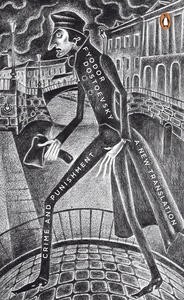
DostoevskyCrimePenguinPart way through my reading of Fyodor Dostoevsky’s Crime and punishment I wrote in my book – because, yes, I am a marginalia writer – “Who does Dostoevsky agree with?” It’s a somewhat naive question, I know, because the author doesn’t have to agree with anyone – and very often doesn’t. You just have to look at Humbert Humbert for example, or Patrick Süskind’s Jean-Baptiste Grenouille. But, in those novels, you can assume the authorial viewpoint. Crime and punishment, however, seems to me to be very different. What is Dostoevsky’s viewpoint? Does he have one?

SOME SPOILERS FOLLOW … THIS IS A CLASSIC, SO FAIR GAME I’D ARGUE.

This brings me to why I read classics. There are two main reasons: one being simply that I’m interested in our literary heritage, and the other is because they still have something to say. I guess this partly answers the question I posed a couple of posts ago doesn’t it? I read for insight into “the human condition”, to understand what makes us tick, and therefore, I suppose, to know myself and others better. Anyhow, back to Crime and punishment and my marginalia comment. The central question in the novel is, really, why did Raskolnikov do it? And his reasons are so ambiguous, so paradoxical, that he slots pretty comfortably into our post-modern world of uncertainty, self-consciousness and fluidity. Of course, he’s not modern (or post-modern). He’s a 19th century creation (and this is a mid-19th century novel with a happy ending). But he’s a creation who is hard to pin down, because he’s the creation of a writer from a society in flux, and of a writer who was perhaps himself in flux. Indeed, Raskolnikov’s name, so the translator of my edition tells me, derives from “raskol” meaning “a split or schism”.

So, Raskolnikov commits his crime. He murders not only the “old hag”, a pawnbroker with whom he’d had several problematic dealings, but her sweet, simple-minded sister Lizaveta, who surprised him in the act. Raskolnikov evinces little or no obvious guilt for his actions, though his physical illness and mental disarray post-murder are surely a psychosomatic response to what he’d done. His behaviour is quite schizoid, at one moment warm and generous, and then suddenly cold and calculating. No wonder those close to him can’t make him out. He’s a slippery beast.

And he’s a slippery beast because it seems – if I understand the various end-notes included in my edition – he’s a vehicle for Dostoevsky’s views on Russian society and intellectual life at the time. So, here I’m answering my opening question: Raskolnikov represents Dostoevsky in that he speaks to Dostoevsky’s concerns about some critical issues, but these concerns are multifarious so cannot be pinned down to one main idea. In some ways Crime and punishment could be seen as Dickensian, in its description of the grime and poverty of St Petersburg, but I don’t see Dostoevsky as a Russian Dickens. His main focus is not social justice, though the idea of “justice” features frequently in the novel, but more intellectual, political and psychological. Raskolnikov’s “motives” range from utilitarian ones (the world will be better off without the “hag”, “a useless, foul, noxious louse”) through philanthropic ones (her money could be used to help others) to megalomaniac and egotistic ones (“I wanted to become a Napoleon”, am I one of the “extraordinary” people “who dares to stoop and grab”, one who “moves the world and leads it towards a goal”?). These motives address many of the debates that were occurring in contemporary Russia, debates about socialism, Westernisation, moral responsibility versus environmental impact on human behaviour, and social Darwinism. Overlaying all this is Dostoevsky’s Christian belief. Sonya, the young girl who takes up prostitution to provide for her step-mother and siblings, is the person to whom Raskolnikov first confesses. While shocked, she listens and refuses to believe, or at least accept, his baser motives. Her solution is a Christian one, to “accept suffering and atone”.

In the end, at his trial, Raskolnikov gives practical reasons for the crime to do with his poverty and desire to use the victim’s money to help his career (except he didn’t touch the money), and admits he turned himself in because of “heartfelt remorse”. He receives a relatively light sentence (only eight years in Siberia) for various reasons, including his sickness before the crime, his generous character, and the fact he did not use the money.

Raskolnikov is one of literature’s great anti-heroes, alongside the likes of Shakespeare’s Macbeth and Camus’ Meursault, to whom he has been compared. I can see why – though he doesn’t have the clear motivation of Macbeth, nor the absence of motivation of Meursault. Like Meursault in particular, Raskolnikov is complex and engenders endless debates that are as affected by the reader’s beliefs, experiences and attitudes, and dare I say by the reader’s times, as they are by the text itself.

The novel’s ending suggests “renewal” and “rebirth”, but what exactly Dostoevsky meant by it all is not completely resolved, at least in my mind. There has been enough ambiguity and paradox throughout – for example, Raskolnikov argues that if he has to question whether he has “a right to power” then he doesn’t because one who does wouldn’t ask – and the trial is covered with such brevity to undermine complete confidence in the resolution. I like this sort of openness. It seems appropriate, therefore, to conclude with Raskolnikov’s loyal friend Razumikhin who says to Razkolnikov’s mother and sister:

Keep fibbing, and you’ll end up with the truth! I’m only human because I lie. No truth’s ever been discovered without fourteen fibs along the way … Name anything you like: science, development, thought, inventions, ideals, desires, liberalism, rationalism, experience, anything at all, anything, anything – and we are all, without exception, still stuck in the first years of preparatory school! We just love making do with other people’s thoughts.

Is Raskolnikov an original, a creative truth-teller, or just another confused human being prattling off ideas he’s heard from others? That is the question.

Fyodor Dostoevsky
Crime and punishment
(Trans. by Oliver Ready)
London: Penguin Books, 2014 (Orig. ed. 1866)
702pp
ISBN: 9780141192802

Julian Davies, Crow mellow (Review)

Julian Davies, Crow mellow Book cover

Courtesy: Finlay Lloyd

Julian Davies, author of Crow mellow and publisher at Finlay Lloyd, has written six novels, some of them short-listed for significant literary awards, but, embarrassingly, I only became properly aware of him through his inclusion in the two Canberra centenary volumes that I reviewed in 2013, The invisible thread and Meanjin’s The Canberra Issue. It’s the Meanjin piece that immediately came to mind when Crow mellow landed unexpectedly in my letterbox last year, probably because I was fascinated by Davies’ description of building himself a place in the mountains south of Canberra near Braidwood. (In fact, I mentioned him in a Monday Musings post about the region). He wrote about people’s fear of the bush, about country versus city living, and about the challenges and paradoxes involved in trying to live a self-sufficient life. It’s not something I can imagine doing myself, but I love reading about people who have the passion to do so. Anyhow, this and the short excerpt from his novel The boy in The invisible thread were my introduction to Davies.

I was therefore intrigued when the odd-looking Crow mellow appeared. It is an unusual shape (longer and narrower than most paperback novels), has a dramatic orange and black cover, has no pagination, and is full of black and white drawings, so full in fact that it was a challenge for me to find space to pencil in my marginalia. I managed however! There are no blurbs on the back cover, just these two sentences:

This book is a novel. It has drawings on every page.

I love this sort of cheekiness, so was looking forward to reading the novel produced by the mind behind it. The cheekiness begins with the title, which might ring a bell with some of you? It is a play, as Davies writes in his Introduction, on Aldous Huxley’s first novel Crome yellow (1921). Indeed, if you read the plot summary in the Wikipedia article on Huxley’s novel, you will have a decent summary of Crow mellow – just ignore the names – because, as the Press Release explains, Davies’ novel is “a contemporary social satire closely based on” Crome yellow.

Now, unlike Lisa (ANZLitLovers) who decided to re-read Crome yellow before reading Davies’ “riff”, I decided to read Davies’ book cold. While I cannot speak for how I might have reacted had I read Huxley first, I am happy to report that the novel holds its own as an independent read. Harking back to the tradition of the 19th century “English country house novel” (Wikipedia), it does have a whiff of the “old world” about it, despite its references to modern technology and financial crises. In fact, it’s a rather odd beast. Its set up – a group of artists staying in a country house/bush retreat with their patrons and admirers – suggests historical fiction, but it is firmly set in contemporary times. This past-present tension adds to the fun of it. The tension is compounded by other factors, one being Phil Day’s drawings which provide whimsical and sometimes very pointed satirical commentary on the text, and another being the fact that the novel’s main character, a poet/novelist who observes more than he acts, is named Phil Day! Games must surely be being played with us!

As you would expect from a “country house novel”, whether or not you’ve read one, the novel takes place over several days, and mostly comprises conversation, over meals, and in different parts of the house and gardens as the inhabitants while away their days. Davies writes in his Introduction that he was attracted to Huxley’s novel for two reasons – the idea of having a go himself at “a playful novel of ideas” and the fact that these ideas, in Huxley’s novel, have to do with “the value, purpose and pretensions of art”. He recognised the challenges in taking this on – novels of ideas are often criticised for being didactic, and “art about art risks disappearing up its own fundament” – but these challenges are of course what appealed to him.

Fortunately, I rather like novels of ideas. Ideas – plus character and language – intrigue me more than plots, so this novel with its flawed characters discussing the “important” things in life – art, love and money – was right up my alley. And of course, art-with-a-capital-A is the idea that interested me most. In an interview last year with journalist Sally Pryor, Davies described how, long ago, he’d become frustrated with the pretensions of the art world and, also, with how “venal” publishing had become, which is why he, with three others initially, had established Finlay Lloyd. He questioned publishing’s definition of “success”, saying:

We have a notion that you have to be a bestseller to be successful, but maybe it’s more interesting to do something a little bit weird and different and have a smaller audience who appreciates it.

Finlay Lloyd has succeeded with Crow mellow, achieving that difficult double of producing something different that is also accessible and fun to read.

And now, I believe I’ve done something different too. I’ve written a long so-called review without many specific references to the book itself. Do I need to I wonder, given the book, by its creator’s admission, closely follows Crome yellow’s story? Well, yes, perhaps I should say something. As I was reading, I made many marks in the book, noting ideas that interested me. Here, in Chapter 3, is cynic Scogum (also called, with appropriate Aussie adolescent humour, Scrotum) speaking to Phil Day about novels:

How many million novels would you say have been written in the last century and a half? Before that people seem to have got along well enough without the blasted things, but now every man and his word processor is blathering away putting words on paper, recounting some lame aspect of their own personal lives, celebrating their petty creativity, as though any other human being on earth could really give a damn. And what possible insight could you have to contribute that Tolstoy or Dickens or Proust or Joyce and so on hasn’t put on paper already? Seventy years ago Scott Fitzgerald had already despaired that the novel was obsolete. What original thought could you have, my dear Phil, what formal invention?

Of course, Scogum is not intended to be the last word on the matter. His is just one of the many views put forward about art in the novel. In another scene, Melissa, on the hunt for a love affair, expresses concern that artist Paul’s drawing is too “literal … where were the ideas in this picture, where the irony?” She asks him about his fine, but literal, charcoal marks:

… but don’t you intend to do something with them? I mean, pull them apart and put them in some sort of context that makes an ironic comment on art as a commodity?

And so the discussions go on throughout the book, sometimes pompous, sometimes sincere, but never reaching resolution because in our post-postmodern world, there is no resolution. And that, too, is part of the underlying, albeit tongue-in-cheek, tension in the book.

Meanwhile, Phil hankers for Anna, the daughter of his wealthy host, while she flirts with artist Paul, and Melissa searches for a love affair elsewhere. The set piece of the story is the annual masked ball to which the neighbourhood and wealthy friends are invited and for which the drawings are particularly exquisite. It’s flirty, and fun, but a little creepy too, in a Nero-fiddled kind of way!

Life, Oscar Wilde said, imitates art, more than vice versa. For Davies and Day, I suspect, life and art are so deeply entwined we couldn’t possibly say – but then that’s probably just what we would say in our highly-conceptualised world. Crow mellow is yet another good read coming out of a small publishing house. Do pick it up if it comes to a bookshop (or library) near you, and let me know what you think.

Lisa (ANZLitLovers) has reviewed the book (including a good description of the art), and author Dorothy Johnston’s review was published just last weekend.

Julian Davies
Crow mellow
Illustrated by Phil Day
Braidwood: Finlay Lloyd Publishers, 2014
No numbered pages (but 384pp, says the Press Release)
ISBN: 9780987592941

(Review copy courtesy Finlay Lloyd Publishers)

Thea Astley, Drylands (Review, of sorts)

I read Thea Astley’s Drylands many, many years ago now, so what I’m going to share here – inspired by my post earlier this year on confronting Australian novels – are the notes I made when I read it. They are not particularly well-formed, because I wasn’t planning a review at the time, though I must admit that I did spend some time skimming it as I tried to massage my notes into some shape. Too hard not to! It’s her last novel, and it earned Astley her fourth Miles Franklin Award (shared with Kim Scott’s Benang).

Drylands is subtitled “a book for the world’s last reader”. It’s one of those tricky books that looks like a collection of short stories but is, albeit perhaps loosely defined, a novel. Its structure comprises sections titled “Meanwhile” by the so-called writer of the stories, Janet, alternated with stories about inhabitants of, or visitors to, a dying town called Drylands:

a God-forgotten tree-stump of a town halfway to nowhere whose population (two hundred and seventy-four) was tucked for leisure either in the bar of the Legless Lizard or in front of television screens, videos, Internet adult movies or PlayStation games for the kiddies.

[…]

No one was reading anymore.

It’s a town “being outmanoeuvred by the weather. As simple as that. Drought. Dying stock.”

The main subject of these stories are three men (Franzi Massig, farmer Jim Randler and the indigenous Benny Shoforth) and three women (Evie the writing teacher, Lannie Cunneen, and Joss the publican’s wife). This is all quite neat, except that we are thrown somewhat by the fact that the “Janet” character may be a conceit dreamed up by Evie, who says she will “write a story … about a woman in an upstairs room above a main street in a country town, writing a story about a woman writing a story”. Since Janet is an inhabitant of Drylands while Evie is not, it makes sense that this might be Evie’s work, not Janet’s, making Evie both character and observer*. Another spanner in the narrative-voice-works is that two of the stories – those of Franzi Massig and Joss – are told first person. I might be reading too much into it, but I wonder if Astley is using this uncertainty to mirror the disorder she sees in society, if that makes sense.

Drylands explores many of the issues important to Astley. The two overriding ones are words and their importance/power, and the impoverishment of the spirit (often related to our inhumanity). Subsumed in the latter are some of Astley’s recurrent issues – gender and race, dispossession and power imbalances. She rails against the shallowness and small-mindedness that lead to poor treatment of “other” (indigenous people, women, less educated people, the ageing, etc), to “the powerlessness”, as Benny calls it, “of poverty and colour”. Here is a husband coming to drag his wife out of her writing class to get him his lunch:

He was hurling words at his shrinking wife like clods or bricks and she was not dodging but receiving them like a willing saint, enduring abuse like a terrible balm.

I wonder what Astley would have written about our treatment of asylum-seekers had she still been around, but unfortunately she died in 2004.

Thea Astley is, as you’ve probably gathered, an unsettling writer – and one with some very strong viewpoints. Besides being unimpressed by how women, indigenous people, and ‘oddballs’ (or outsiders) are treated, she’s also not too fussed about computers, television, and our sports-mad society. For these reasons I’m inclined to agree with Kerryn Goldsworthy that there’s a dystopian element to her vision. I didn’t pick it at first because I tend to see dystopian novels as being speculative or fable or allegorical, as being, in other words, about what “might be” rather than what “is”. The handmaid’s tale is a dystopian novel that is not specifically set in the future but neither is it set in a recognisable “real” world. Lord of the flies and Animal farm are dystopian views of the world that are not set in the future but, arguably, neither do they present a realistic community/society/place. Drylands, though, is recognisably our world, but a pretty grim version of it, which suggests dystopia. It’s probably worth noting here that Drylands was published in 1999, that is, at the end of the millennium.

Regardless of formal definition, though, Drylands, like dystopian novels, is pervaded by a sense of hopelessness. There are likable people – many – but life isn’t easy or happy for them. There are, however, some positive or redemptive hints, particularly for Clem and Joss. Janet, the linking character, on the other hand, can only glimmer the fact that there might be something out there:

There was something out there, but she doubted she would ever discover. The idiocy of her wasted years made her laugh even more.

There were no endings no endings no

awwchallenge2014The writing in Drylands, though sometimes colourful, is sparer, more restrained than we are used to from Astley – and just right for a bitter tale about lack of literacy, loss of reading skills, and the implications thereof. Janet’s mother tells her that “being unable to read is being crippled for life”. Janet, writing her story, worries whether she’s getting her narrative right, but decides it’s “better for readers to frolic with their own assumptions from the words spoken, the deeds done” – which is, perhaps, the ultimate irony if everyone has lost the ability to read! If you only ever read one Astley, you couldn’t go wrong with this one.

Thea Astley
Drylands
Ringwood: Viking, 1999
294pp
ISBN: 9780670884704

* There is a scene in “Stranger in town”, where Evie briefly meets the eyes of the woman (whom we know is Janet) living above the newsagency.

Morris Lurie, Hergesheimer in the present tense (Review)

Morris Lurie, Hergesheimer in the present tense Book cover

Courtesy: Hybrid Publishers

Well, well, well, I got to the end of Morris Lurie’s quirky last novel (if that’s what it is), Hergesheimer in the present tense, and laughed. The final paragraph, which seemed to come out of left field, concerns Dostoyevsky’s contract with a “scurrilous publisher” to deliver a novel – The gambler – on an impossible schedule. It resulted in his hiring the stenographer Anna Snitkina, whom he later married. I laughed because my reading group’s next book is Dostoyevsky’s Crime and punishment (the book published immediately prior to The gambler) and because this little anecdote about Dostoevsky manages to bring together in one paragraph the main themes of the book – the writer’s life, relationships with publishers, and finding love.

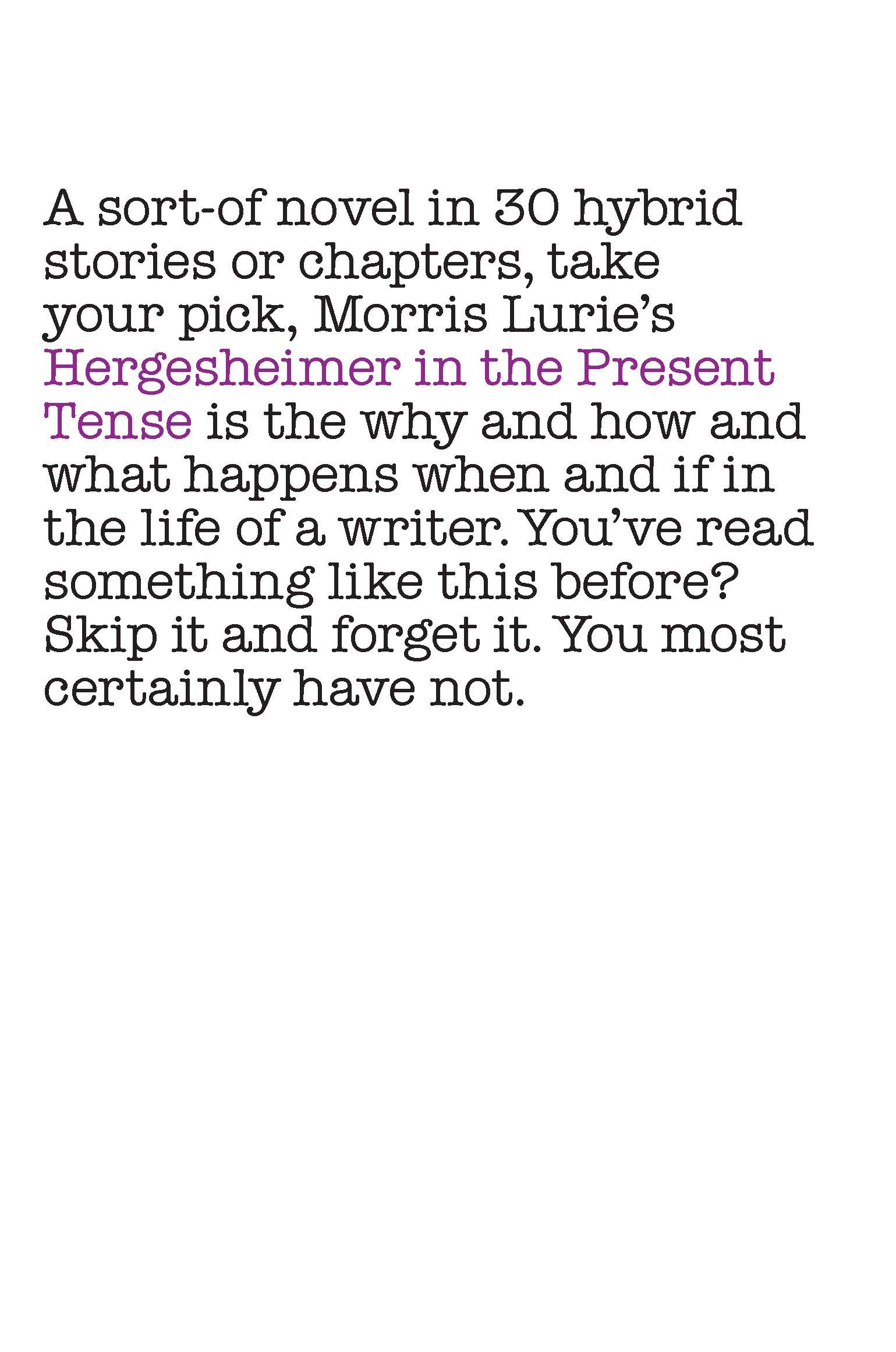
Where to start? Perhaps with my little aside in that first sentence regarding the form of this “novel”. This book has a very plain cover. In fact, it simply comprises some text on plain white, as you can see from the book cover image. And this text is right: I don’t think I have ever read anything quite like this before. But, I did enjoy it, because this sort of challenge to my reading brain appeals to me, particularly when the challenge involves a writer writing about the writer’s life. Delicious. When I say, though, that the book is about “the writer’s life”, I mean that in its broadest sense. It’s about life lived by the writer – his growing up, his women, his children, as well as the specific challenges of being a writer. This brings me back to the main challenge, its form: 30 little vignettes that criss-cross time within and between each other. There is probably an over-riding chronological arc to the narrative, though this is not particularly obvious, partly due to flashbacks within the chapters and partly because there’s not really a plot. The voice is third person, with the occasional lapse (is it a lapse?) into first or even second person.

This is not Lurie’s first book about Hergesheimer. The first was Hergesheimer hangs in, which comprises 26 chapters and was published in 2011. My curiosity sparked, I found a review of it in the Australian Book Review and discovered that there was a “real” Hergesheimer, who, Lurie writes, was

an American writer of great popularity who fell from favour, couldn’t understand it, didn’t know why, bellyached about it endlessly to his pal Mencken, refused to go gently, if you like, into that good night, is quite forgotten now. I appropriated his name to pass unnoticed, as it were, among you. (Hergesheimer hangs in)

Even Wikipedia knows about him! Him, the “real” Hergesheimer, I mean. We don’t need to know this allusion, of course, to understand the book, but it adds a playful layer to understanding our Hergesheimer, because he too is a writer who has had his successes but who is now struggling to be appreciated, to be recognised in the long-term.

As soon as I finished the book, I checked Lurie’s bibliography and discovered what I was expecting: his twenty or so books were published by around ten different publishers. No wonder Hergesheimer, the fictional one I mean, is generally unhappy with publishers*. It starts in the first story, “Hergesheimer slaps leather”, in which he and another writer discuss publishers – publishers not entering their books for prizes, publishers not promoting their books, and so on. This story, told in Lurie’s linguistically playful and rhythmic style, got me right in. Here is the opening paragraph:

Hergesheimer, found suddenly footloose in the city this sunny midmorning, hears called out from nowhere his name. To stop. To turn. To scan. To see. To spot, waving and weaving in rapid approach through the intervening traffic, McCall, an acquaintance at best, if even exactly that, certainly not bosomy, nothing buddyish, warmth to warmth, heart to heart, nevertheless, as Hergesheimer also, similarly in or of the writing trade.

‘Tom’, greets him Hergesheimer, the safety of pavement by McCall now achieved.

I love such writing – active, compelling, demanding the reader’s full attention. And I found it particularly interesting to read so soon after Eimear McBride’s A girl is a half-formed thing with her broken syntax and run-along sentences. Very different writers, very different concerns, but both subverting the “rules” to create honest, unforgettable characters.

Anyhow, the stories/chapters continue. We see Hergesheimer giving writer’s talks in schools, attending conferences, being interviewed, winning a prize, finding a new publisher, and so on. Life is never simple, and rarely are his experiences unequivocally triumphant. His dreams of great success (accompanied by wealth and acclaim) don’t come to fruition. In “Hergesheimer prompts the essential question” a schoolchild doesn’t believe he’s a real writer because “Stories are supposed to have love in them … Where’s the love in yours?” And in the title story, he discovers that prizes don’t always mean what you think they do. Some stories are laugh-out-loud funny, such as his battle to save his typewriter in an increasingly electronic world (“Hergesheimer embraces the new technology”). But mostly the levity has a self-deprecating, often sardonic edge, because, as we know, concerns about publishing, editing, prizes, promotion, plagiarism, are real. Lurie gives them flesh in the form of an experienced but now mostly defeated writer, “a lumbering dinosaur, defeated, out of step with the modern world”, a world where, for example, plagiarism can be explained away as “collage”, “montage”, or “homage”!

Hergesheimer, though, is not only a writer. He’s a son, father, failed husband, lover and friend, so we see him, for example, facing the death of his daughter (“The gift of strength”), being sick, dealing with a landlord, and trying to maintain a shaky relationship with a new woman, the indefatigable Valerie. There’s pathos here, like in his writing life, as he shambles from experience to experience.

Because of its disjointed (though not disconnected) form, you can read this book quickly or slowly. With most chapters running to around five pages, it’s a perfect book for busy times, like now, when reading opportunities have to be snatched amongst the Christmas madness. Lurie, sadly, died within weeks of its publication. Reading it now would be the perfect way to honour his memory – but reading it only for that reason would be selling it short. Far better to read it for its verbal gymnastics, self-deprecating humour and, most of all, for its awareness of the absurdity of life’s endeavours.

Lisa at ANZLitLovers also read and enjoyed this book.

Morris Lurie
Hergesheimer in the present tense
Melbourne: Hybrid Publishers, 2014
190pp.
ISBN: 9781925000337

(Review copy supplied by Hybrid Publishers)

* It reminded me of poet-novelist Alan Gould, who came to my book group and spoke specifically about the difficulty of finding publishers.

Eimear McBride, A girl is a half-formed thing (Review)

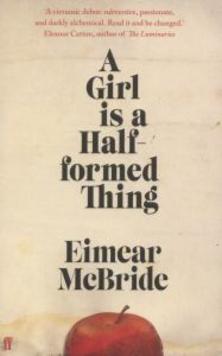
Eimear McBride, A girl is a half-formed thingI try very hard when writing reviews to avoid clichés and superlatives, like, say, “achingly beautiful” or “masterful”. But I think I’m going to use one for Eimear McBride’s multi-award-winning debut novel A girl is a half-formed thing when I describe it as “searing”. I can’t think of a more apposite word. Yet I fear it too has been over-used to the point of meaninglessness. So, let’s try something else …

Once again I’m coming late to the read, and once again this is partly because it was scheduled by my reading group. All I can say is, wow. I’m not sure I’d go so far as Eleanor Catton’s “read it and be changed” commendation on the front of my edition, but I do agree with her  “virtuosic” and “subversive”. It’s a gut-wrenching read.

The plot itself is simple enough. It’s the story of a family – a pious one-could-say-religiously-fanatical mother, a son who survived a serious brain tumour as a toddler, and the younger daughter. The tumour leaves the son somewhat brain-damaged and, of course, it returns. This tumour, the trauma of it, shapes their behaviour and defines their relationships. The story, which spans around 20 years, is told through the daughter and could, in one sense, be seen as coming-of-age. But. This. Tells. You. Nothing. Because …

This is not your typical first-person voice. Instead, we are in the head of the unnamed “girl”. We are there in her conscious unconsciousness (or, is it her semi-consciousness?) in which we hear what she’s experiencing in language that is – here’s another cliché – raw. By this I mean that the language is stripped of the mediation of a formalising narrator’s intellect. Instead it captures the immediate emotional truth of the girl’s experience as she grapples to make sense of her world. This is a book in which the style conveys the meaning as much as the words do.

How does McBride do this you are probably wondering (unless, of course, you’ve already read the book). Well, mostly by breaking, consistently, the rules of grammar and syntax. We are in the girl’s head, a place where, I believe McBride is saying, we rarely think in coherently formed sentences but in what I would call “impressions”. Take, for example, this description, on the first page, of the brother before his diagnosis:

I know. The thing wrong. It’s a. It is called. Nosebleeds, headaches. Where you can’t hold. Fall mugs and dinner plates she says clear up. Ah young he says give the child a break. Fall off swings. Can’t or. Grip well. Slipping in the muck. Bang your. Poor head wrapped up white and the blood come through. She feel the sick of that. Little boy head. Shush.

To orient you, “she” is Mammy, “he” is the father who disappears two pages later, and “you” are the little boy, the girl’s brother. Most of the novel is addressed to him (that is “you”). One of the challenges of reading this book, and it is a challenge to read, is its pronouns. Once you’ve got a handle on them, and once you realise that they are all from the perspective of the girl, you are half way there.

Anyhow, there is easier syntax than the above when life is relatively calm but, when our “girl” is distressed such as when the truth of her brother’s situation can no longer be avoided, it collapses almost completely:

I walk the street. City. Running through my mouth. Running in my teeth the. My eyes are. All the things. The said the done what there what’s all this? That stuff. I could do. My. I walk the street. Who’s him there having a look at me he. Look at my. Tits. Ssss. Fuck word. No don’t. Fuck that. No. Will. Not that. Not. That. But. If I want to then I can do.

This is not the most extreme example – I don’t want to spoil too much – but it should demonstrate what I mean by the language mirroring/enacting/even being her state of mind.

In addition to the idiosyncratic syntax, McBride draws on wide range of literary techniques to keep us focused on, grounded in the emotions of the here and now. The imagery is visceral, returning again and again to  “muck”, “dirt”, “blood”, and “puke”. She alters her rhythms to match the tone, not only through the syntax as evident in the examples above, but through allusions to and repetitions of prayers and hymns, lines from children’s games, literary works and sayings. She makes up new words (“I trup trup off behind her”), mangles existing words (“swoll” for “swollen”), and twists common expressions (“There’s a foul there’s a wind where’s the air”). McBride was inspired by Joyce she says, but her fresh, fearless, urgent language reminded me too at times of Gerard Manley Hopkins.

The novel is clearly set in Ireland and there are odd references to 1980s technology like Game Boys, but overall place and time are unspecified, and none of the characters are named. All this keeps the focus squarely on the emotional core of a family in pain, and the girl in particular. She is abused by her uncle at the age of thirteen and begins a strange love-hate, violent-tender, but sick, relationship with him. Sex becomes for her a weapon, a tool and a punishment. But the book is not about this, that is, it’s not yet another book about abuse. It is about the girl’s inability to handle her emotional pain, and her family’s inability to see her need, it’s about growing up unsupported. She is complicit in her own degradation because for her physical pain is better than the emotional. Like those who self-harm, she seeks out abuse again and again because

… what’s wrong here is me me me. Me the thing but I. Think I know. Is that the reason for what’s happened? Me? The thing. Wrong.

I know this all sounds unremittingly bleak and it largely is, but there are light touches – blackly comic scenes, surprising word plays, and chuckle-inducing descriptions (like her mother’s friends, “they polyester tight-packed womanhood aflower in pink and blue”).

A girl is a half-formed thing is hard to read style-wise and painful to read content-wise. But it is a book that, if you let it, reaches deep into your core and makes you understand the lives of others in a way that only the best literature can. I’m so very glad I read it.

John at Musings of a Literary Dilettante also liked it.

Eimear McBride
A girl is a half-formed thing
London: Faber and Faber, 2014
203pp.
ISBN: 9780571317165

Jane Austen, Lady Susan (Review)

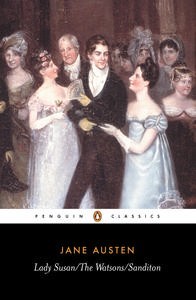
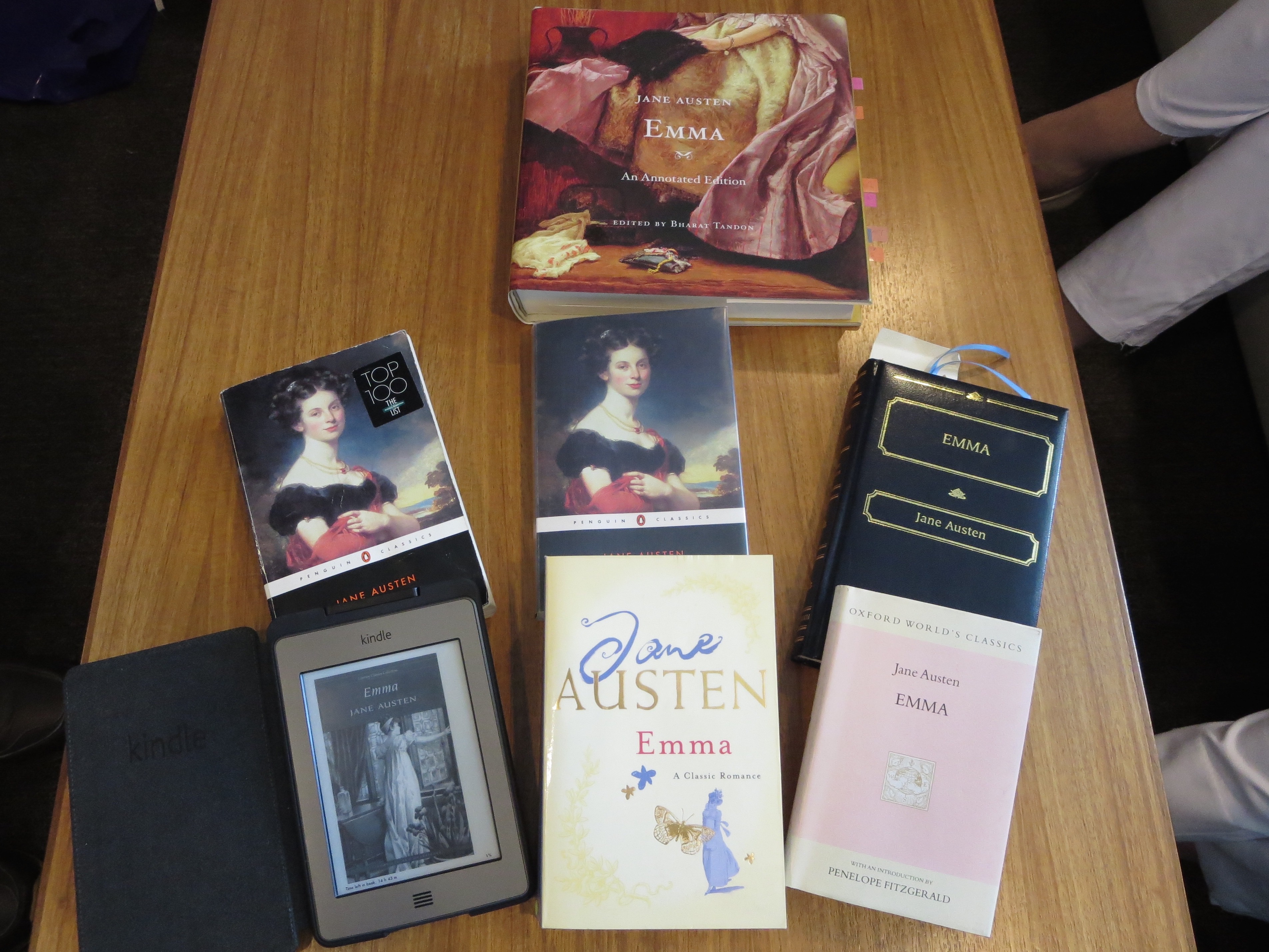
AustenLadySusanPenguinIt is a truth universally acknowledged – I know this is a tired old joke but I seem programmed to do it – that Jane Austen fans will collect multiple editions of her works. There are many reasons for this behaviour, but one of them is our interest in different introductions. And so, although I already had a copy of Lady Susan, in the Minor works volume of R.W. Chapman’s The Oxford Illustrated Jane Austen, I bought the Penguin edition for my Kindle because it had an introduction by Margaret Drabble. And I have a second confession to make: this is a rereading, but my reason for rereading has little to do with the reasons I gave in my recent post on Flanagan. The reason is simple – my local Jane Austen group decided to schedule it for our October meeting. I was happy with that. As far as I’m concerned all bets are off my usual “rules” when it comes to Jane Austen.

If you’re not an Austen fan, you may not have heard of Lady Susan. It is a complete novella that sits between her Juvenilia and her adult novels. It was written, we believe, in 1793/4 when Austen would have been 18-19 years old, but was not published until 1871, well after her death, when her nephew James Edward Austen-Leigh included it in his memoir of her.  It is epistolary in form, something she tried again with Elinor and Marianne. While this latter one she rewrote in her well-known third person omniscient voice, retitling it Sense and sensibility, for some reason she didn’t go back to Lady Susan. One reason might have been its subject matter.

 “the most accomplished coquette in England” (Reginald of Lady Susan)

Lady Susan is a beautiful, 35-year-old widow of four months, who is already on the prowl for a new, wealthy husband. The novel opens with her needing to leave Langford, where she’d been staying with the Manwarings, because she was having an affair with the married man of the house, and had seduced his sister’s suitor, Sir James Martin. She goes to stay with her brother-in-law Charles Vernon and his wife Catherine, whom she’d done her best to dissuade him from marrying. She’s not long there before Reginald, Catherine’s brother, arrives to check her out because, from what he’s heard,

Lady Susan possesses a degree of captivating deceit which must be pleasing to witness and detect.

Of course, the inevitable happens and the artful Lady Susan captivates him. Meanwhile, Lady Susan wants her 16-year-old daughter, Frederica, to marry Sir James, the man she’d seduced away from Miss Manwaring – but sweet, sensible Frederica wants none of this weak “rattle” of a man.

You’ve probably worked out by now that this is not Austen’s usual fare. Lady Susan belongs to the 18th century tradition of wickedness, lasciviousness and adultery, forced marriages, and moralistic resolutions. The novel’s characters tend to be types rather than complex beings, and it is racily written, with a broad brush rather than a fine pen. And yet …

“Lady Susan is not wholly a villain” (Margaret Drabble)

This is also where Austen’s mature touch starts to appear. For all Lady Susan’s self-centred “bewitching” machinations, she is also, as Drabble says, “witty, energetic, intelligent and charming”. Drabble and other critics argue that Lady Susan’s spirit can be seen in characters like Elizabeth Bennet, Emma Woodhouse and, particularly, Mary Crawford who, like Lady Susan, comes from London where she moved in “fast” circles. How could a teenaged country parson’s daughter imagine into being such a duplicitous character? Austen was, we know, a great reader and read the gothic novels of her day. She also knew the behaviour of Mrs Craven, the mother of her neighbour Mrs Lloyd. According to Drabble, Mrs Craven “had treated her daughters shockingly, locking them up, beating them and starving them, until they ran away from home …” just as Lady Susan’s daughter ran away from school. And, as her letters demonstrate, Austen was capable of bite.

We don’t know why Austen didn’t pursue this book, besides making a good copy of it in 1805, or why she didn’t try again to write about a beautiful 35-year-old widow.

Hints of what’s to come

All this is well and good, and I loved the read, but my main reason for reading these early Austens is their insight into the writer to come – her wit and irony, and her commentary on human nature. Lady Susan, having been written on the cusp of her maturity, is particularly interesting in this context. The melodrama, for example, is toned down, compared with the books Austen would have been reading. Frederica isn’t locked up as she might have been in Walpole’s Castle of Otranto (my review), there are no rapes as we see in Richardson’s Clarissa. Austen is moving, in other words, towards the naturalism of her favourite topic, “3 or 4 families in a Country Village”.

I love Austen’s irony, and there’s plenty in evidence here. A good example is when Reginald, completely convinced by Lady Susan, writes to his father of how she has been misrepresented, saying that this

may also convince us how little the general report of any one ought to be credited … I blame myself severely for having so easily believed the scandalous tales invented.

The joke is on him because, of course, he should believe these “scandalous tales”. One of the complexities of the novel is this issue of gossip – who should believe what and whom? As Austen readers know, gossip plays a significant role in her characterisation and plots.

Other ideas and themes that we see in later novels also appear in Lady Susan. Bad mothering is one. Another, more specific, is this delightful comment on accomplishments, reminding us of the discussion between Mr Darcy, Miss Bingley and Elizabeth at Netherfield. Lady Susan writes to her equally scheming friend Alicia Johnson:

Not that I am an advocate for the prevailing fashion of acquiring a perfect knowledge in all the languages arts and sciences; it is throwing time away; to be mistress of French, Italian, German, music, singing, drawing etc., will gain a woman some applause, but will not add one lover to her list.

And then there’s that main reason I love Austen – her terse, pithy commentary on human behaviour. There’s much in Lady Susan, including

but where there is a disposition to dislike a motive will never be wanting

and

Silly woman, to expect constancy from so charming a man!

Have I convinced you to give it a go? I do hope so.

Jane Austen
“Lady Susan”
in Lady Susan, The Watsons, Sanditon
London: Penguin Books, 2003
Kindle Edition EISBN: 9780141907901

Available in e-text.

Annabel Smith, The Ark (Review)

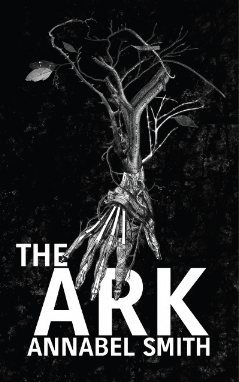
SmithArkSelfPubI must start by thanking Western Australian short story writer Glen Hunting* for recommending Annabel Smith’s The Ark in his comment on a recent Monday Musings post. Hunting wrote that it “is self-published and available as a print book, e-book, app, and has its own interactive website”. I was intrigued so checked it out. My initial reaction was “hmm, is this for me?” But, I’ve wanted to read Smith for a while, so decided where better to start than with this innovative project? I bought the iPad app version and was entertained from the first page. Lisa (ANZLitLovers), who reviewed it just after I started reading it, felt the same.

The Ark is, for want of a better description, dystopian speculative fiction presented in the form of a modern epistolary novel with interactive options. I say “modern” epistolary because the story is told through a variety of textual communications – emails, a blog, memos, reports, minutes of meetings, and news articles. It is divided into two books, of which the first is told, sequentially, through four characters, one on the outside followed by three inhabitants – Kirk Longrigg, CEO of SynBioTec Australia which established the Ark; Ava, a wife, mother and deferred PhD student-expert on despots; Roscoe, the 15-year old son of futurologist Mia; and Pilot, a botanist. At different points in the book we are invited to investigate the Ark via links though which we can tour the bunker, hear the inhabitants, add our own contributions or fan-fiction. I liked the graphics used to depict the Ark, but didn’t spend a lot of time exploring these interactive elements. I suspect different readers, depending on their interests, will behave very differently in this regard. Perhaps game-players will engage more with the interactive features? The good thing is that the book is flexible. It’s not necessary to engage in these digressions, but it can, I’m sure, enhance your enjoyment if you are so inclined.

Roscoe's Blog

Roscoe’s Blog

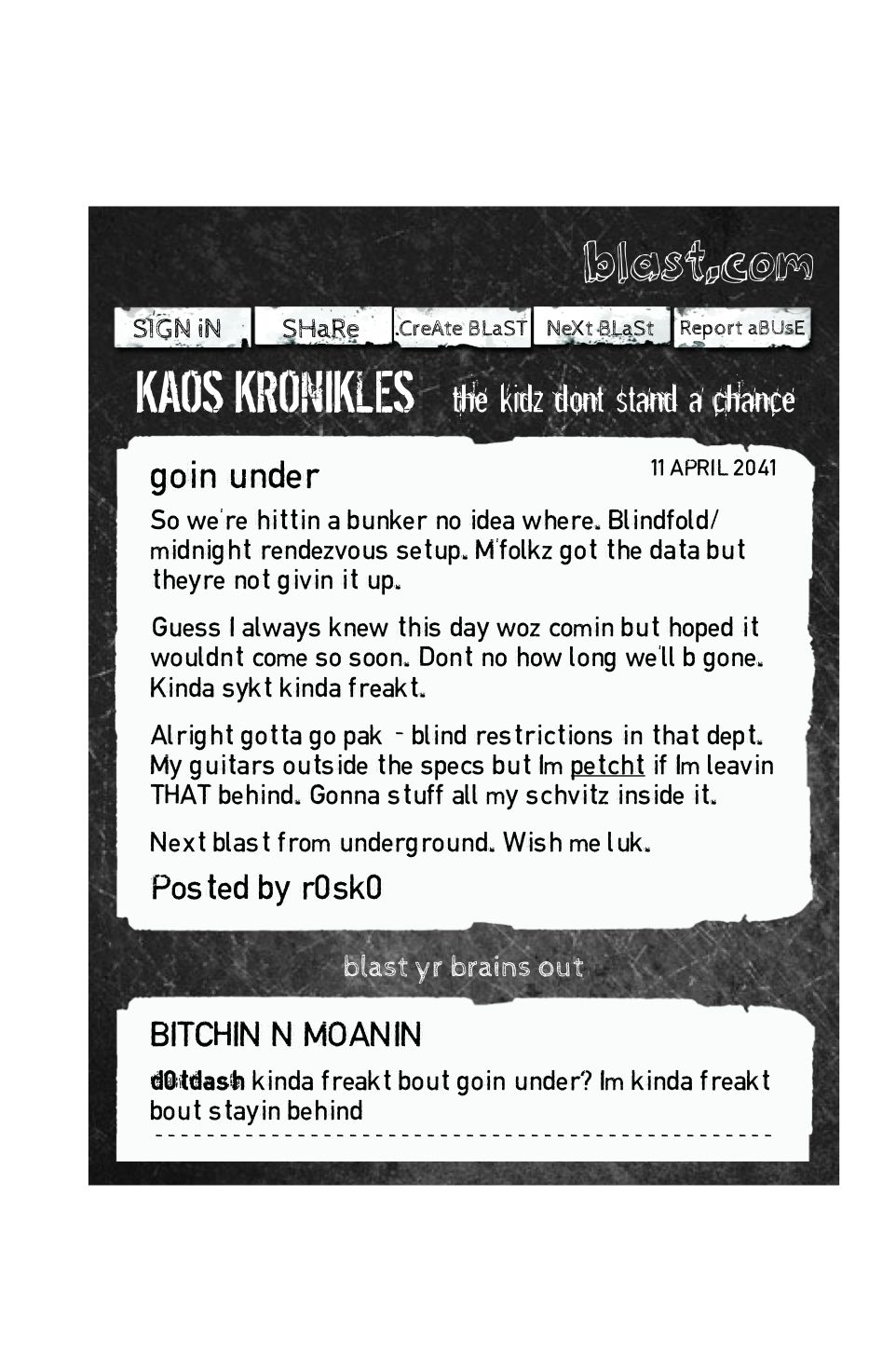
Not surprisingly, an important element of the book is its design. Each different type of communication has its own visual style – the “dailemails”, the more private person-to-person “Gopher”, the supposedly secure “Headless Horseman”, Roscoe’s “Kaos Kronikles” blog, BLiPPs, and so on. Once these become familiar, they signpost the context in which each communication is occurring. As I was reading, I couldn’t help thinking what fun Smith must have had coming up with all the names and acronyms (like GARDEN, the Growth Apparatus for Regenerative Development of Edible Nourishment) used in the Ark.

But please, I hear you asking by now, what is it all about? The story is set between 2041 and 2043, but commences with a brief newspaper report in 2093 announcing that:

Seventeen people have been recovered from a bunker built into Mount Kosciuszko in south-east Australia, where they have been living in total isolation for almost five decades, since the government collapse in the wake of the post-peak oil chaos in 2041.

There is more to the Ark than that though. It was not principally about saving people – as the presence of the botanist may clue you into. The Ark was in fact a seed bank or “National Arboreal Protection Facility” aimed at preserving seeds for an uncertain future. This aspect of the novel reflects Smith’s concern about climate change, something that is reinforced when we discover that the Mount Kosciuszko area in Australia’s high snow country is now rife with sandstorms! But, there is another theme to this novel, besides this specific climate change one. It’s a more universal one to do with charismatic-cum-despotic leaders. Consequently, it is Ava, the expert in despots, who is the first of the inhabitants to carry the story after Kirk’s opening section which concerns a disagreement between him and the Ark’s project manager, Aidan Fox, regarding Aidan’s unauthorised lockdown of the site for security reasons. For some time, we don’t know who to believe. Smith complicates the issue by Ava’s possibly being unreliable due to having suffered mental problems in the past.

Anyhow, the plot thickens. There’s adultery, a few deaths, and some excursions outside. As more things start to go wrong, conflicts arise regarding freedom and human rights versus security… It’s clever, but believable, and fits comfortably with other dystopian novels about people trapped in isolated locations or in alien futures, and it also draws on what we know about the experience of people in religious cults.

This is a plot and ideas-driven novel rather than a character-based one, which is partly due to Smith’s goals and the genre she is working in, and partly a factor of the multi-voice epistolary form which does not lend itself to in-depth characterisation. I say this, though, not as a criticism. It’s a good read, and doesn’t suffer for this lack of character focus, much as I love character-driven novels. It’s just that the characters are generally more “types” than fully realised individuals – the conniving henchman, the willing nurturer, the trusting hardworking followers, the loyal but open-minded offsider. There is, too, an opening for a sequel that could explore, for example, how the seventeen members engage with the world they enter (or reenter) in 2093.

As regular readers know, I’m not a keen e-Book reader. I’ve read a few books on my Kindle, but this was the first complete book I have read on my iPad. It was fine, partly because the form did not mean pages of dense text to confront on a glary screen, but I was disappointed that although I could bookmark pages of interest, I could not make notes on the text as I can on the Kindle or on “regular” books on the iPad. I do like my marginalia, but I guess it’s dependent on how the content is generated. Oh well.

Have I told you enough? I hope so. It’s well worth a read if you like dystopian fiction and/or if you are interested in experiencing different ways of telling stories in our digital world. I’d never want straight prose novels to disappear – and I don’t believe they will – but the arts should also be about experimenting and playing with boundaries, and this is what Smith has done here. Good for her.

awwchallenge2014Annabel Smith
The Ark
Self-published, 2014
ISBN: 9780646923109

* Glen Hunting’s story “Martha and the Lesters” appeared in Knitting and other stories, which I reviewed a few months ago.

Richard Flanagan: The narrow road to the deep north (Review)

Courtesy: Random House Australia

Courtesy: Random House Australia

I love generosity of spirit, the ability to rise above terrible things to see the humanity that lies beneath. Richard Flanagan’s Booker Prize shortlisted The narrow road to the deep north is, without being sentimental or glossing over the horror, a generous book – and this is why I expect it will be one of those books I’ll remember long into the future.

I know I’m late reading it – but this is because I’ve been saving it until my reading group did it, which was earlier this week. Consequently, I spent the last few days of September engrossed in the life of Dorrigo Evans, war-hero, lover of poetry (and of too many women), and, most significantly, POW from the Thai-Burma Railway. It’s one hell of a tale … and not exactly what I expected.

On the surface, Dorrigo had a successful life. He survived the POW camp for one thing, was highly regarded in his career, became a war-hero celebrity due to a documentary (loved this!), and had a long-lasting marriage with three children. But, this is not the full story. Chapter 2 of Book 1, commences:

A happy man has no past, while an unhappy man has nothing else. Dorrigo Evans never knew if he had read this or made it up. Made up, mixed up and broken down. Relentlessly broken down.

This sounds like it could be PTSD, but it’s not. PTSD is important, of course, but Flanagan is interested in broader issues. In many ways the book feels like a big 19th century novel – it has lots of characters, spans a long time-frame, doesn’t shy from coincidences, and explores big themes – but in style, it’s very contemporary, with frequent shifts in time and place, and multiple third-person subjective points of view. It requires concentration to get all the connections, and would benefit from a second reading. Just the sort of book I enjoy getting my teeth into.

I said in my opening paragraph that the book wasn’t exactly what I expected. That’s because I was expecting more war, and perhaps more anger, than I found. There is war, of course, much of it gruesome, as fits the “truth” of that situation, but the main thread is a love story, accompanied by meditations on ideas like truth, goodness and manhood. I can’t possibly discuss all these or we’ll be here forever, so I’m just going to focus on a couple.

“to somehow be more truthful as a human being” (Nakamura)

One of the novel’s strengths is the balance Flanagan strikes between brutality and humanity. He does this partly by paralleling the life of Dorrigo, the commanding officer of the POWs, with Nakamura, the commanding Japanese officer. Nakamura is the enemy but isn’t vilified as you’d expect. Flanagan shows Nakamura to be brutal towards prisoners but we also get inside his head. We learn that he is not comfortable in his own skin – he is, in fact, addicted to shabu (speed) – and that he needs his superiors’ arguments to convince himself of the right of what he is doing. That he is able to do so – that is, to buy completely into the notion of the “Japanese spirit”, into the Emperor’s goals of “The World Under One Roof” – is believable. What soldiers don’t buy into their nation’s “mythology” (whatever it is based on)?

Flanagan follows Nakamura post-war until his death, as he endeavours to rebuild his life – firstly under a false identity to escape being tried as a war-criminal, and later as himself, married and a father. He struggles to define himself – and is surprised to feel himself transformed into “a good man”. A decade or so after the war, his memory of his brutality fades:

time … allowed his memory instead to nurture stories of goodness and extenuating circumstance.

However, when he is dying, he finds it increasingly difficult to hold onto “his idea of his own goodness”. Comparing this goodness with that of his wife, it comes “close to collapsing altogether”. He searches for the “good things in his life — separate of the Emperor’s will, of orders and authority” but finds they are few when compared with his memory of “skeletal creatures crawling through the mud”. His death poem, concluding with “clear is my heart”, is tinged with irony, but reflects his desire “to conceive of his life’s work as that of a good man”.

By contrast, Dorrigo believes himself not to be a good man, to be “entirely bogus”. He marries a woman he doesn’t love, believing his true love to be dead:

For the rest of his life he would yield to circumstance and expectation, coming to call these strange weights duty. The guiltier he felt about his failure first as a husband and later as a father, the more desperately he tried to do only what was good in his public life. And what was good, what was duty, what was ever that most convenient escape that was conveniently inescapable, was what other people expected.

And yet, he’s a “war hero” and validly so. At one point on the Railway, when they are all starving, he refuses to eat some steak. Rather, he sends it back to the men, having “found himself the leader of a thousand men* who were strangely leading him to be all the many things he was not”. This is not false modesty – the men did bring out his best – and yet this modesty is not completely valid either because Dorrigo did have good in him. He was a man prepared to take action for others, at risk to himself. In his last comatose days, he feels that his life had “only ever been shame and loss”, but his final words are words of action, alluding, self-deprecatingly perhaps, to Don Quixote’s windmill but also reminding us of the last line of the poem that defined him, Tennyson’s “Ulysses” – “to strive, to seek, to find, and not to yield”.

 “a poem is not a law” (Bonox Baker)

Two other notions run through the novel – and I’ve already alluded to them both – the love of literature, particularly poetry, and the workings of memory. One scene in particular brings these ideas together. It concerns the funeral pyre for some cholera victims, who include the artist Rabbit Hendricks. When cholera victims are burnt, their personal belongings must also be burnt, but Bonox Baker wants to save Rabbit’s sketchbook because:

it’s a record … So people in the future would, well, know. Remember, that’s what Rabbit wanted. That people will remember what happened here. To us.

Dorrigo quotes from Kipling’s poem, “Recessional”, arguing that everything is forgotten in the end, that it’s better to just live. Bonox disagrees, telling Dorrigo that

A poem is not a law. It’s not fate Sir.
No, Dorrigo Evans said, though for him, he realised with a shock, it more or less was.

For Dorrigo, for Nakamura and for his commanding officer, Colonel Kota, poetry is essential in some way to their lives. Dorrigo, who lived at a time “when a life could be conceived and lived in the image of poetry” eventually finds himself “living in the shadow of a single poem”, while for Nakamura poetry emulates “the Japanese spirit” by which he tries to justify or explain his actions.

Bonox, though, is interested in something else. He continues to argue with Dorrigo about the sketchbook:

Memory is the true justice, sir.
Or, the creator of new horrors. Memory’s only like justice, Bonox, because it’s another wrong idea that makes people feel right.

And so we come to one of the paradoxes that Flanagan exposes in the book – individual memory versus the memory industry. Dorrigo is outed as a war hero through a documentary, which makes him uncomfortable, and yet “to deny the reverence seemed to insult the memory of those who had died”. The memory industry, however, too often ignores the “truth” of the experience in preference for the facts, as bugle-player Jimmy Bigelow discovers:

His sons corrected his memories more and more. What the hell did they know? Apparently a lot more than him. Historians, journalists, documentary makers, even his own bloody family pointing out errors, inconsistencies, lapses and straight out contradictions in his varying accounts. Who was he meant to be? The Encyclopaedia bloody Britannica? … His words and memories were nothing. Everything was in him. Could they not see that? Could they not just let him be?

Paradoxically, Flanagan is questioning the memory industry while at the same time contributing to it. And it is a powerful contribution. Just goes to show the power of literature!

This is a big messy novel, about the two messiest things humanity confronts – love and war. I love its messiness, its lack of answers, but it sure made it hard to write about. Fortunately, Lisa at ANZLitLovers and John at Musings of a Literary Dilettante have also given it a go.

Richard Flanagan
The narrow road to the deep north
North Sydney: Vintage Books, 2013
ISBN: 9781741666700
466p.

* Aussie readers will recognise Flanagan’s reference here to Weary Dunlop.