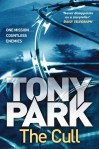
Tony Park, The cull (#MiniBookReview based on a Guest Read)

Tony Park, The cullWhen Tony Park’s The cull was sent to me for review last September, I knew it wasn’t really within my normal ambit but every now and then I try something new, so thought I might give it a go. However, as time passed and more books came, I realised that I had to let it go. But, it occurred to me that Mr Gums, whose reading preferences are a little different to mine, might like to read it during our annual Snowy Mountains getaway. He thought he might so, leaving aside his German translation of Pride and prejudice (which he was reading for the second time), he took it away with him – and enjoyed it, overall.

Some of you may know who Tony Park is, but I have to admit that I didn’t – beyond recognising his name from bookshop shelves – even though The cull is his fourteenth novel! He was born in Sydney, and has worked, according to the media release, “as a reporter, a press secretary, a PR consultant and a freelance writer”. He is a major in the Australian Army Reserve and in 2002 served as a public relations officer in Afghanistan. And, here’s the most relevant bit to this book, he and his wife split their time between Australia and southern Africa where they own a home on the edge of Kruger National Park. He is also, the Media Release says, a volunteer with Veterans for Wildlife, which “pairs military veterans with anti-poaching units and conservation programs in Africa.”

And this is where I should finally talk about the book. It concerns former mercenary Sonja Kurtz, who has apparently appeared in other books by Park. She is hired by a (female, in fact) business tycoon to head a squad whose ostensible task is to gain intelligence about poachers but she ultimately finds herself involved in a full-scale assault against the “poaching kingpins”. In other words, it’s a novel which marries his military experience with his involvement in supporting African wildlife. The Media Release says that Park describes “the job of protecting wildlife” as “a high-risk, high stakes business”. Rhino horn is now worth more than “gold, diamonds or cocaine”.

So what did Mr Gums think? “Pretty good fun”, he says. Like me, he’s not an expert in the crime-action-thriller genres, but he’s read the odd one over the years, including, last year, Tony Jones’ The twentieth man. He thought the characters were well drawn for the genre, and that the writing was engaging and kept him interested. It was full of “gadgets and guns” which entertained him, but had perhaps “unnecessarily detailed descriptions of the sex”. However, that’s part of these sorts of genre books today isn’t it? You find it in movies of these genres too.

Overall, though, it was the theme of protecting African wildlife and environment that made it particularly interesting for him – just as Jones’ exploration of Australia’s first terrorist bombing kept him engaged in that novel. This is what would have drawn me to the book too, if I’d been able to prioritise the read.

And so, that’s about it – except there’s one interesting little thing to add, and it concerns naming rights. I’ll quote from the Acknowledgements at the end:

As with previous books, I’ve surrendered the difficult (for me at least), the task of thinking up names for my characters to a number of worthy charities who have sold or auctioned off rights for generous people to have their names assigned to the cast of The cull and raised money for many good causes in the process.

Those good causes are named, and they are a varied lot, including the HEAL Africa Hospital, the Juvenile Diabetes Foundation, the Australian Rhino Project and the Limpopo Rhino Security Group. I, and probably you, have heard about this phenomenon before, but if you haven’t, here is a 2005 article from the Guardian about authors auctioning off names. It starts by asking “Fancy having your name on a gravestone in Neil Gaiman’s next novel? Or meeting your end at the hands of a zombie in Stephen King’s latest?” Hmm, would you want to be immortalised in some of these ways? There is that thin-end-of-the-wedge issue here – as I touched on in my review of Anna Funder’s Paspaley sponsored story Everything precious – but I don’t think we should let this colour actions like Cull’s which result in money for good causes?

And here endeth this mini-review – with a big thanks to Mr Gums for his contribution.

Tony Park
The cull
Sydney: Pan Macmillan Australia, 2017
411pp.
ISBN: 9781743548455

(Review copy courtesy Pan Macmillan Australia)

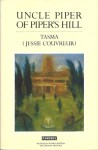
Tasma (Jessie Couvreur), Uncle Piper of Piper’s Hill (#BookReview)

Tasma, Uncle Piper of Piper's Hill

The first thing to say about Tasma’s debut novel Uncle Piper of Piper’s Hill is that it’s rather wordy, speaking to a literacy different from that of today’s readers. For this reason, Uncle Piper won’t appeal to readers who like short simple sentences, and a plot which moves along at a good clip with little reflection or commentary. Consider yourself warned, but know also that, according contemporary reports, this novel made Tasma famous in a week.

So, if you enjoy immersing yourself in the writing of different times, and are interested in late 19th century Australia, Uncle Piper has plenty to offer, starting with well-drawn characters who, in modern clothes, would be as real today as they were in 1888.

Take father, the Uncle Piper of the title, and his son George, for example. Uncle Piper is a self-made man. In his case this involved emigrating from England, where he was poor and with few prospects, to Melbourne, where, starting as a lowly butcher, he worked hard to establish himself as the wealthy, successful businessman he is at the novel’s opening. Now, what often happens when parents struggle to establish themselves and create for their children opportunities that they never had? Why, those children take their easy, comfortable lives for granted. That’s what! Not a new story, is it?

And so, about a third of the way through the novel, we have a wonderful scene between father and son over a girl of whom the father doesn’t approve. Feeding this scene is a two-decade history of growing frustration on Uncle Piper’s part and a learned, practised nonchalance on George’s. The scene is delicious and requires no suspension of disbelief to understand. Here’s a short excerpt of a confrontation in Uncle Piper’s beloved tower at Piper’s Hill:

So he [George] courted a personal attack … and sat caressing his moustache, as was his wont, with his eyes bent on the floor, while his father exposed his grievances in a crescendo key.

If there was anything humiliating in being rated as an “able-bodied young man who wasn’t worth his salt,” as a loafer who was hardly fit to “jackaroo” on a station, as a “lazy lubber” who would “go to the dogs if it weren’t for his father,” George never betrayed that he felt humiliated by so much as the twitching of an eyelid. Persistently stroking the ends of his moustache with an air of profound abstraction, he made it apparent, as soon as Mr. Piper stopped to take breath, that he was suppressing an inclination to yawn.

Can’t you just see it – the increasingly apoplectic father and his determinedly calmly indifferent son!

In basic plot, Uncle Piper of Piper’s Hill is a romance, a marriage story, set against the social backdrop of a meeting between these well-to-do parvenu Pipers, and the impoverished but upper crust Cavendishes. The lowly-born Mrs Cavendish is Uncle Piper’s sister. At the beginning of the novel, the Cavendishes are on a boat being brought out to Australia by Uncle Piper who has, in effect, been supporting them for years and who would now like them with him. He’s offered to find the reluctant Mr Cavendish a job “in the government”. The Cavendishes include two daughters, the kind, unassuming Margaret and her younger sister, the beautiful and imperious Sara. Sara follows her father’s mould of snobbish self-regard trumping any sense of human feeling or empathy, while Margaret is in her mother’s caring and hardworking mould.

Coming out on the same boat is the thirty-something Rev. Lydiat who, unbeknownst to them all, is also connected to the Pipers – this is a nineteenth century novel after all. His now-deceased mother had been Uncle Piper’s second wife. So, the afore-mentioned George is his step-brother, and Uncle Piper’s still-a-child daughter Louey, whom he’d had with the Rev’s mother, is of course his half-sister. But wait, there’s more. Also in Uncle Piper’s household is Laura, the Rev. Lydiat’s sister, whom Uncle Piper had promised his wife, on her deathbed, to care and provide for.

… a house divided against itself …

And now the plot gets complicated – though it’s easy to follow in the book. Rev. Lydiat falls (purely, of course) in love with Sara, while on the boat. And George and Laura, unrelated by blood, are in love. But, Uncle Piper wants George to marry his as-yet-unseen-to-any-of-them cousin Sara. And just to round all this off, Margaret is quietly, humbly, in love with Rev. Lydiat. Lest you give up at this point and think this all sounds a bit silly, let me say that despite its fairly traditional plot of love-triangles and interfering parents, the book has a lot more to offer.

So, where to go from here? There are many angles from which this book could be discussed. Issues like religion, money and class (as I’ve already mentioned), colonial life and the Australian landscape, and even the book’s relevance to Tasma’s biography, are all well worth exploring. I could also have fun teasing out comparisons between this book and Jane Austen’s Persuasion (my review). It’s not hard to see Sir Walter Elliot and his daughter Elizabeth in Mr Cavendish and Sara, or to see Anne Elliot in the capable Margaret. I could also talk about the style, and the influence on the style and tone of its being originally serialised in a newspaper.

However, given my previous reading of Aussie women writers at the time – of Ada Cambridge’s A woman’s friendship and Sisters, and Rosa Praed’s The bond of wedlock – I’d like to mention Tasma’s social commentary, particularly regarding women. Part of the commentary relates to the opportunities offered by Australian life. Uncle Piper’s generosity and capacity for hard work is offset against the snobbery of Mr Cavendish who is happy to take his brother-in-law’s money while continuing to hold himself “above” his host. He is snobbish, selfish and shallow, and by the end of the novel, has learnt nothing. Uncle Piper, on the other hand, along with his son George, learns some lessons and, by the end both have recognised and corrected some of their less tolerant behaviours.

For Uncle Piper much of this change relates to his step-daughter Laura Lydiat. For all his generosity, Uncle Piper has his faults. He can be autocratic, for a start. This does not sit well with the opinionated Laura. She has rejected religion, can be sarcastic, and has an “uncompromising disregard of feelings with which she does not agree”, albeit being very happy to eat at Uncle Piper’s table and wear the clothes he provides! She also does not approve of marriage:

though I abominate the system of marriage, though I think the yoking of two people together without a chance of release–as if the yoke mightn’t gall them any day–perfectly barbarous and absurd–still, in view of our ‘exceptional case’–there, don’t be demonstrative till you’ve heard me to the end–in view, as I said, of our ‘exceptional case,’ I’d have gone off with you to the registrar’s any morning–no, nothing would induce me to go to church–and have signed myself Laura Piper, instead of Laura Lydiat!

MISS THIS IF YOU DON’T WANT TO KNOW WHO MARRIES WHOM …

At the end of the novel, when the also-changed Laura does indeed marry, Tasma compares gentle, dutiful Margaret’s response to the marriage service with Laura’s:

She [Margaret] had followed the service in its most literal sense with all the earnestness of her nature, and would have had no sympathy with the half-perceptible gleam that might have been detected in Laura’s eyes at being called upon to obey George.

START READING HERE AGAIN …

The novel is not, as you can tell from this gentle hint, overtly didactic. There is some running authorial commentary, but the ideas and themes are well conveyed through the story and the characters, who are, for the most part, realistic though there are some saints and sinners among them.

Uncle Piper owes much to the Victorian novel tradition, but one adapted to an Australian setting. The plot overlays a New World made-good story over the more traditional romance narrative. The result is a novel which explores some new ideas about life within a familiar format, which makes it particularly special, I think, for Antipodean readers. Tasma should be read more.

Posted as a contribution to Bill (the Australian Legend)’s Australian Women Writers Gen 1 Week. See also my Monday Musings post this week on Tasma.

AWW Badge 2018

Tasma (Jessie Couvreur)
Uncle Piper of Piper’s Hill: An Australian novel
Project Gutenberg of Australia eBook, 2006
(Originally serialised in The Australasian, 1888; published as a volume, 1889)
Available online at Project Gutenberg of Australia

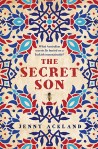
Jenny Ackland, The secret son (#BookReview)

Jenny Ackland, The secret sonMelbourne-based author Jenny Ackland has tried something rather audacious in her debut novel, The Secret Son. Instead of following the autobiographical route that many first novelists do, she has leapt right in and tackled, albeit from left field, one of Australia’s most controversial legends, Ned Kelly. But, here’s the rub: it’s not exactly about Ned Kelly. It’s far more complex than that.

The secret son spans more than a century, from the 1880s to 1990 and beyond. It is set in both Turkey and Australia, and it weaves two stories. One concerns the 19th-century-born James who ends up living in Turkey, having gone to fight at Gallipoli in 1915, and the other tells of Cem, a 23-year-old Turkish-Australian man who is related to the village where James had lived and who travels there in 1990, ostensibly to learn about his heritage and identity. These two men – James/Jim and Cem/”Jem” – work subtly as foils or parallels for each other. James is intelligent, gentle and hardworking, but somewhat passive. He imagines who his father might have been, what sort of man he was. Cem, on the other hand, is young, directionless, well-meaning but rather self-centred. Turkish taxi-driver, Ibrahim, pins his uncertainty immediately, telling him:

You must know who you are and what man you want to become.

What sort of man he wants to become is something Cem struggles with, making this, partly but by no means primarily, a coming-of-age novel.

This brings me to one of the delights in reading this book, which is Ackland’s depiction of life in the Turkish village she calls Hayat (Turkish, she says, for “heart”). It reminded me of some books I read years ago, such as Beverley Farmer’s stories set in a Greek village. Farmer had married a Greek man and lived for some time in Greece, which explained her convincing insight into village life and relationships. Ackland’s depictions were similarly convincing, so I wanted to know how she’d done it. I found the answer in an ABC Books and Arts interview with her. She too had travelled to Turkey, married a Turkish man, spent time there as a bride and young mother. With this knowledge and experience, and an ability to individuate characters, Ackland creates a world that engaged me.

But now you are probably wondering how Ned Kelly fits into all this. It has to do with a historian named Harry whom Cem meets on the plane. Harry has a theory that Ned Kelly had a secret son who fought at Gallipoli and ended up staying in Turkey. His quest is to prove this theory and, in one of those coincidences that all travellers know about, the village where he believes this son went to is the same one that Cem’s family was from. So the scene is set – but the story that unfolds has less to do with Ned Kelly than with families and secrets, paying debts, and growing up.

I started this post by saying that Ackland has been audacious in this, her debut novel, and I implied that it was because of the Ned Kelly plotline. However, her audaciousness extends beyond this. It’s in the novel’s complex structure, too, in the way she weaves the two men’s stories, to-ing and fro-ing in time. It’s in the recurring motifs like bees and honey, tea and sugar, and woven rugs, that she uses to help keep us grounded. And it’s particularly in the change of voice between the more traditional third person voice used for most of the story to first person for the perspective of Berna, who is the village’s wise woman-cum-fortune-teller. Berna also happens to be Cem’s grandmother and James’ daughter, which effectively connects the two story lines. (The family relationships in this book are, I must say, complicated, and require an attentive reader to keep track!)

Anyhow, Berna provides the main link in the novel’s second plot which is about the “debt” Cem discovers he is expected to pay for something his grandfather Ahmet had done long before he’d left the village for Australia. This plotline exposes dissension in the village, and through it Ackland explores ideas about love and loyalty, truth and lies, revenge and forgiveness, not to mention the application of wisdom versus tradition. As the novel progresses, more of the “truth” about what happened comes out, and the plot thickens as we wonder what will be asked of Cem and what he will do in response. Meanwhile, the Ned Kelly storyline weaves its own path between James, Harry, and the village with the help of a woman pilot called Linda. While complex, it’s sensitively done, with, in the end, enough resolution to be satisfying without being too neat and implausible.

There are many angles from which this book can be talked about, besides those I’ve mentioned. There’s a father-son theme, a cheeky metafictional theme about a book called The secret son, Cem’s family experience in Australia as a child of immigrants, and gender. There’s also the idea of debts due by later generations, which Berna argues is not valid, but which her brother Mehmet supports. It’s relevant, I think, that Berna has the last word in the novel.

Early on Berna tells us that “truth” is not the be-all, that sometimes “life is better with surprises in the recipe”. She’s a wise woman, and this, The secret son, is a wise book. It might be a debut novel, and it might push its readers to keep up at times, but the ideas it explores, and its tolerant, generous treatment of its flawed characters, are those of a humane writer.

Lisa (ANZLitLovers) was impressed by the book too.

AWW Badge 2018Jenny Ackland
The secret son
Sydney: Allen & Unwin, 2015
327pp.
ISBN: 9781925266160

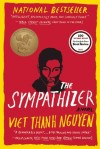
Viet Thanh Nguyen, The sympathizer (#BookReview)

Viet Thanh Nguyen, The sympathizerA cover blurb on my edition of Viet Thanh Nguyen’s Pulitzer Prize winning novel, The Sympathizer, captures the novel perfectly when it calls it “intelligent, relentlessly paced, and savagely funny” (Wall Street Journal). I loved reading it. It’s quite coincidental that I read this straight after Hoa Pham’s Lady of the realm (my review) but they make an interesting pairing because both deal with the Vietnam (or American) War and its aftermath, both are written in first person from a Vietnamese character’s point of view, and both question what happens when revolutions win. But, their approaches couldn’t be more different.

The sympathizer starts with an in-your-face statement by a never-named narrator: “I am a spy, a sleeper, a spook, a man of two faces.” It is April 1975 and the war has ended with the capture of Saigon by the North Vietnamese Army, but in the second paragraph we discover something else about our narrator. He is not talking to us but to a “Commandant”. So, where is he, and why is he talking to a Commandant? We don’t fully find out until near the end, although we soon discover that he is being held captive and is writing his “confession”. The story he tells, the story we read, is his confession. And what he confesses to is his life as a North Vietnamese mole in the close employ of a South Vietnamese General.

In this role, he leaves Saigon in the chaotic evacuation and ends up in Southern California, still working (now unpaid) for the General, while at the same time sending covert reports back to his “aunt” in Paris. In other words, in the USA, he maintains his life as a man of “two faces”, a man who is “able to see any issues from both sides”. He can do this, not only because of his role as a mole, but also because he is a bastard, the son of a Vietnamese woman and a French priest who had seduced her and had never acknowledged his son. With feet in both camps – the Orient and the Occident – he is well-placed to comment on their respective cultures and actions while, at the same time, symbolising their conflicts, confusions and misunderstandings. Near the end he says:

I was always ever divided, although it was only partially my fault. While I chose to live two lives and be a man of two minds, it was hard not to, given how people had always called me a bastard. Our country itself was cursed, bastardised, partitioned into north and south, and if it could be said of us that we chose division and death in our uncivil war, that was also only partially true. We had not chosen to be debased by the French, to be divided by them into an unholy trinity of north, centre and south, to be turned over to the great powers of capitalism and communism for further bisection …

What makes this book such a great read – besides its heart and themes – is its writing. Nguyen migrated to the USA with his parents when he was 4 years old. In the notes at the back of my edition, he describes growing up in a Vietnamese enclave in California, and how he’d decided that he couldn’t live life well with two languages, so decided to “master one and ignore the other. But in mastering that language and its culture, I learned too well how Americans viewed Vietnamese”. This seems to the main driver for this book – to tell a story about the Vietnam War from a Vietnamese perspective – but his aim is wider than that too. It is to comment on war, on its futility, and on the way American culture seems to thrive on it.

The first chapter introduces us to the central feature of Nguyen’s writing, satire, and my, it shows how well he mastered his adopted language. If the pace is relentless, as the Wall Street Journal says, so is the satire. Its targets are broad, and non-discriminatory, though, admittedly, American life and culture bear the major brunt. In Chapter 3, he discusses prostitution:

I am merely noting that the creation of native prostitutes to service foreign privates is an inevitable outcome of a war of occupation, one of those nasty little side effects of defending freedom that all the wives, sisters, girlfriends, mothers, pastors, and politicians in Smallville, USA, pretend to ignore behind waxed and buffed wall of teeth as they welcome their soldiers home, ready to treat any unmentionable afflictions with the penicillin of American goodness.

The language is sly and wry, as our narrator of the divided-soul teases us – provokes us – again and again with dualities and paradoxes. Literally, he is a communist sympathiser, but his true sympathies are broader. “Although it’s not correct, politically speaking”, he says, he feels “sympathy” for the South Vietnamese poor who were attacked by their own soldiers. “No one asks poor people if they want war”, he writes.

And so the book continues. There are comic set-pieces such as his role as a Vietnamese expert on the making of a film that reads very much like Apocalypse Now. The experience teaches him that not controlling the way you are represented results in “a kind of death”. There are also awful scenes of torture and violence, including those where he is ordered by the General, even in the USA, to eliminate apparent opponents. He says of the General’s plans:

The General’s men, by preparing themselves to invade our communist homeland, were in fact turning themselves into new Americans. After all, nothing was more American than wielding a gun and committing oneself to die for freedom and independence, unless it was wielding that gun to take away someone else’s freedom and independence.

This idea of “freedom and independence” is the complex conundrum that underpins the fundamental irony of the book, from its opening chapters when Ho Chi Minh is quoted as saying “Nothing is more important than independence and freedom”. What these mean, what people do in their name, and why so often they are taken away by the very people who called for them, are scrutinised by Nguyen via his narrator.

The sympathizer is, in many ways, a bitter novel, because it sees clearly into the human heart, and its messy, divided nature, its “moth-eaten moral covers” – but the bitterness is offset by a sense of resilience and a belief that it need not be like this. A big thanks to my Californian friend Carolyn for sending me this.

Lisa (ANZLitLovers) was also impressed by this novel.

Viet Thanh Nguyen,
The sympathizer
New York: Grove Press, 2015
382pp.
ISBN: 9780802124944

Hoa Pham, Lady of the realm (#BookReview)

Hoa Pham, Lady of the realm

Hoa Pham was one of the participants at the recent Boundless Festival (my post), so it’s rather apposite that her latest work, Lady of the realm, popped up as my next review copy. The very brief author bio on the Festival site describes the novel as “about a Buddhist clairvoyant in Vietnam”. Well, it is, but it’s about far more than that too.

Vietnamese-Australian Hoa Pham was born in Hobart after her Vietnamese parents went there to study in the 1970s. She has written several novels, children’s books, plays and short stories, but her novella, Lady of the Realm, is the first that I’ve read. It’s a slim book, a novella in fact, told first person in a chronological sequence that covers nearly five decades from 1962 to 2009. If you know your south-east Asian history, you’ll realise that this time-span starts during the Vietnam or American War (depending on your perspective.)

It’s quite a challenge to cover such a long and tumultuous period in less than 90 pages, but Pham achieves it by keeping her focus tight – to the experience of the Buddhist monk Liên. Before we meet her formally though, there is a short prologue, which is also in her voice, albeit unknown to us at that point. She prepares us for the vignette-style in which she tells her story:

Looking back over the years, it seems that time stretches and contracts, depending on my experience of each moment. Some moments are etched in my memory, like the sunlight patterning the water in the river, ethereal moments captured only by my mind. Other longer stretches of time are a blur ….

This makes perfect sense to me in terms of how we remember our lives, and hence works for telling a story that covers a long life in a turbulent place. However, if you are someone who likes to get lost in a character and the ongoing drama of life, this book may not work for you.

So, Liên. She is introduced in 1962 as a young girl who has a prescient dream that the Viet Minh will come and destroy her fishing village. This marks her as the one to succeed her grandmother Bà as keeper of the shrine and mouthpiece for the Lady of the Realm (as she calls the Buddhist goddess of mercy, Quan Ám). Unfortunately, the village head ignores the warning, and the village is attacked with most in the village killed. Liên, however, escapes, and lives to chronicle the aftermath.

The book then takes us through moments in Liên’s, and therefore Vietnam’s, life in 1968, 1980, 1991 and 2007, before finishing in 2009 when Liên is now an old woman living in a Buddhist monastery. She has experienced much violence and oppression – through the war and the “fall of Saigon”, through the Communist regime which she “naively believed” would bring peace but which brought “re-education” and more death, and through later “reforms” which were supposed to open up Vietnam but saw her beloved Prajna Monastery destroyed. Liên survives it all, sustained by hope:

Ever hidden away the Lady could still bring hope, I thought. I had found the Lady in many guises, but the strongest seemed to be the Lady I had inside. (1980)

This hope is sorely tested, however, and in the last section she says:

Sanctuaries are an illusion, only suffering is real. I know that this is not what Buddha taught, and my experience has made my own sayings out of his teachings. I believe that any safety I find is temporary, any refuge is not permanent. But my teacher would say, all things are impermanent and change. I hope that our situation will change. Some days I cannot bear another moment of being under siege. (2009)

The tone, here, is typical of the book as a whole – calm, somewhat resigned, and sometimes hopeful.

Now, how to describe the writing? There’s the tone, and there’s Pham’s simple, direct language (which is also evidenced in the above excerpt). There’s also her preponderant use of short paragraphs. And there’s the episodic form, with each episode/year heralded by an epigraph, the last four by Buddhist monk and peace activist, Thích Nhất Hạnh. Together, these create a sort of prose-poem, and with that, dare I venture, a higher (or perhaps just universal) plane of truth!

In other words, Pham has contrived to tell a personal, human story through her character Liên, while also conveying a philosophical attitude to life based on endurance, compassion and most of all hope. A moving, inspiring read.

Lisa (ANZLitLovers) captures the book beautifully in her review.

aww2017 badge

Hoa Pham
Lady of the realm
Mission Beach: Spinifex Press, 2017
98pp.
ISBN: 9781925581133

(Review copy courtesy Spinifex Press)

Anosh Irani, The parcel (#BookReview)

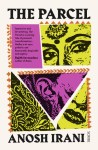
Anos Irani, The scribeOne of the main reasons I read is to enter worlds unknown to me – physical worlds and more interior or personal ones. Anosh Irani’s novel The parcel meets this criterion perfectly. It is set in the Kamathipura red-light district of Bombay/Mumbai, and its main character is a eunuch, or hijra, named Madhu. Brought up as a boy, but never comfortable with that gender, teased and ostracised for his feminine walk, he joins the hijra world at 14 years of age. When we first meet her, though, she’s forty.

The novel opens with a first-person prologue from Madhu, who describes herself as “neither here nor there … neither man nor woman”. It’s clear that she’s at a crossroads in her life, just as Kamathipura is, with the developers moving in and AIDS wreaking havoc. The novel then moves to third person subjective, but still with Madhu who remains our guide until the first person epilogue. It’s a clever structure: it ensures that we are immediately engaged, but then facilitates a narrative that shifts easily between present and past, as Madhu goes through her days while reconsidering her life.

From the beginning, we see that Madhu is deeply unhappy. She is and always has been “a shivering, jittery soul trapped in the wrong body”. She starts her day smoking a beedi, which she flicks away:

She smiled as the beedi disappeared into a gutter. Even dead cigarettes wanted to get away from her as soon as possible.

As the first chapter progresses, we feel Madhu’s pain. She’s forty, no longer in her prime, relegated from being her brothel’s most sought-after prostitute to a mangti hijara, a beggar peddling blessings. She’s grateful to gurumai, the now-failing hijra brothel madam, for taking her in, but she mourns her family who had never given her the love and acceptance she craved. More and more her thoughts turn to them and to her decision to leave when she was fourteen.

“an act of compassion”

It’s important that Madhu be established for us as a figure of pathos, as a character we care about, because by the end of the first chapter we meet “the parcel”, a young 10-year-old virgin girl from Nepal sold by her aunt into sex-slavery. Madhu’s job is to prepare her for her “opening” by the man who has paid for her. It’s a horrific and shocking start to a novel which explores the murky morality of human beings – and we are now attached to Madhu. What are we to think?

Madhu and the parcel are not the only characters, of course. Irani creates a community of people surrounding them – the prostitutes, the brothel madams, the hijra leaders, and Madhu’s ex-lover and dearest friend Gajja. While there is warmth, trust, and loyalty between many of the characters, overall it is a devastating picture of marginalised people who struggle to survive in a world where survival, no matter how or in what form, is all there is.

This is a character-driven novel. We are acutely aware not only of Madhu’s inner conflict, but of her fundamental decency, and her desire to reduce the pain of those around her. This is why she had taken on parcel work many years previously. She’d seen the cruelty with which they were treated and wanted to prepare them – she has no notion of helping them escape – so that the trauma will be minimised, so they will live, so they will not go mad. For her, it’s “an act of compassion” – but, oh my, what this “compassion” involves is unbearable to read. It’s the ultimate perversion of the I’m-doing-this-for-your-own-good scenario, except we are not talking about a little slap, or a time-out. We are talking cruelty – being caged in a dark place, starved, and emotional deprived, in order to to remove hope and teach submission. This is better, Madhu believes, than the pimps’ method of preparing “the parcels for whoredom by plundering them beyond belief, turning them into vegetables.”

The parcel is, however, also a plot-driven novel. As Madhu divulges more of her past – and increasingly questions her decisions and behaviour as well as those of her parents – we wonder what decision she will make about her future, because a decision is surely coming. We also wonder what will happen to “the parcel”. Will Madhu save her? And we wonder about Kamathipura, as internal politics within the hijra hierarchy, and with and between brothel madams, are revealed. It’s not only Madhu who’s in transition, but the community as a whole.

And, it’s an ideas-driven novel. In a way it could be seen as Irani’s love-letter to the hijras. He says in his acknowledgements at the end that he grew up opposite Kamathipura. It inspires and haunts him he said, and he is grateful for the “transgendered people, sex-workers and residents … who opened up their hearts and minds to him over the years”. For Irani, writing this book, I’d say, is “an act of compassion”, and he weaves through it the history of and legends involving this “reviled and revered” group of people, the hijras.

But, there are other ideas too, including the moral complexities inherent in Indian society (and in fact society in general). Prostitution, Madhu sees, keeps “the privileged and selfish safe” by satisfying men’s needs:

As long as the people outside Kamathipura were not harmed, what happened inside the cages was justified. It prevented rape. But in order to prevent rape, parcels were being torn from their homes and raped every minute.

This double-standard is forced home later in the novel when there’s an uproar over the rape of a bride. Madhu is bothered by

how much coverage this incident was getting: a bride had been violated on that most sacred of nights. But what about ordinary women on ordinary nights?  Or indecent women, perhaps, like sex workers? Or hijras? What happened when less-than-ordinary souls got violated? Why not create a furore then? Why let their pain slide away like rainwater into a gutter?

“Like rainwater into a gutter” is one of the many striking images used by Irani. The writing is direct, accessible, and full of images that startle with their clarity, such as Madhu seeing that, for the parcel, “hope was leaving in the way the sun left the evening”, or observing that, for the aging hijra leaders, “as their bones turned brittle, money and power were the only forms of calcium that worked”.

Madhu is a finely wrought, complete character. With maturity, she comes to question her simplistic understanding of her parents’ and indeed gurumai’s actions. Her life becomes increasingly empty and lonely, and yet still “she believed that sometimes life gave you a lesser version of a dream, and it was up to you to take it.” You could, perhaps, say that this is what she does at the end, an end that’s inevitable and, in its own way, redemptive.

In a recent interview, Australian author Richard Flanagan said that novels ask questions. In The parcel that question concerns compassion. I can’t think of a better question for our times.

Lisa (ANZLitLovers) has written an excellent review of this book.

Anosh Irani
The parcel
Melbourne: Scribe, 2017
284pp.
ISBN: 9781925322262

(Review copy courtesy Scribe Publications)

Catherine McKinnon, Storyland (#BookReview)

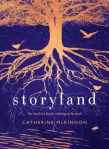
Catherine McKinnon, StorylandIt is still somewhat controversial for non-indigenous Australian authors to include indigenous characters and concerns in their fiction, as Catherine McKinnon does in Storyland. But there are good arguments for their doing so. One is that not including indigenous characters continues the dispossession that started with white settlement. Another is that such fiction brings indigenous characters and stories to people who may not read indigenous authors, which is surely a good thing?

However, such writing requires sensitivity, or empathy, on the part of non-indigenous writers. Indigenous author, Jeanine Leane says that this can only be achieved by social and cultural immersion (which can include informed reading of indigenous writing). McKinnon addresses this in a couple of ways. In her author’s note, she refers to discussing “stories and ownership” with local Illawarra region poet and elder, Aunty Barbara Nicholson, which resulted, for example, in her telling a brutal story from the convict perpetrator’s point of view rather than from the indigenous victim’s. She also acknowledges Nicholson “for reading, local knowledge and generous advice both early on in the process and nearing completion”. But now let’s get to the reason for all this …

Storyland is set in the Illawarra region south of Sydney, and tells the story of the Australian continent, post-white settlement, from 1796 to 2717. It has a nine-part narrative arc that takes us through five characters and six time periods: Will Martin 1796, Hawker 1822, Lola 1900, Bel 1998, and Nada 2033 and 2717. These form the first five parts of the novel. The final four parts return through Bel, Lola, Hawker, finishing with Will Martin, each picking up its character’s story where it had been left first time around. Got it? Two of these characters – Will and Hawker – are based on historical figures, while the rest are fictional.

… a tricksy plot

Will’s employer, the explorer George Bass, says early on that “the land is a book, waiting to be read”, and this, essentially, is what the book’s about. Will is a 15-year-old who sailed with Flinders and Bass in 1796 on their search for a river south of Sydney. On their trip they meet “Indians” whom they fear might be cannibals. We leave them at a nervous moment in their encounter to move to 1822 where we meet the convict Hawker. He’s a hard man, who believes you need “a mind like flint and a gristly intent”. He has his eye on a young indigenous woman, but also on improving his future. From him, we jump again, this time to 1900 and young hardworking dairy-farmer Lola who lives with her half-sister and brother Mary and Abe, both of whom have indigenous blood. There is racism afoot, with a neighbouring farmer suspicious of Abe’s friendship with his teenage daughter Jewell. We leave this story, with Jewell having gone missing, to meet Bel in 1998.

Bel, the youngest of our protagonists at 10 years old, spends her summer rafting with two neighbourhood boys on a lagoon that features in each of the stories. They befriend a couple, Ned and his indigenous girlfriend Kristie. Bel is a naive narrator, but adult readers quickly see the violence at the centre of this relationship. Meanwhile, down the road lives the slightly younger Nada, who is the pinnacle of our chronological arc, featuring in 2033 and 2717. In 2033, climate change has created havoc in the land, and a dystopia is playing out …

Country and connection

I hope this doesn’t sound too confusing – or fragmented – because in fact Storyland is a very accessible book. Superficially, it seems disjointed, but McKinnon connects the stories through links that gradually register as the narrative progresses. For example, the transitions between each story all feature birds, such as this one from Hawker to Lola:

The women are disappearing into the forest. And then they are gone. Lost in the dark trees. An owl

Lola
1900

calling boo-book, boo-book.

(My html skills aren’t up to replicating the layout I’m afraid.) Other links include the aforementioned lagoon, a creek, a cave which most characters reference, a big old fig tree and an ancient stone-axe. None of these are forced, or feel out of place. Instead these places and objects naturally connect the stories, despite their very different narratives, to provide a continuity that transcends the people to focus on the land itself – because, ultimately, this is a story about the land and our ongoing relationship with it.

McKinnon, the author bio says, has been a theatre director and playwright, as well as a prose writer. This is evident in the voices (all first person) and dialogue which beautifully capture the rhythms, vocabulary and grammar of the different characters and their times. Will Martin talks of “Indians”, Hawker talks of “forest”, while turn-of-the-century farmer Lola uses structures like “Jewell and me carry buckets of skimmed milk” and “When he were done”. Ten-year-old Bel is language-proficient, with a good vocabulary, but she sees things through a ten-year-old’s eyes, such as this on the abused Kristie, who “has her big black sunglasses on” and “looks funny, her lips look bigger or something”.  (In a delightful in-joke, her father Jonathan is writing his PhD on unreliable narrators).

The real star of the novel, though, is the land. McKinnon traces its trajectory from an almost pristine state at the dawn of colonisation through being farmed by Hawker and Lola to climate-change-caused destruction in 2033 followed much later by a mysterious post-apocalyptic world. She similarly traces our relationship with indigenous people from early caution, uncertainty and tentative goodwill, through 19th century brutality and ongoing dispossession, to the continuing racism and exploitation of the twentieth century.

The question to ask here is why did McKinnon structure the story the way she did, starting and ending with 1796? Here is Will at the end, exploring a beach on his own:

The white sand curves around the land; the dunes in the late night are dark mountains and valleys; the forest behind is thick and green to the sky. This is a wild place. Too wild for civilisation. It is a place for adventure.

And “the water is fresh” to drink! Is McKinnon, by ending with this more idyllic picture of the land, suggesting that there’s still hope? This is how it was, this is what could happen. Does it have to? Can we yet turn it around? Well, yes, perhaps. As Uncle Ray says to Bel, “it’s our job to look after all this land around here. If we don’t, bad things can happen.”

“To dare is to do”, George Bass tells Will, and this is what McKinnon has done in Storyland. She has combined historical, contemporary and speculative fiction to tell us a story about our land – and our relationship with it and with the people who know it best. This land, these mountains, creeks, lagoons and trees, were here first, Uncle Ray says, and this makes us “part of their history, not the other way around.” The message is clear.

Storyland is a beautiful book physically – in cover, design and construction – as well as being a moving and relevant read. I dare you to read it today.

Bloggers Lisa (ANZlitLovers) and Bill (The Australian Legend) liked this book too.

aww2017 badgeCatherine McKinnon
Storyland
Sydney: Fourth Estate, 2017
382pp.
ISBN: 9781460752326

(Review copy courtesy HarperCollins Publishers)

Jane Austen’s Persuasion, Vol. 2

Jane Austen, Persuasion

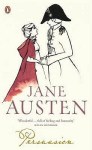
I recently posted my thoughts on Volume 1 of Persuasion, which I read for my Jane Austen group’s slow reading of the novel. This post, obviously, is on the second (and last) volume. As before, I’ll be focusing on reflections from this read rather than writing a traditional review. And, again, just in case you need a refresher on the plot or characters, please check Wikipedia.

Persuasion

… and Self-interest

Last meeting, my Jane Austen group discussed Lady Russell’s advice to Anne. Some found it wanting while others felt she was justified in recommending that 19-year-old Anne reject Captain Wentworth’s proposal. In Volume 2, we get to question Lady Russell’s judgement again, when she sees Mr Elliot as a good suitor for Anne.

So, we have a conundrum. She’s Anne’s friend and supporter, but she’s also a member of the aristocracy, which is not presented positively in the book, and her judgement is suspect. What are we to make of her?

At the end of the novel, Lady Russell is treated well. Is this because her advice, poor though it is (in hindsight, particularly), doesn’t stem from self-interest? Here is Austen wrapping up Lady Russell at the end:

There is a quickness of perception in some, a nicety in the discernment of character, a natural penetration, in short, which no experience in others can equal, and Lady Russell had been less gifted in this part of understanding than her young friend. But she was a very good woman, and if her second object was to be sensible and well-judging, her first was to see Anne happy.

If we agree that Lady Russell is redeemed because her focus was Anne’s happiness, not self-interest, where does this leave Mrs Smith? She was prepared not to share with Anne her knowledge of Mr Elliot’s character, her reason being:

After listening to this full description of Mr. Elliot, Anne could not but express some surprise at Mrs. Smith’s having spoken of him so favourably in the beginning of their conversation. “She had seemed to recommend and praise him!” “My dear,” was Mrs. Smith’s reply, “there was nothing else to be done. I considered your marrying him as certain, though he might not yet have made the offer, and I could no more speak the truth of him, than if he had been your husband. My heart bled for you, as I talked of happiness.

But, given her hopes for Anne interceding on her behalf with Mr Elliot, is there not some self-interest in her decision not to influence Anne? Mrs Smith’s situation was dire in a way that Lady Russell’s was not, but … Anyhow, she too is treated well in the novel’s wrapping up.

What this says to me is that while Austen gently satirises groups (such as the aristocracy) or ideas (such as persuasion/influence/advice-giving), she is not black-and-white about it. She understands humanity – and would like us to, too!

… or, being persuadable

Last post I commented on Anne’s wondering whether Captain Wentworth, after Louisa’s accident at Lyme, might have realised “that a persuadable temper might sometimes be as much in favour of happiness, as a very resolute character.” Well, in the resolution, we discover that he did!

There, he had learnt to distinguish between the steadiness of principle and the obstinacy of self-will, between the darings of heedlessness and the resolution of a collected mind.

Meanwhile, Anne tells him that, despite the pain it caused, her 19-year-old self was right to listen to Lady Russell:

I must believe that I was right, much as I suffered from it, that I was perfectly right in being guided by the friend whom you will love better than you do now. To me, she was in the place of a parent. Do not mistake me, however. I am not saying that she did not err in her advice. It was, perhaps, one of those cases in which advice is good or bad only as the event decides.

This last sentence reminds me of that “good spirit” narrator in The museum of modern love (my review) who said in the opening paragraph, “It’s a human condition to admire hindsight. I always thought foresight was so much more useful”. If only Anne knew, eh, what the event would decide?

Anne Elliot, Fanny Price and Elinor

Jane Austen fans love to consider her characters, to discuss who is the worst villain or the best hero, or whether character X is like character Y, and so on. So, when my Jane Austen group discussed this volume, one member hesitatingly suggested that Anne Elliot could be seen as a mature Fanny Price (Mansfield Park). Yes, I said, I had the same thought! Not so some other members of the group, but here’s the thing. Both Anne and Fanny resist pressure or encouragement to marry people they don’t love, both have strong moral codes, both nearly lose their “love” to rivals, both are relied upon by their families to provide nurturing and support. There are differences. Anne, with her “higher” social position, has more power and agency than Fanny, the poor cousin, but a couple of could see a distinct similarity.

Another member responded that she saw a likeness to Elinor (Sense and sensibility). There is some argument for that too. Elinor is also a steady, moral character who is relied on by her family, and she too nearly loses her “love” to another. And, like Anne and Fanny, Elinor does not need to learn lessons the way Marianne (Sense and sensibility), Elizabeth (Pride and prejudice), Emma (Emma), and Catherine (Northanger Abbey) do. But she doesn’t have to contend with pressure from others the way Anne and Fanny do, which is why I’d see a closer connection between Anne and Fanny.

The Navy

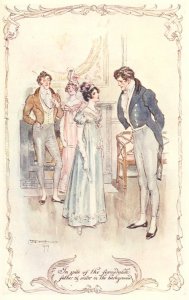
Anne and Captain Wentworth, Ch 20
Anne and Captain Wentworth in front of her “formidable” family (CE Brock, Public Domain)

I said in my Volume 1 post that I’d talk about the Navy in this post, but I’ve ended up talking about other things. However, it’s worth mentioning that in Persuasion, Jane Austen, who had two Naval brothers, presents the Navy positively, as family-oriented men whose values draw more from having good relationships with their families and their “brother” officers  than from status/position. Here is Anne watching Admiral and Mrs Croft in Bath:

They brought with them their country habit of being almost always together. He was ordered to walk to keep off the gout, and Mrs. Croft seemed to go shares with him in everything, and to walk for her life to do him good. Anne saw them wherever she went. …  Knowing their feelings as she did, it was a most attractive picture of happiness to her. She always watched them as long as she could, delighted to fancy she understood what they might be talking of, as they walked along in happy independence, or equally delighted to see the Admiral’s hearty shake of the hand when he encountered an old friend, and observe their eagerness of conversation when occasionally forming into a little knot of the navy, Mrs. Croft looking as intelligent and keen as any of the officers around her.

This continues her feelings from late Volume 1 when the visiting party in Lyme had spent time with Captain Wentworth and his naval friends. She saw their hospitality, their lack of “the usual style of give-and-take invitations, and dinners of formality and display” that typified her circle. “These would have been all my friends,” she thinks, and the idea lowers her spirits. It’s surely no coincidence that in this novel Austen presents some of the worst of the aristocracy with its focus on appearance and position against the best of the Navy with, as Louisa notices, “their friendliness, their brotherliness, their openness, their uprightness”.

And then there’s the last line of the novel:

She gloried in being a sailor’s wife, but she must pay the tax of quick alarm for belonging to that profession which is, if possible, more distinguished in its domestic virtues than in its national importance.

What does this mean, besides the point that being married into the Navy means you will always have the worry of war? Many have discussed the meaning of “more distinguished in its domestic virtues than in its national importance”, with some believing that it is Austen suggesting a new world in which the professional classes, the middle class, represented here by the Navy, is gaining ascendance in English life.

What do you think?

Heather Rose, The museum of modern love (#BookReview)

Heather Rose, The museum of modern loveAs I neared the end of Heather Rose’s Stella Prize-winning novel The museum of modern love, I slowed down. I wanted, of course, to know how it was going to resolve, but I wanted to savour it too. It doesn’t seem right to rush the end of thoughtful books like this.

But, I have to admit that I was initially hesitant about reading the book, as I am about any book inspired by a person or work I don’t know. I fear missing something important. However, I did want to read it and my reading group scheduled it. The die was cast. Then, as I was about to start reading, Brother Gums sent me a link to the documentary Marina Abramović: The artist is present about her and the performance piece which inspired this novel. I was set! As it turned out, I think Rose’s writing is evocative enough that it wasn’t necessary to have seen the film, but it did add a layer to the experience.

So, what is The museum of modern love about – besides love, that is? Its centre is performance artist Marina Abramović’s 75-day piece, The Artist is Present, which she performed at MoMA in the spring of 2010, to accompany a large retrospective exhibition of her work. The piece involved her sitting, still, quiet, at a table all day, 6 days a week (MoMA is closed Tuesdays), with gallery attendees invited to take turns to sit opposite her and share a gaze. It was an astonishing success, with, by the end, people camping out overnight to get the chance to sit. Many attended for days just to watch, creating, as Rose describes it, quite a community of spectators. In the end, over 850,000 people attended, with 1,545 people sitting (including Rose). (All are recorded at flickr.)

Anyhow, from this premise, Rose weaves an engaging, thoughtful story about art and love. It has two main narrative strands, telling the real Marina Abramović’s story and that of an attendee, the fictional musician Arky Levin, whose life is stalling, partly due to a restraining order made by his now-unresponsive terminally-ill wife that he not visit her. Interspersed with these, enriching the exploration of the themes, are smaller stories of other attendees, and family and/or friends of the protagonists. It’s narrated by a mysterious third person voice, who starts the novel with

He was not my first musician, Arky Levin. Nor my least successful. Mostly by his age potential is squandered or realised. But this is not a story of potential. It is a story of convergence.

This is a very particular omniscient narrator, some sort of artist’s muse who self-describes late in the novel as a “good spirit, whim … House elf to the artists of paint, music, body, voice, form, word”, one whose job is sometimes just “to wake things up”. This could be cutesy or forced, but it isn’t because Rose doesn’t overdo it. Mostly the story progresses without the intrusion of this narrator, so that when s/he appears we pay attention.

The moral conundrum at the novel’s heart is – is art enough or is love more important? It’s explored primarily through Levin, whose friends suggest he should appeal Lydia’s court order.

I know you’re going to say that she wanted you to do this; she wanted you to make music. But is that enough?

Music, it sounded feeble suddenly in the face of the yawning gap between life before Christmas and life these past four months. (p. 158)

So what does Levin do? Continue to live his increasingly lonely life making music, or follow his heart?

Levin’s story is off-set against other stories, notably that of Jane Miller, a friendly, recently widowed art teacher visiting New York from Georgia. She is lonely, like Levin, missing her husband “achingly, gapingly, excruciatingly. Her body hadn’t regulated itself to solitude.” She becomes one of the mesmerised watchers, but she also connects with others in the crowd, including Levin and Brittika, a PhD student from the Netherlands who is writing her thesis on Marina. Jane forms a natural link between the two themes of love and art.

What, then, is art?

The first time Jane attends the performance, she overhears people in the crowd questioning what the show is about, asking what is art, in fact. There are, of course, the naysayers, the ones who say that “art is irrelevant. If everything goes to crap, it won’t be art that saves us”. But Jane thinks differently, and turns to the man next to her who is, you guessed it, Levin, and says

I think art saves people all the time … I know art has saved me on several occasions.

As the novel progresses, various claims are made for art. Our muse, speaking particularly for artists, believes that “pain is the stone that art sharpens itself on time after time” and that “artists run their fingers over the fabric of eternity”. Marina’s art teacher says to her 16-year-old self that  “Art will wake you up. Art will break your heart”, which causes Marina to consider that “Art … could be something unimaginable”. At one point Marina is reported as saying “I am only interested in art that can change the ideology of society”.

Jane, the viewer, though, has her own epiphany:

And maybe this was art, she thought, having spent years trying to define it and pin it to the line like a shirt on a windy day. There you are, art! You capture moments at the heart of life.

But, I think it is art critic Healayas who makes the clearest, simplest point when she says during a discussion about Marina’s performance:

She simply invites us to participate … It may be therapeutic and spiritual, but it is also social and political. It is multi-layered. It is why we love art, why we study art, why we invest ourselves in art.

… and what has love got to do with it?

Everything, if art, as all this suggests, is about humanity.

Let’s look specifically at Levin. It would be easy to criticise him, as his friends and daughter gently do, for being passive. But, we do get the sense that Lydia encouraged his passivity in their life together, that she liked to be in control, not in a control-freak way but in that way that super-competent people can do. Moreover, Lydia made her order out of love for him, to let him continue creating his art, rather than look after her which she didn’t believe was in him. So, what’s Levin to do? How does he reconcile his love against hers?

The resolution when it comes is triggered by art, by Marina’s performance. And this, as Jane believes art can do, probably saves him. I say probably because Rose, clever writer that she is, leaves the ending uncertain. As she and Levin realise,

the best ideas come from a place with a sign on the door saying I don’t know.

This is an inspired and inspiring book that leaves you pondering. I’ve only touched the surface.

Lisa (ANZLitLovers) also liked the novel.

aww2017 badgeHeather Rose
The museum of modern love
Sydney: Allen & Unwin, 2016
284pp.
ISBN: 9781760291860

Stephen Orr, Datsunland (#BookReview)

Stephen Orr, DatsunlandTwo things I loved about Stephen Orr’s novel The hands (my review) were its evocation of men, boys and their relationships, and its rural setting. And this is also why I liked Datsunland, his recent short story collection comprising thirteen short stories and a novellaIt’s a no-holds-barred exploration of the lives of boys and men. It is not a pretty book, but it feels real, even where it pushes extremes.

Lisa (ANZLitLovers) interviewed Orr in one of her early Meet an Australian Author Series of posts. Answering her question about who inspired him to write, he said

I became convinced the human psyche was the only thing really worth worrying about, so I’ve been working at it ever since.

This is true of these stories in which men confront their dreams and hopes, their strivings to achieve these, and their frequent failures. Take, for example, the first story, “Dr Singh’s despair”, which is about an Indian doctor from the Punjab who obtains a visa to work in rural Australia. We are desperate for doctors in rural/outback areas and he seeks a better life for his family. Unfortunately, his welcome – to Coober Pedy, which would be a challenge for anyone – is less than ideal. Indeed, we could call it non-existent. Not surprisingly, Dr Singh does not last and returns home, “disappointed … [but] at least happy”. This is the first story in the collection … worth considering, that ordering of the stories!

The stories in this collection are loosely linked. Most are set in rural or suburban South Australia; all focus on men (though women do appear); and many reference, sometimes so briefly you could miss it, a particular school, the Christian Brothers’ Lindisfarne College. The characters never cross into each other’s stories, however. It’s more that the school represents a certain conservative or inward-looking value or attitude – which makes this a good time to introduce the second story, though I promise to not describe every story in the collection! Titled “The shot-put”, it is set on a farm in 1919, just after World War 1, and concerns a couple whose son, a school shot-put champion, is being publicly listed on a Cowards’ List and has therefore been removed from his school’s – the aforementioned college – Honour Board. It’s another story of hopes (and in this case promise) unfulfilled – and more, of lack of compassion.

Lack of compassion is, in fact, one of the underlying themes of the collection. Had Dr Singh in the first story, for example, been shown some compassion, he may have stayed. In the fourth story, “A descriptive list of the birds native to Shearwater, Australia” a new wife begins to realise that what she’d hoped might be compassion in her husband was something entirely different, and in the fifth story there’s something creepy in Brother Vellacott’s caring for Miss Mary. It all, though, comes to a head halfway through the collection, in “Akdal Ghost”, the seventh story. It’s about a preacher, Pastor Fletcher, who should be compassionate, right? He hires a commercial video producer to make a video showing people what will happen if they don’t “find God”. It features the Akdal Ghost, which I had to look up in Wikipedia, and is absolutely shocking, though, as in several of the stories, Orr does not play it fully out. Much more effective to leave it to the reader’s imagination!

Religon is another motif that runs through the collection, and is behind some of the most violent stories. Besides “Akdal Ghost”, there’s “Confirmation” in which a massacre in 1976 Ireland is set against the hopefulness of a son’s confirmation, and “The Syphilis Museum” about a man preparing for the end of the world. One gets the impression that Orr is not a fan of religion.

And, so the stories continue. Some are more poignant, such as “The Barmera Drive-in” about a 45-year-old man who buys an old, long defunct, drive-in, thinking (hoping) he can reclaim his childhood and in so doing make the (or his) world a better place, and “The Shack” about an aging father who needs to decide what to do about his “retarded” son.

Most of the stories focus on adults, but a few feature children, including the 9-year-old boy lost in the hull of ship under construction (“The One-eyed Merchant”) and the 6-year-old boy trapped with a neglectful mother and an abusive step-father (“The Adult World Opera”). The final, titular story, “Datsunland’, which appeared in last year’s Griffith Review IV novella edition, also features a child, though in this case a teenager.

At 100 pages, “Datsunland” concludes the collection beautifully, continuing the melancholic tone but containing just that little bit of hope to leave us not completely discouraged as we turn the last page. It concerns teen-aged Charlie Price, his widowed father Damien, who sells second-hand cars at Datsunland, and his Lindisfarne College guitar teacher, William Dutton. The story opens with William Dutton, a struggling musician who finds teaching, particularly at that “poor cousin of elite schools” Lindisfarne, stultifying. He hates the narrow focus on assessment and performance, on trivialities, such as the proper wearing of socks, on rules that squash motivation and creativity.

Meanwhile, Damien knows his son is bright, has potential, but becomes increasingly concerned about the relationship developing between Charlie and William. The story leads us on, keeping us, along with Damien, unsettled, exploring the awful challenge faced by teachers in today’s fearful environment. What are the boundaries between teacher and student, and where are they crossed? How can a teacher nurture, safely?

Now, more often than not, reviewers describe short story collections as uneven, which is probably not totally unreasonable, because how can every story have equal punch for every reader. So, I’m not going to go there. I don’t think it particularly helps and, anyhow, I’ve seen reviews of collections where different reviewers identify very different stories as the best or the weakest. It’s so subjective, particularly given short stories can range from quiet slices of life to plot-driven-tales-with-twists. If you are a plot-twist lover, can you equally love the quieter story? I’ll simply conclude by saying that in Datsunland, we, like William Dutton, find ourselves “caught in the middle of multiple truths” – and what uncomfortable truths they mostly are. It’s a provocative read, but a good one.

Lisa (ANZLitLovers) reviewed the novella and the collection. The collection has also been reviewed by French blogger Emma (bookaroundthecorner) and Carmel Bird (The Newtown Review of Books) whose insightful analysis of the language and style is well worth reading.

Stephen Orr
Datsunland
Mile End: Wakefield Press, 2017
295pp.
ISBN: 9781743054758

(Review copy courtesy Wakefield Press)