Jane Austen, Sanditon (Unfinished) (#Review)

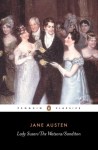
Jane Austen, Lady Susan, The Watsons, Sanditon

I first read Jane Austen’s unfinished novel, Sanditon, in the early 1970s, when I was deep into my love of Austen and had to read everything she wrote. This meant reading her two unfinished novels (the other being The Watsons which I’ve written about here twice before) and her Juvenilia, parts of which I’ve also discussed here. A little later I read the Sanditon completion “by Jane Austen and Another Lady” that was published in 1975. Since then I’ve read Sanditon again, but before I started this blog.

Austen started Sanditon in January 1817, and wrote 12 chapters before leaving it in mid-March, presumably because of her ill-health. She died in July of that year. Like The Watsons, it tantalises Austen fans – even moreso in a way, because we have no information about how she planned to finish it. Here’s what we have …

The novel is set in Sanditon, which Mr Parker and his partner, Lady Denman, are developing into a seaside resort. Due to a carriage accident at the novel’s opening, Mr and Mrs Parker stay at the home of the Heywoods in the country some distance from Sanditon. When they return to Sanditon two weeks later, they bring the Heywoods’ eldest unmarried daughter, the 22-year-old Charlotte, with them. Much of the rest of the novel is seen through her eyes as she meets the various residents of, and visitors to, Sanditon. Like all of Austen’s novels, it is set in a small place and focuses on a few families. But, was it moving in new directions?

The book’s subject is the new fascination with health, and the associated belief in the value of sea-bathing. Some of the fragment’s best comedy comes from descriptions of Mr Parker’s two sisters and brother, Susan, Diana and Arthur, and their various ailments, most, if not all, of which seem imaginary. Indeed, sensible Charlotte suspects “a good deal of fancy” in their “extraordinary state of health.” In her opinion, the number of their “disorders and recoveries” that are “so very much out of the common way, seemed more like the amusement of eager minds in want of employment than of actual afflictions and relief”. She suspects most of their sufferings were

from fancy, the love of distinction and the love of the wonderful. – They had charitable hearts and many amiable feelings – but a spirit of restless activity.

They are kind, and well-intentioned, but she feels

there was vanity in all they did, as well as in all they endured.

Seekers of information about early 19th century health attitudes and practices can learn something from these few chapters.

But there’s more to Sanditon than this health and hypochondria theme, and it relates to money. Of course, money features in Austen’s previous books, but mostly in association with marriage prospects, as it does also in Sanditon. But there’s something new in this novel, something broader about how money operates – about the making of money, and  consumerism. Mr Parker’s sisters are actively involved in finding people to go to Sanditon to take advantage of its health benefits. Mr Parker is thrilled to see cottages in the village “smartened up with a white curtain and ‘Lodgings to let’” signs, but Lady Denman is concerned that lodgings are “underlet”. She is therefore pleased to hear about the possibility of more people coming, through the exertions of Mr Parker’s siblings: “That sounds well”, she says. “That will bring money”. These people include West Indians, who are known to have “full purses” and to “spend more freely.” Lady Denman knows, however, that ensuring stable economics is not simple:

But then, they who scatter their money so freely, never think of whether they may not be doing mischief of raising the price of things – and I have heard that’s very much the case with your West-injines – and if they come among us to raise the price of our necessaries of life, we shall not much thank them Mr Parker.’

Before this, just after Mr Parker had enthused about Sanditon, Mr Heywood had said:

‘Yes – I have heard of Sanditon,’ replied Mr Heywood. – ‘Every five years, one hears of some new place or other starting up by the sea, and growing the fashion. – How they can half of them be filled, is the wonder! Where people can be found with money or time to go to them! – Bad things for a country; – sure to raise the price of provisions and make the poor good for nothing – …’

All this suggests Austen was aware of the changes coming to post-war England. What a shame, she didn’t get to show us what she was thinking.

I’m not going to explore this idea further, nor the tantalising appearance in Chapter 12 of “half-mulatto” Miss Lambe, but move on to a couple of delicious “bits”. One that intrigued me this read is a passing reference to something that’s often discussed, now, regarding the degree to which we separate art from the artist where the artist’s values or behaviour contradict our own. In Sanditon, the man we expect to be the villain, Sir Edward, praises poet Robert Burns. However, our sensible commentator Charlotte is more measured:

‘I have read several of Burns’ poems with great delight,’ said Charlotte as soon as she had time to speak, ‘but I am not poetic enough to separate a man’s poetry entirely from his character; – and poor Burns’s known Irregularities, greatly interrupt my enjoyment of his Lines.

If Charlotte is Austen’s mouthpiece and our guide to life in Sanditon, as she seems to be, this could also be Austen’s condemnation – but with so little of the novel finished, I wouldn’t want to say definitively. However, I love that she raises this contentious issue.

Another “bit” I want to share relates to Austen’s awareness of “modern” expressions. Here she is on the introduction of two sister to Sanditon society:

… the Miss Beauforts were soon satisfied with ‘the circle in which they moved in Sanditon’ to use a proper phrase, for everybody must now ‘move in a circle’, – to the prevalence of which rotatory motion, is perhaps to be attributed the giddiness and false steps of many.

This is pure Austen, complete with a sting in the tail.

I’ll finish here by saying that although Sanditon comprises an early draft of just 12 chapters, and we don’t know where Austen was going, there’s much to enjoy in it – and to ponder, particularly regarding her writing direction – if you love Austen’s work.

Jane Austen
“Sanditon”
in Lady Susan, The Watsons, Sanditon
London: Penguin Books, 1974
ISBN: 9780141907901 (eBook)

Charlie Archbold, Mallee boys (#BookReview)

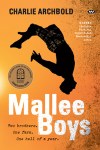
Charlie Archbold, Mallee boysReading synchronicities strike again. Both my last read, John Clanchy’s Sisters, and this one, Charlie Archbold’s Mallee boys, are family stories with a guilt about the death of a family member at their centre. Both, too, are set in non-urban areas, Clanchy’s in coastal New South Wales and Archbold’s in the dry Mallee region of western Victoria. Here, though, the similarities end. Clanchy’s book chronicles a month in the lives of three late-middle-aged sisters, and the person who died was their four-year-old baby brother – a long time ago. Also, Clanchy is a male writer, writing about women, in third person voice. Archbold, on the other hand, is a female writer writing about men. Her subjects are farmer, Tom, and his two sons, Sandy and Red, 15 and 18 at the beginning. The death they are dealing with is their wife and mother, who died just a year before the book opens. This novel, which spans a year, is told in the alternating first person voices of the two brothers.

Mallee boys, however, also reminds me of another book about a farming father and two sons whose wife and mother had died, Stephen Orr’s The hands (my review), but while Orr’s book sits squarely in the literary adult fiction fold, Mallee boys is Young Adult fiction. Its concerns are, therefore, a little different, but it is worth looking at. It won the 2016 Adelaide Festival Unpublished Manuscript Award, and has now been shortlisted for the Children’s Book Council of Australia Book of the Year for Older Readers Award.

Now, that was a long intro – even for me – but I have managed, I think, to include in it a fair introduction to book and its main storyline. I’ll add that while the story is told in the alternating voices of Sandy and Red, the main protagonist is Sandy. He starts and ends the story, and he is presented as the more thoughtful, more reflective, of the two boys. Also, he is not the one carrying the guilt. This is his brother, who was with his mother when she, a pedestrian, was hit by a car.

Like Clanchy with his women characters, Archbold captures the voices of the boys and their father well, their tensions, their squabbles, and most of all the challenges they face in running their home without a mother’s touch! “Chops” for dinner again tonight says it all. Late in the novel, the father Tom admits to being lonely, but his pain is not the focus, this being a YA novel. Sandy is in Year 10, and as a rural boy, is at schooling cross-roads. Their farm can’t afford to send him to boarding school in the city, but can he get a scholarship? Red, on the other hand, is not the scholastic type. He has left school and works the farm with his father, with the usual father-son tensions. Added to this are the boys’ relationships with their friends – not all of whom are “suitable” but Red, in particular, can’t be told and needs to learn the hard way. And, of course, there are girls.

This is all told naturally, neither sensationalised nor sentimentalised, but with enough drama, and humour, to keep readers, particularly the intended audience, interested. I wouldn’t call this a crossover novel exactly, but I did enjoy the read despite its YA intent.

Underpinning the narrative, the plot, is the setting, and this also the London-born Archbold, who has lived and worked as a teacher in the area, evokes beautifully. The setting is the Mallee, which borders the riverland area in which Laguna’s The choke (my review) is set. It’s a dry area, known for sheep and dryland crops like wheat. Farming is tough here, but communities are close. This comes through too, with locals helping each other out, in the natural way people do, something which is surely good for young readers to see and relate to. I do love to see good – but realistic – role modelling in media!

In addition to this, there’s the language. I enjoyed the descriptions of the Mallee, such as Sandy’s of Lake Bonney:

When the river runs low, the water in the lake huddles to the middle, leaving it fringed with smelly sticky mud. It’s a strange place. Because of the drought a lot of the trees around the edge have died. Bony old river red gums stick in the ground like a perching cafe for pelicans and kookaburras.

Tom, the father, tells Red what’s kept him going, despite his loneliness:

“I know it’s the rhythms of nature that have kept me going. This isn’t a glamorous landscape, but it’s in my veins.”

And I enjoyed how the boys describe feelings. Here’s Sandy describing his brother Red:

He acts hard because it gives him control but I know he’s all mushed up inside. Like a beetle with soft guts crammed in under the shell.

And here’s Red, just after his girl has suddenly broken up with him without explaining why:

And so she’s left me hanging, like a daggy bit of wool caught on a fence. Knotted in with no way to break free.

As you’d expect in a coming-of-age story, lessons are learnt, wisdom gained. Sandy says near the end, and this is surely one of the novel’s themes:

… because time doesn’t heal all wounds, like Dad once told me, but it does scab over them.

It sure does. And every now and then those scabs break off and have to re-form, n’est-ce pas? An effective metaphor I think.

Mallee boys, then, is an engaging book about growing up, about facing some of the hardest challenges, and most of all about being male. It’s a book that has something to offer both rural and urban young Australians, and I hope it gets widely read.

AWW Badge 2018Charlie Archbold
Mallee boys 
Mile End: Wakefield Press, 2017
285pp.
ISBN: 9781743055007

(Review copy courtesy Wakefield Press)

John Clanchy, Sisters (#BookReview)

John Clanchy, SistersLocal writer John Clanchy has appeared a couple of times in this blog – as the author of the short story collection, Six: New tales (my review), and as the person launching Stephanie Buckle’s collection, Habits of silence (my review) – but never for one of his novels, until now. Sisters has an interesting history: it was originally drafted at the La Muse writers retreat in southern France in 2008, and has now been published by the retreat publisher, La Muse Books.

Given I introduced the versatile, and too little known, Clanchy in my review of Six, I’ll turn straight to discussing this latest novel of his. Briefly, Sisters tells the story of three late middle-aged sisters and the month they spend together at the family home on the north-central coast of New South Wales where the eldest, Sarah, now lives. The other two sisters, Grace and Rose, are twins. There is a mystery about why Sarah has asked them to come, though Grace is pretty sure she knows why, and we readers are pretty sure we know what it is that Grace believes she knows! It is, however, a little more complex than that – as you would expect. So, the first thing to say is that there is a plot.

The next thing to say is the obvious one – this is a book about sisters. There are, in fact, very few men, and I wondered how Clanchy had managed to capture women so well, because the book succeeds or fails on the basis of his ability to convince us with his women. Well, I had forgotten his dedication, which is “To my sisters Mary, Helen, and Elizabeth / and to Brigid, as ever”. (Brigid is his partner, I believe). I don’t know whether he has brothers too, but clearly he has spent a lot a lot of time with women. No wonder he writes them so well – and with such sensitivity.

So, pretty quickly their individual characters are established. Sarah, as the oldest, is the bossy planner who expects to control their time together. Indeed, she’s orchestrated this month because she has “thinks to discuss … things … to tell.” Grace, the older twin by 49 minutes (!), is widowed and has had breast cancer. She’s a counselor and is seen as the empathetic, reliable one. Rose, by contrast, has had a few husbands and even now is pining for her latest lover back in the city. She can be flighty and a bit oblivious, but can surprise Grace with her perception nonetheless. Clanchy captures the shifting alignments and allegiances between the three beautifully – Sarah’s separation from the twins, Sarah and Grace’s protectiveness towards Rose, Rose and Grace’s natural connection, and so on.

Gradually, Clanchy develops his plot, interweaving the sisters’ time together with stories of their childhood. While they were relatively happy, their growing up was not without drama, recalling Tolstoy’s famous opening to Anna Karenina. Their disabled four-year-old brother drowned in a cave at the beach while under their care, and their father left home for France to live with his mistress. How and why all this happened, what they made of these events as young people and now as adults, and who knew and knows what, underpins the plot. Mystery and secrecy rule. The end, when it comes, is fairly predictable, but then this is not unusual in a well-constructed story. It’s the journey to that point, and the little details in the telling, that make most books worth reading. Here, it’s also the warmth and generosity in the tone that make it such an engaging read – particularly if you are of a certain age!

Of course, Sisters is about more than its plot of unfolding secrets – and the epigraph provides a clue. It comes from TS Eliot’s Four quartets: “We are born with the dead: / See, they return, and bring us with them.” Besides the fact that an old death drives the plot, there is the bigger issue of mortality. The sisters are in their mid-to-late sixties, and one has already had cancer. Rose believes, in fact, that Sarah wants them there to talk about wills. She doesn’t, but mortality is behind her request for them to come – and awareness of mortality imbues much of the sisters’ thoughts and communications over the month. Early on, in Chapter 3, Sarah shows them the work she’s done to restore their (appropriately named) Grandfather Forrest’s orchard:

‘I had to rip the old one out,’ Sarah said without turning her head. ‘It was done for. Over sixty – and over the hill,’ she added. Reminding each of them of a personal fact.

Supporting the plot and theme is Clanchy’s writing. It flows easily from description to dialogue and its various, sometimes funny, set scenes, all supported by evocative turns of phrase. Here’s lively Rose “within whose house of memory window after window was now flying open of its own accord”. And this is thoughtful Grace:

The past was another kind of train journey. One undertaken with only random glimpses of the landscape outside to anchor or trouble the memory …

Memory is, of course, part of the picture – what we remember, how we remember, when we remember, and who remembers what.

There are a few other characters who make brief appearances – those from the past via the sisters’ memories and two policemen, particularly the young, uncomfortable Constable Demko who first visits the sisters to check on neighbours’ reports of nightly activity in the orchard, “Music, people running about, loud voices, laughter …”. It is, of course, the sisters enjoying their summer evenings, “the original Bacchantes” as Sarah tells him.

And here I’ll leave it. Sisters is a gentle, thoughtful novel – sad, but realistically wise. It’s about life and death, regrets and missed opportunities, secrets and guilt, and most of all about love and forgiveness. On the surface, it seems simple – it’s certainly an easy read and it could feel clichéd with its family-secrets-driven plot – but in fact it’s a philosophical book from an older writer reflecting on how we make sense of our lives. His conclusion, I’d say, is that the answer is in the quality of the relationships we forge, and the generosity with which we maintain them. This is the stuff of life.

John Clanchy
Sisters
Labastide Esparbairenque: La Muse Books, 2017
259pp.
ISBN: 9791097233006 (eBook)

(Review copy courtesy La Muse Books)

Claire G. Coleman, Terra nullius (#BookReview)

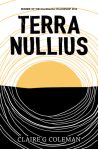
Claire G Coleman, Terra nulliusClaire G. Coleman’s debut novel, Terra nullius, was my reading group’s third book for this year. The first two – An unnecessary woman (my review) and The sympathizer (my review) were well liked – but not so Coleman’s book. In fact that I was the only one who liked it. So, instead of my usual review, I’ve decided to tease out some of the issues my group had with the book, and see where I end up. I didn’t take notes at the meeting, so I’m relying on my memory. I may not have got all the issues down, or down correctly, but I’ll give it my best shot. In doing so, I’ll also draw on GoodReads because its users tend to be general readers, like you finding reading groups.

First though, a brief introduction for those who don’t know the book. Terra nullius starts off reading like an historical fiction novel about the colonial settlement of Australia and the concurrent dispossession of our indigenous people. Coleman’s world of Settlers and Natives, of Troopers and Trackers, of Missions to which stolen children are taken for education, of a Department for the Protection of Natives, and so on, mimics colonial Western Australia in particular, but it’s not long before hints start to appear that all is not as we’ve assumed. Before halfway, all is revealed, and we realise we are not reading historical fiction, but speculative fiction set in some near future. It is, as a result, not about indigenous Australians versus white colonists, but about colonised people of all races versus settler-colonists (“grey fellas”) from somewhere else. This realisation is unsettling, and clever, because it forces non-indigenous readers to switch identification from the colonisers to the colonised.

Now to my reading group’s response. The over-riding criticism was that it was repetitive and tedious. This is the criticism I could most understand, because partway through the novel’s second half I felt the momentum flag a little, which I put down to the structure. It’s multi-stranded, with the stories of different people or groups running parallel for a significant portion of the book. The strands include Native Jacky who is on the run; Settler Sister Bagra who runs a Mission; Settler Sergeant Rohan who leads the posse which is hunting Jacky; Esperance and her camp of free, renegade Natives; and deserter-Settler Johnny Star who is taken in by some rebel Natives. Fortunately, just as I wondered whether the separate groups – the separate strands – were ever going to come together, two things happened. A new character, Father Grark, appeared, and the strands did start to coalesce. These, along with other factors including the writing itself, were enough to prevent the book’s becoming tedious for me.

However, my reading group friends weren’t alone in their criticism. One GoodReads reviewer described it as “gratingly repetitive” and another overall positive reviewer had “some minor quibbles”, of which the main one was that “some elements of the story were repetitive”.

Another criticism made by some of my group was that they weren’t interested in any of the characters. Some GoodReads reviewers concurred. One didn’t “connect with any of the characters” and another said that “the characters, the individuals, are basic, with no complex motivations, no desires”. This surprised me, because I was interested in several of the characters, and I looked forward to their next appearance. One was Esperance, the young woman living with that renegade camp of Natives. Another was Jacky, who is the first character we meet and who, for over half the novel, struggles on alone, trying to survive and keep one step ahead of his pursuers. There are, though, a lot of characters, and I can see the argument that many of them have “no complex motivations”. However, I’m not sure that deep characterisation is always essential for speculative, dystopian fiction, such as this book is. Anyhow, regardless of this point, I can’t accept the argument that none have desires. Esperance and Jacky, for example, certainly have desires. Survival is one, and for Jacky, returning to his home, his country, is a major driving force.

One of the positive GoodReads writers said, and it reflects my response, that “importantly, Coleman’s more ‘extreme’ characters – such as Sister Bagra, in charge of a Native ‘orphanage’ – are frighteningly familiar, and it [is] these elements of the story that will linger.” She is not, in other words, a particularly complex character, but given what I know of colonial history, she is believable. I’d argue that that’s sufficient.

Then there were arguments that the book was too heavy-handed, too obvious, not nuanced enough. Again, there were GoodReads reviewers who agreed, one saying the “messaging was much too overt” and another that it could have been more subtle. However, I’m not sure that I’ve read much dystopian fiction that is subtle. On GoodReads I found a perfect example of how differently we “read” books. One criticised the chapter epigraphs, which come from various fictional “sources”, saying that “the book could have been done much more subtly without the chapter-starters explicitly comparing the colonisation to the colonisation of Australia”, while another said that Coleman’s “use of ‘archival documents’ at the beginning of each chapter gave the book rich perspective.” Again, I concur with the latter, and some in my group agreed that this feature of Coleman’s book was effective and worth exploring further.

It seems that those who are well-versed in speculative fiction’s colonisation stories – in my reading group and on GoodReads – felt that Coleman’s book didn’t offer anything new. A member in my group felt that it was so clearly Western Australia’s story that Coleman may as well have made it Western Australia. I agree that the “facts” aligned closely with the Western Australian experience, but I didn’t see that spoiling its speculative layer. In a way, it increased its effectiveness because, using the GoodReads quote above, it felt “frighteningly familiar”. There is an argument to be had, I suppose, about how “familiar” speculative fiction can be before it’s no longer speculative, but for me it worked.

Other concerns were raised in my group, but there were positives too, particularly regarding the quality of Coleman’s descriptive writing. She knows the landscape well and captures the heat and light, not to mention the weirdness of Australian desert vegetation beautifully:

He [Sergeant Rohan] did not relish another night under the alien trees, the twisted limbs, the hanging bark, the wrong colour: their waxy grey-green leaves too hard, almost glassy.

There’s more to like about the writing than this, however. From the first page when we meet Jacky on the run, I loved Coleman’s voice. It’s direct but evocative, it’s serious but peppered with a light, cheeky touch that uses throwaway lines and afterthoughts to great effect:

Dinner was a disappointment: sure the meat was fresh but it was tough and tasted like all the other Native meats – quite unappetising, only to be relished by the desperate. Good thing they were desperate then.

So, I was impressed by this book. My heart engaged with the characters who were struggling to survive their nightmarish world, while my mind was intrigued by what Coleman was doing, by her layering of historical experience within an imaginative framework, by her grounding us in a familiar story, and then overturning it to force us to see it from a different perspective. I’m not sure I followed all her intellectual twists and turns but I certainly got the point about invasion – and about the cruelty people inflict on each other in its name.

He [Johnny Star] had learned, through his friends, that the bent, broken drugged and drunk state of those surviving near the Settlements was not the habitual state of Natives. The truth was, it was a sort of depression brought on by what they had lost, brought on by being dominated and controlled by another people. Who could not be depressed, being treated like animals in a land that had once been theirs alone.

Without giving away the details, the ending is generally what you’d expect from a dystopian scenario, but it’s not without hope, without defiance too. A great read … at least, I thought so!

Lisa (Anzlitlovers) loved the book, as did Bill (The Australian Legend).

Note: I haven’t cited the individual GoodReads reviewers, but they can be found at the site’s page for the book.

AWW Badge 2018Claire G. Coleman
Terra nullius
Sydney: Hachette Australia, 2017
294pp.
ISBN: 9780733638312

Stephen Orr, Incredible floridas (#BookReview)

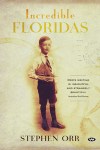
Stephen Orr, Incredible floridasThe good thing about reviewing Stephen Orr’s latest book Incredible floridas is that you know the end at the beginning, so there’s no need to worry about spoilers. The end, the one that you read at the beginning that is, is that Hal, the 22-year-old son of artist Roland and his wife Ena, commits suicide. By the end, the real end that is, you have some understanding of why he does, but you are also left to think about the drive to create art and its impact on family, about parental love and father-son relationships, and about that notion that it takes a village to raise a child.

To make this work, Orr uses a flashback-style chronology. The novel starts in 1962, just after Hal’s death, and then flashes back to 1944, when Hal is 4. From there it moves forward in irregular bunches of years -1948, 1950, and 1956 – until we arrive again at 1962 where it takes us through the events leading up to the death. This, then, is not the book for those who seek excitement and plot. Rather, it’s for those who love character, are intrigued by families and neighbourhood relationships, and like historical fiction.

There’s more to it than this, however – and it relates to the artist-father Roland. He is clearly modelled on the Australian artist Russell Drysdale (1912-1981) about whom I wrote a couple of years ago. Roland’s work and career as described by Orr – his angular lonely figures in stark landscapes, and the decline in his reputation – is similar to Drysdale’s. And Drysdale’s biography – his having a son and daughter, his being rejected for war service because of a detached retina, and his son committing suicide at the age of 21 in 1961 – is similar to our fictional Roland’s.

And then there’s the title. “Incredible floridas” rang a bell with me, and a little research brought it back. Peter Weir made a short film called Incredible Floridas in 1972. (It’s available on YouTube.) It portrays Australian composer Richard Meale (1932-2009) creating his work, Incredible Floridas, which was inspired by the 19th century French poet, Rimbaud. Curiouser and curiouser.

But, how much of this is relevant to Orr’s novel? Well, Meale’s work is an homage to Rimbaud, just as Orr’s is to Drysdale. And Weir’s award-winning short film has been described as “a wonderful tribute to artistic inspiration” which we can see in Orr’s book. Then there’s Rimbaud’s poem, “Le bateau ive” (“The drunken boat), which includes the words “incredible floridas”. It’s about inspiration and ecstasy, and their downsides, disappointment and disillusion. There are, in fact, several references to boats in the novel, paper ones and a painting Roland does of a child in a boat with panthers, another reference to Rimbaud’s poem, in the background.

And, while I’m at it, there are also allusions to Shakespeare’s Henry IV Pt I. Hal is nick-named Prince Hal, and the allusion is underlined by one character telling him to watch out for Hotspur. The irony, of course, is that our Prince Hal does not win out in the end.

I hope all this hasn’t been boring – or worse, off-putting. The book can be read very comfortably without knowing any of this, but I love the layers they contribute. Now, the novel.

“casualty of art”?

Set in mid-twentieth century suburban Adelaide – mostly – the novel tells of Hal’s growing up within a small community comprising, primarily, his family (father, mother and older sister Sonia) and neighbours Mary, her brother Sam, and her lupus-afflicted daughter Shirley who is ostracised and bullied by the neighbourhood kids. Other characters, who appear more sporadically, include Roland’s art school friend James, Mary’s cousin Trevor, and Hal’s grandmother Nan who works for Dr Bailey. These make up “the village” which raises, or tries to, Hal.

From 1944, when Hal is 4, it’s clear that he’s not an easy child. And it’s also clear that Roland is driven by his art – “art was an all-or-nothing proposition”. How these two are related is central to the book. Hal regularly feels he comes second, but Roland is not the stereotypical dark, inward-looking artist. Sure, he thinks about his work most of the time, and sure, he had his “periods … months on end when they barely saw him”, but he is also seen engaging with the family and making time for Hal. Finding the art-life balance is a challenge for creators, particularly when they work from home. Always being there doesn’t mean they are always available. Is Hal a “casualty of art” or are his problems something else?

When Hal is around 16 years old, directionless and acting erratically, sometimes violently so, Roland takes him on the first of several road trips because “he knew that Hal could only be made better under the stars” (albeit Ena thinks Hal “needs a proper doctor”). To a degree it works, but Roland can never quite get it right. Of course he thinks about art and makes sketches – creating a visual diary of the trip – while they travel, but he’s also there communicating with his son, talking about options, and not pushing him to be anything in particular. Unfortunately, Hal doesn’t see the love, the sacrifice, the wish for him to be “happy”. He just sees it as Roland “trying to improve his character”.

Stepping into some of the gaps left by Roland’s busy-ness is next door neighbour Sam. He becomes a second father to Hal, taking him to the racecourse, providing his own thoughtful counsel when Hal comes calling, and making significant sacrifices to help Hal. Nan’s employer, Dr Bailey, is also generous. But Hal just keeps on getting into scrapes – at school and in the neighbourhood. He has few friends because, as he himself realises, he doesn’t know how to be one. As Ena says in the opening section, “Hal was Hal, and his wires were crossed”.

While art and the artist’s life is an overall theme, this is primarily a book about men, about fathers and sons. And Orr portrays them so authentically. There are women here too, but this is the mid-twentieth century and it’s essentially a man’s world in which women’s agency is limited. All they can do, Ena sees, is to follow the men, and try “to make the unworkable work.” Similarly, poor Shirley sees the sacrifices Sam makes for Hal, who has treated her poorly, and wonders where she fits.

So what more is there to say? The writing is clear, evocative and, what I especially love about Orr, includes wonderfully natural dialogue. I’ll just share one excerpt (but it’s so hard to choose!). It comes from 1944 when four-year-old Hal and Roland visit an airforce base with Trevor Grant:

Uniform or not, things were looking up. Hal studied the plane’s wings and asked his dad, “D’yer reckon it’s got guns?”
“No.”
“D’yer reckon I could look inside?”
“Prob’ly not.”
Grant and the other man approached them. The man messed his hair. “This is top secret,” he said. “Has Corporal Grant administered the oath?”
“No, sir.”
“Well, he will, later. And once you’ve taken it you can’t say nothing about this to no one, or else the government will come lookin’ for you. Got it?”
“Yes, sir.”
Roland noticed the same look on his son’s face, as Hal studied the two men. Like he’d just seen a comet for the first time. Something marvellous, new; a boy in a boat in a jungle full of panthers.

Incredible floridas is the third Orr book I’ve read, the others being The hands (my review) and Datsunland (my review). What keeps me coming back is his ability to capture ordinary, day-to-day human interactions, human hopes and fears, with such realism and warmth. There’s no judgement from Orr. He leaves that for the reader to consider.

Lisa (ANZlitLovers) is also a Stephen Orr fan and enjoyed this book.

Stephen Orr
Incredible floridas
Mile End: Wakefield Press, 2017
335pp.
ISBN: 9781743055076

(Review copy courtesy Wakefield Press)

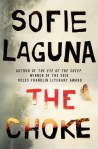
Sofie Laguna, The choke (#BookReview)

Sofie Laguna, The chokeThere are many reasons why I wanted to read Sofie Laguna’s latest book The choke. Firstly, I was inspired by a very engaging author conversation I attended late last year. Secondly, she won the Miles Franklin with her previous book The eye of the sheep (which I still haven’t read). Thirdly, its setting, the Murray River, is one of my favourite parts of Australia. For these and other reasons, I finally slotted it in this month, despite my growing backlog of review copies, and I’m glad I did. It’s an engrossing, moving read.

The novel is divided into two parts, the first set in 1971 when its first person protagonist Justine is 10 years old, and the second set three years later when she is thirteen years old and starting high school. It’s an effective structure. The first part sets up Justine and her physically and emotionally impoverished situation. She lives with her war-traumatised grandfather Pop on a struggling farm on the banks of the Murray. Her mother is long gone, and her father returns erratically. She has regular contact with her two older half-brothers who live nearby with her father’s first wife. Pop loves Justine, but he does not have the wisdom or emotional resources to guide – or even provide for – her as she needs. She is undernourished and poorly groomed. We are therefore unsurprised when Part 2 unfolds the way it does.

Now, I am a little cautious about first person narratives. It’s not that I don’t like them. In fact they can be highly engaging, but it did seem, for a while at least, that first person was becoming the voice du jour. However, Laguna’s choice here is inspired. She’s known for her ability to write young people and it’s well demonstrated here. Telling the story in Justine’s voice enables her to show Justine’s situation, without resorting to telling, which can so easily turn to moralising. Justine is the perfect naive narrator. She can only describe and explain the world as she knows it, so we readers must read between the lines to work out what is really going on. We work out, for example, that she is dyslexic by the way she describes her inability to read. We learn about the quality (often poor) of the relationships that surround her through her observations.

When I looked at [half-brother] Steve it was as if there was a ditch all around him too wide to jump. If you shone a torch into it, you’d never see the bottom. Steve couldn’t get across by himself; it was only Dad who could help him.

She might not understand the world – and it is this, along with her loneliness, which drives the crisis when it comes – but she’s attuned to the feelings between people.

One of the reasons this book so engaged me, in fact, is that it’s all about character. In the conversation we attended, Laguna said a couple of things about this. She said that it’s the characters and the tensions between and within them that drive the narrative and that character IS the plot.

“I got it wrong from the start”

So, who are these characters who drive the narrative? Justine is the main one, of course. She tells us that she was a breech birth – “I thought that was the right way to come out.” She understands by this that she “wrong from the start”, and she blames herself for her mother’s departure three years later. Her sense of being wrong – and feeling somehow responsible – is a recurring refrain in the novel. The other characters – her Pop, her sometimes-present father Ray, her mostly absent but significant aunt Rita, her friend Michael, her half-brothers, and the similarly dysfunctional neighbouring Worlleys – are all seen through her eyes. It is the tensions, stated and unstated, between them and their impact on her, that drive the narrative and the decisions she makes.

As well as a coming-of-age story, The choke is also a classic outsider story. Part one sets up Justine’s outsiderness, and chronicles, among other things, the friendship that develops between her and another outsider at school, Michael, who is taunted, bullied, because of his physical disability. Justine doesn’t have the words, but his disability appears to be cerebral palsy. The end of this friendship with Michael’s departure for the city ends Part One. This friendship plays multiple roles in the narrative. It helps develop Justine’s character. Her decision to stand up for Michael, having earlier wanted nothing to do with him, not only brings her a friend and marks her outsiderness from the cohort, but also shows her own sense of social justice. However, this friendship also exposes her low self-expectations and further reveals her neglect, because Michael’s family is a “normal” middle-class family. There’s a mum and dad, two kids, a proper house, regular meals and proper care. Justine is intitially embarrassed by the gap between their lives and hers, but when Michael eventually visits her home, she discovers he loves visiting it. He loves, for example, the chooks, Cockyboy and the Isa Browns.

By the time Part Two starts, her father Ray is in jail and Justine is starting high school. With Michael gone, she’s isolated at school and, while loved at home, continues to be neglected. The crisis is revenge-driven for something her father had done, but Justine, as the vulnerable female, is, of course, the target. It’s a gut-wrenching story of damage, neglect, abuse and, yes, also just simple misguidedness. Her Pop means well but is ill-equipped for the caring role thrust upon him. In the end, the story is also one of a failure of people and systems – including education – to identify Justine’s real situation.

And then there’s “the choke” of the title. I don’t always discuss a book’s title, particularly given that the author doesn’t always have last say on this, but for this book it’s highly relevant:

Down at The Choke the river pushed its way between the banks. The water knew the way it wanted to go. Past our hideouts, past our ring of stones, past the red gums leaning close enough to touch – it flowed forward all the way to the sea.

The “choke”, then, is a bottleneck in the river, a place, Justine says elsewhere, “where it would push through and keep going”. It is a physical place (based on the actual Barmah Choke) and a metaphorical one. Physically, it is a place of tranquility, of respite, for Justine. However, it also symbolises the things that threaten to “choke” her life, while at the same time hinting at hope, at the possibility of pushing through.

The choke is a book written by someone who knows exactly what she is doing. As I flipped through it to write this post, I noticed again and again the crumbs laid for us, the signs, in other words, that prepare the groundwork for what comes later. There is nothing wasted here. It is a grim story, but it is enlivened by its resilient young protagonist who finds the resources within herself to “push through” when life threatens to overwhelm. It may not have been shortlisted for the Stella Prize but I’m glad I decided to read it.

AWW Badge 2018Sofie Laguna
The choke
Sydney: Allen & Unwin, 2017
369pp.
ISBN: 9781760297244

John Lang, The forger’s wife (#BookReview)

John Lang, The forgers wifeWhen new publisher Grattan Street Press offered me a review copy of John Lang’s The forger’s wife last November, I couldn’t resist, even though it is from their Colonial Australian Popular Fiction series. I say “even though” because, had it been written now, it would probably not have come under my radar. It’s very much in the popular vein. However, as a piece of work first published (in serial version) in 1853, it has much to offer modern readers.

It raises the question, in fact, of why read historical fiction when you can read from the time itself. I’m being a bit flippant here, I know. There is reason – there’s value in looking back, in revisiting the past with eyes from the present – but the question is worth asking, if only to focus our minds on context when we read.

Enough pontificating though, let’s get to the book – or, first, to the author. According to Grattan Street Press, John Lang was Australia’s first locally born novelist. I have in fact written about him briefly before, in a Monday Musings post, but I hadn’t had a chance to read him, until now. I mentioned in that post Victor Crittenden’s biography, because its title says a lot – John Lang: Australia’s larrikin writer: barrister, novelist, journalist and gentleman. Ken Gelder and Rachel Weaver’s Introduction to The forger’s wife provides interesting background to his life, some from Crittenden’s work. Lang, it seems, lived quite a peripatetic life, and had had a few books published by the time The forger’s wife was serialised.

Gelder and Weaver write that it’s generally accepted that The forger’s wife is “the first novel by an Australian-born novelist to feature an Australian detective.” They go on to suggest that it is “the first detective novel in the Anglophone world” arguing that it predates by around ten years The Notting Hill Mystery by Charles Felix which has been seen as the first detective novel in English. The rest of their introduction – naturally, because the series is about popular fiction – focuses on the book as a detective novel. However, I’d like to discuss other things.

The novel is essentially a melodrama which, say Gelder and Weaver, follows “the fairly familiar pattern of a female emigrant’s tale.” It tells the story of Emily Orford, the rather spoilt only child of a well-to-do British army officer. Eschewing more suitable suitors, she falls for a man whom she believes to be Captain Reginald Harcourt, but who is, in fact, the forger Charles Robert. Immediately after their elopement, he is arrested and convicted of forgery, and transported to Australia. Emily, believing that Reginald is innocent, follows him to Sydney. Here, she luckily finds a few friends amongst the colony’s rough and tumble, one being the convict turned policemen-and-thief-taker (our detective), George Flower. She also reconnects with the scurrilous Reginald/Charles, who, despite getting into increasingly outrageous scrapes, manages to keep Emily believing in him. This is a 19th century melodrama so it all turns out alright in the end, though not necessarily exactly as readers might expect.

What I want to talk about now, though, is why this novel is worth reading – besides its credentials as a pioneering detective novel, that is. My reasons have to do with the insight it provides into colonial life. Think how much we learn about life in mid-nineteenth century England from Charles Dickens’ novels. So …

“this uncouth and cruel land” (Emily)

We learn a few things about early to mid-nineteenth century colonial Australia, starting with some vivid descriptions of town and country. We learn about the roughness, the struggle to survive which results in various combinations of theft, corruption, bribery. The novel’s themes include the survival of the wiliest, and the challenge of identifying who you can trust. The naive, trusting Emily would not have survived a minute without the initial help of Captain Dent from Lady Jane Grey, the boat she arrived on, and then George Flower who looks out for her.

We learn about how women make a living – some via the oldest profession. Emily, though, gives piano lessons. However, when she becomes persona non grata because of Reginald, she’s “compelled to do needlework, to knit socks and comforters”. We learn about convicts who become policemen versus those who become bushrangers. We learn about settlers taking the law into their own hands. George Flower, on the hunt for Reginald now turned bushranger, tells a well-to-do settler that settlers need to learn to protect themselves:

The Gov’ment’s a fool for paying for mounted police. You ought to learn the value of combination, and how to protect yourselves.

Later on the same page he says:

I wish to teach you settlers, and the Gov’ment, and bushrangers, a great moral lesson. I want to make you more independent and secure – bushrangers less numerous and daring – and Gov’ment more economic and sensible.

And, of particular interest to me, we learn about attitudes to the original inhabitants. In between the above two comments, Flower says:

You can club up to get rid of the blacks, when they spear your cattle or kill your sheep. Why can’t you capture your own bushrangers?

So, the settlers clearly have no compunction about getting rid of “the blacks” themselves. Presumably they are “easier pickings” and don’t warrant the respect of a lawful process? You don’t always need to read history, then, to know what went on. Sometimes fiction contains useful truths.

There are other references – or not – to Indigenous people. A little earlier than the above scene, Flower is enjoying a lovely moment in a remote spot, where:

he discoursed for some time with [bushranger] Millighan on the grandeur of the scene, and the sweets of liberty. It was a beautiful warm day, and not a cloud in the sky. The foot of man had never before trod the ground on which Flower and Millighan were then standing.

I don’t think Lang was being ironic here!

Later, Flower returns to the same spot, where Millighan’s skeleton now lies. He treats the skeleton of this “brave” adversary with respect, leaving a note to ensure that when, in the future, the remains might be “stumbled across”, the finders will “not suppose he was some black fellow”!

And yet, a page later, there’s recognition of learning from these same “black fellows” when he makes a fire “as the Aborigines do, by rubbing two pieces of dry stick together until they ignite.”

The final reference to Indigenous people also refers to cultural learning. We are told that Flower, now back in England, had become very “‘colonial'” not only in “outward appearance”, but also in “parlance”. “He had mixed a good deal with the blacks” and, while the Aboriginal language was not “thoroughly understood by the Europeans”, it had contributed “sundry worlds and phrases” which Flower used, to the incomprehension of his listeners.

So, while I found the story itself entertaining – indeed a thoroughly enjoyable read – it’s these unconscious insights into the times by a writer of the times that has made this book memorable. I would love to read more in this series.

John Lang
The forger’s wife
Parkville: Grattan Street Press, 2017 (Orig. serialised in 1853)
224pp.
ISBN: 978098762304

(Review copy courtesy Grattan Street Press)

PS: I apologise for overwhelming your inboxes/reader feeds this week. There’s been a lot on. I’ll return to situation normal next week.

Diana Blackwood, Chaconne (#BookReview)

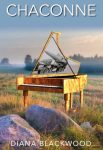
Diana Blackwood, ChaconneDoes a book set in the early 1980s qualify as historical fiction? Does a book about a twenty-something woman’s romantic adventures, and search for direction, qualify as coming-of-age? The answer is probably yes to both. Certainly, it is within these parameters that it’s appropriate to discuss Diana Blackwood’s debut novel Chaconne.

Chaconne, as you can see, has a gorgeous cover. Rather than an image of a pretty young woman, promoting the idea of a “woman’s book”, it features a harpsichord – with an image of a Pershing (or similar) missile inside its open lid – sitting in a golden-lit rural landscape. This clues us into some important aspects of this novel, which are that music and war are involved. Of course, the title, Chaconne, also suggests a music theme. A chaconne, says Wikipedia, is “a type of musical composition popular in the baroque era when it was much used as a vehicle for variation on a repeated short harmonic progression, often involving a fairly short repetitive bass-line (ground bass) which offered a compositional outline for variation, decoration, figuration and melodic invention”. By this description, the “chaconne” works as a metaphor for Eleanor who is “sort of” progressing in her life, though with a deal of repetition, particularly in her way of choosing the wrong men and of  bumbling along, without goal, from job to job. And within this main storyline are several interesting people and events which intervene along the way to add variety and decoration to the whole!

The novel starts with 24-year-old Eleanor arriving in Paris in 1981 to meet her lover, the bourgeois communist Julien whom she’d met a couple of years earlier in Sydney while he was an exchange student in Australia. Eleanor, who has “a fuzzy sense of being shut out of her proper story as if she had failed youth, been found wanting by life itself”, seems to have little direction in her life, though we know from flashbacks that she’s interested in music. One of her complaints against her mother, Mavis, and there are many, is that she’d stopped Eleanor’s piano lessons, replacing them with something she deemed more important for Eleanor’s education, maths tutoring! Escaping to Paris, though, is a bit of out-of-the-frying-pan-into-the-fire, because Julien proves to be rather less than she thought. She finds herself spending much time alone in a tiny flat, relieved somewhat by her English teaching job at a lycée. Fortunately, her loneliness is assuaged a little by some lovely people, such as Rosa and the kind Monsieur Joubert who recognises her interest in music and starts, in a small way, her musical education.

As her relationship with Julien flounders, she meets Lawrence, an American who is flat-sitting for her next-door neighbour. It’s not long before she follows him to Germany, where he, a PhD student in deconstructive theory, is an English tutor on an American airforce base near a German village. The novel is set during the Cold War, when fear of nuclear destruction was high. Here Eleanor also obtains work teaching English. But, Lawrence – as we readers could have told her, just as we could have with Julien – doesn’t turn out to be the man she hoped.

Providing a background to Eleanor’s lacklustre romantic life is the unsettled political situation. Julien is engaged in communist politics, taking part in peace marches and the like, while Lawrence works on a military base where Eleanor keeps her Parisian life quiet and tries not to get too close to the base’s scary off-limit areas. Nonetheless she lives with “the unpalatable truth … that the nuclear umbrella was sheltering her by paying her rent.”

Not only does Lawrence draw her to this uncomfortable environment, but he is also not interested in music. What was she thinking in following him? Luckily, Eleanor finds a choir in the village, and her life gradually starts to change as she finally finds the thing that enlivens her.

And this is perhaps where the novel was a little problematical for me. While Eleanor’s journey to self-discovery was interesting, I never quite “felt” her sadness or her joy. I liked her, but I didn’t fully engage with her. This may be because she makes too many bad decisions that didn’t quite ring true for the intelligent young woman she clearly is. The coming-of-age felt a little late (particularly for the 1980s, which was before our 30-is-the-new-20 age?) But, this could just be sensible me speaking! Still, I would love to have seen more of her gutsy-but-also-life-challenged friend Ruth.

Nonetheless, there’s a lot to like about this book. I particularly enjoyed Blackwood’s obvious love of the English language. Eleanor and her Australian friend Ruth – not to mention her aforementioned mother – are grammar nazis (though that’s an unfortunate phrase given the post-war setting of this novel, a time when Germany was particularly uncertain about its past). The book delights in wordplay (including puns), alongside more serious discussions of grammar. Lawrence pegs Eleanor as “a proponent of prescriptive grammar” while she expects that “traditional grammar was another thing he would like to see tossed on the scrapheap”. The discussions Eleanor has about language are those we have here among the extended Gums’ family. We discuss language with each other, yell at the TV, argue about prescription versus description, ponder how and why language does or should or shouldn’t change. There are no answers but it’s fun exploring the issue.

Blackwood’s writing is also beautifully evocative, such as this description of Monsieur Joubert – “loneliness was close about him like a Parisian winter”. And this of the beginning of spring:

In the last few days spring has retreated. The quickening of the senses, the opening up to life and fate, had been dampened by chilling rain and the need to wear a jumper again.

This is exactly why I’m not a big fan of spring! It taunts with moments of warmth before plunging us all into cold again! Time and again Blackwood captured moments perfectly.

Chaconne, then, is an intelligent, well-written, well-structured book set in interesting times and places. I did like the cheeky metafictional reference to The catcher in the rye’s Holden Caulfield. Eleanor suggests that he needed “a firm but loving grandmother”. However, she also recognises that,

of course, the whole point of being a fictional character was to suffer misadventures and setbacks and humiliations without being bailed out by your grandmother, at least not until you’re sufficiently chastened.

Very true – and in the end our fictional character is – but no, I’ll not give it away.

Chaconne is book that should appeal to those who love Western Europe and baroque music, who remember the 1980s, and who like their romantic novels to be thoughtful and not neatly wrapped up. By the end, Eleanor has grown, but, as in life, we know she has yet more growing to do – and that’s the sort of ending I like.

Lisa (ANZLitLovers) loved this novel and includes two YouTube links to music referenced in the novel.

AWW Badge 2018Diana Blackwood
Chaconne
Melbourne: Hybrid Publishers, 2017
296pp.
ISBN: 9781925272611

(Review copy courtesy Hybrid Publishers)

Jane Austen, The Watsons (Unfinished) Redux

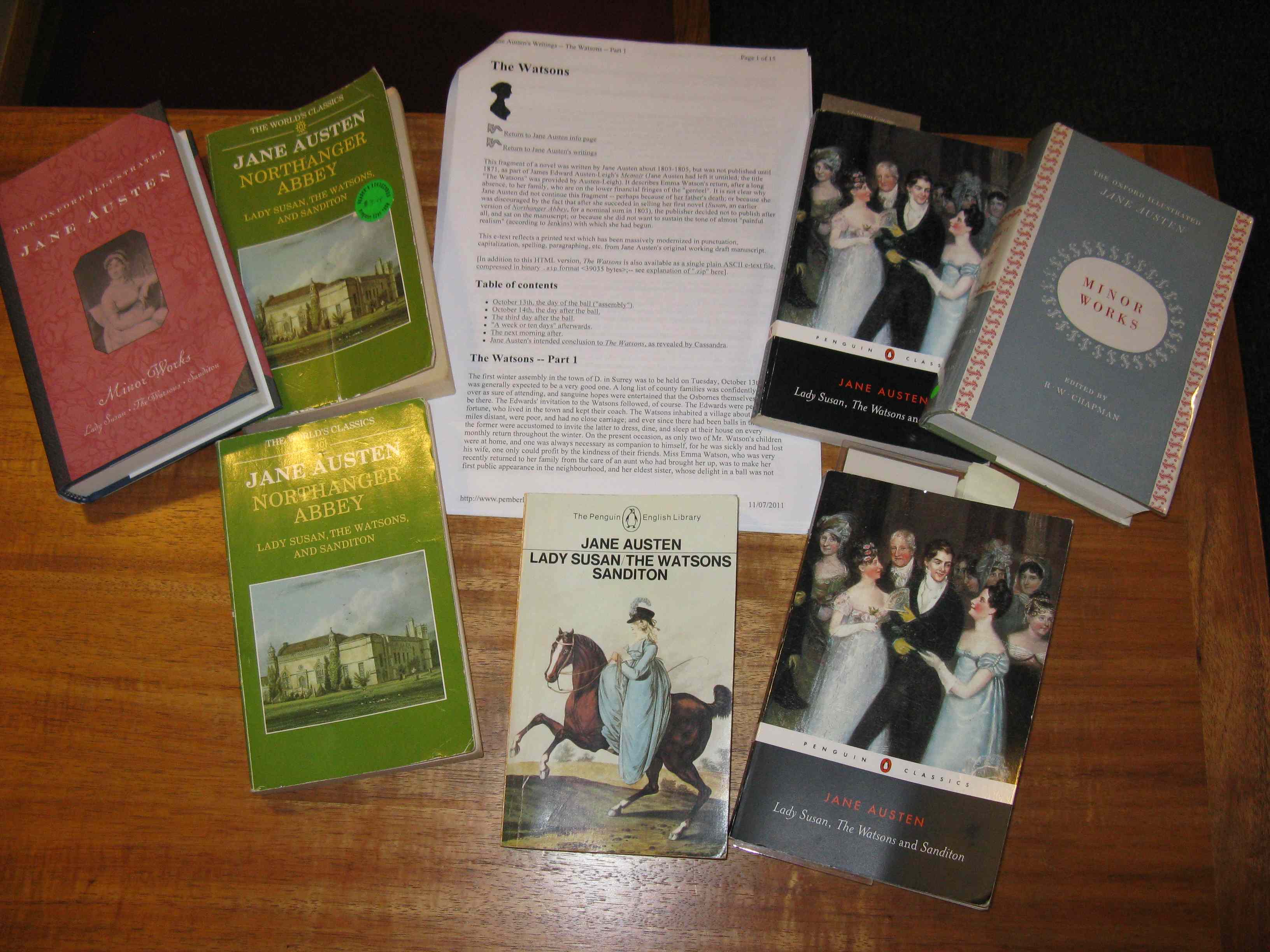
Book covers for Jane Austen's The Watsons

Book covers for Jane Austen’s The Watsons

Jane Austen fans, as you probably know, do a lot of re-reading. Given we only have six complete novels, plus her juvenilia and a couple of unfinished novels, we have little choice. Fortunately, it’s not a chore! And so, having completed rereading all her novels over the last few years for their respective 200th anniversaries, my local Jane Austen group decided to return to her two unfinished novels, starting this month with The Watsons. This was the third time we’ve done it in our relatively short existence. We did it in 2008 and again in 2011 (at which time I wrote my own reflections for this blog).

I do not plan here to write a “proper” review, so if you are interested in my thoughts, please check the link above. However, there are a couple of additional comments I’d like to make, starting with the question I posed in my 2011 post. The question relates to its unfinished nature. There are in fact two main questions regarding this: why did she stop writing it and why didn’t she pick it up again? And here I’ll quickly recap the novel’s background for those who don’t know it. The Watsons was written in Bath probably around 1803-1805, though there isn’t complete consensus about this. It’s commonly believed that she abandoned it after her father’s death in 1805 because of sadness and the resultant uncertainty in her living conditions. Whether this is true or not, it is true that she didn’t take up serious writing again until she settled in Chawton in 1809.

Now, it was at Chawton that she took up two earlier works, which became her first two published books, Sense and sensibility and Pride and prejudice. Why did she not then take up The Watsons and rework/finish it too? This is the more interesting question, I think, than why she stopped it in the first place. There are some theories around, though I haven’t investigated them thoroughly. However, her nephew James Austen-Leigh, who wrote the first “memoir” we have about her life, conjectures that Austen had become aware of “the evil of having placed her heroine too low, in such a position of poverty and obscurity” but I’m not sure I buy it.

My group discussed this idea, and we all felt that Austen had other “poor” heroines, of whom Fanny Price is the obvious example. But, the Dashwood girls were not well-to-do either. It’s true that Austen’s plan for The Watsons, as Cassandra reported, was for things to get worse for our heroine, but still …

No, my idea is different. The Watsons is broadly about four sisters and their marriage prospects – as is Pride and prejudice and Sense and sensibility. When we look at The Watsons, which Austen started after drafting those two books, we can see characters and storylines which remind us of these first two books. And so, I wonder whether, having published P&P and S&S, Austen felt she didn’t have enough new ideas to add to this storyline and wanted to try something different. Certainly, the next book, Mansfield Park, was something different. The marriage plot is still there, but it’s about a poor relation who is taken in by her wealthier ones. The interesting thing is that The Watsons commences with the return of 19-year-old Emma Watson to her family having spent 14 years with a wealthy uncle and aunt. Perhaps Austen decided to explore the story of the poor relation from a different angle, from the time of arrival at the new home?

Another thing about The Watsons is that as well as having characters who remind us of those first two novels, it also has characters reminiscent of some in later books, particularly in Emma. This suggests that while she didn’t finish The Watsons, her work on it wasn’t wasted – and she knew it.

We’ll never know of course. There’s so much we don’t know about our Jane, but it is fun trying to fill in the gaps.

A couple of apposite quotes

There’s more I could explore about this tiny fragment of around 17,500 words, but I’ll save those for the next re-read! Instead, I’ll conclude with two excerpts which grabbed my attention this time.

Gender and money

The first is a conversation between the heroine Emma and the wealthy aristocrat, Lord Osborne, who is interested in her, though his regard is not returned. In this conversation, he suggests that all women should ride horses:

‘I wonder every lady does not. – A woman never looks better than on horseback. –’
‘But every woman may not have the inclination, or the means.’
‘If they knew how much it became them, they would all have the inclination, and I fancy Miss Watson – when once they had the inclination, the means would soon follow.’
‘Your lordship thinks we always have our own way. – That is a point on which ladies and gentlemen have long disagreed. – But without pretending to decide it, I may say that there are some circumstances which even women cannot control. – Female economy will do a great deal my Lord, but it cannot turn a small income into a large one.’

Here we see Emma’s mettle. She stands up to Lord Osborne – to his assumptions about women and to his obliviousness that not all people have the means he has.

On reading to escape

And finally, The Watsons contains another of those wonderful quotes by Austen about books and reading. Here, right near the end of the fragment, Emma is thinking about the downturn in her fortunes through the death of her uncle:

The evils arising from the loss of her uncle were neither trifling, nor likely to lessen; and when thought had been freely indulged, in contrasting the past and the present, the employment of mind, the dissipation of unpleasant ideas which only reading could produce, made her thankfully turn to a book.

So, even in 1805, reading was seen as a way to occupy the mind and so escape, for a while, the troubles of life.

Jane Austen
“The Watsons”
in The Oxford illustrated Jane Austen. Vol VI, The minor works (ed. R.W. Chapman)
London: Oxford University Press, 1969
pp. 315-363

Rabih Alameddine, An unnecessary woman (#BookReview)

Rabih Alameddine, An unnecessary womanLebanese-born American writer Rabih Alameddine’s novel, An unnecessary woman, is tailor-made for readers. It was fittingly, therefore, my reading group’s first book for 2018. The novel is told first person in the voice of 72-year-old childless, divorced Aaliya Saleh, who lives alone and spends her time reading and translating books. Set in an apartment in Beirut in the 2000s, it has a minimal plot, focusing more on the thoughts and ideas of this reclusive woman who describes herself as her “family’s appendix, its unnecessary appendage”.

However, before I tell you more about the subject-matter and why I so enjoyed this book, a little warning. This is the quintessential literary novel. It is packed with literary references and allusions, not to mention references to musicians and artists. One of Aaliya’s favourite authors is the also-reclusive “connoisseur of alienation”, Portuguese poet Fernando Pessoa, and he appears regularly, but she also mentions, in no particular order, WG Sebald, Fyodor Dostoevsky, Patrick White (whom she adores), Helen Garner, Marguerite Youcenar, JM Coetzee, António Lobo Antunes, Ernest Hemingway, Albert Camus, Shakespeare, and many, many, many more. While I know the authors I’ve named here, I certainly don’t know all those she mentions – but it doesn’t matter. Well, it might, in that more knowledge might add all sorts of nuances to the book’s meaning, but all I can say is that I enjoyed it with what I do know.

But now the subject-matter. Where to start? The book covers a lot of ground. It’s about living in a war-torn city and country; it’s about relationships, gender and women’s lives in a patriarchal society in which her “half brothers, like so many men and boys, have the impatience of the entitled”; it’s about aloneness and loneliness; and, best of all, it’s about books and reading. It’s this last one I want to focus on, partly because it’s the one that gave me the most chuckles.

These chuckles aren’t of the belly-laugh variety. They’re more subtle, coming particularly from allusions and irony. Take for example this comment, a bit over halfway through the book:

Most of the books published these days consist of a series of whines followed by an epiphany. I call these memoirs and confessional novels happy tragedies. We shall overcome and all that. I find them sentimental and boring.

This comment made me laugh because her story is, essentially, “a series of whines followed by an epiphany”, for all her dislike of epiphanies. “Enough”, she says, “have pity on readers who reach the end of real-life conflict in confusion and don’t experience a false sense of temporary enlightenment”. This book is, you might be seeing now, also about the intersection between reading and life. To what extent do they inform each other?

Another of her dislikes, in life and in literature, is the idea of “causality”. Alain Robbe-Grillet, she says, “wrote that the worst thing to happen to the novel was the arrival of psychology”, meaning, she believes, “that now we all expect to understand the motivation behind each character’s actions, as if that’s possible, as if life works that way”. So literature, in other words, needs to reflect life. She writes:

I’ve read so many recent novels, particularly those published in the Anglo world, that are dull and trite because I’m always supposed to infer causality. For example, the reason a protagonist can’t experience love is that she was physically abused, or the hero constantly searches for validation because his father paid little attention to him as a child. This, of course, ignores the fact that many others have experienced the same things but do not behave in the same manner, though that’s a minor point compared to the real loss in fulfilling the desire for explanation: the loss of mystery. Causation extraction makes Jack a dull reader.

Interesting point, this “loss of mystery”, this sense that life cannot be so easily explained. She gives an example from “life” of a woman killed, during the civil war, while driving home from work. People proposed all sorts of reasons why it happened. She was a spy, or was a bank courier carrying a large amount of money, or was wearing a flashy diamond, whereas in fact she was just unlucky. “A stray bullet killed her”.

For Aaliyah there is something fundamentally wrong with this cause-focused approach to reading, and to living. She writes:

If you read these pages and think I’m the way I am because I lived through a civil war, you can’t feel my pain. If you believe you’re not like me because one woman, and only one, Hannah, chose to be my friend, then you’re unable to empathize.

This idea that finding causes for what happens to others enables us to distance ourselves from responsibility and to feel safe, has, says Aaliya, been explored by philosophers, such as the “ponderous and portentous” Sartre! Aaliyah, you see, is not cowed by big names and reputations. Nonetheless, she admits that, while she’s trained herself “not to keep inferring or expecting causality in literature”, she constantly wants explanations in life “where none exist”. “Uncertainty”, she says later, “is unsettling”!

I enjoyed Aaliya’s cheeky, somewhat self-mocking voice, the way, for example, her commentary is peppered with allusions – particularly, pointedly, from Macbeth – that tease the reader. But it’s not all light. There’s seriousness – pathos – too. For all her enjoyment of reading and translating (which is another whole topic I could write about), Aaliya is not as happy as she seems. She’s aware of ageing – and refers to Helen Garner’s belief “that all women over sixty instinctively learn to pass by a mirror without looking”- and she is lonely in her chosen aloneness:

It is the loneliness, the abject isolation. Hannah reappears in my memories to remind me of how alone I am, how utterly inconsequential my life has become, how sad.

It is partly in regard to this theme – and to the role of the “three witches” in her building – that Aaliyah has her “damn epiphany” at the end!

Besides the discussion of books and reading, the description of life in Beirut, and the analysis of the outsider’s life, An unnecessary woman has much more to offer, including its small but colourful cast of characters and some gorgeous language. This description of a saucer, for example, is surely also a metaphor for Aaliyah:

The rim of the saucer’s depression is lightly discoloured – a dusting of rust and red and brown, remnants of teas gone by that did not wish to be washed away, refused to be forgotten, the age rings of a small plate.

By her actions, Aaliya, despite her “age rings”, shows that she does “not wish to be washed away”, that she refuses “to be forgotten”. She will not, in other words, accept being “unnecessary”.

I have barely scratched the surface of this thoughtful yet playful book that teases us with an idea and then, more often than not, turns it on its head. It is this mixing of the playful with the serious, in Aailya’s compelling voice, that makes this largely plotless novel such an involving read.

Rabih Alameddine
An unnecessary woman
Melbourne: Text Publishing, 2014
291pp.
ISBN: 9781922148292 (eBook)