Jenny Ackland, Little gods (#BookReview)

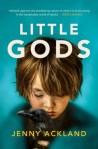
Jenny Ackland, Little godsThe universe is telling me something. Jenny Ackland’s Little gods is the second novel I’ve read in a few months that is set in the Mallee region of northwestern Victoria, the other being Charlie Archbold’s Mallee boys (my review). Interestingly, both are coming-of-age novels, both involve farms, and both have a death at the centre. However, this is where the similarity ends, because Ackland’s protagonist, Olive, is female – and younger than Archbold’s – and Ackland’s death is a mystery to Olive, whereas in Archbold’s novel it’s the mother’s death which precipitates the narrative.

There’s another difference too, and it’s that Mallee boys slots into YA fiction*, albeit also a good read for adults, whereas Ackland’s book, while seen primarily through Olive’s point of view, is adult fiction. This is because although it’s about Olive’s journey, the main focus is on the way children see adults and the way adults completely miss what is going on in children’s minds, on the decisions adults make about what to tell children and how children respond to what they sense isn’t being told.

So, the story. Set in the 1980s, it’s about Olive and her extended family in which two of the sisters, Audra and Rue, had married two brothers, Bruce and William, with a third sister and brother on each side left over. Thistle, the oldest (and left-over sister), lives with Rue and William and their three children, Sebastian, Archie and Mandy, on the sisters’ family farm. Audra and Bruce, with Olive, live close by in town. The action is split between the farm, which Olive’s family visits regularly, and Olive’s home in the neighbouring town.

The novel starts with a little un-named “prologue” which tells us that the book is about the year Olive turned 12, when she was “trapped in the savage act of growing up”. It’s about a time when, uncertain about what was going on, she reached back into her memory, only to find that memory can be deceptive. It all could have ended up far worse than it did. (We know it didn’t because here she is at the beginning, alive, apparently well, but contemplative!)

She is fierce

Anyhow, from this point, the novel proper starts with Olive knowing that the local community thinks her family – the whole family, I mean – “odd”, which entrenches her sense of outsiderness but also fires her sense of agency. The novel starts slowly, with the plot not picking up until we are well in. Before that, Olivia’s character and the family’s complicated relationships, particularly between the sisters, are carefully developed. Olive, we soon learn, is independent and, outwardly at least, sure of herself. She’s “fierce”, as the epigraph from Shakespeare warns us, and bosses her best friend, Peter, and her cousins around. But she is needy too. And for this there is Grace, a wild raven who provides her with the affection that she doesn’t get from her stylish but withdrawn mother. For all her faults, we like her.

And so, here’s Olive, on the cusp of adulthood, wanting to understand the world. She knows which adults in her life will nurture her, mainly Rue, and which are likely to answer her questions, and that’s mostly Thistle. However, Thistle has her own issues and sees life through a particular prism which is not always useful to Olive. It all starts to unravel when Olive finds pictures of her parents and Thistle all holding a baby which is not her. Through insistent questioning, she discovers that the baby had been her sister and had drowned. But, with no more details forthcoming, she decides the baby had been murdered and that she knows who is responsible. She determines on revenge, but needs help. Meanwhile, Thistle is working through her own lost baby problem … You could see this novel as a modern take on the Aussie “lost child” motif.

At times, as the narrative plays out, we are called on to suspend disbelief, but never quite beyond the point of no return. Some shocking things happen but others are diverted, so that by the end Olive has found some answers and also learnt some valuable lessons.

There are several joys in reading this book, one of which is the writing. Ackland’s descriptions of the Mallee, though brief, are evocative:

Sunday morning and the sun rose on the bleached Mallee landscape and lit the distressed greens and greys.

Even lovelier are the ways she captures people, their thoughts and relationships, particularly Olive’s of course:

Olive crept back to the bathroom. It was a startling thing to know that Cleg could be tender with Thistle the sister he seemed to like the least. Standing in front of the mirror it was as if there was an opening inside her mind. A plant, a tall one, with a green stem that was thick all the way around. At the top of it, a tightly bunched bloom, an enormous head of closed, wrapped petals. She didn’t know the colour of the flower yet but it was bright as if illuminated by special lights, and inside the heard of the flower was a quavering, shimmering sensation of coming movement and understanding.

Perfect.

Water also features throughout the novel, which is appropriate given the drowning, but it is also presented as a positive thing. For Olive, water provides respite. At the pool, “her body feels real in the water”, and, submerging herself in the dam she stays “under just to be in that cool distant place for a while longer.” The novel, in fact, opens and closes with references to Olive jumping off the high board – an effective image for the gutsy way she approached life, though the suggestion in the prologue is that having grown up she “was no longer a girl bombing off the high board.”

So, the book is about the challenges of growing up. Olive, the child, sees the world simplistically. People are “little gods” who “have power to do things, like make baddies pay”. She is shocked when lawyer Cleg sees it a little differently, is not so categorical about “bad people”. Ackland explores the clash between child and adult world views by teasing out responses to a family tragedy. As the secret comes out, as the truth is told, some family wounds heal and some lessons are learnt – but at what cost? I thoroughly enjoyed this book.

Oh, and as for what the universe is telling me … it’s that I need to make good my plan of some years’ standing to visit the Mallee!

Lisa (ANZLitLovers) also enjoyed this book.

AWW Badge 2018Jenny Ackland
Little gods
Sydney: Allen & Unwin, 2018
345pp.
ISBN: 9781760297114

(Review copy courtesy Allen & Unwin)

* Mallee boys has just been commended as an Honour Book in the Children’s Book Council of Australia Book of the Year for Older Readers Award

Michelle de Kretser, The life to come (#BookReview)

Michelle de Kretser, The life to comeMichelle de Kretser’s Miles Franklin shortlisted novel, The life to come, makes for great reading but difficult blogging because, like her Miles Franklin Award winner, Questions of travel (my review), it is big, and covers a lot of ground. Where to start is the problem. However, I’ll give it my best shot, starting with its form.

The novel comprises five distinct, almost standalone, parts, except that one character, the Australian novelist Pippa, appears in each one, providing a continuing narrative thread for the whole. She is introduced as a rather naive student in the Part 1 (“The Fictive Self”). We then move through Part 2 (“The Ashfield Tamil”) about Ash and Cassie, Part 3 (“The museum of romantic life”) about Céleste in Paris, and Part 4 (“Pippa Passes”) about Pippa and her in-laws, to end with Part 5 (“Olly Faithful”) about Christabel and Bunty. These characters are Australian, French, British and Sri Lankan.

But something intrigued me. The title of Part 4, “Pippa Passes”, rang a bell, of Robert Browning’s poem “Pippa Passes”. I don’t recollect much about the poem, but its form, interestingly, is similar to de Kretser’s novel. “Pippa Passes” is also the origin of the famous lines “God’s in his heaven/All’s right in the world”. However, while Pippa in the poem acts as a positive force, our Pippa does not. She thinks she’s a “good person”. As Céleste says, “Pippa would always need to demonstrate her solidarity with the oppressed – Indigenous people or battery hens, it scarcely mattered.” In fact, though, she regularly tramples on others, not necessarily intentionally, causing them pain. Presumably de Kretser intended this ironic allusion to Browning’s Pippa. I also wonder whether Christabel alludes to Coleridge’s poem Christabel, which explores the relationship between two women. Hmmm … I may be drawing long bows here as I don’t think Bunty is anything like Coleridge’s Geraldine. Still …

Anyhow, moving right along, I’m going to divide my remaining comments into two main strands – the personal and the, for want of a better word, sociocultural.

The personal

The novel’s title, The life to come, comes from Samuel Beckett’s Endgame, as quoted in the epigraph. It provides a clue to the novel’s main theme. It’s the theme that most touches our hearts, because it’s about the hope for or belief in “the life to come”. It’s about the search for meaning, for transformation, for a full life.

Cassie, for example, realises that her relationship with Ash is about trying to work out “How was she to live?”. She thinks, self-centredly, that “the two Sri Lankans”, Ash and the Spice Market man, “had entered her life to change its course”. Paris-based Céleste, who is fifty-something, single, and having an affair with thirty-something Sabine, is confronting ageing. “Is this all there is?” she wonders, as she sees her future shrinking “to a single point of solitary, penny-pinching old-age.” Pippa, our ongoing character, imagines a glorious future for herself as a writer: “her future was as vast as the light beating its wings in clifftop parks.” Céleste, though, sees something quite different in Pippa; she sees “Excess so far in excess of achievement.” Finally, single, Sri Lankan immigrant Christabel, looks, from the beginning, for that moment of transformation when her real life will begin. At 34, “she had believed, briefly, that her life could be joyful.” She keeps on hoping, however, and even when she accepts, “humbly, that it might never exist for her (“I am ordinary”) … she needed to know it was there“.

De Kretser provides her characters with life’s reality check, that gap between what you imagine and what you achieve. Best to learn it sooner rather than later!

The sociocultural

While that personal strand touches our hearts, the other one provides more of the laughs, albeit rueful ones, because many of them are turned on us. The life to come, in other words, contains a healthy dose of satire, skewering our assumptions and pretentious. When I say our, I’m particularly referring to us left-oriented middle-class earnest do-gooders. Like all good satire, it makes you think …

Eva, Pippa’s mother-in-law, is a good example. She “likes rescuing things”. For example, she employs refugees from a “not-for-profit catering group” to serve food at her parties, while wearing “garments stiffened with embroidery and beads. At throat and wrists she wore silver set with gems, some the colour of butter, others the colour of blood. These tribal ornaments lit Eva’s face, and proclaimed her solidarity with the wretched of the earth.”

In another example, her osteopath Rashida, who also happens to be a Muslim Indian immigrant, dines with Eva and her family. They quiz her about her background:

‘My parents thought that India wasn’t the best place for Muslims,’ said Rashida. ‘I love these potato pancakes, Eva. Could I have the recipe?’

‘Were you persecuted for your faith?’ Eva asked, hushed and hopeful.

‘Not really.’

Keith [Eva’s husband] said, ‘So you were privileged migrants.’

Rashida said nothing. She seemed to be turning the sentence over in her mind, trying to work out its shape.

De Kretser skewers Australians’ naiveté and blindness again and again, particularly regarding the horrors experienced by others, offsetting actual history against the idea of stories. Cassie, who is “postmodernly tutored”, thinks history is “just a set of competing stories” but Ash, born of a Scottish mother and Sir Lankan father, knows the difference between history and story, and understands exactly “the historical sequence that … brought a Tamil civil servant to the counter of a shop in the west of Sydney.” Cassie, Ash sees, “clung to an idea of Australia as a place where kindness prevailed over expediency”, her face denying “the existence of evil, the possibility of despair”. Ash, however, gobsmacked by her lack of awareness, wonders

What is wrong with you Australians? You eat curries without rice, a barbarism. You fear being attacked by people you’ve killed. You stole their land for animals that you slaughter in their millions, when you don’t leave them to die by the side of the road.

Pippa is no better than Cassie. She “saw Europe, momentous and world-historical, magnifying eventless Australia”, oblivious, clearly, to the barbarism enacted on our own shores. After all, as Ash is told when taken to his friend’s country home, “there’s no actual historical [my emphasis] record of a massacre.”

There are lighter, though no less satiric touches, such as Pippa’s telling Christabel about dining out with her literary agent:

We went to this amazing new Asian place at Darling Harbour. It’s been quite controversial because they do live sashimi. But Gloria and I talked about it, the cruelty aspect, and we decided it was Japanese cultural tradition so it was OK.

Where do we draw a line on cultural relativism?

The life to come is an uncomfortable book, particularly for Australians, because it suggests we are generally naive, and blundering, in our assumptions about and behaviour towards others, no matter how hard we try to be “good”. It’s also uncomfortable for us all as humans, because it exposes the gaps between our dreams and hopes for large lives and the reality that more often than not confronts us. The result is something that’s touching but also a bit pitiful.

Is this a Miles Franklin winner? I’m not sure. It may in fact try to do too much. But, is it a great read? Absolutely. I’d recommend it to anyone.

Lisa (ANZLitLovers) also enjoyed the book. And, for a non-Australian blogger, check out Guy’s post at His futile preoccupations.

PS I read this with my reading group.

AWW Badge 2018Michelle de Kretser
The life to come
North Sydney: Allen & Unwin, 2017
375pp.
ISBN: 9781760296568

Randolph Stow, The merry-go-round in the sea (#BookReview)

Randolph Stow, The merry-go-round in the sea

Randolph Stow is a writer I’ve been meaning to read for the longest time – since, would you believe, the 1970s? Embarrassing, really, given his significance. My plan had always been to read his Miles Franklin award-winning novel To the islands first. However, the first I actually bought was The merry-go-round in the sea – back in 2009 when it was re-released as a $10 Penguin classic. It’s taken me until now to read it – and I read it with my reading group, which made it an extra special experience.

BEWARE SPOILERS, albeit this is a classic with minimal plot so, you know …

The merry-go-round in the sea was Stow’s fourth novel, published in 1965 when he was 30 years old. It has a strong autobiographical basis, but is, by definition, fiction. It is essentially a coming-of-age story about a young Western Australian boy, Rob, who, like Stow, was born in Geraldton in 1935. It covers eight years of his life from 1941, when his favourite cousin, the 21-year-old Rick, leaves to fight in World War 2, to 1949, when Rob is 14-years-old and the now-returned Rick is about to leave again, this time to live in London. The plot is not a particularly dramatic one, but rather a lot happens nonetheless.

It all starts in 1941 with Rob and his family moving (“evacuating” is the strange word his mother uses) to a family station in the country, due to fears of Japanese invasion. There Rob enjoys the life of a “bush kid” and is unhappy to find, upon his return to town, that he is really a “townie”. Meanwhile, Rick is at war, ending up a POW on the Thai-Burma railway. His experience is told in three or four brief but vivid digressions from the narrative’s main focus on Rob’s life. We are told enough to prepare us for a changed Rick on his return. In the second part of the novel, the focus is on Rob’s growing up, on his gradual loss of childish innocence, and on Rick’s struggles to come to terms with his life after his experience of war. Nothing is the same for Rick, and Rob worries about his idol.

Now, this is a 400-page novel (in my edition, anyhow) and can be discussed from multiple perspectives, so I’m going to hone in on a couple that most interested me.

One of these is heralded by the book’s structure, by the fact that, although the protagonist, the person through whom we “see” most of the book, is young Rob, the book’s two parts are named for Rick, “1 Rick Away 1941-1945”, and “2 Rick Home 1945-1949.” Superficially, this can be explained by the fact that Rick is a major focus of Rob’s interest. However, I’d argue there’s something more here, that these two characters represent conflicting forces – a duality – within Randolph Stow himself, one being his love of place, of the land and country he grew up in, and the other being his discomfort with that same place and his need to get away, which indeed he did. This duality was, as I recollect, discussed by Gabrielle Carey in her book Moving among strangers: Randolph Stow and my family (my review).

So … through Rob’s third person eyes, Stow writes gloriously, authentically, about Geraldton and the surrounding areas in which he grew up. The language is lyrical, poetic, conveying an emotional intensity in addition to pure description:

By rock pools and creeks the delicate-petalled wild hibiscus opened, and the gold-dust of the wattles floated on water. Wild duck were about, and in trees and in fox-holes by water he looked for the nests, staring in at the grey-white eggs but touching nothing. Climbing a York gum, he was startled when a grey broken-off stump suddenly opened golden eyes at him. He gazed into the angry day-dazzled eyes of the nesting frogmouth and felt he had witnessed a metamorphosis.

There’s repetition of colours, plants, and landforms, but rather than becoming tedious they convey a deep familiarity with and love of place – and make the novel sing.

However, through Rick’s eyes – albeit eyes damaged by his war experience – we see a more conflicted, and arguably more adult, understanding of this place. At the end, he explains his decision to leave to Rob:

‘Look, kid,’ Rick said, ‘I’ve outgrown you…

[…]

‘I can’t stand,’ Rick said, ‘this – ah, this arrogant, mediocrity. The shoddiness and wowserism and the smug wild-boyos in the bars. And the unspeakable bloody boredom of being in a country that keeps up a sort of chorus. Relax, mate, relax, don’t make the place too hot. Relax, you bastard, before you get clobbered.’

Stow wasn’t the only intellectual to leave Australia in the 1960s. Others include Germaine Greer, Clive Robertson, Barry Humphries and Robert Hughes.

My other issue is trickier to discuss: it concerns Stow’s references to Indigenous people in the novel. It’s complicated to tease out, and to do so properly would require a re-read, but I can’t leave the novel without saying something about it, given our heightened awareness these days. As I’ve already said, the book was written in 1965 about the 1940s. In 1957, Stow had spent three months as a storeman at the Forrest River Aboriginal mission in the Kimberleys. His biographer, Suzanne Falkiner, argued (on ABC RN Late Night Live) that this experience created some conflict for him:

‘[His family] had achieved a lot: they had been colonists in America, in the West Indies, the earliest settlers in that region of Australia,’ she says. ‘But as he grew older and as he got to know Aborigines, having worked in the Forrest River mission, I think the conflict became a real source of pain for him.’

I believe that Stow tried to convey some of this in The merry-go-round in the sea. Several times, Rob quotes his family’s racist attitudes, including here:

Rob did not mind the blackn*****s, some of the older ones he rather admired. But his mother was furious because Nan [Rob’s sister] was sitting next to a blackn****r in school. ‘They’re dirty,’ said his mother. ‘They all have bugs in their hair.’

It was funny about blackn*****s. They were Australian. They were more Australian than Rob was, and he was fifth generation. And yet somehow they were not Australian. His world was not one world.*

In other parts of the novel, he describes seeing Aboriginal art in caves, and ponders the people who made them. Not all are so sensitive or interested, however. When he’s taunted at school with having “n****r blood”, he reacts defensively, but when he’s a little older, and schoolfriends once again express racist attitudes, he responds:

‘I like them,’ the boy said, ‘There’s some nice boong kids at school.’

A poor choice of words, but at least Rob stands up for his beliefs. If we take Rob as Stow’s mouthpiece, then it’s pretty clear that Stow is conveying in this novel some disquiet about prevailing attitudes to Australia’s Indigenous people.

There is so much more to explore in this book – including the motif of the merry-go-round itself. As a young boy Rob had been shattered by the discovery of “time and change”, leading him to cling to the idea of a merry-go-round, which revolves and revolves around a solid centre, his family, never changing. By the end, however, with Rick about to leave, he realises that this too is illusion, that the world is not quite as he’d seen it. A bittersweet ending – one that must come to us all at some time!

Several bloggers have posted on this novel in the last few years, including Lisa (ANZ Litlovers) and Kim (Reading Matters), and offer additional perspectives to mine.

Randolph Stow
The merry-go-round in the sea
Camberwell: Penguin Books, 2009
400pp.
ISBN: 9780143202745

* I have blanked out this word to, hopefully, deflect the wrong sort of “hits” on this blog.

Jan Wallace Dickinson, The sweet hills of Florence (#BookReview)

Jan Wallace Dickinson, The sweet hills of FlorenceThere are several reasons why I enjoyed Jan Wallace Dickinson’s historical novel The sweet hills of Florence, the first being Florence itself. I fell in love with Italy in Florence. Brunelleschi’s dome, Giotto’s belltower, the Uffizi and all the other gorgeous places of art and architecture, not to mention the food, combined to capture my heart. It was the first foreign place to do so, and so remains today a special memory. Dickinson, who has apparently lived and worked in Italy for many years, clearly loves Florence too, because it is described in this book with such love.

However, that’s not the only reason for liking this book. Another is the history. I’ve read many, many novels set during the second world war, but not many set in Italy, let alone in Florence. When I visited Florence way back in 1980, it was the art that drew me. I knew very little of its war history, and I don’t recollect its being much on display. Dickinson, though, tells a fascinating story, one that captures both the horror and chaos, the brutality and bravery of war, and particularly of Italy’s war, well.

In some ways, the book could be described as historical romance, except that it doesn’t fit the bodice-ripper formula that I, of admittedly limited experience, see as the definition of this historical fiction sub-genre. What I’m saying in other words, is that in this book, although the love story underpins the plot, it doesn’t drive it in a suspenseful way. This enables Dickinson to explore the main relationship in a more subtle, dare I say, more nuanced way – and to focus on other themes as well.

The story, then, concerns two cousins, Enrico and Annabelle, who are in their late teens to early twenties, during the period of war – 1941 to 1945 – covered by the book. It’s clear from the beginning that Annabelle loves Enrico, and it doesn’t take long before we realise her love is reciprocated. The story follows their lives as partisans, with the Giustizia e Libertà movement within the Italian resistance movement. It’s a story of love, loyalty and camaraderie, but also of courage, deprivation, brutality, and chaos. Dickinson writes this convincingly, though I must say that all the names and places sometimes made my head spin! Here are a couple of examples of her descriptions, describing the German occupation of Florence:

There was no shortage of good citizens ready to settle a score by denouncing someone to Major Charity. The war lifted a rock and from under it, unimaginable creatures emerged, creatures who could not survive in the sunlight, who could thrive only in the dank shady corners of a civil war.

AND

This was the real Florence, the Florence of sobbing and wailing and tearing of hair, not the painted and decorated Florence put on show by the authorities to distract the popular, like the dance of a painted harlot before an audience of terminally ill patients in a madhouse.

Another aspect of the book which made it interesting reading is its structure. The novel is divided into 6 parts, and flips between war-time and the 2000s (up to 2008). The main war action is told chronologically through the middle parts of the novel, while at the beginning and end, we alternate somewhat between past and present. Again, this structure forces us to focus on the characters and their development, on the ideas and themes, rather than the plot.

There’s also paralleling of Annabelle’s love for Enrico, with Clara Petacci’s love for Benito Mussolini. I enjoyed this too. Dickinson spends some time describing Clara and Ben’s relationship. In her Acknowledgements she describes them as “fictionalised characters constructed from my interpretation of diaries, reports and histories.” Clara and Ben’s story serves a few purposes in the novel besides being a focus for Annabelle’s thinking about love. It humanises the two characters, for a start; it encourages us to consider the complexities of their relationship; and it makes the manner of their deaths all the more shocking.

We have no choice, do we?

In the end though, the ideas and themes were what I most enjoyed about the book, particularly those regarding the brutality of war and the lessons learnt or, to be more precise, not learnt. Dickinson makes very clear several times through the novel that there are no saints in war – and that Enrico and Annabelle themselves were capable not only of “justifiable” killing but of more brutal acts:

We cross a line. We decide killing os justified. We have no choice, do we? After that, nothing is taboo. Nothing is unthinkable. We are Freedom Fighters. We are heroes. We have rights on our side. Then wars end. We sleep and try to forget. But beneath it all we are still killers. We stand on the other side of the line. (from Annabelle’s diary)

Dickinson’s main theme, though, concerns the lessons of war. Annabelle’s reaction on the brutal death of Mussolini and Clara, and the subsequent way the bodies were treated, was

I wept for what we have become. Have we learned nothing?

Then, late in the novel, she makes a similar comment, quoting a partisan colleague who’d said:

“Italians … do not learn from the past. They live in the continuous present.”

There were times when I wondered about the reason for the epic nature of this novel, for its spanning so many decades and for, something I haven’t mentioned before, also spanning two countries, Italy and Australia to which Enrico went after the war. Dickinson, through Annabelle and her beloved niece Delia, consider the differences between Italy and Australia, seeing, for example, the former as kinder and the latter as more free. I’m not sure I agreed with all their conclusions, and I’m not sure what these discussions added to the novel, but …

… what did add to the novel were the references to the leering Berlusconi’s re-election in 2008 despite his increasingly fascist tendencies. Seen by a horrified Delia and Annabelle as “a leap back into the past”, it leaves us with, indeed, the question, “have we learned nothing?” The sweet hills of Florence, then, is an engrossing read if you like a strong story about “real” characters, that asks the important questions.

Lisa (ANZLitLovers) also enjoyed this book – I promise I hadn’t read her review when I wrote my introduction, which is suspiciously similar!! I decided not to change it.

AWW Badge 2018Jan Wallace Dickinson
The sweet hills of Florence
Melbourne: Hybrid Publishers, 2018
401pp.
ISBN: 9781925272840

Review copy courtesy Hybrid Publishers.

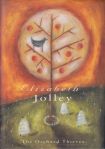
Elizabeth Jolley, The orchard thieves (#BookReview)

Elizabeth Jolley, The orchard thievesElizabeth Jolley’s twelfth novel, The orchard thieves, is a little different from most of the other Jolleys I’ve read. It’s a little less black, a little less about alienation, but it’s unmistakably Jolley in style and preoccupations.

By preoccupations, I mean her interest in family relationships and dynamics – and, related to that, her humane, but clear-eyed, understanding of human nature. The orchard thieves was written when Jolley was in her early seventies, and revolves around a grandmother contemplating the meaning of family and children. It feels very much like the meditations a woman of her age would be having – which is not to suggest that the story itself is autobiography. Still, I can see once again, why Helen Garner loves Jolley (and doesn’t love Thea Astley). Jolley and Garner both draw from their lives, albeit Garner more so, and both focus on life’s interior challenges. They also both do so in spare but loaded writing.

The orchard thieves, then, has a minimal plot, and no named characters. Told third person from the grandmother’s perspective, it concerns a family whose members are identified by their roles: the grandmother, the grandsons who belong to the youngest sister, the granddaughter who belongs to the middle sister, and the aunt (who also happens to be the eldest sister who lives with the grandmother). There is also the son-in-law (the youngest sister’s husband.) The novel (novella, really) is constructed in three parts, and the plot, such as it is, revolves around the return from London of the middle sister with her daughter.

So, what is it all about? It’s about the family at a point in time, from the grandmother’s point of view. It’s about parents and children, about love and worry, and about age and wisdom – not that the grandmother pontificates her wisdom or is even really sure that she has it. She worries about the aunt, her eldest unmarried daughter, fearing she’s lonely. She worries about the grandsons, their safety now and their future. And she worries about the middle sister’s health and happiness when she returns home – for how long? – clearly pregnant but saying nothing. It is this sister’s return that ripples the surface of the family’s finely balanced relationships.

Jolley prepares us for this “rippling” with an initially mysterious Preface, which commences

‘If you have the house,’ the middle sister said to the aunt, the eldest sister, ‘if you have the house you’ll have to pay us each one-third of the current market price. One-third each of the value of the place.’

We immediately think of course that someone has died, and then, as the book commences we realise that the owner of the house, the grandmother, has not died. We then wonder if she will die, but Jolley’s purpose is more subtle. This is not an inheritance-fight plot. Instead, the conversation tells something about the sisters’ characters. It also suggests underlying tensions, and introduces some ideas which, when they re-appear in their correct chronological sequence, become clear.

This is not a depressing book. The tensions are real, but the grandmother’s hard-won wisdom re-stabilises without offering pat solutions – and it’s all done in a quietly meditative, but by no means dry, tone. I found it absolutely delicious reading, with its Jolleyesque references to pear trees and birds, orchards and gardens, music and myths, sexuality and lesbianism; its sly humour; and, dare I say it, its relevance to my own musings. I haven’t reached my seventies yet, but am soon to join the world of grandmas and am certainly the mother of adult children. Jolley captures the concerns, the lessons learnt and still being learnt – about raising children, about relating to adult children, about being a grandmother, and above all about love – so economically but with sensitivity and insight.

Here’s a scene, early in the book:

Alone on the grey rug in the deeply shaded garden, the grandmother began to understand that it was not until she was a grandmother herself that she, because of her own love for her grandsons, realised how much she, as a small child, had been loved. And the pity was that it was too late to acknowledge this to anyone. It was no longer possible to offer, unsolicited, a kiss, a caress or a tender phrase backwards, as it were, over her shoulder. Recalling momentarily the pain of a telephone reprimand, well deserved she was sure, and only one of many, the grandmother came to a very real truth, which was that the great love which holds the mother to the child does not necessarily travel in the other direction, from the child to the mother. She understood also that she would not be the only person in the world to have discovered this.

Such spare writing. With the exception of the descriptions in the opening phrase – “grey” and “deeply shaded” – which set the melancholic, reflective tone, the language is direct and largely unadorned, and powerful as a result.

There are several references to myths and legends, which the grandmother believes “were attempts to explain happenings which were too painful and hard for human endurance.” Wanting to share these with the grandsons, she starts to tell them the story of Ceres/Demeter and her daughter Persephone/Proserpina, but it gets all too dark and boring for them, so they

simply slipped from the grandmother’s hands and disappeared with a slight rustling of dry leaves into the surrounding bushes.

You can just see it can’t you? Elsewhere, this gorgeous elegant language is subverted when the grandmother, walking with her grandsons, uses their language:

The grandmother hoped that the river paths unlike the roads and houses and the trolleys in the supermarket, were not crap. She hoped they were not crappy crap. She hoped that the aunt’s game and the secret paths, the rocks and the rock pools along the river beaches would remain uncrapped for as long as possible.

Oh, I could go on, sharing more and more. There’s so much more to say about, for example, the imagination and how it can lead you to worry and worry, about mothers’ regrets for things they could have done differently, about the time when children need to grow out of thieving orchards, about the reality that the

little rogues and thieves … would, during their lives, do something perfect and noble and wonderful and something absolutely appalling.

And appalling is pretty much how we could describe the middle sister’s behaviour when she arrives!

Helen Garner concludes her tribute to Jolley*, “To my dear Lift-rat” (which she wrote after Jolley had succumbed to dementia), with this:

But it was too late for me to say goodbye, or to thank her for the last sentence of The Orchard Thieves, where an old woman points out comfortingly to her daughter that the difference between a bad haircut and a good one is only a week.

Garner’s right. It’s somehow the perfect, grounding ending for a book which is about both the importance of “the unseen things, the real feelings and the deep needs” and the business of “push[ing] on with living.” It’s a timeless book.

Read for Lisa’s (ANZLitLovers) Elizabeth Jolley Week.

* You can read Garner’s essay on-line and in her collection Everywhere I look (my review).

AWW Badge 2018Elizabeth Jolley
The orchard thieves
Ringwood: Viking, 1995
134pp.
ISBN: 9780670865505

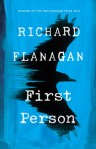
Richard Flanagan, First person (#BookReview)

Richard Flanagan, First PersonRichard Flanagan’s latest novel First person, which I did with my reading group, is a challenge to read. By this I don’t mean it’s “hard” to read but that it requires careful attention to pin down. On the surface, its subject is straightforward. It’s the story of struggling as-yet-unpublished writer, Kif Kehlmann, who accepts the job of ghost-writing a memoir for a con-man, Siegried Heidl. It’s autobiographically-based in that Richard Flanagan himself did just this for the fraudster or imposter John Friedrich, who headed the National Safety Council of Australia. However, the novel takes off in directions far removed from Flanagan’s life. At least, so I believe, though as Kif very quickly learns, how do we know what to believe! Who to trust!?

Anyhow, why write this now, 25 or more years after the events? Well, the title might give you a hint, as well as the subject matter … but, it is a tricksy book, starting from its very nature as a pseudo-memoir about a ghost-written memoir. If you know Flanagan, you’ll know he’s setting himself – and us – up for quite a ride. It’s a complicated ride, and perhaps got a little sidetracked at times, but is nonetheless fascinating …

“ceaselessly self-making”

The story describes, in Kif’s first person (ha!) voice, his experience of ghostwriting Heidl’s memoir and its aftermath. The ghostwriting task doesn’t go well, with Heidl evading Kif’s attempts to obtain the information he needs. Flanagan describes this with the wonderfully evocative language that we love reading him for. “I may as well have used a pair of scissors to pick up spilt mercury”, he writes of his early attempts to get some facts. He tries a different method: ask some direct questions, write up his understanding of the answers, and then check his version with Heidl:

The more outlandish, the less related my story was to the few, vague facts he had outlined, the more ludicrous I was, the more pleased Heidl seemed, and the more he would claim that it accorded exactly with his own memory.

After which, apparently, Heidl would contact 60 Minutes or some other program or newspaper, to line up “paid interviews about himself on the basis of such inventions.”

You can perhaps see where this is going in terms of my Why now question. It’s that Heidl (Friedrich) was continuously reinventing himself. Sound familiar? Heidl lived “in a constant state of transformation”. The end result, as Kif sees it, is that Heidl, “the great story maker … was everywhere present in his creations but nowhere visible”. He was not, as Kif tells it, “so much a self-made man as a man ceaselessly self-making”. This narcissism, this solipsistic way of being in the world, this mania for self-invention, makes this book relevant now.

“Trust is the oil that greases the machine of the world”

The other main issue relating to the Why Now question concerns trust. Heidl was a con-man, which means of course that he played on people’s trust. And my, he did it with bells on. He managed to defraud banks of $700 million by, for example, convincing them that he had a fleet of shipping containers (CIRILs) full of the technology and equipment required for responding to disasters. Heidl says, continuing the heading quote above:

Even people we hate we trust. That’s how it is. And, amazingly, mostly it works. The bankers trusted that the CIRILs were real, that ASO was real, until finally it was real. Like you trust the mechanic did service the car or that the bank is honest; like you trust that the people who run the world know what they’re doing …

Every day now, every single day it seems, we are confronted with organisations and individuals failing to live up to our trust – the churches, the banks, the police, the politicians. This is why, it’s patently obvious, Flanagan wrote this story now.

The novel, then, is about what happens when we buy into this world of make-believe. And it’s not pretty. In the book it is most vividly exposed, at the personal level anyhow, through what happens to Kif during and after his writing of the book. The more time he spends with Heidl, the more he finds himself, against his will, being drawn into Heidl’s world and starting to “think like Heidl”, until finally “all that divided him from me evaporated.” You’ll have to read the book yourself, if you haven’t already, to see how this plays out.

“The novel is dead”

The book is also an apologia for fiction. Like Flanagan, Kif was a struggling novelist when he accepted the ghost-writing job. It’s something that Heidl regularly throws back in his face, whenever Kif questions his truths. Why is a fiction writer, Heidl asks him, concerned about truth and facts when what he does in fact is lie? Hmm … I’d tell him there’s lying and there’s story, and that the former obfuscates while the latter illuminates, but he probably wouldn’t believe me!

Near the end, an entertaining (there’s much humour in the book in fact) but significant set piece occurs when, visiting New York decades later, Kif meets a young writer. She’s in her late twenties and has just published the third volume of her autobiography. The novel, she says, “as a mode of narrative“, is dead:

It’s fake, inventing stories as if they explain things … Just the thought of a fabricated character doing fabricated things in a fabricated story makes me want to gag […] Everyone wants to be the first person. Autobiography is all we have.

Kif says he doesn’t agree … and nor does Flanagan, which he demonstrates most obviously through the very act of writing this story as a novel not a memoir. Fiction, he shows, facilitates the exploration of alternatives, the asking of questions.

Overall, I loved Flanagan’s exploration of our current mania for self and of the issues surrounding truth and our desire (need, even) to trust. I also enjoyed Flanagan’s language. But when I got to the end, I couldn’t make it fully cohere. This is partly to do with the breadth of targets and topics, of which I’ve only touched the surface here. It felt at times that Flanagan had a few points to make – scores to settle even – regarding, for example, publishing and writing in Australia. These confused the main thrust a little – though maybe I have conflated Kif with his author! Finally, the second part of the novel, post Heidl’s death, could have been tighter. Kif’s life diverges significantly from that of his model, Flanagan, and is explored at some length. It’s perfectly logically developed, but the “message” started to feel a little laboured.

Nonetheless, First person is well worth reading – for its (novelistic) insight into that time in Flanagan’s life not to mention into a fascinating episode in Australia’s history; for its intelligent exploration of some critical issues that don’t seem to be going away; and for Flanagan’s marvellous prose. I should probably read it again.

Lisa (ANZLitLovers) loved this book.

Richard Flanagan
First person
North Sydney: Knopf, 2017
392pp.
ISBN: 9780143787242

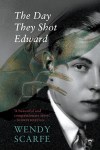
Wendy Scarfe, The day they shot Edward (#BookReview)

Wendy Scarfe, The day they shot EdwardThere’s something about novellas, about the way they can combine the tautness of the short story with the character development of a novel, and then hone in on an idea, undistracted by side-stories. This, in any case, is what Adelaide-writer Wendy Scarfe achieves in her book, The day they shot Edward.

Like her previous novel, Hunger town (my review), The day they shot Edward is a work of historical fiction. It’s set in Adelaide in 1916, in other words, half-way through World War One. Emotions run high, and 9-year old Matthew, through whose third-person perspective we see most of the events, is often uncertain, if not fearful. The plot is simple enough. We know from the title that Edward has died, and we know from the Prologue that Matthew is implicated in his death in some way, but was a child at the time. From the Prologue we move straight into a chronological narrative telling the story of Matthew, an only child who lives with his restless mother Margaret, his wise Gran (Sarah), and his father, the ironically named Victor, who is dying of tuberculosis on the sleep-out. There are three other main characters, the aforesaid Edward, who is an anarchist and whom Matthew idolises, an intimidating man in a cigar-brown suit, and Mr Werther, the German-born headmaster of Matthew’s school.

Matthew’s life is difficult. A sensitive lad, he is caught between his grounded, politically-aware, loving Gran and his self-centred, unhappy Mother. Gran, who approves of Edward’s activism on behalf of disadvantaged people, is constantly disappointed by her daughter’s readiness to put Matthew’s and anyone else’s interests behind her own desire for acceptance by the “better class”. Matthew himself is conscious of his mother’s self-centredness. Out with Gran and Mr Werther, for example, he feels included, part of “the special laughter and talk of Gran and Mr Werther”, but out with his Mother he feels “alone, beside her but separate” because although she sat with him

in reality she skipped out of her chair nodding, laughing, flirting and frolicking around the room. People always looked at her. She insisted that they did.

Complicating all this is that Edward is attracted to Margaret, and she’s happy to flirt with him but, “lost in her dream of social acceptance”, is unlikely to accept him when she does become free. However, lest you are now seeing Margaret as the villain of the piece, she deserves some sympathy. She had chosen poorly in marriage, and her lot is now doubly difficult in having to care for an ill man who hadn’t been a good husband in the first place. Her life is not easy, and her future not assured.

Anyhow, as if this wasn’t enough in Matthew’s life, there are the political tensions – Mr Werther is insulted by his students and is no longer welcomed amongst people who once socialised with him, and, worse, there are people wanting to trap Edward in the act of subversion. The net is closing in on Edward – as we knew it would from the Prologue.

We see these adult tensions and interactions through Matthew’s eyes – but we know the dangers lying behind the things that simply mystify (or, unsettle) him. I would call Matthew a naive narrator but I’m trying to recollect whether I’ve ever read a third-person naive narrator. Regardless, though, this is essentially what he is.

All this is to say that The day they shot Edward makes for great reading. Although we essentially know the end at the beginning, we do not know who the characters are, nor how or even why it happened. We don’t know, for example, who this Mr Wether is who is accompanying the now violin-playing grown-up Matthew in the Prologue. It is all told through a beautifully controlled narrative. There are recurring plot points – from the opening scene when Matthew decides to save the yabbies he’d caught to his ongoing concern about people liking to kill things, from Edward’s little box-gift for Margaret to the boxes of papers he asks them to store. There’s the quiet build-up of imagery, particularly the increasing references to red/blood/crimson colours. There’s the development of the characters through tight little scenes in the kitchen and living room, on the street and in the schoolyard, in cafes and at the beach. And there’s the language which is poetic, but never obscure.

Ultimately, this is a coming-of-age story. Sure, it’s about politics – about how difficult times turn people to suspicion, intolerance and cruelty – and in this, it’s universal. We see it happening now. But it is also about a young boy surrounded by adults whom he doesn’t understand. He’s only 9 when it all comes to a head – young for a coming-of-age – but as he considers in the Prologue:

Had surprise ceased that tragic night? Or did his understanding as a man mark that moment as his step into awareness?

In this, it’s also universal. Matthew learns some difficult truths the night Edward died – but those truths include some positive ones, such as that love can continue after a person dies, that good choices can be made, and that not all people kill things. A lovely, warm, read.

Lisa (ANZLitLovers) also enjoyed this book.

AWW Badge 2018Wendy Scarfe
The day they shot Edward
Mile End: Wakefield Press, 2018
124pp.
ISBN: 9781743055199

(Review copy courtesy Wakefield Press)

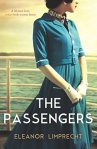
Eleanor Limprecht, The passengers (#BookReview)

The passengers is Eleanor Limprecht’s third novel, but the second I’ve read, that being Long Bay (my review) based on the life of early twentieth century abortionist Rebecca Sinclair. The passengers is also a work of historical fiction, though not specifically based on one person’s experience. Instead, it’s about the Australian war brides who married American soldiers during World War 2 and followed their husbands to the USA after the war.

It is also somewhat more complex in conception and structure than Long Bay’s simple chronological third person narrative. It is framed around a journey, that of war bride Sarah who, through the course of the novel, travels back to Australia, on a cruise-ship, after a 68-year absence. She is accompanied by her circa twenty-year-old American grand-daughter Hannah, who has anorexia nervosa. The narrative comprises alternating chapters in Sarah and Hannah’s first person voices: Sarah’s is primarily her telling her story to Hannah, while Hannah’s is more her internal reflections on her life and her grandmother’s story.

Now, I’m going to get this voice decision out of the way first, because I found it a bit problematic. In her Acknowledgements, Limprecht thanks some people for helping her to hone her focus, and for showing her “how not to be scared of trying a different structure”. Good for her, I say. There’s nothing wrong with trying a different structure. This alternating-voice one, which is not particularly new or out-there, can be used effectively to throw light on two different perspectives and experiences, which is essentially what it does here, though war bride Sarah’s is the main story being told. Hannah never comes quite as alive as Sarah. She provides neat segues between episodes in Sarah’s story, and creates some parallels in their respective experiences, but she, and her condition, don’t really add significantly to the novel. Given this proviso, however, Limprecht does capture her illness authentically, and doesn’t trivialise it by presenting a simple resolution.

Still, the structure works. My issue is more the first-person voices, particularly Sarah’s storytelling one, because it constrains the narrative to the sorts of things Sarah would tell a grand-daughter. She is surprisingly open about deeply personal things like sex with her husband/s, but this narrative approach reduces the opportunity for deeper, more internal, reflections about the emotional, social, and mental challenges faced by war brides.

But now, that discussed, I’ll get on to all the positive things, because this is an enjoyable read. For a start, Limprecht’s evocation of Sarah’s life in Australia, first on a dairy farm south of Sydney and then in Sydney during the war, beautifully conveys life at that time, and captures the strangeness of those days:

How was anyone to make sense of it? The world was upside down, flipped and spinning backwards–women working men’s jobs, street and railway station signs taken down or covered in case the Japs landed, coupons needed just to buy butter, tea, sugar or meat. … The army and navy requisitioning anything they wanted, anything they needed for war. Japanese subs in Sydney harbour.

When death is close, you have to live.

It’s no wonder, as naval officer Jim says to war bride Sarah now en-route to Virginia, that the war “made us do strange things.” For many young women like Sarah, those strange things included marrying young American men whom they barely knew, and not fully comprehending the post-war implications of these weddings, which was that they would be expected to live in America!

Limprecht clearly did her war-bride research well – and I love that she details it at the end of the novel. It shows in the vivid way she relates the experience of these brides as, accompanied by Red Cross workers, they travelled by boat to America and then by train to their husbands all over the country. This part of the narrative not only felt authentic, but it was also highly engaging. At one point Sara describes herself as “barrelling blindly forwards” with “no idea of what world I would enter.” Brave stuff, really. Sarah’s journey continues after her arrival in Virginia, taking us from her early 20s to the present when she is a widow, and retired vet, in her late 80s.

As you’ll have realised by now, the novel’s unifying theme is the journey – a theme I discussed only recently in my post on Glenda Guest’s A week in the life of Cassandra Aberline. Cassie’s journey was about deciding whether she’d made the right decision to leave Perth when she was around 20. Sarah’s is somewhat more complex. It’s about reconnecting with her past, and about putting right, or resolving, the lies she had told both before and after leaving Australia. There’s a journey for Hannah too. She thinks she is there to help her elderly grandmother, but in fact her grandmother had invited her because she hoped it would help Hannah get well. The relationship between Sarah and Hannah is a lovely part of the novel.

There are also several references in the novel to John Steinbeck’s The grapes of wrath, which Sarah reads on her train journey across America. Although the Joads’ travels are rather different from Sarah’s, she sees some similarities to her family’s farm struggles in Australia, and she sees value in Tom Joad’s practical philosophy that “There ain’t no sin and there ain’t no virtue. There’s just stuff people do.”

Overall, then, The passengers is an engaging book about a by-product of war – and the long tail of its aftermath – that has tended to be forgotten in the ongoing focus on men and their experiences. For this, as well as for its lively descriptions of war-time Sydney and of the war brides’ journey by boat to America, I’d recommend it.

Lisa (ANZLitLovers) also enjoyed the war-bride story.

AWW Badge 2018Eleanor Limprecht
The passengers
Sydney: Allen & Unwin, 2018
336pp.
ISBN: 9781760631338

(Review copy courtesy Allen & Unwin)

Nick Earls, NoHo (#BookReview)

Nick Earls, NoHoNick Earls is a Queensland-based writer known mostly for humorous fiction about contemporary life. While I’d heard of him, I hadn’t read any of his work when I attended a session involving him at the 2016 Canberra Writers Festival. The session was titled “Modern Masculinity” (my report). Earls was there because of the recent publication of his Wisdom Tree series of five novellas, of which NoHo is the fifth. I chose to buy it because of my familiarity with its setting, Los Angeles.

The Wisdom Tree books are beautifully designed (by Sandy Cull), and just lovely to hold. For that reason alone, I’m glad I finally decided to pick NoHo off the TBR pile and introduce myself to this writer. The books are apparently “subtly linked”, but I don’t think that means you need to read them all, or read them in any order. I certainly haven’t, and I enjoyed NoHo regardless.

The five books in the series are titled by the name of a place: 1. Gotham, 2. Venice, 3. Vancouver, 4. Juneau, and this one, 5. NoHo. NoHo refers to North Hollywood where 11-year-old Charlie is temporarily living with his mother and 12-year-old sister Cassidy who is seeking her break into the movie business. It’s not this Australian family’s first stay in Los Angeles, so Charlie knows the routine. As Cassidy and her mother do the rounds of agents and auditions, Charlie is left to himself. He chases wifi at audition venues. He goes “dumpster diving” for bottles and cans he can cash in at a recycling centre. And, in the last part of the story, he’s left at an art gallery to work on a school assignment that has been posted on the Distance Ed Blackboard site. Dropped off at 1.15pm, he is still there at gallery closing at 6pm because his sister has a “call-back” – and her needs come first. That’s the basic set up. Oh, and there is a father, but he is back in Australia, due to join the family at Christmas.

The story is told in the first person voice of Charlie. At the Canberra Writers Festival session I attended, Earls said that he used an 11 to 12-year-old boy as a protagonist because this is the age of starting to push boundaries, of wanting to be successfully independent but also being a little fearful. He wanted, he said, NoHo’s narrator to be naive about what he was seeing. That’s pretty much what he’s achieved: Charlie is starting to push boundaries – willing to be independent to a degree – but is not so confident that he isn’t a little anxious when his mum leaves him too long at the gallery. He’s lucky that a down-to-earth warm-hearted security guard, Wanda – “a tough woman who has had difficult times, I can tell” – stays with him.

Charlie isn’t, however, completely naive. He’s an intelligent boy who has some insight into the treadmill his mother and sister are on. He comments on the sorts of dream-and goal-focused mantras that his sister follows:

I’ve seen sports clothes that say, “Never, never, never give up,” but is that right? Never? Triple never? What if your dream is to win a marathon and your body with triple-never do that? It’ll finish, if you work at it, but it’ll never cross the line first and could fall apart trying. What if your dream is to be a movie star before you’re old, and it’s a million other people’s dreams as well? More than a million, actually. And some of them, lots of them, have perfect teeth and better luck than you.

Good questions, Charlie.

The second part of the novella involves Charlie choosing an art work for his art assignment. He chooses an anthropomorphic sculpture titled Family #5, which features three creatures made primarily from found objects. There’s irony or, at least, poignancy, in Charlie’s descriptions of the work:

She could have put three creatures in a row, ignoring each other, but these ones aren’t. They’re relating to each other in a way that says family. We can’t help but see it that way. It’s an instinct. So, it makes you connect with them more … It’s a good family. How a family should be, looking out for each other.

[and]

The child creature has no idea how good life is in this moment before trouble comes, however long the moment might be. It’s the care the parent creatures are showing that keeps you looking.

There’s also a lovely humorous little scene in the art gallery between the guard, Charlie, and a couple of other gallery visitors, that provides a wry little comment on art, what it is and what it means.

Anyhow, NoHo is an engaging, lightly told but not light story about family relationships. Charlie is generous, tolerant even, about his lot. He doesn’t rail about the attention his sister garners (and expects) again and again. It’s not an abusive or consciously neglectful family. The mother and sister don’t exactly ignore Charlie, nor are they intentionally cruel to him. It’s just that Cassidy is the centre of the mother’s energy and Charlie is expected to understand this. And this is, perhaps, where the naive narrator comes in. We see the family dynamics and recognise the potential pitfalls. Life is seemingly good now but trouble is very likely around the corner. Will the family unit hold?

I thoroughly enjoyed NoHo, partly for Earls’ evocation of the place – it made me laugh at times – but mainly for its delightful narrator and his insights into what makes a family. I wish him well!

Lisa (ANZLitLovers) has reviewed 1. Gotham and 2. Venice.

Nick Earls
NoHo
(Wisdom Tree 5)
Carlton South: Inkerman & Blunt, 2015
142pp.
ISBN: 9780992498573

Glenda Guest, A week in the life of Cassandra Aberline (#BookReview)

Glenda Guest, A week in the life of Cassandra AberlineWest Australian author Glenda Guest made quite a splash with her first novel, Siddon Rock, though unfortunately I didn’t read it. It won, for example, the Commonwealth Writers’ Prize for Best First Book in 2010. I was very keen, therefore, to read her second novel, A week in the life of Cassandra Aberline, when the opportunity came my way.

There is a mystery and a question at the heart of this novel, and protagonist Cassie’s Alzheimer’s diagnosis in the opening chapter provides the impetus for their resolution. The mystery is implied in the opening page when Cassie accepts a “brown-paper-wrapped-package” and promises someone something. We soon learn that the package contains a good deal of money, but what the promise is, and why, unfolds through the course of the novel. The question appears on page 8, and is, “What if I was wrong?” About what?

Before I discuss that, though, I want to mention the novel’s organising motif, which is a train trip, assigning this book to the “journey” genre (though perhaps “genre” isn’t quite the right word.) In this genre (or form?), the plot is framed by a journey, by the end of which the protagonist resolves something and/or achieves some sort of personal growth. These stories are as old as literature. The Odyssey and The pilgrim’s progress are obvious examples, but Cormac McCarthy’s The road is a more recent one. Sometimes, the journey is full of adventures, of a series of trials that must be overcome, but some are quieter, more internal. A week in the life of Cassandra Aberline is one of these. There is a physical journey, but most of the action is in Cassie’s mind.

So, why does she take this journey? Well, I’ve implied it already, but will expand a bit more. Cassie left Perth, somewhat suddenly, 45 years before the novel opens. It’s clear that whatever it was that prompted this departure has remained unresolved, but now, with her Alzheimer’s diagnosis, she wants to be sure she was right – and if she wasn’t, because she does admit this possibility, she wants to do whatever is “needed to make amends”. And why does she want to do this? Part way through the trip she reveals the underlying reason:

I should like to understand myself properly before it is too late.

In other words, this is a true journey story, so much so that while we might think she is going home to confront the people she left, this is not so, as she clarifies near the end:

She had imagined her search for the truth would have been done by the time the Indian Pacific reached its destination, and that she’d be on a plane back to Sydney today. That was her expectation, but inconstant memory has not cooperated – it has twisted and turned, throwing up irrelevant and forgotten things, and so she has to stay.

She had chosen the train then, not just because it was the way she’d left all those years ago, but because it would give her the time think through the situation.

On the surface, the novel has a simple chronological arc following the train journey, but as Cassie travels we flash back to her childhood and young adulthood in WA’s Wheatbelt, and gradually piece together her story. We learn that she’d lived with her parents and an older sister, that her mother had died just before she started high school, and that she was very close to a neighbouring farm family, the Blanchards, who comprise Mary, her husband Hec, and their identical twin sons, Dion and Coe. Indeed, she spent more time with them than with her own family, particularly after her mother died, as she felt superfluous at home and was warmly welcomed by Mary who didn’t have a daughter.

However, things go awry, as they are wont to do in situations like this – and it’s precipitated by the Vietnam War, further complicated by romance and the fact that identical twins are involved. And here is where I should say that the novel plays with another literary motif – the twins one. However, this and the journey motif never overwhelm the focus on Cassie, who captures our attention from the start, and retains it throughout. She’s an engaging, well-formed character, who’s both resilient and vulnerable, warm and reserved. She has suffered, but she is never self-pitying.

The novel’s success, in fact, rests on Cassie’s ability to engage us, because we meet few other characters directly, albeit we meet several indirectly through her flashbacks. The story is told third person, but is limited to Cassie’s point of view. The over-riding theme is memory – memory which is of course threatened by her Alzheimer’s but which she needs if she is to work through the problem she has set herself. As she struggles to remember what happened in the past – to see if she can make sense of it – she is confronted by memory’s slipperiness (which may not always be related to her diagnosis). Here she responds to Jack, whom she meets on the train and to whom she admits that “a single moment changed everything”:

But memory slips and slides around, she says, so you never really know if what you remember about that young person is true. You can never be sure of what happened at any given moment. I don’t want to end with a question mark still in my mind, but maybe I’ll never really know what was right or what was wrong.

There’s one more significant thing that I haven’t mentioned, and that’s Cassie’s career, as an actor and then university drama teacher. Her real specialty, her love, is Shakespeare, and this too frames the novel – alongside the journey and the twins. Late in the novel, she reflects on how she teaches her students:

Look at Shakespeare, she will say, at how he leaves room for interpretation, for each actor to take a character and make it their own. That’s what good actors do – work from the details to create a believable persona, to make the watcher believe the character on the stage is true.

She is trying to understand herself, the life she has created …

And so, in a very real way, this novel is all about the journey. There is a plot – and it’s a powerful almost-melodramatic-in-that-Shakespearean-way one – but the main interest is Cassie, herself, and her predicament, past, present and future. In the end, the question is not whether she was right or wrong, but something else entirely. An absorbing read.

Lisa (ANZLitLovers) enjoyed this novel too.

AWW Badge 2018 Glenda Guest
A week in the life of Cassandra Aberline
Melbourne: Text Publishing, 2018
206pp.
ISBN: 9781925603262

(Review copy courtesy Text Publishing)