Anna Funder, Stasiland (Review)

Anna Funder's Stasiland bookcover

Funder’s Stasiland (Courtesy: Text Publishing)

Anna Funder‘s Stasiland, which won the Samuel Johnson Prize for Non-Fiction, is one of those books that can be reviewed from multiple angles, and I know that when I get to the end of this review I’m going to be sorry about the angles I didn’t get to discuss. But, I can only do what I can do, eh?

I found it interesting to read this book immediately after another non-fiction book, Brenda Niall‘s biography True north, because the contrast clarified for me why I liked True north but loved Stasiland. To put it simply, True north is a well-written but pretty traditional biography, while Stasiland is what I’d call “literary non-fiction”. In other words, in Stasiland, Funder uses some of the literary techniques – relating to structure, voice and language – more commonly found in fiction to tell her story. It’s not surprising really that this is the case, because when I heard her speak last month, she said that she had initially planned to write Stasiland as a novel but, having done the research and interviews, it “didn’t feel right” to turn those people’s stories to another purpose. She was also aware that there were things in these stories that might not be accepted, that might seem too far-fetched in fiction! Such is the fine line we tread between fact and fiction.

At this point, I should describe the book, though its broad subject is obvious from the title. Funder (b. 1966) has a long-standing interest in things German, from her school days when she chose to learn German, and has visited and/or lived in Germany several times. She writes of travelling through the former German Democratic Republic, a country that no longer exists, that comprises “tumble-down houses and bewildered people”, and she describes feeling a sense of “horror-romance”:

The romance comes from the dream of a better world the German communists wanted to build out of the ashes of their Nazi past; from each according to his abilities to each according to his needs. The horror comes from what they did in its name.

And so she decides to try to understand this dichotomy and places an ad in the paper:

Seeking: former Stasi officers and unofficial collaborators for interview. Publication in English, anonymity* and discretion guaranteed.

This is, depending on how you look at it, either a very brave or naively silly thing to do. Funder, who sees writing as an act of empathy or compassion, interviews several Stasi men who answer her ad, as well as other East Germans who suffered at Stasi hands. It might be coincidental, but essentially all her subjects who suffered were women, while the perpetrators were men. In fact, when she visits the Stasi HQ in Berlin, she’s told it only had toilets for men! All this is not to say, however, that men didn’t suffer (or, even, that there weren’t women perpetrators). Indeed, some of the Stasi men she interviewed were themselves bullied, blackmailed and otherwise stood over to keep them in line.

What makes this book compelling are the stories she gathers, partly because the stories themselves are powerful and partly because of Funder’s own voice. Funder places herself in the book. This is not a third person “objective” recounting of the interviews she conducted but a journey we take together to find some answers. When she interviews Herr von Schnitzler, who hosted the Black Channel, a television program in which he presented a Communist commentary on excerpted programs from the West, we are in the room with her, hearing not only what he says, but getting a sense of his personality alongside her. We see her being fearless in sticking to her questions in the face of a man who frequently shouts. “I recognise”, she writes, “this pattern of unpredictable shouting followed by bouts of quiet reason from other bullies I have known”.

It is particularly in the von Schnitzler section that the GDR paradox becomes most clear. Von Schnitzler was, Funder tells us, molded by the injustices of the Weimar Republic. We see how the drive to create a new society not bedevilled by the iniquities – that is, the inequalities – of capitalism (or imperialism as many of the Stasi men call it) resulted in the creation of an authoritarian society where freedom was minimal (or non-existent) and dissent not allowed. In stark contrast to von Schnitzler and his refusal to see any error in, or critique, the GDR, is Julia, one of the “victims”, who had believed in the GDR but, through having an Italian boyfriend, had become caught in the Stasi net. She discovered that the “state can be so dangerous, so very dangerous, without me having done anything at all” and was completely traumatised by the extent of surveillance and loss of privacy she experienced. And yet, having experienced the East and the West, she can still say

you see the mistakes of one system – the surveillance – and the mistakes of the other – the inequality – but there’s nothing you could have done in the one, and nothing you can do now about the other … and the clearer you see that the worse you feel.

The GDR story is, as Funder tells it, one of grand humanitarian aims but one also riddled by paradox and irony. She asks Herr Bock, a recruiter of informers, what qualities he looked for in an informer:

‘… and above all else,’ he says, looking at me, his eyes distorted and magnified through the glasses, ‘he needed to be honest, faithful and trustworthy.’

I look back at him. I feel my eyes too, getting wider.

How can you resist a writer who tells a story like this, who shows without telling exactly what is going on, who can inject sly touches of wit and humour into the tough stuff?

I can’t possibly relate all the stories – many quite horrendous – in this book. All I can say is that it is a book that manages to show how history writing can be intimate while at the same time conveying facts and hard truths. It is a memorable book, and worth reading if you have any interest at all in politics and human behaviour.

Anna Funder
Stasiland
Melbourne: Text Publishing, 2002
ISBN: 9781877008917
282pp.

* I’m intrigued by the promise of anonymity because it seems that in some, if not in all, cases, real names are used. I presume the people involved agreed to this.

Helene Hanff, 84 Charing Cross Road

Before you all (well, those of you of a certain age at least) gasp and wonder how it could be that I haven’t read this delightful little tome before, I assure you that I have. However, on our drive home today from our week at the coast, we listened to an unabridged audiobook version, and I can’t resist sharing some thoughts from this most recent acquaintance with the book.

For those of you who haven’t read it, 84 Charing Cross Road could I suppose be described as a sort of epistolary memoir. It comprises the correspondence between an American writer and bibliophile, Helene Hanff, and Frank Doel of Marks & Co, a London bookshop specialising in secondhand and antiquarian books. The correspondence starts in 1949 and covers the next two decades. Over time, others in the Marks & Co family join in, but the essential relationship is always that between bookbuyer Helene and bookseller Frank. In a horrible bit of blurb writing, it is described on the back of my (almost antiquarian itself) paperback as “the very simple story of the love affair between …”. Well, that cheapens it because it’s not a love affair in the usual sense. It’s a business relationship that also becomes a friendship. He is married, she is not … and no romance ever ensues.

I am not going to write a full review of the “story”, about how Helene sent “care packages” to the staff of Marks & Co to brighten up their postwar rations-ridden lives, about its humour and humanity. Rather, I thought I’d just share a couple of the comments she, a true bibliophile, makes about books and reading.

One is to do with marginalia. Hanff, like me, likes marginalia. She does it herself, and she likes it in the secondhand books she buys. She says in response to a book received as a gift:

I wish you hadn’t been so over-courteous about putting the inscription on a card instead of on the flyleaf . It’s the bookseller coming out in you all, you were afraid you’d decrease its value. You would have increased it for the present owner. (And possibly for the future owner. I love inscriptions on flyleaves and notes in margins, I like the comradely sense of turning  pages someone else turned, and reading passages some one long gone has called my attention to.) (16 April 1951)

Another year, another book gift, and here is her response:

I do think it’s a very uneven exchange of Christmas presents. You’ll eat yours up in a week and have nothing left to show for it by New Year’s Day. I’ll have mine until the day I die – and die happy in the knowledge that I’m leaving it behind for someone else to love. I shall sprinkle pale pencil marks through it pointing out the best passages to some book-lover yet unborn. (12 December 1952).

Hanff was clearly a slow-reader and liked re-reading, but she was not sentimental about books per se. Here she is on managing her books:

I houseclean my books every spring and throw out those I’m never going to read again like I throw out clothes I’m never going to wear again. It shocks everybody. My friends are peculiar about books. They read all the bestsellers, they get through them as fast as possible, I think they skip a lot. And they NEVER read anything a second time so they don’t remember a word of it a year later. But they are profoundly shocked to see me drop a book in the wastebasket or give it away. The way they look at it, you buy a book, you read it, you put it on your shelf, you never open it again for the rest of your life BUT YOU DON’T THROW IT OUT! NOT IF IT HAS A HARD COVER ON IT! Why not? I personally can’t think of anything less sacrosanct that a bad book or even a mediocre book. (18 Sept 1952)

Ellen of Fat Books and Thin Women would agree I think. Check out her recent post in praise of re-reading, and see for yourselves. Those of you who’ve been reading my blog for a while will know that I too am not averse to a bit of re-reading. There is a special joy in revisiting loved books and learning from them anew, isn’t there?

Finally, (only) because I’m missing my Jane Austen meeting today due to the aforesaid travel, I will share with you her discovery of Jane Austen. Hanff, you see, was not one for “stories”. “It’s just stories. I don’t like stories” she wrote in an undated letter around 1963/64. She preferred history (“i-was-there-books”), essays, poetry and the like. However, in 1952, she discovered Jane Austen “and went out of my mind over Pride & Prejudice …”. I’m sure I would have liked Helene Hanff.

Helene Hanff
84 Charing Cross Road (Audio CD)
Read by Juliet Stevenson and John Nettles
Hachette Audio (orig. pub. 1970)
2 hrs (approx) on 2 compact discs
ISBN: 9781405502559

Literary encounters, Australian style

I’ve been remiss. I could have solved some of your Christmas shopping challenges by telling you about two books which would be perfect gifts for readers: Shane Maloney and Chris Grosz’s Australian encounters, and Susannah Fullerton’s Brief encounters. Both have “encounters” in the title, but they use the word in slightly different ways, as you’ll see when you read on …

Australian encounters book cover

Book cover (Image: Courtesy Black Inc)

Maloney and Grosz’s book is the more light-hearted of the two, and just right for the Christmas season. Every encounter involves at least one Australian, but not all are literary. Some are a little tongue-in-cheek and a couple, even, are not between people. Take for example, Esperance and Skylab. (Australians will know what this is about!). Each encounter is given a page, with text by Australian novelist Shane Maloney, and a cartoon illustration by book illustrator Chris Grosz. I’ll choose just three* to share with you:

  • Australian novelist George Johnston and Canadian singer-songwriter Leonard Cohen (1960). Cohen (25 at the time) met Johnston (48) and his writer wife, Charmian Clift, in Greece. Johnston and Clift let Cohen stay in their spare room. Cohen says “They drank more than other people, they wrote more … they helped a great deal. They were an inspiration”.
  • Banjo Paterson and Rudyard Kipling (both of whom have been featured in this blog) (1900).  Paterson (36) sat next to Kipling at a dinner in South Africa, where Paterson was visiting to report on the Boer War. They apparently discussed politics and war, and must have hit it off because they met up again a year later in Kipling’s home in Sussex.
  • Robyn Davidson and Bruce Chatwin (1980). This was an organised encounter, and occurred in London. Chatwin had heard of Davidson (30) and her camel journey across the Australian desert. You can imagine what these two remote-area travel writers talked about, can’t you? Nomads was one topic, but politics was not. Chatwin apparently found politics boring and preferred to talk about (and mimic) people. Despite this, Davidson gave him contacts in Alice Springs which he would later use for his Australian travel book, Songlines.

This is an entertaining book, great for dipping into and discovering fun facts. I would have loved it if sources were provided for the information in the encounter descriptions, but this is not that kind of book. And, knowing now that these encounters took place, I can always research them myself.

Susannah Fullerton’s book, albeit called Brief encounters, is a longer tome and describes visits to Australia by 11 literati between 1836 and 1939. The book has an index and an extensive bibliography, satisfying my historian-self. The first visitor she covers is Charles Darwin, and the last HG Wells. In between are writers such as DH Lawrence (who wrote and set his novel Kangaroo only a couple of hours from where I live), Joseph Conrad, Agatha Christie (the only woman), Mark Twain and yes, even Rudyard Kipling.

Given Kipling appears in both books, I’ll use him as an example. Fullerton describes how Kipling came to visit Australia. It had its roots, she says, in an unhappy childhood and a consequent difficulty in forming relationships with women. He set off from England in 1891:

The ostensible reason he gave for the trip was that he was going to visit Robert Louis Stevenson in Samoa. What he desperately needed was to “get clean away and re-sort myself”.

His first experience of Australia was Tasmania – but only briefly – before he landed in Melbourne on 12 November. On 13 November, The Age newspaper reported him as saying:

This country is American, but remember it is secondhand American, there is an American tone on top of things, but it is not real. Dare say, bye and bye, you will get a tone of your own.

I find this quite fascinating because right now many of us feel there is an “American tone” to things in Australia, whereas back in the early to mid twentieth century the tone was distinctly British. Anyhow, Kipling said quite a bit in this early interview, both complimentary and not. His comments apparently “ruffled feathers” and he worked to smooth them over during the rest of his stay. While in Australia, he also briefly visited Sydney and Adelaide.

Now, here’s the interesting bit that ties us back to Maloney and Grosz’s book. He left Australia, Fullerton writes, rather “unenthusiastic about Australians” but this changed eight years later when he went to South Africa for the Boer War. There he met Australian troops and felt he had discovered “a new nation – Australia”. He is quoted as saying that he had never come across a “cleaner, simpler, saner, more adequate gang of men” and saw Australia as forging its own identity. Oh dear – why it is through war that our identity seems to be formed (at least in the eyes of others)?

Fullerton not only uses memoir, biographies and newspaper reports to track Kipling’s relationship with Australia, but she also quotes from his poetry and stories. One of the most significant of these is the ode he was asked to – and did – write for the Melbourne Shrine of Remembrance. The last verse includes the lines:

Then they returned to their desired land,
The kindly cities and plains where they were bred…

Clearly his view of Australia had softened. Fullerton concludes her Kipling chapter with:

Kipling spent only two weeks in Australia and saw very little of the country in that time. The visit may or may not have achieved his purpose of “re-sorting” himself. But it did leave a rich legacy – an ode, the beautiful poem “Lichtenberg” and a delightful explanation of how Australia’s most memorable animal, the kangaroo, came to look the way it does.

Fullerton’s book is well worth reading if you are interested in the authors she covers and/or in Australia as a literary destination! Lisa at ANZLitLovers agrees.

Shane Maloney and Chris Grosz
Australian encounters
Collingwood: Black Inc, 2010
111pp.
ISBN: 9781863955058
(Review copy supplied by Black Inc)

Susannah Fullerton
Brief Encounters: Literary Travellers in Australia 1836-1939
Sydney: Picador, 2009
396pp.
ISBN: 9781405039505
(Personal copy, signed by the author)

* I have left out the juicy bits – you’ll have to read the book yourself if you want to know those!

Anna Krien, Into the woods

How can so many people all be looking at the same thing and see it so differently? The man moseying around in front of me looks at a 300-year old tree and sees a nursing home, while an activist twenty minutes down the road sees a block of flats for furry and feathered creatures.

Vive la différence? Or not! Anna Krien’s Into the woods is an exposé of the decades long battle in Tasmania for its forests, particularly its old-growth native forests. For those who don’t know, Tasmania is Australia’s southern island state. It is famous for its beauty and its wilderness but also, it seems, for its Vs, that is, vitriol, violence and vigilantism. You see, being a small island state, with only 500,000 people, it’s a challenge to keep its economy in the black. Sawmilling and, more recently and more controversially, woodchipping have played an important role in maintaining its economy. It is this controversy – particularly surrounding woodchips – that Krien explores in her book.

Anna Krien, Into the woods

Cover image (Courtesy: Black Inc

On the cover is a “blurb” by Chloe Hooper who wrote The tall man about the death in custody of an indigenous man on Palm Island. This provides a clue to the book’s style, and that is that the author, like Hooper, engages personally in the situation, meeting with parties on all sides of the conflict. In Krien’s case this meant meeting ferals, environmentalists, politicians, loggers, whistleblowers, craftsmen and businessmen.

Krien has organised the book into five thematic sections:

  • Ratbags: the new generation protesters, or ferals, who live pretty primitively on/near the site  they are protecting and who are often in conflict with older activists
  • Loggers: the logging industry workers who range across a wide range of jobs in the industry and are also often conflict with each other
  • The company: Gunns Ltd, the main player in the Tasmanian logging industry, meddler (if so benign a term can be used) in politics, and initiator of the Gunns 20 lawsuit
  • Groundswell: change agents such as whistle blowers, proponents of the “rights” of nature, and shareholders wanting ethical investments
  • The mill: Gunns pulp mill saga, the beginning of the an end?

The story is a complex one, delving into competing interests within the logging industry itself – sawlogs versus woodchips, old-growth versus regrowth native forests versus plantations, public versus private forests – not to mention dissension amongst environmentalists and some very dirty politics. It is a story about jobs versus the environment and the “rights” of nature, of different value systems that set “unmanned” pristine forests against “manned” ones. It is a story of blaming and buck passing. And it is a story of half-truths and distorted truths, all in the name of defending one’s own patch. “I am on a journey through selective truths”, she writes at one point in the book.

This issue of “truths” is beautifully conveyed in her discussion of the timber industry’s language:

I find myself constantly having to decipher new words. Nature needs “disturbance”, logging is “harvesting”, deforestation is “afforestation”, burning woodchips for electricity is a form of “bio-fuel” or “renewable energy”. Woodchips are “feedstock”, while the non-commercial attributes of a forest are “non-wood values”.

The word-games though work on both sides. As she says, “evoking napalm, Hiroshima and the holocaust to describe logging is manipulative”.

A major argument presented by the logging workers is the economic one – jobs – but Krien estimates from the information given her that forestry “accounts for no more than 3% of the workforce”. In fact, she suggests that machines may be a bigger threat to timber jobs than “any greenie”. The more cynical amongst us might think that it is not so much about “jobs” but about “big business”. Sometimes, of course, big business means jobs, but that’s not always necessarily so, not if much of the work can be automated (or, sometimes, though not necessarily here, moved off-shore).

I can’t begin to convey all the information she presents in this book – the history, the statistics, the science, the criss-crossing relationships, not to mention the people, the overt and covert deals, and the truly horrifying violence (both actual and threatened). There are times when I started to feel bogged down in the complexity of it all, but I was reassured when I realised she was feeling it too. She is, in fact, like Hooper, taking us on a journey – but it is a journey that, despite her very real efforts to explore the whole story, does lean to one side, that of those who wish to protect not destroy. As she says in the last chapter:

I’ve tried to balance my seesaw heart, carefully weighing up each argument. But there is something about this island that wants you to choose sides.

I can understand that – it is, in many ways, a magical place. However, I do have one complaint about the book – my ongoing one for books of this ilk – and that is its lack of an index. It is jam-packed with people, events, places, philosophies and theories but how can the casual reader or researcher find them?

And so, is there a resolution to it all? Well no, but there is, she says, a universal story:

… in the greater scheme of things, the island is nothing but a drop in the ocean. But the story is universal – and what goes on in Tasmania goes on in the Pacific islands, in other continents, until it all comes back over the ice to Tasmania again. … Deep down in our bones we must know – we must know that nothing we do is done in isolation. Cause and effect: how did it get so noisy in between?

How indeed? Read this thoughtful, throughly researched book, and you will, unfortunately, find out.

Anna Krien
Into the woods: The battle for Tasmania’s forests
Melbourne: Black Inc, 2010
302pp.
ISBN: 9781863954877

(Review copy supplied by Black Inc)

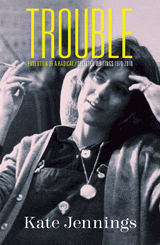
Kate Jennings, Trouble: Evolution of a radical

Kate Jennings, Trouble, bookcover

Bookcover (Courtesy: Black Inc)

I’m not going to beat about the bush but tell it like it is: I absolutely gobbled up Kate Jennings’ Trouble: Evolution of a radical: Selected writings 1970-2010. It took me a fortnight to read it, partly because I’ve been pretty busy but also because there was so much to savour and take in that I did a lot of stopping and thinking. That said, I do have one whinge, so I’ll get it over with now: it has no index. The book is described as an “unconventional” or “fragmented” autobiography and it is chock full of content. She mentions people, she discusses books and genres, she talks about politics, economics and feminism, not to mention all sorts of enthusiasms including, would you believe, swimming pools and shopping! I can see myself wanting to refer to it again and again but each time I’ll have to flip through it to find the idea or topic that I want to explore. Just as well I’m a marginalia person is all I can say!

So, who is Kate Jennings (b. 1948)? She is an Australian-born writer (poet, novelist, short story writer, essayist) and feminist, who stunned Australia with her Front Lawn speech in 1970, confronting progressive men, in particular, with their sexism. She moved to New York at the end of the 1970s and, in one of her iterations, worked as a speechwriter for a couple of large Wall Street firms in the 1990s. Somehow, she seems to have managed to do that without losing her critical eye. I have not yet read her novels, but will (finally, and rather coincidentally) be reading Snake in the next month or so.

Why did I like the book? This is how Jennings describes it in her preface:

This book, then, is a stand-in memoir. I’ve assembled pieces  – essays, speeches and poems, along with short stories and passages from my novels that actually happened – so that a reader might have a narrative of sorts.

On reading this you could be forgiven for fearing a mish-mash but fortunately that’s not what you get. The book is divided into 9 parts, each introduced by Jennings with a current reflection on the aspect of her life and career covered by that part. These parts move more or less chronologically through her life, though the readings themselves jump around a bit. This is because, like most of us really, she revisits some parts of her life many years after they occur, while others are documented at the time of their occurrence. The press release which came with my copy describes it in the following terms: “no-holds-barred” and “pull-no-punches”. What’s that, you say? They’re clichés! They are, but they describe the book perfectly, because this is a fiercely honest book written by a rather formidable woman. How else to describe someone who defiantly affirms, in almost one breath, her commitment to feminism and Jimmy Choo shoes, who calls herself a pragmatist but also argues passionately that “these are times of moral poverty”.

I think at this point I will just dot-point the parts to give you a sense of what she covers, because I fully intend to explore many of her ideas in more detail in the coming weeks/months.

  • Presumption: the making of her intellect, covering the years from 1970 to the late 1980s.
  • A child of grace, a landscape of progress: her childhood in the Riverina area of New South Wales, told mainly through excerpts from her novels and poems.
  • Cause and not symptom: her youth, focusing particularly on her introduction to alcohol (and subsequent joining of AA).
  • You don’t understand! What do you know! You don’t live here!: the life of an Australian expat in the USA explored mostly through her interviews with three other expat writers: Sumner Locke ElliottShirley Hazzard and Ray Mathew.
  • Catching a man, Eating him: her romantic life, which, with some self-mockery, she views through the songs of Dusty Springfield.
  • Crazed, delinquent fabulousness: an eye-opening sampler of her essays from 1990 to 2009 showing what a hard woman she is to pin down!
  • A bright, guilty world: more essays, these ones about her life as a speechwriter on Wall Street during the 1990s, including the full text of her Quarterly Essay 32, titled “American revolution: The fall of Wall Street and the rise of Barack Obama“. She has much to say about the GFC.
  • Irrelevance is deadly: how literature has (or hasn’t) dealt with the issue of business and finance.
  • Cut the shit: two no-holds-barred (yep, bring on the cliché!) essays which, she says, bring us back full circle to her main themes: “The first, a foray into my dusty childhood and Aussie alcoholism and masculinity through the re-release of the movie Wake in Fright, and the second, into poetry and the reasons I forsook it – or it, me – and a pet peeve: closed minds”.

I know it’s a bit of a copout, but I feel I can’t do justice to this book without writing my own Quarterly Essay and so, as I’ve already said above, I will return to it in future posts. In the meantime, the question to ask is: How does it work as an autobiography or “stand-in memoir”. I say very well. It does the things I look for: it tells me the main facts of her life, it shows me her interests, beliefs and values, and it gives me a sense of her personality (which is intelligent, opinionated, fearless and principled). Fragmented it might be in structure, but coherent it is in portraying a life.

In one of the poems she includes in the book, she writes:

… Saying simple things

well or complicated things simply is an art
that is fast disappearing …

Fortunately it is an art that Kate Jennings has not lost.

Kate Jennings
Trouble: Evolution of a radical: Selected writings 1970-2010
Melbourne: Black Inc, 2010
319pp.
ISBN: 9781863954679

(Review copy supplied by Black Inc.)

Louann Brizendine, The female brain

Louann Brizendine (Courtesy: Andy Feinberg)

Louann Brizendine, 2009 (Image: Andy Feinberg released into the Public Domain, via Wikipedia)

Beware – the F-word is coming! Yes, Feminism. It might be a dirty word in some quarters, but I regard myself as a feminist – 1970s style – and so I approached Brizendine’s best-selling book, The female brain, with my cautionary antennae out. It’s not the sort of book I would necessarily have chosen myself but it was a bookgroup read and my number one reading priority is my bookgroup’s schedule. And, really, I’m glad I read it because it is good to keep up with the various arguments and debates going on.

The way I see it – and it’s pretty obvious really – the influences on our behaviour are threefold:

  • biological/biochemical
  • genetic
  • environmental/social

The BIG question is, then, in what proportion do these play out in our lives? Clearly men and women are not the same – you just have to look at us to see that – but as a young woman I believed that environmental factors were the strongest in determining the course of women’s lives. And I still think that’s largely the case. Environmental (or socio-cultural) factors may not necessarily be the determining factors in our individual behaviours but I believe they still do play a major role in the trajectory of women’s lives. As I’m sure they do for men too – but I believe that women still tend to draw the shortest straw.

And yet, there’s a niggle. Statistics – and the obvious evidence around us – show that the proportion of women in leadership roles, for example, in boardrooms, in politics, and so on, is way below what would be pro rata. Why is this? Is it the glass ceiling? Or, is there something else going on? Brizandine suggests women have “superior brain wiring for communication and emotional tones”. Does this discourage us from seeking these leadership roles which, in our current western capitalistic environment at least, tend to be adversarial if not downright aggressive. And then, the thinking and the niggles get murkier. What happens in non-western-capitalist societies? And in indigenous societies? In these (with some notable matriarchal exceptions), women also tend not to be the leaders. Why? Is human society inherently adversarial and aggressive – or is it just that men have made it so. If the latter, can women – with their superior emotional wiring! – change the nature of society?  You see, what happens? Round and round in circles.

And this brings me back to Brizendine, neuropsychiatrist and founder of the Director of the Women’s Mood & Hormone Clinic (which rather suggests where she is coming from). Her book focuses pretty much exclusively on biology. The backcover blurb describes the book in these terms: Brizendine “reveals how the uniquely flexible structure of the female brain determines not only how women think and what they value, but how they communicate and whom they will love”. It’s all in the biology you see! We are “programmed” to seek out the most symmetrical (yes, really, or so she says) good-looking male because it is all about reproduction of the species. Occasionally she qualifies her statements, such as “Humans are not quite so biologically determined [as Syrian hamsters, for example!]” (p. 132) but the  qualifications are minor and infrequent.

It all reads a little simplistically. Like any good non-fiction work, the book is comprehensively referenced with 23 pages of citations/notes and nearly 80 pages of references. However, she herself agrees that it is difficult to properly research the workings of the brain and so many of her arguments are made using either anecdotes, drawing conclusions from the animal world, or based on one-off studies. I don’t have the resources to check all her citations but the Nature magazine reviewer found them wanting in terms of  “scientific accuracy and balance”*. A quick search of the ‘net brings up counter arguments, such as those of Insitut Pasteur neurologist Catherine Vidal, who states that “the differences [in brain development] between individuals of one and the same gender are so great as to outweigh any differences between the genders”. And regarding male versus female test results in, say, mathematics, she says that the main factor is socio-cultural:

The second study, conducted last year with a sample of 300,000 in 40 countries, showed that the current socio-cultural environment is conducive to gender equality. ‘More girls are getting good test scores in maths,’ Dr Vidal highlighted. ‘In Norway and Sweden, the results are comparable, and in Iceland, the girls beat the boys.’ It should be noted, however, that the boys beat the girls in Korea and Turkey.

Of course, she’s talking more about intellectual/academic skills/achievement rather than behaviour which is more Brizandine’s focus – but it serves nonetheless to sound a warning about ascribing causes too simply.

I’m late reading this book which apparently caused quite a flurry when it was published in 2006. I’ll end with Deborah Tannen’s conclusion to her review in the Washington Post (2006):

Paleontologist Stephen Jay Gould once said he despaired of the constant question “Is it nature or nurture?” because “biology and environment are inextricably linked.” Ideally, readers will sift through the case studies, research findings and scientific conjectures gathered in this non-technical book and be intrigued by some while questioning others, bearing in mind the caution that hormones and brain structure play a role in gender differences but are not the whole story. And if this book joins a “nature” chorus that has swelled as a corrective to the previous pendulum swing toward “nurture,” we can assume that another corrective will follow. But given the character — and rancor — of our dichotomous approach to the influences of biology and culture, readers likely will be fascinated or angered, convinced or skeptical, according to the positions they have staked out already. That would be a pity.

Fair enough … and meanwhile, for me, the bottom-line remains: regardless of how similar or different we are, and why, all humans deserve to be respected and treated equally regardless of gender, race or religion.

*Nature, Vol. 443, 12 October 2006.

Louann Brizendine
The female brain
London: Bantam Books, 2007 (First pub. 2006)
352pp.
ISBN: 9780553818499

Alan Bennett, The lady in the van

It is a truism that truth is stranger than fiction, and Alan Bennett’s The lady in the van is one work that proves it. It is strange – and wonderful – that a woman could have lived the way the eponymous lady did for as long as she did, and it is equally strange – and wonderful – that Bennett allowed her to do so in his front yard for as long as he did.

This piece was first published in the London Review of Books in 1989, but I only happened across it this year, twice! First was in the form of a BBC-4 audio CD given to my mother-in-law for Christmas by my brother. She was both mystified and entranced by it and insisted I hear it. Second was, soon after, in a review by kimbofo at Reading Matters. It became clear that this was meant to be my year for The lady in the van! And so, a couple of weeks ago I finally heard the CD, and today I finished the book. Like many before me, I was charmed.

The lady in the van is a simple tale about an eccentric old lady (though she’s only in her late 50s when the story starts in 1969) who lives in a van which Bennett eventually allows her to park in his front yard. That was in March 1974 and it continued until her death in 1989. Fifteen years! It reminded me a little of the Maylses Brothers‘ documentary film, Grey Gardens, which documents the lives of Edith Bouvier Beale and her daughter, also Edith Bouvier Beale, Jackie Kennedy’s aunt and cousin. Due to lack of funds they lived for years in dilapidation and squalor. But, while Bennett’s lady, Miss Shepherd, also lived in squalor, it’s the feisty eccentricity in all these women that associate them in my mind. They are all women who, despite their rather desperate circumstances (for whatever reason), refused to be ground down by it, who maintained some sense of pride and self in the face of a life most of us could not comprehend.

Anyhow, back to Bennett. The story is told primarily through diary excerpts, with a brief introduction, and a postscript added in 1994. In the beginning, there was Miss Shepherd (the name she gives but not her real name) and she was parked in the street in Alan Bennett’s neighbourhood. The first diary entry starts in October 1969, nearly 5 years before she moves into his front yard. Bennett explains how it is that she managed to live in her van on the neighbourhood streets for so long:

What made the social set-up funny was the disparity between the style in which the new arrivals found themselves able to live and their progressive opinions: guilt, put simply, which today’s gentrifiers are said famously not to feel … There was a gap between our social position and our social obligations. It was in this gap that Miss Shepherd (in her van) was able to live.

The whole thing does, I have to say, sound particularly English – the tolerance that enabled her to live that way for so long, and the polite and reserved rather than familiar “relationship” she and Bennett maintained over the years. Throughout the twenty years that the story covers, we learn a fair amount about Miss Shepherd despite her pretty effective attempts to keep herself to herself. We learn that she is committed to the Catholic Church (had in fact tried to be a nun) and politically conservative, and that she occupies herself selling pencils and writing letters and pamphlets. We also learn some things about Bennett, that he is kind (keeping an eye on her throughout, while respecting her privacy) but also that he likes a quiet life:

I was never under any illusion that the impulse [to let her in and stay] was purely charitable … But I wanted a quiet life as much as, and possibly more than, she did.

Bennett gives us a vivid picture of Miss S, through her bizarre sense of dress (including a skirt made of dusters) and her little speech mannerisms, such as her frequent use of the word “possibly”. One of Miss S’s problems is hygiene and toileting, and by the end she is incontinent. Throughout the story, Bennett refers to the smell (stench, actually) of her van. One day he mentions the smell to her, and she responds:

Well, what can you expect when they’re [construction workers] raining bricks down on me all day? And then I think there’s a mouse. So that would make a cheesy smell, possibly.

This is a woman with pride, despite the destitute situation she finds herself in. She is also resilient and sly, and contrives to pretty well always get what she wants. Bennett tells the story with humour but not patronisingly – and this is because it’s a humour that contains admiration for her resourcefulness, for someone who “even when she is poorly … knows exactly what she is about”. How could he do otherwise with a woman who announces to him: “I was a born tragedian … or a comedian possibly”. He clearly struggles with how much he should intervene and how much he wants to intervene. It’s a pretty invidious position to be in really – how far can you (should you, do you) extend charity?

All this said, there is something uncomfortable about it all, as there is about Grey Gardens, and this is the voyeurism involved. Both are truly fascinating stories – but a fascination tinged with horror. Are we plundering their lives for our own entertainment, or are we learning something about the resilience of the human spirit? It’s a fine line: I think Bennett, like the Maysles, has managed to draw it in the right place, and this is because of the humility and real affection with which they have presented these women. Bennett ends up, in the postscript

wondering at the bold life she has had and how it contrasts with my own timid way of going on – living, as Camus said, slightly the opposite of expressing. And I see how the location of Miss Shepherd’s van in front but to the side of where I write is the location of most of the stuff I write about; that too is to the side, and never what faces me.

Bennett, Alan
The lady in the van
London: Profile Books, 1999
92pp.
ISBN: 9781861971227

Bennett, Alan
The lady in the van (audio)
BBC Audiobooks, 2009
85 mins running time

Richard Allen and Kimbal Baker, Australia’s remarkable trees

It’s odd, don’t you think, that a poem by Thomas Hardy is used to introduce a book titled Australia’s remarkable trees? The poem, “Throwing a tree”, starts with a line that leaves you in no doubt as to the poet’s sympathies:

The two executioners stalk along over the knolls

… and concludes with the poignant, nay tragic:

And two hundred years’ steady growth has been ended in less than two hours.

Relevant? Yes. But there are Australian poems that would have done the job, such as, for example, David Campbell’s “The last red gum”, which concludes:

So we stand, me and my brothers, just the bones of ancient trees
that have lined the riverbank since time began.
In a bare and barren landscape, fed by the red dust on the breeze,
We’ve been ravaged by the careless hand of man.

I’m being churlish though I know, as this is a gorgeous book. The best way to describe it, I think, is as the tree equivalent of a dictionary of biography: it documents 50 trees from all over Australia, through photographs (Baker) and text (Allen). The trees are categorised under six chapters:

  • Magnificent natives
  • Old curiosities
  • Foreign invaders
  • Historic trees
  • Private trees
  • Local giants

Not surprisingly, gum trees (22 of them) feature heavily in the book, with four of these being the River Red Gum . In his text – a page or two for each tree – Allen provides some background to the tree (the specific tree photographed, its species, and its location). Just enough information to whet the appetite. Take, for example, the Himalayan Cedar (Cedrus deodar) at Government House in Canberra.

Himalayan Cedar (Deodar cedrus)

Himalayan Cedar (left), Government House, Canberra. (If I’d known I was going to write about it I would have featured it more!)

This tree was 5 years old, when it arrived in Australia, from Britain, in 1837 and was planted on what was then a sheep station called Yarralumla (now the name of its suburb). It is HUGE and one limb is now supported by a steel cable, but it is still surviving and, Allen says, could live another 100 years. When I did a tour of the garden last year, the gardener told us that they are propagating from it: it is clearly of good stock, and propagating it will ensure that it continues to be part of the Government House landscape when it does finally die.

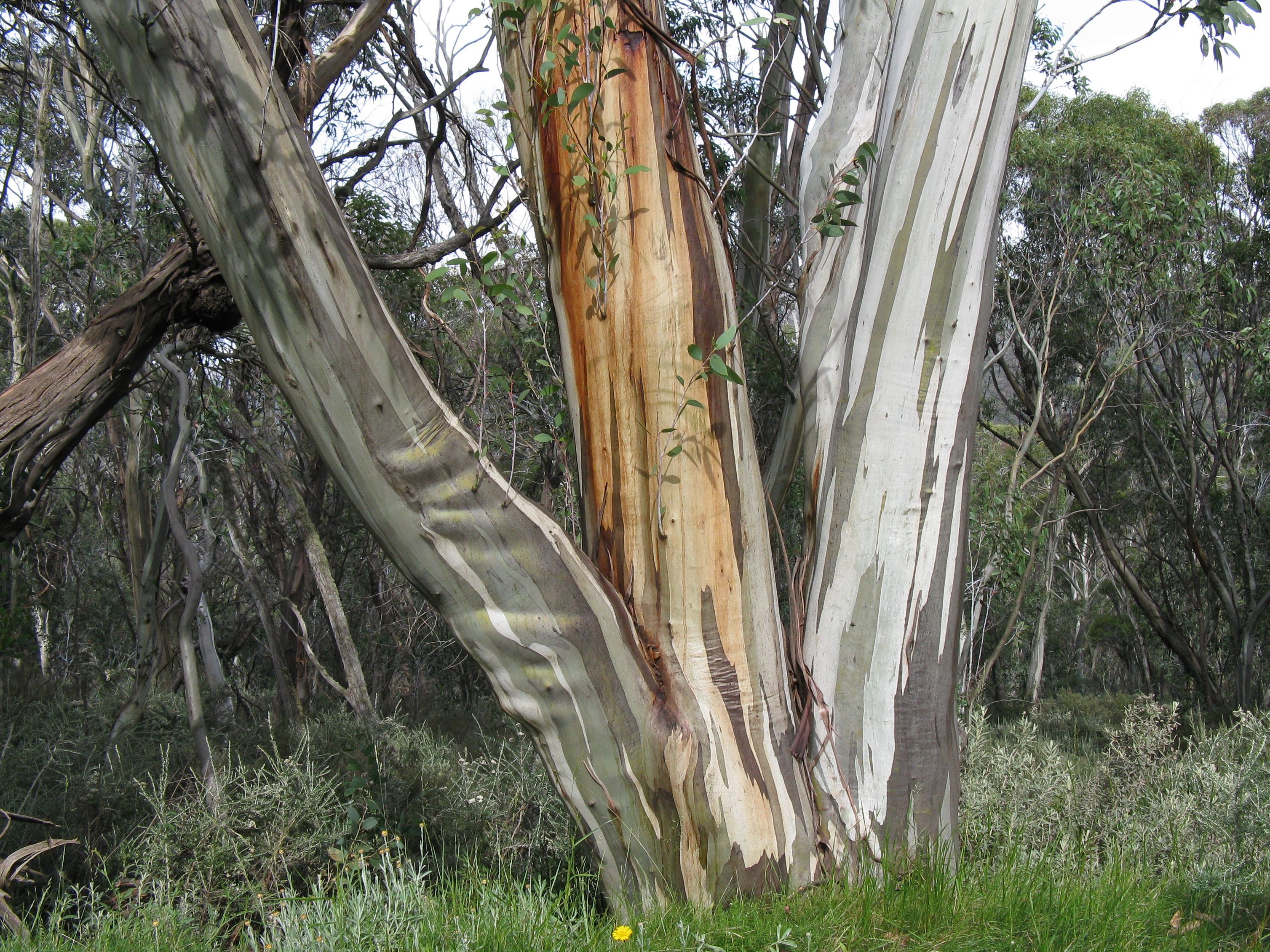
Snow gum (Eucalyptus pauciflora)

Snow gum on Merritt’s Traverse, Kosciuszko National Park, Thredbo

Among the gums featured is one of my favourites, the Snow Gum (Eucalyptus pauciflora). The one chosen for the book is from the Bogong High Plains in Victoria. It has the tortured, twisted formation typical of those that live in high altitudes. And, like my younger less tortured one here, it also has the gorgeous multicoloured ribbon marking that is characteristic of these trees.

These are just two of the trees presented in this book. There are many more gums (and other natives) and more exotics, there are the giants (such as Western Australia’s Karri) and the strange ones (like the Boab and the Banyan Fig), and of course there is the famous, recently discovered (1994) “living fossil”, Wollemi Pine (Wollemia nobilis).

This book has a lot to offer if you are interested in trees – for themselves, and for how they relate to landscape and our sense of place – and if you believe passionately, as the authors do, that preserving them is key to our future. John Muir would be proud. But again, strangely, the book ends not with an Australian reference but a quote from American architect, Frank Lloyd Wright, who apparently said “The best friend on Earth of man is the tree”. I think, though, that I will end with something a little more mystical. It’s from “Scribbly Gum”, by Judith Wright:

The gum-tree stands by the spring.
I peeled its splitting bark
and found the written track
of a life I could not read.

Richard Allen and Kimbal Baker
Australia’s remarkable trees
Carlton: The Miegunyah Press, 2009
254pp.
ISBN: 9780522856699

Leslie Geddes-Brown, Books do furnish a room

Book stacks

Book stack - part of the TBR pile

There was no resisting this book – Books do furnish a room – when I saw it on a table in the National Library of Australia’s bookshop. It’s rare for me to buy a coffee-table book but … this is one gorgeous book. It is lavishly illustrated with images of books in pretty well every room or area of a house from bathroom to bedroom, from stairwell to kitchen. It’s enough to make a booklover drool.

But, what really sold it to me was that, amazingly, it even has an example that justifies my practice shown right: “Surprisingly” says Geddes-Brown, “it is found in a home belonging to a former editor of South African House & Garden … his excuse is that he had no bookshelves and just piled books against his bedroom wall”. Love it! He can visit my house any time.

In her introduction Geddes-Brown, former Deputy Editor of World of Interiors and Country Life magazines, writes:

So books do furnish a room – but not always very well. This book, with images from stylish houses, taken by world-famous photographers, intends to show how it can be done.

Hmm…I do find the text a little simplistic but, what the heck, after all it is really an adult’s picture book. And, it does contain the odd bit of practical advice – particularly for those who have not thought a lot about such things – such as about shelf size, location, and lighting. The book is divided into four sections – Living with books; Working with books; Designing for books; and Making the most of books – with each section having a short introduction followed by lots of well-captioned images to lust after.

And that’s about all I’m going to say, because this is a book to look at not talk about. I will just leave you with this:

… in their way, books are like pictures on the wall; they reveal whether you are a minimalist with all covers hidden under plain wrappers, a maximalist whose every room has a generously filled bookcase, or an anarchist whose preferred method of storage is an untidy heap.

Which one are you?

Leslie Geddes-Brown
Books do furnish a room
London: Merrell Publishers, 2009
158pp.
ISBN: 9781858944913

Top non-fiction of 2009

Is it cheating to do separate lists for fiction and non-fiction? Some people list their top books regardless of form or genre, while others created separate lists. I’m going to do the latter because – well, because I get to choose more books for a start. Actually, I didn’t read a lot of non-fiction this year so my top non-fiction titles will almost be all the non-fiction I read. As with my top fiction, I am listing them in the order I read them.

I didn’t nominate a top fiction for the year, but I’m going to here – and it is the one I read before I started blogging: Chloe Hooper’s The tall man and so I’ll do a little mini-review of it now.

Chloe Hooper’s The tall man

In a nutshell the book, which is best described as “true crime”,  chronicles the fallout that results from the death in custody on Palm Island of indigenous man Cameron Doomadgee, fallout which includes the autopsy report and ensuing riots, and the homicide trial of policeman Chris Hurley. Hooper explores the awful disconnect between people in the communities involved, between white and black, and within the white and black communities. She shows how women (particularly those on Palm Island) are caught in the middle. They believed the policeman killed Doomadgee but, when the riot occurred, they didn’t want the police gone because “who will protect us from the men”.

Throughout the book, Hooper manages to bring what is a very complex situation into rather clear focus…showing, not surprisingly, that in the end it’s the whites who have the power. For example, she attends a police rally organised to support Hurley and notes how they, the police, were fashioning themselves as victim. She comments that “measured against two hundred years of dispossession and abuse, the idea is fantastic, but no-one in that hall was thinking about historical relativities”! This point regarding “historical relativities” is well-made: this is not simply a case of white devil versus black angel, but we know where the real “victimhood” lies. The book also touches on the notion of power corrupting – or, questions at least how police officers are chosen and trained in the first place.

Hooper manages to walk a fine line. You know where her sympathies lie (particularly as the book progresses and she teases out the evidence) but she takes an analytical approach encouraging her readers to also do so. This begs comparison with Helen Garner who takes a far more heart-on-sleeve approach to her subjects in her books, The first stone and Joe Cinque’s consolation.

Finally, she makes an important point when she describes Hurley’s trial as “a false battleground”. Truth and justice – those universal concerns – do need to come out, but the trial is not going to solve the underlying problems. The tall man is a highly readable book about some significant concerns (for Australia at least)…and, in my mind, well deserves the awards it has won. I have only one quibble with it: I wish it had an index!

POSTSCRIPT: Thea Astley also dealt with troubles on Palm Island in her novel The multiple effects of rainshadow. It deals with the event which occurred on Palm Island in 1930 when the supervisor at the time ran amok and killed his children, something which Hooper refers to in the book when she provides a little rundown of Palm Island’s history.

Chloe Hooper
The tall man: Death and life on Palm Island
Camberwell: Penguin Books, 2008
276pp.
ISBN: 9780241015377