Richard Lloyd Parry, People who eat darkness (Review)

ParryDarknessCapeCommenting on my review of Helen Garner’s This house of grief, Ian Darling recommended Richard Lloyd Parry’s People who eat darkness: Love, grief and a journey into Japan’s shadows. I’m ashamed that I rarely follow up the great recommendations I receive here, and I admit that it’s odd that when I did this time it was for a genre I rarely read, true crime. But, I was intrigued because it’s about a crime in Japan, and Japan is a country that I love to visit. Fortunately, Ian didn’t lead me astray. It’s a fascinating book.

I’m not a big reader of crime, in fiction or non-fiction form, but I have read a small number of true crime books over the years, starting, long ago, with Truman Capote’s In cold blood. True crime books vary in emphasis, but the ones that attract me are those that throw light on character and society. This is certainly the case with Parry’s People who eat darkness which tells the story of Lucie Blackman, a 21-year-old English woman who went missing in Tokyo in the summer of 2000 and whose remains were found that winter. Parry writes early in the book that “the story was familiar enough – girl missing: body found: man charged – but … it became so complicated and confusing, so fraught with bizarre turns and irrational developments, that conventional reporting of it was almost inevitably unsatisfactory, provoking more unanswered questions than it could ever quell”.

And so Parry attempts to answer these questions. In so doing he covers a lot of ground. He gives us biographies of both Lucie and the man convicted of killing her, Joji Obara; he exposes Japanese discrimination against Koreans; he explains the role of “hostesses” in modern Japanese culture; he explores Japanese policing and the wider justice system; he looks at the media; and he tells the story of the devastating impact of the murder on Lucie’s family. He’s a good writer and tells it well, but I felt we didn’t need as much of Lucie’s biography as he gave. We needed to know a little about her, of course – including why she was in Japan working as a hostess in Roppongi – but, while it was relevant to delve into Obara’s life, I did wonder about the relevance of telling us about, for example, Lucie’s various friends and earlier boyfriends. Did he include all this to balance out the space he was giving to the perpetrator? Why should Obara get more airplay, after all? The victim is often invisible enough. Still, it’s a long book and could have been tightened a little in this area.

However, this is a minor niggle, because Parry has written a compelling story. I must say that I feel uncomfortable using the word “story” for such a devastating event, and even more uncomfortable calling it “compelling”, but I can’t think of any alternative language, so will just have to continue. What makes it compelling is that this is a crime story that departed the usual scripts. Parry analyses the hows and whys of these departures.

“conquest play”

The first “script relates to the murder: it was not, it seems, premeditated but a date-rape (or, “conquest play” as the perpetrator so chillingly called it) that went terribly wrong. Obara had been practising for many years his perverted idea of “conquest play” in which he invited (or lured) women to spend time with him, during which he would sedate them with chloroform or date-rape drugs to enable him to carry out sexual acts. His behaviour had resulted in the death, in 1992, of an Australian woman Carita Ridgeway, but her death had not been recognised as a “murder”. This, together with the failure of the police to follow up a number of complaints about Obara, meant that Lucie was the next unlucky one to not survive Obara’s gruesome idea of “play”. Obara, though, argued to the end that she died of a self-administered overdose.

“not Japanese”

The next “script” is the trial, which did not run the typical Japanese course. Trials in Japan, Parry tells us, “do not resemble fights, battles or sporting events, as the adversarial logic of its laws seems to prescribe, but rather ‘ceremonies’ or ’empty shells’, devoid of even minor disagreements.” However, Obara fought his case vigorously. Parry describes in great detail Japan’s justice system, from policing to the trial and appeals. In Japan, he says, “you are not innocent until proven guilty”. He quotes sociologist David Johnson’s statement that “Prosecutors, like just about everyone in Japan, believe that only the guilty should be charged and that the charged are almost certainly guilty”. Consequently, in Japan, over 90% of those committed to trial are convicted – and a confession is expected. Parry writes:

‘The police are experienced in persuading people to confess,’ a senior detective told me. ‘We make efforts to let the criminal understand the consequences of their actions. We say things like “The sorrow of the victims is truly deep” and “Have you no sense of reflection on what you have done?” But he was not that kind of person. With him those tactics would never work.’ The detective had no difficulty in explaining this quirk in Obara’s character, although he hesitated a little in spelling it out to a foreigner. ‘It is hard for you to understand, perhaps. But it’s because he is . . . not Japanese.’

Obara was of Korean background, you see, and, as Parry details, Japan does not treat its Korean citizens well. Why Obara was the way he was is too complex to discuss here – though Parry makes a good attempt in the book – but from the police point of view, he was “not Japanese” and, once arrested, did not follow the expected path of a charged man.

“the most terrible, terrible event”

Finally, Lucie’s family, rather than presenting “a tight-knit” unit as is so often presented in post-tragedy media reporting, was bitterly divided. Her parents had been divorced many years before her murder, but it was not amicable. Lucie and her two younger siblings, Sophie and Rupert, lived with their mother Jane, while father Tim lived on the Isle of Wight. Lucie was close to her mother, and often kept the peace between her sister and mother. If all this was a sad situation before Lucie died, it was devastating after. The parents could agree on nothing, from how they responded to the media to how they would inter Lucie.

Jane is a more shadowy figure, because she largely kept to herself. Tim though, with Sophie, was active in the search for Lucie, using whatever resources he could garner. Parry clearly got to know him well, and presents to us an intriguing, sometimes contradictory, man, one who said that the death of his daughter was “the most terrible, terrible event of my life” and yet who could say he felt sorry for Obara. Parry writes of this that:

Nothing better caught the complexity of Tim’s own character, his stubborn unorthodoxy, which to me was so likeable and admirable, but which to many people was repellent. Almost on principle, he refused the obvious point of view and the temptations of conventional morality. The high ground was his for the taking, but instead of marching ahead to claim it, he dawdled and skirted around it, finding shades of pathos and ambiguity where others could see only black and white. Onlookers were not merely puzzled by this – they were appalled.

Parry’s portrait of Tim is one of the most interesting aspects of the book, but his picture of a family destroyed is heart-wrenching. Here is Sophie on the day Lucie’s remains were interred:

What was most glaringly obvious was how Lucie’s death had changed the relationships between all of us, and how as a brother and a sister, and a mum and a dad, we were just four strangers sitting round a table.

It’s a desperately sad story, which had longterm ramifications for Lucie’s siblings.

“the drive to pass judgement”

Parry, an English journalist based in Tokyo, spent around ten years researching this book. He attended the very lengthy trial, spoke to family, friends, police and others involved, and read a lot of written material including letters, diaries and emails. He tells the story from a first person point of view, sharing his research process along the way. He is not actively “in” the story like, say, a Helen Garner, but we can discern his hand.

Humans, he writes

are conditioned to look for truth which is singular and focused, hanging for all to see, like a clear, full moon in a cloudless sky. Books about crime are expected to deliver such a photographic image, to serve up a story as dry as a shelled and salted nut. But as a subject, Joji Obara sucked away brightness; all that was visible was smoke or haze, and the twinkling upon it of external light. The shell, in other words, was all that was to be had of the nut; but the surface of the shell turned out to be fascinating in itself.

Near the end, he suggests that the “drive to pass judgement was one of the extraordinary effects of the case”. It is to his credit that he manages to steer an astutely observed but even course through unexpected scripts to capture the complexity of its “actors”, and thus of humanity. There is value in reading a book like this.

Richard Lloyd Parry
People who eat darkness: Love, grief and a journey into Japan’s shadows
London: Jonathan Cape, [2011]
404p. (in print ends.)
ISBN: 9781448155613 (ePub)

Tara Moss, The fictional woman (Review)

Courtesy: HarperCollins Australia

Courtesy: HarperCollins Australia

In terms of feminist argument, I’m not sure that Tara Moss told me anything I didn’t already know or believe in her first work of non-fiction, The fictional woman, but that didn’t stop me enjoying her take, her approach. Moss is an interesting woman. Her careers as a model and a crime writer meant she wasn’t really on my radar for the first twenty years of her working life, but that changed a couple of years ago when she began appearing on commentary shows I watch like Q&A (see an appearance here) and The Drum. I discovered that she’s a woman of wide interests and many talents. Here are some of them: UNICEF Ambassador for Child Survival, Goodwill Ambassador; UNICEF Australia Patron for Breastfeeding for the Baby Friendly Heath Initiative; Ambassador for the Royal Institute for Deaf and Blind Children; and a PhD candidate in the University of Sydney’s Department of Gender and Cultural Studies.

So the book. Her main thesis – born of her own experience – is that women’s lives and roles are subject to an inordinate number of fictions that contradict reality, and that this helps perpetuate ongoing inequalities for women in representation, status, value. The book starts more like a memoir, telling us how she became a model in her early teens (“The Model”), her experience of being measured by her body (“The Body”), how she survived some early experiences, including rape (“The Survivor”), and her transition to being a writer (“The Writer”). She then moves on to discuss wider topics such as “The ‘Real’ Woman”, “The Archetypal Woman”, “The Beautiful and the Damned”, and “The Crone”, though in these too, she often uses her personal experiences. To illustrate the fictions women live under, she tells of taking a polygraph test to prove that she, a “dumb” “blonde” “model”, could actually have written a successful novel.

Moss supports her discussion of the fictions she identifies with an impressive array of statistical and other evidence. The book is extensively foot-noted (or, is that end-noted), as you would expect from a PhD student. While the points she makes aren’t necessarily new to me, much of her evidence is – and that’s worrying because her evidence is recent confirming that things haven’t changed as much as I’d have hoped since I first started thinking and reading about feminism in the 1970s.

I won’t elaborate the multiplicity of fictions she explores, the way women are simplified into virgin, whore, witch, crone, for example, because we all know them. Even the male readers here know them, I’m sure. Rather, I’d like to talk about some ideas that I found particularly interesting.

One of these ideas relates to the issue of beauty, which comes up in several chapters, but my focus here is “The ‘Real’ Woman” in which she discusses the various campaigns for/promotions of “real beauty” which encourage women to show themselves au naturel. No, I don’t mean naked, but without makeup, and other enhancing products and processes. Having lived my life this way (little or no make-up, no hair-dyeing, no waxing, etc), I was feeling comfortable in this chapter, until I reached her suggestion that these “campaigns” can be “like a beauty pageant, only with different parameters”. In other words, once again, we are asked to “judge” women on the basis of their appearance. She writes:

I see some disturbing similarities between the kinds of appraisals of women’s appearance that we commonly view as misogynistic, and appraisals that present themselves as ‘pro-woman’.

I take her point. “Using images”, she argues, “to make the claim that you are freeing women from the prison of image is a tricky thing to pull off”. I found this chapter the most confronting because, unlike the others which tended to cover more familiar ground, this one forced me to think more deeply about the complexity of how we “see” women. It’s not surprising that she loves John Berger’s excellent work, The ways of seeing.

She explores some of the underlying structural causes, particularly the way our market-driven society supported by the media contort and distort “reality” through stereotyping, simplifying and then generalising. She argues that women’s visibility in the public sphere is dominated by/limited to those “images” needed to sell products. Advertising has become “so entangled with mainstream culture … so entangled with female identity in particular”, she argues, that we do not see the real diversity of women’s engagement in society.

For many people, “gender” and “feminism” are tricky concepts. Moss unpacks them both with excellent clarity. Her definition of feminism is exactly mine. Feminists want

equal opportunity, equal rights, equality for women. (Equality = same value or status. They want to be equal to, not the same as, men).

Yes! How often do we need to repeat this? “Equal” does not mean “same”. And just because you don’t agree with some feminists doesn’t mean you’re not a feminist if you believe in equality for women. Moss understands, though, women fearing to own the term. She tells of once being asked on ABC TV whether she was a feminist, and admitted she felt

an actual ripple of fear. Part of me was afraid of the vitriol I would be subjected to for publicly identifying with the very movement that had given me the right to vote, the right to own property, the right to work and earn my own pay.

How can that be?

And this brings me, in a way, to another theme that pops up through her book: the way women undermine each other. She discusses, for example the “mummy wars” in which working mums are pitted against stay-at-home mums, and breast-feeding mums are pitted against formula-feeding mums. And yet, she also debunks the fiction “that all women hate each other” or that “women are their own worst enemies”, not only by confirming that for many women, other women provide their greatest support, but by exploring how society, and particularly the media, “read” female behaviour and interaction to put this spin. She tells how a joking comment of hers was read as “a swipe at Miley Cyrus”. Again, the main point of her argument is the social construction that supports these “fictions” about women.

In her final chapter, she discusses what she sees as the wider problem which is that the world is not “a fair and balanced place”. We do not have equality – across gender, race or class. This is what we need to address, and she calls us all to action.

Occasionally I worried that Moss was drawing a long bow or skewing her argument a little by her own experience, but in fact I found her thesis and thinking to be clear and logical, intelligently-framed, and forceful without being judgemental. It’s a good read – and provides much for us to contemplate.

awwchallenge2015Tara Moss
The fictional woman
Sydney: HarperCollins Publishers, 2014
328pp.
ISBN: 9780732297893

(Signed copy received from my sister-in-law)

Helen Garner, This house of grief: The story of a murder trial (Review)

Helen Garner, This house of grief book cover

Courtesy: Text Publishing

Well you might ask why you would want to read a book about the trial of a man accused of murdering his three sons by driving his car into a dam and escaping the car himself? Indeed, Helen Garner was asked why she would want to attend such a trial – and write about it. But Helen Garner is made of strong stuff, having previously written The first stone about the sexual harassment of two girls at Melbourne University’s Ormond College and Joe Cinque’s consolation about the trial of a woman accused of murdering her boyfriend via a drug overdose. I’ve read and appreciated both these books, along with novels and short stories by Garner, and so was keen to read this, her latest.

For those of you who don’t know the story, here’s Wikipedia’s summary of what happened:

… as Farquharson was returning his children to their mother after a Father’s Day access visit, his white 1989 VN Commodore vehicle veered across the Princes Highway between Winchelsea and Geelong, crashed through a fence and came to rest in a farm dam where it filled with water and submerged. His three children, Jai (10), Tyler (7) and Bailey (2), were unable to free themselves and drowned. Farquharson managed to escape and alerted another driver who took him to nearby Winchelsea. Police divers recovered the boys’ bodies about 2 am the next day. They were still inside the vehicle and unrestrained by seatbelts.

Farquharson claimed that he did not intend to kill his children, that he had blacked out during a coughing fit (a condition known as cough syncope). However, he was tried and found guilty, tried again after winning an appeal and found guilty again, and was then refused leave to appeal to the High Court of Australia.

Garner sat through both trials, the first one lasting around 7 weeks, and the second one 11 weeks, and managed to condense it all into 300 pages of lucid prose. One of the reasons I was keen to read the book was to see what approach she’d take. In The first stone and Joe Cinque’s consolation, Garner’s opinion is pretty clear from the beginning – and I didn’t fully agree with her (for very different reasons in each of the books). However, in This house of grief, Garner is more measured. She doesn’t want to believe that Farquharson is guilty – “longed to be persuaded” otherwise – but is gradually swayed by the evidence to believe it must be so. She doesn’t engage emotionally with the participants in the intense way she did in Joe Cinque’s consolation, but she is emotional. How could you not be in such a case? There are two reasons I like Garner – her tight, evocative prose, and her fearless honesty. And so, in this book, she tracks her own response as she listens to the evidence – from her disbelief that a father could do such a thing, and her sentimental desire to believe Farquharson, to her horrified admission that any doubt about it is “no more substantial than a cigarette paper shivering in the wind”.

So, let’s get back to the original question. Why read such a story? There are a few reasons, but I’ll discuss my two main ones. The first is to gain insight into, and understanding of, human behaviour. Why do people do what they do? It’s so easy to judge people out-of-hand, but even horrific events have nuances, and I want to understand those. Not to excuse, because it’s impossible to excuse taking the lives of those in one’s care, but to be able to empathise in some way. Isn’t this what literature is about?

Garner achieves this by not demonising Farquharson. As she watches him in court, and listens to the evidence – professional, personal, expert – she presents a picture of a man who was “emotionally immature, bereft of intellectual equipment and concepts, lacking in sustaining friendships outside his family”. At the end of the first trial, the judge speaks kindly to Farquharson, and Garner writes:

Farquharson nodded to him, courteous and present. For the first time I saw him as he might have been in ordinary life, at work, at school. It touched me. Again I felt shocked, as if this response were somehow illegitimate.

(Interestingly, Garner did not accord such recognition to Anu Singh in Joe Cinque’s consolation. Yes, different case, very different people, but the principle still stands I think.) A little earlier in the trial, Garner quotes “a tough American prosecutor” who’d said to her:

‘If I were appearing for him, I’d try to make his family see that loving him doesn’t have to mean they believe he’s innocent’.

But, how tough that would be, eh?

My second reason is to understand the workings of courts and justice. I have never (yet anyhow) been called for jury duty. Oh my, oh my, after reading this, I’m even more desperate that I never am. Although it’s pretty obvious that the right verdict was achieved in this case, the process was not reassuring. Garner’s reporting of evidence and cross-examination reads very like those court dramas you see in film and television. There’s drama, police mistakes, twisting of the truth, character assassinations, conflicting expert opinions – and, in this case, a lot of complicated and sometimes obfuscatory technical evidence about cars and tire tracks and steering inputs, about arcs and gradients. And it goes on for weeks.

Garner keeps it interesting by focusing on the people and their reactions, reporting some dialogue, and summarising the critical (which, she makes clear, is not always the most relevant) points of evidence. Her descriptions of the defence and prosecution team are drawn with a novelist’s eye for character. Sometimes Morrissey, the defence barrister, is “as jumpy as a student undergoing an oral exam”, while at other times he’s “less flustered … more in control of the content and tone of his discourse”. His “waxen” appearance at the second trial is quite different from the beginning of the first when he’s presented as a hearty “spontaneous, likeable man” whose “stocks were high”.

She also pays a lot of attention to the jury. Of course we cannot know what they thought or discussed but Garner watches them, noting when their attention flags and when it picks up, when emotions get the better of them. She writes, for example, of one witness that “the jury liked him … he was one of the witnesses they instinctively trusted”. During her report on the second trial, she quotes American writer, Janet Malcolm who wrote that “jurors sit there presumably weighing evidence but in actuality they are studying character”.

Partway through the book, Garner comments that the question “Did he do it?” is the “least interesting question anyone could ask.” Later, between the first and second trial, she quotes a grandmother from another murky situation in which a father was suspected of killing his children via a house fire. The grandmother asks:

‘What’s worse? — living with suspicions and various possibilities and never knowing the truth, or living with the truth of something too horrible to contemplate.’

Books like Garner’s enable us – nay, force us – to contemplate such questions. They show us that trials are less about retribution, perhaps even less about justice, but more about the truth. What we are to do with the truths we so glean is another question – but that question, Garner suggests, is our “legitimate concern”, and I agree.

awwchallenge2014Helen Garner
This house of grief: The story of a murder trial
Melbourne: Text Publishing, 2014
300pp.
ISBN: 9781922079206

(Review copy courtesy Text Publishing)

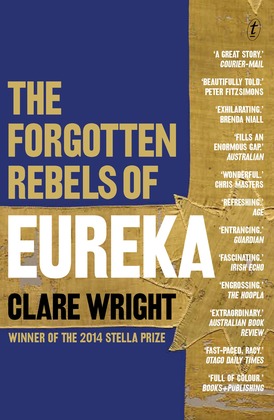
Clare Wright, The forgotten rebels of Eureka (Review)

Book cover, The forgotten rebels of Eureka

Courtesy: Text Publishing

Wah! Once again I delayed reading a much heralded book until my reading group did it*, and so it is only now that I’ve read Clare Wright’s Stella Prize winning history, The forgotten rebels of Eureka. The trouble with coming late to a high-profile book is how to review it freshly. All I can do, really, is what I usually do, and that is write about an aspect or two that particularly interested me. Since other bloggers have already beautifully covered one of these, the history**, I’m going to focus on Wright’s writing and the approach she took to telling her story. I won’t be doing this from the angle of historical theory, as I’m not an historian, but in terms of her intention, and her tone, style, and structure.

If you’re not Australian, you may not have heard of the Eureka Stockade. It was a significant event in colonial Australia’s march to democracy and independence, involving the British army and police attacking a stockade created by miners whose grievances included the payment of a compulsory miner’s licence and the fact that this licence, which they saw as a form of taxation, did not give them the right to vote in the legislature. It has traditionally been framed in masculine terms, but Wright discovered, somewhat by accident while researching another project (as historians do!), a new angle – the role of women in the rebellion. There were, she found, over 5,000 women on the goldfields:

Women were there. They mined for gold and much else of economic value besides. They paid taxes. They fought for their rights. And they were killed in the crossfire of a nascent new order.

Consequently, in her book, Wright draws on extensive primary and secondary sources to explore and expose the lives of these women and the until-now-unheralded role that she believes they played in the goldfields, particularly in the lead up to and aftermath of that fateful day of 3 December 1854.

Wright opens the book with three epigraphs, one of which is particularly illuminating in terms of my subject. It’s by Australian historian Geoffrey Blainey and states that “every history of every country is a mirror of the author’s own interests and therefore selective rather than comprehensive”. Having been interested in historical writing since studying EH Carr’s What is history at university, I like the admission that histories are inherently subjective, regardless of how well researched they are. The historian makes decisions about what s/he will research, what the limits of that research will be, and how s/he will interpret that research. It’s common sense. How can it be otherwise? And so, in this history, Wright’s specific interest in the role of women means that all her research – even research into men’s activities – is viewed through that prism. There’s another implication, too, regarding selectivity: with her focus being specifically the women, we cannot read this book as a comprehensive history of the Eureka Stockade. It complements, or expands, or even jousts with other works.

None of this is meant negatively. I thoroughly enjoyed the read. My point is simply that it’s important, as it always is, to be aware of what we are reading – and I like the fact that Wright recognises this. So, what we have here is, to the best of my knowledge, a thorough but selective history. The text is extensively referenced, with 25 pages of meaningful endnotes and nearly 20 pages of bibliography, and there is a useful index. These are things I look for in a good nonfiction work. The book is logically structured, by theme and chronology, and its (creatively titled) chapters are divided into three main parts: Transitions, Transformations and Transgressions. You can sense a writer’s touch in the alliteration here.

And it’s the writer’s touch I want to turn to now, because Wright has achieved that difficult mix – a well-researched but readable history. It has been written, I’m sure, with an eye on a general, but educated audience. The language is often breezy and even jokey (perhaps a little too much) at times, and yet is replete with classical, Shakespearean, biblical and other literary allusions. She uses metaphor, such as “the cornered lizard bared its frills” to describe the hoisting of the famous Australian flag in the days before the attack. Her descriptions are evocative, and often visceral. You feel you are there in the crowded “tent city” that was Ballarat:

The arrival of the extra troops meant squashing more stinky little fish into an already overpacked tin … From the outside, it seemed like the tightrope was about to snap.

Her stories of the childbirth experiences of Sarah Skinner and Katherine Hancock are devastating to read.

Indeed, I would place this book in the narrative non-fiction tradition. It has a strong narrative drive, with a large cast of characters, some of whom stay with us, some of whom pass through. They include Ellen Young whose poems and letters in the Ballarat Times articulate the mining community’s distress and sense of injustice; hotel-keeper Catherine Bentley who, with her husband, earns the ire of the diggers by consorting with government officials; theatre-owner and actor Sarah Hanmer who donated more to the rebels’ cause than anyone else; and newspaper publisher Clara Seekamp who takes the helm when her husband is arrested for sedition. These women provide significant evidence for Wright’s thesis that women played more than a helpmeet role in the intellectual and political life of Ballarat.

In addition to “developing” these characters, Wright uses other narrative techniques, such as:

  • plot cliff-hangers (much like a screenwriter, which she also is, would do) and pointed aphorisms at the end of chapters
  • foreshadowing to suggest causation: “Even female licence holders expected a modicum of representation for their taxation—as dramatic events would later demonstrate”
  • repetition of ideas and motifs to propel her themes. Take, for example, the Southern Cross. It functions as “a hitching post for existential certainty when all else was in mortal flux” during immigrants’ sea journey from the northern hemisphere to the south (Ch. 3, “Crossing the line”) and is later picked up as a symbol for the rebels’ flag “as the one thing that united each and every resident of Ballarat” (Ch. 11, “Crossing the line (Reprise)”).

As an historian, Wright is confident and fearless, expressing clear opinions, either as direct statements, or indirectly through her choice of language. She calls the Bentleys’ murder trial, for example, a “morality play”. She asks questions; she offers close analysis of her sources, such as noting that the use of the word “demand”, rather than “request” or “humbly pray”, conveys the diggers’ frustration with authority; and she makes considered deductions by testing textual evidence against her understanding of the times and the work of other historians. She discusses discrepancies in reportage, such as the different witness reports of the fire at the Bentleys’ hotel. But she also, as other bloggers and my own reading group have commented, draws a long bow when she suggests the full moon and menstrual synchrony may have been a factor in so many men leaving the stockade on the night of the attack. She provides some evidence for this synchrony as a phenomenon, and offers other reasons for the desertion, but it feels a little out of left field.

At times her nod to the popular and her push for dramatic effect jars, but Wright’s argument that women played an active role at the diggings and in the stockade is convincing. I’m not surprised she won the Stella Prize, because this is engaging reading that is underpinned by extensive scholarship and clear thinking. It’s exciting to see a work that doesn’t just explore the role of women in history but that puts them right in the action.

awwchallenge2014Clare Wright
The forgotten rebels of Eureka
Melbourne: Text Publishing, 2013
539pp.
ISBN: 9781922182548

* I bet you can hardly wait until next month now!
** Do check out historian bloggers, the Resident Judge and Stumbling Through the Past, and litblogger Lisa of ANZLitLovers.

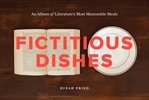
Dinah Fried, Fictitious dishes (Review)

Dinah Fried, Fictitious dishes

Courtesy: HarperCollins Australia

Regular readers here know that I recently spent a few weeks in North America – mostly in Toronto, bookended by a few days in Southern California. We spent our last day with a friend I “met” many years ago through online reading groups. We actually met Trudy for the first time in 2008, so this was our second meeting. She is a fun, generous person, and upon our arrival at her pretty cottage, she proceeded to shower us with gifts targeting our interests and activities. One of these was Dinah Fried’s Fictitious dishes which she chose because of our “sophisticated palate and enthusiastic approach to dining” – as well as, of course, my love of reading. I’m not so sure about the sophisticated bit, but we do love our food!

Dinah Fried’s book, subtitled “an album of literature’s most memorable meals”, is one of those delightful little books for readers to get their teeth into. (Ha!) As you read it you think, of course, about your favourite meals and foods in books. (You know what I’ll be asking you at the end of this post, then, don’t you?). In her introduction, Fried mentions some of her favourites, starting with one of my own, Heidi (by Johanna Spyri). Fried mentions the golden cheesy toast that Heidi’s grandfather serves her in their home in the mountains, but I also remember the white bread rolls that so astonished Heidi when she lived in the town with Clara. Who doesn’t like cheese on toast and perfect bread rolls!

The book contains an eclectic and sometimes surprising collection of “fictitious dishes” in both adult and children’s books that range from European classics like Kafka’s Metamorphosis to modern American Pulitzer prize winners like Cormac McCarthy’s The road. This latter, involving a can of pears, reminded me of the cans of peaches* in Adam Johnson’s The orphan master’s son (my review). In other words, the book can send you off on little journeys of your own! There are 50 or so dishes, and each is presented as a two-page spread. On the left is the title of the book, the quote, and some tidbits of information inspired by the book and/or the food items chosen. On the right is Fried’s photo of the food, lovingly prepared and carefully laid out. In her introduction, she talks briefly about food preparation and the work involved in sourcing just the right props. It is good fun looking at the photos and thinking about her design choices. She is, after all, a designer, a graduate from the Rhode Island School of Design. As with any book of this ilk, some designs worked better for me than others, but I enjoyed looking at them all.

Most intriguing to me, though, were the little pieces of information. They include:

  • the history of various food items, like freeze-dried potatoes, for Beverly Cleary’s Beezus and Ramona;
  • notes about the books, such as prizes won or an interesting point about their publication; and
  • comments on the authors, such as their inspiration for the work or their relationship to the food.

There’s no real pattern to these. Some books have four or five points, and others only two, but they are fun to read. She does provide a list of references at the back, along with a list of the books chosen and the editions she used for the quotes. I do have one bone to pick with her (oh dear!), and that’s regarding her comment on, you’ve probably guessed it, Jane Austen! Food appears quite frequently in Austen’s novels, and particularly in Emma, which features a hypochondriacal father keen to ensure everyone eats as plainly and boringly as he does. It also features a picnic, a strawberry gathering party (from which Fried takes her quote), and balls and dinners. My quibble relates to Fried’s comment that “Despite proposals, Austen never married, setting her apart from many of her novels’ characters, who are husband hunters”. To describe Austen’s heroines so baldly as “husband hunters” badly misses Austen’s point. Her heroines were prepared not to marry (as Austen didn’t) if they couldn’t marry for love. Austen knew the importance of money to women’s security, but her heroines also wanted to love and respect the man they married.

But now, to the fun bit. One of my favourite bookish references to food comes from Virginia Woolf’s A room of one’s own. I’m sure you know to what I refer! However, as Fried’s book is devoted to fiction, I’ll share one of my favourite fictitious dishes (one that wasn’t included by Fried). It comes from Gene Stratton Porter’s A girl of the Limberlost and refers to a brown leather lunchbox:

It did open, and inside was a space for sandwiches, a little porcelain box for cold meat or fried chicken, another for salad, a glass with a lid which screwed on, held by a ring in a corner, for custard or jelly, a flask for tea or milk, a beautiful little knife , fork and spoon fastened in holders, and a place for a napkin.

Not only did I adore the idea of this gorgeous little box, but the love and generosity behind it in the story speaks to the most important thing about food in our lives – the making of and sharing it with those we love. Now, over to you … what are your favourite fictitious dishes?

Dinah Fried
Fictitious dishes: An album of literature’s most memorable meals
New York: Harper Design, 2014
126pp.
9780062279835

* They play an important role in the lives of the main characters, but to explain it would be to spoil!

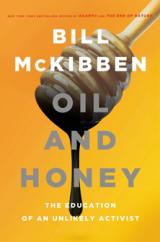
Bill McKibben, Oil and honey (Review)

Bill McKibben, Oil and Honey

Courtesy: Black Inc

It’s coincidental, but nicely appropriate, that the World Meteorological Organisation (WMO) published its Provisional Statement on the Status of the Climate in 2013 last week, just as I was finishing US environmental activist Bill McKibben‘s latest book, Oil and honey: The education of an unlikely activist. It’s likewise coincidental that, three days before WMO’s announcement, Stefanie (of So Many Books) published a post titled Gardening for Climate Change* containing her thoughts on her garden and how climate change might affect it.

WMO’s statement says, among other things, that “During the first nine months of 2013, most of the world’s land areas had above-average temperatures, most notably in Australia, northern North America …”. As you know, I live in Australia; Bill McKibben and Stefanie live in the northern part of the USA. We are seeing (feeling) the changes, and are concerned. What I’m going to say next is pretty obvious, but I’m going to say it anyhow because I always like to start with the basics in discussions like this. There are two critical issues in the climate change debate: Is the climate changing and, if it is, Is it human-caused? It’s hard to imagine, given all the data available, that there’s anyone out there who really believes the climate is not changing, though I believe there are still some who think it’s simply a case of “climate variability”. These people think that the climate will get back to normal (some year soon, they hope). The trickier issue, however, is the causal one. Most of the deniers are not so much denying that the climate is changing, but that we are causing it. This brings me to Bill McKibben.

McKibben does not, in Oil and honey, spend time trying to prove that humans are causing climate change. For him it’s a given. Rather, he shares how he changed from being an environmentalist, who researched and wrote books, to an environmental activist who campaigns (and writes books). It’s an interesting, clearly written book about one man and his path, but can also be read as a how-to for those who want to get active.

You may now, though, be wondering about the title. Oil and honey? I’m sure there’s an ironic allusion here to the biblical “land of milk and honey” (which we are not heading towards), but there is also a literal meaning to the title. The narrative shifts pretty seamlessly between his two main passions. One is to do with bees, honey and good farming practice. The other is oil, or the fossil fuel industry, and how to stop its impact on the climate. Oil and honey, climate and farming. It’s all related.

You may also be wondering, particularly if you’re not American, who Bill McKibben is. As the blurb on the back of my edition says, he has written over a dozen books including the New York Times bestselling Eaarth and The end of nature. He also founded the environmental organisation 350.org and “was among the first to warn of the dangers of global warming”. Despite all this, he did not until recently see himself as an activist. After graduating, he worked as a journalist for The New Yorker for five years, but quit in 1987 when its long-term editor was forced out of his job. Since then he has been a freelance writer.

Oil and honey is his latest book. I’d call it part-memoir part-manifesto, because it is both the personal story of his transition to full-blown activism and the story of his passion for saving the planet. The personal aspect of the book helps make it a good read. We get to understand his thinking, we feel his anxiety about becoming not only an activist but a leader of activists, and we learn that his activist philosophy is inspired by the non-violent resistance ideas of Gandhi and Martin Luther King Jr. We see his love for nature and for working close to the land on the bee-farm he bought for his friend Kirk Webster to run. This farm functions both as respite and as a place for him to see land stewardship working.

That’s the memoir aspect. In the manifesto aspect, he shares with us the development of his ideas and strategies. We learn of various campaigns he has been involved in since 2009, including Step It Up, Keystone XL,  Do the Math. And he explains how he and his co-activists have shifted from focusing on politics and politicians – through such activities as sit-ins at the White House and lobbying politicians – to directly tackling the fossil fuel industry. He came to realise, he says, that the situation was/is becoming so dire there’s no time “for slow graceful cultural evolution”. Consequently, the last part of the book deals with the goal of encouraging educational institutions to divest their investment portfolios of fossil fuel industries. They’ve targeted educational institutions because students represent a significant percentage of climate change activists. For these students the question is simple:

are you paying for our education by investments in an industry that guarantees we won’t have a planet to make use of that learning?

I’ve only touched the surface of what this book covers. Like many books of its type, chances are that it will only be read by the converted. That’s a bit of a shame, but it’s not useless says McKibben:

You might think it’s a waste to preach to the choir, but the truth is, you need to get the choir fired up, singing loudly, all out of the same hymnal. The choir is there, but most of the time it’s just humming in the background, or singing so many tunes that no distinct harmony emerges.

So, if you’re part of the choir, this book is still for you. And if you’re not, think about joining. It could be the most important thing you do.

Bill McKibben
Oil and honey: The education of an unlikely activist
Collingwood: Black Inc, 2013
255 pp.
ISBN: 9781863956178

(Review copy supplied by Black Inc)

* Stefanie has since posted a link to a British blog called Climate Change Garden.

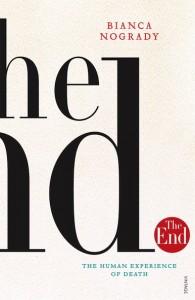
Bianca Nogrady, The end: The human experience of death (Review)

Bianca Nogrady, The end book coverHave you thought about your death? About how and where you want to die? These are the questions Australian science journalist Bianca Nogrady asks us to consider in her recent book, The end: the human experience of death. I’m not a morbid person, but when Nogrady contacted me to ask whether I’d consider reviewing her book, The end, it didn’t take me long to say yes. Like Nogrady I did witness, a couple of years ago, something I would call “a (pretty) good death”. That I felt it was so, intrigued me. I was therefore interested to read what Nogrady had to say.

And what she had to say was fascinating from beginning to end. In her introduction, she says:

This book could just as easily have been Everything you wanted to know about death but were afraid to ask. Death is fascinating, compelling, and it consists of much more than simply the end of a biological life-form. In seeking to understand death, we are seeking to understand life.

The rest of the book is structured logically according to the sorts of topics we are likely to ask about, starting with why we die, and then moving on to issues like defining death, where, when and how we die, spiritual and out-of-body experiences, and religion. Nogrady looks at these issues from all the likely points of view –  medical, sociological, psychological, philosophical, legal and ethical. She organises her information well, and the chapters (and subchapters) flow very naturally from each other.

So far, I have probably made it sound like a well-organised rather dry read – but that’s not how it is. Not only did Nogrady do a lot of secondary research (as the Notes at the end attest) but she also interviewed a lot of people. As a result, the formal information garnered from her research is supported by people’s stories, which also add colour and life to the facts. Many are of course sad – we are talking death after all – but this is not a sad book.

The most complicated section of the book is the second chapter on “Defining Death”. Nogrady takes us carefully through the different “definitions” – specifically, cardiac death and brain death (which, I learnt, can be further subdivided into “whole brain death” and “brain stem death”). She shows how the definition issue has been complicated by medical advances enabling us to keep the body alive and, of course, by the organ transplant process. Royal North Shore Hospital’s Intensive Care Specialist Dr Ray Raper suggests that death is:

a continuum; a graded box with one end as ‘being alive’ and the other end as ‘being dead’ … If you look at the domains of the transition between life and death, they’re spiritual, functional and structural and they’re biological, and the most important ones are the functional ones.

Death, in other words, is a process. If your fingernails are still growing when you are in the coffin, then, says Arizona State University Professor of Philosophy Joan McGregor, the questions needing answers relate to what are we preserving and why do we value it. I’ll leave this discussion here because there is no single solution – or not at present anyhow. This is murky ground indeed, but Nogrady manages to traverse it with clarity. I will probably have to read the book a few times though for the concepts to stick!

She also discusses euthanasia, teasing out misconceptions. She explains the differences between physician-assisted suicide, voluntary euthanasia and terminal sedation. She also explores the rise in palliative care as a profession, covering related issues like death doulas and volunteer workers in palliative care hospitals (or hospices). And of course she talks about near-death experiences, and those death-time phenomena that science can’t explain such as clocks stopping, machines behaving erratically, and deathbed visions.  The final chapter discusses faith and belief. Death is cultural, but, as she discovered, there is as much similarity as there are differences in end-of-life rituals.

It’s a funny thing to say, I suppose, but this is an enjoyable book. It’s neither superficial nor so detailed that you get bogged down. There is a lovely balance between expert opinions and anecdotes. I can imagine reading it again – or parts of it. It’s a shame, though, that there isn’t an index, which seems to be common in non-fiction books aimed at a general market. I guess it’s all about cost.

Australian Women Writers ChallengeIn her epilogue, Nogrady returns to her own experience, to how the death of her grandmother had caused her to want to better understand death. Writing the book, she says, made her think about “the value of planning, or at least thinking about how we want to die”. Death is, after all, a “one-way journey”. We do it alone, and it may well be, she argues, our best chance “find out who we are at the core”. One man who spent a long time thinking about his death, because he had a degenerative, terminal disease, was Australian public intellectual Donald Horne whose last book, written with his wife Myfanwy, was Dying: A memoir. He wrote:

My final drifting away, via a morphine dose, I would want to be among my memories, with Myfanwy whom I love holding my hand.

Think about your death, plan for it, is Nogrady’s final message to us. If you’re ready to take up her challenge, The end would be a good place to start.

Bianca Nogrady
The end: The human experience of death
North Sydney: Vintage Books, 2013
260pp
ISBN: 9781742752051

(Review copy supplied by the author)

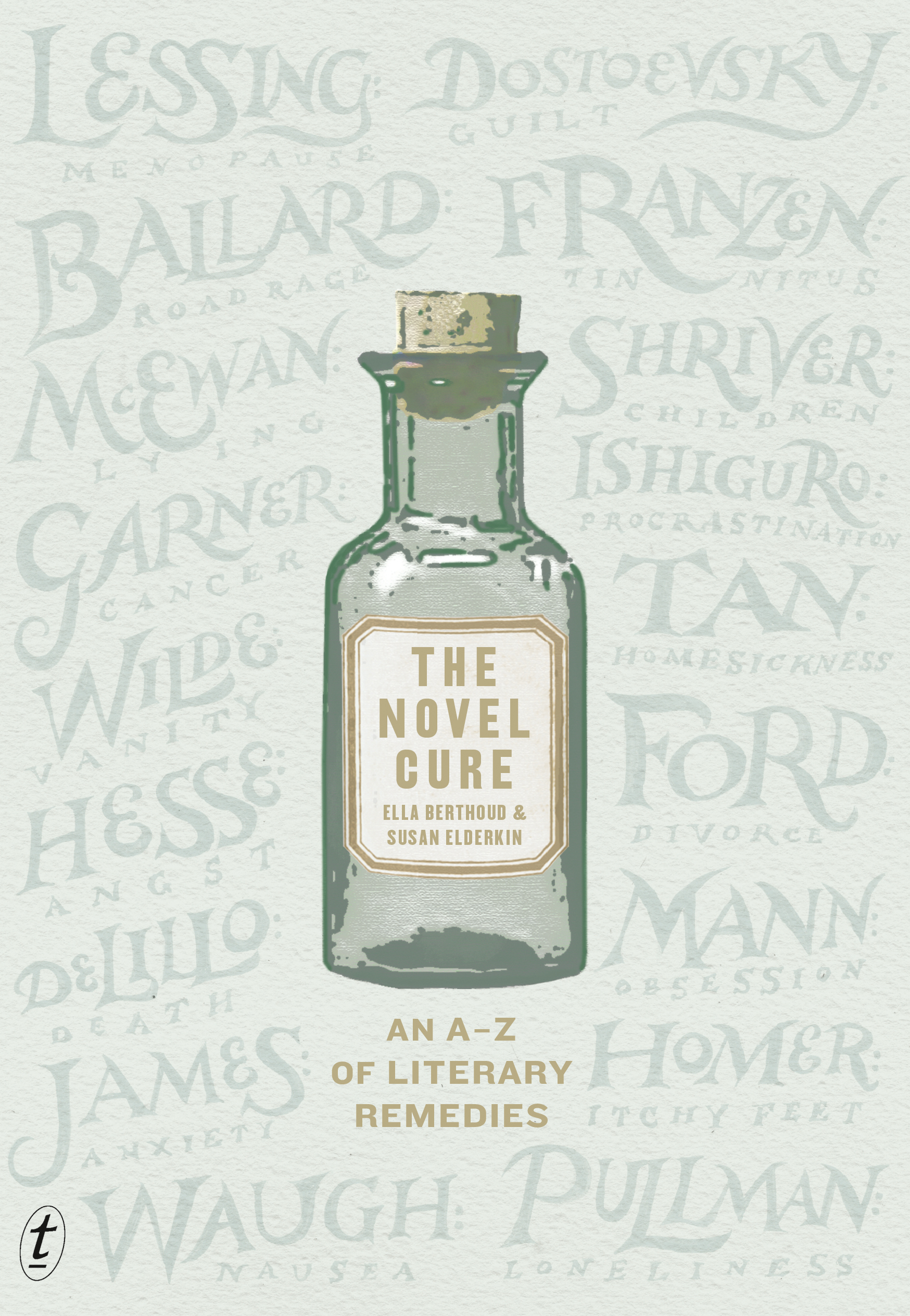
Ella Berthoud and Susan Elderkin, The novel cure: An A-Z of literary remedies (Review)

Novel Cure bookcover

Novel Cure (Courtesy: Text Publishing)

I don’t usually blog about books before I’ve read them cover to cover, but I’m making an exception for Ella Berthoud and Susan Elderkin‘s The novel cure because it’s one of those books that’s best read in small doses (no pun intended). You see, it is a book of bibliotherapy, a book that recommends novels to read to cure almost any ailment you can think of.

Bibliotherapy is described in Wikipedia, but I’ll give you Berthoud and Elderkin’s definition:

the prescribing of fiction for life’s ailments.

I don’t want to give away too many treatments. After all, the authors need to eat. But, to give you a taste, here is a sample of ailments and their prescribed treatments:

  • Daddy’s girl, being a: Can you guess the treatment? It’s Jane Austen’s Emma! You didn’t expect me not to start with Jane Austen did you? Emma, Berthoud and Elderkin say, “has been sent out into the world with an overly high opinion of herself and a self-centredness that can only bring her grief”. They suggest Emma should be seen as a cautionary tale and that girls at risk need to “stop playing the game and show him [their father] what a bad girl you can be”. “See: rails, going off the, for inspiration.” Are you getting the idea?
  • Control freak, being a: The authors suggest two Australian books. Is there something these two Englishwomen are trying to tell we colonials? Both are books I’ve reviewed here, Elizabeth Harrower’s dark The watch tower (my review) and Graeme Simsion‘s comic The Rosie project (my review).
  • Nose, hating your: What else could they suggest for this but Patrick Süskind‘s chilling Perfume. That’s a novel that’s not easy to forget. For all the horror of this novel, the authors manage to turn it to a positive purpose, one determined to help the self-esteem of those self-conscious about their noses!

As lighthearted as all this might sound, the authors do believe in the efficacy of literature to help ease (if not cure) both emotional and physical pain. They apparently hold highly successful bibliotherapy sessions and retreats in the UK. Among the ailments in the book is “Eating Disorder” and the two recommended books, Deborah Hautzig‘s Second star to the right and Jenefer Shute’s Life-size, are serious offerings for sufferers and their carers.

Like the good reference book it is, The novel cure includes see references (such as “Control, out of: See adolescence, alcoholism …”) and see also references (such as “Old age, horror of: See also amnesia, reading associated ….”). These helpful pointers warmed the cockles of my little librarian heart.

Scattered through the book are “Ten Best” lists, for which there is an index at the back so you can find them easily. One that made me laugh is “The Ten Best Novels For When You’ve Got A Cold”. As all Australians know, the best remedy for a cold is eucalyptus. It’s fitting then that Murray Bail‘s gorgeous novel Eucalyptus is top of the list.

There are two other indexes at the back of the book. One is the Index of Reading Ailments (for such life-threatening conditions as “Holiday, not knowing what novels to take on” and “Household chores, distracted by”). And the other is, of course, the Index of Novels and Authors. This makes the book useful for those of you who don’t have any ailments needing cure. You can  see if your favourite novels are cures for others.

You will also see, if you look at this index, the breadth and depth of authors and their works covered in this book. I was thrilled to see many Australian authors represented, covering more than a century of Australian literature. As far as I can tell, every continent is covered. The authors include, for example, South African Lauren Beukes, Indian Rahul Bhattacharya, French Albert Camus, Mexican Laura Esquivel, Japanese Haruki Murakami, Russian Leo Tolstoy, and so on. This index comprises eight two-column pages.

To conclude, I’ll offer my own ailment and cure: Reading slump, being in a: Read The novel cure. You’re sure to find a book or two to cure you and, if you don’t, well, you’ll be reading anyhow!

Ella Berthoud and Susan Elderkin
The novel cure: An A-Z of literary remedies
Melbourne: Text Publishing, 2013
Cover design: WH Chong
456pp.
ISBN: 9781922079350

(Review copy courtesy Text Publishing)

Anita Heiss, Am I black enough for you (Review)

Anita Heiss, Am I black enough for you?

Courtesy: Random House

Anita Heiss‘s Am I black enough for you? is a challenge to categorise, so I’ll start with writer Benjamin Law‘s description on the cover of my edition. He calls it “part family history, part manifesto” to which I’d add “part memoir” because “family history” does not really cover the self-description aspect of the book.

For those of you who don’t know Anita Heiss, she is a Wiradjuri woman and an activist for indigenous Australians. She has a PhD in Communication and Media, focusing on Aboriginal literature and publishing, and is a writer. (I reviewed her chicklit novel, Paris dreaming, earlier this year, and reported last year on her address to the inaugural Canberra Readers’ Festival.) She co-edited the Macquarie PEN anthology of Aboriginal literature and was the guiding force behind BlackWords (the subject of this week’s Monday Musings). And this is just the start … she has been, or is currently, on many boards and committees, particularly to do with indigenous people and communications. She is an Ambassador for the Indigenous Literacy Foundation. She is, in effect, a tall poppy … which brings me to Am I black enough for you?

You see, in 2009, one of Australia’s influential shock jocks, Andrew Bolt, wrote a post titled “It’s so hip to be black” on his blog, asking readers to accept his proposition that there is “a whole new fashion in academia, the arts and professional activism to identify as Aboriginal”. He named many people, including Anita Heiss, calling them “white” or “political” Aborigines. His facts were questionable and his language emotive – such as “madness”, “trivial inflections of race”, “comic”. His argument was that these “white” Aborigines were obtaining unfair benefits from their decision to “be black”. The result was a court case brought by Anita Heiss and eight others against Bolt and his employer, The Herald and Weekly Times, for breaching the Racial Discrimination Act. Heiss and her co-defendants won the case. They did not seek damages. It was ground-breaking stuff that brought out some good discussion about the nexus between racism and free speech, about rights and responsibilities, but it also generated a lot of vituperative commentary. You can research all this pretty easily on the ‘net.

This is the background to Am I black enough for you? which, you might now have gathered, could also be described as an “identity memoir”. On the publisher’s website, Heiss writes that “I wanted to demonstrate that we as Aboriginal people have our own forms of self-identification and self-representation”. She wanted to “challenge the stereotypes” and present “alternative realities of being Aboriginal today”. This she does very well.

Heiss opens the book with her family background, Wiradjuri mother and immigrant Austrian father. She describes herself:

I’m an urban beachside Blackfella, a concrete Koori with Westfield Dreaming, and I apologise to no-one.

This is my story: it is a story about not being from the desert, not speaking my traditional language and not wearing ochre …

In the first four chapters of the book, she tells of her background – her grandmother and mother and their experiences as indigenous women, her father and his values, and her school days. Having laid that foundation, she presents in the fifth chapter, the current working definition of an Aboriginal or Torres Strait Islander person used by the Federal Government:

An Aboriginal or Torres Strait Islander is a person of Aboriginal or Torres Strait Islander descent who identifies as an Aboriginal or Torres Strait Islander and is accepted as such by the community in which he “or she” lives.

That seems pretty tight to me, though no definition is perfect. It’s better than using “a caste system defined by blood quantum (half-caste … quadroon)”.

There are a lot of “ah-so” moments for me in the book – some confirming things I’d already believed and some raising my consciousness about how easy it is to say the wrong thing without being aware of it. Heiss chronicles many instances where (mostly, I think) well-meaning whitefellas seem to get it wrong, such as the non-indigenous academics who proclaim themselves experts in “everything Aboriginal” or the critic who argued that Aboriginal literature “must” be in traditional language otherwise it’s Australian literature. It’s good to have these ideas aired publicly. It helps us test our own conceptions.

Am I black enough for you? has, like most of Heiss’s writing, a strong political and educational purpose. She is on a mission to encourage both indigenous and non-indigenous Australians to think about indigenous identity and, further, about how we relate to each other. She therefore writes in a bright, breezy, accessible style. She’s acutely aware of the power of words and language to define and to obfuscate (though she wouldn’t use such an obfuscatory word!), and frequently discusses language in the book. She makes a particular point about this in the chapter on her academic life, “Epista-what?”, when she says that using academic language, particularly to discuss indigenous issues, served “largely to alienate the very people it was talking about.”

There is much more in this book, and I hope many Australians read it. It’s well-structured, more or less chronologically but in a way that aligns with various themes – academia, the role of literature, her writing, gender – all of which link back to affirming indigenous people’s identity. She comes across as a generous woman – in her relationships with indigenous and non-indigenous people alike. She believes that optimism, rather than negativity and anger, is more likely to get results. It is possibly this optimism which underlies my small frustration with the book: several times she hints at dark times and stresses but, being the optimist, she focuses more on her strategies for overcoming them than on how they have informed her being. I’d like to understand more of that. However, Am I black enough for you? is not a misery memoir, and that’s probably a good thing!

Australian Women Writers ChallengeRead for the Australian Women Writers’ Challenge 2013ANZLitLovers Indigenous Writers Week, and Global Women of Color. Lisa (ANZLitLovers) and Marilyn (Me, You and Books) both enjoyed the book.

Anita Heiss
Am I black enough for you?
Sydney: Bantam, 2012
346pp.
ISBN: 9781742751924

Anna Krien, Night games: Sex, power and sport (Review)

Anna Krien, Night Games

Night Games (Courtesy: Black Inc)

Towards the end of her most recent non-fiction work, Night games, Anna Krien writes:

I wish I’d chosen to follow an ‘easier’ rape trial.

She’s concerned that what she’s written, what she’s finding, won’t “sit well with feminists or footballers”. She might be right, but that would be a shame, because what she’s produced is a rational and, yes, provocative analysis of football culture and the way society enables it. It’s about power, entitlement, complicity – and, of course, sex.

“… despite the verdict, I still don’t know who is guilty and who is innocent”

Like Helen Garner (The first stone and Joe Cinque’s consolation) and Chloe Hooper (Tall man), Anna Krien, whose Into the forest and Us and them I’ve previously reviewed, writes in the narrative non-fiction genre. It uses literary techniques to create a narrative about a real issue or event, and can involve the author putting herself (in this case) in the story. I like the style. If well done, it feels honest because the author is clear from page one about the facts (and their limits) she’s presenting, the ideas she’s exploring and, significantly, the challenges she personally faces during her exploration. Krien doesn’t shy away from confronting her feelings, but neither does she let them overshadow her ability to reason.

And so to Night games. The book tracks the rape trial of an AFL footballer. This has implications for the narrative. The name of the complainant must be suppressed, so Krien decides to suppress the defendant’s name too. The complainant’s testimony was given in closed court, so cannot be reported. This could seriously skew Krien’s story, except that she structures the book in such a way that, although the connecting narrative is the trial, the main game (ha!) is the surrounding culture. Also, Krien reverses traditional trial narrative (fictional and factual) and reports the verdict in her Prologue. This de-emphasises the trial drama, and focuses us on the issues she wants to explore. It’s intelligently done – and once again convinced me that Krien is a writer I want to watch.

The book has six parts – the Prologue, an Epilogue, and four parts in between in which Krein tackles what she sees as the critical issues. These are football culture, particularly regarding male bonding rituals, and attitudes to women and minorities such as black and gay players; rape and what she describes as the grey area surrounding consent; and the broader role of women in football, in various guises, including management and media. These parts could almost be read as separate essays, except that they are connected by the trial narrative, and by their thematic connections to each other.

“an abnormal society…”

Some of my family and friends looked a bit askance when I told them what I was reading. After all, rape is an unpleasant subject and I’m not a football follower – but, I am interested in gender and power, social relationships, and ethical behaviour, which are the book’s real subjects. The picture Krien paints of football culture is not pretty, but neither is it particularly new. Who hasn’t seen and heard, in recent years, news stories about drunken parties and sexual assaults involving footballers? Krien teases out what’s behind these behaviours, and it’s mostly to do with male bonding, a bonding that is characterised by bullying and by a “macho culture of humiliation” in which women become the objects through which the men (try to) prove themselves. It’s not quite that simple of course – and women can try to play the game too, can want footballer notches on their belts – but the pervading attitude, until recent moves to change it, has been one of male power and entitlement.

“… a moral quagmire”

More interesting to me was Krien’s discussion of “the grey area, the gulf of uncertainty between consent and rape”. She quotes academic Catherine Lumby, Rugby League’s advisor on gender and cultural change:

Yes, there are many instances of behaviour that we found in our research into players’ experiences that did not equate to sexual assault but are definitely extremely unethical behaviour – such as after having sex with a girl, throwing her out of your hotel room naked without her clothes for a joke. Or suddenly asking, ‘Do you mind if I invite my mate back?’

How easy, Krien asks, is it for women to say “no” in many of the, usually powerless, situations they find themselves in – and if they don’t say no, have they consented? Is acquiescence consent? If not, what is it? The issue of consent was the critical issue in the rape trial Krien follows in the book – and hence her wish for an ‘easier’ rape trial. I’m aware that, except for that stereotypical violent, sociopathic rapist we all think of, consent is the critical issue in many rape cases. But, what I liked about Krien’s discussion was her analysis of the consent issue within this particular culture and her questions concerning how it might be better negotiated and understood at the time the sex occurs and how it might be better handled legally. Underlying this, though, is the idea that there would be less need to worry about grey areas surrounding “consent” if the culture itself fostered respect and equality, not to mention ethical or moral behaviour.

I’ll leave my discussion of Krien’s arguments and thesis here, otherwise I’ll end up writing an essay myself. I’ll simply add that I like Krien’s self-questioning and analytical, rather than emotional, approach. There’s no list of sources at the end, which I missed, but she clearly identifies her extensive research as she goes, naming the people and works she consulted. I also like her writing. It’s accessible and logical, but has fresh turns of phrase that lift it out of dry reportage.

If you weren’t inclined to read this book, think again, because I found Night games to be illuminating beyond its specific focus on football culture. It is also an excellent read.

Anna Krien
Night games: Sex, power and sport
Collingwood: Black Inc, 2013
268pp.
ISBN: 9781863956017

(Review copy courtesy Black Inc)