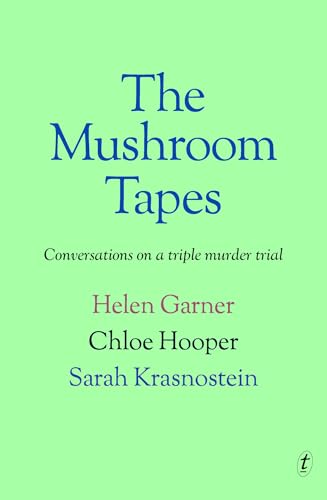
Chances are I’m not telling you anything when I say that The mushroom tapes is about an Australian murder trial that took place over two months in the middle of 2025. However, if you don’t know, this trial concerned a woman named Erin Patterson who was accused of murdering three relatives and attempting to murder a fourth, by serving them toxic-mushroom-laced beef Wellingtons for lunch, in July 2023. The victims were her estranged husband’s parents and aunt, with the survivor being his uncle, Ian Wilkinson. The estranged husband, Simon, had also been invited but pulled out the day before. You can read more at the Wikipedia article, Leongatha Mushroom Murders.
This was one of those cases that captured local and international attention, so when it went to trial coverage was intense. Not only were there the usual news reports on television and radio, and in print and online newspapers, but there were also podcasts, social media threads, and of course conversations everywhere you went. Within weeks of the trial’s conclusion, the books started coming out. People were, as Helen, Chloe and Sarah* write, either obsessed and consuming all they could or repulsed and doing everything possible to avoid it. I was in the middle-ground. I certainly wasn’t obsessed. I didn’t seek out reports but couldn’t miss hearing snippets of news. If it came up in conversation, I took part with whatever information I had recently heard. It’s not that I didn’t care. It’s a terrible and devastating story – for the families involved and particularly for Erin and Simon’s two young children, who were 14 and 9 when the murders occurred. However, having lived through the Lindy Chamberlain days, I’d rather let the court do its job as unhampered as possible. I am increasingly uncomfortable with pronouncing on controversial situations, because the sources are often questionable or incomplete.
Then I heard that Helen Garner, Chloe Hooper and Sarah Krasnostein – all writers of thoughtful narrative nonfiction that I have loved – had decided to write jointly about the case. This, I knew, would interest me, because I could trust them to engage in honest and open-minded thinking that would consider the greys. I hoped, too, that they would reach beyond this particular case to offer something more. I didn’t have a preconceived notion of what this might be, but just wanted them to tease out something bigger than this case for us to take away and ponder. Did they? Read on …
“a rent in the social fabric” (Hannah Arendt)
In the book’s opening pages, the three discuss what they are doing, whether, in fact, they should be doing it. After their first day in court, a few days into the trial, they talk about what they have seen in the witness, Simon – the grief, horror, incomprehension. Invoking Hannah Arendt, they suggest they are “bearing witness to a rent in the social fabric and how the law is going to deal with it” (p. 15). Nonetheless, they are concerned at this early stage, and revisit it often throughout the process, that they might be “just perving”. Helen admits there is an element of “perving” of course,
but you hope that by the time you’ve got a certain degree of skill as a writer, you can become useful. I think it’s useful work. These trials are excruciatingly painful. Your [Sarah’s] description of that journalist, going to drink at the pub – that’s defence, isn’t it, defence against the pain. The pain that you volunteer to witness. (p. 16)
Chloe adds that another issue is the transformation of the town by the media pack. These are just two of the many ideas these three explore amongst themselves as the trial progresses – because this book is completely framed by the trial.
“our eyes will go to different places” (Chloe)
This brings me to the book’s structure and form. It is divided into 6 parts which follow the trial, chronologically, through to the verdict. The parts are themed around the focus of the trial at that point in time, such as mushrooms or the victims. They tease the theme out, while also interrogating wider thoughts that their process was generating.
And their process was an interesting one. When they decided to jointly write this book, rather than individually, they recognised that by working together their eyes would “go to different places”. During the conversation I attended with Helen and Sarah, they talked about these different “places”. Helen’s tended to be “Shakespearean”, and personal, concerned with questions like where is the line that an ordinary person crosses to commit such a crime, while Chloe’s tended to the sociological (as in, what in society created this). No surprises for guessing what legally trained Sarah’s was! These are loose divisions, because they are not one-dimensional women, but it does mean that the discussions are wide-ranging.
The overall tone is one of reportage: “we” drove to Morwell, or “in her opening address for the Crown, Nanette Rogers had told the jury …”, or “Helen and Chloe are still on the phone with Sarah”. These reports, which provide facts, describe the scene, or establish bona fides, are interspersed with conversations selected from hours of recordings and other communications like email. They are introduced by the speaker’s name, as in “Chloe: The public gallery wants a plot twist… ” (p. 109). This might sound disjointed, but in fact the book flows well, which is impressive given the time-frame in which it was produced.
“it has everything in it that’s human, including absurdity” (Chloe)
I have never sat on a jury nor attended a trial, but these writers conveyed a real feeling of what being in that courtroom was like – of the tedium of long days of evidence about mushrooms and dehydrators, of the little communities of people attending court, of the cafe where attendees would go for coffee or lunch, of attendee Kelly the dairy farmer who gets a mushroom tattoo, and so on. It’s both life-changingly serious and oh so ordinary.
But, of course, the centre is Erin. Their discussions about her, as their thoughts waver and shift through mounting evidence, convey just what a strange case this was. As Chloe comments near the end, “it’s a miasma of why?” (p. 222). Who is she? Why did she kill her parents-in-law who had treated her with much kindness? What happened in the marriage? Why does she lie? Is she a “monster” or “a broken person”? They can’t decide. Sarah says, as they wait for the verdict:
“We should be nervous – we’re finding out how much we’ll never know” (p. 226-7)
So, back to my question: Did I come away from this book with some meaningful takeaways? I do think it suffers a little from its rapid production. It is fresh and immediate, but not quite as complete as I was hoping for. Many ideas were touched upon, rather than fully explored – including the impact on a community of being at the centre of such a tragedy and then of intense media attention, the bigger issues about what makes someone (particularly women) kill, the moral questions about what they were doing, not to mention questions about the legal system.
However, meaningful questions were raised, and I enjoyed spending time with these three. On their own, they are some women, but together, they are a force. It was like eavesdropping on the sort of intelligent, compassionate and open conversation that we all aspire to. And they ended on the hopeful note that, despite the horror and the “appalled sorrow”, there was survivor “Ian Wilkinson’s offer of kindness – an enlargement of the field”. “An enlargement of the field”. What a beautiful thought.
Brona, Jonathan, Kate and Rose have all posted on this book.
* I use first names because that’s how they present themselves in the book.
Helen Garner, Chloe Hooper, and Sarah Krasnostein,
The mushroom tapes: Conversations on a triple murder trial
Melbourne: Text Publishing, 2025
240pp.
ISBN: 9781923058750

 Whispering Gums