Nadia Wheatley, Her mother’s daughter: A memoir (#BookReview)

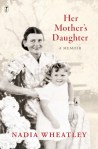
Nadia Wheatley, Her mother's daughterIn Her mother’s daughter: A memoir, Australian writer Nadia Wheatley has written the sort of hybrid biography-memoir that I’ve reviewed a few times in this blog. All of them, as I mentioned in my recent Meet the Author post, have been mother-daughter stories, Susan Varga’s Heddy and me, Anna Rosner Blay’s Sister, sister, and Halina Rubin’s Journeys with my mother. It’s this hybrid form that I’d particularly like to explore in this post.

And the hybrid I’m talking about is one where the biography is of the subject (mothers, in these cases) and the memoir is of the writer (the daughters.) This is the more common form of hybrid biography-memoir, though my research did turn up others, such as Room to dream by Kristine McKenna and David Lynch in which McKenna’s biographical chapters on Lynch are followed by Lynch’s responses to those.

The biographer’s question

There are, of course, many memoirs by people who, in order to tell their own story, need to figure out their relationships with others, particularly their parents. However, these books remain primarily about the writer. Hybrid biography-memoirs, on the other hand, tend to be as much, if not more, about the other person as the writer. The end result might be the writer understanding themselves more, but the focus tends to be the other. This was clearly Wheatley’s intention. Indeed she told us that her biographer’s question was “Why would a nice person like Neen marry an awful person like my father?”

So, her book’s main focus, then is her mother. Nina (Neen) Wheatley, nee Watkin, was born in northern New South Wales in 1906, and died in Sydney in 1958. She lost her own mother when she was five years old. She and her siblings were separated when her father remarried, with Nina and her younger sister Boo staying with their father and his new wife. It became clear that the family expected Nina to be the parents’ carer in their old age. However, Nina managed to train as a nurse, and go overseas during the war as an enlisted nurse with the 6th AGH (Australian General Hospital), where she worked in Greece and Palestine. She returned to Europe after the war to work with UNRRA and then IRO, caring for Displaced Persons. It was during this time that she met the man – English doctor, John Wheatley – she ended up marrying. It was a bad decision: he was a womaniser, possessive and controlling, and, according to Wheatley, sadistic. Indeed, it’s very likely that, had he – and the medical fraternity more broadly – taken women’s health seriously, Nina would not have died when she did. After her mother’s death when Wheatley was 9 years old, she, an only child, lived with a local family known to her (and chosen by her mother before her death.) This was, for Wheatley, a problematic situation – but this part of the story occupies just the last 20 or so pages of the book, and, while it’s important to the overall memoir, I do want to move onto other points.

So, back to the form. Unlike Wheatley, those other three biographers-cum-memoirsts, Varga, Blay and Rubin, were able, as adults, to question their mothers. They could bring an adult’s eye to their mothers, and ask the sorts of questions an adult might ask. They all tape-recorded their mothers. Wheatley’s mother, however, died when Wheatley was nine, so concocting her mother’s story was a very different challenge. Fortunately – and how prescient of her – she realised that her memories wouldn’t last so, at 10 years old, she started writing down her memories of the happy times she spent with her mother and also the stories her mother had told her about her life. At times I wondered how she could possibly have remembered as much detail as she does. However, given Wheatley was clearly a writer from the start and given what she experienced was so powerful, it wasn’t hard to trust her authenticity. It’s these stories and  memories, together with letters, journals and interviews with family members and friends, and official records, that provide the facts for her mother’s biography.

Step one, then, is the research, but next comes how to marshall it all into a narrative. Varga and Rubin, like Wheatley, take us on a journey of discovery. As Wheatley said during the conversation with Halligan, she wanted to take the reader on the quest with her. She wanted to share the detective story of her unravelling her mother’s story, and not just present the evidence. Varga and Rubin do something similar, but they tell their story first person, sharing when their mother is reticent, when they, as daughters, are challenged, and so on. Varga makes it clear to her mother – and us – that this means “it won’t be her life story, not properly” but would be “filtered” through her “reactions and thoughts”, her “second generation eyes.”

Blay, however, is more formal, presenting her mother Hela and aunt Janka’s stories in their words as transcribed from her interviews with them. She intersperses these with her own perspective in italics. The three voices are thus distinct.

Wheatley, though, uses a different approach again. She tells her mother’s story third person, but, intermittently, will suddenly switch to first person to present her own role in the research or the story, removing us from Nina’s chronology to her own time-frame. Chapter 9, which relates her mother’s life immediately postwar, is a good example. The first 10 pages read like a standard biography, describing what Nina was doing, quoting from letters and journals to support the information, then, suddenly, after a reference to Nina’s father’s death, she flashes to nine years after Nina’s own death (and over twenty years after the time we’ve been in.) Nadia is dining with her Auntie Boo, and casually asks if she knows where Nina’s wedding ring is. Her aunt bursts into tears, saying:

‘Daddy’s will was so unfair! To leave everything to Neen! Not just Glenorie, but everything in it!’ As my aunt moved on in her attack, it turned out that I too was guilty as charged: ‘All those things that Nina and you had in that house at Strathfield, you had no right to them.’

Now, Nina’s father had left “other real estate to his other children” but leaving the family home to Nina rankled so much, writes Nadia, that “some of her siblings would never get over it.” After a page on all this, we are returned to Nina’s life, and the third person voice.

This approach ensures that as well as travelling the journey with Nadia, we also see the impact on her, and her sense of guilt, as she is growing up. There are many insertions like this, including one later in the book when Nadia remembers a time with her father when she was three years old. With this approach, Nina’s story is told chronologically, but Nadia’s is disjointed until after Nadia is born when her story is gradually folded in to the main narrative. It’s a tricky approach, but Wheatley, an experienced novelist and biographer, makes it work, resulting in something that provides both a coherent biography of her mother, and the impact on her. It doesn’t necessarily work if you are expecting a detailed memoir of Wheatley’s life, but that wasn’t Wheatley’s goal.

Defining moments

Interesting as all this is, however, the main joy in reading Her mother’s daughter lies in its social history of the first half of the twentieth century. Wheatley’s story of her mother’s experience as an active participant in World War 2 is vivid, and makes a significant contribution to a less covered aspect of that war. Her story of her mother’s life in Sydney during 1950s is significant too – but terribly so.

Nina’s War “story” was fascinating. Her reports of her early experience are cheerful, full of a sense of adventure and camaraderie, but that soon changes as her real war experience starts. She sees the impact of bombing on civilians in Greece, and she nurses casualties of the Syrian campaigns including El Alamein. She already cared about social justice before going to war, but her desire to help others firmed afterwards. Her experience of forced repatriations, of seeing “Poles packed like cattle in trucks” during her work with UNRRA, was “a defining moment” writes Wheatley. Nina wrote in her journal that “This experience will have an intense influence on all my life.”

Wheatley’s description of her mother’s work with Displaced Persons is inspiring, showing Nina to be a resourceful and empathetic woman who managed to create harmony in extremely difficult circumstances. However, her marriage to Dr Wheatley saw this confident, warm woman brought undone. Her husband’s cruel, self-centred behaviour soon soured all Nina’s hopes of a happy marriage of equals. Nadia writes that he either “provoked arguments” with her mother, or set up “elaborate games in which I was the pawn he used to take the queen.” That – and his womanising – were bad enough but, when in 1956 Nina started feeling unwell, the situation became dire because Nina fell prey to a male-dominated medical system, actively supported by her doctor husband. The belief that the ills women of Nina’s now middle-age felt were all “in the mind” resulted in her eventual destruction. It’s devastating for Nina (of course) and for Nadia from whom so much, before and after, was kept secret – but, for anyone who knows or lived through the 50s, it’s only too believable.

Unfortunately, as it turns out, not all the defining moments of Nina’s life were positive ones.

Now, once again, I’ve outstayed my welcome, so I’ll conclude by saying that Her mother’s daughter is a great read for two reasons. Firstly, it provides a thoughtful, authentic – sometimes exciting, sometimes disturbing – social history of the times. And secondly, with Wheatley’s ability to write engaging narratives, it makes for engrossing, moving, provocative reading. I do recommend it.

AWW Badge 2018Nadia Wheatley
Her mother’s daughter: A memoir
Melbourne: Text Publishing, 2018
322pp.
ISBN: 9781925603491

Marie Munkara, Of ashes and rivers that run to the sea (#BookReview)

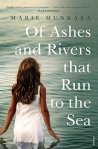
Marie Munkara, Of ashes and rivers than run to the seaThe stories keep on coming, the stories, I mean, of indigenous children stolen from their families and what happened to them afterwards. I’ve posted on Carmel Bird’s compilation of stories from the Bringing them home report, The stolen children: Their stories, and also on Ali Cobby Eckermann’s memoir Too afraid to cry. Now it’s Marie Munkara’s turn with her excruciatingly honest, but also frequently laugh-out-loud-funny memoir, Of ashes and rivers that run to the sea.

Late in her memoir, Munkara learns that she was born “under a tree on the banks of the Mainoru River in Western Arnhem Land.” But, what she writes next is shocking

‘Too white,’ my Nanna Clara said as they checked me out by the camp-fire light, and everyone knew what that meant. Back in those days any coloured babies in my family were given to the crocs because dealing with these things right away saved a lot of suffering later on. It was better that we die in our own piece of country than be taken by the authorities and lost to our families forever.

Does that remind you of anything? It did me – of Toni Morrison’s novel Beloved, and the slave mother’s decision there. Anyhow, knowing what we know now about the lives of many stolen children, we can surely understand her indigenous family’s actions. Luckily, though, for Munkara – and us – Nanna Clara saw something “special” in her, and she was kept. That was in 1960. Three years later, now living on the Tiwi Islands, the inevitable happened and she was taken from home one day when her mother was at work at the mission laundry. Her mother begged for her to be returned, to no avail.

All this, however, we learn near the end of the book. Munkara starts the book when, at the age of 28 and quite by accident, she came across her baptismal card tucked in a book in her parents’ library. It told her that she was born in Mainoru in Arnhem Land. “In the space of an instant,” she writes, “excitement was replaced with mortification as old geography lessons began to resurface” about a “wild and untamed place where Aborigines hunted kangaroos and walked around butt-naked.” However, she decides to find out more, and soon discovers that her mother was still alive and still living in the Tiwi Islands. She decides to go meet her, with no advance notice.

To say that she was shocked by what she found is an understatement. “This is not the tropical island I had imagined,” she writes, “with luscious vegetation and cute little palm-frond houses. It is a dump.” She tries hard to enjoy her time there, but hates it and three days later returns home. However, it’s not long before she realises that she has to return. This ends Part 1 of the four-part book. In Part 2, she goes back in time and tells of her life as the foster child of two unhappy but highly religious people. Her mother was strict, and cruel, but her father was worse. He molested her for many years. A sad, sad upbringing but Munkara, as she admits herself, is a survivor:

But aren’t human beings amazing creatures and even at an early age we can choose to let the bad things in life devour us and we sink or we can make the most of the good bits and swim. … I chose to swim.

Part 2, then, makes for hard reading, but Munkara’s sense of humour, her ability to believe that things will work out, and her independent mind bring her, and us, through. She’s a great story-teller, which makes this section more manageable than you might expect – but it still leaves you angry!

And then we come to Part 3 in which she tells of her return to Bathurst Island. This is where the real interest of the book lies because it is here that Munkara takes us on her journey into another culture. She is us – to a degree. She has been brought up white – albeit “a dusky maiden” version – and her expectations and initial reactions are very much as ours would be. She describes how she tries to apply her whitefella ways to her new life with her Aboriginal family. She expects privacy, cleanliness, order and, most of all, respect for her possessions. None of these sit well with traditional indigenous values as she found them on Tiwi, but she’s determined nonetheless. We can feel her horror and frustration – but she’s telling this story long after the events, and imbues them with a light touch of self-deprecation and a warmth for her family which encourages acceptance rather than judgement (in herself and us).

Some examples:

I spend the day scrubbing the kitchen and neatly place all my things by themselves on a shelf so everyone can see they belong to me, and then I have a well-earnt nap. I sleep soundly and wake up to the smells of cooking. Stretching and yawning I make my way to the kitchen to put on the billy for tea only to stop at the doorway in horror, my mouth still open from the yawn. The room in an absolute shithole of a mess. My stuff is strewn everywhere […] Everyone tiptoes around me now they know I’m in a bad mood and I’m fine with that, maybe they’ll learn not to touch things that they shouldn’t.

and

They are instantly awake when they see that I’m only dressed in my bra and underpants. Thankfully my underwear is matching…

Haha, as if they’d care! And,

… after going to the footy on the weekend with my family for protection I’ve gotten over my fear of big crowds of black people. I now feel quite foolish for thinking they could be harmful to me and reckon I must have gotten this irrational fear from my white parents.

So much of this section resonated with me because it reflected many of the things Mr Gums and I were learning and experiencing as I was reading it. I’ve already posted on the cars, but there’s also the mess, the confusing kinship (including her having to call various dogs her brother, her son, her uncle and so on), the trust in spirits, the lack of concern for possessions, all of which can result in decisions and behaviours mystifying to us whitefellas.

But Munkara also learnt more seriously confronting things, such as that her mother’s damaged leg was caused by leprosy, something she’d thought only happened in the Bible and poor countries:

I slide my ill-informed thoughts into the rubbish bin and slam the lid down tight, angry that our First World country can live in ignorant bliss of our Third World problems. … I bet there wouldn’t be too many white people afflicted with leprosy in Australia because if there were it would be front-page news.

However, while the memoir is, for us, an eye-opening, necessary journey into another culture, it is, ultimately for Munkara, a journey to her self. By the end of Part 3, she has come to a better understanding of who she is:

But they don’t realise that there is no stolen and there is no lost, there is no black and there is no white. There is just me. And I am perfect the way I am. And I know now that I have to leave this place because I’ve learnt all I can for the time being and this lesson is over now.

She only leaves as far as Darwin, however, so she can remain in contact with her family. And so it is that, late in the book, Munkara writes about her (biological) mother’s dying:

When I asked her if she had any regrets she said there were no words in any of our family languages for regret. To regret something was a waste of time so why make a word for something that you didn’t need.

Munkara’s mother’s comment that her language doesn’t have a word for “regret” encapsulates for me the value of reading this book, which is its chronicling of the meeting of two opposing cultures. I thoroughly recommend the book, because understanding what divides us is critical to reconciliation – and because it is a darned good read. She can tell a story, that one!

ANZLitLovers ILW 2018Lisa (ANZLitLovers) has reviewed this book, as has French blogger Emma (Book around the corner) and the Resident Judge. Read for Lisa’s (ANZLitLovers) Indigenous Literature Week.

AWW Badge 2018

Marie Munkara
Of ashes and rivers that run to the sea
North Sydney: Penguin Random House, 2016
179pp. (print version)
ISBN: 9780857987280 (eBook)

Carson McCullers, Home for Christmas (#Review)

Carson McCullers, 1959

Carson McCullers, 1959 (photo by Carl Van Vechten, Public domain, via Wikimedia Commons)

As you will guess from the title of this Library of America (LOA) Story of the Week, I meant to post on it closer to Christmas Day than I have in fact achieved. I chose it for two reasons – firstly the obvious seasonal one, and secondly because my first Carson McCullers post was an unusual piece and perhaps not completely reflective of the writer she was. Her story “Home before Christmas”, while nothing like her best-known novels, does get us a bit closer to them.

First, though, some background. LOA’s notes tell us that the story, written in 1949, was the first of a few essays McCullers wrote for magazines like Mademoiselle and Redbook. McCullers’ biographer, Virginia Spencer Carr, says, according to LOA, that “even as a preschooler Carson would be asked what she wanted and the answer was, ‘I want book—lots of books, Mama’.” I suspect many of you reading this will say the same about yourselves. I know I would!

LOA shares a couple of other stories about the adult Carson and gift-giving – including one that resulted in such a kerfuffle that someone was written out of a will, and another involving Truman Capote. However, they take us further away from the point of THIS story.

“Home for Christmas” was apparently commissioned by Mademoiselle for its 1949 Christmas issue, and was published alongside pieces by food writer MFK Fisher and novelist Jessamyn West (whom I plan to cover here one day via the Library of America). LOA chose to share McCullers’ piece this last Christmas because 2017 was the centenary of McCullers birth.

Now I said in my opening paragraph that this story, although nothing like her best-known novels, does connect us a little with them. Firstly, an autobiographical piece, it describes life in a southern family, but more significantly, like The member of the wedding, it is seen through a child’s eye. It is not like her novels in the sense that it is not Gothic, and nor does it deal in any major way with the loneliness or “outsiderness” that I remember from her oeuvre – though there is a touch of melancholy in it, all the same.

In some ways, it’s a traditional story about childhood yearning for Christmas. It begins in August with our young first person narrator, that is, Carson, pondering Christmas, and it concludes, just after Christmas, with her yearning for the next Christmas. In between, we hear about the buying of Christmas presents, the cooking of Christmas food, and how Christmas day itself was spent. But, there is also a little unifying theme running through this – the “mystery of Time”.

In the second paragraph, it is August and our narrator is up a tree thinking:

I did not want to talk with my brother. I was experiencing the first wonder about the mystery of Time. Here I was, on this August afternoon, in the tree-house, in the burnt, jaded yard, sick and tired of all our summer ways. (I had read Little Women for the second time, Hans Brinker and the Silver SkatesLittle Men, and Twenty Thousand Leagues under the Sea. I had read movie magazines and even tried to read love stories in the Woman’s Home Companion—I was so sick of everything.) How could it be that I was I and now was now when in four months it would be Christmas, wintertime, cold weather, twilight and the glory of the Christmas tree? I puzzled about the now and later and rubbed the inside of my elbow until there was a little roll of dirt between my forefinger and thumb. Would the now I of the tree-house and the August afternoon be the same I of winter, firelight and the Christmas tree? I wondered.

You can see biographer Carr’s point about books can’t you? Anyhow, again, I suspect many of us have pondered Time in this way. McCullers doesn’t labour the point but it pops up a few more times in the article,  including the notion of time behaving differently for different people. “How”, she writes, “could it be that when she [her sister] opened her eyes it would be Christmas while I lay awake in the dark for hours and hours? The time was the same for both of us, and yet not at all the same.” There’s also a delightful little – almost throwaway – line about how her father would manipulate the clocks to enable them to get up early on Christmas morning but not too early for the parents.

“Home before Christmas” is not a particularly deep story/article, but then as an article for a Christmas edition of a magazine, it probably wasn’t meant to be. It is, however, an enjoyable read and, while presumably part of that bread-and-butter work that writers do to survive, it also provides some insight into a significant writer of, and from, America’s south.

Carson McCullers
“Home for Christmas”
First published: Mademoiselle, December 1949
Available: Online at the Library of America

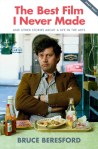
Bruce Beresford, The best film I never made (#BookReview)

Bruce Beresford, The best film I never madeBruce Beresford, author of The best film I never made, is of special interest to me for a couple of reasons, besides the fact that I’ve enjoyed many of his films over the years. One is that after a few years of taking (or, perhaps, “dragging” is more accurate) our then young son to various classic movie “experiences”, like, say, a silent movie accompanied by live theatre organ, we finally hit pay dirt with Bruce Beresford’s Breaker Morant. He loved it, and I’d say his love of film was born then. The other is that I’ve known for some time that Beresford has wanted to film his old university friend Madeleine St John’s novel The women in black (my review). I want to see that film! According to the brief bio opposite the title page, it is being made now. At last!

All this is to explain why I was keen to read Bruce Beresford’s collection of stories when I saw it appear in Text Publishing’s New Releases list. But, what does “collection of stories” mean in the context of non-fiction? These are not essays or even newspaper columns that have been published before, and, disappointingly, there’s no Introduction, Author’s Note or Afterword providing context. There is, though, in that aforementioned brief bio, the address for his website, and there I found a tab called “Articles”. So this is where they are published? Yes, some anyhow, including some in an earlier form, but not all. However, from this, and from their personal, rather chatty style, I’d liken these articles to blog posts, which in his case comprise musings on things relating to his film and opera directing career and his related cultural interests.

The best film I never made, then, is a collection of these blogpost-cum-stories, organised for the book into four parts: I Family, Journeys, Memories; II Making and Not Making Movies; III Behind the Screen; IV Operas, Painters, Writers. The stories are all dated, ranging from 2004 to 2017. Some have brief updates at the end. The 2010 piece on Jeffrey Smart, “Smart lessons”, for example, has a final annotation noting that Smart died in 2013. The stories are not presented chronologically.

And now, because this is not a book with a narrative structure that can be spoiled – though there is some logic nonetheless to the order – I’m going straight to the end. You’ll guess why when I tell you that the title of the last article is “Australian literature and film”, but that literature connection is not the only reason. Other reasons are that it provides a good introduction to the style and tone of the whole, and also to the way he imparts his experience and understanding of filmmaking.

The main point of this last article is to discuss the idea, put forward he says by the press, that “Australian films would benefit if more adaptations were made from acclaimed literary works. Comparisons are inevitably made with foreign films, particularly English and American …” Commenting that he can understand why writer-directors might want to tell their own stories, he admits that probably a majority of English-language films are adaptations of novels but suggests that many of these would be from popular fiction rather than “literary successes”. He unpicks why:

Many novels are famous for their prose style, various colourful characters, their themes and so on: factors which can obscure the fact that other useful ingredients – a coherent plot for example – may be absent. In film, most of the characteristics that distinguish a literary work – such as a striking prose style – are stripped away and this can reveal the lack of a well-constructed story, or convincing dialogue, and be fatal to the effectiveness of the film.

He then provides examples of English and American adaptations, about which, of course, every reader-filmgoer will have different opinions – but I think his principle stands. He comments for example about the difficult of transferring “the satire and dry cynicism” of Waugh to film, and says Patrick White is notoriously difficult “because his novels like Conrad’s, are psychological studies, intense and profound, and not easy to transfer to a film script”. (Interestingly, though, he suggests that Happy Valley, which I’ve reviewed, could be a good candidate because of its “more conventional narrative”.) Filmmakers do better he argues “to adapt novels which rely on a few strong characters and a compelling narrative” like, for example, Kenneth Cook’s Wake in fright (albeit “won no literary prizes”).

So, this article demonstrates Beresford’s grasp of filmmaking, which, unsurprisingly, runs throughout the book, but it also exemplifies his tone and style, including his willingness to share his own prejudices. He’s not a fan of Tim Winton, for example, describing his books “as bargain-basement Patrick White: stylistically derivative, they are far more savage, full of unpleasant characters, and weakly plotted”. And Christina Stead, he says, is “a turgid writer, in my worthless opinion”. This possibly false but not pompous self-deprecation is another feature of his tone. In the same paragraph as the Stead comment, he writes that he’d filmed Henry Handel Richardson’s The Getting of Wisdom, but that “critics did not share my admiration for the result”! (Other films of his, he agrees, aren’t the best.)

And finally, this chapter also reveals his ability to “tell-all” without being gossipy. He suggests that another reason why classic novels aren’t adapted in Australia (as they are in England) is that they are just not well-known, “certainly the word of their excellence has not reached all of those in charge of making financial decisions.” (The challenge of financing films is a theme running through the book, in fact.) Beresford wrote, he tells us, an adaptation of Henry Handel Richardson’s epic, The fortunes of Richard Mahony. He says he hadn’t expected potential investors to have read it, but he “did at least expect them to have heard of it – and her. But this was not the case.” Oh dear! He backs up this example of philistinism with another:

when I was planning a film about Mahler, a Hollywood executive said, ‘What I can’t understand is why you would want to make a film about a nonentity.’ I said  nothing, but perhaps should have told him that one of the most gifted composers of all time could not accurately be described as a ‘nonentity’ – except by someone of overwhelming stupidity.

To his credit, Beresford does not name this person of “overwhelming stupidity”.

If you’ve enjoyed my discussion of this article, then you are likely to enjoy the book. I loved his discussion of the filmic qualities of the artist Caravaggio, and of his friendship with luminaries like Barry Humphries, Clive James, and the late Jeffrey Smart. His Behind the Scenes section provides fascinating insight into the role of cinematographers, composers and designers in the filmmaking process. And so on.

However, because this is a book of collected articles written over a decade or more, there is the occasional repetition, particularly in the first section about his personal life. And, he does come across somewhat as an unreconstructed male. There are several references to his chasing, or his friends’ marrying, beautiful women, which focus I find out-of-date (but that’s just my worthless opinion!)

The best film I never made is an enjoyable book. It’s more chatty and informative than reflective, but if you have followed Bruce Beresford’s films over the years – including Breaker MorantDriving Miss Daisy, Tender Mercies, Black Robe, Mao’s Last Dancer – and you are interested in the practice of filmmaking and in the arts more generally, this book has a lot to offer. And makes, methinks, a good summer read.

Bruce Beresford
The best film I never made, and other stories about a life in the arts
Melbourne: Text Publishing, 2017
281pp.
ISBN: 9781925603101

(Review copy courtesy Text Publishing)

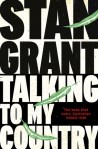
Stan Grant, Talking to my country (#BookReview)

Stan Grant, Talking to my countryHistory is, in a way, the main subject of my reading group’s October book, Stan Grant’s Talking to my country. I’m consequently somewhat nervous about writing this post, because discussions of history in Australia are apt to generate more emotion than rational discussion. I will, though, discuss it – through my interested lay historian’s eyes.

However, before we get to that, I’d like to briefly discuss the book’s form. Firstly, it’s a hybrid book, that is, it combines forms and/or genres. In the non-fiction arena, this often involves combining elements of memoir with something else, like biography, as in Gabrielle Carey’s Moving among strangers (my review). In Grant’s case, he combines memoir with something more polemical – an interrogation of Australian history, and how the stories we tell about our past inform who we are and how we relate to each other.

Secondly, and probably because it’s not a straight memoir – Grant wrote his memoir, The tears of strangers, in 2002 – the book is structured more thematically than chronologically, though a loose chronology underlies it. For example, his discussion of the lives of his grandparents and parents doesn’t happen until Part 3, and then in Part 4 he discusses the government’s policies for handling “the ‘Aboriginal problem'”, particularly that of assimilation (or, more accurately, “absorption”.) This structure enables him to focus the narrative on his theme, so let’s now get to that.

The book opens with an introductory chapter titled, simply, My country: Australia. In it, Grant sets out why he wrote the book, which is to convey to non-indigenous Australians just what life is like for indigenous people, to explain that although history is largely ignored it still “plagues” indigenous people, and to tell us that the impetus for him to finally write the book was the booing of indigenous football player Adam Goodes in 2015. And here, in very simple terms, Grant states his thesis:

This wasn’t about sport; this was about our shared history and our failure to recognise it.

He goes on to explain that while some tried to deny or excuse it, his people knew where that booing came from. From my point of view, it’s pretty clear too.

“the gulf of our history”

Now, I’m not going to summarise all his arguments – or the stories of his and other indigenous people’s experiences – but I do want to share some of his comments about history. As Grant is clearly aware – and what Australian isn’t – history is politicised, sometimes consciously, sometimes unconsciously. My generation, the baby-boomers, grew up learning that Captain Cook discovered Australia and that Governor Phillip established the first settlement. If Aboriginal people were mentioned, it tended to be in passing. They were merely a side-bar to the main story. We may have learnt about the missions (and the “great” work they were doing) and we may have learnt in later years of schooling that many indigenous people lived in poverty, but we weren’t told about the massacres and violence that occurred, and nor was it ever suggested that we* had invaded an already occupied land. However, as we now know, these things we weren’t told are incontrovertible facts, supported by evidence.

Some, unfortunately, still ignore these facts and some try to interpret them differently, while the rest of us accept them but feel helpless about how to proceed. And this leads directly to Grant’s underpinning point, which is that we – black and white Australians – meet across “the contested space of our shared past”. Elsewhere he states it a little less strongly as “the gulf of our history”. I love the clarity of these phrases. They explain perfectly why discourse in Australia regarding indigenous Australians can be so contentious and so often futile. Grant’s point is that we can’t progress as a unified nation until this space is no longer contested, until the gulf is closed or bridged.

Grant puts forward a strong case based on experience, anecdote and hard facts (such as the terrible, the embarrassing, statistics regarding indigenous Australians’ health outcomes, incarceration rates, etc) to encourage all Australians, “my country” as the title says, to understand why, for example, when we sing the national anthem – “Australians all, let us rejoice” – indigenous people don’t feel much like joining in. What do they have to rejoice about? Where is their “wealth for toil”.

Suffice it to say that I found this a powerful book. While in one sense, it didn’t teach me anything new, in another it conceptualised the current state of play for me in a different way, a way that has given me new language with which to frame my own thoughts.

By now, if you haven’t read the book, you’ll be thinking that it’s a completely negative rant. But this is not so. It’s certainly “in your face” but Grant’s tone is, despite his admitting to anger, more generous. His aim is to encourage us white Australians to walk for a while in the shoes of our indigenous compatriots and thus understand for ourselves what our history, to date, has created. He believes that good relationships do exist, that there is generosity and goodwill but that, as the Adam Goodes episode made clear, bigotry and racism still divide us.

Late in the book Grant discusses the obvious fact that this land is now home to us all, that many of us have been here for generations and “can be from nowhere else”. Rather than rejecting “our” claims to love this place, he writes that this should make it easier for us to understand indigenous people’s profound connection to country. He writes:

I would like to think that with a sense of place comes a sense of history; an acceptance that what has happened here has happened to us all and that to turn from it or hide from it diminishes us.

And so, rather than telling indigenous people that “the past is past” and “to get over it”, it would be far better, far more honest, far more helpful, for us non-indigenous people to say, “Yes, we accept what we did and understand its consequences. Now, how should we proceed?” Is this really too hard?

Stan Grant
Talking to my country
Sydney: HarperCollinsPublishers, 2016
230pp.
ISBN: 9781460751978

* And by “we”, I mean, as Robert Manne explains it, not “we” as individuals, but as the nation.

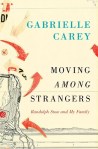
Gabrielle Carey, Moving among strangers (#BookReview)

Gabrielle Carey, Moving among strangersEmma’s guest Monday Musings post last week on Randolph Stow provided the impetus for me to finally retrieve Gabrielle Carey’s Moving among strangers: Randolph Stow and my family from my TBR pile. I’ve been wanting to read it for the longest time, but … well, those of you with big TBRs will understand.

Moving among strangers, whose title comes from a line in Stow’s novel The girl green as elderflower, is an unusual book. It’s partly a biography of Stow, and partly a memoir of Carey and her family, but Carey wouldn’t call it either. She says in her prologue:

… this book is not a biography. Neither is it a work of literary analysis or scholarly enquiry. It is more like a ‘mostly private letter’, to use Stow’s phrase, written out of curiosity, and tenderness towards a man whom I have come to think of as an almost-relative, a dear friend of my mother’s, and the ideal literary mentor.

It all started when, as her mother was dying in 2009, Carey wrote to Stow in England letting him know of her mother’s condition. It was his response, which came four days after her mother’s death, which set Carey off. She’d known there’d been a connection, of course, but she didn’t know much about it. Stow wrote that Joan’s letters from London, when he was a schoolboy and undergraduate, “were like a window on the world”. Why, Carey wondered, did her mother correspond “with a young man, an adolescent, thirteen years her junior, who wasn’t even a relation?” This question is never properly answered in the book, not because there’s something salacious to discover (in case you were wondering), but because some connections made in life don’t have explanations beyond the fact that they occur. If that makes sense.

So, as the book progresses, Carey follows a Stow trail, “like a groupie”. She interrogates his novels and other writings, and reactions to them. She reads the letters Stow wrote to members of her and his family. And she visits the places in England where Stow had lived and meets some of the people who knew him there. One of the main strands in her story concerns Stow’s unease with Australia – with his feeling rejected by Australia and/or his rejecting Australia. There is no answer to this question either, but Carey’s exploration of the issue is enlightening (particularly given all those other Australian intellectuals who left in the 1960s – some well known like Germaine Greer and Clive James, others less so like Jill Ker Conway and Ray Mathew. Each story is different but there is probably a thread that links them too?)

There are many angles, in fact, from which I could write on this engaging but slippery book. There’s Carey’s sharing of her own history – the loss of her mother, her tricky relationship with her sister, the death by suicide of her father, and so on. There’s the form of the work and how it fits into what seems to be a new breed of biography-memoirs that is popping up. And of course, there’s Stow, himself. He comes across as an elusive character, and that’s probably because he was. When she, having made connection with him, enthusiastically tries to engage him, by correspondence, in a literary discussion about his and her mutual interest in James Joyce, he shuts her down, albeit politely, explaining that he was “old and ailing” which, in fact, he was. He died the next year.

This doesn’t deter her – for which we should be grateful because although the book is not, as she forewarns us, a biography, we do, nonetheless gain insight into Stow. She paints a picture, in the end, of a man at odds with the country in which he was born though exactly why is hard to say. Did he reject Australia – with its “depressing tolerance, even worship, of the second-rate” (his words) – or did Australia reject him with its inability to understand his work. Australian critics, apparently, panned his novel Tourmaline, for example, rejecting its combination of “fable and poetry” with “realism”. A later critic, Carey says, notes that Tourmaline represented a change, a move away from “bush realism … towards something more experimental”. However, at the time, as is so often the case with innovative creators, this was not recognised and Stow’s “too truthful, too confrontational of conventional attitudes” novel was not appreciated in his own country. Stow felt the rejection.

But, Carey is wary of coming to conclusions, as she constantly reminds us. At one point, when she has questions and no answers, she tells us that given there’s no one alive to tell her “the real story”, she “can only imagine”, but a page or two later, she says

But I could be wrong. Being wrong, I realised, is how I’ve spent most of my life: misinterpreting, misunderstanding, misjudging, miscommunication. Words slip and slide, as T.S Eliot said, or as Stow put it, ‘words can’t cope’.

A strange thing for a writer to say, perhaps? And yet, perhaps not. Perhaps, it’s something only a writer could say?

You are probably getting the gist now of this unusual book – and hopefully, realising what a delightful, engrossing and stimulating read it is. It is not a long book, and is therefore not comprehensive. If you want, for example, to read about the Stow book I know best, his first Miles Franklin winner, To the islands, you won’t find it here. What you will find though is an intelligent analysis of Stow the man and of his work. You will also gain, or, at least I did, some insights into literary Australia of the mid to late twentieth century – not a list of luminaries, or even a history, but a sense of the life and times, and of how one particular writer did (or didn’t) navigate it.

Near the end, Carey returns to a theme she introduced earlier in the book, that of twinning or duality of perspectives. She concludes that, in the Essex pub where she met people who had known Stow in the latter years of his life, she found “twin versions” of him, one “content in his lifestyle, in his aloneness, who was self-sufficient and independent” and one “who was uncomfortable in his own skin, internally and perpetually in conflict over his sexuality, his nationality and his identity.”

If you are interested in Stow, in Australian literary history more broadly, and/or in Carey herself, this is a book for you.

aww2017 badgeGabrielle Carey
Moving among strangers: Randolph Stow and my family
St Lucia: UQP, 2013
232pp.
ISBN: 9780702249921

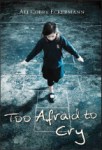
Ali Cobby Eckermann, Too afraid to cry (#BookReview)

ANZ Lit Lovers Indigenous Literature Week bannerHaving reviewed Yankunytjatjara/Kokatha woman Ali Cobby Eckermann’s poetry collection, Inside my mother (my review) for Lisa’s ANZlitLovers Indigenous Literature Week, 2017, I decided to also read her 2012 memoir, Too afraid to cry. It filled in a lot of gaps, which is not necessary to appreciate or comprehend the poetry but which does deepen the understanding.

The memoir’s dedication starts with the lines:

this is a poetic memoir
a story of healing
not burdened by blame

And that is pretty well what it is. It’s not an angry book, so much as a sorrowful one. Sorrow about the abuses and losses that affected her childhood and early adulthood, in particular. The sorrow starts early, when she’s young, and abused. She writes of her uncle rubbing her leg inappropriately, and progressing to assault, though she doesn’t say that because she’s only 7 years old. However, while she may not have the language to analyse what was happening to her, she does have the language to describe the feelings:

I felt the icy wind inside my head begin to blow. I could not move. The icy wind is very dangerous.

This “icy wind” becomes a metaphor throughout the book for the abuse, for her memory of it, and for its impact on her psyche until she can no longer cry – “the ice block had turned to stone, and now there was no moisture left inside me”. Hence the title of the memoir.

So, to summarise the book before I delve any further, Too afraid to cry is the story of a young indigenous baby adopted by a non-indigenous family. It’s a good loving family, with parents who, unable to have children, adopted four – two from the mission – and fostered another. But this family, as loving as it is, is a deeply religious one which does not understand the pain experienced by children from a different culture to its own. The result is that Eckermann is left to contend with racism and abuse that she, too, does not initially understand. Here, for example, is a schoolyard experience:

[I] didn’t notice that they had begun to form a circle around me, but I did notice that the icy wind was blowing inside my head and was starting to freeze my guts. Someone held me while other hands pulled my underpants down. There was a strange noise in my ears, like a faraway scream, but I could still hear the sounds of those doing the laughing and teasing. They said they wanted to know if I was the same as other girls. Someone laughed, saying they didn’t know if ‘boongs’ were different. I was frozen with the icy wind roaring through my body. I didn’t want to know what a ‘boong’ was.

Note the “icy wind” again. As childhood turns to adolescence, Eckermann, who had been an excellent student, begins to withdraw from her family and turns instead to alcohol and drugs to cope with the pain and sense of disconnect. It’s not a surprising story, but it’s a useful one for those who don’t understand what disconnection from one’s own culture can do, particularly in a society where difference is not tolerated. Eckermann learns much later, apparently, of the ridicule her adoptive mother had faced for having aboriginal children.

Anyhow, gradually, after many experiences, painful ones, risky ones and some more positive, Eckermann finds her way to her own culture, and healing begins:

Slowly the stone inside me turned to ice and then the ice began to melt. I felt real tears on my face for the first time in my adult life.

What’s remarkable about the memoir – something you may have guessed from what I’ve written – is her ability to get into her head at the time, to write from the point of view of the age and person she was when the things she describes happened, rather writing them as memory that she is now reflecting and commenting on. Of course the telling of the experience, the choosing of which experiences to tell, is a form of commentary, but I’m sure you get my point.

The memoir is remarkable for other reasons too. It’s told in 92 short anecdotal chapters, which are divided into four parts. The style is spare, with short, simple sentences. This is a book which shows rather than tells. Much of the commentary is conveyed through poems inserted between some of the chapters, such as “Heroin” between Chapters 45 and 46. It’s a short poem, like most of hers, and uses repetition and powerful wordplay on the word “arms”, to invoke prostitution, loving and heroin. The last stanza reads:

in their arms
they survive
a modern world.

Some of the poems appear again – the same or sometimes changed* – in Inside my mother.

Another aspect of the memoir, which adds to its sense of almost mythic universality, though is probably also done to protect individuals, is her minimal use of actual names. Her siblings, for example, include Big brother, Foster brother, and some relations are Aunty and Uncle. She does though name her mothers.

Too afraid to cry is an innovative and evocative memoir, which manages to convey hurt and pain, truthfully, but with a generosity that is humbling.

aww2017 badgeAli Cobby Eckermann
Too afraid to cry
Elsternwick: Ilura Press, 2012
224pp.
ISSN: 978-1-921325-29-8 (eBook)

* Changed, I think. I’m writing this in California, and my copy of Inside my mother is back in Australia.

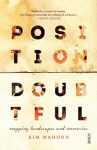
Kim Mahood, Position doubtful (#BookReview)

Kim Mahood, Position doubtfulKim Mahood’s memoir Position doubtful is a such a stimulating read. That might sound weird for a book whose subtitle is Mapping, landscapes and memories, but the thing is that it hits the spot in so many ways that are central to the issues confronting Australians right now. In other words, it’s about our relationship to place. Specifically, it’s about how kartiya* (non-indigenous Australians) comprehend our love for place, how we reconcile that vis-à-vis that of indigenous Australians, and how we go about respecting each other’s relationship with our land. Mahood may not explicitly generalise it like this, as for her it’s a personal journey – one exploring her experience of place and her reckoning of that with the indigenous owners – but I believe we can extrapolate her thinking to encompass something more universally Australian.

So, let me describe this personal aspect of the journey first, because this is, essentially, a memoir. It primarily covers the twenty years or so, from the mid 1990s, during which Mahood, chasing “unfinished business”, made annual trips back, from her Canberra region base, to the Tanami Desert region where she’d spent her childhood on a cattle station run by her parents, but which is now owned by the local Warlpiri people. She chronicles her desert art trips with Pam Lofts, the mapmaking she does to document country and stories, her various itinerant jobs, and most of all her relationships in the communities in which she stays, particularly Mulan (a Walmajarri community) and Balgo (where she works early on in the art centre).

Maps underpin her way of viewing and understanding place, and have become, also, the basis of her art practice. Early in the book, she writes:

In recent years I have made a number of maps with Aboriginal people, designed to reveal common ground between white and Aboriginal ways of representing and understanding country … The information marked on them is a mixture of Aboriginal knowledge – traditional camp sites, the birthplaces of individuals, the tracks of ancestors – scientific information about ancient shorelines and archaeological investigations, and the template of bores and paddocks and tracks and boundaries that represent the cattle stations and stock routes of white settlement. They serve different purposes – aboriginal, scientific, testimonial, environmental – depending on when and where they are used. Often there is a mismatch between my interpretation and the Aboriginal interpretation of their purpose.

So, this is a story about communication and negotiation, about sharing knowledge and understanding, about layers and multiple meanings, and above all, about respect for other while standing one’s own ground. The way Mahood navigates all this – the accommodations and understandings she works through, socially, personally, intellectually, scientifically, artistically and philosophically – is, really, what the book’s about. And it’s what makes it such a relevant read.

Now it’s my turn, I’m going to tell my side of the story

But of course, to write this story, she had to confront that issue I’ve raised here several times before of kartiya speaking for and/or about indigenous people. She addresses this in the last chapter (without specifically discussing the issue itself), when she describes visiting Mulan in September 2015 to tell them about her book. She organises several meetings, and reads “everything” that she thinks “might offend or upset people”. She is particularly anxious about her suggestion that the “popular version” of a massacre story she’s been told could be “a compilation of several distinct events” but she needn’t have worried. Her listeners nodded in agreement and pointed her to other people she could talk to.

This massacre “story” reminded me of another ongoing thread of mine – that one about “fact” versus “truth”. The truth is that massacres occurred – that’s not denied – but the evidence is now so murky that the various “facts” presented don’t always align. Does this mean the history, the recording of massacres, is wrong? I don’t think so.

a template of country infused with multiple meanings

The book is structured more or less chronologically following her trips, but she does move backwards and forwards occasionally – to finish an experience or flesh out a story. In between the more chronological, narrative chapters, are specifically reflective ones where she pauses to explore an idea. One is titled “Mapping Common Ground”. In it she articulates her ideas about language, maps, and being human. She says that “mapmaking was the common ground” on which she and her “Aboriginal companions put together our different conceptions of country”. She describes how maps “captured the imagination of the local mob”. They provided

concrete evidence of the knowledge that existed in the country, and they represented country in a way that everyone could understand, including the kartiya upon whom so much of the negotiations about land depended. … But the maps also aggravated the simmering arguments about who came from where, who owned which place.

And there, you see, is the politics. Politics is not Mahood’s focus but it is there, and the more you know about indigenous history, past and present, in Australia, the more you see it in the book. It’s there in the implications of changing a word from “custodians” to “ownership”, in the absence of middle-aged men resulting in matriarchies, in the “unintended consequences” of the 1968 equal wages bill, in the high prevalence of disease like diabetes, in who has or controls the money, and so on. It’s rather a mess, but “fixing” is not Mahood’s aim here, so she notes and moves on.

The title itself subtly references the underlying politics. Literally it means “of uncertain position” and is often used, for example, to indicate shipwrecks. However, when her father used the term, while navigating in the Tanami Desert, Mahood writes:

The term lodged in my mind as a metaphor for the way in which white Australians move through and occupy the country, especially the less accessible parts of it. And while the advent of satellite technology has given us the tools to find and map geographic locations with great accuracy, it seems to me that our position in relation to the remote parts of the country is more doubtful than it ever has been.

Metaphor, in fact, underpins much of how Mahood sees and explains the world, and I enjoyed that aspect of her writing, the way she finds some term or experience or object to reference bigger meanings.

Position doubtful is not exactly an easy read, but it’s a thoroughly engaging one. As memoirs go, it’s a strange hybrid, combining wonderfully warm and sometimes funny anecdotes about the people she meets and travels with, oral histories, indigenous creation stories, poetic insets, travel writing containing beautiful descriptions of landscapes, and of course her introspective reflections on who she is and what she’s doing. She allows herself to be vulnerable, and yet there’s a strong sense of self there too.

Kim Mahood, Gia Metherell

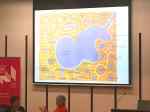
Bessie’s map, from the book and shown at CBR Writers Festival, 2016

I’ll close with some comments she makes regarding a trip to Lake Gregory with local owners and kartiya, including the palaeontologist Jim Bowler. It’s aim was to create “a cross-cultural document” showing “the interplay between  Aboriginal knowledge and western scientific knowledge in a form … easily accessible to both Walmajarri and kartiya“. She writes:

To have the ancient geography interpreted simultaneously through modern science and the Waljirri or dreaming, lays down a template of country infused with multiple meanings. While I don’t believe the creation stories in a literal way, they breathe animate life into the landscape in a form as potent and awe-provoking as the deep-time story Jim’s science tells. They complement rather than contradict each other.

And then, she talks of a discussion with Bessie, premier traditional owner for the area, in which they look at Bessie’s painting (see my image above) and the big painted map created during the project. As they talk, Mahood writes:

In putting together these two ways of conceptualising the same place, I experience a cognitive shift from which I will never entirely cover.

It’s a cognitive shift that is gradually happening throughout Australia – I hope – as we all come to terms with our different ways of seeing our history and our relationship to place and each other. This book makes an excellent contribution to this process.

Lisa (ANZLitLovers) appreciated this book too. Her write-up fills in some of the gaps I couldn’t cover without writing a tome.

aww2017 badgeKim Mahood
Position doubtful: Mapping, landscapes and memories
Brunswick: Scribe, 2016
320pp.
ISBN: 9781925321685

* Kartiya: white people (there is no one indigenous word for white people)

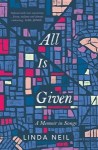
Linda Neil, All is given (#BookReview)

Linda Neil, All is given, coverLinda Neil’s second book, All is given, is subtitled “a memoir in songs”.  I wondered if this meant her memoir would be structured around specific songs – but that’s probably way too prosaic an idea. Certainly, it’s not what I got! I’m somewhat embarrassed to say that I didn’t know of Linda Neil, who is described in the brief author bio as “writer, songwriter and documentary-producer”, but I did enjoy getting to “know” her through this book.

The memoir starts with “Prologue: Songbook”, and immediately I had one of those glimmers of enlightenment because she opens with the end of a house concert. Now, friends of ours hold house concerts. They are such wonderful to-be-treasured occasions, which provide a beautiful way of enjoying music away from big formal concert halls or noisy popular venues. For the performer, however, there are challenges. The concert that Neil opens her memoir on finished at 11pm, and she was hungry, not to mention “spent” after nearly three hours of “singing and telling stories”. Not so, necessarily, the audience. They were energised, inspired, and wanting to talk with her in this lovely intimate venue! So, with food from her host in her hand she sits to chat with one of these people – and discovers that what the woman really wanted to do was share her own stories, which had been stimulated by the concert. Neil, as it turned out, enjoyed hearing her stories – but I learnt a lesson about house-concert etiquette!

Another issue comes up in this opening chapter which attracted my attention. She says that many people think love songs, which she was singing, are autobiographical. However, she writes,

in my experience, they may well be inspired by real people, but the form of a song means that, from this basis of fact, changes need to be made. A bass line is added perhaps. Something high is included. A man becomes a woman. A five-letter name expands to eight …

and so on. The point is, “the facts may not always be true, but the feelings certainly are”. “YES”, I wrote in the margin. And I loved her rider: “and if some events did not happen exactly the way they are described, perhaps they should have”. Haha! Love it. That is what creativity, and living, are about…

Hence, she writes in the last paragraph of this opening chapter:

So think of this collection of stories as a book of songs that contains improvisations and variations on themes of truth. If you listen closely enough you might even be able to hear the fabric of facts and fiction as they are stitched together.

What follows are delightful, non-chronological, stories of travel. This book, in fact, is as much travel memoir as a musical one, and as much about travel to the self as about the places she visits – Shanghai, Paris, Kathmandu, Kolkata, Ulaanbaatar, to name a few – though she writes engagingly about them too.

… a pilgrim of the imagination …

All is given is just a lovely read. Neil presents as a person with such an open heart and curious mind, with such a willingness to give things a go and to test her own preconceptions, that she can’t help but be interesting to read. And when you add to this, her clear, fresh prose, well, you have a book that is a winner on multiple levels. Here, for example, she’s in Paris:

Sometimes a city is the kind of place where, despite being on your own, you are never alone.  Where sitting under a statue or leaning over a balustrade of a bridge is an invitation. You have to discern very quickly, though, who might waylay you, who might waste your time and who might be, like you, a pilgrim of the imagination on a voyage through change. But if your antenna is working properly, the chance encounter with a stranger might bring you something you need at that particular moment in time, something that might not come in any other part of the world, but exactly where you sense of wonder and curiosity has led you, across oceans and skies, out of safety into the unknown.

I wanted to share all of this, but particularly that phrase “a pilgrim of the imagination on a voyage through change”.

This is what the book is about. It’s partly, of course, about the places she goes, the people she meets, the seemingly serendipitous discoveries, such as the recording studio in Kathmandu and the YWCA in Kolkata where she meets a group of people volunteering at Mother Theresa’s Missionaries of Charity, but it’s mainly about the things she learns.

She learns, for example, on her first solo trip, which paradoxically is the last one described in the book, not to travel with the Lonely Planet Guide, because “travel was best unplanned”. It’s a lesson I’m starting to learn. I can’t imagine giving up the guides altogether – not being, clearly, a complete “pilgrim of the imagination” – but I’m gradually freeing myself from the shackles of “musts” to the wonders of “let’s explore”. She experiences the “gift of stories – of listening to and receiving them, of being in the right place at the right time”. This is “the magic of travel”. She learns that she can sometimes be “prim”, when she lectures a young girl on modest dressing in India, where she was “once open-minded”, but on the other hand, that she could be “free”, in opening up to people, where once she “might have felt more cautious”. These are the surprises of travel.

She learns, too, in Mongolia that “freedom” is not the simple concept we like to think it is, that for many Mongolians the initial liberation from Russia was “a catastrophe”. Her Mongolian friend reminds her, once again she says, that:

western narratives of history aren’t the only ones, and that … there are many ways to tell the story of our collection past.

A lesson we Australians are very slowly learning now as we come to grips with different versions of our colonial past. She learns, through this and other experiences, “not to romanticise places” where the reality for the locals is very different, but also to “be happy with tiny moments”.

And so the memoir goes. I’ve focused on travel’s lessons because those reflections spoke to me. Another reviewer could very well pick up the musical motifs, her journey through sound, or perhaps explore the organic way she intersperses moments from her youth with those from travel. The point is, whatever your interest, All is given is an engaging, enjoyable read by a writer-musician who sees that being “real and true” is sometimes different from “being perfect or even good”, but who often manages to achieve both.

aww2017 badgeLinda Neil
All is given: A memoir in songs
St Lucia: UQP, 2016
238pp.
ISBN: 9780702254093

(Review copy courtesy UQP)

Jill Roe, Our fathers cleared the bush (#bookreview)

Jill Roe, Our fathers cleared the bushAs that old pop song goes, what kind of fool am I? I went, you see, to Macquarie University, which I chose for its then modern approach to tertiary education. It was great, but somehow, I didn’t end up in tutorials taught by Thea Astley, nor did I study Australian history in which Jill Roe was one of the University’s foundation lecturers. What was I thinking? Hindsight is a marvellous thing, eh?

Most of you will know who Thea Astley is, but non-Australians, in particular, may not know Jill Roe. She is best known for her comprehensive award-winning biography of Miles Franklin (see a review by Lisa, ANZLitLovers), but she wrote many books and was, among other things, a regular contributor to the Australian Dictionary of Biography. The book I’m reviewing here, Our fathers cleared the bush, was published last year, only months before her death early this year.

Old and new regionalism

What a fascinating read it was – for its content, which tells the story of Eyre Peninsula, a part of Australia I don’t know, and for its form and style. This latter is what I’m going to focus on mostly in this post. The book’s subtitle, “remembering Eyre Peninsula”, provides some clue to its form, which I’d describe as an amalgam of memoir/family history, regional history and historiography. Roe seems, overall, to be exploring an approach to writing the history of regions.  In her introduction she writes:

The aim is not so much to tell my own story – though I often start there – nor to fill a gap in the literature – though there is one – but rather, on the basis of personal reflections and a now quite extensive range of materials, to capture some key aspects of, and moments in, the regional experience over time.

“Extensive range of materials”. Hold that thought, because I’ll come back to it. For now, though, I’m sticking to the regional history idea. Chapter 7, one of my favourites in fact, is titled “I danced for the Queen”. In it she writes quite a bit about regionalism and regional histories. She suggests that as Australian history established itself in the 1950s and 60s, “some fine regional studies appeared” and she names a few. It was “a golden age of regional history when it seemed the national story was becoming clear”. But, she argues, that was “old regionalism”. Since the 1970s, new issues and factors have arisen. These include the understanding of “regionalism” itself; the rise of interest in local and family history which is adding “new building bricks, even new layers” to the undertaking and appreciation of regional history; the role of the environment; and that major factor, the recognition of Aboriginal history, which she says introduces a discontinuity into held narratives. She suggests that exploring Aboriginal history “seems to work best in regional frameworks”. Perhaps, but there is also need to include Aboriginal history in the overarching national story. I presume she would argue that too?

She teases out the Aboriginal history issue a bit more. She says:

On a grander scale, the history of the Kimberley in Western Australia is being transformed by research into the Aboriginal experience, much of it distressing, none of it yet settled or fully integrated into the national story. This history may be hard for some to take in, but that is because it adds new data and a challenging dimension to taken-for-granted narratives. In time, along with environmental and the other histories, Indigenous history will most likely lead to a new regional history in this country.

She then makes what could almost be a manifesto:

… my firm belief that any history in which people cannot recognise themselves – whether proudly or ruefully, in surprise or dismay – is not good history.

Beautifully said, and hard to argue with – at least these days when we don’t accept that history begins and ends with great deeds by big men (and occasionally women).

“a now quite extensive range of materials”

Now, histories can often be rather dry, but Our fathers cleared the bush has a lovely conversational tone. It almost felt like she was talking to me as I read along. We learn a lot about life on the Peninsula from the 1840s to the 1960s and beyond. We hear about farms and schools, churches and sport, transport and the country show. I laughed at her comment that when she turned her mind back to the Peninsula in 1998, she “paid no attention to sport as a source of social life and values, a mistake I mustn’t make again”. Anyhow, all these are features of country life, and many are shared through the prism of her and her family’s experience, but while we come away knowing the skeleton of her life, this is definitely not a memoir. The focus is the history.

However, as well as telling the history, she also shares her methodology and her sources. She says that “the discovery of a new source is the historian’s delight”. She mentions women’s diaries and school records; and she talks about the value and limits of census data. She uses anecdotal evidence but carefully notes the unreliability of recall. She notes there are limits to what personal memories can offer the large picture. In her family, for example, there were no sons so the daughters “did more than usual of the outdoor work.” It would be not be valid to generalise, then, she’s saying, from her family. For some readers, Roe’s historiographical discussions might get in the way of the history itself, but I enjoyed getting to know the historian’s mind.

Finally, she also points to histories that are still waiting, such as “a comprehensive account of the Aboriginal experience of the Eyre Peninsula”. Others include “the coming of service stations” to Australia or the role of Greek Orthodox churches in fishing communities. Anyone looking for a PhD topic might like to start here!

So, I’m at the end of my post and I’ve told you very little about the Eyre Peninsula. All I can say is that if you are interested in the Peninsula, or in the history of rural Australia, you should find what you’re looking for in this book (particularly given its index and extensive end-notes) but if you are interested in approaches to modern history writing, this would also be a good book to read. Roe says, early on, that her approach to history is “post-modern, in the sense that it can’t come to a definite conclusion”. That is certainly what she has presented here – a story about a region that tells us much but which also leaves many questions to be answered – because life goes on and there’s always more historical research to do.

PS For a lovely tribute to Jill Roe written just after her death, please read blogger (and historian) Yvonne’s post.

aww2017 badgeJill Roe
Our fathers cleared the bush: Remembering Eyre Peninsula
Mile End: Wakefield Press, 2016
249pp.
ISBN: 9781743054291

(Review copy courtesy Wakefield Press)