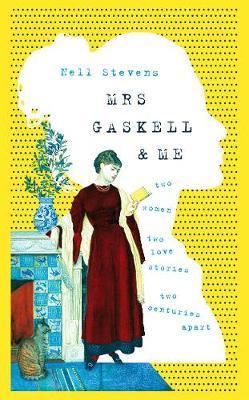
It’s a bit of a stretch, I admit, to submit Nell Stevens’ strange hybrid biography-memoir, Mrs Gaskell and me, as my second contribution to Bill’s (The Australian Legend) Gen 0. But, having read Elizabeth Gaskell’s two novellas, Lizzie Leigh and Cousin Phillis, for the week, and having had Stevens’ book on my TBR for a few years, I decided it was now or never to get it off the shelf. After all, as I wrote in my Two Novellas post, Mrs (Elizabeth) Gaskell (1810-1865) is a good example of a nineteenth century independent woman because, despite being a wife and mother, she managed to forge a career for herself as a writer.
So, let’s leap in. The reason this book is a bit of a stretch for inclusion in Bill’s week is not only because it is one of those hybrid biography-memoirs or bibliomemoirs, but because of Stevens’ statement in her disclaimer at the beginning of her book:
I have changed names, scenes, details, motivations and personalities. Every word has been filtered through the distortions of my memory, bias and efforts to tell a story. This is as true of the historical material as it is of the sections about my own life: studies, letters and texts excerpted here are not always faithfully quoted. This is a work of imagination.
So, it’s a work of imagination that tells two alternating stories. In first person, we have Stevens’ own story, which goes from 2013 to 2017, and encompasses her love affair with an American and the writing of her PhD on Mrs Gaskell. This is the memoir bit. In second person is Stevens’ story of Mrs Gaskell primarily covering the years 1855 to 1865 which encompass her three-months-long trip to Rome in 1857 and its aftermath. This is the biography bit.
Now, regular readers know my attitude to the fiction versus nonfiction question. I am more interested in truths than I am in facts. Facts on their own don’t always tell us a lot, and when we are talking a person’s life, they can be limiting. Knowing when a person married, for example, is far less relevant or interesting than how they felt about their marriage and the person they married, but, it is hard to get facts about those feelings. Even if the subject wrote letters and/or diaries, how truthful were they? And, did what they wrote one day in a fit of passion (positive or negative) reflect the truth of the relationship as a whole? And so on. All this is to say that I am happy to accept Mrs Gaskell and me as an imaginative bibliomemoir, but if you’re not, this book will not appeal to you.
Because of the reason I chose to read this book now, I’m not going to write the usual sort of review. There are several out there, if you are interested. Instead, I am going to focus on how it fits into Bill’s Independent Woman thesis, which is to look at non-Australian writers “whose work influenced, predated or paralleled the first wave feminists of AWW Gen 1”. This means, to me, that we can look at the works of these women writers and at their lives, and Mrs Gaskell had an interesting life.
“all of a sudden you had a career” (Stevens)
It was also, I think, though I haven’t read a true biography of her, a divided life. There was the traditional “Mrs Gaskell”, the well-brought up and educated wife and mother, but there was also this:
“Nature intended me for a gypsy-bachelor; that I am sure of. Not an old maid, for they are particular and fidgety, and tidy, and punctual – but a gypsy-bachelor.”
Gaskell wrote this in a letter in 1854. I checked its accuracy, given Stevens’ disclaimer, and it is, I believe, a true quote. Stevens goes on to write that Gaskell “played the role of wife and mother so very well, and so lovingly, but she was a ‘gypsy bachelor’ nonetheless”. So, while she was not one of those nineteenth century adventurers, like Isabella Bird and Flora Tristan, she was nonetheless independent. In her writing, this came through her “industrial” or “social novels” or what Stevens calls her “philanthropically motivated condition-of-England novels”. In these, she identified and questioned some of the significant social and moral issues of her era: in North and South, for example, she was among the first to explore conflict between employers and workers, and in Ruth (see Bill’s review), she preached compassion for “fallen” women. (I have read both of these, but before blogging.)
However, she also exhibited a level of independence in her personal life, despite its conventional trappings – and this is something that Stevens conveys (albeit with different motivations) in her bibliomemoir. Early in the book, Stevens writes, using her second person voice,
“You were always lucky, Mrs Gaskell; you were always grateful for what you had, and yet, all the same, you were restless” [my emph].
She then briefly chronicles Gaskell’s career trajectory from writing for herself, to sending articles and then short stories to magazines, to, finally, writing her first novel, Mary Barton, in 1853. Stevens writes that it “became the sort of book that people bought and reviewed and talked about, and all of a sudden you had a career”.
This is the background, but Stevens’ focus is Gaskell’s visit to Rome in 1857, when she was 46 years old, and what it meant to her. She went to escape, says Stevens, the potential fallout (of which there was plenty) from her Charlotte Brontë biography*. She found an energising community of artists (authors, poets, sculptors, painters, musicians) and met the seventeen years younger American author and critic, Charles Eliot Norton. They saw each other constantly, and remained in contact afterwards. It was, we believe, an unconsummated relationship, and not all agree it was a romance, though Stevens argues so. Whatever it was, it was clearly intense and significant, and given the (documented) ongoing years of contact that followed, it satisfied some of Gaskell’s intellectual yearnings and fed into her subsequent writing. Beyond this, Rome was, overall, argues Stevens, “transformative for her, to meet Norton, to be in Rome, to be treated as an equal by other artists”.
The other point I’d like to make is Stevens’ story that, at the end of her life, Gaskell bought and renovated a house in Hampshire without telling her husband. Sounds independent to me.
The Nell parts of the book, which chronicle Stevens’ own love affair and her struggles to write her PhD, mostly engaged me, particularly the academic life satire, but, I’m leaving it here because Mrs Gaskell was my theme. It’s an unusual book, but I’m glad I read it. I may not remember the details, which is fine given they may not all be exact, but I will remember how Stevens successfully transformed this intriguing author from her “Mrs Gaskell” persona to a living, feeling, independent woman.
* Wikipedia reports that in 2017 The Guardian named The life of Charlotte Brontë one of the 100 best nonfiction books of all time.
Nell Stevens
Mrs Gaskell and me: Two women, two love stories, two centuries apart
[Published in the USA as The Victorian and the romantic]
London: Picador , 2018 (e-Edition, 2019)
256pp.
ISBN: 978-1-5098-6819-3


 Whispering Gums