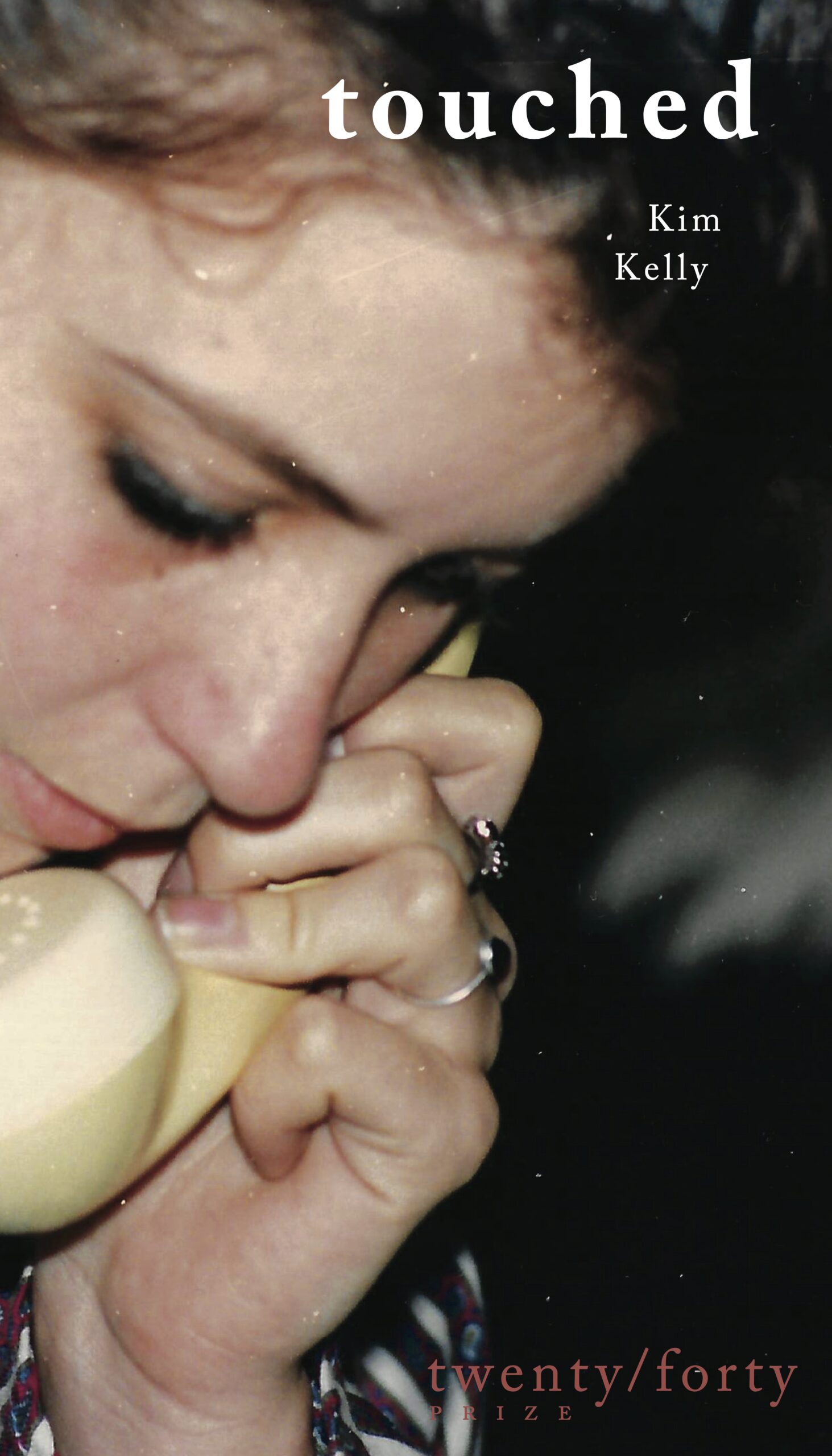
Kim Kelly, Touched (#BookReview)

In 2023, novelist Kim Kelly was one of the two winners of Finlay Lloyd’s inaugural 20/40 Publishing Prize, with her 1920s-set historical novel, Ladies’ Rest and Writing Room (my review). Publisher Julian Davies had hoped at the time to award one fiction and one nonfiction prize, but there was a dearth of good nonfiction entries. That was rectified in 2024, with Sonya Voumard’s book on dystonia, Tremor (my review), being one of the two winners. This year, Kim Kelly returned with a nonfiction work on anxiety, titled Touched: A small history of feeling – and won again.

There is an obvious similarity between these two nonfiction winners, given both deal with medical conditions that impinge significantly on their writers’ lives. However, as quickly becomes apparent, the similarity is superficial, probably due to their writers’ origins. Voumard and Kelly are both published authors with other books to their names, but Voumard is a journalist while Kelly is a novelist, and this I think informs their different approaches to their subject matter.

Finlay Lloyd describes Touched like this:

Why this book is different
Documenting the damaging role of anxiety in our lives is hardly new, but Touched takes us inside the destabilising riot of a three-day panic attack with such insight, honesty and humour that the perspective we gain is revelatory and overwhelmingly hopeful.

Why we liked it
This book has a wonderful breadth of understanding—of the author’s own crazily complex family, of the wider issue of anxiety across society, and of her own voyage as a highly competent yet vulnerable being in a worryingly unhinged world.

Both Voumard and Kelly use a personal narrative arc to frame their discussions. For Voumard it’s the brain surgery she is about to undertake as her book opens, while for Kelly it’s the three-day panic attack she has leading up to her Masters graduation ceremony. Kelly’s focus is this attack. She takes us into it, viscerally. It is the emotional and narrative core of this book. Voumard, on the other hand, weaves her own story through a wider story about dystonia, in which she explores its different forms and treatments through the experiences of others as well as her own. Both writers situate their conditions within a wider societal context, but very differently.

And here I will leave Voumard. After all, she has her own review already!

Kelly starts her book with an (unlabelled) author’s note in which she explains that memory is slippery, so dates and details may not be precise, but “everything in this memoir is true, in essence and in feeling”. I like this, because no-one can remember all the tiny details, and in most cases – crime, excepted – they are not important. What is important is being truthful to the experience, and this, I feel, Kelly achieves.

“It’s exhausting, being human”

Touched is divided into two parts – the lead up to graduation day, and then graduation day and its aftermath. Within these parts are single-word titled chapters starting, logically, with “contact”, and her contradictory responses to “touch”, to how physical touch can settle her but can also produce anxiety when it involves people she doesn’t know well, like, say, hairdressers, doctors and dentists. As for masseurs, no way! But “touched” of course has other meanings, including:

To be in touch, to communicate. To have the touch, a skill at something. To be touched, to be momentarily captured by some sentiment. To live in a vague state of craziness. To feel. Small word, wonderfully big inside its tight dimensions of spelling and sound.(p. 14)

Kelly, who is a book editor as well as a novelist, loves words, so her memoir is written with the eye of someone who is deeply engaged with the meanings of words and how they convey feelings. As graduation day approaches, and she and her partner drive to Sydney for it, she suffers an excruciating panic attack which she describes with a clarity that is revelatory for those like me who have not experienced that degree of psychic distress. At the same time, she looks back to history – including to the Ancient Greeks and philosophers like Aristotle – for ideas on anxiety. And she flashes back to her own past, exploring how and where and why it all began. Her Jewish roots, the experiences of poverty and war in her Irish Catholic tree, the insecurities of her parents, her own childhood fears, and wider societal issues like the imposter syndrome that is particularly common among women, all come into the frame.

It’s not all distress and misery, however, because in between her mulling she shares her wins, her strategies, and her optimistic self that keeps on going. The writing is beautiful, slipping between information-sharing, straight narrative, and light or lyrical, rhythmical moments when she takes a breath and so do we.

Touched is a personal story, and so, by definition, it can be intensely self-focused at times. However, the intensity serves a purpose for those unfamiliar with what anxiety can do. Further, with a keen sense of tone, Kelly regularly reins it in so it never wallows. At the time of her writing, she tells us, around 17% of Australians had experienced some form of anxiety disorder. That’s nearly one in five of us. This book is for all those people – and for the rest of us who know someone who has experienced it, or who might ourselves experience it one day. We just never know. We should thank Kim Kelly for putting herself out there, so beautifully and so honestly.

Read for Novellas in November (as novella-length nonfiction) and Nonfiction November, but not quite finished in time!

Kim Kelly
Touched: A small history of feeling
Braidwood: Finlay Lloyd, 2025
142pp.
ISBN: 9780645927030

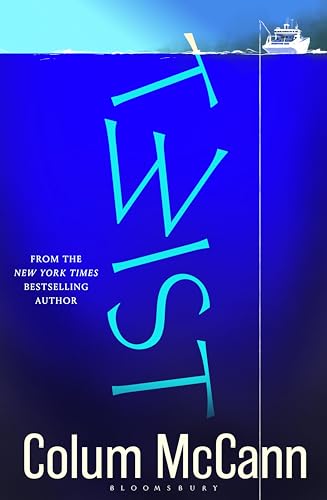
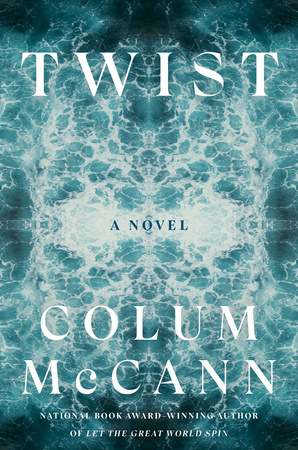
Colum McCann, Twist (#BookReview)

Colum McCann said during the conversation I attended back in May that books are never completed until they are in the hands of readers who tell back what a book is about. This is essentially reception theory, which, referencing Wikipedia, says that readers interpret the meaning of what they read based on their individual cultural backgrounds and life experiences. In other words, “the meaning of a text is not inherent within the text itself, but is created within the relationship between the text and the reader”.

Although I don’t adhere to any theory absolutely, this makes some sense to me – as does my extrapolation from this that the reader’s background and life experiences contribute not only to the meaning they obtain from a work, but their assessment of it.

Colum McCann’s latest novel Twist was my reading group’s last book of the year. All of us were fascinated by its underlying story about the data – our data – travelling around the world via undersea cables, and the fragility or vulnerability of this data. But, when it came to assessing how much we liked the book, other things came into play, things that say as much about who we are as readers, what we look for in books, as they say about the book itself. For example, readers who look to empathise with appealing, rounded, human characters might assess Twist quite differently from those for whom ideas play a significant role in their preferences.

I’ll return to this, but first more on the novel. Twist is narrated by 50-something Irish novelist, Anthony Fennell, whose career had stalled. It “felt stagnant”, and he was feeling disconnected from life, “the world did not beckon, nor did it greatly reward”. He was, in fact, “unsure what fiction or drama could do anymore”. He needed, he tells us, “a story about connection, about grace, about repair”. Fortuitously, into his lap falls an assignment to write a long feature about a cable repair vessel, which is led by a man called John Conway (whose name, we soon realise, contains allusions to Joseph Conrad and also perhaps to that other well-known JC).

So, in the first few pages of the novel, we know we are being told a story from after the event by a writer who was there as it happened. We know this event relates to Conway because Fennell tells us on the opening page that something had happened to him, and that he is going to tell his version of what happened as best he can, which might take some “liberties with the gaps”. Conway, then, is central to the narrative arc, but we also know that the subject matter is data and the internet, and that the theme will concern ideas like connection and disconnection, brokenness and repair, fact, fiction and the limits of storytelling. It’s impressive, in fact, just how much of the rest of the book is set up in the first couple of pages.

The narrative proper then starts. It’s January 2019, and Fennell meets Conway, and his partner Zanele, in Cape Town, before joining the Georges Lacointe on its journey up the western African coast to the site of a cable break. It takes some time to get there, so we get to know Conway a bit more. He is a good leader, and his multicultural crew of men respect him. The first and main cable break is repaired at the end of Part One, and then things go seriously awry. Zanele, who was performing in her unauthorised climate-change-focused version of Waiting for Godot in rural England, suffers an acid attack. Life starts to “unravel” for Conway who cannot get away to help her. Indeed, as the back cover says, Conway disappears.

I will leave the plot there. It does get more complicated, so I’ve not spoiled it I believe. I will return instead to my opening point about readers and their assessments. Most of those in my group who had reservations focused on the characters. Conway and Zanele were too shadowy; they were not well-rounded; we didn’t know them well. And, why choose a hard-to-identify-with man like Fennell as a narrator? I understand these questions but they don’t concern me, because I read the book differently – so let’s look at that.

Twist draws from, or was inspired by, two classic novels, F. Scott Fitzgerald’s The great Gatsby, with its story of a man’s obsessive love for an unattainable woman, and Joseph Conrad’s Heart of darkness and its story about the darkness at the centre of colonialism. While the narrative arc clearly owes much to Fitzgerald, McCann said during the aforementioned conversation that Conrad’s novel provides the more obvious literary parallel. Those tubes along the seabed, he said, follow old colonial routes, and suggest corporate or digital colonialism.

“There is no logic. The world is messy.” (Fennell)

Looking at the novel through this perspective provides a way of understanding why McCann has written it the way he has. It is not about Conway and Zanele. We only see them through the eyes of Fennell. They are established enough to draw us in but their prime role is to support the ideas – disconnection, connection, turbulence, repair – rather than to be the subjects of the story. We know Fennell somewhat better, as we need to. He is a flawed man, stalled in life and feeling disconnected from it. It is his journey through the narrative that carries our hopes for repair.

If I had any criticism, it would more likely concern the writing. McCann’s is an exuberant, epigrammatic style. It’s not hard to see what he is doing, the games he is playing with meaning and metaphor. However, I can enjoy this sort of writing. It keeps ideas to the fore. And they were ideas that interest me – zeitgeist issues about the fragility of our data; the line between doubt/certainty, connection/disconnection (emotionally, spiritually, technologically), and break/repair; and the messiness of life. It’s not hard to find quotable quotes, like “opinion, the obscene certainty of our days” (p. 218) and “the disease of our days is that we spend so much time on the surface” (p. 25). I enjoy these too!

Part Two opens with:

It is, I suppose, the job of the teller to rearrange the scattered pieces of a story so that they conform to some sort of coherence. Between fact and fiction lie memory and imagination. Within memory and imagination lies our desire to capture at least some essence of the truth, which is, at best, messy.

By the end, McCann has told a story which illuminates the messiness of our time. The truth is that there is no real coherence. There is – and probably always has been – just all of us trying to muddle through the best way we can. This is not earth-shattering news, but McCann exposes some of the issues, many driven by technology, that affect our trying today. The light he throws on these – and the personal progress Fennell makes – are why I enjoyed reading this novel.

Colum McCann
Twist
London: Bloomsbury, 2025
239pp.
ISBN: 9781526656957

Margaret Atwood, Negotiating with the dead: A writer on writing (#BookReview)

My reading for Buried in Print Marcie’s annual MARM month has been both sporadic and minimal, to say the least, but this year I finally got to read a book that has been on my TBR shelves for a long time and that I have planned to read over the last few MARMs. It’s Atwood’s treatise (or manifesto or just plain ponderings) on writing, Negotiating with the dead. Interestingly, in 2003 it won the Independent Publisher Book Award (IPPY) for Autobiography/Memoir. I hadn’t quite thought of it that way, though on reflection I can see it does have a strong element of memoir.

Its origins, however, are not in memoir but in the series of lectures she delivered at the University of Cambridge in 2000, the Empson Lectures, which commemorate literary critic, William Empson. (I recently – and sadly – downsized his most famous book, Seven types of ambiguity, out of my library). Atwood turned those lectures into this set of essays that was published by Cambridge University Press in 2002 (and that I leapt on when I saw it remaindered in 2010).

Subtitled “A writer on writing”, this book is probably not quite what most of us would expect, unless we really know Atwood. As she says in her Introduction, it is not so much about writing as about something more abstract, more existential even, about what is writing, who is the writer, and what are the writer’s relationships with writing, with the reader, with other writers, and with themself. It’s also about the relationship between writing and other art forms, like painting and composing. She says in her Introduction that “it’s about the position the writer find himself in; or herself, which is always a little different”. (Love the little gender reference here.) It’s about what exactly is the writer “up to, why and for whom?”

I rarely do this, but I’m sharing the table of contents for the flavour it gives:

  • Introduction: Into the labyrinth
  • Prologue
  • Orientation: Who do you think you are? What is “a writer,” and how did I become one?
  • Duplicity: The jekyll hand, the hyde hand, and the slippery double Why there are always two?
  • Dedication: The Great God Pen Apollo vs. Mammon: at whose altar should the writer worship?
  • Temptation: Prospero, the Wizard of Oz, Mephisto & Co. Who waves the wand, pulls the strings, or signs the Devil’s book?
  • Communion: Nobody to Nobody The eternal triangle: the writer, the reader, and the book as go-between
  • Descent: Negotiating with the dead Who makes the trip to the Underworld, and why?

There is way too much in the book for me to comment on, but I don’t want to do a general overview either, so I’m just going to share a couple of the ideas that interested me.

One of her main threads concerns “duality” and “doubleness” in writers’ lives. There’s a fundamental duality for a writer – a novelist anyhow – between “the real and the imagined”. She suggests that an inability to distinguish between the two may have had something to do with why she became a writer. This interested me, but it’s not what interested me most in this book. Rather, it was the idea of the writer’s “doubleness”, which she introduces in chapter 2, “Duplicity”, the idea that there is the person who writes and the other person who lives life (walking the dog, eating bran “as a sensible precaution”, and so on). She explains it this way:

All writers are double, for the simple reason that you can never actually meet the author of the book you have just read. Too much time has elapsed between composition and publication, and the person who wrote the book is now a different person.

It’s obvious, of course, but we don’t often think about it. Writers do, though. Take Sofie Laguna, for example. In the recent conversation I attended, she said she wished she’d kept a diary when she was writing her novel to capture the “dance” she’d had between the conscious and the subconscious as she worked through the issues she was confronting. In other words, the Sofie in front of us was not the Sofie who had written that book. In chapter 5, “Communion”, Atwood addresses this issue from a different angle when she talks about the relationship between writers and readers.

Back to the writer, though, Atwood talks about, gives examples of, how different writers handle this doubleness, the degree to which they consciously separate their two selves or don’t. This brought to my mind Brian Castro’s Chinese postman (my review) in which he regularly – consciously of course – shifts between first person and third for the same character, a character who owes much to Castro himself but is not Castro. This may be similar to the example she gives, Jorge Luis Borges’ short story “Borges and I”. It’s also something Helen Garner has often discussed, such as in her essay “I” published in Meanjin in Autumn 2002. Even in her nonfiction works, she “creates a persona”, one that “only a very naive reader would suppose … is exactly, precisely and totally identical with the Helen Garner you might see before you”. My point in saying all this is that I think Atwood is exploring something interesting here. Is it new? I don’t know, but it captures ideas I’m seeing both in statements like those of Laguna and Garner, and in recent fiction where I’m noticing an increasing self-consciousness in writers who are explicitly striving for new forms of expression.

Another double Atwood discusses – one related to but also different from the above – is that between the writer and the writing. The writer dies, for example, but the writing lives on. It brought to mind that murky issue concerning posthumous publication (which was discussed on 746 Books Cathy’s Novellas in November post about Marquez’s Until August). It’s a bit tangential, I guess, but Atwood’s separation of the writer and the writing, her sense of the doubleness of writers, puts another spin on this conundrum.

She discusses other issues too, including that of purpose, to which she gives two chapters (3 and 4), setting the art-for-art’s sake supporters against the moral purpose/social relevance proponents, and which of course touches on that grubby issue of writing to earn money!

It’s an erudite book, in that she marshals many writers, known and unknown to me, to illustrate her ideas, but the arguments are also accessible and invite engagement. I did have questions as I read, but she managed to answer most of them. A good read.

Read for Marcie’s #MARM2025

Margaret Atwood
Negotiating with the dead: A writer on writing
Cambridge: Cambridge University Press, 2002
219pp.
ISBN: 9780521662604

Teffi, The examination (#Review, #1925 Club)

Mostly for the Year Clubs, I read an Australian short story, usually from one of my anthologies. However, for 1925, I couldn’t find anything in my anthologies, so turned to other newspaper-based sources, including Trove, but I mainly found romances or works that were difficult to access. And then, out of the blue, I found something rather intriguing, a story titled “The examination”. It was written by a Russian woman named Teffi, translated into English by J.A. Brimstone, and published in The Australian Worker, an Australian Workers’ Union newspaper, on 25 November 1925. I don’t know when it was originally written, nor have I been able to found out who J.A. Brimstone was.

Who is Teffi?

The Australian Worker ascribes the story to N. Teffi. This nomenclature is interesting. My research suggests that Teffi, not N. Teffi, was the pen name of Nadezhda Lokhvitskaya (1872-1952). Wikipedia gives her pen name as Teffi, but its article on her is titled Nadezhda Teffi. Curiously, the article’s history page includes a comment from a Wikipedian, dated 11 June 2014, that “Her pen name is only Teffi, not Nadezhda Teffi”. This Wikipedian “moved” the article (Wikipedia-speak for changing titles) to “Teffi”, but it was later moved back to “Nadezhda Teffi”. Seems to me it should be under “Nadezhda Lokhvitskaya” or “Teffi”. But, let’s not get bogged down. There’s probably more I don’t know about how she used her name over time.

The more interesting thing is who she was. Wikipedia provides what looks like a fair introduction to her life, so I won’t repeat all that here. Essentially, it says she was a Russian humorist writer who could be both serious and satirical, but whose gift for humour was “considered anomalous for a woman of her time”. However, she proved them wrong, “skyrocketing to fame throughout Russia with her satirical writings, so much so that she had candies and perfume named after her”.

Literary scholar Maria Bloshteyn, writing in the LA Review of Books in 2016, would agree. She starts her piece by describing Teffi as “once a Russian literary superstar”, and says that “Nadezhda Lokhvitskaya claimed that she took the comic-sounding and intentionally androgynous nom de plume for good luck”. Bloshteyn writes:

She began to publish in her early 30s and tried her hand in various genres, but it was her short stories, with their keen and hilarious observations of contemporary society, that were read by everyone from washerwomen to students to top government officials. They won her literary success on a scale unprecedented in pre-Revolutionary Russia.

My short story, however, was written post-Revolution, given we are talking 1925. But, I’m jumping ahead. Tsar Nicholas II was a big fan, Bloshteyn says, as was Vladimir Lenin “with whom she worked in 1905 at the short-lived New Life [Novaia Zhizn’] newspaper”. She left Russia in 1919, during the “Red Terror” when things started to turn sour. Her popularity continued in the émigré world. After the collapse of the Soviet Union, her books were read again and “celebrated as recovered gems of Russian humor”.

This potted history sounds very positive, but Bloshteyn explains that there was also darkness in her life, including the death of her loved father when she was young, difficult relationships with siblings, a failed marriage, mental health problems, and more. Also, “she became a victim of her immensely successful but severely confining brand”, meaning editors and readers “only wanted the Teffi they knew” and, worse, “they perceived all of her stories as funny, even when they were clearly tragic”. How frustrating that would be, eh?

She was inspired by – and has been likened to – Chekhov. Bloshteyn says:

Her appreciation of the absurd, of the comic minutiae of life, helps set off the darker or more transcendent aspects of our existence, but her main focus, in the tradition of the great 19th-century Russian writers, was always human nature itself: what makes us tick and why.

I’ll leave her biography here, but if you are interested, start at Wikipedia, and go from there.

“The examination”

“The examination” tells the story of a young girl, Manichka Kooksina, who is sitting for her end-of-year exams which will decide whether she moves on to the next grade. Important things ride on passing them, including staying with her friend Liza who has already passed and getting the new bike her aunt promised her if she passed. However, instead of knuckling down to study she fritters her time, trying on a new dress, reading, and finally filling her notebooks with a prayer “Lord, Help”, believing that if she writes it hundreds or thousands of times she will pass. Needless to say, she does not do well.

The story is beautifully told from her perspective, with much humour for the reader as she flounders her way through preparation and the exam itself. She feels persecuted, an animal being tortured, and resorts to the absurd solution of writing lines, while her nervous peers have at least tried. I wondered why this particular story of hers was chosen by The Australian Worker. Was it the only one available to them in English? Did the examination theme feel universally relevant? According to Bloshteyn, Teffi said that “even the funniest of her stories were small tragedies given a humorous spin”. This is certainly a “small tragedy” for the – hmm, foolish, procrastinating, but believable – Manichka.

Bloshteyn’s essay is primarily a review of two books that had been recently published, Tolstoy, Rasputin, others, and me: The Best of Teffi and Memories: From Moscow to the Black Sea. The former includes sketches and some of her “best loved short stories”. GoodReads says of it that “in the 1920s and 30s, she wrote some of her finest stories in exile in Paris … In this selection of her best autobiographical stories, she covers a wide range of subjects, from family life to revolution and emigration, writers and writing”. I don’t know whether “The examination” is one of them, but Bloshteyn writes, of the child-themed stories she mentions, that all “show children in the process of getting to know the world around them and finding the means to cope with it”. Manichka, although showing some resourcefulness, has a way to go.

I was thrilled to find this little treasure in Trove, and will try to read more Teffi. Has anyone else read her?

* Read for the 1925 reading week run by Karen (Kaggsy’s Bookish Ramblings) and Simon (Stuck in a Book).

N. Teffi
The examination” [Accessed: 21 October 2025]
in The Australian Worker, 25 November 1925

Brian Castro, Chinese postman (#BookReview)

Serendipity is a lovely word, and is even lovelier when it touches my reading. Such was the case with my last two books, Olga Tokarczuk’s House of day, house of night (my review) and Brian Castro’s Chinese postman. The connections between them are simple and complex. Both focus more on ideas than narrative, are disjointed in structure (or, at least, in reading experience), and draw consciously on their author’s lives. They also seem to be questioning the nature of fiction itself, a question that is true of two other books I’ve read in recent times – Michelle de Kretser’s Theory & practice (my review) and Sigrid Nunez’s The vulnerables (my review). None of these books are fast reads, but they are rewarding ones.

The other thing that connects these books is that, because narrative provides more of a loose structure than a driving force and because they blend that narrative with ruminations, memoir, essay, vignettes, anecdotes, recipes even, they exemplify the idea that every reader reads a different book. This is not only – or even primarily – because we are not all men in our mid-70s with mixed ethnicity, to take Castro (and his protagonist) as an example. Rather, it is because we all think about and weigh differently the issues and ideas these authors focus on.

In The vulnerables Nunez refers to Virginia Woolf (as does de Kretser) and her “aspiration to create a new form. The essay-novel”. She also refers to Annie Ernaux’s nonfiction book The years, describing it as “a kind of collective autobiography of her generation”. I’ve digressed a bit here, but my point is that these writers have things to say about their time, their generation, the state of the world – and they are looking for better ways to say it. They are suspicious of pure narrative, and yet I think they also recognise, to some degree at least, that “story” is a way to reach people. Therein lies the tension that each tries to deal with.

So now, Castro! There is a story, a sort of narrative, running through Chinese postman, and I’ll let publisher Giramondo explain it:

Abraham Quin is in his mid-seventies, a migrant, thrice-divorced, a one-time postman and professor, a writer now living alone in the Adelaide Hills. In Chinese Postman he reflects on his life with what he calls ‘the mannered and meditative inaction of age’, offering up memories and anxieties, obsessions and opinions, his thoughts on solitude, writing, friendship and time. He ranges widely, with curiosity and feeling, digressing and changing direction as suits his experience, and his role as a collector of fragments and a surveyor of ruins. He becomes increasingly engaged in an epistolary correspondence with Iryna Zarebina, a woman seeking refuge from the war in Ukraine…

The narrative arc, then, concerns this email correspondence with Iryna. It starts when she emails him:

Dear Professor, I am reading one of your books on the doorstep of war. You once wrote about war eloquently, so the critics said. I do not believe anyone can write eloquently about war. If you could find the time, could you please answer that question. (p. 29/30)

He doesn’t reply “of course”, because he suspects it’s a scam. But, the problem is, it’s got him thinking about his ‘”eloquence” in writing about war’. At this point, readers who have read the epigraphs will remember that one of them quotes John Hawkes*, who said, “Everything I have written comes out of nightmare, out of the nightmare of war”.

War – Ukraine, Vietnam, World War 2, and others – is, then, a constant presence in the novel. As is the aforementioned Iryna because, although she’s “probably a bearded scammer”, he does write back. He asks her about the “dogs in the Donbas”, hoping this “will shove aside the irritating accusation of eloquence”. And so a correspondence begins in which war and dogs, among other issues, are discussed. In other words, dogs become another thread in the novel, as do toilets, aging and its depredations, solitude, the writing life and more.

This is a “big” book, one that, as I’ve intimated, will be read differently by different people. Those concerned about where the world is heading will engage with the issues that mean something to them. Those of migrant background might most relate to his experience of discrimination and othering. Those of a certain age will relate to thoughts about mortality and managing the aging body. (To test or not to test is one question that arises.) Those of a literary bent will love the wordplay and clever, delightful allusions (and wonder how many more they missed. I loved, for example, the allusions to TS Eliot’s “The love song of J. Alfred Prufrock”, a poem about anxiety and indecision which reflects Quin’s inner questioning about action and inaction. I also loved the wordplay that made me splutter at times.) And those interested in the form of the novel will wonder about where this is all leading!

“the unreliability of reason” (p. 232)

There is so much to write about this book, and I’m not sure I can capture the wonder of reading it, how ideas are looked at from every angle – inside out and upside down – in a way that illuminates and stimulates rather than confuses. It’s quite something.

I’ll try to explain something of this through two of the interweaving motifs – toilets and dogs. Both mean multiple things as Castro is not one to close things off. So, early on, toilets reflect the sort of cleaning work migrants must do to support themselves, as Abe does at University. Later, they are part of the aging person’s concern about bowel health. But, in between they could also symbolise feelings of disorder and helplessness, his “anxiety in the gut”, including just coping with “the difficult things of ordinary life”. Similarly dogs epitomise the instinctual, simple life, but, in stories like their being used for target practice, they could also represent innocent victims of war. Here of course, I’m sharing my personal responses to these motifs. There are many others.

No wonder Quin worries about the writing life. It’s something he, a writer, is driven to do, “it pushes fear into the background”, but does it achieve anything?

I’ve always believed it is the novel that carries all the indirect notes of empathy. It may even be violence that brings empathy to war and its suffering. It may be anything. Yet, the plasticity of the novel bends to all the obtuse emotions and accommodates them. Then all is confined to the scrapheap of having been read, having been experienced, having been second-hand and second-read. Major libraries are throwing out paper books. (p.140)

Chinese postman was my reading group’s September book, and it proved challenging, but that is a good thing. We had a lively discussion during which disagreement was not the flavour, but a genuine and engaged attempt to understand what Castro was on about. Whether we achieved that, who knows, but I am glad I have finally read Castro. I won’t be forgetting him soon.

* Wikipedia des John Hawkescribesa (1925-1998) as “a postmodern American novelist, known for the intensity of his work, which suspended some traditional constraints of narrative fiction”. !

Brian Castro
Chinese postman
Artarmon: Giramondo, 2024
250pp.
ISBN: 9781923106130

Olga Tokarczuk, House of day, house of night (#BookReview)

About 30 pages into Olga Tokarczuk’s novel, House of day, house of night, I turned to Mr Gums and said, I have no idea what I am reading, which is unusual for me. I certainly don’t pretend to understand everything I read, but I can usually sense a book’s direction. However, something about this one was throwing me, so …

I had a quick look at Wikipedia, and found this “synopsis”:

Although nominally a novel, House of Day, House of Night is rather a patchwork of loosely connected disparate stories, sketches, and essays about life past and present in … a Polish village in the Sudetes near the Polish-Czech border. While some have labeled the novel Tokarczuk’s most “difficult” piece, at least for those unfamiliar with Central European history, it was her first book to be published in English. [Accessed: 1 October 2025]

That made me feel better! I am more than comfortable with “loosely connected disparate stories” but am only generally-versed in Central European history. So, I decided to relax and go with the flow. From that point on, I started to enjoy my reading more, but it was slow going, because the “disparate stories” demand attention. It’s not a book you whizz through for story, but one you savour for thoughts and ideas, and for the connections you find along the way.

Tokarczuk calls it, in fact, a “constellation novel”, which I understand builds on thinking by the German critic and philosopher, Walter Benjamin (1892-1940). According to academic Louis Klee, who has written on “the constellational novel”, “these novels are recognizable by the presence of a first-person narrator committed to drawing affinities and making connections among disparate things”. They can be non-linear and incorporate various forms of writing from essayistic to lyrical to fragmentary, and encourage readers to find their own connections (like finding patterns in a constellation).

This well encapsulates House of day, house of night. It comprises numerous individually titled chapters (or sections or parts), some just a few paragraphs long, and others several pages. At first it felt disjointed, but it wasn’t long before an underlying structure started to reveal itself, one held together by a first-person narrator, a woman who had come to live in a small Polish village with her partner R – just like Tokarczuk and her husband did – three years before the novel opens. She tells of life in the village, and particularly of the relationship she develops with her neighbour, a somewhat mysterious old woman named Marta, who embodies a wisdom that she sometimes shares but other times must be gleaned from what she doesn’t say.

Interspersed with our narrator’s story, are other stories – some real, some magical, some past, some present – about the region and people in it. There’s a gender-fluid monk named Paschalis who is writing the life of the female saint Kummernis. There’s the unnamed couple who think they have it all, until each is visited by the same lover, a female for “he” and a male for “she”. There’s a religious community called the Cutlers who make knives and believe that “the soul is a knife stabbed into the body, which forces it to undergo the incessant pain that we call life”. There’s the wonderfully named Ergo Sum who had tasted human flesh in frozen Siberia, where he’d been deported in 1943, and believes he is turning into a werewolf. And so on. Some of these stories continue, for several chapters, woven around our narrator’s story, while others stand alone. Some are about people who think they have life worked out, while in other stories, the people don’t have a clue.

There’s more though, because scattered through the stories are ruminations on disparate things like dahlias, nails, comets and grass allergies. And threading through it all are various motifs, usually providing segues between chapters, encouraging us to see links and to ponder their meaning for us. These motifs include dreams, names, time, death, borders, mushrooms (potentially deadly), and knives. The more you read, the more connections you see between them and the stories. Many are philosophically-based, but are not hard to understand. In other words, the challenge is not in understanding, but in how we, individually, process the links we see. You might have already noticed some in my examples above, such as the idea of identity. Even the mysterious Marta, who disappears every winter, is unsettling. Who is she really?

“people are woefully similar”

This is the sort of book you would expect of a Nobel prizewinner. The writing is simple but expressive, and is accompanied by a rich, dark, and often ironic humour. We have border guards who don’t want to deal with a dead body so they quietly shove it to the other side of the border. And Leo the clairvoyant who says “Thank God people have the capacity for disbelief — it is a truly bountiful gift from God”. That made me splutter.

Underpinning all this – the thing that gives the book its heft – is a quiet but somewhat resigned wisdom. It interrogates some big questions – our willingness (or not) to see what is happening in front of us, our relationship to place, how we comprehend time, and who we are. These are explored through universal binaries, not only the night-and-day contained in the title, but life and death, change and stasis, ripening and decay. How do we live with – and balance – these parts of ourselves, of life?

But, House of day, house of night is also set in a particular place and time, southwest Poland, just post World War 2. This area, explains the Translator in her note, was part of the German Reich until 1945, when the Allies agreed to move Poland’s borders west. Many Poles left their old lands of the east (now part of the USSR), and resettled in this once German area in the west, occupying homes left by the evacuated Germans. This specific history is also found in the book, with Polish families hopefully, greedily, digging up German treasures, for example, and Germans sadly returning to see their old places.

House of day, house of night offers no answers, but it sure asks a lot of questions – about how, or whether, we can move forward into more humane, and hence more fulfilling lives.

This brings me to the ending. I won’t spoil it – it’s impossible in a story like this anyhow – but we close, appropriately, on the idea of constellations and finding patterns, and a hope that it is possible to find a pattern that explains it all. It is deliciously cheeky. And, on that note, I will end.

Olga Tokarczuk,
House of day, house of night
Translated from the Polish by Antonia Lloyd-Jones
Melbourne: Text publishing, 2025 (Orig. pub. 1998; Eng trans. 2002)
298pp.
ISBN: 9781923058675

Review copy courtesy Text Publishing

Alice Dunbar-Nelson, Sister Josepha (#Review)

It’s a year since I’ve posted on a Library of America (LOA) story, but I was driven to post on this one for two reasons. I have just posted a review of “The scapegoat” by Dunbar-Nelson’s first husband, Paul Dunbar, and, earlier this year, I reviewed “A carnival jangle”, written by Alice Dunbar-Nelson, before marriage when she was Alice Ruth Moore.

Alice Dunbar-Nelson

In my post on “A carnival jangle”, I provided a brief biography of Dunbar-Nelson, so I won’t repeat that here, except to remind us that she was a poet, journalist and political activist, born to a black mother and white father. She was prominent in the Harlem Renaissance, and lived in New Orleans for 21 years, as well as Boston, New York, and elsewhere.

In that bio, I also wrote that racism was an important issue for her, but that she also took a wider view of human rights. It is this point that I would like to explore further in this post, due to some ideas raised in LOA’s introduction to her story. They focus quite a bit on her relationship with Paul Laurence Dunbar, noting that the two communicated with each other by letter for a couple of years before meeting. Dunbar asked for her opinion on using “Negro dialect in Literature”, which he sometimes did. LOA shares her response, which was that she saw no problem with using dialect if you knew it and had “a special aptitude for dialect work” but that she saw no necessity to do so just because “one is a Negro or a Southerner”, and if, like her, you were absolutely devoid of the ability to manage dialect“. This makes good sense, but the main thing I want to share is what she says next:

Now as to getting away from one’s race—well I haven’t much liking for these writers that wedge the Negro problem and social equality and long dissertations on the Negro in general into their stories. It’s too much like a quinine pill in jelly—I hope I’m not treading on your corns. Somehow, when I start a story, I always think of my folks (characters) as simple human beings, not as types of a race or an idea—and I seem to be on more friendly terms with them.

After detailing more of Dunbar-Nelson’s biography, LOA returns to the issue of subject matter, saying that “the ambiguity of racial identity for the Creole characters” in her stories resulted in several critics in recent decades arguing that

she “camouflaged the issue of race,” that she “spurned that racialized element of her identity,” or that she “shaped her tales of Creole life for white audiences.” In “Sister Josepha,” which we reprint below as our Story of the Week selection, the reader realizes that the lead character is not white only through descriptive hints (“brown hands,” “tropical beauty”) and by what the other nuns do not say about her.

However, continues LOA, another commentator, Caroline Gebhard had noted in a recent article that Dunbar-Nelson

“presumes that readers already read her work as ‘black.’” In the 1890s and early 1900s, most of Dunbar-Nelson’s stories, essays, and poems appeared in Black newspapers and magazines; The Monthly Review, for example, advertised itself as “the only illustrated periodical published by Negroes in this country.” … “Dunbar-Nelson knew she would be read as a Black author and never tried to pass in print,” Gebhard concludes. “To read Dunbar-Nelson’s fictions as addressing only white readers, which the accusation of passing implies, is to dismiss the fact that Dunbar-Nelson’s first and most loyal readers were African Americans.”

This point reminded me of the discussion my American friend Carolyn and I had about “The scapegoat” concerning the fact that it is almost completely set in the black community. White people are not identified, except for the Judge, so we have to work out, between the lines, who else might be white in that story. I think Paul Dunbar assumed we’d know – just as Alice Dunbar-Nelson did, according to Gebhard. It’s a lesson in how difficult it is to read out of one’s own time and culture.

It also reminded me of something more contemporary, a post I wrote in 2021. The focus was memoir, but the point was that ‘diverse writers’ are expected to write narrowly about their diversity, and their frustration that they are not encouraged to write, as Dunbar-Nelson explained, about “simple human beings, not as types of a race or an idea”.

“Sister Josepha”

“Sister Josepha” appeared in Dunbar’s 1899 short story collection, The goodness of St Rocque and other stories, and can be read at the link below. It tells the story of a young three-year-old orphan named, Camille, who was left at a convent orphan asylum. The story opens 15 years later when this orphan has just finished her novitiate and is a fully-fledged sister, but she’s unsettled.

Dunbar tells us that when she was 15, and still Camille, she had “almost fully ripened into a glorious tropical beauty of the type that matures early” and had attracted the attention of a couple who offered to take her in. Her Mother Superior calls her in and makes the offer:

Camille stole a glance at her would-be guardians, and de­cided instantly, impulsively, fi­nally. The ­ woman suited her; but the man! It was doubtless intuition of the quick, vivacious sort which belonged to her blood that served her. Untutored in worldly knowledge, she could not divine the meaning of the pronounced leers and admiration of her physical charms which gleamed in the man’s face, but she knew it made her feel creepy, and stoutly refused to go.

To justify her decision to Mother Superior, who did not force her to go, she announces that she loves the convent and sisters, and would like to be one too. However, three years later, the life is palling for this lively young woman. She’s tired, and bored, and plans her escape, but this is a story about the few opportunities available to a young woman in her situation. Should she live the confining but secure life of a nun, or could she make it out in the world where she has no identity, no name other than Camille, and “a beauty that not even an ungainly bonnet and shaven head could hide”.

What lifts this story out of the large body of often cliched stories about young nuns like Camille/Sister Josepha is the situation and Dunbar’s expressive writing that subtly conveys the reality of our sister’s position. Race is never mentioned but there are hints regarding Camille’s background. This is a different story to “A carnival jangle” but no less powerful.

Alice Dunbar Nelson
“Sister Josepha” (1899)
First published: in The goodness of St Rocque and other stories
Available online: Library of America

Paul Laurence Dunbar, The scapegoat (#Review)

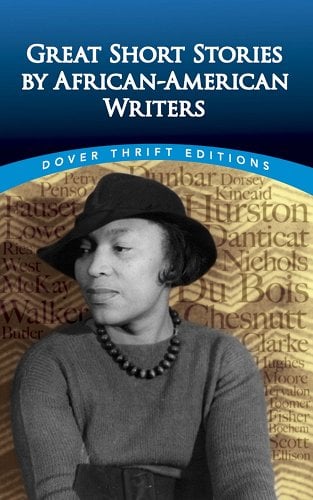
Paul Laurence Dunbar’s short story “The scapegoat” is the fourth in the anthology Great short stories by African-American writers, which my American friend Carolyn sent me. Compared with the previous author, Gertrude H. Dorsey Browne, Dunbar is much better known.

Paul Laurence Dunbar

Paul Dunbar c. 1890, from The African-American Experience in Ohio, 1850-1920, Public domain, via Wikimedia Commons

The biographical note at the end of the anthology provides good background, and Wikipedia has a detailed article on him. Dunbar (1872-1906) was, says Wikipedia, “an American poet, novelist, and short story writer of the late 19th and early 20th centuries”, and “became the first African-American poet to earn national distinction and acceptance”. In fact, it is through his poetry, which is frequently anthologised, that I recognised him when he popped up in the book. He was born in Dayton, Ohio, to parents who had been slaves. Indeed, his father had escaped slavery before the Civil War ended, and fought with the Union Army.

Dunbar, says Wikipedia, wrote his first poem when he was six, and gave his first public recital at nine. Both sources say he was the only African-American in his high school. He was apparently well-accepted, being elected president of the school’s literary society, as well as being the editor of the school newspaper and a debate club member.

Wikipedia provides much detail about his work and publishing history, his health issues (particularly with tuberculosis which killed him), and his failed marriage to Alice Ruth Moore, whose story, “A carnival jangle” (my review), opened this anthology. He was a prolific writer, and was famous for his use of dialect, although he also wrote in standard English. Recognised in his own time, his influence and legacy continues. Maya Angelou titled her book I know why the caged bird sings, from a line in his poem “Sympathy“. But I will conclude with an assessment from his friend, the writer James Weldon Johnson (1871-1938), who wrote in his 1922 anthology, The book of American Negro poetry:

He was the first to rise to a height from which he could take a perspective view of his own race. He was the first to see objectively its humor, its superstitions, its short-comings; the first to feel sympathetically its heart-wounds, its yearnings, its aspirations, and to voice them all in a purely literary form.

We see some of this in the short story chosen for this anthology.

“The scapegoat”

“The scapegoat” is the opening story in Dunbar’s 1904-published collection The heart of Happy Hollow. My anthology describes it as “Dunbar’s story of an ambitious and intelligent young man who sees no reason to sell himself short or accept defeat”. This is accurate, but only half the story.

It is told in two parts, the first before the protagonist Mr Robinson Asbury goes to prison, and the second after his release. The opening paragraph, after referencing the saying that the law is “a stern mistress”, chronicles young Asbury’s fast rise from a bootblack, through porter and messenger in a barber shop, to owning his own shop. The second and third paragraphs describe the story’s setting, the “Negro quarter” of “the growing town of Cadgers”. Here Asbury sets up his barber shop, and attracts customers with his ‘significant sign, “Equal Rights Barber Shop”‘, which our third person narrator says

was quite unnecessary because there was only one race about to patronise the place but it was a delicate sop to the peoples vanity and it served its purpose.

Whatever the reason, he was successful, and his shop became “a sort of club”, where the men of the community gathered to socialise and discuss the news. As a result Asbury soon comes to the notice of “party managers” who, seeing his potential to win them black votes, give him money, power and patronage. This Asbury accepts, and his power and status in the community grows. He then decides he’d like to join the bar, which, with the help of the white Judge Davis, he does.

And so the story continues. With success, he does not “leave the quarter” to “move uptown” as expected, though Judge Davis is prescient:

“Asbury,” he said, “you are–you are–well, you ought to be white, that’s all. When we find a black man like you we send him to State’ prison. If you were white, you’d go to the Senate.”

By now, Asbury’s success is arousing jealousy among his peers, particularly at a local coloured law firm. Two, Bingo and Latchett (great names eh?), are alarmed by Asbury’s fast rise to the top, but his putting out his shingle is “the last straw”. They plan to pull him down, and engage the services of another to lead an opposing faction in the community. However, with the continued help of the “party managers”, Asbury holds the day.

Now politics is messy, and allegiances switch. Along the way Bingo comes over to Asbury’s side. There’s an election, and Asbury’s side wins, but our narrator says:

the first cry of the defeated party was, as usual, “Fraud! Fraud!”

Was there fraud? Certainly there’s intimation of skulduggery, but without evidence it’s decided a “scapegoat” must be found – a big man – and so Asbury is deserted by the party “Machine”, and by his peers including Bingo, and charged. After the jury finds him guilty, Asbury seeks leave to make his statement, which Judge Davis allows:

He gave the ins and outs of some of the misdemeanours of which he stood accused showed who were the men behind the throne. And still, pale and transfixed Judge Davis waited for his own sentence.

It doesn’t come, because Asbury recognises Davis as “my friend”, but he exposes “every other man who had been concerned in his downfall”. He is sent to prison, for the shortest sentence the Judge can give, and is away for ten months, just long enough for him not to have been forgotten and, in fact, to be recognised as “the greatest and smartest man in Cadgers”. (This rehabilitation of Asbury in the eyes of the community while he is absent is just one of the many astute insights Dunbar makes about the way humans think and behave.) Part Two details Asbury’s revenge, but you can read it for yourself at the link below.

“The scapegoat” is a well-written, well-structured story set primarily within the black community, though the “party managers” who want the “black vote” are clearly white. Its main theme concerns political ambition and corruption, and racial oppression. It shows Asbury’s peers working to bring him down, putting their own ambition ahead of the good of the community, and overlays this with oppression by the string-pulling “Machine” uptown. I particularly liked the measured, neutral tone Dunbar employs which, together with his frequent insights into political behaviour and human nature, enables this story to read almost like a fable, a morality tale that says something in particular about this community, about the unfortunate behaviour of people who should support each other, but also something universal about politics and oppression.

It’s unemotional, clever, true – and, unfortunately, still relevant.

Paul Laurence Dunbar
“The scapegoat” (first published in The heart of Happy Hollow, 1904)
in Christine Rudisel and Bob Blaisdell (ed.), Great short stories by African-American writers
Garden City: Dover Publications, 2015
pp. 45-56
ISBN: 9780486471396
Available online (you can find the whole collection at this site)

Louise Erdrich, The night watchman (#BookReview)

Louise Erdrich’s Pulitzer Prizewinning The night watchman is historical fiction about a community fighting back against a government set on “terminating them”. Erdrich, whom I have reviewed before, is an enrolled citizen of the Turtle Mountain Band of Chippewa Indians of North Dakota and it is the story of this community’s response to something called the House Concurrent Resolution 108 that she tells in The night watchman.

Passed by Congress on August 1, 1953, this Resolution would, says Erdrich in her Afterword, “sever legal, sacred, and immutable promises made in nation-to-nation treaties”. Or, as Wikipedia explains, it would “end reservations and tribal sovereignty” and “integrate Native Americans into mainstream American society”.

As it happens, Erdrich’s grandfather, Patrick Gourneau, was Chairman of the Turtle Mountain Band of Chippewa Advisory Committee at the time and recognised this resolution for what it was. He is the inspiration for Thomas Wazhushk, one of Erdrich’s two protagonists. Thomas is a man of two cultures:

Watching the night sky, he was Thomas who had learned about the stars in boarding school. He was also Wazhashk who had learned about the stars from his grandfather, the original Wazhashk. (p. 17)

Throughout the novel Thomas strategically draws on these two selves in order to perform his role, which is to keep the community safe (or, at least, safer, than they would be if the Government’s plans came to fruition).

This is both a sophisticated and a grounded novel. Grounded in the way Erdrich uses her storytelling ability to create a compelling narrative peopled by a large cast of wonderfully individuated characters. We are interested in them all, and this makes the novel a darned good read. Sophisticated in how Erdrich subtly layers her story to enrich its meaning. The overall structure comprises two parallel but related stories or journeys: Thomas’s fight for his community’s survival, and his niece Patrice’s journey to find both her missing sister and her own path in life. Erdrich’s writing is simple, plain, but also imbued with gorgeous lyricism, metaphor and symbolism. The novel is threaded, for example, with physical holes, wells, caves, ship holds, and falls, which never let us forget the precariousness of these people’s lives.

She also peppers the story with humour, which reminds us no matter how serious things are, people can still have a laugh. There are many laugh-out-loud moments, alongside a recognition of humour’s role in how we navigate the things we confront. In Minneapolis, Patrice finds herself in a strange and potentially dangerous situation, and has

the sort of feeling and thinking that could only be described in Chippewa, where the strangeness was also humorous and the danger surrounding this entire situation was of the sort that you might laugh at, even though you could also get hurt… (p. 131)

“Survival is a changing game” (Biboon)

Overlaying all this is Erdrich’s exploration of how language works, how it can be used to clarify or obfuscate, to inspire or deflate. Her writing embodies this knowledge. So, for example, Thomas receives the Resolution papers and reads them carefully. He sees

their unbelievable intent. Unbelievable because the unthinkable was couched in such innocuous dry language. Unbelievable because the intent was, finally, to unmake, to unrecognize. To erase as Indians … his people, all of us invisible and as if we never were here, from the beginning, here. (p. 79)

His people were being targeted, the papers said,

for emancipation. E-man-ci-pation. Eman-cipation. This word would not stop banging around in his head. Emancipated. But they were not enslaved. Freed from being Indians* was the idea. Emancipated from their land. Freed from the treaties that Thomas’s father and grandfather had signed and that were promised to last forever. (p. 80)

Later, the once dapper but now frequently drunk Eddy Mink cuts to the chase, stunning officialdom with his plain language statement:

The services that the government provides to Indians might be likened to rent. The rent for use of the entire country of the United States. (p. 200)

Meanwhile, as Thomas builds his case, Patrice, who works in the Turtle Mountain Jewel Bearing Plant where Thomas is the titular night watchman, sets off for Minneapolis to look for her sister. Vera had gone there with her new husband but had not been heard of since. What Patrice finds in the city, how people can be exploited, is shocking, and she returns home somewhat wiser but with more to learn about herself and the ways of humans.

Surrounding Thomas and Patrice is a large community of people – family, friends, neighbours, work colleagues, teachers, coaches, visiting missionaries, and even a ghost. The interactions between these people build up a picture of a community that functions despite external stresses and the usual internal disagreements. This makes engrossing reading because these characters are so real, including the two Mormon missionaries who not only add humour and pathos but also represent the naiveté of supporters of a faith – in the form of Utah Senator Arthur V. Watkins – that was driving the Resolution.

Similarly, our protagonists’ interactions with specific individuals make great reading while also advancing the narrative and the ideas. When Thomas is with his father Biboon and Patrice with her mother Zhaanat, we feel their spiritual connection with their culture, and their desire to learn from their elders. When Thomas is with the white teacher and boxing coach, Barnes, we see how little non-Indian society understands the existing situation and the implications of the Resolution. Thomas patiently – and generously – explains to the clueless Barnes why Indians are not, and can never be, “regular Americans”. And, why he, Barnes, cannot be an Indian! Just look at this writing:

“If I married an Indian woman,” said Barnes, “would that make me an Indian? Could I join the tribe?”
He was awed at the possible sacrifice he could be making.
Thomas looked at the big childish man with his vigorous corn-yellow cowlicks and watery blue eyes. Not for the first time, he felt sorry for a white fellow. There was something about some of them—their sudden thought that to become an Indian might help. Help with what? Thomas wanted to be generous. But also, he resisted the idea that his endless work, the warmth of his family, and this identity that got him followed in stores and ejected from restaurants and movies, this way he was, for good or bad, was just another thing for a white man to acquire.
“No,” he said gently, “you could not be an Indian. But we could like you anyway.”

In statements like “he was awed at the possible sacrifice he could be making”, Erdrich conveys more about cultural superiority than just this man’s thoughts.

When Patrice is with her girlfriends and workmates, Valentine and Doris, we see how her goals diverge from their more girlish ones, and when she is with Wood Mountain we see her inner conflict about her chosen direction. As a young person, her journey is more personal than Thomas’s but they coalesce when it comes to saving the community.

“Assimilation. Their ways become your ways.” (Roderick)

I loved spending time with these characters. In fact, so did most of my reading group, as this novel was our September read. We enjoyed her vividly drawn characters – and their perfect names, like Juggie Blue, Wood Mountain, Louis Pipestone, Millie Cloud, and Patrice not Pixie. We teased out the complexity of the storytelling, the way Erdrich seemed to effortlessly incorporate complex ideas into a compelling narrative. This starts right at the title, The nightwatchman, which is both literal, Thomas’ job, and metaphorical, in his role of keeping watch as the community’s Chairman. I was reminded a little of Melissa Lucashenko’s novels, in which tough stories are told with compassion and humour to paint a picture of real people confronting a world that’s against them.

Early in the novel, Thomas moves that the Committee call the Resolution the “Termination Bill [because] Those words like emancipation and freedom are smoke”. This bill heralded what is now called the Termination Era (1953-1968). As Erdrich explains in her Afterword, this is what happened to 113 tribal nations. Although some regained recognition, “31 are now landless” and “24 are considered extinct” (p. 447).

The night watchman is one of those books that hits the spot – the heart spot and the mind spot. Recommended.

* The novel is set in 1953, and Indian is the term most commonly used when the specific Chippewa is not.

Louise Erdrich
The night watchman
London: Corsair, 2020
453pp. (Kindle edition.)
ISBN: 9781472155337

The Story of the Oars

Back in 2018, I wrote a post on local author Nigel Featherstone’s first theatrical work, an art-song piece titled The Weight of Light. Seven years later, his second work of theatre, The Story of the Oars, has just finished its short season at The Street Theatre. Having just got back from Japan on Friday afternoon, Mr Gums and I managed to get to the last show this afternoon. For those of you who are not regular readers here, Nigel Featherstone, who has written several novellas/novels and has started spreading his wings into theatre, music and poetry, has featured on my blog several times. However, as I wrote in my post on The Weight of Light, I’m not an experienced theatre reviewer. I don’t have the language, and, as a reader, I find it challenging seeing something only once, and not being able to go back to check something out, as you can with a book! But, I do want to share something about this work.

The Story of the Oars

Promotion, designed by Tobi Skera

People from the Canberra region might get a hint about the setting of this play from the gorgeous graphic used to promote it. The setting, in other words, is Weereewa (in Ngunnawal language) or Lake George (as settler society named it), a lake that appears and disappears with changes in the weather. Over the 50 years I have lived in Canberra, I have seen it empty, full and in between several times.

So, this mesmerising lake and its behaviour is the setting for The Story of the Oars, which The Street’s promotion describes as “a play with spoken-word songs and music”. As the play opens, the lake is dry, and a father (Clocker) and son (Tom), played by Craig Alexander and Callum Doherty, have stopped to have a look. There is much intergenerational humour in the opening dialogue between these two as they spar about how much time to spend there, where to next, and so on. It’s “normal” Aussie stuff, until two women, played by Louise Bennet and Sally Marett, appear, and it soon becomes apparent that there’s a mystery involving Clocker that his son doesn’t know about. This mystery, and Clocker’s reluctance to admit to his son that he knows the lake, underpins the story. What Clocker learns though is, you can’t come back without the truth coming out …

“I am fictitious history” (Clocker)

The story draws on some familiar tropes – a father-son road trip, mysterious deaths in which bodies are never found, the master-servant class and privilege dynamic, a return from the past – but these are not heavy-handed. Instead, they are subtly revealed through a script which shifts smoothly back and forth between natural dialogue, with its humour and recognisability, and poetic soliloquies, with their strong rhythms. This is powerful, not only because the shifts between the two “forms” create breaks in intensity, but also because the natural dialogue conveys the main narrative thread, while the poetic pieces embody more of the emotional and thematic power. The language is beautiful, and it’s accessible, which frees the audience to focus on thinking about the themes and responding to the ideas rather than on trying to understand what’s being said and told.

Then there’s the music, which was composed and played by Jay Cameron on a partly dismantled piano that remained centre stage throughout. We attended a Meet the Makers panel before the performance, and the discussion about the music was particularly relevant. Nigel, for whom text and music are dual passions, had written the initial music, but then Jay was brought in for further development. They thought about the theme of revealing truth, of opening up things, and wanted a radical or physical approach to the music to support this. Then they had the idea of “opening up” the piano. The play commences with the piano’s boards or panels being removed, exposing its working parts. This is the condition in which it is played throughout. The music is minimally percussive at times, or softly melodic or intense at others, always supporting the prevailing emotions without dominating them or being cliched. We loved it.

It was clear from the panel discussion that much thought was given to the piano. It was seen as a core part of the show not just in terms of its role as music maker, but regarding its relationship to the actors, and to the lake. Which brings me to the staging. The stage itself represented the lake and all the action took place there. The titular oars – represented by two light rods – were also permanently on the stage. The lighting of the rods, of the lake’s outline on the floor, and of the backdrop, all changed dynamically to reflect who was in focus, or what was happening between the characters. The stage-lake, like the real one, thus came across as a living thing, a place within which people operate, to which they relate, and which can create fear or sustain or heal.

I wondered as we watched this show, how well it would translate to another place. Weereewa has such meaning for the Canberra region – physically and spiritually. Even if we understand the science behind its behaviour, we still respond to its mystery, to the way it dries up with what lies beneath being revealed only to be inevitably covered up again. Like truths and lies, perhaps. The universals – the narrative tropes and themes – would translate, but would the power of the place? It would all depend on the direction.

The story of the oars doesn’t resolve all the questions it poses about the decisions we make, the truths we withhold or reveal, but it ends on a moment in time when hope is a possibility. We liked that too. It’s a heartfelt, thoughtful and accessible work. It would be great to think that all this work doesn’t end here.

The Story of the Oars
Words and story by Nigel Featherstone
Music by Jay Cameron
Directed by Shelly Higgs
The Street Theatre, 19-21 September 2025