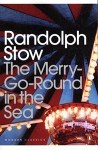
Randolph Stow is a writer I’ve been meaning to read for the longest time – since, would you believe, the 1970s? Embarrassing, really, given his significance. My plan had always been to read his Miles Franklin award-winning novel To the islands first. However, the first I actually bought was The merry-go-round in the sea – back in 2009 when it was re-released as a $10 Penguin classic. It’s taken me until now to read it – and I read it with my reading group, which made it an extra special experience.
BEWARE SPOILERS, albeit this is a classic with minimal plot so, you know …
The merry-go-round in the sea was Stow’s fourth novel, published in 1965 when he was 30 years old. It has a strong autobiographical basis, but is, by definition, fiction. It is essentially a coming-of-age story about a young Western Australian boy, Rob, who, like Stow, was born in Geraldton in 1935. It covers eight years of his life from 1941, when his favourite cousin, the 21-year-old Rick, leaves to fight in World War 2, to 1949, when Rob is 14-years-old and the now-returned Rick is about to leave again, this time to live in London. The plot is not a particularly dramatic one, but rather a lot happens nonetheless.
It all starts in 1941 with Rob and his family moving (“evacuating” is the strange word his mother uses) to a family station in the country, due to fears of Japanese invasion. There Rob enjoys the life of a “bush kid” and is unhappy to find, upon his return to town, that he is really a “townie”. Meanwhile, Rick is at war, ending up a POW on the Thai-Burma railway. His experience is told in three or four brief but vivid digressions from the narrative’s main focus on Rob’s life. We are told enough to prepare us for a changed Rick on his return. In the second part of the novel, the focus is on Rob’s growing up, on his gradual loss of childish innocence, and on Rick’s struggles to come to terms with his life after his experience of war. Nothing is the same for Rick, and Rob worries about his idol.
Now, this is a 400-page novel (in my edition, anyhow) and can be discussed from multiple perspectives, so I’m going to hone in on a couple that most interested me.
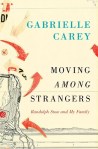
One of these is heralded by the book’s structure, by the fact that, although the protagonist, the person through whom we “see” most of the book, is young Rob, the book’s two parts are named for Rick, “1 Rick Away 1941-1945”, and “2 Rick Home 1945-1949.” Superficially, this can be explained by the fact that Rick is a major focus of Rob’s interest. However, I’d argue there’s something more here, that these two characters represent conflicting forces – a duality – within Randolph Stow himself, one being his love of place, of the land and country he grew up in, and the other being his discomfort with that same place and his need to get away, which indeed he did. This duality was, as I recollect, discussed by Gabrielle Carey in her book Moving among strangers: Randolph Stow and my family (my review).
So … through Rob’s third person eyes, Stow writes gloriously, authentically, about Geraldton and the surrounding areas in which he grew up. The language is lyrical, poetic, conveying an emotional intensity in addition to pure description:
By rock pools and creeks the delicate-petalled wild hibiscus opened, and the gold-dust of the wattles floated on water. Wild duck were about, and in trees and in fox-holes by water he looked for the nests, staring in at the grey-white eggs but touching nothing. Climbing a York gum, he was startled when a grey broken-off stump suddenly opened golden eyes at him. He gazed into the angry day-dazzled eyes of the nesting frogmouth and felt he had witnessed a metamorphosis.
There’s repetition of colours, plants, and landforms, but rather than becoming tedious they convey a deep familiarity with and love of place – and make the novel sing.
However, through Rick’s eyes – albeit eyes damaged by his war experience – we see a more conflicted, and arguably more adult, understanding of this place. At the end, he explains his decision to leave to Rob:
‘Look, kid,’ Rick said, ‘I’ve outgrown you…
[…]
‘I can’t stand,’ Rick said, ‘this – ah, this arrogant, mediocrity. The shoddiness and wowserism and the smug wild-boyos in the bars. And the unspeakable bloody boredom of being in a country that keeps up a sort of chorus. Relax, mate, relax, don’t make the place too hot. Relax, you bastard, before you get clobbered.’
Stow wasn’t the only intellectual to leave Australia in the 1960s. Others include Germaine Greer, Clive Robertson, Barry Humphries and Robert Hughes.
My other issue is trickier to discuss: it concerns Stow’s references to Indigenous people in the novel. It’s complicated to tease out, and to do so properly would require a re-read, but I can’t leave the novel without saying something about it, given our heightened awareness these days. As I’ve already said, the book was written in 1965 about the 1940s. In 1957, Stow had spent three months as a storeman at the Forrest River Aboriginal mission in the Kimberleys. His biographer, Suzanne Falkiner, argued (on ABC RN Late Night Live) that this experience created some conflict for him:
‘[His family] had achieved a lot: they had been colonists in America, in the West Indies, the earliest settlers in that region of Australia,’ she says. ‘But as he grew older and as he got to know Aborigines, having worked in the Forrest River mission, I think the conflict became a real source of pain for him.’
I believe that Stow tried to convey some of this in The merry-go-round in the sea. Several times, Rob quotes his family’s racist attitudes, including here:
Rob did not mind the blackn*****s, some of the older ones he rather admired. But his mother was furious because Nan [Rob’s sister] was sitting next to a blackn****r in school. ‘They’re dirty,’ said his mother. ‘They all have bugs in their hair.’
It was funny about blackn*****s. They were Australian. They were more Australian than Rob was, and he was fifth generation. And yet somehow they were not Australian. His world was not one world.*
In other parts of the novel, he describes seeing Aboriginal art in caves, and ponders the people who made them. Not all are so sensitive or interested, however. When he’s taunted at school with having “n****r blood”, he reacts defensively, but when he’s a little older, and schoolfriends once again express racist attitudes, he responds:
‘I like them,’ the boy said, ‘There’s some nice boong kids at school.’
A poor choice of words, but at least Rob stands up for his beliefs. If we take Rob as Stow’s mouthpiece, then it’s pretty clear that Stow is conveying in this novel some disquiet about prevailing attitudes to Australia’s Indigenous people.
There is so much more to explore in this book – including the motif of the merry-go-round itself. As a young boy Rob had been shattered by the discovery of “time and change”, leading him to cling to the idea of a merry-go-round, which revolves and revolves around a solid centre, his family, never changing. By the end, however, with Rick about to leave, he realises that this too is illusion, that the world is not quite as he’d seen it. A bittersweet ending – one that must come to us all at some time!
Several bloggers have posted on this novel in the last few years, including Lisa (ANZ Litlovers) and Kim (Reading Matters), and offer additional perspectives to mine.
Randolph Stow
The merry-go-round in the sea
Camberwell: Penguin Books, 2009
400pp.
ISBN: 9780143202745
* I have blanked out this word to, hopefully, deflect the wrong sort of “hits” on this blog.




 Whispering Gums