Delia Owens, Where the crawdads sing (#BookReview)

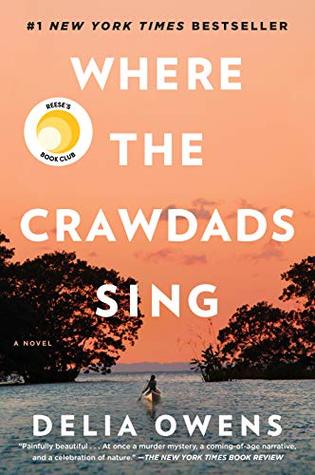
Delia Owens’ bestselling debut novel, Where the crawdads sing, is a problematical novel, as my reading group discovered – and yet, I couldn’t help being emotionally engaged. It reminded me a little of a childhood favourite, Gene Stratton Porter’s A girl of the Limberlost. My heart went out to Owen’s protagonist, Kya, the maligned, ignored, Marsh Girl, and I loved the writing about the North Carolina marshland. But, intellectually, I had to work to defend my enjoyment, which I’ll aim to share here.

“in the end, that is all you have, the connections”

I’ll start with the obvious, a summary of the plot. The main narrative runs from 1952 to 1970, and is told in two chronologies that eventually meet. The novel tells the story of Kya, who, in 1952, is six when her Mum and, soon after, her siblings leave home. Four years later, when she’s ten, her father also departs, leaving her alone, in their North Carolina marsh shack. She can’t read, has no money, and few skills. But, she’s an intelligent, resourceful little girl, and, with the help of a few kind people, she makes a life – albeit a lonely one – for herself. The novel commences, however, in 1969 with the discovery of the body of a young man, Chase Andrews, who is a local football hero. Was it an accident or was he murdered? The second chronology, then, is a crime story, following the investigation of this death through to the court case. You can probably guess where the two chronologies meet.

Owens manages this structure skilfully, drawing us into Kya’s life, and how and why she develops into the person she is in 1970, while, simultaneously, slowly building suspense by recounting the details of the investigation. The writing is lush and evocative, ensuring that we engage with Kya and her struggle to survive, her increasing loneliness and her desperation to connect with others. We see her turn to nature and wildlife to learn about life, as well as to provide herself with sustenance and give her a minimal income (by selling fish and mussels, for example).

This is nature writing at its best, with stunning descriptions of the marsh, and the birds, fish and insects that inhabit it, but it is also eco-fiction, with occasional allusions to development. Tate, a young man who befriends Kya (and provides her with a much-needed connection) tells her:

They think it’s wasteland that should be drained and developed. People don’t understand that most sea creatures—including the very ones they eat—need the marsh.”

The marsh is Kya’s family; it is what, in the absence of family, forms her:

She knew the years of isolation had altered her behavior until she was different from others, but it wasn’t her fault she’d been alone. Most of what she knew, she’d learned from the wild. Nature had nurtured, tutored, and protected her when no one else would. If consequences resulted from her behaving differently, then they too were functions of life’s fundamental core.

It is hard, as a reader, not to care about Kya. Will she find the connections she so badly wants – “Being completely alone was a feeling so vast it echoed” – and will they stick?

“it’s usually the trap that gets foxed”

However, it’s easy to pick holes in the book. Kya’s survival (given her youth) and her development into an educated young woman (given she only spent one day at school) can stretch credulity. Many of the characters feel stereotyped, from the good “colored” people, who put themselves out to help Kya, to the prejudiced townspeople, who reject and exclude her (as they do all marsh people). “Barkley Cove”, writes Owens, “served its religion hard-boiled and deep-fried”. And, if you don’t like your heartstrings being obviously pulled, you may not engage with Kya at all.

All this makes it problematical, because it’s one of those books that whether you love or hate depends largely on what sort of reader you are, what you like to read, and/or how you read this particular book. There are many ways to read Where the crawdads sing – a crime story, a romance, a coming-of-age story, historical fiction, a modern fairy-story or allegory, even, to name a few. Some of these ways demand more realism than others, and expose holes which are irrelevant to other ways. It is one of these other ways that appeals to me.

This way is to read it more like a fairy story or allegory, as a story about the triumph of the maligned, a comeuppance for the underdog. If you read it this way, the stereotyping of the minor characters, and the improbability of Kya’s survival and achievements, serve to emphasise the challenges faced by the underdog. It is hard to explain what I mean without giving away the ending, but I’ll try.

Throughout the novel, we are not only reminded of the prejudice and mistreatment of Kya (as representative of the marsh people) but are also aware of the ostracism of “colored people” as they were called then. Kya turns to nature to learn about life. Early in the novel, when the “colored” Jumpin’ warns her about Social Services looking for her, friend Tate tells her to “hide way out where the crawdads sing”:

Kya remembered Ma always encouraging her to explore the marsh: “Go as far as you can—way out yonder where the crawdads sing.”

“Just means far in the bush where critters are wild, still behaving like critters.”

One of Kya’s main challenges is to work out the differences between what she observes in nature and in human behaviour:

“In nature—out yonder where the crawdads sing—these ruthless-seeming behaviors actually increase the mother’s number of young over her lifetime, and thus her genes for abandoning offspring in times of stress are passed on to the next generation. And on and on. It happens in humans, too. Some behaviors that seem harsh to us now ensured the survival of early man in whatever swamp he was in at the time. Without them, we wouldn’t be here. We still store those instincts in our genes, and they express themselves when certain circumstances prevail. Some parts of us will always be what we were, what we had to be to survive—way back yonder.”

These two quotes – among others – hint at the novel’s underlying idea, which is that it’s not only “critters” who are “wild”, that human beings will be ruthless too. Exploring this ruthlessness in its natural and human manifestations, and how Kya navigates it, is a major theme of this book – and explains why Owens has written it the way she has. The resolution is deeply satisfying (albeit I didn’t love the device used to achieve it).

Where the crawdads sing is a thoughtful read for those who feel passionate about the maligned of this world. It is also a glorious lovesong to the marshland. I’m glad my reading group scheduled it.

Delia Owens
Where the crawdads sing
London: Corsair, 2018
379pp.
ISBN: 9781472154637 (Kindle ed.)

Sara Phillips (ed), The best Australian science writing 2020 (#BookReview)

In 2016, my reading group discussed the 2015 edition of The best Australian science writing. We enjoyed it so much that we decided to do it again, and so this month we read the 2020 (tenth anniversary) edition. Our discussion was as engaged as before (and the overall reasons I enjoyed this volume are the same as those I listed in my post on it, so I won’t repeat them here.)

The publishers invite a different editor each year, and for 2020 it was Sara Phillips, a respected and award-winning science writer herself, with a particular interest in environmental science. The edition opens, however, with a Preface by UNSW Press’s publisher Kathy Bail. She references the annual Bragg UNSW Prize for Science Writing, which was named for the father and son who were Australia’s first Nobel laureates. All shortlisted pieces are included in the anthology. 2020’s winner was Ceridwen Dovey’s fascinating, moving essay, True grit. (Dovey, many of you will know, is also a respected writer of fiction.) The runners up were Ricky French’s Case of the missing frogs and Konrad Marshall’s Jeepers creepersLesley Hughes’ The milk of human genius, Donna Lu’s Stranger thingsand Nicky Phillips’ Bringing home the ancestors, were the other shortlisted articles.

COVID-19?

There is so much I want to share about this volume, but I’m going to start with a quote I used in my 2015 edition post. It came from one of that edition’s Bragg Prize runners-up, Idan Ben-Barak’s Why aren’t we dead yet. This essay provided a wonderfully lucid description of pathogens and the immune system. You can guess why I want to share it again!

And so, an immune system must correctly identify a diverse array of harmful creatures and react to each one in its own special way. Oh, and you know what would be very helpful? If it could remember the pathogens it’s encountered before and store this information on file, somehow, so that it could make short work of them the next time they pop in. And it needs to be prepared for new invaders it’s never encountered before, because life is like that. And it needs to be prepared for completely new invaders nobody has ever encountered before in the history of humankind, because pathogens evolve over time. And it needs to be economical, so the body can keep it operational. And it needs to be fairly unobtrusive, so the body can keep functioning normally. And it needs to do it all very quickly, every time, or the body will be overrun, because pathogens multiply like the devil.

It sure does, as we all now know only too well. However, if you’re expecting pandemic articles to dominate the 2020 edition, you would be wrong, because the edition’s cut-off was March 2020. There are a couple of articles on the topic, but presumably there’ll be more in the 2021 edition. The two in this edition are Liam Mannix’s The perfect virus: two gene tweaks that turned COVID-19 into a killer, which tells us exactly what the title says it will (and in a clear, intelligent way), and Tessa Charles’ Synchrotons on the coronavirus frontline, which describes the importance of synchrotrons to mapping the crystallography of the SARS-CoV-2 protease. Knowing this is critical for the development of drugs/vaccines.

Science and politics

Each edition seems to have threads, which must surely relate to the “zeitgeist”. Introducing the 2015 edition, editor Nogrady wrote that while the 2014 anthology featured several articles “on our changing climate and its repercussions, this year there were an overwhelming number of submissions about our vanishing biodiversity, and what could be or is being done about it”. There were also several articles on robotics and artificial intelligence. Well, five years on, issues like climate change and biodiversity still feature strongly, as Phillips writes in her introduction, but there are some different threads too, as she also identifies, such as the role and importance of description and taxonomy, which, in fact, underpin many of the biodiversity articles. Dyani Lewis’ Identity crisis for the Australian dingo, is an example.

But, Lewis’ article also references something else I detected running through the volume, the close – and sometimes uncomfortable – relationship between science and politics. In the case of the dingo, there are political implications for whether the dingo is classified as its own (native) species (canis dingo) or as a dog (canis familiaris). As a native animal it “could be listed as threatened” if its populations decline, but as a dog “it wouldn’t qualify”. Some scientists accuse others of “bad science”, of forcing the dingo into its own species in order to protect it, when, they believe, the scientific arguments aren’t there for separate classification or taxonomy.

Nicky Phillips’ Bringing home the ancestors discusses the use of DNA to help identify indigenous remains held in museums (and similar institutions) but, she writes, “As a result of the history of mistreatment, some Indigenous people fear that unscrupulous governments or scientists might misuse their genetic information”. To invoke the potential of science or not, that is the question! The following article, The Murray–Darling’s dry mouth, by Jo Chandler, uses the stressed ecology of South Australia’s Coorong to exemplify “the mal-administration, negligence and ignoring catastrophic risks of climate change” that has brought the river-system to the parlous state it is in.

These are just three of many articles which explored the science-politics nexus. I’d love to share them all with you, but, given the year it is, I’ll end this section with an article written before the pandemic but which is so apposite, Felicity Nelson’s Pathogen sovereignty. Nelson explains how such a thing came to be and its implications for scientific research into, yes, pathogens like SARS-CoV-2. “For poorer nations, exercising state power over pathogen samples was quite often their only point of leverage”. Fair enough, as they’d been taken advantage of, but you can see the implications for the quick-sharing of samples so needed during pandemics.

A related thread through the volume concerned the practice, philosophy and funding of scientific research, but I’ll have to leave that, as I do want to get onto …

Inspiring people

It’s not surprising that articles written by journalists for educated-but-lay readers will often hang their information on the stories of inspiring personalities. Bragg Prize winner Ceridwen Dovey did this in True grit, by telling the story of Brian O’Brien, whose inspired idea about gathering and measuring moon dust in the 1960s was overlooked until the 2000s, when, quite serendipitously, his work was noticed by a scientist after NASA realised that it did indeed need to understand moon dust! Jo Chandler tells her above-mentioned Coorong story through the work of ecologist David Paton. He has studied the region for decades, and, though now officially retired, is not giving up, “not least because of his concerns about the capacity of working scientists to conduct deep, unfettered research. ‘You talk, they cut your funding. It’s as simple as that.’”

The inspiring people aren’t all old, however. Cameron Stewart’s Brain wave tells of Vietnamese-Australian inventor, Tan Le, whose work on producing technology that can read brain waves is already providing benefits – to quadriplegics, for example. The potential of this technology is immense, and Tan Le, herself, is astonishing, particularly when you read her trajectory from boat-person to Silicon Valley entrepreneur.

To end …

It’s impossible to do justice to an anthology like this, so, as I did last time, I’m concluding with three quotes that make important points, to my mind anyhow. First is Michelle Starr, who reminds us about the practice and limits of scientific research in The repeating signals from deep space are extremely unlikely to be aliens – here’s why:

‘Wild speculation can sometimes inform the next generation of instrumentation, which can then either confirm or refute the wild hypothesis, or see something else entirely unexpected. And that too is what makes science fun.’ The difficulty lies in understanding the difference between pondering wild ideas as a thought exercise, and evidence based on data and prior experience, observation and conclusions.

Then comes Brian Key from Peter Meredith‘s Underwater and underrated, which is all about fish brains and intelligence:

On the question of animal welfare, Brian emphasises it needn’t be linked specifically to an animal’s ability to feel pain. ‘You can apply human principles to animal welfare,’ he says. ‘Those principles don’t have to be based on scientific evidence; they can be based on the morals and ethics of a society.’

Finally, here is a Moore Foundation grant recipient in Smriti Mallapaty’s For risky research with great potential, dive deep commenting on one of the Foundaton’s sensible research grant conditions:

‘Science has a rich history of not talking about what doesn’t work,’ says Wilhelm, a grant recipient …. ‘By sharing our failures, we have been able to help each other and avoid making the same mistakes over and over again’ … 

Another rich volume, with so much to offer, but I really must end here – or, I’ll be putting you all to sleep.

Challenge logo

Sara Phillips (ed)
The best Australian science writing 2020
Sydney: NewSouth Publishing, 2020
ISBN: 9781742245072 (ebook)

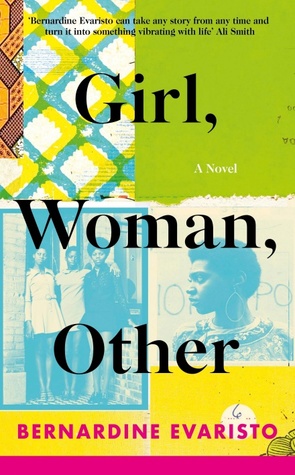
Bernadine Evaristo, Girl, woman, other (#BookReview)

If ever there was a “zeitgeist” book, Bernadine Evaristo’s 2019 Booker Prize winning novel, Girl, woman, other is it. It might be an English-set novel about black British women, “the embodiment of Otherness”, but its concerns, ranging from ingrained inequality, racism and sexism to newer issues such as globalisation, are contemporary – and relevant far beyond its setting.

Take, for example, sexual violence. One young woman, after being raped, is not sure exactly what happened:

    wondering if he’d done anything wrong or was it her fault
    she should have stayed and talked to him about it
    he might have said he hadn’t heard her saying no

(Chapter 2: LaTisha)

This could have been set in Australia, given discussions happening here right now. It is truly troubling how many young women apparently feel uncertain about what they’ve experienced, and turn it back on themselves. But now, having leapt in to make my “zeitgeist” point, I’ll start again, properly!

Girl, woman, other is an astonishing book, as most of my reading group agreed. It’s fresh and exuberant, but oh so biting too. As much poetry as prose, it has minimal punctuation and yet it just flows. It’s a risky book – what great art isn’t? – because, in addition to its idiosyncratic style, it comprises multiple points-of-view that move back-and-forth in time. There are four main chapters, each divided into three parts with each part in the voice of a different character. This makes 12 voices in all! The voices within each chapter are closely related in some way – mothers, daughters, friends – but the links between the four chapters are more subtle. This demands much of the reader.

Fortunately, the voices are captivating. Spanning over a century, they range from the ultra-confident 19-year-old Yazz, daughter of a lesbian mother, to 93-year-old Hattie, a strong-minded farmer and great-grandmother. All are women, and all have some genetic links with African or Caribbean cultures, some from a few generations back, others being themselves migrants. Through them, Evaristo interrogates a diversity of experiences and responses to colour, in particular, in contemporary England. Hattie’s mother, for example, had an Abyssinian father, and she herself had married an African-American GI. However, with the colour fading amongst her descendants, the family is less than happy when it is reintroduced by Julie who “saw not the darkness of his skin but the lightness of his spirit”. Hattie reflects

    none of them identifies as black and she suspects they pass as white, which would sadden Slim if he was still around 
    she doesn’t mind, whatever works for them and if they can get away with it, good luck to them, why wear the burden of colour to hold you back?
    the only thing she objects to is when they objected to Chimango when he arrived on the scene, a fellow nurse at the hospital where Julie worked, from Malawi
    Hattie was sickened by their behaviour, they should’ve been more enlightened 
    but the family was becoming whiter with every generation 
    and they didn’t want any backsliding

(Chapter 4: Hattie)

You can see how well the language flows, and how accessible it is. It’s experimental but unforced. You can also see the author’s approach to her subject matter, which is to show, through her characters, different behaviours, values and attitudes. With 12 characters telling of their interactions with even more people, the breadth of humanity Evaristo encompasses is breathtaking – and it is all done without judgement. Some characters might, and do, judge each other, but Evaristo doesn’t. She lets them speak for themselves, which requires us to read attentively.

So, when Dominique’s female lover increasingly restricts her life, we see abusive control long before she does. And, when 93-year-old Hattie’s mother, Grace, experiences postpartum depression in the early 20th century, it is not named. Who talked about that then? But we recognise it immediately.

Issues come and go in this novel, whether they are up-to-the-minute topics, such as Brexit or transgender rights, or ongoing issues in women’s lives such as violence or ageing. Underpinning it all, however, is race and inequality. Being “othered” is common to Evaristo’s characters, and they all deal with it differently, but we see very clearly its debilitating, devastating impact.

    oh to be one of the privileged of this world who take it for granted that it’s their right to surf the globe unhindered, unsuspected, respected

(Chapter 2: Carole)

By now you might be thinking a few things – that the novel is heavy-going, perhaps, or that it’s chaotic. But nothing doing. For all its seriousness – and there are definitely grim moments – the novel has a light touch, frequently bitingly satiric, sometimes simply funny, always human. Nineteen-year-old Yazz, for example, is a hoot with her teenage know-it-all confidence. Many recognise their failings, as they grow older, such as Amma appreciating her father too late or Carole realising her supportive teacher had feelings. Transgender Morgan, the epitome of the modern activist, speaks many truths:

    Megan was part Ethiopian, part African-American, part Malawian, and part English
    which felt weird when you broke it down like that because essentially she was just a complete human being

Chapter 4: Megan/Morgan

And, although the novel may sound chaotic, it does have an overarching structure. It starts hours before Amma’s play – the one she hopes will finally make her name – is to premiere at the National Theatre, and it ends with the After Party and an Epilogue, which, combined, bring most of the characters together. The ending, in fact, is clever. The After Party is political, drawing together the threads and reminding us that there’s a long way to go before black people in white societies are not defined by their colour. The Epilogue, on the other hand, is personal, showing us that there’s always human connection and that that, really, is the stuff of life – if only we could all see it.

Girl, woman, other is such a read. Uncompromising in its politics, but also warm and cheeky, it offers heart and intelligence in equal measure.

Bernadine Evaristo
Girl, woman, other
Hamish Hamilton, 2019
453pp.
ISBN: 9780241985007 (ebook)

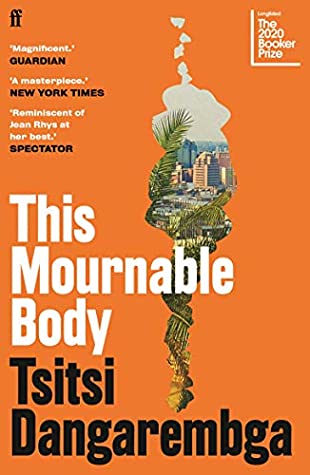
Tsitsi Dangarembga, This mournable body (#BookReview)

Zimbabwean author Tsitsi Dangarembga’s This mournable body was my reading group’s February book. Shortlisted for the Booker Prize, it is Dangarembga’s third novel, and is a sequel to Nervous conditions (1988) and The book of not (2006), neither of which I’ve read. These novels are written in English, the language of Dangarembga’s schooling, though she also speaks Shona.

It is a remarkable book, for its subject matter, vivid writing and the complexity of its protagonist, Tambu (Tambudzai). Wikipedia’s article on Nervous conditions describes Tambu’s character, saying “her desire for an education and to improve herself seem strong enough to overcome just about anything. She is very hard on herself, and always strives to do her best and make the correct decisions”. This perfectly describes the character I met in This mournable body, except that by now Tambu is around 40 years old and disappointed that life has not worked out as she had hoped. Indeed, she is out of work and living in a boarding house, eking out her savings from her previous copy-writing job in order to survive. A sense of failure and an air of desperation surrounds her.

Interestingly, Dangarembga chose a second person voice to tell Tambu’s story. There are various reasons for choosing this voice. Madeleine Dickie chose it for her novel Red can origami (my review) to involve if not implicate the reader in the world she was describing. I don’t know why Dangarembga chose it, but my guess is to convey Tambu’s apparent dissociation from her self. Second person avoids both the objective insight that an omniscient third person voice can provide and the confessional immersion in a life that first person offers. Tambu is struggling; she is caught between her Western-education with its Western-style aspirations and her Zimbabwean family and culture. We see her pain, but second person keeps her and us a little remote from it, as if she and we are watching it, not fully comprehending what is happening.

The novel is set in troubled late 1990s Harare, on the cusp of the millennium. It has a three-part structure – Ebbing, Suspended, and Arriving – which chronicles the trajectory of this period in Tambu’s life. In Ebbing, we see Tambu’s hopes for a successful, secure life, ebb:

Fear, your recurrent dread that you have not made enough progress toward security and a decent living, prickles like pins and needles at the mention of “village.” You have dodged this fear for too long—all your conscious life.

We also learn some of the reasons for the state she’s in, despite having been plucked from her village by her uncle and given a good “white” education. These reasons include the fact that although having gained Independence, Zimbabwe remains a racist place where black Zimbabweans still suffer under the colonialism they “thought” they’d thrown off. Tambu had had a good job as a copywriter in an advertising agency:

you have no one but yourself to blame for leaving your copywriting position. You should have endured the white men who put their names to your taglines and rhyming couplets. You spend much time regretting digging your own grave over a matter of mere principle.

Late in Ebbing, Tambu manages to obtain a decent job as a teacher, but it doesn’t last long, largely because her insecurity – her jealousies and fears – result in her self-destructing.

Suspended starts with her having been suspended from this job and admitted to a psychiatric hospital where her life is effectively “suspended” as she struggles to regain her mental health and equanimity. This she does, with the help of her family, including cousin Nyasha who takes her in. Incomprehensibly to Western-focused Tambu, Nyasha had returned, with her German husband and two children, from an apparently successful life in Europe, to work for the community, and specifically to improve things for Zimbabwean youth.

In the final part, Arriving, Tambu finds herself working for Tracey, her white Zimbabwean nemesis who had been a schoolmate at the prestigious Young Ladies’ College of the Sacred Heart and then her boss at the copywriting agency. Tracey is setting up an eco-tourism business, Green Jacaranda, and sees potential in Tambu – and indeed, Tambu seems to start to find herself, both personally and professionally, but I will leave the plot here …

This mournable body, however, is more than just a story about Tambu. Dangarembga weaves Zimbabwean social and political history into her narrative. While Tambu hadn’t been involved in pre- and post-Independence violence, many in her family had. The impact of war – particularly on women – provides one of the running commentaries throughout the novel. One refrain concerns her sister Netsai’s loss of a leg, which works as a visible reminder of personal and national losses:

Sometimes I ask if people forgot that many people went to war. Because if they have not forgotten, these people in this country, what is going on with them? Why are they so foolish? Do they think we went for this? … This is not what we went for and stayed for without food and blankets, even clothes, without our parents or relatives. Some of us without legs. Yet now we are helpless and there is nothing we can do to remove the things we see that we didn’t go to fight for.

Independence, in other words, is not working out the way they expected. The interplay of race, gender and colonialism continues to impede the country’s growth. Through her characters, Dangarembga powerfully conveys that old mantra “the personal is the political” – even though Tambu, ironically, tries to avoid talking politics with Tracey. “I don’t believe in politics”, she naively tells Tracey.

This mournable body is a serious and often heartbreaking novel, but there is also humour, much of it in the form of irony and satire. Here’s Tracey on her new business, echoing, for different reasons, Tambu’s dislike of “village”:

Everything’s Green Jacaranda eco! And you can’t say village. … That kind of promise doesn’t work these days either. It’s got to sound like fun, not under-development, soil erosion and microfinance.”

Tracey is either oblivious to – or chooses to ignore – the truths of Zimbabwean culture, preferring to exoticise a generalised notion of “Africa” for her business. In one excruciating scene she asks Tambu to organise village women to dance bare-breasted for their tourists.

At the other end of the spectrum is Tambu’s landlady’s now late husband, a black Zimbabwean who had profited from Independence. He had experienced an horrific accident, but

His biggest blow was what happened to his BMW and his temporary relegation to a lowly Datsun Sunny. People admired the stoicism with which Manyanga put up with this.

Dangarembga’s Zimbabwe is a complex society that has been riven by internal and external conflicts over decades, conflicts that are, in part, personified in Tambu’s difficulty in separating out her own goals from the “white” ones she had been educated into. While Dangarembga provides no easy answers, she suggests there are paths of hope, paths that rest with individual people who have a firm grip on what they want for themselves and for their country. This mournable body is an excruciating read at times, but the insights and perspectives it offers, particularly to Westerners whose assumptions it questions, are worth the pain and challenge.

Lisa (ANZLitLovers) was also impressed by this book.

Tsitsi Dangarembga
This mournable body
London: Faber & Faber, 2020 (orig. ed. 2018)
288pp.
ISBN: 9780571355532 (Kindle ed.)

My reading group’s favourites for 2020

In what is becoming a tradition, my reading group once again voted for our favourites from our 2020 schedule. Given many of us like hearing about what other reading groups do, I’m sharing the results as I did last year.

First, though, here is what we read in the order we read them (with links on titles to my reviews):

I really don’t know what came over us this year, as this is way less diverse than we our usual schedule. Almost all are Australian; all but three are novels; there’s not one translated novel; there’s no classic and indeed all were published in 2017 or later. Fortunately, the first half of next year will see us reading a much greater variety, which is good. Our focus always has been Australian – with a special interest in women – but it was never meant to be quite so narrow as this year.

The winners …

All twelve of our currently active members voted. We had to name our three favourite works, which resulted in 36 votes being cast. No weighting was given to one over another in those three, even where some members did rank their choices. Unlike the last couple of years which saw the the favourite books bunched quite closely to each other, there was a runaway favourite this year:

  1. Too much lip, by Melissa Lucashenko (10 votes)
  2. Overstory, by Richard Powers; and Griffith Review 68: Getting on (5 votes each)
  3. One hundred years of dirt, by Rick Morton, Mammoth, by Chris Flynn, and Phosphorescence, by Julia Baird (3 votes each)

I love that Lucashenko’s book was so enjoyed and appreciated (partly because it was one of my recommendations!) It’s interesting that all three of the non-novels on our list featured among our favourites. What does that say about us, or about this year, or about our time of life? Anything? Nothing? Last year, four books (as against 6 this year) made our top three positions, and all were novels by men!

Every book but one received at least one vote, and that one, Anna Goldsworthy’s Melting moments, got an honourable mention (ie, a sneaky extra vote!) from one member.

Of course, this is not a scientific survey (and it’s a very small survey). Votes were all given equal weight, even where people indicated an order of preference, and not everyone read every book, so different people voted from different “pools”.

Selected comments (accompanying the votes)

  • Too much lip: Commenters used words like “engaging” and “authentic” next to “flawed characters”. Several also commented on the humour, and the originality and freshness of its writing and story-telling.
  • Overstory: Most commented on what they learnt about trees, nature, and wildlife activists. One wrote that in this pandemic year, it pulled her into “trees and nature … at a time when I particularly needed to be there”.
  • Griffith Review 68: Getting on: It’s not surprising that a group of women who are “getting on” liked this read. Commenters said things like “essential reading”, “eye-opening” and “thoughtful ideas on a depressing subject”.
  • One hundred years of dirt: Commenters appreciated Morton’s “heart-rending” honesty about his family’s challenges, and his “tribute to his mum”.
  • Mammoth: Commenters loved that it’s “quirky”, “original”, or, as one member said, “a real work of imaginative and stimulating writing”.
  • Phosphorescence: One member, in particular, “adored” it, calling it “a thought-provoking and thoughtful reflection on life, friendship, children, getting old, nature… a book to keep dipping into” while another said, simply, that “Julia helped me find some truths.”

But wait, there’s more!

As last year, some members of my group named other (ie non bookgroup) favourite reads of the year, and I share them with you (with links to my reviews for those I’ve read):

  • Robbie Arnott’s Flame
  • Thea Astley’s An item from the late news (my review)
  • Elisabeth Tova Bailey’s The sound of a wild snail eating
  • John Clanchy’s In whom we trust (my review)
  • Jeanine Cummins’ American dirt
  • Trent Dalton’s All our shimmering skies
  • Bernadine Evaristo’s Girl woman other (scheduled for 2021)
  • Robert Galbraith’s Troubled blood
  • Vicki Hastrich’s Night fishing
  • Christy Lefteri’s The beekeeper of Aleppo
  • David Mitchell’s Utopia Avenue 
  • Sharon Pincott’s Elephant tracks
  • Lucy Treloar’s Wolfe Island
  • Edith Wharton’s The custom of the country (read, and loved, but long before blogging)
  • Tara June Winch’s The yield (my review)

If you are in a reading group – face-to-face or online – would you care to share your 2020 highlights?

And whether you do or not, here’s to you all for the best sort of Christmas you can muster this year. Hope you can make it a good one. Now’s the time to make good stories of our lives if we possibly can. Look forward to catching you on the other side! 

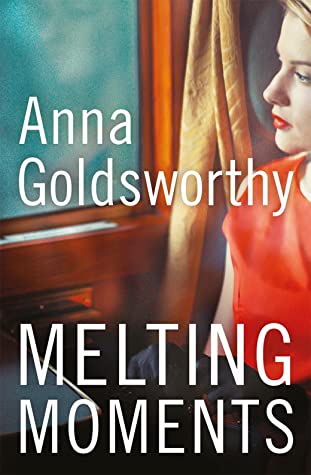
Anna Goldsworthy, Melting moments (#BookReview)

Book cover

Melting moments is Australian writer and concert pianist Anna Goldsworthy’s debut novel, following her highly successful memoir of a decade ago, Piano lessons (my review).

Melting moments – for those not familiar with this Antipodean classic – are little shortbread-based biscuits (cookies) sandwiched together with buttercream. In titling her book by these little treats, with the added intimation of moments that melt our heart, Goldsworthy flags the tone and subject matter of her book. The tone is going to be gentle, and the subject matter domestic. The question is: does this make for an interesting book, or just a sweet one?

Overall, I’d say interesting. As a member of my reading group suggested, there is another connotation of the title, that of moments that melt away, of moments that don’t last. So, Goldsworthy’s Melting moments captures the life of a woman from the so-called “greatest generation”. Born between 1901 and 1927 (so my mother just misses it), they went though the Great Depression and World War 2. Sociologist Glen Elder suggests they came out of these experiences “with an ability to know how to survive and make do and solve problems”. This could describe Goldsworthy’s protagonist, Ruby, who marries Arthur, after a short courtship, on the eve of his heading off to the War. She might as well have the “war widow pension” he says, an idea that was, I think, behind a few marriages at the time. This social history aspect is one of the reasons for reading this book which takes us through the decades of marriage, children, empty nest, ageing parents, retirement village life, leaving us when Ruby reaches her early eighties.

This, I know, makes it sound like one of those big family sagas, but in fact it’s not, on two counts. First, it’s short, at just 230 pages, and second, it has no big dramas – just the little trials and tribulations of life.

“misplaced life”

However, this doesn’t mean the book is boring. Ruby lived in the pre-feminist world when women had few rights but many gender-prescribed responsibilities – stay-at-home, cook and house-keep, bring up the children, and keep the husband happy. Like many of her generation, she doesn’t rock boats, but knuckles down to it (using her consciously developed “resourcefulness” to help her along the way). But, she’s not blind to what all this means and, sometimes, she feels

the emptiness rush in at her, as if she were living on a road from nowhere to nowhere …

Or, occasionally wonders

whether life should be something more than a series of daily tasks, successfully dispatched.

Indeed, later in the novel, she considers a path not taken – one involving throwing it all in for the exciting man. But that way led to “briars … social condemnation; impecuniousness; the heartbreak of children”, and, anyhow, the man had removed himself. Nonetheless, she sometimes feels

as if she had missed a summons. As if she had somehow missed her life.

This situation, of course, is not unique to her generation, but it is true that making such a break in her era would have been more difficult. And, anyhow, Arthur, as Ruby recognises herself, was not a bad husband – just a “stolid” one – and their marriage was “more or less” successful.

The novel is written third person, but its focus is Ruby, meaning that the other characters are not significantly fleshed out. Most are nonetheless more than just simple stereotypes. The “stolid” but kind Arthur, for example, is more willing to accept daughter Eva’s grasping the freedom of the 1960s and 1970s than Ruby. And Eva, though frustrated with her mother’s conservatism and inability to understand the changing world, is a loving daughter who finds a balance between living her life her way and loving and supporting her mother.

Ruby’s parents have some individualised flesh on their bones too, but Arthur’s mother, Granny Jenkins who lives with them much of their married life, is rather more the stereotypical unsupportive, demanding mother-in-law. However, Ruby just gets on with that too – as most women did – organising things as much as she can to minimise the imposition .

Now, early in this post, I mentioned that this book, despite its chronological sweep, is not a saga. This begs the question of how Goldsworthy tells the story of such a long life in such few words. She does it by using an episodic structure, skilfully paced so that you always know where you are in Ruby’s life. The gaps are obvious, of course, but it’s also clear that we are getting the critical “moments” in Ruby’s life.

The end effect of all this is a quietly observed book, one unsatisfying for some, and perfectly satisfying for others, as my reading group discovered. Some of us wanted the gaps filled in. Why was Arthur released early from active service, for example. Others of us accepted that the focus was Ruby and what she thought and cared about. When the opportunity finally comes when Arthur might share his war story, she turns away and makes a cup of tea! “What’s done is done”, she says.

There is some humour in the book, and I did smile many times, but, while it felt like an Austen-ish story, it doesn’t have the sharpness of her wit. I must say that in a nicely observed story like this, I did miss that bit of bite.

Melting moments, then, did not exactly wow me, but neither did I find it trivial. Without being consciously political, it works as a reminder of those women who didn’t always identify what it was that caused their feelings of “emptiness”, but who just got on with it, and somehow managed at the same time to bring up the Evas who went on to grab the opportunities available. Goldsworthy has paid credit to them, in a warm-hearted and enjoyable book.

Challenge logo

Anna Goldsworthy
Melting moments
Carlton: Black Inc, 2020
230pp.
ISBN: 9781863959988

Julia Baird, Phosphorescence (#BookReview)

Book cover

Much as I love watching Julia Baird on The Drum, and much as Mr Gums and I worried about her multiple cancer diagnoses and her extended journey to recovery over recent years, I’m not sure I would have read her book, Phosphorescence: On awe, wonder and things that sustain you when the world goes dark, if my reading group hadn’t scheduled it. However, we did schedule it, and I did read it. I found many of its ideas affirming or confirming, or, if not those, thought-provoking. In other words, although it feels like a self-help book which I usually avoid, I’m glad I read it.

Why? Her hope, which she shares late in the book, is pretty straightforward:

I wrote this book in the hope that it might be a salve for the weary, as well as a reminder of the mental rafts we can build to keep ourselves afloat, the scraps of beauty that should comfort us, the practices that might sustain us, especially in times of grief, illness, pain, and darkness. (p. 274)

She goes on to say that she understands that the things she’s shared, “stillness, kindness, the sea and ancient trees can hardly be a universal panacea for all the suffering on the planet”. This is true, but there is more to the book. In the Prelude, she describes her intention as being ‘to search for “the light within”, for what makes people shine’. What she shares, I’d say, will speak to each reader differently, according to our personal values, beliefs, and life experiences.

The book is divided into four main parts, focussing in turn on awe, wonder and silence; the importance of accepting and valuing failure and imperfection; the art and value of friendship; and the practice of looking and savouring, of paying attention to our inner strengths. Each of these explores its topic from three perspectives: documentary evidence from researchers, writers, philosophers; anecdotal evidence from people Baird knows or has spoken to; and, of course, her own personal experience.

It is an unusual hybrid of a book. Part book of essays, part memoir, and part quest (for “phosphorescence” or “the light within”), it sometimes felt more like a collection of random thoughts and ideas than the coherent argument I was expecting. This may be partly because several of the essays originated in previously published pieces, whose links are not immediately obvious. However, while this uncertainty was at the back of my mind as I was reading, it didn’t stop me enjoying each essay as it came along, because each had something interesting – and often heartfelt – to offer.

So, for the rest of this post I’m going to share some of the ideas that appealed to me and why.

Japanese thought, friendship, imperfection and doubt

First was the frequency with which she references Japanese thinking and aesthetics – and many of you know how much Mr Gums and I like Japan. The ideas, which are hard to put into Western words so my descriptions are loose, are Shinrin-yoku (or forest-bathing, the physiological/psychological benefits of being in the forest); Yūgen (mysterious or sublime, perhaps, experiences of beauty); Wabi-sabi (beauty in imperfection or transience, often characterised by asymmetry, roughness); Kintsugi/Kintsukuroi (repairing broken pottery visibly, so that the damage becomes part of its history and beauty); and Moai (the groups created among newborns in Okinawa to provide lifelong social support).

It’s not surprising that a nation that is generally known for values like stillness and stoicism, for preferring what novelist Juni’chirō Tanizaki calls “a pensive lustre to a shallow brilliance”, might have ideas relevant to a search for our “inner light”.

Moai is discussed in the section on friendship which is titled “We are walking each other home” (after Ram Dass). If there’s one image from the book that moved me it was this, the idea of “walking each other home”. It speaks of grace, tenderness and care, and of the way I’d like to think my friends, family and I are with each other. Baird’s section on friendship is beautiful.

In another evocatively titled section – “We are all wiggly” – Baird discusses failure and imperfection. Again, as in the other sections, she ranges over a wide range of ideas and examples, which are too numerous to share here, but they include honouring our failures, letting ourselves go (appearance-wise), and appreciating impermanence.

In the fourth section, Baird, a Christian, writes about faith and doubt. While I appreciated her discussion of her faith and what Christianity means to her, I most enjoyed her discussions of other forms of faith, hope and stoicism, and its corollary, doubt. Embracing doubt is valid, she argues, though she adds this aside:

(Although, seriously, if you can’t accept what the vast majority of scientists have to say about climate change, it’s not doubt that is your problem.)

I also enjoyed her exploration of the importance of searching for our “ert” (a term coined by marine biologist Lisa-ann Gershwin to oppose “inertia”).

In this section she also refers to Helen Garner and Tim Winton, Australian writers for whom faith is important, but whose thinking about it is personally rather than institutionally focused.

Setting a “low bar”

However, what struck me most was her articulation of a philosophy that I live by. It is, as described by psychologist Barry Schwartz, that “the secret to happiness is low expectations”. Or, at least, Baird adds, “realistic ones, erring on the low side”.

When it first dawned on me that this was how I managed my life, I was surprised. It didn’t seem to accord with my view of myself as an idealist, but I then realised that the two were not mutually exclusive. I could have high ideals of how we should all behave and treat each other but I could also not expect that we all would (all of the time). I worried that this might sound snooty, or holier than thou, but hoped not. For me, this approach encompasses the realisation that we don’t all come from the same place; we don’t all have the same experiences or values; we have not all had the same opportunities; and, perhaps most critically, many of the things that affect us are out of our control and that, to remain sane, I need to be able to accept them.

As I’ve been writing this post, it’s become clear to me that the book does, in fact, satisfy Baird’s goal of searching for “the light within” – even though, while reading it, I sometimes felt I was losing the overall plot as I followed her down multifarious paths. In retrospect, I’ve decided that this could be the book’s strength. Not only does it offer a variety of experiences and thinking, but it enables us to choose paths most suitable for us, paths that may change depending on our circumstances. I won’t be swimming with giant cuttlefish like Baird, but I’m very happy to bathe in the forest.

Challenge logo

Julia Baird
Phosphorescence: On awe, wonder and things that sustain you when the world goes dark
Sydney: Fourth Estate, 2020
310pp. (including 23 pages of Endnotes)
ISBN: 9781460757154

Balli Kaur Jaswal, Erotic stories for Punjabi widows (#BookReview)

Book cover

Broadly speaking, Singaporean author Balli Kaur Jaswal’s third novel, Erotic stories for Punjabi widows, reminds me of Anita Heiss’ choclit books like Paris dreaming (my review). By this I mean it presents as an escapist romcom genre novel but within it is some serious intent. In this case it relates to the oppression of women, particularly widows, and, more specifically, the problem of honour killings, in Britain’s Punjabi Sikh community.

The story concerns the “still searching for her calling” Nikki, who, twenty-two-and-a-half years old with half a law degree behind her, obtains a job teaching writing to immigrant Punjabi widows in Southall, the heart of London’s Punjabi community. Except, what she finds is that these widows do not want to learn to write:

I’ve survived all this time without reading and writing; what do I need it for now?’

What they want is to tell stories – erotic ones – to each other. What they want, really, is companionship and a safe place to be themselves, away from the oppressive eyes of a traditional community dominated by the self-appointed “morality police”, the Brothers.

And here is where some darkness comes in, because within this community, several young women have died. Officially, these deaths are recorded as accidental or suicide, but it gradually becomes apparent that all may not be as it seems and that murder and honour-killing may be involved. Widow Sheena chillingly says later in the book that “in this community I’m suspicious of accidents.” The novel, therefore, is a romcom-cum-crime mystery.

Paralleling this story of the widows and their writing class is that of Nikki and her nearly 25-year-old sister, Mindi. Born in England to Punjabi immigrant parents, they represent the other side of the cultural coin – to a degree, anyhow, because Mindi, a nurse and (still) unmarried, is considering “embracing our culture” and going the traditional arranged marriage route. This shocks the freer wheeling, English-to-a-core-she-thinks, Nikki, who tells Mindi:

This is what young women do in Britain! We move out. We become independent. This is our culture.

Even so, our modern Nikki does sometimes feel “split in two parts. British, Indian.” Fortunately, Nikki meets a man the more usual way – by serendipity – and love starts to bloom. But, this is a rom-com so, as you’d expect, the course of true love doesn’t run smooth and soon enough Nikki finds herself wondering why this man is behaving a little strangely.

As with Anita Heiss’s choclit books, what lifts Erotic stories for Punjabi women out of the straight chick lit genre, is its interrogation of social issues. Besides the above-mentioned mystery concerning a young woman’s death, two other issues are reflected in the lives of these characters, one being the challenges faced by young first generation women, and how they navigate the two cultures they find themselves straddling. By having Nikki and Mindi handle this quite differently, Jaswal reveals the complexity of what this generation faces. Then we add in Nikki’s new love, Jason. I don’t want to spoil anything, but let’s just say that his experience of being a first generation Sikh man from the USA, and the expectations placed on him, adds commentary to Nikki and Mindi’s thoughts about life, love and marriage.

The other main issue is the oppression of Punjabi Sikh women, particularly but not only widows, within their own culture and in the culture of their adopted home. Our widows are invisible in their own community. Without their husbands they are seen as and feel “irrelevant”. However, these Punjabi women overall haven’t made any inroads into the English community either, feeling the English “haven’t made their country or their customs friendly” to them. “Britain”, Nikki realises, “equalled a better life and they would have clung to this knowledge even as this life confounded and remained foreign.”

There is, then, a lot going on here, but Jaswal, whose first novel, Inheritance, earned her a Sydney Morning Herald Best Young Australian Novelist Award, knows how to construct and move along a plot. She also knows how to entertain. The erotic stories are a bit of a hoot. With our widows finding creative synonyms for certain body parts, you may never look at a cucumber the same way again. It’s laugh-out-loud funny at times, which my reading group enjoyed, and there are some lovely touches of irony. For example, the earnest Kulwinder, interviewing Nikki for the writing class, starts to sense that Nikki’s idea and her own may not be aligned:

It dawned on Kulwinder that she had advertised for something she did not understand.

The joke, though, is on Nikki too, because for all her “passion to help the women”, little did she expect just how that “passion” might play out!

My favourite books are those which touch the heart and challenge the mind. Erotic stories for Punjabi widows, for all its serious intent, primarily meets the former. It ticks all the boxes: it’s fun to read, has likeable characters, and its message is valid and relevant. For me, though, it’s a little too obvious and predictable, and the resolution is too neat to give the book the sort of gritty, punchy power I love. However, I enjoyed the read and recommend it to anyone wanting an enjoyable romp of a read with a little meat on its bones.

Lisa (ANZLitLovers) also enjoyed this book.

Balli Kaur Jaswal
Erotic stories for Punjabi widows
London: HarperCollins Publishers, 2017
ISBN: 9780008209902 (eBook)
299pp.

Griffith Review 68: Getting on (#BookReview)

Book coverI love reading the Griffith Review, though have mostly only reviewed individual articles on this blog. It’s a meaty quarterly, with each edition being devoted to a particular theme. Edition 68’s theme, Getting on, seemed apposite for my reading group and so was our August selection. Although it was confronting at times, it was a universally approved choice, and our discussion was lively and engaged.

Like all Griffith Reviews, this edition contains essays, reportage, memoirs, fiction and poems, some from writers who have previously appeared on my blog (like Helen Garner, Vicki Laveau-Harvie, Kathy Marks, and Charlotte Wood); some from writers known to me but not (yet) on my blog (Melanie Cheng, Leah Kaminisky, Sam Wagan Watson among others); and some new to me. The edition opens with editor Ashley Hay’s introductory piece, “The time of our lives: Senescence, sentience and story”. She frames the volume’s overarching subject matter by saying that ageing in Australia:

has been largely framed by intersections between a Royal Commission and its revelations of institutional shortfalls and betrayals; the urgent need for reform; the conditions we place under the umbrella designation of ‘dementia’; an increasing awareness of under-reported ageism; the seemingly intractable gap in life expectancies between Indigenous and non-Indigenous Australians; the day-to-day experience of some 200,000 older Australians who live in residential-care facilities; and an emphasis on the ‘costs’ of an ageing population rather than any framing of the potential benefits of longevity.

However, while these practical and political issues underpin the volume, it also includes some more philosophical and personal reflections which provide breadth and life to the discussion. And so, the edition proper starts with established writer, 77-year-old Helen Garner (“The invisible arrow”) who provides a personal perspective on the experience of ageing, on losing hearing (necessitating hearing aids) and failing sight (requiring cataracts). It’s also about the quandary of being a writer challenged by ageing, an issue somewhat addressed, from a different angle, by Charlotte Wood (“Experiments in the art of living”).

Because my life over the last couple of decades has involved elderly people, I was particularly interested in the essays on aged care practice and policy, especially Sarah Holland-Batt’s “Magical thinking and the aged care crisis” and Beth Mohle’s “System failure”. Both these provided detailed analysis of the current failures of the system – including the multiple reviews with their multiple ignored recommendations – and offer some ideas for improvement. The problem is also taken up provocatively by Gen Xer Ingrid Burkett in “Bold rage” and more calmly but also passionately by another Gen Xer, Charlotte Wood. I did laugh, though, when Burkett suggested one of the ideas discarded by Holland-Batt as “magical thinking”, the “geriatric co-op” or, as Burkett wrote, “buying a large house or building a purpose-built dwelling where we could all live together as we age”. It’s not a new Gen X idea. My Boomer friends and I posited this idea too in our youth!

Policy discussions also take up other issues, like euthanasia and assisted dying (Andrew Stafford’s “Dying wish”) and the disturbing problem of increasing homelessness among older women (Therese Hall’s “Almost homeless”).

Then there are the pieces specifically about the science of ageing (such as Bianca Nogrady’s “Longevity, science and, about medicine and about dead” and David Sinclair’s “Live long and prosper”); about how science may help ageing and aged care in the future (Leah Kaminsky’s intriguing discussion of AI in “Killing time”); and about personal experiences of chronic illness (Mark Aarons’ “Solving my medical mystery”) and death (Gabbie Stroud on her brother’s suicide, “In an unguarded moment”). In this personal vein too is the moving poem, simply titled “Andrew”, about the family’s experience of the terminal illness and death of writer, Andrew McGahan. Niece Anna McGahan writes:

He cannot carry our projected burdens
When he still has heavy gifts
Three glorious, painful months to fill

There are, in fact, several moving pieces – some personal, some professional. Melanie Cheng writes about being an unempathetic intern and what turned her around (“The human factor”) while palliative care specialist, Frank Brennan (“Contemporary loss”), details the practice of palliation. The fiction and poems that are interspersed amongst the non-fiction pieces provide personal perspectives on the information presented. Sam Wagan Watson’s short story “The elsewheres of Charlie Bolt”, for example, powerfully illustrates the isolation and loneliness that many of the contributors identify as serious problems of ageing. The line –

The only songlines Charlie Bolt knew were in the curdling of crow gargles on the street.

– conveys the dislocation Charlie experiences from his culture, as well as from life in general.

It’s impossible to list all the pieces, so I’ll conclude by sharing a couple of my responses to this volume (besides frustration with our policy-makers’ failure to properly address aged care). One relates to the discussion of older people as elders, because this suggests a more positive understanding of ageing. It’s discussed in depth by Jane R Goodall (“Joining forces: The wrath of age meets the passion of youth”) who says “there is little or no public discussion about what it means to be an elder rather than just a senior” and teases out what being an elder might look like. It’s also part of the conversation between Ruth Ross, Jay Phillips and Mayrah Dreise about making “Acknowledgement of Country” statements more meaningful (“Listening to elders: Wisdom, knowledge, institutions and the need for change”).

My other main response concerns denial about ageing and its consequences. I’m with Ailsa Piper (“Old growth: On luck, appreciation and acceptance”) who says “I like saying I’m old”, because, as she says, many never get to. Associated with this denial are people’s claims that they won’t go into aged care, that they’ll leave their home “feet first”, that they will not give up their independence. My experience of watching people age is that the situation is less that you are forced to “give up” your independence, and more that your independence leaves you!

How we handle this situation is up to us, of course, but, as Charlotte Wood reports:

Palliative care nurses have told me people almost always die as they live. A person who has lived with acceptance and gratitude will die in gracious acceptance.

She wonders when it might be time to “change one’s default state”! She then quotes an 84-year-old aged care resident:

Ageing, writes Peter Thomson of Ivanhoe, ‘is inevitable, inexorable and interesting. AAA rating for ageing: Anticipate, Adapt, Accept’.

Now that, rather than “I won’t”, seems to me to be a better default state to take.

Getting on is informative, as you’d expect, but it is also inspirational and challenging. Recommended for adults of all ages!

Note: Links on names are to posts in this blog on those writers. Lisa (ANZLitLovers) wrote up a panel discussion on this volume at the Yarra Valley Writers Festival.

Challenge logoGriffith Review 68: Getting on
(edited by Ashley Hay)
South Brisbane, Qld. : Griffith University in conjunction with Text Publishing, 2020
287 pp.
ISBN: 9781922212498

Chris Flynn, Mammoth (#BookReview)

Book cover

Mammoth, by Chris Flynn (UQP $32.99)

I am not a big fan of anthropomorphism and have read very few animal-narrated books. Animal farm is one, while Watership down, so enamoured by many of my generation, is not. However, I was intrigued by Chris Flynn’s Mammoth, which is narrated by a 13,000-year-old American Mastodon fossil, and was glad when my reading group decided to schedule it.

It is an ambitious book, encompassing the story of humanity’s destructive, often brutal march through time as seen through the eyes of those we supplanted, that is, the fossils of extinct creatures. Our narrator, Mammut, is accompanied by a number of other fossils – the skull of a Tyrannosaurus bataar, a pterodactyl, a prehistoric penguin, and the severed hand of an Egyptian mummy – who have found themselves together in 2007 Manhattan, waiting to be sold at a natural history auction. This auction did take place, and was, in fact, a major inspiration for the novel.

The story is framed by Mammut’s story of his life, death, disinterment as a fossil, and subsequent “life”. As he tells this long story, he is interrupted by the other “characters” who share their own stories, albeit far more briefly than Mammut’s. Each tends to use the voice of the time when he or she was first disinterred, meaning, for example, that Mammut’s voice is the more formal “arcane” one of the early 19th century, while T. bataar’s is the hip voice of the late 20th century.

As Mammut tells his story, he takes us to selected (representative) hot-spots of human brutality such as the Irish Rebellion of 1803, the oppression of Native Americans in the early 1800s, and Nazi Germany. He also covers theories of extinction, climate change, and the equation of big animals with power in the minds of men. The novel starts with a letter written in 1800 by Thomas Jefferson seeking mammoth bones (which he does eventually acquire for the White House), and ends with male celebrities vying for our fossils at the auction. Early on, Mammut tells T. bataar:

Let me tell you, and I say this as an original American, nothing compares to this nation’s willingness to promote patently false notions about itself in order to create a myth of American potency … Who do you imagine will buy us? You said it yourself, T.bataar. We represent power, for that’s what we were: Behemoths, Colossi, Titans. (p. 15/16)

Later, Pterodactylus tells the group about being used in training Hitler Youth:

We were presented to the eager teens as proof that Germany had once been the centre of might in Europe and the origin point for life on earth. Your mastodon friend in particular was elevated as a symbol of strength … I was referred to as the Reptilian Eagle, an apex predator who dominated the skies. It would have been a compliment, had it not come from the mouths of maniacs. (p. 159/160)

Mammoth is, then, a provocative book, confronting head on the ills of humanity. It could be deeply depressing – and in a way it is – but Flynn has taken his own advice (more on this anon) and told his story with humour, mainly through repartee between his fossil characters. I must say that I initially found this humour a bit silly, a bit obvious, and I wondered whether I was going to enjoy the book. However, the more I read, the more fascinated I became by what Flynn was trying to do. I didn’t find it as “hilarious” as some blurb writers did, but Mammoth offers such an idiosyncratic journey that I’m glad I decided to go with the flow.

One of the book’s main pleasures for me, besides its commentary on humanity’s destructiveness, is the writing master class contained within its over-riding story. This started with some digs about the writing life, such as Mammut’s “no-one gets into the writing game for money these days. No-one in their right mind, at any rate”. A sentiment that is reiterated later by French writer, Bernadin de Saint-Pierre.

However, more entertaining was the discussion of writing, or storytelling, itself. As Mammut’s tale progresses, his listeners begin to question him. Sometimes, it’s the issue of disbelief, to which Mammut responds by explaining his sources, by arguing that it’s perfectly valid for his molar to be observing action in one place while his head is elsewhere, or by allowing himself a little leeway:

I know you’re technically an elephant and all, but your recall of events is a little too precise. Not to mention the verbatim dialogue. Surely, you’re making some of this up? This is my problem with the memoir genre. There’s always more fiction in it than people let on.

I possess a remarkable memory, Palaeo, though I will admit to the occasional romanticism of the narrative. For the most part, what I am recounting is true. But, as you say, I am a storyteller who enjoys indulging in a yarn. (p. 143)

There’s also discussion of tone, regarding the degree of brutality and tragedy in Mammut’s tale:

… This entire tale has been a veritable famine of LOLs. Really, Mammut, next time you tell this story, you need to inject some humour, bro.

No too much, I think, T. bataar. No comedian ever won the Pulitzer … (p. 235)

Flynn, thus, cleverly engages with some current issues in criticism while simultaneously fending off potential criticism of his own work. He crowns this early on with the pronouncement that “No story’s gold from beginning to end” (p. 66). How can you argue with that!

There’s much more to this book. I haven’t touched on the fact that almost all its hominid characters are historical personages, many findable in Wikipedia. Mammoth offers an entertaining, accessible introduction to the history of palaeontology and 19th century natural science, and provides a springboard for further research, should you be so inspired.

For now, though, I’m going to end with a poignant statement made by Mammut early in the novel. “Our world was changing”, he says, “and there was nothing we could do about it” (p. 44). I fear this is exactly how our earth is feeling right now. Flynn, I think, would like us to take note and consider what we might do to prevent avoidable extinctions under our watch. An imaginative, engaging read.

Theresa (Theresa Smith Writes) enjoyed this book too.

Chris Flynn
Mammoth
St Lucia: UQP, 2020
254pp.
ISBN: 9780702262746

(Review copy courtesy UQP and literary agent Brendan Fredericks)