Elizabeth von Arnim, Vera (#BookReview)

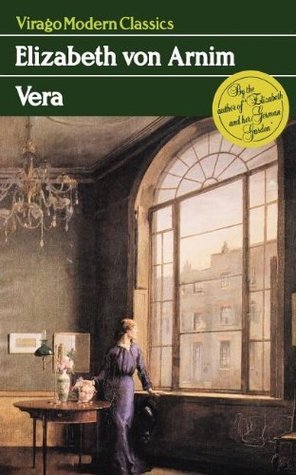
After a run of tough reads in 2021, my reading group wanted something gentler, so I suggested that for our “classic” we do a novel by Elizabeth von Arnim, whose works I’ve loved for their pointed wit, delightful humour, and astute commentary on marriage and the relationship between men and women. As is my wont, I nominated one from my TBR shelves, Vera. To my delight, they agreed.

Then, before reading it, I decided to remind myself of von Arnim’s life, so I read Gabrielle Carey’s Only happiness here: In search of Elizabeth von Arnim (my review). Imagine my horror when, two-thirds through, Carey wrote that Vera was her “darkest” novel, “a haunting portrait of psychological tyranny”. What? Too late by then, but I did hope my reading group would, one, forgive me, and, two, not be turned off von Arnim. As it turned out, all those who attended the meeting liked the book and pronounced it “not too dark”. Was I pleased!

Nonetheless, Vera is a dark novel, one that reminded me of a book written four decades later by Elizabeth Harrower, The watch tower (my review). Both novels are about narcissism and coercive control, about older men who marry and tyrannise vulnerable and inexperienced much younger women.

Wuthering Heights by Jane Austen”

When Vera was published, readers and reviewers were, says Carey, confused. How did “playful, witty Elizabeth von Arnim, author of light social comedies” become “a gothic writer of macabre tragedy”? Von Arnim was distressed but cousin Katherine Mansfield’s husband, John Middleton Murry, is reported to have said to her, on the appearance of a negative review in The Times Literary Supplement, “Of course my dear, when the critics are faced with Wuthering Heights by Jane Austen, they don’t know what to say.”

This is an apposite comment for a few reasons – besides its intention to reassure. Firstly, von Arnim pointedly has Lucy, our young wife, read Wuthering Heights even though husband Everard calls it “morbid”. It’s an effective allusion, given the darkness of Brontë’s novel and its focus on obsessive love. However, Murry’s comment also conveys something about the experience of reading this novel, because, while it is dark and distressing, it still bears von Arnim’s Austen-like light touch, and that, I think, is what my reading group appreciated.

By now, if you haven’t read it yourself, you may be wondering why this novel is called Vera when the two protagonists I’ve named are Lucy and Everard? So, let me do a quick plot summary.

The novel begins with 22-year-old Lucy Entwhistle leaning on the front gate of the house in Cornwall that she and her father had taken for the late summer. Her father has just died suddenly and Lucy is in shock. Into view comes another – apparently – grieving person, the mid-forties Everard Wemyss, whose wife Vera had died a week or so ago. Things, though, are not quite as they seem. A shadow hangs over Vera’s death, with a suggestion that it may not have been accidental but a suicide. Lucy, unfortunately, is naive and vulnerable, and despite the best efforts of her wise Aunt Dot, she is swept into marriage, with socially unacceptable haste. After the honeymoon, Everard takes her to his county mansion, “The Willows”, where Vera had died. He makes no attempt to change anything – expecting Lucy to sleep in the same bed Vera did, to occupy Vera’s sitting room, to have breakfast overlooking the flagstones onto which Vera had fallen (or jumped). Kind, head-over-heels-in-love Lucy does her best to justify Everard’s increasingly controlling behaviour but it dawns all too quickly that he expects nothing less than utter servitude . 

And so, Lucy, whose usual state had been one “of affection and confidence”, learns that the “scenes” that she hated could not be avoided “for no care, no caution would for ever be able to watch what she said, or did, or look, or equally important, what she didn’t say, or didn’t do, or didn’t look”. It leaves her “afraid with the most dismal foreboding, that someday after one of them, or in the middle of one of them, her nerve would give out and she would collapse. Collapse deplorably; into just something that howled and whimpered.”

Lucy starts to think kindly of this Vera she’d never met.

“It’s wonderful, wonderful … what love will do” (The doctor)

It’s grim, certainly, but this is Elizabeth von Arnim, so there’s humour – black comedy – here too. There are some truly funny scenes, particularly involving the poor servants for whom Everard has not one ounce of humanity. These servants only stay at “The Willows” because he is in town all week. They can manage his cruelly imperious ways from Friday night to Monday morning, because the wages were higher than any they’d heard of. (They probably had to be!)

So, here is a scene in which Everard confronts the parlourmaid about a missing button on a piano leg cover:

“What do you see?” he asked.
The parlourmaid was reluctant to say. What she saw was piano legs, but she felt that wasn’t the right answer.
“What do you not see?” Wemyss asked, louder.
This was much more difficult, because there were so many things she didn’t see; her parents, for example.
“Are you deaf, woman?” he enquired.
She knew the answer to that, and said it quickly.
“No sir,” she said.

And so it continues, but you get the gist. The scene is indicative of Wemyss’ extreme bullying behaviour, but you can’t help laughing while feeling for the poor parlourmaid.

This black humour is one of the things that kept me reading. Another was von Arnim’s writing. She has wonderful turns of phrase, such as this of Lucy reining in some disturbing thoughts: “Lucy made a violent lunge after her thoughts, and strangled them”.

Von Arnim is also an excellent satirist and ironist. Just look at the doctor’s statement above. He’s surprised and unsure about the marriage to Lucy but, well, look what love can do! Already, however, we are aware that his initial uncertainty is more than valid. One of the points Carey makes in her book is von Arnim’s disappointment in love and marriage. In her experience – including the marriage to Francis Russell which inspired this novel – men change as soon as they are married or, as the heady days of love wane. Vera is at the extreme, but not unbelievable, end of this disappointment.

Finally, there’s Jane Austen. Elizabeth von Arnim – and I’m not the first to say this – owes much to Austen. From my first Von Arnim, Austen’s wit and astute observation of human nature shone through. She nails the way humans think and behave with, sometimes, excruciating accuracy. But von Arnim’s style in Vera is not Austen’s. We don’t have Austen’s omniscient third person voice. Vera is told third person, but von Arnim uses that technique more common to modernists, the interior monologue, with the narrative perspective shifting between the main characters – Lucy, Everard and Lucy’s wonderful Aunt Dot. In fact, a few of the last chapters are with Aunt Dot as she comes head-to-head with Everard and learns just how right she had been to be concerned – but, well, look “what love will do”.

There’s more to discuss in this book. There’s Wemyss’ deeply creepy infantalisation of his 22-year-old wife, calling her “a good little girl” and “my very own baby”. There’s also his insistence that everything can be simplified to one right answer. Initially, the overwhelmed, grieving Lucy finds this comforting but, having grown up in an atmosphere of intellectual enquiry, she starts to not only think that such an attitude might “cut one off from growth” and “shut one in an isolation”, but to doubt “whether it was true that there was only one way looking at a thing” or “that his way was invariably the right way”.

Too soon after her death, Elizabeth von Arnim was relegated to the realms of light romantic comedy, but that denies their value, even when you look at her lighter works. However, when you add Vera to her oeuvre, you have a writer whose work must be seen as relevant now as it ever was.

Elizabeth von Arnim
Vera
London: Virago, 1983 (orig. pub. 1921)
319pp.
ISBN: 9781844082810

Ida Vitale, Byobu (#BookReview)

Uruguayan writer Ida Vitale’s Byobu was my reading group’s second book of the year. Originally published in Spanish in 2018, with the English translation released in 2021, Byobu is Vitale’s first book of prose to be translated into English. Few, if any of us, had heard of her – and yet, this now 98-year-old woman was, in 2019, named by the BBC as one of the 100 most influential women of the year. The things we don’t know!

Anyhow, Byobu is a curious book. It has no clear narrative, and only one character, the eponymous Byobu. It’s just 85 pages, and comprises 34 “chapters”. It is replete with allusions to a diverse range of writers, thinkers, musicians. In other words, it’s one of those books you can struggle with, if you don’t come up with a way of reading it. For me, this was to jettison preconceptions about what a novel is and go with the flow to see what fell out. And what fell out was a mind-opening, and sometimes witty, series of thoughts and observations about life and living. I can’t say I understood all of it, but I thoroughly enjoyed the reading experience.

The best way I can encapsulate Byobu is to describe it as a sort of modern Everyman story, the story of an individual in a world that can be confusing, if not sometimes downright hostile. The overall theme seems to me to be: How do you live in this world?

Before I explore this more, some basics. Byobu is set in Uruguay, and although there’s no plot per se, there is some structure. (I’d probably find more structure had I time to read it a few times). The opening chapter introduces the idea of “story” – and clues us into the idea that we are going to be unsettled:

a story’s existence, even if not well defined or well assigned, even if only in its formative stage, just barely latent, emits vague but urgent emanations. (“A story”)

The next few chapters introduce us to Byobu, conveying a general sense of who he is. These are followed by chapters that consider bigger issues in contemporary life.

However, although we are introduced to Byobu, he remains somewhat shadowy. We don’t know how old he is, but one member of my reading group suggested he was old, like his author, and that he encompasses an old person’s thoughts about life. I can accept that. Regardless, besides not knowing how old he is, we don’t know whether he is (or has been) married, has a family, is working, and so on. A family home is mentioned, and there are references to daily activities including attending a conference. All this vagueness supports the idea of him as an Everyman (albeit, possibly, an old one!)

We do, though, learn some things about the sort of person Byobu is. He can be indecisive. He has “an intractable inclination to complicate things”, and hates change. He’s not a good storyteller, but he likes nature and enjoys minutiae. Unfortunately, though,

often distracted by some minutia captivating him at a particular moment, he misses fragments of conversations that later turn out to be important. (“On anodyne things”)

I found him very human and engaging, to the degree I could, given his shadowiness.

I fear though that I’m not selling the book, so I’ll try now to share some of its joys and intellect. I’ll start by talking a little about the style. Many of the “chapters”, and I put them in quotation marks because some are only a paragraph long, start with what you could call truisms, but they don’t read as cliches, like:

Everything important lies below the surface. (“Terrestrial labours”)

Byobu concludes that he must begin by ending. (“Knots”)

Byobu has heard it said that ‘every mile has its rough patch’. (“Epiphanies”)

Byobu is not always able to predict how the situations he gets involved in will end. (“Dangerous misunderstandings”)

How can you be sure that the avenue, boulevard, or ordinary road you’re facing is not actually a blind alley? (“Crossroads”)

Just look at that sentence, “Byobu concludes that he must begin by ending”. So terse, so clever. “Knots”, in fact, is one of those one-paragraph chapters. It concerns Byobu’s realisation that if he doesn’t end his “trepidations” and “tepid transactions”, if he doesn’t “lay limbos aside” and “ignore everything initiated by the iniquitous” – he will have to “accustom himself” to “the cage”. But, can he recreate himself?

“Crossroads” addresses another recurrent idea in the book, the importance of the imagination, of mystery, over the mundane. Opposing mystery and imagination are “straight lines” which also recur, starting in the second chapter, “Life is not a straight line”. In “Knots”, Byobu learns that straightness “lays snares” and in “Against the Argive Way”, he is aware that “The world loves conversations in straight lines and single-minded strides. Intersections divert. Labyrinths confound.”

A few chapters in, then, it dawned on me that Byobu was about more than a man muddling through life, that it’s a commentary on modern life. Byobu pleads for the imagination, for not going in straight lines. It critiques conformity, power and authority, commercialisation, urbanisation, inhumanity, and resistance to change. “Internal coherence” explores resisting social pressure. It is “immoral”, it suggests, to accept a world “governed by the boorish authorities who rule during these evil times we inhabit”. Yet, Vitale realises resistance is not easy, so her Byobu “resists on the inside, while staying quiet and feigning surrender”.

In the penultimate “chapter”, “Byobu and the traffic light”, traffic lights are a metaphor for “supervision and compliance”. Here “the defiant … recognise the bad example of a behaviour that is a silent hymn to obedience to all authority”. Vitale goes on to suggest that traffic lights should, in fact, “innervate the pedestrians” (who are “increasingly incongruent elements in the city”) to “assume their role as essential antagonists”. This chapter is a call to defy, to rebel.

Lest this all sound rather bleak, let me say there’s beauty here too. There are, for example, some lovely descriptions of nature:

In the garden, jasmines reign supreme. At night the star jasmine is a vertical Milky Way, delirious with aroma. (“Seasons”)

And, there is quite a bit of humour. Much is of the quiet, understated sort, but it made me laugh. “It’s true”, thinks Byobu, “there were three Wise Men; not quite a battalion” or “They’d better not count on him. He’s not an abacus”.

I hate leaving this book, but of course I must, so, I will leave you with two ideas. The first comes from one of the two epigraphs. Neither were translated, but the second is by Henri Michaux, and it roughly translates as “In case of danger, joke”! Joking is part of this book, but it is also deadly serious. Speaking of “story”, the opening chapter exhorts Byobu (our Everyman) not to “underestimate its flexible, disordered density”. And neither should we, because this novel has much to offer those willing to go with its flow.

Ida Vitale
Byobu
Translated from the Spanish by Sean Manning
Edinburgh: Charco Press, 2021 (Orig. Pub. 2018)
85pp.
ISBN: 9781913867023

Amy Witting, Isobel on the way to the corner shop (#BookReview)

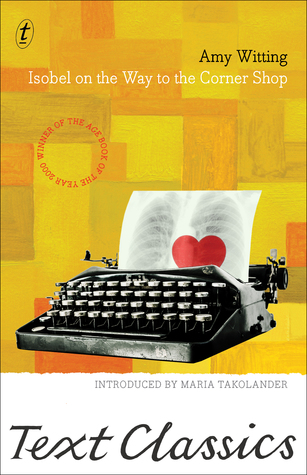
My first reading group book of the year, Amy Witting’s Isobel on the way to the corner shop, nicely doubles as a (late) contribution to Bill’s AWW Gen 4 week. Winner of the 1993 Patrick White Award, Amy Witting is one of those much-admired Australian writers who had not then and still has not received the full recognition she deserves. In her lifetime (1918-2001), she was admired by Patrick White, himself, and Thea Astley. Australian poet Kenneth Slessor is recorded as having said “tell that women I’ll publish any word she writes”.

Another admirer, Australia critic Peter Craven, argued that her form of realism wasn’t really accepted by the reading public until Helen Garner appeared on the scene, but for him “Witting was a great master of realism, a naturalist who could render a nuance in a line that might take a lesser writer a page”. Take for example this two sentence paragraph from our socially unconfident protagonist early in the novel:

The prison of other people’s eyes. No prison narrower.

So now, the book. Isobel on the way to the corner shop (1999) picks up the story of Isobel Callaghan that Witting had started in I for Isobel ten years earlier. You don’t need to have read the earlier book to enjoy and appreciate this one, because enough of Isobel’s past is given for us to have a sense of why she is the person we meet here.

“I have to step out into space”

The person we meet is a 21-year-old woman who, having received some encouragement from an editor, is struggling to establish herself as a writer. She’s poor, starving and isolated, having left her job after screaming at a colleague in “a rage”. She fears she’s going mad. I was engaged from the start by her strong sense of self, her vulnerability, and her determination to be independent, and I enjoyed every moment I spent with her. I felt anxious, as anxious as she did when she felt she was going mad, and just as relieved as she was when her illness was given a name – tuberculosis.

The first third of the novel introduces Isobel and takes us to the moment of her admission into Mornington Sanatorium in the Blue Mountains. In this section, some of the novel’s themes become apparent – one being the artist’s struggle to survive. Another concerns love. The novel starts with Isobel stalled over writing a love scene, because she doesn’t “know the first thing about it”. Not about parental, family love; not about romantic love. This, and her sense of herself as awkward and unlovable, cause her to make a big – and hurtful – mistake when a young man makes a gesture of real affection towards her.

Over the rest of this section of the novel, Isobel meets some people who show genuine kindness – love – towards her. Although the hospital makes her feel like a “parcel”, the section closes with a comforting touch from hospital volunteer Mrs Delaney, “the first time anyone had touched her in kindness”. Through the remainder of the novel, Isobel observes and experiences all sorts of expressions of love (and its opposite), including through a delightful little poetry discussion group at the sanatorium, which starts when Doctor Wang asks Isobel to explain Gerard Manley Hopkins to him.

In the final two-thirds of the novel, another theme that was nascent at the beginning, comes to the fore, and it’s to do with “being oneself”. Isobel’s sense of self is challenged at the sanatorium. It’s an inspired setting because it encompasses a microcosm of society: patients of a disease that doesn’t discriminate between rich and poor, their visitors, and the doctors, nurses and other staff with whom the patients come in contact. Finding your place in such a world, where you can be stuck for months, is not easy.

Isobel is particularly tested by her room-mate Val, a peevish, inflexible, and, she thinks, illiterate woman. Val is unhappy, and like many unhappy people, is self-absorbed. She “felt for no-one”. Try as she might, Isobel cannot get their relationship onto a comfortable footing:

Is it possible to cause so much misery to another human being, simply by being oneself? she wondered, feeling a reflection of that misery. No help for it; she must continue to be herself.

Maintaining your self is difficult, though, when you are “different”, as our funny, resourceful, and compassionate Isobel clearly is. At one point, when her recovery is threatened, she realises that she must be tougher, and so creates a new mantra for herself, “bastards get better”.

There is, surely, a hint of autobiography here, for Amy Witting’s name is a pseudonym, chosen to remind herself to “never give up on consciousness’, not be unwitting, but to always remain ‘witting'”.

Gradually Isobel does get better, physically and emotionally. She discovers, for example, that people from her old workplace cared deeply about her:

I have to live as if…I have to assume that I have some importance to other people. I have to live accordingly. I have to step out into space.

With this comes debts and responsibilities, something new for her to accommodate.

Peter Craven described Witting’s work as “a form of realism”, and “realism” sounds valid to me. The novel contains minimal drama of the narrative-arc kind. Instead, there’s astute, warm and sometimes wry, observation of ordinary people living their lives. Witting looks into the hearts and minds of human beings to understand who we are, and how we get on together with all our differences. She also offers some subtle social commentary about gender, race, poverty, class. These are not the main game, but they inform the realism inherent in the setting.

Ultimately, Isobel on the way to the corner shop is about how a young artist learns to maintain her integrity, her authenticity, while also behaving responsibly and compassionately. It is, in a way, about growing up, but it encompasses far more too.

Amy Witting
Isobel on the way to the corner shop
Melbourne: Text Classics, 2015 (orig. pub. 1999)
311 pp.
ISBN: 9781922182715

My reading group’s favourites for 2021

In our now annual tradition, my reading group once again voted for our favourites from our 2021 schedule – and as has also become tradition (see last year’s if you like), I’m sharing our reading and findings with you.

First, though, here is what we read in the order we read them (with links on titles to my reviews):

This schedule is very different to last year’s which was was less diverse than usual: nearly all were Australian and we didn’t do a classic. It’s true that our focus always has been Australian – with a special interest in women – but it was never meant to be quite so narrow as it was last year. So, this year … we did a classic; we did just 5 Australian books; and we read three male authors (plus those who had essays in the Best Australian science anthology). The first half of next year will see a continuation of this variety, with not only a classic but a translated book (which has been absent for a couple of years).

The winners …

All twelve of our currently active members voted, and the rules were the same. We had to name our three favourite works, which resulted in 36 votes being cast. No weighting was given to one over another in those three, even where some members did rank their choices. Last year we had a runaway winner – it received twice the number of votes as the two which shared second place. This year though was completely different. The winning book received 8 votes, second 7 votes, third 6 votes and so on down to fifth with 4 votes. Consequently, we have two Highly Commendeds this year, because after 4 votes we dropped to 2, 1 and none.

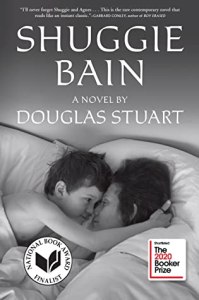
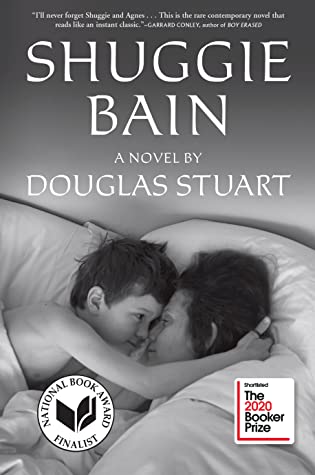
  1. Shuggie Bain, by Douglas Stuart (8 votes)
  2. The crocodile song, by Nardi Simpson (7 votes)
  3. Girl, woman, other, by Bernadine Evaristo (6 votes)

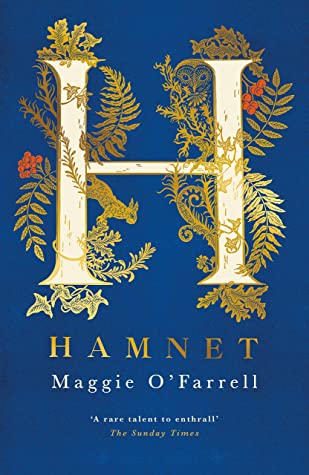
Highly commended: Where the Crawdads sing, by Delia Owens (5); Hamnet, by Maggie O’Farrell (4).

  • Book cover

It was a real tussle this year, and I enjoyed watching the votes come in. Until the last two votes, Nardi Simpson was winning – oh, how I would have loved her to win, particularly after Melissa Lucashenko’s win last year – but she was pipped at the post.

Interestingly, last year all three of the nonfiction titles on our list featured among our favourites, while this year the two nonfiction works didn’t get any votes at all, though they both generated excellent discussions. It’s just that we read such strong fiction. Every book but the two nonfiction books received at least one vote.

Of course, this is not a scientific survey (and it’s a very small survey). Votes were all given equal weight, even where people indicated an order of preference, and not everyone read every book (though most did this year), so different people voted from different “pools”.

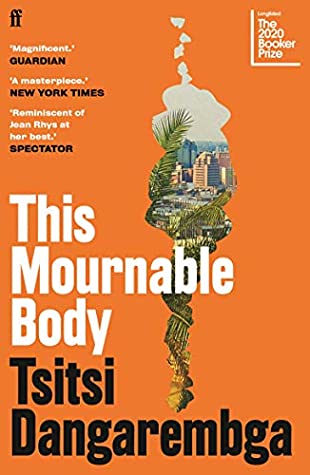
Oh, and if you want to know my three picks, they were Tsitsi Dangarembga’s This mournable body, Bernadine Evaristo’s Girl, woman, other, and Nardi Simpson’s Song of the crocodile. It was a hard decision though, with Shuggie Bain fighting for a place!

Selected comments (accompanying the votes)

Not everyone included comments with their votes, and not all books received comments, but here is a selection of what members said about the top five:

  • Shuggie Bain: Commenters used descriptions like “perceptive”, “powerful”, “brilliant evocative writing”.
  • Song of the crocodile: Comments included “punchy truth-telling”, “loved the ‘fantastic aspects’ … [like] the crocodile totem”, “edgy and important”, “full of beauty and … I understand intergenerational trauma more”.
  • Girl, woman, other: Commenters saw it as a “fabulous evocation of women in complicated relationships”, and “satirical, insightful exploration of diverse women”, while another said “made me feel like I was almost there in London. A great book to read while the borders stopped travel.”
  • Where the crawdads sing”: Our one commenter on it called it “evocative and compelling”.
  • Hamnet: Commenters agreed it was “powerful”: “powerful story of an invisible woman, and the impact of grief” and “powerful … imagined history. Beautiful descriptive writing”, while another said “engaging, well-plotted and historically plausible”

And a bonus!

As in 2019, a good friend (from my library school days over 45 years ago) sent me her reading group’s schedule from this year (links are to my reviews where I’ve read the book too):

  • Kate Grenville, A room made of leaves: novel, Australian author
  • Tony Birch, Ghost River: novel, Australian author (First Nations)
  • Annabel Crabb, The wife drought: nonfiction, Australian author
  • Mark Henshaw, The snow kimono: novel, Australian author
  • Richard Fidler, Ghost Empire: nonficton, Australian author
  • Clive James, The fire of joy…roughly 80 poems: poetry, Australian author
  • Michelle de Kretser, Questions of travel: novel, Australian author
  • Kim Mahood, Craft for a dry lake: nonfiction, Australian author
  • Behrouz Boochani, No friend but the mountains (on my TBR): nonfiction, Kurdish-Iranian author
  • Pip Williams, The dictionary of lost words (on my TBR): fiction, Australian author

My group has read the Henshaw and de Kretser in past years, and we have also read a different book by Kim Mahood (Position doubtful) which we loved.

So, I’d love to hear your thoughts, particularly if you were in a reading group this year. What did your group read and love?

Sarah Krasnostein, The believer (#BookReview)

One of the reasons I love reading fiction is to be introduced to lives and cultures I know nothing about. This is less so in nonfiction, but Sarah Krasnostein’s latest book, The believer, fits the brief. In it she explores questions concerning what people believe and why through six different people (or groups of people), all of which were foreign to me.

The six “beliefs” are eclectic, but can be divided into three categories : personal lives (a death doula and a woman who had been incarcerated for over 30 years for murdering her violent husband); religious lives (through a Creation Museum and some Mennonite families); and the unexplainable (paranormal seekers/ghostbusters and ufologists). These six “cases” all come from either the USA or Australia.

Different readers will be drawn to different ideas in the book, but in my reading group, the most popular were the two personal stories – death doula Annie, and ex-prisoner Lynn. Lynn’s story of abuse at her husband’s hands first and then the justice system’s was heart-rending. Yet Lynn had come to understand that she’d made choices, and had gone on to use her life to make things better for others. Inspiring.

The book has a disjointed three-part structure, with one of each of the three categories explored in “Below”, the remaining three in “Above”, and then some reappearing in the final “Coda: Here” section. Within these sections, the stories are told over several alternating chapters, so no one story is told in one go. One of the questions my reading group discussed was whether this structure helped or hindered our reading. We didn’t resolve this, though the overall consensus seemed to be that the alternating did keep us interested. There was probably method to the placement of the stories, but it wasn’t always clear to us, which might be more to do with the time of year and our concentration levels.

Lightbulb moments

What we did all agree on, however, was that the book had some great lightbulb moments – and for many of us, it’s the lightbulb moments that make a book special or memorable.

One refrain that ran through the book was that life isn’t easy or simple. Mennonite Becky says that “life isn’t just a bed of roses”, and ex-prisoner Lynn understands that “pain is a part of life”. Ufologist Jaimie has a more positive spin, seeing that life “is not just going to work and dying”. There are mysteries out there to explore.

However, for me, the most significant moment occurred in “Before”, in a Paranormal/Vlad chapter. It concerned the need for certainty. Krasnostein references German neurologist, Klaus Conrad, who coined the term apophenia, which essentially means that we look for meaning and coherence, and will go so far as to perceive them in unrelated events and ideas. We will, writes Krasnostein, “choose certainty over accuracy”. “We are compulsive converters of fact into meaning”.

I hope I’m not oversimplifying, but Krasnostein then cites a Science article which talks about the human desire to “combat uncertainty and maintain control” and the importance of this to psychological wellbeing and physical health. You can probably see the lightbulb here: it explained, to me, why some people have found the pandemic harder to handle than others, and why some people can become susceptible to conspiracies. People who feel out of control will look for patterns and answers. For me, living with questions is interesting – and in fact real, because I’m not sure there always are answers – but I feel I better understand now, those who do not feel this way, those who demand certainty, such as “promise there will be no more lockdowns”. I better understand why people might turn to conspiracies when authority doesn’t (indeed, sometimes can’t) provide consistent answers.

Other lightbulb moments were less applicable to my life, but were interesting nonetheless. An example was the Mennonites fear of higher education. It “contains an unacceptable risk of assimilation”, potentially causing tertiary educated members to leave the community (the Mennonite kingdom) and be assimilated into wider society. Higher education threatens their understanding of the world, their faith in the Bible as explaining the world. Krasnostein writes of one Mennonite man who had moved to New York in a mission “to make a difference in people’s lives”:

Anthony’s conflict comes from the fact that the certainties he received instead of education are poor tools for daily living.

There’s that idea of certainties again. Anthony tells Krasnostein that “Theology always scares me because it takes the things that seem simple and makes them complex”. This too returns us to the idea of certainties. Anthony sees life simply. In the Mennonites’ belief in a “loving presence”, they see (create?) “a perfect pattern embroidered into the fabric of reality”. Patterns, again.

What added to the book’s interest was that Sarah Krasnostein was, herself, searching to understand “belief”. She admits to occasionally envying Anthony and his co-believers’ “refusal to accept the absence of evidence as the evidence of absence”. She says at one point, “If I could only ask the right questions I could understand”.

This has not been one of my typical review posts, partly because this is a different sort of book, but mostly because I finished it nearly two weeks ago and am not in the brainspace for doing my usual thing. Forgive me. However, you should be grateful, because this book is jam-packed with stories – some tragic, some poignant, some inspiring and some, I have to admit, infuriating (I’m looking particularly at you Creation Museum) – and it would have been tempting to share too many of them. They weren’t, of course, all equally interesting. And occasionally, they got a bit bogged down in detail to the point that I risked losing the thread. That’s the challenge Krasnostein faced in meeting so many people and wanting to explore all their thoughts and ideas. Overall, it works. Her lyrical prose, and warm, open heart play a big role in that.

Talking about UFO sightings, ufologist Ben tells Krasnostein that “we need to find all these little stories. They build up into a big matrix of stories” which, for him, might locate the “truth” of the events. However, this is also exactly what Krasnostein did in this book and, in doing so, she found, as she writes at the end,

six different stories, six different notes in the human song of longing for the unattainable.

My reading group was a little disappointed that in the Coda, Krasnostein didn’t give us a clear summation of the sort you often find in nonfiction works. In fact, though, I think Krasnostein did find something very real, a belief that could help us accept each other’s wildly different shores a little more: it’s that we are “united in the emotions that drive us into the beliefs that divide us”. That is quite profound, and worth spending some time absorbing.

Challenge logo

Sarah Krasnostein
The believer: Encounters with love, death and faith
Melbourne: Text Publishing, 2021
351pp.
ISBN: 9781922330208

Sofie Laguna, Infinite splendours (#BookReview)

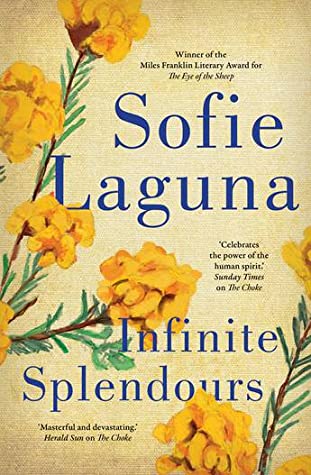
Those of you who know the subject matter of Sofie Laguna’s latest novel, Infinite splendours, will not be surprised to hear that it drew a mixed reaction from my reading group, particularly coming on the heels of recent reads like Nardi Simpson’s Song of the crocodile (my review) and Douglas Stuart’s Shuggie Bain (my review). However, if we all agreed on one thing, it was that Laguna’s writing is splendid.

Some of you though, particularly non-Australians, will not know what it’s about, so let’s get that out of the way first. The back cover blurb starts this way:

Lawrence Loman is a bright, caring, curious boy with a gift for painting. He lives at home with his mother and younger brother, and the future is laid out before him, full of promise. But when he is ten, an experience of betrayal takes it all away, and Lawrence is left to deal with the devastating aftermath.

It’s not a spoiler to say that this betrayal involves sexual abuse.

Infinite splendours, like Laguna’s previous book, The choke (my review), is set in the rural past. In this case, we are in the Grampians, west of Melbourne, and the novel starts in 1953 when Lawrence is 10. As with The choke, my question is, why set the story in the past? And my answer – though I don’t know Laguna’s – is the same: it’s set at a time when awareness of abuse and the resultant trauma were essentially non-existent. This enables Laguna to explore her theme unencumbered.

The novel is told chronologically in three parts. The first ends with the abuse, and the second takes Lawrence through to another crisis in his late twenties, with the third picking him up, a couple of decades later, in 1994. By this time, Lawrence is living alone in the isolated family home. The novel is told first person, so we spend the whole time in Lawrence’s head, seeing only his perspective. It’s intense and introspective, but not unleavened. There are moments of calm and beauty.

One part engaged, another observing. Two selves. (p. 411)

Still, it’s a tough story, as we watch this lovely, sensitive boy, whom we’ve come to love, decline. He stutters. He gives up his interests, including the art in which he’d shown such talent, and he keeps to himself. His body is a source of mental and physical anguish. From the moment of the abuse, he’s a divided person:

I felt myself dividing; there were two selves to choose from. One inside, one outside. (p. 152/153)

There are moments when he may have been helped. Soon after the abuse, his younger brother Paul asks “what did he do to you Lawrence” – but Lawrence won’t confide. At the beginning of part 2, the family’s kind neighbour, Mrs Barry, tells his mother that he reminds her of the “men back from the war”, but of course PTSD was not properly recognised nor treated back then.

After his mother dies when he is 26 years old, his brother leaves home, and a crisis occurs at his workplace. At this point, Lawrence’s self-isolation is complete. He does, however, have points of solace. His beloved mountain Wallis, a fictional mountain in the Grampians which features in the story from the beginning, provides moments of peace, hope and transcendence; a bunker on the property, in which he hides in a game of hide-and-seek at the novel’s opening, is a place he goes to for safety; and his art, to which he returns after leaving his job, provides occupation and self-expression:

This was the world for me; there was Wallis above and the bunker below, and here was I, between them with my tray of colours. (p. 267)

Lawrence also has an art book, Letters from the masters, that his uncle had given him during his “grooming”. This book becomes his “bible” – for art and life – and he returns to it again and again. He studies the paintings, and he ponders the artists’ words. Indeed, the novel’s title comes from Master Millet who wrote “I see far more in the countryside than charm, I see infinite splendours”. And so does Lawrence, particularly in his beloved Wallis. It is while standing on Wallis, before the events unfold, that he has his first intimations of “something else, greater, that was infinite–the earth’s invisible self. Wallis whispered, See this“.

It is in this context that Lawrence’s art becomes his life’s work. He describes one of his landscapes as “like a living thing … a soul contained within an object”, and sees his paintings as his family. He is as settled as he can be. But, change is inevitable, and the time comes when Mrs Barry’s long-empty house across the yard is occupied again. It discombobulates Lawrence:

I painted into the sun, layers of yellow into yellow. Immersion in light. Sun across my knees, sun in the sky, sun on my canvas. Could I not keep going, contained forever within this one emerging world of light? Must I inhabit another?

It seemed I must … Everything changes.

The new occupants are a single-parent family like his own had been, this one, though, with a mother, teen daughter, and, yes, a 10-year-old boy. The tension builds as we readers watch and desperately hope that Lawrence will not repeat history, that he will get his two selves back in sync in the best way.

I said at the beginning that my reading group praised Laguna’s writing. Her descriptions of the landscape are exquisite and her delineation of character, even minor ones, is so very good. Her warmth and empathy are palpable. I also love her ability to change pace and rhythm to evoke different emotions. However, several of us did feel it became repetitive. Further, although I was fully engaged in Lawrence’s story, and was never going to give up on him or the book, there were times that I felt overwhelmed with the multitude of motifs. As well as those I’ve mentioned, like Wallis and the bunker, there’s Robinson Crusoe, Madame Butterfly, a strawman/scarecrow, birds and the bird clock, rocking and a rocking chair, colours, and more. While none of these were gratuitous, they did sometimes become distracting, as I tried to identify whether they were adding anything critical to what I already knew and felt.

As I read this novel, with a frequent sense of foreboding, I was buoyed by my memory of Laguna’s statement that hope is important. Without giving anything away, let’s just say that, here, the hope felt a bit thin, albeit there is a real transcendence in the ending. For that I was truly grateful.

As for my reading group? Well, there’s been a request for books with a lighter touch next year, which is fine by me, as long as they have meat too!

Challenge logo

Sofie Laguna
Infinite splendours
Sydney: Allen & Unwin, 2020
435pp.
ISBN: 9781760876272

Winner of the 2021 Colin Roderick Award

Maggie O’Farrell, Hamnet (#BookReview)

Book cover

Not unusually, I’m late to this book that was all the talk in 2020 – and, I may not have read it at all if it hadn’t been for my reading group. I’m talking, as you will have guessed from the post title, of Maggie O’Farrell’s Hamnet.

As most of you will know, Hamnet’s plot draws from the life of Shakespeare (never named in the novel) and Anne Hathaway, and the death of their son Hamnet at the age of 11. There was an older sister, Susanna, and Hamnet’s twin sister, Judith. O’Farrell explains her interest in her Author’s Note:

Lastly, it is not known why Hamnet Shakespeare died: his burial is listed but not the cause of his death. The Black Death or ‘pestilence’, as it would have been known in the late sixteenth century, is not mentioned once by Shakespeare, in any of his plays or poetry. I have always wondered about this absence and its possible significance; this novel is the result of my idle speculation.

Because this book has been well-covered already online, I’m going to take a slightly different tack with this post, and focus on a couple of questions.

“She herself might tell a different story”

With all books, but particularly with historical fiction, one of my questions is, why did the author choose to write their story. O’Farrell partly answers it in her Author’s note. However, there is also, surely, a feminist reading, because, although the novel is titled Hamnet, it is primarily about his mother Agnes (as Anne is named in Shakespeare’s will). Early in the novel, O’Farrell writes “This is the story, the myth of Agnes’s childhood. She herself might tell a different story”.

The thing is, we don’t know a lot about Agnes Hathaway which makes her ripe for historical fiction. What we do know is that women’s stories were – and too often still are – rarely told, but that that doesn’t mean their lives were unimportant. It means that importance hasn’t been placed on them. Whoever Agnes really was, O’Farrell has created a wonderful, eccentric character, who is perceptive, warm, independently-minded, a little flawed but engaged in the life of her family and community. She is fun to read about.

Besides telling a story about her, though, O’Farrell also presents, through her, a story about grief, and this, for me, was one of the strongest aspects of the novel. Agnes’ thoughts about burying her son, her astonishment that people can complain about their children, her utter discombobulation were so real:

Agnes is not the person she used to be. She is utterly changed. She can recall being someone who felt sure of life and what it would hold for her …

This person is now lost to her for ever. She is someone adrift in her life, who doesn’t recognise it. She is unmoored, at a loss. … Small things undo her. Nothing is certain any more.

So real …

Hamlet?

Warning: Spoiler of sorts

Given the novel is titled for Hamnet, rather than for its main protagonist, Agnes, it’s worth considering why, and this leads us to the play Hamlet. The novel ends with Agnes attending a performance of her husband’s play, which confirms the significance of this play to the novel. The epigraph to the novel’s second part is a quote from Hamlet (V:ii): “Thou livest;/ . . . draw thy breath in pain,/ To tell my story”. But, Hamlet could scarcely be seen to be Hamnet’s story, though I did have a little laugh at the point in the novel where Hamnet chooses to die:

They cannot both live: he sees this and she sees this. There is not enough life, enough air, enough blood for both of them. Perhaps there never was. And if either of them is to live, it must be her. He wills it. He grips the sheet, tight, in both hands. He, Hamnet, decrees it. It shall be.

Eleven-year-old Hamnet seems, here, to be far more decisive than his namesake who is known for his prevarication. This, however, is not what we are expected to take away from the novel I’m sure!

So, what else? Well, there’s the grief theme, which Hamlet can be seen to “resolve” in the novel. Agnes, devastated after her son’s death, can’t understand her husband returning to work – and writing comedies:

His company are having a great success with a new comedy. They took it to the Palace and the word was that the Queen was much diverted by it.

There is a silence. Judith looks from her mother, to her sister, to the letter. 

A comedy? her mother asks.

She is even more devastated though to learn that her husband has gone on to write a play using their son’s name – Hamnet and Hamlet being interchangeable – so she goes to London to confront him. What happens is something else. Initially, she feels eviscerated:

How could he thieve this name, then strip and flense it of all it embodies, discarding the very life it once contained? 

But then, as she sees the ghost father and living son, she starts to see something else:

He has, Agnes sees, done what any father would wish to do, to exchange his child’s suffering for his own, to take his place, to offer himself up in his child’s stead so that the boy might live.

My reading group discussed the question of the play a little, though we didn’t come to any particular conclusion, which I rather like. However, we did talk about how Shakespeare wrote his darkest, strongest plays, including the four great tragedies, after Hamnet’s death, which suggests that his son’s death had a big impact on him. A member also raised the play’s existential nature, seeing it exploring the fragility of life – “to be or not to be” – and how you go on in the face of bleakness.

Now, I could go on and talk about the style (language, use of present tense, symbolism), the decision not to name Shakespeare, and the dual storyline structure, as I normally would, but I’m sure they’ve been discussed elsewhere, so I’m leaving it this time. There were aspects of the novel that I question, but the truth is that I fell for Agnes and her story.

So, I’m going to leave you with two quotes, one from the husband, one from the wife.

It is so tenuous, so fragile, the life of the playhouses. He often thinks that, more than anything, it is like the embroidery on his father’s gloves: only the beautiful shows, only the smallest part, while underneath is a cross-hatching of labour and skill and frustration and sweat. 

Gardens don’t stand still: they are always in flux. 

These relate to their spheres of activity, but they also say something about life, don’t you think?

Maggie O’Farrell
Hamnet
London: Tinder Press, 2020
310pp.
eISBN: 9781472223814

Douglas Stuart, Shuggie Bain (#BookReview)

How to write about a book that has made such a big splash that it has already been extensively reviewed. What more can one say? This is what I’m facing with Douglas Stuart’s debut and Booker Prize-winning novel, Shuggie Bain.

I haven’t, in fact, read much about it, because I prefer to come to books fresh, but I have heard an interview with Stuart, and I can imagine what has been written about his book. I have also discussed it with my reading group. All I can do is just launch in, and write what I would normally write, but I fear it won’t add anything fresh to the discussion. It will, however, record, for me, my thoughts and feelings.

The story

For those of you who haven’t yet read Shuggie Bain, it tells the story of its eponymous protagonist growing up in public housing in 1980s industrial Glasgow. This was the time of Thatcher, a time when mines, shipyards, railyards closed, resulting in significant unemployment and the usual fallout when men can’t work and women and children end up on welfare:

Whole housing estates of young men who were promised the working trades of their fathers had no future now. Men were losing their very masculinity.

This is important, but it is also just the backdrop for the personal story of Shuggie and his mother Agnes. There are other characters, but these two are the book’s core.

The story starts in 1992 with Shuggie, nearly 16, living on his own in a boarding house in Southside Glasgow. He is clearly pitied by the people around him, so the question for us is why is he there alone, how did he get there? We then go back to 1981, where we meet Shuggie’s family, thirty-nine-year-old Agnes, her second husband Shug, and Shuggie’s two older siblings, Catherine and Leek, who were born to Agnes’ first husband. It is not a happy situation. They are all living in a flat with Agnes’ parents, Wullie and Lizzie, and Agnes feels a failure.

When Shug does take his family away, it’s a cruel action, and Agnes and her three children soon find themselves alone, living on welfare payments in the desolate Pithead – a housing scheme which had “the plainest, unhappiest-looking homes Agnes had ever seen”. She knew Shug was “a selfish animal”, but she wasn’t expecting this. From here, their lives are a struggle, though Agnes – now drinking heavily – tries her darnedest to maintain appearances amongst women who reject her and her airs.

The characters

Agnes’ airs! Stuart has an impressive ability to create vivid, real characters. Even the villains of the piece – like Shug – are recognisable as people beyond the “type”, in his case a macho, violent, womaniser, they represent. This is no mean feat. However, it’s Agnes, Shuggie and, to a degree, Leek, who are our focus.

Agnes is a woman with aspirations. She’s resourceful, when sober, and wants more than the life she’s been dealt. But, she is unable to find a way out, largely because, for women of her time and place, it seems that a man is the answer. Her first husband Brendan tries to buy her happiness, but he’s boring. Then the flashy Shug comes along. For all his failings, and they abound, he too tries to buy her happiness, but tires of all her “wanting”.

Unfortunately, one of the things Agnes wants is “to take a good drink”. Her drinking, which was already evident when they lived at her “mammy’s”, becomes a serious problem at Pithead. Life, for her children, becomes insufferable. Catherine skedaddles into an early marriage as soon as she can, while the sensitive, artistic Leek withdraws into himself, leaving the young Shuggie to be the main watcher over his mother. And this is where this novel’s credentials as autofiction come into play, because the evocation of the child-addict parent relationship reads so authentically. We can’t help admiring Agnes’ gallus, while also despairing for her and her children.

So, it’s a heartbreaking story. Not only does Shuggie struggle with his addicted mother – loving her, caring for her in ways that a child should never have to – but he must cope with his own outsiderness that he doesn’t understand. From a very young age his way of talking, dressing and walking, not to mention his disinterest in typical boy things, are ridiculed. He’s called names, beaten up, ostracised, and he doesn’t know why. At 10 years old, aware he’s “no right”, he asks his mother, “What’s wrong with me, Mammy?” If she knows, she doesn’t tell him, but a few years later, he realises that Leek, who had tried to teach him to toughen up, had known all along.

Leek is the support act, figuratively and literally, to Shuggie and his mother. He quietly provides support in the background, even after he eventually leaves home. He’s resentful of the impact on his own ambitions to become an artist, but he sticks around, taking labouring work, because he is needed. In many ways, he’s the hero of the novel, and my heart went out to him as much as to Shuggie. This, I think, says it all:

he looked like a half-shut penknife, a thing that should be sharp and useful, that was instead closed and waiting and rusting.

The writing

It also gives you a flavour of the book’s expressive writing. One of the first things you might notice is that Stuart loves a simile. The book is full of them, but they are so good, like

“The auld man’s face crumpled like a dropped towel.”

and

“The unwelcome presence of a man was like a school bell.”

and so many of Agnes, such this when Shug leaves her

“Agnes, sparkling and fluffy, was lying like a party dress that had been dropped on the floor”.

The book is also well structured, opening in 1992, which immediately tells us that whatever happens Shuggie is going to survive, and ending back in 1992, this time on a note of hope, albeit a tentative one.

Stuart uses vernacular extensively, resulting in much unfamiliar-to-me vocabulary – boak, hauch, gallus, to name a few – but they are understandable from the context, and essential to setting the scene. The novel is not at all hard to read. Indeed it’s beautiful – and easier to understand than some spoken Scottish can be!

Moreover, for all its bleakness, the novel has a good smattering of humour. Here’s Shuggie defending his mother, drunk and over-dressed, marching into the hospital to see her dying father,

Shuggie heard the nurse say to a male attendant that she thought for sure Agnes was a working girl.

“She is not,” said Shuggie, quite proudly. “My mother has never worked a day in her life. She’s far too good-looking for that.” 

What it all means

The novel is, as I’ve said, autobiographical, but that doesn’t mean that Stuart simply sat down and wrote his life. Shuggie Bain reads as a considered piece of fiction that has some things to tell – about dashed dreams, the powerlessness of women in a male-dominated world, poverty, addiction and outsiderness. It’s both political and personal about what happens to lives when the ground beneath is taken away. And yet, for all that, it’s also about love – child-to-mother, brother-to-brother, friend-to-friend – that survives in places you barely expect it to. No-one in my reading group was sorry we scheduled it.

Douglas Stuart
Shuggie Bain
London: Picador, 2020 (2021 eBook)
355pp.
ISBN: 9781529019308

Nardi Simpson, Song of the crocodile (#BookReview)

Nardi Simpson’s Song of the crocodile is a tight multi-generational saga set in the fictional town of Darnmoor over the last decades of the twentieth century. It tells the story of the people of the Campgrounds, who are ostracised, exploited and abused by the white townspeople. Between the Campgrounds and the town proper, with its ironically named Grace and Hope Streets, is the tip, which was created by knocking down “strangely scratched gums” on the old bora grounds. The road to the tip, and on to the Campgrounds, is Old Black Road. The stage is set …

“trespassers on their own country”

The story is told in three parts which span three generations of the Billymil family – Celie, her daughter Mili, and Mili’s eldest son Paddy. Celie’s part starts, however, with her mother, Margaret. Margaret not only runs the town hospital’s laundry, but also undertakes the major load of nursing the hospital’s First Nations patients. They are housed on “the back verandah” and are mostly ignored by the hospital’s medical staff. In this way, very early in the novel, we get the picture loud and clear about how the town’s Indigenous people are treated. The racism, the omniscient narrator tells us, is “hidden yet glaring. It’s the Darnmoor way”.

But there is a parallel story going on here, too, that of the spirits and ancestors, the “knowledge keepers”, who reside among the stars. They “wait for their loved ones to arrive” but they also introduce an important idea underlying this story – the “connectedness” of “all living or once lived things”. This connection is symbolised in the novel by threads and ropes that join sky and earth through birds and trees to the roots underground. I loved that Simpson shared this, that she trusted her readers to respect a worldview that’s foreign to many of us.

Intrinsic to this connectedness, of course, is the land. Some of the book’s most lyrical writing comes from descriptions of the country – rivers, trees, birds – in which it is set. This country is the freshwater plains of northwest New South Wales, the traditional lands of Simpson’s Yuwaalaraay heritage. In her novel its main feature is the Mangamanga River, “known by some as the wide-bodied, liquid boss of the plains.” It is to this river that Mili and/or members of her family go to refresh their spirits, but the men of Darnmoor want to control it, and protect themselves, by building a levee between the town and the Campgrounds.

Essentially, then, Song of the crocodile is the story of people who are made to feel “trespassers in their own land”. But, it’s also the story of strong, resilient women who forge a community on the Campgrounds. With guts and confidence, Celie turns her mother’s laundry skills into a business called the Blue Shed, providing work for herself and the other women. These women are a joy to read about, but they and their families are barely tolerated by the town, which ensures they know their place. When Mili’s bright young friend Trilpa wins a mathematics prize she is disqualified on trumped-up grounds, and when Mili, herself, applies for permission – permission, would you believe – to continue school past the age of 15, she too is brought down, by Mayor Mick Murphy, in the worst way.

“threads of broken lore”

Needless to say, it’s a difficult story. Too many people, people we’ve come to love, “pass” too young. As the oppression of those left behind builds, creating “hopelessness and grief”, the beast – Garriya, our titular crocodile – starts to stir. Regular hints of his rumbling imbue the novel with a sense of foreboding.

The crocodile is apparently a creator being in Yuwaalaraay country, but his evocation in this novel, as Garriya, is unleashed by the evil that has been visited upon the Campground people, evil that has broken the country’s lore. We feel him coming, and Mili’s alienated son Paddy is the conduit. Desperate to counteract this, spirit songman Jakybird wants to reconnect the “threads of broken lore”. He prepares his spirit “choir” for one last, powerful song, Garriya’s cycle. The climax is shocking, but the ending is cheekily open.

All this sounds grim, but I didn’t find it hopeless. There is delightful warmth and humour in the interactions between the Campground women, and there is humour and hope in the spirit world. Through these, Simpson gives us a complex story of oppression and survival. For all the misery suffered by the Billymils and their community, there is hope in their resilience, in their ongoing connection to country, and in their determination to keep passing on culture. Early in the novel, laundry worker Joyce addresses the parcels for delivery, using drawings that convey “a belonging, a knowledge, a truth of the place on which they walked and worked”:

In most cases the recipients failed to notice the mark, tearing the paper off and crushing it into a ball. It didn’t matter that eventually it was taken to the tip and returned to the earth. What mattered were the boys on the bikes that delivered them, that read the symbols then read the land. The drawings and the washing restored old journeys, countrymen walking on places they knew.

Simpson also, as First Nations writers are increasingly doing, uses Yuwaalaraay language throughout. She doesn’t directly translate it and there is no glossary. This bothered some of my reading group, while others of us felt the meaning was always clear – or clear enough. Here, for example, is Margaret in Chapter 1:

“Yaama. Dhii ngaya gaagilanha. Who wants a cuppa?” Margaret pushed open the door to the hospital’s back verandah, its hingers squealing as she entered. “How are we all today?”

Song of the crocodile was my reading group’s July book, and it resulted in one of our liveliest discussions this year, as we defended our diverse responses to its ideas, style, characters and tone.

For me it was an absorbing read. It is uncompromising in its portrayal of the insidious racism that First Nations Australians confront and the devastating impact of that on the spirit, but it also shows resilience in the face of that, and it affirms that culture is strong. That has to be a positive thing?

For Lisa’s and other blog reviews, check her ILW Fiction Reading List.

Challenge logo

Nardi Simpson
Song of the crocodile
Sydney: Hachette Australia, 2020
401pp.
ISBN: 9780733643743

Steven Conte, The Tolstoy Estate (#BookReview)

Steven Conte burst on the scene in 2008 when he won the inaugural Prime Minister’s Literary Award with his 2007-published debut novel, The zookeeper’s war. I always intended to read it but somehow it never happened. Jump to 2020, and Conte’s second novel, The Tolstoy Estate, was published. That’s a big gap, but what he’s produced is a well-researched, carefully-crafted, thoroughly absorbing novel.

What intrigues me more than this gap, however, is that both his novels are set during World War 2, and both deal with Germany in the war. The zookeeper’s war is about how the Berlin Zoo’s owner and his Australian wife managed to keep it going through the war. I wonder what it is about war and Germany that attracts Conte? Or, is it just coincidence?

So many paths to follow

The Tolstoy Estate’s plot is not complicated. Most of the story takes place over the six week period – November-December 1941 – during which a German army medical unit established and ran a hospital in Yasnaya Polyana, Tolstoy’s estate, near Tula, south of Moscow. Arriving at the estate, the Germans, including doctor Paul Bauer, meet the site’s curator, Katerina Trubetzkaya, who is, not surprisingly, hostile. A relationship develops between Paul and Katerina, against a backdrop of deteriorating conditions both on the war-front and in the unit, as its commanding officer Metz’s behaviour becomes increasingly erratic.

Sounds straightforward enough? Yes, but as one of my reading group members said, the novel has so many paths to follow, so many ideas to think about, that it’s impossible to follow them all. I agree, so, here, I will focus on just a couple of them.

I’ll start, however, with a few comments about the style and structure. The novel is primarily told in third person through the perspective of Paul, so our understanding of what happens, our assessment of the characters and their relationships, come through his thoughts and feelings. Fortunately, he is quickly established as a humane, considered person, so we can trust him, as much as we can trust anyone.

SORT OF SPOILER (though not the ending)

Half-way through the novel we jump to 1967, and a letter from Katerina to Paul. This introduces a second chronology which covers nearly a decade from then. Most of it, until the last chapter, is conveyed though a few letters between the two, interspersed with the main wartime narrative.

Why does Conte do this? This is the question I always ask when an author plays with their narrative structure like this. My usual thought is that the author wants to de-emphasise the plot to encourage us to think about something else, but then the question is, what? I suspect that this is partly the case here, and I’ll talk about the “what” soon. Regardless of the “what”, however, the impact of revealing that Katerina and Paul have survived the war, is to slow us down. It encourages us to focus on the development of their relationship against the backdrop of this cruel war, rather than rushing to turn the pages to see what happens next.

As for the paths, the “whats”, there are many. The Tolstoy Estate is about war of course. The history part of this novel is true, in that Tolstoy’s estate was indeed occupied by the Germans for a military hospital, so there is that. And, there’s the exploration, through our two protagonists, of two unappealing regimes, Nazism and Stalinism. I could write more about the nuances of that, but I won’t. Then, there’s its evocation of how humans behave during war, of how some will and some won’t behave with humanity across the enemy divide. We see this in many war novels, so I won’t dwell on that, either, except to say that I liked Conte’s appreciation of the continuum of humanity’s behaviour from the worst to the best. One of the questions on Steven Conte’s website concerns whether we can forgive what we come to understand. I’ll leave that one with you too!

Love is an excellent motivator (Katerina)

Now, though, I want to turn to two paths that particularly interested me – love and literature. Let’s do love first. The Tolstoy Estate is a love story. Both our protagonists have lost their spouses, meaning both are currently free but have experienced love before. However, they are also, of course, technically, enemies, belonging to opposing regimes, both of which can be brutal to those who cross the line. This tests their love.

Love is not one-dimensional, as Conte knows, so he sets their love against other sorts of love, including master-race proponent Metz’s dutiful but ultimately sexless marriage because of the “physiological costs imposed by sexual congress”; the Soviet Government’s conservative, sexist attitude to romantic relationships, evidenced in its reaction to Katerina’s novel; a German officer’s homosexuality that brings about his demise; the bawdy conversations and behaviour of many soldiers. There’s also Bauer’s brief but pointed reference to the soldiers he treats:

Loves or is loved“, he thought constantly as he amputated, concerned less about the truth of the incantation than its usefulness to keeping him alert.

War and love, by definition, make strange bed-fellows. War heightens emotions of all sorts, and forces those who love to think seriously about it, as Paul and Katerina do. Paul’s bawdy but romantic colleague Molineux says that Paul and Katerina’s bond “transcends race, it transcends law”, and yet both Paul and Katerina are aware that the practicalities of love can spoil even a strong bond – which provides the perfect link to the literature path …

Writers document, great men do (Metz)

Contemplating the value and practice of literature underpins the novel, with Tolstoy’s War and peace, of course, providing the pivot. It links to the love path, because Paul and Katerina frequently consider Tolstoy’s evocation of love in the novel. In a letter to Katerina, Paul writes that War and peace reminded him

that love doesn’t always conquer but that, arguably, it’s better that way – that thwarted love is stronger, more enduring than the domesticated kind.

But, beyond love in Tolstoy, Conte’s characters also think about the value of literature. Again, here is Paul in a letter to Katerina, telling her that War and peace had restored his faith in

doing good in the world; because if, as Tolstoy argued, we are all specks in a vast world-historical drama, including those who think they’re in charge, it follows that everyone’s actions are potentially significant, that the humblest person can influence events as much as any general, emperor of tsar.

This counteracts Metz’s argument to Katerina early in the novel that

with his rifle our humblest “Landser” shapes the world in a way your Tolstoy never did.

The old “pen is mightier than the sword” discussion I suppose, but oh so engagingly told!

There are also discussions about the craft of writing – some of which reflect wryly on Conte’s interest, such as Katerina’s research focus being narratology.

But I will end with Katerina’s concern about the fading of the novel in the later 20th century:

Everything fades, I suppose, certainly everything made by human hands, and yet I can’t help feeling bereft to witness this diminution of the novel, which for all its inadequacies has trained us to see the world from others’ points of view. To borrow a Stalinist idiom, the novel is a machine, a noisy, violent thing whose product, oddly enough, is often human understanding, perhaps even a kind of love.

Love … and the novel. A good place to end my post on this compelling and intelligent novel.

Lisa (ANZLitLovers) also loved this novel.

Steven Conte
The Tolstoy Estate
Sydney: Fourth Estate, 2020
410pp.
ISBN: 9781460758823