Monday musings on Australian literature: Forgotten writers 11, Nancy Francis

Like my last forgotten writer, Ruby Mary Doyle, today’s writer, though also a prolific contributor to newspapers in her day, has slipped into the shadows. Neither Wikipedia nor the Australian dictionary of biography (ADB) contain articles for her, but the AustLit database does and Zora Cross, writing as Bernice May in The Australian Woman’s Mirror, also did a piece on her. As with many of my Forgotten Writers articles, I researched and posted a version of this on the Australian Women Writers’ site in April, but have saved posting here until June because I am in Far North Queensland where she lived most of her life. Seemed fitting.

Nancy Francis

Nancy Francis (1873-1954) was a poet, and writer of short stories, essays and serialised novels. She was born in Bakewell, Derbyshire, England, in 1873. According to the Obituary in The Cairns Post, her mother was the surviving descendant of the Beaton family, which was connected, through service, with Mary Stuart, Queen of Scotland. Her Yorkshire-born father was a well-known musician who had played a cornet solo in front of Queen Victoria. Nancy developed her musical talent, and apparently had “a beautiful and unusual soprano voice”. She also wrote verse as a hobby and contributed to various periodicals.

According to the Obituary, Nancy married Frederick James Francis in 1900. They lived in London and other country centres, before coming to Australia, just before the 1914-18 war. With three young daughters, they travelled to the remote Bloomfield River, in Far North Queensland, where her husband joined his brother in various mining ventures. During this period Francis “acquired her exhaustive knowledge of the North Australian bush and its aboriginal inhabitants, of whose character and folklore she made a sympathetic study”. She increased her output over this time, with her verses, articles and short stories appearing regularly in the Bulletin and other southern periodicals. Much of this writing appeared under the nom-de-plume of “Black Bonnet”, which Bernice May (Zora Cross) ascribes to her love of Henry Lawson (who wrote a poem titled Black bonnet”).

After some time – not specified in the Obituary – the family moved to the small mining township of Rossville outside Cooktown, where Frederick and two brothers continued working in mining and other development. The Obituary says that “among these jungle clad hills she produced some of her best literary work, including many of the poems later collected and published in book form”. In 1927, Bernice May wrote about Francis and her daughters – who all became published writers in their teens – and praised the quality of their verse. May clearly had some correspondence with Nancy and her daughters, and was impressed by what the girls had achieved under their mother’s home schooling. Francis wrote to her, “How I long at times for a creepy novel, a box of chocolates and no bright ideas that nag to be put on paper”, which May says reminded her of Mary Gilmore who “in her first passionate days of great poetry declared she could not take her hands out of the cooking-basin and washing-up dish fast enough to run away to her pen and write some fiery line that had flashed to her across her domestic work”. Bernice May understood the challenge faced by women artists.

In 1928, Nancy and her husband moved to Cairns, but not long after, in 1929-30, she travelled back to England. On her return she “joined her husband at Herberton where she lived until her death”, on 28 June 1954. Her husband, who had also worked as a freelance journalist, predeceased her in 1942.

According to the Obituary, she was actively involved in community activities, including being a member of the C.W.A. from its inception, and President of the local branch for eight years. She also worked for the Red Cross and Patriotic Associations during both world wars. She remained a journalist throughout her life and was keenly interested in politics and world affairs. She also left behind four children, the three daughters (Patricia, Kathleen, and Christobel) and a son. The Obituary describes her as follows: “Generous and warmhearted, and with a vast fund of kindness for the underprivileged, she retained the standards of her English upbringing in a new country and a changing world”.

AustLit focuses on her writing. She wrote under many variations of her name and initials – N. Francis, Nancy Christobel Francis, N. C. Francis, N. C. F, N. F., Nancy C. Francis – as well as her Black Bonnet pen-name. They list 426 works by her under her Nancy Francis name variants, and another 62 under Black Bonnet, so she was prolific. And yet, she does not appear in the plethora of reference books, histories and guides I have on Australian literature. Why? Perhaps it’s because she spent her life in such a remote part of Australia, away from the literary world, though she did have writing published down south. Or, maybe it’s simply that for all her writing, she had only one published book, her poetry collection, Feet in the night and other poems, which was published by The Cairns Post in 1947. All her other writing appeared in newspapers and magazines/periodicals.

Indeed, this book’s reviewer in Mackay’s Daily Mercury (28 August 1948) implies that the ephemeral nature of newspapers is behind obscurity when they write that “beautifully hewn lines of poetry, melodious verses which have stirred the infrequent verse-readers for a morning half-hour, lie … forever entombed in rows of bound newspapers in libraries”. Fortunately, however, Francis had managed to compile a volume from her output, and the reviewer liked the result:

“FEET IN THE NIGHT” is … taken from the first poem of the first section, which deals sympathetically with the vanishing natives of this continent, who move like shadows on the hill, or ghosts in the scrub, along dark green valleys and dim waterways out to where the jungle ends. The other sections celebrate the Galllpoli era, romance, soft and melancholy, the scenic glories of the North, and memories of England and the out-bound voyage

We do not hesitate to express the opinion that almost every poem in the collection was well worth rescuing from its dusty obscurity. These verses have been polished and polished again. All are graceful, delicate and restrained.

According to AustLit, her writing for Queensland newspapers included essays in series, such as her studies of North Queensland Aboriginal culture, titled ‘By Forest, Scrub and Shore’ (1939-1940), which include detailed discussions of customs and practices in the region; a series of historical essays on ‘The Anglican Church in North Queensland’ (1936-1938); and many essays on Captain Cook. AustLit also says that her travels Western Europe and Northern Africa around 1930 inspired several poems which expressed her identification with the North Queensland landscape and a longing for her North Queensland home. It seems she travelled overseas more than once, with The Courier-Mail (26 April 1938) reporting on a planned trip to “the Continent” in 1938.

Nancy Francis may not (yet) have come to the serious attention of those documenting Australia’s literary history, but back in 1927, Bernice May was impressed, writing that,

“One does not know whether her crisp articles on nature study, her accounts of the blacks and their ways, or her verses are the most remarkable”.

She also compared Nancy and her daughters to the Brontë sisters, no less, saying

It was not until the Bronte girls left Yorkshire for Belgium that their hearts turned back to the scenes of their youth and they began to write of them with the wonderful feeling which has never since been surpassed in fiction written by women. I sometimes wonder if when this little outpost moves, when perhaps the mother and daughters become separated from the scenes of their early days, something missing in our fiction will be supplied—the great story of the lonely, mighty North.

This is not all she said, but you can read the rest at the link below.

The piece I shared on the AWW site is “The black snake”, which, as the title suggests, references the “snake” motif frequently found in Australian bush stories (including Henry Lawson’s). It draws on familiar short story tropes to tell a good story, and shows a writer who knows her craft and how to entertain her audience.

Sources

  • Bernice May (aka Zora Cross), “Black Bonnet and her daughters“, The Australian Woman’s Mirror, 3 (26),  24 May 1927 [Accessed: 8 April 2025]
  • Black Bonnet“, Daily Mercury, 28 August 1948 [2 April 2025]
  • Black Bonnet, AustLit [5 April 2025]
  • Nancy FrancisAustLit [5 April 2025]
  • Nancy Francis, “The black snake“, The Cairns Post, 28 December 1935 [Accessed: 8 April 2025]
  • Obituary, The Cairns Post, 10 July 1954 [Accessed: 2 April 2025]

Monday musings on Australian literature: 1952 in fiction (2), a national stocktaking

I said in last week’s Monday Musing, which was dedicated to (Kaggsy’s Bookish Rambling) and Simon’s (Stuck in a Book) 1952 “Year Club”, that I wouldn’t write about the ongoing issue of journalists and academics feeling the need to defend Australian literature, because I’ve discussed it before. However, I did read an interesting article on the wider issue that I thought worth sharing. Yes, I know the week officially ended yesterday, 27 April!

Bartlett on Aussie culture

The article I’m talking about came from someone called Norman Bartlett. Born in England in 1908, he migrated to Western Australia with his parents in 1911, so he grew up Australian (albeit he did live in England again with his mother and sister between 1919 and 1924). According to the NLA’s Finding Aid for his papers, he studied journalism, obtained an Arts degree, and served with the RAAF in World War 2. In 1952, he was literary editor and leader writer for Sydney Daily Telegraph and Sunday Telegraph. The article in question was written in reflection of the 1951 Golden Jubilee of the Commonwealth of Australia.

Titled “Let’s take stock of Australian culture”, it appeared in the Daily Telegraph (5 January). Bartlett’s fundamental question was whether Australia had “grown up as a nation”. This meant, he argued, much more than things like “Dominion status, industrial development, the fighting reputation of the A.I.F., a record wool cheque, and prowess at tennis, cricket, and, with reservations, Rugby, football”. Yes, indeed! Rather, it means

maturity in art and literature; a distinct and original “way of life”; a quickened awareness of what being an Australian means; and why being an Australian is different from being an Englishman, an American, or a European. 

A national culture is much more than a cultivated minority’s appreciation of good books, pictures, music, and architecture. 

It is the way we — the majority — feel, think, act, talk, wear our clothes, play our games, and fight our wars.

When our literature, art, music, architecture, and philosophy reflect our national idioms and attitudes they become part of our national culture. Thus, a truly national culture is the expression of a particular people living in a particular place for a long time.

Of course, he doesn’t consider the nation’s original inhabitants in any of this, particularly when he says “originally, Australians were colonials. That is, slips from older stock transplanted into an initially alien soil”. I will just leave that thought, because we are talking 1952 and I think the best thing for us to do is to recognise this context in all he says.

His article aimed to analyse “whether we’ve taken root; whether we are making a collective, intelligent attempt to adjust ourselves to our environment; whether our environment reflects itself in our speech, attitudes, art, music, and literature”. He argues that by the late 19th and beginning of the 20th centuries, writers and artists were moving away from “writing and painting in the English style”. They were “beginning to wake up to the fact that Australians had grown different from the parent British stem”. Not only were writers like Henry Lawson, Joseph Furphy (“Tom Collins”), “Banjo” Paterson, A. H. Davis (“Steele Rudd”) expressing this difference in their stories and verse, but they were writing in “everyday idioms of the Australian people”, as Mark Twain had done in America.

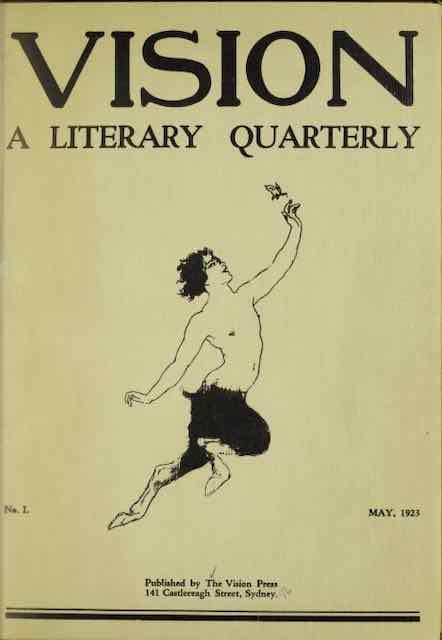
He quotes American critic, C. Hartley Grattan, who argued that a fundamental characteristic of ‘this budding Australian literature was an “aggressive insistence on the worth and unique importance of the common man”.’ But, Bartlett says, with “the growth of a more sophisticated city life, many writers began to feel that aggressive semi-socialistic nationalism [as seen in many of the above-named writers] wasn’t enough”. Writers and artists like the Lindsays and Kenneth Slessor wanted to “liberate the Australian imagination from droughts, gum trees, drovers, and the wide-open spaces”. In 1923, they created a literary magazine called Vision, but soon, says Bartlett, the Lindsays’ romanticism, with its “bookish carnivalia rosy with the fumes of canary wine and cheerful with the seductions of full-breasted wantons … blunted itself on Australian realism”. Love this!

By the Jubilee, increasingly more Australian writers were “realising that life is where you look for it”. He said writers like Kylie Tennant, Frank Dalby Davison, and Xavier Herbert showed there was ‘still plenty of kick in the Australian “bush” tradition”‘ while those like Ruth Park, Dymphna Cusack, M. Barnard Eldershaw, and Dal Stivens, were “more interested in the cities”. He separates out Eleanor Dark, who, despite setting some of her novels in country towns, had “a sophisticated interest in character rather than place”. Overall, he argued, that Australia’s contemporary fiction writers were “more analytical than exultant about the Australian way of life”.

Bartlett also wrote about poetry, visual arts, music and, briefly, dance. You can read these thoughts at the link provided above. He concludes by stating that “Australians are a reading people”, who spent significantly more on books than Americans and Canadians. This rather quantitative conclusion doesn’t answer much in terms of his framing question. However, I liked his discussion of how the bush and city strands were playing out in mid-20th century Australian literature, and his assessment of contemporary writers being more “analytical than exultant” is what I’d like from our artists of all persuasions. What do you think?

Kylie Tennant, The face of despair (#Review, #1952 Club)

Once again, as I’ve been doing for most to the Year Clubs, I am using it as an opportunity to read an Australian short story, usually from one of my anthologies. For 1952, however, the anthologies came up empty, but I did find one via AustLit, and then tracked it down in The Bulletin. The story, Kylie Tennant’s “The face of despair”, was first published in 1952, but has, I believe, been anthologised since.

Who is Kylie Tennant?

Kylie (or Kathleen) Tennant (1912-1988) was born in Manly, NSW, and grew up (says the National Portrait Gallery) in an “acrimonious household”. In 1932, she married teacher and social historian Lewis Charles Rodd, whom she had met at the University of Sydney, and they had two children. When Rodd was appointed to a teaching position in Coonabarabran in rural New South Wales, she left her studies and walked 450 kilometres to join him.

This must have worked for her because she did more firsthand research for her novels, taking “to the roads with the unemployed during the 1930s Depression, lived in Sydney slums and with Aboriginal Communities and spent a week in gaol” (NLA’s biographical note). She also worked as a book reviewer, lecturer, literary adviser, and was a member of the Commonwealth Literary Fund Advisory Board.

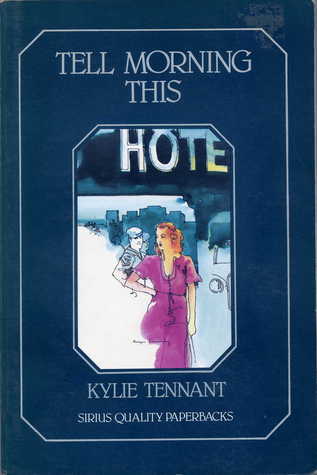
Tennant wrote around 10 novels, including Tiburon (1935); The battlers (1941); Ride on stranger (1943); Lost haven (1946); Tell morning this (1967, which I read with my reading group); and Tantavallon (1983). She also wrote nonfiction (including Speak you so gently, about life in an Aboriginal community), poetry, short stories, children’s books and plays. She won several literary awards, including the ALS Gold Medal for The battlers.

Her Australian Dictionary of Biography entry by Jane Grant says that although the early years of her marriage with Rodd “were complicated by the conflicts between Tennant’s attraction to communism and Rodd’s High Anglicanism, it proved to be an extremely successful creative partnership”. According to Grant, she was briefly a member of the Communist Party in 1935, but resigned a few months later believing the party had lost touch with working-class politics. Grant says that, like slightly older writers such as Vance Palmer and Katharine Susannah Prichard, she believed her novels could ‘educate the public about poverty and disadvantage and change what she termed “the climate of opinion”‘. In other words, she wrote more in the realist style, than the modernism of peers like Patrick White, Christina Stead and Elizabeth Harrower. However, as Grant says “the social message of her novels … was always leavened by humour” – and we also see this in my chosen short story.

“The face of despair”

“The face of despair” tells of a small fictional country town, Garrawong, which, at the story’s opening, had just survived a flood:

WHEN the waters of the first flood went down, the town of Garrawong emerged with a reputation for heroism. “Brave but encircled Garrawong holds out,” a city paper announced, and a haze of self-conscious sacrifice like a spiritual rainbow shone over everyone.

The story has a timeliness given our recent flooding frequency here in Australia. In the third paragraph we are told that “There was a feeling abroad that Garrawong had defeated the flood single-handed” but, a few more paragraphs on, “out of all reason, the rain began again”. Once again the librarians, who had just re-shelved their books, must carry them back out of harm’s way, emitting “small ladylike curses” as they did. But, others weren’t so willing:

“The police began to go round in their duck rescuing the inhabitants; but a strong resistance-movement was developing. They refused to be rescued. They had had one flood—that was enough.”

The story is timely, not only for the recurrent flood issue, but for its description of what is now recognised as “disaster fatigue”. Some residents, like the Doctor, don’t believe it will be as bad as before, that the dam won’t break this time, so they refuse to properly prepare or to accept rescue offers. Others, like the Nurse who runs a maternity home, just can’t do it again. She tells her housekeeper, “I’ll shut the place. I can’t start again, I won’t. No, not again.”

Now, when I was researching Tennant for my brief introduction to her, I found a 2021 article in the Sydney Review of Books. It was by poet and academic Julian Croft and focused on her novel Lost haven. It was published in 1946, just a few years after her best-known books, The battlers and Ride on stranger, but a few years before this story. He writes that Margaret Dick who had written a book on Tennant’s novels in 1966

saw Lost haven as a maturing step away from the ‘austerity’ of Ride on stranger towards ‘a resurgence of a poetic, instinctive response to nature and a freer handling of emotion, an unselfconscious acceptance of the existence of grief and despair’. This was a necessary step towards the maturity of what Dick considered Tennant’s best novel (and I would agree) Tell morning this.

I share this because “The face of despair”, published in 1952 – that is, after Lost haven and before 1967’s Tell morning this – feels part of this continuum. It has such a light touch – one I could call poetic, instinctive, freer – yet doesn’t deny the truth of the situation and what it means for the residents of Garrawong. Tennant uses humour, often lightly black, as she tells of the various reactions – stoic, mutinous, resigned, defeated – from householders, nurses, farmers, shopowners, not to mention the poor rescue police (who “did not seem to realise that they were now identified with the flood, were part of it, and shared the feelings it aroused”). It reads well, because it feels real – with its carefully balanced blend of adversity and absurdity.

Early in the story, the narrator writes of those who felt “mutinous”, who “refused to shift” as they had in the previous flood, adding that

… in the face of this renewed malice there was no heroism, only a grim indignation and a kind of dignity.

Towards the end, the title is referenced when Tennant decribes how “the face of despair” looks in different people as they ponder the flood’s impact. For example, “in the farmer in the thick boots it was the foam in which he had wiped his feet”, but in the poor old vagrant woman, it is “blue lips”. Tennant follows this with:

Despair does not cry out or behave itself unseemly, despair is humble. Its face does not writhe in agony. There is no pain left in it, because it is what the farmer said it was —“The stone finish.”

There is more to the story, and it’s not all grim. Rather, as Dick (quoted above) wrote, there’s “an unselfconscious acceptance of the existence of grief and despair”, and, as the last line conveys, one that encompasses a survivor spirit despite it all. A great story.

* Read for the 1952 reading week run by Karen (Kaggsy’s Bookish Ramblings) and Simon (Stuck in a Book).

Kylie Tennant
The face of despair” [Accessed: 16 April 2025]
in The Bulletin, Vol. 73 No. 3791 (8 Oct 1952)

Monday musings on Australian literature: 1952 in fiction

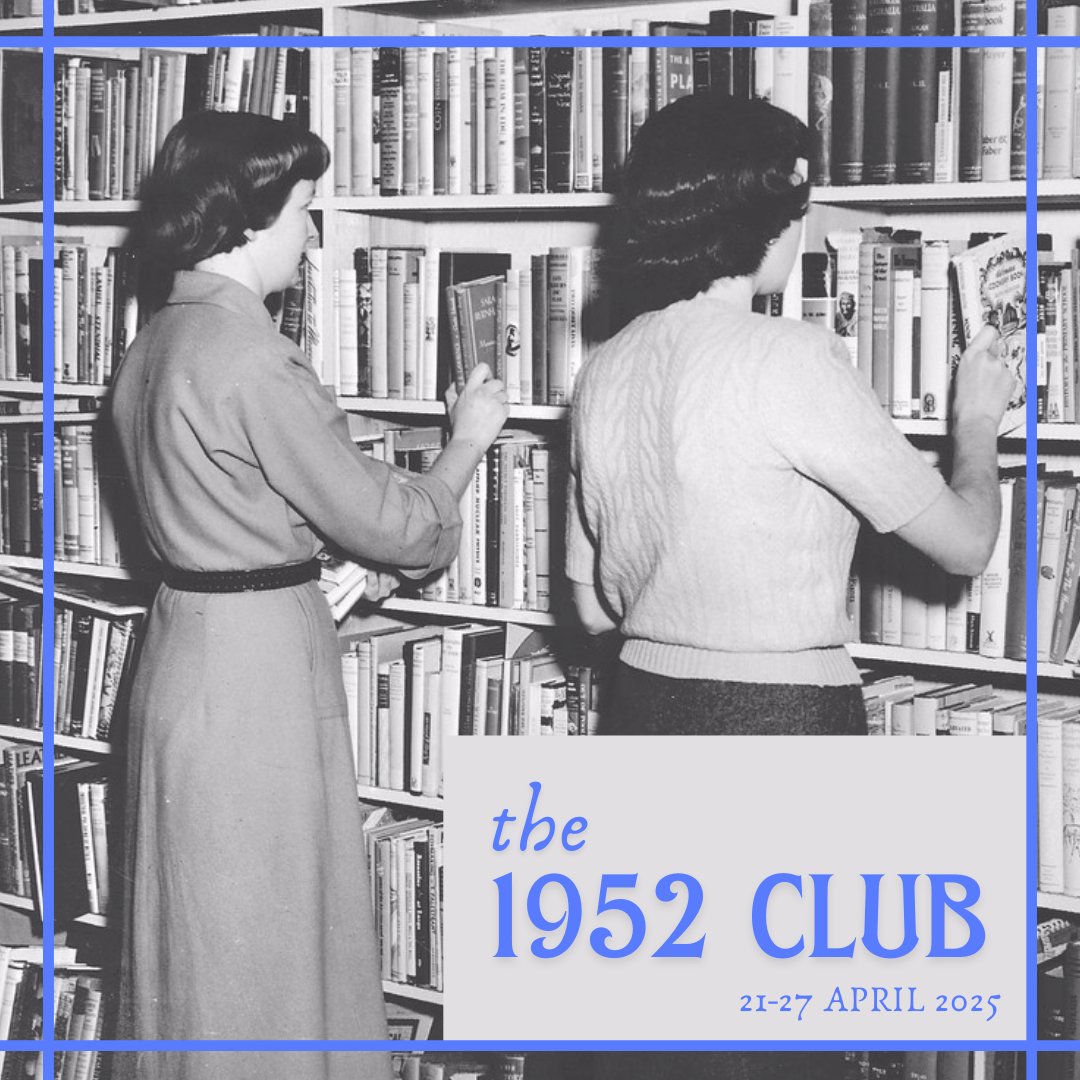
Once again it’s Karen’s (Kaggsy’s Bookish Rambling) and Simon’s (Stuck in a Book) “Year Club” week. This week, it is 1952, and it runs from today, 21 to 27 April. As for the last 7 clubs, I am devoting my Monday Musings to the week.

The 1950s represent the main period of the Baby Boomer generation (1945-1964), but of course, those born at this time had little to say about the literature of the period! Instead, Baby Boomers, of which I am one, are the product of times that were prosperous in the west (at least) but also overshadowed by the Cold War and its fear of a nuclear war. It was a conservative time, with men in charge, and women and other minority groups oppressed, which led to the various rights movements that appeared in the 1960s.

I wrote a post on 1954 when that was the Club’s year back in 2018, so much of what I found for that year, applies to 1952.

A brief 1952 literary recap

Books were, naturally, published across all forms, but my focus is Australian fiction, so here is a selection of novels published in 1952:

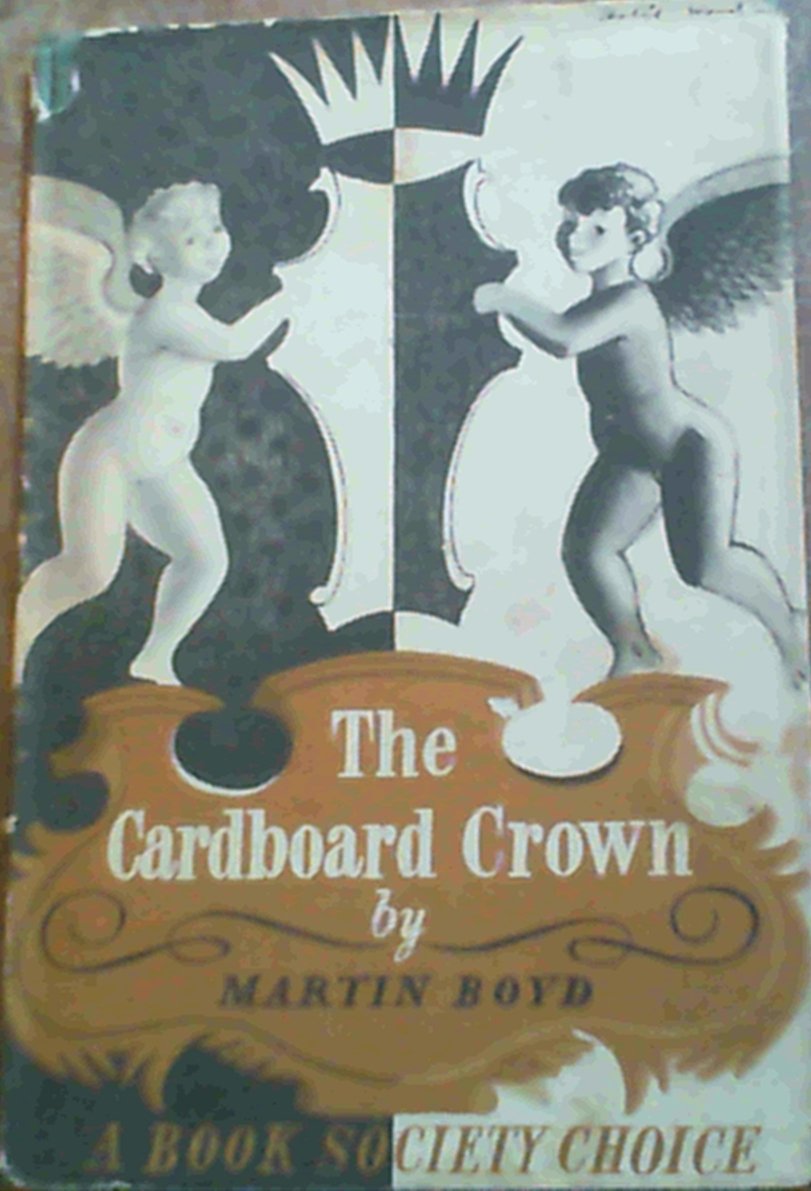
  • Martin Boyd, The cardboard crown (on my TBR)
  • Jon Cleary, The sundowners (read long before blogging)
  • Ralph de Boissière, Crown jewel
  • Helen Fowler, These shades shall not vanish
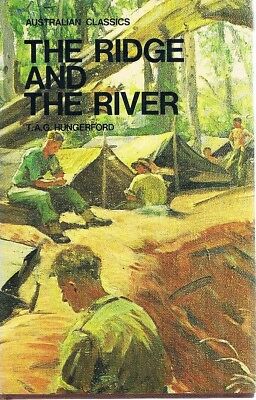
  • T.A.G. Hungerford, The ridge and the river
  • Rex Ingamells, Aranda boy AND Of us now living
  • Philip Lindsay, The merry mistress AND The shadow of the red barn
  • Colin MacInnes, June in her spring (aka Colin McInnes and Colin Thirkell; son of Angela Thirkell; primarily known as an English novelist)
  • Charles Shaw, Heaven knows, Mr Allison
  • Nevil Shute, The far country (read in my teens)
  • Colin Simpson, Come away, pearler
  • Christina Stead, The people with the dogs
  • E.V. Timms, The challenge
  • Arthur Upfield, Venom house

Two of these writers – Martin Boyd and Christina Stead – are recognised today as part of Australia’s literary heritage. Others are still remembered, and at least occasionally read, such as Jon Cleary (whose The sundowners was adapted to a film starring Robert Mitchum in the main Aussie role!), Arthur Upfield (whose novels were adapted for the Boney TV series , and Nevil Shute (who has been adapted mutilple times for film and television). T.A.G Hungerford is especially remembered in the West where there is an unpublished manuscript award in his name.

Born this year were novelists Janine Burke, Nicholas Jose, Larry Buttrose, John Embling, Suzanne Falkiner, and John Foulcher. Suzanne Falkiner edited the first book my reading group did back in 1988, an anthology of short stores by Australian women writers, Room to move.

Cover

There were not many literary awards, but the ALS Gold Medal went to T.A.G. Hungerford for his novel, The ridge and the river. Fourtriplezed who often comments here has reviewed it on GoodReads, noting that its racist language would not be acceptable today, but that it is nonetheless “a very “important and significant piece of Australian literature”. The Grace Leven Prize for Poetry went to R.D. Fitzgerald (whom I don’t know).

The state of the art

As for previous club years, I checked Trove to see what newspapers were saying about Australian fiction. There was the ongoing issue of writers/journalists/academics feeling the need to defend Australian literature, but I’ve discussed that often before, so will not focus on it here, because they essentially bring out the same arguments, including that Australia did have great writers, like Henry Handel Richardson, Christina Stead, and Xavier Herbert.

However, two issues, in particular, captured the imagination of the papers – the idea of banning “indecent” or “crude” literature for Australia’s youth, and the place of “red” or Communist literature in Australian society. These two issues in particular encapsulate much about 1950s Australia – its conservatism, and fear of Communism.

On “indecent” or “crude” literature

The main issue here seemed to be the influx of American comics and movies. It got a wide range of people excited, including First Constable Pat Loftus, Children’s Court prosecutor, and the visiting Mrs J. Kalker, a Dutch headmistress representing the International Montessori Organisation. North Queensland’s The Northern Miner (5 July) cited these two as urging parents to censor what children were reading and seeing. Mrs Kalker, for example, “was horrified to see so many Australian children going to picture matinees and reading comics” and said that “some films and comics are evil influences that contribute to sex crimes and delinquency”. She also said

Australian children were more intense, more restless, and more undisciplined than Dutch children.

Ouch!

On 9 July, in the Illawarra Daily Mercuryit was the state premiers who took up the cause. Indeed, “a magazine with a photograph of a nude woman on the cover was passed around the table at the Premiers’ Conference” during a discussion about “the undesirable comic books being imported into or published in Australia”. Tasmanian Premier, Mr. Crosgrove, wanted such books and comic magazines to “be passed by the censor before their distribution was permitted” but conservative Prime Minister Robert Menzies neatly side-stepped, saying that works published in Australia, to which Cosgrove had referred, was a State issue!

Meanwhile, in the same newspaper report we are told that Mr. Kelly, the N.S.W. Chief Secretary, had received complaints about children being “found during school hours examining indecent publications they kept hidden under their desks” and that he’d sought “legal advice whether a number of publications now circulating in N.S.W. could be regarded as indecent literature. Churchmen and others had represented to him that an evil existed through these publications”.

In August, there were reports in papers like Tasmania’s Advocate (18 August), about the Young Christian Workers’ Movement aligning itself ‘in the battle for a ban on the sale of indecent literature … especially the violent and sex-ridden U.S. “comics”.’ They were developing their own campaign, and were including in their sights an Australian nudist magazine.

The articles abounded, including another report later in the year from the Australian Council of School Organisations, but I think you get the drift.

On “red” literature

There was an earnestness about socialist literature at the time, one that led to what now seems like a narrow definition of what is “valid” literature. Joan Clarke, President Sydney Realist Writers, praised the Communist newspaper the Tribune (28 May), for “publishing so many of the winning poems and stories from the Literary Competitions run by the Youth Carnival for Peace and Friendship” but offered a criticism of two winning stories in the spirit of encouraging development. The authors of the stories aren’t named, but their stories failed in her eyes because, while they were in the approved “realist” style, one failed to identify the “larger reality” surrounding the issue at hand while the other failed to extract “the essential dramatic truth” (as, she says, Frank Hardy does in Power Without Glory).

This was the year that the Australasian Book Society, about which I wrote last month, was formed. Frank Hardy, a member of the Communist Party of Australia, was quoted by Queensland’s Maryborough Chronicle (25 October) as saying its aim was to “foster the country’s cultural literature”, and that “the best authors were people who would concentrate upon human and down-to-earth stories” – and these, the Society believed, were realist stories.

Of course, this was the 1950s and there was much anxiety about Communist influences. On 5 September, the Sydney Morning Herald reported on a little furore regarding Commonwealth Literary Fund grants. Apparently during the parliamentary Estimates debate, Liberal MP, Mr. W. C. Wentworth, and Labor MP, Mr. S. M. Keon charged that too many of the fellowships granted by the Fund had gone to Communists. The paper presented the arguments for and against, referencing past and present Prime Ministers, and identifying several writers who were accused of being said Communists, such as Judah Waten, Frank Hardy, John Morrison, Frank Dalby Davison, and Marjorie Barnard. It was a he-said-she-said type article, with no resolution, but concluded with a reply by Labor MP, Mr Haylen. The article closes on:

“There are certainly no Communists in the literary fund, whose leader is the Prime Minister himself.”

Mr. Haylen said members of the advisory committee had done an honest job. There had not been one book published under sponsorship of the committee that had the faintest tinge of Communist propaganda.

Politics never changes!

That will do for my brief introduction to 1952, unless I decide to share a little more next Monday!

Sources

  • 1952 in Australian Literature (Wikipedia)
  • Joy Hooton and Harry Heseltine, Annals of Australian literature, 2nd ed. OUP, 1992

Previous Monday Musings for the “years”: 1929, 1936, 1937, 1940, 1954, 1962 and 1970.

Do you plan to take part in the 1952 Club – and if so how?

Monday musings on Australian literature: on 1924: 2, New novels

Then as now, newspapers regularly announced new Australian novels as they are published. In these year-based series, I’ve not done a post specifically on the new releases, so have decided to do it for this year. This is not complete but contains books by authors who had some career longevity.

New novel releases

I’ve listed the books alphabetically by title, and have included some of the assessments made by the papers. I’m not including the books published by Bookstall, of course, because I listed them last week.

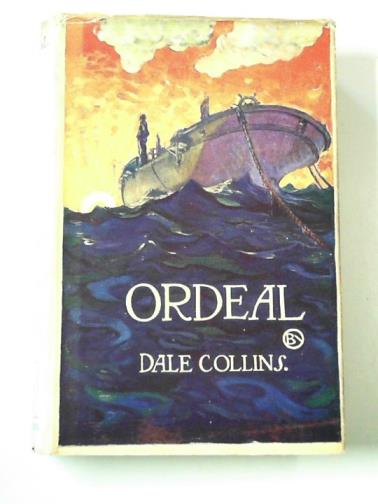
Dale Collins, Ordeal (Cornstalk Publishing): The Land (1 August) says that “it may be said without hesitation that Ordeal would be a remarkable and arresting story under any circumstances, but it is all the more remarkable for being a first essay in this class of fiction” (this class being, I think, a sea adventure). However, there are also reservations: “Occasionally the writer does not appear to be over-sure of his ground, and here and there we have lapses into excessive analyses of emotions, with a slight over emphasis of subtle suggestion, but on the whole the work is admirable. 

Zora Cross, Daughters of the Seven Mile (Hutchinson): Cross’s debut novel was praised, albeit faults were also identified by The Australasian (10 May): “It is not by any means a book without faults, but its merits are many and considerable, and most of them are to be found in the drawing of its characters. The scene is laid in Queensland, in the bush country outside a promising mining town, and the theme of the story is the difficulty of bringing two great forces into harmony, the call of the bush and the allurement of life in great cities.” The paper claims that with her first novel she has “won an important place in the ranks of Australian novelists”.

Ruby M. Doyle, The winning of Miriam Heron (Edward Dunlop): I wrote a recent Forgotten Writers post on Doyle, so I won’t say much. The Australasian (8 November) says that “its best points lie in the studies of bush life, with which the author is evidently familiar”. The plot “is slight”, but Doyle “shows a facile, kindly pen in dealing with the humorous type, and writes a straight, healthy story, that has less of morbidity than has the usual Australian bush tale”. The Advertiser (18 November) also admires her ability to write of the bush. However, The Queenslander (15 November), which also criticises the plot, concludes, interestingly, with “Miss Doyle appears to have attempted to graft something of the Ku Klux mystery into the character of the Australian bush, and so the story develops an atmosphere in places that is not Australian”.

Mabel Forrest, The wild moth (Caswell): According to The Advertiser (9 August), its strength is less its story as its descriptions of the bush. It concludes that “the vivid descriptions of the various phases of Australian life are its most enduring and attractive features”. 

Fergus Hume, The moth woman (Hutchinson): Hume is not Australian, but he did live in Australia for while, and published his detective novel The mystery of a hansom cab (my review) here, which made him of interest to Australians. The Australasian (26 January) says it is “written with a vigour and a freshness that a younger man ambitious of writing stories of the kind might envy” and that “the night life of London, the drug traffic, a mysterious murder following upon efforts to cope with the vices of the under world, provide thrills enough to satisfy the most blase reader of “shockers.” Then the little kicker: “Probabilities or possibilities matter little when one excitement follows on another, when the reader likes that sort of thing.”

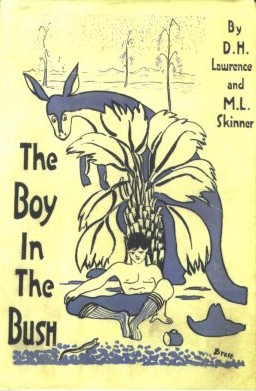
DH Lawrence, ML Skinner, The boy in the bush
First US ed., Thomas Seltzer, 1924

D.H. Lawrence and M.L. Skinner, The boy in the bush (Martin Seeker): Bill and I have both written about Lawrence and Skinner’s collaboration so I won’t repeat that here, but The Australasian (1 November) says that it’s “not easy to decide where Mr. Skinner [except it’s not Mr.] comes in, since there seems to be not a page in the book that is not unmistakably stamped with Mr. Lawrence’s peculiar genius”. Overall, the reviewer is not overly impressed, saying “an irritating mannerism is the repetition, of certain words and phrases, particularly in the description of physical peculiarities. While at times the story is vivid and almost overwhelmingly powerful, it lacks somehow the vital spark”. The Advertiser (22 November), on the other hand, is positive about its humour and insight, and calls it “readable”, but also comments that “at times Australians may be inclined to resent some of the severer criticisms of habits, dress, and customs”.

Vance Palmer, Cronulla (Cornstalk): The Australasian (13 December) gives Palmer’s book fairly short shrift, saying it “will be read with interest by reason of its Australian setting and the act of its being the work of a leading Australian writer”. For the reviewer, however, this station-life story is “built on well-worn lines, and has nothing new to offer either in plot or treatment”.

A few points about this list. First, there is the focus on bush and rural stories. Only two, it seems, are not; one is a sea story, and the other set in London. Even though our population was well urbanised, the bush was how we differentiated ourselves – both to ourselves, and in marketing ourselves to others. Then, there’s the fact that women writers are well in evidence, which confirms again what we know about Australia’s literary scene from the 1920s to 1940s. And, finally, I notice here, as I frequently notice in these earlier Trove articles, a willingness to identify faults. The comments are generally not smart-alecky or cruel, just clear about what they see as strengths and weaknesses. In some cases they recognise that the identified weaknesses are not important to the readers. In other cases, they note that it is a new author who can work on the problem areas. I wonder how the authors felt.

Thoughts?

Previous posts in the series: 1, Bookstall again

Monday musings on Australian literature: on 1924: 1, Bookstall, again

During 2022 and 2023, I wrote a series of posts on Australian literature as it was read, and thought about, a century earlier, in 1922 and 1923. Last year, I researched 1924, with a view to doing the same, and in fact heralded the upcoming 1924 series, but didn’t end up writing any posts. This was partly because many of the concerns were the similar to those of 1923, and partly because other ideas overtook me. But there were some interesting things said, so, nearly a quarter of the way through 2025, I’ve decided to write at least a couple of posts relating to 2024, starting with the Bookstall Company’s Bookstall series of Australian fiction.

This series of cheap paperbacks of Australian novels, as I have posted before, were introduced to the Australian market in 1904. I featured them in posts on 1922 and 1923, and am here updating us with 1924’s output. The series continued to serve its purpose, it seems, of supporting Australian writers as well as of providing reading matter at an affordable price. The Queenslander, introducing two new books in the series, started its brief article on June 7 with:

Australian novelists owe a great deal to the New South Wales Bookstall Company, which, during the last few years, has published more than 200 novels by Australian writers. 

Sydney’s The Labor Daily made a similar comment on December 16.

As far as I can tell from the research I did, publication did slow down with significantly fewer books published in 1924 than in 1923. Here is what I found.

  • Roy Bridges, By mountain tracks
  • Ernest Osborne, The copra trader
  • S.W. Powell, The trader of Kameko: South Seas
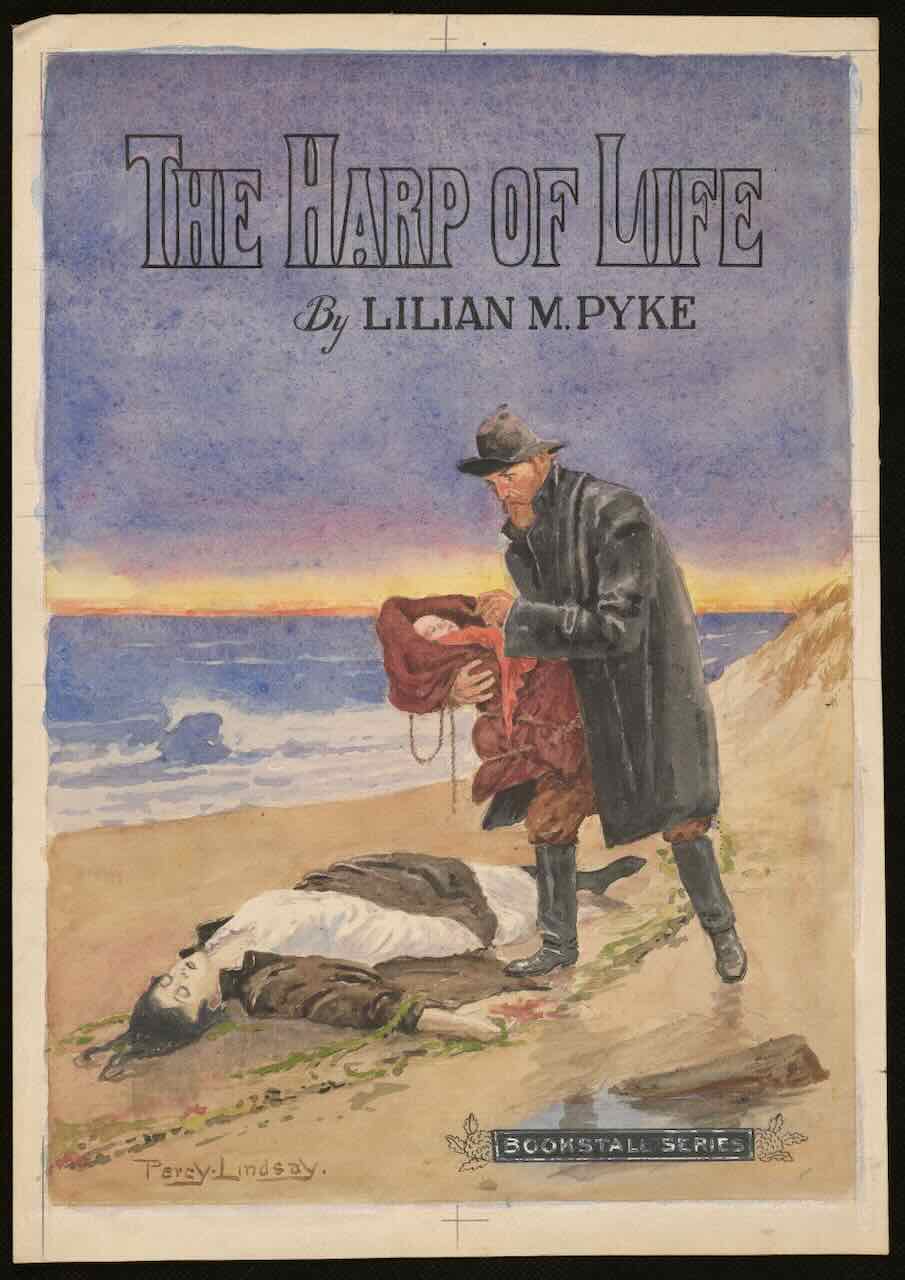
  • Lilian M. Pyke, The harp of life
  • W. Sabelberg, The key of mystery
  • H.E. Wickham, The great western road

So, just 6 books, compared with 20 in 1923, and only one by a woman. (There may have been a few more, but it’s these six that kept popping up in my searches.) Most are adventures of some sort and most feature a “love interest”.

Bushranger stories were still popular at this time, even though the worst of the bushranger era had ended by the 1880s. Both Roy Bridges’ By mountain tracks and Wickham’s The great western road belong to this genre. That said, Bridges’ book is described in The Queenslander (7 June) as “a story associated with the Kelly gang, but the theme generally is that of a romantic love episode”.

Two of the books, those by Pyke and Sabelberg, seem to be contemporary stories, Pyke’s being a tangled story about a waif rescued from the arms of its dead mother on a Queensland beach, and Sabelberg’s a mystery/thriller.

Adventures in the South Seas were apparently making a come-back around this time, with Jack McLaren (who appeared in my 1923 post), Ernest Osborne and S.W. Powell all setting books there. Hobart’s World (12 February) wrote of Powell’s novel as being “full of incident and adventure, and aglow with the rich color of the South Seas. A good shilling’s worth.” This latter point was frequently mentioned in reviews of Bookstall books. Indeed the World, in the same article, said of Wickham’s novel that

“Most of the characters in the book are well-drawn, and convincing, and there are humorous episodes to relieve the tragedies, and compensate for the author’s rather marked tendency to waste words in trite moralisings, and in a too-conscious elaboration of dialogue. Just the same, it is a marvellous shilling’s worth.”

Most reviewers of these books understood their intention as escapist reads or, what we would call today, commercial fiction, and wrote about them within that context. They either praised the works – with one, in fact, describing Osborne’s novel as “brilliantly written” – or, where they were critical, they tempered it with this understanding, as in the Powell example above. However, a report in the Murray Pioneer and Australian River Record (5 December) was not so generous. Sabelberg’s The key of mystery, it said, “is a crude murder story, crudely written”; Powell’s The trader of Kameko, “is a story, with no literary merit, of a white man, two brown girls and a hurricane”; and Wickham’s The great western road “is a story of the early gold rushes in N.S.W. of the same crude character as the other two”. Of course, reviewers do pitch their writing to their audience. Perhaps readers of the Murray Pioneer and Australian River Record had more refined tastes, and more money to spend, and our writer recognised that?

Some newspaper articles noted that some of these writers had already developed their writing skills in other forms. Sabelberg and Wickham, for example, are described as established, successful short story writers, and Lilian Pyke as a writer of “capital” stories for boys and girls – all of which proves, I guess, the point about Bookstall’s role in supporting Australian writers. How better to cut your teeth as a novelist than with a company like this?

And I will leave 1924 on this point. Life has been very busy this last week … so I have not been able to pay as much attention to reading and my blog as I’d like, but I do hope to post a review this week.

Monday musings on Australian literature: Forgotten writers 10, Ruby Mary Doyle

Unlike my last forgotten writer, Dulcie Deamer, today’s writer, though a prolific contributor to newspapers in her day, has slipped into the shadows. Neither Wikipedia nor the Australian dictionary of biography (ADB) contain articles for her, but the AustLit database does. As with many of my Forgotten Writers articles, I researched and posted a versions of this on the Australian Women Writers’ site.

Ruby Mary Doyle

Ruby Mary Doyle (1887-1943) wrote short stories and serialised novels, newspaper articles including travel and nature pieces, and plays, mostly publishing as Ruby Doyle or Ruby M. Doyle. Much of her writing was published in Fairfax’s weekly magazine, The Sydney Mail. By the 1930s she had, says AustLit, gained a reputation as a writer of some standing. She was also active in the Lyceum Club and the Pioneer Club in Sydney. And yet, there are no articles for her in Wikipedia or the Australian Dictionary of Biography.

Doyle was born on the 20 February 1887 in Gunnedah, New South Wales, to Joseph McCormick Doyle, a bank manager for the Commercial Bank, and Annie (née Hooke). She was the first of six children. In 1935, in an article titled “The making of the writer”, Doyle wrote of how she came to writing:

As a child, when I walked through the bush, well behind the family party, every tree seemed an enchanted castle. Birds, butterflies, flowers talked, and I understood them. Imagination — that blessed gift from the gods — had come to me from every side of my family, and finally led me, whether I would or not, into the realm of writing.

According to Kingston, of the Dungog Historical Society, her first published serial was The Dragon, which appeared in The Sydney Mail from 4 June 1913, and was later published in book form as The mystery of the hills. Promoting the book form, which was published in 1919, The World’s News wrote that:

Those who love a story which is thoroughly and typically Australian and of the country will enjoy this tale of love and adventure … The “mystery” we shall not, of course, say anything about, except that it has to do with men who defy the law and have a chief, who is a man of importance. There are several love stories, and they have the usual course, and there is quite a fund of information as to how we Australians live in the country, and how we manage to enjoy ourselves there. 

This little piece says much about how Australia saw itself. “How we manage to enjoy ourselves there [ie “in the country”]” suggests that Australia was well on the way to urbanisation, but fascinated by its bush self.

Further stories and serialisations appeared, including The winning of Miriam Heron in The Sydney Mail in 1918, which was published in book form by Edwards Dunlop in 1924. Announcing this new serial in 1918, The Sydney Mail wrote:

She [Doyle] has already contributed to the ‘Mail,’ and has disclosed literary and dramatic ability of a high order. It is gratifying to note that she shows no disposition to ‘write herself out.’ On the contrary, ‘The Winning of Miriam Heron’ reveals that she has mastered the art of construction, and thus gives her readers a better chance than previously to fully appreciate her literary powers.

From 1924 to 1926, Ruby travelled overseas a few times – to the United Kingdom, the continent, Canada and America – during which time she regularly submitted travel articles to the Dungog Chronicle, which, according to that paper, “were reprinted in many country papers throughout the State.”

Doyle wrote for local papers through the 1920s and 1930s. AustLit lists over 30 works of hers published over this time. She also tried her hand at playwriting. Kingston writes that her play The Family Tree came second in a competition at the Independent Theatre, Sydney, in 1933, and that the following year, The Man from Murrumbidgee, was produced at the Kursaal Theatre, also in Sydney. I believe these are the same play, given The Man from Murrumbidgee is about a status-seeking wife who tries to find “a worthy ancestor” on the family tree.

Doyle’s writing reflects the versatility of the working writer. Her short stories dealt largely with domestic subjects, while her serialised novels included historical stories about the colonial days, and romantic adventure stories. Her non-fiction focused particularly on nature, travel and local history, rather than on social or political commentary. Many of her local history pieces drew on her own family’s long history in the region, and include some delightful touches of humour. For example, she describes a pioneer family (hers it seems), coming out to Australia in 1828 with various things, including merino sheep and

rolls and rolls of beautiful silks, Mr. Hooke having an idea that he would be able to deal successfully in such merchandise. It proved only a supposition, and for the rest of her life Mrs Hooke had a marvellous collection of silks from which her dresses were made. 

There is also some recognition of the original people of the land. Writing in The Sydney Mail 1931 on the town of Gresford, she says that:

Most of the homes in the vicinity bear English and Welsh names — Norwood, Clevedon, Goulston, Camyr ‘Allyn, Caergule, Penshurst, Tre vallyn, etc. The river, named Paterson by the white man, was called Yimmang by the aborigines; one of our poets has written a very beautiful poem, “Ode to the Yimmang,” in which he extols its beauty.

Ruby Doyle was regularly written up in the local Dungog Chronicle, clearly being of interest to the community. She went to England, again, in 1935, planning to be away for two or three years. On 1 March, the Dungog Chronicle,reported on a farewell for this “gifted novelist”, and named Flora Eldershaw – one half of the M. Barnard Eldershaw collaboration – as a co-guest at the event. This suggests Doyle was known to the literati of her time. Doyle died in England in 1943, having never returned home again. A small obituary appeared in various local newspapers, including The Gloucester Advocate (see under Sources). The obituary noted her three published works, but also commented on her writing overall, commenting in particular that

a keen observer of nature, she had the gift of translating her thoughts on paper in an easy readable way.

The piece I posted for the Australian Women Writers Challenge is titled “The flame” (linked below). It is an intriguing story about a disgruntled wife, and invites – particularly from modern eyes – a variety of readings. I’d love to hear your thoughts.

Sources

  • Miss Ruby Doyle, The Gloucester Advocate, 12 January 1943 [Accessed: 14 January 2025]
  • Ruby Doyle, “The flame“, Sydney Mail, 24 July 1935 [Accessed: 3 February 2025]
  • Ruby M. DoyleAustLit [Accessed: 3 Feb 2025]
  • Maureen Kingston, “Was Ruby Doyle our first local travel writer?”, Dungog Chronicle, 25 August 2021 [Accessed via the NLA eResources service: 3 February 1924]

Frank Dalby Davison, Dusty (#BookReview)

It’s a strange coincidence that my second review for Bill’s Gen 1-3 Aussie male writers week is for a novel titled Dusty, when my first was for a short story titled “Dust”. One of those funny little readerly synchronicities. The title, however, is about the only synchronicity because, although both stories allude to the dusty Australian landscape, Casey’s short story is about miners’ lung dust disease while Davison’s novel is about a part-kelpie part-dingo named Dusty.

A bit about Frank Dalby Davison

Davison (1893-1970) was best known as a novelist and short story writer, and was a significant figure in Australian literary circles of his time. There are useful articles for him in Wikipedia, and the Australian dictionary of biography, and I plan to devote a Monday Musings to him soon. Meanwhile, as background to this post, it’s relevant to say that he was born and schooled in Melbourne, but left school in his early teens to work on his father’s farm near Kinglake. The family moved to the United States in 1909, when he was 16. After working there in the printing trade, he travelled more, eventually enlisting for World War 1 in England. After the war, he took up a Soldier Settlement selection near Injune, in central western Queensland. 

Davison wrote several novels, but his best known is probably Man-shy (1931), which won the Australian Literature Society Gold Medal. Featuring a red heifer, it was my introduction to Davison in my first year of high school in the 1960s. Dusty (1946) is also about an animal – this time a dog – and has been in my sights for some time. Both novels drew on his experiences in Injune. AustLit reports that the manuscript of Dusty, ‘entered under the title “Stranger”, and the pen-name “Tarboy”, won the Melbourne Argus and Australasian Post 500 pound Novel Competition in 1946′. 

Dusty

At the end of my edition of Dusty is a promotion for Man-shy which quotes from H.M. Green, the literary historian who inspired Bill’s “generations”. Green writes:

Although other novelists have made animals their principal characters and drawn them realistically, Davison is the first to make a serious attempt to get inside their minds. The red heifer and the mob of wild cattle to which she belongs stand for the spirit of freedom and dogged, untameable resistance; their struggle is made extraordinarily real to us … Davison has a genuine and individual talent.

This could equally apply to Dusty, which tells the story of a dog, sired by a kelpie to a dingo mother. Violently wrenched from his lair when he was a few weeks old, he is sold to a decent man, a bushman named Tom. Tom is no fool. He recognises the mixed blood, but also sees potential in the pup, and trains him to become a champion sheep dog. Their bond is strong but is tested when Dusty’s “dingo blood” starts asserting itself, and he turns sheep-killer by night. This will not do, and Tom knows it. The novel, however, does not play out quite the way you’d expect, and we are left guessing until the end about what will, indeed, happen to Dusty.

That’s the plot, but like many plots it doesn’t tell you much about what the book is really about, or what makes it a good read. Told in three parts, Dusty is a realist novel, detailing life on Australian sheep stations and cattle properties, and told mostly through the perspectives of Tom and Dusty. Yes, you heard right, Dusty, the dog. I was completely engaged because not only is there none of the sentimentality common in stories about a man and a dog, but there’s also nothing anthropomorphic in the dog’s point-of-view. He feels pure dog, which I thought quite a feat. Early on, for example, Tom, having previously given Dusty his dinner without ceremony, puts the food down and starts some training:

Then followed a series of mystifying events. A hand appeared just above the dish and twitched, giving forth a series of soft snapping sounds; then there was a little soft whispering, and then a voice that, like the hand, kept repeating a small noise over and over again. He could make nothing of it …

This dog’s-eye view of the world, based on his experiences to date, continues through the novel.

Soon, though, bigger issues are at play involving the two parts of Dusty’s being, “the ancient battle between conflicting heredities, and between early influence and present environment; the mother against the father, nature against art”. Then Davison adds something interesting. The dingo is the product of nature, while the kelpie, the working dog, is “a product of art”. But, Davison adds, “nature, if man fails in toil or vigilance, hastens to reclaim her own”.

In other words, beneath this deeply interesting story about a man, his dog and outback farming, is a wider story about “nature”, or the essence of our beings. Contained within Dusty is the struggle between the two forces – that of freedom, of following his instinct, and that of living by his training, by rules and responsibilities. After Dusty’s dingo side becomes apparent to all, Tom knows what must be done but chooses to change his life rather than kill his dog. He becomes a self-employed possum scalper in cattle country, and finds, “without meaning any ingratitude for past kindnesses”, that he relishes his new situation in which he is invited to share a meal as “a guest and not just the hired man”. In other words, as a possum scalper, Tom is freer to be his own man.

But, while I think Tom’s life is part of this wider theme, the main focus is animals, and the idea that, in them, “is a whole scheme of values outside those familiar” to us.

There is no easy ending for Tom and Dusty, and we are left, three paragraphs from the end, with a dingo howl, “a cry of mournfulness and dark mirth, of drollery and love and hate and longing, of the joy and sorrow of life, of the will to live, of mockery and despair”.

Dusty is not a didactic book. There is no moralising, no subjective pronouncements about choices. Instead, with its objective tone, and plain but expressive prose, it feels more elemental, something that examines the essence of who we are and what we do to live. And that makes it feel timeless.

Frank Dalby Davison
Dusty
Sydney: Angus & Robertson, 1983 (Arkon ed., orig. 1946)
244pp.
ISBN: 0207133891


Gavin Casey, Dust (#Review)

I have had to put aside the novel I was reading for Bill’s Gen 1-3 Aussie male writers week, as my reading group book called. I will get back to it, and post on it later, but in the meantime, I wanted to post something in the actual week.

So, I turned, as I have for other Reading Weeks, to The Penguin century of Australian stories, an excellent anthology edited by Carmel Bird. Given Bill’s week encompasses writers working from 1788 to the 1950s, Bird’s anthology offered almost too many choices. Besides the obvious Henry Lawson, there were Steele Rudd, Tom Collins, Vance Palmer, and more, ending with Judah Waten’s 1950 story, “The mother”. I considered several, but Gavin Casey captured my attention because in her Introduction to the anthology, Kerryn Goldsworthy, looking at the 1930s and 40s, commented that Gavin Casey’s “Dust” and John Morrison’s “Nightshift” exemplified the more overtly political stories of this era. She added that:

they are stories in simple, unadorned language … that focus on workers and workplace disasters, on the physical dangers lying in wait for working men and women.

I have been interested in this period – and its socialist-influenced political thinking – for some time, so it had to be Casey or Morrison. Casey it was because I have listed him in a couple of Monday Musings posts but knew nothing about him.

Who was Gavin Casey?

Casey (1907-1964) was an author and journalist, born in Kalgoorlie, Western Australia, to an Australian-born father and Scottish mother. 

He doesn’t have a Wikipedia article but there is a useful biographical entry for him in the Australian dictionary of biography (ADB). Written by Anthony Ferguson, it says he had a sketchy education before obtaining a cadetship with the Kalgoorlie Electric Light Station. However, he left there to work in Perth as a motorcycle salesman, only to be “forced” back to Kalgoorlie in 1931 by the Depression. He then worked “as a surface-labourer and underground electrician at the mines, raced motorcycles and became a representative for the Perth Mirror“. He married in 1933, but “poverty plagued them, long after their return to Perth next year”.

By 1936, he was publishing short stories in the Australian Journal and the Bulletin, and in 1938 he was foundation secretary of the West Australian branch of the Fellowship of Australian Writers. His two short story collections – It’s harder for girls (1942), which won the 1942 S. H. Prior memorial prize and in which “Dust” appeared, and Birds of a feather (1943) – established his reputation. Ferguson writes:

Realistic in their treatment of place and incident, his stories showed—beneath the jollity and assurance of his characters—inner tensions, loneliness, unfulfilled hopes, and the lack of communication between men and women.

You may not be surprised to hear that his first marriage failed!

Overall, he wrote seven novels plus short stories and nonfiction works. His novels include Snowball (1958), which “examined the interaction between Aborigines and Whites in a country town”, and Amid the plenty (1962), which “traced a family’s struggle against adversity”. There is more about him in the ADB (linked above).

Ferguson doesn’t specifically address the political interests Goldsworthy references. Instead, he concludes that critics liken Casey’s earlier works to Lawson, seeing “a consistent emphasis on hardship that is tempered, for the male at least, by the conviviality of mates”. Ferguson also praises both for “their perceptiveness” and “their execution”.

The reality of Casey is a bit more nuanced, I understand. For a start, his men are not bush-men but suburban workingmen. Consequently, I plan to write more on him in a Monday Musings Forgotten Writers post, soon. Meanwhile, on with “Dust”.

“Dust”

“Dust” features male characters only, and there are some mates but, while they are important, they are not central. “Dust” also must draw on Casey’s experience of working in Kalgoorlie’s mining industry. It’s a short, short story, and is simply, but clearly constructed. It starts with a physical description of dust swooping through the township, over housetops and hospital buildings, and “leaving a red trail wherever in went”. It sounds – almost – neutral, but there are hints of something else. Why, of all the buildings in town, are “hospital buildings” singled out with the “housetops”, and does the “red trail” left behind signifiy anything?

Well, yes it does, as we learn in the next paragraph. Although this dust comes from “honest dirt” and can do damage like lifting roofs off, it is “avoidable” and is nothing like the “stale, still, malicious menace that polluted the atmosphere of far underground”. Ah, we think, so the “dust” we are talking about is something far more sinister than that flying around the open air.

And here is where the hospital buildings come in. Protagonist Parker and his miner friends are waiting for their six-monthly chest x-rays checking for the miners’ dust lung disease which killed his father. Things have changed since his father’s times, Parker knows. Not only are there the periodic medical examinations, but there are mechanisms to keep the dust down, and a system of “tickets” and pensions for affected miners. But, the risk is still there, and Parker’s anxiety increases as he watches his mates go in one by one, while he waits his turn.

This is a story about worker health and safety – but told from a personal not political perspective. It’s left to the reader to draw the political conclusions. However, it is also a highly relatable story about humans, health, and risky choices and behaviour, because it seems that Parker does have a choice. I won’t spoil it for you, but simply say that the ending made me smile – ruefully.

Gavin Casey
“Dust” (orig. 1936)
in Carmel Bird (ed.), The Penguin century of Australian stories
Camberwell: Penguin Books, 2006 (first ed. 2000)
pp. 86-90

Monday musings on Australian literature: Forgotten writers 9, Dulcie Deamer

Dulcie Deamer, like my most recent Forgotten Writer, Jessie Urquhart, has retained some level of recognition – or, at least notability, with there being articles for her not only in Wikipedia and the AustLit database, but also in the Australian dictionary of biography (ADB). I have briefly mentioned her in my blog before, in Monday Musings posts on the 1930s and 40s.

Dulcie Deamer

Born Mary Elizabeth Kathleen Dulcie Deamer, Dulcie Deamer (1890-1972) was, says Wikipedia, a “novelist, poet, journalist, and actress”. ADB biographer Martha Rutledge, however, is more to the point, describing her as “writer and bohemian”, while her contemporary, the journalist and author Aidan de Brune, puts it differently again, commencing his piece with, “Dulcie Deamer has had an adventurous life”. From the little I’ve read of her and her work, it’s clear she was imaginative and fearless.

Born in Christchurch, New Zealand, to George Edwin Deamer, a physician from Lincolnshire, and his New Zealand-born wife Mable Reader, Dulcie Deamer was taught at home by her ex-governess mother. The timelines of her youth are sketchy in places, but Rutledge says that at 9, she appeared on stage, and De Brune writes that she was writing verses by the age of 11. A year after that, in 1902, De Brune and Rutledge agree that her family moved to Featherston, a small bush township in the North Island of New Zealand, where, de Brune says, “she ran wild” for five years, “riding unbroken colts, shooting, learning to swim in snow-fed creeks, and going for long, solitary rambles of exploration through the virgin bush”. It was here ‘that what she describes as “memories of the Stone Age” came to her’. Somewhere during this time, according to Rutledge, she was sent to Wellington to learn elocution and ballet lessons, apparently in preparation for the stage. At the age of 16, she submitted a story to the new Lone Hand magazine, and won the prize of 25 pounds. It was “a story of the savage love of a cave-man” and it changed the course of her life.

This story, “As it was in the beginning”, won the prize in 1907, from around 300 entries, said one contemporary report (The Wellington Times, NSW, 18 November 1909), and was published in The Lone Hand at the beginning of 1908, illustrated by Norman Lindsay. The critical responses were shocked but, mostly, admiring, that such virile writing could come from such a young woman. The story went on to be published in a collection of her stories in 1909, titled In the beginning” : six studies of the stone age, and other stories ; including “A daughter of the Incas”, a short novel of the conquest of Peru. One reviewer of this collection (Barrier Miner, 27 May 1910), wrote that Deamer “writes with a freedom of speech and a knowledge of things in general which must have fairly astounded her respectable parents, one would think, when they first read her compositions”! You get the gist. This work was republished in 1929 in a special limited edition titled, As it was in the beginning. The Australasian (21 December 1929) reviewed this and wrote of that original award winning story:

It was a tale of primitive man and woman, of a wooing and winning and retaining with club and spear— an unmoral tale, utterly pagan, terrifically dramatic. Its paganism was unsophisticated; its dramatic force was the expression of natural gift. Mr. Norman Lindsay illustrated the story. His paganism could hardly be called unsophisticated, but there was no doubt about his dramatic power. 

She was really quite something it seems and I might research her a little more. Meanwhile, Wikipedia picks up the story (sourced from newspapers of the time). As well as writing, she continued her stage career. She married Albert Goldie, who was a theatrical agent for JC Williamson’s, in Perth, Australia, in 1908. She had six children, but separated from Goldie in 1922. Rutledge, writes that

In the crowded years 1908-1924 Dulcie bore six children (two sons died in infancy), travelled overseas in 1912, 1913-14, 1916-19 and 1921 and published a collection of short stories and four novels—The Suttee of Safa (New York, 1913) ‘a hot and strong love story about Akbar the Great’; Revelation (London, 1921) and The Street of the Gazelle (London, 1922), set in Jerusalem at the time of Christ; and The Devil’s Saint (London, 1924). Three were syndicated in Randolph Hearst’s newspapers in the United States of America. Her themes, including witchcraft, gave ‘free play to the lavish style of her writing, displaying opulence and sensuality or squalor of traditional scenes.

Reviewing The devil’s saint for Sydney’s The Sun, The Stoic gives a flavour of Deamer’s writing. “She has style (a little too ecstatic perhaps) and she has a fine instinct for story-telling”, but there is much kissing – quite explicitly described – and “Sheikish stuff”. However, as The Stoic knows, there are readers for such writing, and s/he concludes that ‘If anybody wants romance, with a flavor of the supernatural and plenty of “pash,” this is the book’.

Deamer left her husband in 1922, and lived a Bohemian life in Kings Cross, while her mother brought up her children. She worked as a freelance journalist, contributing stories, articles and verse to the Australian Woman’s Mirror, other journals and newspapers, including the Bulletin and the Sydney Morning Herald. Like other writers we have featured, she often used pseudonyms. Rutledge tells us that Zora Cross described her in 1928 as ‘Speedy as a swallow in movement, quick as sunlight in speech … [and] restless as the sea’. Debra Adelaide writes that she was known as the “Queen of Bohemia” due to her involvement with Norman Lindsay’s literary and artistic circle, with Kings Cross Bohemianism, and with vaudeville. Various commentators and critics refer to her interest in religion, mythology, classical literature and the ancient world.

Deamer was a founder in 1929 and committee-member of the Fellowship of Australian Writers. In the 1930s she wrote plays, and a volume of mystical poetry titled Messalina (1932), while in the 1940s she another novel, Holiday (1940), another volume of mystical poetry, and The silver branch (1948). De Brune, writing in 1933, says that she was also hoping “to contribute screen stories to the newly-established Australian film industry” but it doesn’t appear that she achieved in this sphere.

In their short entry on her, Wilde, Hooton and Andrews say that her unpublished biography, The golden decade, “is informative on the literary circles of Sydney in the 1920s and 1930s”. They also say that she features in Peter Kirkpatrick’s 1992 book, The sea coast of Bohemia. Whatever we might think of her novels now, she was a lively and creative force in her time, and worth knowing about.

The piece I posted for the Australian Women Writers Challenge is titled “Fancy dress” (linked below). It provides insight into her interests in the magical and mystical and conveys something of her lively, humorous style.

Sources

  • Debra Adelaide, Australian women writers: A bibliographic guide. London, Sydney: Pandora, 1988.
  • Aidan de Brune, “Dulcie Deamer (1890-1972)” in Ten Australian Authors, by Aidan de Brune, Project Gutenberg Australia and Roy Glashan’s Library, 2017 (originally published in The West Australian, 13 May 1933) [Accessed: 21 November 2024]
  • Dulcie Deamer, “As it was in the beginning“, The Lone Hand (1 January 1908) [Accessed: 23 December 2024]
  • Dulcie Deamer, “Fancy Dress“, The Daily Mail (12 July 1924). [Accessed: 21 November 2024]
  • Dulcie Deamer“, Wikipedia [Accessed 21 November 2024]
  • Martha Rutledge, ‘Deamer, Dulcie (1890–1972)‘, Australian Dictionary of Biography, National Centre of Biography, Australian National University, 1981 [Accessed: 21 November 2024]
  • William H. Wilde, Joy Hooton and Barry Andrews, The Oxford companion to Australian literature. Melbourne, Oxford University Press, 2nd, edition, 1994