Elizabeth Harrower, In certain circles (Review)

Elizabeth Harrower, In certain circlesThere’s an interesting story behind Elizabeth Harrower’s last novel, In certain circles. It was all set for publication in 1971, following her very successful The watch tower (my review), when Harrower pulled it. Why? I wondered about this as I read it, and I have some ideas, but more on that anon. First, the story.

In certain circles chronicles the lives from youth until their forties of five people – well-to-do brother and sister Russell and Zoe Howard, orphans from an impoverished background Stephen and Anna Quayle, and Lily the teenage sweetheart and then wife of Russell. Part way through the novel, Stephen and Zoe also marry, as does Anna outside the circle. The story starts and ends with Zoe, but the perspective shifts a little along the way between the various characters. It’s a story of idealism and wasted opportunities, of the decisions we make (or don’t make) and their unintended consequences. It’s also about the way the past can drive those decisions. The setting is Sydney, not long after World War 2, though it’s never made explicit. Harrower is not interested in time and place, just people – who they are, why they do what they do, and how it impacts their deepest selves.

Commentators discussing Harrower invariably tell us that Australian literary luminaries Patrick White and Christina Stead praised her writing. You can see why – she writes with their intensity, probing deeply into the psyches of her characters to explore motive, feeling and behaviour. I’d also liken her to the recently deceased Anita Brookner, who, coincidentally, was born the same year as Harrower, 1928, and who also intensely explored the psyches of her characters.

The thing about Harrower’s writing here, though, is that while character is her focus, a strong sense of form underpins her style. The novel is, for example, presented in three clearly delineated parts, which facilitates time-jumps without the need for extensive explanation and gives it the narrative arc of a classic three-act drama.

So, Part 1 is set just after the war. Zoe is a bright, “fearless”, world-at-her-feet young seventeen-year-old, who often doesn’t mean what she says and is not known for her “social conscience”. She is, clearly, ready for a fall. A perfect Act 1 set up in other words. Big brother Russell, on the other hand, has been touched by experience, including being a prisoner-of-war, and has a more realistic perspective of the world. He sees disadvantage and he wants to right it. The opening scene is a tennis party at the Howards, to which Russell has invited the orphans and at which his fiancée Lily is also present. Our five characters are thus properly introduced to us and each other.

Part 2 starts eight years later, when Zoe is 25 years old and has just returned, upon her mother’s death, from a blossoming career in film and photography in Europe. The course of her life changes at this point, and she marries Stephen who is now in business with her brother Russell. She finds herself deeply in love with this man who, when she was 17, had both attracted and repelled her with his judgement of and opposition to her. In this part, the characters have settled into some sort of stable routine, but we readers see the cracks even if the characters themselves don’t. Take Zoe, our main character, for example:

Excessively, even for someone in love, Zoe had found a chameleon-like capacity for fitting herself to Stephen’s moods.

Hmm, we think … and this too:

From riding the crest of a wave, from taming tigers, she had turned into this new thing–a suppliant, but a suppliant with a purpose: all to be well with Stephen.

The conversations between them are chilling – because Zoe submits and submits her self to his views and ideas.

Meanwhile, Lily, for whom family is all (“it was not only a sort of pity Lily felt for anyone unrelated to her, but an involuntary antagonism”) and who has given up her career for her children, is becoming frustrated with Russell’s focus on a wider humanity. And Anna, now widowed, realises where her love truly lies – Russell.

Then comes Part 3, as it inevitably must. Zoe is nearly 40, and not happy. (We could have told her!) After 15 years of self-denial and subsuming her self to Stephen, she is a changed woman, to her detriment, and she knows it. That fall we assumed at the beginning has finally come – and not just for Zoe. The denouement is dramatic, rapid and effective in shaking up the characters’ complacencies and self-destructive compromises, just as you’d rightly expect in a narrative of this sort.

Besides this three-part structure, Harrower also employs form in her character handling. The novel starts with two sets of siblings and one outsider, Lily, but by the middle of part 2, they have re-formed into two couples and a different outsider, Anna. This rearranging of pairs-and-outsider creates parallels and counterpoints that keep the story tight and focused, exposing tensions and differences.

“wasted years”

But form, of course, is used for a purpose, which is to explore themes important to Harrower. In certain circles is not as claustrophobic or as chilling as The watch tower, but they have similar concerns, such as loneliness and a feeling of entrapment. These play out differently in In certain circles, where the focus is on wasted talents, through lack of opportunities, and wasted lives, through difficult pasts or poor decisions, but the result is the same – loneliness, desolation, and entrapment, conscious or otherwise.

Early in the novel, when she’s still 17, Zoe escapes a room of older people, “away from miserable white faces and wasted years”. Ironically, this is exactly how Zoe finds herself twenty odd years later, because Stephen has, “without the least desire to deflate or wound”, dissolved the last of her “ideas and ambitions”, leaving her trapped, demoralised, “detesting the person she had become”.

Zoe is not the only one. The other characters too find themselves having wasted at least some aspect of their lives, some because they can’t let go of (or are damaged by) the past, others because they honour decisions and commitments they’ve made.

There are many roads by which these characters come to the wasteland in their lives, and Harrower presents them with an acuity that is also generous. She doesn’t judge. Even when, at the beginning, Zoe is arrogant and self-involved, Harrower encourages us to like her because she’s lively and good-hearted rather than malicious. Stephen would be even easier for us to dislike, but his pain, his genuine love for his sister, and his obliviousness to “the damage he had done”, enable us to understand rather than hate him.

And now, here I am, way past when I should have finished this post, but having barely touched on the writing – and I should discuss it, because it is delicious. Harrower nails feelings, attitudes and motives with a pithiness that takes your breath away. Watch out for a Delicious Descriptions post!

So, returning to my opening para, why might Harrower have pulled her novel? I understand that she submitted it, pulled it and re-worked it, then submitted it again, and pulled it permanently. I can see why she may have done this: the drama that precipitates the resolution is a little far-fetched though she explains it well enough to make it work; Russell is comparatively shadowy even among the less developed characters; and occasionally the perspective feels a little clumsy or laboured, as if she hasn’t fully resolved how to bring all her personages into the frame as she desires. But, are these serious enough for the book not to have been published? I don’t think so. Neither did Text, and neither, we have to presume, did that original publisher. It is literature’s gain that this book has finally seen the light of day.

Lisa at ANZLitLovers also enjoyed the book.

awwchallenge2016Elizabeth Harrower
In certain circles
Melbourne: Text Publishing, 2014
250pp.
ISBN: 9781922182968
Annie Dillard, The Maytrees (Review)

Annie Dillard, The MaytreesI am not, as I wrote in my recent post on Emma Ayres’ memoir Cadence, a big “reader” of audiobooks. In fact, until Cadence, I hadn’t listened to one for a few years. However, we do have a few here that we had given Mr Gums’ mother as her sight started to fail and which we retrieved after she died back in 2011. I bought them for her, so am rather keen to see what I think of my choices!

Now, I’ve never read Dillard, though of course I’ve heard of her. The Maytrees, published in 2007, is her second novel, her first being the Pulitzer prize-winning novel Pilgrim at Tinker Creek published over thirty years earlier in 1974. Fascinating … but I’m not surprised. The Maytrees is such a quiet, deeply thoughtful book, it could only have grown out of years of living and contemplation. It reads like a lifelong meditation on the meaning of life at its very foundation – on how and why we love, on how we should live our lives.

WARNING: POTENTIAL SPOILERS

Provincetown, 1983

Provincetown, 1983

There is very little plot, though there is a storyline which tracks the relationship, through various ups and downs, of Toby Maytree (called Maytree in the book) and Lou, the woman he marries. This story is imbued with the place they live, Provincetown, Cape Cod, a place I visited in the 1980s. I loved reliving my experience through Dillard’s gorgeous evocation of it. Anyhow, the time spans from Maytree’s childhood in the late 1920s and 1930s through several decades to, I guess, the 1990s or so. Paradoxically, while the place is woven closely into the story – you get to know, intimately, the dunes, the tides, the beach shack, and even the bed that is moved, as needs change, up and down the floors of their home to bring the outdoors in – the story is absolutely universal. It’s the quintessential boy-meets-girl story but one that doesn’t end at “happily ever after”. It takes us through the long years of their marriage, the birth of their child, a devastating betrayal, a huge-hearted forgiveness, and their deaths. The book shifts around a bit in chronology, making you work a bit, but you usually know where you are.

While the main themes of the book relate to love and life’s meaning, many other ideas come through. There’s a lot of discussion of reading and literature. We are told early in the novel that “He read for facts, she for transport”. When she, Lou, finds love, here is her reaction:

Love so sprang at her, she honestly thought no one had ever looked into it. Where was it in literature? Someone would have written something. She must not have recognized it. Time to read everything again.

Later in the book when love is lost and recovered, she wonders again about love and life’s meaning. There might be a point to life, she wonders, and there might be an answer in books. She feels, however, that she had only moved a millimetre on these questions in her lifetime. She reflects on how life with Maytree had felt complete – until she’d had her baby, Petie, after which she couldn’t imagine life without him. But, inevitably, he too moved on, and in time had his own child presenting him to her as if she didn’t know the experience or feeling!

In other words, it’s a wise, knowing book, a book which sees how people think and behave. Here is Lou, newly alone:

She ignored whatever did not interest her. With those blows she opened her days like a piñata. A hundred freedoms fell on her. She hitched free years to her lifespan like a kite tail. Everyone envied her the time she had, not noticing that they had equal time.

I loved that little kick – “not noticing they had equal time”. How often do we see the other grass as greener, not seeing our own!

There’s also sly – or perhaps not so sly – commentary on American politics. Dillard describes Hoover, in 1947, warning Americans about artists, and asks “Did America have a culture besides making money?” There’s reference to a “Strictly for profit hospital”, and, at another point, when Maytree ponders the idea of shooting himself to save getting too old, we are reminded that “this was America”. These scattered political jibes provide interesting intrusions into what is mostly a philosophical novel.

The language is quietly beautiful. As I was listening to it, I could only really capture phrases to share, such as “he rummaged her spare comments”, or a description of one of Maytree’s earlier girlfriends as “a great handful of a girl out west”, or a description of the sea as a “monster with a lace hem”. Little motifs run through the book. Lou’s various red items of clothing like a scarf or a dress and Maytree’s red-speckled notebooks, for example, provide colour and continuity, and hint too at the passion of their love.

Maytree and Lou are drawn at depth. We move inside both their heads at different times. At the time of Maytree’s betrayal – which I must say is the point in the book that is hardest to grasp – gentle, but strong and resourceful Lou decides that “if this was not shaping up to be Maytree’s finest hour it might as well be hers”. The other main characters populating their Provincetown world include Deary, Reevadare Weaver, Cornelius Blue and Jane Cairo, all of whom add depth and diversity to the close community Dillard depicts.

I must say though that I found it quite a difficult book to listen to. In some ways it was too slow – we read faster than we can listen, I’ve been told. As the reader, David Rasche, read pages and pages of admittedly beautiful description and contemplation, I felt held back. I wanted to read it at my pace, faster. And yet, it was also too fast, because at times I wanted to stop and mull over the words and ideas.

I could go on, but without having the book itself to bring it all together the way I’d like, I’ll just close here and say that I found it a thoroughly satisfying book. It is warm, non-judgemental, generous and wise. And if that sounds like it’s also sentimental and corny, you’d be wrong. One day I’ll read more Dillard.

Annie Dillard
The Maytrees (audio)
(read by David Rasche)
Harper Audio, 2007
5.5 hours on 5 CDs

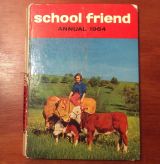
School friend annual 1964

The things you find when you start to declutter! School friend annual 1964 is a blast from my very distant past. Yes, I know, some of you weren’t born then, but I can’t resist sharing the sort of books produced for young girls in the olden days! I loved receiving annuals and anthologies, books in my favourite series or by my favourite authors. The more books I received, the more successful I rated my Christmas. Anyhow, it’s fascinating to look at this over 50 years after it was published.

School Friend AnnualSchool friend annual was an English publication which was also distributed in New Zealand, South Africa, and the Federation of Rhodesia and Nyasaland. Loyal countries of the British Commonwealth, in other words. As far as I can tell it started publication in 1927 and lasted until 1982 by which time I believe it was all comic/picture strip. One article I read suggested that the 1960s are the most collectible!

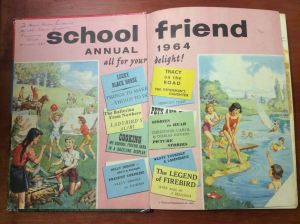
I’m going to discuss the main contents of my 1964 volume by rough category, so we can look at the reading matter deemed suitable for the young girl and teen of the early to mid 1960s. It’s a time when the Beatles were starting to make their presence felt, when the Civil Rights Movement in America was well under way, but when the second wave of women’s liberation hadn’t really started:

School Friend Annual 1964Stories (Prose or verse)

  • Lucky Black Horse, by Cecil Danby: young girls and horses, then, and still now!
  • The Ballerina from Nowhere: this would have been one of my favourite stories (told in verse in fact) as I adored ballet and loved ballet books and ballet stories. No horses for me. It was ballet all the way. The ballerina illustrated is very nicely developed, which was something for skinny-rake me (at the time) to aim for.
  • A Christmas Carol, from the famous story by Charles Dickens: an excerpt.
  • The loneliest girl in town, by Christine Landon: about the new girl in town who wants to join the dashing looking scooter club. This is a teen story, with such writing as ‘”Haven’t you ever realised why Gloria can’t stand you, Mandy?” she asked merrily, “It’s because you’re heaps pretty than she is. She was scared you’d be a rival.”‘ I don’t suppose writers of contemporary children’s books have their protagonists talking “merrily”, do they?
  • The legend of the fire-bird, illustrated by Mollie Higgins.
  • The girl who went back to 1066, by Evelyn Day: a time travel story.
  • Tropical Magic: A cruise in the sun – the story of a hair stylist at sea, by Janet McKibben: about an Island Chief in the Indian Ocean wanting his daughters’ hair to be dressed western style!
  • The midnight feast, by Gwen Perrott: besides the ballet stories, my other favourite stories were school stories – and if they had a midnight feast, all the better
  • Ladybird’s alibi, by Frances Cowen: a detective story involving teens staying with relations: “Uncle George and Aunt Mary are dears, and almost make up for our not being about to spend our holidays with Father and Mother in Ceylon”. Love the language – “dears” – and the social history here, with the parents in Ceylon, another part of the British Commonwealth.
  • The Fisherman’s Daughter, by Percy Clarke: an historical adventure story about a missing father, a strange lady in black and a foreign lugger.
  • Mysterious neighbours, by Hilary Bailey: a contemporary neighbourhood story.
  • All because of Cora, by Frances Lindsay: about a girl in a school choir who wants to be a singer, and her jealous rival.

Stories (Comic form)

  • Dilly Dreem – she’s a scream and Mitzi and Fritzi: short comics, interspersed through the annual.
  • Tracy on the road: a longer story about teenage fashion models. It’s all about a race to be first at a fashion show, but when their competitors run someone off the road, they stop to help. “Luckily”, we are told, “the girls had changed into casual clothes”.
  • The Sparrows of Angel Street: about a street decoration competition
  • My school friend Sara in A dazzling display: I suspect “My school friend Sara” is a series that ran through several annuals.
  • The tomboy next door: what it says – and it would have appealed to me.
  • Camera-mad Carol: about a school girl who wins a camera.

Crafts and cooking

  • Present surprise: add a touch of tinsel: ideas for wrapping presents and Christmas decorations to make.
  • Enticing with icing: how to pretty up a cake with lots of icing – “with a bit of care, imagination and a pound of icing sugar you an turn quite ordinary fare into delicious treats to surprise your guests”. I wonder how many pre-teens, as I was, had guests they cooked for?!
  • Craft articles: two with Practical Prue, make a Pepper ‘n Salt Stand out of raffia, and how turn a dull tray into a “gay” one, plus another article on how to weave yourself a lampshade.

Fashion advice

  • Pretty up a plain dress in six gay ways: oh the changes in language we have experienced! Anyhow, this illustrated article, as they all are, shows how you can sew on lace, add a scarf or a belt, or a frill.
  • A style for your shape: illustrated article on choosing a hairstyle to suit your face shape. After all “let’s face it, it’s your hair that tops off your final appearance”. Haha!
  • Sally Brook’s Variety Act: for example, when buying a coat “don’t have a big collar … they seem to swamp young people”. And “Buying beads isn’t wise, if you have little money to spend on jewellery. Fashions change too quickly. If you want a necklace that you can wear on and on, and which always looks nice, save up for a single row of artificial pearls”. Or, for the same reason, avoid the long chains and medallions, in lieu of “a small chain with a locket or tiny pendant. Our Grandmas wore them, and they’re still being worn today.” (I’m afraid I didn’t take Sally’s advice when I got to the age a few years later – I bought the “in” chunky medallions and long chains! I still have some!)

General interest

  • Pets and their people: a celebrity story containing photos of celebrities like photogpraher Cecil Beaton, actor Hayley Mills and singer Adam Faith.
  • The seven ages of a ballerina: a story in pictures about learning ballet from beginning to being a starring ballerina, “her triumphant/dream-come-true/Reward for practising”.

So, plenty of illustrations, a few comics, a variety of stories covering a range of interests, plus the specific inclusion of horses, ballerinas, craft ideas and, most importantly, fashion advice. What more could a young girl want over the school holidays?

School friend annual 1964
London: Fleetway Publications, 1963
126pp.

Monday musings on Australian literature: June Wright, Crime novelist

Regular readers here may be surprised to see this subject for a Monday Musings given I’m not known as a crime aficionado, but never let it be said that I’m not open-minded. I came across June Wright last year in my role as convener of the Literary and Classics area of the Australian Women Writers Challenge, and was reminded of her again when I wrote my 2015 wrap-up for the challenge. It occurred to me then that she was worth introducing to you!

Dorothy June Wright, née Healy, was born in 1919, and died only recently in 2012. She wrote six crime novels in the middle of the twentieth century. According to the Sydney Morning Herald‘s obituary, she was born in Melbourne, and went to school at Kildara Brigidine and Vaucluse convents, Loreto (in Adelaide), and Mandeville Hall (in Toorak). She worked from 1939 to 1941 as a telephonist at Melbourne’s central exchange – a significant fact as you will soon see – before marrying Stewart Wright in 1942. They had six children.

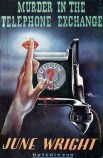
WrightTelephoneExchangeHutchinsonNow, here comes the significance of her job: her first novel, published in 1948, was Murder in the telephone exchange. Wright told a reporter at Melbourne’s Advocate that one of her co-telephonists at the Exchange had once said to her “‘You know you could write a book about this place!” The Advocate goes on to tell her publication story:

June Wright wrote her novel in the midst of busy household duties and a toddling, growing family. When the English publishers, Hutchinsons, announced a £1000 detective story competition Mrs. Wright sent along her manuscript, with a sceptical and open mind on its chances. The competition closed on June 30, 1944, but no manuscript, of the thousands submitted, was awarded the prize. Several, however, were recommended for publication by the judges … Among them was June Wright’s “Murder in the Telephone Exchange”. The publishers are evidently so impressed with her gifts as a story-teller that they have not only signed a contract with her for the immediate publication of the competition manuscript, but have also signed options on her next two novels.

Hmmm … not good enough for a prize but they chose to publish? Still, I’m sure the authors were happy to be published. The next two novels were So bad a death and The devil’s caress. Wright went on to be, apparently, more popular in Australia than Agatha Christie – and yet died pretty much unknown.

Reissued in 2015

The reason Wright has come to our attention now is that her novels are being reissued by US publisher Verse Chorus Press under their Dark Passage imprint, with three published in 2015. That’s not how I learnt about them, though, as I don’t have my ear to the crime genre ground. I heard about Wright through Karen Chisholm’s article on her in The Newton Review of Books.

However, before I tell you about Chisholm’s article, I want to share an excerpt from an article in Perth’s The Daily News. It describes an address June Wright made to the Housewives’ Association:

‘Yes, I have four small children, do my own house-work, and am now writing my third book,’ she told association members. ‘I began my telephone exchange murder story when my first child was a year old, entered the novel for an English competition and was delighted when it was selected for publication.’ Mrs. Wright thinks that housewives are well qualified for writing. They are naturally practical, disciplined and used to monotony — three excellent attributes for the budding writer.

Haha, love it!

I shared this first because it provides a good lead-in to Chisholm’s article. Chisholm, unlike fraudulent me, has read the three reissued novels, and she makes some interesting comments. She says, for example, of Murder in the telephone exchange that the protagonist, Maggie Byrnes “is the first of Wright’s strong female protagonists and we can’t help but assume that there is much of the author herself in Byrnes”. Nagaisayonara, writing at the Crime Fiction Lover website, argues that “it’s a complex, dark novel with a female detective who was far ahead of her time”, and believes that Wright is more like Dorothy L Sayers than Christie. Moving on to So bad a death, Chisholm tells us that Maggie is now married and looking for housing. She writes:

Wright’s family of six children is often remarked upon in interviews when she talks about the workload of writing she maintained, as are the connections between the life of her first character, Maggie, and her own life. Certainly that search for housing during the post-war shortage, and the slightly desperate search for distraction from the day-to-day sameness of childraising and housekeeping, is informed by experience.

Chisholm adds that the new Foreword for So bad a death states that Wright “would joke with interviewers how writing bloody murders was a good way to avoid infanticide”! She sounds like a woman with confidence and presence, doesn’t she?

Adelaide’s The Mail reviewer writing in 1952 about her third novel, The devil’s caress, says that

Mrs. Wright’s new and third work, which concerns odd doings on a Victorian peninsula, is outstanding in one respect. It has a powerful character study of a woman doctor — a commanding, aloof, and in some ways completely misunderstood person, who is married to a surgeon, the antithesis of herself. …  Mrs. Wright’s reportage is as ever brisk and competent. But I eagerly await the day when she concentrates more upon genuine, plausible detection and less upon melodramatic situations.

I wonder if this is why this book was not the third to be re-released last year, although I understand all will be eventually?

Meanwhile, Chisholm writes that in all the three books released so far, the third being the previously unpublished Duck season death, “there has been an underlying sense of fun being poked” and “hints at a wicked, very Australian sense of humour”. She concludes that June Wright was “one of the writers who forged the way for an Australian crime fiction scene that’s vibrant, varied and extremely engaging” and argues that she deserves to be “better remembered and more accessible”.

I must say I’m tempted … are you?

Vincenzo Cerami, A very normal man (Review)

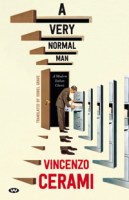
Vincenzo Cerami, A very normal manAnd now for something very different from my recent fare here, a modern Italian classic. Originally published in 1976, A very normal man was, the back cover blurb says, Vincenzo Cerami’s first novel – and it brought him instant acclaim. I can see why. At least, this is the sort of writing that gets me in, but more on that anon.

Now, you may have heard of Cerami (1940-2013). I know I should have, because he was the co-screenwriter on that wonderful 1998 film La Vita è Bella (Life is Beautiful). He was also a poet, commentator and a writer on writing. In other, words a very interesting man! (Couldn’t resist that.)

But now, the book. It is, as you might have realised, a translation, which is always a challenge from my point of view, because I know I’m reading a mediated work. And, as I started this book, I felt it must have represented a very particular challenge because this is a satirical, darkly humorous and deeply ironic work. That must be hard to translate across languages and cultures – and it apparently was, starting with the title. Wakefield Press says on its website that “the complex word play of the Italian title is untranslatable in English; it means literally a very little, very middle-class man”. Does this remind you of Camus’ L’Etranger, and its publication in English as both The stranger and The outsider?

So, who is this very little, very middle-class – or very normal – man? He is Giovanni Vivaldi, living in Rome during the Years of Lead. He’s married, happily enough it seems, with a  20-year-old account-trained son, Mario, of whom he is very proud. He’s been a public servant in the Ministry, the Office for Retirement Pensions, for 40 years, and at the start of the novel he is about to retire. First, however, he wants to get Mario a job in the Ministry. It’s the least he deserves, he believes. Italian novelist Italo Calvino, who apparently negotiated the novel’s publication, also wrote the preface to the original Italian edition. My Wakefield edition’s preface quotes from it:

You would expect a story about office workers to be drab, short on events — the inevitable caricature. Not this one. Extraordinary events abound: a ludicrous initiation ceremony into Freemasonry; an incursion into the savage world of the daily crime columns; revenge that is the stuff of nightmares […] What we see is reminiscent of the precision effects of a magnifying glass angled over the unredeemed ugliness at the heart of civilised society — and over the tenacious lust for living which clings on in a world emptied of meaning.

Hmmm, what more can I say? These excerpts convey a little of the story and the main theme, without giving away too much of the plot. I wouldn’t want to give away any more, but I can talk a little about the character, the style and tone.

“the common sense of an ordinary decent man”

About a quarter of the way through the novel, during his application to become a Freemason, Giovanni is described as having “the common sense of an ordinary decent man”. Sounds lovely doesn’t it? Except that we have already seen quite a bit of not-so-decent behaviour from him, including the very reason he is applying to become a Freemason, which is to obtain favour to help his son beat the civil service exam for the Ministry job. On the first page of the novel, he tells his son that “the sign of a really smart young man is a total focus on career and nothing else. Let the rest of the world go and hang themselves”. On page 2, Giovanni, out fishing with his son, kills a fish in a cruel, violent way. At the beginning of chapter 2, his normal drive to work is described: he’d “deal out vicious abuse to anyone he thought was trying to get in his way, rant and rave against everything and everyone”.  Pretty quickly then, we are clued in to the fact that he is not a very humane man – and yet, he is also presented as a “normal”, responsible family man. He’s (arguably) a good father, a decent husband and a diligent employee.

What happens in the novel is, in fact, shocking, and the way Giovanni responds is even more so, but it is all told in matter-of-fact prose, and this is what I like. I love writing that is integral to the meaning of a work, that is, that isn’t just there to carry the story and ideas. In this case, the calm tone of writing that conveys a grotesque story reinforces the themes of hypocrisy and corruption, of mismatch between the surface and the subterranean (if that makes sense).

The tone might be matter of fact, unemotional, but the imagery leaves us in no doubt as to Cerami’s view of life in 1970s Rome:

The city had all the signs of a Sunday: greasy roller blinds down on the shops; apartments with their entrances yawning open mockingly; parked cars lining the footpaths like the embalmed corpses of family pets; the slow, tentative caterpiller-weaving of empty trams. Against an unbroken infinity of apartment blocks that crossed the city from end to end, branching off in every direction, rows of bristles on a hairbrush for a scabby head.

Cerami mixes up descriptions of mundane detail (“he got his raincoat, grabbed his car keys … found himself a clean handkerchief from his sock drawer”) with descriptions that stop you in your tracks:

In person: young maybe Mario’s age, except that this one reminded you of rusted-out tools and coffee dregs.

At times there is a sense of the mock-heroic: Giovanni “sprang into the saddle of his charger”, that is, his Fiat 850. And there is plenty of humour (dark and otherwise), such as when Giovanni, in a police station, tries various Freemason secret signals, to no avail. Giovanni thinks he’s “mastered the art of living” but his view of living is not an appealing one.

For all this, there are moments when he seems human – he is a loving father and responsible husband – and can tug, albeit briefly, at our sympathy. Overall though, the novel is a devastating indictment of middle-class life that is superficial, self-centred and morally corrupt in a society which seems to be not much better. A fascinating read.

Vincenzo Cerami
A very normal man
Translated by Isobel Grave
Mile End: Wakefield Press, 2015
117pp.
ISBN: 9781743053713

(Review copy courtesy Wakefield Press)

Hanif Kureishi, The buddha of suburbia (Review)

Hanif Kureishi, The buddha of suburbiaThe first thing to say about Hanif Kureishi’s 1990 Whitbread award-winning novel The buddha of suburbia is that it’s pretty funny. It’s a comic satire – over-the-top at times, confronting at others. It has its dark moments, but it’s also brash, irreverent and ultimately warm-hearted towards its tangled band of not always admirable but mostly very human characters. I’ve come late to this book, and only read it now because my reading group decided to align one of our books with ABC RN’s bookclub, which this year is featuring novels from the subcontinent. Kureishi’s book was one of the few we hadn’t read, so it got the guernsey.

It’s a coming-of-age novel about Karim, who is seventeen years old at the start and the son of a Pakistani/Muslim father from Bombay and an English mother. He lives in the suburbs south of London, a place populated, in his eyes, by “the miserable undead”. He wants to live “intensely: mysticism, alcohol, sexual promise, clever people and drugs”. The dreams of a young man which, of course, run counter to everything his parents would wish for – except that his parents aren’t watching. His father leaves his mother early in the novel to pursue his own mid-life crisis enlightenment as a “buddha” dispensing wisdom to other suburbanites, while his mother sinks into her misery and her bed. And so the scene is set …

This is a rather raunchy, bawdy read in which characters push the sexual envelope with little concern for consequences. They engage in all sorts of sex for all sorts of reasons that represent a broad spectrum of human experience and behaviour, some loving, some brutal, some exploratory, some exploitative. The novel is set in early to mid 1970s England, before AIDS, at the dawn of punk, and just before Thatcher’s England (1979 to 1990). This could date it, but I don’t think it does, because its concerns remain relevant today: racism, multiculturalism, the stereotyping of “other”, materialism versus the search for meaning, the role of the arts in our lives, and of course, given the title, the urban-suburban divide.

So, what happens? Both a lot, and not much, in that this is a character and ideas-driven novel rather than a plot-driven one. Told first person by Karim, the novel has two parts – “In the suburbs” followed by “In the city”. In the first part Karim talks of his life in the suburbs, of his friends and family, and describes the breakdown of his parents’ marriage as his father moves in with the lively go-get-’em Eva. It’s a life characterised by racism:

The thing was, we were supposed to be English, but to the English we were always wogs and nigs and Pakis and the rest of it.

Aspirations are low, and education is not seen as being useful:

This was the English passion, not for self-improvement or culture or wit, but for DIY, Do It Yourself, for bigger and better houses with more mod cons, the painstaking accumulation of comfort and, with it, status – the concrete display of earned cash.

The city, on the other hand, is a place where you can remake yourself. It seemed, to Karim, like “a house with five thousand rooms, all different”, far from the stultifying dullness of the ‘burbs. But the dichotomy is not as simple as it sounds. Having moved to the city, like his father and Eva, Karim continues to return to the suburbs to see friends and family. He experiences warmth and support there, while the city, where “the piss-heads, bums, derelicts and dealers shouted and looked for fights” can intimidate him.

Nonetheless, once in the city, Karim does start to remake himself – as an actor. But, as elsewhere in the novel, there’s a sting in the tail. The first role Karim is offered is Mowgli in The jungle book. He does well, and his white family and friends praise him, but his honest, feisty childhood friend Jamila sees it differently:

‘And it was disgusting, the accent and the shit you had smeared over you. You were just pandering to prejudices …’.

Karim, who has, earlier and somewhat defensively, described himself as “beige”, moves on to another theatre group where he is chosen because he is “black”:

‘We need someone from your own background,’ he said. ‘Someone black.’
‘Yeah?’ I didn’t know anyone black, though I’d been at school with a Nigerian.

I think you’ve got the drift now. The humour is sharp, with stereotypes being subverted, twisted or just plain skewered. The book is full of witty asides, clever but insightful quips, and some downright absurd situations. There’s tenderness too. I loved the “heart-ambulance”, in the form of a sister and brother-in-law arriving to take Karim’s mother home with them when her heart is broken.

There’s a fascinating subplot involving Jamila and the marriage arranged for her by her father, Anwar. She accedes, but when her husband, the physically disabled hapless but kind-hearted Changez arrives, she lays down the rules for their so-called marriage, and then sets about reinventing herself – in the suburbs – as a strong, independent, liberated woman.

I said at the beginning that this is a coming-of-age novel, but it’s more than that. It’s about transformation and shape-shifting for people of all ages. The only character among the central group, who is unable to accept the challenge of change, is Jamila’s father Anwar, and his ending is not a positive one. By contrast, his friend, Karim’s father, seeks enlightenment. He wants to be something more than a Civil Service clerk who will never be promoted above an Englishman. So, he sets himself up as a “buddha”, a “visionary” who will provide wisdom from the east. I loved the multiple satire here – the joke of suburbanites seeking wisdom from a so-called eastern mystic, and the subversive idea of a Pakistani Muslim setting himself up as that mystic, a buddha.

The novel is about other things too, such as the arts and culture, and the possibility they offer for salvation. While Karim develops a career as an actor, working out how he can or should use his “culture” to further his goals, his friend Charlie reinvents himself as punk star, Charlie Hero. Like Karim, though for different reasons, he discovers it’s not all as straightforward as he thought.

It’s also about love – romantic love, sexual love, parental love, and the love between friends. All the characters seek it, though not all find it. And underpinning all this is the “immigrant condition”, and the idea that, perhaps, “the immigrant is the Everyman of the twentieth century”.

But, in the end, what it’s really about is the desire for a meaningful life and, without giving away details, I think it’s fair to say that most of Kureishi’s characters achieve this, albeit somewhat messily. That said, I can’t help thinking that Karim’s conclusion that “I thought of what a mess everything had been, but that it wouldn’t always be that way” has an ironic edge.

Hanif Kureishi
The buddha of suburbia
London: Faber and Faber, 1990
ISBN: 9780571249398 (epub edition, 2008)

Mary Austin, The land (Review)

Regular readers here know that I choose my Library of America offerings for various reasons: for authors I haven’t read before but would like to (such as Edgar Allan Poe and Sherwood Anderson), for authors I love and am always happy to read more of (such as Willa Cather, Kate Chopin and Edith Wharton), or for topics that interest me (like slavery and civil rights). Mary Austin’s “The land” fits into this latter: it’s about the American southwest which is a region I love. I have in fact reviewed another Austin story about that region, “The scavengers”.

In “The scavengers”, Austin described the scavenging animals of the American deserts, the buzzards, vultures, ravens, coyotes and Clark’s crows, and promoted the idea of nature’s balance. In “The land” her focus is the landscape itself, and its hard, unforgiving nature. It’s the first story (essay) in her collection Lost borders, and works partly as an introduction to the collection, in which she sets down, she writes, “what the Borderers thought and felt”.

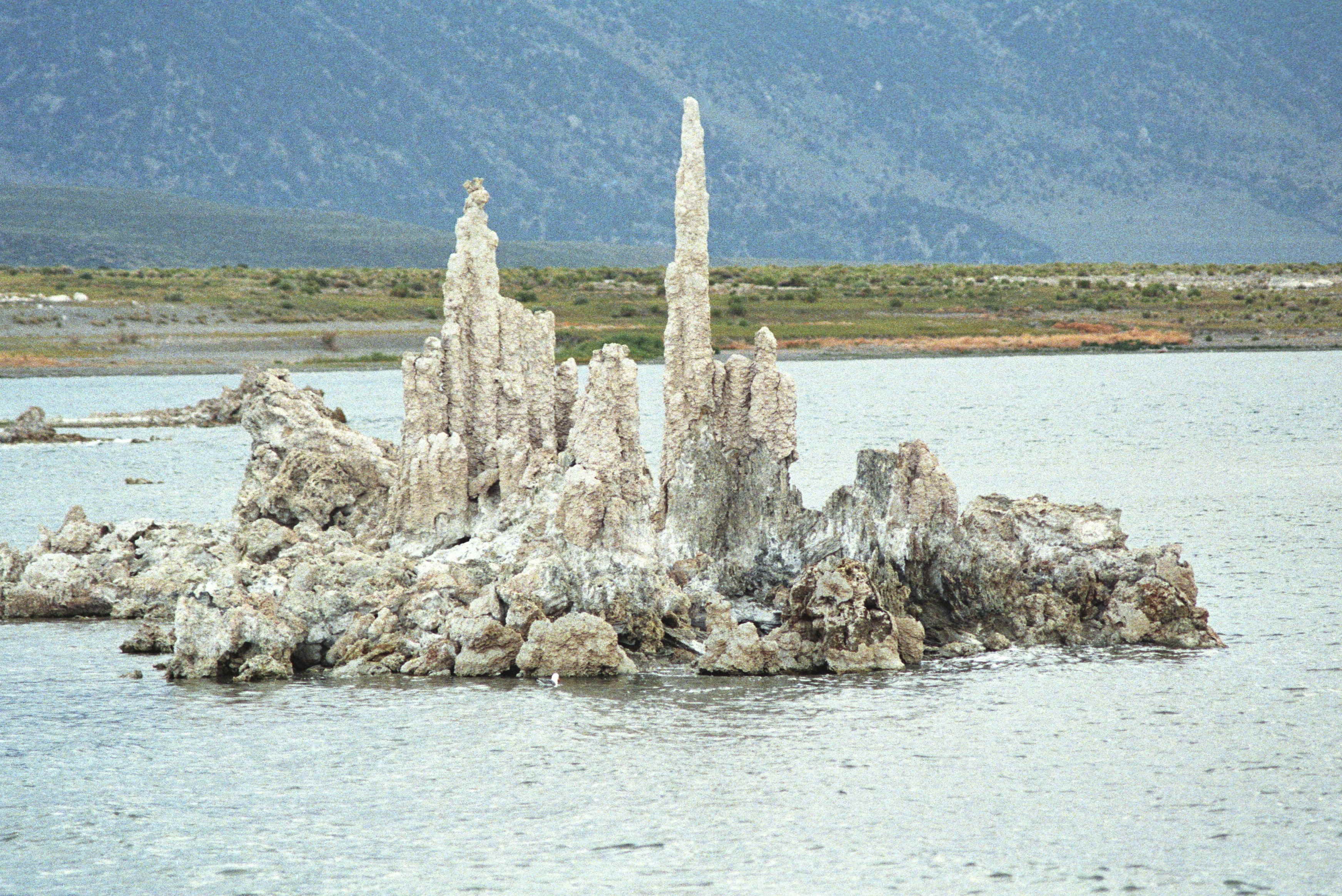
Tufa, Mono Lake

Tufa or “man-deep crystals of pure salt”, Mono Lake

Indeed, LOA’s notes quote scholar Esther F. Lanigan statement that the story introduces “the motley collection of drifters, prospectors, explorers, entrepreneurs, and sheepherders [about whom she will write], most of whom demonstrate an astonishing insensitivity in their dealings with the women closest to them”.

The “lost borders” region she explores in the collection is what I’d call the eastern part of central California*. We are talking country that stretches from the east of the Sierra Nevadas to Death Valley in Nevada. It is remote, hot and very dry. It is country, in other words, that Australians would understand. Driving through this region, as I did in 1983 and a few times in the 1990s, reminded me, in fact, of my road trips in outback Australia – particularly western Queensland and northern South Australia.

“The land” is about story and myth. She writes that “curiously … you can get anybody to believe any sort of a tale that had gold in it”. She’s “sore” that she’s not believed “in some elementary matters, such as that horned toads are not poisonous, and that Indians really have the bowels of compassion”. So, when she is brought a potsherd from Shoshone Land and told she could probably find “a story about it somewhere”, she responds that she’ll “do better than that”, she’ll “make a story”. And so she does, and is amused over time to see her story take on the mantle of truth. She has “a spasm of conscience” on at least one occasion, but doesn’t ‘fess up. Instead, she suggests that there only has to be another similar potsherd found for the tale to be fixed “in the body of desert myths”. Beware, methinks, you oral historians!

“The land” is also about men and women. Austin respects Indian (as she described them back then) knowledge, saying:

Out there, a week’s journey from everywhere, the land was not worth parcelling off, and the boundaries which should logically have been continued until they met the cañon of the Colorado ran out in foolish wastes of sand and inextricable disordered ranges. Here you have the significance of the Indian name for that country— Lost Borders. And you can always trust Indian names to express to you the largest truth about any district in the shortest phrases.

“Largest truth” in “the shortest phrases”. Love that. There’s a lovely, irregular, repetition of “out there” throughout the piece, reinforcing the sense of remoteness and desolation. The unforbidding nature of the land is conveyed in other ways too: by experience, “I have seen things happen that I do not believe myself”, and in description, “the senses are obsessed by the coil of a huge and senseless monotony; straight, white, blinding, alkali flats, forsaken mesas …”.

While Austin respects the Indian inhabitants, she is less impressed by men (and I mean here the male of the species, not mankind). Men are seen as “small”. She describes them as making “law for the comfortable feel of it”. They “pinch themselves with regulations to make sure of being sentient …”. Their “boast of knowledge is likely to prove as hollow as the little yellow gourds called apples of Death Valley”. It is the

men who mostly go into the desert, who love it past all reasonableness, slack their ambitions, cast off old usages, neglect their families because of the pulse and beat of a life laid bare to its thews and sinews. Their women hate with implicitness the life like the land.

Indeed, she concludes this essay with:

If the desert were a woman, I know well what like she would be: deep-breasted, broad in the hips, tawny, with tawny hair, great masses of it lying smooth along her perfect curves, full lipped like a sphinx, but not heavy-lidded like one, eyes sane and steady as the polished jewel of her skies, such a countenance as should make men serve without desiring her, such a largeness to her mind as should make their sins of no account, passionate, but not necessitous, patient—and you could not move her, no, not if you had all the earth to give, so much as one tawny hair’s-breadth beyond her own desires. If you cut very deeply into any soul that has the mark of the land upon it, you find such qualities as these—as I shall presently prove to you.

Austin belongs, I think, to the tradition of nature writers that includes Henry David Thoreau and John Muir (whom I’ve reviewed), but it seems to me that her gender adds quite a different perspective to what she sees.

Mary Austin
“The land”
First published: In Lost borders, 1909.
Available: Online at the Library of America

* This region is at the centre of the California Water Wars (dramatised in the film, China Town)

Sherwood Anderson, Adventure (Review)

Sherwood Anderson, 1933 (Carl Van Vechten [Public domain], via Wikimedia Commons)

Sherwood Anderson, 1933 (Carl Van Vechten [Public domain], via Wikimedia Commons)

As some of you will know, I started discussing books online in January 1997 when I joined a listserv-based international reading group. I was active in that group until around the time I started blogging, when I found I could no longer keep up with all my on-line presences. In the period that my involvement was slowing down the group read Sherwood Anderson’s collection of interrelated stories, Winesburg, Ohio, but I didn’t take part. So, when one of the tales from this book was published last week by the Library of America, I decided to read it.

Rather coincidentally, the story’s title “Adventure” is similar to the last Library of America piece I read, Helen Keller’s “I go adventuring”. Each, however, uses the notion of “adventure” rather differently. Keller talks about physical adventuring, that is, travelling in New York as a deafblind person, though she also talks about what this adventuring means to her emotionally or spiritually. For one, it provides her with “the comforting certainty that mankind is real flesh and that I myself am not a dream”. Regarding Anderson’s use of the word though, LOA’s notes quote scholar Ray Lewis White, who says that “adventure” means ““the one brief moment, the one epiphany, the one telling instant, that captures and communicates the essence of that character’s personality, leaving nothing more to be said or learned about him or her.” The story which is specifically titled “Adventure” is apparently placed slap bang in the middle of the collection – and, yes, there is an epiphany.

It tells the story of Alice, who is twenty-seven years old. Although on the surface she is “very quiet”,  “beneath a placid exterior a continual ferment went on”. This ferment has its origins in a love affair with a town journalist when she was sixteen. She loses her virginity, after sincere promises from the man, Ned, that he would come back for her. He says, “Now we will have to stick to each other, whatever happens we will have to do that”. But of course, as happens with these things, Ned’s life doesn’t go quite as he planned. After a year, he has met other girls and stops writing to Alice. However, she, “the girl who had been loved”, continues to believe and hope that Ned will return.

By her early twenties, she is still waiting. She does not blame Ned for her loss of virginity. Indeed she’d offered to go away with him, unmarried, back then when she was sixteen, but she also feels unable to marry another man because “the thought of giving to another what she still felt could belong only to Ned seemed monstrous”. Alice, then, is not your “typical” shrinking small town girl done wrong. She’d offered to go away with him, but she’s also a product of her time’s attitudes regarding sex being a gift to the one you love and, of course, of her continuing love for this man:

“I am his wife and shall remain his wife whether he comes back or not”, she whispered to herself, and for all of her willingness to support herself could not have understood the growing modern idea of a woman’s owning herself and giving and taking for her own ends in life.

I’m not an expert in early post-World War One America, and I haven’t read the whole book, but I can’t help thinking that Anderson reflects here, in a story published in 1919, the modernist concern with conformist society. He certainly presents a fairly bleak view of what is possible for humans in constricting social environments, as did the “names” of the modernist movement.

Alice – I wonder if there’s an ironic reference in use of this name – continues to hope, she saves money for her future life with Ned for a few years until, one day

With a shiver of dread, she realized that for her the beauty and freshness of youth had passed. For the first time she felt that she had been cheated. She did not blame Ned Currie and did not know what to blame. Sadness swept over her. Dropping to her knees, she tried to pray, but instead of prayers words of protest came to her lips. “It is not going to come to me. I will never find happiness. Why do I tell myself lies?” she cried, and an odd sense of relief came with this, her first bold attempt to face the fear that had become a part of her everyday life.

And so, she continues on, trying “to get a new hold upon life”. She spends companionable time for a while with a much older man, realising she doesn’t want him but is avoiding being alone, because “if I am not careful I will grow unaccustomed to being with people”. And then comes the adventure … in which Alice’s bravery and desire to live life to the full results in a moment of abandon that paradoxically forces her to confront the reality of her situation. It’s a devastating (though not tragic in the usual meaning of the word) conclusion. Read it, and see what I mean.

I really liked this story. I liked the way Anderson presents Alice’s self-awareness, and her little attempts to break free, while at the same time recognising the reality for women like her at that time.

Sherwood Anderson
“Adventure”
First published: In Winesburg, Ohio: A group of tales of Ohio small town life, 1919.
Available: Online at the Library of America

Helen Keller, I go adventuring (Review)

My reading has been so disjointed recently that I thought I’d look at recent Library of America (LOA) offerings for inspiration, and came across Helen Keller‘s “I go adventuring”, an excerpt from her Midstream: My later life. It appealed to me because I haven’t read anything by Keller since I was a teenager, and because this piece is about New York. I couldn’t resist.

Helen Keller sitting holding a magnolia flower, circa 1920 (Presumed Public Domain, from Los Angeles Times photographic archive, UCLA Library)

Helen Keller sitting holding a magnolia flower, circa 1920 (Presumed Public Domain, from Los Angeles Times photographic archive, UCLA Library)

Firstly, Keller. What an amazing woman. Like many, I suppose, I have always been in awe of her ability to make a meaningful life for herself without sight or hearing. LOA’s always useful introductory notes discuss Keller being asked, in relation to another excerpt, “what she could possibly have ‘seen’ from the top of the Empire State Building”. She replied that

I will concede that my guides saw a thousand things that escaped me from the top of the Empire Building, but I am not envious. For imagination creates distances that reach to the end of the world … Well, I see in the Empire Building something else—passionate skill, arduous and fearless idealism. The tallest building is a victory of imagination.

The notes continue to say that throughout her adulthood, Keller “faced scepticism over her abilities and criticism for her choices of language”. On one occasion, she responded that the deaf-blind person “seizes every word of sight and hearing, because his [using the male pronoun common to her times!] sensations compel it. Light and color, of which he has no tactual evidence, he studies fearlessly, believing that all humanly knowable truth is open to him”. American novelist and essayist, Cynthia Ozick, LOA tells us, accepts Keller’s point, saying, simply, “She was an artist. She imagined”.

Secondly, New York. Before I first visited New York in the early 1980s, I’d lived in Sydney, and had visited great European cities like London, Paris and Rome. None of these interested me greatly because I really don’t much like cities. (Yes, I liked the museums and galleries, the historic sites, but as places to “be” they didn’t really appeal). But New York. There was something about it – and I finally “got” cities. I still don’t like them a lot, but I credit New York with opening my eyes to “city-ness”, if that makes sense, to the buzz and rush and life of them.

However, I’ve indulged myself enough now, so let’s get to Keller’s piece. She starts by referring to her situation:

Cut off as I am, it is inevitable that I should sometimes feel like a shadow walking in a shadowy world. When this happens I ask to be taken to New York City. Always I return home weary but I have the comforting certainty that mankind is real flesh and that I myself am not a dream.

See, that’s New York for you! She then talks about the great bridges, starting with Brooklyn Bridge, which she says is “the oldest and most interesting of them … built by my friend, Colonel Roebling”. In my first visit to New York, one of the places I had to visit was Brooklyn Bridge – because of Ken Burns’ wonderful documentary of the same name. It’s an old film now, 1981, but is well worth viewing if you haven’t seen it and get the chance. Keller, though, says she mostly uses the Queensborough Bridge. She writes that not all poetry is found in poetry books, that

much of it is written in great enterprises of engineering and flying, that into mighty utility man has poured and is pouring his dreams, his emotions, his philosophy. This materializing of his genius is sometimes inchoate and monstrous, but even then sublime in its extravagance and courage. Who can deny that the Queensborough Bridge is the work of a creative artist?

While we continue to build astonishing structures, continue to push the edges of what we can achieve,  we are also, I think, more blasé about the achievements and more questioning about the value and implications. Keller’s admiration reminded me of the awe and wonder of the nineteenth and early twentieth centuries towards engineering feats, though she too, with the word “monstrous”, is perhaps sensing some other ways of seeing?

Keller’s piece is really short, so I’m not going to commentate it all. She describes circumnavigating New York in a boat and talks about about life on the water, and she ends with a vivid description of the power of the subways. I want to close though on another reference to herself. She writes:

New York has a special interest for me when it is wrapped in fog. Then it behaves very much like a blind person. I once crossed from from Jersey City to Manhattan in a dense fog. The ferry-boat felt its way cautiously through the river traffic. More timid than a blind man, its horn brayed incessantly. Fog-bound, surrounded by menacing, unseen craft and dangers, it halted every now and then as a blind man halts at a crowded thoroughfare crossing, tapping his cane, tense and anxious.

With that, she conveys so beautifully, for sighted people, some of her experience of the world.

Helen Keller
“I go adventuring”
First published: In Midstream: My later life, 1929.
Available: Online at the Library of America

Monday musings on Australian literature: Black Inc’s Best 100 Poems

I’ve been feeling rather guilty about a book sent to me in late 2013 by Black Inc. I’m usually very conscientious about reading and reviewing books that I’ve accepted for review – not so much for those sent to me “on spec” – but I slipped up with Black Inc’s The best 100 poems of Dorothy Porter. As I recollect, it came just after a major overseas trip and got caught up in the run-up to Christmas. I did read much of it, but just didn’t bring it to conclusion in order to review. So, I thought I’d talk about it “right here, right now”, to use some current vernacular.

The bee hut, by Dorothy Porter

Cover image (Courtesy: Black Inc)

Black Inc, which won ABIA’s Small Publisher of the Year award this year, is a small publisher that actively supports Australian poetry. Not only have they now produced three “best 100 poems” volumes, but they have published the annual Best Australian poems volumes for several years, as well as individual poetry collections like Les Murray’s Waiting for the past, Robert Gray’s Coast road, and Dorothy Porter’s The bee hut (which I reviewed a few years ago now). All these books, as far as I can tell, are published in print and electronic format.

Now, the topic in hand. Here are the three “best 100 poems” volumes published to date, listed in order of publication.

The best 100 poems of Les Murray (2012)

I bought the e-version of this after hearing Murray (b. 1938) speak last year at Poetry at the Gods. As the only living poet of the three, Murray made his own selection. Unlike the Porter collection, in which the poems are grouped in some way, Murray’s selection is simply (though some thought is sure to have gone into the order) a list of 100 poems with no reference to their original context. Murray’s oeuvre is huge – his career has been very long – so without extensive research I don’t know where every poem comes from or how each fits into his career. As you would expect from a “best 100” they  are diverse in subject and style.

The first poem is “Driving through sawmill towns”, from the 1990s I think. Read it and see what you think. I like its understanding of human behaviour – the “tall youths look away” while “it is the older men who/come out in blue singlets and talk softly to you”. Meanwhile, “all day in calendared kitchens, women listen/for cars on the road/lost children in the bush,/a cry from the mill, a footstep -/nothing happens”. I like the sense of resignation in the inhabitants, but no judgement from driver driving through. A later poem, “Mirrorball”, from 2010, describes travellers on a bus riding up the Hume Highway through old towns full of history, but when the driver sets off again “half his earplugged sitters wear/the look of deserted towns”. Oh dear. Not all Murray’s poems are about country towns, but rural life is one of his ongoing subjects.

I’m not sure I really like reading poems in e-format, in which I bought this book, but the upside is that you can carry some poetry with you wherever you go.

The best 100 poems of Dorothy Porter (2013)

PorterBest100BlackIncThis is a posthumous collection selected by Porter’s (1954-2008) partner, the novelist Andrea Goldsmith. It includes a small selection of poems from her verse novel The monkey’s mask which I’m ashamed to say I’ve never read. (Having now read the few poems Goldsmith included here, I’m inspired to rectify this.) It also contains poems from her verse novels El Dorado and Akhenaton, as well as from various other collections of her rather extensive oeuvre. The poems range, for me, from beautiful, heart-rending, funny, and/or wicked to rather obscure. But that’s probably the nature of poetry. Those that draw on classics and mythology sometimes lose me, I have to admit, with their erudition, but her heart, her imagery and the way she can cheekily play with rhyme and rhythm are what I love about Porter.

I’ll just share one of Porter’s poems. It’s called “Circular Quay” and expresses discomfort with perfection, because experience has taught her so: “This perfect day/makes me uneasy … I breathe easier/spying some scum/floating/on a lovely green wave./Nothing’s perfect”. In the middle of this short tight poem she is reminded of the past. It’s the sort of poem that makes me write “Oh, yes” in the margins.

I’m tempted to suggest that Murray writes more of People while Porter’s poetry is more about the Personal. This is a rather coarse generalisation I know. These poets are highly diverse, but it’s how their writing, such as I’ve read in recent years, strikes me.

The best 100 poems of Gwen Harwood (2014)

Gwen Harwood (1920-1995) is the oldest of the three, and is the one I know least, so I won’t say much. I’ve heard her described as one of Australia’s finest poets, and readers I respect speak positively of her, but I really only discovered her when I started researching Australian poets for Wikipedia a few years ago. Why is this? I certainly didn’t study her at school or university, and since then, I must admit, my poetry reading has been very erratic. This selection was made by her son, John Harwood, who is also a writer. Her recurring themes, according to Wikipedia, include motherhood and the “stifled role of women”. Music, the Tasmanian landscape and Aboriginal dispossession also recur in her work.

From the compilers of these collections – the poet himself, the partner, the son – it appears that Black Inc has aimed to make these “best 100” volumes personal rather than academic in flavour, which is lovely I think.

Given these three volumes were published in the last three Novembers, I’m presuming another will be published this November. I wonder who it will be? Meanwhile, I’ll close by saying that these are gorgeously produced books – with lovely covers. They would suit those wanting an introduction to the specific poets as well as their fans.