Bill curates: Imre Kertesz’s Fateless or Fatelessness

Bill curates is an occasional series where I delve into Sue’s vast archive, stretching back to May 2009, and choose a post for us to revisit.

Sue reads some striking books and writes some (many!) striking reviews, of which this is one. I’m not sure I agree with her about Holocaust fiction, but I do appreciate that people who experienced the Nazi concentration camps, or their after-effects in the case of, say, Lily Brett, must write, just as we must read to honour their tribulations, and that a fictionalised account may be the way they choose to do this. Imre Kertész is another Nobel Prize winner I was unaware of. He died in 2016.
_______________________

My original post titled: “Imre Kertesz, Fateless or Fatelessness”

[WARNING: SPOILERS, of sorts]

Let’s get the first thing clear. I like holocaust literature – not because I enjoy the subject matter but because in it I find the most elemental, universal truths about humanity. Depending on the book, this literature contains various combinations of bravery and cowardice, cruelty and kindness, love and hate, self-sacrifice, self-preservation and betrayal, resilience and resignation, and  well, all those qualities that make up humanity and its converse, inhumanity. I have by no means read all that is out there but here are some that have moved me: Anne Frank’s The diary of a young girl (of course) and Anne Holm’s I am David, from my youth, and then books like Martin Amis’ Time’s arrow, Bernhard Schlink’s The reader, Marcus Zusak’s The book thief, and Ursula Hegi’s Stones from the river. There are gaps, though, in my reading, such as Thomas Keneally’s Schindler’s ark (I did see the film), the works of Primo Levi, and Elie Wiesel’s Night. I have, however, just added Imre Kertèsz’s Fateless to my list of books read.

Kertèsz adds a new spin to the universal truths explored by these books – it’s what he describes (in my 1992 translation anyhow) as “stubbornness” which seems to me to mean “resilience” or a determination to survive, and even to have, if possible, little wins against the system.

Anyhow, first the plot. The novel takes place over the last year of the war and concerns Gyorgy Koves, a 14-year old Hungarian Jew, who, one day, is suddenly called off a bus, along with all other Jews on the bus and transported to Auschwitz, and then Buchenwald, Zeitz and back to Buchenwald, before returning home at war’s end. It chronicles his experiences, his thinking, and the impact on him of his experience. He begins as the archetypal naive narrator…but by the end, though his tone has changed little, he is no longer naive. This is rather beautifully achieved as we see his youthful application of logic being changed into something more cynical and survival focused.

Gyorgy speaks with a strange sense of detachment borne, to start with, of an apparent unawareness of what exactly washappening to him and a disbelief that anything untoward would happen. And so, in the beginning, as events unfold he describes them as “natural” because of course, when they got to Auschwitz, it was sensible to inspect each person to see who was physically fit and capable of working. He didn’t know then what would happen to those not found physically fit. The horror gradually builds as reality sets in and he goes about making it through each day – through his share of beatings, the reduced food rations, and all the other deprivations that make up concentration camp life. In the first part of the book he uses the term “naturally” to mean some sort of normal logic but by the end it comes to mean, as he explains to a journalist who asks him why he keeps using the word for things that aren’t natural, that these things were natural in a concentration camp.

Early on in his captivity he says that they approached their life (and work) “with the best of intentions” but they soon discover that these “best of intentions” do not bring about any kindness from their overseers, and so his attitude to getting on, to surviving starts to change. As he starts to physically weaken, become emaciated and develop infections, he observes that “my body was still there. I was thoroughly familiar with it, only somehow I myself no longer lived inside it”. Always dispassionate, always matter-of-fact, while describing the most heart-rending things.

Towards the end, he is placed in a hospital ward and there he is treated better and, even, with a certain amount of kindness. This in its way is as shocking to him as the cruel beatings he experienced at Zeitz. He can see no logic, “no reason for its being, nothing rational or familiar”. He can only understand kindness in terms of the giver receiving “some pleasure” from it or having some “personal need” satisfied. Never is there any sense that altruism might come into play. His view of “justice” is based very much on survival. He says, when he is spared, “everything happened according to the rules of justice … I was able to accept a situation more easily when it concerned someone else’s bad luck rather than my own … This was the lesson I learned”.

And so, in the end he returns home, and finds it hard to explain to people just what happened and how he now views life. He describes getting through his time as “taking one step after another”, focusing just on the moment. He implies that if he had known his fate he would have focused on time passing – a far more soul-destroying activity than concentrating on getting through each day “step by step”. This brings us to the fate/fateless bit. He says at the end that:

if there is a fate, there is no freedom … if, on the other hand, there is freedom, then there is no fate. That is … that is, we ourselves are fate.

I find this a little hard to grasp but he seems to be saying that we are free to make our own choices, even in a concentration camp – we are not fated but make our own fate. He was and is not prepared to accept any other approach to life. But life will not be easy:

I am here, and I know full well that I have to accept the prize of being allowed to live … I have to continue my uncontinuable life … There is no impossibility that cannot be overcome (survived?).

And yet, at the very end of the book, he says “and even back there [in the concentration camp], in the shadow of the chimneys, there was something resembling happiness”. Wow! This is an astonishing book – it charts horrors with a calmness that is quite shocking, and it is particularly shocking not because Gyorgy is unfeeling but because he can’t quite grasp what is happening to him. This is the fundamental irony of the book, and the fundamental truth of a naive narrator: we the reader know exactly how it is even as Gyorgy tries to make sense of it using logic and reason. I must read this book again – and preferably the newer more highly regarded 2004 translation by Tom Wilkinson.

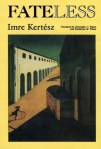
Imre Kertész
Fateless
Translated by Christopher C. Wilson and Katharina M. Wilson
Northwestern University Press, 1992 (orig. ed 1975, in Hungarian)
191 pp.
ISBN: 9780810110496

____________________

I looked in my bookshelves when Bill sent through this Bill Curates post, and discovered that the edition I own is the later Tom Wilkinson one. I must have bought it with the intention of reading it, but I haven’t yet. Oh, the dreams of an everyday reader!

Bill will, I hope, explain his introductory comment regarding Holocaust fiction. We’d love to know what you think – and/or read.

Bill curates: Elizabeth Jolley’s My father’s moon

Bill curates is an occasional series where I delve into Sue’s vast archive, stretching back to May 2009, and choose a post for us to revisit.

Elizabeth Jolley is one of the greats and I am sorry that I have only read her in fits and starts. I have had, unread, Brian Dibble’s biography of her for so long now that I wonder if I should just hurry up and read all these fictionalised accounts of her life first, uncontaminated by knowing what she ‘really’ did.
_______________________

My original post titled: “Elizabeth Jolley, My father’s moon”

Book cover‘No one,’ she says, ‘can write anything till they’ve had experience. Later on perhaps. You will write later on.’ (Elizabeth Jolley, My father’s moon, 1989)

Although fiction demands imagination, it must be based on  some kind of genuine experience. (Elizabeth Jolley, “Only Connect”, essay first published in Toads, 1992)

My father’s moon is the first book in Jolley’s semi-autobiographical trilogy, the others being Cabin fever and The George’s wife. It won The Age Book of the Year Award in 1989.

I am an Elizabeth Jolley fan – and, along with Helen Garner, another Jolley fan, I enjoy the way she repeats and revisits stories and characters from one book or story to another. In this book is the chapter, “Night Runner”, which was published as a short story in Meanjin in December 1983, and again in a short story anthology, Room to move, published in 1985. The narrator of the story – and of the novel – typifies Elizabeth Jolley’s alienated protagonists and their often peculiarly self-centred and self-deluded ways of coping with their loneliness. Clearly Jolley decided that this was a character she wanted to develop further. And clearly she also drew a lot from her own experience to develop this character. Like Vera, Jolley was brought up as a Quaker, her parents sheltered refugees before and during the Second World War, and she trained as a nurse. Like Vera, Jolley probably experienced loneliness and alienation. However, this is fiction and so we need to be careful about how far we take these analogies between Vera and her creator. Much as I can empathise with Vera’s predicament, I must admit that I would hate to think she is Elizabeth Jolley.

It’s an uncomfortable novel. Vera, the first person narrator, is not a highly sympathetic character but neither is she totally disagreeable either. What she is, though, is lonely. The book has a somewhat challenging structure – and I had to concentrate to keep track of where I was. It starts with Vera, a single mother, leaving her parents’ home, with her young daughter, to live and work in a boarding school. Her hopes for a lovely life there among people “who feel and think as I do” are dashed. Such people “are not here as I thought they would be … I am by my own mistakes buried in this green-leafed corruption and I am alone”. In this first chapter are flashbacks to the past, and gradually the book moves into the past, providing us with insights into her character and how she has ended up where she is. Most of this past takes place in the hospital where she trains as a nurse during the war. The book finally returns to the beginning of the novel with Vera resolving to make a step towards alleviating her loneliness. However, we are by no means convinced she will.

The book comprises titled chapters, many if not all of which could be (and some have been) published separately as short stories. This gives it a somewhat disjointed feel – but seems appropriate for the story of a person like Vera. It is full of wonderfully drawn characters, with some very funny (if often dark) scenes and dialogue. Just think nurses and hospitals! There are many references to music – something that is common in Jolley’s works. Music is usually a comforting force for her characters, offering them respite from what is often a cruel world – and this is the case here, with Vera being drawn to characters who love and play music. There is a lot of irony, some of it subtle, some of it less so as in Magda’s comment to Vera who has fantasised about an affair with her husband: ‘You are so innocent and good … Don’t ever change’. Naive perhaps, innocent no!

So, what about the title? Funnily enough(!), it refers to Vera’s relationship with her father, a major stabilising influence in her life. He tells her throughout her childhood that wherever she is she can always look at the same moon he is looking at, ‘And because of this … you must know that I am not far away. You must never feel lonely’. A lovely concept and one to which Vera regularly returns in the book.

My father’s moon is not, I think, the easiest Jolley to read, and there are some things that might become clearer on a second reading. However, its concerns are very representative of her work – loneliness and alienation, homosexuality, parenting, memory, music and religion. While Vera is deeply lonely, while she often behaves selfishly, she can also be kind. She is also no quitter. For that I rather like her.

Elizabeth Jolley
My Father’s Moon
Melbourne: Viking, 1989
171pp.
ISBN13: 9780670822676

 ____________________

I have written several posts on Jolley over the years, including reviews of a couple of novels, a sort of memoir, and a short story, but I had hoped to have read and posted on more of her work by now. Instead, a few of her novels – along with that Brian Dibble biography Bill has – still languish on my TBR pile.

Have you read any Jolley? If so, do you have any favourites?

Helen Garner, Yellow notebook: Diaries, Volume 1, 1978-1987 (#BookReview)

Book coverThe opening session of last November’s inaugural Broadside Festival featured Helen Garner in conversation with Sarah Krasnostein about her recently published Yellow notebook, the first volume of her edited diaries. It was an excellent, intelligent conversation. Garner came across as the forthright writer she is, one who fearlessly exposes difficult and unpleasant things, alongside joys and triumphs.

The epigraph she chose for her diaries is therefore not surprising:

We are here for this–to make mistakes and to correct ourselves, to stand the blows and hand them out. (Primo Levi, The periodic table)

Certainly, in Yellow notebook, Garner both stands some blows and hands a few out. She admits to many mistakes. She allows herself to be vulnerable. She may have cut a lot, as she told Krasnostein, but she clearly didn’t sanitise. Her aim was to select what others might find interesting. She didn’t rewrite, only changing (or adding) something if it would otherwise have been meaningless. A diary, she said, “has no voiceover, unlike a memoir”. That is, a diary contains what you did/felt at the time without the benefit of later reflection; she had to accept herself – both hurting others and being hurt – as she was at the time of writing. This gave her “fellow-feeling” with others.

She also decided not to identify people. She uses initials, such as M for her daughter, F for her husband at the time. Some of these people are, of course, easily identifiable for anyone who knows her biography, but I think there is still value in taking this approach. In this spirit, I decided not to investigate beyond what I already knew about her life.

The yellow notebook has a lot to offer Garner lovers. For what is quite a short book, its content is wide-ranging. It includes observations from life around her (as you’d expect from a writer), snippets of conversations (both overheard and her own), the occasional news item, stories from her life, thoughts about other writers, and of course reflections on her own writing. We are introduced to her love of music, and her interest in religion. We hear about her marriage break-up and her all-encompassing love of her daughter. All this reveals a messy person – someone who can be wise at times, and immature at others, who can be confident but also excruciatingly insecure, who can be unkind but also warm and generous, a person, in other words, like most of us, except most of us don’t lay the worst of ourselves quite so bare.

I could give examples of all of the above – and I should, because there’s glorious sentence after glorious sentence – but I want to focus on her writing life. For the rest, do read the book yourself.

“thinking voluptuously of the stories I’m going to write”

Part of understanding a writer is knowing who they read and admire. The writer Garner mentions most in this volume is Elizabeth Jolley. While Jolley and Garner are, in some ways, quite different writers, they have a lot in common. Both don’t shy away from some of the darker aspects of human behaviour. Sometimes Garner simply quotes Jolley – as we do when a writer reminds us of something we’re experiencing. Sometimes she shares little anecdotes about Jolley, but other times she comments on Jolley’s writing, even when referring to another writer!

‘Cod seemed a suitable dish for a rejected one and I ate it humbly without any kind of sauce or relish.’ –Barbara Pymm, Excellent women. This is Elizabeth Jolley’s tone and it made me laugh out loud.

Elizabeth Jolley makes me laugh out loud too. Garner also loves Jane Austen. She writes:

Mansfield Park. She never tells you anything about the appearance of her characters. As if they were moral forces. I love it.

You can see why I love Garner. She, Jolley and Austen all get to the heart of humans, incisively – and with wit. Garner writes about being rejected:

My short story was rejected by the Bulletin because it contained four-letter words. A letter from Geoffrey Dutton: ‘It pains me to have to knock this back … it’s you at your best.’ Thanks a lot. I suppose he’s a skilled writer of rejection letters.

Other writers Garner mentions include, randomly, Frank Moorhouse, Janet Malcolm, Joan Didion, Tim Winton, Virginia Woolf, Patrick White, DH Lawrence (who “uses the same word over and over till he makes it mean what he needs it to”), EM Forster, Katherine Mansfield, Henry James, James Joyce, Doris Lessing, Christina Stead (whom, she discovers, is “a visonary”), Randolph Stow, Rosa Capiello, and Les Murray:

The infuriating accuracy and simplicity of his images – birds that ‘trickle down through’ foliage. Of course, I think, this is what they do – why didn’t I know how to say it?

Four of Garner’s own books are published during the ten years covered by these diaries, the novels Moving out (1983) and The children’s Bach (1984) (my review), and short story collections, Honour; and Other people’s children (1980) and Postcards from Surfers (1985) (my review).

She shares many of her struggles and challenges in writing The children’s Bach, in particular:

… each morning I set out for my office weak with fear. I will never be a great writer. The best I can do is write books that are small but oblique enough to stick in people’s gullets.

AND

This flaming book is jammed again. I feel my ignorance and fear like a vast black hole.

AND

I’m scared to go into my office in case I can’t make things up.

AND

Went to work and fiddled around for half an hour, then began to properly feel it come … Delirious I ran downstairs and bought myself a pastie …

She shares her thoughts about writing, such as

About writing: meaning is in the smallest event. It doesn’t have to be put there: only revealed.

This is so Austen, too.

More broadly, she also speaks of critics, awards, and readers. It’s engaging and heart-rending all at once – and probably applicable to many writers.

Finally, she reflects on the value of art and on the creation process. Describing the experience of a painter finishing a portrait, Garner writes:

The miracle of making something that wasn’t there before. Pulling something out of thin air.

It’s that capacity that impresses someone like me. I’m sorry for the pain writers (and other creators) endure, but I’m so glad they are prepared to do it. I look forward to Volume 2, and beyond.

Challenge logoHelen Garner
Yellow notebook: Diaries, Volume 1, 1978-1987
Melbourne: Text Publishing, 2019
253pp.
ISBN: 9781922268143

(Review copy courtesy Text Publishing)

Bill curates: Eve Langley’s The pea pickers

Back in April, Karen of Booker Talk published a great series of posts on the A2Z of Bookblogging. One of those posts was on Updating Posts or, Breathing new life into old posts. Bill (The Australian Legend), as part of his generous plan to help me keep my blog alive during my time-challenged period, suggested taking up this idea and reposting some of my old blogs. Thus was born … Bill curates! I am so grateful. And now, I pass you over to Bill …
Bill curates will be an occasional series where I delve into Sue’s vast archive, stretching back to May 2009, and choose a post for us to revisit.
Book coverMy first choice is Sue’s review of Eve Langley’s masterpiece The Pea Pickers. One day Australians will overcome their cultural cringe and realise that in Joseph Furphy’s Such is Life and Eve Langley’s mostly unpublished eleven journals and novels we have writing that should be ranked alongside Ulysses and Rembrance of Times Lost. That’s my opinion and not necessarily Sue’s, but I think she still ranks The Pea Pickers pretty highly, and while she says she might now have written this piece a little differently – it was in fact her first review – I think you’ll agree it stands the test of time.
Eve Langley, The Pea Pickers, first pub. 1942. Cover from Angus & Robertson 2nd ed. hardback, 1958
See also Bill’s posts about Langley:
  • Eve Langley Wrote Two Novels (here)
  • Wilde Eve, ed. Lucy Frost (here)
_______________________

My original post

It  is hard to classify Langley’s most famous novel, The pea-pickers, which was first published in 1942. In some ways it fits into the coming-of-age genre but it is different from the more usual offerings in that genre, if only because there is no real sense at the end that the protagonist has come of age! It also has elements of the picaresque. Again, it’s not typical. The two sisters don’t travel far and wide, they don’t have many “big” adventures”, and it’s heavier in tone than the usual picaresque, but it is about two young women who set out to adventure partly to recover some of their lost history.  A modern interpretation of the picaresque perhaps?

The novel is semi-autobiographical, and is told in first-person. Given that there’s not a very strong plot nor a strong sense of character development, it’s interesting that Langley chose the novel form for it rather than autobiography. She wrote it in the early 1940s, but based it on the journals and poetry she wrote during the time period in which the novel is set, the 1920s.

So what exactly is it about?  The plot is pretty thin: two sisters dress as men and take men’s names, Steve and Blue, in order to work as agricultural labourers in Gippsland, the place their mother has told them about throughout their childhood and with which they feel they have a connection.  The book chronicles their life and work over a few seasons, and particularly describes the people they meet along the way, including a couple of “loves” for Steve, the narrator.

Stylistically it is interesting. Her language is very poetic, and there is also a lot of specific poetry in it. It is quietly humorous. It is also quite declamatory – in an old-fashioned poetic sort of way. There are a lot of allusions, particularly to things classical. There is no real plot, no sense of growth for the main characters from the beginning to the end. All this makes it quite odd – a strange mix of old-fashioned (declamatory style, classical allusions, etc) with post-modern (disregard for traditional elements of the novel such as plot and character development).

Two lovely pieces of writing early in the book are:

Down I fell, in love. And what happened? In feeling, incidents pure beyond pens, anguished beyond all telling. In fact, incidents to the point of idiocy.

and

Then the elderly party with the severe yet insane look took the violin from Blue’s hand and stood beside the door with it, looking as though he were meditating on a dry spell that had brought crows flying around the sheep and mortgages flying around the mailbox, and on that violin he played, with an absent-minded hand, such tunes as Ulysses should have retorted to the harpies.

It’s interesting in terms of social history – the cross dressing, the racism (anti Italians in particular), the depiction of agricultural life of the time. It beautifully evokes 1920s rural Victoria, portraying both the characters who populated it and the sort of small-scale agriculture that was going on.

Cross-dressing or women dressing “mannishly” was a bit of a common thread in nineteenth and early twentieth century Australia. Louisa Atkinson, back in the mid to late 1800s, was a botanist, illustrator, writer who wore trousers (particularly when she was out collecting her specimens) and shocked the locals in the Southern Highlands of NSW (Berrima/Bowral area), even though she conformed in terms of religiosity. Marie Bjelke Petersen (late 19th to mid 20th century) was described as mannish in dress when she was young – and I believe she wore pants. In addition, Marie Bjelke Petersen wrote the story “Jewelled Nights” which was turned into a film starring Louise Lovely in 1925. It is about a woman who dressed as a man. The film didn’t do wonderfully well at the box office. And then Edna Walling in Melbourne in the early 20s wore comfortable jodhpurs when she undertook the gardening and landscaping for which she was famous, leading local residents to call her ‘Trousers.”

So it seems that women did find pants more comfortable and wore them mainly for that reason. But, in this book there is also the issue of assuming a man’s guise to help them to find work. They didn’t try to completely hide their womanhood but they didn’t want to advertise it either. They used their male names in their application letter to get a hop-picking job. They also felt safer if they didn’t look obviously female when they were out and about.

In addition to the coming-of-age theme, the book also has other themes, such as love of land and dispossession from it:

Yes, I am from Gippsland, too. My family have been graziers here for many years. I should be the mother of sons who would be the princes of this province, in thought and action … But what am I? Well, you can see, A wandering pea-picker, living in a galvanised iron hut. But my forefathers were the pioneers here. And that is what is really hurting more than anything. I am nothing to Gippsland; I just wander through her, being hurt by her and used by her in menial toil.

The pea-pickers is a challenge. It seems fresh and innovative, thumbing its nose at many traditions of the time, but it also seems to go nowhere and can be self-consciously self-important. It is, nonetheless, an important part of Australia’s literary heritage and deserves wider reading.

_______________________
Do any of you agree with Bill and me about this astonishing book?

Monday musings on Australian literature: Guest post from Bill on Melbourne and Sydney, 1880-1939

Over the years, I’ve invited people to write guest posts on my blog, including Bill a couple of years ago. However, when Bill (The Australian Legend) became aware of my current family care situation and its impact on my reading and posting, he offered to organise some guest Monday Musings posts for me. It lifted my heart immensely to know that Bill, Lisa and others – as you will see – are willing to help keep this little series of mine going. Thanks so much Bill for taking this in hand. I love that Bill’s post is on a topic dear to my heart (and his). Read on … and do let us know what you think …

Bill’s post

Book coverIn the 1870s and 1880s Melbourne was both Australia’s largest and wealthiest city and its literary centre – around figures like Marcus Clarke, George McCrae (son of Georgianna), Adam Lindsay Gordon, Henry Kendall, Ada Cambridge, Tasma.
What I want to discuss here is the movement of the literary centre to Sydney and how that worked out, during the first half of the twentieth century. This is an opinion piece rather than the result of any great research so feel free to add to what I say and to correct my mistakes.

Sue has always been interested in the women of this period of Australian writing, and over the past few years we, the Australian Lit.Blogging community, have done a lot to establish in our own minds at least, who the women writers were and to review their work. On my blog, I broke Australian writing into ‘Generations’ more or less in line with HM Green’s ‘Periods’ in his History of Australian Literature, so: Gen 1 1788-1890, Gen 2 1890-1918, Gen 3 1919-1960.

Gen 2 and the first years of Gen 3 were characterized by being both Sydney-centred and seriously misogynist. Gen 2 covered the years of the Sydney Bulletin magazine’s greatest influence, Federation, rising nationalism, WWI.  The Bulletin‘s stable of writers: Henry Lawson, Banjo Patterson, Steele Rudd, Joseph Furphy and a host of bush poets, and the drawings of Lindsay Norman (who moved up from Melbourne after leaving art school) followed by the War reporting of Keith Murdoch and CEW Bean left us with an indelible image of ourselves as resourceful bushmen, and larrikin fighting men. An image which both excluded women and around which they had to work.

The Bulletin openly scorned home life and dismissed the popular women writers of the previous generation as ‘Melbourne-based romance writers’.

“The Sydney Bulletin liked to believe that in ‘virile cultures’ where ‘home-life [had] not become so all absorbing: ‘men live and struggle and fight out in the open most of the time. When they go to their homes they go to beat their wives…’{3 Nov. 1888} According to the Bulletin, home life trammelled a man’s spirit and sapped his masculinity. And it robbed him of his independence.” (Marilyn Lake, 1986

This bled into Gen 3 and the Lindsay-led Sydney Push of the 1920s, an antipodean Bohemia where women were only of use as models and for sex.

For those of us over, say, 50 our history, including such literary history as got past the anglophile gatekeepers, was written and taught by returned servicemen, and they very much bought into the myths of the lone bushman, mateship etc. So it is important to realise that there is another history, that of strong, independent women, which is not taught. In the 1890s both Melbourne and Sydney had vibrant women’s movements focussed on (white) female suffrage, yes, but also on domestic violence, temperance, and women’s welfare. The Melbourne movement coalesced around Annette Bear and Vida Goldstein, and Sydney around Rosa Scott and Louisa Lawson, and Lawson’s newspaper, Dawn.

Miles Franklin is the prime example of a woman writer who was influenced by the nationalism of the Bulletin but wrote with a definite pro-woman and anti-marriage slant. After the publication and instant success of My Brilliant Career in 1901, Franklin was taken up by Rosa Scott, and then subsequently fell in with Goldstein’s lot when she moved to Melbourne and became life-long friends with Melbourne suffragists Mary Fullerton and Mabel Singleton. Her fictionalised biographies My Career Goes Bung and Cockatoos describe her year in the Sydney literary set, living with Scott, flirting with AB Paterson, and meeting Lindsay and (Bulletin editor) Archibald.

Franklin lived overseas for many years, from 1906 to the 1930s and when she came back for good, to her mother’s house in Sydney, it was to a changed literary scene, one dominated by women. During the 20s women had been excluded from the Sydney Push’s literary magazine, Vision, and maybe only Zora Cross with her erotic poems fitted in with the times. Anne Brennan, daughter of drunken poet Christopher Brennan, who hung around the Lindsay push for grog and sex, and tried to write, tried to fit in and failed. Christina Stead was tempted to join the Push, but her compulsion to earn enough to flee overseas saved her.

The Melbourne scene gathered around Nettie and Vance Palmer. Vance, originally a Queenslander, tried hard to be a writer in the Bulletin tradition but hasn’t stood the test of time. They were friends with Louis and Hilda Esson and with the poet Maurice Furnley. But more importantly Nettie and Hilda had been at school together at Melbourne’s Presbyterian Ladies College, and subsequently at university. Hilda had been neighbours with Katherine Susannah Prichard’s family and introduced KSP to Nettie. Earlier alumni of PLC included Vida Goldstein and Henry Handel Richardson who, of course, wrote about the school in The Getting of Wisdom.

Nettie, a poet and scholar, maintained an enormous correspondence with a great many Australian writers and was important in maintaining links with expatriates like Richardson.

Sydney women wrote from their homes, isolated from each other until the formation of the Fellowship of Australian Writers in 1928 by Mary Gilmore, Steele Rudd and John le Gay Brereton. Later in the 30s the FAW’s most prominent members were Miles Franklin, Marjorie Barnard and Frank Dalby Davidson.

So what can I say about that fixture of Australian life: Melbourne-Sydney rivalry. Melbourne ‘had’ Katherine Susannah Prichard, but she was living in Perth; Henry Handel Richardson, acknowledged for years as Australia’s best writer, but long since based in England; (the late) Joseph Furphy, writer of the Great Australian Novel, Such is Life; and Nettie Palmer.

Sydney, by the outbreak of WWII, had a blossoming of writers: Kylie Tennant, Marjorie Barnard, Flora Eldershaw, Dymphna Cusack, Eleanor Dark, Ernestine Hill, and Patrick White just setting out. You be the judge.

For a compilation of posts on Australian (mostly) women’s writing up to 1960 see:

  • theaustralianlegend, AWW Gen 1, 1788-1890 (here)
  • theaustralianlegend, AWW Gen 2, 1890-1918 (here)
  • theaustralianlegend, AWW Gen 3, 1919-1960 (here)

Bill Holloway, 25 May 2020

Angela Thirkell, Trooper to the Southern Cross (#BookReview)

Book coverUnlike many, I think, I have not read Angela Thirkell’s Barsetshire novels which, I understand are very different to her only Australian-set novel, Trooper to the Southern Cross, which, in fact, she published under the male pseudonym of Leslie Parker. It has been on my TBR for some time, so I’m grateful that Bill’s AWW Gen 3 Week provided the impetus for me to finally pull it off the shelves and read it.
That said, Angela Thirkell is a bit of a ring-in. Wikipedia describes her as an Australian and English novelist, but really, she, who lived from 1890 to 1961, only lived in Australia from 1920 to 1929. All her novels were published after her return to England, so, although she did some journalistic writing in Australia, it’s a bit of a stretch to call her an “Australian” novelist. Nonetheless, I’d argue that this book, which has an Australian protagonistwas and was published in 1934, is worthy of Bill’s week, and the Australian Women Writers Challenge.

Before I get on with the book, I should tell you that Thirkell’s father was William Morris’ good friend and biographer, and her maternal grandfather was Pre-Raphaelite painter Edward Burne-Jones. She had Rudyard Kipling and Stanley Baldwin as cousins, JM Barrie as godfather, and Beatrix Potter as a neighbour. She moved, then, in interesting circles.

Hilarious and affectionate satire

GoodReads writes that in Trooper to the Southern Cross, Thirkell “assumes the voice of an Australian army officer and relates an amusing, rough-and-tumble sea story about an eventful, post-World War I journey on a troop-carrying vessel deservedly labeled a ‘hell-ship.’ Thirkell’s keen ear for dialogue, and her skillful use of her own first-hand experience of a voyage on a similarly rumbustious vessel, combine to create an amusing and spirited yarn.” This is a fair description, but Virago’s back cover does a better job, describing it as “an hilarious and affectionate satire on the manners and mores of Australia”, “satire” being the operative word.

I make this point because, as Bill will be interested to know, HM Green, in his History of Australian literature, believed, says Virago, this book was written by a male, and described it as an example of “unconscious humour” rather than as satire. It’s an easy mistake to make, particularly if you don’t know the full story. At this point, of course, I had to check out Trove, where I found two contemporary reviews. One, from Sydney’s The Sun (18 November 1934), is scathing, describing it as “without literary merit, with just a touch of sardonic humor and a good deal of unrestrained nastiness”. The main complaint is that the book “portrays the Australian soldier as something between a savage and a simpleton”.

The other review, from The Sydney Morning Herald (29 September 1934), is a little more positive. It has its criticism, though, saying that the “language and outlook” of its army doctor narrator “is that of the common soldier and rather difficult to reconcile with his rank and the assumption that he is a graduate in medicine of an Australian university. Our Medical Faculties hardly turn out their diamonds quite as rough as this unpolished specimen.” However, this reviewer finds the book funny, and concludes:

The voyage was full of incident, and the episodes, tragic, thrilling, or amusing, lose none of their interest in the free manner of telling. From the major’s mouth came artless revelations of opinions on all subjects that are reminiscent of “Gentlemen Prefer Blondes,” though the artlessness has not the subtlety of the art of Anita Loos. Diggers will chuckle over this book.

Hmmm … not The Sun’s diggers, perhaps.

“a reserved kind of chap”

Trooper to the Southern Cross is based on Thirkell’s own trip to Australia in 1920 on the requisitioned German troopship SS Friedrichsruh which, like the novel’s fictional Rudolstadt, had been ingeniously sabotaged by the Germans. For example, the toilets flushed boiling water and salt water flowed from freshwater taps. Not surprisingly this added to the havoc on a ship that was carrying officers with their wives and families, “ordinary” diggers, and prisoner diggers who soon had it over the soldiers guarding them. As Thirkell tells it in her novel, there was much violence on board and at the only two stops made en route, Port Said and Colombo. All this is told in the voice of Major Tom Bowen, who is modelled on Thirkell’s husband, albeit her husband wasn’t a doctor or a major. Bowen’s wife, Celia, however, is not based on herself, says Tony Gould in Virago’s introduction, but Mrs Jerry, the Colonel’s wife, is.

The novel is interesting to read for a number of reasons, one being simply for its history, its being, according to its publisher, the first book to deal with “the repatriation of Australian troops after the war.” A very particular repatriation one would hope, but a story of such nonetheless. Mostly, though, it’s interesting for the voice of its narrator. He is quite something, and I can imagine different readers responding very differently to him. He, like George Thirkell, served in the war from the Gallipoli Campaign right through to Armistice. He’s reasonably educated, having done medicine in Sydney, but he uses Australian vernacular and his cultural tastes are popular. Virago’s Gould notes that Thirkell “became extremely well versed in Australian literature and culture and uses it to comic effect” in the book. Here, for example, is Bowen soon after meeting “the wonderfully pretty little thing” who was to become his wife:

The girl didn’t know what back-blocks were, so I had to explain that they were way out beyond everything. I asked her if she’d read ‘On Our Selection’, because that gives you some idea of the back-blocks. But she hadn’t. And she hadn’t read ‘We  of the Never Never’, nor ‘While the Billy Boils’, so I knew she wasn’t literary.

You can imagine the female Thirkell enjoying writing this male character – and she does it so well. He makes you cringe – with his frequently smug patronising manner, sexism, racism, and general all round chauvinism – and yet you can’t help liking him too. He has nous dealing with men, particularly the diggers for whom he has a clear-eyed affection; he is resourceful; and he shows tenderness to others in need, regardless of who they are. He’s even open to having his mind changed, such as when the Roman Catholic padre helps him out:

To think of an R.C. showing me what Christianity really was. It gave quite a shock to a lot of my ideas.

As a document of 1920s Australian manners and culture, told with a lightly satiric eye, Trooper to the Southern Cross is a surprisingly entertaining read.

Challenge logoAngela Thirkell
Trooper to the Southern Cross
London: Virago, 1985 (Orig. pub. 1934)
(Virago Modern Classic No. 171)
177pp.
ISBN: 0860685926

Monday musings on Australian literature: Christina Stead’s 1930s, Beauties and Bankers

Today’s Monday Musings post is the second of two on Christina Stead that I promised for Bill’s (The Australian Legend) AWW Gen 3 Week. These two posts – last week’s and this – focus on contemporary Australian responses to her four 1930s-published books, based primarily on my research of Trove.

Last week’s post looked at The Salzburg tales (1934) and Seven poor men of Sydney (1934), so this week The beauties and the furies (1936) and House of all nations (1938) get their turn. Although I’ve only read For love alone, plus some short stories of hers, I know many of her books, including last week’s two. However, this week’s books are less familiar to me.

Book cover

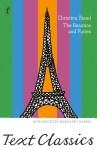
The beauties and the furies was not one of Stead’s most successful books, it has to be said, and I had to dig a bit deeper in Trove to find reviews. It’s the story of a woman who, married to a boring man, runs off to Paris to be with her student lover. The reviews were not kind, mostly for the writing than the content.

The Sydney Morning Herald’s reviewer (22 May 1936) writes that her “definite tendency to develop an artificial style” appeared in her second book, but suggests that

That “visionary imagination,” for which she has been commended, runs away with reality altogether in “The Beauties and Furies” at times.

S/he then quotes from the book, and, I must say that out of context at least it is a little over-the-top, but the review isn’t all bad, saying that despite these passages and “a leaning towards redundancy”, Stead has “a definite flair for delineation of character and a good sense of dialogue and situation”. The book is, however, “too long”, presumable because of the redundancy.

Book coverThe Mail’s review (30 May 1936) is similarly critical, and is titled, in fact, “Not recommended”. This reviewer attacks both the writing and the content, describing the story as

merely a sordid one, not of a beautiful comradeship, but of an illicit love affair between two people, whose ideals are about as spiritual as those of a pair of monkeys.

S/he ends the review with the parenthetical comment “(Censors please note)”. However, even so, this reviewer does see skill, saying “she can write vigorously, yet with simplicity and charm”.

The Australian Women’s Weekly (20 June 1936) joined the chorus:

A good story spoilt by a maddening cascade of words to water the purple patches of the plot. Of course, some of them have their uses. “Endoped dome of misery” might be applied to the reader’s head after ploughing through some of these passages. It seems a pity, for the book might have been a good one had the author stuck to her undoubted gift for descriptive phrases only as the means of telling her story.

The best “review” comes from Melbourne’s The Herald (18 June 1946) which quotes America’s New Yorker critic, Clifton Fadiman, who sees more to admire than criticise:

again declares that Christina Stead, the Sydney woman who wrote “The Salzburg Tales,” “Seven Poor Men of Sydney,” and “The Beauties and Furies,” is “a simon-pure genius, showing not a trace of workaday talent.” “I say this,” he temperately adds, “knowing that ‘The Salzburg Tales’ had its excesses and that ‘Seven Poor Men of Sydney’ was no less flawed … ‘The Beauties and Furies’ though her finest book to date, is also imperfect. Yet it discloses such streaming imagination, such tireless wit, such intellectual virtuosity, that I cannot see how anyone who reads it carefully— and there is no other way to read it — can deny Miss Stead’s position as the most extraordinary woman novelist produced by the English-speaking race since Virginia Woolf. . . . The style is indescribable, the wit hardly suggestible.”

Book coverHouse of all nations (1938), which satirises bankers and financiers, garnered far more positive reviews overall. Edgar Holt in The Herald (9 July 1938) starts with

That I was not very familiar with her work before is an appropriate commentary upon the indifference of most of us to our Australian novelists. “House of All Nations” is a brilliant and exhilarating book, a superb performance of sustained wit, a crushing satire on the world of international finance.

Holt shares many quotes to show the quality of her writing, saying Stead “revels in words. They spurt from her pen, fountain-like”. He does have some criticism but, like Fadiman, is impressed, concluding that

The scope of this book is almost too ambitious; but instead of failing in an exceptionally difficult undertaking, she has written a novel which will command universal admiration.

We should be very proud to include her in the forefront of Australian novelists.

Like Holt, who described the book as a “mosaic”, Adam McCay, in Sydney’s The Sun (10 July 1938) also discusses the novel’s construction:

According to current literary jargon, “House of All Nations” might be called a cavalcade, or a pageant: but its plan is too well-made, not accidental enough, to let it be named a kaleidoscope. Looking for a word, we might say that it is a symphony, with privateering international finance as leitmotiv, and it is written wholly in scherzo movements.

McCay is fulsome in his praise, saying, among other things, that:

In her perception of financial intrigue, as well as in her naked studies of fraud, gluttony, perversion, avarice, and adultery, Miss Stead has eyes as ruthless as a studio light. It is a rare woman who can furnish scepticism and satire as unabashed as Voltaire’s.

I will just note here, in passing, the sexism in some of the commentary. It was the 1930s.

The writer in Brisbane’s The Telegraph (14 July 1938) starts by sharing the qualified assessment made by that American supporter of Australian literature, C Hartley Grattan, then goes on to quote English critic Ricard Church who said that:

Such variety of character, presented with so original and vivid a style, makes this book quite outstanding. And as for the author’s mastery of the details of the international money-market; well, that is worthy of Zola.

So far, then, Stead has been compared favourably with Virginia Woolf, Voltaire and Zola. The aforementioned Adam McCay writes in another article that while one English reviewer sees her as “the most important woman novelist in English since Virginia Woolf”, he’d “go back past Mrs. Woolf to George Eliot”.

One-time Stead friend and supporter, the Australian journalist Florence James, wrote various articles about Stead’s career during the 1930s. In The Sydney Morning Herald (22 September 1938) she noted that

at last Australia is waking up to realise that in London and New York this young Australian is considered by many famous critics to be the most important woman writing in the English language to-day.

There were, of course, naysayers who did not like Stead’s exuberant, untamed style, but we can put that down, in part at least, to the fact that her modernist style was new and innovative. Not everyone likes innovation.

Note: You can find bloggers’ reviews of various Stead works at Lisa’s ANZLitLovers Christina Stead page.

Ruth Park and D’Arcy Niland, The drums go bang! (#BookReview)

Book coverVolume 1 of Ruth Park’s autobiography, A fence around the cuckoo, covers the period of her life up to when she lands in Australia to marry D’Arcy Niland. Not being sure, perhaps, that there’d be a sequel, Park concludes with:

We lived together for twenty-five years less five weeks. We had many fiery disagreements but no quarrels, a great deal of shared and companionable literary work, and much love and constancy. Most of all I like to remember laughter.

That autobiography was published in 1992. The drums go bang, written collaboratively by Park and Niland, was published in 1956 and covers the first five or so of these years to just after the publication in 1947 of The harp in the south.

The first thing that struck me was its point of view: it slips astonishingly between third person and first person plural, sometimes in the middle of a paragraph. And then the penny dropped, its collaborative nature. When they are talking about one of them, Tiger (Ruth’s nickname) or Evans (D’Arcy’s), third person is used, but when they are talking about them together, first person plural is used. Here is an example about their delayed honeymoon:

We didn’t mind the delay. Tiger was crazy to see Sydney, and besides she wasn’t too keen on going away to the Blue Mountains with a strange man. While Evans was away at the Railway she went around the city on her own …

Once you work out what’s going on, it works very well. However, to understand this particular paragraph, and the “strange man” comment you’ll need to read their story for yourself, as I want to move on to other things. Suffice it to say that this comment, while containing an element of truth, given the way their relationship developed, is also an example of their light, self-deprecating humour. As Park said in her autobiography, “most of all I like to remember laughter”.

The drums go bang is a short and often funny book, but it manages to cover a lot, including their struggles to find accommodation in 1940s Sydney when accommodation was scarce, their decision to go freelance and the resultant struggle to survive, their work in the outback, two pregnancies, their lives in Surry Hills and other Sydney suburbs, and their relationships with a wonderful cast of characters. The aspects which interested me most were of course Surry Hills, because it inspired The harp in the south, the writing life, and the writing itself, which provides such an insight into their skills.

Although they tell it with such humour, Park and Niland are very clear about how difficult the freelance life is. For most of the five years covered by the book they live a hand-to-mouth existence, experiencing poverty at close hand. However, there’s also good advice here for would-be writers. For example, early in the book, Tiger expresses frustration at Evans’s belief that a good story will sell regardless, but even this is told with humour:

He was convinced that if the story were good it must sell. He bailed up an amiable Salvation Army major and tried to persuade him that “The Other Side of Love” was just what was needed for the War Cry. He submitted “The Menace of Money” to the Business Man’s Monthly, and a sentimental animal story to the house magazine at the Abattoirs.

They share their Minor Carta, their manifesto for writers who wish to make a living writing. Its eight articles include some hard learnt truths, such as that you have to “write anything and everything”, you cannot afford to be “snobbish” about your art, and you can’t let rejection slips get you down. They talk about the variability of payment systems for freelance work, unscrupulous writing schools, and the importance of marketing, of needing to “shape it to fit”. They write articles, songs, short stories, radio plays, children’s radio, comedy sketches, and more – anything that might bring in a cheque (and they do it sharing one old typewriter.)

I’d love to share more about their lives, and particularly the characters in it, like Evans’ brother Young Gus, the generous freelance publisher Mr Virtue, and colourful relations like Aunt Nibblestones and Uncle Looshus, but I want to get onto something that is most relevant to Bill’s AWW Gen 3 Week, their time in Surry Hills and how it inspired The harp in the south. Initially scared by “the place, with its brawling, shrieking life”, abusive drunks and fighting prostitutes, Park started to adapt, and

… began to study the people for what they were, and not what they did. Their true kindness, their generosity and charity filled her with shame. They were so much more genuinely loveable than she had given them credit for being, and she began to understand how the incredible congestion of their lives, the rabbit-warren houses, the inescapable dirt of an area which is built around the big factory chimneys all contributed to their innately lawless, conventionless attitude towards life. She began to understand that in such a place dirt ceases to become important, morals are often impracticable, and privacy is an impossibility.

As it turned out, though, The harp in the south was written, almost, you could say, accidentally. In New Zealand for some needed R&R after the birth of their second child, they are sent a clipping by Uncle Looshus which announces a Sydney Morning Herald competition for a novel, short story and poem. Park tries to convince Niland to write a novel but he refuses, saying he only writes short stories, and tells her to have a go. So, she does, and of course Surry Hills is her inspiration:

… she felt she understood them. She certainly liked them, mostly because in the midst of all their dirt and poverty and fecklessness they contrived to be happy.

She wrote down a sentence that seemed to sum up their philosophy: “I was thinking of how lucky we are”.

That sentence, the last line in the book, was the key that opened the door. From then on the story grew by itself.

This book, published serially in 1947 to both acclaim and vituperation, has become a classic of Australian social realism, albeit, as Paul Genoni says, “tempered with romanticism”. The same could be said of this delightful memoir.

Challenge logoRuth Park and D’Arcy Niland
The drums go bang!
Illustrated by Phil Taylor
Sydney: Angus and Robertson, 1956
195pp.
ISBN: None

Monday musings on Australian literature: Christina Stead’s 1930s, Salzburg and Sydney

My first Monday musings on Christina Stead (my posts on Stead) was barely introductory, so I’m planning two more to coincide with Bill’s (The Australian Legend) AWW Gen 3 Week. These two posts – this week’s and next – focus contemporary Australian responses to the four books she published in the 1930s. I’m keeping this focus tight because Stead is such a complex figure in Australian literary history, and so much has been written about her already, including Hazel Rowley’s well-regarded biography. (See Lisa’s review at ANZLitLovers). However, I enjoyed reading, in Trove of course, what some contemporary Aussies had to say about her, and wanted to share them.

To start though, a very brief bio relevant to this period. Stead, born in Sydney in 1902, went overseas, to England initially, in 1928. She then lived, and worked in a bank, in Paris from 1930 to 1935, before spending time in the USA, Spain and England with her husband-to-be William Blake (Wilhelm Blech). In 1937, they moved to the USA. She didn’t return to Australia to live until 1968. Her first four books were published in the 1930s: The Salzburg tales (1934), Seven poor men of Sydney (1934), The beauties and the furies (1936), and House of all nations (1938).

Although over the years Stead experienced a mixed reaction from Australia, some critics denouncing her as “expatriate”, it’s clear that in the 1930s, at least, she was well-admired by Australian newspaper reviewers. It’s also clear that she was seen as both a modernist and a realist, with no nods to our bush and pioneer traditions.

Book coverThe Salzburg tales was her first published book and it immediately received positive attention from Australian newspaper reviewers. I was tickled by the writer in Melbourne’s Argus who wrote that “Many times it has been said that there is no particular demand for writers’ collections of short stories but there are authors and publishers who continue to issue books of the kind and apparently the stories find readers.” Plus ça change, it seems.

Reviews of this book noted its inventiveness and original style. For example, S.E.N., wrote in the Daily Mail on 4 April 1934, that

her book is remarkable not only for its inventiveness, but for its original style. It commingles modernism and mysticism, realism and romanticism, the dramatic and the uneventful, love, law, life, laughter, and letters in an olla podrida which is both attractive and unusual. Some of the stories are, like that of the Wanton, a little too highly spiced here and there for the less sophisticated reader; but on the whole Miss Stead has given us a collection of tales which are admirably told and admirably contrasted.

There we have it – “modernism” and “realism” – two styles/approaches that were significant the 1930s literature, and of which Stead was a major exponent. The unnamed reviewer in the Sydney Morning Herald (3 May 1934) remarked that “Miss Stead … really seems to belong in a class by herself”. This reviewer praises the variety, and concludes that “there seems no end to Miss Stead’s inventiveness and no limit to her powers of expression”. Jean Williamson, writing in the Australian Women’s Weekly (7 July 1934), is no less admiring, calling it “extraordinary in its concept, its vocabulary, its technique and its imagery.”

The reviewer in the Townsville Daily Bulletin (7 August 1934) states:

This author is, I understand, an Australian, who now lives in Paris. How long she has been there I do not know but she has accumulated experience, impressions, fed her imagination in a way that would not be possible for an author writing from this side of the world. It is not only that Miss Stead has set her scenes in such a town as Salzburg, and peopled her many pages with remarkable people. Most authors could have done that, but her story is saturated with her personality, lit up humor, knowledge, penetration, and is decidedly original.

This is an interesting comment in the context of Drusilla Modjeska’s book Exiles at home (posted on by Bill). Modjeska’s book is about “the ones who stayed” in Australia … tackling … how to live and work in this country as women and as writers and how to build a culture that has its roots in Australian histories and conditions, rather than in a foreign past” (from Introduction to Reprinted Editions.) Of course, the thing about Stead is that she too forged a contemporary literature, some of it set in or drawn from her Australian experience … which brings me to …

Christina Stead, Seven Poor Men of SydneyStead’s second book, Seven poor men of Sydney, which garnered similarly positive reviews. However, the reviewer in The Newcastle Sun (22 November 1934) makes no bones about its grittiness. It has no “Australian local color of the wattle blossom and stockwhip kind”. S/he describes it as high art, and says “it gives evidence of intuition, of skill in handling of character and of words and of high achievement in the depicting of realities.” For this writer, though, there is such a thing as being too modern, too real:

And while no one can reasonably suggest that a writer should ignore the gutter, it is not necessary to bring in the language of the gutter. It is, indeed, a great pity that a writer who shows abundantly that she is capable of far better things, should think it necessary to be “modern” in this particular way.

I know some readers who still feel this today … Anyhow, interestingly, Bookman writing in the Courier Mail (30 November 1934) has an opposing criticism, saying that “perhaps” the novel’s “weakest point” is that “the characters all talk too learnedly”! However, he too recognises the novel’s “stark realism”. He calls it “a remarkable book; the kind of book to which the word ‘powerful’ is sometimes applied”, but he also clearly fears its politics:

She has revealed the mentality out of which revolutions are made. That lesson is especially important in these days when thousands of lads, with more education than judgment, are being thrown into desperation and into the arms of extreme propagandists because all they can see ahead is blind-alley employment or no employment at all. In such conditions communism flourishes, and Miss Stead doubtless saw it thriving in Central Europe.

The aforementioned Jean Williamson, writing again in the Australian Women’s Weekly (9 March 1935) reports Stead’s own comments on the book.

The Seven Poor Men of Sydney is not so much a novel, I suppose, as a cast of characters battling through daily life, as much passion being expended or the small accidents of daily life as on any one of the great tragic themes; in fact the great tragic themes are all melted down and infused there. That was my feeling in writing the Seven Poor Men.”

Stead, a deeply committed socialist, also says that the novel shows she hasn’t forgotten Australia, nor “the importance of the Labor Movement in everyone’s daily life”.

So, two very different books, both written in a modernist style, both hailed for their inventiveness and her “phrasemaking” – and, put together, neatly reflecting her seemingly dichotomous existence.

Note: You can find bloggers’ reviews of various Stead works at Lisa’s ANZLitLovers Christina Stead page.

Joan Didion, Quiet days in Malibu (#Review)

Malibu from Malibu Pier, August 1993

As for many people I expect, Joan Didion’s now classic The year of magical thinking made a lasting impression on me, so I was keen to read her essay “Quiet days in Malibu” when it popped up as a Library of America (LOA) Story of the Week back in November. I was also interested in the subject matter. Having lived in Southern California in the 1990s, I wanted to see what Didion had to say about Malibu, a place that has always conveyed the romance of Californian beaches to me, largely through Gidget! There, I’ve admitted my teen-girl secret.

What Didion had to say was not what I expected. She starts with:

In a way it seems the most idiosyncratic of beach communities, twenty-seven miles of coastline with no hotel, no passable restaurant, nothing to attract the traveler’s dollar. It is not a resort. No one “vacations” or “holidays,” as those words are conventionally understood, at Malibu. Its principal residential street, the Pacific Coast Highway, is quite literally a highway, California 1, which runs from the Mexican border to the Oregon line and brings Greyhound buses and refrigerated produce trucks and sixteen-wheel gasoline tankers hurtling past the front windows of houses frequently bought and sold for over a million dollars. The water off Malibu is neither as clear nor as tropically colored as the water off La Jolla. The beaches at Malibu are neither as white nor as wide as the beach at Carmel. The hills are scrubby and barren, infested with bikers and rattlesnakes, scarred with cuts and old burns and new R.V. parks. For these and other reasons Malibu tends to astonish and disappoint those who have never before seen it, and yet its very name remains, in the imagination of people all over the world, a kind of shorthand for the easy life [my emph]. I had not before 1971 and will probably not again live in a place with a Chevrolet named after it. 

Things have, naturally, changed since Didion lived there for seven years through the 1970s, but only a little I think. Pacific Highway 1 still runs through it, alongside the beach, though the more inland 101 Freeway is the main north-south route. It is still home to many celebrities and other well-to-do living in expensive mansions. This opening paragraph, however, also introduces us Didion’s style – including her use of repetition (“The water off … The beaches at … The hills are …”) and quietly pointed commentary (as in “I had not before 1971 and will probably not again live in a place with a Chevrolet named after it.”)

This essay, published in a 1979 collection titled The white album, was in fact a reworking of two pieces published in Esquire in 1976. LOA’s notes say that those pieces “showcase the beach community” not through its celebrities but through “the lifeguards on the beach and the manager of a local orchid farm.” To these pieces, which form the bulk of the essay, Didion added the above-quoted introductory paragraph and a concluding section, about which more later.

The white album, LOA’s notes also tell us, opens with her famous line, “we tell ourselves stories in order to live”. The stories she tells in this essay are about “ordinary” people, as much as anyone, really, is ordinary. First up is lifeguard Dick Haddock. She introduces him thus – with that same use of repetition:

Dick Haddock, a family man, a man twenty-six years in the same line of work, a man who has on the telephone and in his office the crisp and easy manner of technological middle management, is in many respects the prototypical Southern California solid citizen.

She describes visiting his “office”, the lookout on Malibu’s Zuma Beach, on Thanksgiving morning in 1975, when

A Santa Ana wind was just dying after blowing in off the Mojave for three weeks and setting 69,000 acres of Los Angeles County on fire. Squadrons of planes had been dropping chemicals on the fires to no effect. Querulous interviews with burned-out householders had become a fixed element of the six o’clock news. Smoke from the fires had that week stretched a hundred miles out over the Pacific and darkened the days and lit the nights and by Thanksgiving morning there was the sense all over Southern California of living in some grave solar dislocation. It was one of those weeks when Los Angeles seemed most perilously and breathtakingly itself, a cartoon of natural disaster …

Oh no! As I post this story, we are suffering similarly from bushfires. We certainly feel that we are living in “some grave … dislocation”. Note too another of those pointed comments – on LA seeming “most perilously and breathtakingly itself, a cartoon of natural disaster”. Anyhow, Didion’s description of Haddock, his colleagues and their work, is respectful and evocative, recognising both the drama and the tedium of what they do.

The second piece is about another prototypical Southern Californian, “a Mexican from Mexico”, or “resident alien” (just as I, a wife, was a “derivative alien” to my husband’s “primary alien”!) Amado Vazquez is anything but ordinary, though, as he’s an expert orchid breeder for Arthur Freed Orchids. Didion shares with us her love of greenhouses:

all my life I had been trying to spend time in one greenhouse or another, and all my life the person in charge of one greenhouse or an- other had been trying to hustle me out.

And here, finally, was her opportunity to spend time in one! Again, in her chatty style, she explains the work of an orchid breeder – of stud plants, of orchid fertility, of the naming of plants, of the business of orchid breeding. She references that racist name-changing behaviour that white people often do, whereby the orchid named for Vazquez’s wife “mysteriously” becomes “Vasquez”.

But, I want to close on the short concluding section in which, after significantly mentioning the drowning death, “a casualty of Quaaludes”, of one of her 12-year-old daughter’s friends, she describes another horrendous fire:

Within two hours a Santa Ana wind had pushed this fire across 25,000 acres and thirteen miles to the coast, where it jumped the Pacific Coast Highway as a half-mile fire storm generating winds of 100 miles per hour and temperatures up to 2500 degrees Fahrenheit. Refugees huddled on Zuma Beach. Horses caught fire and were shot on the beach, birds exploded in the air. Houses did not explode but imploded, as in a nuclear strike. By the time this fire storm had passed 197 houses had vanished into ash …

This fire also destroyed three years of the orchid breeder’s work … Malibu, you see, with its peculiar geography, has is rife for natural disasters.

It was at this point that I realised the irony of the title. Through restrained, respectful reportage about the ordinary people of Malibu, Didion conveys that, in fact, Malibu is rarely quiet, and that few of its inhabitants enjoy an “easy life”.

Joan Didion
“Quiet days in Malibu”
First published: The white album, 1979 (sections published in Esquire in April and June 1976)
Available: Online at the Library of America