Jane Austen, Love and freindship (Review)

Love and Freindship editions

Love and Freindship editions

If you are a Jane Austen fan, you don’t just read her six novels. You read her letters, her unfinished works and her juvenilia. And you read them more than once. So it is that I have just – for my local Jane Austen group – reread Love and freindship (sic), the short epistolary novel she wrote in her 15th year. It is a fun – and illuminating – read. It’s the illuminating part that I plan to focus on here.

But first, a little about the plot. It commences with a letter in which Isabella asks her friend Laura to tell her daughter “the Misfortunes and Adventures” of her Life. “You are this day 55”, she says, and surely now safe “from the determined Perseverance of disagreeable Lovers and the cruel Persecutions of obstinate Fathers”. Laura, while rejecting that she is too old for such “unmerited” misfortunes, agrees to tell her story  to Isabella’s daughter Marianne as a “useful lesson”. What follows is a melodramatic story of sudden friendships, quick-not-always legal marriages, and wild coincidences, accompanied by much fainting and “running mad”.

This doesn’t sound much like the writer described by Charlotte Bronte as “sensible and suitable” does it? And, in fact, this wildly improbable, effusive story isn’t much like her. Or is it? This is the point I’d like to explore a little in my post, because there are many seeds here of the writer Austen was becoming – of the things that were to concern her and of the style she was developing.

The thing that concerned her most was to make fun of silly or ridiculous people and ideas. The most obvious of these in Love and freindship was the late eighteenth century’s cult of sensibility, which involved the favouring of sensibility over sense, the fostering of an overactive imagination (as evidenced by the popularity of Gothic novels). But what is exaggerated and parodied in Love and freindship become more considered subjects in her first novels, Northanger Abbey and Sense and sensibility.

There are, for example, obvious similarities between Laura, here, Catherine Morland in Northanger Abbey and Marianne in Sense and sensibility, but Laura’s complete refusal to recognise that sense has any place in her life is modified in Catherine and Marianne who learn through experience that their imagination and sensibilities, if left uncurbed, can get them into trouble. (Intriguingly the recipient of Laura’s letters is a Marianne. A little Austen in-joke perhaps?). Pride and Prejudice’s Lydia could perhaps be seen as Laura’s true heir: Lydia is not described in quite the same terms as Laura, but she certainly pays no credence to anything remotely sensible.

Now I’m going to be lazy and simply illustrate Austen’s changed approach with some comparative examples. Here is Laura on an older man, her husband’s father:

for what could be expected from a Man who possessed not the smallest atom of Sensibility, who scarcely knew the meaning of Simpathy, and who actually snored.

And here is Marianne, in love with the dashing Willoughby, on Colonel Brandon:

He was silent and grave. His appearance, however, was not unpleasing, in spite of his being in the opinion of Marianne and Margaret an absolute old bachelor, for he was on the wrong side of five-and-thirty; but though his face was not handsome his countenance was sensible, and his address was particularly gentlemanlike.

While Laura ends her tale with:

I took up my Residence in a romantic Village in the Highlands of Scotland where I have ever since continued, and where I can, uninterrupted by unmeaning Visits, indulge in a melancholy solitude my unceasing Lamentations for the Death of my Father, my Mother, my Husband, and my Freind.

Catherine learns her lesson and

… was completely awakened. Henry’s address, short as it had been, had more thoroughly opened her eyes to the extravagance of her late fancies than all their several disappointments had done. Most grievously was she humbled. … The absurdity of her curiosity and her fears — could they ever be forgotten? She hated herself more than she could express.

Exaggeration and parody are the tools used in Love and friendship, while the adult Austen used the more sophisticated, though no less funny, tools of wit and irony to achieve her satire.  And again, I’ll demonstrate with comparative examples. In Love and freindship she satirises novel-reading with broad humour:

“Where, Edward in the name of wonder (said he) did you pick up this unmeaning gibberish? You have been studying Novels I suspect.”

But in Northanger Abbey, the plot itself demonstrates the foolishness of reading novels unwisely, while a respected character conveys Jane’s truth:

The person, be it gentleman or lady, who has not pleasure in a good novel, must be intolerably stupid.

Love and friendship is unsubtle, and is clearly the work of a youthful writer, but it is a hoot to read and we are lucky to have it (and her other juvenilia) to show us an author in the making.

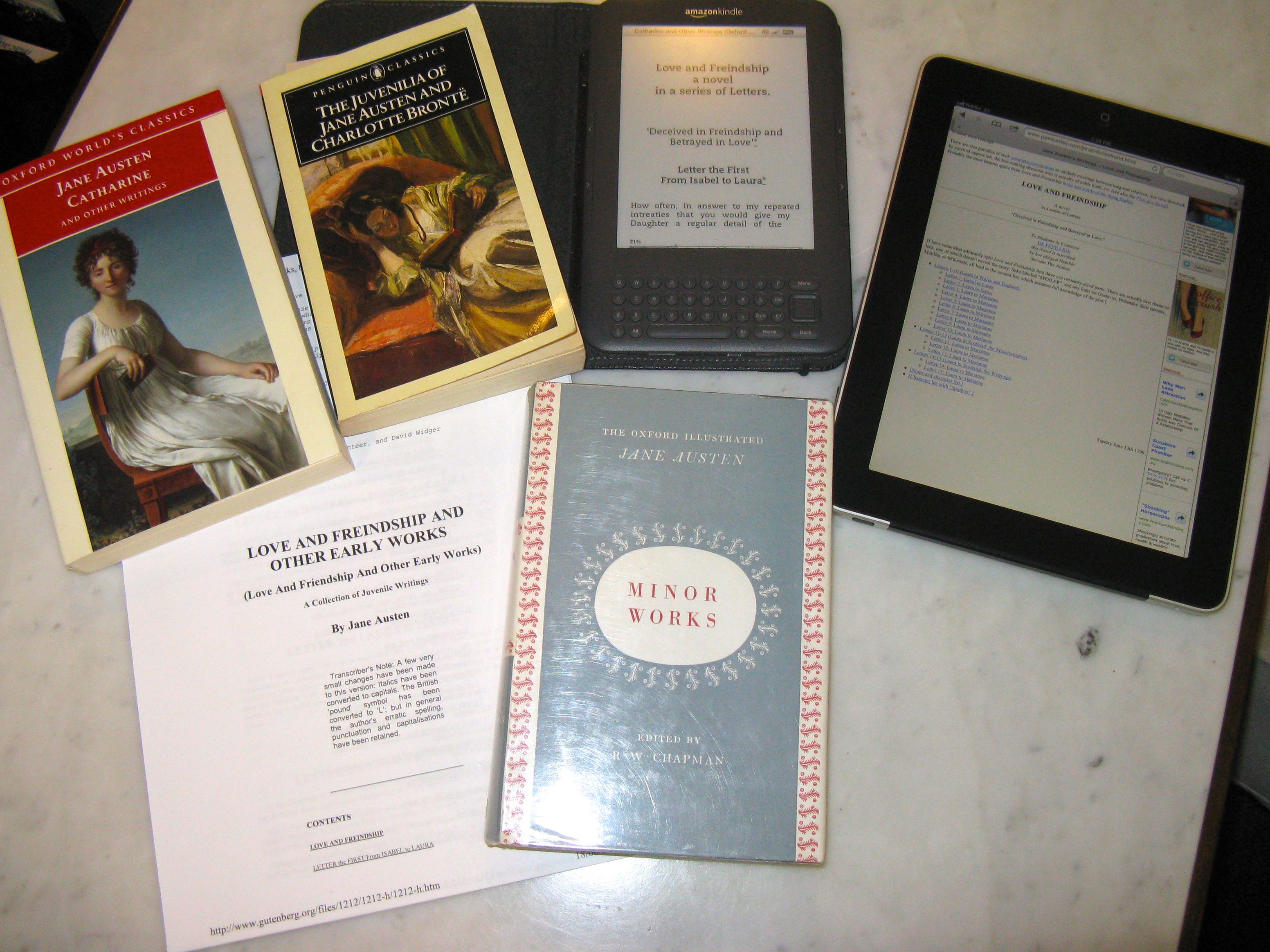
Note: Love and friendship (1790) is available in many formats and manifestations. My first copy was in RW Chapman’s edition of her Minor works, but this time I read it on my Kindle using a bought version, the Oxford World Classics edition titled Catharine and Other Writings. However, you can read (or obtain) it online at Project Gutenberg.

Horace Walpole, The Castle of Otranto

Tower of Horace Walpole's own Gothic house, Strawberry Hill

Tower of Horace Walpole's own Gothic house, Strawberry Hill (Public domain, via Wikipedia)

Would you believe the issue of fact and fiction is consciously raised in yet another novel I’ve read? In his preface to The Castle of Otranto Horace Walpole suggests that it’s possible the story – which he tells us that he “found” and translated – is based on fact. And he concludes that:

If  a catastrophe, at all resembling that which he [the original author, that is!] describes, is believed to have given rise to this work, it will contribute to interest the reader, and will make the “Castle of Otranto” a still more moving story. (Preface to the 1st edition)

Hmm … moving is not quite how I’d describe this Gothic tale but perhaps that’s because I’m a cynical 21st century reader and not a mid 18th century one? I did though enjoy the book, which I read as part of my local Jane Austen group’s preparation for our discussion of Northanger Abbey next month. I had planned to read a Gothic novel by a female author – such as Ann Radcliffe – but time got the better of me and so I settled on The Castle of Otranto which is a novella, but which is also interesting for its pioneer status as the first Gothic novel.

The first thing that entertained me about the novel was the preface and Walpole’s (rather postmodern-like) attempt to pass it off as a story he’d found and translated. He suggests the text had been written in medieval times during the Crusades (between 1095 and 1243). This first edition was well-received by the reading public as well as by some contemporary critics. And so in the second edition Walpole identifies himself as the author, and in its preface claims that the novel was “an attempt to blend the two kinds of romance, the ancient and the modern. In the former all was imagination and improbability: in the latter, nature is always intended to be, and sometimes has been, copied with success…”. This builds, in fact, on an argument he makes in the first edition’s preface that if we ignore the “miraculous” (read “supernatural”) aspects:

the reader will find nothing else unworthy of his perusal. Allow the possibility of the facts, and all the actors comport themselves as persons would do in their situation.

Hmm again … I think he errs on the improbable side of the pendulum, but the characters do, I accept, exhibit a reasonable level of psychological realism.

This change from the first to the second edition is interesting in itself and would be fun to research further … but it’s not something I plan to pursue in this review. I will, though, take up the issue of “the novel” further when I review Northanger Abbey in a month or so since it is in this novel that Austen argues the value of reading fiction.

This brings me to the second thing I enjoyed about the novel, and that was simply experiencing the introduction of the Gothic. Wikipedia says Walpole “introduces many set-pieces that the Gothic novel will become famous for. These includes mysterious sounds, doors opening independently of a person, and the fleeing of a beautiful [usually virginal] heroine from an incestuous male figure”. It also includes the sorts of features that we find in soap operas today – which one could argue are a continuation of the Gothic without the supernatural horror aspect. These features include mistaken identities, people returning from the dead (or, at least, when they are least expected), and love triangles (which are, of course, not only the province of the Gothic). The Castle of Otranto moves at a cracking pace. There’s a lot of dialogue, a good deal of action (human and supernatural), and not too much description.

Another thing that fascinated me is why readers enjoy such over-the-top stories. To prepare for my group’s discussion, I read a critique by Jerrold E. Hogle*. He argues, to put his academic thesis more simply, that the Gothic allows readers to “displace” real fears onto something more fictive. In Walpole and Radcliffe, these fears, he suggests, are somewhat paradoxical: a desire for and rejection of aristocracy and old Catholicism, by the middle class. My group’s discussion raised other reasons too. One is the “excitement” (sexual titillation) roused by these novels, particularly for the young women of the era like, say, Catherine Moreland and Isabella Thorpe in Northanger Abbey. Were Gothic novels that generation’s young adult novels? Another is the idea that, like crime novels, Gothic novels are about the restoration of order: “This is a bad world” says the hero earlier in the novel.

Anyhow, that’s enough of that I think. I haven’t really done a review have I? I haven’t even mentioned the plot. It’s pretty much the usual stuff. There’s Manfred, the lord of the castle, who needs to continue his line to maintain ownership of the castle, but his only son dies on his wedding day. This sets off a train of events in which Manfred decides to divorce his wife, Hippolita, to marry his son’s intended in order to, hopefully, produce more heirs. His plan is intercepted by the appearance of those who claim the castle is theirs. The story includes knights and friars, loving mothers and loyal daughters, helmets and portraits with minds of their own (“the portrait … uttered a deep sigh and heaved its breast”), and, of course, caves and tunnels. The interesting thing about the plot though, in terms of that restoration of order argument, is that not quite the perfect order is restored … but I won’t spoil the story further than that.

As for the opening quote, I’ll leave that for you to ponder …

Horace Walpole
The Castle of Otranto
Originally published 1764
Kindle edition
158Kb

* Hogle, Jerrold, W “Hyper-reality and the Gothic affect: The sublimation of fear from Burke and Walpole to The Ring“, in English Language Notes, 48 (1): 163-176, Spring/Summer 2010.