Flight of the Mind: Day 1, Summary

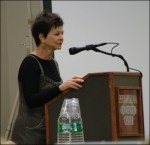
Geraldine Brooks, 2008 (Photo: Jeffrey Beall, via flickr, under Creative Commons CC-BY-ND-2.0)

Geraldine Brooks, 2008 (Photo: Jeffrey Beall, via flickr, under Creative Commons CC-BY-ND-2.0)

Today I went to the National Library of Australia’s Flight of the Mind conference – and, well, my mind took flight! The conference title comes from Virginia Woolf:

The old problem: how to keep the flight of the mind, yet be exact. All the difference between the sketch and the finished work.

Today’s program focused largely on the nexus between fact and fiction (or imagination). The sessions were:

Session 1: Kenneth Binns Lecture

Geraldine Brooks set the tone – as of course she must, being the key-note speaker – by arguing the value of historical fiction. It’s just as well Inga Clendinnen wasn’t there because, like Kate Grenville, Brooks argues that there is validity in “putting ourselves in someone else’s shoes”. She argued that in historical fiction we get “the constants of the human heart” even though the “material world” might be different. She said that the things that divide us – race, gender, creed, time, place – are less significant than the things that unite – love, pity, fear, compassion, and so on. I like her view of the world! I felt like asking her whether she agreed with Inga Clendinnen’s statement in The history question: Who owns the past? (Quarterly Essay 23) that: “It is that confusion between the primarily aesthetic purpose of fiction and the primarily moral purpose of history which makes the present jostling for territory matter”!! Basically, Clendinnen disagrees that novelists can make a contribution to history through, what Grenville described as, “empathising and imaginative understanding”. I’m simplifying a bit of course but, as I understand it, this is the nub – and I fundamentally disagree with Clendinnen (much as I admire her!)

Session 2: Creating fiction from fact: History as inspiration

The three speakers in this session essentially continued along Brooks’ theme, arguing about the truths that can be explored through fiction, with Goldsmith going so far as to say that as well as creating fiction out of fact, novelists can create “fact from fiction”. Rodney Hall talked a bit about the process of writing historical fiction and quoted Robert Graves who once told him to “write first, research later”. Hall suggested that it is important to get the facts right because once a reader stumbles across something they don’t believe, it interrupts the reader’s ability to lose themselves in the text. Fair enough I think – but clearly there are facts that need to be “right” and facts that can be “toyed with”. Otherwise, how could Hall get away with writing a novel titled The day we had Hitler home in which Hitler comes to Australia? It seems to me then that whichever way you look at it, readers of (historical) fiction need to understand in the end that they are reading FICTION!

Session 3: Recreating a creative life

This session focussed on the challenges of writing biography – of finding information, of making selections regarding what to include, and so on – and there were some interesting issues discussed but I’ll leave those for now.

Session 4: Writing across boundaries

Felicity Packard, who teaches creative writing as well as being a practising writer, made some points which clarified things nicely. She talked about working within the conventions of dramatic writing (such as Aristotle’s classic 3-part structure and the need to focus on just a couple of main questions) and the conventions of form (such as the 13-part television series). The other two speakers also referred to the issue of form. It made me realise that the writer of historical fiction works within two constraints – that of form, and that of the history they are working with. It can’t be easy!

Kevin Brophy also talked about the issue of plausibility. He said that journalism needs to do little to achieve plausibility, while fiction needs artifice to reach the same goal. And this brought me back to Geraldine Brooks’ reference in her key-note address to journalism being “the first rough draft of history”. Journalists, she said, get down the facts that are available at the time; then historians go back later and fill in the gaps using the additional records available to them after the passing of time. After all this is done, though, there are still voids – voices that are missing, such as, for example, those of the inhabitants of the plague village of Eyam upon which her novel Year of wonders is based. The historical novelist is, she said, “the filler of voids, the teller of lies” that convey “the emotional truths … the constants of the human heart”. I do wonder what Clendinnen would have said had she been there…but, in my view, today’s speakers did a good job of balancing “the exact” with their “flight[s] of mind”.

Oh, and if you would like a summary of Day 2, don’t look here. Due to other busy-ness, I only booked to attend Day 1.
Marion on Marion (Halligan)

A few days ago I posted a review of Marion Halligan’s latest book, Valley of Grace, and mentioned that Halligan had attended my bookgroup meeting at which we discussed the book. I didn’t, however, share in that post all of the things that Halligan told us – and I won’t in this post either. Some things are just not meant to be shared! Nonetheless, there are things we asked her that are of general interest to readers interested in writers and writing, and these I will share…

As readers often ask writers, we asked her about her writing process. She started off by saying that she never says she has writer’s block. This doesn’t mean she doesn’t get stumped at times but that when she does she just moves on to other writing she has on the go. Valley of Grace was, she said, written essentially over 20 years. She made notes for it back in 1989 when she was living in that apartment in Paris that overlooked the Val de Grâce church. And then, when she got a little stuck in her novel The point, which was published in 2004, she took out the notes she’d made back then and worked them up into a short story. Sometime later, she realised that it was more than a short story and voilà, we now have the book (though it took perhaps a little more than voilà for her to get from short story to book!).

Hand and pen, from Clker.Com

Hand and pen, from Clker.Com

Now, here’s the interesting bit: Halligan writes by hand! She says that the slowness of the eye-hand-paper process makes you think harder and results, for her anyhow, in fewer drafts. Essentially, she writes the story out by hand and then reads it over crossing out and adding in, etc. She then reads it again – often reversing the changes she’d made! It is only then that she types it into her computer, and the sense we got was that at this point it’s pretty much ready to go. We didn’t – silly us – ask her much about the publisher’s editors.

We talked a bit about the use of imagery, including metaphors. She says that much of this is unconscious, that if you are an experienced writer and you get into your story’s mode, the imagery seems to just come (such as the use of light, yellow etc in Valley of Grace). She talked specifically about the challenge of using metaphor and how writers often don’t think them through. Her example of a poorly thought through metaphor was  one writer’s description of a person’s bottom during lovemaking as “white dunes of sand”! The mind boggles rather. Anyhow, this brought to my mind a statement she makes in one of her more self-conscious books, The fog garden:

That is the trouble with metaphor, it may take you to places you don’t want to go.

She had more to say on writing, such as to beware of using too many adjective and adverbs, and that for her books are not about answers but about questions. In Valley of Grace the over-riding question, really, is about the soul, about what makes us human. Now, it’s hard to get a bigger question than that!

We also talked a little about reading and what we like. Halligan is not keen on issue(ideas)-based fiction: she doesn’t think it’s interesting. This is an issue I have referred to briefly in a couple of my reviews, specifically in This earth of mankind and The workingman’s paradise.

Finally, we couldn’t let her go without asking her about her literary influences. Not surprisingly, given that she’s been writing for a long time now, she couldn’t really say, but she did name some of her favourite writers. These included Margaret Drabble, William Trevor, and John Banville. Interesting, eh, that they are all Irish or English! Clearly, I really must read that William Trevor languishing my TBR pile!

Anyhow, you can probably tell from all this that Halligan was generous with her ideas and her time. It was a real treat having her there…

This of course doesn’t make any sense

Foer, 2007 (Photo by David Shankbone, via Wikipedia, used under Creative Commons CC-BY-3.0)

Foer, 2007 (Photo by David Shankbone, via Wikipedia, used under Creative Commons CC-BY-3.0)

Lisa, over at ANZLitLovers, has produced a list of some of the main features of postmodernism. It just so happens that I am also reading a postmodernist book, Jonathan Safran Foer’s Everything is illuminated (from which the title of this post comes). I’ve only just started the book but it is exhibiting those features of postmodernism that I most enjoy:

  • metafiction – in this case highly self-conscious authoring
  • absurdity and irony thinly but uproariously disguising “real” meaning
  • visual playfulness – the titles of chapters by one character typeset in various curvy shapes, while the titles by the other are presented in the usual straight line; use of other typographical features such as upper case, italics, strikethroughs and the like
  • mixed genres – letters (ie correspondence), novel within novel, playscript, and so on.

All these are contained within a comprehensible story-line, once you get into it, and in language that is playful but not so playful that it’s obscure. But more anon. As a character in the novel says:

I do not have any luminous remarks because I must possess more of the novel in order to lumin.

Writing like this makes me laugh out loud…and that is always a good thing.

Truth in fiction?

One of the things we readers regularly talk about is the notion of the truths we find in fiction. I like to collect what authors have to say about this, particularly in their own fiction, and so thought I’d share a few with you.

But first I’ll start with one from Richard Flanagan that doesn’t mention the word “truth”, just to get our juices going:

Books were solid, yet time was molten. Books were consistent, yet people were not. Books dealt in cause & effect, yet life was inexplicable disorder. Nothing was as it was in a book…’ (Flanagan, Gould’s book of fish)

This comes from a character who is clearly frustrated with life – and who doesn’t seem to be learning the right lessons from his reading! More to my point, from another Aussie writer, Rodney Hall, is this:

Fiction…is not so much a licence to make things up as…a licence to tell the truth.’ (Hall, The day we had Hitler home)

I love this – this recognition that fiction is, really, about truth. We readers know it – but there are many others who don’t. Flanagan says something similar in Wanting:

…though the story is a fancy, it is a fancy drawn from the deepest truth. (Richard Flanagan, Wanting)

And yet, this issue of truth in fiction can be looked at from a slightly different perspective. Marion Halligan, in her novel The fog garden in which she explores grief after the death of her husband, has a few things to say on the matter:

She isn’t me. She’s a character in fiction. And like all such characters she makes her way through the real world which her author invents for her. She tells the truth as she sees it, but may not always be right. (Halligan, The fog garden)

and:

A reader could think that, since Clare is my character, I can make all sorts of things happen to her that I can’t make happen to myself. This is slightly true, but not entirely … only if it is not betraying the truths of her life and character as I have imagined them. (Halligan, The fog garden)

Here Halligan tackles head on that problem that so many readers have, particularly in autobiographical/semi-autobiographical novels, of distinguishing “fact” from “truth”; she also explores the wider issue of authorial manipulation of characters. There is more that I could quote but that would get boring, and so I’ll give the last word on the matter to Elizabeth Bowen who, as AS Byatt quotes in her introduction to Bowen’s A house in Paris, is clear about truth and fiction:

The novel lies, in saying something happened, that did not. It must therefore contain uncontradictable truth to warrant the original lie.

And that, as they say is that. Anyone want to disagree?

Think twice about questioning an author!

I have to admit that I’m not one of those readers who gets too hung up about accuracy in fiction. After all, fiction is, by definition, a work of imagination, and not of fact. And so, when I read fiction I’m pretty good at suspending my disbelief. I’m more interested in the world created by the author and whether what is written makes sense (is consistent) within that world. I know this is a simple response to a complex question, but it is the rule-of-thumb I go by and has served me well over the years!

This is not so for all readers…as I have discovered over many years of book discussion. I was thus entertained to come across the following exchange in the “Other People’s Letters” section of The ABC Weekly issue of 15 February 1941 which I read today. It concerns a story, by Australian playwright and novelist Max Afford, that had been serialised in the magazine.

Here is the letter:

Why do authors persistently make their characters wear spectacles with “thick” lenses, such as Edward Blaire apparently needs in your serial Owl of Darkness. No spectacle lenses are ever made thick, as thickness has no effect whatever on the lens power, and would only increase their weight. If it were meant to imply that the spectacles had lenses of high power in them, they could be referred to as “strong” but definitely not “thick”. [Name withheld – by me!]

Here is Max Afford’s response:

It is regrettable that your correspondent is not as careful over facts as he is about nonsensical hair-splitting details. The gentleman is entirely wrong! Sydney oculists assure me that, in some cases, spectacle lenses are ground to as much as 1/4 inch [about 6mm for my younger readers here!] thick.

So there you have it! Our poor gentleman loses on both counts: he is hairsplitting and he is wrong anyhow! Personally, I’d rather enjoy the story and find something more useful to write to the editor about.

What do I mean by spare?

If you asked my kids what my favourite mantras are, they would probably include “less is more” as one of them. This is not to say that I don’t enjoy flamboyance and “over-the-topness”, because I most certainly do, but it is true that I am more often drawn to what I would call “the spare”.

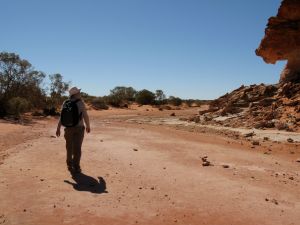
Claypan in Wurre (Rainbow Valley), south of Alice Springs

Claypan in Wurre (Rainbow Valley), south of Alice Springs

As we drove recently through Central Australian desert country, I started thinking about why it is that I love deserts, why I am drawn to them – and it suddenly occurred to me that my love of deserts can probably be equated with my love of spare writing. There are similarities: deserts and spare writing look deceptively simple and even, at times, empty on the surface but, hidden beneath this surface is a complexity that you can only find by looking and, particularly, by knowing what to look for. Conversely, in say a rainforest or a big fat nineteenth century novel, you are confronted with an embarrassment of riches. This is not to say that they, too, don’t have their complexities, but the “wow factor” is in your face!

And so what exactly is spare writing? I realised that I have often called something spare but this has been an intuitive thing – I’ve never actually sat down and defined what I mean by it. I’m going to now – for my benefit even if not for anyone else’s!

What typifies spare writing?

Of course, nothing that I write below is exclusive or absolute – there are, as they say, exceptions to every rule, but there are too, I think, some generalities we can identify:

  • preponderance of short sentences
  • minimal use of adjectives and adverbs
  • apparent focus on the concrete rather than the abstract
  • simple dialogue
  • repetition
  • strong (often more staccato like) rhythm
  • short paragraphs and more white space on the page

By excluding anything that could be seen to be superfluous to the intent, the author can cut to the chase…and the chase is often the most elemental, the most intense of experience or emotion. In this sense spare prose is reminiscent of poetry – and in fact can often feel and sound poetic. Spare writing, though, can also be its own worst enemy: it can be so pared down, so concise, that it becomes elliptical; so non-florid, so unsentimental, that it can seem cold. But then, this is no different from any other style is it? There are those who use a style effectively and those who don’t. Used well, a spare style can grip me quickly and, often, viscerally.

Some proponents of the style

While Ernest Hemingway is the writer most often cited, I think, as a spare writer, I have read little of his work – something I would like to rectify. Albert Camus, particularly in works like The outsider, is spare: the protagonist Meursault explains little leaving it to the reader to untangle who he is and what he feels and believes (or not as the case may be!). JM Coetzee’s Disgrace is another rather spare work, exemplified by its detached tone, by the refusal of the main character to explain himself, and by its matter-of-fact description of fear and horror.

A recent very obvious example is Cormac McCarthy’s The road. This book is elemental in more ways than one: everything is pared down to the minimal – the landscape, the characters, the language. It is in fact about the struggle for life – literally and spiritually. The spare style – with its rhythmic repetitions – makes sure that we see that! And guess what? Its landscape, while not originally a desert has been made so by cataclysm. This is one of the sparest books I’ve read – and also one of the most mesmerising.

An observation

Have you noticed something about the above? All the examples are male. Is a spare style more suited to the male psyche? While I can’t think of any specific examples of women writing quite like the male writers I’ve described, I’d suggest that writers like – yes, I admit it, my favourites, Jane Austen and Elizabeth Jolley – are closer to the spare end of the writing spectrum. Austen, for example, is quite out of step with her female contemporaries, most of whom were writing Gothic or so-called sentimental novels. She is more rational, witty and ironic than descriptive and emotional…which is why, really, Charlotte Bronte, child of the Romantic age, didn’t much like her!

And here, in the interests of following my own “less is more” mantra, I shall close! I would though love to hear others’ thoughts on the matter.