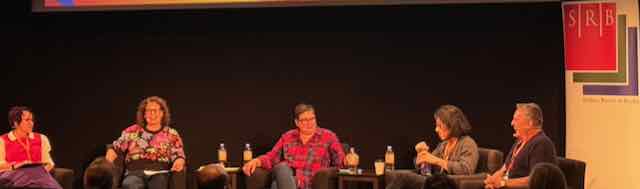
ACT Literary Awards 2025

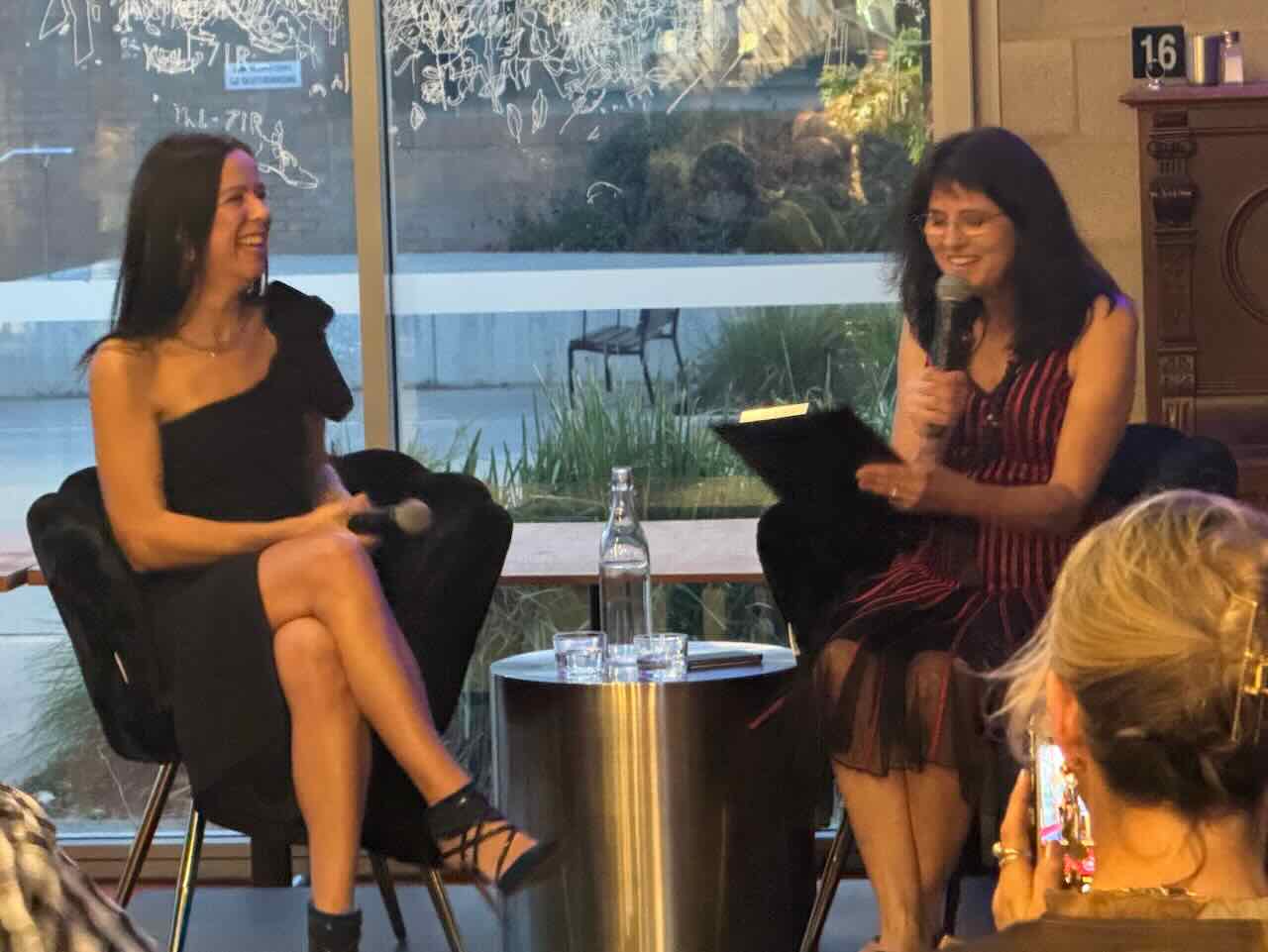
Last night, I attended the presentation of the ACT Literary Awards (which I have attended for the last couple of years). These awards are made by Marion (previously, the ACT Writers Centre), and this year’s event was MC’d again by Katy Mutton and Board Chair, Emma Batchelor. These awards were also framed as kicking off Marion’s 30th birthday celebrations, which is perhaps why the dress code was marked as “Smart Casual – With Flair”! For a bit of flair, I wore my gold-coloured sneakers!

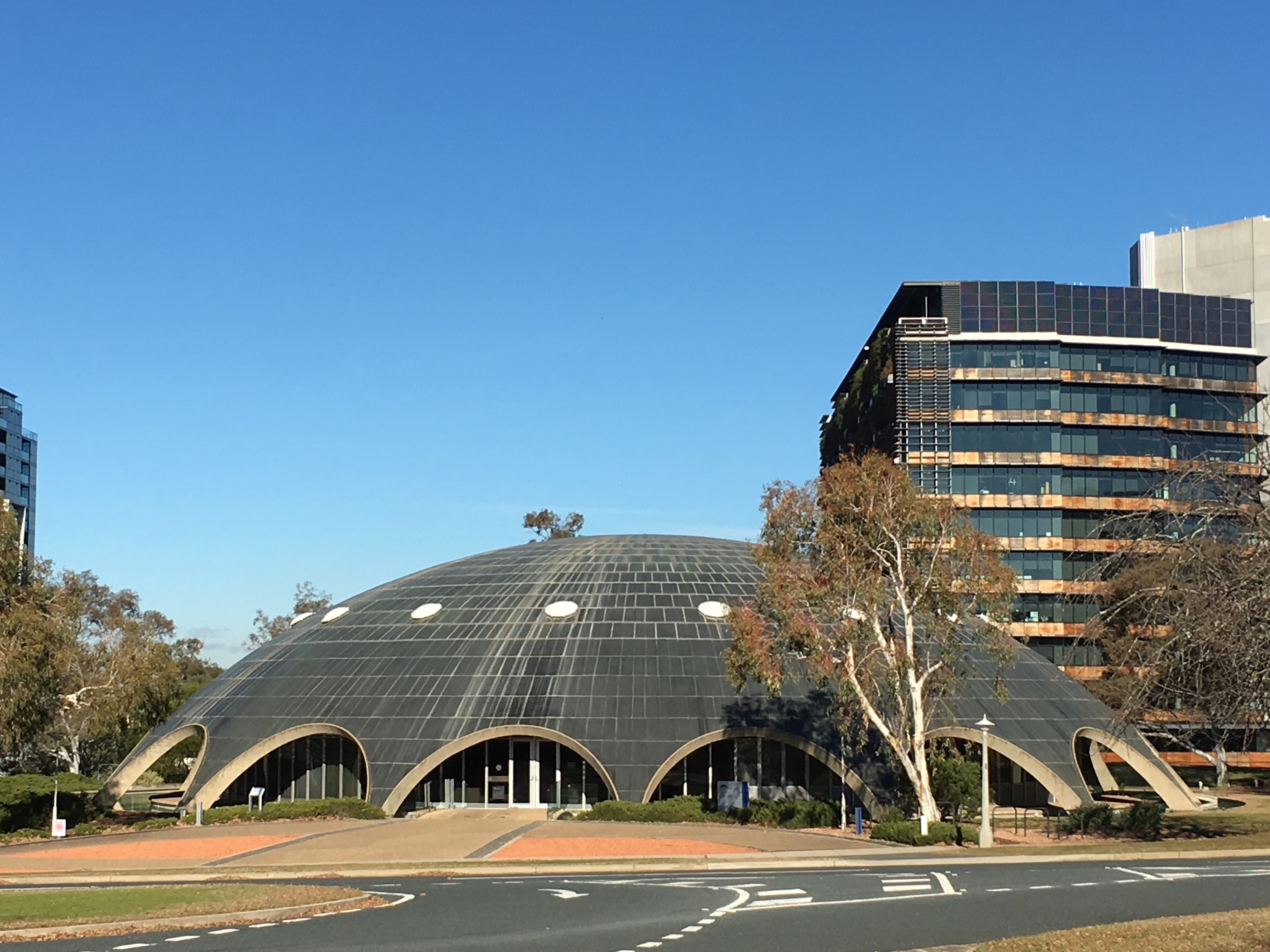
This year the awards were held, not in the Canberra Contemporary Art Space where it had been held for the last couple of years, but in one of Canberra’s iconic buildings, the Shine Dome (which houses the Australian Academy of Sciences). (The Academy was one of the sponsors. Others included the Anderson Pender Foundation, Harry Hartog Bookseller, She Shapes History, Pulp Book Cafe, and the much appreciated Big River Distilling which provided gin for the evening!)

As last year, the event had a lovely relaxed informality, but the main aim of celebrating local authors and the writing community was still front and centre.

Also, as last year, the evening opened with a “rite of passage” offered by local Ngunawal elder, Wally Bell. At the end of the rite, which involves asking for permission to be on another’s country and to use that country whilst there, he told us that the spirit of the land would look after us, but that we have the reciprocal responsibility to respect and care for the land and for other people.

Following this, Michael Petterrsson, MLA, who is, among other things, Minister for Business, Arts and Creative Industries, addressed the gathering on behalf of the ACT Government.

But now, the awards…

Marion offers and/or administers a number of awards, including their own in the four major areas of Poetry, Nonfiction, Children’s and Fiction. Winners in these four categories receive $500 each. As I noted last year, they accept both self-published and traditionally published works.

The judges were:

  • Poetry: Paul Hetherington, Maya Hodge
  • Nonfiction: Katrina Marson, Shannyn Palmer
  • Children’s literature: Jacqueline de Rose-Ahern, Will Kostakis
  • Fiction: Adrian Caesar, Ayesha Inoon

More information on the awards can be found on Marion’s website (linked above).

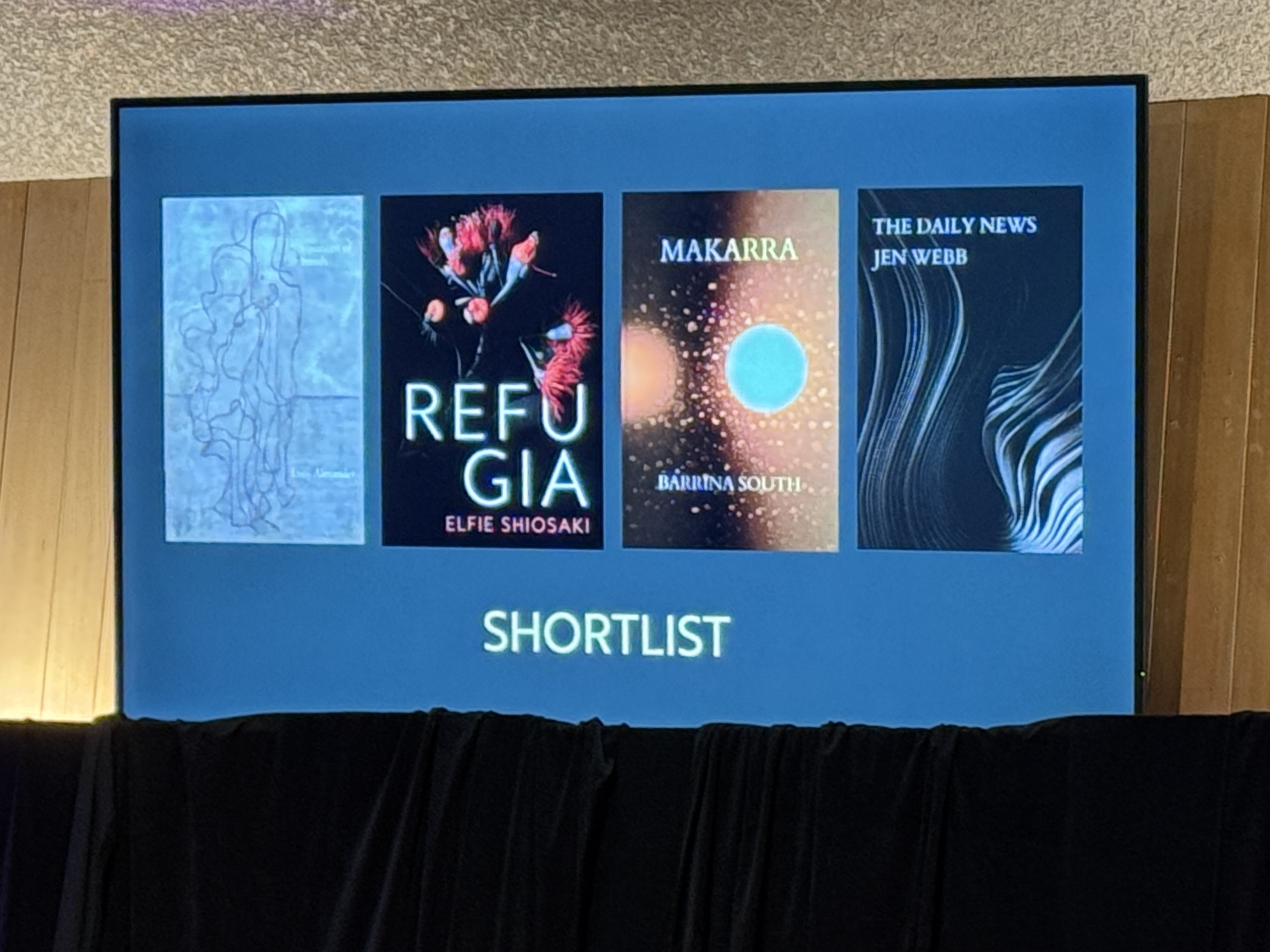
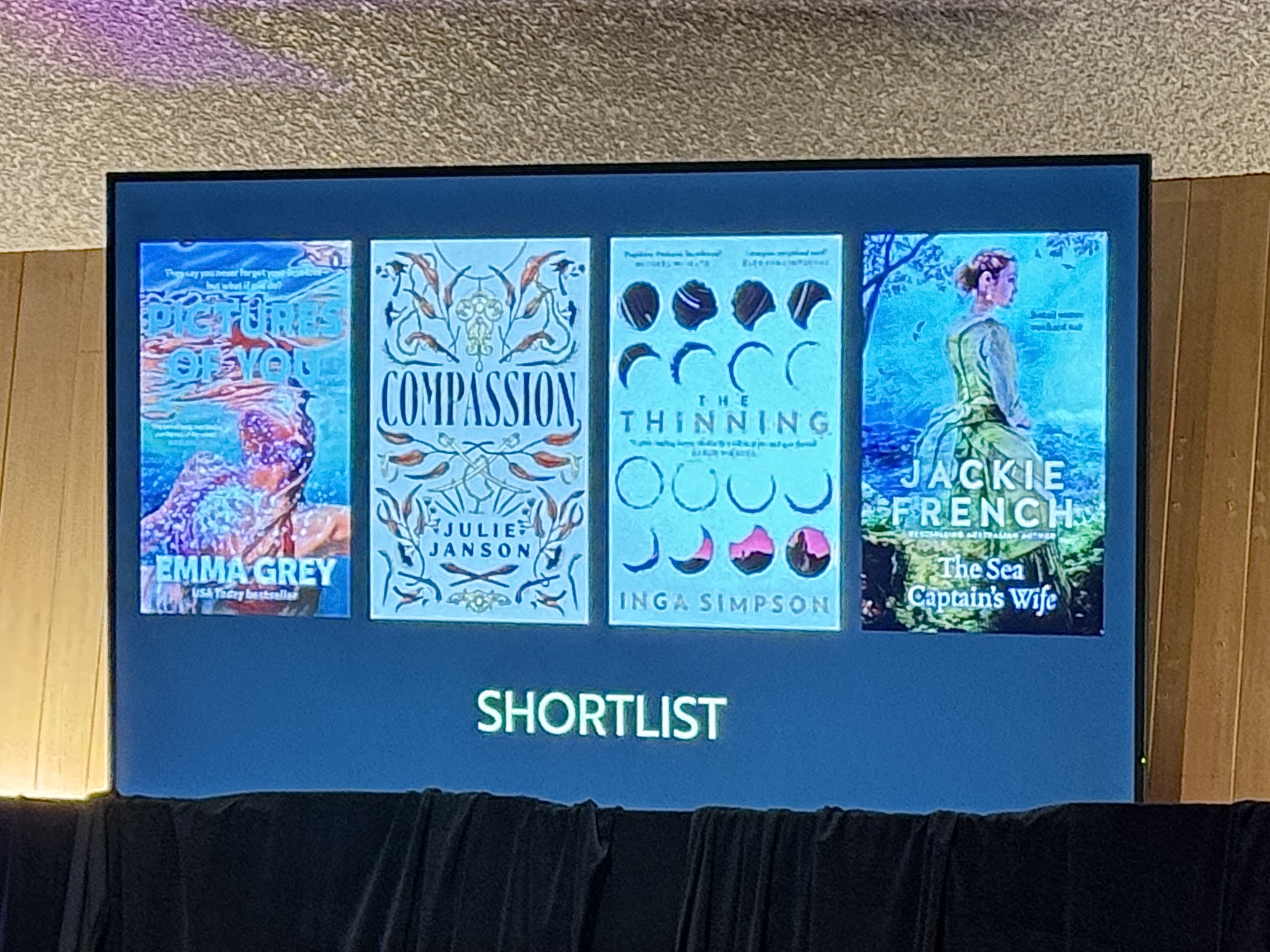
As I didn’t share the shortlists for these awards, I am listing them, highlighting the winners in bold.

Poetry

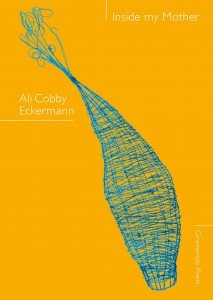
  • Barrina South, Makarra (Recent Work Press) (WINNER)
  • Lucy Alexander, Equations of Breath (Recent WorkPress)
  • Jen Webb, The Daily News (Recent Work Press)
  • Elfie Shiosaki, Refugia (Magabala Books) (HIGHLY COMMENDED)

Nonfiction

  • Melissa Bray, Australian Carillonists: HIGHLY COMMENDED (Self-published)
  • Hilary Caldwell, Slutdom (UQP)
  • Vesna Cvjetićanin, An unexpected life: WINNER (Self-published)
  • Theodore Ell, Lebanon Days (Allen & Unwin)
  • Helen Ennis, Max Dupain: A portrait (HarperCollins Australia)
  • Darren Rix and Craig Cormick, Warra Warra Wai (Scribner Australia): WINNER (Traditionally published)
  • Ben Wadham and James Connor, Warrior soldier brigand (MUP)

Children’s literature

Children’s literature is big in Canberra, with many excellent writers working in this sphere, so again we had two shortlists, one for Younger and one for Older readers.

Shortlist, Younger readers:

  • Lisa Fuller and Samantha Campbell (ill.), Big, big love (Magabala Books): WINNER
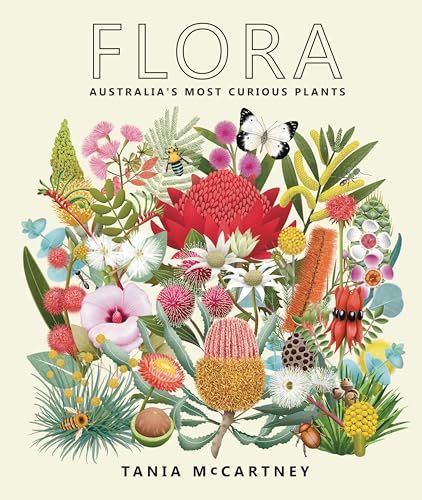
  • Tania McCartney, Flora, (NLA Publishing): HIGHLY COMMENDED
  • Maura Pierlot and Jorge Garcia Redondo (ill.), Alphabetter (Affirm Kids)
  • Stephanie Owen Reeder and Cher Hart (ill.), Sensational Australian animals (CSIROPublishing): HIGHLY COMMENDED
  • Sarah Watts and Aleksandra Szmidt (ill.), Marvellous Miles (Little Steps Publishing)
  • Rhiân Williams, Heather Potter, and Mark Jackson (ill.) One little dung beetle, (WildDog Books)

Shortlist, Older readers:

  • Sandra Bennett, Tracks in the Mist: the Adamson Adventures 4
  • David Conley, That book about life before dinosaurs
  • Jackie French, Tigg and the Bandicoot Bushranger (HarperCollins Australia): WINNER (Middle Grade)
  • James Knight, Spirit of the warriors
  • Gary Lonesborough, I’m not really here (Allen & Unwin)
  • Gabrielle Tozer, The unexpected mess of it all (HarperCollins Australia): WINNER (YA fiction)

Fiction

  • Jackie French, The sea captain’s wife (HarperCollins Australia): HIGHLY COMMENDED
  • Emma Grey, Pictures of you (Penguin Books Australia)
  • Julie Janson, Compassion (Magabala Books): WINNER
  • Inga Simpson, The thinning (Hachette Australia)

Other awards

Other awards were made during the evening, most of them in the first half of the evening, before the above-listed book awards. These other awards are mostly administered by Marion but are made in partnership with other trusts or organisations.

Anne Edgeworth Emerging Writers Award

Provided annually by the Anne Edgeworth Trust, this award is for emerging writers. This year’s was shared between three writers – Elisa Cristallo, Matthew Crowe, Deborah Huff-Horwood. It provides some funding to help recipients progress their work, through, for example, a mentorship, a writer’s retreat, or the services of an editor.

June Shenfield National Poetry Award

This is the only national award made by Marion. It was established in memory of the poet June Shenfield, and “aims to encourage the writing, publishing, and reading of poetry, specifically among emerging Australian poets”.

  • Michael Cunliffe , “Chrome [Ampeybegan Part II]” (QLD)
  • Krystle Herdy, “a metabolism of self” by (VIC): WINNER
  • Hugh Leitwell, “Synemon selene (Victorian form)”: (VIC)
  • Hannah McCann, “Funambulist” (VIC)
  • Josephine Shevchenko, “Building” (ACT): 3rd PLACE
  • Josephine Shevchenko, “Advice” (ACT)
  • Elizabeth Walton, “This is a recipe” (NSW): 2nd PLACE

Finding Beauty Poetry Prize

This new prize for emerging poets was established in memory of Roger Green. An environmental advocate, writer and editor, lover of poetry, and thinker, he believed that beauty had the power to alleviate fear and hardship, and to provide hope and inspiration. The theme this year was “Finding Beauty in Nature”. The winner received $5000, and the runner-up $2000.

  • Alisha Brown, “As a matter of great importance”: WINNER
  • Cate Furey, “Rosalie”: HIGHLY COMMENDED
  • Annie O’Connell, “;
  • Sara Pronger, “Still Green”

Canberra Airport Recognition Award for Literacy Inclusion

This new award (worth $2000) is sponsored by the Canberra Airport and “celebrates individuals, organisations, or initiatives that have made a significant contribution to advancing literacy and inclusion in the ACT region”. It is open to educators, writers, community leaders, publishers, librarians, or grassroots programs whose work demonstrates a deep commitment to inclusive literacy and social impact.

The inaugural winner – a popular one – was Danny Corvini who is behind the new-ish (it is now up to its 8th edition) queer magazine, Stun. You can read more about the magazine, its makers and their work at Stun‘s website.

The Marion Halligan Award

The Marion Halligan Award honours the life and work of the late Marion Halligan, and aims to recognise “works that demonstrate uniqueness, literary excellence, and/or surpass genre boundaries”.

This year’s award was announced by Marion’s young grandson, Edgar, and it went to Tania McCartney for her book Flora: Australia’s most unusual plants. She was clearly surprised and deeply moved by receiving this award in the name of Canberra’s beloved Marion! Tania has a large body of gorgeous work for children behind her and well-deserves this award.

Lifetime Membership Awards

These awards were made to our local heroes who have made longterm contributions to and support for writing and literary culture in the ACT. Recipients were the authors, Nigel Featherstone (my posts) and Irma Gold (my posts), and booksellers/book industry people (plus retiring Marion board members), Katarina Pearson and Deb Stevens (who is also in my reading group. Go Deb).

Canberra (the ACT) is a small jurisdiction, but, as I wrote last year, it has an active, engaged and warm literary community, encompassing writers across all forms and genres, of course, but also publishers, booksellers, sponsors, arts administrators, academics, journalists, and more. All were well in evidence despite the chilly july evening. We were also treated during the evening to a reading of the winning Finding Beauty poem by the poet Alisha Brown, a short performance by local slam poet Andrew Cox, and a video greeting complete with entertaining poem from the travelling-Craig Cormick (my posts) who was one of the originators of Marion 30 years ago.

Another joyful evening spent amongst people who love our literary culture.

Stella Prize 2025 Winner announced

The 2025 Stella Prize winner was announced tonight at a special event at the Sydney Writers’ Festival, and the winner is …

Michelle de Kretser’s Theory & practice

How happy am I that a book I reviewed only last week won the award! It is a provocative and thoroughly engrossing book in all the ways. I don’t feel I did full justice to it, but I did love thinking about what she was doing. It’s playfully mind-bending, but is also very serious about the art of the novel, what it can be, and what it can say. I can’t of course say whether I would have chosen it, as I’ve only read two of the shortlisted books. However, it is a wonderful book, and, when it comes to acceptance speeches, de Kretser is up there with the best. (You can see it at the Stella site) She was compassionate and eloquent. She made a beautiful but pointed statement commemorating two groups of women: the Stella founders who rejected business as usual in the literary world, and the women and girls of Gaza who are suffering under the business-as-usual actions of Israel’s genocide in Gaza.

She also said:

“I’m still afraid. But I’ve just accepted a prize that is not about obedience. It’s not about feel-good narratives, it’s not about marketing, it’s not even about creativity – Stella is about changing the world.”

Michelle de Kretser on a screen

It was pure class.

The announcement was made at a special event at the Sydney Writers’ Festival. It involved: an introduction by Fiona Sweet, Stella’s CEO; a discussion between three of the judges (Astrid Edwards, Leah-Jing McIntosh and Rick Morton) about the shortlisted books; the awarding of the prize; Michelle de Kretser’s recorded acceptance speech (see here); and a conversation between her (in Sussex) and Rick Morton.

Just to remind you, the short list was:

  • Jumaana Abdu, Translations (fiction, kimbofo’s review)
  • Melanie Cheng, The burrow (fiction, my review)
  • Santilla Chingaipe, Black convicts: How slavery shaped Australia (non-fiction/history)
  • Michelle de Kretser, Theory & practice (fiction, my review)
  • Amy McQuire, Black witness: The power of Indigenous media (non-fiction/essays)
  • Samah Sabawi, Cactus pear for my beloved: A family story from Gaza (memoir/non-fiction)

And the judges were Gudanji/Wakaja woman, educator and author Debra Dank; teacher, interviewer/podcaster, and critic Astrid Edwards; writer and photographer Leah-Jing McIntosh; Sudanese–Australian media presenter and writer, Yassmin Abdel-Magied; and journalist and author with a special focus on social policy, Rick Morton. Astrid Edwards was the chair of the panel.

I have now read nine of the 13 winners: Carrie Tiffany’s Mateship with birds (2013, my review), Clare Wright’s The forgotten rebels of Eureka (2014, my review), Emily Bitto’s The strays (2015, my review), Charlotte Wood’s The natural way of things (2016, my review), Heather Rose’s The museum of modern love (2017, my review), Alexis Wright’s Tracker (2018), Vicki Laveau-Harvie’s The erratics (2019, my review), Jess Hill’s See what you made me do (2020, my review), Evie Wyld’s Bass Rock (2021), Evelyn Araluen’s Dropbear (2022, my review), Sarah Holland-Batt’s The jaguar (2023), Alexis Wright’s Praiseworthy (2024), and Michelle de Kretser’s Theory & practice (2025, my review).

Thoughts anyone?

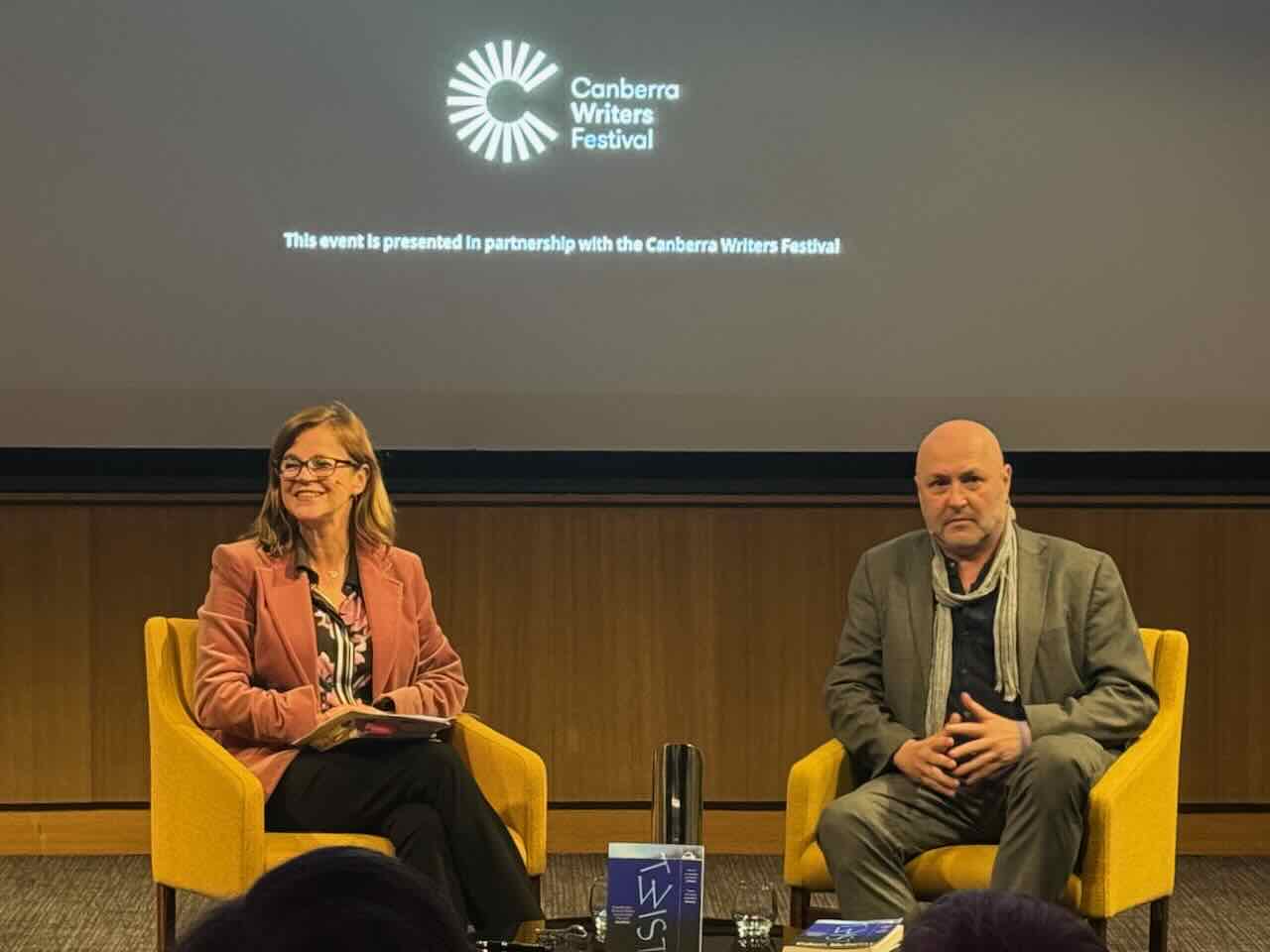
Author Talk: Twist with Colum McCann

Like the recent Canberra Writers Festival author talk we attended with Helen Garner, last night’s event featuring Irish-born writer Colum McCann was a full-house. I have been wanting to read McCann for some time, but I hadn’t realised just how big a following he has.

The evening opened with a welcome and acknowledgement of country from Marie-Louise Ayres, Director-General of the National Library, who then introduced the participants:

  • Colum McCann: multi-award winning author of eight novels, three short story collections, and two works of non-fiction, and President and co-founder of the non-profit global story exchange organisation, Narrative 4.
  • Nicole Abadee: writer, editor, podcaster, literary awards judge, and facilitator at writers’ festivals and other literary events.

The conversation

This was a conversation which went to the heart of how I perceive the world (if that doesn’t sound too grandiose), a way that is both optimistic but realistic, that simultaneously encompasses opposing truths. It also interested Mr Gums whose professional training was in telecommunications engineering. Interested? Then read on …

Nicole started by fleshing out Marie-Louise’s introduction of Colum. Yes, he was born in Dublin, but he has lived in New York City for over 20 years. She named two of his books that particularly interested her – Let the great world spin, which draws from Philippe Petit’s 1974 tightrope walk across the Twin Towers, and Apeirogon, which was inspired by the real-life friendship between Israeli Rami Elhanan, whose daughter was killed in a Hamas suicide bomb attack, and Palestinian Bassam Aramin, whose daughter was shot by an Israeli border guard. (This reminded me of Izzeldin Abuelaish’s memoir I shall not hate.) She described his newest novel, Twist, as “enigmatic and urgent”.

On storytelling

Nicole then added one more bit to Colum’s biography, the fact that in 1986, when he was 21, he cycled across the US from east to west, which is where, he has said, he learnt to listen. I have to add here that only a few years earlier, in 1982, my brother rode his bike across the US, but from west to east. Anyhow, Nicole used this additional piece of biography to lead into her first question: was this where he first learnt the value of storytelling?

Maybe, replied Colum, but it could have been at school, when he was 8. He praised teachers (and librarians) for being, with their promotion of books and reading, at the “frontline of democracy”. Also, his father was a journalist who encouraged writing and writers, including women writers like Edna O’Brien. (He told some delightful stories about his dad.)

But yes, the cycle ride was part of it. People would give him their story, and expect him to pass those stories on. This point led to a discussion of Narrative 4, and its Story Exchange Program, which he describes as “an act of radical empathy”. Its foundational concept is

“To step into the shoes of others in order to be able to step back into our own“.

It involves pairing two very different people, who share their own stories with each other, and then retell the other’s story as if it were their own. When kids do this, they are initially terrified of each other, but soon discover how similar they are, and “the barriers come tumbling down”. He asked the audience to try it then and there, and the buzz in the theatre was exhilarating.

On what Twist is about

The plot centres on the repair and sabotage of underwater cables. His inspiration was a story he read during COVID about the Léon Thévenin, a cable repair ship going out to fix Africa’s broken internet. A ship, he thought, isn’t the internet out there in the air? This inspired him to learn how the internet works. Everything we know is in those submarine cables/tubes but they are going to places we don’t know. He saw this story as a metaphor for, among other things, the idea that everything is both connected and disconnected.

These cables/tubes, which are owned by Google, Meta, Apple, etc, can be seen as digital colonialism. The tubes carry the data as light, which is both magical and biblical but also terrifying. More paradox.

From the reality perspective, these tubes are very easily damaged, and security (obvious to anyone’s eye) is “unbelievably slack”. It has, in fact, been suggested that the next major war will start under water. (Mr Gums whispered to me that China has announced that it has a cable-cutting ship.) Colum talked a little more about the very real risks and dangers involved here. We are talking about government – hospitals, education, and so on – about our lives which are tied to information and disinformation. This can be hard to write about, but he found it easy to write about in a novel. He used the tone of The Great Gatsby, and also referenced Heart of darkness. Twist has many illusions and allusions!

Colum then read p. 49 at Nicole’s request … a beautiful, rhythmic passage that sets the scene.

On Twist’s characters

Nicole suggested that the characters are also broken and need to be repaired. (All part of the metaphor.) Colum clarified straight off that his protagonist, Andrew Fennell, is not he. Fennell is a journalist in his mid-40s, and a failed novelist who thinks this story will be easy and may solve “his own ruptured cable”. He meets the boat’s Chief of Mission, John Conway (an allusion to Conrad, and with initials that carry other allusions!) They are all men, and are all at sea – literally and figuratively.

Somehow, Colum managed, throughout the conversation, to slip almost seamlessly between light and dark, without dragging us down. He believes we live “in fairly shattered times”, but admits we could point to many “end-times”: the pandemic (which is when he wrote this 2019-set novel), 9/11 (he was living in New York at the time), post WW2 and the fear of nuclear war, and more. BUT he sees now as different because it’s all moving so quickly we can’t easily repair it. He identified climate and global migration as two big issues.

However, he’s an optimist, so he believes repair is possible. He pointed to what Greta Thunberg achieved by standing up. She has done magical things, but it’s not enough. We need more voices like hers.

On The Great Gatsby parallels

Nicole was keen to explore the parallels with The Great Gatsby, but although that novel frames this one, Colum didn’t want to focus on that. He sees Heart of darkness as the more obvious literary parallel. The tubes, he says, follow old colonial routes, and suggest corporate or digital colonialism.

He then talked about writers and readers. The big secret about writers is that “we don’t know what we are doing”. Books are never completed until they are in the hands of readers who tell back what a book is about. As for whether his book contains truths, truth, he said, is the music in the background.

Returning to the overall connection-disconnection metaphor, he said we have never been more connected yet so alone. This is particularly acute for young people. The machine is not the problem, but our relationship to the machine. And here came the paradoxes again. Technology is also good. How do we hold these contradictory ideas. He alluded to Dickens – it’s the best of times and the worst of times (and can be “incredibly crushing”). How do we support our young people? Through education, books, parents.

These are big problems, but not insurmountable. This is where storytelling comes in, as used at Narrative 4. We are in real danger of losing books but we still have stories.

On writing and politics, as activism, as disruption

Colum recognises that writing doesn’t have to be political, but for him it is. It’s about disrupting conventional thinking. When asked what he wanted to disrupt with this book, he responded, “I don’t know”, and added that this was a “good answer”. He wished more people would say they don’t know.

This led to the idea of the “ethical imagination”, which includes being conscious about intruding on others’ stories. Cultural appropriation is completely valid, but you enter another’s story or domain “with head bowed” and come out again to do justice to the story. There’s cultural appropriation and cultural celebration: two opposing truths. How do we live with the messiness between two endpoints, which in themselves are absolutes and problematic. He was saying, as I understand it, that life/truth/ethics lie in managing the messiness between the endpoints. This thinking – this way of understanding our lives – greatly appeals to me.

Q & A

On Nabokov’s statement that “imagination is the purest form of insubordination”:

Colum liked this idea. Messy is where decency is, but America is not recognising the messiness. “Multitudinous is good”, but currently in the USA there’s denial that you can be (embrace) multitudes. Art needs to say life is complicated.

On whether fact and truth are the same thing: Colum illustrated this with a story about Apocalypse now, that he references in the novel. He described a scene from the film and behind-the-scenes of that scene. It demonstrated “two clear realities”. The filmed scene (the fictional reality, or invented scene) is what we all see and remember, while the real events that happened on set has got lost in the haze. This was a more sophisticated answer than I would have given. I like its refusal to be simple. He added that “facts are mercenary things”, things that are “used”, and don’t necessarily get to the truths.

Conclusion

Andra Putnis, the new Artistic Director of the Canberra Writers Festival, closed the session.

A big thanks to local author Karen Viggers for passing on her ticket to me when she realised she would be out of town – in Bhutan, in fact! I am so glad I attended this conversation.

Author Talk: Twist with Colum McCann
With Nicole Abadee
National Library of Australia, in partnership with the Canberra Writers Festival
Friday 9 May 2025

Irma Gold in conversation with Karen Viggers

The Canberra launch of Irma Gold’s latest book, her second novel Shift (my review), was a joyful affair that reminded me of other launches of books by Canberra writers, such as Karen Viggers’ Sidelines and Nigel Featherstone’s My heart is a little wild thing. Canberra is a comparatively small jurisdiction so when one of our own launches a book, local authors, booksellers, publishers, editors, critics, reviewers and readers turn out to cheer them on. Such was the case tonight when Irma Gold came to town to launch Shift. She now lives in Naarm/Melbourne, but was active in the Canberra literary community for over a decade.

Both Irma Gold and Karen Viggers have appeared many times in my blog, so I won’t introduce them again, but I will remind you that they now jointly produce the Secrets from the Green Room podcast. They are clearly simpatico, and the conversation, as a result, flowed easily while still covering meaningful ground.

The conversation

Karen commenced with an acknowledgement of country and a rundown of Irma’s many achievements, and then led into the conversation with a cheeky question …

Had the several outstanding reviews she’d received in the first month after publication gone to her head? It has been a dream response, admitted Irma, but what means most to her are the supportive messages she’s received from her friends in Soweto.

Karen then briefly summarised the book. It’s about portrait photographer Arlie who goes to Kliptown, in Soweto, partly because his South African mother refuses to talk about it. The sensitive and somewhat lost Arlie needs to know more, to understand his mother, and, he’d like to prove himself to his father. Karen said she found the ending deeply moving.

Why South Africa? Irma’s father was born there, so she’s always been interested. This was further sparked in her teens when she read Biko, resulting in her reading more about freedom fighters and South Africa more widely. She didn’t get to South Africa until her 40s, when she went with her youngest brother. Through a chance meeting, they were introduced to Kliptown, a community with no electricity, school or sewerage, among other things. A seed was sown then. She visited again, with another brother (a trip which I followed through Irma’s Instagram account. It was fascinating, if I can use such a shallow-sounding word for such a poorly supported community.) Karen then asked how dangerous it was. Irma felt safer in Kliptown, despite its reputation for violence, than in other parts of South Africa, mainly because she and her brother were working in and for the community.

On the haves vs have-nots. Karen spoke of how well Irma had illustrated the gap between the haves and have-nots; how she’d shown Arlie displaying his privilege without always being aware of it, while other times he’d catch, and be embarrassed by, his stumbles in this regard. Irma shared an anecdote about giving money to someone who had been their guide, and the difference it had made for him. She felt guilty all the time. As she was writing the novel she reflected constantly on how, by virtue of birth, she lives here in privilege and they live there.

On creating a great sense of place. Irma kept notebooks, and took lots of phots and videos. Watching the videos would take her right back there, and she’d remember more including things she hadn’t written down. People didn’t mind her taking photos. In fact they loved it, but she was working with the community.

On the characters and their names. Irma has no idea where Arlie came from. He was in her head when she made her first trip to South Africa. Also, she didn’t specifically choose photography for him but in retrospect, she realises it’s the perfect choice, because photography is all about different ways of seeing things. She’s always loved photography, but she did have expert advice from a photographer in the Canberra writing community. Jigs, Arlie’s brother’s fiancee, also just came to her, but the spark for Glory came from seeing a gorgeous young woman in a local gospel group. As for her African characters’ lively names, many of the Africans she met know what their names mean, why they were given their names. Being an “over-sharer” herself, she loves their openness and willingness to tell their stories.

On Mandela. Irma was shocked to find that Mandela was not the hero in young Africans’ eyes as he was in hers. They feel they’ve been sold a “broken dream”, that things have not improved as they were promised. Bob Nameng of SKY (Soweto Kliptown Youth) kept telling her that she had to write about the situation because no one is listening, nothing changes. This is not to say that Kliptown is all tragedy. There is also a lot of joy. She saw so much art and music in the community, and an overall “lust for life”.

On relationships. Karen was particularly interested in what Irma was trying to show in Arlie’s difficult relationship with his father. Irma said that Arlie judges his father harshly, but Glory suggests to him other ways of looking at the situation. Forgiveness and openness are important in relationships.

What is she asking of her readers? Irma liked the idea that she was “making the invisible visible”. She grew up in a family that had strong feelings about injustice. Ultimately, the book is about people. They are the most important thing to her. Kliptown is its people. She also likes Charlotte Wood’s idea of following “wherever the heat is”.

Q & A

On the title: It was a complicated process. Her original title was either disliked or deemed forgettable. In the end she produced a list, from which the publisher made a selection, and she chose one of those! She now likes her title.

On being published in South Africa. Currently only Australia-New Zealand rights have been sold. It’s difficult getting books into other jurisdictions.

Karen concluded by asking whether there was a “drive for change” in the novel. Although Irma had said that people and relationships are her over-riding interest, she admitted that change is also part of what it is about. Yes! I remember that Irma also said her first novel The breaking was primarily about the relationships. However, it too is about an issue – elephant tourism – that she would like to see changed. The way I see it is that her novels are inspired by justice-related issues that she would like to see changed, but that relationships are what fascinate her. In truth, you probably can’t solve big issues without having good relationships. Combining a passion for driving change and for good relationships between people makes, I’d argue, for good reading.

Thanks

The evening concluded with Irma thanking many in the Canberra community who had helped her, including of course Karen Viggers, but also John Clanchy who had read many drafts and whose honest feedback was instrumental in the book’s coming into being, Dylan Jones for being her photography consultant, the wonderfully supportive Canberra writing community, ArtsACT for helping her with some funding (again), and the Street Theatre for hosting the event.

Irma Gold – Shift: Book Launch
The Street Theatre, Canberra
9 April 2025

Stella Prize 2025 Longlist announced

Last year the Stella Prize longlist announcement took place on a Monday, gazumping that week’s Monday Musings. This year it’s a Tuesday, and it was again streamed online from the Adelaide Festival Writers Week …

As I say every year, I don’t do well at having read the Stella Prize longlist at the time of its announcement. In recent years the most I’ve read has been two (in 2019). Last year I’d read none at the time, but have read one since. This year, I have read one of the longlist (see below). I have read 8 of the 12 winners to date, which means I am falling behind! It’s not that I necessarily disagree with the winners, but just that my reading has been leading me in other directions.

In Stella’s spirit of keeping their judging panels fresh, none of this year’s judges were on last year’s panel, though some have judged before. This year’s panel comprises Gudanji/Wakaja woman, educator and author Debra Dank; teacher, interviewer/podcaster, and critic Astrid Edwards; writer and photographer Leah-Jing McIntosh; Sudanese–Australian media presenter and writer, Yassmin Abdel-Magied; and journalist and author with a special focus on social policy, Rick Morton. Astrid Edwards was the chair of the panel, and made the announcement.

The longlist

Here is the list, in alphabetical order by author, which is also how they were presented:

  • Jumaana Abdu, Translations (novel)
  • Manisha Anjali, Naag Mountain (poetry)
  • Melanie Cheng, Burrow (novel, my review)
  • Mantilla Chingaipe, Black convicts: How slavery shaped Australia (nonfiction)
  • Michelle de Kretser, Theory and practice (novel, on my TBR, kimbofo’s review)
  • Dylin Hardcastle, A language of limbs (novel)
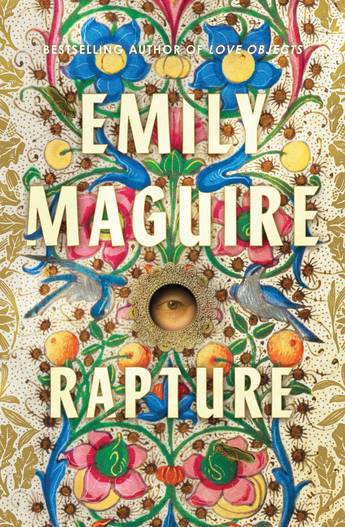
  • Emily Maguire, Rapture (novel, my CWF Sessions 2 and 3)
  • Amy McQuire, Black witness: The power of Indigenous media: A family story from Gaza (nonfiction)
  • Samah Sabawi , Cactus pear for my beloved (nonfiction)
  • Mykaela Saunders, Always will be (short stories)
  • Inga Simpson, The thinning (novel) (Brona’s review)
  • Cher Tan, Peripatetic: Notes on (un)belonging (nonfiction)

So, seven fiction (including one short story collection), four nonfiction and one poetry collection, this year. You can read about the longlist, including comments by the judges at the Stella website.

Prior to the announcement, I pre-loaded this post with 15 potential longlistees, as a little test to myself on how many I might identify of the 12. I picked only three, partly because I hadn’t heard of some of the books the judges listed and partly because I didn’t know a lot about many of the others.

As always, I am not going to question the selection. The Stella is a diverse prize that aims to encompass a wide range of forms and styles, including some I don’t necessarily chase, and I haven’t read widely enough from 2024’s output, anyhow. But I have read one here, and gave a couple of the others to family members at Christmas. One was Rapture and it was loved. I’m keen to read the novels and the short story collection, in particular.

Last year there was an interesting panel discussion between the judges, but I don’t know whether there was one of not this year, because the YouTube link dropped out just as Astrid Edwards was finishing the list. Darn it.

Each of the longlisted authors receives $1000 in prize money, donated by the Copyright Agency’s Cultural Fund. The winer will receive $60,000. There were over 180 submissions this year.

“Literary prizes are subjective beasts, but I assure you, the works on this year’s longlist are remarkable.” Astrid Edwards

The shortlist will be announced on 8 April, and the winner on 23 May. You can seen more details on the Stella 2024 page.

Any comments?

Author Talk: The season with Helen Garner

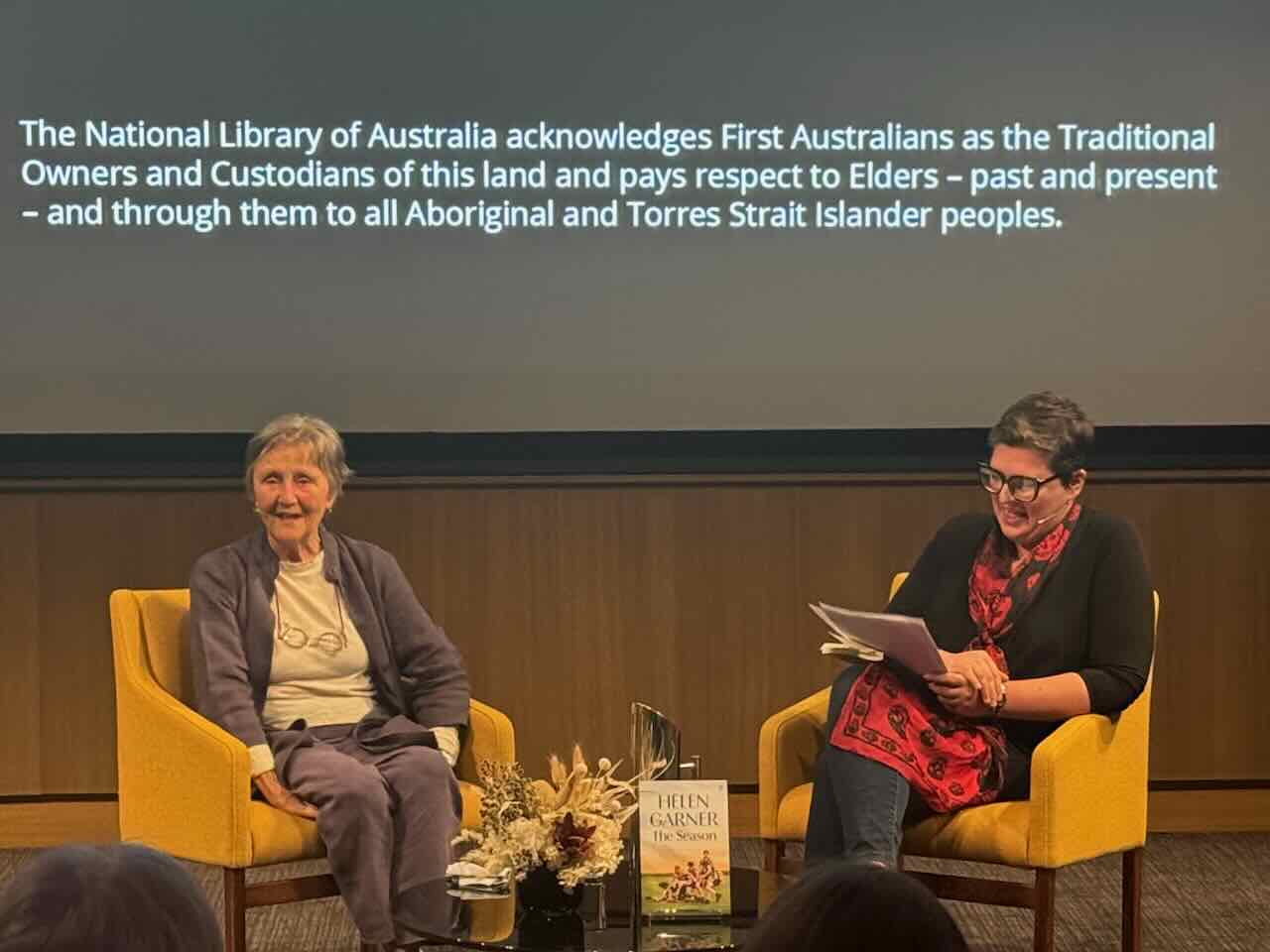
It is a measure of the love and respect readers have for Helen Garner that this event, held in the National Library of Australia’s 300-seat theatre, had a 200-strong waiting list. And, it was well worth booking early for.

The evening was emceed by Luke Hickey, the National Library’s Assistant Director-General Engagement. He started with a welcome, acknowledgement of country and an introduction of the participants, who were:

  • Helen Garner (my posts): multi-award winning author of novels, stories, screenplays and works of non-fiction.
  • Beejay Silcox: writer, literary critic and about-to-retire Artistic Director of Canberra Writers Festival.

The conversation

This was a joyful but engaged conversation that flowed easily, while gently getting to the nub of some great ideas.

Beejay started by reminding us that “Canberra” means “meeting place” and that for millennia people have met here to “talk about things that matter”. She then tried to define what Helen Garner means to us. She is a writer who destablises and discomforts us, who energises us, who provokes us but not for provocation’s sake. She’s a writer who doubts, is uncertain, and who, because of this, brings us along with her.

On writing The season

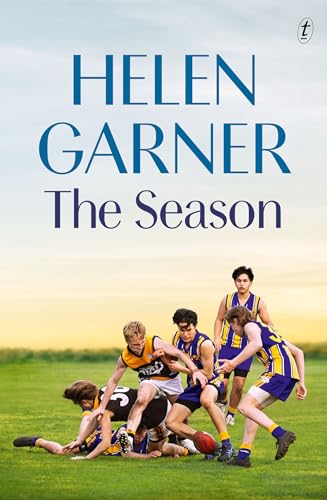
Beejay called The season a graceful book, a love letter from a grandmother to boys and men. Some see it as very different from her previous work, but Beejay was not so sure. What did Garner think?

Garner said this was the most fun writing she had done. It was an “extraordinary experience” and came at a time when she felt burnt out. Preparing her three diaries had involved many “squirmy 2ams”. She also saw it as her last chance to get close to a grandchild.

Contrary to her normal practice, which is not to ask permission, Garner had asked her grandson and his coach whether it would be ok for her to attend training sessions with a view to writing about the experience.

Beejay commented on Garner’s reference in the book to being an invisible older woman. Was it a superpower or curse. Oh, superpower, said Garner! She didn’t want to interview the players, just observe.

Garner didn’t know anything about teams, so she’d sit back, an invisible figure in her straw hat and overalls, and watch. The boys were, generally, oblivious of her presence, and had no sense of this being rude. She was fascinated by their behaviour versus that of girls, with which she is more familiar. They would dump their stuff any which way – bags, bikes, phones – and keep on walking to wherever they were going. Girls, by comparison, place their bikes, say, neatly against a tree. Women scan the territory, whereas these boys had tunnel vision, a “tremendous ability to concentrate” or focus.

She observed that during training the coach would exhort the boys to widen their field of vision. It was “thrilling to watch”. Garner conveyed such joy about watching the young men. I remember feeling the same about watching my son’s cricket team. Those boys were so enthusiastic, so sure, after getting out for a duck, that they’d hit that six next time. Their confidence was infectious.

On football, and writing about it

Garner admitted to being a Western Bulldogs fan, and talked about her love of footy. She “can’t stand it when it’s not footy season”, which drew some perhaps surprised but warm-hearted laughter from the audience.

Beejay spoke of Garner’s “narrative love of the game”, of her anchoring her writing about it in terms of writers like Blake, and Homeric epics, of her referencing “elemental” ideas like mercy, triumph, vengeance.

Garner talked about her introduction to the sport – her origin story as Beejay framed it – via the 1997 documentary Year of the dogs. It was a time of great change in the sport, and she was moved by the decisions made by some players to not chase the money.

While she knows the rules and understands the play, she will “never” understand the game, but doesn’t care. She didn’t want to take a position on football. Some expected her, for example, to take a feminist position, and explore the brutal aspects, but she wanted to glorify.

Beejay asked how hard it was to not write what people expected. Garner didn’t know how to write a polemical book about football. In fact, she struggled to turn her experience into a book. She started writing it in the past, but that gave it an historical feel. As soon as she changed to present tense, she knew she had her story.

Beejay asked her to read the opening two paragraphs:

I pull up at the kerb. I love this park they train in. I must have walked the figure-of-eight round its ovals hundreds of times, at dawn, in winter and summer, to throw the ball for Dozer, our red heeler-but he’s buried now, in the backyard, under the crepe myrtle near the chook pen.

The boy jumps out with his footy and trots away, bouncing. it. Boy? Look at him. He’s been playing with our suburban club since he was a tubby little eight-year-old; I have never paid more than token attention to his sporting life. But this year he’s in the Under-16s. The shoulders on him! He must be almost six feet tall. He’s the youngest of my three grand-children. The last, and there will be no more.

Beejay described this as a masterclass in writing. Everything is in these two paragraphs – relationships, rhythm of life, her sense of place, death.

Garner said, simply (modestly, some of us would say):

“What I’m good at is saying what happens”.

On Garner, the writer and grandmother

Garner loves being a grandmother, and got more laughs when she admitted that after three marriages she was no good at being married, but had found a place to be in the world. She sees the role of a grandmother as being “a servant”, that is, as serving the family, helping the family grow, being the backstop.

Beejay returned to her introduction of Garner as self-effacing, as a writer who doubts. In this book, she describes herself as “a bore”. Is this questioning of herself a whim, and what is the gap between the book she imagines and the one she creates.

Garner never has an idea of what her book is to be. She writes sentence by sentence. She talked about being “a small piece of shit”. While one husband told her he didn’t feel that way, she thinks most of us feel small, at least sometimes. They are valuable times; they balance “the insane moments of triumph”.

On values, lessons, manners

Garner loves football because the discipline of sport puts boundaries around the urge to fight. (She referenced the Iliad with its sense of enormous power). Garner and Beejay discussed a photo Garner loves of two footballers at a moment of defeat, with its Homeric sense of valour and duty, of intimacy, loss and pain. Garner sees these footballers as young, and perfect. She loves “noble postures of defeat” rather than Achilles-style roaring, bellowing triumph.

Garner thinks football can teach boys manners. There can be moral teaching, to not think of themselves and to trust each other .

Beejay also noted that The season is a love letter to volatile youth but is also about age. What did Garner mean by feeling envy. Was it of youth? Of boys doing things she couldn’t? Or related to the presentism of youth, and being unweighted by the past? A bit of all of this. Garner envies youth, its fearlessness. The discussion then turned to what happens to boys who are tender when young but are forced to harden when they get older. Garner hates “the clamp” that is put on emotion in boys.

For all the talk about youth envy, Garner also accepts her age. At 82, she is bothered that people try to deny her age, as in “you’re not old”!

Q & A

On boys and masculinity: a couple of questions/comments concerned this. One audience member thanked her for her “lovely writing” about boys compared to all the “toxic masculinity” talk that confronts them today. Garner hates that those two words – “toxic” and “masculinity” – are glued together, and that boys have to face it. Another questioner wondered how parents can help boys become the boys we’d like them to be. Garner shared an experience she had of Tim Winton calming his distraught 4-year-old by simply sitting with the child and repeatedly naming his feelings, “you’re so angry, you’re so sad”, rather than telling him to get over it, etc.

On Garner being a great observer of human emotions and whether she has questions in mind when she is observing. Nope! Garner just barges in! She’s no good at planning. People love it if you are interested in their work. She realises she is “completely un-bore-able”. (I can relate to this.) She quoted a French writer who said “ignorance and curiosity” form the basis of their writing.

On whether writing The season cured her feeling of burnout: Garner has signed a contract to deliver another book in December but “has nothing say”!

Conclusion

I loved this conversation, not only because Beejay asked perceptive, interesting questions and because Garner is – well, Garner – but also because Garner confirmed my own feelings about sport. It is life – it’s narrative, character, drama, emotion. It can play out so many of the big things we feel and experience.

Beejay clearly liked this too because she concluded the conversation on the idea that football is bigger than just the game. Was there one lesson we could take away from it. Garner’s response?

”Don’t turn your back on the play”!

And with that the session closed to enthusiastic and appreciative applause.

Author Talk: The season with Helen Garner
With Beejay Silcox
National Library of Australia, presented in partnership with the Canberra Writers Festival
Thursday 20 February 2025

Monday musings on Australian literature: Final thoughts on Canberra Writers Festival 2024

In 2019, I wrote a detailed wrap-up of that year’s Canberra Writers Festival, and I thought to do one this year, though I didn’t have the fascinating stats I had in 2019. However, with this year’s festival bumping up against November, which is a very busy month in the blogosphere, I’ve decided to scale down my plans and just share some ideas which caught my attention, mainly because they popped up more than once in the six sessions I attended.

Many of the ideas related to the ideas that drive the authors or that affects their writing lives.

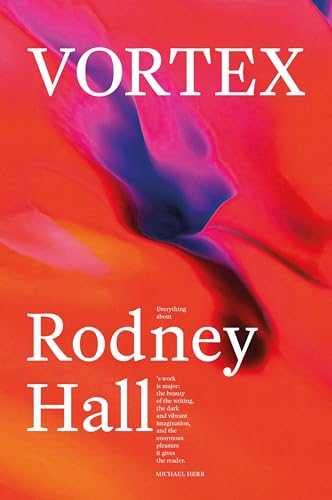
  • Who are the decisionmakers, how are things being decided: Rodney Hall and Catherine McKinnon, in slightly different ways, indicated that these questions drive much of what they write. Hall said “we don’t know when the things that affect our lives are hatched”, and that too often we react (and act) without asking “why” things have happened. Similarly, McKinnon is interested in understanding our governments and the decisions they make, in thinking about who we are trusting to make decisions. 
  • Writing about the self: While autofiction and writing about the self are a strong trend of modern writing, they don’t appeal to all writers. Not surprisingly, the self-described classicist Rodney Hall is one of these. He sees his classicism as being out of step with his peers, whom he admires but who are interested in more personalised expression, because people “want the dirt of what you are yourself”. Robbie Arnott was more forthright. He sees the modern focus on writing on the self as raising mundanity to art. (I can enjoy both – it’s all about degree!)
  • Writing to encourage feeling in readers: Robbie Arnott and Anita Heiss were both very clear about wanting to make people feel. Heiss wants readers to feel with her characters. She see this as the power of fiction. (In fact, she suggested this differentiated fiction from nonfiction, which I can’t agree with. I know I’m not the only one who has been powerfully moved by nonfiction. As a blog-reader wrote to me, what about Anne Frank’s diary, for a start?) Arnott was also vey clear about his goals in this regard. For him, the aim of fiction is not to render the world as it is but how it feels. He starts by looking for the emotion.
  • Historical fiction, and looking at what it is about NOW that the past can illuminate: Once upon a time I avoided historical fiction, but that time has long gone, because I’ve learnt that historical fiction can explore ideas that speak to me. Catherine McKinnon and Emily Maguire both talked about the relevance of historical fiction to now. First, there’s the issue of retrieving history that has been lost (the role played by women, for example, or queer lives), because it didn’t meet the prevailing (often patriarchal) mindset. But McKinnon also talked about how you look for the story you want to tell now – at what it is about now that you want to speak to, at what it is about humans that is interesting to us now. So, the 2005 Oppenheimer-biography, American Prometheus was, she felt, about how people could be picked up and then dropped, but she was interested in decisionmaking (and how it can be petty).
  • On living in our loud, noisy, controlling, egotistical world: Charlotte Wood and Robbie Arnott both referred to this (but would have covered it more in the session I couldn’t attend due to a clash, The power of quiet): Wood said she understands the appeal of asceticism in our “you-can-have-everything world”, bur recognises that the idea of “obedience” (versus wanting to argue) is a challenge for the ego in our egotistical world. Arnott’s quietness is based in his focus on landscape and nature. Both, at least as I heard them, see value in withdrawing (at least for a while) from the noise that can get in the way of being.

Some ideas, not surprisingly, related more to their craft.

  • The craft: What I heard was writers knowing (or learning) how much the craft of writing does the job they want, rather than focusing on plot or character, for example. A good structure, the right voice, sentences that do something – these are what makes writing come alive, what makes their stories work. Structure, for example, is fundamental to what Rodney Hall does. Arnott talked about crafting his books sentence-by-sentence. Maguire and Wood talked about “propulsion” in their narratives coming from the language, the sentences, the voice. “If the voice is strong”, said Wood, “the reader will follow along. It’s propulsive. That’s the key.”
  • Writing as a vocation, that is, as something you must do, kept coming through, and was specifically mentioned by Charlotte Wood, Emily Maguire, and Robbie Arnott. It’s their sacred place.

None of this is mind-shatteringly new, I suppose, but these ideas interested me for different reasons – usually related to the context in which they were explored, or the slant or angle they were given. I hope you find something of interest here.

So, does anything here speak to you?


Finlay Lloyd 20/40 Publishing Prize 2024 Winning Books Launch with Conversation

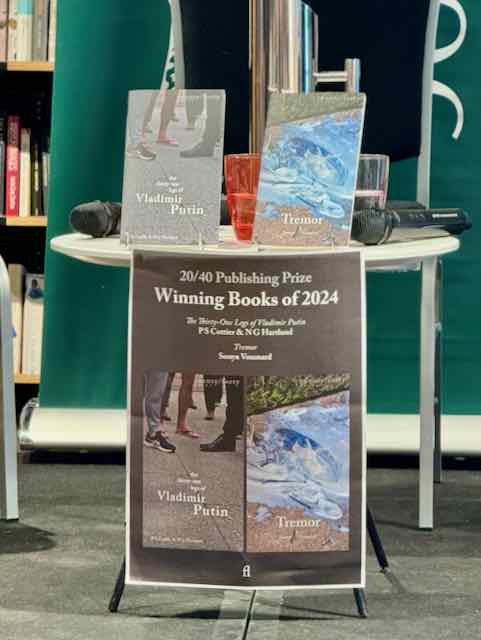
I mentioned the nonfiction winner of the 2024 Finlay Lloyd 20/40 Publishing Prize, in this week’s Monday Musings, but saved the full winner announcement until after I attended the launch at a conversation with the winning authors this weekend.

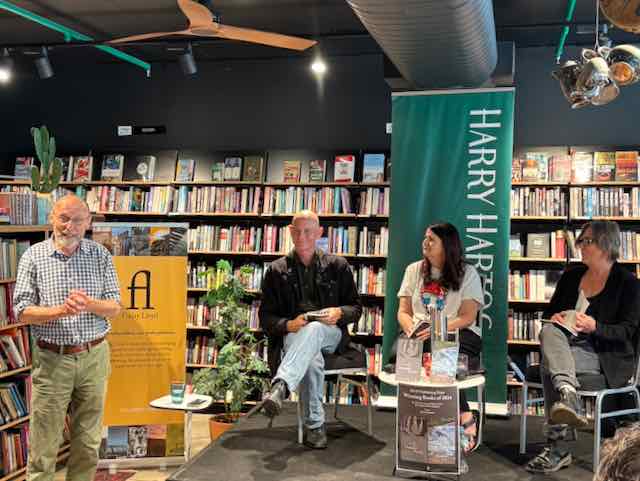
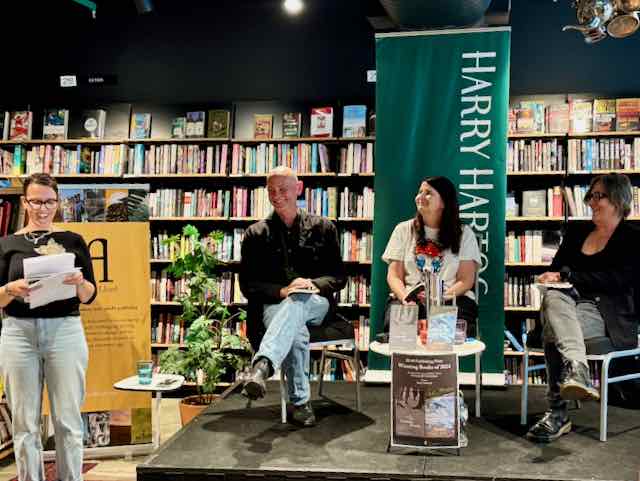
The participants

This year, as publisher Julian Davies had hoped, there was a prize for fiction and one for nonfiction. The winners were all present at the conversation, and were:

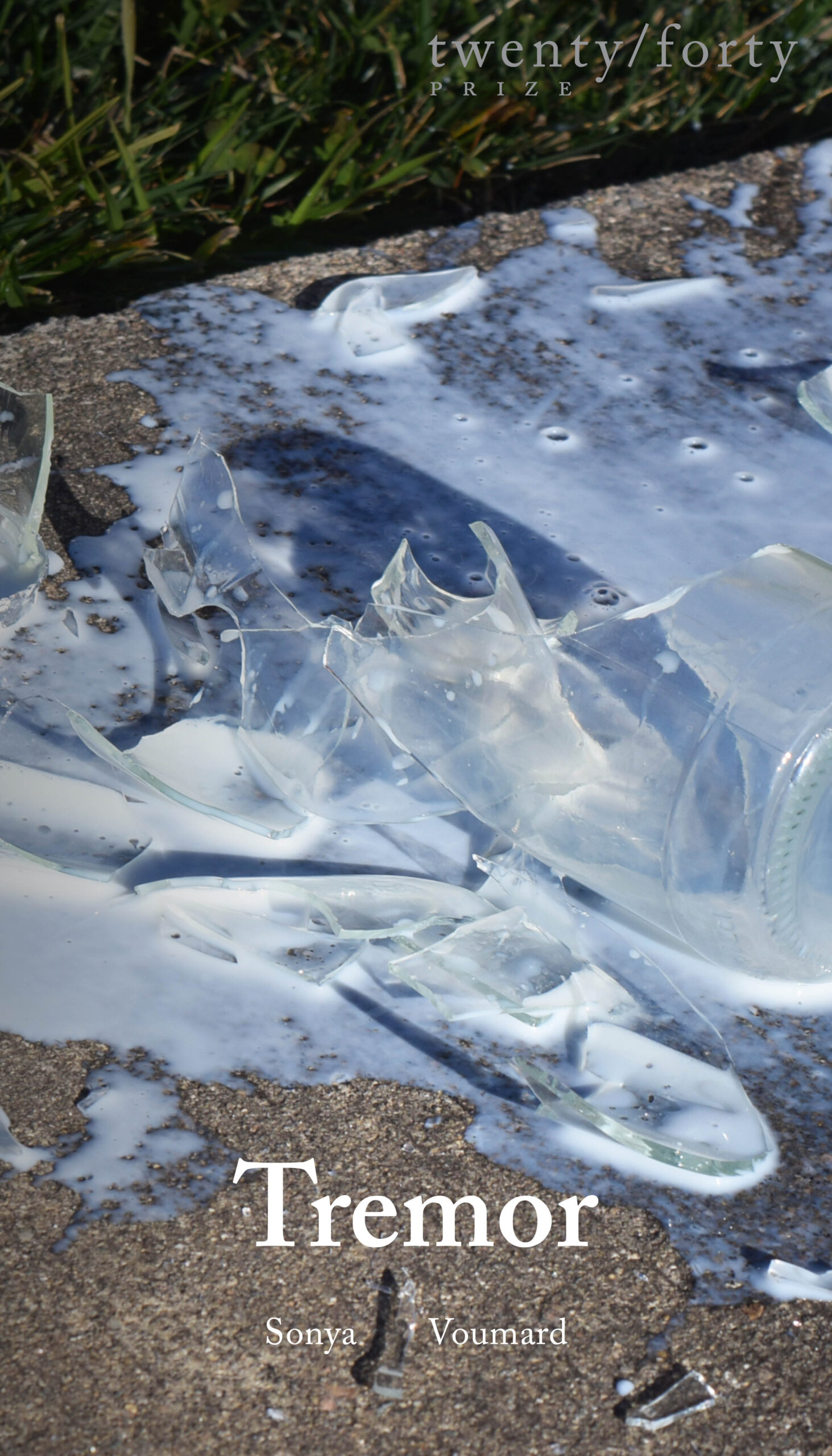
  • Sonya Voumard for Tremor, which the judges described as “notable for its compellingly astute interweaving of the author’s personal experience with our broader societal context where people with disabilities, often far more challenging than her own, try to adapt to the implicit expectations and judgements that surround them”.
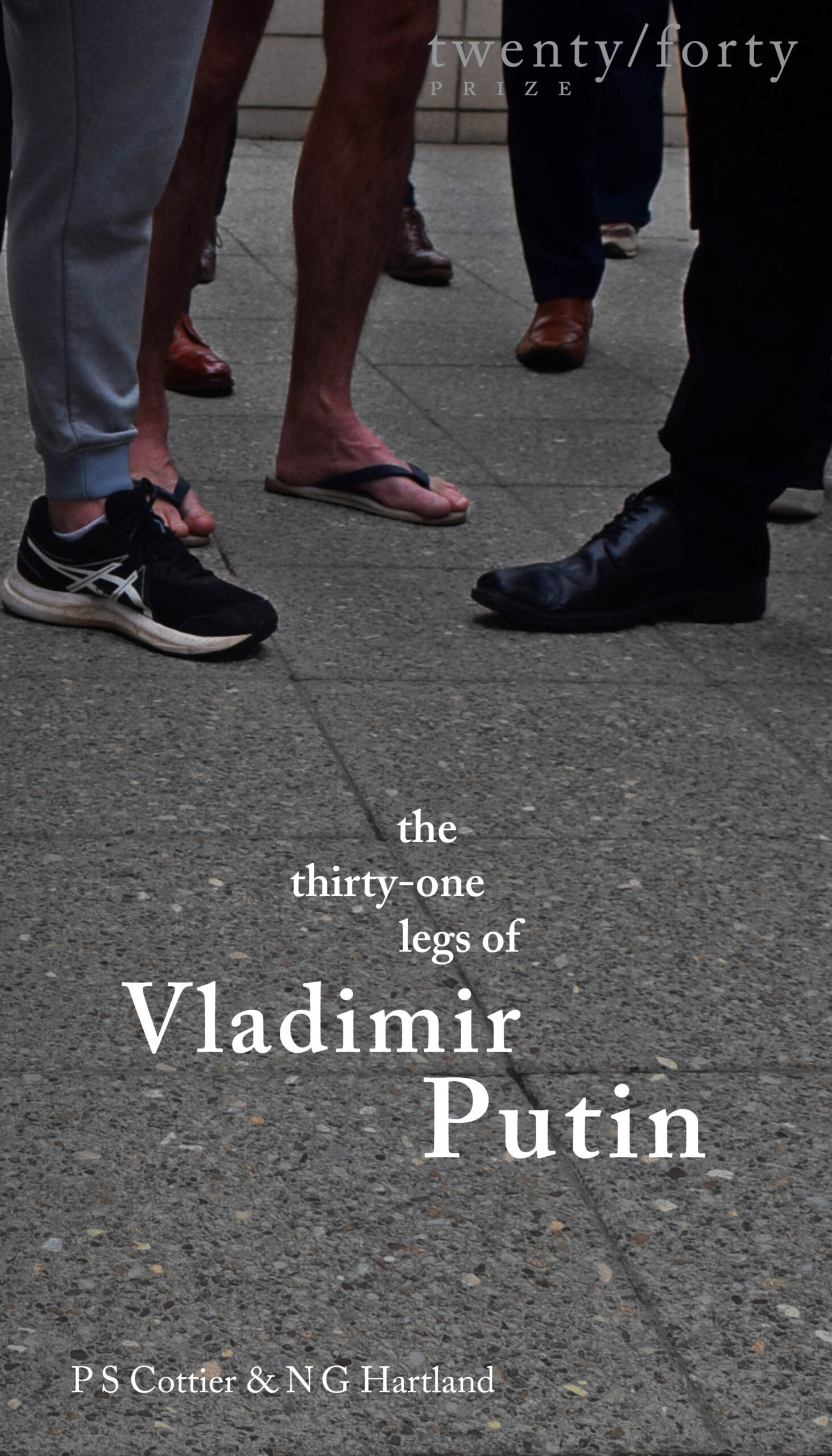
  • P S Cottier & N G Hartland for The thirty-one legs of Vladimir Putin, which the judges said “welcomes us to a world where absurdity and reality are increasingly indistinguishable and where questions of identity dominate public discourse. The book spirits us off on a playful journey into the lives of a group of individuals whose physical attributes appear to matter more than who they may be.”

The conversation was led by Sally Pryor who has been a reporter, arts and lifestyle editor, literary editor and features editor at The Canberra Times for many years. Born in Canberra, and the daughter of a newspaper cartoonist, she has a special connection to our city and its arts world.

And of course, the publisher, Julian Davies, started the proceedings. As I wrote in last year’s launch post, he is the inspiring publisher and editor behind Finlay Lloyd, a company he runs with great heart and grace (or so it seems to me from the outside.)

The conversation

Before the conversation started proper, Julian gave some background to the prize, and managed to say something different to what he said last year. He described Finlay Lloyd as a volunteer organisation, with wonderful support from writers like John Clanchy. He reminded us that they are an independent non-profit publisher, but wryly noted that describing themselves as non-profit seems like making virtue out of something that’s inevitable! Nonetheless, he wanted to make clear that they are not a commercial publisher and aim to be “off the treadmill”. And of course he spoke of loving “concision” and the way it can inspire real focus.

As last year, the entries – all manuscripts, as this is a publishing prize – were judged blind to ensure that just the writing is judged. The judging panel, as I wrote in my shortlist post, included last year’s winners.

Then, Sally took over … and, after acknowledging country, said how much, as a journalist, she also loved concision. Short books are her thing and they are having a moment. Just look, she said, at Jessica Au’s Cold enough for snow (my review) and Claire Keegan (see my post). Their books are “exquisite”. She then briefly introduced the two books and their authors. Sonya’s Tremor is a personal history told through vignettes, but which also explores more broadly the issue of viewing differences in other. She then jokingly said that she “thinks” Nick and Penelope’s book is fiction. Seriously though, she loved the novel’s set up which concerns the lives of 16 Putin “doubles”. It’s a page-turner. The books are very different, but share some themes, including identity, one’s place in the world, and how we can be captured and defined by the systems within which we live.

On Sonya’s journey

The conversation started with Sonya talking about her journey in writing this book. She was about to have brain surgery, a stressful situation. But she’s a journalist, and what do journalists do in such situations? They get out their notebook. Her coping mechanism was to cover it as a story, one of big stories of her life.

She has had a condition called Dystonia – mainly tremor in her hands – since she was 13. She managed for many years but, as she got older, more manifestations developed, not all easily linked to the condition, and her tremor got worse. Getting it all diagnosed took some time.

Sally noted that in the book, the doctor is thrilled that he could diagnose her and have someone else to observe with this condition (which is both environmental and genetic in cause). Sonya, of course, was thrilled to have an answer.

On Nick and Penelope’s inspiration and process

It started when they were holidaying in Queensland. I’m not sure I got the exact order here, but it included Penelope’s having read about Putin doubles, and Nick having been teased about looking like Putin. Penelope said it was a delight to write in a situation where humour would not be seen as a negative. The story is about look-alikes being recruited from around the world to act as Putin doubles should they be so needed.

Sally commented that the doubles respond differently. For some, it provides purpose, while others feel they lose their identity. What’s their place in the world, what does it mean?

Putin, said Nick, is an extraordinary leader who has morphed several times through his career. They tried to capture different aspects of him, though uppermost at the moment is authoritarianism. How do we relate to that? Penelope added that it’s also about ordinary people who are caught up in politics whether we like it or not. Capitalism will monetise anything, even something genetic like your looks.

Sally wondered about whether people do use doubles. Nick and Penelope responded that it is reported that there are Putin doubles – and even if they are simply conspiracy theories, they make a good story.

Regarding their collaborative writing process, Nick started “pushing through some Putins” so Penelope wrote some too, but they edited together. Nick is better at plot, at getting a narrative arc, Penelope said.

On Sonya’s choosing short form not memoir

It was a circuitous process. There is the assumption that to be marketable you need to write 55,000 plus words. She had the bones, and then started filling it out, but it was just “flab”. The competition (and later Julian) taught her that there was a good “muscular story” in there, so she set about “decluttering”. Sally likes decluttering. The reader never knows what you left out!

“Emotional nakedness” was a challenge for her, and to some degree members of her family found it hard being exposed – even if it was positive – but they learnt things about her experience they hadn’t known. Sonya’s main wish is that her family and loved ones like what she’s written.

But, did she also have a sense of helping others? Yes! There are 800,000 Australians with some sort of movement disorder, and many like she had done, try to cover it up. (For example, she’d sit on her hands during interviews, or not accept a glass of water). Her book could be liberating for people.

Continuing this theme, Sally suggested there are two kinds of people, those who ask (often forthrightly) about someone’s obvious condition, and those who would never. She wondered how Sonya felt about the former. It varies a bit, Sonya replied, but it feels intrusive from people you don’t know well. At work it can feel like your ability is being questioned.

On Nick and Penelope’s editing process

Nick explained that their story had a natural boundary, given they had a set number of Putins. (And they didn’t kill any Putin off in the writing!) There was, however, a lot of editing in getting the voice/s right, and getting little arcs to the stories.

In terms of research, they read biographies of Putin, and researched the countries their Putins come from.

Sally wondered whether Nick and Penelope saw any legal ramifications. Not really, but they did research their Putins’ names to get them appropriate but unique, and they have a fiction disclaimer at the end (though Julian didn’t believe it necessary!)

On Sonya’s writing another book on the subject, and on negotiating with those involved

While there are leads and rabbit holes that could be followed, Sonya is done with this story (at present anyhow).

As for the family, Sonya waited until the book was finished to show them, but she also tried to avoid anything that might be hurtful or invade people’s privacy. She’s lucky to have a family which has tolerated and understood the journalistic gene. Regarding work colleagues, she did talk to those involved. It was a bit of a risk but she didn’t name those who had been negative towards her. Most people just thought her shaking was part of her, and she liked that.

Sally talked about the stress of being a daily newspaper journalist, with which Sonya agreed, and gave a little of her personal background. She started a cadetship straight out of school and was immediately thrust into accidents and court cases. It was a brutal baptism. Around the age of 30, when the tremor and other physical manifestation increased, she decided she couldn’t keep doing this work.

Were they all proud of their achievement with this format?

As a poet Penelope is comfortable with brevity, so this was an expansion (to sentences!) not a contraction. Nick was obsessed with “patterning” – with ordering, moving between light and dark, internal and external, providing an arc. Penelope added that it started with less of an arc, including no names for the Putin doubles.

Sonya paid tribute to Julian for being “such an amazing editor” who taught her about how to impose structure on chaos. Penelope added that it was an intense editing process. It was also a challenge because, being a publishing prize it’s not announced until publication so she couldn’t tell people what she was working on. But the editing process was interesting.

Q & A

There was a brief Q & A, but mostly Sally continued her questions. However, the Q&A did bring this:

Is Nick and Penelope’s book being translated into Russian and/or will it be sent to Putin: Julian said Finlay Lloyd were challenged enough getting books to Australians. Penelope, though, would love Russians having the opportunity to read it. Perhaps, said an audience member, it could be given to the Russian embassy …

Julian concluded that it had been a joy working with these authors who “put up with him”, and thanked Sally sincerely for leading the conversation.

This was a lovely warm-hearted event, which was attended by local Canberra writers (including Sara St Vincent Welch, Kaaron Warren, and John Clanchy) and readers!

These books would be great for Novellas in November. You can order them here.

The Finlay Lloyd 20/40 Publishing Prize Winning Books of 2024 Launch
Harry Hartog Booksellers, Kambri Centre, ANU
Saturday, 2 November, 12.30-1.30pm

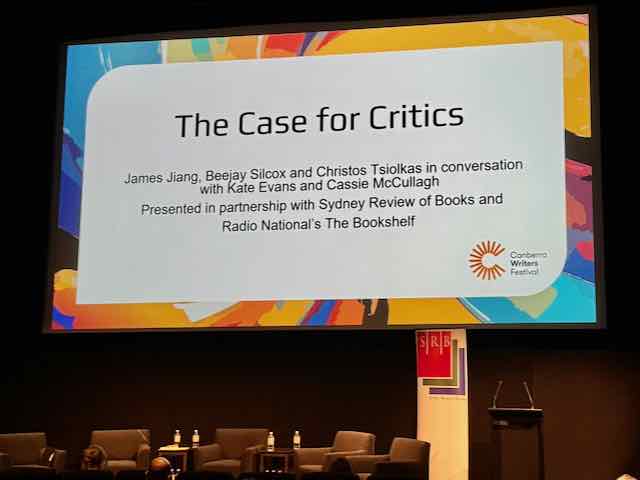
Canberra Writers Festival 2024: 6, The case for critics

Presented in partnership with Sydney Review of Books and Radio National’s The Bookshelf 

This was my final session of the festival, and it felt the perfect choice after five sessions focussing on authors and their novels. The program described it this way:

Derided, disparaged and cursed to the heavens, book critics are depicted as literature’s grand villains – as frustrated creators and gleeful wreckers. But what do critics really do? And why are they necessary for a healthy literary ecosystem? James Jiang, Beejay Silcox and Christos Tsiolkas – a trio of Aussie critics – make the case for criticism. In conversation with Kate Evans and Cassie McCullagh (recorded for Radio National’s The Bookshelf).

Again there was no Q&A, because it was being recorded.

The session was conducted jointly by Kate Evans and Cassie McCullagh though the participants didn’t need much guidance as this was a topic they cared deeply about.

Cassie did the acknowledgment of country. The participants were introduced – author Christos Tsiolkas (who has appeared several times on my blog), Editor of the Sydney Review of Books James Jiang, and critic and Canberra Writers Festival Artistic Director Beejay Silcox. Then the discussion commenced. I considered using my usual headings approach but the discussion was so engaged and free flowing, that I decided breaking it up would lose some of the connections. So, I’ve bolded a few ideas here and there as a guide. And, I’ve put my own reflections in parentheses.

Kate leapt right with a question to Beejay about what happens when she “sees the whites of the eyes” of someone she has critiqued. This indeed had happened, Beejay responded, as she had loved one book by Christos and not another! But, if she can’t be honest she shouldn’t be doing the job. She doesn’t feel uncomfortable facing people if she has done her job properly, thoughtfully, respectfully.

Christos admitted that it can be difficult to receive criticism, but he also writes criticism. However, it’s film criticism, because as an Australian novelist he feels he can’t be objective about other Australian novelists. He has critiqued novelists no longer with us, such as Patrick White.

Beejay had been writing criticism out of Australia for seven years before she appeared on the scene, so she didn’t have that issue of being known. (In fact, some thought her name was a pseudonym being used by an author, and Christos was one of the suggestions for that author!)

James, who is ex-academia, believes reviewing living authors offers a “massive opportunity” because you can guide the development of the art into the future. Critical thought, in other words, gets sucked up into the culture at large.

Kate and Cassie, who use reviewers on their radio program, were interested in how you choose who reviews what. Debut authors can sometimes want to make a name for themselves and, for example, love to attack the sacred cows. So, their practice is to give these authors books from other countries to review. They are also conscious of hidden agendas they’d like to avoid, like friends or lovers who had fallen out! (I suspect that working for a national broadcaster that people love to criticise requires a different mindset.)

James, on the other hand, doesn’t mind a gung-ho critic. But he feels that increasingly in Australian letters there is the official story and the backroom chat, with the latter often not appearing in social media. He would like transparency, and wants these informal ideas to make their way into formal criticism.

Christos took this idea up, arguing that criticism is a conversation, an argument, but he likes to know the perspective of the critic, where they are coming from. He thinks Australians are scared of having the debate. He also thinks that to be a good reviewer you need to be a good writer. This came up a few times through the discussion, the idea that good criticism is a work in its own right.

Picking up the idea that Australians are scared of the debate, Beejay suggested that we are a comfortable country but criticism is inherently uncomfortable. She’s been told she is brave, but she’s not. She knows what bravery is and it’s not her. Rather, she is being honest. She worries for our culture if what she does is seen as “brave”. Criticism should open doors, but it is often mistaken for closing things down. (Thinking about bravery versus honesty, I wonder if it’s more about confidence. Confidence in what you think, confidence that you can present it clearly, and confidence that you can defend it.)

Christos talked about loving the American film critic Pauline Kael. She starts by asking what is the work doing, and how is it doing it. But, she has criticised – negatively – films that he loves. So, immediately he is in a conversation with her about why he loves the work, perhaps even despite her criticisms.

Writing schools, Christos said, should teach criticism and how to deal with criticism, because there is a sting to a critical review. He quoted Hemingway’s advice to young writers – don’t compare yourself to the present because you don’t know what will hold, compare yourself to the past. (This is probably good advice for critics too! So many works we read now won’t hold, for reasons that, admittedly, aren’t always due to quality.)

At this point, Kate asked what is good criticism. For her it is not about guiding her on whether to read a book or not. In fact, she said, let’s define criticism!

James suggested that criticism was ultimately a form of ekphrasis. The most interesting reviews are those that “recreate the object of scrutiny”, that “conjure the object”, for the reader. In other words, criticism explores the work itself rather than whether it is better or worse than some other work. So, probed Cassie, it’s not about evaluation but context? Not in a discrete way, James said, but you are evaluating all along. Every process of description contains evaluation. But it’s not plonking some assessment at the beginning or end. (I wrote YES! here, because I often worry that I don’t pronounce enough on my feelings about a book. Today’s session has encouraged me to continue with my preference for trying to work out what a book is doing, rather than focusing on whether I like it.)

Christos suggested that the best way to show you care about the art is to ask why it doesn’t work.

Kate then got to the nub of the word “criticism” which people tend to understand as something negative rather than something more analytical. Beejay took this up, saying that people want to ask about the negative, the “bloody”, but she also looks for awe. It’s about opening a book and being prepared to be drawn in, of watching a mind at work. (This is what most intrigues me when I’m reading: What is the mind behind this doing? Where is it going? Why is it doing this?) Her greatest fear is that she will lose the capacity for awe, to be amazed.

Christos said that it can be hard to write about what gives you the awe. (It can be hard to write about the opposite too, though, methinks?) Beejay suggested that the best critics bring doubt, not certainty. They offer “a (their) theory” about the work.

Christos talked about having trust in the critic (and he gave an example of a music critic he trusts, who works in an area he knows little about).

Asked about bringing in expertise, James made the interesting statement that he wants to estrange experts from their expertise. He talked about the difficulties of public writing – and used The Conversation as an example. Experts tend to dilute their writing for the public so that it ends up being “high advertising” for the university. He wants to get away from that. Good public writing might change the style – from academic – to make it interesting, to engage the reader, but shouldn’t dilute the content. SRB will accept essays from 3000 to 10000 words. He gave the example of a 10000-word essay by a poet on the poetics of videogames. There was a mismatch between the subject (video games) and perspective (a poet) but the the result was something good.

On this expertise issue, Beejay commented that many feel they need to have read everything relevant to be able to comment, but she doesn’t believe that’s so. Christos suggested it was partly generational, and came out of the post-modern era. He had to wash it all off when he left university. (I understand this.)

Beejay on the other hand was a lawyer, not an academic. She left the law, and thought academia was solipsistic, not willing to have conversation. She found criticism by accident. Books saved her life, and now she’s giving back to them. She’s jaded about academia.

James, however, grew up with working class parents, and was looking for where he could go to have the conversations he wanted. He found it in an English seminar. The classroom environment taught him to edit his own writing. (Kate commented that Michelle de Kretser’s latest novel, Theory and practice, feeds well into this discussion.)

The conversation then moved on to the focus on the latest thing, and how to not be “just recent”. Christos said the best festival panels for him are those where they discuss influences and books loved. We need to find space for this because there is the danger that some of what we focus on is just fashion, and that we are being influenced by the language around us. He wishes there were more spaces for reflective pieces. (Being involved in the Australian Women Writers blog, and a Jane Austen group, I don’t disagree with any of this!)

Beejay loves reading favourite writers on how they became who they are. She criticises Australia because she loves it, but we are anglophone and protestant. We have an incredible critical legacy and we forget it. Rodney Hall, for example, has a large body of work but only one book, besides his latest, can be bought in bookshops. Critics can keep older work alive, and the more alive our discourse, the more alive our culture.

Christos agreed, and talked about a community radio session that focuses on the things we love. (The damage done by academia is that there’s no love.)

Cassie wondered about pulling punches, and talked about being told to pull one. Beejay had never pulled punches, but she knows which punches she wants to make. James offered a different angle, suggesting that some things are interestingly bad, whereas others can be good but dull. There’s much good but dull publishing he suggested. Christos talked about being told he should have pulled a punch when reviewing a promising young woman because what she was doing was important. What he’d written was “fair but not right”!

Returning, it seemed, to the idea of evaluation, Kate grapples with “stars”. She’s not good with binaries, but if you’re not binary, are you being nuanced or wishy-washy. (I feel her pain!) Beejay suggested that how she feels is almost irrelevant to the reader, it’s how she thinks that’s important. Feeling can impact thinking, but she has written positive reviews about things she didn’t care for.

Cassie then asked about spoilers. For Christos, to do justice to a work, to get to a conversation about it, he assumes you are interested in the whole, in how it works. James gave the example of classical tragedies. We all know how they are going to end. But then, he said, he is more of a voice and style rather than a plot person. (Yes!) Criticism is an ethical activity, and you need to be brave about owning your idea. (I think I might have missed how this related to spoilers.) Beejay talked about having the trust of her reader and working out when to share what. Criticism is the tip of the iceberg. There is a lot of effort and care beneath it. (This discussion of spoilers missed a significant point that wasn’t addressed at all during the discussion which is whether there is a different between Review and Criticism. I feel there is, and that in reviews spoilers are generally not what readers want, whereas with criticism it’s as Christos said, it’s about the whole and you can’t do that without talking about the end.)

And that was that … have you made it to the end? If so, do you have any thoughts to share?

Canberra Writers Festival, 2024
The case for critics
The Arc Theatre, NFSA
Sunday 27 October 2024, 12-1pm

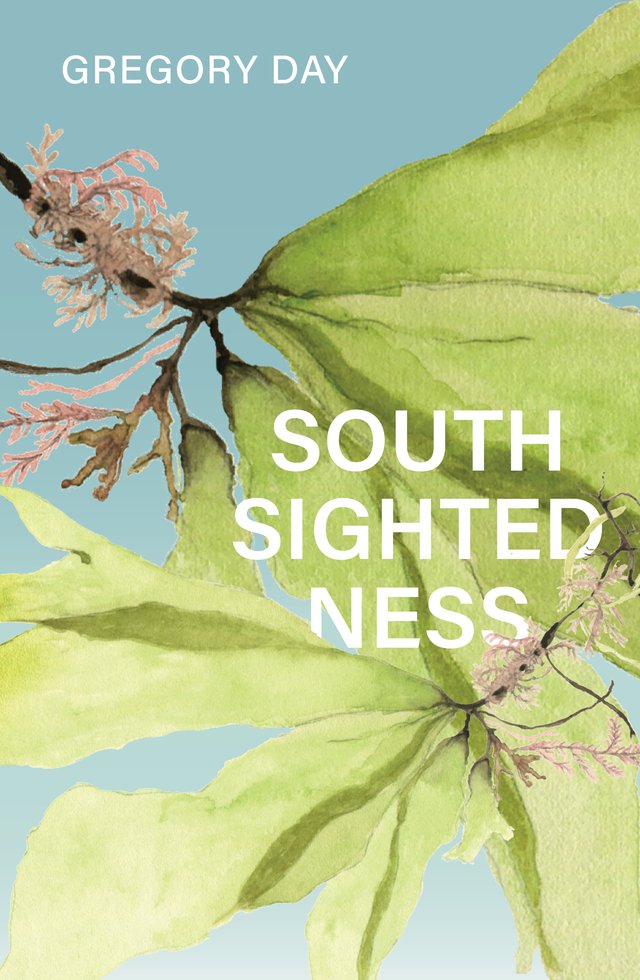
Canberra Writers Festival 2024: 5, Your favourites: Anita Heiss

In conversation with Astrid Edwards

Astrid Edwards is a podcaster who conducted a “conversation” I attended at last year’s Festival (my post), while Wiradyuri writer Anita Heiss (my posts) has made frequent appearances on my blog. This was my second (and final) “Your favourites” session at the Festival, though there were more in the program. Here is the program’s description: 

This year marks the 200th anniversary of the Bathurst Wars. Anita Heiss’s thrilling new novel, Dirrayawadha, takes its title from the Wiradyuri command ‘to rise up’ and is set during these pivotal frontier conflicts. Join Anita in conversation with Astrid Edwards (recorded for The Garret podcast).

Contrary to usual practice, it was the guest, Anita, who opened proceedings. She started by speaking in language which she then translated as acknowledging country, paying respects, honouring it, offering to be polite and gentle (I think this was it, as my note taking technology played up early in the session!)

Astrid then took the lead, saying it was a privilege and honour to be on stage with Anita Heiss. She did a brief introduction, including that Anita had written over 20 books across many forms, had published the first book with language on its cover, and was now a publisher. She also said there would be no Q&A, presumably because the session was being recorded for her podcast.

The Conversation proper then started, with Anita teaching us how to say the title of her new book, but I was still playing with my technology, so will have to look for YouTube instruction later, as I did with Bila Yarrudhanggalangdhuray. She then read from the beginning of Dirrayawadha.

On choosing fiction for the story

Astrid was not the only person to ask this question, said Anita. So had some of the Bathurst elders. Her answer was that we all read differently, so stories need to be told in all forms – children’s, young adult, adult fiction, poetry, nonfiction, and so on. She talked about her first novel, Who am I? The diary of Mary Talence (2001), which was commissioned by Scholastic for young adults in their My Australian Story series. Told in diary form, it’s about a young girl’s experience of the Stolen Generation – and it made a bookseller cry. That’s the power of fiction – to make people feel. Anita wants people to feel with her characters. You can’t do that in nonfiction, she believes.

She has four points-of-view (POVs) in the novel: the land, the historical warrior Windradyne, his fictional sister Miinaa, and the fictional Irish political convict Daniel. Her original idea had been to use Baiame (the creator) as her POV, but she’s received mixed feelings about this. She thought, then, of using the land, but she found it hard to tell her love story through that POV. So, she ended up with her four POV novel!

As well as fiction’s ability to appeal to our feelings, Anita said the other power of fiction is reach. She quoted someone (whom she can’t remember) who said that if women stopped reading, the novel would die. Men rarely read fiction, she believes, particularly fiction by women. The composition of this morning’s audience didn’t contradict this! Her aim is to reach women in book clubs. This led to a brief discussion about “commercial” being seen as a dirty word, but it means reach!

On the violence

An interesting segue perhaps from the idea of encouraging women readers! But, violence is the subject of this historical novel about the 1824 Bathurst War, which was fought between the Wiradyuri people and the United Kingdom of Great Britain and Ireland. Every act of violence by the settlers brought revenge. Anita described the Proclamation of Martial Law made by Governor Brisbane which included that “Bloodshed may be stopped by the Use of Arms against the Natives beyond the ordinary Rule of Law”. While there was reference to its being a last resort, it sanctioned violence.

Anita talked a little about the history, and recommended nonfiction books for further reading, but said she wanted to translate the massacres into a palatable form for wider audiences. And, she wants people to know this story through the Wiradyuri lens. (She commented that the colonisation of Gaza is the same story. What have we learnt as human beings.) She talks about the book so people can learn but every time she does, it is re-traumatising.

On her main characters

Anita spoke about each of the characters, about the historical Windradyne, and his bravery in fighting for his people. All she had to do to fight Bolt (see Am I black enough for you?) for his racist attacks was go to court, but in Windradyne’s time people lost their lives. She created his sister Miinaa because she wants to show strong Wiradjuri women (and Suzanne, for a strong settler woman).

As for Daniel O’Dwyer, she spoke about the Irish political convicts who were transported because they fought the Britain for their sovereignty. It’s the same story. However, most of Dan’s Irish convict friends did not recognise the similarity because, once in Australia, they were fighting for their own survival, for jobs.

Anita spoke quite a bit about Dan, because he helps represent conflict or opposition within settlers about what was happening. She talked about there being long standing connections between First Nations people and the Irish because they experienced loss of sovereignty at the same time. Through Dan, we see an Irish man who is conscious of being on Wiradyuri country. There are people who put themselves on the line for the right thing (like, today, the Jews for Peace group.)

And, Anita told us something I didn’t know which is that the word “deadly” as we hear used by First Nations people comes from the Irish, who use it in a similar way. There were other similarities between the Irish experience and that of First Nations people, including not being allowed to use their language.

Ultimately though, First Nations people were measured against Eurocentric behaviour. The Wiradyuri were seen as barbaric, and the convicts, who lived in fear, did not see that the violence they experienced was a reaction to their own behaviour

Astrid said she was catching a glimpse of a what if story – or alternative history. That is, what if the Irish had sided with the Wiradyuri?

The landownder family, the Nugents, and their place Cloverdale, were based on the Suttors and Brucedale in the Bathurst region. Sutter (who sounds a bit like Tom Petrie in Lucashenko’s Edenglassie) learnt Wiradyuri and built a relationship with the people. Co-existence, in other words, can happen. Again, what if? (Anita auctioned the name of her settler family in a Go Foundation fundraiser.)

On the love story

Anita said it is difficult to write about violence, so the love story between Miinaa and Dan, gave her a reprieve from violence and heartache. Further, through all her novels – this came through strongly in her early choclit books (see my review of Paris dreaming) – she wants to show that First Nations people have all the same human emotions, to show “us as complete, whole people”. She likes humour, but it was hard to find humour in a war story. Still, she tried to find moments of distance from painful reality.

On learning her language

Anita said her aim is not to write big literary novels, but using language does make her writing more rich, powerful. However, she is still learning it. She told a funny story about posting a YouTube video on how to pronounce Bila Yarrudhanggalangdhuray. Readers practised it, messaged her and sent clips of their achievement, but then an Aunty (I think) told her that she’d got it wrong. She was distressed, until a friend told her, “you are learning what should be your first language at the age of 50”. She does, however, feel privileged to be able to learn her language in a university setting when her mother wasn’t allowed to speak it at all.

There was more on language – including the Wiradyuri words for country, love, and respect, and that Wiradyuri words are always connected to place. Country matters to Anita. She talked a little about her growing up, and her parents, about her experience of living with love and humour. Race was never an issue between her Austrian father and Wiradyuri mother.

Astrid wondered whether there had been any pushback from using language – Bila Yarrudhanggalangdhuray – for her last novel’s title, given it was groundbreaking. It was during COVID, Anita said, and a Zoom meeting with her publisher, who wanted to push boundaries. Anita suggested taking English off the over – and the publishers went with it. Anita doesn’t want the title to be a barrier, and she doesn’t want people to get upset if they get it wrong, but no-one has pushed back.

On her new role as a publisher

I have written about this initiative which involves Anita being the publisher for Simon and Schuster’s new First Nation’s imprint, Bundyi, so I won’t repeat it here. She talked about the titles I mentioned, albeit in a little more detail. She wants to produce a commercial list, including works by already published authors doing different things and by emerging writers.

The session ended with another reading from Dirrayawadha – of the novel’s only humorous scene, which has Suzanne explaining Christianity to a very puzzled Miinaa.

A friendly, relaxed session, which nonetheless added to my knowledge and understanding of Anita Heiss and of First Nations history and experience.

Canberra Writers Festival, 2024
Your favourites: Anita Heiss
The Arc Theatre, NFSA
Sunday 27 October 2024, 10-11am