Rebecca Skloot, The immortal life of Henrietta Lacks (#BookReview)

Rebecca Skloot, The immortal life of Henrietta LacksIn her extensive acknowledgements at the end of her book, The immortal life of Henrietta Lacks, Rebecca Skloot thanks “Heather at The Book Store, who tracked down every good novel she could find with a disjointed structure, all of which I devoured while trying to figure out the structure of this book.” Interesting that she looked at novels, particularly given our recent discussion regarding non-fiction that reads like fiction, but more on that later …

Many of you will have heard of the book, or, if not, of Henrietta Lacks, or of her HeLa cells? It’s a sort of hybrid biography-cum-science book about an African-American woman named Henrietta Lacks who died in 1951, and the immortal HeLa cell line that was and continues to be cultured from her cervical cancer cells. As Skloot writes, “these cells have transformed modern medicine.” The book was published in the USA in 2010. It won multiple awards, including, says Wikipedia, the National Academies Communication Award for “best creative work that helps the public understanding of topics in science, engineering or medicine”. In addition, the paperback edition was on the New York Times Bestseller List for 75 weeks.

I’ve described the book as hybrid, because the story (or biography) of Henrietta Lacks is just one of its threads. It also interrogates the complex intersection between race, class and ethics in medical research as well as broader ethical ramifications of issues like “informed consent” and the commercialisation of human tissue. Skloot, herself, says early in the book,

The Lackses challenged everything I thought I knew about faith, science, journalism, and race. Ultimately, this book is the result. It’s not only the story of HeLa cells and Henrietta Lacks, but of Henrietta’s family—particularly Deborah—and their lifelong struggle to make peace with the existence of those cells, and the science that made them possible.

If you haven’t guessed it by now, then, this book is another example of those non-fiction books that I like so much in which authors author takes us on their journey of discovery, in this case to understand the people and the science, the ethics and the law, behind this astonishing story. Skloot wasn’t the first so tell it, however – something she makes clear during our journey. Earlier stories include Michael Rogers’ 1976 article in Rolling Stone, and the 1997 BBC documentary, The way of all flesh, which you can watch on YouTube. I’m not going to spend a lot of time on the story of the cells, so if you want to know about them – read the book and/or watch this video.

Skloot explains her own fascination with Henrietta, from being introduced to her cells in high school, through those HeLa cells being “omnipresent” throughout her biology degree, to when she was in graduate school studying writing “and became fixated on the idea of someday telling Henrietta’s story”. It’s not surprising then that this book has been extensively researched – as evidenced by the Notes and Acknowledgements. (These two chapters make great reading in themselves.) It took around 10 years to write, not just because of this extensive research. A major issue which Skloot had to confront was the understandable suspicion and anger of the Lacks’ family, whose help she needed if she were to tell this story properly and with integrity. Their story is bound up in a long invidious history of research carried out on African-Americans, which is also detailed in the book.

“What do you mean, ‘everybody else’?!”

So, the structure. The book is divided into three parts – Life, Death, Immortality. In the first two parts, the story is told in two roughly alternating, chronological threads – one telling the story of Henrietta Lacks, her cells, and her family, from 1920 to 1973; the other tracking the early days of Skloot’s research from 1999 to 2000. In the third part, the two tracks coalesce into one chronological thread, starting from 1973 when the late Henrietta’s daughter-in-law, Bobbette, discovers quite accidentally via a friend’s brother-in-law, that Henrietta’s cells were being used in scientific research and had been since 1951. Until that point, no-one in the family had known that Henrietta’s cells were still “alive” and being used in research all over the world:

“What?!” Bobbette yelled, jumping up from her chair. “What you mean you got her cells in your lab?”

He held his hands up, like Whoa, wait a minute. “I ordered them from a supplier just like everybody else.”

“What do you mean, ‘everybody else’?!” Bobbette snapped. “What supplier? Who’s got cells from my mother-in-law?”

She is, to put it mildly, horrified – and rushes to tell her husband and thence the family.

Here, though, I’m going to return to the issue of writing non-fiction like fiction. There’s the use of narrative structure, of plot lines, to create some sort of tension for the reader – in this case it largely revolves around the lives and reactions of the family, particularly Deborah – while we are also learning drier “stuff” about the history and ethics of cell culture and medical research. The dialogue I’ve just shared is part of the main plot line concerning the family’s discovery of what had been happening to Henrietta’s cells.

Then there’s the use of evocative, descriptive language. Skloot doesn’t overdo this, staying, in the main, direct and focused – but there are enough little flourishes to keep the writing interesting, like “HeLa grew like crabgrass” or “tufts of hair like overgrown cotton sprouted from his head”. The imagery draws from the area in which it is set. And, there’s the use of dialogue. Skloot did carry out a lot of interviews over her decade-long research and often makes clear when she’s quoting from those – but not all dialogue comes from that research. Some is imagined – or what critics call “representative”. No-one, for example, would have recorded Henrietta’s exact words when she visited her gynecologist, but Skloot writes:

“I got a knot on my womb,” she told the receptionist. “The doctor need to have a look”.

How much more interesting that is to read than, say, “Henrietta visited her gynaecologist, telling the receptionist that she had pain in her womb that needed to be investigated.” I know what I’d rather read. Not only is dialogue more engaging, but if the writer gets the voice right it enhances our understanding of the character. One of the delights of this book, in fact, is our getting to “know” members of Henrietta’s family, and the dialogue plays a significant role in this. Not non-fiction readers, however, approve of this approach.

As I’ve already said, I’m not going to write a lot about the content of this book, fascinating though it is. It has been written about extensively; there are interviews with Skloot on the web; and for background there’s that BBC documentary. The book is now nearly a decade old. Cell research has moved on, but the story of the intersection of race and class with science and ethics is still relevant. Moreover, this is a book of history – the history of medicine. Close to home for me, for example, was learning that HeLa cells were involved in identifying the connection between the HPV virus and cervical cancer, and thence the development of the vaccine with which my reading group’s daughters were among the first in the world to be vaccinated.

All this makes the book well worth reading. There were, admittedly, times when the cell science got the better of me (and other non-scientific members of my reading group) but not enough to turn us off. Skloot’s courage, warmth and empathy with people out of her ken, the trust those initially fearful, angry people came to place in her, and her ability to tread the fine line between judgement and analysis when discussing actions of the past make this a special read. No-one in my reading group regretted this choice for our schedule. A fine way to end the year.

Rebecca Skloot
The immortal life of Henrietta Lacks
Sydney: Picador, 2010
ISBN: 9781742626260 (ePub)
Emily O’Grady, The yellow house (#BookReview)

Emily O'Grady, The yellow house

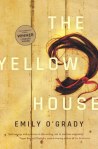
Although Emily O’Grady’s debut novel The yellow house won this year’s prestigious The Australian/Vogel’s Literary Award for unpublished manuscripts by authors under 35, I wasn’t sure at first that I was going to like it. I think this was because I was feeling I’d read a surfeit of books this year about young people living challenging lives in rural settings – Charlie Archbold’s Mallee boys (my review), Jenny Ackland’s Little gods (my review) and Sofie Laguna’s The choke (my review). I wasn’t sure this was going to have anything new to offer.

However, it wasn’t long before ten-year-old Cub’s voice got me in and I realised that this book had a different spin again, which is that it explores how families of violent or sociopathic criminals, like serial killers, cope in the long years after it all comes to light. It’s a coming-of-age story, in a way, but a very different one. Cub, then, is our narrator. She lives on a “lonely property bordering an abandoned cattle farm and knackery” (back blurb) with her twin bother Wally, her 17-year-old brother Cassie whom she adores, and her parents, Colin and Christine. Within sight of their home is “the yellow house” in which her maternal grandfather, Les, had lived. He had died two years before the Cub and Wally were born – and in the prologue we learn that he had been a serial murderer of young women. The prologue closes with a now wiser Cub telling us:

Now, I know everything he did trickled down and created us all, because it turned out he was the god of all our lives.

So we know at the beginning something that Cub doesn’t know when the narrative “really” starts. Why does O’Grady take this approach? I’m guessing it’s to focus us less on that plot. We know what Cub doesn’t know – or at least enough of it. We can therefore focus on how a family lives with this knowledge rather than on trying to work out, as Cub has to do, what the secret is. It makes Cub a perfect naive narrator: she has the curiosity and loyalty of a child but lacks the wisdom necessary to make the right calls. There’s an added complexity to Cub’s situation which increases her isolation: everyone else in the family knows, including her twin brother. Cub wasn’t told because she’s a girl. It’s no coincidence that she, Coralie, has a baby-ish nickname, while her twin brother doesn’t.

The novel proper starts when Cub is approaching 11 years old, and her aunt, Helena, and 11-and-a-half-year-old cousin, Tilly, move into the yellow house. Tilly’s father, Dermott, we’ve already been told, had driven his car into the dam some time ago and died. It is Helena and Tilly’s appearance which sparks the events that play out in the rest of the novel, events that are “driven” by that violent forbear whose “rotten blood” is in their veins, whose legacy they struggle to shake off.

It’s a horrifying novel. We realise early on that the family is ostracised by the community in which they live, and is struggling emotionally. Cub’s Dad does his best to keep them together but is ill-equipped for the challenge he faces, while her Mum also does her best in her own way, but regularly takes to her bed, with various malaises, many depression-based presumably. Cub and Wally have no other friends at school, something Cub doesn’t fully cotton on to, but we do:

The kids at school were strange; Wally and I played by ourselves at lunchtime, always paired up when we did partner work.

Cub is consequently desperate to make Tilly, so close in age, her friend:

I tried to think of something else to say. I knew we had one chance to make a good impression and I didn’t want to waste it. But the silence felt as deep as the dam, impossible to swim out of. I was annoyed at myself for not practising with the girls at school. I should’ve been prepared.

But, it never quite works. Tilly, dangerously – she’s too much like her mother, Cub’s Mum hints at one stage – is more interested in boys. And, there are boys – besides Wally. There’s Cassie, and his creepy friend Ian. Tilly, like Cub, doesn’t know the story of the “yellow house” and her mother is determined to keep it that way.

The story develops slowly, chillingly, and, it feels, inevitably, as the secrets, parental inadequacy, community prejudice and cold opportunism combine to result in … I’d like to say more, but perhaps should not spoil the plot.

This is not a novel in which everything is explained – as can be typical of naive narrator stories – but there seems to be a specific intention here. At least, I’d say that O’Grady’s aim is not to tease out all the possibilities and permutations of the situation, nor to follow the more usual crime fiction path of restoring order out of chaos. Instead, it’s to encourages us, at each point, to consider what might be happening, why it might be happening, and what might make (or have made) it happen differently. That gives the book a power that those more traditional crime novels don’t have.

Besides this open-endedness which kept me engaged and pondering throughout, there’s O’Grady’s writing. It’s not tricky. There’s quite a bit of dialogue and simple description of what’s going on, as you’d expect, rather than a lot of reflection, but O’Grady has some lovely turns of phrase. At one point Cub is near Cassie’s friend Ian:

Now that I was right up close to him I didn’t know what to do; it was like my brain was wrapped in sticky tape and I couldn’t think properly.

The language and imagery, as this example shows, are appropriate for Cub’s age. And there’s the “yellow house” itself. Yellow has so many connotations. It can suggest something warm, bright, cheery, hopeful, but is also the colour of cowardice and deceit, and can convey sickness. The contrast between these positive and negative meanings of the title underpin the novel’s horror.

Why read this novel? There’s the obvious reason that it explores a subject that many of us must wonder about when we hear of violent crimes – how does the wider family cope, what happens to them? And there’s the associated reason that in so doing it might encourage us to think more empathetically if we found such a family in our midst. But, besides that, it’s an engaging debut novel by a new young writer from whom we will hopefully hear more. It’s always exciting to be in there at the start.

Lisa (ANZLitLovers) also liked this book.

AWW Badge 2018

Emily O’Grady
The yellow house
Crows Nest: Allen & Unwin, 2018
314pp.
ISBN: 9781760632854

(Review copy courtesy Allen & Unwin)

Monday musings on Australian literature: Barbara Jefferis Award and negative depictions of women

A month ago, blogger Kim Forrester (Reading Matters) tweeted “I’ve stopped reading books where a woman being murdered is the plot point. Let’s change the story.” I thought this was interesting, but didn’t think a lot about it at the time because I read very little crime (though I do watch some). However, I was reminded of it when, last week, Lisa (ANZLitLovers) brought my attention to this year’s Barbara Jefferis Award and the judging panel’s comment on the submitted books – but first some background.

The Barbara Jefferis Award has very specific criteria:

“the best novel written by an Australian author that depicts women and girls in a positive way or otherwise empowers the status of women and girls in society”.

In other words, it is not the sex of the writer that’s relevant here (nor, in fact, the genre). This award is for books about women and girls, but it must also present them in a positive or empowering way. It was controversial at the time it was established. I remember it well because I created the Wikipedia article on it. I noted that journalist and literary editor Susan Wyndham had asked whether Australia needed a new fiction award encouraging ‘positive’ portrayals of women and girls, or whether it’s “an outdated gesture in a post-feminist culture rich with female authors, characters and readers?” And then I continued with:

Several writers have supported the award, including Tom Keneally, Helen Garner, Frank Moorhouse, Gerald Murnane, Anne Deveson, Kerryn Goldsworthy and Brian Castro. However, writer and critic, Andrew Reimer dislikes the idea of focusing on “social agenda” over “novelist’s skill and imagination”, and novelist Emily McGuire agreed, stating that she doesn’t “like the idea of judging fiction based on its message”. Author and critic, Debra Adelaide, expressed her concern that the award might encourage “safe and constrained” writing and wondered whether “we are getting to the point where we have more awards than publishing opportunities”.

Libby Angel, The trapeze actJumping ten or so years later to the 2018 award, here is The Sydney Morning Herald’s report after the announcement of Libby Angel’s The trapeze act as winner:

Among a record number of books entered for the $55,000 Barbara Jefferis Award, a surprising number featured domestic violence, death or the subjugation of women, according to judge Sandra Yates, running contrary to the prize’s explicit criteria.

The first three books Yates read from the longlist saw one woman burnt at the stake, one woman pushed off a cliff and the other a victim of domestic violence.

“We were surprised, I have to say, that so many even in the longlist seemed to have such dark, negative portrayals of women in them,” she said. “We [women] don’t need any more books about our capacity to endure, I think we have established that.”

Reporting this, Lisa commented “So I am not the only one sick-and-tired of the current crop of misery memoirs and novels featuring women as victims…”

I don’t feel as strongly as Lisa about the “current crop” of books, but I am interested in the wider issue at play here, which I’d break down into three main questions:

  • How do we define positive, empowering representation?
  • Is there, currently, a prevalence of negative representations?
  • Should writers conform to a “social agenda”?

I’m not sure whether there is a definition for the judges to work with – and would be interested to hear from Dorothy Johnston who wrote a guest post here on judging this award –  but I’d define positive, or empowering depictions of women and girls as those in which women are able to exert some sort of agency in their lives. This could include Lisa’s “misery memoirs” if, as often happens, they end with the woman rising above the challenges (the violence, the abuse, the poverty, the illness – whatever the initial misery is) to take control. There can be a fine line here, though, between Yates’ notion of “enduring” and the idea of being, or becoming, empowered.

To be simplistic, we could say that, in the context of this award’s requirements, there are three “types” of books depicting women: those whose portrayals are positive (or, “ultimately” positive); those whose portrayals are neutral, that is, they are just about women getting on with the normal business of life; and those in which woman are essentially victims, with no agency to improve their lot.

Looking at the novels I’ve read that feature women and/or girls and were published between 1 January 2016 and 31 December 2017, I would say that most – by my definition, anyhow – would fall into the first two “types”. These books include:

  • Carmel Bird’s Family skeleton (my review)
  • Diana Blackwood’s Chaconne (my review)
  • John Clanchy’s Sisters (my review)
  • Claire Coleman’s Terra nullius (my review)
  • Madelaine Dickie’s Troppo (my review) (shortlisted for the Barbara Jefferis’ Award)
  • Michelle de Kretser’s The life to come (my review)
  • Sara Dowse’s As the lonely fly (my review)
  • Glenda Guest’s A week in the life of Cassandra Aberline (my review)
  • Sofie Laguna’s The choke (my review)
  • Catherine Mackinnon’s Storyland (my review)
  • Emily Maguire’s An isolated incident (my review)
  • Josephine Rowe’s A loving, faithful animal (my review)
  • Anna Spargo-Ryan’s The paper house (my review)
  • Ariella van Luyn’s Treading the air (my review)

Not all of these are simple, positive depictions, but their women are not all victims, albeit some are certainly challenged by the decisions they’ve made. I know from experience, however, that my definition of “positive” is not universal, and that I see hope where others don’t. Laguna’s The choke, for example, is undeniably grim – but Laguna believes in offering hope, and, whether or not you like the ending, it is intended to be hopeful.

The only book I’ve read from this period which, by my definition, would not meet the Award’s positive depiction criterion is Mirandi Riwoe’s The fish girl (my review). That girl tries, but is ultimately powerless and so done in by men with power over her.

So, I don’t necessarily agree that the majority of current books – at least those I’ve read – focus on women as victims. Many of the female protagonists may commence as victims – like Laguna’s Justine or the two protagonists in Charlotte Wood’s The natural way of things (published in 2015) – but most of the books are about confronting problems, not simply succumbing to them and enduring.

As for whether writers should conform to a social agenda, my simplistic answer is no. But that doesn’t mean that a social-agenda based award is, in itself, wrong. It just means that it would be unwise for an author to write to an award whose requirements didn’t align with what they wanted to say. We have in fact many social-agenda oriented awards – the Stella Prize and the David Unaipon Award being just two examples.

How would you define “positive depiction”, and what do you think about the current crop of novels (regardless of where you live)?

Queensland Literary Awards 2018 winners announced

Hot off tonight’s twitter feed are this year’s winners of the Queensland Literary Awards. They combine specific state awards and awards for which all Australian writers are eligible.

Here is the whole suite of winners in the order they were announced:

  • Queensland Premier’s Award for a work of State Significance: Jackie Ryan’s Expo 88
  • Bri Lee, Eggshell skullYoung Publishers and Writers Award: Bri Lee’s Eggshell skull and Anna Jacobson, whose debut poetry collection will be published by UQP in 2019.
  • Queensland Writing Fellows: Michael Gerard Bauer, Laura Elvery and Jackie Ryan.
  • State Library of Queensland Poetry Collection — Judith Wright Calanthe Award: Michael Farrell’s I love poetry (Giramondo), which, says the Twitter feed, the judges found to be “a truly inventive book” 
  • Glendower Award for an Emerging Queensland Writer: Melanie Myers for her manuscript Garrison Town. The judges, says Twitter, described it as “a polished, multi-layered narrative”.
  • David Unaipon Award for an Unpublished Indigenous Writer: Kirstie Parker for her manuscript The making of Ruby Champion, which impressed the judges for the way it “seamlessly draws together the outback Aboriginal grassroots experience with the urban Black story”. The David Unaipon Award has brought us some wonderful writers in the past, of which, to date, I’ve reviewed four here.
  • QUT Digital Literature Award: David Henry Thomas Wright & Chris Arnold’s Little Emperor syndrome. The judges noted its “elegantly simple execution of a wickedly complex narrative”. 
  • Griffith University Children’s Book Award: Peter Carnavas’ The elephant (UQP).
  • Griffith University Young Adult Book Award: Cally Black’s In the dark spaces (Hardie Grant Egmont)
  • University of Southern Queensland Short Story Collection-Steele Rudd Award: Jennifer Down’s Pulse points (Text Publishing), which the judges described as “a daring, compelling and refreshing collection” 
  • University of Southern Queensland History Book Award: Jackie Ryan’s Expo 88: We’ll show the world (UQP), which the judges praised for its “achievement in analysing the many dimensions of the Expo story…with such pacey economy is extraordinary” 
  • University of Queensland Non-Fiction Book Award: Alexis Wright’s Tracker (Giramondo) which the judges said “is stunningly innovative in the way it brings the life and story of Tracker Tilmouth to the printed page”
  • Kim Scott, TabooUniversity of Queensland Fiction Book Award: Kim Scott’s Taboo (Pan Macmillan) which the judges described as “a confronting but ultimately hopeful book that probes Australia’s heart of darkness in poetic and masterly prose.” (Still on my TBR but Lisa has read!)
  • Courier-Mail People’s Choice Queensland Book of the Year Award: Beth Wilson’s Brisbane houses with gardens.

Jackie Ryan, Expo 88

Some interesting awards and books here, but Jackie Ryan is clearly the winner of the night, having won the Award for a work of State Significance, the History Book Award, and a Writing Fellowship. I should say that publisher UQP shows her books full title as We’ll show the world: Expo 88 – Brisbane’s almighty struggle for a little bit of cred.

I particularly love that these Awards include one for Digital Literature (since 2017, I believe). It’s not surprising, though, given the work being done in keeping up with new writing and publishing technologies by the Queensland Writers Centre. You may remember that last year I reviewed the Writing black digital collection edited by Ellen van Neerven and supported by the Centre’s If:book arm.

Anyhow, as always, congratulations to all the winners. What a thrill it must be.

Prime Minister’s Literary Awards Shortlist, 2018, announced

I don’t always announce all literary awards shortlists, but have decided to announce the Prime Minister’s Literary Awards shortlist this year. The press release says that over 500 books were submitted across the 6 categories. Is that all? I guess I would have expected more, but it is somewhat expensive to submit, particularly for small publishers. There is NO entry fee, but 10 copies of each book submitted must be provided.

Over the years, the number of categories offered under the award, which was introduced in 2008 by Kevin Rudd, has increased, which is excellent I’d say for Australian writers, given the value of the award. Winners receive $80K, and shortlisted authors $5K.

I also don’t always announce all the categories covered by awards, but this year I’m gonna, starting with Fiction of course!

Michelle de Kretser, The life to comeFiction

  • A long way from home, Peter Carey (Penguin Random House): on my TBR (Lisa’s review)
  • Border districts, Gerald Murnane (Giramondo): on my TBR (Lisa’s review)
  • First person, Richard Flanagan (Penguin Random House): my review
  • Taboo, Kim Scott (Pan Macmillan): on my TBR (Lisa’s review)
  • The life to come, Michelle de Kretser (Allen & Unwin): my review (and winner of this year’s Miles Franklin Award)

Quite a male-dominated list this year, and generally conservative, as it sticks with tried and true authors, but nonetheless these are all, from what I’ve read or ascertained from others, good books. Still, I have liked that this award has often introduced us to something a bit different (like Stephen Daisley, and Lisa Gorton) from the other awards, but not so here. It would be lovely to see Gerald Murnane win – the only one among these not to have won a significant Australian award – given his significant contribution to Australian letters, but, will he?

I have not read any of the rest of the shortlisted books, I’m afraid.

Poetry

  • Archipelago, Adam Aitken (Vagabond Press)
  • Blindness and rage: A phantasmagoria, Brian Castro (Giramondo Publishing)
  • Chatelaine, Bonny Cassidy (Giramondo Publishing)
  • Domestic interior, Fiona Wright (Giramondo Publishing)
  • Transparencies, Stephen Edgar (Black Pepper)

Looks like that wonderful independent publisher Giramondo is one of this year’s winners, regardless of WHO wins the awards in the end. Good on them, in particular, for supporting poetry so well.

Non-fiction

  • Asia’s reckoning, Richard McGregor (Penguin Random House UK)
  • Mischka’s war: A European odyssey of the 1940s, Sheila Fitzpatrick (University of Melbourne Publishing)
  • No front line: Australia’s special forces at war in Afghanistan, Chris Masters (Allen & Unwin)
  • The library: A catalogue of wonders, Stuart Kells (Text Publishing)
  • Unbreakable, Jelena Dokic and Jessica Halloran (Penguin Random House): my report of an In Conversation event

Australian history

  • Beautiful Balts: From Displaced Persons to New Australians, Jayne Persian (NewSouth Publishing)
  • Hidden in plain view: The Aboriginal people of coastal Sydney, Paul Irish (NewSouth Publishing)
  • Indigenous and other Australians since 1901, Timothy Rowse (NewSouth Publishing)
  • John Curtin’s war: The coming of war in the Pacific, and reinventing Australia, Volume 1, John Edwards (Penguin Random House
  • The enigmatic Mr Deakin, Judith Brett (Text Publishing)

And here, NewSouth Publishing, the publishing arm of the University New South Wales, has strut its stuff. They also did well at this year’s New South Wales Premier’s Literary Awards, where they won two prizes, including Paul Irish’s Hidden in plain view for the NSW Community and Regional History Prize. As I’ve said before, it’s excellent to see university presses publishing and doing well.

Children’s literature

  • Feathers, by Phil Cummings and Phil Lesnie (Scholastic Australia)
  • Figgy takes the city, Tamsin Janu (Scholastic Australia)
  • Hark, it’s me, Ruby Lee!, Lisa Shanahan and Binny Talib (Hachette Australia)
  • Pea pod lullaby, Glenda Millard and Stephen Michael King (Allen & Unwin)
  • Storm whale, Sarah Brennan and Jane Tanner (Allen & Unwin)

Young Adult literature

  • Living on Hope Street, Demet Divaroren (Allen & Unwin)
  • My lovely Frankie, Judith Clarke (Allen & Unwin)
  • Ruben, Bruce Whatley (Scholastic Australia)
  • The ones that disappeared, Zana Fraillon (Hachette Australia)
  • This is my song, Richard Yaxley (Scholastic Australia)

And, in the youth literature area, congrats to Allen and Unwin, Hachette Australia and Scholastic Australia who have scooped the pool. I don’t know enough about this area to know how representative this is, but I do know that indigenous publisher Magabala Books publish children’s books. I wonder if they submitted.

The complete shortlist with judges’ comments can be seen on the website. And now, I apologise for the rushed post, but I’m running late for my afternoon commitments and will be out this evening too.

Thoughts, anyone?

Monday musings on Australian literature: The Next Chapter

Two weeks ago I wrote a Monday Musings post on HarperCollins’ new prize for unpublished manuscripts, the Banjo Prize – and this week I saw the announcement of the winners of another new “prize”, the Wheeler Centre’s Next Chapter initiative.  It’s a very different kettle of fish but is another program offering opportunities to writers who may be struggling to be heard …

The Next Chapter program was, in fact, announced back in May as “an unprecedented new way of supporting writers”. Like the Horne Prize, about which I’ve also written recently, it is supported by the Aesop Foundation. Before I get onto Next Chapter, I need to tell you about this interesting company called Aesop! Established in Melbourne in 1987 it is – would you believe – a company that sells skin, body and hair products that are “created with meticulous attention to detail, and with efficacy and sensory pleasure in mind.” Hmm … no wonder I, who uses minimal and very basic skin, body and hair products, have never heard of them. However, it seems that their philosophy extends beyond their products to “fostering literacy, storytelling, and diversity”, which they do through a Foundation which offers support through two granting programs. I almost feel I should check out their products.

Anyhow, back to the Wheeler Centre’s Next Chapter. The Centre recognised that there are aspiring writers all around Australia who find it hard to get their stories heard. It also realised that “the commercial market is not always the best place for a writer to develop their skills and hone their craft.” And so it created the Next Chapter program, which aims

to elevate the Australian stories that aren’t being published – and to nurture a new generation of writers, from all sorts of backgrounds, to tell them.

They plan to do this by selecting, each year, “ten outstanding writers” who will be given $15,000 each to develop their work. They will also be matched with a mentor who will work with them to bring their writing to life, and connect them with peers, publishers and readers.

Maxine Beneba Clarke, The hate raceThe good thing is that although the Wheeler Centre is Melbourne-based/Victorian-focused, this program is being offered nationally – in order, says director Michael Williams, to “find the next chapter of Australia’s literary story.” The inaugural judging panel is beautifully diverse – you know how I feel about that – comprising Maxine Beneba Clarke (whose The hate race I’ve reviewed), Benjamin Law, Christos Tsiolkas (who has also appeared here several times), and Ellen van Neerven (who has appeared here several times). There is a video (with transcript) about the program at the Centre’s site, outlining the judging criteria – merit, impact, potential, suitability and significance.

Law, supporting the program, said that the two most important things he needed to build a sustainable writing career were “mentorship and money,” which is what the Next Chapter aims to provide. Tsiolkas said, on accepting the role of judge:

I am supporting The Next Chapter because we need to listen to and be astonished by more voices in Australian writing. Both to reflect the reality of contemporary Australia but also, and possibly more importantly, to provoke and invigorate cultural forms and expressions.

The danger of the word diversity is that it can be reduced to feel-good, kumbaya sloganeering. The radical dare of diversity is that it challenges us to be open not only to the difference of voice but the difference of opinion, politics, belief, aesthetic, commitment and priority. Real diversity should burst bubbles and we need that more than ever now.

Looking at the winners below, I’d say the judges have made a bang-on attempt to achieve this goal …

So, who are the inaugural winners? Being emerging writers they are not well-known, but many do have a good cv already, including being published in literary journals and/or performing at festivals (or elsewhere) and/or winning specialist awards:

  • Evelyn Araluen, indigenous poet, researcher, and educator working with Indigenous literatures at the University of Sydney
  • Jean Bachoura, Damascus-born, Melbourne-based writer and actor
  • Ennis Cehic, writer of fiction, non-fiction, poetry and essays, who was born in Bosnia and Herzegovina, but now lives in Melbourne
  • Nayuka Gorrie, New South Wales-based Gunai/Kurnai, Gunditjmara, Wiradjuri and Yorta Yorta freelance and comedy television writer, who focuses on black, feminist and queer politics
  • Lian Low, a Melbourne-based writer and spoken word artist, who has collaborated with circus artists, poets and dancers, in Malaysia and Australia
  • Yamiko Marama, Melbourne-based writer, therapist and food truck owner who is interested in social justice and memoir
  • Giselle Au-Nhien Nguyen, Melbourne-based Vietnamese-Australian writer, editor and bookseller
  • Ara Sarafian, Melbourne-based writer and editor who writes comedy-fiction, commentary and satire
  • Adrian Stanley, South-Australian based indigenous artist
  • Adam Thompson, Aboriginal (Pakana) writer from Launceston who writes contemporary, Aboriginal-themed short fiction.

There is, as you can see, a high proportion of winners from Melbourne – which is not hugely surprising for a new program emanating from Melbourne. Despite this geographic concentration, however, the winners’ backgrounds are diverse. You can read more about them at the Wheeler Centre’s site.

So, another interesting initiative – from a literary centre with support from a philanthropic foundation. So great to see, particularly given it focuses not only on emerging artists but also on encouraging and supporting “real” diversity. Now, it will be interesting to see where these writers/performers pop up next?

Horne Prize – the “political correctness” controversy

Help Books Clker.com

(Courtesy OCAL, via clker.com)

Dare I step into the breach? I think I will. Let me start by saying I’m a strong supporter of political correctness, though I hate the term itself and the way it is bandied about with little thought or nuance. To me, political correctness fundamentally means respect for and sensitivity to the feelings and place or position of others – of others, that is, who are less powerful, have less agency and status than the prevailing majority. It means, essentially, in our culture, not privileging the western white straight abled male perspective in the way we speak and write, and in who gets to speak and write.

Having this fundamental view means that I (generally) support indigenous Australians’ call for non-indigenous writers not to write in the voice of indigenous characters. I say “generally” because I’m not a believer in black-and-white rules when it comes to art. I also say it because I think that non-indigenous writers should be able to include indigenous characters in their books where relevant. Otherwise, the risk is that oppression and invisibility is being perpetuated by their absence. There’s a fine line here between oppression-through-absence and oppression-through-appropriation. This line needs to be trodden carefully and must be in consultation with relevant indigenous people. Not all indigenous people agree with this approach, but some do I believe. This opinion of mine is set in jelly not concrete – as I have no wish to continue oppression – but it’s my intellectual position on the issue.

So, the Horne Prize. Named for the late public intellectual Donald Horne who wrote on Australian culture and identity, the Horne Prize was established in 2014 by Aesop and The Saturday Paper. It is “for an essay of up to 3000 words, addressing some part of the theme ‘Australian life’ – shining light on a particular aspect of who we are, from a contemporary perspective.” It’s probably not well known in general circles, but it came to the fore on the weekend when two judges – writer Anna Funder (whom I’ve reviewed here) and journalist/public intellectual David Marr – resigned from the panel when they discovered that some restrictions had been added to this year’s submission guidelines.

David Marr explains it in The Guardian:

But, without warning the judges, Jensen [The Saturday Paper editor] decided to radically narrow the rules and issued a list of what the Horne prize was “not seeking or accepting” this year: “Essays by non-Indigenous writers about the experiences of First Nations Australians. Essays about the LGBTQI community written by people without direct experience of this community. Any other writing that purports to represent the experiences of those in any minority community of which the writer is not a member*.”

Marr continues in this article that on seeing this, he immediately contacted Jensen expressing his disagreement with such restrictions and advising that he could not be on the panel as a result. To his credit, Jensen immediately emailed the other judges – Funder, indigenous Australian academic Marcia Langton, and a representative of Aesop – explaining his reasons:

The guidelines attempted to reduce the number of essays we received that offered chauvinistic or condescending accounts of particular groups of Australians, especially First Australians.

Funder withdrew because she felt that much of her own work would not be approved under the guidelines, while Marr reports this of Langton:

Langton told me: “I don’t think you should completely rubbish Erik’s attempt to get rid of the rubbish.” She views the new guidelines as: “Probably a mistake because it’s not the done thing. I’ve got a lot of sympathy for what he’s trying to achieve but it crosses the line on censorship and free speech.”

Another article in The Guardian by Calla Wahlquist quotes some who agree with Jensen’s new conditions: Kerryn Goldsworthy who thought they were “absolutely fair enough”, Anna Spargo-Ryan (whose The paper house I’ve reviewed here) who “wished guidelines restricting writers from venturing outside their own experience and authority weren’t necessary, but that the negative reaction to the entry criteria proved they still were”, and two indigenous Australian writers, Nayuka Gorrie and Jack Latimore. Wahlquist writes this of Latimore:

Latimore said it was part of a broader global push to ensure people from minority groups retained control over and any benefit that stemmed from the telling of their stories.

“If you want to get a deeper or richer Aboriginal story, an Aboriginal journalist is going to be the one who gets that more than anyone else,” he said.

Now, my opinion is – and I think it is similar to Marr’s – that no such “rule” should be needed because good, sensitive, intuitive judges should be capable of identifying essays which are chauvinistic, condescending or worse. Such works should not make the first cut. My belief is that the “best” works on marginalised or dispossessed peoples, on “other” – and of course not all essays will be on these subjects – will, almost by definition, be by people who have the appropriate lived experience. (But, perhaps, I am naive to believe all this?)

The critical thing, then, in regards to general awards like this (ie not those targeted to specific groups like The Stella Prize for women or the David Unaipon for indigenous Australians) may be less about who can write what, but who should judge (an issue I discussed recently in fact). This panel seems diverse: it includes a white woman (Funder), a gay white man (Marr), and an indigenous woman (Langton). Knowing these three, I’d (if anyone asked me) say that they are knowledgeable and skilled enough, are thoughtful and sensitive to prevailing community values and attitudes, to make a good decision. (Yen-Rong Wong, though, may disagree.)

And the end result? Jensen has withdrawn these additional conditions and the deadline for the prize has been extended by a month. Nice to see someone willing to change his mind publicly eh?

I feel a little nervous writing this – but I’d like to think we can discuss this issue from a fundamental basis of respect for all, with the understanding that there is in fact no right or wrong but a multiplicity of opinions which are best shared rather than buried under the carpet.

* None of the discussion here, or that I read, addresses the tricky issue of labelling and identification, of how you prove you are part of the valid community for your topic.

Monday musings on Australian literature: The Banjo Prize

I have just caught up with a new literary prize – the Banjo Prize – which is not to be confused with the Banjo Paterson Writing Awards I guess it’s to be expected that one of Australia’s favourite bush poets might be honoured by more than one award being named for him.

Before I get to the new one, I’ll briefly mention the older one. The Banjo Paterson Writing Awards were established in Orange in 1991 “to honour Banjo Paterson [of course], a great Australian writer and favourite son of Orange.” They seem to be run by the Orange City Library, the Central Western Daily and ABC Central West Radio, and have three categories: Short Story, Contemporary Poetry and Children’s Writing. The entries, they say, don’t have to be written in Banjo’s style, but must be Australian in content. Fair enough. The winners receive cash prizes ($2000 for each of the first two, and $200 for the children’s award.)

The Banjo Prize is a different thing altogether. Firstly, it’s a manuscript award, and secondly it’s offered by a publisher, HarperCollins. The winner will receive a $15,000 advance and a chance of a publishing contract, while two runners-up will receive written assessments of their manuscripts which could also result of course in their books achieving publication down the track.

Most of the articles I read about the award seemed to be based on HarperCollins Press releases or came from HarperCollins itself. The articles announced the prize in March, the shortlist in August, and then the winner at the end of August. The winner, from 320 submissions, is Tim Slee with his manuscript, Burn. HarperCollins’ Head of Fiction Catherine Milne, whom you’ve met here before, said of the winner:

Burn is a novel that sneaks up on you, and takes you by surprise – and before you know it, you’re deep in its world and don’t want to leave. Burn is a thought-provoking, heart-warming, quintessential Australian novel like no other, and I’m just thrilled that it is our inaugural Banjo Prize winner.

Tim Slee, Charlie JonesThe two runners-up were Ruth McIver for Nothing Gold and Gregory James for Bordertown.

It’s unlikely that any of these authors will be well-known to us because the whole point is to discover new Australian storytellers. However, Adelaide’s The Advertiser provides some information about Slee. He is an “Adelaide-born expatriate writer”, and has previously self-published science fiction and historical novels. The Advertiser says that “he was thrilled that the book that ‘broke through’ for him was one about the ‘unbreakable spirit’ of Australian people.” He’s apparently lived abroad for more than a decade – they don’t say where – but “has returned regularly” to Australia. His author bio at Amazon.Com tells us he’s also won the 2016 US Publishers Weekly BookLife Prize for Fiction and was a past winner of Allen & Unwin’s INK prize for short fiction.

Anyhow, Burn was apparently inspired by a father and son he met five years ago during a family camping holiday in southeast Victoria. The two had sold their farm and the father was heading to Melbourne to look for work because

making a living on the land was too bloody hard. I remember the pain in his eyes. Watch any news bulletin about the drought today, you’ll see that pain.

Burn starts with “the death of a bankrupt dairy farmer who sells his herd and sets fire to his house rather than hand it over to the banks.” Slee calls it a warning that “a lot of people in this country have had a gutful and it’s ready to go up in flames.” Sounds like a book that grapples with some confronting contemporary issues. We’ll just have to wait now for it to be published …

The write stuff

Before I leave this prize, I’d like to share some points made by Denise Raward in the Sunshine Coast Daily in an article titled “Have you got the write stuff?” She wrote it in April after the award was announced. I like that she took the press release, did some research and produced a thoughtful commentary. She notes that Australia is undergoing “something of an amateur writing boom.” Evidence for this includes, she says, the Sydney-based Australian Writers’ Centre [AWC] saying that there’s been “a huge surge in interest in its online and classroom writing courses in just the last five years.” AWC’s national director Valerie Khoo, she continues, attributes this “to the very thing that was supposed to kill the written word as we knew it, the internet.” Khoo said that “people have discovered it’s easy to tell their own stories on platforms like Facebook, Instagram, blogs and so on … It’s given them a voice – and an audience.” It has, in other words, encouraged the art of storytelling.

Raward responds with a note of caution, reminding us that “if it’s the lure of fame and fortune spurring the growing ranks of part-time writers, they may well be disappointed. A 2015 study of 1000 Australian book authors found the average income from their writing was $12,900 a year.”

She then goes on to say that unlike some of its rival publishing houses, HarperCollins hasn’t accepted unsolicited manuscripts for some time because the strike rate was too low. Allen & Unwin, for example, accepts unsolicited manuscripts, receiving about 1000 a year. Publishing rates for first time authors in Australia, Raward says, “are infinitesimal but it doesn’t seem to deter the punters.” HarperCollins’ Milne wants to open the door, hoping that the prize “will become a fixture on the writing community’s calendar and give new authors something to work towards every year.”

Raward then asked – logically – what publishers look for in a manuscript:

Milne says there are some definite pointers but there’s also some magic involved.

“My first piece of advice is to read, read, read,” she says. “Have a notion where your work is going to sit within the genre you’re writing in. Be familiar with the well-known authors and how they’re telling their stories and also the niche authors. Know the territory.”

And then:

The next tip is one she can’t emphasise enough – to make sure the beginning is compelling. Milne says she can often tell whether a manuscript is going to captivate her just by reading the title, first paragraph and synopsis.

There’s more, but you can read it all in the article. Raward does report though that Milne says they’re not looking for science fiction and fantasy, but are for other genres that are currently very popular: “great historical fiction, romantic comedies, family sagas, gritty crime – domestic noir and psychological thrillers.”

Milne, however, makes the point that in the end

it’s always the more intangible qualities that make manuscripts leap out of the pile: a unique voice, passion in the writing and good old-fashioned story telling.

She wants to be “kept up late at night because I can’t stop turning the pages. I want to feel the passion that went into writing it.”

Burn must have done that!

It’s an interesting initiative from HarperCollins, if only because it represents a very public commitment to reading manuscripts. A prize to watch – will it continue, and will it unearth some exciting new storytellers?

What do you think?

Monday musings on Australian literature: Melbourne Centenary literary competitions, 1934

I came across a reference to the 1934/35 Melbourne Centenary literary competitions quite by accident, but they intrigued me so I decided to investigate further. Here’s what I found …

Melbourne Centenary

According to an article in the La Trobe Journal (no. 34, October 1984), there was much discussion about whether to celebrate the centenary in a major way or not, but it was eventually decided to go ahead because of its importance, and because visitors “would circulate money and create jobs”. A valid reason, given, as the article says, that “Australia was slowly recovering from the world-wide depression”.  Unemployment was falling, it says, but was “still at a serious level.”

So, a celebration was planned, to span last six months, starting with a Henty celebration at Portland in October 1934 and finishing with “the anniversary of the Batman and Fawkner settlements at Port Phillip in 1935.” The celebrations included, among other things, several competitions including the MacRobertson Centenary Air Race and the Melbourne Centenary Grand Prix.

The article also mentions that the Centenary Council sponsored The Centenary gift book. Edited by Frances Fraser and Nettie Palmer (who has appeared here before), it was, apparently, entirely written and illustrated by women. The things you learn.

Literary Competitions

There were four literary competitions – for a poem, short story, novel and war-novel. Before I discuss them, though, I’d like to share a comment about the competition which I found in the notes accompanying a 2007 exhibition mounted from the Monday University Library’s Rare Book Collection, Australian Women Writers 1900-1950. The comment comes from writer Marjorie Barnard (who has also appeared here before):

Marjorie Barnard pointed out to Leslie Rees with some irony that the 1934 Victorian Centenary literary competition was worth £200, while the golf championship attracted five times that amount.

Plus ça change, eh?

Poetry

The first prize awarded was for the Poem, announced in August 1934. It was worth £50, and there were 179 entries. The winner was Furnley Maurice, pseudonym of Frank Wilmot who apparently founded the Melbourne Literary Club in 1916. His winning poem was ”Melbourne and memory”.  Ninety-six lines long, it was described by the judges – W. F. Wannon, Nettie Palmer, and Enid Derham – as “a work of beauty and permanence.” The announcement in Adelaide’s The Advertiser (11 August) says it “consists of irregular but cadenced and rhymed verse”, and describes its theme as “the impact of Melbourne today upon a sensitive observer.” I like the “sensitive observer” bit!

Commentators describe it as “an early attempt to capture the everyday life of a city through references to familiar places.” It opens Maurice’s collection, Melbourne odes. The Oxford companion to Australian literature says that the odes overall “deal with places and events familiar in the life of the city: the Victoria Markets, the annual agricultural show and orchestral concerts in the Melbourne Town Hall”. One, “Upon a row of old boots and shoes in a pawn-broker’s window”, describes the plight of the unemployed, and is, the Companion says, “a powerful radical commentary on the economic misery and injustice of the time.”

Short story

The Short Story prize, also worth £50, was announced next, in September. For the short story and novel prizes, entries had to be submitted under a pen-name, to ensure blind judging. The announcement in the West Australian (29 September) said the winner was “‘Caspar Dean’ for the story entitled ‘Sea Hawk.'” ‘Caspar Dean’, they then divulge, was none other than novelist Vance Palmer (whom you’ve also met here). There were 119 entries.

Brisbane’s columnist, “The Bookman”, in The Courier Mail (6 October) is more expansive:

In the writing of a short story, many attempt but few succeed. It is an art that requires both study and practice, for a good short story is the concentrated essence of incident and character, dovetailed in a manner that carries conviction. Mr. Vance Palmer is the present-day master of the short story in Australia, so it is not surprising that he won the prize for the best story in the Melbourne Centenary Short Story Competition. It is said that Henry Lawson’s outstanding success as a writer of short stories was that he hung a lamp on every place that he wrote about. Vance Palmer has many of the characteristics of Lawson, but he is less dramatic; he has a far greater vocabulary, a more polished style, and a better knowledge of the world. Sincerity is his strong suit in novels, stories, plays, or poetry.

Fiction

In November, it was the Novel’s turn, and the result was more surprising. Firstly, there were joint winners, and secondly one of the winners was unknown. The prize, donated by “Mrs James Dyer”, the sister of Melbourne’s Lord Mayor, was worth £200. There were 153 entries, and the judges were, said Melbourne’s The Age (24 November), Enid Derham (senior lecturer in English at the University of Melbourne), H. W. Allen (Vice-master of Ormond College) and Frank Wilmot (Furnley Maurice who won the Poetry prize). The winners were ‘Redhead’ (Frederick Sydney Hibble) with his novel Karangi, and ‘Ivan Power’ (Vance Palmer) with The Swayne family. Sydney-based Hibble set his novel in country New South Wales, while Palmer’s was set in Melbourne.

The Age’s report says – somewhat politically incorrectly now – that:

… Mr. Hibble was overjoyed. He said he had written the book hurriedly, having spent only four weeks on it. Mr Hibble is a cripple, and in receipt of an invalid pension. Mr. Hibble has written a number of short stories, and had his book sub-edited by a Sydney woman journalist.

Hibble apparently became disabled in 1919 “after suffering an illness during the flu epidemic.”

Now, I’ve never heard of FS Hibble, but “Pegasus”, writing in the Book Talk column in Rockhampton’s Morning Bulletin (26 January 1935), is highly impressed:

The Swayne Family, by Vance Palmer, which I dealt with a few weeks ago, was an outstanding novel of its kind, and Karangi, by F. S. Hibble … which I have just read, is as fine a piece of well-balanced realism as has appeared in the history of the Australian novel … the beauty of both books, to a great extent, lies in the fact that the setting is not emphasised, as has been the tendency in many Australian books, but just taken for granted, as it should be, and treated as a strictly subordinate part in the creation of a work of art. Both take their vitality from the vividness of their characterisation, and the deft working out of relations between these characters; but, whereas The Swayne Family depends for its interest for the wide sweep which it takes over the various members of three generations, Karangi is a much more detailed study of the working out of one particular character upon the background provided by scarcely more than a dozen characters in all.

S/he goes on to say that while both are “outstanding” novels,

I think “Karangi” by far the finer achievement. If the writer’s hand appears to lack the mature experience of Vance Palmer, the depth of his insight into human nature might appear to be greater, his capacity to make the very ordinary people he has chosen for his characters appear unique, his handling of the development of the character through pressure of the emotions, and his sense of the dramatic in his presentation of the tale betoken an author who will yet go very far.

And yet, as happens surprisingly often, this was Hibble’s only book, though he had several short stories published.

War novel

Finally, the War Novel. This prize, also worth £200, was made by the Victorian branch of the Returned Sailors’ and Soldiers’ Imperial League as its contribution to the Centenary. The conditions, according to Hobart’s The Mercury (March 1934), were that:

Candidates must be persons who served abroad during the war as members of the Australian Imperial Force, the Royal Australian Navy, or the Australian Nursing Service. The novel must deal with the life of the Australian soldier in the war, and his reaction to the various conditions, environments, and the experiences through which he passed. The sequence of the story and the descriptive matter must be accurate historically and geographically, a condition which certainly will distinguish any war novel from any other one has read.

Hmm, so a Nurse could enter but the subject had to be a “he”, “the Australian soldier”?

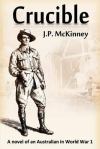
JP McKinney, CrucibleThe winners were announced in Melbourne’s The Age on, appropriately, Anzac Day in 1935. I say winners because first (£150) and second (£50) prizes were awarded. The first went to Over the top by ‘Sar-Major’ (pen-name for JP McKinney, Surfers Paradise, Queensland), with the second going to Summer campaign, by ‘Roger Walters’ (C.W.W. Webster, Melbourne). There were over 50 entries, with the judges being Sir Keith Murdoch, Sir Harry Chauvel, and Mr. Phillips (a Melbourne barrister). A note in Miles Franklin’s papers at the State Library of NSW, states that her novel All that swagger “was entered in the Melbourne Centenary Prize Competition in 1934”.

Over the top was published by Angus and Robertson as Crucible.

But, JP McKinney of Surfers Paradise rang a bell. The newspaper reports didn’t help, though, because the reason I recognised his name came later. Yes, he’s the man who became the husband of one of Australia’s most famous poets, Judith Wright. The things you learn, as I said before!

Miles Franklin Award 2018 Shortlist

Having posted this year’s Miles Franklin Award Longlist I decided I may as well keep on with it! After all, it is, probably, Australia’s most watched award. The shortlist was announced in Canberra tonight – not that I was invited!

Catherine McKinnon, StorylandHere is the list:

Some random observations:

  • Gerald Murnane, a neglected Australian author has made it through to the shortlist, which is great to see. Of being longlisted, he said he was “gratified”, because it was “a suitable reward for the hard task of writing the book.”
  • Two previous winners, Michelle de Kretser and Kim Scott, have made it through.
  • Recent winner of the Premier’s Award in the 2018 Adelaide Festival Awards for Literature, Hornung, has also made the cut. Her novel The Last Garden has also been shortlisted for the ALS Gold Medal. Hornung, who hasn’t been listed for the Miles Franklin, said of being longlisted that it felt “like a personal endorsement.”
  • McKinnon, who has been overlooked, to date, by other awards, has also been shortlisted – which is great to see because it’s an interesting book and a good read. She said about being longlisted that she was “Delighted, dizzy, honoured, thrilled.” What will she feel now!
  • Four of the six books are by women writers, and one is by an indigenous writer.

Judge Richard Neville, Mitchell Librarian of the State Library of NSW, said, justifying the shortlisting in terms of Miles Franklin’s criteria:

The Miles Franklin 2018 shortlist engages with the complexities of Australian life in all of its phases, and the legacy of its timeless Indigenous past and its recent European present. All the novels explore how Australians connect with their complex stories, with their emotional histories, and with the legacy of colonisation. Each author in the shortlist considers what it means to live in a particular location, with unique and challenging vision. The vibrancy of contemporary Australian literature, and its relevance to thinking through the challenges of modern Australia, is confirmed with this diverse and intelligent shortlist.

The winner will take away $60,000, and each shortlisted order will receive $5,000 from the Copyright Agency’s Cultural Fund.

The judges for this year are: Richard Neville (State Library of NSW),  Murray Waldren (journalist and columnist for The Australian), Dr Melinda Harvey (book critic), Lindy Jones (bookseller), and Susan Sheridan (Emeritus Professor in Humanities, Flinders University).

The winner will be announced in Melbourne on 26 August. I congratulate them all and wish them luck …

Is your favourite there? Do you want to make a prediction?