I’m on a roll! That is, this week’s Monday Musings is another post on a lesser known literary prize. I’ll probably stop here for a while, but I came across this one in my notes, and thought, why not? The award is the Hilary McPhee Award (obviously, given the post title!) and is managed by the University of Melbourne. It is relatively new, having been established in 2016, and no, it is not due to a bequest. Hilary McPhee is still – I’m pleased to say – alive.
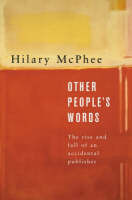
McPhee is probably known to most Australian readers, but may not be so well known further afield. I did write about her some years ago. However, I will recap now. Hilary McPhee is one of Australia’s literary giants. She, with the late Diana Gribble, founded in 1975 a small independent publishing company called McPhee Gribble. They filled a major gap in Australian publishing at the time by bringing us new Australian authors like Tim Winton, Helen Garner and Murray Bail. I have reviewed these writers here because they have all gone on to be giants themselves. McPhee Gribble also commissioned Carmel Bird to write a guide for aspiring writers, which resulted in the well-regarded (and highly readable), Dear Writer (1988). It’s so well regarded in fact that a revised edition was published in 2013 as an eBook titled Dear Writer Revisited. McPhee Gribble survived for 14 years before being sold in 1989 to Penguin. (Soon after, Diana Gribble established Text Publishing.) McPhee documented the history of their publishing adventure in a memoir, Other people’s words (which I read before blogging). It’s a great read – still.
Anyhow, back to the award, which is formally described on the University of Melbourne’s website. It is funded by a donation of $90,000 from Hilary McPhee’s brother, Peter McPhee, a Professor Emeritus of the University of Melbourne. It is for
writers making contributions to the Melbourne University Publishing Limited (MUP) publication, the Meanjin Journal or any replacement or successor publication to that journal.
The actual process, as described by the University in its documentation, is that Melbourne University Press (MUP) will “provide a shortlist of candidates for the Award, from which the Dean of the Faculty [of Arts] (or nominee) will select the recipient in consultation with the Chief Executive Officer of MUP”.
So, what exactly is the contribution being awarded? Well, it seems to be an essay – published in Meanjin, which is one of Australia’s oldest literary magazines. In 2022, the prize was worth $3,500, so not a huge prize but surely a decent feather in the cap. (Australia’s “premier” essay-writing prize is, probably, the Calibre Prize, which currently nets its winner around $7.500.) Announcing the winner of the 2022 award, the Queensland University of Technology’s Centre for Justice blog was more specific about the award criteria, saying that the award “recognises brave essay writing that makes a fearless contribution to the national debate. Eligible essays are shortlisted from those published in Meanjin each calendar year”.

I have not, unfortunately, been able to find a list of the winners. My search engine found next to nothing, it’s too recent for Trove, and Meanjin does not seem to have a page devoted to the prize, which is a shame. Here is all I’ve been able to find …
- 2021: Sylvia Martin, “Homework”, in Meanjin, Summer 2021 (I think this won in 2021 but I might be wrong)
- 2022: Amy McQuire, “The act of disappearing: On the silences that shroud the disappearances of Aboriginal women and girls“, in Meanjin 81 (4), Summer 2022 (This definitely won in 2022, and you can read the essay at the link.)
McQuire’s essay commences with a quote from Audre Lorde, and then this:
We do not know how many Aboriginal women have gone ‘missing’ in this country. The archives are filled with the ‘missing’: the Aboriginal women who are no longer here to speak; the Aboriginal women who do not have names; the Aboriginal women who do not have graves or places where their families can remember them. There is a comfort that comes with the word ‘missing’, because to be ‘missing’ implies that perhaps they have left on their own accord; that there are no perpetrators or violence enacted against them. As Canadian First Nations lawyer and activist Pam Palmater says, the term ‘missing’ is a misnomer: ‘It seems to imply that these women or girls are just lost or ran away for a few days.’ ‘Missing’ also comes with the assumption that the case is still active. When the police speak of ‘missing persons’, there is an implication that the police are still searching for them, and that they will never tire in their search until those who are ‘missing’ are found or come back. Because they are still ‘missing’, the police do not see themselves as responsible for failing to find them; but instead, see the women themselves as ‘responsible’ for going missing in the first place. There is a term specific to this place, in that women are accused of going ‘walkabout’, which serves to naturalise their disappearances as innate to Aboriginal culture, and not a distinctly settler-colonial phenomenon.
It’s a strong and necessary read…
I’d love to know if you know anything about this prize and its winners.
 Whispering Gums