Delicious descriptions: Marie Munkara on cars

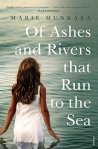
Marie Munkara, Of ashes and rivers than run to the seaI don’t usually post Delicious Descriptions before I review a book but this one seems apposite. Yesterday, we did a tour of the Tiwi Islands – of Bathurst Island in particular. This is where Marie Munkara’s memoir Of ashes and rivers that run to the sea, which I mentioned in my last Monday Musings, is set.

So, the tour … we disembarked from the ferry, wandered up the beach to wait for our local guide, and soon saw a car pull up. One of the other tour members exclaimed, “Look, it’s got no windows!” And no, it hadn’t. Well, that’s not quite true, it had a broken front windscreen. However, it had no side or back windows. Regardless, a horde, seemingly, of locals, climbed in. Now, if you’re an Aussie, particularly if you’ve also seen the TV documentary series Bush Mechanics, you’ll know a bit about indigenous people and their relationship with cars – demonstrating both their resourcefulness and their lack of concern about material things. We saw and heard much evidence of this during our trip.

Anyhow, Marie Munkara certainly learnt about it, the real way – that is, through personal experience. This excerpt comes from the occasion when she agreed to go buffalo shooting …

I can deal with the early start, it’s just the vehicle he’s driving that leaves me dumbfounded. It defies description. I can tell from the rusted skeleton before me that it was once a 4×4 but I wouldn’t have a clue what make it is. A cloud of black smoke billows from the truncated exhaust, and the motor sounds like it’s running on one cylinder. There are no mudguards and the bonnet appears to be borrowed from another car and held in place with fencing wire. There is no tray left on the back anymore –time, salt-water and bad driving have taken care of that. Instead my four brothers are perched on packing crates that have been lashed onto the subframe. They busily light up rollies and shiver in the cool dawn air while early-morning sunlight filters through the bullet-holes in the roof above Colin’s head. My face must be registering concern as I look at the packing crates because Colin laughs and tells me that I have the seat of honour in the cabin. The door is rusted shut so I clamber in through the open window (there’s no glass anyway) and promptly go through the floor. I look down to see myself standing on the road. They were all waiting for that and laugh uproariously as I inspect the gaping hole and wonder where I’m supposed to put my feet. I see that Colin has a similar problem, both floors are totally rusted out.

‘Look there,’ says Colin and I see the rope tied from the window-winder to the steering column that I can rest my feet on as we drive along. Feeling a breeze on my neck I turn to see a gaping hole behind me: the rear window is also missing. Colin explains that this happened when he pulled up and Danny’s arse went through the window and got stuck. How Danny managed to get jammed in that space is beyond my powers of comprehension so maybe Colin’s pulling my leg. I test my foot-rest and it holds, though the thought of what might happen if one or both of my feet come off it as we are driving along almost makes me climb back out again. But I think of what I might miss if I did so I stay. I pretend I haven’t noticed there isn’t a seatbelt and off we go.

I have no idea how fast we’re going because none of the gauges are working, but I can tell it’s fast as we glide over the corrugations in the dirt road like it was smooth bitumen. Colin hoons around the corners like a racing-car driver and I hang onto the seat for dear life and push my feet hard against the rope. I manage to screw my head around without falling down the hole in the floor and look out the rear window. Despite the clouds of dust that enshroud them and Colin’s crazy driving, my brothers are still there, no one has fallen off their packing crate yet.

And that was only the start of an adventure which saw them all limping home, in the rain, after the car ran out of fuel, an event which didn’t surprise Munkara and which our Arnhem Land tour driver seemed to suggest is a common occurrence.

The thing about Munkara is that she’s laugh-out-loud funny. She’s also willing to giving things a go (mostly, anyhow!), and most of all she writes with respect and affection. All being well, I’ll post my review next week.

Monday musings on Australian literature: about Arnhem Land

When this post goes live (during NAIDOC Week) I will be in Australia’s Top End, touring a region called Arnhem Land – and will most likely be incommunicado. Located in the north-east of the Northern Territory, it is named after the ship captained by Dutchman William van Colster who visited the area in 1623. The ship, the Arnhem, was named for the city of the same name, in the Netherlands.

According to Wikipedia, the region has a population of around 16,000, of whom 12,000 are Yolngu, the traditional owners. The main town is Nhulunbuy, with other major population centres being Yirrkala, Gunbalanya, Ramingining, and Maningrida. Mr Gums and I will be visiting most of those places during our 12-day tour. Arnhem Land is known for the fact that a large percentage of its indigenous people live on small outstations on their traditional lands, with minimal western cultural influence. Arnhem Land is almost like a separate country – and visitors need a permit to enter.  Many of its leaders continue to push for a treaty that would allow the Yolngu to operate under their own traditional laws.

East Alligator River, western Arnhem Land

Arnhem Land borders, on its west, Kakadu National Park, which we have visited twice in the past. On both occasions we have done short indigenous-led tours of that border area – one on the East Alligator River, and the other into the country as far as the Injalak Art Centre. Those tours introduced us to some of the culture – the law, the art – of the people. It’s gratifying to feel our understanding of our country growing through these experiences.

However, for my Monday Musings of course, I want to share something of the region’s literary heritage, which given that the traditional culture there is oral, includes song. This list is very little, highly eclectic and very selective.

Some musicians

Yothu Yindi

Probably because I lived some of my childhood years in northwest Queensland, Arnhem Land was familiar to me, but it didn’t really, I think, become known to many Aussies until the band Yothu Yindi burst on the music scene in the early 1990s. The group was formed in the mid 1980s, but it was their song “Treaty” (I did mention of treaty in my intro, after all!) from their album Tribal Voice which brought them to national attention in 1991. The lead singer was Mandawuy Yunupingu and his nephew Dr G Yunupingu, about whom I posted last week, was an original member. The song “Treaty” was a collaborative work by the two Yunupingus, and other members of the band, and non-indigenous museum Paul Kelly. “Treaty” has gone on to become one of Australia’s most significant songs, being named in 1991 by Australasian Performing Right Association (APRA) as one of the Top 30 Australian songs of all time, and being added, in 2009, to the National Film and Sound Archive’s Sounds of Australia registry.

Yothu Yindi could occupy a whole post to themselves, so please check the link I’ve provided if you are interested. They have played a major role in promoting and developing Yolngu culture, to both Yolngu and wider Australia’s benefit.

There are many performances of the song, which includes words in language and English, on YouTube, including this one published by mushroomvideos. Here are a few lines:

This land was never given up
This land was never bought and sold
The planting of the union jack
Never changed our law at all

Dr G Yunupingu

I won’t add much here, because I spoke about his legacy in my above-mentioned post on Gurrumul, the documentary film about him. Besides the fact that his music is beautiful, and that he sang about his culture (and lived his culture for all to see), Dr G also made a significant contribution to Australian culture by writing and performing most of his songs in the languages of his region. The pride in culture that singing in language gives to his people can’t be underestimated.

A writer from Arnhem Land

Marie Munkara

Marie Munkara, Of ashes and rivers than run to the seaA member of the Stolen Generations, Munkara was born on the banks of a river in Arnhem Land, but she was taken, at the age of three, to a mission at nearby Melville Island (part of the Tiwi Islands). From here she was passed on to European foster parents, and didn’t see her mother again until she was 28 years old. You can read some of her story at SBS. I have reviewed her glorious David Unaipon Award winning book, Every secret thing, and plan to read her memoir Of ashes and rivers that run to the sea while I’m in Arnhem Land (for Lisa’s ANZlitLovers Indigenous Literature Week which coincides with this year’s NAIDOC Week. This year’s theme is, appropriately, Because of her we can.)

A blast from the past

Of course, I had to check out the digitised newspapers in Trove, and by narrowing my search to “Arnhem Land Literature” I retrieved a small number of hits, all from the 1930s, only two of which specifically related to Arnhem Land. Both were short stories by non-indigenous writers about Japanese pearlers in the region. I’ll just share one, because it’s by one of Australia’s most popular authors of the day, Ion Idriess (1889-1979). According to Wikipedia (the link’s on his name), he spent some time, after returning to Australian after World War I, travelling in the remote Cape York region, and working with pearlers and missionaries in the Torres Strait islands.

His story, titled “The massacre on the No Gawa Maru”, was published in Sydney’s The Sun on July 11, 1936, and clearly draws from his knowledge of pearling. It’s about a Japanese pearl-shell poacher, Captain Toyama of the “No Gawa Maru”, who “knew he was cruising here against the laws of his own Government and the Australian.” He knows about the Three-Mile limit, and he’s also aware of the Australian patrol boat, the “Larakia”, with its machine gun. It’s “nervy” business this pearl-shell poaching, but they are driven by “fatalism and greed and hope”, the idea of “easy wealth, quickly won.” (Something Idriess likens to the Australian gold field mania which also sent men to “lonely graves”.)

Anyhow, Idriess sets the scene:

They had passed Groote Eylandt lying away eastward with its hills rising as if from a great grey cloud upon the sea. Captain Toyama now stared for’ard where along the Arnhem Land coast islands were taking shape in silhouettes of tree-tops. Presently he saw the sun sheen on straw-colored grass.

Toyama’s crew tell stories of brutal indigenous attacks on boats, too, and of indigenous men selling their women “cheerfully” and the women going “eagerly”, but to accept this “is a death trap. Their women are only a snare. They kill for blood lust and loot.” He refers here to King Wongo of Caledon Bay, who was a real person. Idriess’ story is a gruesome, dramatic story about an indigenous attack on Toyama’s boat. According to the Australian Dictionary of Biography (ADB), it appears that Idriess bought into the idea of Wonggu/Wongo as an “evil genius” behind this sort of brutality, but not all agreed. ADB’s article on Wonggu concludes:

A man of influence, authority and charisma, he represented a romantic and little known aspect of Northern Territory history. More importantly, the events in which he was involved drew attention to the issues of Aboriginal justice and rights to land.

Trove, which I’ve only dipped into about this, certainly includes some very positive articles about Wonggu/Wongo.

The other story is by Keith Ellis, and is called “Sampans”. You can read it online if you like.

I hope that by the time we’ve ended our Arnhem Land tour we’ll know not only more about contemporary culture, but about some of its history and past characters too. I’ll report back if we do!

PS: There’s a good chance I will not manage to post a Monday Musings next week. Enjoy the break!

My literary week (12), some art, a film, and an unseen play

Much as I’d like to, I don’t have time to write full posts on the three “events” I’m writing about today, but I do want to at least document them. I don’t, in fact, document every film, show or exhibition I attend but I have particular reasons, which will hopefully become obvious, for wanting to share these three.

MoMA at the NGV (National Gallery of Victoria)

For a very exciting reason – Mr Gums and my becoming grandparents for the first time – we made a flying trip to Melbourne last weekend, and, as we couldn’t spend all our time gazing at the adorable newborn, we took ourselves off to the current exhibition at the National Gallery of Victoria during our long weekend. Titled MoMA at NGV: 130 Years of Modern and Contemporary Art, it comprises a selection of MoMa’s world-famous collection. About 200 pieces the website says. The works are organised pretty traditionally – that is, in chronological order, but within this order there are themes, mostly relating to specific art movements, such as Cubism, Fauvism, Abstract Expressionism, Pop Art, and so on. The website says that “the exhibition traces the development of art and design from late-nineteenth-century urban and industrial transformation, through to the digital and global present.” It’s an inspiring exhibition, but like all such big, dense, exhibitions, we had tired by the end, despite breaking for lunch in the middle – so my concentration, not to mention my feet, did start to fail, affecting what I remember.

Anyhow, the exhibition opens with a wall comprising a work each by van Gogh, Gauguin, Cézanne and Seurat, who, the audioguide explained, are deemed to mark the beginning of modern art.

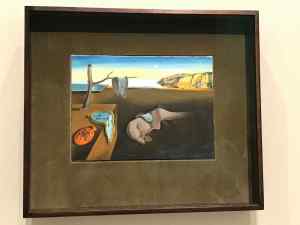
Salvador Dali, The persistence of memory, 1931

So, what did I enjoy? Of course, I liked seeing famous works by well-known artists, such as Dali’s “The persistence of memory” (the famous melting/dripping clocks painting). Who knew it was so small? Well, you do know it, if you read the small print in art books, but you don’t tend to remember that – at least I don’t always. It’s only seeing the work itself that makes this stick. This is partly what makes going to exhibitions so worthwhile. I also enjoyed seeing lesser known works by well-known artists, and works by artists I barely know or didn’t, until last weekend, know at all! And, I appreciated the inclusion of women artists, such as photographer Margaret Bourke-White (1904-1971) who was apparently looked at askance for photographing machines.

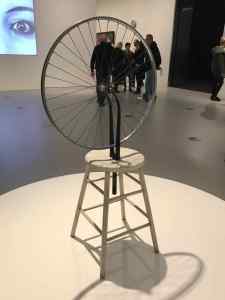
Marcel Duchamp, Bicycle wheel, 1951 (original was 1913)

There is so much more I could say, but, this being a litblog primarily, I’m going to end on one idea that particularly tickled me. Early in the exhibition is a work by Marcel Duchamp, the originator not only of Dada but of the art of “readymades“. The audioguide argued that one of Duchamp’s contributions to modern art was the idea that a work of art is not complete until it is joined with the viewer’s perception and questions (even if, the guide said, that question is, “is this art?”) This got me thinking once again about reading, and the fact that a book has as many meanings as it has readers, because each of us brings our own perspectives to it. An old hat idea, now, I guess, but I liked that Duchamp’s ideas resonated for me beyond the visual arts.

Gurrumul (Cinema Nova, Carlton)

Another exciting event in our lives – one still to come – is that in a few days we’ll be heading off to Australia’s Top End, to tour Arnhem Land and then spend a few additional days in Darwin. I can’t wait for the warmth – nor to experience Arnhem Land which has been on my must-visit list for some time now. Luckily for us, two friends have just returned from the same tour, and they advised us, in preparation, to see three films: Ten canoes (which we’ve seen before, but looked at again, via DVD last week), and two recent documentaries Gurrumul and West wind: Djalu’s legacy.

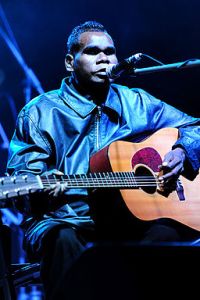
Gurrumul Yunupingu

Dr G Yunupingu @ Fremantle Park (17/4/2011), By Stuart Sevastos, using CC BY 2.0 (Wikimedia Commons)

Unfortunately we’ve missed West Wind on the cinema circuit, and it’s not available on DVD until later this year, but Gurrumul is still screening. So another time-filling activity for us in Melbourne was to see it at the Cinema Nova in Carlton. For those of you who don’t know, the film is about the recently deceased indigenous Australian musician, Dr G Yunipingu (the name used for him since his death in respect of indigenous Australian funerary practices. Permission was given, by Yunipingu himself the film says, for the film to be released, despite another indigenous practice of not showing images of deceased persons for some time after their deaths.)

Dr G Yunupingu was born on Elcho Island, in Arnhem Land, and was discovered early in his life to be blind. He taught himself to play music, and was clearly gifted – though it was his voice (“the voice of an angel” some said) that really captured attention. He wrote his own songs, which he sang mostly in language. The film chronicles, primarily, his musical life, but given his close connection to his culture, that couldn’t be done without reference to his family and culture.

It’s a traditional documentary, style-wise, but it’s the content, the subject himself, that makes this such a moving film. I was quite wrung out by the end – and not only because it had been an emotional couple of weeks leading up to it. One of the issues underpinning the film is an age-old story for indigenous people – the challenge of moving between two opposing cultures. It was a challenge that brought indigenous artist, Albert Namatjira, undone in the end. Dr G Yunupingu managed it better overall – partly because of his own sense of self and strong attachment to his country and culture, but partly also because his non-indigenous mentors had learnt from history and were respectful of Yunupingu’s wishes. This doesn’t mean that there weren’t tense times! The film will, I’m sure, enhance our Arnhem Land trip – but it’s worth seeing regardless.

Tourmaline (The Street Theatre)

Randolph Stow, TourmalineAnd, well, this last stop in today’s post is exciting too – but disappointing also, as I will be missing it. Yes, I am concluding this post by discussing something that not only have I not seen, but won’t be seeing either. I have a very good reason though for this strange behaviour, and it’s that the production, an adaptation of Randolph Stow’s novel Tourmaline, was written by Emma Gibson, one of the bloggers I mentored in last year’s Litbloggers of the Future program. Emma, in fact, wrote a guest post for this blog on Stow and the novel.

It is part of a double bill of adaptations of sci-fi-futuristic texts, the other being HG Wells’ War of the worlds. In her guest post, Emma said that the book has been described as an “ecological allegory”. This would slot nicely into Emma’s main interest, at present anyhow, which is writing about place. According to the promotions, the adaptations are made for radio – which is great to see in itself – but are being performed on stage at the Street Theatre. I am so sorry that I will be missing it – but I wish playwright Emma, and The Street, the best success with it.

Do you have any cultural outings to share?

Monday musings on Australian literature: Reconciliation Day in Canberra

National Reconciliation Week 2018 LogoToday, 28 May 2018, we in Canberra celebrated our inaugural Reconciliation Day Public Holiday. We are the first jurisdiction in Australia to have such a public holiday*. From this year, this day will be held on the first Monday after 27 May or on the 27th if it is a Monday – the 27th being that anniversary of the 1967 referendum which resulted in a change to the Australian constitution to enable indigenous Australians “to be counted in reckoning the Population”. Our Reconciliation Day falls within Australia’s National Reconciliation Week (27 May to 3 June), whose theme this year is Don’t keep history a mystery: Learn. Share. Grow.

The aim of the Week (which commemorates both the Referendum and the MABO decision) is, as Reconciliation Australia says on its website, for “all Australians to learn more about Aboriginal and Torres Strait Islander cultures and histories, to share that knowledge and help us grow as a nation. And for this year’s theme, their aim is for us “to learn more about the Australian story.”

Now, to my mind there are two incontrovertible facts – no matter what interpretive layer might be added to them. These are that:

  1. Indigenous (Aboriginal) Australians were here first, tens of thousands of years first in fact.
  2. Non-indigenous Australians arrived in the late eighteenth century and took up land will-nilly to suit their needs, with no formal, practical recognition of the existing inhabitants and their ownership of the land.

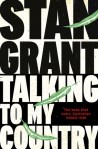
Stan Grant, Talking to my countryWhen I decided to write this post I wondered how best to make it fit the Monday Musings subject, but the Week’s theme – Don’t keep history a mystery – gave me my angle. And so, although I recognise the importance of fiction to understanding history and its impact, here I’m going to share a selection of non-fiction works, by indigenous writers, which tell their history and/or the impacts of their history on their lives. (I’ve read some of these, including some before my blog, but not all). Here goes

  • Eric Wilmot’s Pemulwuy: the rainbow warrior (1987): a rare history, particularly at the time, of an indigenous Australian hero. We all know about Australian “heroes” from our past but how many of us know – or were taught about – Pemulwuy or Jandamarra, for example.
  • Ruby Langford Ginibi’s Don’t take your love to town (1988) is now regarded as a classic indigenous memoir, one documenting her survival in spite of the poverty and tragedy surrounding her.
  • Sally Morgan’s My place (1988): Although my consciousness had already been raised by reading books by non-indigenous writers, like CD Rowley, in the 1970s, it was Sally Morgan’s My place which really brought home for Aussies some of the ways dispossession had impacted indigenous people’s lives – the shame, in particular, that her ancestors had been made to feel.
  • Doris Pilkington’s Follow the rabbit-proof fence (1996, Bill’s review, The Australian Legend): one of the first stories – better known to many Aussies via the feature film – about Stolen Generation children’s experiences to come to the wider Australian public.
  • Anita Heiss’s Am I black enough for you (2012, my review) is a contemporary urban successful indigenous woman’s manifesto about the challenges of being indigenous in modern Australia, setting assumptions and expectations against facts.
  • Noel Pearson’s Quarterly Essay: A rightful place: race, recognition and a more complete Commonwealth (2014): the title says it all. I should have read this one.
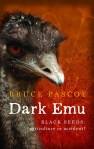
  • Bruce Pascoe’s Dark emu, black seeds (2015, my review) which publisher Magabala Books says “attempts to rebut the colonial myths that have worked to justify dispossession.”
  • Stan Grant’s Talking to my country (2015, my review) which he was inspired to write when he realised that the booing of footballer Adam Goodes “was about our shared history and our failure to recognise it.” Exactly this week’s theme!Bruce Pasco, Dark emu

Reconciliation Australia lists more books and reports, including fiction and works by non-indigenous Australians. It’s well worth checking out – and contains many works I have never heard of, let alone read.

Meanwhile, there were many ways to celebrate Reconciliation Day in Canberra, including a Reconciliation Day Eve concert with Archie Roach and Tiddas, a Reconciliation Day in the Park event, and special events at various cultural institutions including the National Museum of Australia, the National Film and Sound Archive, and the National Gallery of Australia.

This is an important day for itself, but it’s also important to help redress the imbalance created in recent years by over-emphasis on the importance of Australia Day and ANZAC Day. I am not averse to these days but I am to suggestions that they, individually or together, define Australia and Australians. They don’t. They contribute to what makes us Aussies – but we have a bigger history that we must (personally and politically) also recognise and accept as being part of what defines us.

Do you have any favourite books on the topic? (Or on a similar critical topic, if you’re not Aussie?)

* It was created by replacing a previous holiday, rather than by adding an additional holiday to our calendar.

John Lang, The forger’s wife (#BookReview)

John Lang, The forgers wifeWhen new publisher Grattan Street Press offered me a review copy of John Lang’s The forger’s wife last November, I couldn’t resist, even though it is from their Colonial Australian Popular Fiction series. I say “even though” because, had it been written now, it would probably not have come under my radar. It’s very much in the popular vein. However, as a piece of work first published (in serial version) in 1853, it has much to offer modern readers.

It raises the question, in fact, of why read historical fiction when you can read from the time itself. I’m being a bit flippant here, I know. There is reason – there’s value in looking back, in revisiting the past with eyes from the present – but the question is worth asking, if only to focus our minds on context when we read.

Enough pontificating though, let’s get to the book – or, first, to the author. According to Grattan Street Press, John Lang was Australia’s first locally born novelist. I have in fact written about him briefly before, in a Monday Musings post, but I hadn’t had a chance to read him, until now. I mentioned in that post Victor Crittenden’s biography, because its title says a lot – John Lang: Australia’s larrikin writer: barrister, novelist, journalist and gentleman. Ken Gelder and Rachel Weaver’s Introduction to The forger’s wife provides interesting background to his life, some from Crittenden’s work. Lang, it seems, lived quite a peripatetic life, and had had a few books published by the time The forger’s wife was serialised.

Gelder and Weaver write that it’s generally accepted that The forger’s wife is “the first novel by an Australian-born novelist to feature an Australian detective.” They go on to suggest that it is “the first detective novel in the Anglophone world” arguing that it predates by around ten years The Notting Hill Mystery by Charles Felix which has been seen as the first detective novel in English. The rest of their introduction – naturally, because the series is about popular fiction – focuses on the book as a detective novel. However, I’d like to discuss other things.

The novel is essentially a melodrama which, say Gelder and Weaver, follows “the fairly familiar pattern of a female emigrant’s tale.” It tells the story of Emily Orford, the rather spoilt only child of a well-to-do British army officer. Eschewing more suitable suitors, she falls for a man whom she believes to be Captain Reginald Harcourt, but who is, in fact, the forger Charles Robert. Immediately after their elopement, he is arrested and convicted of forgery, and transported to Australia. Emily, believing that Reginald is innocent, follows him to Sydney. Here, she luckily finds a few friends amongst the colony’s rough and tumble, one being the convict turned policemen-and-thief-taker (our detective), George Flower. She also reconnects with the scurrilous Reginald/Charles, who, despite getting into increasingly outrageous scrapes, manages to keep Emily believing in him. This is a 19th century melodrama so it all turns out alright in the end, though not necessarily exactly as readers might expect.

What I want to talk about now, though, is why this novel is worth reading – besides its credentials as a pioneering detective novel, that is. My reasons have to do with the insight it provides into colonial life. Think how much we learn about life in mid-nineteenth century England from Charles Dickens’ novels. So …

“this uncouth and cruel land” (Emily)

We learn a few things about early to mid-nineteenth century colonial Australia, starting with some vivid descriptions of town and country. We learn about the roughness, the struggle to survive which results in various combinations of theft, corruption, bribery. The novel’s themes include the survival of the wiliest, and the challenge of identifying who you can trust. The naive, trusting Emily would not have survived a minute without the initial help of Captain Dent from Lady Jane Grey, the boat she arrived on, and then George Flower who looks out for her.

We learn about how women make a living – some via the oldest profession. Emily, though, gives piano lessons. However, when she becomes persona non grata because of Reginald, she’s “compelled to do needlework, to knit socks and comforters”. We learn about convicts who become policemen versus those who become bushrangers. We learn about settlers taking the law into their own hands. George Flower, on the hunt for Reginald now turned bushranger, tells a well-to-do settler that settlers need to learn to protect themselves:

The Gov’ment’s a fool for paying for mounted police. You ought to learn the value of combination, and how to protect yourselves.

Later on the same page he says:

I wish to teach you settlers, and the Gov’ment, and bushrangers, a great moral lesson. I want to make you more independent and secure – bushrangers less numerous and daring – and Gov’ment more economic and sensible.

And, of particular interest to me, we learn about attitudes to the original inhabitants. In between the above two comments, Flower says:

You can club up to get rid of the blacks, when they spear your cattle or kill your sheep. Why can’t you capture your own bushrangers?

So, the settlers clearly have no compunction about getting rid of “the blacks” themselves. Presumably they are “easier pickings” and don’t warrant the respect of a lawful process? You don’t always need to read history, then, to know what went on. Sometimes fiction contains useful truths.

There are other references – or not – to Indigenous people. A little earlier than the above scene, Flower is enjoying a lovely moment in a remote spot, where:

he discoursed for some time with [bushranger] Millighan on the grandeur of the scene, and the sweets of liberty. It was a beautiful warm day, and not a cloud in the sky. The foot of man had never before trod the ground on which Flower and Millighan were then standing.

I don’t think Lang was being ironic here!

Later, Flower returns to the same spot, where Millighan’s skeleton now lies. He treats the skeleton of this “brave” adversary with respect, leaving a note to ensure that when, in the future, the remains might be “stumbled across”, the finders will “not suppose he was some black fellow”!

And yet, a page later, there’s recognition of learning from these same “black fellows” when he makes a fire “as the Aborigines do, by rubbing two pieces of dry stick together until they ignite.”

The final reference to Indigenous people also refers to cultural learning. We are told that Flower, now back in England, had become very “‘colonial'” not only in “outward appearance”, but also in “parlance”. “He had mixed a good deal with the blacks” and, while the Aboriginal language was not “thoroughly understood by the Europeans”, it had contributed “sundry worlds and phrases” which Flower used, to the incomprehension of his listeners.

So, while I found the story itself entertaining – indeed a thoroughly enjoyable read – it’s these unconscious insights into the times by a writer of the times that has made this book memorable. I would love to read more in this series.

John Lang
The forger’s wife
Parkville: Grattan Street Press, 2017 (Orig. serialised in 1853)
224pp.
ISBN: 978098762304

(Review copy courtesy Grattan Street Press)

PS: I apologise for overwhelming your inboxes/reader feeds this week. There’s been a lot on. I’ll return to situation normal next week.

Monday musings on Australian literature: Jane Austen and the Stolen Generations

Yes, you read right, this very brief Monday Musings post is about what Jane Austen might have said – did say in her way – about the Stolen Generations.

What makes great literature great is its timelessness. By this I mean the fact that what is said in, say 1815, is still relevant in, say, 2018. It is this timelessness, in particular, that makes me love Jane Austen. She is so right, so often, about human nature and human behaviour. So, while the quote I’m planning to share comes from British not Australian literature, and from 1815 not 2018, it relates closely to an issue that is currently very important to Australians, the Stolen Generations.

Here’s the quote:

There is something so shocking in a child’s being taken away from his parents and natural home. (Emma, ch. 11: Mrs John Knightley on Frank Churchill being removed from his home after his mother’s death)

“Something so shocking”. There’s nothing much more to say, is there … except that …

… when I drafted and scheduled this on February 7 for posting on Monday February 12, I hadn’t remembered that the next day, February 13, was the tenth anniversary of the Australian Government’s Apology to the Stolen Generations. How freaky – but how appropriate – is that? It’s also rather concerning because, as Reconciliation Victoria says:

As we approach the anniversary of the historic Apology we know that Aboriginal and Torres Strait Islander peoples are still grossly over-represented in our prisons, in out-of-home care, are still dying in custody and are still subjected to racism on a regular basis. There is still much work to do.

It’s a continuing blight on our government, on all of us, that we have achieved (are achieving) so little by most measurable standards.

For those who would like to hear the speech PM Rudd made in the Australian Parliament, here is the YouTube link.

Monday musings on Australian literature: Teaching indigenous texts

This post was inspired by an email I received from Reading Australia announcing a partnership with the Broome-based indigenous publisher Magabala Books for a project that was

inspired by the many teachers who reached out to Reading Australia to ask for more resources on works by Indigenous creators, and particularly units that showed non-Indigenous teachers how to teach Indigenous texts.

Then, quite coincidentally, I read on my Twitter feed this morning about a one-day seminar that had been run last week by AustLit’s BlackWords (about which I’ve written before) called Teaching with BlackWords Symposium – so I decided to broaden this post a little. As someone who is keen to promote and review indigenous writing but is always a bit anxious about it, I’m thrilled to see programs like these offering to help people who feel the same and who have formal responsibilities for teaching and sharing.

Reading Australia and Magabala Books

When I clicked on the link in my email announcing the Reading Australia-Magabala Books partnership, I discovered that this was the second such project, supported because of the success of the first. Both projects are funded by the Copyright Agency’s Cultural Fund.

The first project, implemented in 2017, involved Magabala Books creating resources for 15 books for primary school teachers to use in classrooms. You can access resources for 11 of the nominated 15 books on the Magabala site. I’m assuming that the rest is still to come.

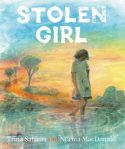
Saffioti, Stolen girlSo, for example, the resource for Stolen Girl (which was written by Trina Saffioti and illustrated by Norma MacDonald) starts with a section titled “connecting to prior knowledge” and points teachers to additional resources like the Bringing them home report. The resource says the book is suitable for around Year 4 (ie around 9-10 year olds). It starts by encouraging children to think about the meaning of “home” and the difference between “house” and “home”. It asks teachers to carry out an Acknowledgement of Country, to discuss its meaning and to talk about the name of the country in which the school is located. It also refers them to use stories from a site called Australians Together. These are just a few of a whole raft of activities helping teachers explore the ideas and history behind this book.

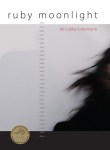
Ali Cobby Eckermann, Ruby MoonlightThe 2018 partnership turns to secondary school teaching. It identifies 8 books (listed in the order used on the site) for which resources will be written:

  1. Becoming Kirrali Lewis by Jane Harrison
  2. Dark Emu by Bruce Pascoe (my review)
  3. Grace Beside Me by Sue McPherson
  4. Jandamarra and the Bunuba Resistance by Banjo Woorunmurra and Howard Pederson
  5. Ruby Moonlight by Ali Cobby Eckermann (my review)
  6. Songs That Sound Like Blood by Jared Thomas
  7. Ubby’s Underdogs: Heroes Beginnings by Brenton E. McKenna
  8. Us Mob Walawurru by David Spillman and Lisa Wilyuka

I’ve only heard of a few of these books, but from what I do know it looks like a good variety.

I wonder how well promoted this program is, and how much it is being used in schools?

Teaching with BlackWords Symposium

Moving up the educational tree, the BlackWords Symposium was geared to secondary and tertiary teachers. The symposium was subtitled Best Practice for Teaching with Indigenous Stories, and promoted as “an important professional development event for teachers.”

The promotion continued:

Have you ever felt concerned, awkward about, or ill-prepared to teach Indigenous authored texts and issues into your classroom?  Would you like advice on how to respectfully use Aboriginal and/or Torres Strait Islander stories and history in your teaching? Do you think your teaching could benefit from a deeper understanding of the concerns and issues that First Nations writers address in their work?

The symposium was apparently sold out. How wonderful is that?

The  speakers were some of our big movers and shakers in promoting indigenous literature, Dr Anita Heiss, Professor Larissa Behrendt, Dr Sandra R. Phillips, and Samuel Wagan Watson. Also, someone I don’t know, Lindsay Williams, described as the “English Teacher Guru”, led a workshop on “using AustLit’s BlackWords resources in the classroom”. The day was chaired by Anita Hess and Kerry Kilner (of AustLit). AWW team member and author Jessica White, whose novel Entitlement I’ve reviewed, tweeted that it was “an amazing day”. Lucky her.

Things are happening, consciousnesses are being raised – but we are a long way, yet, from resting on our laurels.

Stan Grant, Talking to my country (#BookReview)

Stan Grant, Talking to my countryHistory is, in a way, the main subject of my reading group’s October book, Stan Grant’s Talking to my country. I’m consequently somewhat nervous about writing this post, because discussions of history in Australia are apt to generate more emotion than rational discussion. I will, though, discuss it – through my interested lay historian’s eyes.

However, before we get to that, I’d like to briefly discuss the book’s form. Firstly, it’s a hybrid book, that is, it combines forms and/or genres. In the non-fiction arena, this often involves combining elements of memoir with something else, like biography, as in Gabrielle Carey’s Moving among strangers (my review). In Grant’s case, he combines memoir with something more polemical – an interrogation of Australian history, and how the stories we tell about our past inform who we are and how we relate to each other.

Secondly, and probably because it’s not a straight memoir – Grant wrote his memoir, The tears of strangers, in 2002 – the book is structured more thematically than chronologically, though a loose chronology underlies it. For example, his discussion of the lives of his grandparents and parents doesn’t happen until Part 3, and then in Part 4 he discusses the government’s policies for handling “the ‘Aboriginal problem'”, particularly that of assimilation (or, more accurately, “absorption”.) This structure enables him to focus the narrative on his theme, so let’s now get to that.

The book opens with an introductory chapter titled, simply, My country: Australia. In it, Grant sets out why he wrote the book, which is to convey to non-indigenous Australians just what life is like for indigenous people, to explain that although history is largely ignored it still “plagues” indigenous people, and to tell us that the impetus for him to finally write the book was the booing of indigenous football player Adam Goodes in 2015. And here, in very simple terms, Grant states his thesis:

This wasn’t about sport; this was about our shared history and our failure to recognise it.

He goes on to explain that while some tried to deny or excuse it, his people knew where that booing came from. From my point of view, it’s pretty clear too.

“the gulf of our history”

Now, I’m not going to summarise all his arguments – or the stories of his and other indigenous people’s experiences – but I do want to share some of his comments about history. As Grant is clearly aware – and what Australian isn’t – history is politicised, sometimes consciously, sometimes unconsciously. My generation, the baby-boomers, grew up learning that Captain Cook discovered Australia and that Governor Phillip established the first settlement. If Aboriginal people were mentioned, it tended to be in passing. They were merely a side-bar to the main story. We may have learnt about the missions (and the “great” work they were doing) and we may have learnt in later years of schooling that many indigenous people lived in poverty, but we weren’t told about the massacres and violence that occurred, and nor was it ever suggested that we* had invaded an already occupied land. However, as we now know, these things we weren’t told are incontrovertible facts, supported by evidence.

Some, unfortunately, still ignore these facts and some try to interpret them differently, while the rest of us accept them but feel helpless about how to proceed. And this leads directly to Grant’s underpinning point, which is that we – black and white Australians – meet across “the contested space of our shared past”. Elsewhere he states it a little less strongly as “the gulf of our history”. I love the clarity of these phrases. They explain perfectly why discourse in Australia regarding indigenous Australians can be so contentious and so often futile. Grant’s point is that we can’t progress as a unified nation until this space is no longer contested, until the gulf is closed or bridged.

Grant puts forward a strong case based on experience, anecdote and hard facts (such as the terrible, the embarrassing, statistics regarding indigenous Australians’ health outcomes, incarceration rates, etc) to encourage all Australians, “my country” as the title says, to understand why, for example, when we sing the national anthem – “Australians all, let us rejoice” – indigenous people don’t feel much like joining in. What do they have to rejoice about? Where is their “wealth for toil”.

Suffice it to say that I found this a powerful book. While in one sense, it didn’t teach me anything new, in another it conceptualised the current state of play for me in a different way, a way that has given me new language with which to frame my own thoughts.

By now, if you haven’t read the book, you’ll be thinking that it’s a completely negative rant. But this is not so. It’s certainly “in your face” but Grant’s tone is, despite his admitting to anger, more generous. His aim is to encourage us white Australians to walk for a while in the shoes of our indigenous compatriots and thus understand for ourselves what our history, to date, has created. He believes that good relationships do exist, that there is generosity and goodwill but that, as the Adam Goodes episode made clear, bigotry and racism still divide us.

Late in the book Grant discusses the obvious fact that this land is now home to us all, that many of us have been here for generations and “can be from nowhere else”. Rather than rejecting “our” claims to love this place, he writes that this should make it easier for us to understand indigenous people’s profound connection to country. He writes:

I would like to think that with a sense of place comes a sense of history; an acceptance that what has happened here has happened to us all and that to turn from it or hide from it diminishes us.

And so, rather than telling indigenous people that “the past is past” and “to get over it”, it would be far better, far more honest, far more helpful, for us non-indigenous people to say, “Yes, we accept what we did and understand its consequences. Now, how should we proceed?” Is this really too hard?

Stan Grant
Talking to my country
Sydney: HarperCollinsPublishers, 2016
230pp.
ISBN: 9781460751978

* And by “we”, I mean, as Robert Manne explains it, not “we” as individuals, but as the nation.

Monday Musings on Australian literature: the Boundless Festival

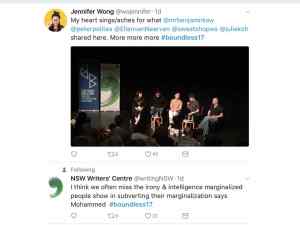
Boundless Festival panelLast Saturday, the NSW Writers’ Centre and Bankstown Arts Centre presented Boundless: A Festival of Diverse Writers, which they describe as the “first-ever festival focused on Indigenous and culturally diverse Australian writers and writing”. My first reaction was, Really? Surely not. There was Blak and Bright held last year in Melbourne. But, hmm, that was specifically Indigenous. I couldn’t, quickly anyhow (and that’s relevant in itself), think of anything else. So, Boundless does appear to be the first to combine all of Australia’s culturally diverse writers under one umbrella. This is a worry. However, the good thing is, as the post-festival tweets suggest, that it was a stimulating event.

It was also free, and comprised “performances, readings, panel discussions, audiovisual experiences, and workshops for children and adults.” And, if you haven’t guessed, the Festival’s name references the line “boundless plains to share” from Dorothea Mackellar’s poem “My country”. It’s a great title, having both ironic and aspirational connotations.

So, who was there? And what was the program? According to the website, over 40 artists were involved. I have to admit that I’ve only heard of a few, including:

  • Ivor Indyk, an Australian-born editor and publisher of Polish immigrant parents. He founded Giramondo Publishing.
  • Mirielle Juchau, an Australian Jewish writer, whose novel The world without us was shortlisted for the Stella Prize and NSW Premier’s Literary Award.
  • Julie Koh, an Australian-born writer of Chinese-Malaysian parents, whose short story collection, Portable Curiosities, was shortlisted several awards including a NSW Premier’s Literary Award. Koh was also named as a 2017 Sydney Morning Herald Best Young Australian Novelist.
  • Benjamin Law, an Australian-born writer and journalist of Hong Kong Chinese parents. His memoir The family Law was adapted for a television series.
  • Hoa Pham, a Vietnamese-Australian writer whose novel, Lady of the realm, I’ll be reviewing soon.
  • Ellen van Neerven, an indigenous Australian writer whom I’ve reviewed here a few times.
  • Markus Zusak, an Australian born writer of German and Austrian parents. I’ve reviewed  his young adult-adult crossover novel, The book thief, here.

I need to say that the listing of artists in the Festival Program did not provide their origin, which is, I guess, about not labelling. However, I felt that readers here might want to know something about their backgrounds because that, presumably, explains their role as presenters at a festival specialising in diversity. I really hope this hasn’t been insensitive of me.

It was a pretty packed program, with some concurrent streams. The sessions included:

  • GetSmART: An insider’s look into the world of book publishing. It was convened by Jennifer Wong, host of Bookish on ABC iView, and involved publishers Chren Byng (HarperCollins), Ivor Indyk (Giramondo), and Robert Watkins (Hachette).
  • Shaping the horizon: Exploring how new writers are “reshaping the landscape and literature of Australia” and its effect on “how we see ourselves as a community”. Convened by Benjamin Law, and involving Michael Mohammed Ahmad, Julie Koh, Peter Polites, and Ellen van Neerven.
  • All in the family: About how to “write about families without offending your own”. It involved Cathy Craigie, Mireille Juchau, Benjamin Law, Omar Sakr, and was convened by Jennifer Wong.

Other events and activities included a pop-up bookstore with book signings (which you’d expect at literary festivals), panels and workshops for children and young adults, film screenings, and a poetry slam.

Just prior to the festival, The Au Review interviewed Benjamin Law who said about the importance of festivals like Boundless:

By some measures, Australia’s one of the most diverse nations on the planet. We’re home to the oldest living, surviving and thriving human cultures and communities bar none, with Aboriginal and Torres Strait Island storytelling spanning back millennia and continuing to present day. About half of us have parents born overseas and a quarter of us are migrants. One in five speak languages other than English at home. And yet that’s rarely the image of Australia we export or tell ourselves. Showcasing Australian writing in all of its diversity is a vital start.

And answering a question about how he’d define “Australianness” he said:

We’re a happily mongrel nation and one of the most diverse on the planet. And we’re a happy group of contradictions that must be acknowledged: the home to the oldest living human cultures and communities bar none, as well as one of the youngest modern immigrant nations on earth. If you disagree with me, die angry about it.

Nothing fancy here, just plain description. I like it – though perhaps not everyone would use the terms “happily” and “happy”, not yet anyhow.

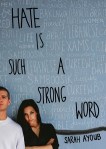
Sarah Ayoub, Hate is such a strong wordAlso just before the Festival, SBS.com.au wrote about Lebanese-Australian author Sarah Ayoub, who has written two YA novels, Hate is such a strong word and The Yearbook Committee. She speaks about growing up in a mono-cultural part of Sydney where she never experienced racism but, she says, as she grew up:

I started to think about how ethnic enclaves don’t really do much for cultural cohesion. I found that there were so many stereotypes that white people had about my community and there were so many stereotypes that my community had about white people.

Ayoub believes that Australia is now at the forefront of diverse publishing, and names Alice Pung, Randa Abdel-Fattah, Tamar Chnorhokian, Melinda Marchetta, and Michael Mohammed Ahmad as her favourite authors writing about multi-cultural Australia.

So, there’s positivity about how we are going, but to make sure we don’t become complacent, I’ll conclude with a tweet (hashtag #boundless17) from Djed Press:

White facilitation and white programming at festivals is really problematic and not often discussed.

Festivals like Blak and Bright and Boundless are important initiatives on our journey to being a true (and happy) multicultural nation, but as this tweet makes clear we certainly have a way to go yet.

Do you actively seek “diversity” (however YOU define it) in in your reading?

Carmel Bird (ed), The stolen children: Their stories (#BookReview)

Carmel Bird, The stolen childrenCommenting on my post on Telling indigenous Australian stories, Australian author Carmel Bird mentioned her 1998 book The stolen children, describing it as her contribution “to the spreading of indigenous stories through the wider Australian culture”. It contains stories told to, and contained in the report of, the National Enquiry into the Separation of Aboriginal and Torres Strait Islander Children from their Families (Bringing them home)*. She offered to send me a copy, and of course I accepted (despite having read much about the Report at the time.)

Bird said in her comment that the book is “still regularly used in schools”. This is excellent to hear because it contains a history that needs to be told – forever, alongside all those other histories taught to Australian students. It needs to be as well (if not better) known by our students as the story of The Gold Rush or Our Explorers. We need to know it, we need, as a nation, to know our dark side, our failures, as well as our big adventures and achievements.

What makes this book particularly useful is Carmel Bird’s curation of it – and I would call what she’s done “curation” because of the complexity and variety of the writings she has gathered and organised. Bird has structured the book carefully to tell a story, with introductory front matter (including a preface from Ronald Wilson the National Committee’s prime commissioner); the Stories themselves; Perspectives from people at the time, including Hansard excerpts from politicians at the tabling of the Report; the Report’s Recommendations; and end matter comprising an Afterword from historian Henry Reynolds and a poem titled “Sorry” by Millicent whose story appears in the Stories section. Bird’s curation also  includes providing introductions to each of the stories to draw out important issues or points about that person’s situation, and adding other explanatory notes where appropriate.

This careful curation ensures that the book contains all the content and context it needs to stand alone as a resource for anyone interested in the Stolen Generations.

“It made no sense”

In her story, Donna says “It made no sense”. She’s describing her train trip away from her mother in the company of a white woman, a train trip she’d been initially excited about, thinking it was to be a family trip. However, with her mother staying behind on the platform and her brothers disappearing one by one as the journey went on, it just made no sense to her.

None of the stories make sense. And they are all heart-rending. Some children were given up willingly by their mothers, who believed it would result in better opportunities, and some, most, were stolen, often suddenly, with no explanation. Some were newborn, some pre-school or primary school-age, while others were 12 years old or more. Some found themselves in loving foster homes, but many found themselves in institutions and/or abusive situations. All, though, and this is the important thing, suffered extreme loss. They lost family and they lost language and culture. Fiona, for example, who will not criticise the missionaries who cared for her, says, on reconnecting with her family thirty-two years later:

I couldn’t communicate with my family because I had no way of communicating with them any longer. Once that language was taken away, we lost a part of that very soul. It meant our culture was gone, our family was gone, everything that was dear to us was gone.

Fiona also makes the point, as do several others, about the treatment of the mothers:

We talk about it from the point of view of our trauma but – our mother – to understand what she went through, I don’t think anyone can understand that.

The mothers, she said, “weren’t treated as people having feelings”.

The stories continue, telling of pain, pain and more pain. Murray says “we didn’t deserve life sentences, a sentence I still serve today”, and John talks of being a prisoner from when he was born. “Even today,” he writes, “they have our file number so we’re still prisoners you know. And we’ll always be prisoners while our files are in archives”. This is something that I, as a librarian/archivist, had not considered.

But, there’s more that makes no sense, and that’s the government of the time’s refusal to apologise, to satisfy, in fact, Recommendations 3 and 5a of the Report. This issue is covered in the Perspectives section, with extracts from speeches made by the then Prime Minister John Howard and the Minister for Aboriginal Torres Straight Islander Affairs Senator Herron who argue against making an apology, and from the Opposition Leader Kim Beazley and Labor Senator Rosemary Crowley, who made their own apologies. Crowley also says:

If ever there were a report to break the hearts of people, it is this one.

The Perspectives section also includes other commentary on the Report and the apology. There’s a letter to the editor from the son of a policeman who cried about his role in taking children away from “loving mothers and fathers”, and one from La Trobe Professor of History Marilyn Lake contesting the historical rationale for the practice of forcible removal. She argues that there had never been “consensus [about] the policy of child removal”. There’s also a long two-part article published in newspapers that year, from public intellectual Robert Manne. He picks apart the argument against making an apology, noting in particular Howard’s refusal to accept that present generations should be accountable or responsible for the actions of earlier ones. Manne differentiates between our role as individuals and as members of a nation:

we are all deeply implicated in the history of our nation. It is not as individuals but as members of the nation, the “imagined” community, that the present generation has indeed inherited a responsibility for this country’s past.

In the event, of course, an apology was made, finally, in February 2008, by Labor Prime Minister Kevin Rudd. This, however, does not mitigate the value of Bird’s book. It has value, first, as documenting our history and the voices of those involved – indigenous people, politicians and commentators. And second, it contains thoughts and ideas that we still need to know and think about, not only for historical reasons, but because in the twenty years since the Report we have not made enough progress along the reconciliation path. It is shameful.

I loved Carmel Bird’s introduction. It’s both passionate and considered, and clearly lays out why she wanted to do this book. I’ll conclude with her words:

I think that perhaps imagination is one of the most important and powerful factors in the necessary process of reconciliation. If white Australian can begin to imagine what life has been like for many indigenous Australians over the last two-hundred years, they will have begun to understand and will be compelled to act. If we read these stories how can we not be shocked and moved …

“There can,” she says, “be no disbelief; these are true stories.” This is why the stolen generations should be a compulsory part of Australian history curricula (Recommendation 8a). It’s also why, to progress reconciliation, we should keep reading and listening to indigenous Australians. Only they know what they need.

aww2017 badgeCarmel Bird (ed)
The stolen children: Their stories
North Sydney: Random House, 1998
188pp.
ISBN: 9780091836894

(Review copy courtesy Carmel Bird)

* For non-Australians who may not know this Enquiry, its first term of reference was to “trace the past laws, practices and policies which resulted in the separation of Aboriginal and Torres Strait Islander children from their families by compulsion, duress or undue influence, and the effects of those laws, practices and policies”. You can read the full Report online.