Archie Roach, Tell me why: The story of my life and my music (#BookReview)

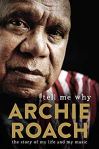
Book coverGood things come to those who wait! At least, I hope so, because Lisa has had to wait a long time for a review from me for this year’s Indigenous Literature Week. Finally, though, I finished the main book I chose for this year’s challenge, Archie Roach’s memoir, Tell me why: The story of my life and my music.

Most Australians will know who Archie Roach is, but international readers here may not. A member of the Stolen Generations, Archie Roach is an indigenous Australian singer, songwriter, guitarist, and political activist. The story he tells in his memoir, Tell me why, is not an unusual one in terms of people of his background and generation, but that doesn’t mean it isn’t worth reading, because not everyone can tell this story in the way that Roach can. Perhaps this is because he’s a songwriter, or perhaps, more correctly, he’s a songwriter because he can tell stories.

Roach starts his story with a Prologue set in 1970. He is 14 years old, and receives a letter from one of his birth sisters telling him that his birth mother had died. This is a surprise, because his adoptive parents had been told his parents had died in a fire. He then flashes back in Chapter 1 to tell us about his life, as he knew it, up to 1970. This life involved being stolen from his parents, and being placed in two foster homes, one abusive, before being placed, in 1961, with the Melbourne-based Coxes with whom he was still living in 1970. In Chapter 2 he picks up that point in 1970 when he received the letter, and tells his story chronologically from then on, with some flashbacks to fill in his family’s early life as he learns it himself.

Although Roach had had a good life with the Coxes, who had loved him and whom he loved, the discovery that members of his birth family were still alive brought with it a desire to learn who he was, and he left home. He managed to make contact with his family, but before that he was introduced to drinking (having “a charge”) and life on the streets. Not surprisingly, his story, like those of many young indigenous people who have lost contact with their culture and thus with their bearings, involves alcoholism and related illnesses, run-ins with the police, prison, unemployment, and all-round instability. Archie would obtain work, would be appreciated as a worker, but the demons would return and down he’d plummet again. It’s a common cycle.

However, Archie had a couple of big pluses in his corner. There was Ruby Hunter, whom he met while still a teen and who became the love of his life. It’s not that her appearance resulted in a miraculous turnaround. Real life is rarely like that. But she became the supportive base to whom he would return and who, eventually, did provide the stability that enabled him to turn his life around and become the success he now is. The other plus was music, to which he was first introduced by the Coxes, particularly Dad Cox who loved to sing and who gave him his first guitar. While the stories about his drinking life were distressing to read, the story about how music “saved” him, and how he gradually came to realise that he could tell stories through music, was moving and inspiring.

This brings me back to my opening comment that “not everyone can tell this story in the way that Roach can”. The memoir is beautifully constructed, from the Prologue that vividly takes us into the classroom where Roach receives the letter about his mother, to the use of song lyrics, most of them Roach’s own, to introduce each chapter. Roach uses foreshadowing at the end of several chapters to move the story on, such as this at the end of the chapter in which he arrives in Adelaide – “This would be the last hours before finding Ruby Hunter”. And this one at the end of the chapter where Jill Shelton is recommended to him as a manager – “Jill would end up saving my life at a time when I didn’t see there was any point in saving it.”

Roach also mixes up the narrative, commencing some chapters with the next part of the story, while others he introduces with something more reflective. I particularly liked the opening to the chapter in which Ruby dies:

Some people see time as a river with a steady current. Some people say we get in and move with that current, all of us ageing uniformly. I don’t believe that’s true, though. I’ve seen people age years overnight.

It happens to a lot of our people, and it happens to an awful lot of us drinkers. It doesn’t just happen while we’re drinking, either; we could’ve been years off the stuff and then something might change. We might lose a sister or a brother, and suddenly we have age in our face and in our step.

Sometimes it happens for no reason. Someone will be living their life and all of a sudden time will heap years on their shoulders.

Of course, Roach also talks about politics, about Indigenous opposition to the 1988 Bicentenary, about John Howard’s  opposition to a national apology and his criticism of the “black armband view” of Australian history, about Aboriginal deaths in custody, about the stolen generations, and more. It’s all told through the prism of his own personal experience or through his involvement in political action. Most readers will know these issues, but the personal stamp offered by books like this helps keep the issues real and in front of us. Roach, like so many Indigenous people, amazes me by walking that fine line between anger at what has happened to his people and generosity towards the rest of us.

In the end, Roach’s message is an inclusive one. His songs, he has found, speak to non-Indigenous people too, with many telling him that “that’s what happened to me”. Consequently, his songwriting, he says, now “feels more inclusive, more universal” because “it’s about all of us – you can’t write about yourself without including everyone.”

He writes:

For so long we have been divided by ‘isms’ – racism, sexism, fundamentalism, individualism – but when we come back to the place of fire, I believe we will discover there’s far more that connects us than separates us. I believe we will be one humanity again, that we will find release, healing and true freedom.

I love the hope in this but, let’s be clear, Roach is not letting us off the hook. That is, he doesn’t believe we are there yet. He is, though, choosing an aspirational path, and for that I thank him.

ANZ LitLovers logoArchie Roach
Tell me why: The story of my life and my music
London: Simon & Schuster, 2019
378pp.
ISBN: 9781760850166

Monday musings on Australian literature: Indigenous Australian writers and the Miles Franklin Award

This is not going to be a treatise on the Miles Franklin Award and diversity. We all know literary awards have not been as diverse as they could have been (and that they still have a way to go). We know, too, that this is not only due to judging, but also reflects the fact that the publishing industry has not been as diverse as it could be. It is probably also true that, in the past at least, we readers have not demanded more diversity in our reading. However, this story is too complex for this post, and, anyhow, has been explored many times. Today, I simply want to celebrate those Indigenous Australian writers who have been listed for and/or won Australia’s (arguably) most prestigious literary award, the Miles Franklin, in the spirit of bringing attention to their work as a body of literature.

Notwithstanding the above, I do need to make the point that it wasn’t until 2000 that we started seeing Indigenous Australian writers appear in the short and longlists for the award*.

  • 2000 Kim Scott’s Benang (won) (Lisa’s and Bill’s reviews)
  • 2007 Alexis Wright’s Carpentaria (won) (my review)
  • 2011 Kim Scott’s That Deadman Dance (won) (my review)
  • 2012 Tony Birch Blood (shortlisted) (Lisa’s review)
  • 2014 Melissa Lucashenko Mullumbimby (longlisted) (Lisa’s review)
  • 2014 Alexis Wright The Swan Book (shortlisted) (Lisa’s and Bill’s reviews)
  • 2016 Tony Birch Ghost River (longlisted) (my review)
  • 2018 Kim Scott’s Taboo (shortlisted) (Lisa’s and Bill’s reviews)
  • 2019 Melissa Lucashenko’s Too Much Lip (won) (my review)
  • 2020 Tony Birch’s The white girl (shortlisted) (my review)
  • 2020 Tara June Winch’s The yield (won) (my review)

This slideshow requires JavaScript.

You could probably call this a round-up of the usual suspects, in terms of contemporary Indigenous Australian novelists, with Kim Scott and Tony Birch appearing three times, Melissa Lucashenko and Alexis Wright twice each, and of course relative newbie, Tara June Winch, once. It’s notable that every book here deals with Indigenous issues. This is important for truth-telling, but it will be a measure of our maturity as a nation when Indigenous Australian writers can feel free of the need to carry these truths on their backs.

Anyhow, I wonder what Miles Franklin would say? When she said “without an indigenous literature, people can remain alien in their own soil”, I don’t believe she was thinking of the real Indigenous people of this soil. However, I imagine that, were she living now, she would love the richness that the growth of Indigenous Australian literature has brought to Australian life and culture.

It seems apposite, then, to leave this (very) little tribute with the words of this year’s winner, Tara June Winch, as quoted in the Sydney Morning Herald, “It doesn’t have to be POC writers against white voices – we have to work together to bring voices to the fore.” Absolutely. Let’s hope more and more diverse writers get to tell their stories to us. I – and I know many of my litblogging friends – love to read them. Meanwhile, if you haven’t read it yet, I recommend that you do read The yield, a complex but strong book which its author calls “a once-in-a-lifetime love letter to Australia.”

Have you read any of the listed books, and if so, would you like to share your favourite/s?

* I may have missed a writer or two, as I didn’t find complete lists of short and longlisted authors from the beginning of the award, but I think my point still stands.

Monday musings on Australian literature: Indigenous Australian literature, 1970s

Although Lisa’s (ANZLitLovers) annual Indigenous Literature Week is officially over for 2020, I thought I’d bookend it with a second Monday Musings, this one on how Indigenous Australian literature looked around 50 years ago. Who was writing then, and what were they writing?

My main sources were Trove, of course, and the Macquarie Pen anthology of Aboriginal literature, edited by Anita Heiss and Peter Minter. In their introduction, Heiss and Minter argue that:

Aboriginal literature as we know it today had its origins in the late 1960s, as the intensification of Aboriginal political activity posed an increasing range of aesthetic questions and possibilities for Aboriginal authors.

With the Constitutional Referendum of 1967, and, as they put it, “the election of the reformist Whitlam government in 1972 [that] saw a new radicalisation in Australian politics”, there was a growing interest in land rights and cultural self-determination. In this world, Aboriginal literature “began to play a leading role in in the expression of Aboriginal cultural and political life”.

Heiss and Minter nominate the period from 1967 to the mid-1970s as being “significant for the sudden growth in Aboriginal authorship across a broad range of genres.” Ha! It was in 1967 that I wrote a little piece for my school year book on “Aboriginal equality in Northern Australia”. (It’s a bit excruciating to read now, being the words of an idealistic young teen, but that was when my interest in Indigenous Australian rights really started – and when I started reading authors like Kath Walker, later Oodgeroo Noonuccal.)

Book coverThe writers they name from that time – Kath Walker, Jack Davis, Kevin Gilbert, Monica Clare (who is new to me), Gerry Bostock and Lionel Fogarty – pretty much mirror the writers who cropped up in my Trove search. Heiss and Minter describe them as

active in the political sphere while simultaneously catalysing a nascent publishing industry and writing their own vanguard pieces of creative literature.

There is another name that they don’t mention, but who comes up in Trove, and that’s the controversial Colin Johnson (who also published under the name Mudrooroo.)

The interesting thing about this group of people is that they are primarily poets and playwrights. Davis, Bostock and Gilbert are both, while Walker (Noonuccal) and Fogarty are best known as poets. The exception is Monica Clare. She was primarily an activist, but wrote an autobiographical novel that was published posthumously in 1978, Karobran: The story of an Aboriginal girl. Why were poetry and drama so dominant at that time? Is it because they were easier to publish (or get published) – or perform? Is it because these forms lend themselves more to the activism all these writers were engaged in? A poem, after all, is a powerful tool that can be performed, learnt and quoted again and again – as Noonuccal’s were, I know.

Now, what did the newspapers at the time have to say about Indigenous writing? First, there were several references to the paucity of Indigenous writing and Indigenous characters in contemporary literature, including in children’s literature. Presumably this awareness marked the beginning of the slow change that led us to the last decade or so in which we’ve seen significantly more Indigenous writing being published across all forms and genres.

There was, though, less awareness of the importance of Indigenous people telling their own stories. The sense I get is that it was perfectly alright for non-Indigenous people to tell Indigenous stories. Reviewer Lyndal Hadow, writing in the Tribune about a book of short stories by someone called D Stuart, praises:

his wide and deep knowledge and appreciation of the Aborigine. I believe there is no one who has written with such understanding in all the literature of the subject. His ear and his pen for the subtleties of altered English as used by his Aboriginal friends are not matched by any one I have read, and I have read them all. Again Stuart shows that those of whom he writes are known to him, not as subjects to be studied, but as old friends whose lifestyle he understands, and whose strengths he respects.

I love her confidence in her assessment because she has “read them all”!

The most comprehensive article I found about Indigenous writing in Australia came from the University of New South Wales’ student magazine Tharunka in 1976. The article, written by John Beston, commences:

Who are the Aboriginal writers? The first person to supply an answer to that question was Kath Walker, herself the best known of Aboriginal writers. In an article entitled “Aboriginal Literature,” in the January 1975 issue of Identity, Kath Walker mentions five writers other than herself — Jack Davis, Kevin Gilbert, Colin Johnson, Wilf Reeves and Dick Roughsey — and concludes that there is an exciting time ahead. I agree with her.

Beston comments on the three main poets of the time, Walker, Davis and Gilbert, and shares this:

Kath Walker has graciously acknowledged Jack Davis to be the better poet, but there is no clear superiority of one poet to the other: Davis is the more skilled craftsman, but Walker sometimes has greater emotional force.

This article is worth reading, because it surveys the gamut of Indigenous Australian writing at the time, across all forms and genres. He concludes, though, by returning to Walker and her significant role, saying (in the tone of his times):

The quality of her work and the success she met with — We Are Going went into seven editions — gave other Aboriginals a needed boost and encouraged them to express the creativity that they have always had. So Aboriginal literature is less than twelve years old. The young tree is certainly flourishing.

Another article I found noted Kevin Gilbert’s being awarded a literature grant to write a book. And, there was a 1979 review of the book Literature and the Aborigine in Australia by a non-Indigenous writer, which seemed to be more about “the history of the efforts of Australian writers to come to terms” with Indigenous culture than about Indigenous literary culture itself, though the review does say:

‘There is also, completing the record, the very new group of writers, Aboriginal or part-Aboriginal themselves, who are producing their own literature.’

In the 1970s, then, there wasn’t a lot of coverage of Indigenous Australian writing, but there was the beginning of an awareness that Indigenous Australians were writing – and that Indigenous Australians and their culture should no longer be overlooked. We have a long way to go yet in terms of all Australians reading and appreciating Indigenous Australian writing and culture, but it is useful to see where we’ve come from, don’t you think?

Past ILW/NAIDOC Week-related Monday Musings

Monday musings on Australian literature: Indigenous Australian biographies

Yesterday was the start of Lisa’s (ANZLitLovers) 2020 Indigenous Literature Week, and, as I have done for a few years now, I’ve decided to devote my Monday Musings to an Indigenous Australian literature topic. This year’s topic is Indigenous Australian biography.

I have previously written Monday Musings on Indigenous Australian autobiographies and memoirs. These have flourished in the last decade or so, particularly, it seems, memoirs from Indigenous Australian women. I’ve reviewed several on this blog. However, biographies are a different form altogether, and in researching for this post, I’ve struggled to find many. Readings bookshop, for example, provides a list of Australian First Nations Memoir and Biography but I struggled to find many biographies in their list. It is a positive thing that publishers and readers have embraced memoirs, but I can’t help feeling that the paucity of biography tells us something about the place of Indigenous Australians in Australian culture.

The Australian Dictionary of Biography (ADB), self-described as “Australia’s pre-eminent dictionary of national biography”, aims to provide “informative and fascinating descriptions of the lives of significant and representative persons in Australian history.” This suggests that biography has a formal role in telling the story of a nation. Consequently, the dearth of Indigenous Australian biographies – if my research is right – is surely a measure of the continuing marginalisation or exclusion of Indigenous Australian culture and lives from our national story.

Not surprisingly, I’m not the only one to have noticed this problem. In 2017, the National Centre of Biography launched a new project “to develop an Indigenous Australian Dictionary of Biography“. It’s being led by Shino Konishi who is of Indiengous descent from Broome. She is on the ADB’s Indigenous Working Party which was established in 2015, and which includes “leading Aboriginal and Torres Strait Islander scholars from each state and the territory”. The main aim of the project is to add 190 new Aboriginal and Torres Strait Islander biographies to the ADB which, they say, has published nearly 13,000 biographies since 1966, but “has tended to under-recognise the contribution of Indigenous people to the Australian story”. The end-result of the project will be a dedicated Indigenous ADB.

Alongside this, the National Centre of Biography, which publishes the Australian Dictionary of Biography, also hosts a site called Indigenous Australia which “brings together all entries on Indigenous Australians found in the NCB’s biographical websites–Australian Dictionary of Biography, Obituaries Australia, Labour Australia and Women Australia.” It also supports the Australian Indigenous Autobiography Archive, which is an initiative of the University of Western Sydney. (However, it moves us away from my focus here on biography.)

Of course, the above is all very important, but the ADB is about biographical essays in a dictionary of biography. I’m also interested in full-length biographies. I didn’t find many, but, as always, I’m hoping you will tell me (or remind me of) others?

Alexis Wright, TrackerIndigenous Australian biography – a small selection

  • Max Bonnell’s How many more are coming?: the short life of Jack Marsh (2003): on athlete and first class cricketer, Jack Marsh, who died in 1916.
  • Kathie Cochrane’s Oodgeroo (1994): on poet and activist Oodgeroo Noonuccal.
  • Ruby Langford Ginibi’s Haunted by the past (1999): on Ginibi’s son, Nobby, who spent significant time in prison, and the systemic failures in handling Indigenous young.
  • Kevin Keeffe’s Paddy’s road: Life stories of Patrick Dodson (2003): on activist Patrick Dodson, and his family, and their commitment to reconciliation.
  • Marlene J. Norst’s Burnum Burnum: A warrior for peace (1999): on Burnum, Stolen Generations survivor, sportsperson and activist.
  • John Ramsland’s The rainbow beach man (2009): on Les Ridgeway, Worimi elder, who was a farm labourer, station manager and was eventually recruited by Charles Perkins to work in the Commonwealth Department of Aboriginal Affairs.
  • Peter Read’s Charles Perkins: A biography (2001): on activist, Freedom Ride participant and administrator, Charlie Perkins.
  • Banjo Woorunmurra and Howard Pedersen’s Janadamarra and the Bunuba Resistance (1995): on Aboriginal resistance fighter, Jandamarra, and his resistance against invasion in the Kimberleys.
  • Alexis Wright’s Tracker (2017): on the charismatic ‘Tracker’ Tilmouth, activist, a book which is described by some as a “collective memoir” but which I’ve included here as an example of new forms of “biography”, particularly for Indigenous life-writing.

So, now, please add to this list …

Past ILW/NAIDOC Week-related Monday Musings

Tara June Winch, The yield (#BookReview)

Book coverTara June Winch’s novel, The yield, follows her impressive – and David Unaipon award-winning – debut novel Swallow the air (my review). Ten years in the making, The yield could be described as her “passion project”. It makes a powerful plea for Indigenous agency and culture.

I wrote about The yield’s genesis last year, but will repeat it here. It was inspired by a short course Winch did in Wiradjuri language run by Uncle Stan Grant Sr (father of Stan Grant whom I’ve reviewed here a couple of times). Discovering language was, she said, transformative, but turning her passion into a book proved tricky. She started with too broad a canvas, until her mentor, Nigerian Nobel Laureate Wole Soyinka, encouraged her to focus on 500 acres of land, telling her she could tell her story through that lens. So, she found her 500 acres on the Murrumbidgee, created fictional places – the Murrumby River, and the towns, Massacre Plains and Broken – and her novel started to take shape.

“that unhandsome truth”

But my, what a shape it takes. It has three, roughly alternating, narrative strands, each quite different in style but each reflecting or enhancing the other two. They are:

  • Poppy Albert Gondiwindi, dictionary writer, first person narrator. He is dying but is also a time-traveller, so, Winch said, his story has elements of magical realism. It’s told through the words in his dictionary, starting at the end of the alphabet, “a nod to the backwards whitefella world I grew up in”. “The dictionary”, Poppy says, “is not just words – there are little stories in those pages too.” There sure are. Through them Poppy tells the story of his and his people’s lives; he passes on as much of their culture as he has learnt and can tell; and he shares his hopes and values:

respectyindyamarra I think I’ve come to realise that with some things, you cannot receive them unless you give them too. Unless you’ve even got the opportunity to give and receive. Only equals can share respect, otherwise it’s a game of masters and slaves – someone always has the upper hand when they are demanding respect. But yindyamarra is another thing too, it’s a way of life – a life of kindness, gentleness and respect at once. That seems like a good thing to share, our yindyamarra.

  • August Gondiwindi, Poppy’s grand-daughter, third person voice. She tells a contemporary story of the 500 acres where the Gondiwindis live, and the challenges faced, including from mining and river degradation. Her story is about finding her place after living overseas for ten years. It’s a quest story, in a way, a little like that of Swallow the air’s protagonist. We meet her in Chapter 2 as she hears of the death of Poppy:

She knew that she had once known the beloved land where the sun slapped the barren earth with an open palm and knew too that she would return for the funeral … go back and try to find all the things she couldn’t find so many thousands of kilometres away.

(“Where the sun slapped the barren earth with an open palm”. Winch’s language throughout is gorgeous.)

  • Reverend Ferdinand Greenleaf, Lutheran missionary, first person voice. Winch created him, she said, to “round” out the story. He’s her villain, but she gives some balance, humanity, to him by sharing his own experience of loss of home and mother tongue. His story is told through the letter he writes in 1915 to Dr George Cross of the British Society of Ethnography about his experiences running a mission from the 1880s. The first instalment ends with why he is writing it:

To tell how wrongs became accepted as rights. … I will tell that unhandsome truth, even if it will amount to last words. The circumstances and the times demand it.

His story is the most problematic for readers because he, with good intentions, established the ironically named mission, Prosperous House, near the non-ironically named town of Massacre Plains. Indeed, Poppy writes in his dictionary that the Reverend was “the only good white gudyi” he’d known, gudyi meaning medicine man, priest, conjuror. Greenleaf’s heart is in the right place – having seen the “the vile inhumanity practised by the white-skinned Christian on his dark-skinned brother in order to obtain land and residence, for ‘peaceful acquisition'” – but of course he is a man of his times and his paternalistic actions have their own consequences. August sees the paradox in his “trying to protect those ancestors at the same time as punishing them”, while her aunt Missy takes a harsher stance.

These three stories span over 100 years from the late nineteenth century to the present, with Poppy Albert’s dictionary providing the novel’s backbone, spiritually, culturally, and plot-wise. August’s story, on the other hand, provides its emotional heart, while Greenleaf’s provides important historical context.

The stories don’t, then, just meander along side by side for their own sakes. Each contributes to an overall plot which concerns a proposed mine, and efforts to stop it – a story that is broadly reminiscent of non-Indigenous Australian author Madelaine Dickie’s Red can origami (my review). In both stories the Indigenous people need to invoke Native Title if they are to have a chance of stopping the mine, and in both stories competing interests and loyalties, not to mention a helping of skulduggery, work to prevent the Indigenous owners from progressing their claim.

In Winch’s story, Poppy’s dictionary, which documents not only language but his people’s ongoing connection to the land, together with a collection of artefacts that had been donated to a museum by local rich landowners, and the information in Reverend Greenleaf’s letter, are critical to the Native Title claim. August and her family’s challenge is to realise the relevance of and/or discover and locate these “proofs”, while others try to foil them. It’s the oft-repeated story across Australia when traditional owners, protestors and landowners, with competing or criss-crossing interests, confront development, particularly mines.

Threading through all this is the novel’s heart, August’s journey to find herself and her place of belonging, as she navigates her people’s painful history of being “torn apart”, of massacres and dispossession, of racism, of incarceration, and of abuse from both within and without her culture. These are stories we’ve heard before. However, Winch keeps them fresh and urgent by engaging with contemporary thought (concerning, for example, Indigenous agricultural practice and the idea of slavery) and by creating characters who feel real and authentic, who are complicated like those in Melissa Lucashenko’s Too much lip (my review), rather than simple mouthpieces for ideology.

For all the anger and sadness in the book, it is also a positive – perhaps even hopeful – one. Early on, Poppy’s wife and August’s grandmother, Elsie, tells her, “Please don’t be a victim”. This is, I’d say, Winch’s plea to her people, and is reinforced by Poppy’s dictionary words at the end in which he says the time for shame is over. It is time, in other words, to heal, to be proud, to embrace country with confidence.

The yield is a rewarding read. Its three very different voices challenge our minds to think carefully about what we are reading, while its plot and characters engage our hearts. I would be happy to see it win the Stella Prize next week.

Challenge logoLisa (ANZLitLovers) also loved the book and includes examples from Poppy’s dictionary.

Tara June Winch
The yield
Hamish Hamilton, 2019
344pp.
ISBN: 9780143785750

Monday musings on Australian literature: Recovering Australia’s Indigenous languages

In my recent Delicious Descriptions post on Madelaine Dickie’s Red can origami, I referred to last year’s UN International Year of Indigenous Languages. It occurred to me that while I’ve referred to Indigenous Australian languages several times in this blog, I’ve never specifically posted about them. Now seemed a good time, particularly given interest the year generated. As local Canberra newsreader Dan Bourchier wrote last year, ‘to the UN, language is more than a method of communication, it’s a “repository for each person’s unique identity, cultural history, traditions, and memory”.’

Late last year, The Conversation published an article on “the state of Australia’s indigenous languages”. They started with some facts: in 1788 there were between 300 and 700 Indigenous languages spoken across Australia as shown by anthropologist Norman Tindale’s 1974 map, but by the 2016 Census, only around 160 of these languages were reported as being spoken at home, and of these, only 13 traditional Indigenous languages were still spoken by children. The article then lists the languages and the number of speakers recorded in the Census. Do read the article, if you are interested, as it also discusses the challenges involved in obtaining a true picture of the situation. Here, though, I want to move onto the recovery of language – assuming, of course, that readers here agree that recovering language is important, critical, to people and their culture.

Noongar language (Daisy Bates)

Noongar language (recorded by Daisy Bates)

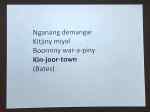
Certainly, it’s clear that Indigenous people want to revive heritage or original languages, and many are doing so “from old recordings and documents, and sometimes from elderly speakers”. In 2017, I wrote a post on Indigenous Australian author, Kim Scott’s Ray Mathew Lecture “A paradox of empowerment” which was about  “how reclaiming Aboriginal language and story may offer a narrative of shared history and contribute to social transformation.” Scott talked about a project he’s involved in to regain and claim Noongar language, and he described how they were doing that. One way is through archival sources, and – Bill (The Australian Legend) will like this – he used a story recorded by Daisy Bates as an example. It shows something that Dickie alludes to in her novel, which is that Indigenous languages, like English, change – so Bates recorded the Noongar people incorporating the the name of the settlement, King George Town, into their language, Kin-joor-town. Book cover

So, there is a quite a lot going on in specific Indigenous communities to revive languages that have died or nearly died (as the Noongar are doing) and to maintain languages that have survived (as the Yolngu are doing). There are indigenous publishers, like Magabala Books and the Indigenous Literacy Foundation (ILF), who are publishing books in language. (I reviewed the English edition of the ILF’s picture book, I saw we saw, which was first published in language.) There are Indigenous singers, like the late Gurrumul*, who sing in language. Red Room Poetry has a Poetry in First Languages project. And, slowly, Indigenous languages are being taught in schools and universities. Saying all this, though, is not say the job is done. It simply says that things are happening – and, seemingly, increasingly so.

But I also wanted to say something about the relevance of all this to non-Indigenous people. Right now, many Indigenous people are not keen for non-Indigenous people to learn their languages – not while their own people are not proficient, as this could easily become a new form of dispossession. However, reconciliation and respect are helped, as many like Scott and Stan Grant believe, by non-indigenous Australians becoming more familiar with Indigenous languages. For some time now, significant Australian sites have returned to their local Indigenous names – Uluru (Ayres Rock), Kata Tjuta (The Olgas), Watarrka (King’s Canyon), Nitmiluk (Katherine Gorge), Kati Thanda (Lake Eyre) and Purnululu (The Bungle Bungles) are some examples. This recognises that these places have a history long preceding that contained in the names given them by settlers.

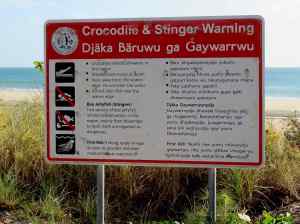
Sign in Arnhem Land

Signage around Australia is increasingly recognising local Indigenous culture. Welcome signs to many towns now include the name of the local Indigenous nation. I have also come across some bi-lingual signs in larger Indigenous communities, though this is rare. You can now buy clothing displaying Indigenous language, such as the t-shirt we bought our grandson. It featured an echidna with the Indigenous label biggi billa. And, excitingly, our Canberra newsreader now starts the evening news bulletin with “Yuma, Good-evening” and closes with “Yarra, Good-night”. We all know greetings like Caio and Au-revoir. Why not Yuma and Yarra? Or, whatever it is, where you live? Indigenous author Tara June Winch said in a conversion I attended last year that it’s a sign of respect to use local words when we travel overseas, so why not the same here? Fluency, she said, isn’t necessary to show such respect.

Book coverFinally, on the subject of authors, Indigenous words are increasingly appearing in contemporary fiction – in, for example, Melissa Lucashenko’s Too much lip (my review), Tara June Winch’s The yield (a novel about language, in fact), and, yes, Madelaine Dickie’s Red can origami. Just a few words here and there – and being done in a way that doesn’t exoticise language but, rather, assumes it is part of the culture.

Dan Bourchier, in the article linked in the opening paragraph, quotes Stan Grant:

Indigenous languages also present a tantalising opportunity for all the people of Australia to find a deeper sense of belonging. The empty space of terra nullius could be filled with the voices of people of all backgrounds speaking the first languages of this land. It is a space to truly build a nation.

I’m loving all these initiatives. What about you? And do you have any examples to share?

Delicious descriptions: Madelaine Dickie on Indigenous language and Uranium

Book coverMy recent post on Madelaine Dickie’s Red can origami was getting too long – and I just couldn’t cover in detail all that I wanted to, so I’ve decided to do one of my rare Delicious Descriptions posts to expand some ideas from the book.

Concluding my post, I commented that the novel is an effective consciousness-raiser as well as a great read. One of the many points Dickie makes concerns the intrinsic significance of language to cultural identity. (This issue, in fact, was discussed much during last year’s International Year of Indigenous Languages.) Here is Dickie in Red can origami (and do note the second person style – “you’re invited to sit …”):

You’re invited to sit in on a Burrika language session at Gubinge District High. It’s the first week of term one and the session’s being funded through the community benefits package. The language teacher is fishing-club-Keith’s wife Kylie, an intimidating, bearded old girl, with a deep wrinkle line between her eye. She stands in front of a class of teenagers. She explains that in Burrika, there are six words to describe anger, four words to describe jealousing and that there’s even a word for someone who’s a serial liar. Here, she looks pointedly at a young woman wearing heavy eyeliner. Then she says some people think the Burrika language is only used to describe things like berries and barramundi. Here, she looks pointedly at you.

Language comes from country, she tells the kids. Language comes from the rocks, the desert waterholes, from the creeks that twist through the mangroves. Language comes from the sky. When you don’t know your language, you can’t tell country you are coming, and you can’t look after your country. (p. 195)

With Indigenous language revival programs popping up around the country, some of which I’ve mentioned in my blog, Dickie was spot on to make this point in her book.

The issue of uranium mining and its potential for problems, if not disaster, underpins the novel’s plot. It also provides a good example of how Dickie teases out different attitudes from the various stakeholders – the Indigenous people, protesters, the people of Gubinge, the mining company employees, and Ava herself as she navigates spin versus facts and reality. And as Ava ponders the issue, the second person voice brings us on her journey with her. Whenever we hear “you”, there’s that little initial reaction, “who, me?” Anyhow, Burrika leader Noah patiently tells a radio presenter,

No-one wants to see a uranium mine on their country. Not the mob at Jabiluka, not the mob in South Australia, and not the people in Gubinge. But when you’re under duress, when you are given a choice between something and nothing, you choose something.

These are the sorts of real-world challenges that are posed by the novel.

At the book’s launch, Dickie referred to Japan’s involvement in uranium mining in Australia, and mentioned the Fukushima disaster. She quoted from the letter written in 2011 by Yvonne Margarula of Kakadu’s Mirarr people to UN Secretary General Ban Ki Moon concerning the Fukushima disaster:

Given the long history between Japanese nuclear companies and Australian uranium miners, it is likely that the radiation problems at Fukushima are, at least in part, fuelled by uranium derived from our traditional lands. This makes us feel very sad.

The sense of extended community responsibility expressed in this letter is surely something we could all learn from – and this, I’m sure, is what Dickie hopes her book will encourage its readers to consider.

Madelaine Dickie, Red can origami, Fremantle Press, 2019.

Madelaine Dickie, Red can origami (#BookReview)

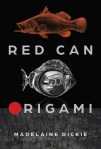
Book coverSome writers, I understand, suffer from a thing called “second novel syndrome”, which describes the fear of writing a second novel after a successful first one. Well, it’s clear that Madelaine Dickie, who won the TAG Hungerford with her first novel Troppo (my review), hasn’t suffered from this particular disorder, because her second novel, Red can origami, is not only another good read but it presents as a confident work from an author who knows exactly what she wants to do.

A confident work

Let’s start with the plot. Red can origami is set primarily in a town in Australia’s north-west called Gubinge, to which Melbourne-based journalist Ava has gone for a job as a reporter. Fairly soon, though, she is offered a significantly better paid job as an Aboriginal Liaison Officer by the Japanese uranium mining company, Gerro Blue, who wants someone to help them negotiate an exploration licence with the local native title owners. Already you can see, I’m sure, some red flags, because this plot is going to require Dickie to create Indigenous Australian characters and, thus, to speak for them. This, of course, raises once again that thorny question of who can write what.

Now, I attended this novel’s New South Wales launch at the south coast just before Christmas (and just before the bushfire situation got out of control). I hadn’t met Dickie before, but her mother-in-law, who held the launch, is a good friend and one of my reading group’s original members. Dickie gave a wonderful speech in which she addressed this question head-on. She quoted Anita Heiss’s statement that the Australian novel needs to be inclusive; she reminded us that there were many Indigenous writers, like Alexis Wright in Carpentaria and Tara June Winch in The yield, who are telling their stories well; and she quoted non-Indigenous author Stephen Hawke who writes Indigenous characters and argues that you need to write well and be respectful. In addition, she, who has lived in the Kimberleys where the novel is set, described some of the work she’s done in recent years for traditional owners, including going “on country with old people”. Her arguments and credentials seem fair enough to me – though of course, in the end, it’s up to each reader, Indigenous and non-Indigenous, to decide for themselves.

The other point I want to make about the confidence of this work is its voice, because it is told second person. This too Dickie confronted in her speech. She was leaving no stone of potential contention unturned. I was impressed. Anyhow, essentially, she said that she’d tried writing it third person but it flowed better when she switched to second. That was her writerly judgement – and certainly I found it easy to read. However, she also had a political reason for this choice, and it’s this, she wanted to involve if not implicate the reader in what’s happening. Second person does this very effectively – at least it does in this book. I won’t spoil the ending, but I’ll just say that the second person voice makes the last line an inspired one.

About the book

So now, I’ve talked a lot around the book, but not a lot about it. Another thing Dickie said in her speech was that she wanted the book to be a page-turner – and that it is. The novel moves at a good pace, as did Troppo, and covers a lot of ground in its 220 pages. It starts with Ava arriving in town and building up a little band of both Indigenous and non-Indigenous friends and aquaintances. These characters include Lucia, an Indigenous reporter on the same paper as she; Ash, a non-Indigenous local TAFE lecturer who is soon attracted to Ava, and who shows her the ropes, taking her fishing and to the local bars in particular; and Noah, an Indigenous station-manager and local Indigenous leader, to whom Ava is attracted. Ava quickly falls in love with the land and the life of the Kimberleys, but equally quickly she becomes aware of local politics – and, with her reporter’s eyes, she notices some suss things going on. Is Gerro Blue already working on the land they haven’t yet obtained the licence to do? What are those bones they’ve disturbed?

It is in this environment that Ava, who has already shown sympathy towards the Indigenous owners, is wooed by Gerro Blue’s smooth CEO, Yuma Watanabe, to be their Aboriginal Liaison Officer. If there is a plot fault in the novel, it could be this – why would she take such a job – but Dickie makes us believe. Not only is Watanabe a shrewd employer, but Ava genuinely, albeit uncertainly, believes she can help the local Burrika people. After all, she thinks, “better you, with your olive-green heart, than someone else”. However, she also admits that being paid real money rather than a reporter’s salary, would set her up. She is, then, a real or flawed character, just as we like our characters to be.

As the book progresses, conflict increases. The traditional owners disagree over whether to grant Gerro Blue the licence, particularly given it’s for uranium mining, with all its implications. (Dickie has specifically set her novel around 2011, the year of the Fukushima disaster.) They don’t all trust Ava either. Protesters, from within and without the Indigenous community, make their own waves. Dickie navigates well this tricky, but real – and not at all unusual – situation in native title negotiations. She clearly knows whereof she speaks. Anyhow, while all this is going on, Ash is keeping an eye out for Ava, while Ava is keeping her eye on Noah. It all, of course, comes to a head, with a powerful ending that is entirely appropriate to the story being told.

And then there’s the writing. This is a novel written in the voice of a young woman living in remote Australia. The voice is, thus, earthy, but also fresh and authentic. Dickie’s writing is expressive, and has been pared to the essential, which is not the same as saying it is bare and plain. It is anything but. Here is Ava describing her sophisticated Melbourne sister:

Imogen’s voice is all sparks. It holds the drunken sequin shine of a Melbourne night.

And here a boab tree in Perth, far from its home (like Ava):

The boab’s bark is cracked, its leaves are withered, and its roots strain from the soil, as if it’s planning on splitting town, hitching north.

So, Red can origami is a good read, as Dickie intended, but it also has an underlying purpose. Dickie is passionate about northwest Australia, and about the challenges faced by Indigenous Australians – and she wants all Australians to understand this better. Red can origami sits within that contemporary literature space comprising works which explore Indigenous and non-Indigenous Australian relationships and interactions. Like Lucashenko’s Too much lip, and similar novels, Red can origami works beautifully as a consciousness-raiser, because it wraps authentic situations and issues in an engaging, page-turning story. In doing so, it teaches us about the beauty of northwest Australia, about the complexities of native title legislation and practice, about the nastiness that happens when politics and business get together, about direct and indirect racism, about dispossession, and, above all, about the diversity of human beings and the challenges we face in getting along together. A book for now.

Lisa (ANZLitLovers) was also impressed by the book, and teases out some different angles.
Challenge logoMadelaine Dickie
Red can origami
Fremantle: Fremantle Press, 2019
221pp.
ISBN: 9781925815504
Nhulunbuy Primary School, I saw we saw (#BookReview)

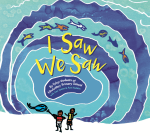
Book coverA week or so ago, I wrote a post to commemorate this year’s Indigenous Literacy Day. In that post I noted that the book I saw we saw was going to be launched at the Sydney Opera House that day. It was written and illustrated by students from Nhulunbuy Primary School, up on the Gove Peninsula, and a number of them were going to read and perform from the original Yolŋu Matha language version, Nha Nhunu Nhanjal?, at the launch. I ordered my own copy of the book that day.

The books – the original Yolŋu Matha version, launched at this year’s Garma Festival, and the English version – were published by the Indigenous Literacy Foundation, which describes itself as a “national book industry charity”. Their aim is to “reduce the disadvantage experienced by children in remote indigenous communities in Australia, by lifting literacy levels and instilling a lifelong love of reading”. These two books came out of their Community Literacy Project, and were produced through a series of workshops with illustrator Ann Haddon and teacher-librarian Ann James, with local Yolŋu elders helping develop the story.

So, the English-version book. It begins with a brief introduction telling us that the Yolŋu people of north-east Arnhem Land represent one of the largest indigenous groups in Australia. Their main language is Yolŋu Matha, which, it explains, has twelve sub-languages, each with its own name. It also tells us that, for most Yolngu children, English is their second (or even third or fourth) language. I saw we saw, the English language version of their book, is, by definition, written in English, but it uses words from the Dhaŋa sublanguage to name the actual “things” seen. This is a lovely, effective way of introducing indigenous language to non-indigenous people (as recommended at the Identity session of the Canberra Writers Festival). However, this approach also creates a bit of a challenge for the reader – what is being seen, and how do you pronounce it?

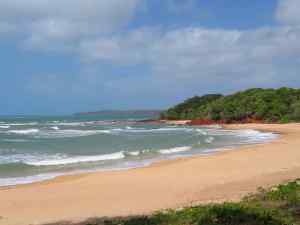
Beach, north-east Arnhem Land

Beach, north-east Arnhem Land

Well, there is quite a bit of help for us in this. First, the text and illustrations provide a lot of clues. “I see a waṯu grab a stick from a man” is accompanied by quite a busy drawing with birds, fish, turtle, jellyfish, and a person fishing, but there is also a picture of a dog with a stick in its mouth. So, waṯu is dog! Sometimes, however, it’s not so easy to get it exactly right, either because of the busy-ness of the picture or the (delightful) naiveté of the children’s drawings. You can usually guess, but can be uncertain, nonetheless. In these cases, the illustration on the last page of the story, which shows most of the creatures with their English names, provides most of the answers. Finally, there is also the online Yolŋu dictionary which, in fact, I used to obtain the necessary diacritics since, funnily enough, they are not available on my Apple keyboard!

That’s the “what is being seen” problem solved, but what about the pronunciation issue? How would you pronounce ŋurula (seagull)? Or mirinyiŋu (whale)? This one is easily solved. At the front of the book is a QR code. You hold your tablet or smart phone camera over that to be taken to a website where you can hear the story read by child-speakers of the language. The whole story only takes 3 minutes or so. Of course, being able to then say the words yourself will take some practice.

The story itself is simple, traditional picture-book style. The pages alternate between “I saw …” and “We saw …”, with each “I saw – We saw” pair forming a rhyming couplet:

I saw a maranydjalk leaping high
We saw a ŋurula soaring in the sky

It’s a delightful book. The rhymes are comfortable, not forced; the illustrations are appealing, particularly to young people; and story introduces readers to the rich natural environment of Arnhem Land region. It also conveys the pride the young authors and illustrators have in their country. It would be a wonderful book to use in primary school classrooms. It’s certainly one I look forward to reading to Grandson Gums when he’s a little older (and I’ve practised my Yolŋu Matha).

You can purchase this book directly from the Indigenous Literacy Foundation, for $24.99.

AWW Challenge 2019 BadgeNhulunbuy Primary School students, with Ann James and Ann Haddon
I saw we saw
Broadway: Indigenous Literacy Foundation, 2019
40pp.
ISBN: 9780648155492


Indigenous Literacy Day 2019

Today, Wednesday 4 September, is Indigenous Literacy Day, which the Indigenous Literary Foundation (ILF) describes as “a national celebration of Indigenous culture, stories, language and literacy”. The day is intended to both promote awareness of disadvantage in indigenous communities, and to  “encourage the rest of Australia to raise funds and advocate for more equal access to literacy resources for remote communities.”

I have been donating annually to ILF for the last few years, but there’s more I can do to support them and raise awareness. Writing this post is one of those ways.

It seems particularly relevant for me to do this this year, because the importance of supporting indigenous literacy, and, related to this, of spreading knowledge about indigenous languages was the impassioned parting message from Tara June Winch, Yvette Henry Holt and Jeanine Leane, at the Canberra Writers Festival Identity session.

Nha Nhunu Nhanjal? project

Book coverA few weeks ago, I received an email from the ILF reminding me about Indigenous Literacy Day and telling me about a book they are publishing, commemorating both this day and this year’s International Year of Indigenous Languages. The book is Nha Nhunu Nhanjal?, and is the product of a special project. It was “written and illustrated by Yolŋgu Matha-speaking students from Nhulunbuy Primary School on the Gove Peninsula in North East Arnhem Land and was launched at this year’s Garma Festival”. An English edition of the book, titled I Saw We Saw, will be launched at the Sydney Opera House today, Indigenous Literacy Day. Students from Nhulunbuy, 4,000 kilometers away, will be present to read and perform from the Yolŋgu Matha version.

In the email, ILF quoted well-known Australian author Richard Flanagan, an ILF Ambassador, speaking at the Garma Festival:

“Every language is a universe, and each universe allows us to understand what it is to be human in a different, larger and richer way. Like a basket woven out of many pieces of grass, many languages make our societies stronger and better.”

ILF says, reiterating Winch and co’s message, that

It is vital for young children to have access to books in their language. And seeing their way of life reflected in books their own children and community have created, ensures that cultural identity and connections to country remain strong.

We all know this don’t we? Many of us love reading about other cultures, but our first home, our starting point has to be, and for most of us naturally was, books about our own culture.

How can you support indigenous literacy and culture?

There are many things you can do, of course, depending on your skills, abilties, interests and wallets. Here are some ways:

  • donate to ILF (here)
  • buy a book (or two) from the National Library of Australia’s Bookshop, online or in store, today, between 9am and 5pm, as they all be donating 5% of all sales made to the  Indigenous Literacy Foundation. (Or from any other bookshop offering a similar donation to ILF today.)
  • buy the English version of the book, to keep, give away and/or donate to your local school.
  • hold your own fundraising activity, such as a Book Swap (doesn’t have to be today!)
  • advocate for ILF on social media, tagging @IndigenousLiteracyFoundation on Facebook and Instagram, and @IndigenousLF on Twitter

Let’s do what we can to help indigenous Australians’ literacy. And let’s also do what we can to increase non-indigenous Australians’ understanding of an ongoing 60,000+ years culture that no other country in the world is lucky to have. I mean, really, how fortunate we are.