Monday musings on Australian literature: Bread and Cheese Club and Indigenous Australians

Since last week’s Monday Musings post on Melbourne’s curious, but now defunct, Bread and Cheese Club, I’ve been doing further research into its various activities, and have found it to be an amazingly vibrant organisation. The club’s motto was “Mateship, Art and Letters” and a major focus seemed to have been Australian writers. Certainly its first Knight Grand Cheese, JK Moir, was a significant book collector, and it did publish around 40 or so books. However, its activities spread widely across what they would have described as Australiana. I might come back to them again, but today I want to write about their relationship to indigenous Australian culture.

Publishing

The club was quite an active publisher and among its publications were some rather significant works, for the time in particular, to do with Australian Aboriginal culture:

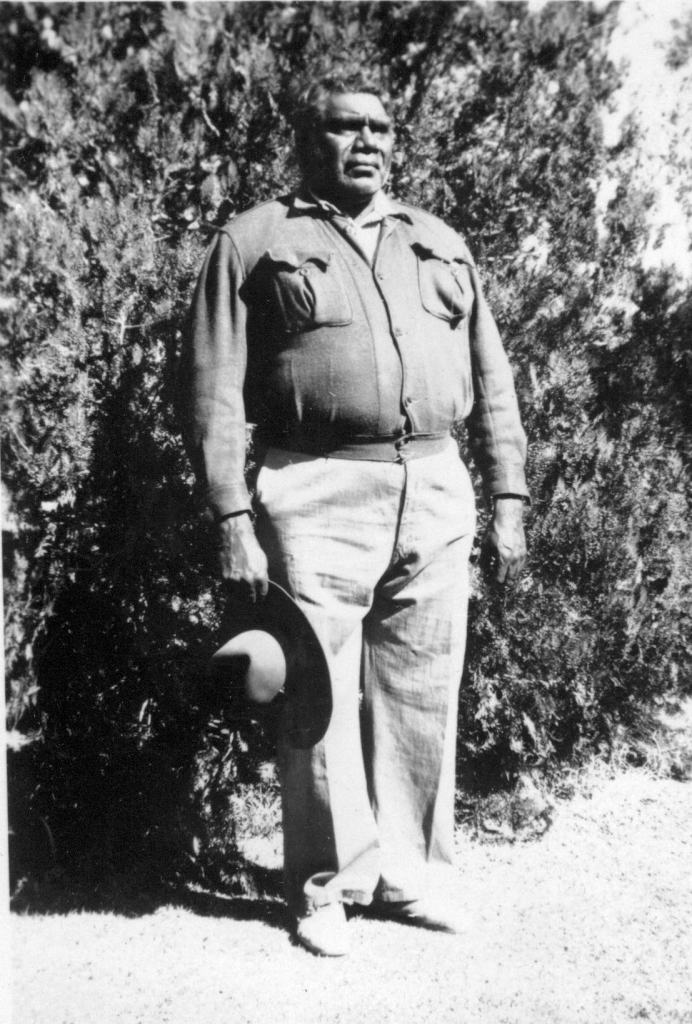
Albert Namatjira, 1949 (Public Domain, via Wikipedia)

Albert Namatjira, 1949 (Public Domain, via Wikipedia)

  • Art of the Australian Aboriginal by Charles Barrett and Robert H. Croll (with a foreword by anthropologist AP Elkin), in 1943. Charles Barrett was a naturalist and journalist, and R.H. Croll an author and public servant. Both travelled widely throughout Australia. Barrett was passionate about protecting ancient Aboriginal art, writing that its protection “should be a national concern: white morons have already disfigured many”.
  • The art of Albert Namatjira by C. P. Mountford, in 1944. Albert Namatjira is one of Australia’s best known Aboriginal artists, a pioneer. Mountford was a mechanic and public servant turned anthropologist who, by the 1920s, was developing the interest in indigenous Australian culture that stayed with him the rest of his life. He was particularly interested in art, but I was intrigued to read in the Australian Dictionary of Biography that “in 1935 he was appointed secretary of a board of inquiry to investigate allegations of ill-treatment of Aborigines in the Northern Territory, at Hermannsburg and Ayers Rock”. He also travelled with Norman Tindale who is famous for his detailed map of indigenous Australia.

Interesting, I think, that it was this “little” club which published these books.

Donation to the Adelaide University’s fund for Aboriginal research

This one intrigued me, and is what inspired this post, in fact. I read in The Argus, 19 May 1951, that Albert Namatjira had donated £1000 to the Adelaide University’s fund for Aboriginal Research. But, apparently, the story goes, he did not make the donation himself because “as Australian law now stands, an aborigine cannot control an income of his own”! Enter Bread and Cheese Club founder JK Moir who made the donation on Namatjira’s behalf out of the proceeds of the book by CP Mountford. Moir is quoted as saying:

Albert, as an aborigine, cannot control his affairs, but I know what we have done has his enthusiastic endorsement. There is no precedent for this anywhere. An aborigine raising £1000 through his work for the cause of his own people is unique. I can assure you it will not be the last donation if we can help it.

Coranderrk and the Barak Grave

The final story activity I want to share is more in the style of those working bees that groups like Rotary and Lions have often done. It concerns the cemetery at Coranderrk. Coranderrk was an Aboriginal reserve established by the government for dispossessed indigenous Australians. It operated from 1863 to 1924. It’s quite a story that I won’t detail here, but in 1950 the land was handed over to the Soldier Settler Scheme. The cemetery, which of course contained graves of the previous indigenous residents, was by then in disarray. In a letter to the editor of the Healesville Guardian on 19 May 1951, naturalist David Fleay wrote of being “shocked at its state of absolute neglect and ruin”. Only two graves, one being that of, Barak, the last king of the Yarra Yarra tribe, were distinguishable he said. He also refers to the marble monument to Barak that had been in a significant position in the town of Coranderrk but was now in a depot. He argued that money should be put aside to renovate the cemetery and that the Barak monument go to its “rightful place”. He also suggests that “it is possible that the Melbourne Bread and Cheese Club, champions of Australiana would take a decided interest”.

And so, in fact, they did. A Healesville Guardian column by Oswald C Robarts on 11 November 1955 writes of their contribution. They seem to have become involved in 1952 and carried out at least one working bee in 1955. It’s not clear what else they did. A report in the Club’s journal, Bohemia, states that “we did a good day’s work and those who remember the terrible state of the Cemetery when we saw it on our first visit would be surprised. Much remains to be done.”

I will conclude though with Oswald C Robarts:

On January 23 this year, several members of the Club travelled from Melbourne, bringing with them the necessary materials and equipment for handling the heavy parts of the memorial. Working throughout the day in near-century heat, they completed the job. It should be scarcely necessary to add that these men, like others who have previously urged that something should be done about Coranderrk, were not concerned with public kudos nor material gain.

Basically, interest in the “old” Australians who have gone, and wise, firm and considerate care for those that remain, are matters of public conscience. There is by now fairly wide general agreement that far too often in the past, as well as today, they have been handed the seamiest side of Western civilisation. Here is a paradox to be removed, for Australia today is spending millions on the Colombo Plan, and bending over backwards to assure our Asian neighbours that there is no such thing as a “White Australia” policy in a racial sense.

There is an element of paternalism in “the wise, firm and considerate care for those that remain” but this seems to be to be pretty strong stuff for 1955. Thanks once again to Trove for making these papers available.

Kathy Marks, Channelling Mannalargenna (Review)

A few weeks ago I wrote a Monday Musings about the Walkley Awards, noting some of the winners that particularly interested me. They included two awards for essays in the Griffith Review, one by Melissa Lucashenko, whose essay “Sinking below sight” I subsequently reviewed, and the other by Kathy Marks whose essay, “Channelling Mannalargenna” is the subject of this post. Both essays deal with indigenous topics but while Lucashenko, who won the award for Long Feature, has Aboriginal heritage, Marks, whose award was for Indigenous Affairs, is English. This adds an intriguing layer to her piece which is about the troubled issue of identity in indigenous Tasmania. Marks has, however, been writing about the Asia-Pacific region since 1999.

Like most Australians of my generation, I grew up believing that genocide had resulted in the elimination of indigenous people from Tasmania. Truganini, we were told, was the last “full-blood” Tasmanian Aboriginal person. She died in 1876. In 1978, the documentary, The last Tasmanian, made by filmmaker Tom Haydon and archaeologist Rhys Jones, popularised this idea. It is, however, not quite as simple as we’d been led to believe – and Marks’ essay chronicles the identification legacy left by a history of being discounted. The Walkley judges described the essay as follows:

An elegantly written essay about a community still wrestling daily with the act of colonisation. Adding poignancy is the hovering myth of extinction, Kathy Marks deftly draws the reader into the everyday of establishing Tasmanian Aboriginal identity, teasing out the tensions, but without seeking catharsis.

It’s a brave essay, I think, something that Marks herself recognises when she said on her win that “I was thrilled to receive the award, not least because of the challenging and sensitive nature of the subject matter.” Being brave, though, is surely the hallmark of a good journalist. And so, Marks tackles the thorny issue regarding the definition of indigeneity in Tasmania.

As I read the essay, I was reminded of remarks made by Anita Heiss in Am I black enough for you? on conflict within the indigenous community regarding Aboriginality. Heiss discusses the different ways people come by their Aboriginality and says:

What age and experience  moving around the country has given me is a better understanding of the complexities around individual and collective Aboriginal identity. One shouldn’t be too quick to judge others, especially when some of us have been fortunate to know who we are all our lives, and others haven’t.

And herein lies the rub in Tasmania. Because of the particular history of indigenous Tasmanians, family lines and connections have been broken, and so the way Tasmanians discover their Aboriginal background is highly varied. In her essay, Marks talks to many of the groups and factions existing in contemporary Tasmania, and describes the bitter lines that have been drawn between some of them. Some of these lines are so strongly defended that one group, the Tasmanian Aboriginal Centre (TAC) in particular, has taken legal action against people who have claimed indigenous heritage. Officially, the definition of Aboriginality in Tasmania is the same as that established by the Federal government – the three-pronged factors of ancestry, self-identification and being accepted by the indigenous community. The TAC, however, demands a family tree as part of this. Marks quotes Michael Mansell who argues that to be accepted as indigenous Tasmanian, people need to:

show that…their families, from every generation back to tribal, have always maintained their connection with being Aboriginal. So that excludes people who undoubtedly have Aboriginal descent but who have been brought up as white people… If there’s been a break in the generations, where someone lost contact, the Aboriginal community’s view is…you can’t revive it.

Not all can provide this unbroken connection. For example, indigenous Tasmanian academic, Greg Lehman, told Marks that people were not keen to admit to indigenous forbears in the 194os and 1950s. And then there’s the devastation – dislocation –  that occurred one hundred years earlier through George Arthur’s infamous Black Line and then George Augustus Robinson’s corralling of indigenous people at the so-called “friendly mission” Wybalenna on Flinders Island in the 1830s.

awwchallenge2014Looking from the outside, I find this conflict all very sad. It’s hard enough when indigenous people suffer rejection and discrimination from the white majority culture, but when it also comes from inside the community it must be devastating. Patsy Cameron, an indigenous Tasmanian whose bona-fide is accepted, would like to see a more inclusive approach. Marks quotes Cameron:

‘Even someone who hasn’t been active in their culture or in the politics of the day,’ she says, ‘it doesn’t make them any less Aboriginal. Anyone who can show their lineage, and their extended family acknowledges them as part of that family, we should be embracing them. We should be embracing people who have been lost, rather than chasing them away and doing to them the exact thing that non-Aboriginal people have done to us in the past: denying us our rights, our identity.’

I’ve only touched the surface of Marks’ essay. It’s an excellent read that starts with a brief history of indigenous relations in Tasmania, including some distressing anecdotes regarding discrimination, before exploring in some depth the essay’s central issue regarding Aboriginal identity. Fortunately, the essay is freely available online via the link below. If you have any specific or general interest in the topic I commend it to you.

Kathy Marks
“Channelling Mannalargenna: Surviving, belonging, challenging, enduring”
Published in the Griffith Review, Edition 39, 2013
Available: Online at the Griffith Review

Melissa Lucashenko, Sinking below sight (Review)

In this week’s Monday Musings about the Walkley Awards, I noted that Melissa Lucashenko had won the award for Long Feature Writing for her essay “Sinking below sight: Down and out in Brisbane and Logan” in the Griffith Review. I’ve now read the essay, and thought I’d share it with you. I’ve reviewed Lucashenko before, an essay and a short story. I really must get to one of her novels one day!

With her mixed European and indigenous Australian heritage, Lucashenko is well placed to tackle significant contemporary issues and see them from multiple perspectives. The last essay of hers that I reviewed, “How green is my valley”, dealt with stewardship of the land and the threat imposed by climate change. In “Sinking below sight” her subject is poverty. Lucashenko’s essays make engaging reading. Instead of dry reportage, she starts from the personal, and from that draws conclusions that make sense. And so, while “How green is my valley” drew from her experience on a farm in northern New South Wales, this essay draws from her return, after losing her farm through divorce, to the town of Logan, one of Australia’s ten poorest urban areas.

You’ve probably noticed that her subtitle alludes to Orwell’s autobiographical work Down and out in Paris and London which chronicles his experience of poverty. Similarly, Lucashenko writes that she’s been poor before, so “I had the skill set”. But, this essay is not about her. She starts by setting the scene, describing this “Black Belt” region as one in which

Welfare recipients and the working poor … don’t necessarily realise they are hard up. More accurately, many don’t realise just how poor they are, since everyone in their lives is battling.

She then moves on to the main topic of her essay, which is to find out “How do my Black Belt peers manage? How do single mums, in particular, get by on current levels of welfare? And what dreams are possible for the Brisbane underclass in 2013?” To answer this interviews three women currently living in poverty – Selma (27), Marie (38) and Charmaine (49) – and discusses their situations.

Selma, a Yugoslavian of Serbian and Croatian parents, has four children under ten and a partner who is in and out of jail. Having been a refugee and then involved with an abusive Aboriginal man, Selma has some clear views on her situation:

What I don’t like in society … is the judgments put on Indigenous and refugee and domestic violence people. I was in that situation for nine years. They say you make a choice, but I don’t ever remember choosing to be beaten up! From the age of seventeen ’til about two years ago, domestic violence was part of my everyday life.

She blames poverty for violence, saying that “poverty breeds hate”. Lucashenko suggests that the abuse she experienced “had roots also in the trauma and racism of the refugee experience.”

Marie is also a mother of four, with an “on-again, off-again partner”. She is a member of the “working poor” so not quite as poor as Selma. She grew up in a troubled home, had been sexually molested as a child, and was living independently by the time she was 14 years old. She, like Selma, had a history of “severe emotional and physical abuse from her previous partners, who were all, bar one, Anglo-Australian men”. Lucashenko writes:

Marie spoke to me of feeling enormous rage about the past abuses in her life, rage which sits constantly just beneath the surface.

The third woman is Charmaine, “blond, slim and still able to laugh despite a life that would crush most of us [and] the white Australian mother of four Aboriginal kids”. She too was raped and molested as a child, and ended up in a violent relationship in which she stayed too long.

Australian Women Writers Challenge

While recognising that her examples are more anecdotal than statistical, Lucashenko nonetheless draws some conclusions. They include:

  • Underclass expectations, which see people who grow up with nothing, expecting little
  • The importance of public housing in providing some “minimal prospect of safety”
  • Loneliness and isolation, which drive single mums back to “untenable situations”
  • Violence and mental illness in parents and partners, which entrench poverty for women
  • Childhood molestation and/or rape, which all three women had experienced
  • Women seeking relief in drugs, which of course can initiate new downward trajectories

Her three women, Lucashenko finds, have hopes for the future. Selma and Charmaine are studying, because, as Lucashenko writes

Realising that poverty is a creation of society and its choices, these two women also know that their lives might shift through higher education.

Pragmatic Marie has a saving plan. Their situations though are tenuous. To achieve their goals, they’ll need strength. Better still, though, would be if they got effective financial and other practical support.

Lucashenko opens the essay with the epigraph that “the opposite of poverty isn’t wealth. It’s justice”. Her essay may not be statistically significant from an academic perspective, but anyone who reads contemporary social commentary knows that what she writes rings true – and this, clearly, is why she won the Walkley.

Melissa Lucashenko
“Sinking below sight”
Published in the Griffith Review, Edition 41, 2013
Available: Online at the Griffith Review

Monday musings on Australian literature: Writing the Australian landscape (2)

In this week’s Monday Musings*, I plan to continue last week’s discussion of some of the ideas that arose from the National Library of Australia’s Writing the Australian Landscape conference.

But first, I’ll recap the two questions posed by the keynote speakers:

  • Day 1, author Murray Bail suggested that only when we are at ease with ourselves will our need to discuss place (or landscape) fall away.
  • Day 2, historian Bill Gammage asked How long must we continue to write our landscape as outsiders?

Thinking about these over the past week, I’ve come to the notion that these could (almost) be seen as two sides of the same coin. That is, as I understood him, Bail wasn’t so much suggesting that we’ll end up not discussing place or landscape but that we won’t “need” to focus on it to prove our Australianness, to confirm our identity. Landscape would then become part of the background, it would be part of us, and we would no longer be outsiders to it. Does this make sense or am I twisting their words, I wonder?

The meaning of place

Several “place” related concepts were discussed over the weekend, sometimes with clear definitions, and sometimes more loosely. Many speakers talked about the relationship between Landscape, Place, Country and Culture. Landscape was not seen as purely physical but as something that we relate to and/or that impacts on us. Gammage argued that it takes time and memory to translate “landscape” to “country” or “culture”. Historian Matthew Higgins talked about “place memory” and suggested that when we talk about and remember place, “life is as important as the landscape”.

Gammage, and several other writers including Sue Woolfe, Charles Massy and Ros Moriarty, spoke of learning about indigenous Australians’ relationship to the land, a relationship in which the physicality of the land is inextricably entwined with spirituality. People, land and law are three aspects, he said, of the one thing.  While westerners objectify the land – as in, “isn’t it beautiful?” – indigenous Australians see their ancestors in it. Landcare is the business of life. Climate change activist, Anna Rose, and Adrian Hyland, who wrote Kinglake 350 about the Black Saturday fires, would agree, albeit from a different perspective.

John Moriarty Qantas Plane

John Moriarty Qantas Plane

Non-indigenous woman Ros Moriarty, who is married to indigenous Australian John Moriarty, said:

Australians have no idea that the singing of the continent continues. We sip at the edge of its physicality when we could gulp from the well of its spirit.

This message, reiterated slightly differently by many of the speakers, was the most powerful message (for me, anyhow) of the weekend. It wasn’t a new concept to many of us I think, but the strength and clarity of its communication was moving and inspiring.

… And then, late in the conference came …

Jeanine Leane

I’m singling out Jeanine Leane because she was, as far as I’m aware, the only indigenous writer to speak at the conference. I have read and reviewed Leane’s gently powerful Purple threads, and was looking forward to seeing her in the flesh. She had a big task, but she was up for the challenge. She reiterated the points made by other speakers regarding country and its meaning for indigenous Australians but she, of course, spoke from the experience of having walked the talk. She knew intimately whereof she spoke and showed how much we westerners, albeit with a lot of goodwill, stumble around in our understanding.

For example, she spoke of the notion of Australian “classics”. She argued that the works of writers like Xavier Herbert, Patrick White, David Malouf, and Kate Grenville, which are regularly identified as “classics”, are classics of the settler quest written for settler readers. Within the concept of “classic”, she argued, is the question, “Whose classic?” Leane pushed the point further by referencing Alexis Wright, author of Carpentaria (my review). Western (white) critics, she said, see magical realism in Wright’s work. (Ouch!) But the notion of “magic”, she argued, is used by settler critics for things they can’t understand. For Wright, though, the point is that “if you can’t see that tree behaving strangely, that’s your problem”.

Leane seemed, however, more optimistic than angry, for all the strength of her argument. She said that there is a proliferation of Aboriginal writing across genres, and that this writing expresses not only the “generational story of loss and longing” but also people’s aspirations. I hope she’s right, but even more, I hope more of it is taught is Australian schools and read by Australians of all backgrounds.

And this brings me back to Bail and Gammage. How should we “settler” Australians proceed? How do we relate to the “place” in which we live in a way that isn’t superficial or tokenistic but that doesn’t (arrogantly) presume a connection that we don’t have?  We have a way to go yet.

* There is more to say, but this will be the last post for the moment. I may share more again later, perhaps after the papers become available on the NLA’s website.

Monday musings on Australian literature: Role of Aboriginal literature

Most keen readers have firm views about the value of reading to them. Some, I think, read mainly to escape. Others like to be opened to other ways of being and thinking. Others like the things they learn – yes, even from fiction! And still others love beautiful or interesting language. These aren’t the only reasons, and aren’t mutually exclusive, but are I think among the main reasons …

Last week I reviewed Anita Heiss‘s Am I black enough for you? Heiss has a PhD in Aboriginal literature and publishing, and is active in promoting Aboriginal literature. She has co-edited The Macquarie PEN Anthology of Australian Aboriginal literature, and she was the guiding force behind BlackWords, the topic of last week’s Monday Musings. She is a writer herself (of novels, poetry and non-fiction) and has published two children’s books co-written with students of La Perouse Primary School as the result of workshopping stories with them. She is regularly invited to talk about Aboriginal literature – in Australia and overseas – at conferences and seminars. You won’t be surprised then to know that she has very clear ideas about the role of Aboriginal literature.

Here is what she says in Am I black enough for you?:

Aboriginal literature from Australia serves many purposes: it records our ‘truths’ about history; it functions as a tool for reconciliation, allowing non-Indigenous Australians to engage with us in non-confrontational ways; it provides a means of self-representation in Australian and world literature and assists understanding of the diversity of our identities; finally, it challenges subjective and often negative media stereotypes and interpretations in our lives.

While this feeds into some of the reasons we read, it is a far more political manifesto for literature than we are used to. But then Indigenous Australians are in a very particular, and minority, position.

By some definitions, aspects of this could almost be seen as propaganda – in the sense that she’s essentially talking about promoting a cause – but propaganda, once a neutral term, now has very negative connotations. It contains notions of ‘skewing” facts, and of coercion and control, usually by the state. This of course is not what Heiss is talking about – but she is talking about the role literature can play in reflecting and expressing, to both the self and other, a particular view of things. Whether this is conscious – as Heiss clearly is with her chicklit books (see my review of Paris dreaming) – or subconscious is not really the point. (If it’s too conscious, too manipulative, and/or not believable, readers will stay away). The point for Heiss is that more indigenous writers need to be able to express themselves so that indigenous and non-indigenous people will better understand and know the reality of indigenous Australian life and experience, rather than rely on non-indigenous-written texts and stereotyping. Education, more than persuasion, is what she sees as the goal.

Heiss’s manifesto, as I’m calling it, also made me think of “ideological” novels, that is, those novels which consciously argue a philosophical or political, that is, ideological, line. But this too, I think, is not really what Heiss is saying – though individual indigenous novels could very well fit this specific definition. She is recognising, rather, that all literature functions as part of the prevailing ideology (or culture) within which it is written and therefore can’t help but impact this ideology simply by being, regardless of whether it reinforces or questions or rejects existing norms. The more Aboriginal literature is published, the more it is likely to shift the prevailing ideology, which is a good thing.

Why am I writing this? Just, I guess, because as a reader I like to think about who writes and why they write the things I read, and about the role literature plays in my life (and our collective lives). I appreciated Heiss’s clear manifesto on what she believes and thus on why she does what she does. I wanted to share it – and tease it out a little. I’ve done that, and now I’m happy!

Anita Heiss, Am I black enough for you (Review)

Anita Heiss, Am I black enough for you?

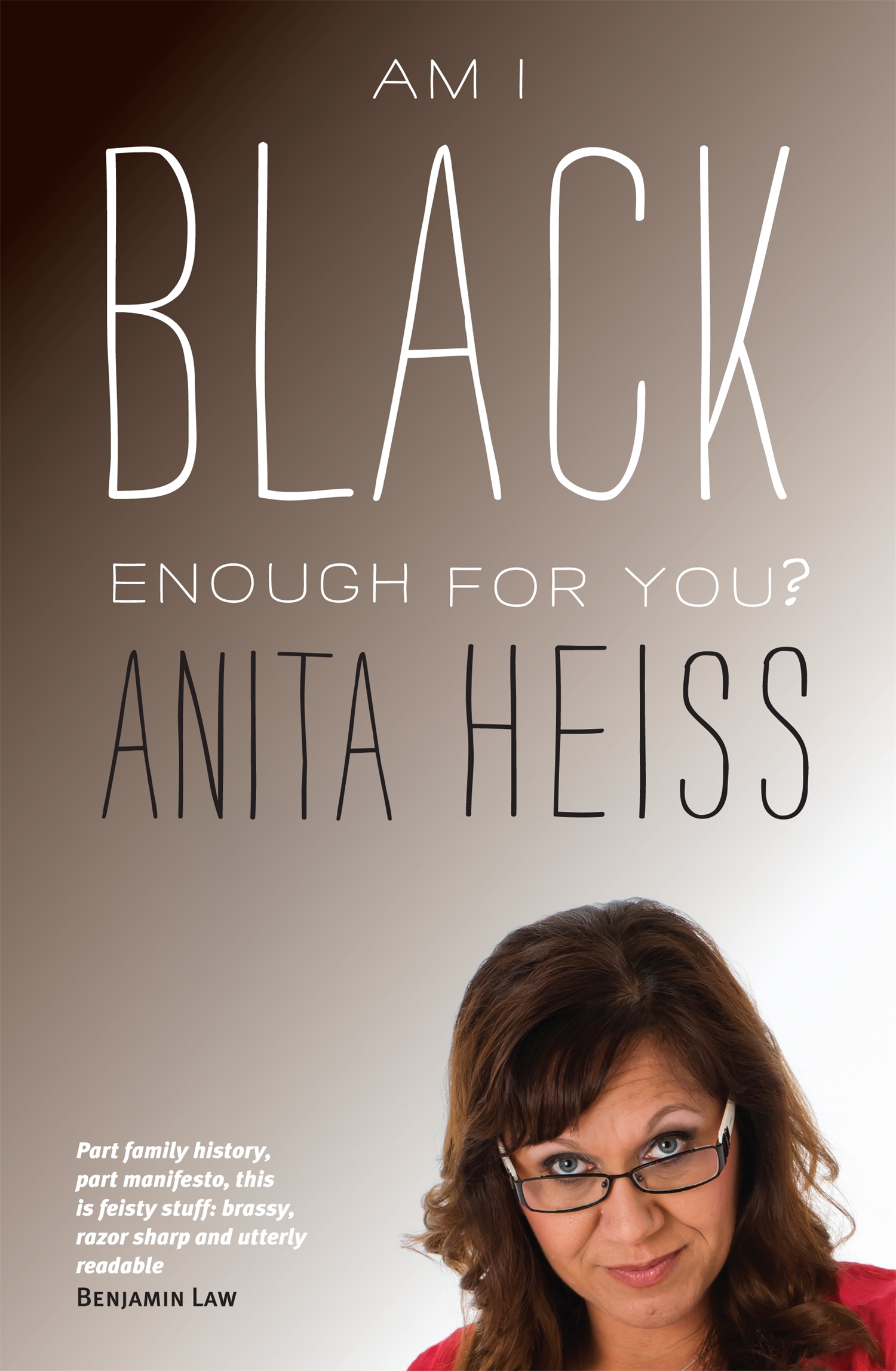
Courtesy: Random House

Anita Heiss‘s Am I black enough for you? is a challenge to categorise, so I’ll start with writer Benjamin Law‘s description on the cover of my edition. He calls it “part family history, part manifesto” to which I’d add “part memoir” because “family history” does not really cover the self-description aspect of the book.

For those of you who don’t know Anita Heiss, she is a Wiradjuri woman and an activist for indigenous Australians. She has a PhD in Communication and Media, focusing on Aboriginal literature and publishing, and is a writer. (I reviewed her chicklit novel, Paris dreaming, earlier this year, and reported last year on her address to the inaugural Canberra Readers’ Festival.) She co-edited the Macquarie PEN anthology of Aboriginal literature and was the guiding force behind BlackWords (the subject of this week’s Monday Musings). And this is just the start … she has been, or is currently, on many boards and committees, particularly to do with indigenous people and communications. She is an Ambassador for the Indigenous Literacy Foundation. She is, in effect, a tall poppy … which brings me to Am I black enough for you?

You see, in 2009, one of Australia’s influential shock jocks, Andrew Bolt, wrote a post titled “It’s so hip to be black” on his blog, asking readers to accept his proposition that there is “a whole new fashion in academia, the arts and professional activism to identify as Aboriginal”. He named many people, including Anita Heiss, calling them “white” or “political” Aborigines. His facts were questionable and his language emotive – such as “madness”, “trivial inflections of race”, “comic”. His argument was that these “white” Aborigines were obtaining unfair benefits from their decision to “be black”. The result was a court case brought by Anita Heiss and eight others against Bolt and his employer, The Herald and Weekly Times, for breaching the Racial Discrimination Act. Heiss and her co-defendants won the case. They did not seek damages. It was ground-breaking stuff that brought out some good discussion about the nexus between racism and free speech, about rights and responsibilities, but it also generated a lot of vituperative commentary. You can research all this pretty easily on the ‘net.

This is the background to Am I black enough for you? which, you might now have gathered, could also be described as an “identity memoir”. On the publisher’s website, Heiss writes that “I wanted to demonstrate that we as Aboriginal people have our own forms of self-identification and self-representation”. She wanted to “challenge the stereotypes” and present “alternative realities of being Aboriginal today”. This she does very well.

Heiss opens the book with her family background, Wiradjuri mother and immigrant Austrian father. She describes herself:

I’m an urban beachside Blackfella, a concrete Koori with Westfield Dreaming, and I apologise to no-one.

This is my story: it is a story about not being from the desert, not speaking my traditional language and not wearing ochre …

In the first four chapters of the book, she tells of her background – her grandmother and mother and their experiences as indigenous women, her father and his values, and her school days. Having laid that foundation, she presents in the fifth chapter, the current working definition of an Aboriginal or Torres Strait Islander person used by the Federal Government:

An Aboriginal or Torres Strait Islander is a person of Aboriginal or Torres Strait Islander descent who identifies as an Aboriginal or Torres Strait Islander and is accepted as such by the community in which he “or she” lives.

That seems pretty tight to me, though no definition is perfect. It’s better than using “a caste system defined by blood quantum (half-caste … quadroon)”.

There are a lot of “ah-so” moments for me in the book – some confirming things I’d already believed and some raising my consciousness about how easy it is to say the wrong thing without being aware of it. Heiss chronicles many instances where (mostly, I think) well-meaning whitefellas seem to get it wrong, such as the non-indigenous academics who proclaim themselves experts in “everything Aboriginal” or the critic who argued that Aboriginal literature “must” be in traditional language otherwise it’s Australian literature. It’s good to have these ideas aired publicly. It helps us test our own conceptions.

Am I black enough for you? has, like most of Heiss’s writing, a strong political and educational purpose. She is on a mission to encourage both indigenous and non-indigenous Australians to think about indigenous identity and, further, about how we relate to each other. She therefore writes in a bright, breezy, accessible style. She’s acutely aware of the power of words and language to define and to obfuscate (though she wouldn’t use such an obfuscatory word!), and frequently discusses language in the book. She makes a particular point about this in the chapter on her academic life, “Epista-what?”, when she says that using academic language, particularly to discuss indigenous issues, served “largely to alienate the very people it was talking about.”

There is much more in this book, and I hope many Australians read it. It’s well-structured, more or less chronologically but in a way that aligns with various themes – academia, the role of literature, her writing, gender – all of which link back to affirming indigenous people’s identity. She comes across as a generous woman – in her relationships with indigenous and non-indigenous people alike. She believes that optimism, rather than negativity and anger, is more likely to get results. It is possibly this optimism which underlies my small frustration with the book: several times she hints at dark times and stresses but, being the optimist, she focuses more on her strategies for overcoming them than on how they have informed her being. I’d like to understand more of that. However, Am I black enough for you? is not a misery memoir, and that’s probably a good thing!

Australian Women Writers ChallengeRead for the Australian Women Writers’ Challenge 2013ANZLitLovers Indigenous Writers Week, and Global Women of Color. Lisa (ANZLitLovers) and Marilyn (Me, You and Books) both enjoyed the book.

Anita Heiss
Am I black enough for you?
Sydney: Bantam, 2012
346pp.
ISBN: 9781742751924

Monday musings on Australian literature: BlackWords

NAIDOC Week, to which last week’s Monday Musings was dedicated, officially finished yesterday, but I’ve decided to bookend it with another Monday Musings focusing on indigenous Australian literature. This post, in fact, also harks back to two Monday Musings ago which talked about the AustLit database – because I want to introduce you to one of AustLit’s projects, BlackWords.

BlackWords was established in 2006 under the guidance of Dr Anita Heiss (whose Paris dreaming I reviewed earlier this year and whose memoir Am I black enough? for you I’ll be reviewing this week). It is a resource for and database of Aboriginal and Torres Strait Island writers and storytellers. It contains, where available, the standard information provided throughout the database:

  • author biography
  • lists of works by the author and about the author

Aboriginal and Torres Strait Islander Australians are the traditional keepers of their oral history, we are the custodians presiding over Indigenous Australian literature … (Indigenous writer and David Unaipon Award winner Yvette Holt)

It now contains records for over 5,000 people and organisations. Wow! The database aims to cover “published and unpublished books, stories, plays, poems, and criticism associated with eligible writers and storytellers … in English, in Australian languages, and in translations.” Given that the loss of language is a significant concern for our indigenous peoples, capturing works in Australian languages is a particularly important goal.

… each time we translate black words onto white paper we are reclaiming an integral piece of our heritage, culture and language.” (Yvette Holt)

Tara June WInch

Tara June Winch (Photo: Howcheng, using CC-BY-SA 3.0, via Wikipedia)

Currently the BlackWords homepage spotlights three featured authors: Tara June Winch, Anita Heiss and Samuel Wagan Watson. Click on the author’s name and you get taken to their AustLit page. In the right sidebar of their page is something called Resource Maps. For Anita Heiss and Tara June Winch these include Wiradjuri Trail (Wiradjuri being the nation they both belong to). The Resources Maps contain hand-built links to internet sources on the topic. As with all of AustLit, these maps are works in progress.

The left sidebar contains a variety of links, encouraging other explorations, such as “Teaching with BlackWords”,  “Publishers” and “Translations”.

Specifically for BlackWords, the site also includes a timeline of historical dates significant for Aboriginal and Torres Strait Islander people. It starts at 1788 … the date when white people established their first settlement in Australia. The text entries for these dates include links to works and authors in the database. Also, under the dates – where relevant – are links for search terms that will lead searchers to works indexed in the database about the event/date. So, for example, under 1788, are links for Pemulwuy, an Aboriginal warrior who resisted the white invasion, and Bennelong, who was captured by Governor Phillip and found himself caught between two cultures. (The timeline is a little tricky to find. It would be more obvious if placed in the left sidebar, but instead it’s a dot point under “About” on the About page.)
… when storytellers speak, their words will inextricably tie indigenous peoples to their lands and to their mobs … (Yvette Holt)

BlackWords is a wonderful initiative and has now reached the critical mass to be of value to indigenous and non-indigenous Australians alike. It is for resources like this that the Internet is at its best, don’t you think?

Melissa Lucashenko, How green is my valley (Review)

Almost a year ago I reviewed a short story, “The silent majority”, by Melissa Lucashenko. It was published in the Griffith Review of November 2009. I enjoyed the story and so, in honour of NAIDOC Week and ANZLitLovers Indigenous Literature Week, I thought I’d review another of her Griffith Review contributions. This one, “How green is my valley”, is described as a memoir, and was published in Winter 2006.

I love how Lucashenko, with her dual Aboriginal and European heritage, traverses both in her writing. She commences “The silent majority” with the famous opening words of Pride and prejudice – “”It is a truth universally acknowledged”. The title of this piece immediately brings to mind Richard Llewellyn‘s classic novel How green was my valley, and clues us into her themes: beauty under threat, complicated relationships with land, and the precarious balances involved in maintaining it.

Lucashenko starts her memoir – though, really, I’d call it a personal essay – with a Mark Twain quote, which has a prescience now that he could not have guessed:

Everybody talks about the weather/but nobody does anything about it.

She then describes the experience of torrential rain in Bundjalung country, the coastal regions of north-east New South Wales/southeast Queensland. She’s moved, she says, to “one of Australia’s wettest shires”. The first half of the essay describes how residents manage – or don’t – the rain. She talks of students being let off school, of the weather not distinguishing between rich and poor, and of how community is fostered as people with 4WDs deliver food to the stranded who don’t. “The information we receive from land”, she says, “is tightly nuanced”. Farmers watch closely and know how the days will pan out once the rain sets in:

We who live on Bundjalung land know that eventually the rain will stop, the mould will retreat and the mud will dry. Whatever climate change is going to mean for our kids, in the short term life for us will return to normal.

Then, halfway through the essay, comes the sting in the tail: she reminds us that the inhabitants of Tuvalu will lose their home in the next few decades as their island is submerged, and the semi-traditional hunting lifestyle of the Inuit of the Arctic Circle “will be shattered by global warming even sooner”. She wonders whether indigenous people like the Inuit will be able to translate “the clan, the traditions of egalitarianism, stoicism and intensely valued community, to life in suburbs and towns.”

Lucashenko’s thesis is that it can be done, that it is possible to be “bicultural”, to span the chasm “between industrial and indigenous views of the ‘good life’ and what constitutes a proper society”. She argues that the egalitarian ethic espoused by Henry Lawson and Banjo Paterson

the traditions of mateship that faithfully mimic the brotherhood of initiated Aboriginal men and the myriad skills of surviving from and maintaining the land – were learned by some colonial whites from Aboriginal people.

Hmm … I haven’t heard that before. I suspect Australia’s mateship tradition has rather multi-pronged origins but this could certainly be part of it.

Lucashenko’s point though is to draw a parallel between white Australians’ love of land and indigenous people’s. She says that any Australian who has holidayed at the same beach every summer, or “diligently looked after” their own little patch, has “walked in Aboriginal footsteps” whether they know it or not. Hmmm … again I think this is a little bit of a long bow, in the sense that there are people all over the world who love their bit of land. But it doesn’t spoil her argument that it would have been good had the influence of Aboriginal knowledge and practice been greater, because then

More Australians might have learned not just to love the place (as some indisputably do) but to listen to the land more seriously. Had more Aboriginal philosophers been valued rather than shot or packed off to missions, all Australians might have learned the careful and intense attention to detail that many of us in the valley are still forced to practise as a matter of course.

With climate change breathing down our necks, will we all “be rooned”, she asks (alluding to one of my favourite old ballads “Said Hanrahan“). Will our “valley” be destroyed by our inability to tame our capitalistic consumerist urges, or will we learn in time how to be true custodians of our land?

Melissa Lucashenko
“How green is my valley”
Published in the Griffith Review, Edition 12, Winter 2006
Available: Online at the Griffith Review

Monday musings on Australian literature: Indigenous Australian memoirs

As Australians would know, this week – July 7-14 – is NAIDOC week. NAIDOC originally stood for an organisation – ‘National Aborigines and Islanders Day Observance Committee’ – but the acronym has now become the name of the week itself. Fascinating how acronyms can take on lives of their own, isn’t it? Anyhow, the theme for this year’s celebrations is We value vision: Yirrkala Bark Petitions 1963.

This theme commemorates the 50th anniversary of two bark petitions which were sent by the Yolngu people of Yirrkala in northeast Arnhem Land to the Australian Parliament. The petitions concerned the Commonwealth Government’s granting of mining rights on land excised from Arnhem Land. They asked the Government to recognise the Yolngu peoples’ traditional rights and ownership of their lands. These petitions were the first indigenous Australian documents recognised by the Government and helped, the NAIDOC website says, to “set into motion a long process of legislative and constitutional reforms for Aboriginal and Torres Strait Islander people”. Many Australians know of Eddie Mabo and the Native Title Act of 1993, but I wonder how many know of actions like this which occurred decades earlier?

In this spirit of commemorating the past, I thought today’s Monday Musings could focus on indigenous Australian memoirs/autobiographies. I’ve written on this topic before, and so will try to avoid repeating myself too much. Interestingly, all of the books I mention below are by women. The Cambridge companion to Australian literature says, in fact, that since the 1970s, Aboriginal women have dominated indigenous autobiography.

A number of themes run through indigenous memoirs/autobiographies and, of course, identity is a big one. One of the best known examples of a memoir about identity is Sally Morgan‘s My place which was published in 1988, Australia’s bicentenary year – the bicentenary, that is, of white settlement in Australia. It was not a year that was universally celebrated by indigenous Australians, for good reason. My place was, possibly, the first book by an indigenous Australian that many non-indigenous Australians had read – and it became a best-seller. Morgan, also an artist, told the story of her family – and of their shame that was so strong that she had not been told she was indigenous. She’d been let think she was of Indian (that is, from the subcontinent) extraction, until she was well into her teens. I haven’t read My place since 1988, but I expect it would still stand up well today. Morgan is a great story-teller.

Anita Heiss‘s Am I black enough for you, which was published in 2012, is also about identity, but in a different more confident way. I’m reading this one now. In it, Heiss aims to educate Australians about the breadth of indigenous life and experience in Australia, to show us that people do not have to be living a traditional indigenous life in the desert to identify as indigenous.

A big topic for indigenous memoirs is the experience of the Stolen Generation. Many of these also deal with identity, but from a specific point of view. I mentioned one – Doris Pilkington‘s Following the Rabbit Proof Fence – in my previous post. While I’ve read a couple of novels dealing with this issue since that post, I haven’t read more memoirs. There are many out there, though, including Rosalie Fraser’s Shadow Child: A Memoir of the Stolen Generation (1998), Doris Kartinyeri’s Kick the tin (2000), Donna Meehan’s It is no secret: The story of a stolen child (2000).

As Australians would know, the most comprehensive study of the Stolen Generation appeared in the government report Bringing them home (1997). This 700-page report contains excerpts from the testimonies of over 500 indigenous people about their or their families’ experiences of being stolen.

A common style of memoir – for indigenous and non-indigenous people alike – is what I’d call the “success memoir”. You know, those chronicling major success or high achievement. Sydney 2000 Olympic Games gold medallist Cathy Freeman wrote Cathy: Her own story in 2003. As often happens with memoirs written by non-writers, she had a co-author, the sportswriter Scott Gullan.

Last but not least is the simple story-of-my-life memoir, though most memoirists wouldn’t be writing their stories if they really were simple! Ruby Langford Ginibi would fall into this category – I think, as I haven’t read her yet. Ginibi published her first book, the gorgeously titled Don’t take your love to town, in 1988 when she was 54. She won a Human Rights Literary Award for it. Ginibi was a lecturer in and historian of Aboriginal history, but her start was way different. She married young, had nine children, lived and worked in the bush, and also worked as a clothing machinist. One of the obituaries written after her death says:

Through her numerous books, short stories, poetry, interviews and public appearances and her commitment to ‘edu-ma-cating’ non-Aboriginal people about Indigenous peoples’ circumstances and struggle she made a distinctive and substantial contribution to Australian history and literature.

 “‘Edu-ma-cating’ non-Aboriginal people”. That’s what all these writers are doing in their different ways … I’m glad they are, and will continue to read a few each year.

Unfortunately, many of these books are likely to be out of print but most should be available in libraries – in Australia at least. If you’d like to read one, I suggest you do so now and join ANZLitLovers Indigenous Literature Week. Lisa will, I understand, accept reviews after the week has finished.

Satellite Boy (Movie review)

It’s disappointing to say the least that the new Australian film, Satellite Boy, is in very limited distribution. It was released 10 days ago, and in my city, with 6 cinema complexes, it is screening in only one. Why? It’s rather an indictment of Australian audiences that such a film is not receiving wider distribution.

Off the soapbox, now, and onto the film. Satellite Boy tells the story of Pete (Cameron Wallaby), who’s around 11 years old and who lives in an abandoned, derelict drive-in cinema on the edge of town with his grandfather, Old Jagamarra (David Gulpilil). His mother has left, but Pete is expecting her back to carry out their plan of turning the cinema into a restaurant. Meanwhile, Old Jagamarra and Pete learn that the land is to be taken over by a mining company, so Pete sets off, on bike, with his friend Kalmain (Joseph Pedley), to change the mining company’s mind. Shortly into what is supposed to be a 2-day ride, they end up on foot, walking through some pretty forbidding country. Pete confidently says to Kalmain:

If you walk country, country will look after you.

East Kimberley landscape

Between Wyndham and Kununurra

Of course, it’s not that simple. The Australian outback is a harsh place, and while indigenous Australians have traditionally lived in it, we know that Pete has not yet learnt enough to survive.  “I’m sick of your stories” he mutters at the beginning of the film as his grandfather tries to pass on knowledge. However, as indigenous director Catriona Mackenzie has said in interviews, Satellite Boy is not a realistic film.

This is an important point because, from a realism point of view, the film has holes. Firstly, for those who like accuracy in fiction, the story’s geography is out of whack. You don’t for example, travel to Kununurra from Wyndham via Purnululu (the Bungle Bungles) National Park. But then the destination is never named, so the geography only fails if you know the region. Not naming places helps McKenzie, who also wrote the script, give the film a mythic or fabular tone – and enables her to focus on country rather than place. The other “hole” is that the film does not confront, with any depth, the conflict between old and new, or the likely ramifications of Pete’s choice. Despite some hints of cultural conflict and dysfunction, particularly in Kalmain’s family, it’s not a gritty film, like, say, Samson and Delilah (my review).

Purnululu (The Bungle Bungles)

Walking in Purnululu (aka The Bungle Bungles)

And so, of course, Pete and Kalmain do make it through, albeit with some scary moments, particularly for Kalmain who doesn’t quite have Pete’s faith or knowledge (or the guiding spirit of a grandfather). Most of the film concerns their journey, which buys into both the picaresque tradition, and the “lost child” motif I’ve written about before. As the boys start to lose their way, moving deeper and deeper into forbidding landscape without food or water, the camera cuts between Pete trying to put into practice his grandfather’s lessons and Old Jagamarra, worrying, and willing them on.

At its heart, the film is a coming-of-age story, indigenous-style. It is about a young man learning about country and having to decide what it means for him. Catriona McKenzie said that

the notion of country from an Aboriginal perspective is that it supports your spirit. It sustains you on a spiritual level, as well as a physical one if you have that understanding. That’s what I was going for.

And is, I think, what she achieved.

I loved David Bridie’s music. It’s evocative and engaging, sometimes playfully toe-tapping as when the boys set off on their journey, other times moodily spiritual as when Old Jagamarra appeals to the sky spirits/ancestors to bring the boys home. That the sky and the Milky Way are important to indigenous Australians’ belief system is made clear in the film’s opening when Old Jagamara sings “Twinkle Twinkle Little Star” in language. This significance is reinforced when, a little later, the camera looks up from Pete’s bed to show us the ceiling decorated with star stickers – and again when, during their journey, the boys sleep in a satellite dish cradled between land and sky.

It’s a beautiful film, though also a slow one, which may be one reason why distribution is limited. Mr Gums felt the landscape photography was self-indulgent at times but, given the theme, I felt it was (mostly, anyhow) justified. The performances from the three main characters are excellent – Gulpilil is luminous, and newcomers Wallaby and Pedley are convincing.

The film was shown last year at Toronto International Film Festival. I wonder what that audience made of it. For me, it adds another perspective to the indigenous films that we are starting to see – not as tough as Samson and Delilah, not as joyful as Bran Nue Dae, but nonetheless thoughtful and relevant.

Satellite Boy
Dir: Catriona McKenzie
Prod: Satellite Films, 2012