Delicious descriptions from Down Under: Arnold Zable on survival and stories

Arnold Zable is not, I believe, very well-known even in Australia, but I think he is a beautiful writer. He has a lovely way with words but, more importantly I think, his writing is warm and generous. I’ve read two of his novels – Cafe Scheherazade and Sea of many returns – and enjoyed them both. Zable was born in 1947 in New Zealand to Polish-Jewish refugees, a fact which clearly has driven his interest in human rights in general, and the migrant experience in particular. He has a new book out – Violin lessons – and so I thought now would be a good time to introduce him.

Cafe Scheherazade (2001), which is based on the stories told by Jewish refugees in the real Cafe Scheherazade in Melbourne, is, as much as anything, about survival – and, as is obvious from the title, about the importance of stories to this survival.

… but they persist with their opinions as if to argue is to know they are alive. They continue to tell their tales, as if to talk is to know they have survived.

and …

I feel the limits of my craft, the limits of what words can convey.

and …

panic … that … I would perish; and my tales would perish with me.

and, reflecting the practice of many survivors of the Holocaust (and other trauma) …

This is when the stories began to be suppressed … an urgent need to forget and to rebuild their aborted lives.

It’s a beautiful book … and well-worth reading if you ever get the chance.

PS If you Google Cafe Scheherazade Melbourne you’ll find some images (including those from a play that was adapted from the book) but I couldn’t find any that were free for me to use here.

Delicious descriptions from Down Under: Thea Astley on aging

Regular readers of this blog will now that I’m a big fan of Thea Astley. One of her last novels (novella, actually) was Coda, a biting story about elderly widow Kathleen who is losing her memory but struggling, with little help from her self-centred children, to maintain some independence and, more, dignity. The book is full of wonderful acerbic insights that make you smile while hitting you in the guts at the same time. The novel opens with ‘”I’m losing my nouns”, she admitted.’

Here are some other excerpts:

… her oddities were increasing with age, her indifference to convention running counter to the refinements and pretentiousness of her children’s lifestyles.

And

… Public Service pension that drizzled brief fortnightly puddles of support into her bank account like a rusty tap.

And

She was scrabbling and rooting about for words in that old handbag of her years.

Astley’s early novels were exuberant, expansive in their imagery – though they too had satirical bite – but her last novels, particularly Coda and Drylands, were tighter, more spare. I wonder if that has something to do with her own aging, with no long having the gift of time?

Alice Joyce in her Booklist review, on Amazon, says “Astley’s high regard in her native Australia is understandable after reading this taut, compelling new novel about a strong-minded widow not yet ready to concede defeat and bow to the realities of her failing memory and the physical limitations of an aging body”. It is truly unfortunate that Thea Astley is not well-known outside Australia.

Delicious descriptions from Downunder: Isabella Bird on Nikkō in Japan

Woodwork on temple in Nikko, Japan

Carved birds and animals at Toshō-gū Shrine, Nikkō, Japan

This is one of those Delicious Descriptions that is from Downunder but is not of Downunder, if you know what I mean. It’s actually of Japan – as you observant readers will already know given the title of this post – and it comes from Isabella Bird‘s Unbeaten tracks in Japan to which I referred in my first Japan trip post in May.

One of Bird’s first stops after leaving Tokyo was Nikkō, now designated as a UNESCO World Heritage Site for its astonishing complex of shrines and temples. It was, it appears, no less astonishing in the late 19th century than it was for us when we visited it in 2006. Bird spends quite a few pages describing it, but I thought I’d share this one for now:

The shrines are the most wonderful work of their kind in Japan. In their stately setting of cryptomeria, few of which are less than 20 feet in girth at 3 feet from the ground, they take one prisoner by their beauty, in defiance of all rules of western art, and compel one to acknowledge the beauty of forms and combinations of colour hitherto unknown, and that lacquered wood is capable of lending itself to the expression of a very high idea in art. Gold has been used in profusion, and black, dull red, and white, with a breadth and lavishness quite unique. The bronze fret-work alone is a study, and the wood-carving needs weeks of earnest work for the mastery of its ideas and details. One screen or railing only has sixty panels, each 4 feet long, carved with marvellous boldness and depth in open work, representing peacocks, pheasants, storks, lotuses, peonies, bamboos, and foliage. The fidelity to form and colour in the birds, and the reproduction of the glory in motion, could not be excelled. (Letter VIII)

It is, as Bird says, simply marvellous, full of wonderful details that you can spend hours wandering around. However, during Bird’s stay:

there were two shocks of earthquake; all the golden wind-bells which fringe the roofs rang softly, and a number of priests ran into the temple and beat various kinds of drums for the space of half an hour.

Nikkō apparently means “sunny splendour”, and it sure is that – but how vulnerable it is.

Delicious descriptions from Down Under: Kim Scott on indigenous connection with the land

A short Delicious Description today from Kim Scott‘s That deadman dance, but an important one because it attempts to convey to we non-indigenous people just how closely indigenous people relate to their environment. It comes from the same expedition as my previous Delicious Descriptions post:

Sometimes Wooral addressed the bush as if he were walking through a crowd of diverse personalities, his tone variously playful, scolding, reverential, affectionate.

It was most confusing. Did he see something else?

Delicious descriptions from Down Under: Kim Scott on confronting the new

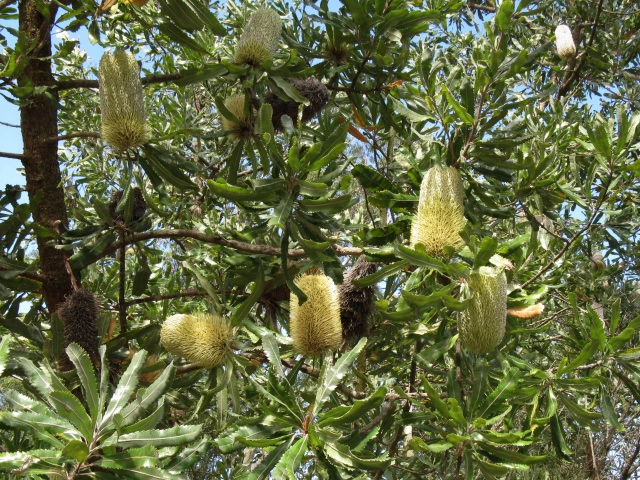
Banksia

Candlestick-shaped flowers aka Banksia

Here is the first of two or more (depending on how the spirit moves me) Delicious Descriptions from Kim Scott‘s book That deadman dance.

My first one presents two excerpts which describe people confronting the new. First, the British settlers during their expedition to find land:

They found a path, rocky and scattered with fine pebbles that at one point wound through dense, low vegetation but mostly led them through what, Chaine said, seemed a gnarled and spiky forest. Leaves were like needles, or small saws. Candlestick-shaped flowers blossomed, or were dry and wooden. Tiny flowers clung to trees by thin tendrils, and wound their way through the shrubbery, along clefts in rock. Bark hung in long strips. Flowering spears thrust upward from the centre of shimmering fountains of green which, on closer inspection, bristled with spikes.

Modern-day Aussies would recognise most if not all of these plants, but I can imagine how strange they would have been to people who came from the soft landscapes of England and Ireland.

By contrast, here is Wunyeran describing his experience on a ship to an elder:

It was hard to describe the food, he said. Some of them had tasted it before on ships, but other tastes too and … all very strange. There were many things … He tried to explain the tube you looked through that brought you close; the scratched markings one of the men made on something like leaves. Book, Journal, they said.

They gave him a good koitj, he said, and showed his people the smooth axe…

Throughout the book we to and fro between the British and indigenous ways of doing, being and seeing … but I particularly loved these two concrete descriptions of people reacting to new sights and experiences.

Delicious descriptions from Down Under: Melbourne scenes, 1850s

One of the contributors to Charles Dickens‘ weekly magazine Household Words was Richard HorneAccording to the notes on Contributors in Margaret Mendelawitz’s five-volume set, Charles Dickens’ Australia, which I reviewed last week, Horne was an English-born author who lived in Australia from 1852 to 1869. He agreed to write travel pieces for Household Words “in return”, say the notes, “for advances to equip the expedition and for regular payments to his wife”. (Apparently Dickens refused to have anything to do with Horne when he returned to England due to the minimal contributions Horne had made to his wife’s support while he was away. Given Dickens’ own less than admirable treatment of his wife this smacks a little the pot calling the kettle black, methinks)

Anyhow, one of Horne’s articles for Household Words is included in the first book of Mendelawitz’s set. The article, published in 1853, is titled “Convicts in the gold region” and discusses convicts in the Melbourne area. I enjoyed some of his descriptions and thought I’d share a selection with you.

on Melbourne

… Melbourne, famous, among other things, ever since it rose to fame two years ago, for no roads, or the worst roads, or impassable sloughs, swamps, and rights of way through suburb wastes of bush, and boulder stones, and stumps of trees …

I was going to use this to talk about how stereotypes start but in fact Melbourne’s roads aren’t particularly bad these days, even though it does have a reputation for its strange road rule, the hook turn. The next description, however, is more typical of Melbourne:

It is night; a cold wind blows and a drizzling rain falls.

And yet again I jest a little when I say typical. Melbourne is famous for having four seasons in a day so cold and rain are not the only weather you experience there!

at the Pentridge Stockade

Pentridge prison was built in 1850 to cater for the growing number of prisoners resulting from increased crime due to the gold rush. Horne had a reason for describing Melbourne’s roads at the beginning of his article, because the road to Pentridge itself was a beautiful one. It was built using convict labour.
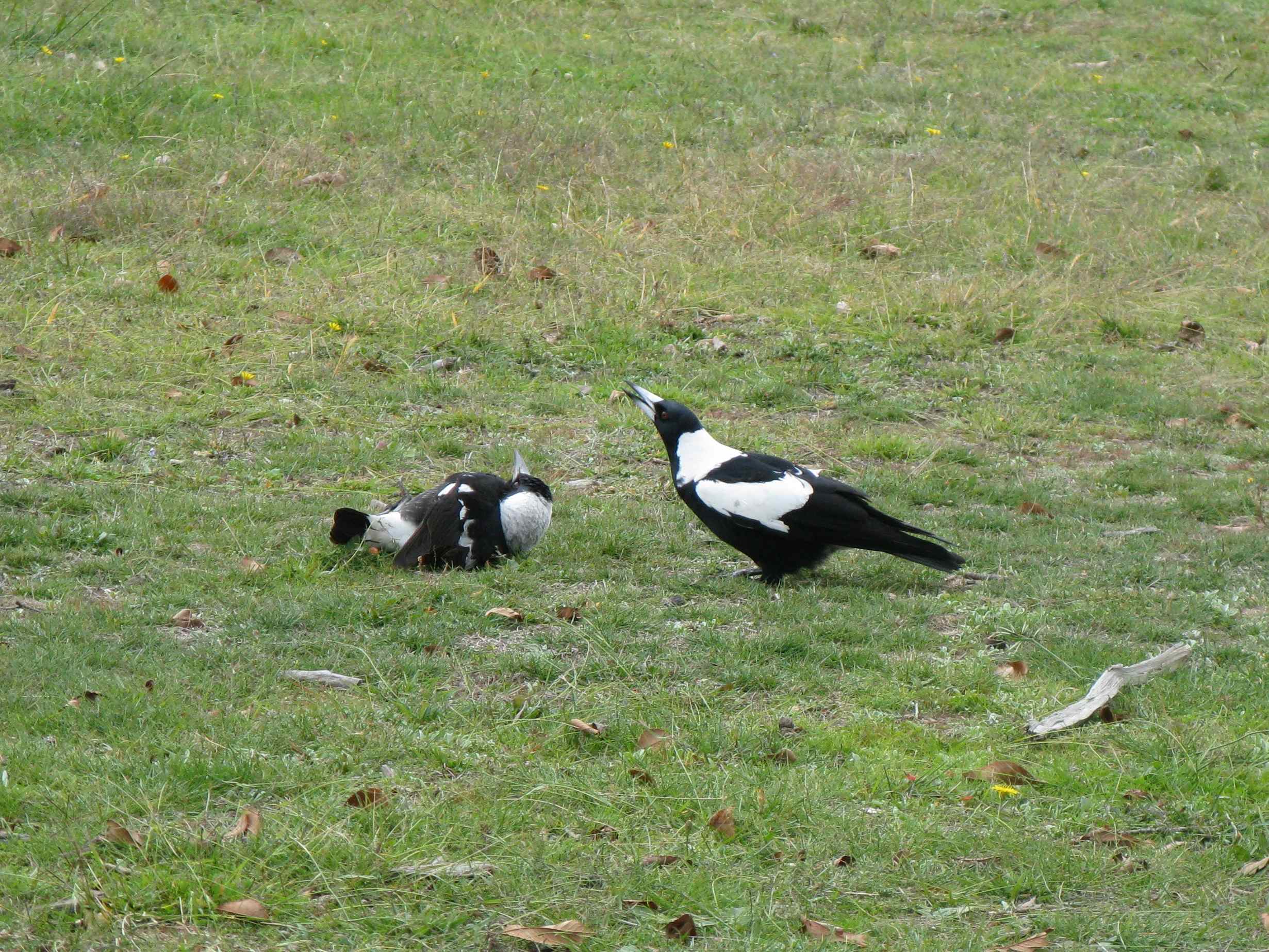
Magpies at Tidbinbilla

Not on broken granite, but magpies nonetheless

The yard is covered with loose stones of broken granite; and I notice close to my feet and looking directly into my face, a magpie. He also, holding his head on one side interrogatively, seems to ask my business here. I take a fresh breath as I look down at the little thing, as the only relief to the oppressive nature of prison doom that pervades the prison scene.

This man is clearly a writer … the contrast he draws here is both pointed and poignant.

I have taken a stroll around the outskirts of the Stockade, and, while gazing over the swampy fields, now wearing the green tints of the fresh grass of winter which is near at hand, and thence turning my gaze to the bush in the distance, with its uncouth and lonely appearance, I hear …

And now we’re really talking … because this description of the Australian bush as uninviting and unappealing was widely held by our 19th century colonials. And, I’d venture to say, Australian culture didn’t really start to come into its own until we started to appreciate the beauty of our bush!

Delicious descriptions from Down Under: Of wine and bushrangers

Moondyne Joe

Joseph Bolitho Johns (1830-1900) aka Moondyne Joe. (Presumed public domain, from the Fremantle Prison website, via Wikipedia)

Now this is something literally delicious and I couldn’t resist sharing it with you. It is the description of a wine from Houghton Winery in Western Australia. The wine is The Bandit Sauvignon Blanc Pinot Gris 2010, and here is the description* from the back label:

The Bandit was Western Australian Moondyne Joe who earned notoriety for his elaborately planned jailbreaking. Moondyne’s good taste was to be his undoing. His final capture occurred when he broke into the Houghton Winery in 1869. The Bandit wines are daring blends of tremendous character which immortalises the legend. Aromas of passionfruit and lemon lead to a juicy palate complemented by hints of nashi pear.

I wonder if Moondyne had ever tried Nashi Pear? I do love wine labels – this was a pleasant wine but I can’t say I noticed the nashi, much as I love that fruit.

Anyhow, as with many of our Australian bushrangers, Moondyne Joe has been “celebrated” in fiction, verse and film. His being Western Australian and my being an easterner, he is less well-known to me than our eastern bushrangers, but now I have heard of his “good taste” I feel inclined to investigate him further. A bandit who breaks into a winery surely can’t be all bad!

* I do hope I haven’t breached copyright by quoting this at length.

Delicious descriptions from Down Under: Adrienne Eberhard on stones

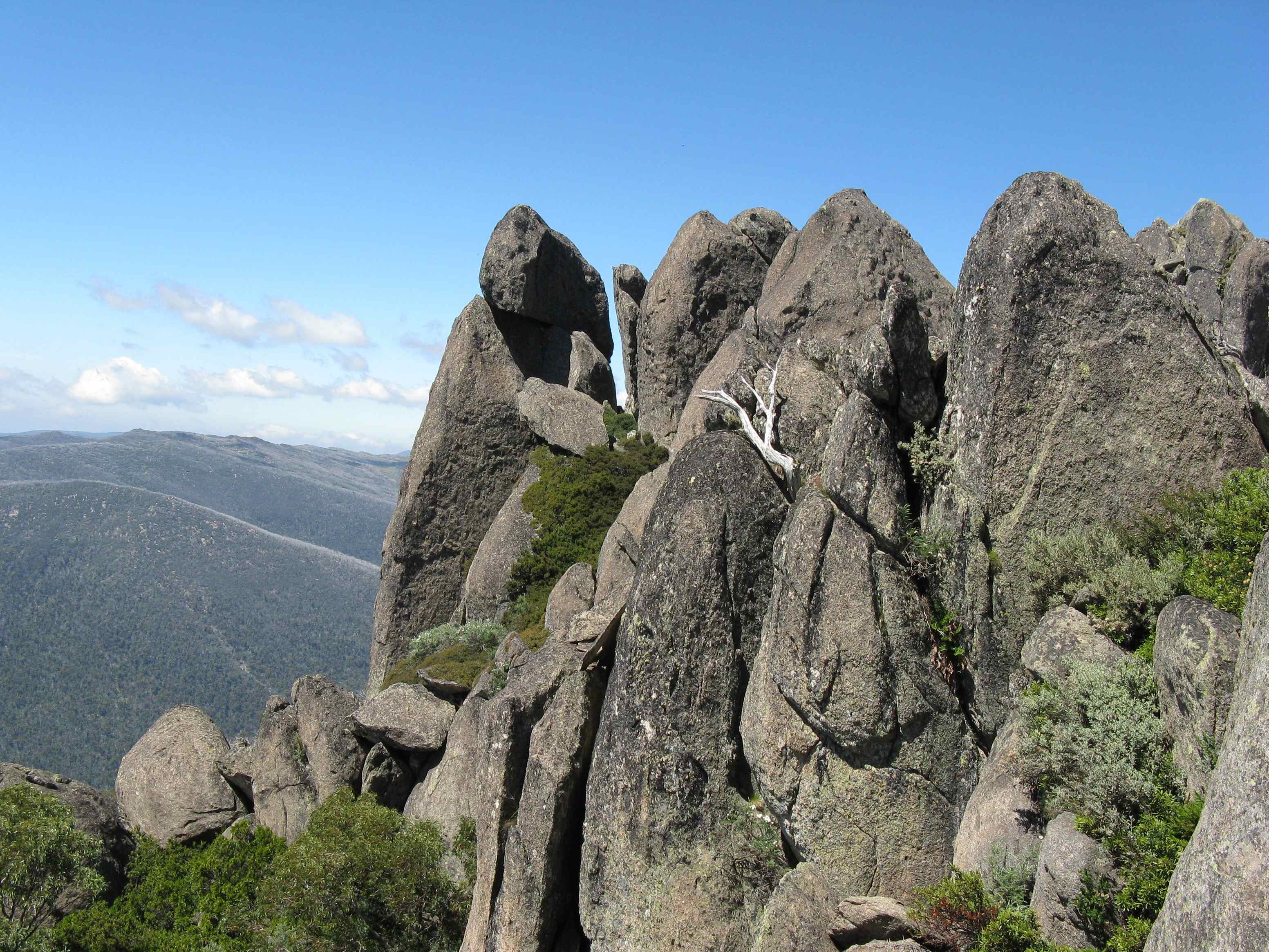
Porcupine Rocks, Kosciuszko National Park

Porcupine Rocks, Kosciuszko National Park

Having just returned from Japan where stones are revered, I thought it might be apposite to share one of the poems from Adrienne Eberhard’s section “The Magic of Stones” in her suite of poems about Jane, Lady Franklin.

Blocky, grain-growing, cast in the stance
of a thousand others
Embedded, spore-emblazoned, lying in layers
of limb-lost wist
Forging, fossil-jawed, timing the hours
of a mute universe
Gravelled, facet-shattered, your end
is never nigh
Stoning the earth, shelving the soil
(“Rock”)

It’s not my favourite poem in the book, but I like the way it conveys the paradoxical nature of rocks – their longevity and their mutability. Their time, geological time, is almost beyond human (at least, my) comprehension and yet they do change, which gives an organic (life-like) dimension to their inorganic nature. Lichen grows on them, water and wind act upon them, trees and other plants force their roots into them. The original shape-shifters perhaps!

Anyhow, it’s no wonder, I think, that stones/rocks are a common symbol across time and space. They feature, for example, in the Arthurian legend (with the sword-in-the-stone) and in Christianity (with Peter, the rock). A well-known Australian representation is in the book/film, Picnic at Hanging Rock, where the rock has multiple meanings from the earthy (sexuality and loss of innocence) to the mystical/spiritual. Paradox again … but that’s rocks for you.

Delicious descriptions from Down Under: Elizabeth Jolley on gums

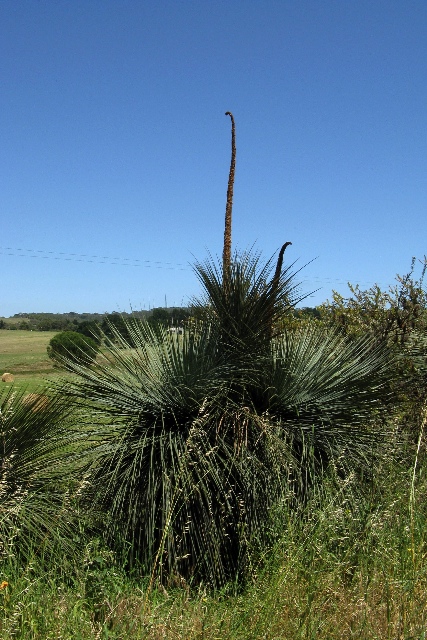
Xanthorrhoea

Xanthorrhoea (once called Blackboys)

Just a little one today from Elizabeth Jolley‘s somewhat quirky memoir, Diary of a weekend farmer:

For some reason the great trees have been left standing and the bush, the blackboys and the wild flowers have not been cleared on our 5 acres. The wandoo trees very beautiful also jarrah and something called Black Butt? Red gum has white flowers? White gum which has red. Rough wild bark. Leaves fall all the time and new leaves come, stained bark. (from 11th November 1970)

Jolley learning the land …

Delicious descriptions from Down Under: Thea Astley on oddballs

Thea Astley is one of my favourite writers and so I thought my next Delicious descriptions should be from her. It won’t be the last because her writing is truly delicious. Up till now, my Delicious Descriptions have been of landscape/environment. This one  is about people. It’s from Drylands (1999), her last novel (or, really, a set of connected stories) and fourth Miles Franklin Award win. Its subtitle is “a book for the world’s last reader” and it’s based on protagonist Janet’s belief that “no-one’s reading anymore”,  that “smartarse technology” was invading people’s lives and resulting in alienation and disengagement. (What would she say about the rise of e-books?) Astley exaggerates, of course, but her belief in the social disintegration that inspired the book is palpable.

It is full of evocative quotable writing, but for this post I’ve chosen one that describes the characters of the town, Drylands, that Janet lives in:

What’s great about these godforsaken holes, Janet decided next morning, leaning over her small balcony and watching the place rub its eyes and start to wake up, are the oddballs. They stand out. You meet them. They enrich. No. More. They furbish the day.

Furbish the day! Thea Astley may have passed on to the big library in the sky, but she left behind an astonishing body of work that can’t help but furbish the days I choose to dip into them.