Delicious descriptions: Fiona McFarlane thinks a house can be a character

In another life, well, not quite another life, but in my pre-blog life when I discussed books online via listserv reading groups, I became involved in various literary discussions. One of these was whether a house or place can be a character. Some of us argued they could because they could be seen to act or react, to reflect mood, and so on. Others argued they couldn’t because they couldn’t develop the way characters can. The argument was never resolved. In other words, I suspect we all remained in our original positions. As you might have guessed, I was in the former camp. Of course, a house or place is not a person, but if an author personifies them in some way, imbues them with “spirit” or “emotion”, then I’m happy to “see” this in terms of character, albeit a different sort of character. I’d argue that Fiona McFarlane, whose The night guest I reviewed earlier this week, would agree.

Here is a description of the protagonist Ruth’s house after Frida comes to be her “carer”:

The house took to Frida; it opened up. Ruth sat in her chair and watched it happen. She saw the bookcases breathe easier as Frida dusted and rearranged them; she saw the study expect its years’ worth of Harry-hoarded paperwork. She had never seen such perfect oranges as the ones Frida brought in her little string bag. The house and the oranges and Ruth waited every weekday morning for Frida to come in her golden taxi, and when they left they fell into silences of relief and regret. Ruth found herself looking forward to the disruption of her days; she was a little disgusted at herself for succumbing so quickly.

Of course, McFarlane is using the house to represent Ruth’s state of mind, to represent Ruth “seeing” herself adopt and adapt, but still, I can describe that as the house having, or even being, character.

A little later in the novel, when Ruth has two guests in the house causing tensions, she worries:

Now she would lose him because of Frida, and Frida because of him; and with that, her last before sleep, the whole house emptied out.

Of course, the whole house didn’t empty out. All three were still there, but the sense (or fear) of psychic emptiness is palpable. Perhaps this is not the house having/being character exactly, but I’m not averse to seeing it that way.

What do you think? Do you ever see a house or place (a setting, in other words) as being or having character?


Delicious descriptions: Julian Davies on reading

A couple of weeks ago I reviewed Julian Davies’ Crow mellow. It’s an enjoyable and at times provocative read. I’d love to share many descriptions and scenes from it but, since this is a reader’s blog, I’ve decided to share some thoughts relevant to my focus made by the main character, poet Phil Day. Much of the discussion in the novel concerns the creation and criticism of art, but here Phil is considering its consumption, specifically in this case, reading:

Reading, writing. If writing was a perplexing activity, reading had to be somewhat puzzling. What could be more passive? He was more of a reader than most, an absorber of information on trust, on a whim and a wish. And what did he believe he was getting from the activity? Entertainment? Well, of a sort, but that was never enough. Betterment? He wasn’t so benighted a romantic as to believe anyone was improved by books. If it was information, wasn’t it a bloodless sort of knowledge? What else then? No, the most he hoped from reading were some silent conversations. If the authors were long dead, the interaction seemed more animated. This was a simple paradox simply to be enjoyed.

I was fascinated by this, because sometimes I wonder myself about whether this activity I so love is too passive. Should I be getting out there instead and doing something? There’s plenty to do – both around the house and outside it in the service of others. Of course, being a reader, I argue with myself that it’s not too passive, but on what grounds? Entertainment goes only so far – and anyhow, I’m not sure that I read specifically for entertainment, though reading is something I enjoy. And information is part of it, but less so – particularly if we are talking facts – from reading fiction. But betterment? This is a good one because there has been quite a bit of discussion recently about the value of reading.

In 2013 Huffington Post listed, with some supporting evidence, “7 Unconventional Reasons Why You Absolutely Should Be Reading Books” which include things like improved empathy and staving off Alzheimer’s. Last year, several newspapers reported on research published in Science which argued that “that social skills are improved by reading fiction – specifically high-end stuff*, the 19th-century Russians, the European modernists, the contemporary prestige names … [that] those who read extracts from literary novels, and then took tests measuring empathy, social perception, and emotional intelligence, did significantly better than other subjects who read serious nonfiction or genre fiction.” Science writer, Christian Jarrett, at the wired.com, though, does put some breaks on claims that reading changes our brains.

So, I’m sort of with Phil. I hope reading helps stave off dementia (which is “betterment” for me) and I’m romantic enough to hope that reading might improve our ability to empathise, but I don’t think “betterment” is the main reason I read. Conversation, however, is another thing – silent conversation with the author, sometimes conveyed via marginalia, and conversation with other readers about what I’ve read. These conversations challenge my intellect. But there are other reasons I read too. I read to escape into other worlds, both near to and far from my own, and I read for the emotional hit – to laugh, to cry, to feel all sorts of emotions (although I try to avoid fear!!) What all these add up to in the end is something very simple: I read because it gives me pleasure.

I’ve titled the post “Julian Davies on reading” but it’s his character Phil Day speaking. Is this what Davies thinks too? Possibly, though Crow mellow being the sort of satire it is, I think all we can assume is that Davies is throwing some ideas out there and that, since these ideas are coming from Phil, we should give them particular consideration.

And now, you know what I’m going to ask: Why do you read?

* The high-end literary word used by the Sydney Morning Herald writer!

Delicious descriptions: Eimear McBride is not all grim

Reactions to Eimear McBride’s A girl is a half-formed thing, which I reviewed recently, vary greatly. It is, overall, a bleak read and its style is idiosyncratic, which makes it a double whammy. So, for example, it has been called “brutal” (by Sunday Times Ireland) and a “joyous thing” (by Michael Cathcart, RN’s Books and Arts Daily). Both of these make sense to me – the story is “brutal” but the writing is “a joyous thing”, because it’s alive, it wakes you up, it compels you on.

In 2013, as you may have already heard, it was the inaugural winner of the Goldsmiths Prize, which was “established to celebrate the qualities of creative daring associated with the University and to reward fiction that breaks the mould or opens up new possibilities for the novel form. Accordingly, the annual prize of £10,000 will be awarded to a book that is deemed genuinely novel and which embodies the spirit of invention that characterises the genre at its best”.

Like most “brutal” works of art, though, A girl is a half-formed thing does have light or chuckle-inducing moments. I wanted to share one with you. Reviewers, I’ve noticed, have tended to choose a scene from the grandfather’s wake to illustrate this so I thought I’d choose something different, a description of Mammy being visited by her church friends early in the novel. Here goes:

Some most are women. In a blue moon a man. I like to eye. Sitting in the corner jugging as I can for all they say is interesting. Dress undressing no-neck cindy. Not stopping or I get look at little lugs there listening in. Oh taking it all in that one. Doesn’t miss a thing. Spelling I know but too iquick to understand r.u.n.o.f.f with the s.a.c.r.i.s.t.a.n and they are living in s.i.n down in such and such a place. There’s stink girl’s mother and her sister with women’s troubles so peculiar all pointed down and asked and how’s ahem? Ah she’ll not sit down for years. Apparently the smell of it is something wicked but god knows it’s not her fault. Their brother’s second wife — ach the first died leaving five behind. Tell me where’s the sense? They’re wild as wild. As bold as brats. The P.P’s housekeeper — God rest her late husband. A lovely man. She gave him a hard life but sure. Mrs one whose husband ran the AIB. Uppity up in herself — behind palms in the scullery they whisper adding a splash to warm the pot. Great red hat she wears to mass. So we have a look at her and where’s the humility in that? Ah each to their own, they say. Then your woman who bought a knitting machine. A hundred and twenty pounds now where did she … Her little boy. Downs. God love him. She does school jumpers so she can get him toys that are ed-u-cat-ional nod nod. That’s right for God helps those who help themselves. The politician’s wife they’d normally spite but God help us her heart is broke. He’s running about with this one and that one. She can’t look down on them. Her vows were sacred and he’ll not get her in mortal sin. Her heart may be pierced with a thousand spears but she’ll offer it as a penance that’s a bit proud don’t you think? And the one whose husband’s a desperate drunk. Like his father before him you know the type, vicious. That’d kill you in it by mistake. Her blue eyes. Her black eyes. Is he on the bottle? they say and pray for sometimes giving up and the forgiveness of his sins.

Go with it – and it’s perfect, a funny, biting rendition of women’s gossip. Stop to unpack the “sentences” – and you’re lost.

Delicious descriptions: Clare Wright’s sources on the Australian landscape

While the focus of Clare Wright’s The forgotten rebels of Eureka, which I recently reviewed, is the role of women in the Eureka Stockade, the book offers a wealth of wonderful insight into the times. As regular readers know, I have a specific interest in descriptions of landscape so I greatly enjoyed contemporary descriptions of the environment that Wright includes in her book. I can’t resist sharing some with you.

In the first chapter, Wright quotes from the diary of Englishman Charles Evans who walked to the diggings with his brother and another companion. He wrote of one place along their journey:

the scene from the hills was lovely beyond expression—the sun had set and a mellow twilight and the silvery rays of a full moon shed a soft light over the beautiful landscape … I cannot remember any scene in my own country … to excel it—I was going to say, perhaps even to equal it. (from his diary, 1853-55)

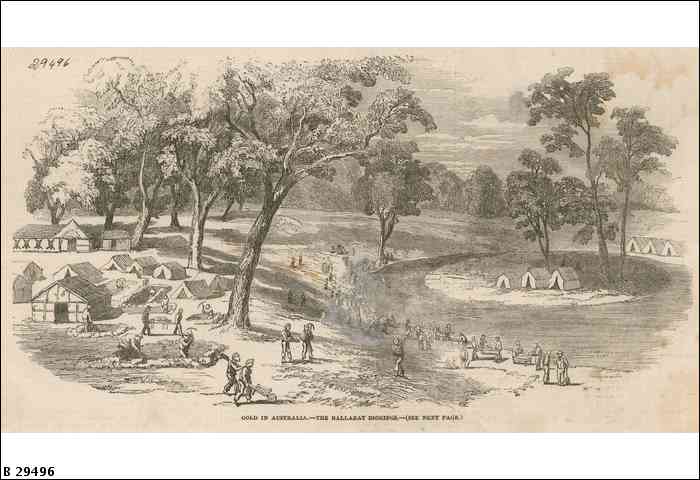
Ballarat Diggings c.1852

Ballarat Diggings c1852 – not so ugly, but before the rush was in full swing (Courtesy: State Library of South Australia, B29496

By contrast, English journalist William Howitt comments on the destruction of the landscape in the service of digging for gold:

The diggers seem to have two especial propensities, those of firing guns and felling trees … Every tree is felled, every feature of Nature is annihilated. (from his book Land, labour and gold, 1855)

According to Wikipedia, Howitt’s body of work draws from “his habits of observation and his genuine love of nature”. Environmentalism, as we know only too well, didn’t spring up in the twentieth century, but I always enjoy, albeit with a certain chagrin, coming across concern about environmental degradation in writings from the past. Wright, with her characteristically evocative language, writes that several diarists and letter-writers comment on the ugliness of the diggings. They “emphasise”, she says, “the conquest of culture over nature, the bulldozer urgency of conquest.”

For some reason that doesn’t fully make sense to me, Wright also quotes Mrs Mannington Caffyn from a book published in 1891, but I’ll share it because Wright did and because it is such an evocative description of Australian sunlight:

Australian sunlight is quite original, and only flourishes in Australia [me: Funny that!]. It is young and rampant and bumptious, and it is rather cruel, with the cruelty of young, untried things.

Many – though of course not all – of the 19th century sources Wright quotes in the book have a picturesque way with words. Mrs Caffyn’s example here was written for publication, but I enjoyed the expressive language used by several of the diarists and letter-writers too. The aforementioned Charles Evans, for example, says this of the plains between Melbourne and Ballarat:

stretching as far as the eye could reach were immense grassy plains undulating in emerald folds like the swell of the ocean.

I may write another more serious post on this book, if I can get my head into gear, but hope you enjoy these little descriptions in the meantime.

Delicious descriptions: Richard Flanagan on Poetry

In my review of Richard Flanagan’s The narrow road to the deep north I talked a little about the importance of poetry to some of the main characters. I can’t resist sharing just a little more on this topic.

This is Dorrigo thinking, at the end of his life, though he doesn’t know just how near it is at the time:

He felt the withering of something, the way risk was increasingly evaluated and, as much as possible, eliminated, replaced with a bland new world where the viewing of food preparation would be felt to be more moving that the reading of poetry; where excitement would come from paying for a soup made out of foraged grass. He had eaten foraged grass in the camps; he preferred food. The Australia that took refuge in his head was mapped with the stories of the dead; the Australia of the living he found an ever stranger country.

Dorrigo Evans had grown up in an age when a life could be conceived and lived in the image of poetry, or, as it was increasingly with him, the shadow of a single poem. If the coming of television and with it the attendant idea of celebrity – who were otherwise people, Dorrigo felt, you would not wish to know – ended that age, it also occasionally fed on it, finding in the clarity of those who ordered their lives in accordance with the elegant mystery of poetry a suitable subject for imagery largely devoid of thought.

I was thrilled when I read that Dorrigo, who was born around 1913, had “grown up in an age when a life could be conceived and lived in the image of poetry”. It reminded me of my recent observation that poetry seems to have played a more significant role in people’s lives back in the 1920s than now. So, for Dorrigo, poetry is what he turns to for sustenance, for meaning or explanation, in his life. He says at one point that he can sleep without a woman, but he can’t sleep without a book. I love the idea of a world where poetry is widely known, loved and referred to.

Anyhow, here is Nakamura, dying of cancer, thinking about “goodness”:

He told himself that, through his service of this cosmic goodness, he had discovered he was not one man but many, that he could do the most terrible things he might otherwise have thought were evil if he had not known that they were in the service of the ultimate goodness. For he loved poetry above all, and the Emperor was a poem of one word — perhaps, he thought, the greatest poem — a poem that encompassed the universe and transcended all morality and all suffering. And like all great art, it was beyond good and evil.

Yet somehow — in a way he tried not to dwell upon — this poem has become horror, monsters and corpses. And he knew he had discovered in himself an almost inexhaustible capacity to stifle pity, to be playful with cruelty in a way that he found frankly pleasurable, for no single human life could be worth anything next to this cosmic goodness. For a moment, as he was being eaten by Tomokawa’s* oppressive armchair, he wondered: what if this had all been a mask for the most terrible evil.

The idea was too horrific to hold on to. In an increasingly rare moment of lucidity, Nakamura realised what was imminent was a battle not between life and death in his body, but between his dream of himself as a good man and this nightmare of ice monsters and crawling corpses. And with the same iron will that has served him so well in the Siamese jungle, in the ruins of the Shinjuku Rashomon and at the Blood Bank of Japan, he resolved that he must henceforth conceive of his life’s work as that of a good man.

Nakamura, as I said in my review, saw poetry as portraying “Japanese spirit” and it helped him justify his actions as commander of the camp. After the war, he gradually started to question his actions, but here at the very end of his life he wants, needs in fact, to see himself as a good man. And by force of will he does so, enabling him to choose as his death poem one which concludes with “clear is my heart”.

I love the idea of choosing your own death poem – and think I’ll start thinking about mine. What about you?

* He’s visiting Tomokawa, who had been one of his corporals on the Railway.

Delicious descriptions: Brooke Davis on salmon gums

In my recent review of Brooke Davis’ novel Lost & found I mentioned her descriptions but didn’t really give any examples. I can’t leave this book without giving you two that involve a rather interesting tree. It also gives me an opportunity to share my photographs of one! They are beautiful (though my photographs don’t really do them justice).

Salmon Gum

Salmon Gum from NT (Eucalyptus tintinnans).

The interesting thing about Gum Trees – because of course I am talking about gums – is their nomenclature. Many gums have multiple names, and sometimes the same name is used for several different species. An example is the Ghost Gum. This name is commonly used for several species of gums that mostly grow in arid Australia and have ghostly white bark. There are other examples though, one of which is the less commonly known Salmon Gum. I have only seen the Eucalyptus Tintinnans in the Northern Territory, but Davis writes about, I assume, the Western Australian native one, the Eucalyptus salmonophloia. I don’t have a photograph of it but you can see a gorgeous one on this blog (I hope they don’t mind my linking to it).

So, here is the first description:

They drive past rows of gum trees, leaning out over the road and into the sky, like dancers posing. Those trees there, the bus driver says. See how pink they are? Millie nods. They make her think of the inside of her mouth. Salmon gums. Always looks like the sun’s setting on them.

Do you reckon that’s a sly joke about “gums” there?

Another shot of Eucalpytus Tintinnans

Another shot of Eucalpytus Tintinnans

The second one comes in a description of the people of inland Western Australia, from Karl’s perspective:

Back home, on the southwest coast, the people have dazed eyes, blond edges, waterlogged strides. The people here are different: scratchy, like they’ve been sketched roughly on paper, like they are born of the very red dirt they scuff their feet in, made out of the salmon gums that line the streets. They yell outside the bakery, the supermarket, the pubs and in the main thoroughfare, chopping at words as though throwing their sentences in a blender. Karl doesn’t feel like he fits in here. Then again, Karl doesn’t feel like he fits in back there, either.

The sky is between day and night, that deep blue it gets when it’s shedding one for the other.

Not being from the West, I don’t fully understand the basis of the distinction she’s making here between the coastal and inland people – what’s this about yelling outside bakeries, supermarkets and pubs? – but I did enjoy reading this description. It’s vivid. I know that a few Western Australians read this blog. I’d love to hear what they think of this, and what it says to them.

Delicious descriptions: Some thoughts on Ouyang Yu’s language

I didn’t get around, in my recent review of Ouyang Yu’s novel Diary of a naked official, to discussing his language, so couldn’t resist another post.

As you would expect in an erotic novel, particularly one framed as a diary, the language is rife with obvious – and consciously so on the part of our narrator – sexual references and innuendo. It is, to put it baldly, in your face. Yet there are, also, some subtle undercurrents. I’ve chosen one excerpt to illustrate some features of the language. Reading it will also give you a feeling for the tone, which is, among other things, conversational, self-confident and unashamed. At one point, Shi Ma (the narrator) describes his diary as “the only confessional” that he can have in a world where there are “no priests of any religious or religious denominations worth my trust and confidence”, but from my understanding of the word “confession” I’d read this as irony.

Names are an issue in the book – as you might expect in a diary. Shi Ma uses initials for most of the significant people in his life: W is Wife and D is Daughter, for example. The women he “loves” tend to be anonymous or go by aliases, which are often flower names, such as Acacia, Daffodil, Goldenrod and Nasturtium. Some characters though have more ordinary names. Consider this:

However passionate and deep one’s love is, it tends to peter out like a brisk fire that burns with passion and heat, only to burn itself out at the end of the day. Peter – what a name in association with the phrase ‘peter out’ – had an affair with Third, the third daughter in her family, a pretty girl who did frames for his paintings, but had to marry a Singaporean woman when he went to Sydney. Third fought tooth and claw to stop him from marrying and going. According to Sam, Third threatened suicide but didn’t; instead, she left scratch marks all over Peter’s back, traces of love when gone, turned sour and resentful.

Love seems to have two faces, one loving, the other hating. Sue is a typical example. Like the name ‘Peter’, this name is portentous. I would run miles away from any woman by that name because who knows if she is not going to Sue you one day? In fact, when a girl I loved reported that her name was ‘Sue’, I said: It’s not a name you should have. I’d much prefer you call yourself ‘Su’ or ‘Soo’. In fact, Soo with two holes in it is infinitely preferable to Sue with a ‘u’. She seemed to like it and said: I’ll think about it.

Besides including an example of the book’s sexually explicit language, this excerpt also addresses two of the novel’s concerns – love and power. Shi Ma discusses “love” endlessly, all the while behaving in an exploitative and generally loveless manner. He is obsessed with sex but desires love, and seems unable to reconcile the two in any meaningful way. Power, on the other hand – who has it, how it is used, what effect it can or does have – is one of the undercurrents of the novel. Ouyang Yu reveals a world in which power, particularly between the genders, is a complex business (with business being perhaps the operative word!) Women in his novel do wield some power, but whether that power is to their (or anyone’s) benefit is a question Yu leaves for the reader to consider.

Delicious descriptions: Wallace Stegner on “what writers do”

In my recent review of Stegner’s last novel, Crossing to safety, I talked a little about the nature of art (in its wider meaning). I wanted to include the following excerpt but it was a little long, and anyhow, I felt it deserved its own post. So, here it is …

About two-thirds through the novel, Sid and Charity’s daughter suggests that Larry write a novel about them, but he demurs:

– Hallie, you’ve got the wrong idea of what writers do. They don’t understand any more than other people. They invent only plots they can resolve. They ask questions they can answer. Those aren’t people you see in books, those are constructs. Novels or biographies, it makes no difference. I couldn’t reproduce the real Sid and Charity Lang, much less explain them; and if I invented them I’d be falsifying something I don’t want to falsify.

– I thought fiction was the art of making truth out of faked materials.

– Sure. This would be making falsehood out of true materials.

This leads in to the quote on writing about quiet lives that I used in my review.

Stegner did, though, draw inspiration from people he knew. In fact, Crossing to safety was inspired by the friendship he and his wife had with a couple called the Grays. They all met at the University of Wisconsin and they summered together in Vermont many times (I believe). The Grays had died by the time the novel was published, but their children did see and approve the manuscript before it was published.

I like the fact that Stegner, who wrote biographies as well as fiction, doesn’t differentiate these two forms in terms of the creation of “character”. Unlike fiction, biographies may aim for “fact” – but the facts are still selected and interpreted resulting in a version of the subject, aren’t they?

I’m intrigued though by the idea that novelists only ask questions they can answer. I wonder whether they sometimes use fiction to explore questions they can’t answer?

Anyhow, I’d love to hear your perspectives on this – particularly if you are a writer.

Delicious descriptions: Jessica Anderson and urban life

I didn’t quote much from Jessica Anderson’s One of the wattle birds in my recent review, which is unusual for me – so I decided a Delicious Descriptions post was in order. I had trouble however choosing which excerpt to quote. My first thought was to share an example of the book’s wonderful – and often very funny – dialogue, but each example I looked at seemed to need too much explanation to make it work out of context. So, I’ve gone with some internal reflection instead, partly because it also demonstrates something Anderson was known for, her urban/suburban setting.

This excerpt occurs early in the book when Cec has turned up unannounced at her Uncle and Aunt’s place in Turramurra* to ask her uncle for the umpteenth time about her mother’s decisions. (See my review linked above if you need to be refreshed on this central issue in the book).

I’ve chosen it for a few reasons. It gives insight into Cec’s confused mental and emotional state, and her values. It also shows the way Anderson uses rhythm to convey that state, and it gives us a glimpse of her satirical humour.

The RIVERLAND orange isn’t bad for this time of year, and as I eat it I look through the big glass doors into the living room. The fortress look hasn’t extended to this part of the house, and I can see on the other side the twins huddled over the phone talking to Amy. It’s a big room with high ceilings and pale thick sculpted-looking curtains and polished floorboards with rugs and altogether that well-known look of peaceful opulence that Katie and I used to say was the dread and horror of our lives. But now, because at Annandale our yellow cotton blinds are sun-streaked with greyish-white, and there is dust on the tops of our paper moons, and the fronts of our Ikea drawers keep popping out like little awnings and have to be kicked back into alignment, and because I ought to be studying like mad so that one day I’ll have a wonderful steady job, and earn enough money to have a room equivalent to that (and then what?) and because I feel sorry for Wil being hampered with someone like me, I feel generally very depressed and hopeless, and wonder if I really want to ask Uncle Nick any questions, or whether I just want him to hug me and massage my scrawny little hands in his.

Phew, that last sentence is long! I like the way this excerpt conveys self-knowledge alongside her uncertainty. I like the youthful rejection of an older generation’s values alongside a recognition of that being the likely progression of things. Cec comes across as a young woman in pain but with a good head on her shoulders. We feel that she will get through this … but how, and with what further insights, is the interesting question.

* I’ve added the location for those who know Sydney. Turramurra is a beautiful, leafy suburb in the affluent upper North Shore.

Delicious descriptions: More on Eleanor Catton’s The Luminaries

Rightly or wrongly, I try to keep my reviews to a reasonable length. When they start creeping up to 1200 words, I worry that readers will be discouraged from reading. There’s so much to read out there – so many books, so many blogs, so many articles. And so, when my review of The luminaries started to close in on 1100 words, I decided that it was time to stop. There’s always my Delicious Descriptions series I thought …

So here I am. I’m going to introduce my follow-up with another character description, this time of the young banker:

Charlie Frost was no great observer of human nature, and as a consequence, felt betrayed by others very frequently. The air of cryptic strategy with which he often spoke was not manufactured, though he was entirely sensible of its effects; it came, rather, out of a fundamental blindness to all experience exterior to his own. Frost did not know how to listen to himself as if he were somebody else; he did not know how to see the world from another man’s eyes; he did not know how to contemplate another man’s nature, except to compare it, either enviously or pitiably, to his own. He was a private hedonist, perennially wrapped up in the cocoon of his own senses, mindful, always, of the things he already possessed, and the things he had yet to gain; his subjectivity was comprehensive, and complete.

An important aspect of the novel I omitted in my review was its relationship to the 19th century Victorian novel. I just couldn’t do it justice in a few words … Since writing my review, I’ve been roaming around blogs and reviews, reading various responses. I’m finding a fascinating array of ideas: it’s rich, it’s hollow, it’s tedious, it’s exciting, it’s innovative … and so on. Many discuss this 19th century novel aspect – and one of the issues raised is Catton’s characterisation. Some suggest, as I have too in other reviews, that the novelist should show not tell. They argue that Catton’s character descriptions, such as the one above, do too much telling. They don’t like it. I don’t see it that way, though. For me, it’s a matter of what you show and what you tell. No amount of her “showing” me Charlie Frost would result in my being able to describe his character the way she has here. I’m more than happy to read such delicious descriptions as this, and then watch the character acting it out.

Catton also invokes other stylistic features of the Victorian novel – the coincidences, the red herrings, the mixed identities, the large cast of characters, the gritty realism, and the omniscient and sometimes intrusive narrator. Is Catton being anachronistic or has she offered a fresh take? I feel the latter. For one thing, there is no clear protagonist until, perhaps, towards the end when the chapters shorten and the focus narrows to the two who we realise are the luminaries. That’s a subversion of expectations. Maybe it’s this that creates the problem.  With no protagonist for us to hang our hat on, we feel adrift, uncertain. We thought the stranger, Walter Moody, would be our protagonist but he disappears midway after the trial. Furthermore, Victorian novels tend to have clear moral arguments. This novel has themes and moral concerns, but the conclusion does not, really, resolve them. That’s not particularly subversive, but it is more modern.

Another way Catton has nodded to the 19th century tradition is through using descriptive chapter summaries to open each chapter, as in “In which a stranger arrives in Hokitika …”. You need, with this book, to be a reader who reads such details. Some readers tend to ignore  features like chapter headings, seeing them as superfluous, but in The luminaries you ignore them at your peril. As the novel draws to a close, the “in which” chapter summaries become longer as the chapters themselves, following her waning-moon astrological structure, become shorter. By the last few chapters, these so-called summaries contain information that is not further elaborated in the chapter itself. If you don’t read them, you miss some plot. I liked this playing with the form, this reminder that the book is a holistic thing. It, too, is subversive.

However, I mustn’t be too holier than thou, because I didn’t put the effort into understanding the astrological charts, which represent another nod to the 19th century (though not so much to the 19th century novel.) As I understand it, astrology, an ancient school of thought, experienced a resurgence in the 19th century after being generally discarded during the 17th-18th centuries’ Age of Enlightenment (or Reason). Goethe, no less, was an enthusiast, as was, later in the century, Jung. For me, though, reading all the text in the novel is one thing; leaving the novel to go research astrological signs and their meanings is a whole different ball-game. If such knowledge added meaning to the novel, then I’m afraid I missed it.

All this brings us to one question. Why did Catton choose to write her novel in this style? Is it riff, pastiche, reworking, or homage? I’m not sure, but it sure seems to have got a lot of people talking. As for me … I’m still puzzling!

PS One of the most interesting analyses I’ve read of the novel is by Julian Novitz in the Sydney Review of Books.