Murakami on The Great Gatsby

F Scott Fitzgerald, 1937, by Carl van Vechten (believed public domain)

F Scott Fitzgerald, 1937, by Carl van Vechten (believed public domain)

I have nearly finished Haruki Murakami’s slim memoir, What I talk about when I talk about running, but thought this little tidbit deserved its own post. As well as writing his works in Japanese which others translate for him, he also translates English language works into Japanese. Interesting eh? Anyhow, while he was writing this memoir, he was also translating F. Scott Fitzgerald’s The Great Gatsby. This is what he says:

Gatsby really is an outstanding novel. I never get tired of it, no matter how many times I read it. It’s the kind of literature that nourishes you as you read, and every time I do I’m struck by something new, and experience a fresh reaction to it. I find it amazing how such a young writer, only twenty-nine at the time, could grasp – so insightfully, so equitably, and so warmly – the realities of life. How is this possible? The more I think about it, and the more I read the novel, the more mysterious it all is.

Well, that’s it. I really do have to read The Great Gatsby again. I felt it when I read Azar Nafisi’s Reading Lolita in Tehran, I feel it when I see it appear in those top 10 (100, or whatever) lists, and I feel it again now. Murakami, with lovely modesty, has pinpointed that thing which defines great literature – the ability to read a work again and again and find “something new”, or “experience a fresh reaction”. That’s what I get from writers like Jane Austen. It’s not what I get from, say, Toni Jordan (as enjoyable as her novel  Addition was).

Gatsby, here I come – sometime soon I hope!

On growing old

Photo by Chalmers Butterfield (via Wikipedia)

Photo by Chalmers Butterfield (via Wikipedia)

I am currently reading Haruki Murakami’s What I talk about when I talk about running. I will write more on it when I’ve finished it, but today I came across this statement which rather caught my attention:

…one of the privileges given to those who’ve avoided dying young is the blessed right to grow old. The honour of physical decline is waiting, and you have to get used to that reality.

“The blessed right to grow old!” I like that. It is how I am going to think of myself from now on…

Jane Austen Regency Feast

I’m going to have my dinner after which I shan’t be thinner (Jane Austen, Juvenilia)

Last night was my local Jane Austen Society’s eighth annual midwinter feast. We started off small in 2002 as a lunch for members only but, in the last few years, we have expanded it to a night event including members’ partners, resulting in some very convivial nights. We are a small group and not everyone can make the chosen date, so our numbers vary. Last night we were 13.

This year's feasters tuck into dessert

This year's feasters tuck into dessert

Regency Feast Main Courses

Regency Feast Main Courses

Every member brings a dish chosen from the Regency era, though not all dishes are perfectly authentic: some ingredients are hard to get, some cooking techniques are not those we use now, and sometimes we just don’t exactly know how it was done. Our main sources are the Jane Austen Centre’s online magazine and Maggie Black and Deirdre Le Faye’s The Jane Austen cookbook (which presents the recipes used by  Martha Lloyd – Jane’s closest friend and confidante after her sister, Cassandra). This year our main courses were:

  • Beef and roasted vegetable ragout
  • Chicken curry in the Indian manner
  • Vegetable pie
  • Salmagundy/Salamongundy
  • Potatoes
  • Salad of greens with cucumber
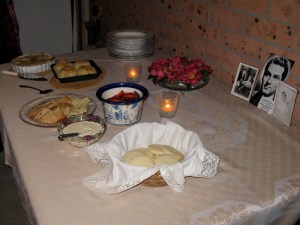
Regency Feast Dessert Table

Regency Feast Dessert Table

We are slowly building up quite a repertoire: each year there are some old favourites and some new experiments. Our members enter wonderfully into the spirit and regularly give something new a try, and so each year some very nervous chefs arrive with their dishes – and each year their anxieties are proved unfounded as we dig into their dishes with relish. Past main meal dishes have included Fish in corbullion, Broiled salmon, Roast pork, and Beef-steak pudding. We haven’t yet quite got into goose and partridge but I reckon we will!

Desserts are usually trickier as original recipes often assume a lot that has now been lost – or require highly time consuming processes that most of us can’t quite commit to. However, many Regency enthusiasts have interpreted and translated recipes and we are gradually sussing them out. Past desserts have included Black Caps (aka Baked Apples Miss Bates – from Emma, you know! – style), Whipt Syllabub and Cranberry Jelly (first make your “isinglass jelly”). This year we were tempted by:

We don’t, as you can see, go hungry – and neither are we bored as we spend a few hours talking, eating, laughing and, yes, drinking. As Jane wrote (though I have to admit that these words in this particular character’s mouth have an ironic edge):

Give me but a little cheerful company, let me have only the company of the people I love, let me only be where I like and with whom I like, and the devil take the rest, say I. (Jane Austen, Northanger Abbey)

Seen today

As we were shopping at our local mall today, we saw a mum with her young daughter who was about 8 years old. This little girl was wearing a t-shirt that said:

I’m too pretty to do homework.

I’ll say no more … because, well, what can I say?

Too many books?

Gutenberg, Public Domain image from Wikipedia

Gutenberg, Public Domain image from Wikipedia

No, this is not one of those “too many books too little time” posts. This is way more serious! This is about something I read in the July issue of goodreading (why I read this magazine is beyond me really, but I do). What I read was this, from one Ken Duncan who is apparently an Australian panoramic landscape photographer:

Unfortunately, for our generation, books are a dime a dozen [but] in the old days books used to be something very special, where you had artists create them.

It’s unfortunate that books are commonly available? How awfully elitist this sounds. I know where he is coming from – after all it’s in an article on limited edition books – but he chose an unfortunate way to make his point. Beautiful books are lovely to have and to hold but in the end what really counts is that as many people as possible can access them. Gutenberg and Caxton must be rolling in their graves!

My mate the AktiMate

I’m late into mp3 players, mainly because I’m not all that keen on walking around with earbuds stuck in my ears. I like to engage with the world – particularly when I walk – rather than cut myself off. After all, isn’t it nice to have some pockets of peace in our otherwise wonderfully connected world? Slowly, though, I started to realise there were other benefits to having an iPod. The car. What a boon it is to be able to plug a player into the car and have immediate access to a large music library (not to mention podcasts and audiobooks) without having to carry around a bunch of CDs. And then there’s home. CDs are on the way out, electronic music is in, and I have in fact been downloading music from iTunes for a while now. BUT, among the plethora of iPod dock options out there, which one to get?

This is where Mr Gums, dare I call him that?, came to the rescue as he always does when it comes to things technological. There are limits, I’m afraid, to my feminism. So, what did I want:

  • a neat system that would not take up a lot of space and would be easy to use;
  • a basic system (as I don’t at this stage need much in the way of fancy functionality);
  • decent sound for a biggish space; and also, hopefully,
  • the ability to plug in my internet radio so I can better listen to great stations like Folk Alley.
AktiMateMini Speaker (1 of 2), with iPod and Internet Radio

AktiMate Mini Speaker (1 of 2), with iPod and Internet Radio

And what, after a search of shops and the internet, did he find to meet these criteria? The AktiMate Mini – two neat little speakers with an iPod dock on one of them, and a remote control. That’s it. It has good sound, particularly for my uncomplicated ears though the experts also review it well, is easy to use, and takes up little space. Looks good too, though I have to admit that, at first, the little iPod did look a bit silly perched on top, but I soon got used to that. And, they do only come in black and white, so you can’t coordinate with all those glorious iPod Nano colours! But that’s probably just as well – lime green chromate speakers might have been a bit of overkill.

In the end, it was all so easy … why did I take so long?

Cheaper books? At what cost?

Richard Flanagan gave the closing address at this year’s Sydney Writers Festival and spoke about recent moves to end territorial copyright in Australia which would allow the sale of overseas editions in Australia. It appears that this move is supported by big businesses such as Dymocks, Coles and Woolworths who apparently call themselves the Coalition for Cheaper Books. Flanagan argues that they should more rightfully be called the Coalition for Bigger Business.

IMG_3462I should put my cards on the table:

  • I buy books.
  • I buy new books mostly.
  • I prefer independent stores but I also use chain stores.
  • Price is an important criterion but is not the only criterion.
  • I like to buy books from knowledgeable staff who are prepared to help me if I’m having trouble.
  • I rarely buy online.

As I understand it the current situation is, partly anyhow, that:

Australian publishers have 30 days to publish a domestic version of any book that has been released anywhere in the world. If the book is published within 30 days, all booksellers are obliged to buy the publication from the Australian publisher and cannot import the book from an overseas publisher. (Bookseller.com)

I must admit that I don’t fully understand how this territorial copyright really plays out in terms of authors, publishers, booksellers and bookbuyers. How can I? With all the vested interests presenting their cases – and often making diametrically opposed statements –  it is hard to separate out the remainder from the classic. So, who do I support? I guess the main question to ask is, what is broken that this proposal is trying to fix? 

The Coalition says this in their submission to the Productivity Commission:

The Coalition supports the removal of these restrictions because an open market for books will lead to lower prices and quicker availability. This benefits consumers.

Ah, how sweet, they care about us, the consumer! And look, they continue with “There is strong evidence that access to books increases literacy”. I will repress my desire to be sarcastic here.

And then we get to the point: “Without parallel import restrictions [the same thing as “territorial copyright” I presume?] the consumer will have greater choice and pay less because it will be in the interests of Australian publishers to serve the consumer better…”

In other words, this appears to be, just as Flanagan said in his speech, a fight for control between booksellers and publishers. The funny thing is that the Australian Booksellers Assocation (presumably not representing the big boys) has changed its position from the one it held in 2001 and now supports the status quo.

I would love to pay less for books – and here I disagree with Flanagan that books cost about the same in the USA as they do here. In my experience they don’t. But, I am also aware that there has been a wonderful renaissance in Australian writing and publishing over the last couple of decades. If there is any risk that changes to these laws will see reduced publication of Australian authors then I am not willing to support these changes. 

So, let’s have an honest analysis of the problem – I’m still not sure what it is though can guess it’s to do with threats, real or imagined, being posed by the electronic and online world – and canvass a range of solutions. Flanagan puts forward a couple in his speech. Let’s not shoot from the hip with a solution that seems to be currently supported by only one part of one sector of the Australian book industry.

Note: See Australians for Australian Books for the anti-Coalition case.