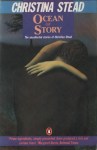
 I am so glad Lisa (ANZLitLovers) has given me an excuse, her Christina Stead Week, to finally pick up Ocean of story: The uncollected stories of Christina Stead. I bought this book, in 1991, from a sale table for all of 98 (Australian) cents! What a bargain. I then popped it on my Australian literature TBR shelves, where it has sat, and sat, and sat – until now.
Before I get to it, though, I must confess that this post’s title is a bit of a lie. Christina Stead just called this story “Ocean of story”, but RG Geering, the editor of this “uncollected” collection, made it the Introduction to the book. I decided that I could use this to differentiate in my post title that the post is just about this introductory story. Fair enough?
Now to the overall collection. I am on record as stating that I don’t read introductions to books before I read the book itself. I would in fact prefer these “introductions” to be called “afterwords” and placed at the end. And that’s what Geering has done here except, being perverse, I’d rather that for such a “curated” collection it had been at the beginning! Consequently, I didn’t see it until I’d read the first story and, finding it a little unusual, wondered why there wasn’t some sort of editor’s introduction. So, I went looking. And there, at the end, was his Afterword!
Geering writes that the book
brings together for the first time most of the short prose writings that appeared in various places (journals, magazines and newspapers) outside the thirteen volumes of fiction published during her own life, along with other unpublished pieces found among her personal papers after her death.
And then he says that he has grouped the pieces “according to their settings and contents rather than chronologically”. In this way, they will “follow the contours of [her] somewhat wandering life.” Then, right towards the end of his Afterward, he finally describes the opening piece: it’s
a contribution to ‘The International Symposium on the Short Story’ in Kenyan Review, 1968 … [and] is a highly personal essay, rather than a conventional article.
And that is exactly what it is, a “highly personal essay”, one that, by its end, has given us a “highly personal” understanding of what stories, and particularly short stories, meant to Stead. It starts:
I love Ocean of Story, the name of an Indian treasury of story; that is the way I think of the short story and what is part of it, the sketch, anecdote, jokes cunning, philosophical, and biting, legends and fragments. Where do they come from? Who invents them? Everyone perhaps. Who remembers them so that they pass endlessly across city life? I know some of those marvellous rememberers who pass on their daily earnings in story; and then they are forgotten to become fragments, mysterious indications. Any treasury of story is a residue of the past and a record of the day.
I love the open-endedness of her conception. It’s a free-flowing one that allows stories to take all forms. She goes on to say that “what is unique about the short story is that we all can tell one, live one, even write one down.”
Then she turns autobiographical, starting with her childhood with her father. She was, she says, “born into the ocean of story, or on its shores”, the daughter of a “lively young scientist”. He
told his tales. He meant to talk me asleep. He talked me awake.
Ha, the impact of stories on an imaginative child, which Stead clearly was. He told her stories drawn from his zoological work, and “stories of the outback…and even a few historic events.” But then comes the important thing – the thing that is important to all who read – that is, what stories do for us. She writes that the thousand stories she heard between two and four and a half
formed my views – an interest in men and nature, a feeling that all were equal, the extinct monster, the coral insect, the black man and us; and another curious feeling in me, of terrestrial eternity, a sun that never set.
This feeling came via her father’s nature-related stories which taught her that while death was necessary, there was always “a frail print” left. However, the storytelling – these times that allowed her “to see the unseen” – ended when she was four and a half and her father remarried. The magic was imprinted by then though!
“the million drops of water”
Indeed, she sees stories as “magical”. You only need for someone to say, she says, “Here’s a story; it happened to me” and all will listen. We seek stories – even those “twisted, inferior, cramped, and sterile stories on TV” – because we hope to recognise and “have explained our own existence”. She’s right – on both superficial (what am I doing) and deeper, more psychological (who am I) levels – don’t you think? She continues:
It isn’t necessary that these stories should be artistic or follow formula or be like Chekhov or the last metropolitan fad, or anything. The virtue of the story is its reality and its meaning for any one person: that is its pungency.
She argues that while the “masterpiece” might be appropriate for professionals, “the essential for us is integrity and what is genuine.” She then, interestingly given she wrote this in 1968, harks back to stories of the 1930s:
not all are memorable (some are) but all record the realities of the days when America was suffering and looking for a way out and thinking about its fate; and – look at those same today – they are a vivid and irreplaceable memento. That is what is best about the short story: it is real life for everyone; and everyone can tell one.
In other words, “the story has a magic necessary to our happiness”! We seek “the powerful story rooted in all things which will explain life to us”. I love all this. It is such an argument for the importance and value of the arts.
Stead concludes by telling a story about a group near London that she once joined. All were asked to stand up and tell a story, and
everyone, those stuffy and snug people came to life, became mouths out of which bubbled stories poor and ordinary or before unheard of.
There it was, she says, “the ocean of story”. And this happens everywhere, anytime. So,
The short story can’t wither and, living, can’t be tied to a plan. It is only when the short story is written to a rigid plan, or done as an imitation, that it dies. It dies when it is pinned down, but not elsewhere. It is the million drops of water that are the looking-glasses of all our lives.
I classed this post as “(Review, possibly)” because I haven’t really written a review. Rather, I’ve described/shared Stead’s attitude to stories – and to story-making and storytellers. I love her egalitarianism, even when describing stories that are “poor and ordinary”; I love her flexible idea of what makes a story; I love her chatty, idiosyncratic style; and most of all I love her passion for the importance of stories (particularly short stories) to our lives. I look forward to reading at least some of those in this book.
 Christina Stead
“Introduction: Ocean of story”
in Ocean of story: The uncollected stories of Christina Stead
Ringwood: Penguin Books, 1986
552pp.
ISBN: 9780140100211
 Whispering Gums