Monday musings on Australian literature: Guest post from Tony of Tony’s Book World

As with most of my guest posters to date, I came across Tony (of Tony’s Book World) not long after I commenced blogging. He stood out like a beacon because he was a non-Aussie blogger who had read a significant amount of Australian literature, including Patrick White no less. If you check his blog, you will find that he even has a page listing his favourite Australian fiction. He (so far, anyhow) doesn’t have any other nationally focused pages. How could I not ask him to write a guest post here! Thanks Tony, it’s been great getting to know you through blogging. Not only have I enjoyed getting to know my own literature through other eyes but you’ve introduced me to some writers – like Dawn Powell – that I know will be up my alley.

Tony has chosen for his topic one of the grand dames of Australian literature …

Henry Handel Richardson and The Fortunes of Richard Mahony

English:

Henry Handel Richardson, 1945, by Coster (Presumed Public Domain, via Wikipedia)

It is terrific and I am grateful to Sue for having this opportunity to guest write in “Whispering Gums”. It took me long enough to figure out that a Whispering Gum is a tree, an Australian (eucalyptus?) tree.

I have never been to Australia. In fact I live about as far on Earth from Australia as you can get in Minneapolis, Minnesota, US, where most of our trees are either oaks or pine trees. Yet over the years I’ve developed a passion for Australian literature starting with Christina Stead and Patrick White (whom I consider probably the greatest novelist ever, just to give you an idea where I’m coming from). My appreciation of Australian literature has continued through the years with many writers including such recent writers as Tim Winton, M. J. Hyland, and Joan London.

Today I want to write about the “The Fortunes of Richard Mahony” trilogy by Henry Handel Richardson which I consider the high point of Australian literature along with Patrick White’s novels. Henry Handel Richardson was the male pseudonym of woman writer Ethel Florence Lindesay Richardson who lived from 1870 to 1946. I read this entire trilogy back in 1991 and 1992, and it was one of my most moving reading experiences.

Each of her (Henry Handel Richardson’s) novels is an effort to understand and to make us understand the complexities of a human situation, and this is in itself an invigorating and sometimes subversive exercise in following truth along unexpected paths. — Karen MacLeod, Henry Handel Richardson (1985)

Richardson later wrote that the character of Richard Mahony was based on her own physician father. What makes this trilogy so moving is the complexity and unsparing honesty that Richardson brings to the character of Richard Mahony. Just as perceptive parents know their own children, faults and all, better than anyone else in the world, children as they grow up observe their parents closely. Most children love their parents, but that does not mean they aren’t aware of their faults. From your own children, you can run but you can’t hide. Richardson gives the reader the full portrait of Richard Mahony entirely free of sentimentality. In fact Richardson said that so much had been written about the great successes among the Australian people, she wanted to give a picture of one of the many failures, and so we have this story of the slow decline of Richard Mahony.
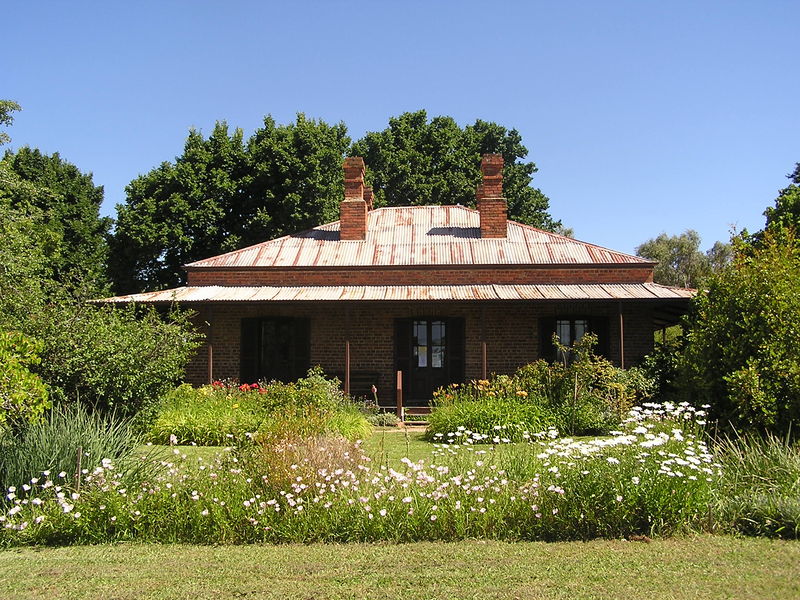
Lake View House, Chiltern

Lake View House, Chiltern, where Richardson lived when young (By Golden Wattle, via Wikipedia, using CC-BY-SA 2.5)

The first volume of the trilogy, “Australia Felix” begins at the goldfields near Melbourne in 1852. Richard is a young man just arrived from Dublin, Ireland and he is running the Diggers Emporium on the goldfields. He is more interested in reading philosophy than drinking and socializing, and most of his neighbors dislike him, thinking he is arrogant. He does meet fifteen year-old Polly whom he marries. Polly, later known as Mary, becomes a strong female figure in the trilogy. After losing his store due to accidentally selling spoiled flour, Richard takes up his original profession as a doctor

In the second volume, “The Way Home” Richard and Mary go back to the British Isles, this time to Glasgow, but soon Richard decides they can never be successful there and the couple returns to Australia and locate in the goldfields in Ballarat where he establishes a practice as a doctor. Here they finally have a daughter.

When the first two volumes of The Fortunes of Richard Mahony were originally published, there was little fanfare and few sales. All that changed when the third volume, “Ultima Thule”, was published in 1929. It was greeted with a chorus of praise from the critics, had good sales, and overnight Richardson became famous. Readers finally latched on to the tragedy of Richard Mahony and his family.

As the story in the trilogy continues, a strange thing happens. As I mentioned before, Richardson’s portrayal of Richard Mahony is honest and unsparing. Yet the reader is sympathetic and cares more about what happens to this man because of his faults and failures, not in spite of them. Richardson presents a total human being defects and all, and this complete blunt account gives the trilogy its power. Richardson applies these same forthright techniques to the wife Mary and the daughter.

Another distinctive feature of the trilogy is the style of the writing. Richardson’s writing has a visceral natural quality that puts you in to whatever scene she is depicting. I still remember some of the intense goldfield scenes vividly. There are similarities in her style to that of Patrick White, and I can’t help but think that White had read The Fortunes of Richard Mahony carefully sometime before writing his own novels.

One of Richardson’s literary heroes was Leo Tolstoy. “This is not a novel, it is a world”, wrote W. D. Howells of Tolstoy’s War and Peace, and the same line applies to The Fortunes of Richard Mahony. All of life is in these pages. As an unknown English critic said of The Fortunes of Richard Mahony, it is “one of the great inexorable books of the world’’.

The book Henry Handel Richardson – A Study by Nettie Palmer (1950) was very helpful to me in writing this article.

Monday musings on Australian literature: Guest post from Kim of Reading Matters

This week’s Monday musings brings you my fourth guest post, this time from Kim of Reading Matters. Like Guy, Kim started commenting on my blog in its infancy and I soon discovered that this blogger from England was actually an Australian. Naturally we developed a rapport. I have appreciated Kim’s support of my blog – through regular commenting  (particularly in my fledgling days) and through inviting me to be a Triple Choice Tuesday guest. She is one of England’s top litbloggers and this month is hosting an Australian literature month as I advised in last week’s Monday Musings.

I’m thrilled that Kim decided to write on children’s literature. Her guest post on children’s classics beautifully complements Louise’s recent post on current writers/illustrators.

Australian classic books from an Australian childhood

When you are an Australian expat who’s lived overseas for as long as I have (13 years and counting…) it’s easy to think you’ve never lived anywhere else. Then you have little “cultural blips” that rudely remind you that you grew up on the other side of the world.

For me, these “blips” usually occur when friends and colleagues start reminiscing about sweets (or should that be lollies?) from their childhood that are no longer available, or British TV shows they watched when they were growing up which were never screened in Australia. Once I had to sit in on a lengthy discussion about children’s literature where many of the references went completely over my head.

This got me thinking about my favourite books from childhood, all by Australian authors, which do not appear to have ever attracted an international audience. Here are three classics, none of which have been out of print in Australia, that mean a lot to me:

Blinky Bill by Dorothy Wall

Dorothy Wall (1894-1942), a New Zealand-born Australian, originally illustrated books for other writers before creating her own series about a mischievous male koala called Blinky Bill. The first book — Blinky Bill: The Quaint Little Australian— was published in 1933 and two others followed — Blinky Bill Grows Up (1934) and Blinky Bill and Nutsy (1937).

My aunt had three books in one beautifully bound volume. I still remember the distinctive red cover and the cheeky little picture of Blinky Bill, wearing bright orange trousers, toting a swag and billy can on a stick slung over his shoulder. It was always a real treat when I was allowed to take the book down from the shelf and look at the colour-plates inside. I remember turning the pages with awe and being very careful not to mark the book in any way.

Funnily enough I can’t really remember what the stories were about, but I remember the pictures with almost perfect clarity, they were so vivid and funny.

I’m delighted to say that you can read the text online at Project Gutenberg Australia

The Muddle-Headed Wombat by Ruth Park

The muddle-headed wombat by Ruth Park, book cover

Ruth Park (1917-2010), yet another New Zealand born author who called Australia home, also turned to Australian wildlife for inspiration.

Her main character was a wombat — a creature with which many non-Australians may not be familiar, think of a very cute furry pig with a cheeky face and short stumpy legs — whom was very muddle-headed.  He spoke in spoonerisms and misused similar sounding words — for instance “sensibubble” instead of “sensible” — which meant he often said very funny things without realizing it.

Wombat, as he was officially known, had two friends — a skinny grey cat called Tabby and a practical female mouse called Mouse — whom accompanied him on all kinds of adventures.

I can only recall vague details of particular stories — there were more than 16 in the series, all written between 1962 and 1971 to accompany an ABC radio show, which was cancelled by the time I was born. For instance, in one story Wombat bought a bicycle with shiny red wheels and in another he ate some chalk that made him sick.

But it was the quite hilarious illustrations that I remember most — along with the cute red jacket and floppy purple hat Wombat used to wear!

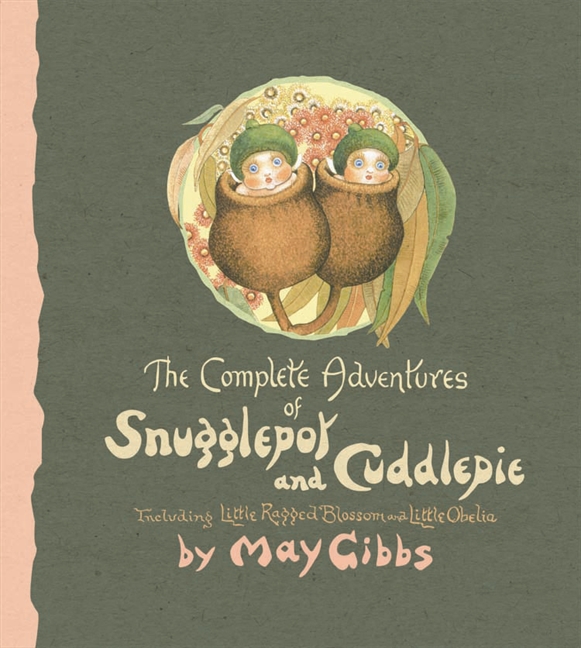
The Adventures of Snugglepot and Cuddlepie by May Gibbs

May Gibbs' Snugglepot and Cuddlepie

May Gibbs (1877-1969) was an English-born Australian writer and illustrator whose stories were inspired by Australian native flora.

She’s probably best known for her gumnut babies, Snugglepot and Cuddlepie, who are cute little foster brothers that resemble eucalyptus nuts.

The pair go on an adventure in the Australian bush, but they have to take care not to run into the big bad Banksia men — horrible creatures modeled on banksia cones, which are a bit like hairy pinecones.

As a child I remember being physically scared of the Banksia men, but as ever in the world of children’s literature, good overcomes evil and they sink to the bottom of the sea!

The best part about Snugglepot and Cuddlepie, which was first published in 1918, are the truly beautiful illustrations by the author. To this day these illustrations are used on all kinds of merchandise, but what I hadn’t realized until I started writing this piece is that all profits go to UNICEF, the Spastic Centre of NSW and the NSW Society for Crippled Children (now the Northcott Society), according to the wishes of May Gibbs’ bequest.

May Gibbs home Nutcote, on the shores of Sydney Harbour, is also open to the public.

I suspect that all three books, with their emphasis on Australia’s unique plants and animals, may be responsible, not only for my love of Australian literature, but my love and respect of the Australian bush, too.

Monday musings on Australian literature: Guest Post from Guy of His Futile Preoccupations

Monday Musings’ Guest Post no. 3 comes from Guy Savage of His Futile Preoccupations. Guy started commenting on my blog very early on and endeared himself to me by giving me the nickname of Gummie. That is a very Aussie thing to do – or is it English? Guy, you see, is an expat Brit living in the USA. (At least I think I’ve got that right.) I quickly discovered that Guy had an interest in and knowledge of things culturally Australian and we have shared some interesting conversations about Australian authors and films over many posts here and there. He is also interested in the classics, including authors like, oh, Jane Austen for example. His other interest – he’s a man of many talents – is crime fiction and film noir, and he writes with great flair on things criminal! Do check out his blog. You won’t be disappointed.

But, on with the post. Guy stunned me when, commenting on my very first Monday Musings, he named Max Barry as his favourite Aussie writer. Max Barry, who is he? Well, today Guy is going to tell (me) us … read on …

Max Barry 2006

Max Barry 2006 (Courtesy: dejahthoris, via Wikipedia, using CC-BY-SA 3.0 Unported)

Max Barry: One of Australia’s National Treasures

Ok, I’ll admit it. I’m not rational about Max Barry. I’d like to say that I’m his number one fan, but that makes me sound as though I’m ready for psycho-therapy, and anyway, if you make a trip to Max’s website and sign up as a member of Max’s Posse (currently at 5785 and climbing), you’ll see that he’s his own number one fan. So instead I’ll land on the safer statement that I’ve been a fan of this Australian author for 10 years. Born in 1973, Max Barry is a young writer, and there’s going to be a lot of great books coming from his home in Melbourne. I suspect that he’s better known outside of Australia, but I’m basing that on the fact that Gummie hadn’t heard of Max Barry before I mentioned him, and she’s my barometer for all-things-to-do-with-Australian-culture.

Yes it’s been ten years since I first came across Max Barry in 2001 via an out-of-print copy of his first book, Syrup, a brilliantly funny novel which satirizes marketing and consumerism. Actually I’d better back up a bit here–the book, published in 1999, was attributed to Maxx Barry in a continuation of the marketing idea. Max says he added the extra X:

because it seemed like a funny joke about marketing, and I failed to realize everyone would assume I was a pretentious asshole.

Syrup is the story of an unlikely hero, Scat, a marketing graduate from Iowa who moves to L.A. He devises a marketing plan for a new drink called Fukk and plans to sell his idea to Coca-Cola, but before he can seal the $3 million dollar deal, Scat’s roommate, Sneaky Pete, in a wickedly funny backstabbing move of corporate theft, claims the copyright.

Syrup is one of the funniest books I’ve ever read, and when I concluded the novel, I was troubled that I’d found it purely by accident. I took the book’s out-of-print status rather personally, and buying about a dozen copies, I sent them out to anyone who was still speaking to me and urged them to read the book. Without exception, everyone who got one of those copies of Syrup loved the book.

Barry’s second novel appeared in 2003. Jennifer Government is an alternate-reality vision of globalization in which most countries are nakedly dominated by corporations rather than by governments. Corporate employees take the name of the corporation they work for as surnames, and schools are sponsored and controlled by corporations intent on raising the next generation of avid consumers. This is a novel in which corporate competition has become so fierce that consumers become stiffs in a guerilla marketing campaign guaranteed to hype sales of crappy new tennis shoes. Jennifer Government is a remarkably intelligent and prescient novel, for some of the fictional dire social conditions Barry created no longer seem quite so futuristic in the post-boom gloom.

Barry’s 2006 novel Company again placed the individual in the middle of corporate nastiness. This novel, set in Seattle, explores the shady dealings of the Zephyr Holdings Company, and when Stephen Jones from the Training Sales Dept. begins to ask a few awkward questions, he finds himself catapulted into management. In this novel, Barry blends the nonsense rules of corporatism with the naturally absurd results, and consequently, this is a perfect depiction of the insanity of life within the corporate machine.

This year Barry published his fourth novel, Machine Man–the story of corporate scientist Charles Neuman, employee of Better Future, who accidentally loses a leg in an industrial accident. Charles’ discovery that the replacement leg is better than the original sets off a chain of events in which Charles decides to improve himself limb by limb in a grimly hilarious skewering of corporate culture.

Over the years, Barry’s novels have been optioned for film and disappointingly several projects have not gone beyond the blue sky phase; I was rather excited at the news that Steven Soderbergh and George Clooney’s Section 8 films optioned Jennifer Government, but so far nothing on that score. But someone out there has noticed the Vast Talent that is Max Barry and 2012 will see the release of Syrup from director Aram Rappaport. Max Barry flew to America and watched the filming and even got a small cameo role.

Ok so Max Barry has written four novels–two of which are the funniest books I’ve ever read, and now it looks as though he’s about to get some long delayed-global recognition, but there’s a lot more to this author that makes him exceptional. Max has also taken control of his own marketing–albeit that no-one was interested in Max back when his first novel was out-of-print, but any new author out there could learn a thing or two from Max. Max has maintained an active website since 1999 and keeps in touch with his fans (and I’d like to think we’re a little nuttier and stranger than the average readers) via an e-newsletter. In 2004, Max converted his website to a weblog where he shares his news. On the site, you can check out NationStates, a game designed by Max to help market Jennifer Government:

NationStates is a state stimulation game. Create a nation according to your political ideals and care for its people. Or deliberately oppress them. It’s up to you.

Max even has a few videos up on youtube. But if you want to get a taste of Max’s wonderful sense of humour, check out his weblog where you will see comments about nasty critics in a piece called Things Critics Do That Piss Me Off . Here’s Number 3:

#3: Spots Plot Holes That Are There

Max Responds: Shut the fuck up! Go write your own novel, you hack!

And on the Q& A subject of whether or not Syrup is based on Max’s sordid period of employment with Hewlett-Packard:

That’s a filthy lie. Why, if HP was like Syrup, it would be a seedy den of politics and corporate back-stabbing, brimming with sexual tension. That is absolutely not true. There was very little sexual tension.

Actually, HP was a great place to work and taught me a lot about how companies function. I worked with some tremendously talented salespeople, most of whom used their powers for good instead of evil.

As a reader of crime fiction, I’ve noticed that many crime writers tend to take a different type of approach from other so-called literary authors that leaves no room for ivory tower elitism. Not only do many crime writers maintain extremely active blogs (thinking Max Allan Collins, James Sallis, Duane Swierczynski here), but there’s also a high level of reader involvement. Duane Swierczynski (Severance Package, The Wheelman), for example, is even organizing a Philadelphia bus trip January 2012 to the grave site of author David Goodis (Dark Passage). Crime writers don’t seem to feel the need to distance themselves from fans; perhaps they’ve even learned that maintaining a place for readers to check to see what they’re reading and writing is actually a good thing, or there again perhaps they’re tougher than their average readers, and they’re not scared to get within punching distance. Whatever the reason behind this internet-author-reader-relationship, this is the sort of proximity I see in Max Barry–there’s an innate humility in this writer that makes me, as a reader, cheer for his success. He’s an Everyman who’s worked in mind-numbingly boring, demeaning jobs, and he just happens to have the talent to write about his experiences which become, in turn, our experiences. He’s not just a writer who produces a book once in a while; if you’re a fan, you’re involved. We’ve been with Max through his disappointments and his successes, through the birth of two children (to clarify, Max’s wife, Jen  gave birth–not Max), and when Max wrote a serial called Machine Man, newsletter subscribers got to read chapters and give feedback. When Max landed a book contract for Machine Man, we even voted on the choice of cover.  It makes me feel all warm and fuzzy just thinking about it…. Sniff…

… and you’ve made us all warm and fuzzy with your passionate post Guy. I recently bought Company – I just have to find time to read it! Meanwhile, readers here might like to check out Book Around the Corner’s reviews of Syrup and Company and Guy’s own reviews of Jennifer Government, Companyand Machine man.

Monday musings on Australian Literature: Guest post from Louise of A Strong Belief in Wicker

This week’s Monday Musings is my second Guest Post in the series. It comes from the lovely Louise of A Strong Belief in Wicker. I first “met” Louise through an online bookgroup and we quickly discovered that we lived within a few hours’ drive of each other. Consequently, we have also “actually” met several times (always, to date, through her visiting my city. I must reverse the direction one day.) Louise is a warm and generous soul. She picked up (funny that!) on my love of Jane Austen, and so over the years I have been the lucky recipient of Jane Austen related gifts and of links to things Austen, the most recent being to a review of a children’s book about Mr Darcy, the duck! I value her friendship … and so was thrilled when she was thrilled to be asked to write a guest post. Her blog is wide ranging, but has a focus on children’s literature, and so that is what she has brought us today:

Five Australian Children’s Literature Authors/Illustrators

I was so incredibly excited to have Whispering Gums ask me to write a Guest Post that I immediately had No Ideas! After all Aussie kids lit is so vast! There is such a broad range of picture books, books for young readers, and YA, that it’s hard to know where to start. Of course there are some internationally known superstars writing books for young Aussies and kids around the world. But you don’t really need my help to find your way to Mem Fox, Sonya Hartnett, Shaun Tan or Markus Zusak. Not that their work isn’t worth highlighting. Of course it is.  It’s just that they are justifiably already very famous. In Australia, and around the world.

So I thought I would highlight some authors and illustrators who I’ve read and loved recently – and who deserve to be much more well-known.

Freya Blackwood

A local favourite for me as Freya lives in my town in NSW. I’ve been aware of her work for several years now and love her soft, warm illustrative style. She has an artistic heritage – a few years ago our local art gallery had a wonderful exhibition on her artist grandfather, Harold Greenhill’s work. Freya initially worked in film production and worked on Peter Jackson’s The Lord of the Rings films, and then started off illustrating classic Australian works such as Waltzing Matilda and The Man from Snowy River. She has since worked with many of the biggest names in children’s picture books – Australians such as Libby Gleeson and Margaret Wild, and international authors like Roddy Doyle. In 2010 she won the incredibly prestigious Kate Greenaway Medal. The book she illustrated with Roddy Doyle, Her Mother’s Face, is just perfect, so incredibly moving, I think it is one of my favourite picture books ever. The story of a young girl whose mother died when she was 3. Her father is immobile within his grief and the girl wonders if she has forgotten her mother’s face. Cover blurbs are rarely correct, but I think this book is indeed “a balm to the heart, and a feather in the knickers.” Freya’s current book is the equally fabulous Look, A Book written by Libby Gleeson.

Gary Crew

Is a prolific, highly regarded, critically acclaimed Australian author who doesn’t get nearly enough mainstream recognition. He has written picture books (mainly for older children due to their content and themes) and YA books. I’ve only read his picture books so far, but there are so many gems to be found. He has written two books that were illustrated by Shaun Tan – these are extraordinary. Memorial about a tree planted to mark the end of World War I, and The Viewer, a rather grim view of world history, masterfully illustrated by Tan. Gary Crew has written a brilliant series of books dealing with endangered or extinct animals such as I Saw Nothing: The Extinction of the Thylacine and I Did Nothing: The Extinction of the Paradise Parrot. His books for older readers are apparently even darker still, and some horror titles, which isn’t really my genre of choice, but I would still trust Gary Crew to take me there. Gary lives and works in Queensland, and is an Associate Professor of Creative Writing at the University of the Sunshine Coast. Next year he will be a State Ambassador for the National Year of Reading.

Jackie French Waltz for Matilda

Bookcover for A waltz for Matilda (Courtesy: HarperCollins Australia)

Jackie French

She really is quite a big name. Her subject range is vast. Picture books about wombats and royal underwear. Nonfiction books about keeping chooks in your back yard. And a rapidly increasing range of amazing children’s fiction. She really is extraordinarily prolific. She has written more than 140 books, there really has to be something for everybody. I devoured her most recent book Nanberry a month or two ago. An incredible book that brings the first years of white settlement in Sydney to vivid life. It’s a cracking read, and a fascinating glimpse into our past. My son’s teacher has been reading his Year 5 class her Waltz for Matilda as part of their Australian history studies this year. It has taken the better part of the school year, but has held the children’s interest throughout. Jackie French lives and works in the Araluen Valley in Southern NSW.

John Heffernan

I came across John Heffernan’s extraordinary first book Spud accidentally a few years ago. And I’m so thankful that I did. It’s a remarkable, compelling page turner that I picked up after midnight one night on a whim, and couldn’t put down until it was finished, sometime after 1.30 am.  A tremendously powerful story of a blue heeler called Spud. Spud starts out her life in the city when blue heelers are fashionable pets, but she chewed too much and blue heelers fell out of fashion and she was sent to an animal shelter where a kindly old farmer buys her. Spud’s life changes when she travels into the country to go the farm and become a working dog. There are some graphic acts of both human and canine violence in this book, making it suitable for older, sturdier kids. Just thinking about the book makes me want to reread it, and this time get to read the whole series. John Heffernan is an author and farmer, working and writing in Northern NSW. He has written 24 books from picture books to YA. His picture book My Dog is a powerful, sad and very moving book for the older child dealing with ethnic cleansing.

Martine Murray

I have no idea how Martine Murray escaped my gaze until this year – but she did. Until I came upon The Slightly True Story of Cedar B. Hartley. I love books written in a quirky first person voice, and Cedar B. Hartley gives us that in spades. Cedar’s is a wonderful, observant funny tale of a young girl growing up in Melbourne and doing some circus tricks. There is a great followup book too – The Slightly Bruised Glory of Cedar B. Hartley. Interestingly, I read that Martine Murray feels another of her books, How to Make a Bird, to be her best. I haven’t read that one yet. There is always something more to look forward to. Martine Murray is an author and illustrator who lives in Melbourne.

Garry Disher, Wyatt (Guest post)

Some time ago I found in my mailbox a bundle of books from my lovely contacts at Text Publishing. Unfortunately, there were more books in the bundle than I could read at the time, and a couple were in genres I don’t generally read (though that’s not to say I wouldn’t read them if I had the time). So, like Lisa at ANZLitLovers and as I did for my last LibraryThing Early Reviewers copy of That Paris Year, I decided to use the Guest Post idea. For the LibraryThing guest post, the reviewer was my daughter, Hannah of Wayfaring Chocolate. This time, it’s my son, Evan. The book is Garry Disher‘s latest crime novel Wyatt, which won the 2010 Ned Kelly Award for Best Crime Fiction.

Evan read the novel while he was with us for Christmas. He has since returned to Melbourne (his home and the setting of the novel) and, while busy preparing for his flight to the USA tomorrow, made the time to please his mum by writing his review. I must say, it looks like the sort of crime novel I could enjoy. Thanks Evan …

Evan’s review of Wyatt, by Garry Disher

Gary Disher, Wyatt

Wyatt (Courtesy: Text Publishing)

Less a cops and robbers story than a robbers and robbers story, Wyatt is a new crime novel from the Australian author, Garry Disher. We are introduced to the protagonist and title character, Wyatt, as he is attempting to rob an extortionist. As one would expect in a good crime novel, it doesn’t go according to plan. Disher’s prose is terse and to the point, much like Wyatt himself, and the narrative races along, following a jewel heist and its aftermath. Set in Melbourne, which suddenly becomes dirtier and more sinister under Disher’s pen, Wyatt features many of the trappings of classic noir-ish, hard-boiled novels. This world is populated by seductive femme fatales, tough, if old-fashioned, men, and it will get the better of you if you don’t have your guard up. Wyatt is an aging, professional criminal, who is treated with reverence as a master within his field. He is cold, intelligent and calculating, yet sympathetic.

Surrounded by a host of characters, all dangerous in their own ways, Wyatt is pitted, almost indirectly over the course of the novel, against a French criminal much like him, and much his equal. However, to discuss more of the plot would be to spoil most of the fun. The pace rarely slows down, and the writing is taut and spare. The characters are archetypes, almost larger than life, but not overwritten. Disher has an invigorating, simple style. The violence, when it erupts, is abrupt and surprising and, without a hint of an overdrawn epilogue, the ending simply ends.  Wyatt is apparently the seventh book in a series featuring the title character. Despite having never read any of the others, and having a perhaps irrational bias against series in general, I am now eager to check out the others.

Garry Disher
Wyatt
Melbourne: Text Publishing, 2010
274pp.
ISBN:  9781921656811

(Review copy courtesy Text Publishing)

Joanna Biggar, That Paris year (Guest post)

When I received That Paris year via the LibraryThing Early Reviewers Program, I got the sudden attack of the guilts! How was I to review this book alongside all the other books I wanted to read? And then the thought struck me! My daughter, Hannah (aka Wayfaring Chocolate), is a reader, was an exchange student (albeit in the USA), and had recently been to and fallen in love with Paris. Perhaps she might like to read and review it  – and, yes, she would (with not too much arm-twisting). I posted a version of that review, as required, on LibraryThing, and then suggested we post it here too. She did some small revisions and … here it is … Thanks, Hannah!

Wayfaring Chocolate’s review of That Paris year, by Joanna Biggar

That Paris year, book cover
Book cover (Image: Courtesy: Alan Squire Publishing)

That Paris year weaves together the story of five American female college students on exchange at the Sorbonne in Paris in 1962. There is something dream-like about the narration of the girls’ lives as it is J.J., one of the five, who recounts the story of each, through her own memories, tales the others have told her and, at times, her own surmising about what may or may not have happened in their lives. It is not that J.J. is an unreliable narrator, but that the novel reads in the same way that life is experienced – as a sometimes clear, sometimes hazy pinning together of what we ourselves remember and feel, what others have told us of their own lives, and the threads we create in our minds to tie the two together. Moreover, this novel shows how sometimes, in pulling together our own and others’ stories, we have the potential to blur the boundaries of our selves:

Still, I wondered at it, wondered where she had disappeared when she recited Eve’s thoughts as if they were her own.

Each of the five girls followed in this novel is initially set out as markedly different. Yet for all their varied degrees of attractiveness, confidence, studiousness and self-awareness, ultimately each girl seems focused on one thing above all else: the quest for love, sex, and a life partner. It is this that weakened the novel a little for me as, while I myself am a female university student in my early twenties with a deep love of Paris who wouldn’t mind not being single, I felt suffocated by the constant idea thrumming through this novel that a man is what will, ultimately, define me as a young woman.

The novel certainly deals with other aspects of women’s coming-of-age, such as coping with parents’ divorce, class dichotomies, living in a foreign country, and navigating the limits – or limitlessness, it seems at times – of friendship. I only wish some of these narrative threads had been fleshed out in more detail. Such issues are as relevant today as they were during the novel’s 1962 setting, and the evocative writing of Joanna Biggar ensures that the reader is cognisant of this. The political tension between America and France at this point in history, the insecurities one character (Gracie) faces when comparing her homeliness with the long-legged grace of her statuesque friends, even the novelty of putting on an American Thanksgiving dinner in Paris – these are concepts that Biggar tackles with humour, grace, and a fair degree of sympathy.

For example, even when Gracie’s dogged belief that her intelligence is a curse preventing men from liking her made me want to reach into the book and shake her by the shoulders, I couldn’t help but feel both sympathy and understanding for her in the following:

By trusting me, by believing there was a place of revelation – Paris – where possession of all womanly secrets was obtained, she had simply been delivered into another of Dante’s circle. In only a few short weeks, she already felt doomed … by being short, ill-dressed, and homely in the world capital of style.

One thing I did particularly enjoy was that there were times during the reading when I felt that all I had to do was close my eyes to believe myself back in a smoky Parisian cafe, or perhaps on a beach in Avignon with the wind rising, or sitting by the Seine watching stylish Parisian women strut past me. Biggar has a talent for evoking a Paris, and a France, that is both familiar yet not clichéd, and this was something I particularly took pleasure in. There were also moments when particular lines jumped out at me as if they were my own, such as when one character tells another that:

Maybe it’s just that you have a way of listening like you’re hearing more than I even know I’m saying […] Jocelyn listens too, so much so that sometimes I think she can play back to me what I’ve said. Maybe she doesn’t hear in quite the same way.

Haven’t we all had people in our lives who, we know, implicitly “get” us, and others with whom conversations only ever take place on the surface? I think Biggar captures the way in which both types of friends are valuable in different ways. In fact, you could read her novel as a study of different types of friendship (and, as I’ve mentioned above, how for some women friendships are apparently mediated through and in reference to men).

Yet despite my slight reservations with the novel, I would still recommend it for anyone who has had, or wants, a Paris Year of their own. This novel brought back memories of my own time in the City of Lights and, for that, I am grateful.

Joanna Biggar
That Paris year
Bethesda: Alan Squire Publishing, 2010
469pp
ISBN: 9780982625101

(Review copy courtesy Alan Squire Publishing, via LibraryThing Early Reviewers Program)

Monday musings on Australian literature: Guest post by Lisa from ANZLitLovers

When I started this Monday musings series, I said that I’d have the occasional guest post. The first one, I decided then, had to be Lisa at ANZLitLovers. Not only did she give me a lot of encouragement when I started blogging (thanks Lisa!) but she is one of our most committed bloggers on Australian literature. In her day life she is a primary school librarian, and so she decided to do her Guest Post on a subject dear to her heart. Read on …

How do we raise the next generation of booklovers?

In recent weeks there’s been a lot of chat in the blogosphere about the impact of eBooks in the marketplace, but I think reading is under more pressure from the diversity of entertainment choices that are available now, than it is from the method used to deliver the book.  I grew up without TV, so weekly visits to the library with my father were an essential component of my life from the time I first learned to read, and I’ve never lost that reading habit. Children now have so many choices, it can be hard for them to find time for a book.

So how do we raise the next generation of booklovers?  If you’re a booklover yourself, it’s important to you that your kids are too, but it’s important for all of us because reading books makes better people of us.  The world needs better people, right?

As a booklover myself I think children are deprived if they don’t have access to lovely books, so all the children in my life get books for presents until they turn into sulky teenagers, and then they’re on their own.  But getting books for presents doesn’t necessarily turn a child into one who loves books…

Remember little Scout, in To Kill A Mockingbird, when her foolish teacher forbids her to read with her father anymore? Scout is appalled.  ‘Until I feared I would lose it, I never loved to read. One does not love breathing.’  She learned to read not with pretty picture books but by reading the most boring of texts over her father’s shoulder.  She loved to do it because she was with him.  However that was in a different age, and there’s nothing to tell us that Scout went on voraciously reading books into adulthood.

As a teacher-librarian, it’s my job to share books with children.  Primary librarians don’t just manage library acquisitions and book processing, or guide students with their book borrowing and research.  We teach as well.  I have 17 classes for an hour each week.  I’m supposed to teach them research skills, and I do, but I think the literature part of my curriculum is much more important.  The kids I teach might not remember how to takes notes for a project but they will always remember the meaning of the word ‘perfidy’ – and the moral issues that lie behind it – because I read them Kate DiCamillo’s Tale of Despereaux.  They’ll also remember joining in that pleasurable gasp of woe at the end of the lesson because they have to wait till the following week to find out what will happen next.  Suspense is good!

Our definition of literature is ‘those books that you always remember, forever and ever’. What are the ones that they apply this definition to? Here are some of them:

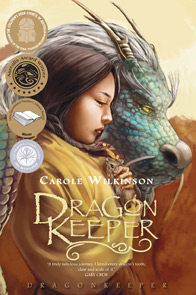
Dragon Keeper book cover
Cover image from Black Dog Books


DragonKeeper by Carole Wilkinson is a compelling fantasy/adventure series about a nameless slave girl in Ancient China whose job it is to feed the dragons.  Most boys past a certain age won’t put up with female central characters, but they sit still and listen for this one.  When the evil dragon hunter turns up to kill the last dragon for its body parts, she flees with it on an epic journey to protect a mysterious stone.  The book won the CBCA (Children’s Book Council of Australia) Book of the Year and took out a host of other awards, and my students and I went on to become keen fans of this wonderful Melbourne author. The sequel, Garden of the Purple Dragon, was shortlisted everywhere in 2006, Dragon Moon won the CBCA Award in 2008, and now there is a prequel – Dragon Dawn – which shows us Danzi as a young dragon, a mere 1000 years old.  A great favourite.

Sticking with dragons for the time being, I always read Lily Quench and the Dragon of Ashby by Natalie Prior to lure Years 3 and 4 students to reading.  Once again there is a female hero plagued by self-doubt, but she rises to the occasion (literally) when Queen Dragon lands in the grey, miserable town of Ashby and challenges the evil Black Count who has taken over everything and rules with an iron fist.  This one is rich in opportunities for discussion too, but it also features droll humour which eight and nine year old students can appreciate.  This is one of a series of seven, so the other six books are whisked off the shelves by borrowers before I’ve got to the end of chapter two…

The Deltora Quest by Emily Rodda series is a blockbuster.   Three trusty companions travel across Deltora to retrieve magic artefacts and defeat the evil Shadow Lord.  It’s a particular favourite with kids who play computer games involving collecting artefacts to fight off the Bad Guys.  No matter how many of these books I buy there are never enough, and I’ve given up trying to shelve them where they belong on the R shelf.  They have a tub of their own where the kids can riffle through looking for the title they want. (There are 15 in the series).

Another favourite is Truck Dogs, A Novel in Four Bites by Graeme Base.  He’s a picture book author and first editions of this book have full colour artwork, showing the bizarre creatures featured in this SF adventure.  It takes place at some time in the future in outback Australia when dogs have mutated into hybrid vehicles, part canine-part machine.  The hero, Sparky, (a Jack Russell/ute cross) is a scamp forever in trouble, but when a gang of Rottweilers come into town to steal all the town’s petrol, he leads the Mongrel Pack street gang to defeat Mr Big, (a Chihuahua/BMW cross) and save the day.  It’s an exciting romp with tongue-in-cheek humour and kids love it.

Do-Wrong Ron by Steven Herrick is completely different.  It’s a novel in free verse, and it tells the story of Ron who is good-hearted but manages to do almost everything wrong.  He tries to help Isabella’s grandmother who is too sad and lonely to go out of her house, and as usual things go wrong – but turn out right.  This is a great book for those under-confident kids who think they’re never going to belong, and the gentle humour is lovely.

Billy Mack’s War by James Roy is a great antidote to boys’ enthusiasm for war.   It’s set in 1945 and it tells the story of how shamefully the POWs were treated when they were evacuated back to Australia from Japan.  Billy doesn’t know his father, and he’s embarrassed and his loyalties are tested when he hears people talk about the POWs ‘sitting out the war’ while others fought.  His father’s experienced such horrors that he’s not coping with freedom very well. Not a book for under 11s, but a book that will intrigue older readers around Anzac Day…

Finally, although it’s British, I can’t resist including my favourite, Sir Gawain and the Green Knight, retold brilliantly by Michael Morpurgo, Britain’s Children’s Laureate.  This ancient tale from the 14th century takes place in Camelot, where on New Year’s Eve the feasting is interrupted by a strange green man who confronts the reputation of King Arthur’s knights with a fearsome challenge.  It is Sir Gawain who has to prove that he has courage, determination and honour, and it is this one that has my students pleading for me to read the finale even after the bell is long gone for them to go out to play.  We talk about the seven knightly virtues, and whether they still apply today; we talk about why Gawain says his life is less important than his king’s, and we talk about why flirting with your best mate’s girl is so wrong.  I read Michael Morpurgo’s version of Beowulf to Years 5 & 6 too and they love that as well (especially the gory bits), but it is Sir Gawain and his quest to do the right thing when tempted not to, who speaks to them across the centuries.

While nearly all my students love listening to stories in the library each week, I know that they don’t all turn into booklovers.  However some kids, who never used to borrow, now do so regularly and they’re in the library before school pestering me to buy new books as well.  I wish I knew the secret that makes this happen for more of them…

Back to Sue … Thanks Lisa for this inspired and inspiring guest post. Now, we’d love to hear your thoughts on the issue …

What is a classic: Guest post at DesertBookChick

Those who read this blog may have come across DesertBookChick (DBC) before. She’s the one who doesn’t like Jane Austen! In fact, she admits that, despite being a PhD, she’s a bit anxious about classics in general. However, not one to shy away from a challenge, she has declared August Classics Month on her blog. She is running a range of activities for this, including guest posts. Today the guest blogger is me. Do go check out her blog. And, if you’ve come here from there, you are most welcome to check me out!

Anyhow, writing that post – and reading some of the comments already made on DBC’s blog this month – has made me think more on this whole classics business. And here is what I think…

They must speak to some universal truth

That is, what they say about human nature has to ring as true today as when they were written. There is a fascinating little paradox here though, because classics can come and go. Clearly there is something more going on – something, perhaps, commercial or political or academic, which brings me to …

They must stand the test of time (and place)

Little Black Dress

Little Black Dress, says Clker.com (Courtesy: Chika87 at Clker.com)

To know they ring as true today as when they were written, some time must have elapsed. Think classic fashion. A classic LBD (aka little black dress) is one which looks as smart (note, not trendy, not funky, but smart) today as it did 30 years ago. It may show its age around the edges – perhaps an older style fabric, or a slightly different length – but it still works beautifully.

The way I test this for literature is not by defining an arbitrary amount of time but by a more pragmatic rule-of-thumb. And that is multiple reprintings – not in the first flush of publication, but some years down the track. The more years down the track and the more reprintings, the more classic perhaps? Or, at least, the closer it gets to the pantheon of classics, like, say, Shakespeare and Jane Austen!

But it is not always quite this simple

Some books die and then are revived. Sometimes this is to do with “fashion” in academia as writers fall in and out of favour (but I’m not going to explore this one now). Sometimes though there is something more, shall we say, political going on. And here I’m referring to minorities, such as, oh, women! In the 1970s, with the revival of feminism, there appeared a number of publishers who fossicked out works by women that had been lost (the works that is, not the women!). Virago Press and The Women’s Press are two biggies, but there were (and still are) many others. They (re)introduced us (or me at least!) to writers like Elizabeth von Arnim. These presses revealed that, while the meaning of “classic” as expressing something universal may be a commonly agreed thing, what we get to read is a highly constructed thing.

I’d love to know what you think. What do you mean by classic (excluding the Greeks for the time being!)? Do you purposefully choose or not choose to read classics, or is the notion of making such a distinction irrelevant to you? What are your favourite classics?

And, if you are interested in what some others are saying on this, do pop over to DesertBookChick. While there, you could always help me in my project of changing her mind about Jane Austen!