Monday musings on Australian literature: Whither Australian literature, 1930s (Pt. 2)?

As I wrote last week, I apologise to those of you not interested in the history of Australian literature, because yes again I am continuing my little survey of contemporary writing about Australian literature in the 1930s. This week I plan to look at some another discussion about the place of and interest in Australian literature.

So, today’s post looks at an article which asked Why is the average Australian reader, if given the choice, more likely to pick an overseas (English or American book) than an Australian one?

Australian fiction in America

In 1935, Pegasus (whoever that is) wrote an article (probably syndicated) in the Central Queensland Herald inspired by Australian readers’ apparent preference for books written overseas*, and in which s/he discusses, conversely, the growth of interest in Australian literature in America! S/he says that the Christian Science Monitor reports that “the American reading public is beginning to ‘wake up’ to the fact that worthwhile fiction is being produced in Australia”.  Tell McKinnon et al, that, eh? Pegasus, in fact, says that

Australian fiction has been noticed in America is something to be put to the credit side of the ledger, when Australian authors and critics deplore the quality of Australian fiction produced to date.

Book coverIndeed, Pegasus says that the Christian Science Monitor writer talks about the enthusiasm of the American reviewers “which is more than I can remember occurring in this country”. The book, they are particularly enthusiastic about is Henry Handel Richarson’s The fortunes of Richard Mahony. Pegasus notes that “there are many in Australia who would agree with the American critic who described this novel as ‘the most important single piece of literature ever to come out of Australia,’ [but] it has never become popular in Australia, either amongst critics or readers”!

Pegasus then shares some of the other books that were being appreciated in America. Rolfe Boldrewood’s Robbery under arms and Marcus Clarke’s For the term of his natural life are also loved here, he says, but EL Grant Watson’s Desert horizon, “has been forgotten here, if it ever received any particular attention”. Katherine Susannah Prichard’s Working bullocks was being deservedly appreciated, but, says Pegasus,

the unfortunate Coonardoo, well-written though it is, is probably better appreciated than it deserves by an American critic who can regard it as “a portrayal of the relations between the white race and the white black on a typical cattle station in north-eastern Australia.

Other books appreciated in America include G.B. Lancaster’s Pageant, M. Barnard Eldershaw’s A house is built, and Frank Dalby Davison’s Red heifer (Man shy), which “has already been accepted in America, probably to a greater extent than in Australia”. Man shy and A house is built are both well known to me, and would be regarded as classics I think, but G.B. Lancaster, whom most of us haven’t read, is mentioned once again in my blog. This is the name used by Edith Lyttleton (1873-1945). Born south of Launceston, she moved with her family to New Zealand when she was six years old, and stayed there until she moved to England in 1909. She returned to Tasmania in the 1930s, but ended up moving back to England. She wrote, among other things, thirteen novels and some 250 short stories, which, says AustLit, were “mostly narratives of romance and adventure set in the remote back country of New Zealand, Australia and Canada”. It’s probably not surprising, given she lived very little of her adult life in Australia, that she’s not particularly well-known here now. However, Pageant did win the ALS Gold Medal.

What all this says to me is that when it comes to the creative arts, there is always something for commentators to be concerned about – and then talk about – which is not necessarily a bad thing. After all, any publicity is good publicity, n’est-ce pas?

Any comments?

* Things seemed to have started to change by 1937, according to Angus and Robertson’s Mr W.G. Cousins.
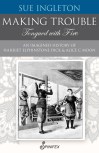
Sue Ingleton, Making trouble: Tongued with fire (#BookReview)

Book coverIn my recent post on Jessica White talking about her hybrid memoir-biography Hearing Maud, I commented that I’m intrigued by the ways in which biography is being rethought in contemporary literature. When I wrote that, I not only had White’s book in mind, but Sue Ingleton’s Making trouble. You can probably guess why from its sub-sub-title: “an imagined history of Harriet Elphinstone Dick and Alice C. Moon”.

“An imagined history”? And yet, it is classified on the accompanying media release as “Non-fiction (biography, history, crime)”. What does all this mean? Making trouble is about two English women, Harriet Elphinstone Dick (1852-1902) and Alice C. Moon (1855-1894), who, in 1875, left England for Australia. As the media release says, they were champion swimmers at a time when women did not swim in the sea; they refused to wear the corsets that women had been told were necessary to hold themselves up; and they were in love at a time when – well, you know the story. The problem, however, is that there is not enough documentary evidence for a traditional, formal biography. Ingleton writes in her Prologue that there were

no letters, no direct descendants both women being childless, no personal communications, only some newspaper stories, advertisements and sections of a thesis written in 1985.

In other words, their achievements are primarily documented in newspapers (“may the gods bless TROVE”, Ingleton writes): through ads for gymnasiums and physical education lessons, articles on talks and lectures, and death notices. Ingleton also had access to a master’s thesis by Lois Young titled Feminism and the physical sex sex education, physical education and dress reform in Victoria, 1880-1930).

To flesh out their lives, to give sense to these determined, influential women, Ingleton fills in the gaps using her imagination and her understanding of the history of the time. Describing herself as a “detective in time”, she had no choice, she writes, but to call this book “an imagined history” or, what is defined elsewhere, “speculative biography.” There is, in fact, a growing awareness, perhaps even acceptance, of this speculative approach to biography, but it’s tricky. At what point does such a work tip over into historical fiction?

Writing on the Australian Women’s History Network about her imaginative book The convict’s daughter, historian Keira Lindsey shares the contradictory responses she received to her requests for endorsement. One historian said she had “fearlessly carved a new path between history and fiction,” while another was “infuriated that she had gone “beyond the historian’s remit”. Clearly then, it partly depends on the reader. Some of us have more tolerance for straying from fact than others. But the writer’s approach and style also affects how readers respond.

Lindsey, for example, did not footnote, but she referenced the sources “with an index and bibliography”. She also provided “chapter notes at the end of the book for those wanting to know which portions of the book were fact and which were not”  and she explained her approach in an Afterword.

Ingleton took a different approach. She writes a Prologue and provides endnotes. I haven’t read The convict’s daughter so can’t comment on how Lindsey’s approach worked, but I did like Ingleton’s Prologue, albeit she argues that there are three components to her work – the Fact line, the Fiction line, and the Spirit world which, she says, can result in the revelation of “hidden facts” or “invisible truths”. This takes us into somewhat strange territory for a biography, speculative or otherwise, but in fact it doesn’t intrude too disconcertingly into the narrative proper.

“a barely documented history”  (Ingleton)

So, to tell the story of her two women, Ingleton interweaves more formal writing, which conveys the facts as she knows them, with a narrative style that is much closer to historical fiction. It generally works well, by which I mean you can usually tell which is fact, or draws on fact, and which is invented or imagined. While I’m happy to accept the use of imagination to fill in gaps, I did feel some of the imagined sections went a little too far into the historical romance fiction vein. I understand why, though. Ingleton is, among other things, an actor, director and stand-up comedian, and so is drawn to dramatic action. She also wanted to convey the love and romance between these two who dared to be different. How to do that in the absence of letters, was her challenge.

Now then, to the women, and why they’re worth reading about. Have you heard of them? Probably not, which is not unusual for women’s stories. Dick and Moon were, says Ingleton,

early pioneers* of physiotherapy, healthy diet, gymnastics and swimming for women and girls, biodynamic farming, journalism, breaking the barriers of women creating their own businesses and most importantly they were lesbians living together – the final bastion against the Patriarchy.

They also fearlessly advocated for sensible women’s attire, that didn’t cripple them physically and mentally. It’s an amazing story really. We follow them from England, to Australia, back to England when Moon’s father falls ill, and back to Australia. We see them build their gymnasium business in Melbourne, develop a teaching practice in schools, and establish a farm at Beaconsfield. Then we see Moon, devastatingly for Dick, cut loose and move to Sydney where she builds a career in journalism, only to die, before she’s 40, in seemingly mysterious circumstances, circumstances for which Ingleton believes she has an answer and builds a fair case.

All this is set against the backdrop of the burgeoning women’s movement in Australia – it was the time of the New Woman and the suffrage movement. Although Dick and Moon “were never deeply connected to the suffrage movement”, they did move in some of the circles mentioned by Clare Wright in her You daughters of freedom (my review), and “certainly were outspoken in the area of women’s rights over their own bodies and minds”.

Making trouble is an unusual book, but Harriet Elphinstone Dick and Alice C. Moon are two women who played a significant role in promoting women’s rights and proving, by their achievements, that women are as capable of living independently as men. They should be better known. Ingleton has done us a service in bringing them to our attention with such passion and flair.

* Not long after, another woman, Marie Bjelke Petersen (1874-1969) also pioneered physical culture for women, and was accused of dressing mannishly.

AWW Challenge 2019 BadgeSue Ingleton
Making trouble: Tongued with fire: An imagined history of Harriet Elphinstone Dick and Alice C. Moon
North Geelong: Spinifex, 2019
276pp.
ISBN: 9781925581713

(Review copy courtesy Spinifex Press)

Monday musings on Australian literature: Whither Australian literature, 1930s (Pt. 1)?

Apologies to those of you not interested in the history of Australian literature, because this week and next I’m continuing my little survey of contemporary writing about Australian literature in the 1930s. My first post discussed the move from “gumleaf and goanna” to other topics, and last week’s focused on discussions about the importance of writing about character. This week and next, I plan to look at some bigger picture discussions about the place of Australian literature.

These posts are, however, based on a somewhat serendipitous search of Trove. There could very well be articles – there probably are – which say some different things. I can only share what I have been able to find in the time I have available. Just as well I’m not producing an academic work, eh?

And here might be a good place to point you to an article by Susan Lever in Inside Story concerning the current parlous state of teaching and research about Australian literature in Australian universities. It’s particularly depressing, now that we have Trove with its rich content, that there is not the support for research into our written heritage and culture – which, of course, feeds into discussions about who we are and where we are going.

Australian literature’s place in the Dominions

Why is it that Australian creative literature, fiction, and poetry has not reached the same high standard as that of South Africa and Canada?” and “What is the place of the Australian novel in the fiction of the British Dominions?” These questions were posed in reports of a lecture given in June 1934 by Firmin McKinnon to the English Association of the University of Queensland. Thomas Firmin McKinnon (1878-1953) was, coincidentally, born in the Yass area not far from were I live. He was a journalist, and, says Desmond Macaulay in the ADB, was nicknamed at Brisbane’s Courier, “the Encyclopaedia”! He and his wife were active in Brisbane’s cultural life, and by the mid 1910s and 1920s, he was “recognized as a tireless literary lecturer and mentor of many young writers”. Among his many roles, he was President of the Queensland Bush Book Club. Macaulay also says that “his Anglocentric conservatism, however, allowed little sympathy for certain literary trends”, so we should keep this in mind when thinking about his views of Australian literature.

The two reports are both in Brisbane’s Courier-Mail, one a brief report on a Tuesday and the other clearly a more feature article report on a Saturday. Neither have by-lines as far as I can see, so I’ll just call them Tuesday and Saturday. Tuesday’s is titled “Australian fiction: Where is it lacking” and Saturday’s is “Australian fiction: It’s place in literature”.

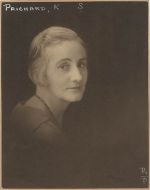
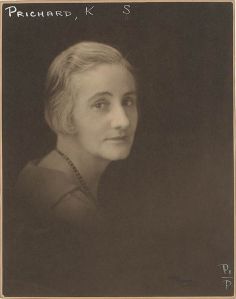
Katharine Susannah Prichard

Prichard, 1927/8 (Courtesy: State Library of NSW, via Wikimedia Commons)

Tuesday says that McKinnon particularly focused on the fiction of South Africa (represented by Sarah Gertrude Millin, Pauline-Smith, and Norman Giles), Canada (by Martha Ostenso, Corinthia Cannon, and Maza de la Roche), and Australia (by Katharine Susannah Prichard, Brent of Bin Bin, Flora Eldershaw, Marjorie Barnard, Helen Simpson, G. B. Lancaster, and John Dalley). Tuesday shares some of McKinnon’s arguments for the comparative failure of Australian fiction versus that of South Africa and Canada, saying that McKinnon’s conclusion is that “the contrast of nationality, and conflict of international ideas … were deficient in Australia. Even the contrasts provided by the migration era of the gold digging days had disappeared, and Australia was now the most homogeneous race on earth.” By contrast, South Africa had “a continuous conflict of colour and clash of nationalities” and while there was less conflict in Canada, it did have “a contrast of nationalities”. Hmm … sounds a bit simplistic to me. Prichard and Barnard-Eldershaw, for a start, found signifiant issues to tackle within our so-called homogenous culture. As did Christina Stead in Seven poor men of Sydney, but that, her first novel, was only published in the year of this lecture.

Tuesday reported that during the post-lecture comments, one person said “that many books of Australian fiction showed a good deal of slovenliness and lacked any marked spiritual impulse and characterisation”.

Book coverSaturday, as you would expect, provided more detail, including about the authors chosen to represent the three countries. Saturday reports that McKinnon admitted that “we have in Australia, in its history, and in its great cities excellent material and splendid background” but were not producing literature equal to Canada and South Africa. Saturday writes, presumably reporting McKinnon, that:
Unquestionably the impatience of the age has something to do with the decline of great creative literature all over the world. Beauty in literary form cannot flourish to perfection in an age that is wildly excitable, in an age that relishes some snippet about Bradman or Larwood, much more than it would a gem of English.

Have things changed much? Saturday goes on to report (or say) that

Australia has produced some very creditable fiction, but almost every creditable novelist who is writing of Australia has been abroad. Now is there any reason why our purely Australian novelist is not doing better work? There must be. Here in Australia we have a magnificent background for novels, and there is abundance of material. Some of the greatest novelists in the English language, from Jane Austen and Scott to Dickens and Walpole, have found their inspiration in happenings far less outstanding than those that could be found in the development of Australia, and in characters that may be found in any Australian city. But everything lies in the treatment of the subject, and our novelists fall short in the treatment of the story. Now what is the reason?

Llike Tuesday, he reports on the various ideas put forward and rejected by McKinnon, one being the effect of Democracy, itself, which he argued “which tends to the mediocre in everything”. Saturday quotes McKinnon as saying

Art and literature need to be fostered by leisure, good taste, moderate wealth, and cultivated discernment, and these do not flourish best in a democracy. Demos is a poor patron of art and literature.

Sounds a bit elitist don’t you think?

However, McKinnon, fortunately, realised the error of this argument, given Canada and South Africa were also democracies. And so, as Tuesday did before him, Saturday shares McKinnon’s argument that it’s “the lack of contrast and conflict in Australian life” that doesn’t support “literary creativeness”.

The answer? McKinnon says that what Australia needed was the “steady flow of migration” to provide “the clashes”, the opportunity to make comparisons “that are particularly valuable to the creative artist”. I’m not sure I fully agree with McKinnon’s argument regarding literature – I don’t see much evidence of clash of cultures driving Jane Austen’s novels, for example – but I do agree that cultural diversity is a good thing.

Anyhow, it appears that McKinnon gave a version of this talk later in the year, on 17 October, to the Authors’ and Artists’ Association. He again compared Australian writers with Canadian and South African ones, and he again argued that Australian novelists, with some exceptions, lack perspective and imagination, that they’re narrow and insular. Perhaps because this time he was talking to the creators themselves, he was, it appears, a little more positive. He “spoke of the vast and artistic improvement In Australian fiction within the past three years” albeit “all of it [was] written by travelled authors”. He again recommended migration to Australia, but added that “the development of aviation” and “even the Centenary gatherings in Melbourne” would be valuable in “helping to provide that standard of measurement that novelists needed”.

Now, I don’t know the South African and Canadian writers named, so I can’t comment on their relative merits. I’d love to hear from anyone who does know them. Regardless, though, I believe that Australians were producing some very interesting work in the 1930s, alongside the usual more popular fare?

Any comments?

Jessica White in conversation with Inga Simpson

Book cover

Hearing Maud, author Jessica White told us in her conversation with Inga Simpson two weekends ago, was 15 years in the making. This is something I already knew, because, as the result of our involvement in the Australian Women Writers Challenge, I’ve met Jess and we’ve talked about this book. However, it was excellent to hear the more detailed story – and at its conclusion rather than partway through. Jess is clearly very happy to have it finally off her hands, but it’s also clear that the book was, and is, very important to her – as you shall see.

The participants

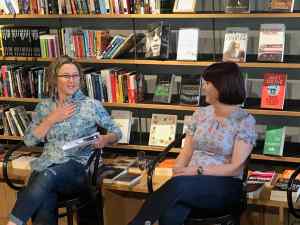
Simpson and White
Simpson (L) and White (R), Muse, 2 Nov 2019

Jessica White has written two novels A curious intimacy, which earned her a Sydney Morning Herald Best Young Novelist gong, and Entitlement (my review). She’s been listed for various prizes, and has had essays and short stories published in Australia’s best-known literary journals, including MeanjinSoutherlyOverlandIsland and Griffith Review. She is a lecturer/researcher at the University of Queensland.

Inga Simpson, whom I’ve still to review here (but I will), has written three novels, Mr Wigg, Nest and Where the trees were, the last two of which have been listed for or won prizes. Her latest book, Understory, is a memoir about her love of Australian nature, and especially trees.

The conversation

As Simpson advised at the beginning, the conversation was not a Michael-Parkinson-like hardball interview but more a conversation between friends which, apparently, they are. As a result, it had a warm, natural feel, while still addressing some important points and issues.

Hearing Maud, which I’ve just started reading, is one of those hybrid memoir-biographies that I’ve talked about recently. However, most of those have been mother-daughter stories, the biography being about the mother and the memoir, the daughter. White’s book is different. The biographical subject is Maud, the deaf daughter of the late nineteenth-early twentieth century writer Rosa Praed (1851-1935) (whom I read before blogging). White did not know or ever meet Maud so her knowledge has come from her research, which, Simpson said, is a strength of White’s.

White began by talking about the book’s genesis. It started with her PhD research into Rosa Praed, with whom White felt a connection, given they shared a rural, bush background and a love of romance! White was drawn to Praed’s “racy romances”, she said!

However, as she researched Praed, she discovered the existence of Maud, and the more she researched the more she realised what a “terrible life” Maud had had. So, she started writing a biography about Rosa and Maud. This was rejected by a publisher, but in rejecting it he suggested that she make the book “more about deafness”. To her credit, White was not put off. Having initially felt that deafness hadn’t challenged her, she started, as she continued to research Maud’s life, to recognise more about her own life as a deaf person – and then to perceive the intersections and divergences in their two lives.

Patricia Clarke, in her biography of Praed, Rosa! Rosa!, wrote that it was fortuitous for Maud to be born at a time when they were teaching deaf to speak, but White, now understanding more about deafness, saw it differently. It was a time of Social Darwinism – when the idea was to breed out disabilities – so the pressure to conform was strong. This was often, as it was in Maud’s case, counterproductive, if not disastrous. I will write more on this when I review the book, but essentially, a number of factors, including the breakup of Maud’s family and Rosa’s non-inclusive attitudes, resulted in her having a mental breakdown at 28 years old, and being committed to an asylum. She spent the next 39 years of her life there, that is, until she died!

The conversation spent some time on White’s own experiences as a deaf person. Simpson, being a writer, was particularly interested in language, so questioned White about words she’d used in different contexts to those Simpson was familiar with, such as, “coming out” (as a deaf person), “assimilation” (of deaf people into hearing culture), “mainstream” (of people with disabilities into abled-culture), and “colonialism” (of deaf culture and language by hearing culture.) Coming out as a deaf person was a slow process for White, not so much because she was resistant to the idea but because she hadn’t realised how much deafness had impacted her. Living in the country amongst a large extended family, she’d been, essentially, sheltered from fully experiencing her deafness. She was, she said, brought up as a hearing person, and just saw herself as “a bad hearing person”. That got a rueful laugh from the audience.

However, White was conscious through her teens and early twenties of a sense of isolation and loneliness. It was not until she was in her 30s that she started think about herself as deaf, and understand its impact on her life. She recognises, though, the paradox (“the poison and the cure” that she discusses in Hearing Maud) of her deafness, because she believes it has had, for her, negatives but also positives. She would not, she says, have become a writer if she hadn’t been deaf, and turned to reading at a young age.

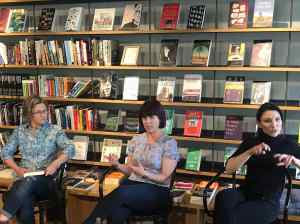
Signing during the conversation
The conversation was signed.

The conversation, at this point, engaged in some of the history and politics of disability (and particularly deafness, of course): on government policy regarding educating deaf children, on the politics of whether to teach signing or not, on the notion (that is embedded in the cochlear implant development) of ”fixing” people. White argued that this medical model of disability opposes the cultural model, which, for example, allows deaf people to sign, to have have deaf friends, to, in fact, be deaf. White observed that signing is strongest in poorer countries where the medical model is not so developed/can’t be afforded! White is now interested in learning to sign, and is pleased that the book has opened pathways for her into deaf communities. She clearly hopes this will result in mutual benefit to them all.

White also explained how her deafness forced her to develop the ability to intensely focus – on faces and body language, for example – to find patterns and thus meaning. This need to attend to detail makes her a good scholar, she believes, albeit also exhausts her!

Returning to more literary topics, White addressed that tricky memoir issue regarding their potential to hurt others. White said that although she says some tough things, this was not an issue in her clearly close family, whom, she described, as over-sharers! Nonetheless, she did pare back some difficult things in her parents’ lives. She also said that the self in the book is her authentic self.

As for what’s next, White has other things planned – as indeed I know she does because, from my meetings with her, I know she has a mile-a-minute mind! One project is an ecobiography about the pioneering Western Australian botanist, Georgiana Molloy, in which she wants to show the importance of biodiversity. She defined ecobiography, as being about how ecology shapes who we are. I’m intrigued by the various ways the biography form is being explored, expanded, teased out in contemporary literature, so I look forward to White’s ecobiography take.

Q & A

There was a short Q&A, which I won’t share in full, but I did ask White why she’d decided to combine memoir and biography. She said that she wanted to tell Maud’s story, but that hers created a foil or mirror for that story, and in doing so, it enriched both stories.

Another questioner, commenting on deaf people having to conform to the speaking world, asked what the speaking world could do to make life easier for deaf people. White said that many people don’t understand the feeling of powerlessness that disability can bring. She hopes the book will help people see that there are different ways of being.

Jessica White in conversation with Inga Simpson
Muse (Food Wine Books)
Saturday 2 November, 4.30-5.30pm

Monday musings on Australian literature: Setting vs Character in 1930s Australian fiction

Today’s post continues the discussion started in last Monday’s “gumleaf and goanna” post. It looks particularly at what reviewers were saying about setting/scene and character, through five Australian books that were reviewed in papers during the decade. There was clearly a lot of engagement in the community about the development of Australian literature, and you can expect more posts on the decade!

This post was inspired, though I’m not going to labour the point, by Eric Norton, who wrote in The Courier Mail in 1934. He comments on the over-focus in Australian literature on “some half dozen ‘peculiar’ environments — the farm, the selection, the station, the mining camp, and a few others, which, if not familiar to us in actuality, have become so through the magazines or by repute”. The stories relying on these, he says, “develop inevitably a certain sameness”. For him, “the imperishable in fiction is that which deals primarily with the shallows or the deeps of the human heart” and he concludes with:

In the creation of fiction, as in life, it is character, not setting, that counts; and it is to the Australian rather than to Australia that the local novelist must look for his inspiration.

Book coverBrent of Bin Bin: We now know this pseudonym was Miles Franklin, but it was a pretty well-kept secret at the time. Certainly, the reviewer in Melbourne’s The Age had no idea. S/he reviews Ten creeks run (1930) (see Bill’s review), which was the second Brent of Bin Bin novel. The reviewer has mixed feelings, saying that “the same defects and the same merits” are apparent in it, but then says that “the effect of repetition is to bring out the merits more emphatically and to place the defects in the background”. This reviewer discusses both setting and character:
The canvas is crowded with minor characters, and the author has not sufficient skill to make these minor characters stand out individually; but the mass effect is good as a background to this story of station life on the Murrumbidgee more than a generation ago. Station life has never been more faithfully depicted in Australian fiction, or with so little conscious effort. Most of the more important characters are true to life, and though the story does not reveal much imaginative force on the part of the author in creating dramatic situations, he [ha!] has skill enough to keep the reader’s interest alive.

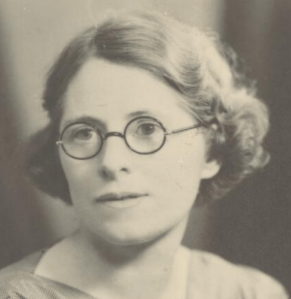
Birkett, 1939, Unknown, National Library of Australia, Public Domain, Via Wikimedia Commons.

Winifred Birkett, who won the prestigious ALS Gold Medal, for her 1934 novel, Earth’s quality. The reviewer in Melbourne’s Leader, says this book represents a “great advance on her previous book, Three goats on a bender”.  S/he goes on to say that Earth’s quality,

like so many other Australian novels, has a sheep station for its setting, but unlike most of its class it is not a description of station life, but a study in characterisation. And most of the characters are portrayed with the skill of a practised hand.

S/he then describes some of the main and minor characters, noting that one of the minor characters, Anthony, a Cockney man-of-all-work, “stands out with the vividness of reality”. Fascinatingly, however, “Miss Birkett is not very successful in portraying woman characters”. The story is “somewhat bare of incident, but the literary quality of her book lifts it much above the level of most Australian novels”.

John K Ewers: A Western Australian novelist, poet and schoolteacher who was President of the WA branch of the Fellowship of Australian Writers. His second novel, Fire on the wind (1935), was reviewed in Melbourne’s Leader.  It’s a story about disastrous bushfires in Gippsland in the late nineteenth century. The reviewer notes that Ewers hadn’t lived in Gippsland, but did have “relatives who spent part of their lives there, and lived through the terrible experiences of Black Thursday.” S/he then outlines the plot – a farm saga – including describing the characters, and concludes that “Although the author is not a Gippslander he knows the bush and the settlers, and on that account the background of his story has the note of realism. His best portrait is that of the aged Colliver, who, despite his narrowmindedness and his bigotry, is an engaging old man”. (ADB)

William Hatfield (pen-name of English-born writer Ernest Chapman): This author I hadn’t heard of. He was best known for his novel Sheepmates (1931), but the review I’m focusing on is for his 1933 novel, Desert saga. It buys right into our modern discussions about who can write what story, because it is, says the The Age’s reviewer, “about a tribe of aborigines in Central Australia, who, when the story opens, had never even seen a white man.” Our reviewer says the author provides “an interesting account of tribal customs and ceremonies, but the primitive conditions of life of an aboriginal tribe do not provide the variety in scene, incident and character, which are the main essentials of a good novel”. Of course, there would have been be good character to explore here, but Hatfield wouldn’t have been the man to do it. Hatfield is on firmer ground when he introduces white men, and explores their relationship with Indigenous people. The reviewer concludes that it’s obvious that Hatfield “has studied the Australian aborigines, and that in presenting their customs, habits and mentality, in the form of a story, he has adhered to truth”. Hmm … how does the reviewer know – and yet, it’s interesting to see that Indigenous people appeared in fiction more often, perhaps, than we might have thought. (ADB)

Kay Glasson Taylor (who, Bill identified last week, used the pseudonym of Daniel Hamline, and was second place-getter in the 1929 Bulletin Prize): The reviewer of her novel, Pick and the duffers (1930), commences by noting that the Australian story “must stand on its own merit, and not by implication or suggestion strive to emulate something of quite different atmosphere.” S/he was commenting on the claim on the jacket of “Pick …” that “Pick is an Australian re-incarnation of the immortal Tom Sawyer.” Our reviewer finds such comparisons dangerous. S/he writes that like several recent Australian stories, “the setting of Pick and the duffers is Queensland, and it deals with some lively incidents connected with cattle duffing on “Coomera” and adjoining stations … It is quite a good yarn, with plenty of action and incident”. It also, interestingly, has an Aboriginal character, Gordon, who is a friend of 11-year-old protagonist Pick. But, for our reviewer, it’s a “a good story for boys, but to adults, Pick becomes tedious with his posturing and posing and precocities”. Not much character development here!

I have more, but will save them for another post another time. I’m enjoying exploring the period, particularly seeing the reviewing style, and what reviewers looked for in and thought about Australian literature.

Any comments?

David Brooks, The grass library (#BookReview)

Book coverOK, I’m going to show my hand here. I love animals – and hate animal cruelty – but I am not vegan. More to the point though, I am cautious about animal rights activists because they can sometimes act out the very violence and cruelty on humans that they condemn for non-human animals. I was, therefore, a little wary when I was offered for review David Brooks’ book, The grass library. However, Brooks, a poet/novelist/essayist/academic/one-time co-editor of Southerly, has enough cred that I decided to take a chance. I’m glad I did – just as I was glad to have read, three years ago, Bidda Jones and Julian Davies’ more targeted animal rights book Backlash: Australia’s conflict of values over live exports (my review).
The publisher’s letter accompanying my review copy quoted the Sydney Morning Herald’s description of Brooks as “one of Australia’s most skilled, unusual and versatile writers”. It is the combination of this writing skill, with the thoughts contained within, that makes The grass library such an engaging and provocative read.

Although there is no doubt about the author’s commitment to his cause, The grass library is not an in-your-face polemical book. Instead, it is a thoughtful work in which Brooks, now a committed vegan and animal rights advocate – advocate being, perhaps, a more appropriate word than activist – works through his practical, philosophical and ethical position. And he does so in a way that encourages us to think along, and to wonder about and question our own thoughts, practices and values.

The book is part-memoir, part-reflection. It starts with Brooks’ partner, simply called T in the book, pronouncing that she can’t eat meat anymore. “We’re turning vegetarian”, she says. A week later, that becomes vegan. And so, a big change occurs in their lives, one that takes oyster- and cheese-loving Brooks not too long, in fact, to get used to. Brooks writes, heralding the book’s real subject-matter:

But this book isn’t about veganism, or guilt. If I’d permitted myself a more eighteenth-century subtitle it might have been “An account of three years pf philosophical and un-philosophical transactions with animals in the Blue Mountains of New South Wales”, but ultimately and more simply it’s about discovery and wonder: wonder and wondering.

After a couple of false starts, Brooks and T find themselves, in 2012, living on a small farm in the Blue Mountains, with their recently adopted dog Charlie, and, soon after, two rescue sheep, Henry and Jonathan. Not long after that, a new-born lamb, Orpheus Pumpkin, joins them, and by the end of the book, ram Jason brings the number to four. These sheep and Charlie form the book’s backbone and become (or, should I say in the spirit of the book, are) characters in their own right. Other non-human animals appear too, some briefly, including cicadas, ducklings, a snake, and rats.

What I most enjoyed about this book is the calm, non-histrionic way in which Brooks introduces and ponders on a range of random-sounding but coherent-as-the-book-progresses ideas, such as “dusk anxiety” and “herd music”. “Dusk anxiety” is introduced early on through a twitching that Charlie was exhibiting at that time of day. It’s a sort of mood-change or discombobulation that some humans (and, Brooks believes, some non-human animals like Charlie) feel at that strange twilight, half-and-half time of day. Sounds valid to me. However, it also provides Brooks an opportunity to raise the issue of anthropomorphism. His argument is that anthropomorphism is not a bad thing, that in fact, it is central to empathy. The barbarity we engage in against animals is made possible, he argues, by denying this empathy, by believing “that we are so different from the creatures we live amongst that we cannot know or even hazard how they feel.” To read this book, then, you need to understand (if not accept) this fundamental world-view. Brooks may not know what the non-human animals he writes of feel, but he writes with the assumption that they do feel (and that we may know what they feel).

Another significant idea underpinning the book is that of the binary way we view animals. This idea is one of the most confronting or, at least, challenging in the book:

There are so many old, rusty binaries involved here. […]

We categorise animals, and behave towards them – accord or refuse them protection or sanctuary – depending on whether we see them as wild or tame, feral or domesticated, native or exotic, rare or common, endangered or of least concern, pet or pest, livestock or otherwise …

In most of these cases, he says, one side of the binary will be given a higher “value” (in human terms), with, often, a justification to kill the opposing side. For each animal concerned though it is his/her life!

It’s not for nothing, I think, that the next chapter talks about rats at their farm!

This discussion of binaries is part of a major thread in the book, which is language, and how it “trips” us up, how it “will restrict us, hold us back, if we don’t learn to use it with greater care and respect”. Language is all too often speciesist, he argues. Grammar – the use of “it” for a non-human animal, for example – is violent, for example, or, at least, has the potential for violence.

It’s a book, then, that makes the brain hurt – albeit in a gentle, encouraging way. However, there is beauty in the book too, such as the chapter on “herd music”. This chapter starts in his writing room, his “grass library”, and is inspired by the appearance outside his room of the two sheep when (and only when) he plays music. He ponders this. They are herd animals, but being just two rescue sheep, they have no herd and are thus deprived of, he posits, the music of the herd:

… if music it can be called (but how else to call it?): the sound of hooves shifting in the grass or tapping on stone, the occasional bleat of a lamb, response of its mother, grunt or growl or call of a ewe or a ram, the sound of snipping at grass-blades, coughs, throat-clearings, nudgings, strokings, as one sheep passes another, regurgitations, ruminant chewings, fartings, belches, sounds nearer and further off, all in all a constant, rolling concert, approximated—very distantly resembled, in a bizarre, post-something way— by the muted rhythmical under-music of whatever it is that I might be playing on the stereo system in my cabin, an aural equivalent of warmth, the ghost of companionship.

I share this because I loved this, but also because it provides some insight into the way Brooks thinks (or wonders.)

I can’t say I agree with all that Brooks writes. For example, as vegans, he and T didn’t want to feed their rescue lamb lactose-based lamb powder, so they seek non-animal products like almond milk (which doesn’t, for the record, work). But, but, I say, lambs grow on milk! And then, of course, there are those binaries. Philosophically I take his point, but practically? I need to think about this more.

The grass library, then, can be a confronting read because it challenges us to reconsider some fundamental perspectives and assumptions. However, it is not a difficult read, because not only is it generous, but it is also peppered with engaging stories about life in the mountains and the non-human animals with whom Brooks and T. live. I recommend it.

Lisa (ANZLitLovers) also enjoyed this book.

David Brooks
The grass library
[Blackheath]: Brandl & Schlesinger
221pp.
ISBN: 9780648202646

(Review copy courtesy Brandl & Schlesinger)

Prime Minister’s Literary Awards Winners, 2019, announced

The Winners of the the Prime Minister’s Literary Awards for 2019 were announced earlier today, but I was driving to Berrima for my annual “same-time-next-year” catch up with a dear Sydney friend.

Below is the shortlist for the three categories I posted on in my shortlist post, with the winners marked in bold.

Fiction

  • Rodney Hall’s A stolen season, Picador (my review)
  • Gail Jones’ The death of Noah Glass, Text Publishing
  • Melissa Lucashenko’s Too much lip, University of Queensland Press (my review)
  • Suneeta Peres da Costa’s Saudade, Giramondo Publishing (Lisa ANZLitLovers’ review)
  • Laura Elizabeth Woollett’s Beautiful revolutionary, Scribe Publications

Oh well, not one I’ve read but Gail Jones has been around the traps for a long time with many shortlisted books, so congratulations to her.

Non-fiction

  • Cynthia Banham’s A certain light: A memoir of family, loss and hope, Allen & Unwin
  • Gabrielle Chan’s Rusted off: Why country Australia is fed up, Vintage Books
  • Paul Genoni and Tanya Dalziell’s Half the perfect world: Writers, dreamers and drifters on Hydra, 1955–1964, Monash University Press
  • Chloe Hooper’s The arsonist: A mind on fire, Hamish Hamilton (on my TBR) (Lisa AnzLitLovers’ review)
  • Maria Tumarkin’s Axiomatic, Brow Books (my review)

Australian history

  • Billy Griffiths’ Deep time dreaming: Uncovering ancient Australia, Black Inc.
  • Anna Haebich’s Dancing in shadows: Histories of Nyungar performance, UWA Publishing
  • David Kemp’s The land of deams: How Australians won their freedom, 1788-1860, The Miegunyah Press
  • Meredith Lake’s The Bible in Australia: A cultural history, NewSouth Publishing
  • Clare Wright’s You daughters of freedom: The Australians who won the vote and inspired the world, Text Publishing (my review)

Other winners …

Three other categories were announced:

  • Poetry: Judith Beveridge Sun music: New and selected poems 
  • Young Adult fiction: Michael Gerard Bauer’s The things that will not stand
  • Children’s fiction: Emily Rodda’s His name was Walter

The complete shortlist with judges’ comments can be seen on the website (Check out their augmented reality function!)

No further comments from me, and no images, as I hate doing this on my iPad, but what about you…

Thoughts?

Monday musings on Australian literature: 1930s, moving beyond “gumleaf and goanna”

Time for another post inspired by Trove, this one, as often happens actually, discovered while researching something else. What I discovered was the discussion that went on in the 1930s about Australian fiction’s coming of age – and the fact that much of this was down to the women writers of the time (about which I have written before).

This post will focus on what critics and reviewers were saying about the Australian novel and its creators, and I’ll start with an intriguing competition that was run by Sydney’s The Sun in 1934. The competition was, apparently, for “a short comment on the progress of Australian fiction since the war”. What a fascinating competition idea? The competition report sums up the entries as follows:

Nobody expressed regret at the passing of the “gumleaf and goanna” phase — that tiresome exploitation of externals, of the obviously distinctive things in the Australian scene. Contestants commented on the decline of blood-and-thunder melodrama, and on the entry into Australian prose of high imagination and feeling for style (notably in the works of Henry Handel Richardson). Several commented on the success of women writers (H. H. Richardson, Kathleen Pritchard [sic], G. B. Lancaster, Helen Simpson, and others), and the use of themes of universal interest, even if the setting be Australian.

Katharine Susannah Prichard

Katharine Susannah Prichard (1927/8) (State Library of New South Wales [Public domain], via Wikimedia Commons)

This idea that Australian prose was moving away from a focus on melodrama and simple plots to exploring deeper issues and concerns runs through all the articles I read from the decade. As The Sun’s writer says, the setting, for most, was still Australian, but the core issues were becoming more universal. (Also running through the articles, unfortunately, was an ongoing issue with getting Katharine Susannah Prichard’s name right – something I’m sure biographer Nathan Hobby knows all about, and then some!)

Anyhow, the winner of the competition, a Miss Constance Wallace of Roseville, wrote that:

The Australian novel at last has broken from the convention of gum-trees and wide open spaces. It is losing its colonial, narrow atmosphere for a more vital and a broader national—and International—outlook. It has achieved a deeper humanity and a more virile quality. No longer is it mere landscape painting; the canvas begins to glow with the warmer tones of human emotions.

She names, among others, Henry Handel Richardson, Helen Simpson, G.B. Lancaster (pseudonym for Edith Joan Lyttleton), M Barnard Eldershaw, and a man or two, including Ion Idriess.

Meanwhile, back in 1931, The Canberra Times reported on two talks given to the Canberra Society of Arts and Literature by eminent men of letters of the time, Kenneth Binns and Harold White. Binns discussed M Barnard Eldershaw’s Green memory. He described the plot as “strong, dramatic and dignified” and as proceeding “with that quality of inevitableness which is characteristic of all great dramatic writing”. He liked the characterisation, describing the interest being in “the pull of character against character, instinct against instinct” in the two main characters, but he also commended the authors’ ability to delineate their minor characters. In terms of style, he described the pair as “masters of vivid, picturesque yet dignified writing”, likening them to Robert Louis Stevenson, “in their use of picturesque and arresting words and metaphors, and also in their command of highly pregnant short sentences”. Binns believed that Marjorie Barnard and Flora Eldershaw had “produced a book which not only delights but which also adds dignity and significance to Australian letters”.

Book coverWhite talked about Henry Handel Richardson’s The fortunes of Richard Mahony (1930), starting by contesting some of the criticisms from Australian critics. He described the trilogy as having “a structural harmony found only in very great novels” and he dispensed with “the question of whether the author had produced a typicallv Australian book or not” by saying it was “a universal work, and that should be enough”. (So there!) White, like Binns, then went on to talk about the work in detail – plot, characterisation, style, and so on, concluding, our reporter says, that

with this one book, Australian fiction took its rank with European conception of the novel as a form of art through which the real experiences of life are recorded sincerely and honestly. At the same time the author had recreated a period in our social history and added two living creations to the world’s great characters in fiction.

In 1934, a writer in The Age reviewed a later work by Henry Handel Richardson, The end of a childhood, which s/he described as “a collection of odds and ends”. Some of this the reviewer felt would “add little to the author’s reputation”. However, the work includes some sketches of girlhood, in which, says the writer, “slight as they are, Mrs. Robertson [sic!!!] displays a penetrative knowledge of the mentality of young girls”. The book concludes with four stories, which, our writer finally praises, reveals the “psychological subtlety which has proved a valuable asset in her portrayal of characters on a larger canvas”.

Moving on, in 1937, an article in Adelaide’s The Advertiser discussed Katherine [sic] Susannah Pritchard’s [sic] (honestly!) novel Intimate strangers, which the writer argues represents a development in Australian fiction because it “gives one the impression that Mrs. Pritchard [sic] is feeling her way towards what one may call the sociological novel”. The writer has some reservations about the book, but also praises it because Prichard

has grasped so well … the essentially challenging nature of marriage — the surrender that it calls for but which cannot wholly be given; the individual aspirations that, in its infinite demands, it so often submerges; the regrets it cannot completely banish; and the whole complex and unfathomable business of two distinct personalities being required to find a common denominator.

Dymphna Cusack, JungfrauAnother writer praised during the decade is Dymphna Cusack. In another 1937 article in Adelaide’s The Advertiser, the reviewer praises Cusack’s Jungfrau (my review). The reviewer starts with:
“IT is not wholly fanciful to suggest that within a decade or so most novels of ideas will be written by women,” a distinguished English literary critic wrote recently. “Modern intelligent men,” he added, “express themselves and their thoughts more easily in autobiographies, biographies, essays, and books of travel than in the form of fiction. And the future of the English novel is already largely in the hands of women.”

Our reviewer goes on to suggest that we should test this idea against the Australian novel, and starts by referencing Henry Handel Richardson. However, “are there”, s/he asks, “any young Australian women writers to succeed her in making the future of the Australian novel a brilliant one?” Well, yes, is the answer, and one of these is Dymphna Cusack as evidenced by her debut novel Jungfrau. I loved the writer’s reference to the cover, when s/he describes it as “a novel that — despite its title and its publishers’ absurd pictorial jacket— is arrestingly Australian in every way as well as being a fine piece of fiction”.

S/he goes on to praise Jungfrau, for its portrayal of Sydney, giving

a valuable picture of our city life that should do much to dispel persistently recurring illusions abroad concerning Australians’ homes, culture, manners, and way of speech.

Not only is Jungfrau “interesting and convincing”, s/he writes, it is also

extremely well-written, the prose having an effortless continuity and forcefulness which make it delightful to read, as, one feels, it must have been delightful to write.

The writer praises Cusack’s “lesser characters”, saying she “has endowed the very least of them with life; they are all so easy to believe in, and so easy to like or laugh at or despise.” And finally, s/he concludes that “altogether, the young writer is very much to be congratulated on her first book; on her irony, insight, and deft handling of human nature”.

So, Henry Handel Richardson, Katharine Susannah Prichard, Marjorie Barnard and Flora Eldershaw, and Dymphna Cusack … all praised, with clear argument, for progressing Australian fiction through the quality of their writing and their characterisation, and by tackling bigger and more universal ideas.

Have you read these authors, and, if so, what would you say?

Special Book and Event Giveaway for Jessica White’s Hearing Maud

Book cover

Regular readers here will know that I very rarely do give-aways. However, when Jessica White, who is on the Australian Women Writers Challenge team with me and whose novel Entitlement I’ve reviewed, asked whether I’d be happy to do a giveaway for her latest book, Hearing Maud, and her conversation with Inga Simpson at Muse, how could I refuse? Of course, I couldn’t, and didn’t want to.

So, here’s the deal:

On Saturday 2nd November, from 4.30 – 5.30pm at the wonderful Muse Books and Cafe, Jessica will be in conversation with writer Inga Simpson about her hybrid memoir on deafness, Hearing Maud, which details Jessica’s experiences of deafness after losing most of her hearing at age four. It charts how, as she grew up, she was estranged from people and turned to reading and writing for solace, eventually establishing a career as a writer. Central to her narrative is the story of Maud Praed, the deaf daughter of 19th century Queensland expatriate novelist Rosa Praed. In researching Maud’s story, Jessica reached back into the history of the deaf and realised how, although her and Maud’s stories are a century apart, they both still struggled with the expectations that they be like hearing people.

Jessica is offering not one but TWO giveaways:

  • a copy of the book and a free ticket to this event; or,
  • a copy of the book

Please leave your name in the comments, noting which of these two draws you wish to go into, by midnight AEDST Tuesday 29th October.

The draw, using a random number generator, will be made on Wednesday 30th October:

  • The winner of the book and event will just need to turn up at the event as his/her name will be recorded at the door.
  • The winner of the book will need to email his/her address as requested in the announcement email.

Jessica and I look forward to hearing from you!

Ros Collins, Rosa: Memories with licence (#BookReview)

Book coverMemoirs are tricky things. There are readers who love them, readers who hate them, and readers like wishy-washy me who sit in the middle. I sit in the middle because, for a start, I don’t like to say “never” when it comes to reading. I sit in the middle because I couldn’t cope with a steady diet of memoirs, particularly those how-I-got-over-my-[whatever trauma or challenge it was], which is certainly not to say that I don’t admire those memoirists or don’t enjoy some of their fare. And, I sit in the middle because I don’t like formula, because I like books that try to tackle their subject or their form a little differently. So, the memoirs I mostly read are those which play with form or whose subject matter offers something different. Ros Collins’ memoir, Rosa: Memories with licence, does both of these.
First, the subject-matter. Rosa deals with, as the book description says, “Anglo-Australian Jews [who are] often overlooked in fiction and memoir.” Having known many Anglo-Australian Jews through my life, I was interested to read Collins’ discussion of her family’s life, as a contrast to those more directly Holocaust-influenced lives of European Jews we’ve all read about. It’s not easy being Jewish, I believe, regardless of personal or family history, so I was interested to read this story.

Then there’s the form. The subtitle, “memories with licence”, suggests that this is not going to be your usual memoir. For a start, it is told third person about a person called Rosa, which is the name given to the author Ros by “two elderly men from Southern Europe” whom she met on a recent Anzac Day Eve. She goes on to say, in her Introduction, that it is this “Rosa who wanders through the following stories, sometimes fictionally, sometimes autobiographically”, though I hazard to guess it is mostly autobiographical – just told one voice removed! Near the end of the introduction, she says that:

Rosa is much more personal [than her previous family history book, Solly’s girl] – and freely written – and I have taken liberties with the truth. Memoir with a little fiction, or fiction with a little history? It’s hard to say. Memories with licence.

The book has been classified on its back cover as Memoir. And that is how I have read it, as it reads true.

So, why tell it this way? Collins says she wishes “to entertain”. Her aim is not to delve into world history, cataclysmic events, or, even, dystopian futures. She wants, instead to shine a light on lives that may not be well known to many Australians, on Anglo-Australian Jewish lives. Taking a third person voice enables her to tell her story a little more objectively, to comment on what people, in particular Rosa, were, or may have been, thinking and feeling. Third person also enables her to get out of the main subject’s voice and head. It enables her to suggest what others might be thinking, such as Rabbi Szymanowicz:

Rabbi Szymanowicz stopped surreptitiously searching the room for younger people with whom he might more profitably connect, and looked at her. Seldom, if ever, had he met an elderly congregant quite like her; for an eighty-something-year-old Rosa did not come across as a sweetly gentle Miss Marple – more likely to be opinionated and argumentative.

This sort of statement could not be made in the same way in a traditional memoir. A traditional memoirist can not so directly get into the head of another character. A traditional memoirist can only suppose what another character might think (unless they are quoting documented facts from, say, letters). Taking this third person approach gives Collins more licence. She can, for example, “guess” about the relationship between her two grandmothers, two women who were not happy because they lost significant supports, when Rosa’s parents married.

All this could be disconcerting to some readers, but Collins has been honest from the start about what she is doing. Ultimately, the important thing is whether the book rings true and I believe it does. Rosa’s character – her humanity, her sense of her own flaws, her uncertainties, as well as her pride in her achievements – shines through.

Another way in which the book departs from traditional memoir is in its lack of linearity. While there is an overall movement from past to present, Rosa is not told chronologically. Instead, each chapter or “story” takes up a theme through which the story of English-born Rosa (Ros) and Australian-born Al (Ros’s husband Alan) is told. Chapter 4, “Jellied eels”, for example, explores food, Jewish culture, and Rosa’s navigation of it all. Collins explains how, as a child, Rosa had been told what she could and couldn’t eat, but not told why. Her mother expected her to “just accept the traditions” but of course this is not the way to hand down traditions, not, certainly, “to a difficult daughter – full of unnecessary questions”!

Collins also tackles, gently and without polemics, what Israel means (or, might mean) for Anglo-Australian Jews. For those of us who find Israel and the politics of the region highly problematic, it’s useful – though not necessarily convincing – to be reminded that in Israel, as Rosa quotes Golda Meir saying, “nobody has to get up in the morning and worry about what his neighbours think of him. Being a Jew is no problem here.”

Rosa, then, is a warm-hearted, open-minded “memoir” written by an Anglo-Australian Jewish woman for whom being Jewish, as for many I believe, is as much, if not more, about history and heritage as god and religion. In this book, Collins interrogates her family’s past, and her late husband’s story, in order to come to a better understanding of herself, and of what she would like to pass on to the next generation. This book is testament to that soul-searching, and makes good reading for anyone interested in the life-long business of forming identity, Jewish or otherwise.

AWW Challenge 2019 BadgeRos Collins
Rosa: Memories with licence
Ormond: Hybrid Publishers, 2019
ISBN: 9781925736113
186pp.