Marian Matta, Life, bound (#BookReview)

In August 2020, small independent publisher MidnightSun sent me two short story collections, Margaret Hickey’s Rural dreams (reviewed last month), and Marian Matta’s Life, bound. I enjoyed Rural dreams, as some of you may remember, for its exploration of rural lives from multiple angles and points of view. Life, bound is a very different collection. It doesn’t have a stated unifying theme but, like many short stories, it is unified by its characters being ordinary people trying to make the best of the life they have been given – or of the life that, sensibly or not, they’ve made for themselves!

The promotion accompanying the book describes it this way:

Free agents or captives of our past?

In Life, Bound, characters find themselves caught in situations not of their own making, or trapped by ingrained habits, walking in grooves carved out by past events. 

What characterises this collection, beyond this, is the varied tone, from the gothic-influenced opening story “The heart of Harvey’s Lane” to the strongly realist closing stories, “He turned up” and “A bench, a bard, a turning tide”. As with many short story collections, you never quite know what you’re going to get when you turn the page to the next story. In “The heart of Harvey’s Lane” a man becomes a famous photographer off the back of a shocking incident, but, after a while, starts to withdraw from the world, into a very strange house. As he scales down his career, he recognises that

The downward turn in my income almost exactly mirrored the upward turn in my satisfaction.

Nonetheless, the ending, when it comes is disconcerting. Covering a few decades, it’s an engrossing story about the way life can go.

Some stories are shocking, such as the second story “Climb”, about a young boy abused by his step-father, while others are cheeky, such as “Lovely apples” about a loving young couple and the suggestive “Drive my car”. In some stories, abused or overlooked characters get their own back. “Roadkill” is particularly cleverly told – with a great opening – and you have to cheer for the much-maligned Emily who’s not as stupid as they all think. But in other stories, things don’t work out, such as the devastating story about blighted hopes, “He turned up”. This title has a powerful double meaning. Titles in short stories are, I think, particularly important, because, given the form’s brevity, every word must count. Matta uses her titles well. Some are purposefully obscure, not giving anything away except perhaps the literal, as in “Climb”; others are more clearly figurative, as in “Desire lines” or “Lovely apples” or “Three-sixty”; while others are superficially descriptive but contain so much more, as in “A bench, a bard, a turning tide”.

Now, though, let’s get back to the characters “caught in situations not of their own making”. They include an abused boy, a transgender person, a woman caught in domestic violence, a homeless woman. These characters can break our hearts, but in Matta’s hands they are the characters who just might come through. I’m not naming the stories, here, because part of Matta’s skill is in slowly revealing the character’s situation, so why should I tell you here straight off?

Other characters are a mixed bunch, some “trapped by ingrained habits”, others just at a certain stage in their lives where an action has, perhaps, unintended reactions. There’s the alcoholic ex-husband who desires reconnection with his family (“Desire lines”), two sea-changers who meet in their new chosen town and become friends (“Claimed by the sea”), two people post-one-night-stand (“Summer of love”). This last one exemplifies how Matta mixes up her structure. Not all stories are simple, linear chronologies. “Summer of love” is linear, but told from the alternating points of view of the woman and the man, a perfect solution for a story about a one-night-stand.

The varied structure is one aspect of this collection that keeps the reader engaged. The above-mentioned variations in tone are another, plus, of course, the characters and stories themselves, but another is the language. Here, for example, is a character deciding that discretion is the better part of valour:

Jimmy decided not to chase that remark down to a point of clarity.

(Waterwise)

Then there are those phrases that make you laugh, such as this on entitled teenage boys being told off by their headmistress:

They shrugged, just sufficiently out of sync to appear like a music video dance troupe.

(Roadkill)

My last example is Rita – her town’s “voice of authority, the historical society’s walking catalogue” – being unusually flummoxed by a question:

A frown settles slowly on Rita’s face; her infallible memory has tripped over a corrupted file.

(Winston Mahaffey’s hat”

The stories are all, fundamentally, about humans – the things that happen to us or the messes we get into, and how, or if, we get out of them. But some of the stories also reference contemporary issues, such as climate change, domestic abuse, and homelessness.

The stories aren’t linked but this does not mean that order is not important. With a collection like this – that is, one dealing with some of life’s toughest challenges – the order in which the stories are presented, and which one is chosen for the end, can be significant. In this collection, Matta has followed the sad, bitter penultimate story with a story about homelessness in which the destitute but proud Merle slowly comes to trust the warm, generous 23-year-old Ethan. Surely this is intended to leave us with a sense that all is not lost, that there is hope if we ignore our differences and focus on our common humanities.

So, another engaging and stimulating collection of stories from Midnight Sun with – is it too shallow to end on this? – another beautiful cover.
Challenge logo

Marian Matta
Life, bound
Adelaide: MidnightSun, 2020
223pp.
ISBN: 9781925227710

(Review copy courtesy MidnightSun)

Monday musings on Australian literature: Kate Jennings (1948-2021)

Kate Jennings, Moral Hazard

Strangely, Australian writer and intellectual, Kate Jennings, has been in the air lately, even though she has lived in New York since 1979. She’s been in blogosphere because blogger Kim Forrester reviewed her novella, Moral hazard, just last month, but she’s been more broadly visible too because she features in the documentary Brazen hussies which screened in cinemas last year, and was broadcast on ABC-TV in a shortened version, this year. I saw both versions, and was inspired by Jennings’ bravery and passion in speaking for women at a 1970 Vietnam Moratorium march. This speech marks, many believe, the beginning of the second wave of feminism in Australia.

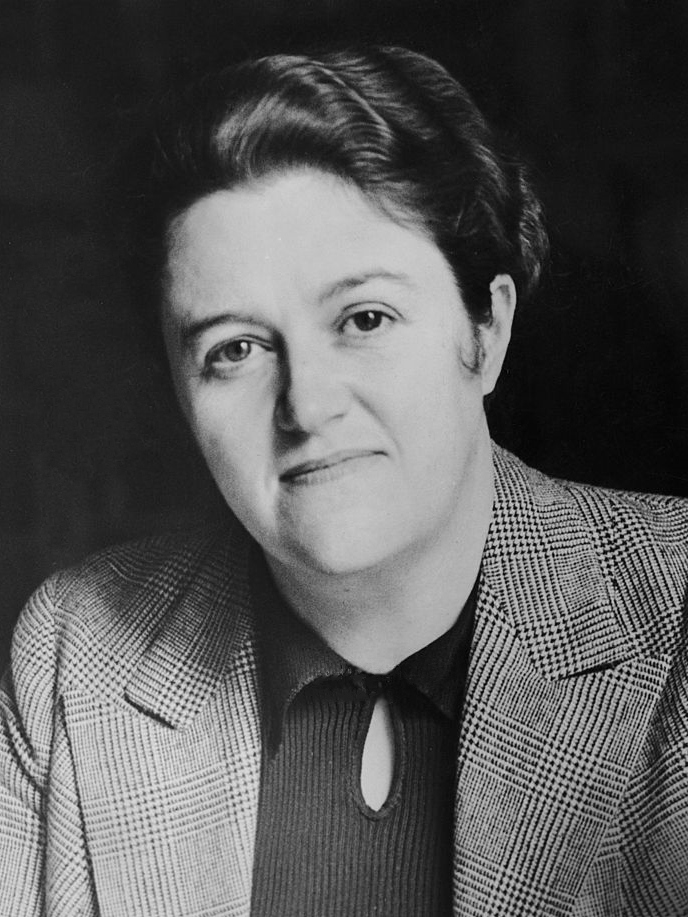
Kate Jennings, then, was quite a woman, and it’s incredibly sad that she died this weekend at the too-young age of 72. Yes, Virginia, 72 is too young.

“one of our essential writers” (David Malouf)

I’m impressed but not surprised that Australian novelist, David Malouf, described her as “one of our essential writers” in The Sydney Morning Herald’s announcement of her death. What does “essential” mean? I don’t know what Malouf means by this, but I agree with him in terms of my own meaning of the word. For me, essential, in this context, encompasses two things. First, it’s that the writer writes about important (though I don’t like this word) or significant or, perhaps even better, critical subjects. An essential writer will address the issues that are central to our being – personal, political and/or societal. But, I sense that Malouf means a little more. Certainly I do, and it’s that an essential writer doesn’t just write about, let us say, the “essential” things, but they confront us with them. They go where others don’t go – in subject matter, or form, or tone, or language, or … I’m sure you know what I mean.

Malouf thinks Jennings filled this bill, and so too, I think, does Maria Tumarkin who appeared in the first Sydney Writers Festival session I attended this weekend. A quick Google search retrieved the 2016 University of Melbourne Handbook (archived version). It includes the description of a course on The Art and Practice of the Personal Essay taught by Maria Tumarkin and Kevin Brophy. The description says “Some essayists we might read: Montaigne, Swift, A.D. Hope, Annie Dillard, Kate Jennings, Joan Didion, David Foster Wallace”. This is quite a list, and it tells us something about Jennings’ stature, and how Tumarkin and Brophy view her.

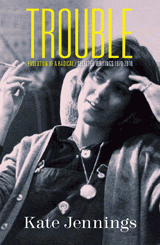
Kate Jennings, Trouble, bookcover

So, in what way was Jennings essential? I’ll start with the above-mentioned speech that brought her to the fore when she was just 22. The women in the Vietnam Moratorium movement had fought (hard) to have one of their number included among the many male speakers scheduled to speak at the march. Here is how Jennings, herself, introduces it in her “fragmented autobiography”, Trouble: Evolution of a radical: Selected writings (1970-2010) (my review).

We persisted, and eventually the organisers gave in. As the most experienced writer in our group, I was given the task of composing the speech, which we decided would be deliberately incendiary. But what I wrote was so incendiary everyone balked at giving it, me included. In the end, with a big shove and no experience of speaking in public, much less in front of a thousand or more, I walked the plank.

The reaction to her speech, she says, was immediate – much of it negative, particularly from the men in the movement – but, she writes

the confrontational language of the speech worked: we could no longer be ignored. Right tactic, right time.

It was essential, in other words. (You can read it here.)

And Jennings continued in that vein, being true and uncompromising to what she believed in. Take, for example, her introduction to the poetry anthology she edited, Mother I’m rooted. She was unapologetic about what drove her choices. She states the problem, then says what she did:

I don’t know any longer what is ‘good’ and what is ‘bad’. I have been trained to know, in a patriarchal university, on a diet of male writers. We have to go back to bedrock, and explore thoroughly that which is female and that which is male, and then perhaps we can approach androgyny, and humanity.

I have chosen the poems mainly on the grounds of women writing directly, and honestly.

(Included in Trouble)

Jane Bullen, reviewing the book in the ANU’s student newspaper Woroni (23 July 1975), picked up this point:

Perhaps it is this that is most striking about the book; the form of the poem is subordinated to the intense desire to say something, to mean something. Sometimes what is said contorts the poem, and the words are clumsy in their attempt to say it. The honesty, the urgent saying of what is meant is expressed (in the flawed structure, the not quite balanced nature of many of these poems. The effect of this is a refusal to compromise, an insistence on meaning in the face of form and a book well worth the time it takes to read it. 

My point is that Jennings saw that this poetry was different, that it may not have met the “received” style, but that it had something to say and she was darned well going to let them say it.

Her own writing broke boundaries. Her novel Snake (1996) takes the autobiographical novel to a different place with its spare style, episodic form, and mixed voice, and her Miles Franklin Award-winning novel Moral hazard (2002) is a work of that rare genre, business fiction. She wrote an essay, “Gutless fiction”, for the Australian Financial Review (26 August 2005), on the necessity for

unflinching works of fiction that engage our public and private selves, our intellect and emotions. More able to inhabit the skins of its characters, fiction can capture the ambiguity and caprice inherent in human behaviour and then give it context and causality in ways that nonfiction rarely can.

(Included in Trouble)

Erik Jensen’s book, On Kate Jennings, in the Writers on writers series, provides tender but honest insight into Jennings. Her life had many troubles. It’s worth reading, but I’m going to conclude by sharing something he tells us Jennings wrote for the back cover of her first poetry collection:

‘Kate Jennings is a feminist. She believes in what Jane Austen recommended at fifteen: “Run mad as often as you chuse; but do not faint.”’

(Jane Austen, Love and freindship)

An essential writer recognising another! Vale Kate Jennings. You gave us much to think about. A true legacy.

Lisa wrote a Vale Kate Jennings post on the weekend, and I have reviewed three of her books.

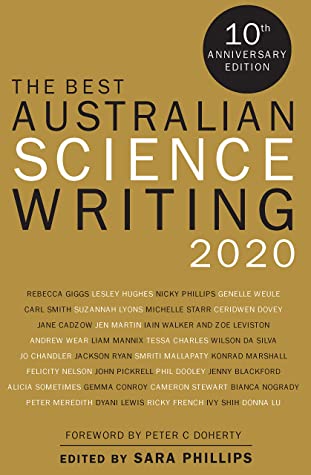
Sara Phillips (ed), The best Australian science writing 2020 (#BookReview)

In 2016, my reading group discussed the 2015 edition of The best Australian science writing. We enjoyed it so much that we decided to do it again, and so this month we read the 2020 (tenth anniversary) edition. Our discussion was as engaged as before (and the overall reasons I enjoyed this volume are the same as those I listed in my post on it, so I won’t repeat them here.)

The publishers invite a different editor each year, and for 2020 it was Sara Phillips, a respected and award-winning science writer herself, with a particular interest in environmental science. The edition opens, however, with a Preface by UNSW Press’s publisher Kathy Bail. She references the annual Bragg UNSW Prize for Science Writing, which was named for the father and son who were Australia’s first Nobel laureates. All shortlisted pieces are included in the anthology. 2020’s winner was Ceridwen Dovey’s fascinating, moving essay, True grit. (Dovey, many of you will know, is also a respected writer of fiction.) The runners up were Ricky French’s Case of the missing frogs and Konrad Marshall’s Jeepers creepersLesley Hughes’ The milk of human genius, Donna Lu’s Stranger thingsand Nicky Phillips’ Bringing home the ancestors, were the other shortlisted articles.

COVID-19?

There is so much I want to share about this volume, but I’m going to start with a quote I used in my 2015 edition post. It came from one of that edition’s Bragg Prize runners-up, Idan Ben-Barak’s Why aren’t we dead yet. This essay provided a wonderfully lucid description of pathogens and the immune system. You can guess why I want to share it again!

And so, an immune system must correctly identify a diverse array of harmful creatures and react to each one in its own special way. Oh, and you know what would be very helpful? If it could remember the pathogens it’s encountered before and store this information on file, somehow, so that it could make short work of them the next time they pop in. And it needs to be prepared for new invaders it’s never encountered before, because life is like that. And it needs to be prepared for completely new invaders nobody has ever encountered before in the history of humankind, because pathogens evolve over time. And it needs to be economical, so the body can keep it operational. And it needs to be fairly unobtrusive, so the body can keep functioning normally. And it needs to do it all very quickly, every time, or the body will be overrun, because pathogens multiply like the devil.

It sure does, as we all now know only too well. However, if you’re expecting pandemic articles to dominate the 2020 edition, you would be wrong, because the edition’s cut-off was March 2020. There are a couple of articles on the topic, but presumably there’ll be more in the 2021 edition. The two in this edition are Liam Mannix’s The perfect virus: two gene tweaks that turned COVID-19 into a killer, which tells us exactly what the title says it will (and in a clear, intelligent way), and Tessa Charles’ Synchrotons on the coronavirus frontline, which describes the importance of synchrotrons to mapping the crystallography of the SARS-CoV-2 protease. Knowing this is critical for the development of drugs/vaccines.

Science and politics

Each edition seems to have threads, which must surely relate to the “zeitgeist”. Introducing the 2015 edition, editor Nogrady wrote that while the 2014 anthology featured several articles “on our changing climate and its repercussions, this year there were an overwhelming number of submissions about our vanishing biodiversity, and what could be or is being done about it”. There were also several articles on robotics and artificial intelligence. Well, five years on, issues like climate change and biodiversity still feature strongly, as Phillips writes in her introduction, but there are some different threads too, as she also identifies, such as the role and importance of description and taxonomy, which, in fact, underpin many of the biodiversity articles. Dyani Lewis’ Identity crisis for the Australian dingo, is an example.

But, Lewis’ article also references something else I detected running through the volume, the close – and sometimes uncomfortable – relationship between science and politics. In the case of the dingo, there are political implications for whether the dingo is classified as its own (native) species (canis dingo) or as a dog (canis familiaris). As a native animal it “could be listed as threatened” if its populations decline, but as a dog “it wouldn’t qualify”. Some scientists accuse others of “bad science”, of forcing the dingo into its own species in order to protect it, when, they believe, the scientific arguments aren’t there for separate classification or taxonomy.

Nicky Phillips’ Bringing home the ancestors discusses the use of DNA to help identify indigenous remains held in museums (and similar institutions) but, she writes, “As a result of the history of mistreatment, some Indigenous people fear that unscrupulous governments or scientists might misuse their genetic information”. To invoke the potential of science or not, that is the question! The following article, The Murray–Darling’s dry mouth, by Jo Chandler, uses the stressed ecology of South Australia’s Coorong to exemplify “the mal-administration, negligence and ignoring catastrophic risks of climate change” that has brought the river-system to the parlous state it is in.

These are just three of many articles which explored the science-politics nexus. I’d love to share them all with you, but, given the year it is, I’ll end this section with an article written before the pandemic but which is so apposite, Felicity Nelson’s Pathogen sovereignty. Nelson explains how such a thing came to be and its implications for scientific research into, yes, pathogens like SARS-CoV-2. “For poorer nations, exercising state power over pathogen samples was quite often their only point of leverage”. Fair enough, as they’d been taken advantage of, but you can see the implications for the quick-sharing of samples so needed during pandemics.

A related thread through the volume concerned the practice, philosophy and funding of scientific research, but I’ll have to leave that, as I do want to get onto …

Inspiring people

It’s not surprising that articles written by journalists for educated-but-lay readers will often hang their information on the stories of inspiring personalities. Bragg Prize winner Ceridwen Dovey did this in True grit, by telling the story of Brian O’Brien, whose inspired idea about gathering and measuring moon dust in the 1960s was overlooked until the 2000s, when, quite serendipitously, his work was noticed by a scientist after NASA realised that it did indeed need to understand moon dust! Jo Chandler tells her above-mentioned Coorong story through the work of ecologist David Paton. He has studied the region for decades, and, though now officially retired, is not giving up, “not least because of his concerns about the capacity of working scientists to conduct deep, unfettered research. ‘You talk, they cut your funding. It’s as simple as that.’”

The inspiring people aren’t all old, however. Cameron Stewart’s Brain wave tells of Vietnamese-Australian inventor, Tan Le, whose work on producing technology that can read brain waves is already providing benefits – to quadriplegics, for example. The potential of this technology is immense, and Tan Le, herself, is astonishing, particularly when you read her trajectory from boat-person to Silicon Valley entrepreneur.

To end …

It’s impossible to do justice to an anthology like this, so, as I did last time, I’m concluding with three quotes that make important points, to my mind anyhow. First is Michelle Starr, who reminds us about the practice and limits of scientific research in The repeating signals from deep space are extremely unlikely to be aliens – here’s why:

‘Wild speculation can sometimes inform the next generation of instrumentation, which can then either confirm or refute the wild hypothesis, or see something else entirely unexpected. And that too is what makes science fun.’ The difficulty lies in understanding the difference between pondering wild ideas as a thought exercise, and evidence based on data and prior experience, observation and conclusions.

Then comes Brian Key from Peter Meredith‘s Underwater and underrated, which is all about fish brains and intelligence:

On the question of animal welfare, Brian emphasises it needn’t be linked specifically to an animal’s ability to feel pain. ‘You can apply human principles to animal welfare,’ he says. ‘Those principles don’t have to be based on scientific evidence; they can be based on the morals and ethics of a society.’

Finally, here is a Moore Foundation grant recipient in Smriti Mallapaty’s For risky research with great potential, dive deep commenting on one of the Foundaton’s sensible research grant conditions:

‘Science has a rich history of not talking about what doesn’t work,’ says Wilhelm, a grant recipient …. ‘By sharing our failures, we have been able to help each other and avoid making the same mistakes over and over again’ … 

Another rich volume, with so much to offer, but I really must end here – or, I’ll be putting you all to sleep.

Challenge logo

Sara Phillips (ed)
The best Australian science writing 2020
Sydney: NewSouth Publishing, 2020
ISBN: 9781742245072 (ebook)

Monday musings on Australian literature: Writing about the war between the wars (2)

Last week’s post focused on attitudes to writing about the war during the interwar period, particularly in relation to the realism of books like Erich Maria Remarque’s All quiet on the western front. This post continues the discussion, but will share some specific war writing from the article that inspired this series.

But first, a reminder of the main concern expressed about the war novels coming out in the late 1920s to early 1930s. L.S. Avery, former Secretary of State for the Dominions, explains it in his statement that the

fashion of “stench warfare” writing would pass, and the war would take its place as the marvellous effort and an amazing romance in which no part was more amazing that that played by the Australians.

He was proposing the toast of “The Commonwealth of Australia” at a dinner at the Royal Society of St. George, London, in May 1930. I can’t resist digressing to a description of the dinner, which:

was reminiscent of old times. The roast beef of Old England was borne around the room, preceded by the crimson cross of St George, and heralded by the roll of drums and the playing of fifes. Only Empire food, including Australian apples, was served.

No wonder they looked to war being presented as a “marvellous effort” and “an amazing romance”, eh?

Recommended war writing

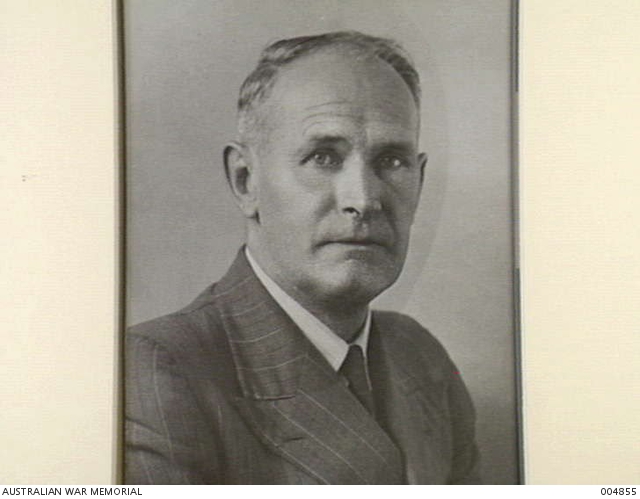
Cyril Longmore, c. 1941. Public Domain; Courtesy Australian War Memorial

Now to Non-com’s article on the “AIF in Literature” in Perth’s The Western Mail (30 April 1936).

Who is this Non-com, I wondered? Some googling took me to the State Library of Western Australia photographic database where I discovered that he was Cyril Longmore (1897-1964), of The Western Mail, which, the photo notes said, preferred to use pseudonyms. Of course, I wanted to find out a bit about Cyril Longmore. More googling found the portrait I’ve used here on the Australian War Memorial (AWM) photographic database. Its notes said he’d been “appointed Military Commentator of the Department of Information” in 1941. At this point, I returned to Trove and found an article in Launceston’s Examiner (21 January 1941) about this appointment. He was to replace one Major Jackson who was returning to military service. The Examiner says that Longmore was recommended by C. E. W. Bean (the respected war historian), and that he had served in “the last war with the 44th Battalion and attained the rank of captain”. Post-war, it says, he “has been actively connected with Australian journalism and has written extensively on military subjects, of which he is a close student”. 

So, not only did I find out who Non-com was, but I also ascertained his credentials for writing the article he did. (Oh, and the AWM also told me that he was The Western Mail‘s editor!)

His article is based on a talk he did for an “Australian Authors” session on the “National station” (by which I presume he means the ABC). Despite his credentials, he commenced by saying that

I speak on the A.I.F. in literature with diffidence, being no authority on the subject, although I have read most of the Australian war books, and my work has led me to make some study of them during the last few years. In this talk I am not touching Dr. Bean’s great historical work on the A.I.F., nor am I mentioning several Australian war novels. I have taken those books produced during the last five years which purport to be the experiences of those who wrote them—men (and a woman) who served in Australian units.

In other words, his focus is not novels but memoirs and the like, but I think they are relevant to our discussion. I’m glad he includes women (albeit “a woman”, parenthetically!) It’s now 1936, but he too references All quiet on the western front, negatively, saying it “seemed to stimulate the imaginations of authors all over the world, for each seemed to try to outwrite the others in his trail of ghastliness”.

Anyhow, here’s his list, in his order:

  • Red dust (1931), by JL Gray, writing as Donald Black: Subtitled “A classic account of Australian Light Horsemen in Palestine during the First World War”, this was apparently written during the war as a diary, and, says Longmore, “is a remarkable description and analysis of the life and deeds of the Australian trooper”.
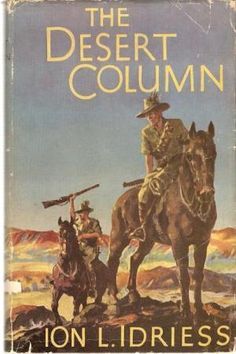
  • The desert column (1932), by Ion L. Idriess: Also a story in diary form of the Lighthorsemen, but at Gallipoli, Sinai and Palestine. Longmore says that “some of his pen-pictures are epics of war realism”. (As realistic as Remarque’s, I wonder?)
  • Hell’s bells and mademoiselles (1932), by Joe Maxwell, VC, who served with the 18th Battalion. Longmore says it is “an enjoyable volume, but there is some fiction woven into its truth, especially about the mademoiselles. The best feature in it is its faithful reproduction of types” that diggers would recognise.
  • Jacka’s mob (1933), by E. J. Rule: Longmore describes it as “a true and vivid picture of experiences with the 14th Battalion, A.I.F., by a man who was intimately associated with everyone and everything of which he wrote. It is no glowing picture of faultless knighthood.” He continues that “Knighthood and chivalry were in every unit in the A.I.F., in all the fighting armies, but even knighthood experienced the chill pangs of “wind-up” at times, and it is in the correct proportions in which the author has presented these and many other of the minor personal details that somehow escape the novelist [my emph!] that makes Jacka’s mob so valuable.”
  • The gallant company (1933), by H.R. Williams: Subtitled “An Australian soldier’s story of 1915-18”, it is praised by Longmore as the “best of all the Australian war books … It is not highbrow literature and there is no forced striving for effect. But it is a faithful, vivid narrative of an Australian unit and of its individuals, with just sufficient historical background to give them their proper atmosphere. A readable book that does justice to the great achievements of the digger and puts “war, wine and women” in proper perspective”.
  • Iron in the fire (1934), by Edgar Morrow: About the author’s experience of the 28th Battalion, Longmore praises it for being “the truest and most comprehensive war book of the lot” in terms of capturing the “inner feelings — sinking in the pit of the stomach before zero; sorrow at the death of a comrade; joy on receipt of a letter, or a parcel, or leave, which we all tried to hide under a mask of unconcern.” It’s “critical”, he says, and “all may not agree with the criticisms of authority, but it is a fine book”.
  • The grey battalion (1933), by Sister May Tilton: The one book by a woman, “the only one of its kind”, this “gives its readers an idea of the great courage and endurance that were needed by these women in their unenviable task of nursing the sick and maimed victims of war back to health and strength”. Interestingly, he notes that “what they suffered themselves no one will ever know”!
  • The fighting cameliers (1934), by Frank Reid. By a member of the A.I.F’s Camel Corps, but Longmore sees it as “the one disappointing Australian war book” because “colour and realism are lacking”.
  • Crosses of sacrifice (1932), by J. C. Waters. Differs from the others because the author is a journalist who was too young to go to war but had “toured the battlefields and war cemeteries of the world”. Longmore says he “brings a reverent and understanding mind to … his subject”. He writes more on this book than on any of the others!

Do you read war histories, diaries or memoirs?

Bill curates: Best Young Australian Novelists

Bill Curates is an occasional series where I delve into Sue’s vast archive, stretching back to May 2009, and choose a post for us to revisit. Today, what I’d like to know is where do all the Best Young Novelists go? Emily Maguire, who’s featured in this post from 2013, wrote one about Gundagai a few years back that was well received (Ok, I criticised some of her truckie stuff), and Romy Ash – I know the name, but where are the others? 

______________________________

My original post titled: Monday musings on Australian literature: Best Young Australian Novelists

Back in May, the Sydney Morning Herald (SMH) announced its Best Young Australian Novelists awards. They have been doing this for 17 years, though I only became aware of them a few years ago. They are usually announced at or to coincide with the Sydney Writers Festival.

The judges this year were Marc McEvoy, SMH Literary Editor Susan Wyndham, and Melbourne author Kristin Krauth whom I’ve only become aware of through the Australian Women Writers Challenge. To be eligible, writers have to be “35 years or younger when their book is published”. So, the award is called “Best Young Australian Novelists” but it is apparently granted on the basis of a specific book.

Zane Lovitt, Midnight Promise

This year’s winners are:

  • Romy Ash whose Floundering was short-listed for this year’s Stella Prize, Dobbie Literary Award, and Miles Franklin Literary Award, among others. An impressive achievement for her debut novel. She has also written short stories, and I’ve read one, “Damming”, which was published in Griffith Review Edition 39. I have not, though, read Floundering. It apparently explores “the menace of a hostile landscape”. I’m fascinated by the fact that the outback continues to be a significant presence or theme in Australian literature. Ash argues that while writing about the outback may seem a cliche, the point is that much of Australia is “not benign”. That surely is the point, and is what makes it so rich with dramatic possibility.
  • Paul D Carter for Eleven Seasons which won the 2012 Vogel Literary Award and was shortlisted for the UTS Glenda Adams Award for New Writing in the 2013 New South Wales Premier’s Literary Awards. The novel is apparently about “boys obsessed with football and the men who live by its rules”. Sounds like one that would be interesting ro read in the context of Anna Krien’s Night Games which I reviewed last month. Interestingly Carter’s day-job is teaching English in a Melbourne girls’ school.
  • Zane Lovitt whose Midnight promise I have – woo hoo – read and reviewed here. It’s more a collection of interconnected short stories, but there is a loose narrative thread running through it following the career of its  private detective protagonist.
  • Emily Maguire for Fishing for tigers. Maguire, unlike most of the winners, has quite a few books, including three other novels, to her name, and has won the Best Young Australian Novelist award before. She teaches creative writing, and it sounds like she’s well qualified to do so, doesn’t it? Fishing with tigers was inspired by Grahame Greene’s The quiet American, and is about “divorcee Mischa Reeve, 35, whose affair with Vietnamese-Australian Cal, 18, upsets her friends, including Cal’s father, Matthew”.
  • Ruby J. Murray whose Running dogs was, like Carter’s Eleven seasons, also shortlisted for the UTS Glenda Adams Award for New Writing in the 2013 New South Wales Premier’s Literary Awards. I hadn’t heard of Murray, I must admit, but this book sounds interesting. It’s set in Indonesia, which is a significant country for Australia, and like Maguire’s Vietnam-located Fishing for tigers, it is about an expat Australian aid worker. Murray, who worked in Indonesia in 2009, was horrified at how little Australians knew (know!) about Indonesia despite its importance to us economically and politically, not to mention being a major holiday destination for Australians.
  • Majok Tulba for Beneath the darkening sky. It, like Maguire and Murray’s books, is set outside Australia, in this case, in Sudan. And, like Romy Ash’s Floundering, it was shortlisted for the Commonwealth Book Prize. It’s narrated by an 11-year-old village boy and is “about child soldiers in Africa”. It’s fiction. Tulba says he used some experiences he and his brother had, but he was not himself a child soldier. Apparently Sudanese rebels tried to recruit him but he “failed the test – he was shorter than an AK-47 assault rifle“! Lucky him, eh?

They sound like an interesting bunch of authors and books, don’t they? And, I’m rather intrigued that half of them are not set in Australia, which reflects our increasingly multicultural society. It’s good to see our literature recognising this.In 2012, only three awards were made – Melanie Joosten for Berlin Syndrome, Jennifer Mills for Gone (which is waiting patiently in my shelves to be read), and Rohan Wilson for The Roving Party. Past winners have included Nam Le, Christos Tsiolkas, Chloe Hooper and Markus Zusak.

___________________________

Bill is right about Emily Maguire. In fact I have read and reviewed the book he mentions, An isolated incident (my review), as has Bill (his review) as you might have guessed from his comment. Moreover, she has a new book coming out this year, Love objects. I also wrote a second post about this award in 2020. But now, over to you …

Have you read any of these authors? If so, we’d love to hear what you’ve read and think.

Stella Prize 2021 Winner announced

Unfortunately – though not really – I was not able to “attend” the online announcement as I did last year, as I’m spending a few days in the Snowy Mountains with Mr Gums and two friends.

Before I announce the winner, which most of you will have heard by now anyhow, here is a quick recap:

  • the longlist was announced on 4 March; and
  • the shortlist was announced on 25 March: Rebecca Giggs’ Fathoms: The world in the whale (non-fiction); SL Lim’s Revenge (fiction); Laura Jean McKay’s The animals in that country (fiction); Louise Milligan’s Witness (non-fiction); Mirandi Riwoe’s Stone sky gold mountain (fiction); Evie Wyld’s The bass rock (fiction)

And the winner, from 160 entries, is British-Australian author Evie Wyld’s The bass rock. Jaclyn Booth, Stella Prize’s Executive Director, called it “a gripping novel that is unlike anything I’ve read before”, and judging panel chair, Zoya Patel, says that it “forces the reader to think and engage with the unique narrative structure, but in a way that feels effortless, so engaged are you by the story.” It deals with the legacy, and trauma, of male violence, so is very much a “zeitgeist book”, which is to say, it’s relevant to our times. I must read it, as I have the previous fiction winners …

It is the fifth work of fiction to win in nine years. The previous four were Heather Rose’s The museum of modern love (2017, my review), Charlotte Wood’s The natural way of things (2016, my review), Emily Bitto’s The strays (2015, my review), and Carrie Tiffany’s Mateship with birds (2013, my review).

You can read more about the book on the Stella website.

The winner receives $50,000, and each long and shortlisted author also receive monetary prizes.

If you have any comments on the winner, please share them with us.

Monday musings on Australian literature: Writing about the war between the wars

By accident, really, I came across an article from the 1930s in Trove about war novels. However, with Anzac Day coming up here in Australia next weekend, it seemed apposite to follow up. So, I did – and was somewhat surprised by what I found.

Not surprisingly, World War 1 was still fresh in people’s minds in the 1930s, and there were many opinions on how war should be written about. Erich Maria Remarque’s now classic All quiet on the Western Front was particularly controversial at the time and discussions about it provide some insight into those opinions. First published in 1928, it appeared in English in 1929 (translated, in fact, by an Australian, Arthur Wesley Wheen, himself a World War 1 soldier.)

“the most graphic picture I have had of the war” (Woman reader)

All quiet on the Western Front was a big hit, particularly with women readers. An article in the Port Adelaide News (14 March 1930) reports that “the popularity of the war novel is still maintained in England, where every girl typist seems to have read All quiet“. Apparently one Council Library system had bought a record number of 126 copies of the book, but they had 553 people on their waiting list. Unfortunately, the article said, “borrowers, strong in that possession which is nine ‘points of the law are lending All quiet to relatives and friends before returning it”. (Love it!)

Here in Australia All quiet was also popular with women, as The Herald (14 February 1930) reported in its article, “VC attacks war novels”. Captain W.D. Joynt V.C., speaking at a Legacy Club luncheon, denounced “recent war books” including All quiet. At the luncheon, Captain Peters, of booksellers, Robertson and Mullen’s, said that women “had been the largest buyers and readers of the book”. It had “achieved such success that it was affecting the sale of wholesome [my emph] English novels”. He continued that the boom of interest in war novels “had brought out some good war books, but not many, and unless the protest was made the women and young people would get a wrong impression of the soldiers”. A motion had been put “to deplore” such books, but it failed, not because attendees disagreed but because they feared the motion would increase interest in the book!

So, what was the problem? Wikipedia summarises the controversies in its article, but I’ll share some of what I found in Australian newspapers. The main concern seemed to be that its presentation of war denigrated the heroism of the soldiers. It had too much “muck”. One speaker at the luncheon said that “the book showed contempt for the men who served at the war, and brought grief to dependents of men who fell at the war” while another said that the phrase “give ’em muck” was applicable to the book. He said he had “read one or two chapters and refused to go further. It is full of Continental grossness. The coarse language is superfluous. This type of book should be banned.”

Interesting that women were reading this “muck”.

The writer in Freeman’s Journal (10 April 1930) comments on the new fashion for war novels, saying that for some time people had had their fill of war news but

Now it has come into its own again, and, perhaps under the influence of the peace movement, it concentrates on the most repulsive aspect of war, sometimes deliberately trucking to the appetite of so many readers for word-pictures of the evil aspects’ of human life. Many of these novels are as wide of the truth and as repulsive as Zola’s La Debacle, which professed to give a realist picture of the war of 1870, but was a horrible libel on the people of France, representing her young soldiers as mostly imbecile fools or blackguards. 

He goes on to describe another novel – not Remarque’s – that has, as its central figure, an utterly incapable Anglican chaplain. He says:

It was by self-sacrifice and earnest efforts to be helpful that they [Anglican and Non-conformist chaplains] won the respect of the men. It is an insult to their memory to write of them as this novelist does, as if they were either hopeless failures or self-seeking idlers.

Similarly, the Singleton Argus (28 April 1930) reports on one Rev. C. J. Macaulay, who was the principal speaker at the West Maitland Anzac Day service. Macauley made “a scathing attack … on salacious war novels”. He doesn’t name any, but said they “paint vile pictures, not so much of war, as of the men themselves”.

Interesting that women were apparently reading these “vile pictures”.

Were women seeing something different? Were women, like Lady Kitty’s woman reader, appreciative of “the grim reality” that its opponents wanted to hide? Lady Kitty writes that “it is remarkable what a vogue war novels are having now, especially among women. The type of immediate postwar sentimental romance has given way to simple narratives which reveal the common soldier’s point of view.”

Writing about war

JP McKinney, Crucible

Meanwhile, in 1934, Australia’s RSL instituted a war novel competition. It was “open to all men and women who served abroad during the war as members of the Australian army, navy or nursing services”. The novel had to “depict the life of an Australian soldier during the war, and his reactions to the various conditions and environment through which he passed. The sequence of the story and descriptive matter must be historically and geographically correct”. It was won by JP McKinney (who, alert readers among you may know, was Judith Wright’s husband, though much later.) His novel was published as The crucible, in 1935.

During my research, I came across a letter to the editor written by McKinney concerning his novel, and writing about war. He was responding to reviewers who seemed to criticise his novel for being “largely recollections cast in the form of fiction” or “more or less autobiographical”. (Helen Garner knows the feeling!) McKinney wanted to correct these misconceptions. He writes:

A writer of fiction is permitted, by the canons of his art, to draw for his material upon both his own and other peoples’ experience and upon his imagination, the only demand made of him being, if his work is to be judged as literature, that he keep within the bounds of probability. His accepted function is to illuminate life— or at least that aspect of it which he treats —from all angles. The greater the fidelity to life and actuality the greater his achievement. 

But, he says, people seem to see war fiction differently:

In the case of the war novelist, however, it appears to have become unconsciously assumed that he shall write only of what he knows from his own actual, personal experience; and he is either denied, or assumed not to have availed himself of, the privilege of his fellow craftsmen of ranging into the realm of what may be called created fact. 

So, he writes, “I granted myself the fiction writer’s full privilege, the only restriction I placed upon myself being that I make no sacrifice of truth to dramatic effect”. The characters are all created he said; they’re “types” not “persons”.

J.P. McKinney did go to war, but, some readers here may be interested to hear the words of T.C. Squire, editor of London Mercury (reported in Tasmania’s Advocate, 10 January 1930). He was critical of the current crop of war novels, like Remarque’s, suggesting that they came out of “hysteria” rather than from thinking, compassionate, “religious” men. He concluded his comments with

And it may be that the novel of this war (there is precedent for it) may come from some Tolstoi or Hardy of the future, who never saw a bullet fired and never looked in the face of the unnecessary dead.

And here, I’ll conclude with Henry Savage from The Port Adelaide Gazette (10 January 1930). He was, I think, a local businessman and religious official. He wrote about war novels:

There is a great difference between the horrors of war and reading of its horrors; between reality, that is to say, and the interpretation of reality in terms of art. Will the story of Eden ever stop simple Adam from being lured to his hurt by curious Eve? Will Hamlet make a man of action out of a dreamer and give him faith and resoluteness? Can it be done?

Ignoring Adam-and-Eve, I pass his question on to you!

Arthur Gask, The passion years (#Review, #1936Club)

A couple of weeks ago, I posted a Monday Musings in support of Karen (Kaggsy’s Bookish Rambling) and Simon (Stuck in a Book) #1936 Club, which involves participants reading, posting and sharing books from the chosen year.The #1936 Club has been running, 12-18 April, which means it is about to finish.

In my post I listed a number of potential books for me – or others – to read (and noted those from the year that I’ve read in the past.) Unfortunately, I did not find the ones I wanted to read, so I decided to do something different, read a short story! The first short story I considered was Ernest Hemingway’s The snows of Kilimanjaro, which was first published in Esquire in 1936, but, I really wanted to do an Australian story – so, back to the drawing board. And, at Project Gutenberg Australia I found a short story published on Boxing Day (26 December) 1936 in, wait for it, The Australian Women’s Weekly! Nothing ventured, nothing gained I thought so in I dived. It’s called of course, “The passion years”.

Published in a women’s magazine on Boxing Day, it is, as you would guess, a romance. It’s past midnight and two women – “all pink and white in their robes-de-nuit” and looking “pretty enough to eat” – are chatting, one of them telling the other about her brother’s romance:

It seems just like a tale one reads and, of course, it’s a very sentimental one, too. Oh, no dear, you take it from me sentiment is not all sickly, and only those say it is who are getting old and sickly themselves. Sentiment’s the most beautiful thing in all the world, and when you’re first in love, well, the sentiment there is just too holy and too sacred to understand.

As the story goes, her brother had lost all his money in a horse race and at the same time a wealthy young woman falls for him, but, being a proud and responsible man, he withdraws when he realises she is showing interest in him because he doesn’t want to be a fortune hunter. You can guess how it works out, but what adds to the story is the perspective and world view offered by the narrator. Our teller asserts that “a baby’s only what every girl who’s really in love looks forward to”. The story is very much of its time and place, highly gendered, but it is nicely written.

However, of more interest is the writer, Arthur Gask. The Australian dictionary of biography (ADB) describes him as a dentist and novelist. Born in England in 1869, he came to Adelaide, Australia, with his second wife, in 1920. He was particularly a crime writer, and was prolific as Wikipedia and the Project Gutenberg Australia show. His first novel, The secret of the sandhills, was published to immediate success in 1921, partly he believes due to the reviews by S. Talbot Smith. Wikipedia says he wrote it while waiting for his patients!

Gask went on to write over thirty books, as well as countless short stories. He gave up dentistry in 1933, and bought a farming property, which he names Gilrose, after his detective, Gilbert Larose. However, apparently most of his stories were set in England. ADB’s Michael Tolley described his writing as pacy and sometimes titillating, and says that his works were translated into several European languages, were serialised in newspapers, and broadcast on radio.

For interest, I tracked down a local review of his posthumously published novel, Crime upon crime. The review was written by AR McElwain in Adelaide’s The Mail on 4 October 1952. I was interested in his comment on the writing

Prolific Mr. Arthur Gask of Adelaide (SA) has a remarkable facility for blending sordid crime with old world charm So much so that I am usually more fascinated by his prose style than by the actual cases …

He also provides insight into Gask’s detective:

Our old friend, Gilbert Larose introduces some unorthodox sleuthing. But there’s a Gaskian explanation for it all, never fear. Larose is simply “acting up to his reputation as a man who always places justice above law.”

McElwain’s comment on Gask’s writing points to why he most drew my attention. His writing was also admired by novelist, HG Wells, who called Gask’s 1939 novel, The vengeance of Larose as his “best piece of story-telling…It kept me up till half-past one.” In addition, philosopher Bertrand Russell also loved his books. Russell corresponded with Gask, and visited him in Adelaide in 1950, when Gask was 81 and Russell 78.

According to Wikipedia, Gask was still writing two 80,000-word novels a year when he was nearly 80. Prolific indeed.

So, my contribution to the #1936club is small, but I’m thrilled to have finally taken part and to have discovered another Aussie writer.

Did you take part in the 1936 Club?

Trevor Shearston, Hare’s fur (#BookReview)

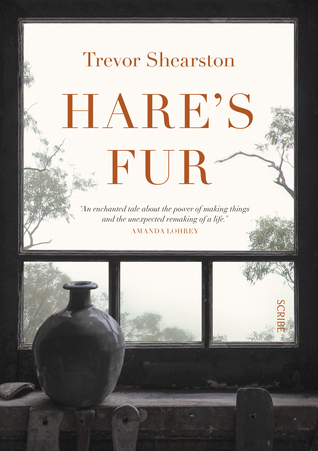
While I want to, I often don’t manage to follow up books recommended by Lisa but Trevor Shearston’s Hare’s fur particularly caught my attention. He was an Australian author I didn’t know; the novel is set in the Blue Mountains; and the protagonist is a potter, which sounded intriguing. So, I bought it – over a year ago, in fact, when I had a bookshop gift voucher to spend – but have only just managed to squeeze it into my schedule.

It’s a lovely read. However, I was surprised to discover that Shearston has published several novels, and a short story collection. His 2013 novel Game, about bushranger Ben Hall, was longlisted for the Miles Franklin Award, and shortlisted for the Christina Stead and Colin Roderick awards. Hare’s fur is quite a different book – at least, ostensibly, as I haven’t read Game to know its style or underlying concerns!

So, Hare’s fur. It tells the story of Russell Bass, a recently widowed 70-something potter living in the beautiful Blackheath area of the Blue Mountains. Unlike his potter son-in-law, Hugh, Russell sources the rock for his glazes in the canyons below his home. On one of his forays – to a remote creek that he thinks only he visits – he hears voices, and, on further investigation, discovers three children living in a cave, teen Jade who is looking after her younger sister Emma and little brother Todd. They are, he discovers, hiding from child welfare (DoCS) and the police. What would you do? The novel – novella, really, I’d say – tells the story of the relationship that develops between these four, and how Russell navigates this tricky human, legal and moral territory.

Now, before I go further, I was interested to see in Trevor Shearston’s GoodReads author page a book called The impact of society on the child: Proceedings of the inaugural annual meeting. I can’t find what his role was. It doesn’t seem he was editor or assistant editor, but, assuming he was involved, it suggests a formal interest in children’s well-being. Certainly, that is the essential theme of this novel. It’s about deciding what’s responsible and being generous, in the face of justifiable fear and lack of trust.

From Govett’s Leap, Blackheath

What’s lovely about this novel is that the adults involved – not just Russell, but, peripherally, his daughter and son-in-law who live 30-minutes walk away, and his neighbour – are open to solving this problem. They recognise the very real risks and challenges of Russell’s desire to protect the children, but they don’t resort to black-and-white solutions. I will leave what happens there, because one of the joys of the novel is following the various characters’ decisions and actions as they navigate this tricky situation.

Other joys of the novel include the writing, and particularly the descriptions of the landscape. Here is part of Russell’s walk down to his creek:

Tea-tree and lomandra had grown across the opening of the abandoned lookout. He pushed through the clumps of blades to the apron of lichened concrete and found the faint pad that only his feet maintained, skirting to the right of the platform through wind-sculpted casuarinas and hakea and more tea-tree to the cliff edge. There he stopped and removed his beanie and took the sun on his face and scalp. It was the last direct sunlight he would know until he stood again on this spot. …

He describes the birds and flowers, the colours and the misty coldness of the mountains, so beautifully.

The characterisation is good too. Told third person but from Russell’s perspective, we are privy to the feelings of this man who is still grieving his wife but is getting on with it. His daughter and son-in-law, and his neighbour, invite him over for dinner or drop meals on his doorstep, but he’s not helpless. He’s sad and a bit lonely, but he has his work. His relationship with the children is gentle, thoughtful and respectful. His response to Jade is wise,

She lacks education, he told himself, not intelligence. Don’t talk down to her.

Then there’s the title – hare’s fur. Hands up, if you know what it means? I didn’t, but it’s a special kind of brown glaze. Jade asks him how he turns the rocks into glaze. He tells her

… when it’s heated to a high enough temperature it’ll melt again. And, having lots of iron in it, that gives a black glaze. If I’m lucky, with streaks of dark blue, or red, or sometimes little brown flecks that look like animal fur.

One of Russell’s most treasured possessions is a valuable, 900-year-old hare’s fur tea bowl bequeathed him by a collector. Why the novel is titled for this is not obvious, but presumably part of it relates to the fact that this glaze is precious and rare, and needs to be nurtured like the children he has found. There’s a point where he shows Jade this bowl and lets her hold it. He tells her she can go look at it in his room any time, but asks her not to pick it up. Trusting her like this, with an object precious to him, is significant – but not laboured in the novel.

Hare’s fur is a positive book about the importance of trust and respect, and of being open to others. It’s also about how lives can be remade. Russell is as lucky as the children that they found each other.

Trevor Shearston
Hare’s fur
Melbourne: Scribe, 2019
194pp.
ISBN: 9781925713473

Monday musings on Australian literature: Forgotten writers 1, Helen Simpson

Do you often wonder how many of the writers we love now will still be read a few decades on? How good are we at identifying those who will continue to be read? So-so, I think you’ll agree if you’ve noticed the many unfamiliar, but well-regarded-at-the time, names amongst the authors mentioned in my various historical posts. It is this that has inspired me to start a new, occasional, Monday Musings sub-series on forgotten Australian writers.

Helen de Guerry Simpson, ca 1935, photographer unknown. (Public Domain, via Wikipedia)

First up, I’ve chosen an interesting one because of her complex relationship with Australia. She’s Helen Simpson, or, more fully, Helen de Guerry Simpson, who was born in Sydney, Australia, in 1897 and died in Worcestershire, England, in 1940.

I’ll start with a brief bio. Simpson was born in Australia and lived here until 1914, when, at 16 years old, she went to England to join her mother who had separated from Simpson’s father several years previously. After that, Simpson spent very little time in Australia, as far as I can tell from the Australian Dictionary of Biography. She returned in 1921 for her brother’s wedding, but was back in England by February 1924. She was in Australia again briefly in 1927, but was back in England that year, as she married there in 1927. Her husband was Australian-born Denis Browne, interesting to us because his uncle was Thomas Alexander Browne (aka Rolf Boldrewood). However, he was significant in his own right as the Father of Pediatric Surgery. Simpson came back to Australia in 1937, to give a series of lectures for the ABC, but was gone again by 1938. Sadly, she died of cancer in 1940.

So, she was Australian, even though Arnold Haskell wrote in 1944 that Katharine Susannah Prichard, Helen Simpson and Henry Handel Richardson “are so well known in England that they are accepted as English writers”! Colin Roderick included her in his 1947 book Twenty Australian novelists, and Zora Cross includes Simpson in her list of writers who started here but then moved abroad.

Starting here is a bit of a moot point. The ADB says that she published several short plays and founded the Oxford Women’s Dramatic Society before her 1921 Australian visit. However, in 1921, Angus and Robertson did publish her Philosophies in little, “a collection of her own verse with her translations from French, Italian and Spanish”. In 1922, ADB also says, she entered a play about Benvenuto Cellini, A man of his time, in the Daily Telegraph literary competition. It was staged the next year by Australian theatrical producer Gregan McMahon. ADB says he only produced four Australian plays between 1920 and 1927, so that’s surely a feather in her cap.

Novels

Simpson wrote 13 novels between 1925 (Acquittal) and 1940 (Maid no more). A few were collaborative works, including a couple of detective novels written with Clémence Dane. She also wrote verse, plays, short stories and non-fiction works.

The Oxford companion to Australian literature (2nd ed.) devotes almost a full column to her. It says that two of her novels had Australian content – Boomerang (1932) and Under Capricorn (1937) – and that her “trio of fantastic novellas”, The woman on the beast (1933), includes one set in Australia in 1999! (Links are to Project Gutenberg Australia.) Two of her novels, one being Under Capricorn, were filmed by Alfred Hitchcock.

So, how good was her writing? Let’s start with Miles Franklin who mentions her in her diaries. She writes in August 1936:

Helen Simpson: one of the giants. Perhaps she would have wiped Brent [of Bin Bin, or Miles herself] out of his field had she not relinquished it. The lively vitality and inherent understanding of the Australian scene in Boomerang show what we lost, what England has gained. Again, in the third division of The woman on the beast in a sketchy, impressionistic effort, she indicates what she could have done to take Australia by the back of the collar and shake her to a sense of her asininity, her pathetic enslavement to an old sectarian controversy–a worse importation than the foxes and other noxious weeds. But H.S. left her country for her own great literary success.

Australian writer Coralie Clarke Rees, in an extensive article in The Sydney Morning Herald (1 June 1937), agrees, calling this “third division”

an imaginative “tour de force,” showing Australia, as the last stronghold of the old order of religion and politics, being invaded by a woman evangelist of the new totalitarian order, whose character seems an ingenious compound of that of Aimee Semple MacPherson and Mary Baker Eddy.

However, Miles Franklin later (around March 1940) modified her view of Boomerang, noting its “melodrama and disjointedness”, and Katharine Susannah Prichard, writing to Miles Franklin on 1 July 1932, says that

HM Green [see my recent Monday Musings post], of Sydney, writing to me the other day, said he liked it [Back to Bool-Bool] much better than Boomerang

Now, here I’m going to share the opening of Boomerang, which won the 1932 James Tait Black Memorial Prize:

Life can afford extravagance, books cannot; for this reason nobody will dream of believing in my two grandfathers. They are too true to be good–good fiction, at any rate; if I try to give some kind of picture of them, it is because they frame between them a vision of a golden age, which could only have existed in brand-new countries, among brand-new circumstances and laws. It was not a golden age for everybody, wives or servants for instance, but for these two it was; they were, to use a word which is almost dead, characters.

I am sorry to think what would happen to these two old gentlemen if they had the misfortune to live now; it would be something legal, that is certain, falling heavily to crush their magnificent egotism and eccentricity. Their wives, who in the ‘seventies put up with them with the uncomprehending patience accorded by Insurance Companies to Acts of God, would nowadays divorce them. Servants would bring, and win, actions against them for assault. As for their families, these would scatter immediately after the first row or two, and go forth to earn their livings with all the horrid freedom that the post-war period accords …

I love this cheeky tone, and her reference here (and in the Foreword) to the fact that fiction cannot be as “extravagant” as life! The Oxford companion says that Boomerang and Under Capricorn “have involved, highly coloured plots, lightly sketched but credible characters, and a lively, humorous and sophisticated narrative style”. This, in fact, summarises what I found in Trove.

So, for example, The Sydney Morning Herald reviewing (16 February 1932) Boomerang describes its rather wild episodic plot and thinks its characters are not particularly well-drawn, but argues that:

It can safely be said that no Australian novelist for many years has provided such an exciting tale, or handled separate scenes and episodes with such liveliness and wit.

I particularly enjoyed respected academic of the time T. Inglis Moore who wrote that:

it is in the romances, Boomerang and The woman on the beast in particular, that Helen Simpson has found her metier. In them she stands out amongst Australian writers as a witty romantic, a teller of vivid tales spiced with satire, tinged with wit.

His article (linked on his name above) in the Sydney Morning Herald (7 August 1937) offers a thoughtful, even-handed analysis of her, and is well worth reading. He recognises that she can be “romantically theatrical, artificial, escapist”, but, assessing her place in Australian literature, he says:

Amongst the contemporary novel-writers one stands supreme. No other Australian comes within cooee of Henry Handel Richardson. Then comes, well, Katharine Prichard, shall we say, along with Brent of Bin Bin? And here, somewhere, must come Helen Simpson.

He concludes with:

Taking her all in all, she is perhaps the most “intelligent” of contemporary Australian novelists in the sophisticated sense, and, along with Christina Stead, the wittiest.

This is strong praise. So what happened? Where did she go? Was her style not strong enough overall to overcome her plots and characters? Or, is it just a matter of fashion? Whatever, I have greatly enjoyed reading about this woman, and may very well share a bit more about her in the future because she was quite a character.

Printed sources

Brunton, Paul (ed.) The diaries of Miles Franklin (2004)

Ferrier, Carole (ed.) As good as a yarn with you (1992)

The Oxford companion to Australian literature, 2nd ed. (1994)