The literary world is replete with works published posthumously. Jane Austen had two completed works published after she died, but there are many many others including Kafka, Tolkien and more recent giants like David Foster Wallace. In some cases, the writer had finished the work but time or some other reason resulted in its not being published in their lifetime. Austen’s two works are good examples. Northanger Abbey had been sold in 1803 to a publisher who never published it. It was bought back in 1816, and Austen worked further on it that year. Persuasion was completed that same year, which was the year of her death. Both were published months after her death through her brother. In other cases, as we discussed in last week’s post on unfinished works, writers specify that they don’t want their work published. Presumably, there are also cases where we just don’t know the creator’s thoughts.
In 2018, The Conversation published an article on the ethics of posthumous publication, but, while it identifies ethical issues in relation to various authors, like Philip Larkin and WH Auden, it doesn’t fully grapple with them. It does, however, note that Auden’s literary executor, Edward Mendelson has written separately about his ethical dilemmas with regard to Auden’s wishes. For anyone interested in some stories, the article is worth checking out. The main point is that, as we discovered with Patrick White, it is most often the literary executor’s job to resolve the issue – and it isn’t easy.
This post shares a few examples of Australian posthumously published (mostly finished) works.
Across the ditch
Having said that, however, I’m going to start with New Zealand which is, after all, Antipodean, so close! (For those not in the know, “the ditch” refers to the Tasman Sea that separates Australia and New Zealand.)

My first example is the wonderful Janet Frame, and an interesting discussion on ABC RN’s The Book Show in 2008 about posthumous publication of Frame’s work. Presenter Ramona Koval discusses the posthumous release of literary works with Frame’s niece Pamela Gordon, chair of a charitable trust set up by Frame to manage her literary estate. Gordon said that she wished there’d been a “literary executor for dummies” guide to help her. Her job was facilitated by the fact that Frame believed in posthumous publishing, seeing it as “dignified”. Some of her works were not published in her lifetime for personal reasons. Frame also destroyed a lot of work that she felt was not up to being published. She also clearly indicated which poems she felt were finished. Frame wanted her poems published, and the first collection published after her death, The goose bath, was awarded New Zealand’s top poetry prize in 2007. Her 1963 novel, Towards another summer, and a 1974 novel, In the memorial room (Lisa’s review) have also been published, with, apparently, her prior approval.
My second example is an earlier, great New Zealand writer, Katherine Mansfield. She died suddenly in 1923, at the age of 34, of a pulmonary haemorrhage, leaving behind much unpublished work. Her husband, John Middleton Murry edited and published two short story collections, a volume of poems, a novella titled The aloe, and other collected writings. I’m guessing that dying so suddenly so young, she left no instructions and that we rely on her husband “knowing” her wishes.
My side of the ditch
I’ve written before about Patrick White’s literary executor, Barbara Mobbs, and her difficult decision to allow publication of White’s unfinished novel, The hanging garden. Literary executors have a challenging task, of which publishing unpublished works – my focus here – is only one aspect.
Many books, we are confident, were competed by their authors in the expectation of publication. Examples include my teenage favourite Nevil Shute’s Trustee from the tool room (1960); Morris West’s all but finalised The last confession (2000); Jacob Rosenberg’s The hollow tree (2009); Dorothy Porter’s poetry collection The bee hut (my review) and essay On passion (my review); Bryce Courtenay’s Jack of Diamonds (2012); Georgia Blain’s non-fiction The museum of words (2017); and Andrew McGahan’s The rich man’s house (2021). All were published within a year or two of their author’s death.

A different example, and one that may have better suited last week’s post, is Christina Stead’s I’m dying laughing, published in 1986. Wikipedia says that she worked on it on and off over decades between other works. One chapter, titled “UNO 1945”, was published in Southerly in 1962. A few years later, her New York agent wanted certain revisions, as did her British publisher. It appears that comments from an American friend about her handling of Hollywood radicals set off a long process of revision that she came to regret. The final book was put together by her literary executor, Ron Geering who says in the preface:
“What I inherited…was a huge mass of typescript ranging in finish from rough to polished and in length from page bits to different versions of whole chapters, along with piles of basic and supplementary material.”
There’s no suggestion here that Stead did not want it published.
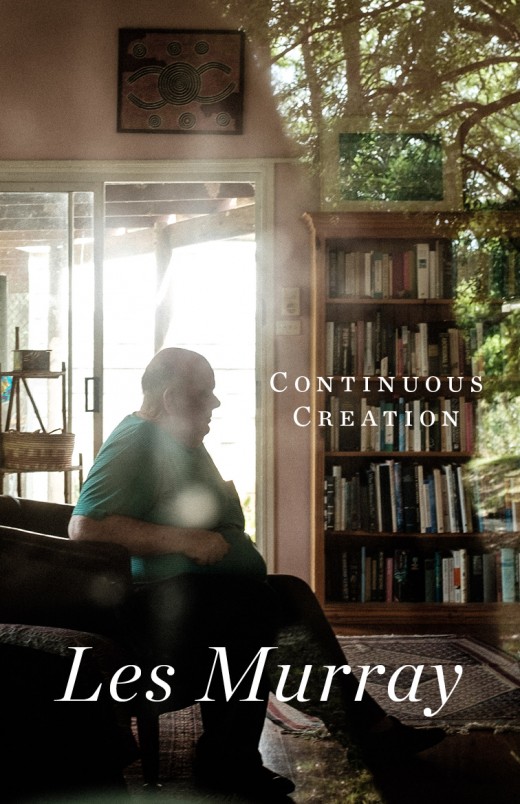
My last example is a book due for release next month, March 2022. It’s Continuous creation, a posthumous collection of poems by Les Murray. Publisher Black Inc says that the volume comprises “poems he was working on up to his death, as well as work uncovered from his scrapbooks and files”. Given his wife survived him, I assume she supports this publication.
Black Inc’s promotion for this book references the title poem, which, they write, calls up ‘the spirit of continuous creation, “out of all that vanishes and all that will outlast us”’.
“All that will outlast us”! Can’t think of a better conclusion for a post on posthumous publication.
Are you aware of reading posthumously published books, and does it make a difference to your reading experience?







 Whispering Gums