I have written on and reviewed novellas almost since this blog started, because I love the form. Last year, for Novellas in November (run by Cathy of 746 Books and Rebecca of Bookish Beck), I wrote a Monday Musings on Supporting Novellas (here in Australia). This year, I thought I’d address the meme’s first week’s theme, which is Classic Novellas. I am also going to dedicate this post to Brona’s AusReadingMonth, because I know she loves a good novella too!
I love Bookish Beck’s introduction to novellas, in which she quotes American author Joe Hill‘s description of novellas as being “all killer, no filler”. This beautifully captures why I love great novellas – they cut to the chase. This is not to say that longer books can’t also cut to the chase. Of course they can, but novellas often get a bad press because, you know, they are over before you’ve started, they don’t offer value for money in terms of how much you pay per page, etc etc. None of these anti-novella reasons cut it with me, though, because for me writing is all about the punch (broadly speaking) – and you can get that in a short story, a novella, or a full-length novel.
Wikipedia’s article on the novella provides a useful introduction to the form. Do read it if you are interested, but I thought I’d share just one quote from it, because it expands on Hill. The quote comes from Robert Silverberg‘s introduction to the novella anthology, Sailing to Byzantium. He writes that the novella
is one of the richest and most rewarding of literary forms…it allows for more extended development of theme and character than does the short story, without making the elaborate structural demands of the full-length book. Thus it provides an intense, detailed exploration of its subject, providing to some degree both the concentrated focus of the short story and the broad scope of the novel.
I have discussed the definition of novellas before, and you can read more in Wikipedia, so am not going to go there again, except very broadly. Definitions, after all, are the darnedest things, and here, for this post, I’m confronted with two – “classic” and “novella”. Regular readers here will know that I do like discussing definitions but, perhaps contrarily, I’m also happy for them to be loose. That is, I like definitions to offer a framework for the topic under consideration, but I don’t like them to lock us down. So …
For the purposes of this post I’m going to use meme-leader Cathy’s definitions. Classic, then, means published up to and including 1980 (or thereabouts), and novella means up to 150 pages and no more than 200! (Officially, novellas are defined by number of words but how can readers know that, so pages, for all their variation in size, is it!)
Selected Australian classic novellas
The first novella I can remember reading was in fact a classic Australian one, Frank Dalby Davison’s Man-shy, in my first year of high school. It had quite an interesting history, as Wikipedia describes. Originally self-published through the Australian Authors Publishing Company, it was soon picked by Angus and Robertson after winning the 1931 ALS Gold Medal, before then being successfully published in America as The red heifer. In a post on 1930s Australian literature, I shared that a columnist/critic had written that Davison’s The red heifer “has already been accepted in America, probably to a greater extent than in Australia”.
Over the decades since then I have read many more … including most of those in the list below (though several were before I started blogging).
Jessica Anderson, Tirra lirra by the river (1978) (Lisa’s post)
Patrick White, The cockatoos: Shorter novels and stories (1974) (Bill’s review)
I’ve included Helen Garner’s novella, although it is pushing the definition envelope a bit, because, when researching its Wikipedia article many years ago, I discovered that Australian academic and critic, Don Anderson, had argued that
There are four perfect short novels in the English language. They are, in chronological order, Ford Madox Ford’s The Good Soldier, Scott Fitzgerald’s The Great Gatsby, Hemingway’s The Sun Also Rises and Garner’s The Children’s Bach.
That is some accolade.
This is a small selection, based mostly on those I know and have read. I’d love to hear of your favourite classic novellas – and, if you are Australian, I am particularly interested in classic Australian ones that I haven’t included here.
Having just posted on Biff Ward’s The third chopstick, and with the 50th anniversary of Gough Whitlam’s election (which set in train our final withdrawal from the war) being imminent, I felt now seemed an appropriate time to devote a Monday MusingsAustralian fiction about the war.
Ward’s book is nonfiction, but here I want to focus on fiction because of the special role the creative or imaginative arts play in reflecting who we are. Academic Geoffrey Davis makes the point that
there is an important distinction to be drawn between writing by former active combatants, which often appeared in the immediate post-war period and was largely inspired by personal experience of the war, and fiction by non-combatants, published considerably later. Each new generation must form an image of the wars that have shaped its times and must assess the way in which those wars have impacted on their own society.
Yes!
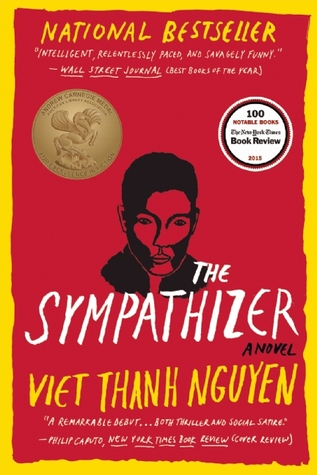
The most recent Vietnam (American) War novel I’ve read is Viet Thanh Nguyen’s Pulitzer Prize-winning The sympathiser (my review), which satirically confronts the mess of this war through the experience of Vietnamese refugees in the USA, but I have also read a handful of Australian novels about the war.
“All wars are fought twice, the first time on the battlefield, the second time in memory” (Viet Thanh Nguyen, Nothing ever dies: Vietnam and the memory of war, cited by Davis)
A select list
Here is a select list of novels and short story collections, with a brief note on their focus or angle:
Alison Booth, A distant land: on war-reporting and corruption
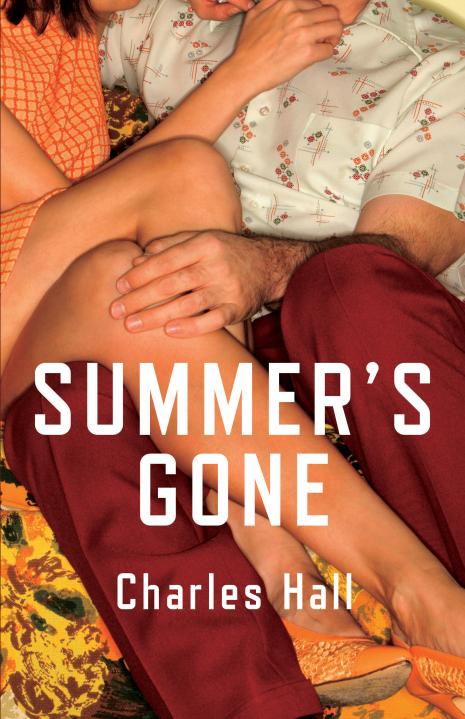
Charles Hall’s Summer’s gone (2014) (my review): includes conscription and draft-dodging
Myfany Jones’ The rainy season (2009) (Lisa’s review): on war trauma and its effect on the family
Adib Khan’s Homecoming (2003): on a Vietnam vet’s postwar trauma
Nam Le’s The boat (2008): includes short stories about Vietnamese refugees
Gabrielle Lord’s The sharp end (1998): on traumatic psychological effects of the war on soldiers
Doug McEachern’s Stardust and Golden (2018) (Lisa’s review): on conscription
William Nagle’s The odd angry shot (1975): a war-time story based on the author’s experiences
Hoa Pham’s Lady of the realm (2017) (my review): set in Vietnam itself, pre, during and post war
Hoa Pham’s The other shore (2014) (Lisa’s review): on the impact in Vietnam itself
John Rowe’s Count your dead (1968): realities of war, and American policy, drawn from author’s time there
Jospephine Rowe’s A loving, faithful animal (2016) (my review): on PTSD and intergenerational trauma
Evie Wyld’s After the fire, a still small voice (2009) (Kim’s review): on war trauma in a Vietnam War conscript and his war-veteran father
I have called this a select list, which might imply that I’ve curated a special selection but in fact, I didn’t find many books beyond those I already knew, so this list includes most of those I found. Why are there so few?
This is a question author Alison Booth also raised in a post she wrote on “Australian Fiction and the Vietnam War”. She commences:
The Vietnam War is sometimes termed a forgotten war. Neglected by Australian literature until relatively recently, it seems it was the war that most of us wanted to forget. The last and most prolonged proxy battle of the Cold War, it saw Australians become increasingly divided. Should the country be at war at all, or had it been manipulated into involvement by its political leaders? Did people have the right to take to the streets and protest about the war? And just how far was the security intelligence organization prepared to go to silence the protesters?
These issues offer endless possibilities for writers of fiction and yet they have been little used.
When she looked for lists of fiction, what she found (as did I) was mostly written by American males. She finds this lack “puzzling” because so much of what happened then has relevance to now. For example, 50 years after that war, we are still confronting “those trade-offs between surveillance and security on the one hand, and personal liberty on the other”; we are still involved in unwinnable wars; and protests still generate conflict. She concludes by wondering whether it will take more time “before novelists find the Vietnam War period appealing” and “before publishers do as well”. Or, maybe it’s that “too many people remember that period with distaste” and we need to wait until the next generation is interested in historical fiction featuring the Vietnam War. I have no answers, but, like Booth, I do find it curious.
However, Davis observes that some of Australia’s non-Vietnam war literature might, in fact, be a response, to it. One critic, he writes, has suggested that the authors of some of our First World War novels, such as McDonald’s 1915 (1979) and Malouf’s Fly away Peter (1982), “may have chosen the divided, angry and anguished climate of that time as their setting as a means of dealing indirectly with Australia’s part in the Vietnam War, where similar social schisms greeted Australian involvement”. An interesting explanation, though these could also have been a reaction to the increasing interest in “celebrating” war? Further, Davis says that the same source has suggested that “the Vietnam War is the hidden subject” of some novels set in Southeast Asia, like Christopher Koch’s The year of living dangerously (1978) and Blanche d’Alpuget’s Turtle Beach (1981). Another interesting point.
Finally, Davis suggests early in his paper, and reiterates it at the end, that the anti-war novel has a long tradition in Australian literature, and that “this has been influential in shaping the attitudes of subsequent generations of Australians to their country’s history”.
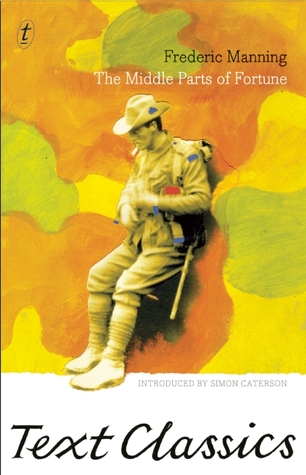
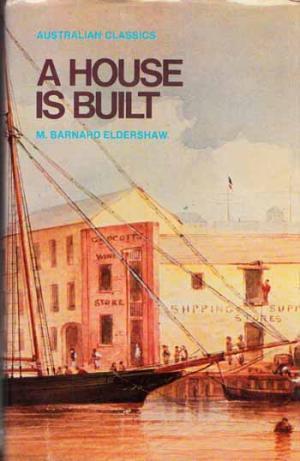
I had identified two novels for my 1929 read, M. Barnard Eldershaw’s A house is built and another. With Lisa also considering A house is built, I decided to go for the other. I started it, and am loving it, but I won’t finish it in time, so I thought I’d check my Australian anthologies for a 1929 offering, and found one. In the Macquarie PEN anthology of Australian literature is the first chapter of a book I’d been unaware of until I wrote my 1929 Monday Musings post this week. The book is The middle parts of fortune: Somme and Ancre, 1916, by Frederic Manning.
It particularly caught my attention because the title sounds more like a nonfiction book. So, I checked it. Yes, it is fiction, I clarified, and has an interesting history. I’ll start, though, with the author…
Frederic Manning (1882-1935) was born in Sydney. An apparently sickly child, he was educated at home, and when a teenager he formed a close friendship with Rev. Arthur Galton, who was secretary to the Governor of New South Wales. When Galton returned to England in 1898, Manning went with him, but returned to Australia in 1900. However, he returned to England in 1903 – when he was 21 – and there he remained. He produced all his writing from there, but the Australian Dictionary of Biography (linked on his name) claims him as Australian.
That’s all very well – for us to say now – but at the time of his death, according to Nicole Moore who wrote his entry in the Anthology, he was “largely unknown in Australia”. And yet, she continues, “his novel, The middle parts of fortune: Somme and Ancre, 1916 (1929) is cited around the world as one of the most significant and memorable novels of the First World War”. Indeed, she writes, it is “often grouped” with Ernest Hemingway’s Farewell to arms and Erich Remarque’s All quiet on the western front.
Manning served in the war from October 1915, first as Private (no. 19022) and later as a second lieutenant, though apparently the officer’s life did not suit him. He drank, and resigned his commission in February 1918. Wikipedia explains explains that, with increasing demand through the 1920s for writing about the war, and his having published some poems and a biography, he was encouraged to write a novel about his wartime experiences – and so The middle parts of fortune was born.
The story does not end here, however. The first edition was published privately and anonymously, under subscription, says Moore. Soon after, in 1930, an expurgated edition was published under the title Her privates we, with the author now identified as Private 19022. This version, Moore says, “removed the soldiers’ expletives that strongly punctuate the text”. Acceptable, apparently, for the private edition, but not for the public one! Wikipedia says that Manning was first credited as the author, posthumously in 1943, but the original text wasn’t widely published until 1977.
Wikipedia identifies the book’s admirers as including Ernest Hemingway, Arnold Bennett, Ezra Pound, and T. E. Lawrence. Lawrence is quoted as saying of The Middle Parts of Fortune that “your book be famous for as long as the war is cared for – and perhaps longer, for there is more than soldiering in it. You have been exactly fair to everyone, of all ranks: and all your people are alive”, while Ernest Hemingway called it “the finest and noblest novel to come out of World War I”. How could I have not known it?
Now, the book … Wikipedia says that each chapter begins with a quote from Shakespeare – answering a question I had, because Chapter 1 so starts. The source of the quote, however, is not cited, but a quick internet search revealed it to come from Act III, Scene 2 of Henry IV Part 2:
By my troth, I care not; a man can die but once; we owe God a death. … and let it go which way it will, he that dies this year is quit for the next.
It basically says that we can only die once, and that we’ll all die one day – so, we may as well accept our fate? A soldier’s creed?
Before I say briefly discuss the first chapter, I’ll add that Nicole Moore says that the protagonist’s nationality is not “made explicit” which is “in keeping with the novel’s deflation of military hierarchies and nationalism”. She goes on to say that it explores “the effect of war on reason and selfhood” and is thus “an existentialist study of the extremes of human experience”.
I’ve read several novels, over the years, about World War 1, including – to share another Australian one – David Malouf’s Fly away Peter. It too powerfully evokes the terrible impact of that war.
So, Manning’s Chapter 1 introduces us to a soldier stumbling back to the trenches after some action during which many men had been lost. Soon, he – named Bourne, we learn – is joined by a couple of Scottish soldiers – not from his battalion – and then an officer from his. The rest of the excerpt chronicles his moving through a “battered trench” to join his compatriots in their dugout, before setting off again to meet their captain and retire to their tents in the ironically, but truthfully, named “Happy Valley”.
The tone is one of desperate resignation. Faces are blank (despite “living eyes moving restlessly” in them); no energy is wasted in unnecessary talk; and whiskey is a necessary support after “the shock and violence of the attack, the perilous instant”. The description of their progress from the dugout to the camp above ground beautifully exemplifies the writing:
they saw nothing except the sides of the trench, whitish with chalk in places, and the steel helmet and lifting swaying shoulders of the man in front, or the frantic uplifted arms of the shattered trees, and the sky with clouds broken in places, through which opened the inaccessible peace of the stars.
The “frantic uplifted arms of the shattered trees” and the “inaccessible peace of the stars” conveys it all – and this is only Chapter1.
If you would like to know more about this novel, you can check Lisa’s blog, as she knew of this book and reviewed it back in 2015!
Frederic Manning The middle parts of fortune: Somme and Ancre, 1916 (1929) in Macquarie PEN anthology of Australian literature (ed. Nicholas Jose) Crows Nest: Allen & Unwin, 2009 pp. 365-369 ISBN: 9781741754407
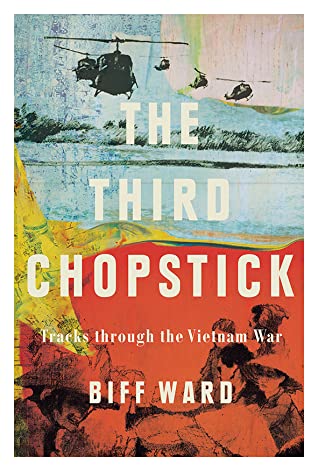
Biff Ward’s The third chopstick was my reading group’s October selection. It’s the second book by Ward that we’ve done, the first being her memoir, In my mother’s hands (my review), about growing up with her academic father, the historian Russel Ward, and her mentally ill mother, at a time when mental illness was shameful and to be hidden. It was a moving book that engendered an engaged and wide-ranging discussion. Biff Ward, in fact, attended that meeting.
The third chopstick is another personal book, but one that’s not so easy to classify. I would describe it as hybrid memoir-creative nonfiction. Memoir, because it’s about her experience as an anti-Vietnam war protester who later chose to meet Vietnam veterans and listen to their stories. And creative nonfiction, because, although nonfiction, it uses some of the devices of fiction to engage its readers. These include hinging her story around one particular vet, Ray, whom she describes as her “muse”, her “archetypal veteran”, her conduit, perhaps, to “the missing piece”. His story, combined with his powerful presence, gives the book its compelling, narrative drive.
The implication of what I’m saying here is that while The third chopstick is historical it is not an academic history. Although Ward did the historian thing, and conducted recorded interviews with vets, she does not attempt to present an “authoritative” analysis of protesters or of vets, but a thoughtful, personal quest. It has no footnotes, although there is a selected reading list at the end, and there’s no index. This is not to say, however, that it doesn’t add to our understanding of history, because it certainly does.
The book has a logical, and more or less chronological, structure, though there is criss-crossing of timelines where appropriate. It has three main parts – Protest, Veterans, Vietnam – which are bookended by a Prologue and Epilogue. In Protest, Ward describes her life as a protester, and introduces us to her ongoing interest in Vietnam long after the war ended. In Veterans, she introduces us to the veterans she met and interviewed, shares their stories and experiences, and reflects on these. Finally, in Vietnam, she discusses post-war Vietnam, including how Vietnamese people have processed, and live with, what happened. She has visited the country many times – as a sole tourist, on war-themed tours, and as a tour leader herself. On some of those visits, she either accompanied or met vets. Through these postwar connections, she starts to bring together her central questions concerning how we Australians got caught up in this, and what it did to us – as a nation, as individuals – though, of course, there are no simple answers.
“a scrambled snarl”
A bit over halfway through the book, while interviewing Nick, an SAS veteran of the war, Ward confronts the issue of “killing”. Nick’s story causes her to think about that and, thence, her stance as a pacifist. She realises she’d never really grappled with it. She had, she writes, a ‘”natural” antipathy to killing, a generalised kind of pacifism which yearns for peace’ but she also believed that, if needed, she would strive as hard as she could to defend “me and mine”. Her pacifism was “a scrambled snarl of thoughts and feelings”. She doesn’t explore this further, as it’s not the subject of the book, but …
… I liked this expression because what her book does is explore just what “a scrambled snarl” war is, whichever way you look at it. I particularly liked her various reflections on war. She makes the point early on that it is well known that war takes years to recover from. Vet Graham tells her that medieval knights “used to go into a monastery after being on a crusade”. He himself had, after leaving the army, been ill; he’d been in hospital and at a health farm, before spending “thirteen years, mostly alone, making music, keeping quiet”. By the time Ward met him, he was working with the Federation for Vietnam veterans.
Throughout the book, then, Ward reflects on war in general, but I’ll just share a couple that captured my attention, both resulting from her reading of Ray’s journal, where he expresses the trauma he experienced. It leads Ward to suggest “that the truth of all war is only these depthless oceans of grief”. A few pages later, she discusses “moral injury”, which “refers to an injury to the soul, to morality, to what can happen when a soldier has to do something against his own sense of what is right and wrong.” The injury done to Ray is immense.
Ward may not have intended this, but her book also functions, at least a little, as a cautionary tale, because she shows how easy it is to believe you are doing the right thing when you protest for a humane cause, and be oblivious to the potential for unintended consequences. The anti-Vietnam War protesters’ beef was with the government and its policies, but the result, as we all know now, was that the soldiers who went to Vietnam were vilified – not so much by the core protesters but by others who took their ideas on without understanding the politics. Ward shares some of the facts and myths about how it played out.
Ward also discusses those other two big fall-outs from this particular war – Agent Orange and its ongoing impact on the health of both soldiers and Vietnamese people, and PTSD, which she describes as the Vietnam vets’ gift to the world.
What makes this book a particularly good read, besides all this subject matter, is the language, which mixes journalistic-style reportage with more evocative writing. There’s too much to share, but here’s one describing her experience of transcribing Ray’s journal:
As I transferred his words from the page to pixels on my screen, they sometimes spiralled off and pranced about the room like leering pixies.
(This sometimes necessitated her needing to take a break!)
Here’s an appropriate point to explain the title, because it came from Ray, as she explains in Chapter 2. While in a restaurant, he places two chopsticks in parallel lines, about two centimetres apart, across a bowl, and names the space between the two as “normal life … where people get born and grow up …” etc. Then, he takes another chopstick (“the third chopstick”), places it parallel to the others, the same distance apart, and says
The veteran lives here, alongside but separate, see? He can see this life, he pointed back to the first space. He can see what other people are doing, but he can’t join in. He doesn’t know the rules anymore. It might look like like garbage to him. It’s got no connection to what’s happening inside him, see?
The secret, Ray continues, is for the veteran to be able to handle both “his own stuff” and join in. There’s a little more to it but that’s the gist.
Lest you be thinking so, The third chopstick is not just relevant to those who lived through the Vietnam War era. As I read this book, I couldn’t help thinking about a war that is happening right now. Near the end, Ward writes:
So even today, for the People of the Bag*, the mountains and the rivers, the land and the water and their interconnectedness are concepts integral to the way Vietnamese conceive of themselves. And, I chucke to myself, those men in Washington and Canberra thought they could somehow beat them, that the People of the Bag would eventually give up? Really?
Given its origins in a leftie anti-Vietnam war protester who went on to engage openly and genuinely with soldiers involved in that very war, The third chopstick is quite an astonishing book. For anyone interested in the complex experience of war, it makes excellent reading. All eleven who attended my reading group agreed.
* The Vietnamese, from their Creation Myth
Biff Ward The third chopstick: Tracks through the Vietnam War Penrith: IndieMosh, 2022 313pp. ISBN: 9781922812025
As many of you know by now, Karen (Kaggsy’s Bookish Rambling) and Simon (Stuck in a Book) run “reading weeks” in which they nominate a year from which “everyone reads, enjoys, posts and shares wonderful books and discoveries from the year in question”. The current year is 1929, and it runs from today, 24 October to 30 October. For the third time now, I have decided to devote a Monday Musings to the week (my previous two being 1936 and 1954).
1929 is a meaningful year for me, because that was the year my dear mum was born. It was, however, meaningful more universally too, given, as most of you will know, the Wall Street Crash came late in the year and ushered in the Great Depression. But, of course, this happened at end of 1929, so won’t be reflected in the books published that year.
My research located books published across all forms, but my focus is fiction, so here is a selection of 1929-published novels:
Arthur H. Adams, Lola of the chocolate and A man’s life
James Tucker (as Giacomo di Rosenberg), Ralph Rashleigh (Bill’s review)
Arthur W. Upfield, The Barrakee mystery
Arthur Wright, Gaming for gold
By the late 1920s, there was quite a flowering in women’s writing, which continued through the 1930s. This is reflected in the above list, which includes Jean Devanny, Marjorie Barnard and Flora Eldershaw (writing collaboratively as M. Barnard Eldershaw), Mary Gaunt, Katharine Susannah Prichard and the already-established Henry Handel Richardson. Effie Sandery (Elizabeth Powell), Myra Morris and Alice Grant Rosman also appear in the list, but are new to me.
There were very few literary awards at the time, but two that were established in 1928, made awards in 1929: the ALS Gold Medal went to Henry Handel Richardson’s Ultima Thule and The Bulletin’s (unpublished) Novel Competition was won by Vance Palmer’s The passage.
Writers born this year included poet Peter Porter, and novelists Kenneth Cook, Catherine Gaskin, Ray Mathew, and Glen Tomasetti (though she was better known as a singer-songwriter and activist). Deaths included Barbara Baynton, who continues to be the subject of some of my most popular posts.
The state of the art
Of course, I checked Trove to see what newspapers of the time were saying about Australian literature, and fiction in particular.
One of the things that shone through the newspaper articles I read was great enthusiasm to support and promote Australian literature. The papers reported on the meetings of many organisations, including the Australian Literature Society (which originated the ALS Gold Medal), the Queensland Authors’ and Artists’ Association, the Henry Lawson Literary Society of Sydney, and The Royal Australian Historical Society. The papers noted the issues they raised, and what guest speakers discussed. These included:
holdings of Australian literature in school, university and public libraries. There was clearly concern about either lack of good holdings and/or lack of promotion of those holdings. Brisbane’s The Telegraph (8 February), for example, reported that the University of Queensland had approved the purchase of books by Australian authors for the University library from the proceeds of Authors’ Week. Further south, Tasmania’s Mercury (6 December) reported that the Australian Natives’ Association* had decided to write to the Launceston Public Library committee, asking them to set aside a section of their library for “works of all descriptions by Australian authors” and to so identify them.
support for Australian literature. A couple of papers reported that organisations had expressed appreciation for the support given to Australian literature by newspapers. Melbourne’s Argus (19 March) quoted a speaker at the Australian Literature Society saying that “the best newspapers of the Commonwealth were making a definite attempt to create a literary tradition, and the standard of professional writing was high, despite the fact that writers appeared to be paid in inverse ratio to their qualities” [my emph]. The Sydney Morning Herald (11 June) repeated similar praise from the Henry Lawson Literary Society which said that “opportunities for Australian writers had been greatly extended by the interest displayed by Australian newspapers and journals prominent among which were the Sydney Morning Herald and the Bulletin. On the other hand, Melbourne’s The Age (16 March) wrote of Australian Literature Society’s point that “more is required of the public than a passive loyalty”, while the above quoted Argus wrote of the public’s “indifference”.
lectures on Australian literature. Papers also reported on various lectures given on Australian literature. The Australian Worker (28 August) promoted a series of three to be given by author, editor and critic A.G. Stephens. It was organised by the University Extension Board “in response to numerous requests for lectures on literary subjects”. His topics were Australian Poetry, Australian Humor, and Australian Literature.
This is just a small taste of the sorts of discussions of Australian literature that occurred throughout the year. The final recurring issue I want to share concerned the quality of Australian literature – to date.
Journalist Firmin McKinnon had strong views about Australian literature, and I have reported on him before. Then, 1934, he was still speaking about what he was arguing in 1929, which was how “behind” Australian literature was compared with the settler societies like Canada and South Africa. Brisbane’s The Telegraph (6 August) reported on a lecture he gave, in which he pronounced that:
Australian novelists have failed in the main because they have no definite attitude towards life that is worth writing about, because many of the characters are unreal, and because they have failed to interpret the great soul of the real Australia.
He did, however, praise two novels from my list above. One was John Dalley’s Max Flambard, which he described as
the best novel yet produced of Sydney and suburban life, failing only because he had given his novel a tinge of satire which detracts from a true interpretation, and depicts snobbery as the dominating feature of suburban life.
Oh dear, we can’t be satirical about Australia? But, he saves his best praise for the one he sees as “the greatest Australian novel”:
“A House is Built,” by Miss Eldershaw and Miss Barnard. … while it may be too long and too particularised for the average reader, it was a story of the reconstruction of the past, covering the history of Sydney for half a century.
Overall, though, he argues that Australian literature to date was lacking a “definite constructive outlook towards life”. McKinnon was firmly of the opinion, as The Queenslander (6 June) reported on an earlier address, that
some writers unfortunately wallowed in the realism of misery, forgetting that misery was not a dominant feature of Australian life, but light-hearted optimism and courage.
Australian writers “must”, he told the meeting, “tell a story true to Australian life”. I think I’ll leave you with that little thought!
In my recent post on Carmel Bird’s bibliomemoir, Telltale, I hinted that there could be another post in this book. There could, indeed, be many, but I must move on, and I must not spoil the book for others. However, given many blog-readers enjoy personal posts, I’ve decided to share a few of my particular delights in the book. I found myself frequently writing “Yes” in the margins …
“I’m glad, now, that I have always defaced books”
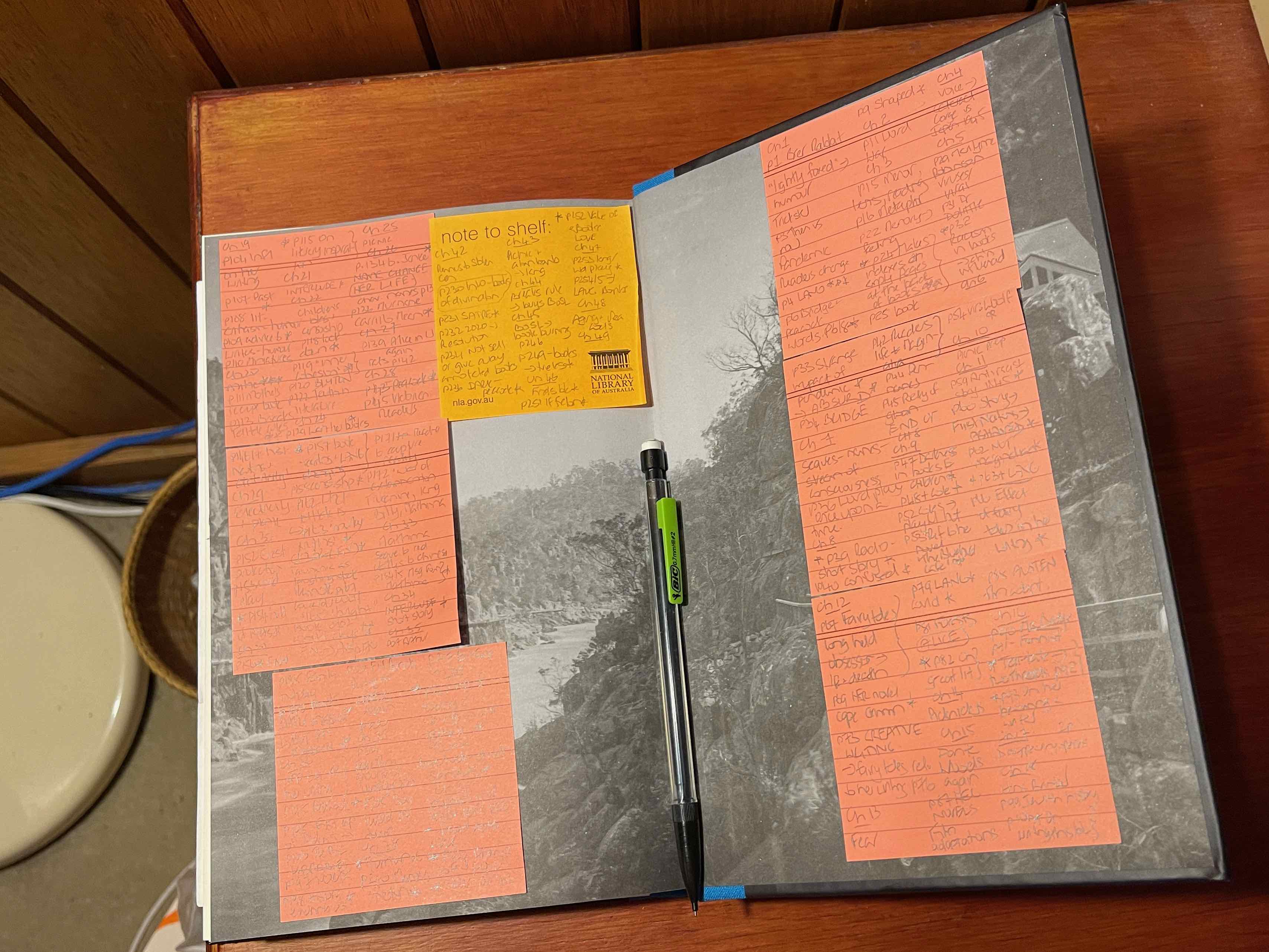
… because, like Carmel Bird, I have, since I was a student, “defaced” my books. Not only that, but my defacements seem to be of a similar ilk to hers. For example, I sometimes add an old envelope, or post-it notes, inside back covers to carry more notes. Like her, I love books with several empty pages at the back to accommodate note-taking.
Not enough blank pages at the end of Telltale!
Carmel Bird also loves indexes – and I love the fact that Telltale has a beautiful index, because such a book should, but often doesn’t. But, what really tickled me was her comment early in the book that “I also make a rough index on the empty pages at the ends of books I read” (or, as she also writes, “pencilled lists of key elements”). Yes! Sometimes, my indexes are more like notes, but other times my notes are more like indexes. Mostly, though, I do a bit of both, with exactly what depending on the book and on my response to it. This latter point is implied in Bird’s statement that:
In 2020, paying so much attention to books, I took particular notice of the differences in the ‘indexes’I had made at different times, how on each re-reading I had noticed different details.
Here, she not only shares her reading practice but also comments on reader behaviour, on the fact that each time we read a book we find something new. That can be for various reasons. On subsequent readings we already know the book at some level and so are ready to see more in it; on subsequent readings the world will have changed so the things we notice can also change according to the zeitgeist; and then, of course, the biggie, on subsequent readings, we ourselves have changed so we see the world differently. I love that Bird’s indexes reflect this – and that she saw it.
But, there’s a downside to all this “defacement”, which Bird also discusses. Writing about discarding books – the how and why – she says, “when I have annotated a book, it is not much use to anybody but myself, so selling it or giving it away are not possible solutions”. I know what she means, though I contest that hers would not be of use to anyone else. Who wouldn’t enjoy owning a book so defaced by her?
There is, however, a point at which she and I depart. When reading an outsize paperback becomes “too difficult … to manage comfortably” she will attack it “vertically down the spine with an electric carving knife” to divide it into manageable portions. I know some travellers tear out sections of travel guides they no longer need, but librarian-me finds destruction a step too far. Sorry Carmel, I understand, but …
“oh what a lovely word”
Like many authors, Carmel Bird loves words. It’s on show in all her work, but in Telltale, it’s front and centre. In her opening chapter, she writes that
Uncle Remus uses terms such as ‘lippity-clippity’. This is the kind of singing, onomatopoeic language I sometimes invent when writing.
And, so she does, even in this nonfiction bibliomemoir. Did it come from reading Uncle Remus “all that time ago”, she ponders. Was it “embedded” in her brain, back then, without her “even realising”? Probably.
Throughout Telltale, Bird discusses words – how they have changed over time (in meaning, for example, or in acceptability), how they look, where they come from, how they sound. As the daughter of a lexicographer, I would be interested in this. As a lover of Jane Austen whose wit and irony I adore, I would be interested in this. And, as one who loves writing that plays well in the mouth and sounds great to the ear, I would be interested in this. If you love words too, this book will be an absolute delight for you.
Other delights
As I said when opening this post, I really mustn’t spoil this book for others, so I’ll just add a few other delights:
her discussions of the many books and stories she chooses to share – those she found on her shelves that she felt illuminated her life and writing. I’ve mentioned very few of these because, really, this is the thing that most readers will want to discover and enjoy. Get to it … Meanwhile, I will name just two here. One is Dickens’ Bleak House which she writes “might” be her favourite Dickens. It might be mine too. The other is Marjorie Barnard’s “The persimmon tree” which she describes as “extraordinarily powerful”. Barnard’s “The persimmon tree and other stories” is one of the only short story collections I’ve read more than once. I concur!
silly little things like the fact that she loves green (as do I) and that she learnt that “lovely” word “tessellated” at the tessellated pavement at Tasmania’s Eaglehawk Neck (as did I).
she loves the internet and allowed herself to use it for this book. She was the first fiction writer in Australia to have a website. Like most of us, she prefers printed books, but she also sees the advantage of electronic books (including the ease of searching them – as an index-lover would!)
Finally, early in the book, Bird discusses memory:
As is often the case with memory, while some of physical details are clear, the principal element that has been retained is the feeling. Perhaps the feeling is the meaning.
Yes! This makes sense to me. I can rarely remember plots or denouements, but for the books that are special to me, I can remember how they made me feel – uplifted, melancholic, inspired, distressed, excited, angry, and so on. These feelings are surely associated with what the author intended us to take away, and therefore they must reflect the meaning?
Here, I will, reluctantly, leave Telltale, but I’ll do so on one of its three epigraphs, the one from her own character:
‘memory is the carpet-bag mire of quag filled with light-dark truth-lies image innation and butterflies’
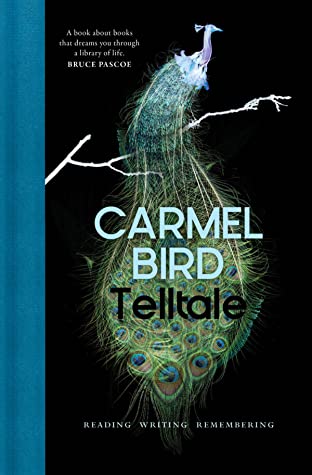
Finally, I have found something to thank COVID for – Carmel Bird’s Telltale. Best described as a bibliomemoir, Telltale may never have been written if Bird had not been locked down with her extensive library. What is a lively mind to do in such a situation? I can think of a few options, but what Bird decided was to revisit the books she’d read since childhood and, through them, look for patterns in her life and, because they are intertwined, in her writing practice. She would reflect on “the working of the imagination, the behaviour of the unconscious mind”.
Telltale, in other words, is more than a simple chronological run-through of her books, because the reading and writing life is not so easily compartmentalised. She writes that it
is composed of two different kinds of narrative. One is warp and one is weft, and I am not sure which is really which. Will the threads hold? What patterns might I work across the surface? Will the metaphors crumble into useless dust? One thread speaks of books read and sometimes of books written. And also of things that happened in my life. The other speaks of a journey of the heart, a pilgrimage through a patchy history of the world, becoming a poetic thread that runs through the whole narrative.
A complex book then, but one told in such a personal, confidential come-with-me voice, that it reads like a lovely long conversation with an intelligent friend. Like any intelligent conversations, though, it requires the participants to be on their toes, to be ready for twists and turns, for surprising connections and conclusions, to be both confronted and delighted. Bird heralds this in her opening sentence:
As a child at the end of World War Two, I was introduced to the concept of the Trickster in literature.
That trickster was Brer Rabbit, whom I also remember from my childhood, but I was of a more prosaic mind than Bird, who has proven to be a bit of a trickster herself. Yes, the dictionary uses words like “dishonest”, “cunning”, and “deceptive” to describe “trickster”, but the trickster in literature, as Wikipedia explains, “is a character in a story … who exhibits a great degree of intellect or secret knowledge and uses it to play tricks or otherwise disobey normal rules and defy conventional behavior”. This is how I see Carmel Bird as a writer. The surface can look quite simple, but underneath there is usually something else going on. You only have to check out the epigraphs to her books, which frequently include bon-mots “written” by her own character, Carillo Mean. It’s apposite, then, that she starts her book with a “trickster”. It tells us to be ready for – well, anything.
So, Telltale. It looks like a bibliomemoir – a book about her reading and writing life – but as she explains in the excerpt above, it also encompasses “a patchy history of the world” as it has affected or appeared to her. To unite it all, she crafts her tale around a narrative heart, a loved book, Thornton Wilder’s The Bridge of San Louis Rey. She wants to write about it but can’t find it. This injects a mystery: will she find it? It also introduces a potential conflict: will she break the rule she set for herself to not buy books and only use those on her (clearly extensive) shelves. As the memoir progresses, we become party to her increasing concern about where it is and what to do.
Why of all the books, you might be asking, The bridge of San Luis Rey? But, that might be for me to know and you to find out.
“to move the heart and illuminate the mind”
Late in Telltale, Bird mentions reading Katherine Mansfield’s short story “The fly” when she was fifteen. She writes:
I suddenly saw how the surface narrative and the narratives and meanings below the surface could dance together with an electrifying elegance to move the heart and illuminate the mind. This was my first conscious lesson in style and structure.
See! It’s a lesson Bird clearly took to heart, and which is on display in all the works of hers I’ve reviewed. (As for “move and heart and illuminate the mind” – who could want more from reading?) Earlier in the book, she refers to another aspect of her style: “the pleasure I take in moving (drifting, spinning, flicking) from one topic to another”. This pleasure, she suggests, could have come from her father’s six-volume Harmonsworth’s household encyclopedia. Again, we see this approach in Telltale. It’s one of the things I love about Bird’s writing. It can be challenging, of course, but it is exciting to be so challenged – and to thus be respected as a reader.
Anyhow, the point is that while on the surface Bird seems to move or flick from topic to topic, her books are invariably held together by framing ideas and motifs. Here, it’s not only the search for The bridge of San Luis Rey, but two other narratives, which she draws together towards the end of the book. One concerns a childhood family picnic to Cataract Gorge in 1945, and the other, the gathering of American planes for the rarely-remembered firebombing of Tokyo in March 1945. Woven through these narratives is another, Bird’s growing awareness of the devastating dispossession of Australia’s First Nations people, starting from her acceptance, as a Tasmanian-born child, of their “extinction” in her state.
These are the main narratives that make up the aforementioned “patchy history”, and I fear this may be sounding disjointed. In fact, however, the “threads” hold, because the relationship between this “patchy history” and the books she has read and written is strong. Not only are there the obvious and expected connections between the “history” and her reading and writing, but there are also two recurring motifs that are real, historical, and literary – bridges, which can symbolise “fragile communication and union”, and peacocks which can signify “eternal life”.
Telltale is a delicious and revelatory read, and I’m not doing it justice. I’ve not, for example, touched on the quirky, often poetic, tapered chapter ends, or the neat segues between chapters. Nor have I said much about the writing which can turn from seriously descriptive or philosophical to whimsical or poetical in a paragraph. And nor have I shared the reflections about reading and writing, about truth and meaning, about words and language, that I specifically noted down to share, because, frankly, there are too many. There may be another post in this.
I took some time to read this book, and I’m not sorry. To read Bird, if you haven’t realised already, is to agree to join her on a sometimes merry, sometimes macabre dance. If we do, what we find is a compassionate heart that, despite it all, believes in love and calls us to hope, as that peacock that has accompanied us throughout darts and dances across the sky.
Last week, I introduced the Bush Book Club. Established in Sydney in 1909, its aim was to get books out to remote areas of New South Wales not supported by other services like Schools of Arts and Mechanics Institutes. In my post I focused on its establishment and aims, but I found it so interesting that I’m back again, this time to share something about their book selections and early achievements.
The books
Not having independent funds, besides what they fundraised, the Club (B.B.C.) planned to focus on donated secondhand books, but that didn’t mean they accepted anything. While they wanted to cater for males and females of all ages, their goals were worthy, which meant, as I quoted last week, there was a censoring committee to ensure that “vulgar, trashy, novels, and morbid, unwholesome works” would not be sent. Indeed, as the Mudgee Guardian and North-Western Representative (30 June 1910) reported, the Club’s aim was
To provide high-class literature to the dwellers in the bush districts of New South Wales, who live beyond the reach of any School of Arts. … The books for the club are provided by people who are interested in supplying really good literature. The club is non-political, and non-sectarian.
So, its early aims were good quality literature, that was non-political and non-sectarian. However, it seems that as it got underway, the materials sent were more varied than these goals imply, albeit, as the newspaper reports continued to confirm, books continued to be censored. This censorship doesn’t seem to have been questioned, though, suggesting that the censor’s pen was light or that the recipients were undemanding.
I read many reports about the club over its first decade, mostly comprising newspaper reports on the Club’s annual meeting. The story was the same – the good work being done, and increases every year in the number of “centres” being supported; the call for donations of money and books to support the work; and references to the dullness of life in “outback” and the need to support the people who were “breaking the sods of our new country and bearing the burden and heat of the day away from the pleasures and comforts of civilisation” (SMH 17 April 1912). These comments sound condescending at times, but many remote people were desperate for reading matter, all the same. No mention, of course, of First Nations people. It seems that the patron was always a “Lady” – like Lady Poore, Lady Chelmsford, Lady Strickland – most of them, vice-regal. The role was presumably passed on as each arrived with her husband, but there is a sense from the reporting that they took on the role with relish.
There were also some references to the actual books. Reporting on a Club meeting in December 1911, two years after the Club’s establishment, The Sydney Morning Herald, noted that there was a tendency for book donors to send
too many “serious” books. The lighter style of literature, tersely written, and of ordinarily human interest, was preferable.
A few months later, The Sydney Morning Herald’s (17 April 1912) report (linked above) commented that it’s alright “if they [the recipients] are not great readers, and if Marie Corelli and E. P. Roe are appreciated above Ruskin or Carlyle”.
the demand among bush readers was chiefly for wholesome fiction, but tastes are very varied; “anything and everything about the war” being eagerly devoured.
library is gathered together, being truly an “omnium gatherum” of all sorts and descriptions, from Bacon to Artemus Ward, from Dickens to Charles Garvice, from Shakespeare to Gordon, all acceptable and all sure of their readers. The only literature barred from the shelves are political and sectarian works. … The parcels are selected, so that there is a sprinkling of heavier reading, one or two of Thackeray or Dickens, or suchlike; two or three boys’ and girls’ books, and about 20 light novels, besides magazines and small weekly publications galore.
“I must read or I shall go mad”*
The Club lasted some decades and expanded beyond New South Wales, but I will write more on this later. Here, I’ll focus on its first decade. The Sydney Stock and Station Journal regularly reported on it, which is not surprising given its rural focus, but this must also reflect the Club’s significance. In January 1912, just over 2 years after the Club was founded, the journal reported that there were 125 centres operating, adding that
There is a “centre” within coo-ee of the Queensland border, and there are several out on the Castlereagh. The Riverina knows the B.B.C. well, and the Club’s books are working out towards the Darling. No place is too far.
The journal also notes that a centre could be as small as a few families. I imagine the Club’s willingness to be organisationally flexible played a role in its success. It wouldn’t have hurt, either, that, as this journal also said, the Club “is anxious to send just what the centre wants. Its desire is to please. Say what you want and the Club will do its best to satisfy.”
Some of the newspaper reports describe the sorts of “centres” that were receiving books. On 7 May 1914, the Clarence and Richmond Examinerreported that there were 309 centres, which included “railway camps, sleeper cutters ‘ camps, shearing sheds, and country hospitals”. A year later, on 29 April 1915, The Sydney Morning Herald reported that there were 370 centres, and named the Light Horse Camp at Liverpool as one of them. It was, of course, wartime, by now.
One lady wrote that for years she had not been able to read anything except a newspaper, books being out of reach but now she is making up for lost time with the help of the Book Club. Another correspondent described the pleasure given to the children of the household when the parcel of books arrived; a lighthouse keeper sent his warm thanks for (presumably) “light” literature, which relieved his solitude.
Very funny!
By 1918, the club was still going strong, with many of the original volunteers still involved. The majority of them were women, and they included some interesting names – but I will talk about that in my next B.B.C. post.
I understand that literary conversation events in Canberra go best when the subject is political. I guess it’s the nature of the beast – that is, of living in the national capital. But for me, it’s the fiction writers that I want to see, and we do get some interspersed amongst the run of historians and journalists that we get. Even so, it’s been three years since I attended an ANU/Canberra Times Meet the Author event, due partly to the pandemic which halted the program for a while and partly because I have a pretty full dance card. However, Mondays are often free, so Mr Gums and decided to check out Craig Silvey. I’ve only read his best-selling Jasper Jones (my review) but that’s because you can’t read everything. I would like have read Honeybee. Tonight’s focus, though, was his latest novel, Runt.
The conversation was conducted by local author Irma Gold, who is no stranger to this blog. She’s always good in the interviewer’s chair, being both warm in manner and astute about writing – and so it proved again tonight.
The conversation
After MC Colin Steele did the usual introductions, Irma took over and introduced Silvey and the book we were there to hear about. Runt is, she said, a middle-grade children’t book. It features a solitary girl, Annie, with a penchant for fixing things, and the dog, Runt that she befriends. Irma found Runt a heart-warming book, which was lovely to read to her 11-year-old son. She believes it is destined to become a children’s classic. It would, both she and Colin Steele said, make an excellent Christmas gift. What a shame our grandson is only 4.
Irma Gold and Craig Silvey, 2022, ANU
After some light-hearted banter with Craig about a Fremantle biscuit artist – who knew? – Irma got down to business. Noting that Runt represents a new audience for Craig – that middle-grade age – she asked what his favourite book/s had been as a child. Craig replied that he’d been a voracious reader as a child. (Show me an author who wasn’t!) He loved a range of books, including those traditional classics like Lord of the Rings and the Narnia books, but then he made some points that were specific to him. For example, he liked books that made him feel things, and named a short story by Paul Jennings titled “Busker”. It was the first story, he said, that made him cry. Another favourite was Goodnight Mr Tom, which elicited sounds of agreement from the audience, and which, he later realised, might have partly inspired Honeybee.
He also liked books that made him laugh, and he mentioned Roald Dahl, Paul Jennings again, and the James Herriot vet series.
After this, there was some discussion of Runt, which is set in the perfectly named country town of Upson Downs. There are Annie and Runt of course, and some villains, including the farmer, Earl, who is also a collector. One of the things he collects is water! Earl is buying up farms to get the water, and wants Annie’s family’s farm. The plot revolves around Annie’s plans to save the farm. There was more chat about the story and the characters, which include the wonderfully named 13-year-old Fergus Fink, and then we moved onto setting and themes.
Irma noted that Craig had grown up on an orchard in a small country town, and asked whether this had inspired Runt. Craig responded that the novel was an “affectionate love letter to country life“. He loves country people – their use of understatement, and their dry humour – and the country makes for great fiction settings because it is “exposed to the whims of elemental forces”.
This led to a discussion about the relevance of climate change to the book. Craig observed that water policy and climate change are putting people under pressure, and that villain Earl’s avarice is boundless. There are subtle messages in the book, including the fact that people are more important than hoarding/collecting things!
Irma commented that Runt is very different to Honeybee, but it does encompass diversity. Craig responded that he writes about Australians in Australia, and that we are a diverse country. Irma then said that the book had a contemporary setting but a very classic feel. Craig replied that he wanted classical elements underpinning his text but that, for example, a 13-year-old boy’s aspiration now would be to be a YouTube star. Of course!
From here Irma turned to screenplays, because each of Craig’s books have or are being adapted to film, with Craig also writing the screenplays. There was discussion about the screenplay writing process, and how Craig, “wrote them sort of together”. Film development for Runt is already underway, with production possibly starting next year.
Craig had some interesting things to say about writing screenplays versus novels. There are rigidities to screenwriting that you don’t have in novel writing, he said. The screenplay format can be too restrictive to let your creativity fly, so he enjoys novel writing, but, conversely, writing screenplays reins him in as a novelist, which has benefits.
Irma’s next question concerned publishing and the fact that Craig has been published for 20 years now. How has publishing changed? Interesting question, responded Craig. For him, the biggest change is in the post-publishing aspect. Back in 2004 when his first novel, Rhubarb, was published, we were not as “connected” so you had no idea what was happening with your book. Now, with social media, you get immediate recognition and can see what is happening. Reviewing is democratised and it is “a really beautiful thing”, he said. (As a blogger, I appreciated this.)
Publishing, itself, though is still painful. You take this tender part of yourself and you expose it to the world. So, while his success means that he no longer has to do the “shitty jobs” he had to do when he was 19 and writing Rhubarb, in terms of writing, he still faces the blank page with the same uncertainty. This is essential, though, to being a writer: you need to “straddle the pain and struggle” but you need also to balance it with hope and pride. Such a mentally healthy attitude.
On whether he was always going to be a writer, Craig talked about meeting his first writer, Glyn Parry, at school, when he was 14. He realised, suddenly that writers were human beings and it could be a vocation. He wrote to Parry, and got some great advice: “Don’t become a writer, be a writer”. Craig didn’t go to university. Instead, he did menial jobs and read and read – and “forensically examined novels.”
After a delightful little interlude discussing his career as an electric ukelele player in a band called the Nancy Sykes (inspired by Dickens, of course). During the band’s short life, they apparently played Shaun Tan’s bride down the aisle! A little later in the interview there was another fun interlude, this time about his being a finalist in Cleo’s Bachelor of the Year contest and being described as “the thinking woman’s buttered crumpet”. It was an entertaining story, but I’m not going to spoil it just in case you get to a launch and hear it yourself. Instead, back to the writerly life.
Irma asked Craig whether he enjoyed book tours, and the response was immediate. He loves it and is deeply grateful to anyone who comes out to hear him. Novelists lead bifurcated lives. They tease stories out of themselves, then release them to the audience at which point they become each reader’s to appreciate and define. He said most authors, like himself, feel profoundly empty when they finish a book, but engaging with readers fills him back up again.
Q&A
These sessions are always well-run, resulting, always, in time for a Q&A. There were some excellent questions. Canberra didn’t let Irma down!
On getting the voice of a teenager, and whether he sees hope in younger people: Craig said that he has gravitated to teenage protagonists (though Annie is I think pre-teen), because everything is amplified at that age. The bubble your parents keep you in is pierced and you start to recognise the truth of things. It’s a time of profound change, when you start to define who you are, where you’re going. He likes to pair his protagonist with something opposite that can provide the catalyst for change. As for hope, he said that Runt‘s protagonist Annie’s hope is infectious. She inspires change, kindness, generosity, hope.
On diversity and the challenge of writing characters outside his own experience: (This would have been my question if I hadn’t been taking notes and had to get up and go to a microphone!) Craig responded that the further his character is from his own experience, the more responsible he feels. His practice is to connect with the appropriate community, as he did with the trans community for Honeybee. I loved Craig’s response to this question. He had three rules of thumb for writing ethically: do no harm; your purpose must have merit; and execute properly. Ethical writing is something we must discuss, he said. Responding to a follow-up question on Honeybee, he said that while the trans character doesn’t announce herself at the beginning, it was clear to all audiences that she was trans. His writing was informed by the trans community. The risks trans people take in disclosing themselves means that his character would not have announced their trans nature immediately. His character Sam is slow to trust, which is true.
On film adaptations and how he feels about giving over control: Craig said that he has screenwriter all his novels which partly answers the question! However, filmmaking, he continued, is a vastly collaborative process which is the opposite of writing a novel. He said that seeing Jasper Jones brought the screen was one of the most extraordinary moments of his life. It’s a communal artistic pursuit, and the result can be something larger than you are capable of conceiving on your own.
Irma closed by reiterating that Runt was a “really beautiful book” and that Craig had been compared to Roald Dahl. That is an accolade worth having. Having not read the book, I can’t say whether I agree or not, but I can say that Craig came across as a genuinely positive yet thoughtful and serious-minded person, and that Irma did a great job of bringing it all out. Thoroughly enjoyable – and there should have been more people there!
I came across a reference to the Bush Book Club during my research for those 1922 posts I’ve been doing this year. I flagged it for a post in the series – but then discovered that the Club was founded in 1910. It’s a fascinating project, and I haven’t reached the end of it yet, so am just starting here with an introduction to it.
What was it?
The Bush Book Club was not a book club in our contemporary, reading-group meaning of the word, but an organisation that was founded at the end of 1909 to send books to remote areas of New South Wales, specifically to those areas lacking a School of Arts (or Mechanics Institute). It was inspired by similar work being done by the England-based Victoria League in places like Canada.
The Club was formed by Mrs. Aubrey Withers during an “informal meeting” at Admiralty House, under the auspices of Lady Poore who became its first President. Several newspapers reported on it, including the Sydney Morning Herald (22 December), which explained that members of the first committee included women from the Women’s Branch of the Empire League (our version, apparently, of the Victoria League). The SMH added that the Girls’ Realm Guild had “been engaged in bush library work” for over a year, but “decided to join in the bigger movement” resulting in “no overlapping”.
The SMH also reported that some very clear principles were laid, which would make for success. These included that it would be “non-sectarian and non-political”, and for both men and women. There would also be
a censorship committee to see that only suitable literature is distributed. By “suitable” is not meant only standard works or books of a “goody goody” nature, but care will be taken that vulgar, trashy, novels, and morbid, unwholesome works are not amongst those sent out.
This sort of sensibility would be typical of 1909, but I do love the language used. In terms of practicalities, the SMH notes that railway authorities had “promised” to send the books without charge, and that the committee hoped that school-houses would become distribution points for the books. As far as I’ve read to date, distribution was handled by different groups depending on the location – from schools and libraries to community organisations. In Kyogle, for example, it was the North Kyogle Progress Association, while in the Mudgee area it was Erda Vale Subsidised School. The service was not to be free, with the rural readers to be charged pay 3d. a month (or 2s. per annum) to access the books.
The project was very much a grass-roots activity, founded on volunteering and good-will. The expectation from the start was that it would be based primarily on second-hand books. As the SMH writes, “There is hardly a household in Sydney which does not have periodical clearings out of old books and magazines, and it is mainly on these that the club will depend.” The new Club, then, immediately started promoting the project, asking Sydney-siders to donate used (and new) books and magazines to the cause. The SMH put it this way:
So, if any of you wish to send a parcel of books to the bush people, do not reject this because it’s too deep, or that because it’s too fanciful. Remember that there are intellects in the back blocks just us keen as yours, and minds far more hungry than yours can be for mental meat. And please, please remember that there are little children whose minds are opening every day, and to whom the fairy tales, which are so old in your nursery, will carry a world of delight, and open up the fairyland of romance and imagination.
The condescension is palpable … meanwhile, the seemingly indefatigable Lady Poore did organise fundraisers, for “incidental expenses”.
Lady Poore – and a little controversy
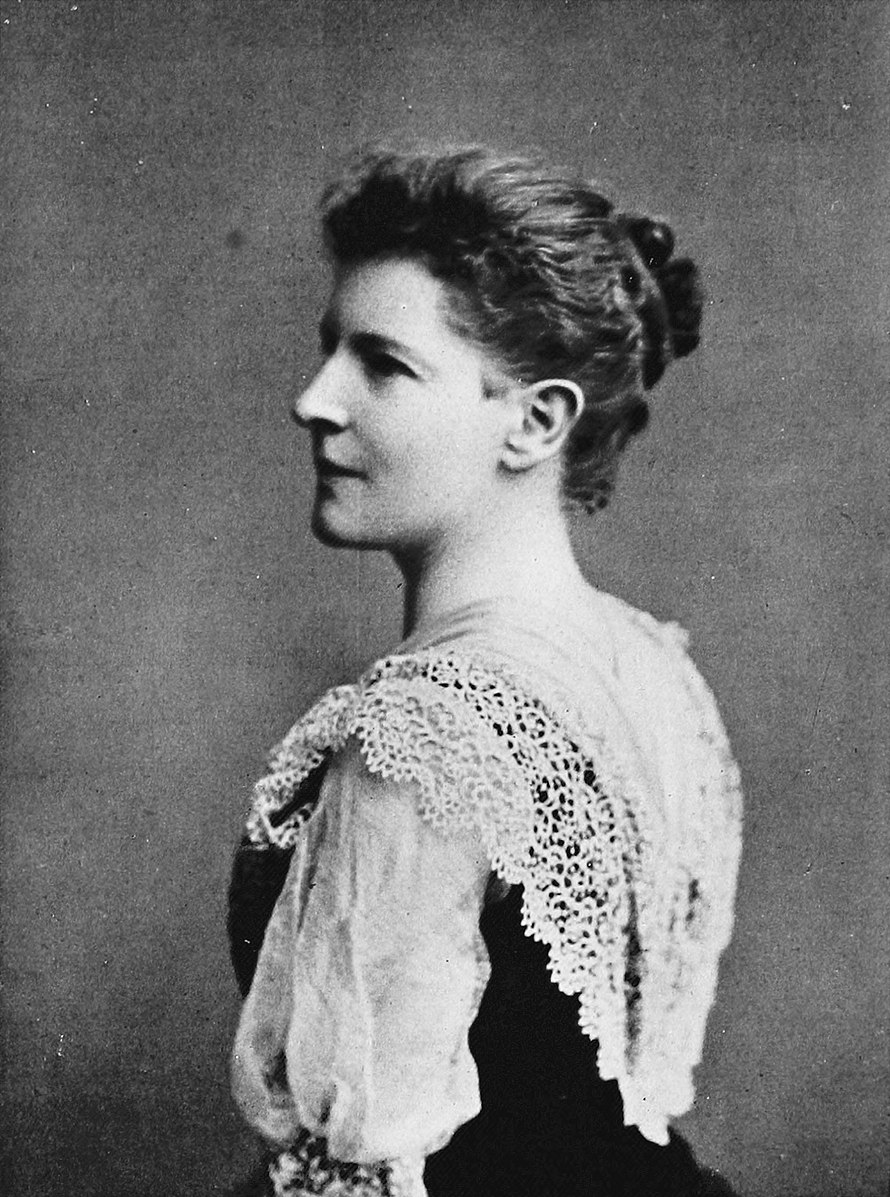
From G Vandyk Ltd, An admiral’s wife in the making, 1860-1903 (1917), via Wikipedia. Public Domain.
Which brings me to Lady Poore. Ida Margaret Graves Poore (1859-1941) was, according to Wikipedia, “an Anglo-Irish autobiographer and poet”. Her husband was the baronet, Sir Richard Poore, who became an Admiral in the Royal Navy, and was posted to Sydney from 1908 to 1911.
As you can see from those dates, Lady Poore was only formally involved for a year or so, though later reports occasionally mention that she continued to ask about the Club long after she’d left. She was, though, involved in a little controversy, which many papers reported on – and which she herself managed to treat with self-deprecating humour. (She really sounds like something.) Here’s what happened …
In April 2010, Lady Poore presided over the first annual meeting of the Bush Book Club, at Sydney’s Town Hall. The Sydney Morning Herald (6 April) reported on the meeting, and noted that Lady Poore was keen to “impress … the actual need of books”. She talked about the paucity of reading matter in many remote areas, and argued against the opinion held in some quarters that people who had little leisure for reading needed nothing more than the weekly newspaper. The Sydney Morning Herald‘s report of her speech continues:
If she as a temporary, and she honestly thought, sympathetic dweller, in their midst, might be allowed to offer a criticism, she should say that what the Australian national character lacked was imagination. Commonsense was really “common” here, and she knew no quality of greater practical value but fancy, vision imagination, call it what they would, was not common, and without books she did not see how it was to be awakened, fostered, and rendered articulate. There might be in New South Wales bush-poets in embryo as powerful as Lindsay Gordon, as humorous and pathetic as A B Patterson* (who she was glad to say, was one of their vice-presidents) – bush-novelists too and bush naturalists; but without the help and stimulus provided by reading they would … die full of unexpressed, because un-expressible, ideas. Apart from those who might succeed in literature, there were many whose hard, workaday lives would be made brighter and more beautiful by the reading of books.
I’m going to put aside her examples of writers to emulate, and cut to the controversy chase. As you can imagine, there was quite a reaction to the idea that Australians lacked imagination, though there was some misreporting. One columnist, for example, thought she was only referring to children, and another to women. Then there was “Roseda” writing in the Wellington Times (14 April 1910) in central western NSW. She (I assume) says that Lady Poore might be right about reading stimulating imagination but, she writes,
To me it seems the Great Silent Bush has more imaginative influences than any book. It is all inspiration and should beget the fancy monger. If it lacks this the fault is in the individual and yet not his fault either. Bush dwellers are too much occupied to have leisure for imagination. Patience say I ’twill come. Are we not producing some of the best songsters in the world? Soon there will be a need of songs for them and then poets will emerge from their slumbers. Bush bards evolve yourselves please.
I love the light tone … indeed, the interesting thing is that while the reports I saw didn’t agree with her, neither did they take severe umbrage, suggesting to me that she and/or her endeavour were much appreciated.
Later in April, Lady Poore attended the birthday of The Optimists’ Club (which she was encouraging to support the B.B.C.). The Daily Telegraph (27 April) reports her referencing her little faux pas. She apparently told the gathering that the press certainly didn’t lack imagination, and that
If she could conveniently take off her hat she would take it off to the press in recognition of the extraordinary kindness, not to say leniency, with which they had treated her— a stranger. A weekly publication of great literary merit likened her to a seagull. Could imagination go further? That was before she was a month in Australia, and it earned her undying gratitude, by the pretty, if unmerited, compliment. A daily paper of high standing credited her with a handsome heliotrope satin gown and a riviere of diamonds — neither of which she possessed — and she had never forgotten the inventive kindness of the writer. Indeed, the press of Australia had invariably used her with a generosity far beyond her deserts, and their recent criticisms had only whetted her appetite for information concerning a country and a people she had a good reason to love.
Ah Lady Poore, what a charmer.
I was going to write more in this post, including about the actual books and the early achievements, but I don’t want to try your patience so I’m going to hold that over until next week. You will be hearing more about the B.B.C.
* In my reading of newspapers in Trove I come across many misspellings, particularly of Banjo Paterson (as Patterson) and Katharine Susannah Prichard (as Katherine and/or Pritchard), suggesting that sub-editing was not necessarily better in the olden days!



 Whispering Gums