A.B. Paterson, The Man from Snowy River and other verses

Cover for The man from Snowy River and other verses (Courtesy: Sydney University Press)

Is there an Australian out there who doesn’t like Banjo Paterson? Who can’t sing “Waltzing Matilda”, or quote a line or two from “The Man from Snowy River” or “Clancy of the Overflow”? While some of the 12 titles chosen for publication by Sydney University Press in its first set of Australian Classics Library might be surprising, the selection of A.B. Paterson’s The man from Snowy River and other verses should not be. Indeed, Peter Kirkpatrick writes in his introduction to this edition that “You’re about the read the most famous book of Australian poetry ever published”. As well as having been published in entirety many times over the more than 100 years since it first hit the streets in 1895, its poems have also appeared in collected works editions and too numerous to count anthologies. This then is not really the sort of book a reviewer “criticises” in the traditional sense of the word.

Perry Middlemiss, at the appropriately named  Matilda, recently reprinted an 1895 Brisbane Courier review of the first edition. This review makes it clear that many of the poems were already well-known and quoted “all over Australia”. And nothing, I’d say, has changed in the intervening century or so! Why is this? In Derek Parker’s  new biography, Banjo Paterson: the man who wrote Waltzing Matilda, Paterson is quoted as saying:

Poetry is older than civilisation … and it will make men laugh or weep or fight better than any acting or speech-making. Of course, this only applies to real poetry, and not to the verse that most of us write. There is a great difference between poetry and verse, and when a man speaks of real poetry, he should always take his hat off.

So Banjo, it seems, didn’t make great claims for art…I’m not so sure about that.

Paterson was 31 when this collection was published. Many of the poems had been published in The Bulletin, whose editor, according to Peter Kirkpatrick, wanted his readers in the lead up to Federation in 1901 “to imagine the kind of nation Australia might become”. Paterson was an important tool in his vision-making armoury. This provides an interesting hook from which to view the poems. What is the Australia and what are the values that Paterson espouses?

Paterson was born in the country but at the time of writing these poems was a city solicitor. Many of the poems, though, romanticise the country over the city, such as “the foetid air and gritty of the dusty, dirty city” versus “the vision splendid of the sunlit plains extended” (“Clancy of the Overflow”). And many, in a similar vein, champion the underdog – the working man versus the toff or boss. It’s not always simple black and white though. If you only knew Paterson from his well-known poems like “The Man from Snowy River”, “Clancy of the Overflow” and even “The Geebung Polo Club” you would be forgiven for thinking his view of the bush and bushmen was romantic. This is not completely so, though. Paterson in fact chronicles human behaviour in all its diversity. Alongside the hardworking drovers and shearers (albeit some with a touch of cunning) like “Saltbush Bill” and the characters in “A Bushman’s Song” and “The Droving Days”, there are the easily duped “Man from Ironbark”, the rogue Ryan who is helped to escape the law by his loyal girl in “Conroy’s Gap”, and the cheating horse-owners whose attempt to sell off a poorly performing horse comes back to bite them in “Our New Horse”. Having read William Lane’s The workingman’s paradise I was tickled to see a reference to shearers and unions in “A Bushman’s Song”: “‘We shear non union here,’ says he. ‘I call it scab’, says I”.

Many of the poems are humorous: there are characters whose gullibility lets them down as in “Johnson’s Antidote” and others who fail in their attempts at trickery (often to do with horse-racing). Paterson lauds ingenuity, but not when it is deceitful. There are also the nostalgic poems yearning for the romance of the simpler past (before money and business got in the way), such as “On Kiley’s Run”. And then, of course, are the tragic ones, speaking directly of the hardships of life. The saddest has to be one of my childhood favourites, “Lost” (“Though far and wide they sought him, they found not where he fell;/For the ranges held him precious, and guarded their treasure well”). Another is “Only a Jockey” about a 14-year-old jockey who dies in a training accident (“What did he get from our famed Christianity?”).

While all the poems are rhyming, Paterson uses a great variety of rhythms and rhyming schemes to match the tone of his “verse” – from the heroic, romantic and elegaic to comic. There’s also intertextuality (such as Clancy appearing in “The Man from Snowy River”) and a good deal of irony. I like the self-conscious story-telling in poems like “Conroy’s Gap”:

And that’s the story. You want to know
If Ryan came back to his Kate Carew;
Of course he should have, as stories go,
But the worst of it is, this story is true:
And in real life it’s a certain rule,
Whatever poets and authors say
Of high-toned robbers and all their school,
These horsethief fellows aren’t built that way.

Not all the poems work equally well – some are a little awkward and clumsy – but, taken as a whole, recognising the spirit in which they were written, they present an intriguing insight into late 19th century Australia and values, and make entertaining reading as well. Whether you call it poetry or verse, I take my hat off to Banjo!

A.B. Paterson
The Man from Snowy River and other verses
Sydney: Sydney University Press, 2009 (orig. pub. 1895)
128pp.
ISBN:9781920899035

(Review copy supplied by Sydney University Press)

Favourite Australian novel

Matt over at A Novel Approach has brought to my attention the Australian Book Review’s poll to find our FAN, that is our Favourite Australian Novel. Not, they say, Australia’s favourite novel (which would end up with books like Lord of the Rings on the list), nor our favourite Australian book (which could very well result in memoirs like A fortunate life or Mao’s last dancer being on the list). No, we are talking our Favourite Australian (ie written by an Australian, however you personally define that) Novel (ie prose fiction of a certain length) of all time.

ABR is keen to get a good poll going: they are offering some rather nice bookish prizes. So, here is your chance to make a difference – and possibly win a very appealing prize!

I’ve voted. It was hard. I don’t really like making such judgements about something that is so subjective – but the prize was calling. Ha! I wondered whether to go political – and choose a novel by a minority author like a woman, an indigenous person, or a non-English speaking background (NESB I believe they are – or were – called) person. Or, should I be a little iconoclastic, and choose a favourite book that has been forgotten and/or ignored by the literary establishment? In the end, though, I went with my heart and voted for the first Australian novel to grab and inspire me when I was still at school. Care to guess what it was?

Murray Bail, The pages

The pages, Paperback cover (Image: Courtesy Text Publishing)

The pages, Paperback cover (Image: Courtesy Text Publishing)

It’s not surprising that someone who calls herself Whispering Gums loved Murray Bail’s previous novel, Eucalyptus, and so it was with some enthusiasm that I picked up his latest novel, The pages, a few days ago. My edition, unlike the one imaged here, is the hard cover one and, funnily enough, it looks like the bark of a tree (like, say, a eucalyptus!). That makes sense I suppose since trees are the source of paper.

It is, I have to say, a bit of an odd book – but I did like reading it nonetheless. Plot-wise, it’s pretty flimsy. Middle-aged Erica, a philosopher, goes outback with her friend, the psychologist Sophie, to stay with brother and sister graziers, Roger and Lindsey, in order to examine their late brother Wesley’s “philosophy”.  This gives the novel two narrative strands – the women’s experiences as they stay with Roger and Lindsey interspersed with the told-in-flashback story of Wesley and how he came to write his philosophy. Both strands are told in third person until near the end when, as Erica starts to read some of Wesley’s writings (his “pages”), his strand switches to first person.

Occasionally inserted between these strands are funny little digressions on topics such as hospitality in relation to philosophers and psychoanalysts (Ch. 8), and psychoanalysts, philosophers and their chairs (Ch. 23). Juxtaposition may partially throw light on these but I’m not sure it does fully. Bail seems to want to say something about psychoanalysis (which Bail says is typified by the “endless sentence”) versus philosophy (“the long sentence”) but I’m not sure exactly what it is. He seems more negative about psychoanalysis, but philosophy is also found wanting.

I like the characterisation. Bail’s characters are very comprehensible as people and as types: the socially awkward but dependable Erica, the self-centred flirtatious Sophie, and the practical no-frills Lindsey, for example, are recognisable but interesting too. I also like the language, the description of the setting in particular is evocative but not overdone:

Through the window she saw a tall pale-grey eucalypt surrounded by a darker cluster of pines, elms, cedars. It pronounced a solid leave-it-or-take-it way of being. The simple strength of the tree: stand it alongside the lack of statement, on her part. For a moment – before looking away – Erica saw herself as resolute only in a few minor things.

There is humour in it too, mostly of the ironic or sly type. The solicitor, for example, is described as having “pursed lips from the many years of putting words in parentheses”. And, as you can see from that, there’s play on words, about words, and with words (and language): the sandstone “weathered and worn smooth by the never-ending revision of ideas” and the ambition of philosophers to “build a word-model of the world, an explanation, parallel to the real world.”

The book is rather elliptical (in both its literal and literary meanings). Wesley goes from country to Australian city to foreign cities and back to the country in search of a philosophy, a new way of understanding the world. During these journeys we are tantalised with “glimpses of clarity”  as he tries to comprehend what might comprise his philosophy while at the same time he is confronting (seeking?) something way more human – love. In these later moments he wonders whether  “the ambition to supply the answer to everything is a form of madness” and suggests that “philosophers have been unsatisfactory in the examination of emotions”. Meanwhile, Erica moves from the city to the country (a physical and metaphysical “interior”) to, she hopes, find a new philosophy in Wesley’s “pages” but what she actually finds, in the country, is love. Somewhat akin to Wesley’s questionings she comes to wonder “what possible dent could philosophy make on the fact of existence?” Contrasts and contradictions underpin the book.

Earlier, around the middle of the book, it is said of Wesley that he “was finding a gap existed between the clarity of his chosen subject, and the softer unavoidable intrusions of everyday life”. It seems to me that, by the end, he has not closed that gap OR, rather, he finds that true philosophy lies IN the gap. The final line of the novel is that “we are philosophers; we cannot help being”. I love the wordplay on the last word: “being” as in “existing”, and “being” as in “being philosophers”.

Somewhat similarly, Erica says near the end of the novel:

One of philosophy’s functions has always been to shine light into the dimly lit, the imprecise, the hopeful.

What we find reflected in Bail’s The pages, then, is “a glimmer of clarity” that, for we readers as for the characters, comes and goes with the “light”. And, isn’t that pretty much how it is in life?

Murray Bail
The pages
Melbourne: Text Publishing, 2008
199 pp.
ISBN: 9781921351464

Note: I’ve read a small number of reviews since reading this book, seeking a more complete understanding. These reviews are more erudite than mine and most are longer so delve a little more deeply, but none, really, offer me a better understanding. The one I like the best, because it most closely reflects my understanding of and reaction to the book, is by Hermione Lee.

Flight of the Mind: Day 1, Summary

Geraldine Brooks, 2008 (Photo: Jeffrey Beall, via flickr, under Creative Commons CC-BY-ND-2.0)

Geraldine Brooks, 2008 (Photo: Jeffrey Beall, via flickr, under Creative Commons CC-BY-ND-2.0)

Today I went to the National Library of Australia’s Flight of the Mind conference – and, well, my mind took flight! The conference title comes from Virginia Woolf:

The old problem: how to keep the flight of the mind, yet be exact. All the difference between the sketch and the finished work.

Today’s program focused largely on the nexus between fact and fiction (or imagination). The sessions were:

Session 1: Kenneth Binns Lecture

Geraldine Brooks set the tone – as of course she must, being the key-note speaker – by arguing the value of historical fiction. It’s just as well Inga Clendinnen wasn’t there because, like Kate Grenville, Brooks argues that there is validity in “putting ourselves in someone else’s shoes”. She argued that in historical fiction we get “the constants of the human heart” even though the “material world” might be different. She said that the things that divide us – race, gender, creed, time, place – are less significant than the things that unite – love, pity, fear, compassion, and so on. I like her view of the world! I felt like asking her whether she agreed with Inga Clendinnen’s statement in The history question: Who owns the past? (Quarterly Essay 23) that: “It is that confusion between the primarily aesthetic purpose of fiction and the primarily moral purpose of history which makes the present jostling for territory matter”!! Basically, Clendinnen disagrees that novelists can make a contribution to history through, what Grenville described as, “empathising and imaginative understanding”. I’m simplifying a bit of course but, as I understand it, this is the nub – and I fundamentally disagree with Clendinnen (much as I admire her!)

Session 2: Creating fiction from fact: History as inspiration

The three speakers in this session essentially continued along Brooks’ theme, arguing about the truths that can be explored through fiction, with Goldsmith going so far as to say that as well as creating fiction out of fact, novelists can create “fact from fiction”. Rodney Hall talked a bit about the process of writing historical fiction and quoted Robert Graves who once told him to “write first, research later”. Hall suggested that it is important to get the facts right because once a reader stumbles across something they don’t believe, it interrupts the reader’s ability to lose themselves in the text. Fair enough I think – but clearly there are facts that need to be “right” and facts that can be “toyed with”. Otherwise, how could Hall get away with writing a novel titled The day we had Hitler home in which Hitler comes to Australia? It seems to me then that whichever way you look at it, readers of (historical) fiction need to understand in the end that they are reading FICTION!

Session 3: Recreating a creative life

This session focussed on the challenges of writing biography – of finding information, of making selections regarding what to include, and so on – and there were some interesting issues discussed but I’ll leave those for now.

Session 4: Writing across boundaries

Felicity Packard, who teaches creative writing as well as being a practising writer, made some points which clarified things nicely. She talked about working within the conventions of dramatic writing (such as Aristotle’s classic 3-part structure and the need to focus on just a couple of main questions) and the conventions of form (such as the 13-part television series). The other two speakers also referred to the issue of form. It made me realise that the writer of historical fiction works within two constraints – that of form, and that of the history they are working with. It can’t be easy!

Kevin Brophy also talked about the issue of plausibility. He said that journalism needs to do little to achieve plausibility, while fiction needs artifice to reach the same goal. And this brought me back to Geraldine Brooks’ reference in her key-note address to journalism being “the first rough draft of history”. Journalists, she said, get down the facts that are available at the time; then historians go back later and fill in the gaps using the additional records available to them after the passing of time. After all this is done, though, there are still voids – voices that are missing, such as, for example, those of the inhabitants of the plague village of Eyam upon which her novel Year of wonders is based. The historical novelist is, she said, “the filler of voids, the teller of lies” that convey “the emotional truths … the constants of the human heart”. I do wonder what Clendinnen would have said had she been there…but, in my view, today’s speakers did a good job of balancing “the exact” with their “flight[s] of mind”.

Oh, and if you would like a summary of Day 2, don’t look here. Due to other busy-ness, I only booked to attend Day 1.

Favourite writers: 3, Thea Astley

I love its densely woven grammar, its ingrained humour, its uncompromising politics, and its undimmed outrage at human folly, stupidity and greed (Kerryn Goldsworthy on Thea Astley’s writing)

and

Great story, great characters … Stylistically, however, this book is like a very handsome, strong and fit woman with too much makeup on … This kind of writing drives me berserk” (Helen Garner, on Astley’s “An item from the late news”)

Despite winning four Miles Franklin awards along with several other major Australian literary awards, Thea Astley (1925-2004) has to be one of Australia’s most underappreciated writers. The two quotes above, from two significant Australian literati, give us a clue why. She was uncompromising and gutsy in her subject matter and she took risks with her style. This made her a pretty controversial writer. It also makes her great for discussion by reading groups (if they’re prepared to give her a try!)

Before I continue, though, I need to be honest. Her career spanned over 40 years and some 15 or so novels, as well as countless short stories, essays and articles, but I have only read about half of the novels and a few short stories. I’ve read enough though, from her mid career A kindness cup (1974) to her last novel Drylands (1999) to know that I like her and want to read more.

Take Drylands, for example. It covers a lot of the things important to Astley. Two major ones are words and their importance/their power, and people’s cruelty to each other. Subsumed in this latter one are some recurrent issues for her – gender, race, and other power imbalances. She has several targets in this book: she’s not too fussed on computers, television, or our sports-mad society; she’s also critical about how women are treated, not to mention indigenous people and ‘oddballs’. She’s a writer with a strong social conscience – and, for example, tackled race issues head on in books like the ironically titled A kindness cup (1974) and the gorgeously titled The multiple effects of rainshadow (1996).

But it’s not her subject matter that loses her fans so much as her writing. It can be dense…though it can have a sly humour too. She once said in an interview with Candida Baker that “I can’t resist using imagistic language. I like it. I really don’t do it to annoy reviewers”! It’s how she thinks. Here, for example, are some lines describing a town and its “barbaric” Christmas from the first page of the novel, An item from the late news (1982), referred to by Helen Garner in my opening quotes:

…the beer-gut belchings and the rattle of schooner glasses that always discover the Christmas crib and soothe the infant with whack yoicks seem to me to have a muckworm style. All towns. Not just this one. Because this one is smaller, a mere speck on the world’s glassy eye, the grossness is horribly apparent.

Time usually diminishes the memory; but for me it has done nothing but magnify that swollen moment of history when Wafer had the wax on his wings melted from flying too close, not to the sun, but to the local grandees.

Astley, as you can see, is rather critical of small town Australia…and small towns are the common settings for her books. I’m not sure why I, an optimist, like her jaded view of the world. Perhaps being an optimist enables me to take on board her concerns – concerns that are hard to argue against – without being ground down by them?  Anyhow, in 2002 she won a much-deserved, I think, special award at the NSW Premier’s Literary Awards for being ‘a trailblazer’.

I hope, if you haven’t read her before, that this has whetted your appetite. I’ll say no more but end with a favourite line, with which I identify, from Drylands :

… she had never been harried by the glamour of any possessions but books.

(Note: You may notice that some of the content of this blog is also on Wikipedia. Please don’t accuse me of plagiarism: what I’ve used here is material I put there!)

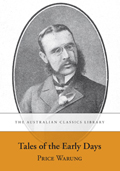
Price Warung, Tales of the early days

Tales of the early days (Cover: Courtesy Sydney University Press)

Tales of the early days (Cover: Courtesy Sydney University Press)

Okay, I admit it, I have convict ancestors (plural even!). Consequently, I was particularly interested to read Price Warung’s 1894 collection of short stories, Tales of the early days, when I discovered it was part of the Australian Classics Library recently published by the Sydney University Press. My convicts include John Warby who, with another labourer, stole two donkeys and was transported to Australia on the Pitt in 1791, and Sarah Bentley who stole several items of clothing from her mistress in 1795 and was transported on the Indispensable. In 1796, John married the 16-year old Sarah. Fortunately (for me and for them), they were a hardworking pair. John had been given land by Governor Phillip in 1792, and he and Sarah made a good life for themselves, so much so that there is now a primary school named after him, the John Warby Public School in the Campbelltown area west of Sydney.

Enough about my family, though. What about Price Warung? He was, in fact, William Astley, and was born in Liverpool, England, in 1855 but came to Australia with his family in 1859. He became, according to the succinct little biography at the back of the book, a radical journalist and short-story writer, with particular interests in transportation (or, convict) literature, and the Labour and Federation movements.

Now to Tales of the early days. This was his second published collection, and comprises 8 stories set in Norfolk Island, Hobart, Sydney and London. They explore various aspects of convict life, and many draw on real people and events. In fact, my city’s new (and first) prison is named after the penal reformer/prison commandant, Alexander Maconochie, who features in the first two stories. The eight stories are worth listing for their titles, most of which convey a strong sense of personality:

  • Captain Maconochie’s ‘Bounty for Crime’
  • The Secret Society of the Ring
  • In the Granary
  • Parson Ford’s Confessional
  • The Heart-Breaking of Anstey’s Bess
  • The Amour of Constable Crake
  • The Pegging-Out of Overseer Franke
  • At Burford’s Panorama

These stories can be described as “historical fiction”. In a new introduction to this collection, Laurie Hergenham quotes Thomas Keneally, who has written a deal of historical fiction. Keneally says:

the novelist need not prove his reliability to scholars … the only warrant a writer needs for his ideas about the past is that they reek of human, poetic, dramatic, symbolic veracity and resound in his imagination.

Like many writers of historical fiction, Warung draws on documentary fact. He writes largely in the social realism style that was typical of the nineteenth century. A strong theme runs through the book, and it can be best described by quoting Robert Burns’ “man’s inhumanity to man”. Warung’s particular argument is that this inhumanity is worse in the “System” (aka The Establishment) than in the convicts.  As one of the convicts says in the longest and, generally regarded to be, the best story, “The Secret Society of the Ring”:

Th’ System finds orl its orf’cers men, an’ leaves ’em orl brutes. Orl o’ we don’t get ‘ardened, but there ain’t one o yer wot doesn’t.

And so Warung, with his own apparently anti-British sentiment in the lead up to Federation (and Australia’s independence), perpetuates the myth that the convicts were poor souls turned bad by the System: “the beast-nature with which the System had superseded that granted unto him by his Creator”. It is true, if you read the histories, that some (many?) convicts were victims of poverty in Britain and were transported for comparatively minor offences, but there were also many who were violent, serial offenders. It is also true, though, that the treatment of convicts in Australia was, overall, very harsh – particularly in the secondary penal establishments like Norfolk Island and Hobart (at nearby Port Arthur). It’s not for nothing that Warung, with the fire clearly in his belly, chooses these as the settings for most of his stories of horror.

The first story, “Captain Maconcochie’s Bounty of Crime” serves as a useful introduction to the longest and most complex in the book, “The Secret Society of the Ring”. It introduces us to Maconochie and his desire to improve “the monstrous conditions of penal life at Norfolk Island” but, we are told, the System does not want him to succeed because his failure would mean “that the System was right and its administrators were wise”. And so, the cynicism (or is it simply realism?) starts:

Therefore the failure was only to be expected. Men do not care about being proved wrong, even if it could be shown that a few dozen souls were saved in the process of correction.

This truth, as Warung conceives it  and which encompasses related truths relating to the behaviour of men in power, is played out again and again in the stories that follow – but it is no more ironically conveyed than in “The Secret Society of the Ring” in which the Ring, which is the convicts’ own “system”, turns out to be every bit as cruel and inflexible as the System that controls them. Maconochie’s attempt to appeal to convicts’ (“society’s wrecks”) sense of fraternity and loyalty to each other – and along the way provide them with a more comfortable prison life – is undermined by the loyalty demanded of the Ring. This is a devastating story – and the most sophisticated in the collection in terms of style and structure.

The third story, “In the granary”, is no less devastating, and turns on the irony of a granary, designed by “a genial officer”, being put to far from genial purposes. This story has an interesting, given Warung’s own work as a journalist, discussion of the power of newspapers. “Parson Ford’s Confessional” is the only one of the collection that doesn’t focus on convicts. Rather it explores corruption among those in power just, I suppose, to make sure we know that this corruption does not only occur in relation to convicts. The next three stories chronicle events in the life of a particular character: Anstey’s Bess, a convict woman whose maternal love nearly brings her down; Constable Crake whose lust does bring him down; and Overseer Franke, the ironically nick-named Cherub who selects the architect of his downfall (but the triumph here is rather Pyrrhic). The final story is set in London and nicely shows us what those “at home” were seeing of the colony while also providing a final opportunity for corruption and power to again ensure that the downtrodden remain that way. (It is also the only story to refer to the Aboriginal people of Australia – and the reference is surely ironic when he describes the “Savage King” Bennelong’s recognition of “the new era of civilisation”!)

Warung’s style is not subtle – he uses irony heavily, foreshadowing, symbolism, some wordplay, the occasional repetition and understatement, and authorial intrusion – and he can over-explain at times, not trusting always that the reader gets it. It would be a very dull reader, though, who didn’t! The tales are, it has to be said, pretty black and white. The System is demonstrated again and again to be corrupt and cruel, with no attempt made to explore the privations those in power also suffered. That said, the stories are powerful and, despite their lack of “balance”, convey enough truths to make reading them worthwhile for both their narratives and the messages underpinning them. It is good to see them brought to life again.

(Review copy supplied by Sydney University Press)
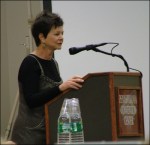
Marion on Marion (Halligan)

A few days ago I posted a review of Marion Halligan’s latest book, Valley of Grace, and mentioned that Halligan had attended my bookgroup meeting at which we discussed the book. I didn’t, however, share in that post all of the things that Halligan told us – and I won’t in this post either. Some things are just not meant to be shared! Nonetheless, there are things we asked her that are of general interest to readers interested in writers and writing, and these I will share…

As readers often ask writers, we asked her about her writing process. She started off by saying that she never says she has writer’s block. This doesn’t mean she doesn’t get stumped at times but that when she does she just moves on to other writing she has on the go. Valley of Grace was, she said, written essentially over 20 years. She made notes for it back in 1989 when she was living in that apartment in Paris that overlooked the Val de Grâce church. And then, when she got a little stuck in her novel The point, which was published in 2004, she took out the notes she’d made back then and worked them up into a short story. Sometime later, she realised that it was more than a short story and voilà, we now have the book (though it took perhaps a little more than voilà for her to get from short story to book!).

Hand and pen, from Clker.Com

Hand and pen, from Clker.Com

Now, here’s the interesting bit: Halligan writes by hand! She says that the slowness of the eye-hand-paper process makes you think harder and results, for her anyhow, in fewer drafts. Essentially, she writes the story out by hand and then reads it over crossing out and adding in, etc. She then reads it again – often reversing the changes she’d made! It is only then that she types it into her computer, and the sense we got was that at this point it’s pretty much ready to go. We didn’t – silly us – ask her much about the publisher’s editors.

We talked a bit about the use of imagery, including metaphors. She says that much of this is unconscious, that if you are an experienced writer and you get into your story’s mode, the imagery seems to just come (such as the use of light, yellow etc in Valley of Grace). She talked specifically about the challenge of using metaphor and how writers often don’t think them through. Her example of a poorly thought through metaphor was  one writer’s description of a person’s bottom during lovemaking as “white dunes of sand”! The mind boggles rather. Anyhow, this brought to my mind a statement she makes in one of her more self-conscious books, The fog garden:

That is the trouble with metaphor, it may take you to places you don’t want to go.

She had more to say on writing, such as to beware of using too many adjective and adverbs, and that for her books are not about answers but about questions. In Valley of Grace the over-riding question, really, is about the soul, about what makes us human. Now, it’s hard to get a bigger question than that!

We also talked a little about reading and what we like. Halligan is not keen on issue(ideas)-based fiction: she doesn’t think it’s interesting. This is an issue I have referred to briefly in a couple of my reviews, specifically in This earth of mankind and The workingman’s paradise.

Finally, we couldn’t let her go without asking her about her literary influences. Not surprisingly, given that she’s been writing for a long time now, she couldn’t really say, but she did name some of her favourite writers. These included Margaret Drabble, William Trevor, and John Banville. Interesting, eh, that they are all Irish or English! Clearly, I really must read that William Trevor languishing my TBR pile!

Anyhow, you can probably tell from all this that Halligan was generous with her ideas and her time. It was a real treat having her there…

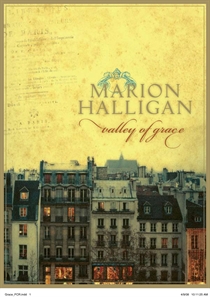
Marion Halligan, Valley of grace

Valley of Grace book cover (Courtesy: Allen & Unwin)

Valley of Grace book cover (Courtesy: Allen & Unwin)

Delicious but sly are the first words that come to mind when I think about Marion Halligan’s latest novel, Valley of Grace. Take this for example:

You know, people think flowers are pretty. Sentimental. Frivolous even. But the fact is, everything begins in the garden. Humans. Society. Civilisation. Evil. Things bud, bloom, weather, age, die. There is as much decay as there is burgeoning. Gardens offer emblems of our passage through the world.

Sly because you know she is alluding to the Garden of Eden here but, without the snakes, apples or trees, the garden symbolism is wider, more encompassing than the simple biblical Fall of Man. Delicious because the language flows so beautifully – and it’s typical of the sure writing that’s found throughout the book. The style is relaxed and flowing, even when it is staccato (if that makes sense). It feels conversational, and yet it is not colloquial. And, it contains Halligan’s hallmarks – wonderful descriptions of food and wine, of home and gardens.

The novel is set in contemporary Paris and chronicles a few years in the life of Fanny and her family and friends. At the beginning of the novel she is 25, single, and working with the gay Luc in his antiquarian bookshop, but very soon she marries builder and restorer of old buildings, Gérard, who is 38. There’s no mystery about this – you can see it coming and it comes. What doesn’t come after that is a baby.

There are no big dramas in this book so if that’s what you like, this is not for you. It is however the book for me, because while I can enjoy a book with drama, that’s not what I read books for. I read them for the very things that I got out of this book: astute observation of humans and how we think and behave, combined with writing that delights, inspires and grabs. Valley of Grace explores all the sorts of things that make up human experience – love and friendship, betrayals, secrets, appearance versus reality, and more besides – but most of all it is about babies and children. The having of them, the not having of them, the healthy and the damaged, the child and the god-child, and the wild child are all covered in this neat little book.

And, in fact, as Halligan told us at our bookgroup meeting tonight (to which we’d invited her and she’d wonderfully accepted), children were a major inspiration for the book. She lived in Paris in 1989 and, from her apartment window, could see the church, Val de Grâce, which was built by Anne of Austria as her part of a bargain with God to give her a child (Louis XIV, no less). This story fed into Haligan’s thinking about fertility (the presence of it and the absence of it) and about how in the past women came to “a bad end” if they didn’t have a baby or had a baby at the wrong time. She said that in the 1960s we thought this would all change but in fact it hasn’t quite turned out that way because women are having babies later and the result is more problems (such as infertility, increased miscarriages, “damaged” babies). This book is, then, her meditation on children – who they are, what they mean to us. And the following will show you just what Halligan thinks they mean:

Taking an angry or maybe anguished baby and changing it from a stiff protesting awkward bundle into a relaxed kitten-like creature seems to Fanny as important a thing as anybody could ever do.

The novel is told in third person but from different perspectives in different chapters – with some wonderful set-pieces, such as the story of Sabine and her arrogant philosopher husband Jean-Marie to whom she delivers “the pavilion girls”. Halligan said that telling the story this way replicates the way life goes – we are the heroes of our own stories, but bit-players in those of others. This makes sense – and certainly works well in the book.

There is a luminous quality to the book, conveyed largely through imagery to do with light and colour (mainly yellows). Mostly it is comforting, but sometimes it is not. Here is Fanny in the Val de Grâce:

She looks up at the immensity of the pale grey stone. Even with all the decoration, the cherubs, the frescos, the marble and gilt columns, it has a bareness, a coldness. It’s the colour of concrete, There’s no stained glass. The light is silvery; when the sun shines, lemony. There is no comfort in it, as there is in her house.

And then in her apartment:

She looks at the graceful space of the apartment. At the light, greenish gold today with summer sun and the fresh leaves on the chestnut trees, their milky white flowers buzzing with bees.

It’s a short book – just under 250 pages – and a rather gentle one. It’s sometimes a little sad, but other times it has a wry humour.  It’s well researched, but the research hangs lightly on it. Its ending is one of the most inspired I’ve read for a long time – but you’ll have to read it yourself to see if you agree.

I have read a few Halligans over the years – Lovers knots, The golden dress, The fog garden and The point – and have enjoyed them all. I’ll close this post with a favourite line from The fog garden because I think it describes this book to a T:

Read a wise book and lay its balm on your soul.

William Lane, The workingman’s paradise

Wealth and Poverty both seem to degrade most of us. (p. 249)

The workingman's paradise (Courtesy: Sydney University Press)

The workingman's paradise (Courtesy: Sydney University Press)

So says Bohemian Connie Stratton to the hero Ned Hawkins in William Lane’s 1892 novel, The workingman’s paradise. William Lane, an English-born journalist, union supporter and socialist, wrote under a number of pseudonyms including John Miller, the name he used for this novel which was re-published this year as part of the Australian Classics Library.

Lane writes in his preface that the book was titled and written “hurriedly”, in order to:

  • raise funds for unionists imprisoned during the Queensland Shearers Strike of 1891; and
  • explain unionism to non-unionists and Socialism “to all who care to read or hear, whether unionists or not”.

If this suggests to you that The workingman’s paradise is a social-realist novel, you would be right. It is very much a novel of ideas, which presents a bit of a challenge: shall I focus on the polemics or on the literary aspects? I will try to cover both – but it is worth reading this edition’s new introduction by academic, Andrew McCann, as it rather nicely explores the politics behind the novel.

As with many polemical novels, the plot is pretty minimal. It concerns two childhood friends, Nellie and Ned, who meet up again in Sydney in the 1880s having not seen each other for many years. Both are children of selectors who have struggled and both have become quite politicised, though at the beginning of the novel Nellie’s understanding of politics is broader and her commitment to the Cause (aka Socialism) more complete than Ned’s. Nellie loses no time in introducing Ned to the underside of Sydney life, and to her friends (who include the Connie of the opening quote). It is through these experiences that Ned’s political education is cemented. Oh, and there is of course an attraction between them!

The novel is divided into two parts: the first is set in the late 1880s when Ned comes to Sydney and meets Nellie and her friends, and the second takes place a couple of years later, on the eve of the Queensland Shearers Strike, when Ned returns to Sydney to garner support for the shearers. Without giving too much away, there is no real resolution to the plot, something which Lane refers to in his preface: “This plot got very considerably mixed and there was no opportunity to properly rearrange it”. If you read for plot, then, you may be disappointed, but if you read for characters, ideas and a fine use of the English language, this is well worth the effort. And there is some effort involved because, while it is not a particularly long novel, its main focus is its ideas and they require a reasonable level of concentration. There are a couple of places, such as socialist Geisner’s long discussion with Ned, which can become a little heavy-going if the subject is not to your interest.

Lane writes in a high rhetorical style that is rather typical of novels whose main purpose is didactic. He effectively uses such techniques as repetition (particularly anaphora), declamatory statements, and classical and biblical allusions to convey his message. This style can feel unsubtle and old-fashioned to modern ears but in Lane’s hands it has a certain beauty. There is, for example, a sophisticated use of repetition at the beginning of Part 2, Chapter 1: The slaughter of the innocent. Nellie is sitting with and thinking about a dying baby and, after each set of thoughts, is the following repetition:

So Nellie thought, sitting there beside it … (p. 152)

So Nellie thought, weeping there beside it … (p. 153)

So Nellie thought, the tears drying on her cheeks … (p. 154)

And that, you think is the end of them (three repetitions, after all, being the most common style), but then two pages later comes:

So Nellie thought, in her indignation and sorrow …

Through these repetitions we feel the buildup of her pain and see the progress of her thought from sadness to indignation.

The novel comprises more than simple argument though. In a nod to the romantic tradition, it is also a very visual novel with some effective descriptive passages, such as those showing us Sydney at its best and worst:

The streets, some wider, some narrower, all told of sordid struggling. The shops were greasy, fusty, grimy. The groceries exposed in their windows damaged specimens of bankrupt stocks, discoloured tinned goods, grey sugars, mouldy dried fruits; at their doors, flitches of fat bacon, cut and dusty. (p. 24)

and

At their feet the faint ripplings of this crystal lake whispered their ceaseless lullaby and close behind them the trees rustled softly in the languid breathings of the sleeping tree. Of a truth it was Paradise, fit above all fitness to gladden the heart of men, worthy to fill the soul to overflowing with the ecstasy of living, deserving to be enshrined as a temple of the Beautiful wherein all might worship together, each his own God. (p. 185)

The ideas expressed in the novel are simple, yet complex too. Through Ned and Nellie, and through discussions between two “masters”, the conciliatory Melsom and the “Capitalism personified” Strong, Lane explains the master-worker divide, the development of unions, and the “freedom of contract” idea. And through the meeting at the Strattons, and Ned’s later meetings with Geisner and then Connie, he conveys his conception of Socialism as a “religion” that “can only come by the utter sweeping away of competition, and that can only come by the development of the socialistic idea in men’s hearts”. (p. 138) True Socialism is defined by Geisner as “men working as mates and sharing with one another of their own free will [ie. not organised by the State]”. (p. 134) After reading this, you probably wouldn’t be surprised to hear that Lane ended up trying to establish a utopian community in Paraguay in 1893.

Using a variety of narrative techniques – including stories of characters met along the way – Lane manages to present a broad picture of working class 19th century Australia: the marine strike, the girls who end up on the street, the piece-workers at home, and the struggle to farm are just some of the stories woven through the book. Reading all this, you would think that Lane was the epitome of all that is humane, but for all the idealism – the arguments for gender equality, for the socialist ideal of equality between worker and master – the book has its discomforting side and this is its racist (specifically anti-Chinese) overtones. From very early in the book, the Chinese are held up, essentially, as the enemy in both city and country:

The fruiterers seemed not to be succeeding in their rivalry with each other and the Chinese hawkers. The Chinese shops were dotted everywhere, dingier than any other, surviving and succeeding, evidently by sheer force of cheapness … The day grow (sic) hotter and hotter. Ned could feel the rising heat, as though he were in an oven with a fire on underneath. Only the Chinese looked cool. (p. 24-25)

and

Then down would come the wages, up would go the hours and in would come the Chinese. (p. 238)

Even idealists, it seems, have their feet of clay!

This is the sort of book that can be read as a work of literature and as a work of political philosophy. While it can happily stand on its own as a literary classic for the quality of its writing, its prime value for me is its evocation of late nineteenth century Australia – an Australia which, you will have realised by now, was no “workingman’s paradise”!

Note on the text: The title page verso advises that the book is “a repaging of text files on SETIS, itself input from the 1892 edition …” I understand this text was input via OCR which is a boon for publishers wishing to reproduce pre-electronic texts but which can also result in a significant number of “artefacts” (misread characters). Sydney University Press has clearly worked hard to clean up the text but a number of these artefacts have slipped through. I understand they will be corrected for future printings.

(Review copy supplied by the Sydney University Press)

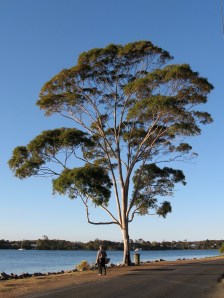
Time for another gum

Sydney Blue Gum on the Hastings River

Sydney Blue Gum on the Hastings River

This is, I believe, a Sydney Blue Gum (Eucalyptus saligna) though I could also be wrong as I’m very much an amateur when it comes to tree identification. It does look like: they can be found up and down the east coast of New South Wales, of which the Hastings River is part, and they can grow to 60 or more metres tall which this one certainly seems to be aiming for. Whatever it is, I couldn’t resist photographing it. It rather dwarfs Mr Gums below doesn’t it?

Blue Gums are apparently the trees referred to in Henry Lawson’s 1919 poem, “Chatswood”:

And a little wood was on it, and the trees were tall and good,
And his young wife used to dream there, so he called it “Chattie’s Wood”.

“Chattie’s Wood” has long since gone, and shops are standing in a row
Where the young wife went a-dreaming in a the days of long ago,

Chattie was apparently Charlotte Harnett, the second wife of Richard Hayes Harnett, a North Shore Sydney landowner in the 1860s and one-time Mayor of Willoughby, and she did wander the Blue Gum High Forest of Chatswood West. The trees have long disappeared (from there anyhow) and some suggest that Lawson played a little loose with the specific details of their story but  it is generally agreed that Chattie’s Wood is the origin of the name of the Sydney suburb of Chatswood.

Another poem, “Blue Gum Forest” (1976) by Roland Robinson, was also inspired by these trees:

The blue gums soar, naked
smooth, to where they over arch …

This year Australian composer Matthew Orlovich set this poem to music for a capella choir. I’d love to hear it one day. Anyhow, these are just two examples I found by doing some quick research. It seems that while the Sydney Blue Gum may have made way for shops in Chatswood, they still survive – in both physical and imaginative form. Long live the gum!