Best unread books of the decade

One of my favourite internet bookgroup friends – the one who gave me the Jane Austen diary – has just posted, on a listserv we belong to, a link to The Guardian’s list of books that got away over the last decade. Now, that’s a new take on lists isn’t it?

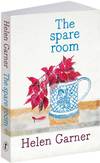
Spare Room

The spare room cover (Courtesy: Text Publishing)

They asked people like publishers, literary agents and translators to nominate books that didn’t make, but they think should have, “best of best” lists. I’ve only read one of the books nominated, Helen Garner’s The spare room. It was nominated by Jamie Byng, the Managing Director of Canongate which published it! Fair enough. I’m sure they published many other books that didn’t make the “best of the best” lists either so his selection has some credibility. I think he hits the nail on the head when he says  it is “deceptively slight”. It does seem pretty simple but Garner is a great writer, and an unflinchingly honest one too. Put these together and the result is a compelling book, even though Lisa at ANZLitlovers doesn’t quite agree. Actually, both of us disagree with much of the way Garner views her world but I admire her nonetheless. Read this:

The one thing I was sure of, as I lay pole-axed on my bed that afternoon … was that if I did not get Nicola out of my house tomorrow I would slide into a lime-pit of rage that would scorch the flesh off me, leaving nothing but a strew of pale bones on a landscape of sand.

Sometimes Garner fills me with a similar rage, but when she presents me with writing and imagery as powerful and as fresh as this I can’t help but love her at the same time…and agree that Jamie Byng has a bit of a point.

(NB. The funny thing, though, is that The spare room won a few awards in Australia so I’m wondering how valid a selection it really is in this particular list.)

Helen Garner
The spare room
Melbourne: Text Publishing, 2008
195pp
ISBN: 9781921351396

Andrew Croome, Document Z

Truth, according to the dictionary, can mean several things including:

  • the state of being the case, fact or actuality; and
  • a transcendent or spiritual reality.
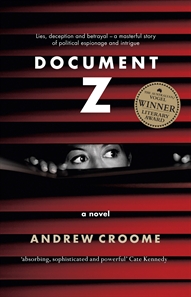
Document Z bookcover

Document Z cover image (Courtesy: Allen & Unwin)

Truth in all its variety and slipperiness is, I think, the fundamental theme of Andrew Croome’s Document Z which won the 2008 The Australian/Vogel Literary Award. This book, which chronicles the famous-in-Australia Petrov Affair about the defection of Vladimir (familiarly, Volodya) and Evdokia Petrov in 1954, began as a PhD Creative Writing thesis. Who needs a PhD in Creative Writing, though, when you have a publication offer instead?

At the end of the novel is a reference to an oral history that was conducted with Evdokia by the National Library:

This historian’s questions give her the space to betray Volodya, to admit his faults, to commit herself finally, to the truth. She doesn’t. The record is no all-important thing, and what exactly would be the point?

What indeed? After all, duplicity is what the book is about. Vladimir and Evdokia are MVD agents at the Soviet Embassy. This is their secret role, in addition to their formal embassy roles, and it puts them in conflict with the ambassador since, in effect, they work for two masters, the ambassador and the MVD headquarters in Moscow. Not an easy position to be in, particularly in a regime that thrived on suspicion.

Croome nicely structures the book, commencing with the dramatic attempt on 19 April 1954 by the Soviet authorities to return Evdokia to Russia. The book’s narrative form is multiple third person subjective, and this opening scene is viewed through Evdokia’s eyes: “Evdokia knew this crowd was for her. They were hunting her…”. She was wrong though. The crowd was with her and were “hunting” those who seemed to be taking her away. This opening chapter ends with the words, “Everything he had betrayed”. The scene is set to tell their story, and the book flips back to 1951 and their arrival in Canberra. From this point on the story is told through several eyes, particularly Evdokia’s, Vladimir/Volodya’s (who, Moscow thought, “could be well and truly trusted [my stress]”) and Dr Bialoguski’s (the man who worked for ASIO and who, through cultivating Petrov’s friendship, engineered the defection).

I enjoyed the book – partly because it was set in familiar territory, which is a bit of a rarity for we Canberrans, and partly because I was interested in the Petrov Affair. Croome seems, to the best of my knowledge, to have captured the era well. I loved the description of the Soviet Embassy wives going shopping…and he nicely evokes the polarisation of views between East and West/Communism and Capitalism that characterised the Cold War period. However, the book was a little unsatisfying too. I think it’s because Croome focusses a little too much on plot machinations for me – and yet the plot is not dramatic enough to support this. He does try to get “into” the characters but, for all his sound characterisation of the Petrovs, they are, at the end, pretty much as shadowy in terms of their “true” natures/desires/motivations as they were at the beginning. In the end, there’s not much drama in either the political or the personal story. It feels, almost, as though they were victims of circumstance – and perhaps they largely were.

And what were these circumstances? Well, they were largely the duplicitous – and fear-ridden – situation they lived and worked in. I had to laugh, early in the book, at the description of the embassy’s secret (MVD) section: “Somewhere, the roof leaked“. The book has many little ironies and paradoxes mostly playing on notions of secrets, lies, deception and betrayals, playing, that is, on a world in which truth is treated with rather careless abandon. By the end of the book we are, I think, no nearer the truth. We perhaps know some of the “facts” (albeit this is fiction!), but we do not “really” know the “spiritual reality” of these two people whose marriage seemed weak and who apparently lived a pretty sad life in exile.

I’d certainly recommend the book … it’s well written, and is a genuinely interesting portrayal of the case. But if you are looking for insights into the affair, I’m not sure you’ll find them here.

Andrew Croome
Document Z
Crow’s Nest: Allen & Unwin, 2008
350pp.
ISBN: 9781741757439

Arnold Zable, Sea of many returns

He leaps through centuries, tears apart myths, and reassembles them in his own way.

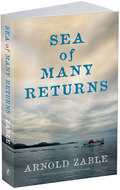
Sea of Many Returns cover

Cover image courtesy Text Publishing

These words that are said of one of the characters in Arnold Zable’s Sea of many returns could just as easily be said of Zable himself – not only of this book, but of his earlier ones such as Cafe Sheherazade. Zable loves telling stories, stories that weave between each other in an attempt to understand the impact of dislocation and exile on the human psyche – well, on his characters’ psyches but it is not hard to universalise this.

Sea of many returns is, essentially, a dual point-of-view novel:

  • the first person narrator, Xanthe, who was born in Melbourne to an Ithacan father and who tells her story; and
  • the third person story of Mentor, her paternal (also Ithacan) grandfather whose journals she is translating.

The story roams, backwards and forwards, from 1895 to present time as Xanthe and Mentor tell of the lives of their family members in Greece and Australia…about all their leavings and returnings, for work or adventure, or more terribly for war or, simply, to find a better life:

The stories I have heard, and am yet to hear, are echoes of one refrain: Is there somewhere on earth where I can find peace and prosper? Once the question is posed, the agony begins, the eternal dilemma: to stay or leave? To retreat behind fortifications, or cast our fate to the winds? (Xanthe, p. 203)

Underpinning this dilemma is the yearning for Ithaca – which translates, really, to the yearning for place, for home. Towards the end of the novel Mentor discusses the notion of “nostalgia” or “the pain of longing for the return”. Put this together with “the Ithacan phobia, the fear that I may never return” and the result is a melancholic – but not depressing – tone, since it is mostly accompanied by, if not always strength of mind, a resilience of spirit.

Not surprisingly, it’s the men who travel, at least in the earlier times of the book. As Xanthe’s aunt says, resignedly, “Let your men roam distant lands. Let them do what they must. What choice do we have? Bend your back to the mountain. Sow and reap”. And so, while Xanthe talks to some of the women in her Greek family, it is the men whose stories she seeks as she tries to understand her father, the angry Manoli, and her grandfather, Mentor. However, the book’s final section, titled “Epilogue: The resident tiller of the soil”, focuses on 90-something year old Irini who, quite paradoxically Xanthe realises, has not left Ithaca since her arrival there 90 years before and yet “is both voyager and teller, Odysseus and Homer”. This is perhaps a little elliptical but it has a certain resonance nonetheless! And Andreas does mutter in the previous section, “To know one place is to know all places”.

While the novel takes on a mythic overtone, it is “history” which provides its backbone and puts flesh on its characters: there are, for example, the way-too-many wars (to which many men go and from which some return), the 1916 anti-Greek riots in Kalgoorlie, the 1953 earthquakes in Ithaca, and the building in Melbourne of Cafe Australia and the Capitol by the Chicago architects, Walter Burley and Marion Mahoney Griffin. This last one seems a bit odd in terms of the overall thrust of the book but is interesting to one who lives in the city they planned!

I have only touched on a little of what this novel contains – there are the references to the Homeric quest and the story of Odysseus, there is the drunk but wise Niko, there is the beauty of the language in its rhythms and descriptions, and there is music – but if I go on, I might, like its storytellers, never stop. As Andreas says to Xanthe near the end

I have told you one version of the story and tomorrow I may tell it with a different slant. Each word I utter is true and false at the same time …

Paradoxical? Yes! But that is the essence of this lyrical and mesmerising but also rather mystifying – or, is that mythifying – book!

Arnold Zable
Sea of many returns
Melbourne: Text Publishing, 2008
307pp.
ISBN: 9781921351532

Jessica Anderson, The commandant

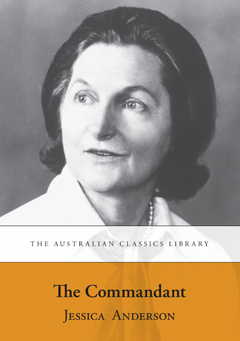
Jessica Anderson, The commandant Book cover

Cover image for The commandant (Courtesy: Sydney University Press)

When I first read about Sydney University Press’s Australian Classics Library, the book I really wanted to read waThe commandant by Jessica Anderson. It’s her only historical novel, but its subject matter doesn’t stray much from what she told Jennifer Ellison in an interview many years ago, “I was very much, and always have been, preoccupied with people who are strangers in their society” and “I am interested in families… They are interesting – you know, the tangle” (Rooms of their own). This is a clever and thoughtful novel by yet another much overlooked Australian woman writer.

[WARNING: SPOILERS, if you don’t know the history on which this is based]

The plot is pretty simple. It is set in Queensland’s penal settlement of Moreton Bay in 1830. It draws from the real story of the commandant there, Patrick Logan, who was noted for his harsh methods and who was murdered while out on an expedition. In the novel, Logan’s family is joined by his wife’s young sister (“the stranger”), Frances, who, on her way up to the settlement via Sydney, has been introduced to “radical” ideas critical of Logan’s regime. The scene is therefore set for potential conflict either between Patrick and Frances, or within Frances herself, or both.  In the end, it is a bit of both as Patrick finds his practices questioned and Frances confronts the realities of living in a penal settlement.

Except for Frances’s boat trip up to Moreton Bay with some of the settlement’s residents, the novel is set entirely in Moreton Bay. The characters include Logan’s household (family and servants), his wife Letty’s two women friends, officers of the settlement including two medical officers and the man sent to replace Logan, and of course some prisoners. There are also some characters in Sydney – Frances’ would-be beau and the sisters of a newspaper editor jailed for his criticism of the regime and against whom Logan is bringing libel action. The characters are well-drawn, with the significant ones nicely complex. You get a good feel for life in the settlement.

I would love to write about many of the characters as there are some wonderfully meaty ones, but I’ll just focus on Frances, the only character, really, who changes during the course of the novel. At the beginning, she “was seventeen; she was not stupid, but was often absurd”. She is also sympathetic to the idea of reform, which she says she developed through seeing servant life and poverty first-hand in Ireland and which puts her at odds with many in the settlement. She has a lovely ability to question herself, to see her failings, and it is this which enables her to learn from her several painful experiences. By the end, she is wiser in the ways of the world and has learnt to live with “incurable knowledge”, but has not lost her commitment to the cause of humanity.

Much of the story is told in dialogue – in fact, it wouldn’t be hard to turn it into a play/screenplay. Anderson handles this dialogue well, nicely differentiating the characters, from Letty’s lisp to officer Collison’s uneducated speech patterns. Letty’s lisp is an ironic touch – it lulls us into thinking she is one of those superficial flirtatious women but we soon discover that she is more complex than just a pretty little wife. Characters are nuanced by their reactions to each other  as well as by what they say, rather than by a lot of specific authorial comment, though there is that too.

There is also description, including some particularly beautiful ones of the bush during the search expedition for Logan, such as:

…a few clumps of trees, their rough bark the colour of iron, and their foliage a dun green, stood with the junction of trunk and root shrouded (my emphasis) by tall pale grass; and although at his left the river marked out a fissure of brighter greens, none among them were the sappy (again my emphasis) greens of England and Ireland or the dense fleshy greens of the coast … Among and behind this scrub stood big trees with foliage in similar colours, and with trunks of grey, or silvery grey, or of mauve shading to grey or rust, or of the beautiful colour of pink clay. It was as if everything here inclined not to the sun’s bright spectrum, but to those of the mineral earth and the ghostly daytime moon.

This is not an entirely benign landscape she is decribing – but neither does it hang heavily on her tale: her main focus after all is people. Here is an evocative description of Letty:

She fragmented the worry with her laugh, and waved it away with her hands, but it always seemed to reassemble, out there in the air, and float back to resettle on her.

One of the things that intrigued me most about the novel as I was reading it was the narrative form. It is a pretty straight chronology, but with many small flashbacks that help illuminate the characters. Most interesting though are a couple of slight but meaningful foreshadowings which, before the novel’s end, give us a sense of the sisters’ futures. This makes us realise that the novel is not really about them…it is about humanity, about how we treat each other – and, about that special word, mercy. You will have to read it for yourselves to know what I mean.

Jessica Anderson
The commandant
Sydney: Sydney University Press, 2009
326pp.
ISBN: 9781920898946

(Review copy supplied by the Sydney University Press)

Markus Zusak, The book thief

In one moment, there was great kindness and great cruelty, and I saw it as the perfect story of our humans are. (Zusak on the Random House website)

Zusak could hardly have chosen, for The book thief, a better setting to explore the best and worst of humanity than Germany during the Holocaust. The book reminds me a little of Ursula Hegi’s Stones from the river which also deals with a small German town during the war and the hiding of Jews, though Hegi’s book has a much wider canvas, covering a few decades.

The novel, which is narrated by Death, tells the story of a young girl Liesel (the book thief) who is left with a foster family in a small German town in the lead up to and during World War II. Liesel is treated well by her foster parents, Hans and Rosa Hubermann, and makes friends with people in the neighbourhood including Rudy Steiner, a boy her own age. Not long into the novel, the Hubermann household is also joined by Max, a 24 year old Jewish man whom they hide. From here we follow the family and the neighbourhood as they live through the war. The characters – and there are many of them – are well drawn.

It’s a clever, memorable book. The use of Death as a narrator and its structure, which seems both old world (the chapter titles ‘featuring….’) and post-modern (the inclusion of the illustrated stories, the little bold-type assertions like ‘A small threat from Viktor Chemmel to Rudy Steiner’, ‘He survived like this’), give it a fresh tone which impel the reader on. This tone has a veneer of whimsy while at the same time being deadly serious.

There is a bit of foreshadowing but it’s handled well. It tells us our narrator is omnipotent and warns us that bad things are going to happen (and we know they will anyhow). I don’t usually mind foreshadowing – and agree with Death who says:

Of course, I’m being rude. I’m spoiling the ending, not only of the entire book, but of this particular piece of it. I have given you two events in advance, because I don’t have much interest in building mystery. Mystery bores me. It chores me.

The star of the book for me is its language. It’s superficially simplistic but is really quite sophisticated. There are some wonderful images – ‘pimples were gathered in peer groups on his face’; ‘they were going to Dachau to concentrate’; ‘rumour of sunshine’; ‘the sky began to charcoal towards light’ – but these are not overdone.

Zusak effectively handles the fact that the characters are German and would be speaking German through the occasional use of German words and phrases. And he lightly translates most of this German for us,  such as ‘”Keine Ahnung’, Rudy said, clinging to the ladder. He had no idea.'” Again, there isn’t too much of this but just enough.

The repetition of the curses – “Saumensch”, “Saukerl”, “Jesus Mary and Joseph” – give it a light touch, as do things like the “Keine Ahnung … He had no idea” above and the gruesome humour of “they were going to Dachau to concentrate”. Again, none of this is overdone. Not too funny, but definite touches of humour. There are those who say you can’t “do” humour and the Holocaust, but I don’t agree: this book is a perfect example of why I don’t.

There is also poetry to the language – with this poetry coming as much through the rhythm, as through imagery:

In the morning he would return to the basement.
A voiceless human.
The Jewish rat, back to his hole.

[and]

She didn’t need an answer.
Everything was good.
But it was awful, too.

[and]

Why him?
Why Hans Huberman and not Alex Steiner.
He had a point.

[and]

Their drivers were Hitlers, and Hubermanns, and Maxes, killers, Dillers and Steiners.

And then there is the frequency of ‘3s’. For example:

  • The Hubermanns lived at 33 Himmel Street (and 33 was the age Jesus Christ was when he died – relevant?);
  • the common curse was ‘Jesus, Mary and Joseph’;
  • a lot of the rhythms (such as the examples above) come in threes.
  • it is third time unlucky for Hans Hubermann
  • “The Word Shaker” written by Max story starts with “three important details about his life”.

The threes just keep coming. Three is a pretty magical number: the trinity; mind, body and spirit; past, present and future. The concept of “three” is found in most religions and represents, at its simplest, unity.

The novel seems to have two main themes. One is the power of words – to help and to hinder. I loved this, describing Leisel’s surviving the bombing: “the words WHO had saved her life”. The personification of words here, at the end of the novel, is really effective. Words sustain her through most of the book, but there was a point when she nearly gave up on them, as when she tears up a book in the mayor’s house after having seen Max in the Dachau march:

Soon there was nothing but scraps of words littered between her legs and all around her. The words. Why did they have to exist? Without them, there wouldn’t be any of this. Without words, the Führer was nothing. There would be no limping prisoners, no need for consolation or worldly tricks to make us feel better.

What good were the words.

BUT the other theme is the one that ends the book: what it means to be human. Death says:

I wanted to explain that I am constantly overestimating and underestimating the human race – that rarely do I ever estimate it. I wanted to ask her how the same thing could be so ugly and so glorious, its words so damning and brilliant … tell her the only truth I truly know … I am haunted by humans.

In other words, Zusak, in this book, encapsulates humanity – its best and its worst – and does it through using ordinary people living in/coping with extraordinary times. His message is simply that humans are capable of wondrous things and of heinous things. No astonishing truth really – we all know it – but he shows how closely these can co-exist and how fine the line often is.

Markus Zusak
The book thief
Sydney: Picador, 2005
584pp.
ISBN:033036426X
The magnificent River Red Gums

River Red Gum

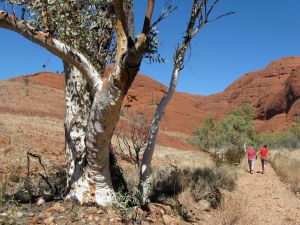
River Red Gum, Valley of the Winds Walk, Kata-Tjuta

River Red Gums, or Eucalyptus Camaldulensis, are among our most ubiquitous of gum trees, but that doesn’t mean they’re a boring tree. As their name implies they grow along watercourses – including ones that are very very dry such as those you find in Central Australia. They are also a significant part of what makes the Murray River such a gorgeous old river. Apparently, though, they are not found in Tasmania.

One of the well-known places to see these gums is the beautiful Barmah Forest of the Murray-Darling Basin. It boasts trees that are over 500 years old. Sadly, though, there are concerns that due to the extended drought that area has been experiencing, many trees are threatened, if not already dying. I’ve been to this forest and it is a treasure – it would be tragic to lose it.

Being ubiquitous – and beautiful – they feature regularly in Australian arts (in poetry, song, fiction, and art). Of course, they feature in Murray Bail’s captivating novella Eucalyptus:

River Red Gum

Warty River Red Gum, Jessie Gap, East MacDonnells

Over time the River Red Gum (e. camaldulensis) has become barnacled with legends… there’s always a bulky Red Gum here or somewhere else in the wide world, muscling into the eye, as it were: and by following the course of rivers in our particular continent they don’t merely imprint their fuzzy shape but actually worm their way greenly into the mind, giving some hope against the collective crow-croaking dryness. And if that’s not enough the massive individual squatness of these trees, ancient, stained and warty, has a grandfatherly aspect; that is, a long life of incidents, seasons, stories.

River Red Gum

River Red Gum, Bond Gap, West MacDonnell Range

Too many poets to mention have written about this gum. I thought I’d choose just two. First is David Campbell, who addresses the threat to their continuation. Here are some lines from his poem “The Last Red Gum”:

So we stand, me and my brothers, just the bones of ancient trees
that have lined the riverbank since time began.
In a bare and barren landscape, fed by red dust on the breeze,
we’ve been ravaged by the careless hand of man.

Second is Lisa Bellear, an indigenous poet who, in her poem “Beautiful Yuroke Red River Gum”, uses the Gum to symbolise the post-colonial history of Aboriginal Australians. The poem starts:

Sometimes the red river gums
rustled
in the beginning of colonisation
when
Wurundjeri
Bunnerong
and other Kulin nations
sang and danced
and
laughed
aloud

Not too long and there are
fewer red river gums, the
Yarra Tribe’s blood
becomes
the river’s rich red clay

If this isn’t poignant enough, the poem concludes with:

Red river gums are replaced
by plane trees from England
and still
the survivors
watch.

What more can I say?

Were you an Argonaut?

Before the sun and the night and the blue sea, I vow to stand faithfully by all that is brave and beautiful; to seek adventure, and having discovered aught of wonder, or delight; of merriment or loveliness, to share it freely with my comrades, the Band of Happy Rowers. (from The ABC Weekly, 28 Dec 1940)

Once an Argonaut always an argonaut!  Erato 30 (aka Cat Politics) has blogged a couple of times about the Argonauts Club , which was a hugely-popular-in-its-day children’s club broadcast on Australia’s ABC radio from 1941 to 1972. You had to be between 7 and 17 to join, and you were given a Ship Name and Number – that is you became one of the 50 rowers on one of Jason’s ships. (Jason and the Argonauts – get it!) Hence Cat Politics was Erato 30 and I, Whisperinggums, was Athos 26. As Cat Politics (or is it Erato 30?) says, avatars existed a long time before the Internet!

The Argonauts Club had a long history, which I won’t go into here. For a good rundown, check my link above to the Wikipedia article. Suffice it to say that members were encouraged to submit contributions – poems, stories, art works, musical compositions – as well as questions to experts such as Mr Melody Man (Lindley Evans). In addition stories were heard, and information imparted on everything from writing to sports, music to nature, all in the spirit of fun, adventure and creativity.

Now, the thing is that we Argonauts are starting to grow old and, while some histories have been written, such as Rob Johnson’s The age of the Argonauts, the ABC apparently does not have a complete list of ship names, let alone of the 100,000 or so members. The Friends of the National Film and Sound Archive would like to rectify this and so have set up an Argonauts Register. If you were an Argonaut and would like to register, here is the form. Please do – our cultural history needs you!

That was one reason for writing this post. My other reason was to comment on the number of significant Australian writers, artists and musicians who passed through the Argonauts Club, either as presenters or writers for the show, or as members. Presenters included poets A.D. Hope and Dame Mary Gilmore, artist Jeffrey Smart, actors John Ewart and Peter Finch, the photographer Frank Hurley, to name a very few. One of the most well-known writers for the the Children’s Session was Ruth Park whose serial, The muddle-headed wombat, is one of the first things mentioned whenever two or more Argonauts get together.

Famous Australians who were Argonauts include comedian Barry Humphries, novelist Christopher Koch, composer Peter Sculthorpe, writer Robert Dessaix, musician Rolf Harris and television writer Tony Morphett, again to name a very few. Morphett is reported as saying that the Argonauts inspired him to see writing as a career: “This is a valid thing to be doing – it’s okay to be a writer.”

As for me, I was not one of those keenly contributing Argonauts who aimed for the Dragon’s Tooth award let alone the ultimate Golden Fleece and Bar, but I loved the show. It was an important part of my childhood. There has, I think, been nothing quite like it since, on radio or TV, that has inspired such a wide age-group for so long. What a shame that is.

Rob Johnson
The golden age of the Argonauts
Rydalmere: Hodder & Stoughton, 1997
270pp
ISBN: 0733605281

On the literary road, in Gippsland

The Gippsland area of Victoria is a particularly rich one in terms of Australia’s literary history. It is also an area I’ve never visited before and so this week we decided to return home from Melbourne via the less common path, that is via Gippsland. Unfortunately our trip through the region was a quick one, with just one overnight stop at the pretty little fishing and tourist town of Lakes Entrance. It has whetted my appetite for a more leisurely exploration of the area in the future. Gippsland is a diverse region with plains, lakes, rivers, mountains and coastal landscapes – the sort-of “something for everyone” place that tourist guides like to promote.

Some of the authors commonly associated with Gippsland are Eve Langley, Mary Grant Bruce, Katharine Susannah Prichard and Hal Porter … Some were born there (such as Porter) and some visited there (such as Katharine Susannah Prichard), but all wrote about the region. The English writer, Anthony Trollope, also visited the area in 1872.

Eve Langley, whose novel The pea-pickers was the subject of one of my early posts, was particularly well known for extolling the virtues of Gippsland. In The pea-pickers, her two main characters travel through Gippsland – to places like Bairnsdale and Lakes Entrance – working as agricultural labourers. Steve, the main character, yearns to return to her family’s glory years as “princes” of Gippsland.

One of my favourite – though rather politically incorrect these days – childhood authors was Mary Grant Bruce. She set several of her lesser novels in the region and drew on her experiences there for her children’s series, The Billabong novels. My literary guide suggests that “the sense of escape and immersion in untouched nature”  are evident in Bruce and Langley. While clearly there is more settlement now than there was in the early to mid twentieth century when these writers were writing, there are still many wild and natural spaces to enjoy in the Gippsland.

One discovery – and a rather embarrassing one for a person who prides herself on her knowledge of Australian geography – was that it is in Gippsland that the Snowy River, of Banjo Paterson fame, has its mouth. How did I not know that? Anyhow, I was pleased to see it at its quieter end!

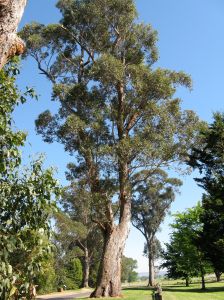
Gum tree, Orbost

Towering gum tree, Orbost

None of the region’s literary heritage was evident to the casual traveller – how I wish we celebrated our writers more. I will finish though with some lines from a poet of the region, Jennings Carmichael, as quoted in the guide under the entry for the town of Orbost:

Each soaring eucalyptus, lifted high,
The wandering wind receives;
I watch the great boughs drawn against the sky,
Laden with trembling leaves.
A soft harmonious music, full and rare,
Murmurs the boughs along–
The voice of Nature’s God is solemn there,
In the deep undersong.

On the literary road

Back in the mid 1990s I bought The Oxford literary guide to Australia. Having not looked at it for a few years, I decided to take it on our current little road trip. Two days ago, for example, we drove through Gundagai and Tarcutta, both of which appear in the guide.

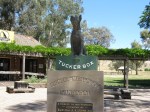
The Dog on the Tuckerbox, GundagaiGundagai, NSW

Most Australians will have heard of Gundagai – there is the famous Dog on the Tuckerbox (which features in many songs and poems) and the well-known song, “Along the road to Gundagai”, by Jack O’Hagan. Its lines include:

where the blue gums are growing and the Murrumbidgee flowing.

The funny thing is that Jack O’Hagan apparently never visited Gundagai! This didn’t stop him writing other songs about the town too including “When a boy from Alabama meets a girl from Gundagai”.

There are several other songs and poems featuring the town – including by Banjo Paterson and Henry Lawson –  but the Guide says it is a mystery as to why this particular town “was such a popular inspiration for songs”. If they don’t know, I don’t know either … but it is a pretty town with a famous old bridge.

Tarcutta, NSW

Not all that far down the road from Gundagai is Tarcutta. According to the Guide it is a popular truckies stop. It also features in the poem “Under way” by Bruce Dawe:

…there would be days
banging open and shut like the wire door of the cafe in Tarcutta
where the flies sang at the windows…

Ah, the flies! Apparently in 1961 Les Murray wrote his poem “The burning truck” in the same cafe. Unfortunately, having already had coffee at Bullocky Bill’s near the Dog on the Tuckerbox, we did not test our muse in Tarcutta.

And yesterday we drove through other towns, including…

Emerald, Vic

Down in the Dandenongs east of Melbourne is the pretty little town of Emerald – quite different from the somewhat drier and dustier Tarcutta and Gundagai. It was a gold town – hmm, wonder then why it was called Emerald! Apparently Katharine Susannah Prichard spent her honeymoon here with Hugh Throssel in a cottage owned by her mother. She wrote her novel Black Opal (1921) while staying in the town in another cottage.

Vance and Nettie Palmer lived there in the early 1920s. Nettie wrote:

You could easily imagine yourself taking root there, developing a local patriotism, bringing up your children to know its history and become attached to its soul.

Having passed through, I can think of worse places to live. Vance Palmer’s novel, Daybreak (1932) is set here and in the Dandenongs in general.

Peter Pierce (ed)
The Oxford Literary Guide to Australia
Oxford: Oxford University Press, 1983 (rev ed)
501pp.
ISBN: 0195536223

Prime Minister’s Literary Awards, 2009

Nam Le’s The boat has won the fiction category in the Prime Minister’s Literary Awards. Much deserved too I say! Interestingly, the non-fiction prize was shared by two books: Evelyn Juers’ House of exile, and Marilyn Lake and Henry Reynolds’ Drawing the global colour line. Lisa, at ANZLitLovers, recently wrote about Juers’ book – you can read what she says here.

The Boat – Recap

Back in February I reported on my bookgroup’s discussion of The boat on our group blog, but that was before I started writing here. I won’t repeat here what I said there – as you can read it yourselves. I will note though that one of its stories was included in Mandy Sayer’s recent anthology, The Australian long story. That has to say something! If you haven’t read it yet, think about it now. Nam Le is a new voice on the scene and I certainly hope he isn’t a flash in the pan.