Nettie Palmer on short stories

In a recent Monday Musings I mentioned Nettie Palmer who was part of one of Australia’s famous literary couples. Her husband, Vance Palmer, wrote, in the late 1930s to early 1940s, a regular column for the ABC Weekly published by the then Australian Broadcasting Commission. Nettie Palmer also contributed to this paper, albeit less regularly. One of these contributions is a discussion, in 1943, of Australian and Russian short stories. In it she made a simple but clear statement on what she believes is essential to a good story:

What is a story without the power to see what matters to people, to detect the character’s most revealing moment? A sense of life is something more than mere narrative, or a knack for inventing a scene.

This appeals to me because of her focus on meaning and character rather than on plot … and I like the way she hones in on “the character’s most revealing moment”. When I think about it, the best short stories do tend to centre on just that, a moment (an action, a decision, an event) in which the character’s self is revealed to us. I think of Guy de Maupassant‘s “The necklace”, Kate Chopin‘s “Désireé’s baby” and Henry Lawson’s “The drover’s wife”. In these stories, the main characters are confronted by a challenge to their sense of being … and how each responds tells us much about who they are, and we, in contemplating their reactions, learn a bit more, perhaps, about who we are.

Does this definition of a good story hold for longer fiction too?

Monday musings on Australian literature: Meanjin’s Tournament of Books

Henry Handel Richardson in 1945, a year before...

Henry Handel Richardson, 1945 (Presumed Public Domain. Courtesy: Wikipedia)

Many Monday musings ago I wrote about the reduced visibility of women writers in Australia. I wasn’t the only one concerned and things have been afoot to up the ante for women writers. For example, a new award targeting women writers, the Stella Prize, was announced earlier this year. And now Meanjin, a longstanding literary magazine, is emulating the Morning News’ Tournament of Books (to which a favourite blogger, Hungry like the Woolf, introduced me a couple of years ago) by conducting a tournament comprising books by Australian women writers.

Meanjin describes the tournament as follows:

The way it works is this: 16 books are chosen … and then divided into pairs. A judge is given a pair, reads them both, writes up their decision process and announces which of the pair they deem the better book. That book then progresses into the next match to go up against a winner from a previous round. It’s a sporting tournament for people who don’t like sport.

This year, in light of the discussion around women’s writing and literary prizes, we’ve selected a short list of novels exclusively by Australian women. The list has been chosen by us, and is incomplete, capricious and arbitrary. That’s ok. There’s no way you could do Australian women authors justice in 16 books…

Fair enough … and being this upfront about their selection makes it hard for us to complain, doesn’t it? And really, I wouldn’t want to, because I can’t imagine we’d ever get universal agreement on 16 books, anyhow.

The tournament schedule can be viewed at the Meanjin site so I won’t detail it here, but I will list* the 16 books, partly because it’s a useful list, despite its arbitrariness, for those interested in Aussie women’s lit:

Regular readers of my blog will recognise some of my favourite and oft-mentioned authors here. Interestingly, a couple of young adult/children’s novels (those by Carmody and Marchetta) have been included – one of their “capricious” decisions, perhaps! Not that I have anything against such novels – I thoroughly enjoyed Marchetta’s Looking for Alibrandi – but I wonder whether they have the weight to beat a Stead or an Astley, a Wright or a Jolley, for example. Well, keep reading …

Round 1 results

  • Match 1, Gilgamesh beat The lost dog. Both are interesting books but Gilgamesh is a beautiful one. I would have chosen it too.
  • Match 2, The children’s Bach beat Mr Scobie’s riddle. This is harder. I love The children’s Bach but have not read Mr Scobie’s riddle. I’m not sure it’s the Jolley I’d have chosen … but, oops, I said I wasn’t going to go there, so let me just say that this match is a tricky one – the judge thought so too – and I’m glad I wasn’t asked to call it!
  • Match 3, My brilliant career beat Tirra lirra by the river. Another hard one, but My brilliant career would have to be the sentimental favourite in this pairing. And, anyhow, how could I not agree with a book the judge called “chick-lit amongst the gums” and “Austen in an Akubra with a broad Australian twang and some permanent sun damage”?
  • Match 4, Looking for Alibrandi beat Harp in the south. Interesting decision. A main criterion for the judge seemed to be the ability to stand the test of time … but, but, I argue, Looking for Alibrandi is only 20 years old while Harp in the south has already stood the test of time. And, I’m not sure that Alibrandi reaches adult audiences in the same way that Harp does. Still, perhaps I should read Alibrandi again to be sure.
  • Match 5, The secret river beat A kindness cup. Both good books, and a very hard choice … one the judge clearly found hard too. It seems as though it was Astley’s more dystopian view that was the deciding factor. That seems a bit of a cop out to me!
  • Match 6, The man who loved children beat Obernewtyn. Now this must surely have been a no-brainer and the judge agrees, explaining why they were (mis)matched in the first place. I’ll say no more.
  • Match 7, The fortunes of Richard Mahony beat Of a boy. Another pretty obvious choice, really. While I do think a short novel or novella can beat a hefty tome, this is probably not the hefty tome to be up against!
  • Match 8, The world beneath beat Carpentaria. Now this does surprise me. The latter won the Miles Franklin award while The world beneath was not shortlisted. I don’t think we should give excessive credence to awards but it seems the judge gave the match to The world beneath because he found Carpentaria “difficult”. Is this fair or right, I cry into cyberspace? No, but at least the judge admits to being “covered in the stench of subjectivity”, so all one can do is vote Carpentaria back in the zombie round.

Plot, humour  and readability seemed high on the various judges’ agendas. They would not be my top criteria but, as this tournament is mainly about promotion of women writers and having some fun, I’ll say no more, except that I’ll report again on the tournament after the second round has been played …

* The two linked titles are to reviews on this blog. I’ve read many of the books listed, but mostly long before I started this blog.

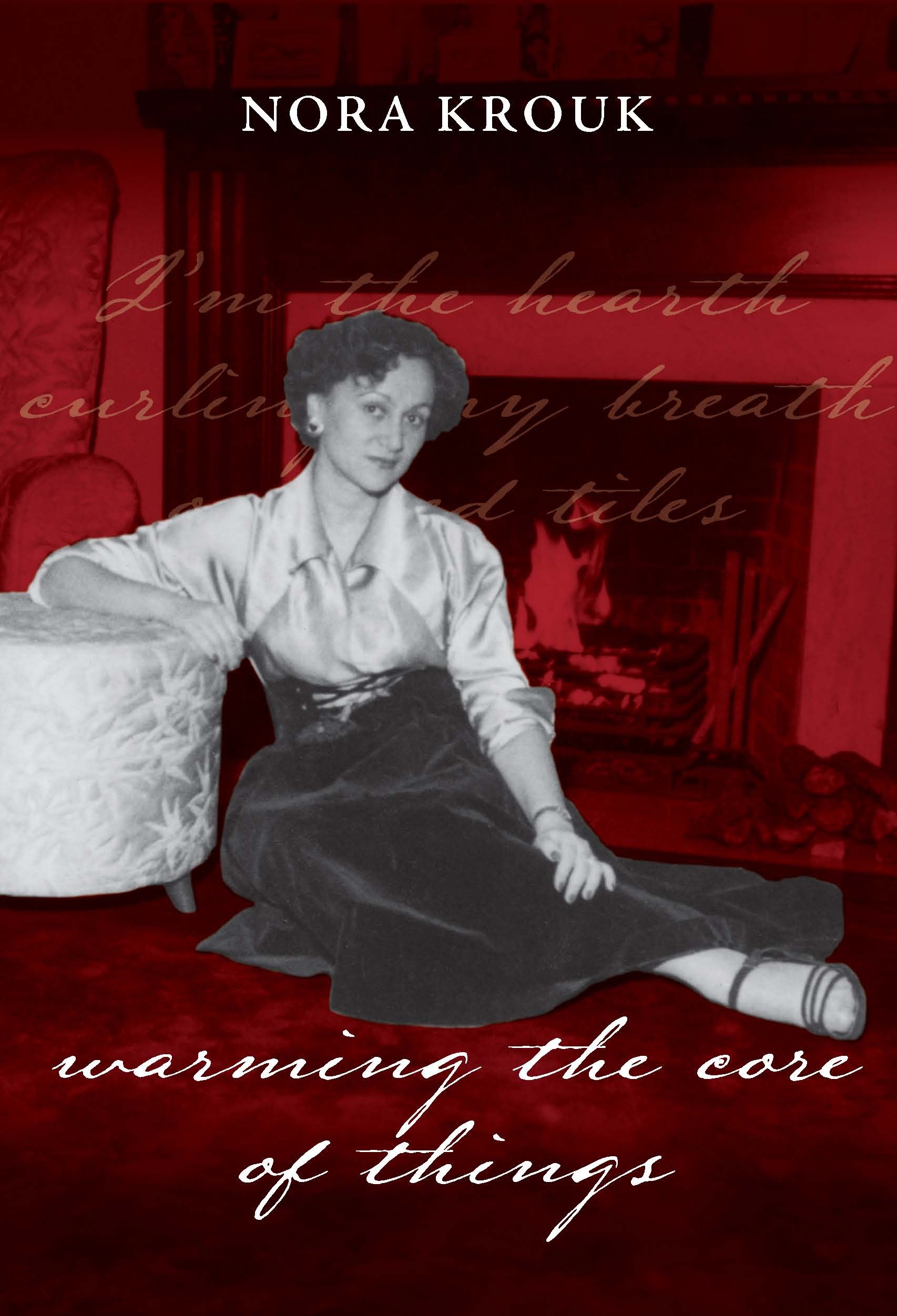
Nora Krouk, Warming the core of things

Nora Krouk, Warming the core of things, book cover

Nora Krouk, Warming the core of things (Image courtesy Hybrid Publishers)

life wrapped in bundles
of painful joy
(from “Skies will be luminous”)

The reason I like to read poetry is the obvious one – the way poets can capture a feeling or idea in just a few carefully chosen words that are presented through a controlled rhythm. Nora Krouk fills this bill nicely!

I hadn’t heard of Krouk before this book came to my attention … but she’s been around for a while. In fact, she’s 90 years old and has been in Australia since 1975. She is the daughter of a Polish Catholic father and a Jewish mother. She was born in China, married in Shanghai and lived in Hong Kong before emigrating to Sydney. She was educated in Russian schools and has written poetry in Russian and English. She has been published internationally, and has won several awards. Phew! I don’t usually provide such detail about authors, but it seems appropriate to do so here.

The collection is organised into three sections, and the order of these sections is interesting: In memoriam, Renewals, Transitions. I like the way it moves from death, through awakenings and rebirths, to change accompanied by uncertainty. This order keeps us on our toes. It offers no easy conclusions to the challenges posed in the first section but neither does it suggest hopelessness as the reverse order might have.

The poems are, for the most part, very accessible. Elizabeth Webby is quoted on the back of the book as saying that the poems “will appeal to both those who usually read poetry and those who don’t”. I’m in the middle ground here – I like to read poetry but don’t read it often enough – and I think Webby is right. Many of the poems have stories – seemingly about people Krouk knows – and those stories speak to the ordinary things of life which, for someone of Krouk’s age, include memory, aging, loss and death. These things are explored with a sense of enquiry and some resignation, rather than with a railing and ranting. The poems move between her daily life and historical events (some of which she or her family experienced), particularly the horrors that occurred under Hitler and Stalin.

I commenced this review with two lines from a poem in the Renewals section because they encapsulate what seems to be Krouk’s philosophy: Life is not easy, she’s saying, but there is much to enjoy and wonder at. The first poem in the book is a widow’s poem. It speaks of grief, but it also introduced me to something interesting about her poetry, what Anna Kerdijk Nicholson describes on the back of the book as her “idiosyncratic rhythm and lineation”:

I don’t weep much.     I read
and write     even cook     then
catch myself and return to you
(from “Fima (1914-2008)”)

These spaces in her lines control, force even, the rhythm for the reader. They allow us to breath, to feel the sense of the words and, in a way, they provide a more intimate, conversational tone to the work. They slow us down and prevent us from rushing through the poems.

Aging and memory, as I’ve already mentioned, are recurrent themes in the collection.  Memory, though, is a pretty broad church, and Krouk explores it in its various guises – from loss of memory to remembering the (often painful) past:

They chase a name
a thought     an event
(“The couple”)

It’s different for us
we have no grave
He was last seen
in the prison yard
(from “For Leon K” who died under Stalin’s regime)

But not all the poems are about challenge. There are lighter poems, and there is humour. I loved her short poem about a young smiling woman:

A smile is hovering over our street
a light funny quizzical smile
It slipped off her lips
brushed past the creamy cheek

dripped over a sunny wattle and stayed.
(from “A young woman”)

Much of her imagery is domestic, everyday. There are family dinners and bridge afternoons with friends. Jacarandas and gums, camellias and lavender feature, grounding her poetry in her Australian life. But, there are also allusions to things literary (such as Shakespeare and Tolstoy) and political/historical (as mentioned earlier), which confirm her as a poet of universal concerns.  Some of her poems combine the Australian and the political – such the example below, which demonstrates that she is capable of more than a little irony:

Where do we turn Matilda     Lead the dance
As promised in the anthem     we advance
(from “Sorry”)

There are also a few specifically religious poems, but I found some of these (“Widowed a hundred times”, and “I am not envious Lord”) a little too melodramatic for my liking, while others, such as her meditation on snakes (“Snakes are much maligned”), engaged me. Poetry, as I’ve said before, is such a personal thing.

Krouk has lived long and experienced much. There are many more poems I’d love to excerpt – and maybe I will in a future post. Meanwhile, I can’t think of a better way to summarise this book than through her own words:

Under the skies     luminous
things drop
(from “Skies will be luminous”)

Nora Krouk
Warming the core of things
Melbourne: Hybrid Publishers, 2011
126pp.
ISBN: 9781921665431

(Review copy supplied by Hybrid Publishers)

Delicious descriptions from Down Under: Ada Cambridge on the “bare necessities”

In her novel Sisters, Ada Cambridge describes the plight of one sister who is suddenly left penniless (more or less) and has to move out of her home. The scene is set … the character is packing to move, with the house and her life in disarray:

Deb sat amid the ruins of her home. She occupied the lid of a deal-packing case that enclosed a few hundreds of books, and one that was half-filled stood before her, with a scatter of odd volumes on the floor around.

[…]

‘That cottage you talk about,’ he said, ‘will not hold all those.’

‘Oh, books don’t take any space,’ she replied brusquely. ‘They are no more than tapestry or frescoes. I shall have cases made to fit flat to the walls.’

‘That will cost money.’

‘One must have the bare necessities of life …’

You can tell that Deb is going to be one of the more interesting characters in the book, can’t you?

Monday musings on Australian literature: Ada Cambridge

Photograph of Ada Cambridge by Spencer Shier c...

Ada Cambridge, c. 1920, by Spencer Shier (Public domain, from National Library of Australia, via Wikipedia)

It’s time, methinks, for another Monday Musings post highlighting a specific writer – and this time I’ve chosen Ada Cambridge. I discovered Cambridge back in the late 1980s when there was a resurgence (in Australia anyhow) in recognition of women writers. What was great about this resurgence was that it not only saw increased publication of contemporary women writers, but also the republication of past writers. I sussed out and read quite a few of these older, oft-forgotten writers, including, obviously, Ada Cambridge (1844-1926) who was, in fact, one of Australia’s best-known writers in her time.

She was a fascinating woman. Born in England, she married the Reverend George Cross in 1870 and a few weeks later emigrated with him to Australia for his work. They lived in several towns in Victoria until 1913 when they returned to England. Cambridge came back to Australia in 1917, on Cross’s death, and remained here for the rest of her life. Like many clergymen’s wives she worked hard supporting her husband. She suffered her share of sadness, including losing children to illness, and shocked her husband by writing of her experience of religious doubt and marital trials.

Cambridge was a prolific writer but, as is the common lot of women writers, her role as wife and mother came first. She wrote in her memoir*, Thirty years in Australia, that “housework has all along been the business of life; novels have been squeezed into the odd times” and in those days housework was far more onerous than it is today. She must have been a wonderful time manager! I have read only two of her novels: A woman’s friendship (1889), which was published as part of the Colonial Texts series edited by, surprisingly, the Australian Defence Force Academy, and Sisters (1904), which was published by Penguin in their Penguin Australian Women’s Library series.

While Cambridge’s first writings were religious in nature, she moved on to tackle more controversial subjects, particularly relating to women and their relationships. It’s many years since I read these two books but I remember my surprise at their content. These are not traditional women’s romantic novels. They confront, instead, the dual constraints women faced in terms of class and gender, particularly regarding the desire for independence and the physical and intellectual impositions of marriage.

A woman’s friendship explores the friendship that develops between two women (both married, one to a journalist and the other to a squatter) and a man through The Reform Club, of which they are the only members. It toys with the fine balance between marital responsibility, sexual attraction and the desire for intellectual companionship – and Cambridge is pretty up-front about the sexual tensions and jealousies that can lie just below the surface of friendships like this. Pretty interesting stuff for that time – and it makes me think a little of Edith Wharton. However, I think Wharton focused more on the notion of entrapment and was rather bitter, whereas Cambridge was more pragmatic about human nature and consequently less tragic.

In Sisters, according to the notes on the back of my edition, Ada Cambridge “dispenses with conventional romantic notions about marriage”. And this, as I recollect, is pretty right. She explores the marriage fortunes (or misfortunes) of four well-to-do sisters – what they decide (do they marry for love, for money, or not at all) and the implications of their decisions. Cambridge is unsentimental (cynical even) about the idea of “happily ever after” showing rather that “I do” is just the beginning. Indeed, as Cambridge writes of one lover who doesn’t win his girl:

He did not know what a highly favoured mortal he really was, in that his beautiful love story was never to be spoiled by a happy ending.

I couldn’t resist quoting that, but it doesn’t represent the totality of Cambridge’s attitude to marriage. A review from The Argus, in 1907, of a later novel, A happy marriage, suggests:

Mrs Cross [aka Ada Cambridge] apparently is no idealist in the matter of marriage. She looks for disillusionment and expects differences of opinion. But she recognises the possibility of ultimate happiness in spite of some incompatibility. Perhaps after all, this is the wisest view and it is more wholesome not to glorify what is not infrequently inglorious. It is, besides, the highest optimism to be able to forecast a happy future from an unhappy present. In any case our authoress is quite impartial in her distribution of blame and very sane in her judgments of men and women.

Cambridge was, for me, a wonderful find … and one day I’ll read more of her work. Meanwhile, if you’d like to read her, you can access some of her work (particularly Sisters) at the following websites:

* As reported in The Sydney Morning Herald, 31 July 1926.

Monday musings on Australian literature: Are short stories on the rise?

Today I’ll dip my toes into the muddy waters that comprise short stories. Regular readers of this blog know that I’m rather partial to short stories. Why, I wonder, are they still pretty much the second class citizen of the literary world? Marion Halligan said, on the release of her latest collection, Shooting the fox, that her agent’s initial reaction to receiving the collection was:

Oh, Marion, short stories?

Marion says, though, that while publishers have traditionally not liked short stories, “they may be changing their minds”.

And so, today, I’ll talk a little about short stories. I’ve wanted to write on them for a while but the subject is so vast I’ve kept putting it off. Should I talk about short story awards? Or favourite short stories? Or favourite short story writers? Or collections? Or? I will probably visit some of those topics in future posts, but today I’ll just talk a little about Halligan’s belief (or is it simply hope) that “they may be changing their minds”.

Is there any evidence? Well, there may be (though I don’t have the statistics to prove that what I say here represents real change or just a continuation of the status quo).

Short story collections

There have been some critically successful collections of short stories published in recent years, of which the best known is probably Nam Le‘s The boat. It’s a beautifully diverse and accomplished collection which I read not long before I started this blog. Not only was it was shortlisted for awards, but it won some significant ones, that is, it won awards that were not specifically targeted to short stories, including, in 2009, the Prime Minister’ Literary Award for fiction and the New South Wales Premier’s Literary Awards Book of the Year. Tim Winton’s collection of somewhat connected short stories, The turning, won the New South Wales Premier’s Christina Stead Prize for Fiction in 2005. But then, Helen Garner won for Postcards from Surfers in 1986, and Beverley Farmer for Milk in 1984. So, is there anything new to celebrate? Perhaps, because the exciting thing about Nam Le is that The boat is his first book … a first book of short stories that won major awards! Change afoot? Or an anomaly?

Irma Gold in an article on short stories in Overland suggests that more short story collections are being shortlisted for awards, and cites this year’s Queensland Premier’s Literary Awards as evidence. She also notes that the publishers of these shortlisted works are mostly small – Black Inc, Salt Publishing, Black Pepper and Affirm Press. Are small publishers the only ones willing to take a risk on short story collections – like Affirm Press’s gorgeous Long Story Shorts – by emerging and lesser known writers? Whatever the answer, thank goodness for small publishers!

Short story anthologies

Short stories continue to be published in literary magazines, large and small, but their success as a genre feels (rightly or wrongly) more solid if they are published in books which readers are willing to buy. And there does seem to be quite a lot (my best scientific measure) of anthologies being published.

There are annual editions by such (small, again) publishers as Black Inc, Scribe (which has done two anthologies now) and the Griffith Review. In her Editor’s Note for Scribe’s New Australian Stories 2 , Aviva Tuffield writes:

Those dwindling opportunities for single-author collections concern me, both as an editor and as a reader. Many of the foremost novelists in Australia today – Gail Jones, Kate Grenville, Peter Carey, Joan London, Peter Goldsworthy – began their publishing career with story collections, but this trajectory no longer seems available. Yet short stories are vital training grounds for our writers …

Two points. First, Tuffield doesn’t seem to agree with Halligan that things might be changing, and second, are short stories only to be valued as “a training ground”? If that’s how we see them, then they will remain second-class citizens – won’t they? I suspect Tuffield does like short stories in themselves too … but I wonder whether this “training ground” idea is held by many readers?

Then there are anthologies compiled by an editor, often on a theme, such as Families (ed. Barry Oakley, 2008, in Five Mile Press’s series of “topic” oriented short story collections) and Brothers and sisters (ed. Charlotte Wood, 2009). These anthologies are (I’m guessing) the bread and butter of short story publishing: they are clearly easier to market. They have been around for a long time (and I’ve read many over the years), but they tend, in my experience, to focus on works by established writers (and often, though not always, use stories previously written and published). Good stories, usually, and good reading, but probably a less useful indicator of the health of short story writing and publishing in Australia.

So, where does all this leave me (us)? Nowhere, really, I think, in terms of resolving whether Halligan is right or not – but at least I have finally written a post on short stories. There will be more.

In the meantime, what do you think of short stories and their health (here or in your country)?

What do Di Gribble and Steve Jobs have in common?

MabBookPro

My current beloved MacBook Pro - aging but still fine

You probably think it’s strange to put these two luminaries together – one a lesser-known Australian publisher and entrepreneur and the other an international icon in personal computing. But the thing is, you see, that besides the fact that they both died this week – from cancer – Gribble and Jobs both entered my life in the mid 1980s. And their impact was significant. I have consequently decided to add my cyberspace tribute to these two people.

Di Gribble first. With Hilary McPhee, Di Gribble established a significant small Australian publishing house, McPhee Gribble. That was in 1975, but the real impact for me was about a decade later when I returned to reading Australian literature with a renewed enthusiasm – and it was through imprints like McPhee Gribble that Aussie literature was encouraged and promoted. McPhee Gribble were, in fact, the first to publish Helen Garner, Murray Bail and Tim Winton, all of whom I have reviewed here. Wonderful Australian writers, and we’ll surely be seeing tributes from them in the coming days and weeks. The company was sold to Penguin in 1989, with Gribble and McPhee going onto other things – but remaining in the Australian literature fold. Gribble’s post-McPhee Gribble ventures included the publishing company Text Media (later also sold, and still going strong as Text Publishing) and the independent digital media publishing company Crikey. She was, as they say, a goer – and we, in Australia at least, will miss her.

(You may also like to read Lisa’s tribute at ANZLitLovers)

And now Steve Jobs. Our first personal computer was one home-built by Mr Gums in the late 1970s. It was a great little computer – and as a librarian I was of course drawn by its possibilities, particularly for information management and retrieval. Our first database was one to manage our wine cellar! An excellent joint project to test the possibilities. This computer was, however, not particularly user-friendly. Mr Gums, the engineer, was well into DOS command lines but the computer didn’t easily engage we laypeople. Then along came Jobs, and Mr Gums, always on the lookout for improved technologies, saw the new world of personal computers coming. So, in 1985, we bought one of the first Macintosh models available in Australia – and I was hooked. The mouse, the GUI  interface with its WYSIWYG style, the continual improvements, not to mention the gorgeous designs (I even loved my often-maligned little clamshell laptop) have kept me in the orchard. Apple products are just so delicious! As most of my friends know, it is hard to separate me from my Mac (not to mention other Apple products, such as my latest gadget, the iPad2). Thanks Steve, we’ll miss you too.

Irma Gold, Two steps forward

Irma Gold's Two steps forward Bookcover

Irma Gold's Two steps forward (Courtesy: Affirm Press)

Irma Gold’s* Two steps forward is, apparently, the last release in Affirm Press’s Long Story Short series. I have reviewed two others previously – Gretchen Shirm’s Having cried wolf and Leah Swann’s Bearings – but, before talking about this book, I must say how much I love the books themselves. I am starting to read eBooks. I recognise they are likely to be the future and they do offer advantages over print books. They take up less space, for a start. You can change font size to suit your eyes. And, eReaders have inbuilt dictionaries which can be useful when you are reading while out and about (or are just too plain lazy to get off your seat to find the dictionary). But, this doesn’t mean I don’t like print books – especially lovely ones to look at and hold like this Affirm Press series. I like their slightly smaller size and their simple, clear, modern design. The three I’ve read also have very stylish monochromatic covers. There’s little, in fact, not to like about them.

Now, though, the book. This is one of those short story collections, like Swann’s Bearings, that has its own title rather than one drawn from one of the stories within. I like that – and the title of this book, Two steps forward, is a particularly clever one, because of course it immediately calls forth the complete saying “two steps forward one step back”. This concept works well for the stories in Gold’s book.

Irma Gold is a writer and editor. She has been published in various journals, such as Meanjin and Island, but this is her first published collection. Well done her, because it’s an engrossing collection. Gold’s writing is clear and warm, and she demonstrates in this collection an ability to handle a range of voices and points of view. There are 12 stories in the book: five are told 1st person, two 2nd person, and the other five 3rd person. Her protagonists are mostly women, but there are a few male voices too. The stories could be described as “scenes from a life” (well, lives, really). Her characters include a single mother hoping for love (“The art of courting”), an empathetic woman working in a refugee detention centre (“Refuge”), a father experiencing his first access visit, after two years, with his 8-year-old daughter (“Tangerine”), an emotionally-neglected teen girl living in a caravan park (“Sounds of friendship”), an old homeless man (“Great pisses of Paris”), and so on. The characters are authentic. You know who they are, what they feel, and what they are confronting:

You notice how thin your lips have become, how the flash of greasy fuchsia looks almost crude. You pull at the loose skin on your neck, and the spongy puffs around your eyes filled with lines, the skeleton veins of a dead leaf. (“The art of courting”)

I want to touch him, but the space between us is fractured. (“Refuge”)

I compose sentences in my head, but none of them work. (“Kicking dirt”)

Says they can’t afford to waste cash on stuff they don’t need, though apparently alcohol is essential. (“Sounds of friendship”)

There’s a painful vulnerability to her characters, as they confront their particular challenges, such as visiting a terminally ill friend (“The visit”), facing a miscarriage (“The third child”), or trying to reconnect with a young daughter (“Tangerine”). Their lives are finely observed, so much so, in fact, that you feel you’ve been there – even if you haven’t. Their triumphs, when they have them, are hard won.

I also liked Gold’s use of imagery. It’s apt, evocative, and is not overdone or pushed too far – which suggests careful writing, good editing, or both:

 A day leaking away with a spill of apricot. Air stung with lavender. (“The art of courting”)

… and Abby catches the cold-barrelled words Mick fires at her mother. (“Sounds of friendship”)

But it was all icing slathered over stale cake. (“The anatomy of happiness”)

The tone doesn’t vary much, but this doesn’t spoil the experience. The stories, overall, have a somewhat melancholic air, as the characters struggle to keep a forwards momentum in their lives ahead of a backwards one. And, there are touches of humour (mostly wry) and some occasional irony (such as a reference to our anthem’s “boundless plains to share” in “Refuge”) that provide relief.

Endings are always hard … at least that’s what E. M. Forster told us in Aspects of the novel … but Irma Gold has handled them well. Keeping with the title, most of her stories have more hope than not – but none are fully resolved. Like life really.

Irma Gold
Two steps forward
Mulgrave, Vic: Affirm Press, 2011
(Series: Long Story Shorts, 6)
192pp.
ISBN: 9780980790474
Also available in eBook format

(Review copy courtesy Affirm Press)

* I was tickled to note in her Acknowledgements that Gold spent some time at Varuna Writers’ Centre.

Monday musings on Australian literature: Australian literary couples

Elizabeth Barrett Browning and Robert Browning

Elizabeth Barrett and Robert Browning (Unknown date and photographer, Public Domain, via Wikipedia)

Are you fascinated, like I am, by literary couples? It seems so romantic to share one’s calling with another … even if the reality is not always as idyllic or as successful as it sounds. We’ve all heard of Robert and Elizabeth Barrett Browning, Ted Hughes and Sylvia Plath, Virginia and Leonard Woolf, to name just a few famous couples. I’m guessing, though, that not many have heard of our Australian couples, but we do have them – and so this week I’m sharing five (from the past) with you.

Vance (1885-1959) and Nettie Palmer (1885-1964)

While Vance and Nettie Palmer are not particularly well-known now (at least to the best of my knowledge), they were extremely significant in their heyday, the 1920s-1950s, as writers, as proponents of Australian literature and as mentors for younger writers. Nettie in particular corresponded with and supported many women writers, including Marjorie Barnard (1897-1987) and Flora Eldershaw (1897-1956). They were literary critics and essayists. Vance was also a novelist (I read his The passage many moons ago) and dramatist, while Nettie was also a poet. They were political – egalitarian, anti-Fascist, and tarred, as were many back then, with the “Communist” brush! Their relationship seems to have been a productive and supportive one.

George Johnston (1912-1970) and Charmian Clift (1923-1969)

This is one of those troubled pairings, and it ended in the suicide of Charmian when she was not quite 46. They met in Australia, lived together in England and Greece (where they tried to live on their writing), before returning to Australia with their three children in 1964. Johnston wrote the highly successful My brother Jack, which some see as a contender for the Great Australian Novel and which is the first in a semi-autobiographical trilogy. Charmian wrote two successful autobiographies, Mermaid singing and Peel me a lotus. Both wrote much more across a wide spectrum: novels, essays and other journalistic pieces, short stories, and so on. Theirs was, in the end, one of the more self-destructive rather than mutually supportive relationships. Sad.

Ruth Park (1917-2010) and D’Arcy Niland (1917-1967)

Ruth Park (born in New Zealand) and D’Arcy Niland were more than a literary couple. They created a literary family, with two of their five children, twin daughters Deborah and Kilmeny, becoming successful children’s book writers and illustrators. I have written about Ruth Park before. She and D’Arcy worked as free-lance writers and shared a concern in their writings for the battlers in Australia. They worked hard to survive on their writing, turning their hands to a wide range of forms and genres, including novels, short stories, plays and journalistic pieces. They were, like the Palmers, a successful and happy couple until D’Arcy’s early death.

Rosemary Dobson (b. 1920) and Alec Bolton (1926-1996)

Rosemary and Alec were a little different from the other couples I’ve chosen to discuss here, but I’ve chosen them because they lived in my city, and I (ta-da) met and worked for a few years in the office next door to Alec. Rosemary Dobson is a significant Australian poet who associated with other major Australian poets like A. D. Hope and David Campbell. She has published around 14 volumes of poetry, edited anthologies, and translated poetry from French and Russian. Her husband was not so much a writer as a publisher. According to the AustLit* website he “was a creative force in Australian publishing for almost half a century. After his war service he worked as an editor for Angus & Robertson and Ure Smith before establishing the publishing program at the National Library of Australia”. He established one of those wonderful small presses, Brindabella Press, in 1972 while still working at the Library, and then continued working on it after his retirement. It was a labour of love, and among the authors he published was, of course, his wife!

Dorothy Porter (1954-2008) and Andrea Goldsmith (b. 1950)

Dorothy Porter, whose last book The bee hut I have reviewed here, is (was) another Australian poet. She lived with her partner, the novelist Andrea Goldsmith, for 17 years before she died through cancer in 2008. Goldsmith, whose latest novel The reunion I’ve also reviewed here, said in an interview after Porter’s death that “I’ve always loved Dot’s work – indeed I fell for the poetry before I fell for the poet”. Porter, who also wrote several verse novels, was more prolific than Goldsmith, but both produced well-regarded work during the course of their relationship. Another productive and successful pairing.

Some time ago I read an article about literary couples and the challenges they face: financial (supporting themselves from writing), space (finding room for each to write), and the big one, jealousy or competitiveness. I’m impressed that, despite such issues, four of the five couples I’ve described seem to have been remarkably successful – and this is beautifully exemplified by Ruth Park’s words at the end of her autobiography, Fence around the cuckoo:

We lived together for twenty-five years less five weeks. We had many fiery disagreements but no quarrels, a great deal of shared and companionable literary work, and much love and constancy. Most of all I like to remember the laughter.

After sharing five children and a rather insecure career, that’s pretty impressive.

I’d love to hear about other literary couples – Australian or otherwise, past or present – that you have come across.

* I have not provided a link to this site since most of its content is available by subscription only.

Hazel Rowley, Franklin and Eleanor: An extraordinary marriage

First Family of the United States

Roosevelt Family, 1919 (Courtesy: Franklin D Roosevelt Presidential Library and Museum, via Wikipedia

I wonder what would make an Australian biographer decide to write about an American couple? And I wonder, having now read Hazel Rowley’s Franklin and Eleanor: An extraordinary marriage, what she would have made of, say, Joseph and Enid Lyons, Australia’s own political power couple. Unfortunately we’ll never know as Rowley died just around the time this, her latest biography, was released. There is, of course, good reason for writing this story: Franklin and Eleanor are an interesting couple, and they did have an impact on the international stage, as well as their national one.

In her acknowledgements at the end of the book, Rowley writes:

I learned quickly that all sources, both primary and secondary, were unreliable. There was so much that could not be said, even in private letters…

Therein lies the rub for the would-be biographer of Franklin and Eleanor Roosevelt. There’s a lot of primary source material available. They wrote copiously to each other and to others, others wrote copiously to them and to others about them. There are diaries written by many in the Roosevelt circle. There’s Eleanor’s newspaper column, My Day, which she wrote for nearly three decades. And there are memoirs, interviews, and sundry other items documenting their private and public lives. Indeed, even though it’s known that some significant letters were destroyed, the biographer of Franklin and Eleanor is challenged by a surfeit of records, unlike those poor biographers of Jane Austen who try to make a lot out of what is a rather small historical record.

And yet, there are still gaps. This is, in the end, what makes fact different from fiction, isn’t it? When you are writing about real people you cannot know everything in their hearts, you cannot be sure of their real motivations, and so whatever biography we read, no matter how thoroughly researched and well written it is, there are things we will never know. With fiction – and maybe I’m being a little ingenuous – the character only exists in the author’s mind and on the page. Whatever the author tells us is all we can know and we must work with that …

Enough intro, let’s get to the book. Franklin and Eleanor: An extraordinary marriage is an extraordinary read. The research Rowley did was clearly comprehensive – as the endnotes demonstrate. Rowley takes, she says, a different tack to the other biographies out there by choosing to focus specifically on the marriage. Her thesis is that it was not simply a patched up compromise (after Franklin’s betrayal with Lucy Mercer) or simply a political marriage, but “a joint endeavour, a partnership that made it possible for the Roosevelts to become the spectacular and influential individuals they became”.

And that’s certainly how she presents it … and, moreover, how the evidence she presents suggests it was, though we’ll never know, really, what interior compromises the couple made in terms of their personal happiness. Eleanor was devastated by Franklin’s love affair with Lucy Mercer in 1918, and divorce was apparently mentioned. Threats of disinheritance and of loss of his political career plus, it seems, his love for Eleanor resulted in reconciliation and the marriage continued. However, it did shift gear, particularly after Franklin’s polio attack in 1922, and began to encompass a variety of “romantic friendships” for both. Eleanor wrote, many years later in her book You learn by living that

You must allow someone else to meet the need, without bitterness or envy, and accept it.

That tells us, I think, that the “new” marriage was not easily come by. But it also tells us that it was come by. And so, in the mid-1920s during Franklin’s “recovery” from polio,

Franklin had Warm Springs [resort bought by FDR]; Eleanor had Val-Kill [cottage]. Franklin had Missy; Eleanor had Nancy and Marion. Both had Louis Howe.

The fascinating thing about the Roosevelts is the loyalty they inspired in the people who worked with them. Many of the long-standing friendships and relationships chronicled in the book are with the secretaries, body guards, campaign managers, journalists who were in their employ or worked alongside them. There are stories galore in the book about how they opened their homes, including the White House, to others, enjoying communal living way before the 1960s.

The book is, as I’ve already mentioned, well-researched. Most of what Rowley tells us appears to be based on primary records (that are well documented in the extensive endnotes at the back of the book), and she occasionally indicates when she thinks the “facts” have been modified with an eye on posterity. But there are also times when she makes assumptions, such as her belief that Franklin and Lucy did not have a real “affair” because they had little opportunity to be alone; because Lucy was Catholic, single and probably a virgin; because they would have feared pregnancy; and so on. All logical enough but the facts aren’t known.

While the book is about their marriage, we don’t learn a lot about their parenting style. However, their political life is told at a general level – FDR’s New Deal, CCC and Lend-Lease programmes, his relationship with Churchill, and Eleanor’s political works including her involvement in the creation of the United Nations. We learn a little of how Eleanor’s more radical ideas were tempered by the supportive but more political Franklin. I loved a government official’s description of Eleanor at the United Nations General Assembly:

Never have I seen naiveté and cunning so gracefully blended.

As a 21st century reader, I was also interested in the behaviour of the press and how the extent of FDR’s handicap was either hidden from the press or, sometimes, hidden by the press from the public:

From today’s perspective, it is astounding that the press stuck to the rules. Even journalists who disliked Roosevelt respected the dignity of a handicapped man.

They weren’t perfect though. Towards the end of his life when he was sick and convalescing in the South, FDR was driven in his car one day in front of the press simply to halt the rumours that had started to fly. He apparently said:

Those newspapermen are a bunch of God-damned ghouls.

Little did he know!

It’s a great read – for its analysis of the “extraordinary marriage” and for its picture of the times. I thought, as I read of Eleanor’s debut early in the book, that her young womanhood was somewhat close in time and place to the women who populate Edith Wharton’s novels, but Eleanor, through either luck or good judgement, escaped the lives and fate of those characters. How lucky, really, for the world that she did.

Hazel Rowley
Franklin and Eleanor: An extraordinary marriage
New York: Farrer, Strauss and Giroux, 2011
345pp.
ISBN: 9780374158576