Monday musings on Australian literature: Australian Arts, mid-1960s style

Hodge and Whitehurst, Nation and PeopleLast week’s Monday Musings discussed my high school history book, Nation and people, published in 1967. I don’t plan to labour this book, but I would like to share its chapter on the Arts.

The authors, Brian Hodge and Allen Whitehurst, dedicate 8 pages to “The Arts” which is pretty good, I think, for a school history book. The chapter is divided into sections: Slow growth of Australian culture; Poetry; Drama; The novel; Music; and Painting. There are gaps here – nothing on film or sculpture, for example – but what can you do in 8 pages after all!

They start by arguing that “a distinctive Australian cultural tradition has been slow to grow”. Now, before you jump at me and say “But, but, but, what about indigenous culture?”, they do mention this, albeit with the paternalism that was typical of the time:

True culture is probably the product of a deep and intimate relationship with one’s country, something that occurs over centuries. The original owners of the land, the aborigines, certainly evolved an individual culture that was part of the spiritual core of their existence. Although nothing was written they formulated their legends to explain to the young the marvels of the universe, they composed and sang their simple and sometimes haunting melodies, they carved in primitive fashion, they danced superbly.
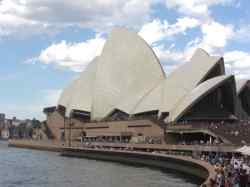
Sydney Opera HouseThere’s a lot that’s wrong with this statement from our 21st century eyes, but at least they recognise the “original owners” and the fact that culture comes from “a deep and intimate relationship with one’s country”. They then go on to describe how the early settlers tended to rely on “the old culture” and that even the balladists telling stories about the new land used “the tunes of their forefathers”. However, they say, “a vigorous development in all the arts” happened after the second world war “coinciding with remarkable economic progress”. Government increased its patronage of the arts, and “in Sydney”, they write, “there is being constructed an Opera House which architectural histories describe as a major achievement of architecture in the twentieth century”. It sure was.

Poetry

I’m just going to briefly share their points on poetry and the novel, given these are the topics most relevant to my blog. Regarding poetry, they point particularly to Judith Wright and AD Hope whose poetry “has been distinguished by a vigour and their imagery noted for its immediacy of impact”. How I wish I could be so succinct! Seriously though, I like their assessment of Wright, that she has “perhaps more poignantly than any other poet”

expressed the nation’s new-found spiritual awareness of its past … Her poetry is the deep expression of the feelings of women: to love, to old age, to decay, to the past, to war, to the future. JB Priestley, prominent English novelist, dramatist and critic, has claimed that Judith Wright is one of the best poets writing in English today.

How fabulous, even though their reference to “the feelings of women” does sound a little reductive?

As for  AD Hope, he too, they say, has “been highly acclaimed by overseas critics”. See that cultural cringe? Clearly, the fact that overseas critics praise Wright and Hope proves their worth! Anyhow, they describe him as “a satirist concerned with Man and his frailties.” (Note the uppercase Man to imply both genders but they can’t avoid the “his”). They quote Hope as describing “Australia as a place ‘where second-hand Europeans pullulate timidly on the edge of alien shores’.” They also say:

In no way does he resemble Wright. Rather he has consciously tried to lead Australian poetry away from a preoccupation with its environment, a savage reaction to the school of Australian poetry that concentrated on gum trees, koalas, kookaburras, kangaroos and boomerangs. His satire has an acidity, a near tragic note and a technical mastery new to Australian poetry.

They name a few other poets, including Douglas Stewart (a favourite from my schooldays), David Campbell, and Gwen Harwood whom they describe as “perhaps one of the most promising contemporaries … whose poetry is deeply personal, with original and compelling imagery”. They were right. She did become important, and one of Australia’s most significant poetry prizes is named for her.

The novel

I’d like to talk about drama, music and painting, but I don’t have the time and energy for that right now, so I’ll move onto “the novel”, which, interestingly, receives far less space than poetry and drama.

They start by saying that “during the 1930s Australian novelists tended to concentrate on the family saga, digging into Australia’s past to reveal the rise of egalitarianism.” They name Miles Franklin’s All that swagger (1933) and the unknown-to-me Landtakers (1934) by Brian Penton. They say that their novels are about pioneers who, as they “gained wealth … seemed to die spiritually.” We can read Landtakers at Project Gutenberg Australia. I’m surprised that they don’t mention works by Katharine Susannah Prichard, M. Barnard Eldershaw, and the other women who made quite a splash in the 1920s-40s. Some of their work was in this “pioneer” mould, but some also turned to the urban landscape, particularly Marjorie Barnard and Flora Eldershaw.

Anyhow, they go on to say that “the writing of historical novels of this pattern continued in the 1940s” but that developments occurred in the 1950s, heralded particularly by Patrick White’s Voss in 1957. They quote an unnamed critic saying:

White has opened up in a startling way the range of Australian fiction, not only by his experiments in form and language (which are sufficiently striking in themselves) but by conceiving and acting out the dramas of his characters in an imaginative world with one more dimension than our novelists have genuinely recognised as existing.

Fascinating, but a little mystifying. “One more dimension”. Is that the telepathic communication experience between Voss and Laura? And “genuinely recognised”? What does that exactly mean? However, I do like their suggestion that the result has been “a turning away from the violence of nature to a deeper study of man himself, with his depths of hidden passion and violence”. They quote Xavier Herbert, Morris West and Hal Porter as writing books reflecting this development.

Points to ponder

At the end of each chapter, Hodge and Whitehurst include some discussion questions. I can’t resist sharing those for this chapter:

Do you consider the Arts important for man? Why?
Do you think the Arts could be an important source for historians? Why?
Which of the Arts are most important in your family?
Do you believe future generations of Australians will regret the enormous expense of the Sydney Opera House?
Do you think Australians yet regard culture as an integral part of their existence

You don’t have to answer them all!

Monday musings on Australian literature: Arnold Haskell’s Australia

Arnold Haskell, Waltzing MatildaWho is Arnold Haskell you are probably asking, if you are anything like me. The answer will probably surprise you: he was a British dance critic, who wrote many books on ballet, and was, in fact, involved in the development of the Royal Ballet School. But, he also visited Australia a couple of times, first in 1936, as a publicist-reporter with the Monte Carlo Russian Ballet. He returned to Australia in 1938 to research his book Waltzing Matilda: a background to Australia, which was published in England in 1940 (though not published in Australia until 1944). And guess where I found this book? Yep, in my aunt’s house.

So, he visited Australia a couple of times before the Second World War, but his book was published during the war. I find that quite fascinating – who would be interested in what is really a travel book in such  abnormal times? (I looked at the records for this book in Trove. There are several editions: most are categorised as “description and travel”, but some as “civilisation” and “history”. I think the former is better, but it just goes to show that categorisation is never easy!)

Anyhow, here is how he starts his Introduction:

I happened on Australia four years ago, at four days’ notice and by complete accident. Had I been given a week’s notice I probably would not have come at all. I was completely, even aggressively uninterested in that continent. … When I let my friends know where I was going, they said “Why?” which did not encourage me, and left me speechless for once.

His lack of interest wouldn’t surprise Australians who are aware that for the British, particularly at that time, we Australians were simply colonials, and had nothing of interest to offer, and particularly nothing for those who saw themselves as sophisticated. Haskell saw Australia, for example, as offering “hospitality, hearty but uncouth”. He says in this first paragraph that he was “bribed” to accept the trip, partly by the work (the ballet company) and partly by the opportunity to visit Ceylon (now Sri Lanka) and Honolulu, en route. Harrumph!

However, he “became … enchanted”, and so returned later for 6 months to see more. As there were no books that described Australia in the way he as a traveller wanted, he decided to write it himself:

Australia, in comfort at all costs, in luxury if possible; Australia, stressing the modern plumbing in the most modern hotel in Sydney rather than the lack of plumbing in the dead centre [had he visited his own counties I wonder?]; recounting the lives, thoughts and works of many eminent painters rather than the pathetic state of the rapidly dwindling aboriginal; in fact to write of Australia as one writes of Europe or America: positively and without the eternally negative point of view.

It would be easy for us to take exception to this, but it’s more interesting to read it as a reflection of (a certain segment of) the times, and as something that can provide insight into the world as it was then. And anyhow, he goes on to say that he want to trace

the evolution of a society from brutality and chaos to as perfect an expression of ordered democracy as can be found, to show the amazingly rapid transition from an unhappy group of felons, often not so bad, and their gaolers, often not so good, of overbearing petty Himmlers and dictator governors to a civilised community of amazingly tolerant people living in a country freer from crimes of violence than any other, in a continent that has never known the hatred, violence, hypocrisy and destructiveness of Europe.

Ah, it would be lovely to pat our own backs at this, except that we know that there has been violence here. It just wasn’t spoken of back then.

He goes on, completely oblivious to Australia’s long history of occupation by indigenous people, talking about how Australia’s history is still mainly a “family tradition rather than history”, one in which “I remembers” have not yet made it into “the ordered framework of text-books and university courses”. Again, although his view is myopic, I love this way of describing the “short” history as he saw it.

However, his book is not, he says, a history but a personal story which he hopes will “provide the background” that he found lacking.

I will come back to this book, I think, because as well as travelling around the states, he also did some of his own primary research checking letters, manuscripts etc to obtain his own perspective. It should make for fascinating reading … but for now, I’m tired folks, so signing off with a shorter than usual one!

The Griffyns are mummified

Those Griffyns, if you haven’t realised it from my previous posts, are a brave and versatile bunch. Their latest outing, the Ear of the Cat, was inspired by musical director Michael Sollis’ residency in Egypt last year. Performed last weekend, it was the ensemble’s first real concert of the year and was included – a first for them I think – in this year’s Canberra International Music Festival.

Holly Downes

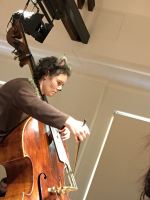
Brown cat Holly Downes playing her double bass

Another first, sort of, is that it was designed to appeal to children or, as the Ensemble’s promo describes it, it’s “a staged production for the young and young at heart:  a show all about cats, magical keys, video games, and a green soup eaten by ancient kings”. (I say “sort of” because the Griffyns did create and perform a school version of last year’s ANZAC Dirty Red Digger program.)

So, a staged production featuring cats. Here is how the Griffyns explained it:

Come on an adventure of discovery as deep within an underground Egyptian tomb, four mummified cats are woken by a mysterious sound. Join these inquisitive cats and be led by your ears, as you journey through an unfamiliar new world of haunted mazes, video games, and the streets of contemporary Cairo to help the cats find a way to belong in the land of the living.

Chris Stone

Mummified cat, aka violinist Chris Stone

It was a 45-minute (or thereabouts) program that took us from a mummy’s tomb to the streets of Cairo. As we walked into the performance space we were confronted with four colour-coded mummified “cats” (Holly Downes, Susan Ellis, Chris Stone and Michael Sollis) lying on pallets down the length of the hall (in the Ainslie Arts Centre). Gradually, to the call of sophisticated cat Kiri Sollis’ gorgeous piccolo – acting like a Pied Piper, perhaps? – the cats awoke and shed their mummy bindings, and started looking for a way out. A key was found but were they brave enough to venture out? Perhaps not – or not quite yet. This was, though, a multi-media performance, so while the cats crept about, uncertain of what to do, we were entertained by video interviews with young Egyptians about life and cats in Cairo. They were engaging as young people can be and added a dose of reality to the fantasy being enacted in front of us – but finally we discovered that the “ear of the cat” is the shape into which you tear and then fold pita bread to eat green Mulukhiyah soup. You can always be sure to learn something new from the Griffyns!

Now, what else to say? Michael Sollis’ clever music, which supported the narrative, varied from cattish-wailing to foot-stomping, from discordant sounds reflecting anxiety and uncertainty to lyrical jig-like and sometimes jazzy ensemble pieces conveying confidence. Laura Tanata’s harp played a gentle encouraging role throughout. Soprano Susan Ellis, reminding me of a spunky (less tatty) Grizabella from Cats*, prowled the room looking for answers, and at one point carried on an evocative and entertaining squeaky “conversation” with Kiri Sollis’ piccolo (if I’ve remembered correctly). The whole ended with a “miao chorus” inviting audience participation.

While the “story” was about mummified cats, it called up, for me, a broader archetype – sophisticated town cat versus nervous country cousins – and, as in all good stories, they all got together in the end.

I must admit that I’m not sure I fully comprehended all the connections being made as the story progressed, perhaps because coming from an older generation I’m not so good at quickly absorbing multiple inputs, but I always enjoy seeing what these skilled performers come up with. They make music meaningful and fun, and present it with a great deal of warmth towards their audience. I look forward to their next concert.

Griffyn Ensemble: Michael Sollis (Musical Director and Mandolin), Susan Ellis (Soprano), Kiri Sollis (Piccolo), Chris Stone (Violin), Laura Tanata (Harp) and Holly Downes (Double Bass).

* Ian McLean who reviewed the performance for City News was also reminded of Grizabella! I think it was the long fur coat.

National Eucalypt Day

After writing my Monday Musings on World Poetry Day this week, I was surprised to discover that today, Wednesday 23rd March, is National Eucalypt Day. I had no idea we had such a day, which is probably not surprising as this is only its 3rd year. It is an initiative of the Bjarn K Dahl Trust and its aim is “to further raise awareness of eucalypts and celebrate the important place that they hold in the hearts and lives of Australians”.  I love that, of course.

The Bjarn K Dahl Trust is a philanthropic fund, that, according to their website, was “established from a bequest by Bjarn Dahl, a Norwegian Forester, who developed a true affinity with the Australian bush, and a particular love for the Silvertop Ash, Eucalyptus sieberi, and left his entire estate to establish the Trust”. Wow, eh? (The date of 23rd March was chosen for National Eucalypt Day because it was Dahl’s birthday. I wonder if he’s related to Roald Dahl?)

My quick Google search suggests that the day is taking off somewhat faster than poor old World Poetry Day – well, I found three events anyhow. Here in Canberra, the Australian National Botanic Gardens are celebrating Eucalypt Week, but today, THE day, they presented a talk titled “As Australian as a gum tree : An historical look at eucalypts in Australian culture”. (Unfortunately I was otherwise engaged, or I would have been there). The Royal Botanic Gardens in Victoria offered a Walk with an expert eucalypt botanist. Back in Canberra again, I discovered that, for some reason, the National Arboretum celebrated National Eucalypt Day on 18th March, with “a variety of short walks”. Better early than never, I suppose!

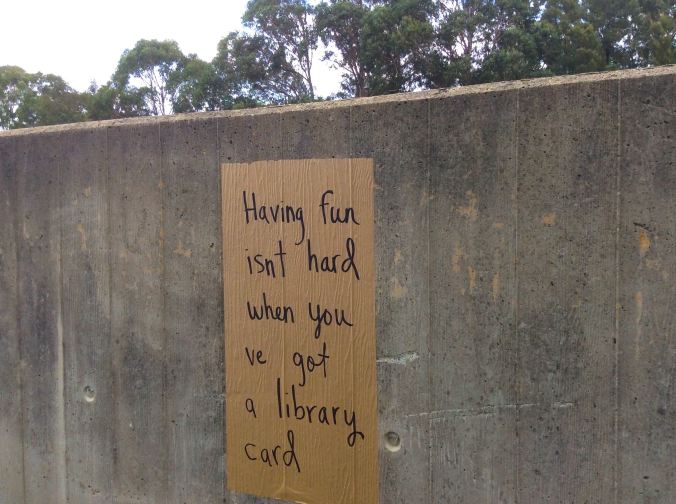
I have written about gum trees (our popular name for eucalypts) several times on this blog, so am not going regale you with more right now. Instead, I’m going to share a photo I took today in a carpark in Canberra’s NewActon Precinct. Peeping above the wall are, yes, eucalypts.

Library Card poster Nishi Car Park

Not the best photo – the light wasn’t great – but the conjunction of library-love and eucalypts was too good to resist.

Happy National Eucalypt Day everyone (and especially to the Resident Judge of Port Phillip whom I was meeting for drinks right after taking this photo! It’s been years since we caught up – and it was lovely).

The Griffyns experiment with Utopia

In a recent Monday Musings, I referred to the fact that the Griffyn Ensemble’s last concert for 2015 would be about the New Australia Movement’s Utopia experiment in Paraguay. That concert took place this last weekend, and what a concert it was. The Griffyns – yes, I’m a fan – just keep getting better. Well, actually, they’ve always been good musicians, but the concerts are becoming tighter, more coherent perhaps, while still retaining the freshness, inventiveness and intimacy that we members so enjoy about them.

Mary Gilmore, 1927 (Public Domain, at State Library of QLD, via Wikipedia)

Mary Gilmore, 1927 (Public Domain, at State Library of QLD, via Wikipedia)

The Griffyns do like to move around town, so this concert was held in the foyer of the National Portrait Gallery. Not surprisingly, there were a couple of portraits of Dame Mary Gilmore on the wall behind the performers. The venue worked nicely (even though we do like the Belconnen Arts Centre’s friendly little bar!) The acoustics – to my ears – were excellent, and the natural, early evening light coming in through the big windows was just delightful.

But now, the music, which, appropriately, all came from Australian and South American composers. At the start, musical director Michael Sollis announced a change in the program, swapping the third piece, Gerardo Dirié’s Ti xiuhtototl, with the fifth piece, Eric Gross’s Rondino Pastorale. I wondered why – and whether it might become evident as the concert went on. It did, because Gross’s work and the piece preceding it, George Dreyfus’ Mary Gilmore goes to Paraguay, are lyrical, pastoral pieces evoking idyllic scenes appropriate to the ideals of the new Utopia. By contrast, Gerardo Dirié’s piece is more plaintive, sombre, even a little discordant. In terms of the story being told, it fit better towards the end of the concert as the Utopian dream is starting to fail. The story, in other words, was conveyed musically as well as through words spoken and sung by Susan Ellis who, with a twinkle in her eye, played an older Dame Mary Gilmore looking back on her Paraguayan experience.

The program was, at roughly one-hour, shorter than many Griffyn programs, but it ran without a break, transitioning seamlessly from piece to piece. The concert opened with Sollis speaking a promo for New Australia – “Start your life afresh”, he exhorted. This was followed by Laura Tanata on harp and Chris Stone on violin playing Nigel Westlake’s Beneath the midnight sun. It was beautiful, with Tanata’s gentle, lyrical harp offset by the more plaintive violin, suggesting to me a little uncertainty (for the new colony, I mean, not the musicians. Their playing was mesmerising, and set a high standard, which was fortunately maintained).

Ellis then took up the story from Gilmore’s point of view, and we heard the ensemble play Dreyfus’ accessible, melodic piece which, with its hints at times of a rousing, western movie theme, conveyed the excitement and enthusiasm of pioneers. I loved Kiri Sollis’ flute and Stone’s violin here. It’s a crowd-pleasing sort of piece, and was played with a verve which carried us all along. Gross’s piece continued this positive tone, while Ellis, as Gilmore, told us nostalgically that “I wish I was back in Cosme” (Cosme being the name of Lane’s second settlement in Paraguay).

This was followed by the central piece of the concert, Vincent Plush’s “The Paraguay songs” from The plaint of Mary Gilmore. It’s a rather tricky piece requiring Ellis to sing words from Gilmore’s letters. Yes, you’ve read correctly, from letters – that is, not from verse, but from prose. I sat up. Good prose, of course, does have rhythm, but these were letters, not crafted fiction. Here are a few lines from the program:

Communism as we have it is alright, Harry*, and we are getting on — slowly, of course, but in a year or two what is now is, will have gone, so beautiful, so rich in bird-life, and plants. And the history! And the story of the war. If you were only here Henry.

See what I mean? It takes some singer and composer to make that work. I was impressed by how well and expressively Ellis, not to mention the full ensemble, rose to the challenge.

The aforementioned rather sombre Dirié work followed this, and was performed, with a melancholic soulfulness, by the four female Griffyns who sang some lovely harmony, in addition to playing their instruments. Really moving. This was preceded by Gilmore telling us about some of the troubles in the colony, and was followed by another sombre-sounding piece, The freedom of silence by Alcides Lanza.

The concert concluded with Gilmore expressing sadness that Cosme did not turn out to be what she expected. She left in 1900, five years after she arrived, because of the pettiness and squabbles. Nonetheless, she never regretted the experience, arguing that while it was not a success, neither was it a complete failure:

… we failed the harshly scornful say … [but] we sowed a seed.

Villa-Lobos’s wistfully sad Song of the black swan (with hints, if my ears didn’t mistake me, of Swan Lake), played by Tanata and Downes, concluded what was a satisfying, well-performed and nicely conceived concert. Roll on 2016 I say … if you are in Canberra, and would like to know more (and even buy tickets), check out their website.

You can hear different versions of two of the pieces online:

Griffyn Ensemble: Michael Sollis (Musical Director and Mandolin), Susan Ellis (Soprano), Kiri Sollis (Flutes), Chris Stone (Violin), Laura Tanata (Harp) and Holly Downes (Double Bass).

* Henry Lawson

And so another great Musica Viva year ends

Musica Viva has done it again: it has produced another year of splendiferous, inspiring concerts. Mr Gums and I have been subscribing to Musica Viva (or its predecessor here in Canberra, the Canberra Chamber Music Society*) for nearly four decades – albeit with a gap in the middle for child-rearing and overseas posting. We love it, which of course is not surprising given we subscribe year after year!

I don’t know how Musica Viva runs in other cities, but we have a vibrant community here, fostered by an enthusiastic committee (and no, I’m not a member) and a small but creative office led by Michael Sollis (he of the Griffyn Ensemble). All of this is underpinned by the intelligent programming of Australian composer and Musica Viva artistic director Carl Vine.

Before I talk a little about the concerts I want to say something about timing. Canberra’s concerts have commenced at 7pm for over a decade now. I loved it when I was working. Of course, it may have helped that the concert hall was across the road from my workplace, though it wasn’t for Mr Gums. He’d drive over to me, we’d have a light meal on the ANU campus, go to the concert and be home by around 9.30pm. Perfect for a work night. Now we are retired, we are perfectly happy to do the European thing – eat our main meal in the middle of the day, then have a light snack before the concert, and perhaps a dessert afterwards. Works well for us.

Now to the concert experience. Over his years as office manager, Michael Sollis (who only turned 30 this year!) has worked hard to add value to the Musica Viva experience. We have pre- and post-concert events, and interval performances. To give you an example, this year’s pre-conference events have included a courtyard performance by local early music specialist Ian Blake before Renaissance group Tafelmusik, a tour of the Canberra School of Music’s historical piano collection before piano soloist Paul Lewis, a pop-up choir before a cappella group I Fagiolini, and even a wine tasting by Musica Viva’s local wine sponsor, Eden Road Wines. That of course could go before any concert!

During Interval, we can hear a performance on the School of Music’s café floor by young music students, usually mirroring the main act. So, for example, our last concert was the Eggner Trio, and the interval recital was by a young student trio. We enjoy checking out the next generation, and hopefully they enjoy performing for an appreciative audience.

The post-concert event is usually a Q&A with the performers or a CD signing. For the final concert of the year, Sollis and the committee tried something different. The Q&A was held in one of Canberra’s oldest brewpubs, the Wig & Pen, which is located in the School of Music’s ground floor. An inspired idea. At least Eggner Trio, comprising three brothers aged from their late 20s to mid 30s, seemed to think it was! And I think we audience members who joined in found it a fun, relaxed end to our Musica Viva year.

I don’t know what you think about all this, whether it would appeal to you, but I love the commitment to engaging and inspiring the community that lies behind all this.

Beethoven statue, Bonn

Beethoven statue, Bonn (his birthplace)

So, you are probably wondering, who (or what) did we actually hear in 2015. In Canberra, we get 6 of the year’s 7 touring performers. Our numbers don’t, apparently, quite support receiving all 7 yet. A goal for the future! This year, we had:

  • Tafelmusik Baroque Orchestra from Canada which presented a staged/choreographed multimedia show called House of Dreams, in which the musicians took us through the art, architecture and music of Europe through works by Handel, Vivaldi, Purcell, Telemann, Bach and Marais. It was an exciting show though perhaps not quite as coherent as their Galileo Project which we saw a few years ago.
  • Goldner String Quartet, from Australia and comprising two married couples, played Ligetti, Beethoven and a new crowd-funded piece by Australian composer Paul Stanhope. Lovely music – and I can never say no to Beethoven who, if I were forced to choose, would be my favourite composer.
  • Cellist Steven Isserlis with pianist Connie Shih. We always love Steven Isserlis (with his wild curly hair) – but Shih more than held her own in what was a Gallic-inspired program.
  • I Fagiolini is an English a cappella group which specialises in “Renaissance and 20th-century vocal repertoire”. They were impressive and very entertaining, particularly in their staging of Janequin’s “La Chasse” which they performed from memory. It’s “a nightmare to memorise” says their leader Robert Hollingworth. They also performed a new work by Australian composer Andrew Schultz titled “Le Molière imaginaire; Or, Keep Your Enemas Closer”. You had to be there really. (I hope you didn’t think chamber music is all toffee-nosed seriousness!) Their concert ended on a more respectfully serious note, though, with another 20th-century piece, Adrian Williams’ “Hymn to Awe”.
  • Paul Lewis is an English solo pianist. In the spirit of gender equality, I’m going to talk about male appearance. I do like a male musician with curly hair, so I’m automatically partial to Steven Isserlis and Paul Lewis! Luckily they are excellent musicians too. Lewis, as I recollect, played his whole program – all Beethoven and Brahms – from memory, something we discussed with him at the post-concert Q&A.
  • Eggner Trio, comprising three young brothers from Austria, closed out the 2015 season with a beautiful program featuring Robert Schumann, Australian composer Dulcie Holland (her trio composed in 1944 but not performed until 1991!), and Dvorak.

Musica Viva’s four core values are “quality, diversity, challenge and joy”. We certainly had all that 2015. A huge thanks to all the paid staff, volunteers and performers who made it happen.

* The Canberra Chamber Music Society was founded in 1956 and for more than two decades presented chamber concerts in Canberra, in association with Musica Viva Australia which was established in 1945.

Monday musings on Australian literature: Australian novels adapted for opera

Today’s post is inspired by an article, “Fly away Peter: When Australian literature goes to the opera”, published in May this year in The Conversation. Written by Associate Professor of Vocal Studies and Opera at the University of Sydney, it was inspired by the production of an opera based on David Malouf’s wonderful novel, Fly away Peter.

Now, as some of you may remember, I’ve mentioned Fly away Peter several times in this blog, one being in my second Monday Musings post. Fly away Peter is one of my favourite Australian novels and is also one of a fairly select group of Australian novels dealing with the first world war. I have also mentioned David Malouf in relation to opera before, most recently in a Monday Musings post on Australian novelists and poets who have also written libretti. Malouf has written a few libretti, the most famous being for Patrick White’s Voss, about which I wrote in a post on The Voss Journey. You can probably see, by now, why I was interested in Halliwell’s article.

Halliwell discusses a number of Australian novels/short stories that have been adapted for opera – and I’m going to share them here, in alphabetical order by novelist (with links to my reviews, where I’ve done one):

  • Barbara Baynton’s “The chosen vessel” (my review) was adapted by Australian-British composer and festival director, Jonathan Mills, with libretto by Australian poet Dorothy Porter. It was retitled The ghost wife and premiered in 1996. Halliwell writes that “Baynton’s bleak story, debunking the dominant male myth of the noble bushman, was translated into a confronting music theatre work”. It was performed in Melbourne and Sydney, and had, says Halliwell, a “well-regarded run in London”.
  • Peter Carey’s Bliss was adapted by Australian composer Brett Dean, with libretto by British librettist Amanda Holden. It premiered in Sydney in 2010 to a positive reception, says Halliwell, and was similarly positively received in Melbourne and Edinburgh. It was later presented, in a new production, in Hamburg, under Australian conductor and supporter of the work, Simone Young.
  • Helen Garner’s The children’s Bach (my review) was adapted by Australian composer Andrew Schultz, with libretto by Australian librettist Glenn Perry. It premiered in Melbourne in 2008. Halliwell describes it as “a lightly-scored and evocative chamber opera which took the central metaphor of the fugue from the novel”.
  • Patrick White’s Voss was adapted by Australian composer Richard Meale with libretto, as I’ve already said, by David Malouf. It premiered at the Adelaide Festival in 1986. Halliwell says that it was “hailed at its premiere in 1986 as the ‘Great Australian Opera'”, but it has never been produced again – at least not yet. There have been attempts to adapt Voss for film but some have argued that, while its mystical, visionary aspects translate well to opera, this is not so easy for film.
  • Tim Winton’s The riders was adapted by Australian composer Iain Grandage with libretto by Australian poet, novelist, playwright and librettist, Alison Croggon, It premiered in Melbourne last year (2014). Matthew Westwood wrote in The Australian that “Grandage uses a hunting instrument — the horn — to evoke a man’s odyssey across Europe for the wife who has deserted him. (Frustratingly for that man, Scully, and many of Winton’s readers, the elusive Jennifer never appears.)” Oh dear. I must say that The riders is one of Winton’s least memorable works for me – and I don’t think I’m the only one to feel that way. However, the adaptation was very positively received, says Halliwell.

Alison Croggon is reported in The Guardian as saying that although it’s daunting, it’s logical to write libretti if you write poetry. This makes sense to me: rhythm is critical to poetry, songs and music. Three of the five librettists here – Porter, Malouf and Croggon – are poets.

Halliwell commences his article by quoting Malouf’s statement that “No libretto can reproduce the novel from which it is drawn”. Grandage and Croggon like to call their opera “a reimagining rather than an adaptation”. I’d argue that this is true of all adaptations of a work from one form to another. It’s surely unrealistic to expect a work to be the same. The challenge for the adaptation is to decide what is the essence of the work and to convey that – and for audiences to see if they agree!

Anyhow, if you are interested more widely in the subject of novels adapted for opera, you can check out this Wikipedia category page. It’s by no means complete – indeed not all of the operas I’ve listed here are included.

I’d love to hear whether you have seen any operas adapted from modern novels. Or, do you have a favourite novel you’d love to see adapted for opera?

The Griffyns take us north – way north

The time has come, I think, to talk about disclosures. I have been blogging for just over six years now, mostly on literature but also, occasionally, on other cultural experiences – including the Griffyn Ensemble. The thing is that Canberra is a small place and we who move around it start to get to know each other. This is not unusual, but it does complicate the issue of reviewing/blogging. I’ve attended seminars and/or read discussions on reviewing “in a small world”. How do you be “objective” (not that we can ever be totally objective) when there’s been personal contact? And yet, how many literary reviewers in Australia do not know, have not met, the writers they review? Similarly, for music reviewers, or theatre reviewers?  Few, I’d say, once they’ve been in the game for a while and are reviewing people who’ve also been in the game for a while.

So, what does this mean? To what degree are “reviews” invalidated by such connections? To date I have disclosed when I have received books for review, but what other disclosures should be made? I’d love to know what you think. Meanwhile, I will say that Mr Gums and I identify as Griffyn Ensemble supporters. We like what they do and would love others to enjoy them too. This, I think, you need to know.

Mt Stromlo burnt out telescope

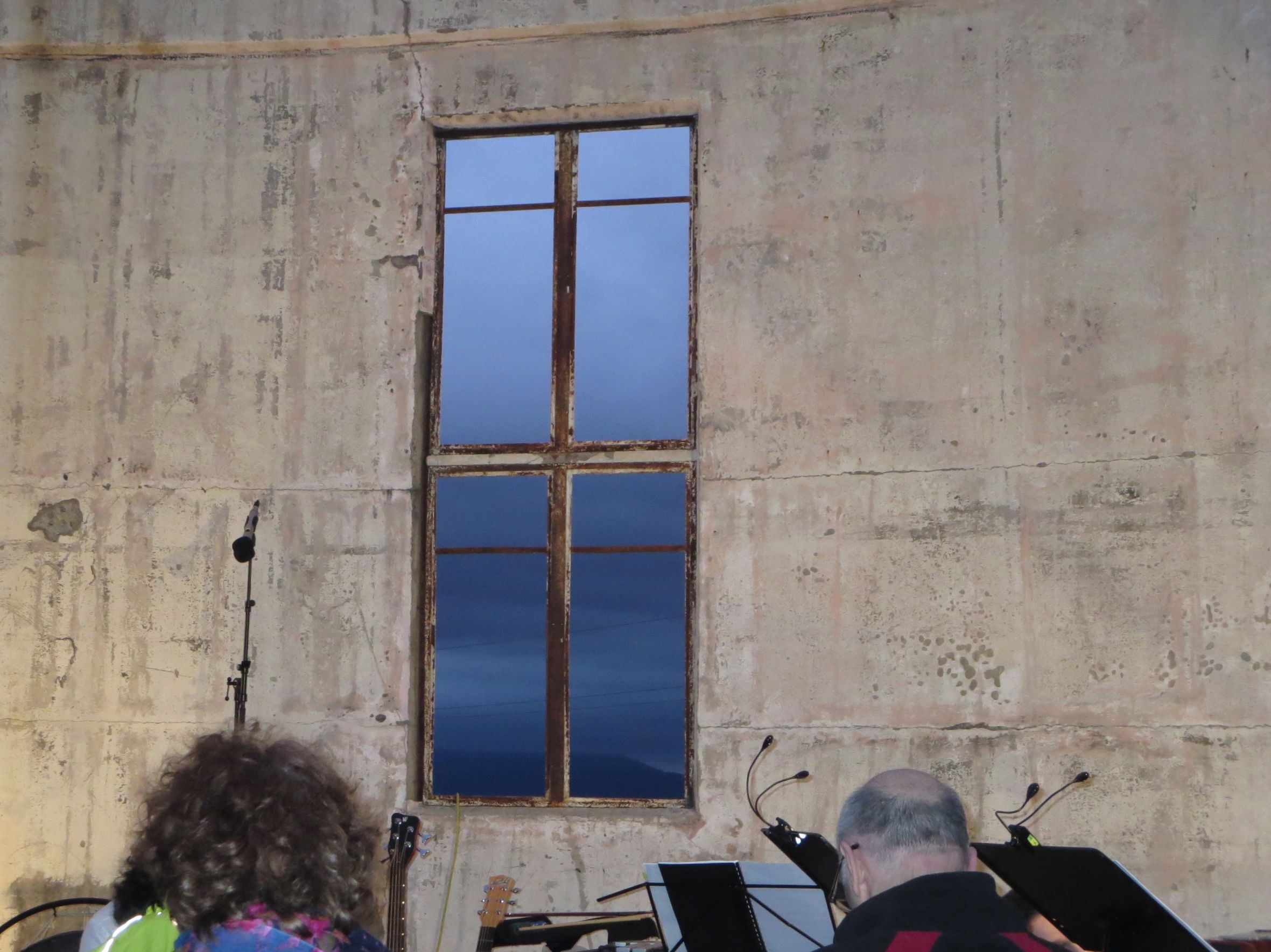
Waiting for “Southern Sky”, in the roofless, burnt out telescope, Mt Stromlo, Nov 2013

Now that’s off my chest, let’s get to the latest concert, Northern Lights. It was unusual for the Griffyns in that it comprised one piece, albeit encompassing 14 movements, composed by their musical director Michael Sollis. As Sollis explained to us at the beginning, it was his response to Estonian composer Urmas Sisask’s piano piece Southern Sky. The Griffyns had performed Sollis’ arrangement of this, with narration by astronomer Fred Watson, in the Mt Stromlo observatory ruin in 2012, reprised in 2013. That concert too comprised one multi-movement piece. To compose his “response”, Sollis visited the Arctic Circle with Fred Watson in November 2014.

Now, here’s where I want to reiterate the comment I made regarding rereading in my recent review of Peter Carey’s Amnesia. The same goes, surely, for other art forms. Consequently, when Northern Lights finished I knew I’d love to hear it again because there was a lot going on: I know I’ve missed some musical connections and relationships, and some finer points of the story being told. But, I did enjoy it. Let me set the scene …

Griffon Ensemble's Northern Lights

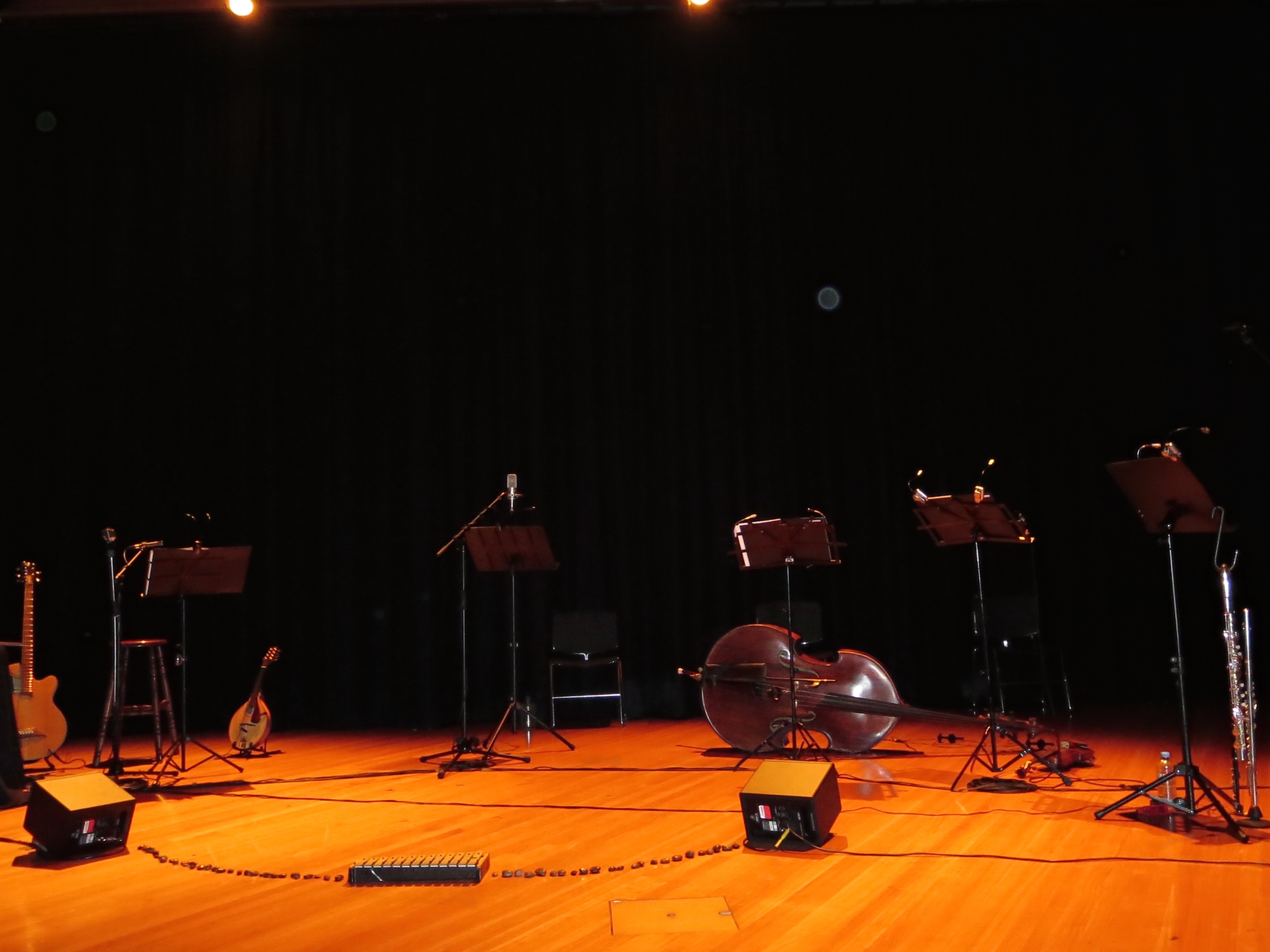
Part of the stage set for “Northern Lights”

The performance took place in semi-darkness in the James O. Fairfax theatre at the National Gallery of Australia. We were given a glossy program booklet which featured photographs taken by Sollis on his tour, one photograph for each movement. It was a bit of a challenge to follow the program in the semi-dark but I managed pretty well. In his introduction, Sollis told us that, while Watson’s tour focused on the northern lights, he was aware of other lights too – particularly the long twilights – and that he wanted to capture this fuller experience in his piece. The semi-dark ambience, with occasional soft changes in light levels, was intended to convey some of this. I rather liked the dark – it certainly helped keep our focus on the music and the musicians for a start!

In keeping with the Griffyn Ensemble’s style, this was more performance than pure concert. Sollis incorporated both science and myth into his work, by paralleling a scientific narration by Fred Watson (via recording) with a Snow-White-like-fairy-story-cum-norse-myth about a young girl who, cursed, is banished from the sunny sky to a dark earth where the sun can’t reach. She must find the sun to break the curse. Consequently, the culmination of Northern Lights was not “The Aurora” (Movement 12), but “Celestial Sunlight” (Movement 15*). The story takes place over 24 hours, with the times marked against the movements in the program (except for the first and last movement).

Now the music. I guess you would broadly define it as modern or contemporary classical – but, before you think it, this does not mean it was discordant or inaccessible. It wasn’t traditional by any means in form or sound, but it was evocative music, impressionistic even, if I dare invoke that term.

The ensemble, in its current line-up, has been together for around 18 months now and they look comfortable together. It’s an unusual grouping of instruments but for the audience, or me at least, it provides some exciting opportunities to hear different combinations of sounds. In Northern Lights, Sollis pushed the instruments, including Susan Ellis’ voice, to convey a range of moods and sensations. We heard whales singing, water dropping, ice creaking, particles popping; we sensed the melancholy of the long nights and the joy of the aurora.

I can’t possibly talk about all 14 movements, so I’ll just mention a few highlights which I hope I’ve remembered correctly. In “Amnesia near a  Stream” (2) played by the full ensemble, I particularly enjoyed the swelling sounds of Laura Tanata’s harp to evoke dawn or, at least, the awakening of the girl sent to earth. I also loved the harp’s gentle repetitive phrases in “Goodnight Aurora” (14), but in other movements this traditionally angelic instrument surprised us with more grating sounds. There was a lovely, melodic, singing folk-like tune, reminding me somehow of the American west, from Chris Stone’s violin in “Under Ground” (8). This piece was accompanied by some beautiful percussive effects from Holly Downes’ double bass. “Floating” (9) featured Susan Ellis, with eerie echo, and the violin. Ellis also moved us with what must surely have been challenging high humming in “Emerging Dots of White” (7). Kiri Sollis was kept busy playing piccolo, flute and alto flute (thought not all at once!) In “Excited Particles Flying High” (11) the piccolo shone as the excitement built. The sound of sheets of paper vibrating and crackling at the end of this movement was wonderfully effective. Through all this Sollis was busy conducting (with his body or eyes), attending to the mixing in of the spoken word components, or playing his guitar or mandolin.

The overriding questions are, I suppose, how well did the science work with the fairy story, and does the music hang together as a whole work. I can’t answer that on one performance, but I certainly came away feeling I’d once again experienced excellent musicians playing music that engaged both my brain and my spirit. What more can you ask, really?

Ensemble: Holly Downes (double bass), Susan Ellis (soprano), Kiri Sollis (flutes), Chris Stone (violin), Laura Tanata (harp), Michael Sollis (director/composer plus plucked strings).

* Although the last movement was no. 15, there were only 14 movements, as there was no no. 13 – a nod, presumably, to superstition and perhaps to the mystical aspects of the journey we were taken on.

I spent Anzac with the Griffyns

While other Aussies were attending dawn services, or watching almost 24/7 ANZAC broadcasts on the box, this ANZAC Day, Mr Gums and I chose to remember it by going to the Griffyn Ensemble’s The Dirty Red Digger concert, which was devised by their musical director Michael Sollis. Even more audacious than usual, Sollis managed to create a thoughtful show that married the story of the Glebe Rugby League football team (the Dirty Reds) with that of the ANZACS in World War 1, framed by interviews with young rugby league footballers today. He – and his “team” of engaged and talented performers – had the audience glued to its seats.

In a program that ran for a little over 2 hours, with a short break for half-time (!), Sollis spun a story about men and war and sport, about loss and class war and conscription. The performance integrated music and song, much of it composed (and all of it arranged) by Sollis himself, with archival and documentary film footage. The amount of work involved in putting all this together, the research, the writing, the interviewing, not to mention the composing and arranging – well, let’s just say we are in awe. It certainly conveyed Sollis’ passion for the subject matter – music, history, politics and football.

The show comprised nineteen pieces of music (or eighteen if we count the reprise as one) that varied in style from “classical” to folk and rock, from music hall/vaudeville to ragtime. Between and during the musical numbers, this versatile ensemble recited letters and poetry, and enacted stories with barely a hitch, while on the screen we saw a diverse selection of mostly war-related historical footage interspersed with contemporary interviews with young footballers from the Gungahlin Bulls.

“Man’s blind indifference to his fellow man” (Eric Bogle)

Sollis teased out two main themes through the show: the relationship of football to the Australian labor movement and, by extension, class struggle; and the challenge of manhood and the value of brotherhood for soldiers and footballers, past and present. We shared in the grief for soldiers (including footballers) lost, the humour and pathos of vaudevillian propaganda, and the recognition that many young working class men today continue to find purpose, meaning and mateship in football.

“I cannot engage in the work of recruiting and urge others to enlist unless I do so myself” (Ted Larkin)

Ted Larkin

“ER Larkin” (Unknown) (Presumed Public Domain via Wikimedia Commons)

Rugby League football we learnt had its origins in northern England when working class clubs, unable to survive under the more affluent south’s “amateur” rule, broke away in 1895 to create the Northern Rugby Football Union. This form of football was established in Australia 1908. It represented, the Griffyns told us, a social movement which united young Australian working class men. It was also, from its start, closely aligned with the Labor party. Prime Minister Billy Hughes, who later earned the labor movement’s ire by attempting to introduce conscription in the Great War, was Glebe Rugby League Club’s patron in 1908. He was just one of several Labor politicians who aligned with the Rugby League movement because of its labor movement origins.

Another of these politicians was Ted Larkin. He was Australian Labor Party member for the NSW State Parliament, from 1913, and the paid secretary of the NSW Rugby League. He died at Anzac Cove on 25 April 1915, and, with his brother who died in the same battle, has no known grave.

You are probably starting to see now the story the Ensemble wove for us as they joined the history of Rugby League football to the progress of the War. It was told through music composed in various styles by Sollis (such as “Heartbeat”, “The Digger’s London Leave”, “Greater Game Rag” and “Conscription”) alongside propaganda songs of the era (such as “What do you think of the Kaiser?” and “Daddy’s in the firing line”) and more recent works like Eric Bogle’s heart-breaking “Green fields of France” and “Working Class Man” (made famous in Australia by Jimmy Barnes). The connections were palpable.

We also heard unfamiliar composers, such as Edouard (or Ede) Poldini, a turn of the century Hungarian composer best known for his miniature piano pieces, like “The Clock”, which featured Kiri Sollis on flute supported by the ensemble. It had a lovely, distinctive tick-tock motif.

“Footy’s my fix” (contemporary footballer)

Interspersed with footage from the Great War, including the Conscription Referendums and the Great Strike of 1917, were interviews with young Gungahlin Bulls footballers and one of their coaches. They talked of mateship, what football means to them, and how they’d feel about going to war should the call happen again. They spoke from their hearts about depression and alcohol, and with humour about the distance between them and those IT guys, the “keyboard warriors”, who are too smart to get themselves beaten up on a football field! Through their comments, and the accompanying footage, Sollis brought working class culture to an arts environment, and as the ensemble belted out “Working Class Man” we saw on the screen those (not really so) simple souls with hearts of gold in our complicated land. It was pretty spine-tingling.

I believe this program will tour nationally. Don’t miss it, if it comes near you. If you’re not moved by the story and impressed by the musicianship of the performers, not to mention challenged to keep up, well, your tastes are very different to mine!

Other (very different) YouTube versions of some of the music:

And you can see sheet music for “The Clock” online, though I couldn’t find a performance.

Team Griffyn: Michael Sollis (Musical Director and Mandolin), Susan Ellis (Soprano), Kiri Sollis (Flute), Chris Stone (Violin), Laura Tanata (Harp) and Holly Downes (Double Bass).

The Griffyns go to China with Gough

… figuratively speaking, of course! The Griffyn Ensemble commenced their 2015 season in fine style, with guest artist, Chinese pipa player, Professor Zhang Hongyan. As always, the concert had a theme, evident from its title, Whitlam in China (and the development of friendly relations between our two countries). It was a tightly performed, well conceived and thoroughly enjoyable concert.

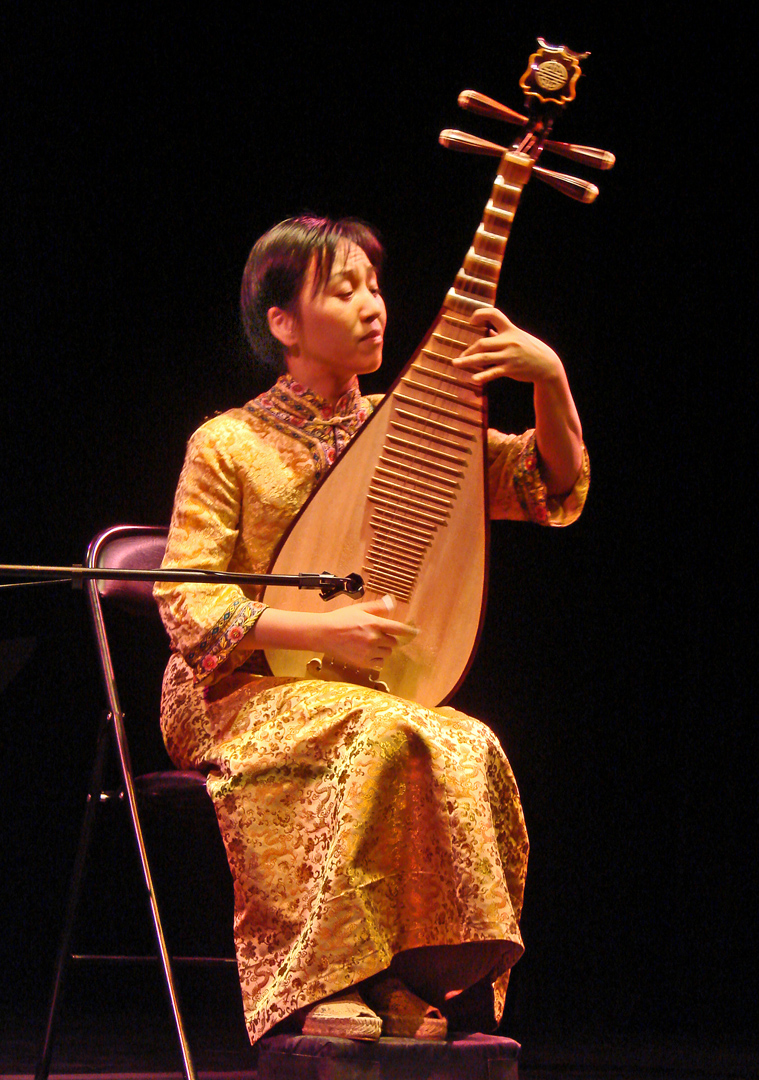
Lingling Yu playing Pipa at Musée Guimet, Paris (Courtesy: Dalbera, CC-BY-2.0, via flickr)

Lingling Yu playing Pipa at Musée Guimet, Paris (Courtesy: Dalbera, CC-BY-2.0, via flickr)

First though, we had the pre-concert entertainment by the string quartet from the China Philharmonic Orchestra. They played three Chinese pieces – all folk-based – in the National Library of Australia’s Lower Ground public space. I don’t remember the names of the first two pieces, but the second one had a gorgeous melancholy to it, and it sounded a little familiar. The first violinist told us that it was about longing and homesickness, and is frequently used for Chinese New Year. I’ve probably heard it somewhere! The third piece was a lovely contrast, “Happy Girl”. Many of us listening couldn’t resist bobbing our heads a little. These folk tunes sounded fine in a Western string quartet configuration.

After this prelude, we all filed into the National Library’s lovely 300-seat theatre, a favourite place of mine and one that I had much to do with professionally, many moons ago. I love visiting it.

Somewhat unusual for the Griffyns, this program’s narrative had a clear chronology, commencing with Gough Whitlam’s election to parliament in 1952 and ending pretty much with the famous dismissal in 1975. The music itself though moved around a bit in time. Here is the program, with links to online versions* (mostly played by other performers) where I have found them:

  • I will build my house on the water. By Horace Keats to a 4th century Chinese poem. Performed by the Griffyn Ensemble (Soprano JaneParkin with Pianist Clemens Leske version)
  • Dragon boat. Traditional. Performed by Hongyan Zhang
  • Moonlit night on the Spring River. Traditional, based on a Chinese poem by Zhang Ruoxu. Performed by  Hongyan Zhang, with the Griffyn Ensemble (China Broadcasting Traditional Orchestra version)
  • In our image, in our likeness. Movements 1, 3, 4. By Leilei Tian. Performed by Kiri Sollis (Recorders), Chris Stone (Violin) (mp3 version)
  • Like spinning plates. By Radiohead. Performed by the Griffyn Ensemble, featuring Susan Ellis (Soprano). (Radiohead’s own version)
  • It’s time. By Paul Jones and Mike Shirley. Performed by the Griffyn Ensemble, featuring Susan Ellis (Soprano). (Original version)
  • Dance music of the Yi People. By Wang Huiran. Performed by Hongyan Zhang. (Chu Yuan version)
  • Big decisions: The Whitlam dismissal. By Robert Davidson. Performed by the Griffyn Ensemble.
  • The song of the pipa player. By Mo Fan to a poem by Bai Juyi. Performed by Hongyan Zhang, with the Griffyn Ensemble (Ding Yi Music Company version)

If you listen to any of these you will realise what a varied – as usual – concert it was.

The concert was narrated by Griffyn musical director Michael Sollis, frequently accompanied by apposite little bars on the double bass (Holly Downes). He had clearly done a lot of reading about Whitlam’s political life, and his narration included quotes from people of the time, such as other politicians and officials, commentators and journalists. While Mr Gums and I, unlike the Griffyns, lived the era, I did learn some things. Gough, after all, was some decades older than I! I learnt, for example, that the first time he mentioned Australia recognising or making overtures to China was in 1954! Sollis described in some detail Whitlam’s history-making visit to China in 1971, when he was still Opposition leader. Whitlam, Sollis reported with a wry look, told Chinese premier Zhou Enlai that

The Australian people have had a bitter experience in going all the way with LBJ. They know America made [Prime Minister Harold Holt] change his policy and they will never again allow the American president to send [Australian] troops to another country.

Sollis also quoted Stephen FitzGerald, who accompanied Whitlam and who later became Australia’s ambassador to China. FitzGerald described the trip as:

an expedition of great bravado and exposure but [also?] great political judgment and luck. It was a journey to the unknown because no one knew what would come of it or who Whitlam would meet. It was personal diplomacy of great political sensitivity.

This section of the narrative was accompanied by a performance of Leilei Tian’s In our image, in our likeness by Kiri Sollis on recorders and Chris Stone on violin to evoke the meeting between Whitlam and Zhou Enlai. I enjoyed listening to the music and thinking about how the two instruments, the two melodies, might reflect the content and tone of the talks. And it was performed with such aplomb and skill by these two musicians who clearly enjoyed what they were doing. One of the many highlights of the night.

Another highlight was the revival-style performance, led by soprano Susan Ellis, of the ALP’s 1972 election song, It’s time. The audience couldn’t resist clapping along.

And finally, while still on the Whitlam theme, I enjoyed Big decisions: the Whitlam dismissal, a piece composed by Australian Robert Davidson for wind quartet with recorded speech. We, of course, had the Griffyns, not a wind quartet, and I presume Sollis had arranged it, as he had the final piece, The song of the pipa player. The recorded speech component of Big decisions comprised excerpts of speeches made at the time – most of which we of a certain age, or students of politics, recognised. The Australian Music Centre says that “The music emphases the inherent melody in recorded voices of Gough Whitlam, Malcolm Fraser, Sir John Kerr and a supporting cast of Paul Keating, Sir Joh Bjelke-Petersen, Sir Charles Court and others”. I loved the way key words and lines from the speeches were repeated with musical accompaniment working around them. Intriguing. Clever.

And then, on top of all this was the pipa, played with such energy and yet delicacy too by Zhang Hongyan. Just check the link I’ve provided under Dragon boat to see what I mean. The concert ended with an ensemble performance of The song of the pipa player composed to a 9th century poem by Bai Juyi. Sollis explained the origin of the piece … here is the beginning of the poet’s foreword to it:

In 815 I was demoted from the Capital to a local Officer of Jiujiang Prefecture. One autumn night of the following year, while seeing off friends on a boat leaving Penpu harbor on the Yangtze River, I suddenly heard a pipa tune being played from the neighboring boat. The music style was clearly from the capital. Being totally surprised, I made an inquiry and learned that the musician was a lady who used to be a famous star in the Capital … Then her glorious years past with the time as her beauty faded. Finally she had to lower herself to marry to a merchant.

Demotion, you see … a fitting conclusion to a wonderful concert in which music and narrative combined perfectly to keep the audience engaged from beginning to end.

Ensemble: Kiri Sollis (flute), Chris Stone (violin), Laura Tanata (harp), Holly Downes (double bass), Susan Ellis (soprano), Michael Sollis (director/composer).

* I tend to provide links where I can because much of the music the Griffyns play is unfamiliar.