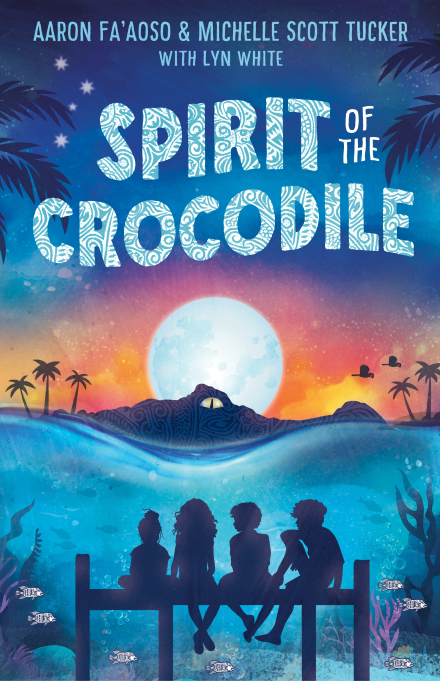
Aaron Fa’Aoso and Michelle Scott Tucker’s Spirit of the crocodile is a children’s/YA book, which makes it atypical reading for me. However, I’m not averse breaking my rules occasionally, and so I made an exception for this book – mainly because of its collaborative authorship and its setting.
Aaron Fa’aoso and Michelle Scott Tucker have collaborated before – on Fa’Aoso’s memoir, So far so good. It is, apparently, the first memoir by a Torres Strait Islander to be published commercially. Last year I posted on another collaborative memoir, Some people want to shoot me, by Wayne Bergmann and Madelaine Dickie. I sense that collaborative story-telling between First Nations Australian and white writers is increasing. There are probably many reasons why these collaborations happen, but from authors’ perspectives I understand that it results in better understanding and the transfer of skills and knowledge between the participants. In good collaborations, the mutual respect for each other’s skills is usually evident. Certainly, in this novel, we can sense the different knowledge, storytelling and writing skills that have been brought to the work, but the end result is something that flows well for the reader.
As for the setting … As far as I have been able to ascertain there’s been very little First Nations fiction set in the Torres Strait, which makes this one worth considering regardless of its intended audience. But for me, specifically, is also the fact that I visited the Torres Strait last year, heard some history of the islands there, and saw a presentation by Saibai Islanders, so of course, I have additional interest in the region. Now, having said all that, onto the book …
Spirit of the crocodile is set on Saibai Island, which … well, I’ll let the book describe it:
Only a metre or so above sea level, Saibai was a magnificent low-lying wetland – a flat mixture of mangrove trees, grassy plains and salty swamps. Ezra felt connected to every part of it. It wasn’t like one of those typical tropical islands in the movies but Ezra didn’t mind. Saibai had been home to his family for thousands of years – it was part of him and he was a part of it.
It is also just 4 kilometres south of Papua New Guinea.
Spirit of the crocodile, as you will have surmised, features a boy called Ezra. He is 12 years old, and is in the last weeks of his primary school days. Change is coming and he’s anxious because there is no high school on the island. He – and his friend Mason – will have to go to Thursday Island (TI) for that, and Ezra is not so sure he wants to leave the island and his family.
This, however, is not the only change coming. Threaded through the novel is the spectre of climate change. Saibai Islanders know their country and know when things aren’t looking right. The sky looks wrong, the seasons aren’t behaving as they used to, fish numbers are falling, and, most obviously:
Little by little, as the tides rose slightly higher each year, those other Main Roads – and the homes and trees along them – had been claimed by the sea. (p. 5)
This is not future change but happening right now – and it triggers the novel’s crisis, when a huge storm tests everyone’s mettle, particularly Ezra’s and Mason’s. It is, however, Ezra’s older sister Maryanne who makes the point that these unusual storms, not to mention bushfires and excessive hot weather, are no longer surprises:
The whole world knows it’s getting worse, we can see the water rising, our land disappearing, and no one cares! (p. 234).
So we have Ezra’s life changing as he prepares to transition to high school, and the climate changing, but we have one more big change – coming-of-age.
Spirit of the crocodile is about 12-year-old boys (mostly), so we are not so much in the territory of sexual maturation though there are light hints that this is coming too. No, it’s about mental, psychological, moral growth. It’s about that transition from self-centred childhood to responsible adulthood. At the beginning, Ezra and Mason are kids, playing silly pranks and thinking only of their own fun. Ezra in particular has a lot to learn, and some of it he learns from Mason who, he notices without fully understanding, is already starting to make that transition.
Two things particular to Ezra’s life suggest this coming change. One is the appearance of a large crocodile in an unusual place. Ezra feels what Mason sees, that the croc looks straight at him. Well, as Athe Harold says, Ezra “is a crocodile himself, a member of the Koedel clan … The crocodile is his totem and kin” (p. 19). Later in the novel, the crocodile returns, and again looks “directly at Ezra”. This time Ezra is prepared and looks straight back. His mum tells him the crocodile is “a sign … of … change” (p. 116), but doesn’t explain what. Another lesson for him to learn for himself!
The other thing also occurs early in the novel, a beard-shaving ceremony (Ubu Poethay) which marks the initiation of young men into manhood. It’s a few years off yet for Ezra and Mason, but during the novel Ezra’s dad makes the first gentle steps towards introducing him to Men’s (or spirit) business.
So, Spirit of the crocodile is many things. It’s a work of eco-literature documenting the reality of life on Saibai Island right now, and a call to arms, evoked through Maryanne who explains the value of education in a prestigious school:
It might give me an easier way through to the whitefella world … So I can learn how to use their stuff to help our people. Like Eddie Mabo did … I want to learn how to use their rules, their laws, their knowledge. (p. 226)
It is also a coming-of-age novel, that feels like it would appeal to kids of many backgrounds. And it generously shares culture. This does involve a little bit of telling, but is not didactic. When First Nations people tell the rest of us to educate ourselves about their culture, it is to books like this that we can go for some of that knowledge and understanding.
Superseding all this, however, is the fact that Spirit of the crocodile is a warm-hearted story about family and community. It has some important messages but they are wrapped in a story that feels real. Recommended.
Bill (The Australian Legend) has also reviewed this book.
Aaron Fa’Aoso and Michelle Scott Tucker
Spirit of the crocodile
Crow’s Nest in Cammeraygai Country: Allen and Unwin, 2025
248pp.
ISBN: 9781743317099
 Whispering Gums
I pounced on this book when I first heard of it, having lived on Saibai for a brief time with my then husband whose people are from the Koedal clan, as are my now adult son’s. You are right that it is a first in mainstream or commercial fiction to have a novel set here.
The island that I remember was from the late 1980s so much has changed, at least so far as the book’s representation of it, however the culture and importance of family and tradition have not.
I enjoyed this book for its warmth and simple telling of a story with believable characters and a glimpse into a place and people that most Australians would never see.
Oh how interesting Denise. The remotest I’ve lived is Mount Isa when I was a child in the 1960s. It gave me a taste for remote Australia and particularly an interest in FNQ, which is why I was thrilled to finally get there last year, but we only went to TI and Friday Island (also very tiny with just one pearl farm).
Anyhow, I’m glad you enjoyed this book. I’m hoping my son might like it for his Melbourne 5th graders, and if not for his 2nd grade son (when he’s ready). I’m getting a copy for him. It’s nice too that it points out the challenges but within a positive rather than negative framework. We don’t want to guild the lily but we also don’t want people to feel hopeless or discouraged.
I don’t often see many books in which they discuss the natural disasters that are occurring today because of climate change. Typically, I see books that are set shortly in the future in which climate change has wreaked havoc on the world, and it’s supposed to serve as a warning to us now. I don’t think we need to write fictitious futures to scare us; the call is coming from inside the house.
Yes, very good point Melanie. Thanks for identifying that. As we know, islands in particular are very aware that the change is now. We can believe it because we see trends but they see it, they see their land going under water. And when you are a small space the trends are much more visceral I suspect.
It’s happening near me along the shore of Lake Michigan. The houses along the lake, which are on steep banks, are falling into the water due to erosion.
I don’t know that fact Melanie but I’m not surprised. What are certain people over there thinking!
I appreciate this kind of collaboration; there have been a few books like this here too. A true act of reconciliation. And I admire those people who recognise that Change is Change, and underscore the idea that we need to develop skills that help us cope with change of all sorts when we are young (or as soon as we can, anyway), so I like the idea that, in this story, the crisis rooted in the climate change is right in there with ordinary-human-stuff like coming-of-age changes. It’s also realistic: struggles rarely present themselves in sequential order.
Thanks Marcie … I appreciate this response because of course I agree with your perspective and am glad you understood all this from my post!
And of course I agree with you about these collaborations.
This sounds like a lovely book!
Perfect description Stefanie.
Oh Sue. Oh my heart. What a privilege – and what an honour – to have our little croc book read so closely and generously. Thank you so much. You’ve really captured what it was we were trying to achieve (yes, the messages, but with a page-turning story being the ultimate aim). In exciting news, the book has been picked up by Lerner, a publisher in the US, and will be released there next year. We’re pinching ourselves, honestly, to think of American readers immersing themselves in the Torres Strait!
You’re right that there are only a few novels written by Torres Strait Islanders about the region but they’re coming. Moonlight and Dust, for example, is a new YA novel by Torres Strait Islander Jasmin McGaughey. And I’ve been pressuring online booksellers (successfully!) to include more Torres Strait titles in their curated collections of First Nations works.
Finally, and again with grateful thanks – you are the only reviewer to recognise that co-authorship is a genuine and positive act of reconciliation. Frankly, writing Aaron’s memoir was a positive, life-changing experience for both of us. That we were then asked to write Spirit of the Crocodile was a beautiful bonus.
Oh I’m so glad you are happy with my review, Michelle. I didn’t use the word reconciliation in my description but that is indeed what I meant as you could see. Sometimes I am anxious about assuming too much so I back off “naming” things, but I do believe FN writing and FN-nonFN collaborative writing make significant contributions to reconciliation and truth-telling.
Thanks for the reminder re Jasmin McGaughey. I did see/hear her at last year’s Canberra Writers Festival – which I think is when I bought your book. I nearly bought hers but it’s a bit more in the fantasy genre, so that plus the YA genre, decided me that I just couldn’t fit it in. I could have mentioned it in this post though!
Anyhow, congratulations on the US Publisher pick-up. How absolutely wonderful. And congratulations on this book. I really enjoyed seeing how the themes were developed, and loved watching Ezra’s perspective/understanding slowly change. There was so much more to say but you can’t say everything.
Thanks Sue, really appreciate it.
My main aim is not to make authors happy but I am so glad when I do, because it feels like our minds have met in some meaningful way.
This sounds wonderful and I love the cover!
It’s a beautiful cover, isn’t it.