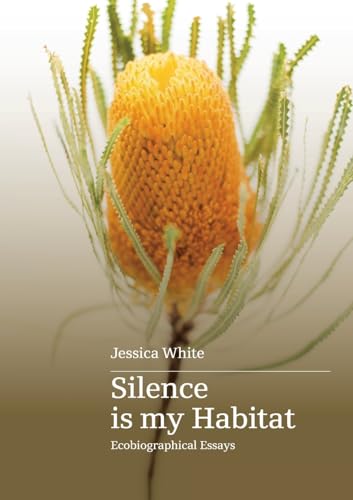
Those of us who follow Jessica White have been waiting for the biography of nineteenth century botanist, Georgiana Molloy, that we know she has been researching, but then, almost out of the blue, appeared something a little different, a collection of ecobiographical essays titled, Silence is my habitat.
Published under the beautiful Upswell imprint, Silence is my habitat takes us on a journey with White as she navigates her grief over her mother’s death, tying into it, as she goes, the many strands that have comprised her life to date. Like her hybrid memoir, Hearing Maud (my review), Silence is my habitat defies easy categorisation. It’s not straight biography or memoir, and while it presents as a collection of essays, they are not, for all their careful end-noting, your typical formal essay. This is why I like White. She is out there in the vanguard thinking about what makes us who we are and about how to write about it, honestly and openly. On her website, she explains her book thus:
While a biography chronicles a person’s life, an ecobiography details how a person’s sense of self is shaped by their environment. My forthcoming essay collection, Silence is my Habitat: Ecobiographical Essays, details how deafness shapes my relationship with different environments, such as the bush, bodies of water, archives, and institutions.
In this book, then, the self is herself, not Georgiana Molloy, though Molloy makes frequent appearances all the same. The book comprises eleven essays, some of which have been published before, in their entirety or in different forms.
Many strands
I wrote above that in Silence is my habitat, White incorporates “the many strands” of her life to date. They include, of course, her biography – her family-farm childhood, becoming deaf at the age of four, finding her partner, the motherhood question, and the wrenching death of her mother. They also include her academic and research life which have taken her around Australia and the world, and various other events and issues, such as the pandemic or, even, architecture.
Then, threading through and linking the essays (and these strands) are three main motifs – deafness, grief, and nature. Importantly, White opens with an Author’s Note in which she briefly discusses the “deaf” versus “Deaf” issue, advising that she will use the lowercase version for herself, but uppercase where it is the preference of people she references. Identity and nomenclature, as we know, is a fraught issue, so it is worth being upfront, as White is, clearly and respectfully.
So the essays … we start with scene-setting, in an essay appropriately titled “Grounding”. It gives us, effectively, her origin story, ending with the expected, but nonetheless devastating death of her mother. Referencing the etymology of the word “essay”, she concludes:
To write an essay is to make an attempt, to test or try out one’s responses to a subject, emotionally, intellectually and psychologically … Perhaps this is why I turned to the form in the year following my mother’s death. (“Grounding”)
Essays, though, can take many forms, with White adopting here a discursive style, which, in this case, relies largely on vignettes and digressions to explore that essay’s main theme. This approach encourages us to see the world holistically – to look for connections (and perhaps find more for ourselves) – rather than follow one line of argument. In “Hostile architecture”, for example, White starts by referencing two specific uses of architectural features to deter, respectively, pigeons and homeless people. Then, through vignettes which shift between her own experiences and the research of others, she explores ways of “accommodating” workers with disabilities. She talks specifically about DeafSpace, a concept developed at/for Gallaudet College, and closes by bringing these personal and informational strands together to make the essay’s main point about Universal Design that just might suit us all.
These are elegantly written essays, which is easier to say than to explain because, to some degree, it’s indefinable. But, I’ll give it a try. I see it as a combination of several things. The language, for one. White interweaves straight information from academic research with small narratives from moments in her life, gorgeous descriptions of nature, and expression of deep, sometimes heart-breaking emotion.
Then there’s the way White develops her essays. For example, “Intertwining”, which follows the aforementioned “Hostile architecture”, starts very differently – on something personal, with White scrambling over rocks in Cumbria, and thinking about Georgiana Molloy who had left that region for Western Australia in 1829. The rest of the essay focuses mostly on Molloy’s life, but told through personal and ecobiographical perspectives which include White interweaving her own painful journey to non-motherhood with the story of Molloy, who buries two children and distracts herself from grief “by turning to the natural world”. Another recurrent perspective appears here, the colonial project, because the Molloys were, of course, part of “the colonisation [that] crept across the south-west like a parasitic vine”, and has resulted in ongoing stress on “weathered soils … never meant to sustain large numbers of humans”. The essay ends, neatly, with White standing on Cape Freycinet, near where the Molloys had lived, and coming to terms with her own life and choices.
And finally, there’s the sophistication of the ideas being explored through this ecobiographical framework. The concept – of understanding how a person’s sense of self is shaped through their interaction with their ecosystem – is easy enough to grasp, but conveying that in a nuanced way for any particular individual is the challenge.
For White, the self has, since she was four, been framed by her deafness. It made her, from that young age, “observant and quiet” which, given she was a farm girl, meant she developed the kinship with the natural world that imbues all the essays. Deafness also made her dependent on her family until she was in her mid-thirties. From this she develops ideas about interdependencies – between people, between people and culture, and between people and the environment. Through her essays, White teases out how these facts of her life – deafness and dependencies/interdependencies – make her who she is including informing her understanding of the world. They give her a particular way of seeing that she translates for us. For example, she writes of research into ecoacoustics, and how even soil has sound. Degraded soils, however, are quieter, which causes her to suggest:
If ecosystems are quiet, it seems that we should pay attention to them. (“On the wing”)
Silence is my habitat is the sort of writing I enjoy. It’s intelligent, heartfelt, confronting and confident – and, by the end, White has found not only the space to grieve but a way forward. That way forward includes recognising the interdependence of all things:
If silence is our habitat, it is one that engenders contemplation, compassion and creativity. It prompts us to seek connection, for we understand innately that to be alone is dangerous. Our lives are intimately bound up with, and depend upon, other creatures. In losing them, we lose ourselves. (“Balancing”)
Ecobiography, I can see, has much to offer.
Jessica White
Silence is my habitat: Ecobiographical essays
Perth: Upswell, 2025
170pp.
ISBN: 9781763733121
 Whispering Gums
I bought this at Christmas but it hasn’t made it to the front of the pile yet (when you look back it’s odd what one chooses to read).
Now, when I do read it, and it will be soon, I think I’ll just say read Sue’s review.
I agree Bill … re our choices I mean. But I hope you get to it soon, because there’s so much to say about it and I’d love your thoughts. It’s a really great read and the references to WA will add extra interest for you.
It’s interesting writing these posts because I start off down a path and then find that takes me in a direction (of course) that means some things are easier to fit in than others. I think my post here shows the struggle I had with the book but I just decided it was time to post it and move on.
There’s something about deaf people: those of them who aren’t too angry are almost always creative beyond their due.
Well that’s an interesting call MR! But certainly, there are some very creative deaf people around. And Jessica names a few in her book, including Judith Wright.
And I never knew that !
Apparently she didn’t talk about but if I remember Jessica White correctly it was evident by her 20s.
Why do you think D/deaf people are particularly angry? That doesn’t ring true with the Deaf community here in the States at all…
I’ve read so much about deaf people not wanting to even talk about stuff like cochlear; about their wanting the hearing to stop trying to help them … I worked for a TV caption centre where it became mandatory to learn Auslan so as not to make the deaf grumpy …
It’s a very clear impression I was given around that time.
Thanks for these examples MR. Melanie and I have discussed / tussled about some of these issues, including the cochlear issue. I’m sure she’ll respond.
BTW I think the “helping” issue might be about attitude, about being made to feel they are “lesser” and needing to be “helped” (which has an almost paternal sense to it) whereas I think the feeling is that their needs should be “accommodated” (I loved this word in Jessica’s book) as part of making life easier for all to live their lives. I think Jessica makes the point that many “accommodations” for deafness are actually good for all. Same goes for accommodations for many disabilities.
Thanks so much for your reply! I appreciate getting your perspective. I also think it’s interesting that it was mandatory to learn Auslan. Yes, many deaf people are very pride of their identity and culture, so when someone comes in talking about cochlear implants, to them, that’s a sort of genocide. Some people do want cochlear implants, and they embrace them. Typically, folks who were born deaf to deaf parents are incredibly anti-cochlear implants. They truly feel like hearing people are trying to wipe them out.
Absolutely correct, in my experience: those of a deaf family were much more … erhmm … stern …
It’s their culture, and they see medical tech forced upon them. Deaf families are incredibly proud. Their Deaf children have a huge advantage of not being language deprived during the peak language-learning years, which most deaf people miss unless someone encourages them to integrate sign language into the infant’s life. Thanks for this conversation; I appreciate your perspective! I tend to side with the Deaf pride folks — they don’t need fixed. However, I understand the institutions and systemic prejudice that would lead a person to getting a cochlear implant, or having one put on them without their consent when they are a minor.
And thanks to you Melanie. I think we’ve had a good discussion about one of those tricky topics. I hope others coming here might get something out of this conversation.
It’s really interesting isn’t it. I don’t think us hearing people easily understand how people who don’t have what we think is essential feel, particularly if they grow up in families where lack of hearing is normal? I can understand that they might get tired of people always wanting to “fix” them! That might make them come across a bit short at times?
Oh thanks Melanie … I appreciated some of that from our discussions but not quite that depth of feeling re fear of being wiped out!
Good question Melanie,
What a thoughtful review Sue!
I am inspired to check this one out.
I wonder if it’s available as an ebook?
Thanks Kate, glad you liked the post and, even more, that it has inspired you to check out the book. (And I’m glad, from our subsequent messaging, that you have found eBook sources for it.)
Ecobiographical sounds like my cup of tea too, combining two of my favourite genres 🙂
I agree, Brona, it does.
I’m guessing she chose lowercase-d to discuss herself as deaf because she has only recently started learning sign language. The little d indicates medical deafness whereas the uppercase D indicates being part of the culture, which absolutely includes the language. My understanding is that is a hard journey to navigate—deaf is often medical even if you’re trying to join the culture, there is cultural Deafness, hard-of-hear folks are on the fence, etc. I can only speak from the experience of a hard-of-hearing person, and yes, it’s incredibly challenging being stuck between two worlds.
If you haven’t Googled DeafSpace to see photos of it, you should! It’s a really cool concept, and I love that people from difference spaces in a room or different floors can all communicate with each other thanks to intentional design.
This sentence is specifically what sold me on getting White’s newest book because it hits all the sweet spots of nonfiction for me: “White interweaves straight information from academic research with small narratives from moments in her life, gorgeous descriptions of nature, and expression of deep, sometimes heart-breaking emotion.”
Thanks Melanie … I was hoping you would comment. Yes, in her author’s note she does explain that medical/cultural is the main distinction between deaf and Deaf.
I didn’t Google DeafSpace but I now will.
And I am so glad that sentence has inspired you to read the book because I laboured quite a bit over it! I didn’t want to overdo my description but I wanted to convey the depth and variety here. It could have felt disjointed because it does hop about a bit, within essays, but in fact as you read it feels seamless because of the ideas being built upon.
I was curious if Australian has the same use of “d” vs “D,” so I’m glad you White explained it is used the same way there.
I really love it when this kind of interweaving works. I think some aim for it, but it just comes out feeling scattered, whereas with others you can see there must have been countless revisions to allow the reader to flow through it all right alongside the writer, rather than being dragged along.
Me too, Marcie. I love how sometimes the jumps are quite sudden with in this one and sometimes not, but they all lead to some well constructed idea. And, I loved learning stuff on the way in this one – such as the hostile architecture, or, in another essay, the idea od “charismatic” species.
I very much hope this gets published in the US!
Fingers crossed Stefanie. I imagine you would love it.