In 2023, novelist Kim Kelly was one of the two winners of Finlay Lloyd’s inaugural 20/40 Publishing Prize, with her 1920s-set historical novel, Ladies’ Rest and Writing Room (my review). Publisher Julian Davies had hoped at the time to award one fiction and one nonfiction prize, but there was a dearth of good nonfiction entries. That was rectified in 2024, with Sonya Voumard’s book on dystonia, Tremor (my review), being one of the two winners. This year, Kim Kelly returned with a nonfiction work on anxiety, titled Touched: A small history of feeling – and won again.
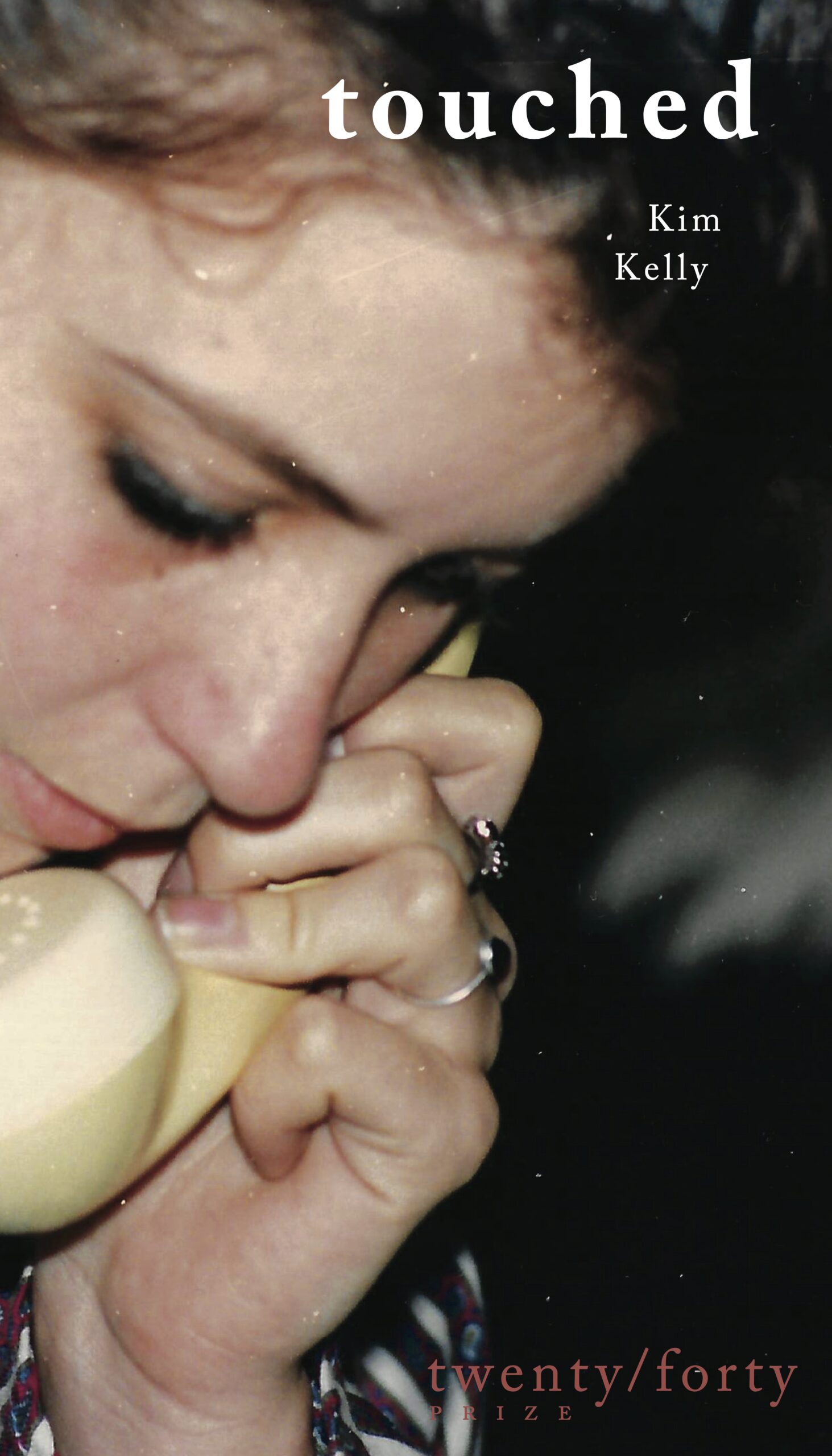
There is an obvious similarity between these two nonfiction winners, given both deal with medical conditions that impinge significantly on their writers’ lives. However, as quickly becomes apparent, the similarity is superficial, probably due to their writers’ origins. Voumard and Kelly are both published authors with other books to their names, but Voumard is a journalist while Kelly is a novelist, and this I think informs their different approaches to their subject matter.
Finlay Lloyd describes Touched like this:
Why this book is different
Documenting the damaging role of anxiety in our lives is hardly new, but Touched takes us inside the destabilising riot of a three-day panic attack with such insight, honesty and humour that the perspective we gain is revelatory and overwhelmingly hopeful.Why we liked it
This book has a wonderful breadth of understanding—of the author’s own crazily complex family, of the wider issue of anxiety across society, and of her own voyage as a highly competent yet vulnerable being in a worryingly unhinged world.
Both Voumard and Kelly use a personal narrative arc to frame their discussions. For Voumard it’s the brain surgery she is about to undertake as her book opens, while for Kelly it’s the three-day panic attack she has leading up to her Masters graduation ceremony. Kelly’s focus is this attack. She takes us into it, viscerally. It is the emotional and narrative core of this book. Voumard, on the other hand, weaves her own story through a wider story about dystonia, in which she explores its different forms and treatments through the experiences of others as well as her own. Both writers situate their conditions within a wider societal context, but very differently.
And here I will leave Voumard. After all, she has her own review already!
Kelly starts her book with an (unlabelled) author’s note in which she explains that memory is slippery, so dates and details may not be precise, but “everything in this memoir is true, in essence and in feeling”. I like this, because no-one can remember all the tiny details, and in most cases – crime, excepted – they are not important. What is important is being truthful to the experience, and this, I feel, Kelly achieves.
“It’s exhausting, being human”
Touched is divided into two parts – the lead up to graduation day, and then graduation day and its aftermath. Within these parts are single-word titled chapters starting, logically, with “contact”, and her contradictory responses to “touch”, to how physical touch can settle her but can also produce anxiety when it involves people she doesn’t know well, like, say, hairdressers, doctors and dentists. As for masseurs, no way! But “touched” of course has other meanings, including:
To be in touch, to communicate. To have the touch, a skill at something. To be touched, to be momentarily captured by some sentiment. To live in a vague state of craziness. To feel. Small word, wonderfully big inside its tight dimensions of spelling and sound.(p. 14)
Kelly, who is a book editor as well as a novelist, loves words, so her memoir is written with the eye of someone who is deeply engaged with the meanings of words and how they convey feelings. As graduation day approaches, and she and her partner drive to Sydney for it, she suffers an excruciating panic attack which she describes with a clarity that is revelatory for those like me who have not experienced that degree of psychic distress. At the same time, she looks back to history – including to the Ancient Greeks and philosophers like Aristotle – for ideas on anxiety. And she flashes back to her own past, exploring how and where and why it all began. Her Jewish roots, the experiences of poverty and war in her Irish Catholic tree, the insecurities of her parents, her own childhood fears, and wider societal issues like the imposter syndrome that is particularly common among women, all come into the frame.
It’s not all distress and misery, however, because in between her mulling she shares her wins, her strategies, and her optimistic self that keeps on going. The writing is beautiful, slipping between information-sharing, straight narrative, and light or lyrical, rhythmical moments when she takes a breath and so do we.
Touched is a personal story, and so, by definition, it can be intensely self-focused at times. However, the intensity serves a purpose for those unfamiliar with what anxiety can do. Further, with a keen sense of tone, Kelly regularly reins it in so it never wallows. At the time of her writing, she tells us, around 17% of Australians had experienced some form of anxiety disorder. That’s nearly one in five of us. This book is for all those people – and for the rest of us who know someone who has experienced it, or who might ourselves experience it one day. We just never know. We should thank Kim Kelly for putting herself out there, so beautifully and so honestly.
Read for Novellas in November (as novella-length nonfiction) and Nonfiction November, but not quite finished in time!
Kim Kelly
Touched: A small history of feeling
Braidwood: Finlay Lloyd, 2025
142pp.
ISBN: 9780645927030
 Whispering Gums
I used to be on the mailing list for Kim Kelly’s newsletters, but I don’t remember seeing one for a while – maybe she’s moved to substack. I’ve liked a couple of her novels but a couple of others I tried were Historical Fiction, not my favourite genre.
I have had anxiety attacks (I think) in the middle of divorces which made me make odd decisions at work. One employer paid for me to do therapy which helped a lot. Do I want to read Kelly’s account? I’m not sure.
Thanks Bill … I guess you are among the 17%. I have moments of being anxious but I don’t think I’ve had an anxiety attack – hmm, except maybe, now I think about it, in my mid 20s. There was a time when I felt I was falling apart inside. I did see a counsellor then for a while. Interestingly, I didn’t think about that when I was reading this, because it was so long ago, and I guess only lasted for a short time in my life. The counsellor – not a psychologist as I recollect – was a great help. As for whether you want to read Kelly’s book, I can’t answer that of course!
Thanks for sharing your review. I’d be interested in reading this, experiencing anxiety in situations that don’t warrant is new to me, seemingly a side effect of peri-menopause.
Oh poor you Shelleyrae. I hope it disappears again, soon. You’d probably like this book then.
I must get hold of an audio copy – providing one is made, of course – seeing as how I’ve told about this very subject …
Yes, I think you’d like it MR, though I’m not sure that Finlay Lloyd does audiobooks.
One of the “fun” things about having anxiety is that if a book about anxiety isn’t done well, it gives you anxiety (cue distressed giggling). However, it sounds like Kelly has done a great job of balancing not only what is in the narrative, but how it’s written. Too much description of anxiety can induce anxiety! I tried reading a memoir called Monkey Mind by Daniel Smith, and I couldn’t get through the prologue. Same thing with Goodbye, Again: Essays, Reflections, and Illustrations by Jonny Sun. I look forward to reading this one.
Good point Melanie about the description of anxiety. There is a bit in this book so see how you go. It is frequently interspersed with other things, including family history, her work, discussions about words etc that I think it is nicely balanced but there is some intensity too. Just stop reading – of course – if it’s too much.
Will do!
It’s interesting that accounts like these could be very healing or very disturbing, depending on one’s personal experiences and positioning to such stories. I suppose that’s always true with reading? But somehow, when it comes to the body/mind/spirit, it seems even…”more true”?
Yes, I think so Marcie … It’s fascinating to me that some people want to get as far away as possible in their reading from something that has distressed them whereas reading about that thing is exactly where I head. A most recent very general example is the pandemic – I am so keen to read what fiction writers (in particular) have to say about the experience while others don’t want to be reminded of it.
I used to think that I was fairly neutral about pandemic writing, didn’t seek it out but didn’t avoid it either, but it now seems as though the “no thanks” pandemic readers (or, NOT pandemic readers) are so firm in their positions that I have moved into the “yes fine” pandemic readers camp, simply by virtue of not having had a negative opinion about books set in that time or reflecting on that theme.
That makes sense to me. I haven’t actively sought out books that I’ve been told are pandemic set books, but when I see them mentioned, my first reaction is that I’m interested, and I am glad when one crosses my path.
I am often anxious at different times for the ‘usual’ things – starting a new job, sometimes funerals which is different to a panic/anxiety attack which I discovered recently when I experienced my first full-blown attack at the dentist. Very unpleasant and thankfully Mr Books was with me otherwise I would not have been able to drive home.
Which is my long way of saying I think this would be an interesting memoir to read. Thanks for bringing it to our attention Sue.
Oh I’m sorry you had that attack at the dentist, Brona. I hope it doesn’t happen again. I hate the dentist, as my lovely dentist knows (I’m sure he has me flagged in his notes!) but I haven’t had a panic attack. (Though, there were the two times he tried using some sort of mouth guard to keep my mouth open while he did some work. I felt I couldn’t manage breathing and swallowing saliva, and I did feel panicky, so we don’t do that anymore! I just do the work of keeping my mouth open myself!)
I suspect most modern dentists are now trained in how to manage panic attacks – it’s a situation almost designed to generate fear! I had gone through a longish procedure – meditation and breathing techniques had got me through most of it, but suddenly as the end was in sight, it all fell apart! I honestly thought I was having a heart attack, which of course made the panic worse. Thankfully my new dentist is very calm and kind – he talked me through it and gave me time to get myself back together with no judgement.
That sounds scary … fortunately I think modern dentists seem to be more understanding about these things. We are very lucky I think I. Terms of the quality of our dental care, if we can afford it.
Pingback: Anna, Angus Gaunt | The Australian Legend